
Psalms 119:79

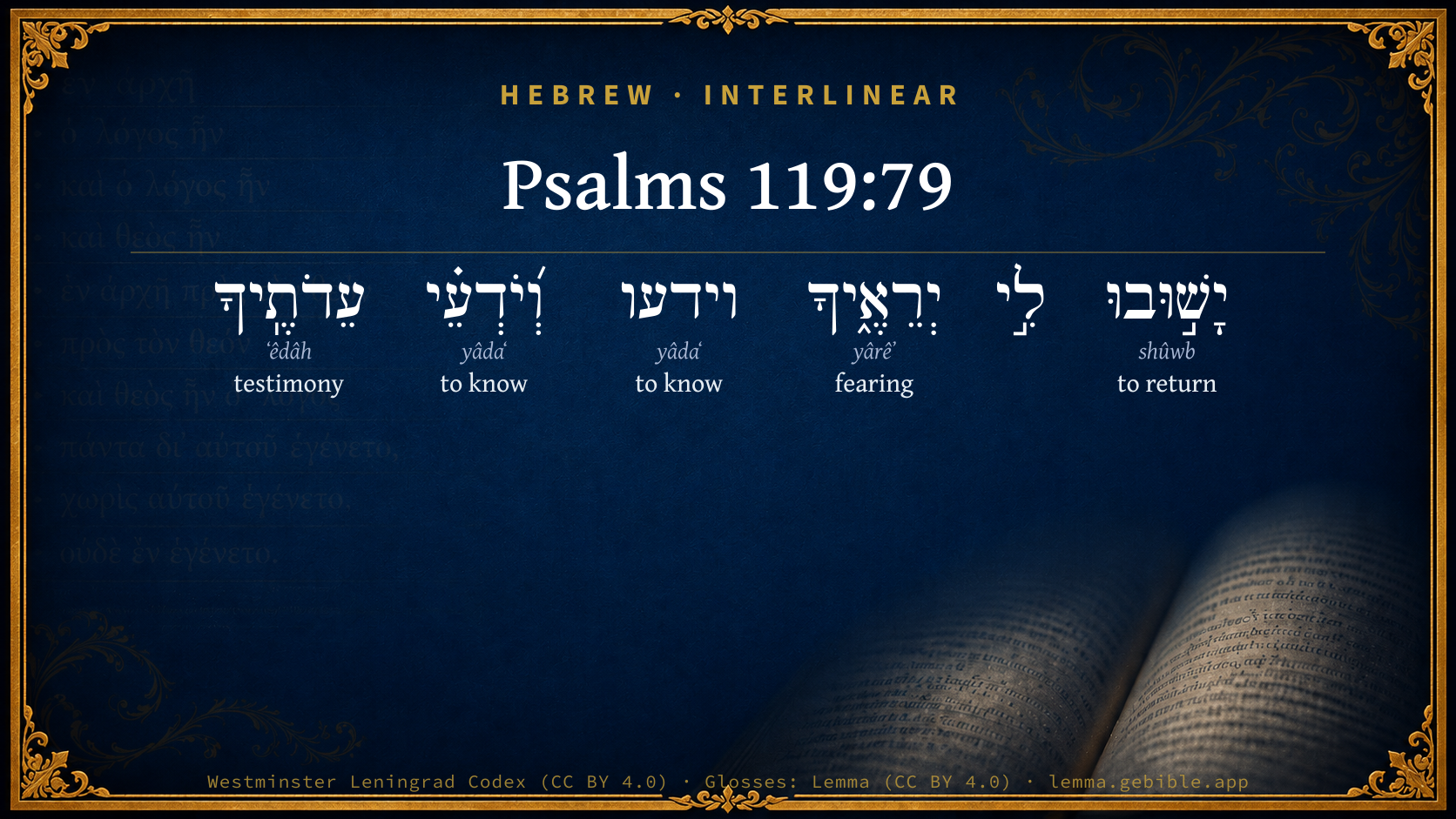
Hebrew (Westminster Leningrad Codex) Psalms 119:79 appears in the Hebrew Old Testament. The text above is from the Westminster Leningrad Codex. Each word links to its Strong’s number, a concise gloss, and parsing drawn from the Open Scriptures Hebrew Bible morphology. Click any word for its full Brown-Driver-Briggs (BDB) entry.
Download image
Cite this verse

Psalms 119:79 (World English Bible). Public Domain. Lemma interlinear Bible study tool, https://lemma.gebible.app/v/psalms/119/79.

Show BibTeX & RIS
BibTeX
RIS
English Translation
Let those who fear you turn to me. They will know your statutes.
World English Bible · Public Domain
Download a study sheet

One document with this verse’s original text, its word-by-word gloss line, the meaning frame, cross-references with their text, attributed commentary, and full source and license credits — printable, and it pastes into notes with its structure intact.

This verse Autodidact and up

Study sheet (.html) Plain text (.txt)

A passage Seminary Student

Up to 50 verses in one chapter. A passage sheet keeps up to 6 commentary sources and 12 cross-references per verse, in the order this page ranks them, and says so on the sheet whenever that leaves anything out. Ask for a single verse and you get the Autodidact verse sheet above.

Everything on this page stays free to read, with no account — the sheet is a download of what is already on screen, not access to it.

Want to remove ads? Support Godless Engineer
Compare translations 3

The same verse in 3 English versions, stacked beneath the original-language interlinear above. Click any original word for its lexicon entry.

Each is an independent rendering of the whole verse — the interlinear is not word-aligned to these translations.

Highlighted words mark where these versions differ — a whole-verse word diff, not a word-by-word alignment.

  • World English Bible Public Domain
    Let those who fear you turn to me. They will know your statutes.
  • King James Version Public Domain
    Let those that fear thee turn unto me, and those that have known thy testimonies.
  • unfoldingWord Literal Text CC BY-SA 4.0
    May the fearful of you turn to me, so that they may know your testimonies.

unfoldingWord Literal Text — © unfoldingWord, licensed CC BY-SA 4.0. Word-aligned USFM3 via Door43 (git.door43.org/unfoldingWord/en_ult).

Versions to compare (up to 4)

3 of 4 selected

Show all 17 translations

Every available English version of this verse, each an independent rendering of the whole verse.

  • World English Bible Public Domain
    Let those who fear you turn to me. They will know your statutes.
  • Berean Standard Bible Public Domain
    May those who fear You turn to me, those who know Your testimonies.
  • Majority Standard Bible Public Domain
    May those who fear You turn to me, those who know Your testimonies.
  • King James Version Public Domain
    Let those that fear thee turn unto me, and those that have known thy testimonies.
  • American Standard Version (1901) Public Domain
    Let those that fear thee turn unto me; And they shall know thy testimonies.
  • Revised Version (1885) Public Domain
    Let those that fear thee turn unto me, and they shall know thy testimonies.
  • Geneva Bible (1599) Public Domain
    Let such as feare thee turne vnto me, and they that knowe thy testimonies.
  • Young's Literal Translation Public Domain
    Those fearing Thee turn back to me, And those knowing Thy testimonies.
  • Literal Standard Version CC BY-SA 4.0
    Those fearing You turn back to me, || And those knowing Your testimonies.
  • Unlocked Literal Bible CC BY-SA 4.0
    May those who honor you turn to me, those who know your covenant decrees.
  • unfoldingWord Literal Text CC BY-SA 4.0
    May the fearful of you turn to me, so that they may know your testimonies.
  • Darby Bible Public Domain
    Let those that fear thee turn unto me, and those that know thy testimonies.
  • World Messianic Bible Public Domain
    Let those who fear you turn to me. They will know your statutes.
  • Webster's Bible Public Domain
    Let those that fear thee turn to me, and those that have known thy testimonies.
  • Free Bible Version CC BY-SA 4.0
    Let those who follow you turn to me, those who understand your laws.
  • Bible in Basic English Public Domain
    Let your worshippers be turned to me, and those who have knowledge of your words.
  • JPS Tanakh (1917) Public Domain
    Let those that fear Thee return unto me, and they that know Thy testimonies.

Literal Standard Version (2020), Covenant Press — licensed CC BY-SA 4.0. Text via the HelloAO Bible API (eBible.org). Unlocked Literal Bible (unfoldingWord) — licensed CC BY-SA 4.0. Text via the HelloAO Bible API (eBible.org). unfoldingWord Literal Text — © unfoldingWord, licensed CC BY-SA 4.0. Word-aligned USFM3 via Door43 (git.door43.org/unfoldingWord/en_ult). Free Bible Version, Dr. Jonathan Gallagher — licensed CC BY-SA 4.0. Text via the HelloAO Bible API (eBible.org).

Word by word

More ways to search: Search by grammar → Find every occurrence → Compare this word →

Practice this passage: Drill this verse → Learn its vocabulary →

About this verse

These counts appear in no published source. They are computed here, from the morphology-tagged text and Lemma’s own curated glosses. What Lemma adds →

6
words
4
distinct lemmas
Wisdom
section

Shared distinctive vocabulary

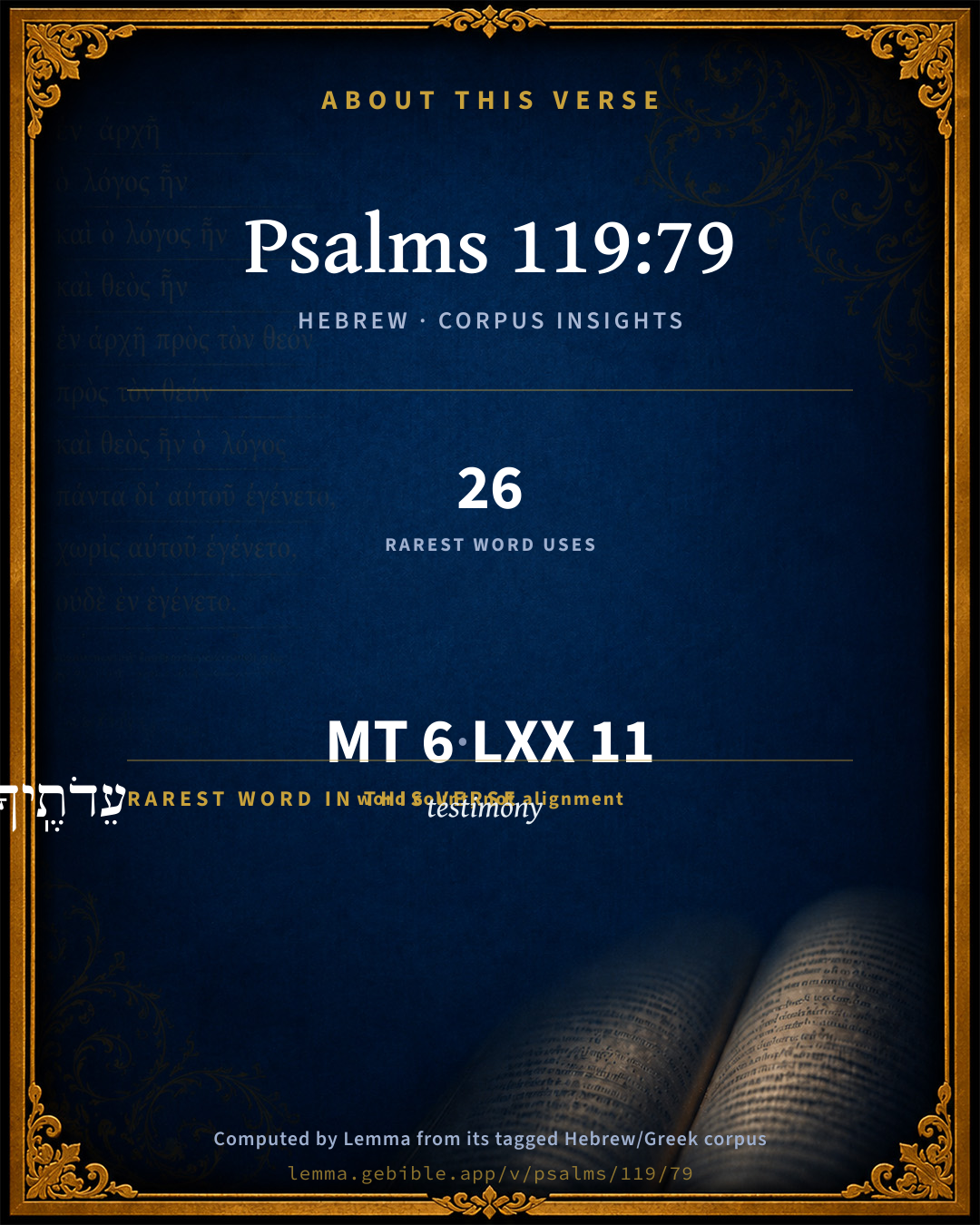
עֵדֹתֶֽיךָ testimony H5713 occurs in 25 verses of the Hebrew Bible. Also found in:

Grammatical profile

  • 3 verbs
  • 1 noun
  • 1 adjective
  • 1 preposition

Verb forms

  • יָשׁ֣וּבוּ Qal · Imperfect
  • וידעו Qal · Sequential Perfect
  • וְ֝יֹדְעֵ֗י Qal · Participle Active

Repetition

A word recurs within this verse — often emphatic in Hebrew:

  • וידעו to know H3045 ×2

Hebrew & Septuagint length

In English translation the verse runs 13 words from the Hebrew and 14 from the Septuagint (LXX English) — closely comparable.

A rough comparison of the two English renderings, which tokenize alike — not a word-level alignment.

Word counts can differ between the Hebrew and the Greek without any difference in meaning — e.g. the Hebrew direct-object marker אֵת has no separate Greek word, and Greek often adds the article ὁ.

In the original languages it is 6 Hebrew tokens and 11 Greek tokens — but the two are counted differently (Hebrew bundles its prefixes and suffixes into one token; the Greek is in lemma form), so that isn’t a like-for-like length.

Cross-references

4

Topical passages linked to Psalms 119:79 in the Treasury of Scripture Knowledge — connected by theme and wording, ordered by reader-vote popularity; previews shown in the World English Bible.

  • Psalms 119:74 Those who fear you will see me and be glad, Because I have put my hope in your word.
  • Psalms 142:7 Bring my soul out of prison, That I may give thanks to your name. The righteous will surround me, For you will be good to me.
  • Psalms 7:7 Let the congregation of the peoples surround you. Rule over them on high.
  • Psalms 119:63 I am a friend of all those who fear you, Of those who observe your precepts.

Cross-references courtesy of OpenBible.info (CC BY 4.0).

Hebrew and Greek witnesses Masoretic Hebrew ↔ Greek Septuagint

The same verse in the two great witnesses to the Old Testament, shown verse-for-verse.

You’re reading Greek Psalm 118 (Hebrew Psalm 119). The Septuagint counts the superscription, so verse numbers can differ from the Hebrew — chapter-level alignment, not verse-by-verse. Numbering follows Rahlfs.

These are two independent witnesses, not word-aligned to each other, and the Septuagint is shown in lemma (dictionary) form.

Hebrew Psalms 119:79 Masoretic · Westminster Leningrad Codex

יָשׁ֣וּבוּ לִ֣י יְרֵאֶ֑יךָ וידעו וְ֝יֹדְעֵ֗י עֵדֹתֶֽיךָ

Let those who fear you turn to me. They will know your statutes.

World English Bible · Public Domain

Greek LXX Greek Psalm 118:79 Septuagint · lemma form

ἐπιστρέφω ἐγώ ὁ φοβέω σύ καί ὁ γιγνώσκω ὁ μαρτύριον σύ

Let those that fear you, and those that know your testimonies, turn to me.

LXX2012 (modern English Septuagint) · Public Domain

On this verse, The Cambridge Bible for Schools and Colleges discusses the Septuagint’s reading. Read the note in Commentary ↓

Hebrew: Westminster Leningrad Codex (CC BY 4.0). Greek: Septuagint (public domain); English from LXX2012 (modern English Septuagint) (Public Domain). How the Septuagint differs from the Hebrew →

Commentary

Notes on Psalms 119:79 from classic Christian and Jewish commentators (each source and its license shown beneath its notes). The classic Christian expositions comment on the surrounding passage and are grouped to its opening verse, so a note may address several verses; the Jewish commentaries on the Tanakh (Rashi and others) are per-verse, so they appear only where the commentator wrote on this verse.

Lemma curates 59 commentaries, every one of them public domain or Creative Commons licensed, each selected and text-cleaned for this edition rather than reprinted as found. About our sources →

Trapp's Complete Commentary

John Trapp

Psa 119:79 Let those that fear thee turn unto me, and those that have known thy testimonies.

Ver. 79. Let those that fear thee] These are fitly opposed to those proud ones, as Mal 3:13; Mal 3:16.

Turn unto me] From whom they have shrunk in mine affliction.

And those that have known thy testimonies] Deum cognoscere et colere, to know and serve God is the whole duty of a man, saith Lactantius.

John Trapp, A Commentary or Exposition upon All the Books of the Old and New Testament (1647–1656) — public domain. Text from a community e-Sword module.

J. A. Alexander on Psalms

Joseph Addison Alexander

79. (Psa 119:79) Let them return to me that fear thee and know thy testimonies. Let thy servants who have looked upon me as abandoned by thee now restore to me their confidence. The various reading in the last clause does not affect the meaning of the sentence, except that the reading in the text may be included in the wish, let them know thy testimonies, i.e. let them learn from my experience to understand thy precepts better.

Joseph Addison Alexander, The Psalms Translated and Explained (1850) — public domain. Text from a community e-Sword module.

Geneva Bible (1599)

Geneva Bible translators

That is, be comforted by mine example.

He showeth that there can be no true fear of God without the knowledge of his word.

Geneva Bible (1599) marginal notes — public domain. Text via Bolls.life.

Adam Clarke's Commentary

Verse 79. Let those that fear thee] The truly pious.

Turn unto me] Seeing thy work upon me, they shall acknowledge me as a brand plucked from the burning.

Adam Clarke's Commentary on the Bible (1810–1826) — public domain. Text from a community e-Sword/MySword module.

John Calvin's Commentaries

79. Let such as fear thee turn unto me. In this verse, which is connected with the preceding, the Psalmist affirms, that the deliverance which he obtained would afford common instruction to all the godly. My condition, as if he had said, may, for a time, have disheartened the righteous, as well as increased the insolence of my enemies; but now, taking courage, they will turn their eyes to this joyful spectacle. Moreover, let us learn from the two marks, by which he distinguishes true believers, what is the nature of genuine godliness. He puts the fear, or the reverence of God, in the first, place; but he immediately joins to it the knowledge of Divine truth, to teach us that these two things are inseparably connected. The superstitious, indeed, exhibit a fear of God of a certain kind, but it is a mere show, which quickly vanishes. Besides, they weary themselves in their own inventions to no purpose; for God will take no account of any other services, but those which are performed in obedience to his commandments. True religion, then, and the worship of God, have their origin in faith — in the faith of what he has enjoined; so that no person can serve God aright, but he who has been taught in His school.

John Calvin's Commentaries (1540-1563) — public domain. Text from the Calvin Translation Society English edition (1840s-50s) via the Christian Classics Ethereal Library (ccel.org). Calvin's coverage is partial (roughly two-thirds of the Bible); uncommented books and verses are honest gaps, never fabricated. The 19th-century editor's footnotes and remarks are omitted so the notes are faithfully Calvin's own voice.

The Cambridge Bible for Schools and Colleges

gen. ed. J. J. S. Perowne

79. and those that have known &c.] Even those who know. So the Q’rç, with LXX, Syr., Jer. The K’thîbh has and they shall know, or, that they may know, with the Targ. This gives the best sense. Let my experience of Thy mercy shew the godly the blessedness of keeping Thy testimonies.

The Cambridge Bible for Schools and Colleges (gen. ed. J. J. S. Perowne; Cambridge University Press, 1878–1918) — public domain. Text from a community e-Sword module.

John Gill's Exposition

For I am become like a bottle in the smoke,.... Like a bottle made of the skins of beasts, as was usual in those times and countries: hence we read of old and new bottles, and of their rending, Jdg 9:13, Mat 9:17. Now such a bottle being hung up in a smoky chimney, would be dried and shrivelled up, and be good for nothing; so Jarchi's note is,

"like a bottle made of skin, which is dried in smoke;''

and the Targum is,

"like a bottle that hangs in smoke.''

It denotes the uncomfortable condition the psalmist was in, or at least thought himself to be in; as to be in the midst of smoke is very uncomfortable, so was he, being in darkness, and under the hidings of God's face; black and sooty, like a bottle in smoke, with sin and afflictions; like an empty bottle, had nothing in him, as he was ready to fear; or was useless as such an one, and a vessel in which there was no pleasure; like a broken one, as he elsewhere says, despised and rejected of men. It may also have respect unto the form of his body, as well as the frame of his mind; be who before was ruddy, and of a beautiful countenance, now was worn out with cares and old age, was become pale and wrinkled, and like a skin bottle shrivelled in smoke;

yet do I not forget thy statutes; he still attended to the word, worship, ways and ordinances of the Lord; hoping in due time to meet with comfort there, in which he was greatly in the right.

John Gill's Exposition of the Whole Bible (1746–1763) — public domain (CC PDM 1.0). Text via the HelloAO Bible API.

Albert Barnes' Notes on the Bible

Let those that fear thee turn unto me - Let thy friends be my friends. Let them show me favor, and count me among their companions. If the great and the powerful turn away from me; if they persecute me, and do me wrong; if they cast out my name as evil, and are unwilling to associate with me, yet let thy friends, however poor and humble, regard me with kindness, and reckon me among their number, and I shall be satisfied.

And those that have known thy testimonies - Thy law. Those who can see and appreciate the beauty of thy commandments. This is the ground of true friendship in religion - the common love of God, of his law, and of his service. This is a permanent ground of affection. All friendship founded on earthly distinctions; all derived from titled birth - from rank - from affluence - from civil, military, or naval renown - from beauty, strength, or nobleness of form - must be temporary; but that which is founded on attachment to God, to his law, and to the Saviour, will abide forever.

Albert Barnes' Notes on the Bible (1834–1885) — public domain. Text from a community e-Sword/MySword module.

Matthew Poole's English Annotations

Turn unto me; either,

1. Turn their eyes to me as a spectacle of God’s wonderful mercy; or rather,

2. Turn their hearts and affections to me, which have been alienated from me, either by the artifices and calumnies of my adversaries, or by my sore and long distresses, which made them prone to think that either I had deceived them with false pretences, or that God for my sins had utterly forsaken me; which doubtless was a very grievous burden to David, who had a far greater esteem and affection for such persons than for all other men, and desired above all things to stand right in their opinions.

Known, i.e. loved and practised them; as words of knowledge are oft used.

Matthew Poole's English Annotations on the Holy Bible (1683–1685) — public domain. Text from a community e-Sword/MySword module.

The Treasury of David

Charles H. Spurgeon

Ver. 79. Let those that fear thee turn unto me, and those that have known thy testimonies. Perhaps the tongue of slander had alienated some of the godly, and probably the actual faults of David had grieved many more. He begs God to turn to him, and then to turn his people towards him. Those who are right with God are also anxious to be right with his children. David craved the love and sympathy of gracious men of all grades, of those who were beginners in grace, and of those who were mature in piety "those that fear thee, "and "those that have known thy testimonies." We cannot afford to lose the love of the least of the saints, and if we have lost their esteem we may most properly pray to have it restored. David was the leader of the godly party in the nation, and it wounded him to the heart when he perceived that those who feared God were not as glad to see him as aforetime they had been. He did not bluster and say that if they could do without him, lie could very well do without them; but he so deeply felt the value of their sympathy, that he made it a matter of prayer that the Lord would turn their hearts to him again. Those who are dear to God, and are instructed in his word, should be very precious in our eyes, and we should do our utmost to be upon good terms with them.

David has two descriptions for the saints, they are God fearing and God knowing. They possess both devotion and instruction; they have both the spirit and the science of true religion. We know some believers who are gracious, but not intelligent; and, on the other hand, we also know certain professors who have all head and no heart: he is the man who combines devotion with intelligence. We neither care for devout dunces nor for intellectual icebergs. When fearing, and knowing walk hand in hand they cause men to be thoroughly furnished unto every good work. If these are my choice companions I may hope that I am one of their order. Let such persons ever turn to me because they find in me congenial company.

Ver. 79. Let those that fear thee turn unto me. Some think it intimates that when David had been guilty of that foul sin in the murder of Uriah, though he was a king, they that feared God grew strange to him, and turned from him, for they were ashamed of him; this troubled him, and therefore he prays, Lord, let them "turn to me" again. He desires especially the company of those that were not only honest but intelligent, "that have known thy testimonies, "have good heads as well as good hearts, and whose conversation will be edifying. It is desirable to have an intimacy with such. Matthew Henry.

Ver. 79. Let those that fear thee turn unto me, etc. As he had not his own flesh to fight against only, but the world also, so he did not only himself fight, but he seeketh the help of others. When many see that religion cannot be truly professed but danger will come of it, because many set themselves against it, they flee from it, and go to the greater pair, which is the wicked. If we will avoid this, let us join ourselves to God's children, and they will help us with counsel and advice; for one may be strong when we are weak, another may have counsel when we shall not know what to do; therefore by them we shall be kept from many evil things. So Paul (2Ti 1:16), after he had complained of the wrong that many had done unto him, he straightway giveth thanks for the family of Onesiphorus, which refreshed him more than all his enemies could discourage him; so that he durst oppose this one household to the whole rabble of the wicked. Richard Greenham.

Ver. 79. Let those that fear thee, etc. You must go to God and beseech him to choose your company for you. Mark what David said and did; in Ps 119:63 he saith, "I am a companion of all them that fear the Lord"; yet in this verse he goes to God, and prayeth, saying, "Let those that fear thee, O Lord, turn unto me, and those that have known thy testimonies." As if he should say, "Of a truth, Lord, I am a companion of all that do fear thee; but it is not in my power to bend their hearts unto me; the hearts of all men are in thy hands", now therefore "let those that fear thee turn unto me." So do you go to God, and say likewise: Lord, do thou choose my company for me; oh, do thou bow and incline their hearts to be my companions. William Bridge.

Ver. 79. Those that fear. "Those that have known. "Fear and knowledge do make up a godly man. Knowledge without fear breeds presumption; and fear without knowledge breeds superstition; and blind zeal, as a blind horse, may be full of mettle, but is ever and anon stumbling. Knowledge must direct fear, and fear must season knowledge; then it is a happy mixture and composition. Thomas Manton.

Ver. 79. One great means to restore a good understanding among God's people is prayer. David goeth to God about it: "Lord, let them turn to me." The Lord governs hearts and interests, both are in his hands, and he useth their alienation or reconciliation, either for judgment or mercy. God, when he pleaseth, can divert from us the comfort of godly friends; and when he pleaseth, he can bring them back again to us. The feet of God's children are directed by God himself; if they come to us, it is a blessing of God; if not, it is for a correction. He made Jacob and Laban meet peaceably (Genesis 30), and in the next chapter, Jacob and Esau. Thomas Manton.

Ver. 79. Restoration to church fellowship.

1. Good men may be in such a case as to need to be restored.

2. They should not be ashamed to seek it.

3. They should pray about it.

Ver. 79. Select society.

1. Sociableness is an instinct of human nature.

2. Sociableness is helpful to a wholesome Christian life.

3. The choice of society should be a subject of prayer. C.A.D.

Psalms 119:80*

Charles H. Spurgeon's The Treasury of David (1869–1885) — public domain. Psalms only. Text from a community e-Sword/MySword module.

The Pulpit Commentary

Let those that fear thee turn unto me; or, "return to me;" i.e. recover their confidence in me, when they see that I am not forsaken of thee (see vers. 76, 77), but am the recipient of thy "tender mercies." And those that have known thy testimonies; or, according to another reading, "and let them know thy testimonies;" i.e. "let them learn from my experience to know thy precepts better.

Experience can teach.

It is said that "Experience is a dear school, but fools will learn in no other." The proverb is in a large sense true, but we want it now only to fix the point that experience is a school; experience can teach, does teach. In a satirical spirit Froude says, "Experience is like the stern-lights of a ship, it casts its rays over a way that has been taken." But that is not in any large, or practical sense, true; the actual experience must be a thing of the past, but the lessons learned by experience are available forces for the ordering of the life that we have to live. The distinction between animal and man, instinct and intelligence, is that man can profit by experience, the animal does not.

I THE EXPERIENCE WHICH TEACHES IN THE RELIGIOUS LIFE IS EXPERIENCE RELATIVE TO DIVINE COMMANDMENTS. What the good man wants his past life for is the study of conduct in the light of what was known to be God"s will. What has happened in our lives does not much matter, and of themselves events teach very little. How did what happened stand related to what we knew to be right? That is the supreme question; and that alone reveals failures and frailties. That experience alone teaches, and provides forces for the endeavor to live a better life. In measure we have "known God"s testimonies;" but how has our actual life been ruled and toned by what we knew?

II THE ONE THING THAT EXPERIENCE TEACHES IS OUR ABSOLUTE NEED OF DIVINE SUPPORT. The one thing which the past has to show every honest and earnest-minded man is, that he has always failed when he trusted to his own judgment and strength, and ventured to neglect or to go aside of God"s revealed will; and that he has always succeeded when, in a spirit of true humility, he persistently endeavored to know God"s will, and shape conduct and meet emergencies in its gracious leadings. Experience when consulted has always the same teaching to give. It may be summed up in this way, "You have always needed God as your Helper and Guide; you need him now as much as ever; you always will need him. R.T.

The Pulpit Commentary (1880–1919), ed. H.D.M. Spence-Jones & Joseph S. Exell — public domain. Text from a community e-Sword module.

John Wesley's Explanatory Notes

Known - Loved and practiced them.

John Wesley, Explanatory Notes Upon the Whole Bible (1754–1765) — public domain. Text via the GEBible commentary corpus.

unfoldingWord translationNotes

Door43 World Missions Community

turn to me

People returning in friendship to the writer is spoken of as if they physically turn towards him. AT: "come to me" or "unite with me" (See: Metaphor)

those who know your covenant decrees

Possible meanings are 1) this further describes those who honor God or 2) this indicates the purpose for those who honor God to return to the writer. AT: "so that they may learn your covenant decrees" (See: Connecting Words)

May my heart be blameless

Here "heart" represents a person's thoughts and motives. AT: "May I be blameless" (See: Metonymy)

I may not be put to shame

This can be stated in active form. AT: "I may not be ashamed" (See: Active or Passive)

translationWords

honor

turn

covenant

decree

blameless

statute

shame

unfoldingWord translationNotes — © Distant Shores Media and the Door43 World Missions Community, licensed CC BY-SA 4.0. Source: git.door43.org/Door43/en_tn.

Rashi

Rabbi Shlomo Yitzchaki (Rashi)

May those who fear You...return to me For the Sanhedrin separated from him when he became a mezora because of that iniquity [with Bath-sheba]. Even if she was divorced, whoever puts his eyes on her, anyone who touches her, will not be guiltless.

Rashi on the Tanakh — English translations: “The Judaica Press complete Tanach with Rashi, translated by A. J. Rosenberg” (CC BY 4.0); “Pentateuch with Rashi's commentary by M. Rosenbaum and A.M. Silbermann, 1929-1934” (public domain); “The Metsudah Tanach series, Lakewood, N.J” (CC BY 4.0); and “The Book of Joshua, Metsudah Publications, 1997” (CC BY 4.0). Text via Sefaria.

Lesson kit

Teaching starters — assembled from the data on this page, not authored interpretation. Every prompt links to the verse data it draws on. Edit before teaching.

Psalms, in the Wisdom, opens this verse with 6 words (4 distinct Hebrew lemmas). Its most distinctive word is ʻêdâh (“testimony”). A historical commentator’s framing appears above. Read the whole chapter for the surrounding context.

Discussion questions

  1. What does “testimony” (ʻêdâh) contribute to the verse as a whole?
  2. How does Genesis 21:30, which shares the word «testimony», read alongside this verse?
  3. What does the repetition of “to know” (2× in this one verse) do in this verse?
  4. These translations render this verse differently; the difference is in the English rendering, not the original. What questions does that raise?
  5. «יָשׁ֣וּבוּ» is a Qal Imperfect verb. How does that grammatical form shape the action described?
  6. Compare how Trapp's Complete Commentary and J. A. Alexander on Psalms read this verse. Where do they agree or differ?

Things to notice

Reading settings

Reading text

Shown beneath each verse's original-language words.

Old Testament
Old Testament edition

Read the OT as the Masoretic Hebrew (MT) or the Greek Septuagint (LXX).

English shown for the Greek Septuagint (in the Hebrew ↔ Greek comparison).

Comparing translations? Open the Compare panel on any verse page to stack up to four side by side.