
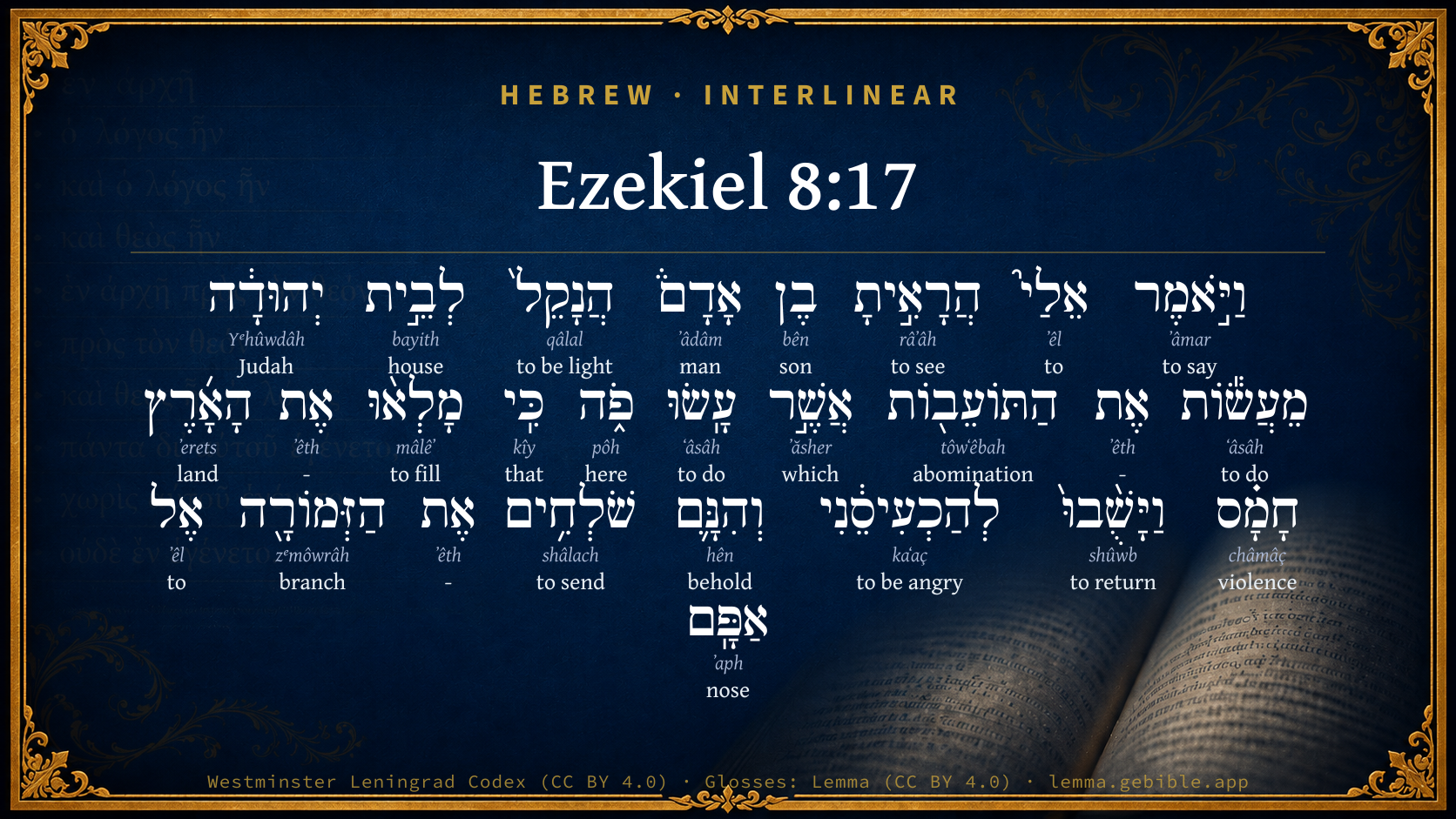
Ezekiel 8:17

Hebrew (Westminster Leningrad Codex) Ezekiel 8:17 appears in the Hebrew Old Testament. The text above is from the Westminster Leningrad Codex. Each word links to its Strong’s number, a concise gloss, and parsing drawn from the Open Scriptures Hebrew Bible morphology. Click any word for its full Brown-Driver-Briggs (BDB) entry.
Download image
Cite this verse

Ezekiel 8:17 (World English Bible). Public Domain. Lemma interlinear Bible study tool, https://lemma.gebible.app/v/ezekiel/8/17.

Show BibTeX & RIS
BibTeX
RIS
English Translation
Then he said to me, Have you seen [this], son of man? Is it a light thing to the house of Judah that they commit the abominations which they commit here? for they have filled the land with violence, and have turned again to provoke me to anger: and, behold, they put the branch to their nose.
World English Bible · Public Domain
Download a study sheet

One document with this verse’s original text, its word-by-word gloss line, the meaning frame, cross-references with their text, attributed commentary, and full source and license credits — printable, and it pastes into notes with its structure intact.

This verse Autodidact and up

Study sheet (.html) Plain text (.txt)

A passage Seminary Student

Up to 50 verses in one chapter. A passage sheet keeps up to 6 commentary sources and 12 cross-references per verse, in the order this page ranks them, and says so on the sheet whenever that leaves anything out. Ask for a single verse and you get the Autodidact verse sheet above.

Everything on this page stays free to read, with no account — the sheet is a download of what is already on screen, not access to it.

Want to remove ads? Support Godless Engineer
Compare translations 3

The same verse in 3 English versions, stacked beneath the original-language interlinear above. Click any original word for its lexicon entry.

Each is an independent rendering of the whole verse — the interlinear is not word-aligned to these translations.

Highlighted words mark where these versions differ — a whole-verse word diff, not a word-by-word alignment.

  • World English Bible Public Domain
    Then he said to me, Have you seen [this], son of man? Is it a light thing to the house of Judah that they commit the abominations which they commit here? for they have filled the land with violence, and have turned again to provoke me to anger: and, behold, they put the branch to their nose.
  • King James Version Public Domain
    Then he said unto me, Hast thou seen this, O son of man? Is it a light thing to the house of Judah that they commit the abominations which they commit here? for they have filled the land with violence, and have returned to provoke me to anger: and, lo, they put the branch to their nose.
  • unfoldingWord Literal Text CC BY-SA 4.0
    He said to me, “Do you see this, son of man? Is it a little thing for the house of Judah to do these abominations that they are doing here? For they have filled the land with violence and they have turned again to provoke me to anger, putting the branch to their noses.

unfoldingWord Literal Text — © unfoldingWord, licensed CC BY-SA 4.0. Word-aligned USFM3 via Door43 (git.door43.org/unfoldingWord/en_ult).

Versions to compare (up to 4)

3 of 4 selected

Show all 18 translations

Every available English version of this verse, each an independent rendering of the whole verse.

  • World English Bible Public Domain
    Then he said to me, Have you seen [this], son of man? Is it a light thing to the house of Judah that they commit the abominations which they commit here? for they have filled the land with violence, and have turned again to provoke me to anger: and, behold, they put the branch to their nose.
  • Berean Standard Bible Public Domain
    “Son of man,” He said to me, “do you see this? Is it not enough for the house of Judah to commit the abominations they are practicing here, that they must also fill the land with violence and continually provoke Me to anger? Look, they are even putting the branch to their nose!
  • Majority Standard Bible Public Domain
    “Son of man,” He said to me, “do you see this? Is it not enough for the house of Judah to commit the abominations they are practicing here, that they must also fill the land with violence and continually provoke Me to anger? Look, they are even putting the branch to their nose!
  • King James Version Public Domain
    Then he said unto me, Hast thou seen this, O son of man? Is it a light thing to the house of Judah that they commit the abominations which they commit here? for they have filled the land with violence, and have returned to provoke me to anger: and, lo, they put the branch to their nose.
  • American Standard Version (1901) Public Domain
    Then he said unto me, Hast thou seen `this', O son of man? Is it a light thing to the house of Judah that they commit the abominations which they commit here? for they have filled the land with violence, and have turned again to provoke me to anger: and, lo, they put the branch to their nose.
  • Revised Version (1885) Public Domain
    Then he said unto me, Hast thou seen this, O son of man? Is it a light thing to the house of Judah that they commit the abominations which they commit here? for they have filled the land with violence, and have turned again to provoke me to anger: and, lo, they put the branch to their nose.
  • Geneva Bible (1599) Public Domain
    The he said vnto me, Hast thou seene this, O sonne of man? Is it a small thing to the house of Iudah to commit these abominations which they do here? for they haue filled the land with crueltie, and haue returned to prouoke mee: and loe, they haue cast out stinke before their noses.
  • Douay-Rheims (1899) Public Domain
    And he said to me: Surely thou hast seen, O son of man: is this a light thing to the house of Juda, that they should commit these abominations which they have committed here: because they have filled the land with iniquity, and have turned to provoke me to anger? and behold they put a branch to their nose.
  • Young's Literal Translation Public Domain
    And He saith unto me, `Hast thou seen, son of man? hath it been a light thing to the house of Judah to do the abomination that they have done here, that they have filled the land with violence, and turn back to provoke Me to anger? and lo, they are putting forth the branch unto their nose!
  • Literal Standard Version CC BY-SA 4.0
    And He says to me, “Have you seen, son of man? Has it been a light thing to the house of Judah to do the abomination that they have done here, that they have filled the land with violence, and turn back to provoke Me to anger? And behold, they are putting forth the branch to their nose!
  • Unlocked Literal Bible CC BY-SA 4.0
    He said to me, “Do you see this, son of man? Is it a little thing for the house of Judah to do these abominations that they are doing here? For they have filled the land with violence and they have turned again to provoke me to anger, putting the branch to their noses.
  • unfoldingWord Literal Text CC BY-SA 4.0
    He said to me, “Do you see this, son of man? Is it a little thing for the house of Judah to do these abominations that they are doing here? For they have filled the land with violence and they have turned again to provoke me to anger, putting the branch to their noses.
  • Darby Bible Public Domain
    And he said unto me, Seest thou, son of man? Is it a light thing to the house of Judah to commit the abominations which they commit here, that they yet fill the land with violence, and keep provoking me afresh to anger? And behold, they put the branch to their nose.
  • World Messianic Bible Public Domain
    Then he said to me, “Have you seen this, son of man? Is it a light thing to the house of Judah that they commit the abominations which they commit here? For they have filled the land with violence, and have turned again to provoke me to anger. Behold, they put the branch to their nose.
  • Webster's Bible Public Domain
    Then he said to me, Hast thou seen this, O son of man? Is it a light thing to the house of Judah that they commit the abominations which they commit here? for they have filled the land with violence, and have returned to provoke me to anger: and lo, they put the branch to their nose.
  • Free Bible Version CC BY-SA 4.0
    “Son of man,” he said to me, “have you seen this? The people of Judah aren't content just to do these disgusting things. They also commit violent crimes across the country and keep on making me angry. Look at how they're deliberately insulting me!
  • Bible in Basic English Public Domain
    Then he said to me, Have you seen this, O son of man? is it a small thing to the children of Judah that they do the disgusting things which they are doing here? for they have made the land full of violent behaviour, making me angry again and again: and see, they put the branch to my nose.
  • JPS Tanakh (1917) Public Domain
    Then He said unto me: 'Hast thou seen this, O son of man? Is it a light thing to the house of Judah that they commit the abominations which they commit here in that they fill the land with violence, and provoke Me still more, and, lo, they put the branch to their nose?

Literal Standard Version (2020), Covenant Press — licensed CC BY-SA 4.0. Text via the HelloAO Bible API (eBible.org). Unlocked Literal Bible (unfoldingWord) — licensed CC BY-SA 4.0. Text via the HelloAO Bible API (eBible.org). unfoldingWord Literal Text — © unfoldingWord, licensed CC BY-SA 4.0. Word-aligned USFM3 via Door43 (git.door43.org/unfoldingWord/en_ult). Free Bible Version, Dr. Jonathan Gallagher — licensed CC BY-SA 4.0. Text via the HelloAO Bible API (eBible.org).

Word by word

More ways to search: Search by grammar → Find every occurrence → Compare this word →

Practice this passage: Drill this verse → Learn its vocabulary →

הַזְּמוֹרָ֖ה
zᵉmôwrâh
H2156
“the · branch”
Particle, Definite Article + Noun, Common, Feminine, Singular, Absolute
Part of Speech
Particle + Noun
Type
Common
Gender
Feminine
Number
Singular
State
Absolute
Full BDB Definition

Origin: from H2168

TWOT: 559b

branch, twig, shoot
  1. וַיֹּ֣אמֶר ʼâmar H559 “and · to say” Conjunction + Verb, Qal, Sequential Imperfect, 3rd Person, Masculine, Singular
  2. אֵלַי֮ ʼêl H413 “to · me” Preposition + Suffix, Personal, 1st Person, Common, Singular
  3. הֲרָאִ֣יתָ râʼâh H7200 “to see” Particle, Interrogative + Verb, Qal, Perfect, 2nd Person, Masculine, Singular
  4. בֶן bên H1121 “son of” Noun, Common, Masculine, Singular, Construct
  5. אָדָם֒ ʼâdâm H120 “man” Noun, Common, Masculine, Singular, Absolute
  6. הֲנָקֵל֙ qâlal H7043 “to be light” Particle, Interrogative + Verb, Niphal, Perfect, 3rd Person, Masculine, Singular
  7. לְבֵ֣ית bayith H1004 “to/for · house of” Preposition + Noun, Common, Masculine, Singular, Construct
  8. יְהוּדָ֔ה Yᵉhûwdâh H3063 “Judah” Noun, Proper
  9. מֵעֲשׂ֕וֹת ʻâsâh H6213 “from · to do” Preposition + Verb, Qal, Infinitive Construct
  10. אֶת ʼêth H853 “-” Particle, Direct Object
  11. הַתּוֹעֵב֖וֹת tôwʻêbah H8441 “the · abominations” Particle, Definite Article + Noun, Common, Feminine, Plural, Absolute
  12. אֲשֶׁ֣ר ʼăsher H834 “which” Particle, Relative
  13. עָֽשׂוּ ʻâsâh H6213 “to do” Verb, Qal, Perfect, 3rd Person, Common, Plural
  14. פֹ֑ה pôh H6311 “here” Adverb
  15. כִּֽי kîy H3588 “that” Conjunction
  16. מָלְא֨וּ mâlêʼ H4390 “to fill” Verb, Qal, Perfect, 3rd Person, Common, Plural
  17. אֶת ʼêth H853 “-” Particle, Direct Object
  18. הָאָ֜רֶץ ʼerets H776 “the · land” Particle, Definite Article + Noun, Common, Both, Singular, Absolute
  19. חָמָ֗ס châmâç H2555 “violence” Noun, Common, Masculine, Singular, Absolute
  20. וַיָּשֻׁ֨בוּ֙ shûwb H7725 “and · to return” Conjunction + Verb, Qal, Sequential Imperfect, 3rd Person, Masculine, Plural
  21. לְהַכְעִיסֵ֔נִי kaʻaç H3707 “to be angry · me” Preposition + Verb, Hiphil, Infinitive Construct + Suffix, Personal, 1st Person, Common, Singular
  22. וְהִנָּ֛ם hên H2005 “and · behold · them” Conjunction + Particle, Demonstrative + Suffix, Personal, 3rd Person, Masculine, Plural
  23. שֹׁלְחִ֥ים shâlach H7971 “sending” Verb, Qal, Participle Active, Masculine, Plural, Absolute
  24. אֶת ʼêth H853 “-” Particle, Direct Object
  25. אֶל ʼêl H413 “to” Preposition
  26. אַפָּֽם ʼaph H639 “nose · their” Noun, Common, Masculine, Singular, Construct + Suffix, Personal, 3rd Person, Masculine, Plural

About this verse

These counts appear in no published source. They are computed here, from the morphology-tagged text and Lemma’s own curated glosses. What Lemma adds →

27
words
23
distinct lemmas
Prophets
section

Notable vocabulary

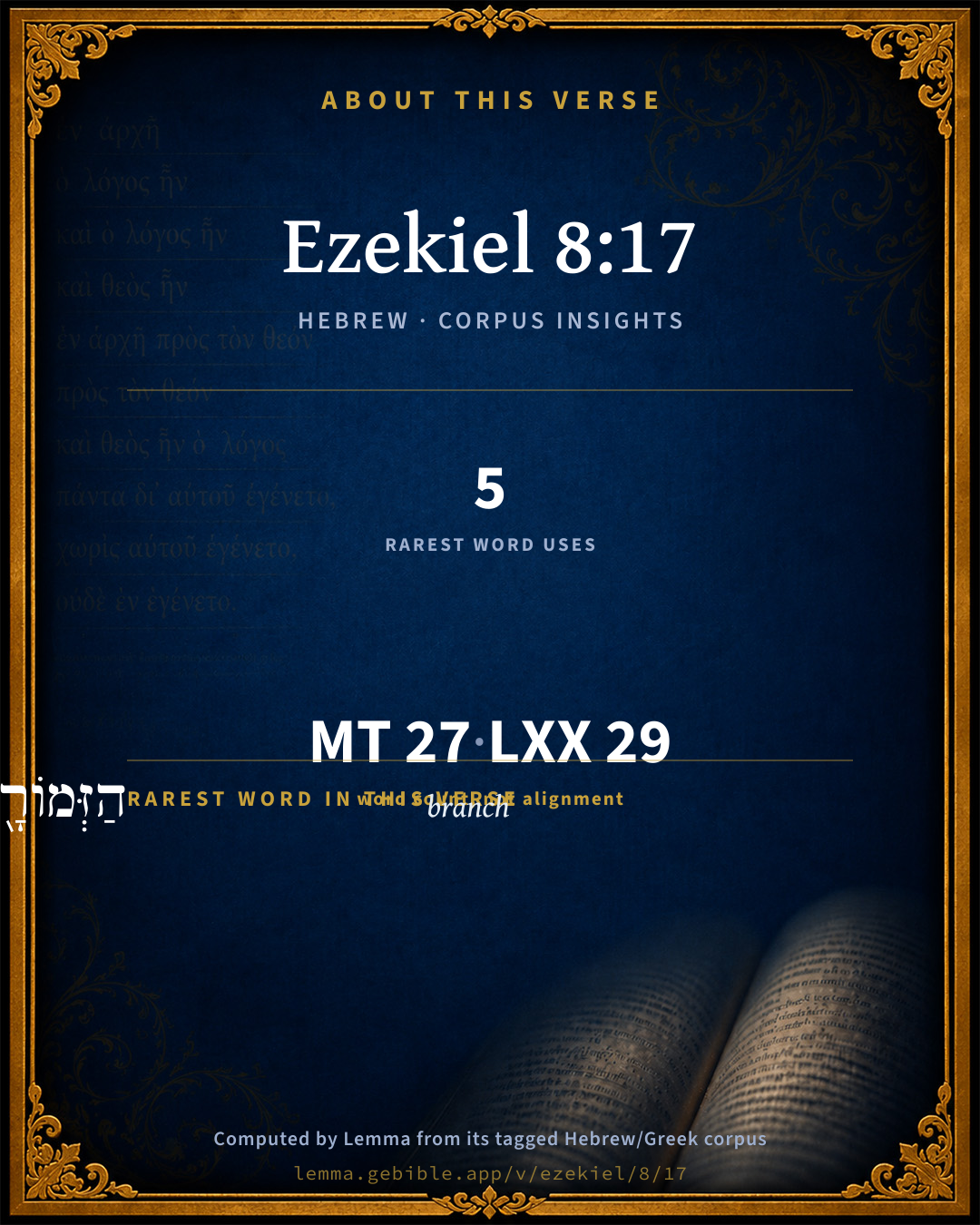
The rarest word here is הַזְּמוֹרָ֖ה branch H2156 — appearing just 5 times in the whole Hebrew Bible.

Shared distinctive vocabulary

הַזְּמוֹרָ֖ה branch H2156 occurs in 5 verses of the Hebrew Bible. Also found in:

Grammatical profile

  • 9 verbs
  • 9 nouns
  • 2 prepositions
  • 1 conjunction
  • 1 adverb
  • 5 particles

Verb forms

  • וַיֹּ֣אמֶר Qal · Sequential Imperfect
  • הֲרָאִ֣יתָ Qal · Perfect
  • הֲנָקֵל֙ Niphal · Perfect
  • מֵעֲשׂ֕וֹת Qal · Infinitive Construct
  • עָֽשׂוּ Qal · Perfect
  • מָלְא֨וּ Qal · Perfect
  • וַיָּשֻׁ֨בוּ֙ Qal · Sequential Imperfect
  • לְהַכְעִיסֵ֔נִי Hiphil · Infinitive Construct
  • שֹׁלְחִ֥ים Qal · Participle Active

Repetition

Words recur within this verse — often emphatic in Hebrew:

  • מֵעֲשׂ֕וֹת to do H6213 ×2
  • אֵלַי֮ to H413 ×2

Hebrew & Septuagint length

In English translation the verse runs 57 words from the Hebrew and 45 from the Septuagint (LXX English) — closely comparable.

A rough comparison of the two English renderings, which tokenize alike — not a word-level alignment.

Word counts can differ between the Hebrew and the Greek without any difference in meaning — e.g. the Hebrew direct-object marker אֵת has no separate Greek word, and Greek often adds the article ὁ.

In the original languages it is 27 Hebrew tokens and 29 Greek tokens — but the two are counted differently (Hebrew bundles its prefixes and suffixes into one token; the Greek is in lemma form), so that isn’t a like-for-like length.

Cross-references

17

Topical passages linked to Ezekiel 8:17 in the Treasury of Scripture Knowledge — connected by theme and wording, ordered by reader-vote popularity; previews shown in the World English Bible.

  • Ezekiel 9:9 Then said he to me, The iniquity of the house of Israel and Judah is exceeding great, and the land is full of blood, and the city full of wrestling [of judgment]: for they say, Yahweh has forsaken the land, and Yahweh doesn't see.
  • Ezekiel 7:23 Make the chain; for the land is full of bloody crimes, and the city is full of violence.
  • Jeremiah 6:7 As a well casts forth its waters, so she casts forth her wickedness: violence and destruction is heard in her; before me continually is sickness and wounds.
  • Micah 2:2 They covet fields, and seize them; And houses, and take them away: And they oppress a man and his house, Even a man and his heritage.
  • Zephaniah 1:9 In that day, I will punish all those who leap over the threshold, who fill their master's house with violence and deceit.
  • Genesis 6:13 God said to Noah, "The end of all flesh has come before me, for the earth is filled with violence through them. Behold, I will destroy them with the earth.
  • 2 Kings 21:16 Moreover Manasseh shed innocent blood very much, until he had filled Jerusalem from one end to another; besides his sin with which he made Judah to sin, in doing that which was evil in the sight of Yahweh.
  • 2 Kings 24:4 and also for the innocent blood that he shed; for he filled Jerusalem with innocent blood: and Yahweh would not pardon.
  • Jeremiah 7:18–19 The children gather wood, and the fathers kindle the fire, and the women knead the dough, to make cakes to the queen of the sky, and to pour out drink-offerings to other gods, that they may provoke me to anger.
  • Jeremiah 19:4 Because they have forsaken me, and have estranged this place, and have burned incense in it to other gods, that they didn't know, they and their fathers and the kings of Judah; and have filled this place with the blood of innocents,
  • Jeremiah 20:8 For as often as I speak, I cry out; I cry, Violence and destruction! because the word of Yahweh is made a reproach to me, and a derision, all the day.
  • Ezekiel 7:11 Violence is risen up into a rod of wickedness; none of them [shall remain], nor of their multitude, nor of their wealth: neither shall there be eminency among them.
  • Ezekiel 11:6 You have multiplied your slain in this city, and you have filled the streets of it with the slain.
  • Ezekiel 16:26 You have also committed sexual immorality with the Egyptians, your neighbors, great of flesh; and have multiplied your prostitution, to provoke me to anger.
  • Amos 3:10 "Indeed they don't know to do right," says Yahweh, "Who hoard plunder and loot in their palaces."
  • Amos 6:3 Those who put far away the evil day, And cause the seat of violence to come near;
  • Micah 6:12 Her rich men are full of violence, Her inhabitants speak lies, And their tongue is deceitful in their speech.

Cross-references courtesy of OpenBible.info (CC BY 4.0).

Hebrew and Greek witnesses Masoretic Hebrew ↔ Greek Septuagint

The same verse in the two great witnesses to the Old Testament, shown verse-for-verse.

These are two independent witnesses, not word-aligned to each other, and the Septuagint is shown in lemma (dictionary) form.

Hebrew Ezekiel 8:17 Masoretic · Westminster Leningrad Codex

וַיֹּ֣אמֶר אֵלַי֮ הֲרָאִ֣יתָ בֶן אָדָם֒ הֲנָקֵל֙ לְבֵ֣ית יְהוּדָ֔ה מֵעֲשׂ֕וֹת אֶת הַתּוֹעֵב֖וֹת אֲשֶׁ֣ר עָֽשׂוּ פֹ֑ה כִּֽי מָלְא֨וּ אֶת הָאָ֜רֶץ חָמָ֗ס וַיָּשֻׁ֨בוּ֙ לְהַכְעִיסֵ֔נִי וְהִנָּ֛ם שֹׁלְחִ֥ים אֶת הַזְּמוֹרָ֖ה אֶל אַפָּֽם

Then he said to me, Have you seen [this], son of man? Is it a light thing to the house of Judah that they commit the abominations which they commit here? for they have filled the land with violence, and have turned again to provoke me to anger: and, behold, they put the branch to their nose.

World English Bible · Public Domain

Greek LXX Ezekiel 8:17 Septuagint · lemma form

καί εἶπον πρός ἐγώ ὁράω υἱός ἄνθρωπος μή μικρός ὁ οἶκος ιουδα ὁ ποιέω ὁ ἀνομία ὅς ποιέω ὧδε διότι πίμπλημι ὁ γῆ ἀνομία καί ἰδού αὐτός ὡς μυκτηρίζω

And he said to me, Son of man, you have seen this. Is it a little thing to the house of Juda to practise the iniquities which they have practised here? for they have filled the land with iniquity: and, behold, these are as scorners.

LXX2012 (modern English Septuagint) · Public Domain

On this verse, Joseph Benson's Commentary discusses the Septuagint’s reading. Read the note in Commentary ↓

Hebrew: Westminster Leningrad Codex (CC BY 4.0). Greek: Septuagint (public domain); English from LXX2012 (modern English Septuagint) (Public Domain). How the Septuagint differs from the Hebrew →

Targum (Aramaic paraphrase)

1

The Targum is the ancient Jewish Aramaic paraphrase of the Hebrew Scriptures — an interpretive translation, not the Hebrew text itself. Onkelos (literal) and Pseudo-Jonathan (expansive) render the Torah, and Jonathan the Prophets. Coverage is partial: where no permissively-licensed English translation exists for a verse, only the Aramaic is shown. This is verse-level text, not a word-by-word alignment to the Hebrew.

  1. Targum Jonathan Prophets (Joshua–Malachi)
    וַאֲמַר לִי הָא חֲזֵיתָא בַּר אָדָם הַזְעֵיר לְבֵית יְהוּדָה מִלְמֶעֱבַּד יַת תּוֹעֶבְתָּא דַעֲבָדוּ כָא אֲרֵי מְלוֹ יַת אַרְעָא חֲטוּפִין וְתָבוּ לְאַרְגָזָא קֳדָמַי וְהָא אִינוּן מַיְתָן בַּהֲתָא לְאַפֵּיהוֹן:

    (no public-domain English translation for this verse)

    Targum Jonathan — Aramaic: “Mikraot Gedolot” (public domain). English: “Sefaria Community Translation” (CC0 1.0 (public-domain dedication)); “London "Chaldee Paraphrase," 1871” (public domain). Text via Sefaria.

Commentary

Notes on Ezekiel 8:17 from classic Christian and Jewish commentators (each source and its license shown beneath its notes). The classic Christian expositions comment on the surrounding passage and are grouped to its opening verse, so a note may address several verses; the Jewish commentaries on the Tanakh (Rashi and others) are per-verse, so they appear only where the commentator wrote on this verse.

Lemma curates 59 commentaries, every one of them public domain or Creative Commons licensed, each selected and text-cleaned for this edition rather than reprinted as found. About our sources →

Trapp's Complete Commentary

John Trapp

Eze 8:17 Then he said unto me, Hast thou seen [this], O son of man? Is it a light thing to the house of Judah that they commit the abominations which they commit here? for they have filled the land with violence, and have returned to provoke me to anger: and, lo, they put the branch to their nose.

Ver. 17. And, lo, they put the branch to their nose.] In honour th the sun, whose heat produceth the mot redolent wines; or they might be branches of laurel dedicated to the sun. R. Solomon rendereth it, They put a stink to my nose, even ventris crepitum pro suffitu. Vah, vah, vah! {a}

{a} ιδου, αντοι, ως μυκτηριζοντες. - Septuag.

John Trapp, A Commentary or Exposition upon All the Books of the Old and New Testament (1647–1656) — public domain. Text from a community e-Sword module.

Joseph Benson's Commentary

Eze 8:17-18. Then he said — After the prophet had seen all, and had had time to consider all he saw, God appeals to him concerning the heinousness of their crimes. Is it a light thing to the house of Israel — Who know and profess better things, and are dignified with so many privileges above other nations? Is it excusable in them, who have God’s oracles and ordinances, that they commit the abominations which they commit here? — Do they not deserve to suffer who thus sin? Should not such abominations as these make desolate? For they have filled the land with violence — All kinds of injustice are here meant, toward all sorts of men, whom they first despised and then defrauded, oppressed, or destroyed. And it is not strange if they who wrong their Creator make no conscience of injuring their fellow- creatures, and with all that is sacred, trample also on all that is just. And this wickedness of their conduct toward each other would have made their worship an abomination, even if it had been paid to the true God: see Isa 1:11, &c. And have returned to provoke me, &c. — After having filled the land with violence, they return to the temple to practise their idolatries: from injustice against man they return to impiety against God, and thus, by fresh abominations, add new aggravations to their guilt. And lo, they put the branch to their nose — This obscure clause is supposed by several commentators to relate to some custom among the idolaters of dedicating a branch of laurel, or of some other tree, to the honour of the sun, and carrying it in their hands at the time of their worship. And Spencer, De leg. Hebrews, lib. 4. cap. 5, observes, “that the heathen, in the worship of their deities, held forth the branches of those trees which were dedicated to them:” a rite which was called among the Greeks, οσχοφορια, θαλλοφρια: that is, branch-bearing. And Lewis, in his Origines Hebrææ, vol. 3. p. 4, observes, that the most reasonable exposition is, that the worshipper, with a wand in his hand, was wont to touch the idol, and then apply the stick to his nose and mouth, in token of worship and adoration. The Jewish rabbins, however, reckon this among the texts which their wise men have corrected, and say the original reading was not אפם, their nose, but אפי, my nose, or face; according to which reading the sense will be, They put a stick to my face, namely, to mock, or exasperate me: or, taking זמרהto mean here, not a branch, but, as Buxtorf renders it, odor malus ventris, the words will mean, they put an offensive smell to my nose, that is, they put an open affront upon me, namely, by turning their back to me in the place dedicated to my worship. And to this sense the LXX. interpret it, reading αυτοι ως μυκτηριζοντες, they are as those that mock me, or publicly affront me. The Vulgate, however, reads the clause as we do. Dr. Lightfoot renders the place, They put the branch to my wrath, or their wrath; that is, “they add more fuel to my wrath, which will burst out like a flame to consume them: just as if one should lay a heap of dry sticks upon a fire.” Therefore will I deal in fury, &c. — Hebrew, in anger, or wrath. Mine eye shall not spare — Their provocations are such, that my justice cannot be satisfied without bringing deserved punishment upon them; and though they cry, &c. — Their sins cry louder for vengeance than their prayers cry for mercy.

Joseph Benson's Commentary on the Old and New Testaments (1811–1818) — public domain. Text from a community e-Sword module.

Tyndale Open Study Notes

Tyndale Open Resources

8:17-18 The abominations that the Israelites were committing in the Temple complex were tantamount to thumbing (literally putting the twig [or branch] to) their noses at the Lord. This gesture was at least defiant, and possibly vulgar.

Tyndale Open Study Notes — © Tyndale Open Resources, licensed CC BY-SA 4.0. Text via the HelloAO Bible API.

Geneva Bible (1599)

Geneva Bible translators

Declaring that the censings and service of the idolaters, are but infection and villainy before God.

Geneva Bible (1599) marginal notes — public domain. Text via Bolls.life.

Jamieson, Fausset & Brown

Robert Jamieson, A. R. Fausset & David Brown

put . . . branch to . . . nose--proverbial, for "they turn up the nose in scorn," expressing their insolent security [Septuagint]. Not content with outraging "with their violence" the second table of the law, namely, that of duty towards one's neighbor, "they have returned" (that is, they turn back afresh) to provoke Me by violations of the first table [CALVIN]. Rather, they held up a branch or bundle of tamarisk (called barsom) to their nose at daybreak, while singing hymns to the rising sun [STRABO, 1.15, p. 733]. Sacred trees were frequent symbols in idol-worship. CALVIN translates, "to their own ruin," literally, "to their nose," that is, with the effect of rousing My anger (of which the Hebrew is "nose") to their ruin.

Jamieson, Fausset & Brown — Commentary Critical and Explanatory on the Whole Bible (1871) — public domain (CC PDM 1.0). Text via the HelloAO Bible API.

Adam Clarke's Commentary

Verse 17. They put the branch to their nose.] This is supposed to mean some branch or branches, which they carried in succession in honour of the idol, and with which they covered their faces, or from which they inhaled a pleasant smell, the branches being odoriferous. That the heathens carried branches of trees in their sacred ceremonies is well known to all persons acquainted with classic antiquity; and it is probable that the heathen borrowed those from the use of such branches in the Jewish feast of tabernacles. There are many strange, and some filthy, interpretations given of this clause; but the former are not worth repeating, and I abominate the latter too much to submit to defile my paper with them. Probably the Brahminic Linga is here intended.

It really seems that at this time the Jews had incorporated every species of idolatry in their impure worship, - Phoenician, Egyptian, and Persian. I might add that some imagine the image of jealousy to be a personification of idolatry itself.

Adam Clarke's Commentary on the Bible (1810–1826) — public domain. Text from a community e-Sword/MySword module.

John Calvin's Commentaries

God complains as formerly of the wickedness of the people, especially of their perfidious and wicked revolt, because they so defiled the temple which ought to be sacred to God alone. He adds besides another complaint, that they were not content in their wickedness, which tended to violate human society and common rights, and the pursuit of mutual equity, unless even religion should be weakened by them. For under the word חמס, chemes, is comprehended whatever is contrary to the second table of the law. There is, therefore, a use of the figure a part for the whole, in this word חמס, chemes, violence, as if he had said, they were addicted to frauds, rapine, slaughter, cruelty, perjuries, spoliations. Since, therefore, they abstained from no injustice, says God, they manifestly provoke me also: as if he had said, after being unjust towards men, they now dare to erect their horns against me. We know that God’s law was comprehended in the two tables. As to the former table, it prescribes what the true and pure worship of God is. The Jews had violated the second table, since they neglected all the duties of charity, and neither equity nor uprightness flourished among them. After they had filled the land with iniquity; this was their intolerable ungodliness, that after despising men they attacked God himself. We see now the reason of the context, Is this a light thing? says he. Thereafter he had spoken of the wickedness simply and by itself, as they say, he now amplifies by comparison when he says, before this they had filled the earth with violence, but now they have turned themselves to provoke me — behold these, he says, etc. The adverb of place must be noticed here, as I have before advised. For their impiety is the more detestable, since they broke into the temple to defile themselves with their idols. That place at least ought to remain pure and unpolluted, though the whole land had been infected with many defilements; but when not even the temple is spared, this is a sign of desperate and almost furious audacity. He, therefore, repeats the adverb which he had used before, and in the same sense.

As to the latter part of the verse, some, as I have said, take הזמורה, hez-moreh, for foulness: I know not why, for I am not aware that this noun is used elsewhere in this sense. But because nothing better occurred to them, they think it probable, and some have invented a foolish fable that they broke wind in honor of the sun, as if the noise of the belly was a grateful offering to the idol, since by this means they openly despised God. But these are conjectures. Others think more correctly who suppose this to be used metaphorically: for they were accustomed to burn incense to their idols; and so, according to them, God alludes to a pleasing and sweet odor when he names it a foul smell, as if he had said, even if the Jews pleased themselves in their superstitions, yet the incense sent forth a foetid odor and they should perceive it: for if he speaks of the nostrils it ought to be considered as a punishment. Some suppose that the relative of the third person is put for that of the first, as if God would say, to my nose or to my wrath: and they fabricate an insipid comment, that this place was changed by the Rabbins through reverence for God, as if forsooth there were not numberless passages where God pronounces in clearer words that he was disgracefully despised. But first, because this noun properly signifies a branch, and is taken in that sense in many places; then since the noun אפ, aph, may be explained as well passively as actively, the context will flow best if we say, they put forth a branch to their wrath — that is, to their destruction, because they provoked God. For what is the meaning of putting forth a branch, but that they heaped evil upon evil. They had violated, as I have said, the second table of the law, they were thieves, robbers, perjurers, and violent. Now at length their rage was directed against the former table of the law, so as to overthrow the whole worship of God. So therefore it will make good sense to say, that boughs were put forth — for the singular number is taken for the plural, as often happens. Since, therefore, they so put forth boughs or budded, God says, that this should be for their destruction, because at length when he had spared them a long time, after a fit time for their punishment arrived, he would consume them. Now, therefore, we understand what the Prophet means. But if any other conjecture pleases, every one may form his own opinion; I do not contest the point, but I show what I think most probable. It follows —

John Calvin's Commentaries (1540-1563) — public domain. Text from the Calvin Translation Society English edition (1840s-50s) via the Christian Classics Ethereal Library (ccel.org). Calvin's coverage is partial (roughly two-thirds of the Bible); uncommented books and verses are honest gaps, never fabricated. The 19th-century editor's footnotes and remarks are omitted so the notes are faithfully Calvin's own voice.

Ellicott's Commentary for English Readers

(17) For they have filled the land with violence.—Corruption in religion here, as always, bore its proper fruit in moral deterioration. A people who go astray from their duty to God are always found to neglect also their duty to man. Israel had before fallen into great and grievous sins. Within the memory of those still living, the good king Josiah, supported by the prophet Jeremiah and many others, had made great effort at reformation, and had purged the Temple of its abominations; hence God says the people “have returned to provoke me to anger.”

Put the branch to their nose.—This is an obscure expression, on which the learning and ingenuity of commentators have been spent in vain. It is an allusion to some custom well known at the time, but now lost. The simplest explanation seems to be in a reference to the habit of the Parsees (mentioned by Strabo) in their worship to hold twigs of the tamarisk, palm, and the pomegranate before their mouths.

A Bible Commentary for English Readers, edited by Charles John Ellicott (1878–1897) — public domain. Text from a community e-Sword module.

The Cambridge Bible for Schools and Colleges

gen. ed. J. J. S. Perowne

17. Is it a light thing] Probably: is it too light a thing for the house of Judah to commit … that they have filled: cf. Isa_49:6; ch. Eze_9:9.

the branch to their nose] This is supposed to be part of the ceremonies of their sun-worship. It is said that the Persian sun-worshippers held before them a branch or bunch of date, pomegranate or tamarisk tree, or according to some of the Homa tree, probably that their breath might not contaminate the glory of the rising deity. The word “nose” might mean face (Gen_3:19), but why not “mouth?” And this distinctively Persian rite is hardly probable at so early a date in Israel. Also the reference to idolatry seemed concluded, for it is asked whether these idolatries were not enough, that they had also filled the land with blood. LXX. has given a general sense, “and behold these are as mockers,” probably regarding the words as a proverbial phrase.

The Cambridge Bible for Schools and Colleges (gen. ed. J. J. S. Perowne; Cambridge University Press, 1878–1918) — public domain. Text from a community e-Sword module.

John Gill's Exposition

Then he said unto me, hast thou seen this, O son of man?.... Took notice of and considered this piece of idolatry, worshipping the sun toward the east:

is it a light thing to the house of Judah that they commit the abominations which they commit here? could these things, which are such dreadful abominations, committed here in the temple, be reckoned light things by them, as surely they cannot? yet these are not all that they have done:

for they have filled the land with violence; with rapine and oppression; doing injury to the poor and needy, the widow and the fatherless, in all places:

and have returned to provoke me to anger; by other instances of idolatry:

and, lo, they put the branch to their nose; a laurel, or olive, or vine branch, which idolaters carried in their hands, and put to their nose, in honour of the idol they worshipped; in like manner as they kissed their hand at the sight of the sun, Job 31:26; and which the Jews did in imitation of the Heathen. This is one of the eighteen places in which there is "tikkun sopherim", or a "correction of the scribes"; who, instead of "my nose", direct to read "their nose"; hence the words are differently interpreted by the Jewish commentators; who, by rendered "branch", think an ill smell is meant; arising either from their posteriors, their back being towards the temple; or from the incense which they offered up to their idols; so Kimchi and Menachem in Jarchi; agreeably to which Fortunatus Scacchus (k) understands this, not of any branch used by idolaters, which they put to the nose of their idol, or their own, for the honour of that; but of the censer which the Israelites used, contrary to the command of God, and which they put to their nose to enjoy a forbidden smell; see Eze 16:18; but Gussetius (l) gives another sense of the words, rendering them, "they send forth a branch to their anger"; the Israelites are compared to a vine, as in Isa 5:1; sending forth bad branches, idolatrous actions, as here in this chapter; and to these bad branches they sent forth or added another, even anger against God, the prophets, true believers, and right worshippers of God; and therefore he also would deal in fury and wrath, as in Eze 8:18; so Dr. Lightfoot (m) renders it,

""they send the branch to my wrath", or "to their own wrath"; that is, to what they have deserved; as if it was said, in the same manner that anyone puts wood to the fire, the branch of the wild vine, that it may the more quickly be burnt; so do these put the branch to my wrath, that it may burn the more fiercely; hence it follows, "therefore will I also deal in fury", &c.''

The Targum is,

"and, lo, they bring shame (or confusion) to their faces;''

what they do turns to their own ruin and destruction; as follows:

(k) Sacror. Eleaochr. Myrothec. l. 2. p. 536. (l) Ebr. Comment. p. 231. (m) Heb. & Talmud. Exercitat. in Johan. xv. 6.

John Gill's Exposition of the Whole Bible (1746–1763) — public domain (CC PDM 1.0). Text via the HelloAO Bible API.

Albert Barnes' Notes on the Bible

“Violence” represents sin against man, “abominations” sins against God. These went hand in hand in Jerusalem.

And have returned - After the reformation effected for a time by Josiah’s zeal, they have gone back to their old state.

They put the branch to their nose - An allusion to a then familiar practice, of which we find no clear traces elsewhere. Ezekiel is describing the attitude usual in such devotions, the branch held before the mouth, but wishing to represent it in contemptuous and derogatory terms, he substitutes the word “nose” for “mouth.”

Albert Barnes' Notes on the Bible (1834–1885) — public domain. Text from a community e-Sword/MySword module.

Haydock's Catholic Bible Commentary

Nose, to hide their faces respectfully, (Calmet) when they look at the sun rising. (Haydock) --- A thyrsus was used in honour of Bacchus, who is often confounded with the sun. Various improbable versions of this text are given. It may signify Hebrew, "they threw their instruments down before their faces," like the twenty-four elders, Apocalypse v. 8. (Calmet)

George Leo Haydock (1774–1849), Haydock's Catholic Family Bible and Commentary, 1859 edition — public domain. Excludes Psalms (Douay-Rheims chapter numbering differs from Protestant) and Deuterocanonical books (Catholic canon only).

Matthew Poole's English Annotations

Then; after the prophet had seen all, and had time to consider all he saw.

He said unto me; God appeals to the prophet. Doth the house of Judah think these no sins, or but little sins, or that I account not those provocations to anger? Do they so sottishly undervalue me and my law and ordinances, &c.? These idolaters, as others of the same stamp, are great oppressors; every where their oppressions may be found in great and high degrees.

Violence; all injustice is here meant towards all sorts of men, whom they first despise, and next destroy.

Have returned; from injustice against man, they return to impiety against God.

They put the branch to their nose; consecrate first these branches in the sun, and then next prize them, as what had touched the idol, and was bettered by it. Or, perhaps, took some branches out of the garland, wherewith they decked the idol, the altar, the victim, or themselves; and as the Orgyasts, i.e. worshippers of Bacchus, did wave their Thyrsus, the stalk or stem wreathed with ivy about it, carrying it in their hands whilst they danced, bowed their bodies, and often kissed the branches, so did these idolatrous Jews.

Matthew Poole's English Annotations on the Holy Bible (1683–1685) — public domain. Text from a community e-Sword/MySword module.

Whedon's Commentary on the Bible

Daniel D. Whedon

17. They put the branch to their nose — This seems to be the particularly objectionable feature connected with the sun worship just described, which may indicate that it was a debased and impure form of such worship. The gesture referred to is one common to ancient rituals and was the symbol of life and fructification. Flowers and trees played a great part in the religious symbolism of all ancient religions. (See Fraser’s Golden Bough.) In the tombs of Egypt almost every deceased person and the mourning friends are represented smelling the lotus. Even to-day the lotus is the most favored religious emblem in Japan. Tell a Buddhist that his heart is corrupt and cannot be cleansed, and he will answer, “The lotus springs from the mud” (Asiatic Quarterly Review, viii, p. 441). The custom of holding a bundle of twigs to the nose by the Magi during prayer is reported by Strabo (xv, 3, 14). This is the beresma of the Avesta, and is still done by the Parsi priests. Astarte-Aphrodite or Tammuz-Adonis is represented on an ancient vase in front of the Asherah tree with flowers in both hands, one bouquet of which is held to the nose. On the Assyrian monuments earlier than Ezekiel’s day the priests are represented carrying a spray in one hand, and in one case at least the priest is seen lifting the spray to his nose just before he offers sacrifice. This same gesture is seen in another representation of a priestess or goddess who stands before the symbol of the sun; it is common everywhere in the adoration of the flower god Tammuz-Adonis. Max Ohnefalsch-Richter points out that the smelling of a flower or a flowering branch or the holy tree itself was a most solemn ceremonial in the ancient ritual in Cyprus. In various statues the priest or worshiper is represented adoring the sun, while in his left hand he holds the flowering spray to his nose (Kypros, Bible, and Homer, 1893, p. 136, etc.). Perrot and Chipiez describe thus a Phoenician temple: “The air was full of perfume, of soft and caressing sounds… the voluptuous cooing of the dove mingled with the rippling notes of the flute.… Here sat the slaves of the goddess covered with jewels and dressed in rich stuffs with bright-colored fringes… necklaces of gold, amber, and glass hung between their swelling breasts; with the pigeon, the emblem of fertility, in one hand and a flower or myrtle branch in the other, these women sat and waited” (Phoenicia and Cyprus, ii, pp. 108, 138, 332). A class of male prostitutes were connected with the Baal worship, and a class of priestess prostitutes (Kadishti) with the Ashtoreth, Ishtar, and Tammuz cults. “The recent revelations concerning the hideous meaning of this seemingly inoffensive symbol and the ritual connected with it perfectly explain the strong words contained in the Bible text. This ‘fills the cup!’ God is now determined to punish, and the following chapter brings before the eyes of the seer the judgment according to its various phases.” — Orelli.

Daniel D. Whedon (gen. ed.), Commentary on the Old and New Testaments (1874–1909) — public domain. Text from a community e-Sword module.

The Pulpit Commentary

For returned read, with the Revised Version, turned again. The wind seems chosen with special reference to the attitude of the idol worshippers. It may be noted that even here the prophet speaks not only of the idolatry of Judah, but of its violence also, as bringing down the judgments of Jehovah. Lo, they put the branch to their nose. The opening word expresses the prophet"s burning indignation. The act described probably finds its best explanation in the Persian ritual of the Avesta. When men prayed to the sun, they held in their left hands a bouquet of palm, pomegranate, and tamarisk twigs, while the priests for the same purpose held a veil before their mouth (Spiegel, "Iran. Alterth.," 3:571, 572, in Smend), so that the bright rays of the sun might not be polluted by human breath. And this was done in the very temple of Jehovah by those who were polluting the whole land by their violence. The LXX gives, as an explanation, wJv mukthrizontev, as though the act was one of scornful pride, (comp. Isa_65:5) the sign of a temper like that of the Pharisee as he looked upon the publican. (Luk_18:11) Lightfoot takes the "nose" as the symbol of anger, and looks on the phrase as proverbial: "They add the twig to their anger, fuel to the fire;" but this has little to commend it. The word for "branch" is used in Eze_15:2 and Num_13:23 for a vine branch.

Making light of sin.

I SINNERS MAKE LIGHT OF SIN. This is a commonly observed fact. Let us see how it is caused.

1. As an attempt to excuse the sinner. This, of course, is the most obvious and palpable reason why many people try to minimize their own sin. The prisoner pleads "Not guilty" simply to save himself. The same is done even before the private bar of a man"s own conscience; for we wish to excuse ourselves to ourselves. Thus there may be no conscious deception, no hypocrisy. We may really persuade ourselves that we are not so bad as we seem to be. The wish is father to the thought.

2. By the force of habit. We grow accustomed to the worst companions if we are much with them, as we scarcely notice the ugliness of what is constantly with us, though strangers would be struck with their first sight of it. So while we become familiar with our sins, their supreme and most dreadful wickedness ceases to affect us, as the fearful sight of mutilated bodies ceases to affect hospital surgeons. The horror dies out of the aspect of wickedness, and a look of familiarity takes its place.

3. Through the influence of example. If a man stood alone in his sin, he would he appalled at the singular horror of it. But he sees it reflected in the lives of his neighbours, and, judging himself by the average standard of society, instead of taking the Law of God for his measure, he passes an easy sentence.

4. In the deadening of conscience. This is the worst and the most dangerous effect of sin. The sense for perceiving its guilt is blunted. Until conscience is reawakened by the Spirit of God, no man truly appreciates his own guilt.

II IT IS IMPOSSIBLE FOR GOD TO MAKE LIGHT OF SIN.

1. He sees it as it truly is. God is not deceived by our excuses. He sees into the true nature of our thought and conduct with an all-searching eye, and he is perfectly true and just to judge according to fact.

2. God measures it by the law of holiness. He knows our weakness, our ignorance, our temptation; and he does not judge men as he would judge angels of that we may be sure; for "shall not the Judge of all the earth do right?" But according as we have light he will estimate our conduct, measuring it against that light, and not against the darkness of our neighbours. God cannot endure iniquity. In his sight it is hideous and hateful and utterly deserving of condemnation. Let us remember that we shall not be judged by man"s standards of conventionality, but by God"s pure law of righteousness.

3. If God forgives sin, he does not make light of it. Forgiveness is not excusing evil. It recognizes the whole black guilt of it. Jesus who brought free forgiveness denounced sin itself as no stern Hebrew prophet had ventured to denounce it. In pardoning the penitent he carefully hotel that her sins were "many". (Luk_7:47) The publican is commended for his humiliation in the confession of sin. (Luk_18:13) We can only judge of God"s horror of sin by the darkness and agony of Gethsemane and Calvary. God forgives sin at the cost of his own Son. The great atonement of Christ was rendered necessary because God could not make light of sin, though he desired to save the sinner. We can be saved from our sin, not by making light of it, but when we fully confess its whole guilt and shame.

Vers. 17, 18. Men co-assessors in judgment with God.

In saving men from sin, God qualifies them for the highest offices in his kingdom. "They shall sit upon thrones, judging the twelve tribes of Israel.

I GOD GIVES US, IN STAGES, HIS VIEW OF HUMAN GUILT. Without question, we should take very low and imperfect conceptions of sin, unless God revealed to us the facts in the moral department of existence. By such means, God condescends to train us for companionship with himself, and for high office in his realm. "Know ye not that we shall judge angels?

II GOD SHOWS US FURTHER THE MANIFOLD EFFECTS OF HUMAN SIN.

1. Its inexcusableness. It is not committed from want of knowledge. Those in Judaea who had the clearest access to knowledge respecting God yielded to idolatry.

2. Its effect upon others. All sin is contagious; and when exhibited in the lives of learned and official personages, it has peculiar fascination. The mystic force of influence diffuses it far and wide.

3. Its penetrative power. It touches and taints every part of man"s nature body, soul, and spirit. It defiles every department of human life andinterest agriculture, commerce, literature, legislation, the household.

4. Its cumulative energy. It grows worse and worse, until every restraint is broken down, and all sense of shame is destroyed. Open defiance of God is the last phase of iniquity.

III GOD SUMMONS OUR JUDGMENT TO ASSESS THE GUILT. God appeals to his prophet for his estimate of the case. "Hast thou seen this, O son of man? Is this a light thing?" Our judgment, our reason, our moral sensibility, our conscience, have been conferred upon us for this selfsame purpose, viz. that we should condemn what is evil and approve what is good. Under certain circumstances it is our duty not to judge; as, for instance, when all the facts of the case are not within our possession, or when sympathetic help is better than critical examination, or when our judging faculty is better exercised about ourselves than about others. Our good, and the world"s advantage, must be our guide when to judge and when not to pass a judgment.

IV GOD DESIRES TO HAVE OUR ACQUIESCENCE IN HIS DECISIONS. He puts great honour upon men in making them partners with him in the highest offices of the heavenly state. God is no lover of monopoly. As his creatures become fitted for eminent office and honour, he promotes them. To give them pleasure is to give himself pleasure. If any of his creatures become as wise and pure and good as he is, he will not repine. He calls us his sons and daughters; and inasmuch as the relationship is real, he loves to have our companionship, ay, and our hearty approval of all that he does. When Christ shall sit as Judge, in glorious state, we are told that all the holy angels shall sit with him. And if he will come to "be admired by his saints," he will desire to have admiration for his deeds as well as for his Person. "He shall be justified" by his people "as often as he judges. D.

The Pulpit Commentary (1880–1919), ed. H.D.M. Spence-Jones & Joseph S. Exell — public domain. Text from a community e-Sword module.

John Wesley's Explanatory Notes

Violence - All injustice is here meant towards all sorts of men, whom they first despise and next destroy. Returned - From injustice against man they return to impiety against God. The branch - As the worshippers of Bacchus waved their Thyrsus, the stalk wreathed with ivy, and bowed their bodies and often kissed the branches, so did these idolatrous Jews.

John Wesley, Explanatory Notes Upon the Whole Bible (1754–1765) — public domain. Text via the GEBible commentary corpus.

unfoldingWord translationNotes

Door43 World Missions Community

Do you see this ... man?

Yahweh is commanding Ezekiel to think about what he has just seen. AT: "Think about this ... man." (See: Rhetorical Question)

Is it a little thing for the house of Judah to do these abominations that they are doing here?

God uses this question to show that he is right to be angry at the people of Judah. AT: "I am right to be angry at the house of Judah because of these abominations that they are doing here." (See: Rhetorical Question)

house of Judah

The word "house" is a metonym for the family that lives in the house, in this case the descendants of Judah over many years. See how you translated these words in Ezekiel 3:1. AT: "the Judah people group" or "the people of Judah" (See: Metonymy)

they have filled the land with violence

"throughout the country they are doing violent things or "all over the country they are attacking one another"

to provoke me to anger

"to make me angry"

putting the branch to their noses

Possible meanings are 1) the people were using the branches in false worship or 2) the people were using the branches to show rebellion against Yahweh. The words "branch to ... noses" may be a literal tree branch and literal noses, or they could be the term for a hand gesture. (See: Idiom)

my eye will not have compassion

The eye is a synecdoche for the person whose eye it is. AT: "I will not look on them with compassion" or "I will not be compassionate to them" (See: and Synecdoche)

I will not spare them

"I will still punish them"

Though they cry in my ears with a loud voice

"Though they yell their prayers to me with a loud voice"

I will not hear them

"I will not listen to them"

translationWords

house

Judah

abomination

anger

compassion

unfoldingWord translationNotes — © Distant Shores Media and the Door43 World Missions Community, licensed CC BY-SA 4.0. Source: git.door43.org/Door43/en_tn.

Rashi

Rabbi Shlomo Yitzchaki (Rashi)

Was it [too] trivial to the house of Judah Is it trivial and light in their eyes, the other sins that they have committed?

to prevent them from performing the abominations that they should refrain from doing all the abominations that they have done in My house here?

for they have [already] filled the land with violence and that that iniquity is trivial in their eyes, and they repeatedly provoke Me within My house with these abominations.

and behold they send disgrace into their nose Behold they send to their nose the foul odor of this “song,” which they “sing” with the wind emerging from their anus; i.e., this disgrace of theirs will come back to their faces. Menachem (p. 79) explained: “and behold they send the disgrace into their nose” is a matter of disgrace and shame; and according to his explanation, He compares the aroma of their censers and (Ezek. 20:28) “the anger of their sacrifices” and (ibid.) “their pleasant aroma” to the work of the disgrace of the orifices. “Their backs to the Temple of the Lord” implies this idea.

Rashi on the Tanakh — English translations: “The Judaica Press complete Tanach with Rashi, translated by A. J. Rosenberg” (CC BY 4.0); “Pentateuch with Rashi's commentary by M. Rosenbaum and A.M. Silbermann, 1929-1934” (public domain); “The Metsudah Tanach series, Lakewood, N.J” (CC BY 4.0); and “The Book of Joshua, Metsudah Publications, 1997” (CC BY 4.0). Text via Sefaria.

Lesson kit

Teaching starters — assembled from the data on this page, not authored interpretation. Every prompt links to the verse data it draws on. Edit before teaching.

Ezekiel, in the Prophets, opens this verse with 27 words (23 distinct Hebrew lemmas). Its most distinctive word is zᵉmôwrâh (“branch”). A historical commentator’s framing appears above. Read the whole chapter for the surrounding context.

Discussion questions

  1. How does “branch” (zᵉmôwrâh) shape what this verse is saying?
  2. How does Numbers 13:23, which shares the word «branch», read alongside this verse?
  3. What does the repetition of “to do” (2× in this one verse) do in this verse?
  4. These translations render this verse differently; the difference is in the English rendering, not the original. What questions does that raise?
  5. «וַיֹּ֣אמֶר» is a Qal Sequential Imperfect verb. How does that grammatical form shape the action described?
  6. Compare how Trapp's Complete Commentary and Joseph Benson's Commentary read this verse. Where do they agree or differ?

Things to notice

Reading settings

Reading text

Shown beneath each verse's original-language words.

Old Testament
Old Testament edition

Read the OT as the Masoretic Hebrew (MT) or the Greek Septuagint (LXX).

English shown for the Greek Septuagint (in the Hebrew ↔ Greek comparison).

Comparing translations? Open the Compare panel on any verse page to stack up to four side by side.