2 Samuel 2:30

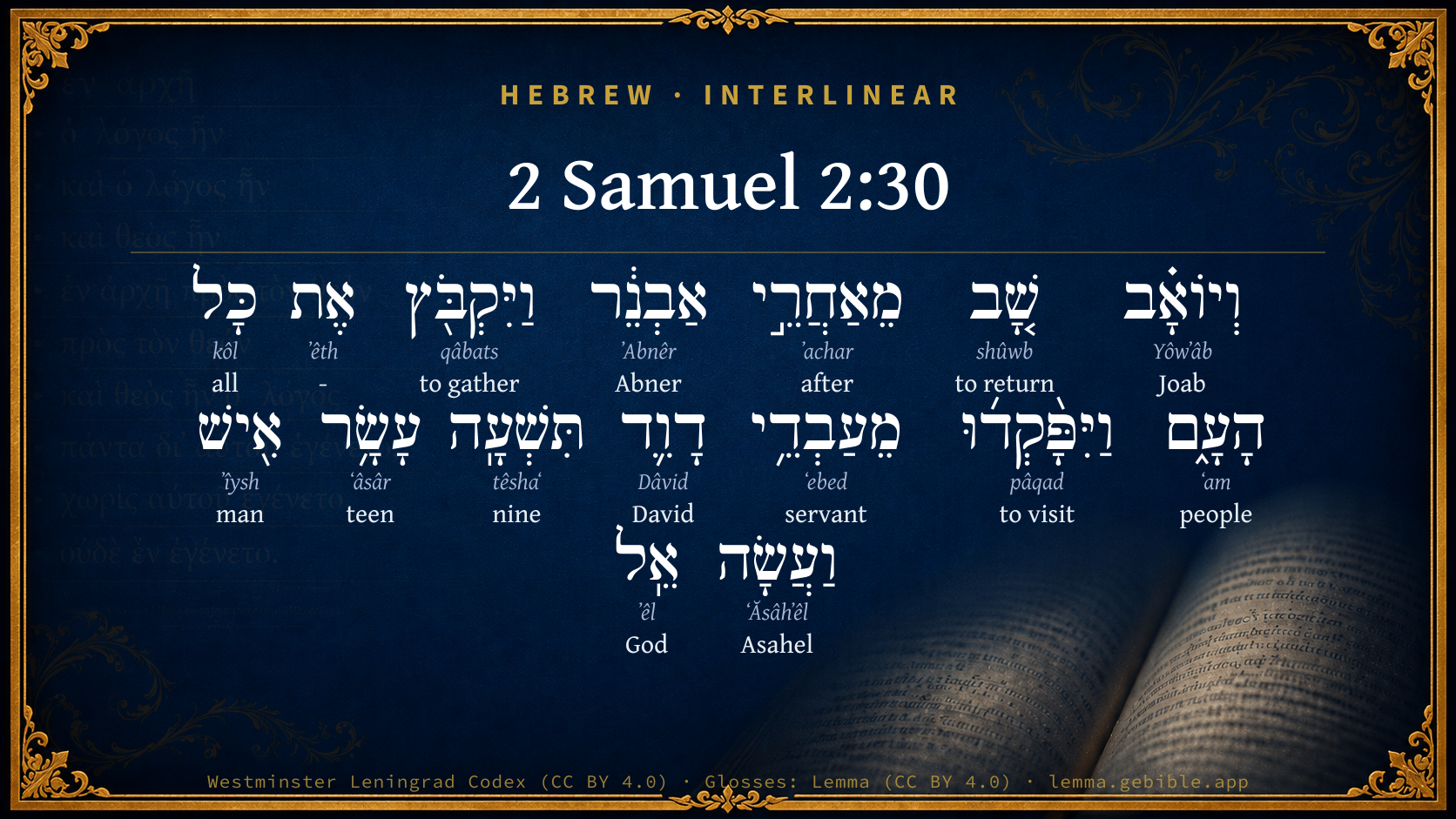
Hebrew (Westminster Leningrad Codex) 2 Samuel 2:30 appears in the Hebrew Old Testament. The text above is from the Westminster Leningrad Codex. Each word links to its Strong’s number, a concise gloss, and parsing drawn from the Open Scriptures Hebrew Bible morphology. Click any word for its full Brown-Driver-Briggs (BDB) entry.
Download image
Cite this verse

2 Samuel 2:30 (World English Bible). Public Domain. Lemma interlinear Bible study tool, https://lemma.gebible.app/v/2-samuel/2/30.

Show BibTeX & RIS
BibTeX
RIS
English Translation
Joab returned from following Abner: and when he had gathered all the people together, there lacked of David's servants nineteen men and Asahel.
World English Bible · Public Domain
Download a study sheet

One document with this verse’s original text, its word-by-word gloss line, the meaning frame, cross-references with their text, attributed commentary, and full source and license credits — printable, and it pastes into notes with its structure intact.

This verse Autodidact and up

Study sheet (.html) Plain text (.txt)

A passage Seminary Student

Up to 50 verses in one chapter. A passage sheet keeps up to 6 commentary sources and 12 cross-references per verse, in the order this page ranks them, and says so on the sheet whenever that leaves anything out. Ask for a single verse and you get the Autodidact verse sheet above.

Everything on this page stays free to read, with no account — the sheet is a download of what is already on screen, not access to it.

Want to remove ads? Support Godless Engineer
Compare translations 3

The same verse in 3 English versions, stacked beneath the original-language interlinear above. Click any original word for its lexicon entry.

Each is an independent rendering of the whole verse — the interlinear is not word-aligned to these translations.

Highlighted words mark where these versions differ — a whole-verse word diff, not a word-by-word alignment.

  • World English Bible Public Domain
    Joab returned from following Abner: and when he had gathered all the people together, there lacked of David's servants nineteen men and Asahel.
  • King James Version Public Domain
    And Joab returned from following Abner: and when he had gathered all the people together, there lacked of David's servants nineteen men and Asahel.
  • unfoldingWord Literal Text CC BY-SA 4.0
    And Joab returned from after Abner, and he assembled all of the people. And 19 men and Asahel were missing from the servants of David.

unfoldingWord Literal Text — © unfoldingWord, licensed CC BY-SA 4.0. Word-aligned USFM3 via Door43 (git.door43.org/unfoldingWord/en_ult).

Versions to compare (up to 4)

3 of 4 selected

Show all 18 translations

Every available English version of this verse, each an independent rendering of the whole verse.

  • World English Bible Public Domain
    Joab returned from following Abner: and when he had gathered all the people together, there lacked of David's servants nineteen men and Asahel.
  • Berean Standard Bible Public Domain
    When Joab returned from pursuing Abner, he gathered all the troops. In addition to Asahel, nineteen of David’s servants were missing,
  • Majority Standard Bible Public Domain
    When Joab returned from pursuing Abner, he gathered all the troops. In addition to Asahel, nineteen of David’s servants were missing,
  • King James Version Public Domain
    And Joab returned from following Abner: and when he had gathered all the people together, there lacked of David's servants nineteen men and Asahel.
  • American Standard Version (1901) Public Domain
    And Joab returned from following Abner: and when he had gathered all the people together, there lacked of David's servants nineteen men and Asahel.
  • Revised Version (1885) Public Domain
    And Joab returned from following Abner: and when he had gathered all the people together, there lacked of David’s servants nineteen men and Asahel.
  • Geneva Bible (1599) Public Domain
    Ioab also returned backe from Abner: and when he had gathered all the people together, there lacked of Dauids seruants nineteene men and Asahel.
  • Douay-Rheims (1899) Public Domain
    And Joab returning, after he had left Abner, assembled all the people: and there were wanting of David's servants nineteen men, beside Asael.
  • Young's Literal Translation Public Domain
    And Joab hath turned back from after Abner, and gathereth all the people, and there are lacking of the servants of David nineteen men, and Asahel;
  • Literal Standard Version CC BY-SA 4.0
    And Joab has turned back from after Abner, and gathers all the people, and there are lacking of the servants of David nineteen men, and Asahel;
  • Unlocked Literal Bible CC BY-SA 4.0
    Joab returned from pursuing Abner. He assembled all his men, from whom were missing Asahel and nineteen of David's soldiers.
  • unfoldingWord Literal Text CC BY-SA 4.0
    And Joab returned from after Abner, and he assembled all of the people. And 19 men and Asahel were missing from the servants of David.
  • Darby Bible Public Domain
    And Joab returned from following Abner, and gathered all the people together; and there lacked of David's servants nineteen men, and Asahel.
  • World Messianic Bible Public Domain
    Joab returned from following Abner; and when he had gathered all the people together, nineteen men of David’s and Asahel were missing.
  • Webster's Bible Public Domain
    And Joab returned from following Abner: and when he had assembled all the people, there lacked of David's servants nineteen men, and Asahel.
  • Free Bible Version CC BY-SA 4.0
    When Joab got back from chasing Abner, he gathered all the men together. Nineteen of David's men were missing in addition to Asahel.
  • Bible in Basic English Public Domain
    And Joab came back from fighting Abner: and when he had got all his men together, it was seen that nineteen of David's men, in addition to Asahel, were not with them.
  • JPS Tanakh (1917) Public Domain
    And Joab returned from following Abner; and when he had gathered all the people together, there lacked of David's servants nineteen men and Asahel.

Literal Standard Version (2020), Covenant Press — licensed CC BY-SA 4.0. Text via the HelloAO Bible API (eBible.org). Unlocked Literal Bible (unfoldingWord) — licensed CC BY-SA 4.0. Text via the HelloAO Bible API (eBible.org). unfoldingWord Literal Text — © unfoldingWord, licensed CC BY-SA 4.0. Word-aligned USFM3 via Door43 (git.door43.org/unfoldingWord/en_ult). Free Bible Version, Dr. Jonathan Gallagher — licensed CC BY-SA 4.0. Text via the HelloAO Bible API (eBible.org).

Word by word

More ways to search: Search by grammar → Find every occurrence → Compare this word →

Practice this passage: Drill this verse → Learn its vocabulary →

וַעֲשָׂה
ʻĂsâhʼêl
H6214
“and · Asahel”
Conjunction + Noun, Proper
Part of Speech
Conjunction + Noun
Type
Proper
Full BDB Definition

Origin: from H6213 and H410

TWOT: None

Asahel = "God-made" - nephew of David, son of David's sister Zeruiah, and brother of Joab and Abishai; swift of foot he was killed by Abner when he pursued him in battle and caught him - a Levite in the reign of king Jehoshaphat of Judah who went through the kingdom giving instruction in the law - a Levite in the reign of king Hezekiah of Judah in charge of the tithes and dedicated things in the temple - a priest, father of Jonathan, in the time of Ezra
  1. וְיוֹאָ֗ב Yôwʼâb H3097 “and · Joab” Conjunction + Noun, Proper
  2. שָׁ֚ב shûwb H7725 “to return” Verb, Qal, Perfect, 3rd Person, Masculine, Singular
  3. מֵאַחֲרֵ֣י ʼachar H310 “from · after” Preposition + Preposition
  4. אַבְנֵ֔ר ʼAbnêr H74 “Abner” Noun, Proper
  5. וַיִּקְבֹּ֖ץ qâbats H6908 “and · to gather” Conjunction + Verb, Qal, Sequential Imperfect, 3rd Person, Masculine, Singular
  6. אֶת ʼêth H853 “-” Particle, Direct Object
  7. כָּל kôl H3605 “all of” Noun, Common, Masculine, Singular, Construct
  8. הָעָ֑ם ʻam H5971 “the · people” Particle, Definite Article + Noun, Common, Masculine, Singular, Absolute
  9. וַיִּפָּ֨קְד֜וּ pâqad H6485 “and · to visit” Conjunction + Verb, Niphal, Sequential Imperfect, 3rd Person, Masculine, Plural
  10. מֵעַבְדֵ֥י ʻebed H5650 “from · servants of” Preposition + Noun, Common, Masculine, Plural, Construct
  11. דָוִ֛ד Dâvid H1732 “David” Noun, Proper
  12. תִּשְׁעָֽה têshaʻ H8672 “nine” Adjective, Cardinal number, Masculine, Singular, Absolute
  13. עָשָׂ֥ר ʻâsâr H6240 “teen” Adjective, Cardinal number, Masculine, Singular, Absolute
  14. אִ֖ישׁ ʼîysh H376 “man” Noun, Common, Masculine, Singular, Absolute
  15. אֵֽל ʼêl H410 “God” Noun, Proper

About this verse

These counts appear in no published source. They are computed here, from the morphology-tagged text and Lemma’s own curated glosses. What Lemma adds →

16
words
16
distinct lemmas
Historical
section

Notable vocabulary

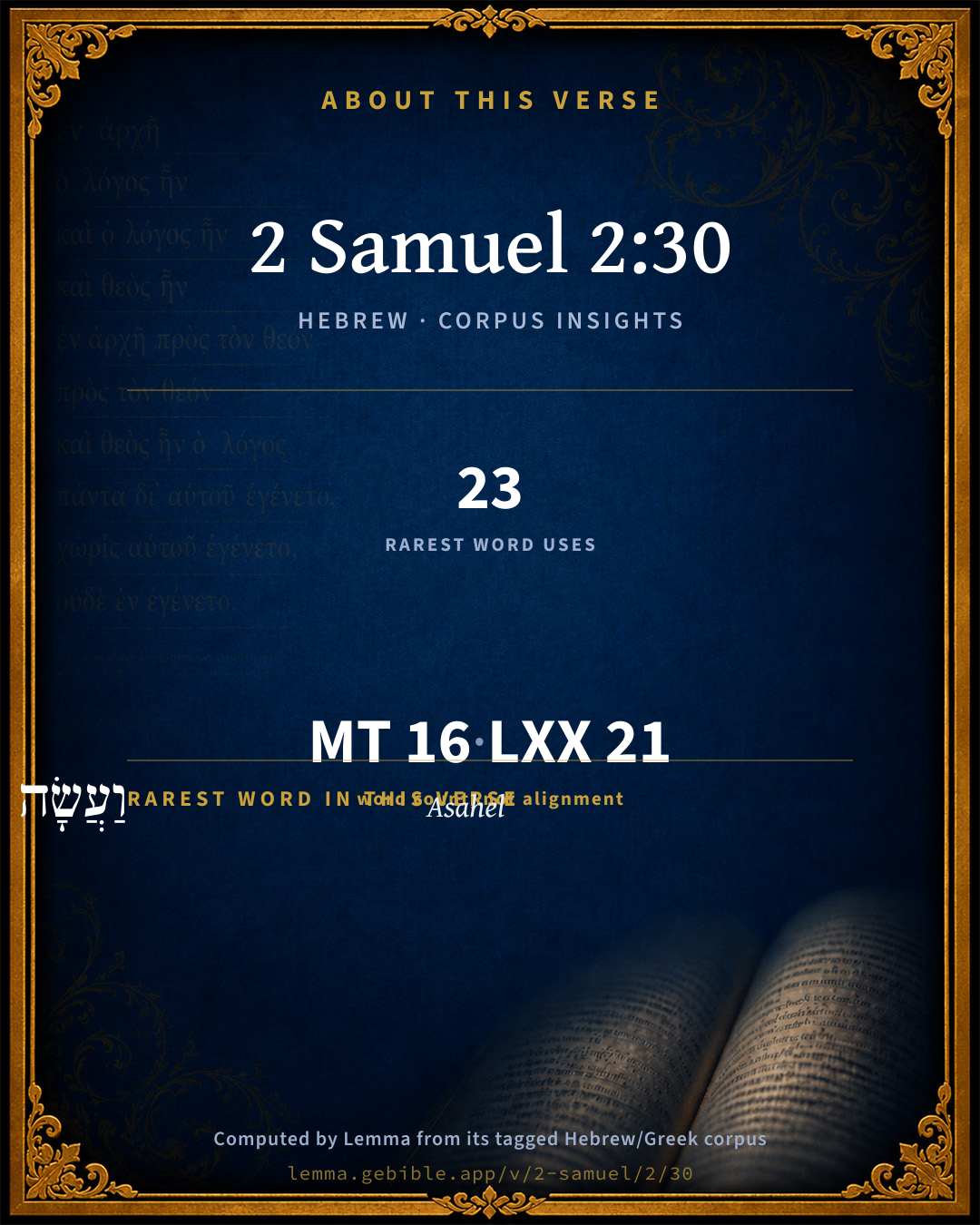
The rarest word here is וַעֲשָׂה Asahel H6214 — appearing just 23 times in the whole Hebrew Bible.

Shared distinctive vocabulary

וַעֲשָׂה Asahel H6214 occurs in 17 verses of the Hebrew Bible. Also found in:

Grammatical profile

  • 3 verbs
  • 9 nouns
  • 2 adjectives
  • 1 preposition
  • 1 particle

Verb forms

  • שָׁ֚ב Qal · Perfect
  • וַיִּקְבֹּ֖ץ Qal · Sequential Imperfect
  • וַיִּפָּ֨קְד֜וּ Niphal · Sequential Imperfect

Hebrew & Septuagint length

In English translation the verse runs 23 words from the Hebrew and 25 from the Septuagint (LXX English) — closely comparable.

A rough comparison of the two English renderings, which tokenize alike — not a word-level alignment.

Word counts can differ between the Hebrew and the Greek without any difference in meaning — e.g. the Hebrew direct-object marker אֵת has no separate Greek word, and Greek often adds the article ὁ.

In the original languages it is 16 Hebrew tokens and 21 Greek tokens — but the two are counted differently (Hebrew bundles its prefixes and suffixes into one token; the Greek is in lemma form), so that isn’t a like-for-like length.

Hebrew and Greek witnesses Masoretic Hebrew ↔ Greek Septuagint

The same verse in the two great witnesses to the Old Testament, shown verse-for-verse.

These are two independent witnesses, not word-aligned to each other, and the Septuagint is shown in lemma (dictionary) form.

Hebrew 2 Samuel 2:30 Masoretic · Westminster Leningrad Codex

וְיוֹאָ֗ב שָׁ֚ב מֵאַחֲרֵ֣י אַבְנֵ֔ר וַיִּקְבֹּ֖ץ אֶת כָּל הָעָ֑ם וַיִּפָּ֨קְד֜וּ מֵעַבְדֵ֥י דָוִ֛ד תִּשְׁעָֽה עָשָׂ֥ר אִ֖ישׁ וַעֲשָׂה אֵֽל

Joab returned from following Abner: and when he had gathered all the people together, there lacked of David's servants nineteen men and Asahel.

World English Bible · Public Domain

Greek LXX 2 Samuel 2:30 Septuagint · lemma form

καί ιωαβ ἀναστρέφω ὄπισθε ἀπό ὁ αβεννηρ καί συνἀθροίζω πᾶς ὁ λαός καί ἐπισκέπτομαι ὁ παῖς δαυίδ ἐννεακαίδεκα ἀνήρ καί ασαηλ

And Joab returned from following Abenner, and he assembled all the people, and there were missing of the people of David, nineteen men, and Asael.

LXX2012 (modern English Septuagint) · Public Domain

Hebrew: Westminster Leningrad Codex (CC BY 4.0). Greek: Septuagint (public domain); English from LXX2012 (modern English Septuagint) (Public Domain). How the Septuagint differs from the Hebrew →

Targum (Aramaic paraphrase)

1

The Targum is the ancient Jewish Aramaic paraphrase of the Hebrew Scriptures — an interpretive translation, not the Hebrew text itself. Onkelos (literal) and Pseudo-Jonathan (expansive) render the Torah, and Jonathan the Prophets. Coverage is partial: where no permissively-licensed English translation exists for a verse, only the Aramaic is shown. This is verse-level text, not a word-by-word alignment to the Hebrew.

  1. Targum Jonathan Prophets (Joshua–Malachi)
    וְיוֹאָב תַּב מִבָּתַר אַבְנֵר וּכְנַשׁ יַת כָּל עַמָא וּשְׁגוֹ מֵעַבְדֵי דָוִד תִּשְׁעַת עֲסַר גַבְרָא וַעֲשָׂהאֵל:

    (no public-domain English translation for this verse)

    Targum Jonathan — Aramaic: “Mikraot Gedolot” (public domain). English: “Sefaria Community Translation” (CC0 1.0 (public-domain dedication)); “London "Chaldee Paraphrase," 1871” (public domain). Text via Sefaria.

Commentary

Notes on 2 Samuel 2:30 from classic Christian and Jewish commentators (each source and its license shown beneath its notes). The classic Christian expositions comment on the surrounding passage and are grouped to its opening verse, so a note may address several verses; the Jewish commentaries on the Tanakh (Rashi and others) are per-verse, so they appear only where the commentator wrote on this verse.

Lemma curates 59 commentaries, every one of them public domain or Creative Commons licensed, each selected and text-cleaned for this edition rather than reprinted as found. About our sources →

Trapp's Complete Commentary

John Trapp

2Sa 2:30 And Joab returned from following Abner: and when he had gathered all the people together, there lacked of David’s servants nineteen men and Asahel.

Ver. 30. There lacked of David’s servants, &c.] War is the slaughter house of mankind, and the hell of this present world, saith one: Mars Alpha malorum. It openeth the gates of infelicity that were shut up in times of peace. Wherefore Lactantius {a} thought it not lawful for a just man to be a warrior: whose justice was to be his warfare. Some Anabaptists also hold the same. But God is called a man of war, {Exo 15:3} and said to have war with Amalek; {Exo 17:16} he sendeth the sword; {Eze 14:17} mustereth the men; {Isa 13:4} ordereth the ammunition; {Jer 50:25} batheth the sword in heaven. {Isa 34:5} David fought his battles. {1Sa 25:28} Captain Cornelius, who was of the Italian band, was highly accepted in heaven. John Baptist disliked not the soldiers’ calling, but directeth them how to manage it, &c.

{a} Instit., lib. vi. cap. 20.

John Trapp, A Commentary or Exposition upon All the Books of the Old and New Testament (1647–1656) — public domain. Text from a community e-Sword module.

Joseph Benson's Commentary

2Sa 2:30. There lacked of David’s servants nineteen men — This renders it probable that the twelve men of Judah, who in the beginning of the fight engaged in combat with as many men of Benjamin, were not killed; for if they were, then there would have been no more than seven men killed in the subsequent battle; which is not likely.

Joseph Benson's Commentary on the Old and New Testaments (1811–1818) — public domain. Text from a community e-Sword module.

Ellicott's Commentary for English Readers

(30) Joab returned.—He cannot be supposed to have returned that day farther than to Gibeon, since it was already sunset (2Sa_2:24) before the pursuit ended. There, doubtless, he mustered his forces, and counted and buried the slain.

Nineteen men.—It is uncertain whether these numbers include the twelve champion combatants on each side. The great disparity of numbers slain on the two sides is to be accounted for partly by the advantage given by bow and spear, the chief weapons of ancient warfare, to the pursuer over the pursued, and partly by the fact that Joab’s men had been long trained under David in hardship and deeds of valour, while Abner’s men were the remnants of Saul’s defeated army.

A Bible Commentary for English Readers, edited by Charles John Ellicott (1878–1897) — public domain. Text from a community e-Sword module.

John Gill's Exposition

And Joab returned from following Abner,.... It being in his commission from David to shed as little blood as he could:

and when he had gathered all the people together; who had been pursuing the Israelites, some one way and some another:

there lacked of David's servants nineteen men, and Asahel; who is particularly mentioned, because a very honourable man, valiant and courageous, a relation of David, and brother of Joab the general, and the loss of him was greater than all the rest. This has made some think that the twelve men of the servants of David were not killed in the duel, or otherwise there must be but seven slain in the battle; though that is not more strange than that in the battle with Midian not one should be slain, and, yet a terrible slaughter was made of the Midianites, Num 31:1. So in a sharp battle between the Spartans and Arcadians, ten thousand of the latter were slain, and not one of the former (q). Stilicho killed more than an hundred thousand of the army of Rhadagaisus, king of the Goths, without losing one of his own men, no, not so much as one wounded, as Austin affirms (r). At the battle of Issus the Persians lost an hundred ten thousand men, and Alexander not two hundred (s). Julius Caesar killed in the three camps of Juba, Scipio, and Labienus, ten thousand men, with the loss of fifty men only (t). After these instances, not only the case here, but that between the Israelites and Midianites, cannot be thought incredible, for the sake of which the above are produced. This account, according to Josephus (u), was taken the day following.

(q) Diodor. Sic. l. 15. p. 383. (r) De civilate Dei, l. 5. c. 23. (s) Curtius, l. 3. c. 11. (t) Hirtius de Bello African. c. 86. (u) Antiqu. l. 7. c. 1. sect. 3.

John Gill's Exposition of the Whole Bible (1746–1763) — public domain (CC PDM 1.0). Text via the HelloAO Bible API.

Whedon's Commentary on the Bible

Daniel D. Whedon

30. Nineteen men and Asahel — Whilst Abner lost three hundred and sixty men. But Abner’s army had been weakened and disheartened by the defeat at Gilboa, and perhaps by other subsequent struggles with the Philistines, whilst Joab’s men were probably all picked warriors, who had for years followed David, and taken lessons from his consummate military skill.

Daniel D. Whedon (gen. ed.), Commentary on the Old and New Testaments (1874–1909) — public domain. Text from a community e-Sword module.

The Pulpit Commentary

Vers. 30, 31. Nineteen men three hundred and three score men. Though David"s "mighties," as they were called, excelled in the use of arms, yet the disparity of numbers is remarkable; for the Benjamites were also famous warriors. We can only account for it by the superiority of the tactics of Joab, who was a man of consummate military skill, and who knew both how to gain a victory and how to use the advantage which the pursuers have over the pursued to the full. If we sometimes wonder that David endured Joab so long, we ought to remember how much he owed to his nephew"s genius, and that Joab was always faithful to himself.

Vers. 30-32. (GIBEON, BETHLEHEM, HEBRON.)

The sorrows of victory.

a glorious thing must be a victory, sir!" it was remarked to the Duke of Wellington. "The greatest tragedy in the world," he replied, "except a defeat" ("Recollections," by S. Rogers). The rejoicing by which it is attended, is usually mingled with weeping and sometimes swallowed up of grief. Various persons are thus affected for various reasons. Think of the sorrows endured:

1. At the fall of fellow soldiers. "Nineteen men and Asahel" (vers. 23, 30) who come not to the muster after sunset (vers. 24, 30), nor answer to the roll call, but lie in the chill embrace of death. "Alas! fallen are the heroes.

2. In the burial of the dead. (Ver. 32.) No opportunity is afforded for seeking out and burying all the slain; but the remains of Asahel are carried across the hills by night (ver. 29) and laid in the tomb of his father in Bethlehem, where the sorrow of the preceding day is renewed. It reminds us of a pathetic scene of recent times described in the familiar lines

We buried him darkly at dead of night, The sod with our bayonets turning; By the struggling moonbeam"s misty light, And our lanterns dimly burning. (Wolfe.)

1. When the news is conveyed to their homes. "They came to Hebron at break of day;" a day of bitter grief to many bereaved hearts. "By the slaughter of a war there are thousands who weep in unpitied and unnoticed secrecy whom the world does not see; and thousands who retire in silence to hopeless poverty for whom the world does not care" (Dymond).

2. For the miseries of fellow sufferers; the enemy defeated, bereaved, and mourning for they too are "brethren," and cannot but be remembered with sympathy and pity.

3. Concerning the state of the departed. A soldier"s life is not favourable to piety and preparation for heaven, and the passions by which he is commonly swayed when his earthly probation is suddenly terminated are such that we can seldom contemplate his entrance into the eternal world with feelings of cheerfulness and hope. "After death the judgment.

4. On account of the animosities of the living, which are increased by conflict and victory, and are certain to be a source of future trouble. (2Sa_3:1, 2Sa_3:30, 2Sa_3:33)

5. Because of the dishonour done to the cause of the Lord"s Anointed. Religion suffers, the progress of the kingdom is hindered, and the King himself is "grieved for the misery of Israel." "The victory that day was turned into mourning". (2Sa_19:2) So is every victory gained by "the devouring sword." But there are victories which are bloodless and tearless, sources of unmingled joy; spiritual victories over ignorance and sin won by and through the might of him at whose birth the angels sang upon those hills of Bethlehem, "Glory to God in the highest, and on earth peace, good will toward men. D.

The Pulpit Commentary (1880–1919), ed. H.D.M. Spence-Jones & Joseph S. Exell — public domain. Text from a community e-Sword module.

Keil & Delitzsch

C. F. Keil & F. Delitzsch

Joab also assembled his men for a retreat. Nineteen of his soldiers were missing besides Asahel, all of whom had fallen in the battle. But they had slain as many as three hundred and sixty of Benjamin and of Abner's men. This striking disproportion in the numbers may be accounted for from the fact that in Joab's army there were none but brave and well-tried men, who had gathered round David a long time before; whereas in Abner's army there were only the remnants of the Israelites who had been beaten upon Gilboa, and who had been still further weakened and depressed by their attempts to recover the land which was occupied by the Philistines.

Keil & Delitzsch — Biblical Commentary on the Old Testament (1861–1891) — public domain (CC PDM 1.0). Text via the HelloAO Bible API. (Old Testament only.)

unfoldingWord translationNotes

Door43 World Missions Community

Asahel

This is the name of a man. (See: How to Translate Names)

360 men of Benjamin with Abner

"360 men from Benjamin who followed Abner." Abner did not die.

360 men

"three hundred and sixty men" (See: Numbers)

of Benjamin

This phrase means "from the tribe of Benjamin." (See: Metonymy)

took up Asahel

"carried Asahel's body with them"

the day dawned on them at Hebron

"they arrived at Hebron by dawn the next morning"

translationWords

Joab

Abner

Benjamin

bury

grave

Bethlehem

Hebron

unfoldingWord translationNotes — © Distant Shores Media and the Door43 World Missions Community, licensed CC BY-SA 4.0. Source: git.door43.org/Door43/en_tn.

Rashi

Rabbi Shlomo Yitzchaki (Rashi)

Nineteen men and Asoel. But is not Asoel included in [the group called] "the servants of Dovid," so why is he [singled] out? [The reason is] he was worth all of them [together] and so too [a similar case], (Yehoshua 2,1), "Go see [and spy out] the land and Yericho" and so too [another similar case] "King Shlomo loved many foreign women and the daughter of Pharaoh." (Kings I, 11, 1 ).

Rashi on the Tanakh — English translations: “The Judaica Press complete Tanach with Rashi, translated by A. J. Rosenberg” (CC BY 4.0); “Pentateuch with Rashi's commentary by M. Rosenbaum and A.M. Silbermann, 1929-1934” (public domain); “The Metsudah Tanach series, Lakewood, N.J” (CC BY 4.0); and “The Book of Joshua, Metsudah Publications, 1997” (CC BY 4.0). Text via Sefaria.

Lesson kit

Teaching starters — assembled from the data on this page, not authored interpretation. Every prompt links to the verse data it draws on. Edit before teaching.

2 Samuel, in the Historical, opens this verse with 16 words (16 distinct Hebrew lemmas). Its most distinctive word is ʻĂsâhʼêl (“Asahel”). A historical commentator’s framing appears above. Read the whole chapter for the surrounding context.

Discussion questions

  1. The word ʻĂsâhʼêl carries the sense “Asahel.” How does it shape the verse?
  2. 2 Samuel 2:18 shares the word «Asahel» with this verse. How do the two illuminate each other?
  3. These translations render this verse differently; the difference is in the English rendering, not the original. What questions does that raise?
  4. The verb «שָׁ֚ב» is Qal Perfect. How does its form color the action?
  5. Reading how Trapp's Complete Commentary and Joseph Benson's Commentary read this verse, where do the two commentators agree and where do they part?

Things to notice

Reading settings

Reading text

Shown beneath each verse's original-language words.

Old Testament
Old Testament edition

Read the OT as the Masoretic Hebrew (MT) or the Greek Septuagint (LXX).

English shown for the Greek Septuagint (in the Hebrew ↔ Greek comparison).

Comparing translations? Open the Compare panel on any verse page to stack up to four side by side.