
Ezekiel 20:22

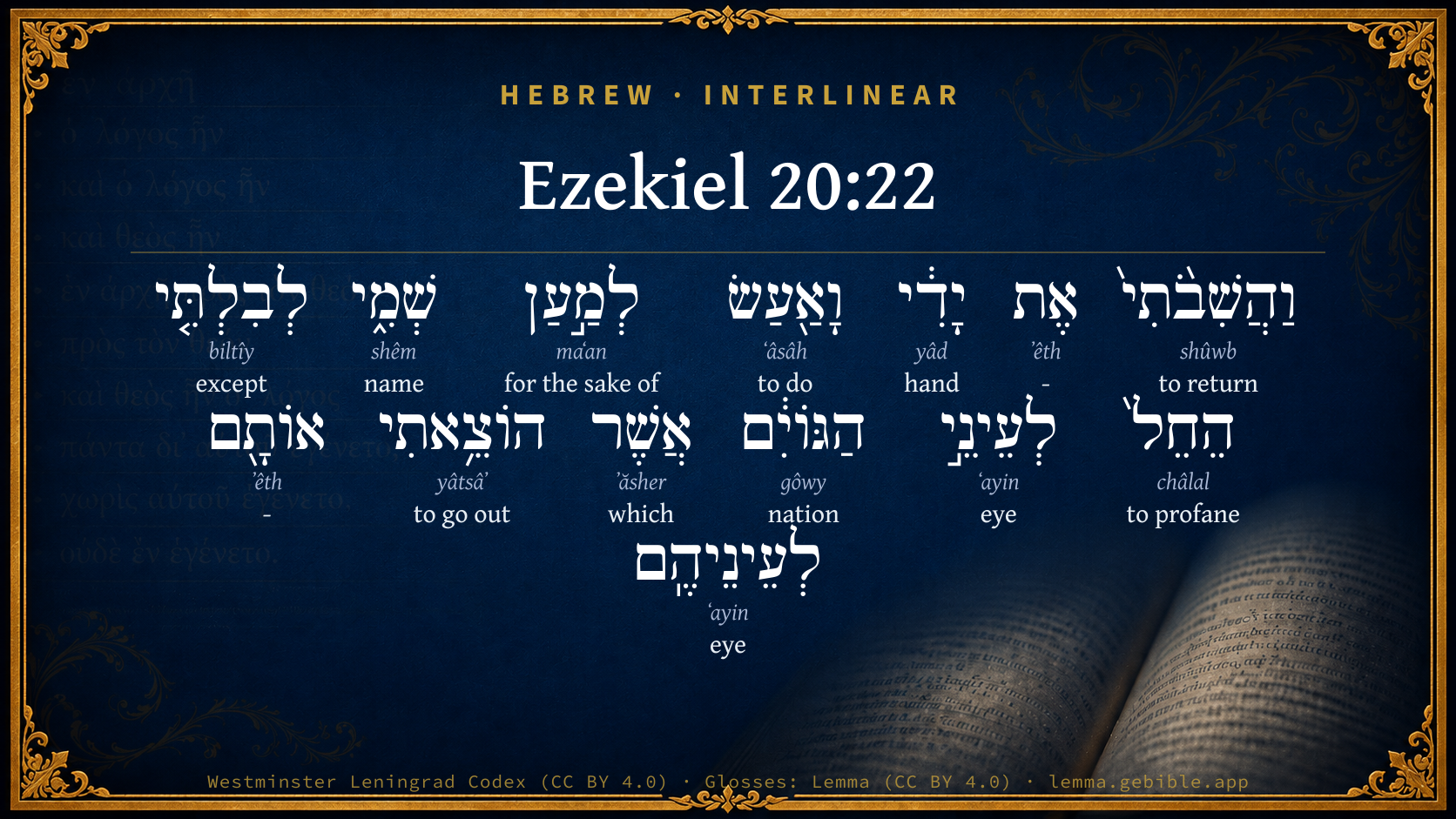
Hebrew (Westminster Leningrad Codex) Ezekiel 20:22 appears in the Hebrew Old Testament. The text above is from the Westminster Leningrad Codex. Each word links to its Strong’s number, a concise gloss, and parsing drawn from the Open Scriptures Hebrew Bible morphology. Click any word for its full Brown-Driver-Briggs (BDB) entry.
Download image
Cite this verse

Ezekiel 20:22 (World English Bible). Public Domain. Lemma interlinear Bible study tool, https://lemma.gebible.app/v/ezekiel/20/22.

Show BibTeX & RIS
BibTeX
RIS
English Translation
Nevertheless I withdrew my hand, and worked for my name's sake, that it should not be profaned in the sight of the nations, in whose sight I brought them forth.
World English Bible · Public Domain
Download a study sheet

One document with this verse’s original text, its word-by-word gloss line, the meaning frame, cross-references with their text, attributed commentary, and full source and license credits — printable, and it pastes into notes with its structure intact.

This verse Autodidact and up

Study sheet (.html) Plain text (.txt)

A passage Seminary Student

Up to 50 verses in one chapter. A passage sheet keeps up to 6 commentary sources and 12 cross-references per verse, in the order this page ranks them, and says so on the sheet whenever that leaves anything out. Ask for a single verse and you get the Autodidact verse sheet above.

Everything on this page stays free to read, with no account — the sheet is a download of what is already on screen, not access to it.

Want to remove ads? Support Godless Engineer
Compare translations 3

The same verse in 3 English versions, stacked beneath the original-language interlinear above. Click any original word for its lexicon entry.

Each is an independent rendering of the whole verse — the interlinear is not word-aligned to these translations.

Highlighted words mark where these versions differ — a whole-verse word diff, not a word-by-word alignment.

  • World English Bible Public Domain
    Nevertheless I withdrew my hand, and worked for my name's sake, that it should not be profaned in the sight of the nations, in whose sight I brought them forth.
  • King James Version Public Domain
    Nevertheless I withdrew mine hand, and wrought for my name's sake, that it should not be polluted in the sight of the heathen, in whose sight I brought them forth.
  • unfoldingWord Literal Text CC BY-SA 4.0
    But I turned my hand away and acted for my name’s sake, so it would not be profaned in the eyes of the nations in whose sight I had brought out the Israelites.

unfoldingWord Literal Text — © unfoldingWord, licensed CC BY-SA 4.0. Word-aligned USFM3 via Door43 (git.door43.org/unfoldingWord/en_ult).

Versions to compare (up to 4)

3 of 4 selected

Show all 18 translations

Every available English version of this verse, each an independent rendering of the whole verse.

  • World English Bible Public Domain
    Nevertheless I withdrew my hand, and worked for my name's sake, that it should not be profaned in the sight of the nations, in whose sight I brought them forth.
  • Berean Standard Bible Public Domain
    But I withheld My hand and acted for the sake of My name, so that it would not be profaned in the eyes of the nations in whose sight I had brought them out.
  • Majority Standard Bible Public Domain
    But I withheld My hand and acted for the sake of My name, so that it would not be profaned in the eyes of the nations in whose sight I had brought them out.
  • King James Version Public Domain
    Nevertheless I withdrew mine hand, and wrought for my name's sake, that it should not be polluted in the sight of the heathen, in whose sight I brought them forth.
  • American Standard Version (1901) Public Domain
    Nevertheless I withdrew my hand, and wrought for my name's sake, that it should not be profaned in the sight of the nations, in whose sight I brought them forth.
  • Revised Version (1885) Public Domain
    Nevertheless I withdrew mine hand, and wrought for my name’s sake, that it should not he profaned in the sight of the nations, in whose sight I brought them forth.
  • Geneva Bible (1599) Public Domain
    Neuerthelesse I withdrew mine hand and had respect to my Name that it should not be polluted before the heathen, in whose sight I brought them foorth.
  • Douay-Rheims (1899) Public Domain
    But I turned away my hand, and wrought for my name's sake, that it might not be violated before the nations, out of which I brought them forth in their sight.
  • Young's Literal Translation Public Domain
    And I have turned back My hand, And I do `it' for My name's sake, Not to pollute `it' before the eyes of the nations, Before whose eyes I brought them out.
  • Literal Standard Version CC BY-SA 4.0
    And I have turned back My hand, || And I do [it] for My Name’s sake, || Not to defile [it] before the eyes of the nations, || Before whose eyes I brought them out.
  • Unlocked Literal Bible CC BY-SA 4.0
    But I turned my hand away and acted for my name's sake, so it would not be profaned in the eyes of the nations in whose sight I had brought out the Israelites.
  • unfoldingWord Literal Text CC BY-SA 4.0
    But I turned my hand away and acted for my name’s sake, so it would not be profaned in the eyes of the nations in whose sight I had brought out the Israelites.
  • Darby Bible Public Domain
    But I withdrew my hand, and wrought for my name's sake, that it should not be profaned in the sight of the nations, in whose sight I had brought them out.
  • World Messianic Bible Public Domain
    Nevertheless I withdrew my hand and worked for my name’s sake, that it should not be profaned in the sight of the nations, in whose sight I brought them out.
  • Webster's Bible Public Domain
    Nevertheless I withdrew my hand, and wrought for my name's sake, that it should not be profaned in the sight of the heathen, in whose sight I brought them forth.
  • Free Bible Version CC BY-SA 4.0
    But I held back and did what I did so I would not be misrepresented, so that I wouldn't lose respect in the eyes of the other nations who had seen me lead Israel out of Egypt.
  • Bible in Basic English Public Domain
    And I was acting for the honour of my name, so that it might not be made unclean in the eyes of the nations, before whose eyes I had taken them out.
  • JPS Tanakh (1917) Public Domain
    Nevertheless I withdrew My hand, and wrought for My name's sake, that it should not be profaned in the sight of the nations, in whose sight I brought them forth.

Literal Standard Version (2020), Covenant Press — licensed CC BY-SA 4.0. Text via the HelloAO Bible API (eBible.org). Unlocked Literal Bible (unfoldingWord) — licensed CC BY-SA 4.0. Text via the HelloAO Bible API (eBible.org). unfoldingWord Literal Text — © unfoldingWord, licensed CC BY-SA 4.0. Word-aligned USFM3 via Door43 (git.door43.org/unfoldingWord/en_ult). Free Bible Version, Dr. Jonathan Gallagher — licensed CC BY-SA 4.0. Text via the HelloAO Bible API (eBible.org).

Word by word

More ways to search: Search by grammar → Find every occurrence → Compare this word →

Practice this passage: Drill this verse → Learn its vocabulary →

לְבִלְתִּ֤י
biltîy
H1115
“to/for · except”
Preposition + Conjunction
Part of Speech
Preposition + Conjunction
Full BDB Definition

Origin: constructive fem. of H1086 (equivalent to H1097 )

TWOT: 246i

not, except (substantive) - not (adverb) - except (after preceding negation) (adverb) - except (after an implied or expressed negation) (conjunction) - so as not, in order not (with preposition) - an account of not, because...not (with preposition) - until not (with preposition)
  1. וַהֲשִׁבֹ֨תִי֙ shûwb H7725 “and · to return” Conjunction + Verb, Hiphil, Perfect, 1st Person, Common, Singular
  2. אֶת ʼêth H853 “-” Particle, Direct Object
  3. יָדִ֔י yâd H3027 “hand · my” Noun, Common, Both, Singular, Construct + Suffix, Personal, 1st Person, Common, Singular
  4. וָאַ֖עַשׂ ʻâsâh H6213 “and · to do” Conjunction + Verb, Qal, Sequential Imperfect, 1st Person, Common, Singular
  5. לְמַ֣עַן maʻan H4616 “for the sake of” Preposition
  6. שְׁמִ֑י shêm H8034 “name · my” Noun, Common, Masculine, Singular, Construct + Suffix, Personal, 1st Person, Common, Singular
  7. הֵחֵל֙ châlal H2490 “to profane” Verb, Niphal, Infinitive Construct
  8. לְעֵינֵ֣י ʻayin H5869 “to/for · eyes of” Preposition + Noun, Common, Both, Dual, Construct
  9. הַגּוֹיִ֔ם gôwy H1471 “the · nations” Particle, Definite Article + Noun, Common, Masculine, Plural, Absolute
  10. אֲשֶׁר ʼăsher H834 “which” Particle, Relative
  11. הוֹצֵ֥אתִי yâtsâʼ H3318 “to go out” Verb, Hiphil, Perfect, 1st Person, Common, Singular
  12. אוֹתָ֖ם ʼêth H853 “- · them” Particle, Direct Object + Suffix, Personal, 3rd Person, Masculine, Plural
  13. לְעֵינֵיהֶֽם ʻayin H5869 “to/for · eyes · their” Preposition + Noun, Common, Both, Dual, Construct + Suffix, Personal, 3rd Person, Masculine, Plural

About this verse

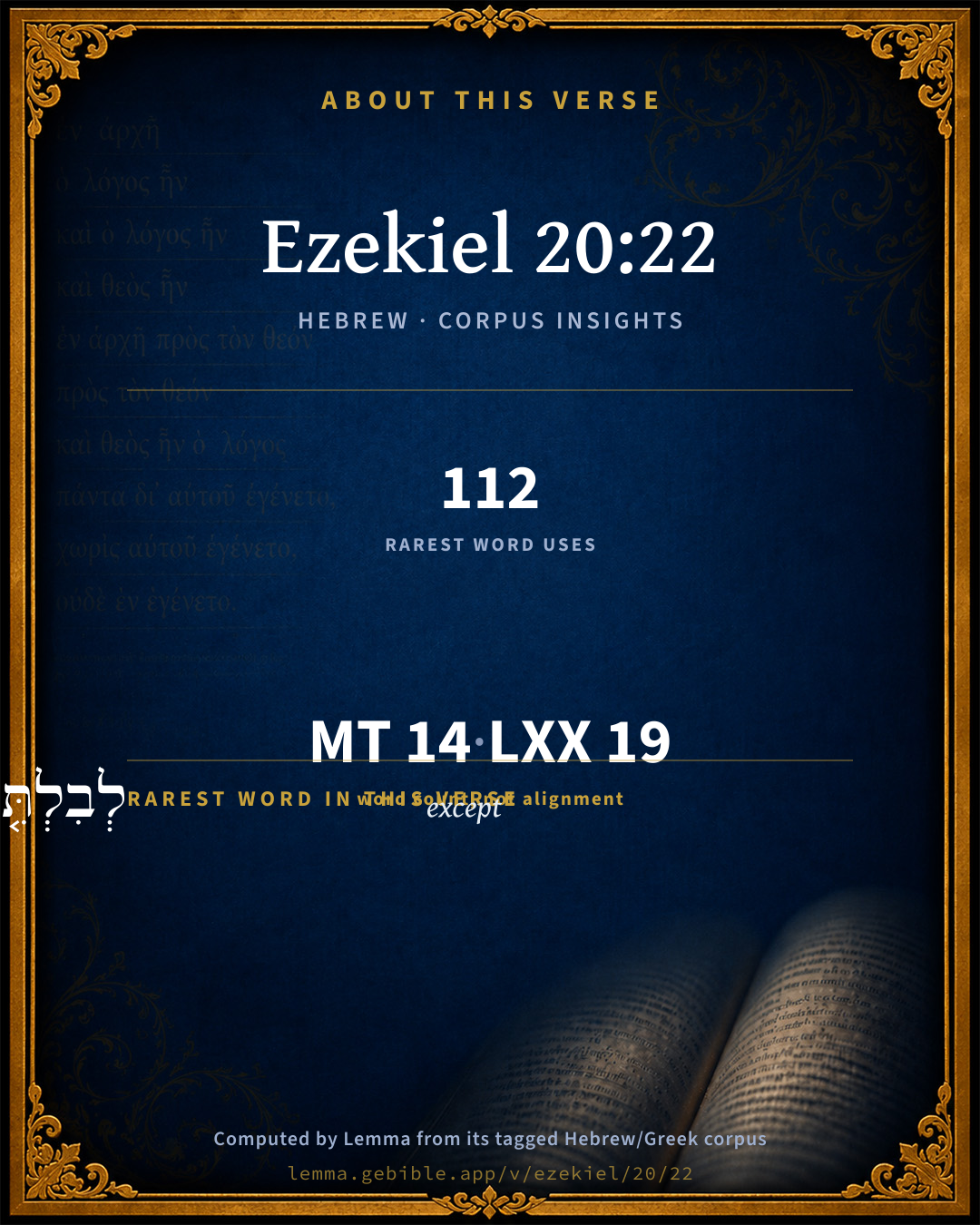
These counts appear in no published source. They are computed here, from the morphology-tagged text and Lemma’s own curated glosses. What Lemma adds →

14
words
12
distinct lemmas
Prophets
section

Grammatical profile

  • 4 verbs
  • 5 nouns
  • 1 preposition
  • 1 conjunction
  • 3 particles

Verb forms

  • וַהֲשִׁבֹ֨תִי֙ Hiphil · Perfect
  • וָאַ֖עַשׂ Qal · Sequential Imperfect
  • הֵחֵל֙ Niphal · Infinitive Construct
  • הוֹצֵ֥אתִי Hiphil · Perfect

Repetition

A word recurs within this verse — often emphatic in Hebrew:

  • לְעֵינֵ֣י eye H5869 ×2

Hebrew & Septuagint length

In English translation the verse runs 30 words from the Hebrew and 24 from the Septuagint (LXX English) — closely comparable.

A rough comparison of the two English renderings, which tokenize alike — not a word-level alignment.

Word counts can differ between the Hebrew and the Greek without any difference in meaning — e.g. the Hebrew direct-object marker אֵת has no separate Greek word, and Greek often adds the article ὁ.

In the original languages it is 14 Hebrew tokens and 19 Greek tokens — but the two are counted differently (Hebrew bundles its prefixes and suffixes into one token; the Greek is in lemma form), so that isn’t a like-for-like length.

Cross-references

14

Topical passages linked to Ezekiel 20:22 in the Treasury of Scripture Knowledge — connected by theme and wording, ordered by reader-vote popularity; previews shown in the World English Bible.

  • Ezekiel 20:9 But I worked for my name's sake, that it should not be profaned in the sight of the nations, among which they were, in whose sight I made myself known to them, in bringing them forth out of the land of Egypt.
  • Ezekiel 20:14 But I worked for my name's sake, that it should not be profaned in the sight of the nations, in whose sight I brought them out.
  • Psalms 78:38 But he, being merciful, forgave iniquity, and didn't destroy them. Yes, many times he turned his anger away, And didn't stir up all his wrath.
  • Isaiah 48:9–11 For my name's sake will I defer my anger, and for my praise will I refrain for you, that I not cut you off.
  • Jeremiah 14:21 Do not abhor [us], for your name's sake; do not disgrace the throne of your glory: remember, don't break your covenant with us.
  • Job 13:21 Withdraw your hand far from me; And don't let your terror make me afraid.
  • Psalms 79:9–10 Help us, God of our salvation, for the glory of your name. Deliver us, and forgive our sins, for your name's sake.
  • Jeremiah 14:7 Though our iniquities testify against us, work you for your name's sake, Yahweh; for our backslidings are many; we have sinned against you.
  • Ezekiel 20:17 Nevertheless my eye spared them, and I didn't destroy them, neither did I make a full end of them in the wilderness.
  • Psalms 25:11 For your name's sake, Yahweh, Pardon my iniquity, for it is great.
  • Psalms 115:1 Not to us, Yahweh, not to us, But to your name give glory, For your loving kindness, and for your truth's sake.
  • Lamentations 2:8 Yahweh has purposed to destroy the wall of the daughter of Zion; He has stretched out the line, he has not withdrawn his hand from destroying; He has made the rampart and wall to lament; they languish together.
  • Daniel 9:17 Now therefore, our God, listen to the prayer of your servant, and to his petitions, and cause your face to shine on your sanctuary that is desolate, for the Lord's sake.
  • Daniel 9:19 Lord, hear; Lord, forgive; Lord, listen and do; don't defer, for your own sake, my God, because your city and your people are called by your name.

Cross-references courtesy of OpenBible.info (CC BY 4.0).

Hebrew and Greek witnesses Masoretic Hebrew ↔ Greek Septuagint

The same verse in the two great witnesses to the Old Testament, shown verse-for-verse.

These are two independent witnesses, not word-aligned to each other, and the Septuagint is shown in lemma (dictionary) form.

Hebrew Ezekiel 20:22 Masoretic · Westminster Leningrad Codex

וַהֲשִׁבֹ֨תִי֙ אֶת יָדִ֔י וָאַ֖עַשׂ לְמַ֣עַן שְׁמִ֑י לְבִלְתִּ֤י הֵחֵל֙ לְעֵינֵ֣י הַגּוֹיִ֔ם אֲשֶׁר הוֹצֵ֥אתִי אוֹתָ֖ם לְעֵינֵיהֶֽם

Nevertheless I withdrew my hand, and worked for my name's sake, that it should not be profaned in the sight of the nations, in whose sight I brought them forth.

World English Bible · Public Domain

Greek LXX Ezekiel 20:22 Septuagint · lemma form

καί ποιέω ὅπως ὁ ὄνομα ἐγώ ὁ παράπαν μή βεβηλόω ἐνώπιον ὁ ἔθνος ὅς ἐκἄγω αὐτός κατά ὀφθαλμός αὐτός

But I wrought so that my name might not be at all profaned before the Gentiles; and I brought them out in their sight.

LXX2012 (modern English Septuagint) · Public Domain

On this verse, The Cambridge Bible for Schools and Colleges discusses the Septuagint’s reading. Read the note in Commentary ↓

Hebrew: Westminster Leningrad Codex (CC BY 4.0). Greek: Septuagint (public domain); English from LXX2012 (modern English Septuagint) (Public Domain). How the Septuagint differs from the Hebrew →

Targum (Aramaic paraphrase)

1

The Targum is the ancient Jewish Aramaic paraphrase of the Hebrew Scriptures — an interpretive translation, not the Hebrew text itself. Onkelos (literal) and Pseudo-Jonathan (expansive) render the Torah, and Jonathan the Prophets. Coverage is partial: where no permissively-licensed English translation exists for a verse, only the Aramaic is shown. This is verse-level text, not a word-by-word alignment to the Hebrew.

  1. Targum Jonathan Prophets (Joshua–Malachi)
    וַאֲתֵיב יַת מְחַת גְבוּרְתִּי וַעֲבָדֵית בְּדִיל שְׁמִי בְּדִיל דְלָא יִתְחַל לְעֵינֵי עַמְמַיָא דְאַפְקֵית יַתְהוֹן לְעֵינֵיהוֹן:

    (no public-domain English translation for this verse)

    Targum Jonathan — Aramaic: “Mikraot Gedolot” (public domain). English: “Sefaria Community Translation” (CC0 1.0 (public-domain dedication)); “London "Chaldee Paraphrase," 1871” (public domain). Text via Sefaria.

Commentary

Notes on Ezekiel 20:22 from classic Christian and Jewish commentators (each source and its license shown beneath its notes). The classic Christian expositions comment on the surrounding passage and are grouped to its opening verse, so a note may address several verses; the Jewish commentaries on the Tanakh (Rashi and others) are per-verse, so they appear only where the commentator wrote on this verse.

Lemma curates 59 commentaries, every one of them public domain or Creative Commons licensed, each selected and text-cleaned for this edition rather than reprinted as found. About our sources →

Trapp's Complete Commentary

John Trapp

Eze 20:22 Nevertheless I withdrew mine hand, and wrought for my name’s sake, that it should not be polluted in the sight of the heathen, in whose sight I brought them forth.

Ver. 22. See on Eze 20:14.

John Trapp, A Commentary or Exposition upon All the Books of the Old and New Testament (1647–1656) — public domain. Text from a community e-Sword module.

Adam Clarke's Commentary

Verse 22. I withdrew mine hand] I had just lifted it up to crush them as in a moment; for they also were idolatrous, and walked in the steps of their fathers.

Adam Clarke's Commentary on the Bible (1810–1826) — public domain. Text from a community e-Sword/MySword module.

The Cambridge Bible for Schools and Colleges

gen. ed. J. J. S. Perowne

22. withdrew mine hand] Lit. turned, or turned back his hand, outstretched to smite. The words are wanting in LXX., and in the other verses (Eze_20:9; Eze_20:14) the phrase “I wrought for my name’s sake” begins the verse. For be polluted, profaned.

The Cambridge Bible for Schools and Colleges (gen. ed. J. J. S. Perowne; Cambridge University Press, 1878–1918) — public domain. Text from a community e-Sword module.

John Gill's Exposition

Nevertheless I withdrew mine hand,.... When it was stretched out against them, as in the above instance, and did not utterly consume them. The Targum is,

"and I turned away the stroke of my might:''

and wrought for my name's sake, that it should not be polluted in the sight of the heathen, in whose sight I brought them forth. See Gill on Eze 20:9 and See Gill on Eze 20:14.

John Gill's Exposition of the Whole Bible (1746–1763) — public domain (CC PDM 1.0). Text via the HelloAO Bible API.

Matthew Poole's English Annotations

Nevertheless, Heb. And. God seems to take to himself the posture of one that was just going to smite, yet draws back that he might spare, and act like his own infinite goodness, not suitable to the sin of this generation.

Wrought: this is explained Eze 20:9.

Matthew Poole's English Annotations on the Holy Bible (1683–1685) — public domain. Text from a community e-Sword/MySword module.

Whedon's Commentary on the Bible

Daniel D. Whedon

22. I withdrew mine hand — The hand which had been outstretched to execute judgment (Eze_20:12) was drawn back because of the misunderstanding which the heathen would have of such an action. They would see in it not a proof of God’s holiness, but of his powerlessness to protect his people.

Daniel D. Whedon (gen. ed.), Commentary on the Old and New Testaments (1874–1909) — public domain. Text from a community e-Sword module.

John Wesley's Explanatory Notes

I withdrew - God seems to take the posture of one that was just going to smite, yet draws back that he might spare.

John Wesley, Explanatory Notes Upon the Whole Bible (1754–1765) — public domain. Text via the GEBible commentary corpus.

Lesson kit

Teaching starters — assembled from the data on this page, not authored interpretation. Every prompt links to the verse data it draws on. Edit before teaching.

Ezekiel, in the Prophets, opens this verse with 14 words (12 distinct Hebrew lemmas). Its most distinctive word is biltîy (“except”). A historical commentator’s framing appears above. Read the whole chapter for the surrounding context.

Discussion questions

  1. What does “except” (biltîy) contribute to the verse as a whole?
  2. How does Ezekiel 20:9, which shares this passage’s theme, read alongside this verse?
  3. What does the repetition of “eye” (2× in this one verse) do in this verse?
  4. These translations render this verse differently. What is at stake in choosing one wording over another?
  5. «וַהֲשִׁבֹ֨תִי֙» is a Hiphil Perfect verb. How does that grammatical form shape the action described?
  6. Compare how Trapp's Complete Commentary and Adam Clarke's Commentary read this verse. Where do they agree or differ?

Things to notice

Reading settings

Reading text

Shown beneath each verse's original-language words.

Old Testament
Old Testament edition

Read the OT as the Masoretic Hebrew (MT) or the Greek Septuagint (LXX).

English shown for the Greek Septuagint (in the Hebrew ↔ Greek comparison).

Comparing translations? Open the Compare panel on any verse page to stack up to four side by side.