
1 Kings 13:6

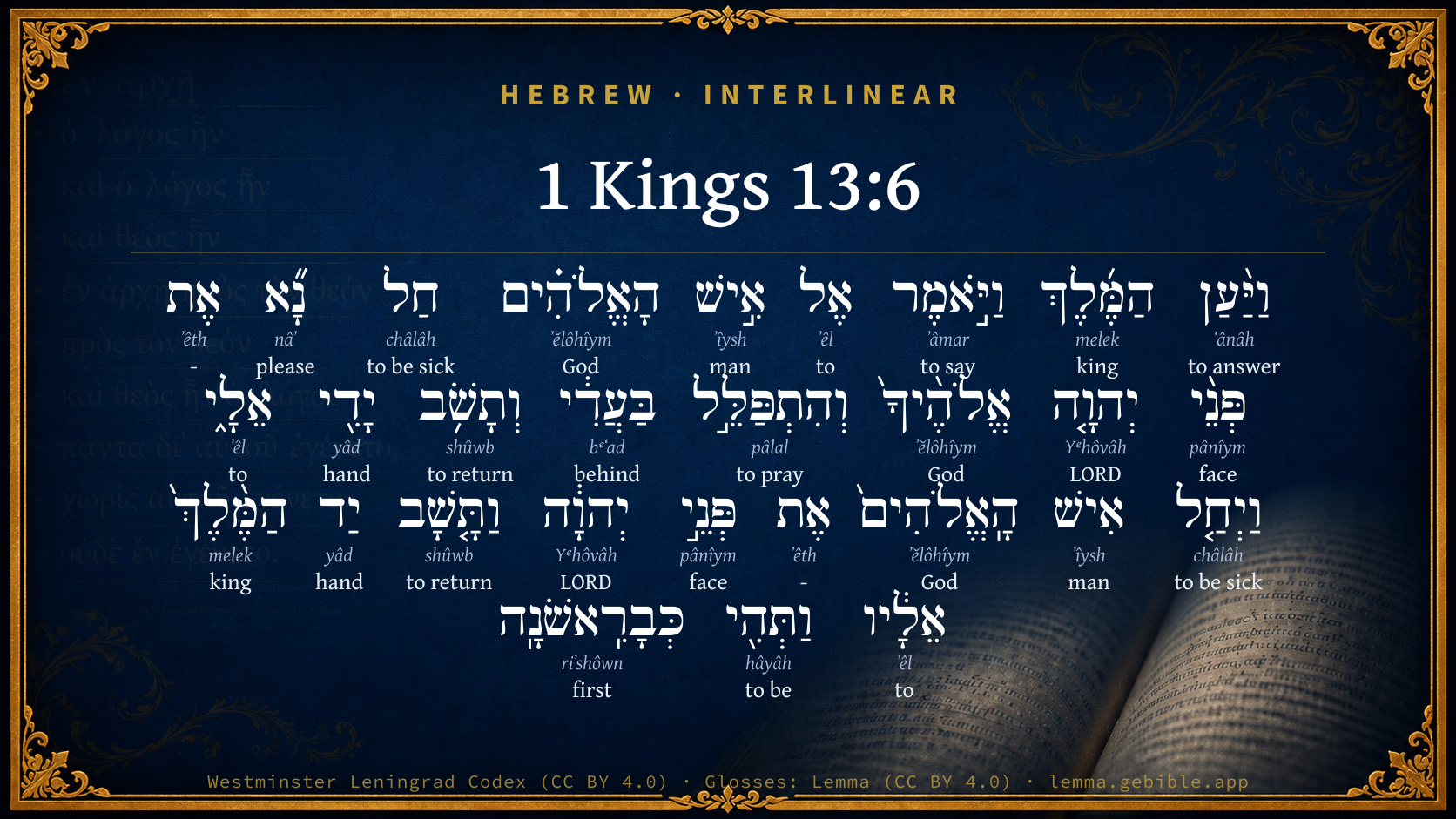
Hebrew (Westminster Leningrad Codex) 1 Kings 13:6 appears in the Hebrew Old Testament. The text above is from the Westminster Leningrad Codex. Each word links to its Strong’s number, a concise gloss, and parsing drawn from the Open Scriptures Hebrew Bible morphology. Click any word for its full Brown-Driver-Briggs (BDB) entry.
Download image
Cite this verse

1 Kings 13:6 (World English Bible). Public Domain. Lemma interlinear Bible study tool, https://lemma.gebible.app/v/1-kings/13/6.

Show BibTeX & RIS
BibTeX
RIS
English Translation
The king answered the man of God, Entreat now the favor of Yahweh your God, and pray for me, that my hand may be restored me again. The man of God entreated Yahweh, and the king's hand was restored him again, and became as it was before.
World English Bible · Public Domain
Download a study sheet

One document with this verse’s original text, its word-by-word gloss line, the meaning frame, cross-references with their text, attributed commentary, and full source and license credits — printable, and it pastes into notes with its structure intact.

This verse Autodidact and up

Study sheet (.html) Plain text (.txt)

A passage Seminary Student

Up to 50 verses in one chapter. A passage sheet keeps up to 6 commentary sources and 12 cross-references per verse, in the order this page ranks them, and says so on the sheet whenever that leaves anything out. Ask for a single verse and you get the Autodidact verse sheet above.

Everything on this page stays free to read, with no account — the sheet is a download of what is already on screen, not access to it.

Want to remove ads? Support Godless Engineer
Compare translations 3

The same verse in 3 English versions, stacked beneath the original-language interlinear above. Click any original word for its lexicon entry.

Each is an independent rendering of the whole verse — the interlinear is not word-aligned to these translations.

Highlighted words mark where these versions differ — a whole-verse word diff, not a word-by-word alignment.

  • World English Bible Public Domain
    The king answered the man of God, Entreat now the favor of Yahweh your God, and pray for me, that my hand may be restored me again. The man of God entreated Yahweh, and the king's hand was restored him again, and became as it was before.
  • King James Version Public Domain
    And the king answered and said unto the man of God, Entreat now the face of the LORD thy God, and pray for me, that my hand may be restored me again. And the man of God besought the LORD, and the king's hand was restored him again, and became as it was before.
  • unfoldingWord Literal Text CC BY-SA 4.0
    And the king answered and said to the man of God, “Entreat, please, the face of Yahweh your God and pray for me, that my hand may return to me.” And the man of God entreated the face of Yahweh, and the hand of the king returned to him, and it became like at the first.

unfoldingWord Literal Text — © unfoldingWord, licensed CC BY-SA 4.0. Word-aligned USFM3 via Door43 (git.door43.org/unfoldingWord/en_ult).

Versions to compare (up to 4)

3 of 4 selected

Show all 18 translations

Every available English version of this verse, each an independent rendering of the whole verse.

  • World English Bible Public Domain
    The king answered the man of God, Entreat now the favor of Yahweh your God, and pray for me, that my hand may be restored me again. The man of God entreated Yahweh, and the king's hand was restored him again, and became as it was before.
  • Berean Standard Bible Public Domain
    Then the king responded to the man of God, “Intercede with the LORD your God and pray that my hand may be restored.” So the man of God interceded with the LORD, and the king’s hand was restored to him as it was before.
  • Majority Standard Bible Public Domain
    Then the king responded to the man of God, “Intercede with the LORD your God and pray for me that my hand may be restored.” So the man of God interceded with the LORD, and the king’s hand was restored to him as it was before.
  • King James Version Public Domain
    And the king answered and said unto the man of God, Entreat now the face of the LORD thy God, and pray for me, that my hand may be restored me again. And the man of God besought the LORD, and the king's hand was restored him again, and became as it was before.
  • American Standard Version (1901) Public Domain
    And the king answered and said unto the man of God, Entreat now the favor of Jehovah thy God, and pray for me, that my hand may be restored me again. And the man of God entreated Jehovah, and the king's hand was restored him again, and became as it was before.
  • Revised Version (1885) Public Domain
    And the king answered and said unto the man of God, Entreat now the favour of the LORD thy God, and pray for me, that my hand may be restored me again. And the man of God entreated the LORD, and the king’s hand was restored him again, and became as it was before.
  • Geneva Bible (1599) Public Domain
    Then the King answered, and saide vnto the man of God, I beseeche thee, pray vnto ye Lord thy God, and make intercession for me, that mine hand may bee restored vnto me. And the man of God besought the Lord, and the Kings hand was restored, and became as it was afore.
  • Douay-Rheims (1899) Public Domain
    And the king said to the man of God: Entreat the face of the Lord thy God, and pray for me, that my hand may be restored to me. And the man of God besought the face of the Lord, and the king's hand was restored to him, and it became as it was before.
  • Young's Literal Translation Public Domain
    And the king answereth and saith unto the man of God, `Appease, I pray thee, the face of Jehovah thy God, and pray for me, and my hand doth come back unto me;' and the man of God appeaseth the face of Jehovah, and the hand of the king cometh back unto him, and it is as at the beginning.
  • Literal Standard Version CC BY-SA 4.0
    And the king answers and says to the man of God, “Please appease the face of your God YHWH, and pray for me, and my hand comes back to me”; and the man of God appeases the face of YHWH, and the hand of the king comes back to him, and it is as at the beginning.
  • Unlocked Literal Bible CC BY-SA 4.0
    King Jeroboam answered and said to the man of God, “Plead for the favor of Yahweh your God and pray for me, so that my hand may be restored to me again.” So the man of God prayed to Yahweh, and the king's hand was restored to him again, and it became as it was before.
  • unfoldingWord Literal Text CC BY-SA 4.0
    And the king answered and said to the man of God, “Entreat, please, the face of Yahweh your God and pray for me, that my hand may return to me.” And the man of God entreated the face of Yahweh, and the hand of the king returned to him, and it became like at the first.
  • Darby Bible Public Domain
    And the king answered and said to the man of God, Intreat now Jehovah thy God, and pray for me, that my hand may be restored to me again. And the man of God intreated Jehovah, and the king's hand was restored to him again, and became as before.
  • World Messianic Bible Public Domain
    The king answered the man of God, “Now intercede for the favor of the LORD your God, and pray for me, that my hand may be restored me again.” The man of God interceded with the LORD, and the king’s hand was restored to him again, and became as it was before.
  • Webster's Bible Public Domain
    And the king answered and said to the man of God, Entreat now the face of the LORD thy God, and pray for me, that my hand may be restored to me again. And the man of God besought the LORD, and the king's hand was restored to him again, and became as it was before.
  • Free Bible Version CC BY-SA 4.0
    Then the king said to the man of God, “Please plead with the Lord your God—pray for me that I may have my hand back!” The man of God pleaded with the Lord, and the king was given back the use of his hand as it was before.
  • Bible in Basic English Public Domain
    Then the king made answer and said to the man of God, Make a prayer now for the grace of the Lord your God, and for me, that my hand may be made well. And in answer to the prayer of the man of God, the king's hand was made well again, as it was before.
  • JPS Tanakh (1917) Public Domain
    And the king answered and said unto the man of God: 'Entreat now the favour of the LORD thy God, and pray for me, that my hand may be restored me.' And the man of God entreated the LORD, and the king's hand was restored him, and became as it was before.

Literal Standard Version (2020), Covenant Press — licensed CC BY-SA 4.0. Text via the HelloAO Bible API (eBible.org). Unlocked Literal Bible (unfoldingWord) — licensed CC BY-SA 4.0. Text via the HelloAO Bible API (eBible.org). unfoldingWord Literal Text — © unfoldingWord, licensed CC BY-SA 4.0. Word-aligned USFM3 via Door43 (git.door43.org/unfoldingWord/en_ult). Free Bible Version, Dr. Jonathan Gallagher — licensed CC BY-SA 4.0. Text via the HelloAO Bible API (eBible.org).

Word by word

More ways to search: Search by grammar → Find every occurrence → Compare this word →

Practice this passage: Drill this verse → Learn its vocabulary →

חַל
châlâh
H2470
“be sick”
Verb, Piel, Imperative, 2nd Person, Masculine, Singular
Part of Speech
Verb
Stem
Piel
Form
Imperative
Person
2nd Person
Gender
Masculine
Number
Singular
Full BDB Definition

Origin: a primitive root [compare H2342 , H2470 , H2490 ]

TWOT: 655

to be or become weak, be or become sick, be or become diseased, be or become grieved, be or become sorry - (Qal) to be weak, be sick - (Piel) - to be or become weak, feel weak - to become sick, become ill - (CLBL) to entreat, pray, beg - (Niphal) - to make oneself sick - to be made sick - to be tired - (Pual) to be made weak, become weak - (Hithpael) to make oneself sick - (Hiphil) - to make sore - to make sick - to show signs of sickness, become sick - to grieve - (Hophal) - to be made sick - to be wounded
  1. וַיַּ֨עַן ʻânâh H6030 “and · to answer” Conjunction + Verb, Qal, Sequential Imperfect, 3rd Person, Masculine, Singular
  2. הַמֶּ֜לֶךְ melek H4428 “the · king” Particle, Definite Article + Noun, Common, Masculine, Singular, Absolute
  3. וַיֹּ֣אמֶר ʼâmar H559 “and · to say” Conjunction + Verb, Qal, Sequential Imperfect, 3rd Person, Masculine, Singular
  4. אֶל ʼêl H413 “to” Preposition
  5. אִ֣ישׁ ʼîysh H376 “man of” Noun, Common, Masculine, Singular, Construct
  6. הָאֱלֹהִ֗ים ʼĕlôhîym H430 “the · God(s)” Particle, Definite Article + Noun, Common, Masculine, Plural, Absolute
  7. נָ֞א nâʼ H4994 “please” Particle, Exhortation
  8. אֶת ʼêth H853 “-” Particle, Direct Object
  9. פְּנֵ֨י pânîym H6440 “face(s) of” Noun, Common, Both, Plural, Construct
  10. יְהוָ֤ה Yᵉhôvâh H3068 “LORD” Noun, Proper
  11. אֱלֹהֶ֨יךָ֙ ʼĕlôhîym H430 “God(s) · your” Noun, Common, Masculine, Plural, Construct + Suffix, Personal, 2nd Person, Masculine, Singular
  12. וְהִתְפַּלֵּ֣ל pâlal H6419 “and · pray” Conjunction + Verb, Hithpael, Imperative, 2nd Person, Masculine, Singular
  13. בַּעֲדִ֔י bᵉʻad H1157 “behind · me” Preposition + Suffix, Personal, 1st Person, Common, Singular
  14. וְתָשֹׁ֥ב shûwb H7725 “and · to return” Conjunction + Verb, Qal, Jussive, 3rd Person, Feminine, Singular
  15. יָדִ֖י yâd H3027 “hand · my” Noun, Common, Both, Singular, Construct + Suffix, Personal, 1st Person, Common, Singular
  16. אֵלָ֑י ʼêl H413 “to · me” Preposition + Suffix, Personal, 1st Person, Common, Singular
  17. וַיְחַ֤ל châlâh H2470 “and · to be sick” Conjunction + Verb, Piel, Sequential Imperfect, 3rd Person, Masculine, Singular
  18. אִישׁ ʼîysh H376 “man of” Noun, Common, Masculine, Singular, Construct
  19. הָֽאֱלֹהִים֙ ʼĕlôhîym H430 “the · God(s)” Particle, Definite Article + Noun, Common, Masculine, Plural, Absolute
  20. אֶת ʼêth H853 “-” Particle, Direct Object
  21. פְּנֵ֣י pânîym H6440 “face(s) of” Noun, Common, Both, Plural, Construct
  22. יְהוָ֔ה Yᵉhôvâh H3068 “LORD” Noun, Proper
  23. וַתָּ֤שָׁב shûwb H7725 “and · to return” Conjunction + Verb, Qal, Sequential Imperfect, 3rd Person, Feminine, Singular
  24. יַד yâd H3027 “hand of” Noun, Common, Both, Singular, Construct
  25. הַמֶּ֨לֶךְ֙ melek H4428 “the · king” Particle, Definite Article + Noun, Common, Masculine, Singular, Absolute
  26. אֵלָ֔יו ʼêl H413 “to · him” Preposition + Suffix, Personal, 3rd Person, Masculine, Singular
  27. וַתְּהִ֖י hâyâh H1961 “and · to be” Conjunction + Verb, Qal, Sequential Imperfect, 3rd Person, Feminine, Singular
  28. כְּבָרִֽאשֹׁנָֽה riʼshôwn H7223 “like/as · in/at the · first” Preposition + Preposition, Determined + Adjective, Adjective, Feminine, Singular, Absolute

About this verse

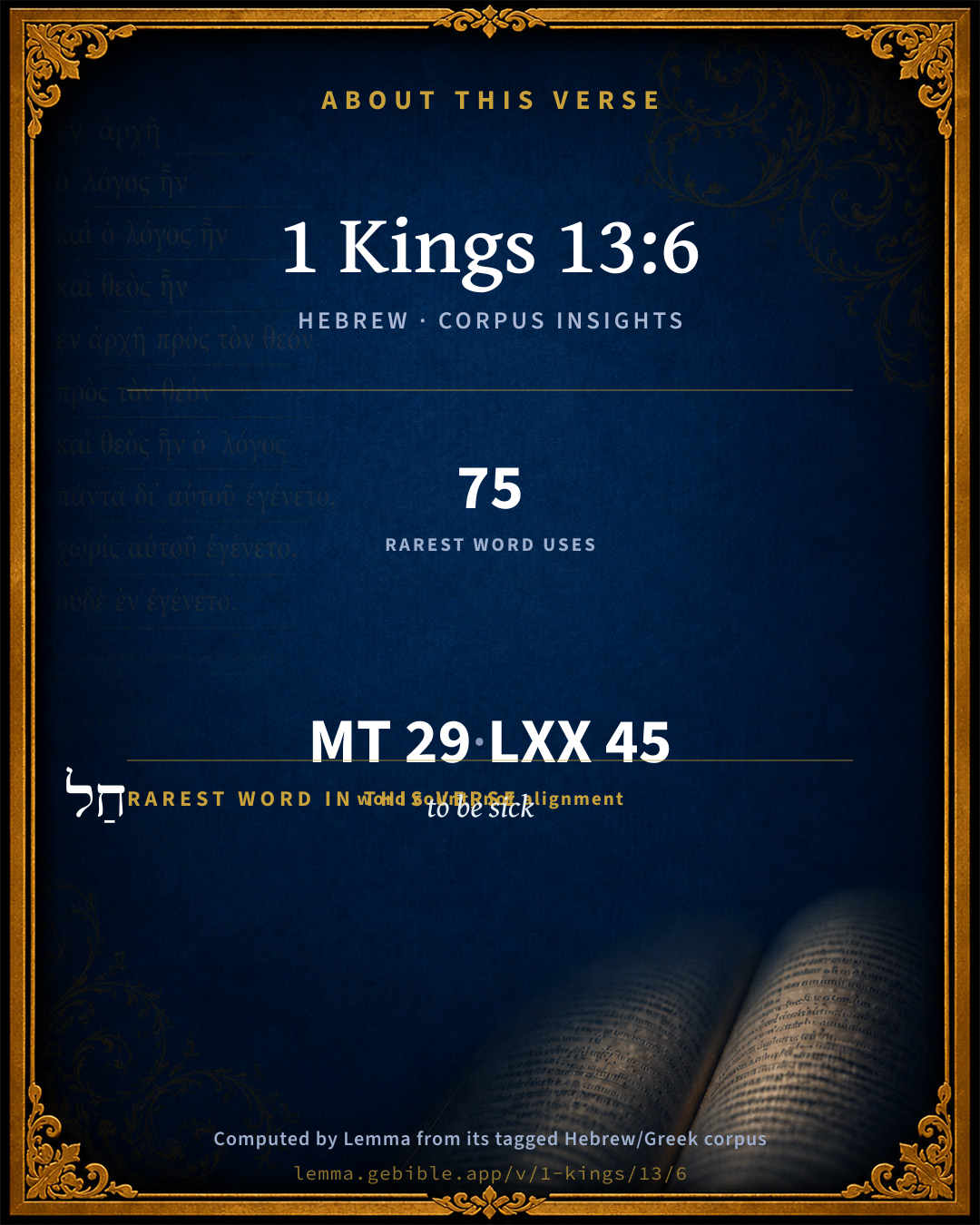
These counts appear in no published source. They are computed here, from the morphology-tagged text and Lemma’s own curated glosses. What Lemma adds →

29
words
17
distinct lemmas
Historical
section

Grammatical profile

  • 8 verbs
  • 13 nouns
  • 1 adjective
  • 4 prepositions
  • 3 particles

Verb forms

  • וַיַּ֨עַן Qal · Sequential Imperfect
  • וַיֹּ֣אמֶר Qal · Sequential Imperfect
  • חַל Piel · Imperative
  • וְהִתְפַּלֵּ֣ל Hithpael · Imperative
  • וְתָשֹׁ֥ב Qal · Jussive
  • וַיְחַ֤ל Piel · Sequential Imperfect
  • וַתָּ֤שָׁב Qal · Sequential Imperfect
  • וַתְּהִ֖י Qal · Sequential Imperfect

Repetition

Words recur within this verse — often emphatic in Hebrew:

  • הָאֱלֹהִ֗ים God H430 ×3
  • הַמֶּ֜לֶךְ king H4428 ×2
  • אִ֣ישׁ man H376 ×2
  • חַל to be sick H2470 ×2
  • פְּנֵ֨י face H6440 ×2
  • יְהוָ֤ה LORD H3068 ×2
  • וְתָשֹׁ֥ב to return H7725 ×2
  • יָדִ֖י hand H3027 ×2
  • אֶל to H413 ×3

Hebrew & Septuagint length

In English translation the verse runs 47 words from the Hebrew and 43 from the Septuagint (LXX English) — closely comparable.

A rough comparison of the two English renderings, which tokenize alike — not a word-level alignment.

Word counts can differ between the Hebrew and the Greek without any difference in meaning — e.g. the Hebrew direct-object marker אֵת has no separate Greek word, and Greek often adds the article ὁ.

In the original languages it is 29 Hebrew tokens and 45 Greek tokens — but the two are counted differently (Hebrew bundles its prefixes and suffixes into one token; the Greek is in lemma form), so that isn’t a like-for-like length.

Cross-references

21

Topical passages linked to 1 Kings 13:6 in the Treasury of Scripture Knowledge — connected by theme and wording, ordered by reader-vote popularity; previews shown in the World English Bible.

  • Exodus 8:8 Then Pharaoh called for Moses and Aaron, and said, "Entreat Yahweh, that he take away the frogs from me, and from my people; and I will let the people go, that they may sacrifice to Yahweh."
  • Exodus 9:28 Pray to Yahweh; for there has been enough of mighty thunderings and hail. I will let you go, and you shall stay no longer."
  • Exodus 10:17 Now therefore please forgive my sin again, and pray to Yahweh your God, that he may also take away from me this death."
  • Acts 8:24 Simon answered, "Pray for me to the Lord, that none of the things which you have spoken happen to me."
  • Luke 6:27–28 "But I tell you who hear: love your enemies, do good to those who hate you,
  • Exodus 8:28 Pharaoh said, "I will let you go, that you may sacrifice to Yahweh your God in the wilderness, only you shall not go very far away. Pray for me."
  • Numbers 21:7 The people came to Moses, and said, We have sinned, because we have spoken against Yahweh, and against you; pray to Yahweh, that he take away the serpents from us. Moses prayed for the people.
  • Exodus 8:12–13 Moses and Aaron went out from Pharaoh, and Moses cried to Yahweh concerning the frogs which he had brought on Pharaoh.
  • Exodus 12:32 Take both your flocks and your herds, as you have said, and be gone; and bless me also!"
  • Numbers 12:13 Moses cried to Yahweh, saying, Heal her, God, I beg you.
  • 1 Samuel 12:19 All the people said to Samuel, Pray for your servants to Yahweh your God, that we not die; for we have added to all our sins [this] evil, to ask us a king.
  • 1 Samuel 12:23 Moreover as for me, far be it from me that I should sin against Yahweh in ceasing to pray for you: but I will instruct you in the good and the right way.
  • Jeremiah 37:3 Zedekiah the king sent Jehucal the son of Shelemiah, and Zephaniah the son of Maaseiah, the priest, to the prophet Jeremiah, saying, Pray now to Yahweh our God for us.
  • Jeremiah 42:2–4 and said to Jeremiah the prophet, Let, we pray you, our supplication be presented before you, and pray for us to Yahweh your God, even for all this remnant; for we are left but a few of many, as your eyes do see us:
  • Matthew 5:44 But I tell you, love your enemies, bless those who curse you, do good to those who hate you, and pray for those who mistreat you and persecute you,
  • Luke 23:34 Jesus said, "Father, forgive them, for they don't know what they are doing." Dividing his garments among them, they cast lots.
  • Acts 7:60 He kneeled down, and cried with a loud voice, "Lord, don't hold this sin against them!" When he had said this, he fell asleep.
  • Romans 12:14 Bless those who persecute you; bless, and don't curse.
  • Romans 12:21 Don't be overcome by evil, but overcome evil with good.
  • Revelation 3:9 Behold, I give of the synagogue of Satan, of those who say they are Jews, and they are not, but lie. Behold, I will make them to come and worship before your feet, and to know that I have loved you.
  • James 5:16–18 Confess your offenses to one another, and pray one for another, that you may be healed. The effective, earnest prayer of a righteous man is powerfully effective.

Cross-references courtesy of OpenBible.info (CC BY 4.0).

Hebrew and Greek witnesses Masoretic Hebrew ↔ Greek Septuagint

The same verse in the two great witnesses to the Old Testament, shown verse-for-verse.

These are two independent witnesses, not word-aligned to each other, and the Septuagint is shown in lemma (dictionary) form.

Hebrew 1 Kings 13:6 Masoretic · Westminster Leningrad Codex

וַיַּ֨עַן הַמֶּ֜לֶךְ וַיֹּ֣אמֶר אֶל אִ֣ישׁ הָאֱלֹהִ֗ים חַל נָ֞א אֶת פְּנֵ֨י יְהוָ֤ה אֱלֹהֶ֨יךָ֙ וְהִתְפַּלֵּ֣ל בַּעֲדִ֔י וְתָשֹׁ֥ב יָדִ֖י אֵלָ֑י וַיְחַ֤ל אִישׁ הָֽאֱלֹהִים֙ אֶת פְּנֵ֣י יְהוָ֔ה וַתָּ֤שָׁב יַד הַמֶּ֨לֶךְ֙ אֵלָ֔יו וַתְּהִ֖י כְּבָרִֽאשֹׁנָֽה

The king answered the man of God, Entreat now the favor of Yahweh your God, and pray for me, that my hand may be restored me again. The man of God entreated Yahweh, and the king's hand was restored him again, and became as it was before.

World English Bible · Public Domain

Greek LXX 1 Kings 13:6 Septuagint · lemma form

καί εἶπον ὁ βασιλεύς ιεροβοαμ ὁ ἄνθρωπος ὁ θεός δέω ὁ πρόσωπον κύριος ὁ θεός σύ καί ἐπιστρέφω ὁ χείρ ἐγώ πρός ἐγώ καί δέω ὁ ἄνθρωπος ὁ θεός ὁ πρόσωπον κύριος καί ἐπιστρέφω ὁ χείρ ὁ βασιλεύς πρός αὐτός καί γίγνομαι καθώς ὁ πρότερον

And king Jeroboam said to the man of God, Intreat the Lord your God, and let my hand be restored to me. And the man of God entreated the Lord, and he restored the king's hand to him, and it became as before.

LXX2012 (modern English Septuagint) · Public Domain

On this verse, The Cambridge Bible for Schools and Colleges discusses the Septuagint’s reading. Read the note in Commentary ↓

Hebrew: Westminster Leningrad Codex (CC BY 4.0). Greek: Septuagint (public domain); English from LXX2012 (modern English Septuagint) (Public Domain). How the Septuagint differs from the Hebrew →

Targum (Aramaic paraphrase)

1

The Targum is the ancient Jewish Aramaic paraphrase of the Hebrew Scriptures — an interpretive translation, not the Hebrew text itself. Onkelos (literal) and Pseudo-Jonathan (expansive) render the Torah, and Jonathan the Prophets. Coverage is partial: where no permissively-licensed English translation exists for a verse, only the Aramaic is shown. This is verse-level text, not a word-by-word alignment to the Hebrew.

  1. Targum Jonathan Prophets (Joshua–Malachi)
    וַאֲתֵיב מַלְכָּא וַאֲמַר לִנְבִיָא דַייָ צַלֵי כְעַן קֳדָם יְיָ אֱלָהָךְ וּבָעֵי מִן קֳדָמוֹהִי וּתְתוּב יְדִי לִי וְצַלִי נְבִיָא דַייָ קֳדָם יְיָ וְתָבַת יְדָא דְמַלְכָּא לֵיהּ וַהֲוַת כְּקַדְמֵיתָא:

    (no public-domain English translation for this verse)

    Targum Jonathan — Aramaic: “Mikraot Gedolot” (public domain). English: “Sefaria Community Translation” (CC0 1.0 (public-domain dedication)); “London "Chaldee Paraphrase," 1871” (public domain). Text via Sefaria.

Commentary

Notes on 1 Kings 13:6 from classic Christian and Jewish commentators (each source and its license shown beneath its notes). The classic Christian expositions comment on the surrounding passage and are grouped to its opening verse, so a note may address several verses; the Jewish commentaries on the Tanakh (Rashi and others) are per-verse, so they appear only where the commentator wrote on this verse.

Lemma curates 59 commentaries, every one of them public domain or Creative Commons licensed, each selected and text-cleaned for this edition rather than reprinted as found. About our sources →

Trapp's Complete Commentary

John Trapp

1Ki 13:6 And the king answered and said unto the man of God, Intreat now the face of the LORD thy God, and pray for me, that my hand may be restored me again. And the man of God besought the LORD, and the king’s hand was restored him again, and became as [it was] before.

Ver. 6. Intreat now the face - seek the favour for me - of the Lord thy God.] He could not say, My God, for he had chosen other gods, forsaken his own mercies, and was miserable by his own election.

And the king’s hand was restored again.] Such is the power of prayer. {Jas 5:16} A like example we find in Nicephorns and Cedrenus, of a certain profane painter in Constantinople, who, assaying to paint Christ in the form of Jupiter, had his hand in like sort dried up and withered. But upon humble confession of his fault, he was healed again, at the devout prayer of Gennadius, bishop of that city.

And became as it was before.] But his heart continued as hard and inflexible as ever. See on 1Ki 13:4.

John Trapp, A Commentary or Exposition upon All the Books of the Old and New Testament (1647–1656) — public domain. Text from a community e-Sword module.

Joseph Benson's Commentary

1Ki 13:6. The king said, Entreat now the face of the Lord thy God — Of him who hath manifested himself to be thy God and friend in a singular manner; and therefore will hear thy prayers for me, though he will not regard mine, because I have forsaken him and his worship. The man of God besought the Lord — This he did to assure Jeroboam that what he had said was not from ill-will to him, and that he heartily desired his reformation, not his ruin. And the king’s hand was restored — God showed him this mercy, 1st, Because he repented of the violence intended against the prophet, for which his hand had been dried up: 2d, To assure him that the stroke was from God: and, 3d, That this goodness of God to him might lead him to repentance, or if he continued impenitent, might leave him without excuse.

Joseph Benson's Commentary on the Old and New Testaments (1811–1818) — public domain. Text from a community e-Sword module.

Tyndale Open Study Notes

Tyndale Open Resources

13:6 hand was restored: God showed mercy toward Jeroboam; his restored hand should have reminded Jeroboam that it was still possible to serve God properly.

Tyndale Open Study Notes — © Tyndale Open Resources, licensed CC BY-SA 4.0. Text via the HelloAO Bible API.

Geneva Bible (1599)

Geneva Bible translators

Though the wicked humble themselves for a time when they feel God’s judgment, yet after they return to their old malice, and declare that they are but vile hypocrites.

Geneva Bible (1599) marginal notes — public domain. Text via Bolls.life.

Adam Clarke's Commentary

Verse 6. Entreat - the face of the Lord thy God] The face of God is his favour, as we see in many parts of the sacred writings. He says, thy God; for Jeroboam knew that he was not his God, for he was now in the very act of acknowledging other gods, and had no portion in the God of Jacob.

And the king's hand was restored] Both miracles were wrought to show the truth of the Jewish religion, and to convince this bold innovator of his wickedness, and to reclaim him from the folly and ruinous tendency of his idolatry.

Adam Clarke's Commentary on the Bible (1810–1826) — public domain. Text from a community e-Sword/MySword module.

The Cambridge Bible for Schools and Colleges

gen. ed. J. J. S. Perowne

6. Intreat now the face of the Lord thy God] Here the R.V. has adopted the rendering of the phrase by A.V. in Psa_119:58; Pro_19:6 “Intreat now the favour, &c.” The idea of the original word is that of soothing, so as to relax the frowns and anger of any one, and hence to gain favour instead of displeasure. We are not to conclude because Jeroboam says ‘the Lord thy God’ that he himself had ceased to acknowledge Jehovah. But in the present circumstances God was evidently more favourable to the prophet than to the king and this Jeroboam intends to express.

and pray for me] These words are omitted in the LXX. (Vat.).

besought the Lord] The expression is exactly the same in the Hebrew as in the former part of the verse. So the R.V. has here ‘intreated the Lord’. To insert ‘the favour’ a second time would make the verse read heavily, but there seems no reason for varying the verb.

The Cambridge Bible for Schools and Colleges (gen. ed. J. J. S. Perowne; Cambridge University Press, 1878–1918) — public domain. Text from a community e-Sword module.

John Gill's Exposition

And the king answered and said unto the man of God,.... In another tone than when he bid the people lay hold on him; not in a haughty, but humble manner; not as threatening, but supplicating:

entreat now the face of the Lord thy God; he does not say "my God", for he had apostatized from him, and served other gods, but "thy" God, whose prophet he was, and who had an interest in him, as clearly appeared by what he had said and done by him;

and pray for me, that my hand may be restored me again; not that the anger of God might be turned away from him, and he enjoy the divine favour, and have an application of pardoning grace made to him, only to have this outward mercy, this temporal favour restored to him, the use of his hand:

and the man of God besought the Lord; not rendering evil for evil; but being of a forgiving spirit, though the king had stretched out his hand against him, he lifted up his hands to heaven for him:

and the king's hand was restored again, and became as it was before; which was another instance of divine power, and a further proof of the prophet's divine mission; from whence it might be concluded, that what he had prophesied of would be fulfilled, and was an instance also of divine goodness to the king, which should have led him to repentance, but did not.

John Gill's Exposition of the Whole Bible (1746–1763) — public domain (CC PDM 1.0). Text via the HelloAO Bible API.

Haydock's Catholic Bible Commentary

Thy God. He does not say my, being conscious that he had abandoned his service. (Menochius) --- Before. We may be surprised that God thus heals a man, whose heart was not changed, ver. 33. (Estius) --- But miracles do not always work a conversion. Pharao, Saul, and Achaz beheld the in vain: only one of the ten lepers returned to give thanks, Luke xvii. 17. This miracle rendered Jeroboam still more inexcusable. (Calmet)

George Leo Haydock (1774–1849), Haydock's Catholic Family Bible and Commentary, 1859 edition — public domain. Excludes Psalms (Douay-Rheims chapter numbering differs from Protestant) and Deuterocanonical books (Catholic canon only).

Matthew Poole's English Annotations

The king answered, i.e. spoke, as that word is oft used in both Testaments.

Entreat now the face of the Lord thy God, who by his zeal for time hath manifested himself to be thy God and Friend in a singular manner; and therefore will hear thy prayers for me, though he will not regard mine, because I have forsaken him and his worship.

The man of God besought the Lord, to assure Jeroboam that what he had said was not from ill-will to him, and that he heartily desired his reformation, not his ruin.

The king’s hand was restored again; partly, to assure him that the stroke was from God; partly, because he repented of that violence which he intended against the prophet, for which God inflicted it; and partly, that the goodness of God to him might have led him to repentance; or if he continued impenitent, leave him without all excuse.

Matthew Poole's English Annotations on the Holy Bible (1683–1685) — public domain. Text from a community e-Sword/MySword module.

Whedon's Commentary on the Bible

Daniel D. Whedon

6. Entreat now the face of the Lord — More literally, Stroke the face. Caress; entreat so imploringly that you cannot be refused. The king’s alarm and momentary terror was like that of the sorcerer Simon. Act_8:24.

Daniel D. Whedon (gen. ed.), Commentary on the Old and New Testaments (1874–1909) — public domain. Text from a community e-Sword module.

The Pulpit Commentary

And the king humbled and alarmed by the judgment he had experienced in his own person answered and said unto the man of God, Intreat now The Heb. is very expressiveSmooth or stroke the face." It is an expression which occurs several times. (See especially Exodus 2Ki_13:4; 2Ch_33:12; Pro_19:6) of the Lord thy God i.e., whose messenger thou art. "Jeroboam, conscience stricken, does not dare to call Jehovah his own God" (Wordsworth). This was probably the case, yet surely it is an inference not warranted by the text. The expression, "The Lord thy God," is of constant occurrence, especially when a "man of God" is addressed; (cf., 1Ki_17:12 1Ki_18:10) and pray for me This sudden change in his bearing shows how much Jeroboam was frightened. The sight, too, of the king humbly supplicating the prophet who a moment before had protested against the calf worship was calculated to make an impression on the minds of the people, that my hand may be restored me again. And the man of God besought lit., stroked the face of the Lord, and the king"s hand was restored him, and became as it was before.

HOMILIES BY J. WAITE Ver. 6.

The King confronted by the Prophet.

Jeroboam is not allowed to pursue his iniquitous career without solemn Divine rebuke and warning. Though Rehoboam has been forbidden to attempt forcibly to suppress the revolt of the tribes, (1Ki_12:24) a "man of God out of Judah" is sent sternly to denounce the rival altar, and to give the sacrilegious king something like a symbolic forewarning of the disasters that should surely befall him. The scene, described here with so much simplicity and dramatic force, is full of moral instruction.

I In the person of the king we see THE HELPLESSNESS OF A WICKED MAN IN THE HANDS OF AN OFFENDED GOD. The physical associations and the mental conditions here presented are alike suggestive of this. It is a striking picture of restrained infatuation and impotent rage.

1. The king"s withered arm tells how God can in a moment turn the strength that is used against Him to weakness. "When thou with rebukes dost correct man for iniquity," etc.. (Psa_39:11)

1. The rent altar suggests the certain frustration, sooner or later, of the purposes and plans of those that are at enmity with God. "The Lord

2. bringeth the counsel of the heathen to nought," etc.. (Psa_33:10) "If this counsel or this work be of man," etc.. (Act_5:38)

3. The king"s inability to pray for himself reminds us how God sometimes forsakes those who forsake Him, so that it seems utterly vain for them to call upon Him. Many a man has felt like Saul, "I am sore distressed, and God is departed from me," etc.. (1Sa_28:15)

1. His appeal to the prophet to intercede for him is typical of the way in which ungodly men are often contrained by force of circumstance to seek succour from those whom they have despised. "The wheel of fortune turns and lowers the proud," and they are placed, perhaps, at the mercy of the very men whom they once scorned and injured. Such are the penalties that God often inflicts on those who trifle with His authority and defy His power. Such is the curse that falls upon "presumptuous sin.

II The behaviour of the prophet presents A FINE EXAMPLE OF MORAL DIGNITY AND CONSCIOUS STRENGTH. See here

(1) The courage of a man who knows that God is on his side. The prophets of old, conscious of a more majestic Presence and a higher Sovereignty, never trembled before the face of wicked kings. The fear of God casts out all other fear. "Be not afraid of them that kill the body," etc.. (Luk_12:4, Luk_12:5) "If God be for us," etc.. (Rom_8:31)

(2) The magnanimity of one who feels that he is called to witness for God among men. The prophet will not take advantage of the king"s helpnessness; rather responds at once to his appeal. He who is inspired by God"s Spirit will not return scorn for scorn, or retaliate an attempted injury, but rather use for beneficent ends the power that he possesses. "Lord, wilt thou that we command fire to come down from heaven and consume them? Ye know not what manner of spirit ye are of," etc. (Luk_9:54, Luk_9:56)

(3) The efficacy of the prayer of a righteous man. The withered arm is restored, and though this had no happy moral effect, as might have been expected, on Jeroboam, the whole transaction, in which mercy was thus blended with judgment, vindicated the honour of Jehovah, and established afresh His sovereign claim to the allegiance alike of king and people. W.

The Pulpit Commentary (1880–1919), ed. H.D.M. Spence-Jones & Joseph S. Exell — public domain. Text from a community e-Sword module.

John Wesley's Explanatory Notes

Thy God - Who hath manifested himself to be thy God and friend, in a singular manner; and therefore will hear thy prayers for me, though he will not regard mine, because I have forsaken him and his worship. Besought - To assure Jeroboam, that what he had said, was not from ill-will to him, and that he heartily desired his reformation, and not his ruin. Restored - Because he repented of that violence, which he intended against that prophet, for which God inflicted it: and that this goodness of God to him, might have led him to repentance; or, if he continued impenitent, leave him without excuse.

John Wesley, Explanatory Notes Upon the Whole Bible (1754–1765) — public domain. Text via the GEBible commentary corpus.

unfoldingWord translationNotes

Door43 World Missions Community

Plead for the favor of Yahweh your God

The abstract noun "favor" can be expressed as a verb. AT: "Plead that Yahweh your God may favor me" (See: Abstract Nouns)

my hand may be restored to me again

This can be stated in active form. AT: "Yahweh may restore my hand" (See: Active or Passive)

the king's hand was restored to him again, and it became as it was before

This can be stated in active form. AT: "Yahweh restored the king's hand and made it as it was before" (See: Active or Passive)

Come home with me and refresh yourself

The word "yourself" is a reflexive pronoun. AT: "Come home with me and eat some food" (See: Reflexive Pronouns)

translationWords

plea

favor

pray

restore

reward

unfoldingWord translationNotes — © Distant Shores Media and the Door43 World Missions Community, licensed CC BY-SA 4.0. Source: git.door43.org/Door43/en_tn.

Rashi

Rabbi Shlomo Yitzchaki (Rashi)

Your God. But not my God, because he was still in a state of rebellion.

As it was originally. Standing and burning sacrifices to idols.

Rashi on the Tanakh — English translations: “The Judaica Press complete Tanach with Rashi, translated by A. J. Rosenberg” (CC BY 4.0); “Pentateuch with Rashi's commentary by M. Rosenbaum and A.M. Silbermann, 1929-1934” (public domain); “The Metsudah Tanach series, Lakewood, N.J” (CC BY 4.0); and “The Book of Joshua, Metsudah Publications, 1997” (CC BY 4.0). Text via Sefaria.

Lesson kit

Teaching starters — assembled from the data on this page, not authored interpretation. Every prompt links to the verse data it draws on. Edit before teaching.

1 Kings, in the Historical, opens this verse with 29 words (17 distinct Hebrew lemmas). Its most distinctive word is châlâh (“to be sick”). A historical commentator’s framing appears above. Read the whole chapter for the surrounding context.

Discussion questions

  1. How does “to be sick” (châlâh) shape what this verse is saying?
  2. How does Exodus 8:8, which shares this passage’s theme, read alongside this verse?
  3. What does the repetition of “God” (3× in this one verse) do in this verse?
  4. The translations on this page render this verse differently — a whole-verse word diff, not a word-by-word alignment. What might account for the different wordings?
  5. «וַיַּ֨עַן» is a Qal Sequential Imperfect verb. How does that grammatical form shape the action described?
  6. Compare how Trapp's Complete Commentary and Joseph Benson's Commentary read this verse. Where do they agree or differ?

Things to notice

Reading settings

Reading text

Shown beneath each verse's original-language words.

Old Testament
Old Testament edition

Read the OT as the Masoretic Hebrew (MT) or the Greek Septuagint (LXX).

English shown for the Greek Septuagint (in the Hebrew ↔ Greek comparison).

Comparing translations? Open the Compare panel on any verse page to stack up to four side by side.