
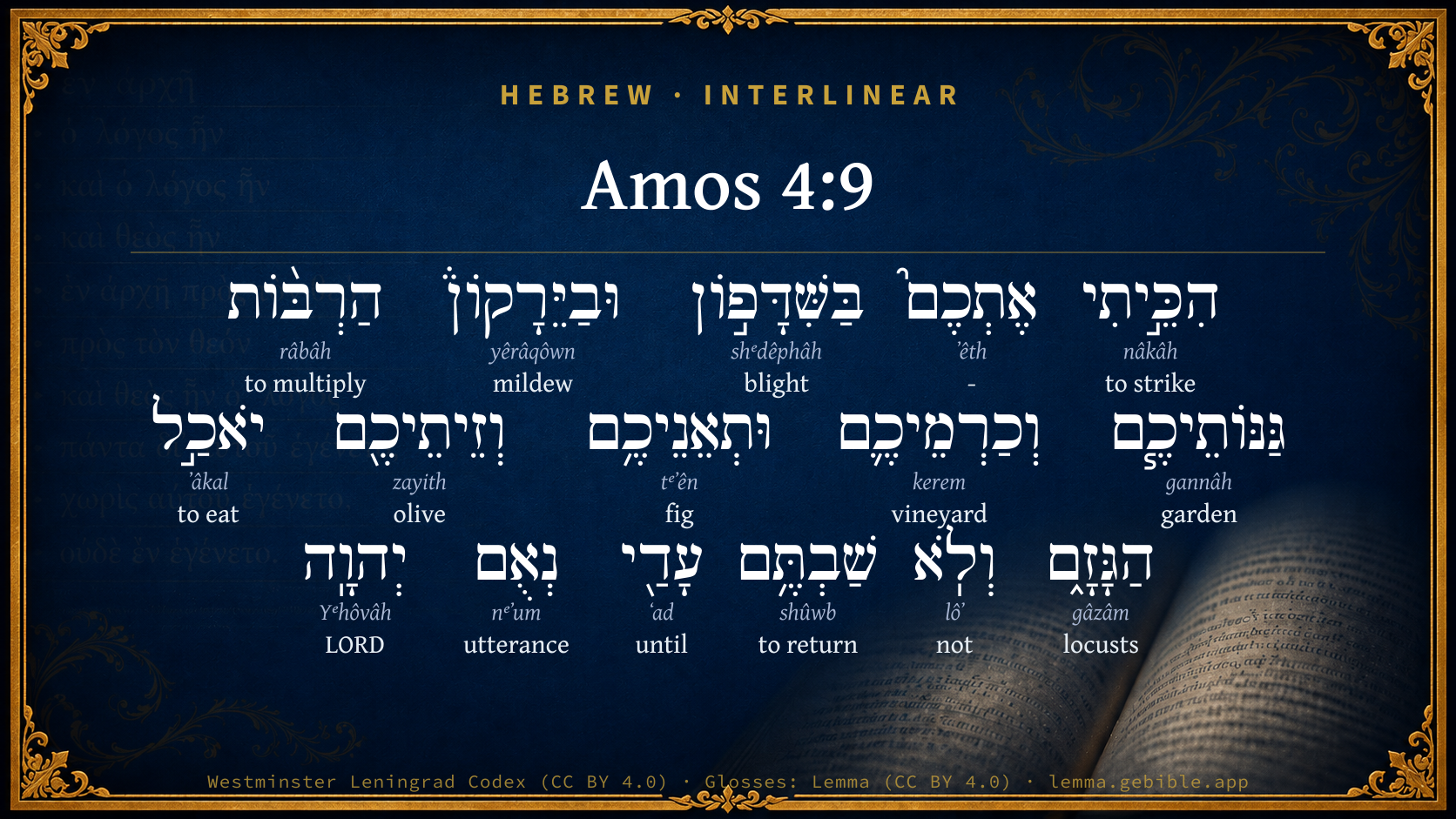
Amos 4:9

Hebrew (Westminster Leningrad Codex) Amos 4:9 appears in the Hebrew Old Testament. The text above is from the Westminster Leningrad Codex. Each word links to its Strong’s number, a concise gloss, and parsing drawn from the Open Scriptures Hebrew Bible morphology. Click any word for its full Brown-Driver-Briggs (BDB) entry.
Download image
Cite this verse

Amos 4:9 (World English Bible). Public Domain. Lemma interlinear Bible study tool, https://lemma.gebible.app/v/amos/4/9.

Show BibTeX & RIS
BibTeX
RIS
English Translation
I struck you with blight and mildew many times in your gardens and your vineyards; And your fig trees and your olive trees have the swarming locust devoured: Yet you haven't returned to me," says Yahweh.
World English Bible · Public Domain
Download a study sheet

One document with this verse’s original text, its word-by-word gloss line, the meaning frame, cross-references with their text, attributed commentary, and full source and license credits — printable, and it pastes into notes with its structure intact.

This verse Autodidact and up

Study sheet (.html) Plain text (.txt)

A passage Seminary Student

Up to 50 verses in one chapter. A passage sheet keeps up to 6 commentary sources and 12 cross-references per verse, in the order this page ranks them, and says so on the sheet whenever that leaves anything out. Ask for a single verse and you get the Autodidact verse sheet above.

Everything on this page stays free to read, with no account — the sheet is a download of what is already on screen, not access to it.

Want to remove ads? Support Godless Engineer
Compare translations 3

The same verse in 3 English versions, stacked beneath the original-language interlinear above. Click any original word for its lexicon entry.

Each is an independent rendering of the whole verse — the interlinear is not word-aligned to these translations.

Highlighted words mark where these versions differ — a whole-verse word diff, not a word-by-word alignment.

  • World English Bible Public Domain
    I struck you with blight and mildew many times in your gardens and your vineyards; And your fig trees and your olive trees have the swarming locust devoured: Yet you haven't returned to me," says Yahweh.
  • King James Version Public Domain
    I have smitten you with blasting and mildew: when your gardens and your vineyards and your fig trees and your olive trees increased, the palmerworm devoured them: yet have ye not returned unto me, saith the LORD.
  • unfoldingWord Literal Text CC BY-SA 4.0
    I afflicted you with blight and mildew. The multitude of your gardens, your vineyards, your fig trees, and your olive trees— the locusts devoured them all. Yet you have not returned to me— this is Yahweh’s declaration.

unfoldingWord Literal Text — © unfoldingWord, licensed CC BY-SA 4.0. Word-aligned USFM3 via Door43 (git.door43.org/unfoldingWord/en_ult).

Versions to compare (up to 4)

3 of 4 selected

Show all 18 translations

Every available English version of this verse, each an independent rendering of the whole verse.

  • World English Bible Public Domain
    I struck you with blight and mildew many times in your gardens and your vineyards; And your fig trees and your olive trees have the swarming locust devoured: Yet you haven't returned to me," says Yahweh.
  • Berean Standard Bible Public Domain
    “I struck you with blight and mildew in your growing gardens and vineyards; the locust devoured your fig and olive trees, yet you did not return to Me,” declares the LORD.
  • Majority Standard Bible Public Domain
    “I struck you with blight and mildew in your growing gardens and vineyards; the locust devoured your fig and olive trees, yet you did not return to Me,” declares the LORD.
  • King James Version Public Domain
    I have smitten you with blasting and mildew: when your gardens and your vineyards and your fig trees and your olive trees increased, the palmerworm devoured them: yet have ye not returned unto me, saith the LORD.
  • American Standard Version (1901) Public Domain
    I have smitten you with blasting and mildew: the multitude of your gardens and your vineyards and your fig-trees and your olive-trees hath the palmer-worm devoured: yet have ye not returned unto me, saith Jehovah.
  • Revised Version (1885) Public Domain
    I have smitten you with blasting and mildew: the multitude of your gardens and your vineyards and your fig trees and your olive trees hath the palmerworm devoured: yet have ye not returned unto me, saith the LORD.
  • Geneva Bible (1599) Public Domain
    I haue smitten you with blasting, and mildewe: your great gardens and your vineyardes, and your figtrees, and your oliue trees did the palmer worme deuoure: yet haue ye not returned vnto me, saith the Lord.
  • Douay-Rheims (1899) Public Domain
    I struck you with a burning wind, and with mildew, the palmerworm hath eaten up your many gardens, and your vineyards: your olive groves, and fig groves: yet you returned not to me, saith the Lord.
  • Young's Literal Translation Public Domain
    I have smitten you with blasting and with mildew, The abundance of your gardens and of your vineyards, And of your figs, and of your olives, Eat doth the palmer-worm, And ye have not turned back unto Me, An affirmation of Jehovah.
  • Literal Standard Version CC BY-SA 4.0
    “I have struck you with blasting and with mildew, || The abundance of your gardens and of your vineyards, || And of your figs, and of your olives, || The palmer-worm eats, || And you have not turned back to Me,” || A declaration of YHWH.
  • Unlocked Literal Bible CC BY-SA 4.0
    I afflicted you with blight and mildew. The multitude of your gardens, your vineyards, your fig trees, and your olive trees— the locusts devoured them all. Yet you have not returned to me —this is Yahweh's declaration.
  • unfoldingWord Literal Text CC BY-SA 4.0
    I afflicted you with blight and mildew. The multitude of your gardens, your vineyards, your fig trees, and your olive trees— the locusts devoured them all. Yet you have not returned to me— this is Yahweh’s declaration.
  • Darby Bible Public Domain
    I have smitten you with blasting and mildew; the palmer-worm hath devoured the multitude of your gardens, and your vineyards, and your fig-trees and your olive-trees: yet have ye not returned unto me, saith Jehovah.
  • World Messianic Bible Public Domain
    “I struck you with blight and mildew many times in your gardens and your vineyards, and the swarming locusts have devoured your fig trees and your olive trees; yet you haven’t returned to me,” says the LORD.
  • Webster's Bible Public Domain
    I have smitten you with blasting and mildew: when your gardens and your vineyards and your fig-trees and your olive-trees increased, the palmer-worm devoured them: yet have ye not returned to me, saith the LORD.
  • Free Bible Version CC BY-SA 4.0
    I struck your many farms and vineyards with blight and mildew; locusts devoured your fig trees and olive trees. But still you did not return to me, declares the Lord.
  • Bible in Basic English Public Domain
    I have sent destruction on your fields by burning and disease: the increase of your gardens and your vine-gardens, your fig-trees and your olive-trees, has been food for worms: and still you have not come back to me, says the Lord.
  • JPS Tanakh (1917) Public Domain
    I have smitten you with blasting and mildew; the multitude of your gardens and your vineyards and your fig-trees and your olive-trees hath the palmer-worm devoured; yet have ye not returned unto Me, saith the LORD.

Literal Standard Version (2020), Covenant Press — licensed CC BY-SA 4.0. Text via the HelloAO Bible API (eBible.org). Unlocked Literal Bible (unfoldingWord) — licensed CC BY-SA 4.0. Text via the HelloAO Bible API (eBible.org). unfoldingWord Literal Text — © unfoldingWord, licensed CC BY-SA 4.0. Word-aligned USFM3 via Door43 (git.door43.org/unfoldingWord/en_ult). Free Bible Version, Dr. Jonathan Gallagher — licensed CC BY-SA 4.0. Text via the HelloAO Bible API (eBible.org).

Word by word

More ways to search: Search by grammar → Find every occurrence → Compare this word →

Practice this passage: Drill this verse → Learn its vocabulary →

הַגָּזָ֑ם
gâzâm
H1501
“the · locusts”
Particle, Definite Article + Noun, Common, Masculine, Singular, Absolute
Part of Speech
Particle + Noun
Type
Common
Gender
Masculine
Number
Singular
State
Absolute
Full BDB Definition

Origin: from an unused root meaning to devour

TWOT: 338a

locusts
  1. הִכֵּ֣יתִי nâkâh H5221 “to strike” Verb, Hiphil, Perfect, 1st Person, Common, Singular
  2. אֶתְכֶם֮ ʼêth H853 “- · you” Particle, Direct Object + Suffix, Personal, 2nd Person, Masculine, Plural
  3. בַּשִּׁדָּפ֣וֹן shᵉdêphâh H7711 “in/at the · blight” Preposition, Determined + Noun, Common, Masculine, Singular, Absolute
  4. וּבַיֵּרָקוֹן֒ yêrâqôwn H3420 “and · in/at the · mildew” Conjunction + Preposition, Determined + Noun, Common, Masculine, Singular, Absolute
  5. הַרְבּ֨וֹת râbâh H7235 “to multiply” Verb, Hiphil, Infinitive Construct
  6. גַּנּוֹתֵיכֶ֧ם gannâh H1593 “gardens · your” Noun, Common, Feminine, Plural, Construct + Suffix, Personal, 2nd Person, Masculine, Plural
  7. וְכַרְמֵיכֶ֛ם kerem H3754 “and · vineyards · your” Conjunction + Noun, Common, Both, Plural, Construct + Suffix, Personal, 2nd Person, Masculine, Plural
  8. וּתְאֵנֵיכֶ֥ם tᵉʼên H8384 “and · figs · your” Conjunction + Noun, Common, Feminine, Plural, Construct + Suffix, Personal, 2nd Person, Masculine, Plural
  9. וְזֵיתֵיכֶ֖ם zayith H2132 “and · olives · your” Conjunction + Noun, Common, Masculine, Plural, Construct + Suffix, Personal, 2nd Person, Masculine, Plural
  10. יֹאכַ֣ל ʼâkal H398 “to eat” Verb, Qal, Imperfect, 3rd Person, Masculine, Singular
  11. וְלֹֽא lôʼ H3808 “and · not” Conjunction + Particle, Negative
  12. שַׁבְתֶּ֥ם shûwb H7725 “to return” Verb, Qal, Perfect, 2nd Person, Masculine, Plural
  13. עָדַ֖י ʻad H5704 “until · me” Preposition + Suffix, Personal, 1st Person, Common, Singular
  14. נְאֻם nᵉʼum H5002 “utterance of” Noun, Common, Masculine, Singular, Construct
  15. יְהוָֽה Yᵉhôvâh H3068 “LORD” Noun, Proper

About this verse

These counts appear in no published source. They are computed here, from the morphology-tagged text and Lemma’s own curated glosses. What Lemma adds →

16
words
16
distinct lemmas
Prophets
section

Notable vocabulary

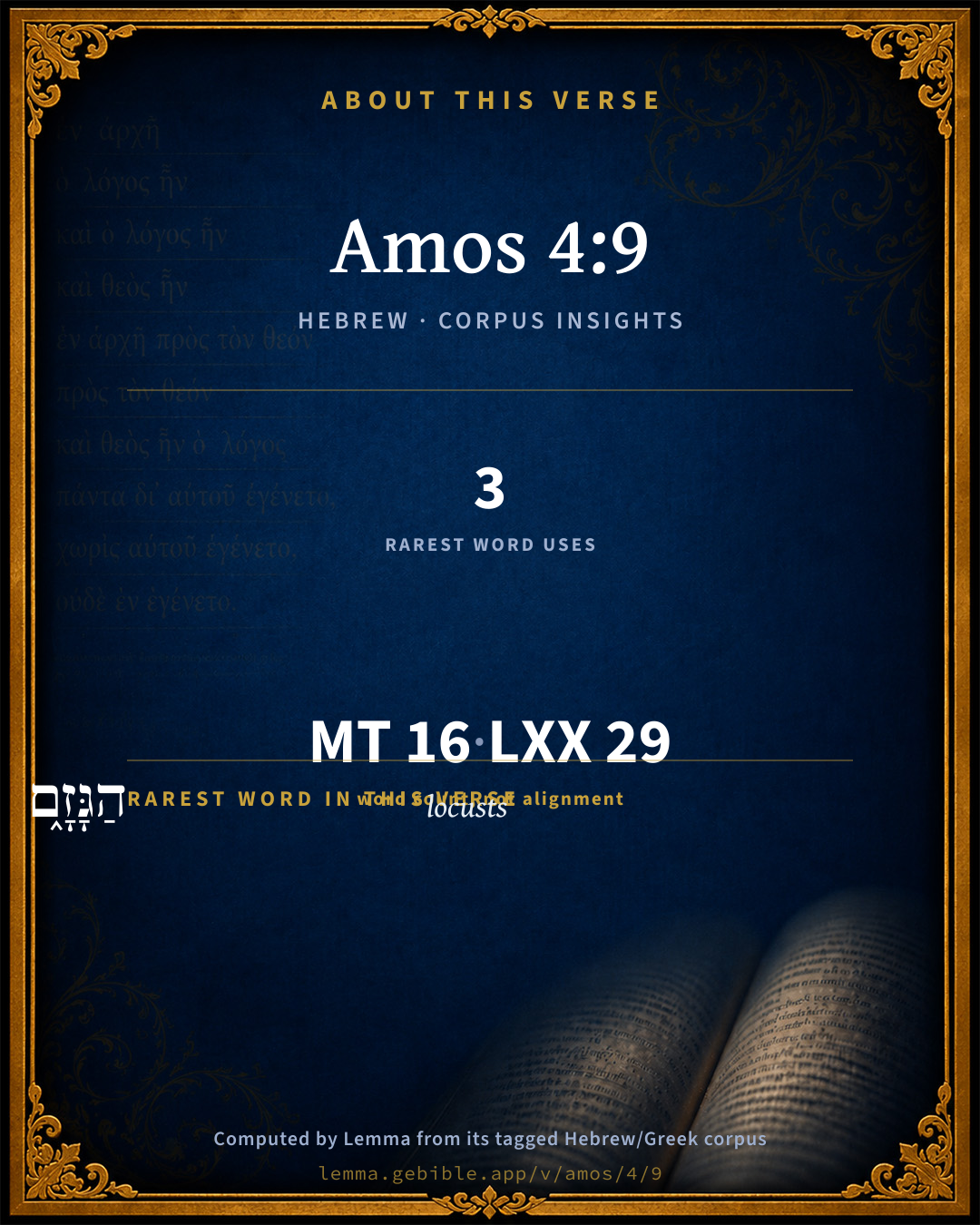
The rarest word here is הַגָּזָ֑ם locusts H1501 — appearing just 3 times in the whole Hebrew Bible.

Shared distinctive vocabulary

הַגָּזָ֑ם locusts H1501 occurs in 3 verses of the Hebrew Bible. Also found in:

Grammatical profile

  • 4 verbs
  • 9 nouns
  • 1 preposition
  • 2 particles

Verb forms

  • הִכֵּ֣יתִי Hiphil · Perfect
  • הַרְבּ֨וֹת Hiphil · Infinitive Construct
  • יֹאכַ֣ל Qal · Imperfect
  • שַׁבְתֶּ֥ם Qal · Perfect

Hebrew & Septuagint length

In English translation the verse runs 36 words from the Hebrew and 36 from the Septuagint (LXX English) — the same length.

A rough comparison of the two English renderings, which tokenize alike — not a word-level alignment.

Word counts can differ between the Hebrew and the Greek without any difference in meaning — e.g. the Hebrew direct-object marker אֵת has no separate Greek word, and Greek often adds the article ὁ.

In the original languages it is 16 Hebrew tokens and 29 Greek tokens — but the two are counted differently (Hebrew bundles its prefixes and suffixes into one token; the Greek is in lemma form), so that isn’t a like-for-like length.

Cross-references

16

Topical passages linked to Amos 4:9 in the Treasury of Scripture Knowledge — connected by theme and wording, ordered by reader-vote popularity; previews shown in the World English Bible.

  • Deuteronomy 28:22 Yahweh will strike you with consumption, and with fever, and with inflammation, and with fiery heat, and with the sword, and with blasting, and with mildew; and they shall pursue you until you perish.
  • Haggai 2:17 I struck you with blight, mildew, and hail in all the work of your hands; yet you didn't turn to me,' says Yahweh.
  • Joel 1:4 What the swarming locust has left, the great locust has eaten. What the great locust has left, the grasshopper has eaten. What the grasshopper has left, the caterpillar has eaten.
  • Amos 4:6 "I also have given you cleanness of teeth in all your cities, And lack of bread in every town; Yet you haven't returned to me," says Yahweh.
  • Amos 7:1–2 Thus the Lord Yahweh showed me: and, behold, he formed locusts in the beginning of the shooting up of the latter growth; and, behold, it was the latter growth after the king's harvest.
  • Deuteronomy 28:42 All your trees and the fruit of your ground shall the locust possess.
  • 1 Kings 8:37 If there be in the land famine, if there be pestilence, if there be blasting [or] mildew, locust [or] caterpillar; if their enemy besiege them in the land of their cities; whatever plague, whatever sickness there be;
  • 2 Chronicles 6:28 If there be in the land famine, if there be pestilence, if there be blasting or mildew, locust or caterpillar; if their enemies besiege them in the land of their cities; whatever plague or whatever sickness there be;
  • Job 36:8–13 If they are bound in fetters, And are taken in the cords of afflictions,
  • Isaiah 1:5 Why should you be beaten more, That you revolt more and more? The whole head is sick, And the whole heart faint.
  • Isaiah 42:24–25 Who gave Jacob for a spoil, and Israel to the robbers? Didn't Yahweh? he against whom we have sinned, and in whose ways they would not walk, neither were they obedient to his law.
  • Jeremiah 3:10 Yet for all this her treacherous sister Judah has not returned to me with her whole heart, but only in pretense, says Yahweh.
  • Jeremiah 5:3 O Yahweh, don't your eyes look on truth? you have stricken them, but they were not grieved; you have consumed them, but they have refused to receive correction: they have made their faces harder than a rock; they have refused to return.
  • Joel 1:7 He has laid my vine waste, And stripped my fig tree. He has stripped its bark, and thrown it away. Its branches are made white.
  • Joel 2:25 I will restore to you the years that the swarming locust has eaten, The great locust, the grasshopper, and the caterpillar, My great army, which I sent among you.
  • Amos 4:8 So two or three cities staggered to one city to drink water, And were not satisfied: Yet you haven't returned to me," says Yahweh.

Cross-references courtesy of OpenBible.info (CC BY 4.0).

Hebrew and Greek witnesses Masoretic Hebrew ↔ Greek Septuagint

The same verse in the two great witnesses to the Old Testament, shown verse-for-verse.

These are two independent witnesses, not word-aligned to each other, and the Septuagint is shown in lemma (dictionary) form.

Hebrew Amos 4:9 Masoretic · Westminster Leningrad Codex

הִכֵּ֣יתִי אֶתְכֶם֮ בַּשִּׁדָּפ֣וֹן וּבַיֵּרָקוֹן֒ הַרְבּ֨וֹת גַּנּוֹתֵיכֶ֧ם וְכַרְמֵיכֶ֛ם וּתְאֵנֵיכֶ֥ם וְזֵיתֵיכֶ֖ם יֹאכַ֣ל הַגָּזָ֑ם וְלֹֽא שַׁבְתֶּ֥ם עָדַ֖י נְאֻם יְהוָֽה

I struck you with blight and mildew many times in your gardens and your vineyards; And your fig trees and your olive trees have the swarming locust devoured: Yet you haven't returned to me," says Yahweh.

World English Bible · Public Domain

Greek LXX Amos 4:9 Septuagint · lemma form

πατάσσω σύ ἐν πυρώσις καί ἐν ἴκτερος πληθύνω κῆπος σύ ἀμπελών σύ καί συκών σύ καί ἐλαιών σύ καταἐσθίω ὁ κάμπη καί οὐδέ ὥς ἐπιστρέφω πρός ἐγώ λέγω κύριος

I struck you with parching, and with blight: you⌃ multiplied your gardens, your vineyards, and your fig-grounds, and the cankerworm devoured your olive yards: yet not even thus did you⌃ return to me, says the Lord.

LXX2012 (modern English Septuagint) · Public Domain

On this verse, Haydock's Catholic Bible Commentary discusses the Septuagint’s reading. Read the note in Commentary ↓

Hebrew: Westminster Leningrad Codex (CC BY 4.0). Greek: Septuagint (public domain); English from LXX2012 (modern English Septuagint) (Public Domain). How the Septuagint differs from the Hebrew →

Targum (Aramaic paraphrase)

1

The Targum is the ancient Jewish Aramaic paraphrase of the Hebrew Scriptures — an interpretive translation, not the Hebrew text itself. Onkelos (literal) and Pseudo-Jonathan (expansive) render the Torah, and Jonathan the Prophets. Coverage is partial: where no permissively-licensed English translation exists for a verse, only the Aramaic is shown. This is verse-level text, not a word-by-word alignment to the Hebrew.

  1. Targum Jonathan Prophets (Joshua–Malachi)
    מְחִיתִי יַתְכוֹן בְּשִׁדְפָנָא וּבְיַרְקָנָא סַגְיוּת גַנֵיכוֹן וְכַרְמֵיכוֹן וְתֵינֵיכוֹן וְזֵיתֵיכוֹן אָכְלָא זַחֲלָא וְלָא תַבְתּוּן לְפוְּלְחָנִי אֲמַר יְיָ:

    (no public-domain English translation for this verse)

    Targum Jonathan — Aramaic: “Mikraot Gedolot” (public domain). English: “Sefaria Community Translation” (CC0 1.0 (public-domain dedication)); “London "Chaldee Paraphrase," 1871” (public domain). Text via Sefaria.

Commentary

Notes on Amos 4:9 from classic Christian and Jewish commentators (each source and its license shown beneath its notes). The classic Christian expositions comment on the surrounding passage and are grouped to its opening verse, so a note may address several verses; the Jewish commentaries on the Tanakh (Rashi and others) are per-verse, so they appear only where the commentator wrote on this verse.

Lemma curates 59 commentaries, every one of them public domain or Creative Commons licensed, each selected and text-cleaned for this edition rather than reprinted as found. About our sources →

Trapp's Complete Commentary

John Trapp

Amo 4:9 I have smitten you with blasting and mildew: when your gardens and your vineyards and your fig trees and your olive trees increased, the palmerworm devoured [them]: yet have ye not returned unto me, saith the LORD.

Ver. 9. I have smitten you with blasting and mildews] This by immoderate rain; that by drought caused by an east wind, that ventus urens et exsiccans. God cannot possibly want a weapon to tame a rebel.

When your gardens and your vineyards increased] Or were trimmed and tricked up. Taxat nimium eorum studium, saith Mercer. The prophet here taxeth their overmuch pains taken and cost cast away in multiplying and dressing their orchards and vineyards; when, in the mean while, they neglected the sincere service of God; and suffered their own hearts to lie like the sluggard’s field, that was all grown over with thorns and briars, Pro 24:31, that is, with lusts and sins, under which lurketh that old serpent.

The palmerworm] Which is worse than the locust, as Jerome noteth; for the locust feeds only on the tops of the ears of grain as he flies (and thence hath his name in Greek, ακρις), but palmerworms stick close to the fruits or flowers they light on; and will not off till all be consumed. It is the last and worst of evils, saith he; and leaves nothing behind it: omnia corrodit et converrit, makes clean work. See Joe 1:4; Joe 1:10-12. {See Trapp on "Joe 1:4"} {See Trapp on "Joe 1:10"} {See Trapp on "Joe 1:11"} {See Trapp on "Joe 1:12"}

Yet have ye not returned unto me] No, not yet; but have rejected the remedy of your recovery: see Amo 4:8.

John Trapp, A Commentary or Exposition upon All the Books of the Old and New Testament (1647–1656) — public domain. Text from a community e-Sword module.

Jamieson, Fausset & Brown

Robert Jamieson, A. R. Fausset & David Brown

blasting--the blighting influence of the east wind on the corn (Gen 41:6).

when . . . gardens . . . increased--In vain ye multiplied your gardens, &c., for I destroyed their produce. BOCHART supports Margin, "the multitude of your gardens."

palmer worm--A species of locust is here meant, hurtful to fruits of trees, not to herbage or corn. The same east wind which brought the drought, blasting, and mildew, brought also the locusts into Judea [BOCHART], (Exo 10:13).

Jamieson, Fausset & Brown — Commentary Critical and Explanatory on the Whole Bible (1871) — public domain (CC PDM 1.0). Text via the HelloAO Bible API.

Adam Clarke's Commentary

Verse 9. I have smitten you with blasting and mildew] He sent blasting and mildew on the crops, and the locust on the gardens, vineyards, and fields; and this in such a way as to show it was a Divine judgment. They saw this; "yet they did not return to the Lord!"

Adam Clarke's Commentary on the Bible (1810–1826) — public domain. Text from a community e-Sword/MySword module.

John Calvin's Commentaries

Though one kind of punishment may not convince men, they are yet thereby proved with sufficient clearness to be guilty before God. But when in various ways he urges them, and after having tried in vain to correct them in one way, he has recourse to another, and still effects nothing, it hence more fully appears that they, who are thus ever unmoved, and remain stupid whatever means God may adopt to lead them to repentance, are altogether past recovery. This is the drift of what the Prophet now adds: he says that they had been smitten by the east wind He shows that want of food does not always proceed from one cause; for men become hardened when they feel only one evil: as the case is when a country labors under a drought, it will be thought to be as it were its fate. But when God chastises men in various ways, they ought then no doubt to be touched and really affected: when, on the contrary, they pass by all punishments with their eyes closed, it is certain, that they are wholly obstinate and so fascinated by the devil, that they feel nothing and discern nothing. This is the reason why the Prophet records the various punishments which had been already inflicted on the people.

Hence he says now, that they had been smitten by the east wind, and by the mildew. What mischief the mildew does to the standing corn, we know; when the sun rises after a cold rain, it burns out its substance, so that the ears grow yellow, and rottenness follows. God then says, that the standing corn of the people had been destroyed by this blasting, after dryness had already prevailed though not through the whole land in an equal degree; for God rained on one part, while a neighboring region was parched through want of rain: the Prophet having stated this, now mentions also the mildew.

He says further, that the fig-trees and vines had been consumed, that the gardens had been destroyed, and that the olive trees had been devoured by chafers or palmer worms. Since then the Israelites had been in so many ways warned, was it not a strange and monstrous blindness, that being affrighted they could bear these chastisements of God, and be not moved to return to the right way? If the first chastisement had no effect, if the second also had been without fruit, they ought surely at last to have repented; but as they proceeded in their usual course, and continued like themselves in that contumacy of which we have spoken, what any more remained for them, but to be wholly destroyed as those who had trifled with God? We now then understand what the Prophet means.

Moreover, this passage teaches, as other similar passages do, that seasons vary not by chance; that now drought prevails, and then continual rains destroy the fruits of the earth, that now chafers are produced, and then that heaven is filled with various infections, — that these things happen not by chance, is what this passage clearly shows: but that they are so many tokens of God’s wrath, set before our eyes. God indeed does not govern the world, according to what profane men think, as though he gave uncontrolled license both in heaven and earth; but he now withholds rain, then he pours it down in profusion; he now burns the corn with heat, then he temperates the air; he now shows himself kind to men, then he shows himself angry with them. Let us then learn to refer the whole order of nature to the special providence of God. I mention his special providence, lest we should dream only of some general operation, as ungodly men do: but let us know that God would have himself to be seen in daily events, so that the tokens of his love may make us to rejoice, and also that the tokens of his wrath may humble us, to the end that we may repent. Let this then be learnt from the present words of the Prophet.

Amos further teaches us, that wind and rain, hail and droughts heat and cold, are arms or weapons by which God executes vengeance on account of our sins. Whenever God then intends to inflict punishment on us, he puts on his armor, that is, he sends either rain, or wind, or drought, or heat, or hail. Since it is so, let us not think that either rain or heat is fortuitous, or that they depend on the situation of the stars as ungodly men imagine. Let us therefore know, that all nature so obeys God’s command, that when rain falls seasonably, it is a token of his love towards us, and that when it is unseasonable, it is a proof of his displeasure. It is meet to think the same of heat and of cold, and of all other things. Let us now go on with the words of the Prophet —

John Calvin's Commentaries (1540-1563) — public domain. Text from the Calvin Translation Society English edition (1840s-50s) via the Christian Classics Ethereal Library (ccel.org). Calvin's coverage is partial (roughly two-thirds of the Bible); uncommented books and verses are honest gaps, never fabricated. The 19th-century editor's footnotes and remarks are omitted so the notes are faithfully Calvin's own voice.

Ellicott's Commentary for English Readers

(9) Blasting and mildew.—Burning up the corn before it is ready to ear, and producing a tawny yellow, instead of golden red, was another judgment. Nothing escapes the Divine visitation. “Your gardens, vineyards, fig-trees, and olive-trees”—which in a well-watered enclosure might escape the general drought—the locust devours in vast numbers (so the Heb. should be rendered); comp. Joe_1:4.

A Bible Commentary for English Readers, edited by Charles John Ellicott (1878–1897) — public domain. Text from a community e-Sword module.

The Cambridge Bible for Schools and Colleges

gen. ed. J. J. S. Perowne

9. Blasting and mildew. The same two words in combination, Deu_28:22, 1Ki_8:37, Hag_2:17. Blasting (cf. Gen_41:6; Gen_41:23; Gen_41:27, “blasted by the east wind”) denotes the disastrous effects produced by the scorching (Hos_13:15; Jon_4:8) and destructive (Job_27:21) ‘east wind,’ blowing up hotly from the desert. The ‘east wind’ of the O.T. is something very different from the ‘east wind,’ as known to us: it corresponds to the modern simoom or sirocco (Arab. sherḳîyeh, or ‘east’ wind,—applied, however, also to winds from the S.E. and S.),—hot winds which in Palestine come up suddenly with great violence, driving clouds of sand before them, and so “withering and burning the growing corn that no animal will touch a blade of it” (Van Lennep, Bible Lands, p. 238). Robinson gives a description of one which he experienced in the extreme S. of Judah (B.R[154], I. 195): “The wind had been all the morning north-east, but at 11 o’clock it suddenly changed to the south, and came upon us with violence and intense heat, until it blew a perfect tempest. The atmosphere was filled with fine particles of sand, forming a bluish haze; the sun was scarcely visible, his disk exhibiting only a dun and sickly hue; and the glow of the wind came upon our faces as from a burning oven.” See also ib. p. 207, II. 123; G. A. Smith, Geogr., pp. 67–69; and Wetzstein’s note in Delitzsch’s Commentary on Job_27:21. By mildew is meant “a blight, in which the ears turn untimely a pale yellow, and have no grain.” The Heb. word signifies (pale and unhealthy) greenness.

[154] .R. … Edw. Robinson, Biblical Researches in Palestine (ed. 2, 1856).

when your gardens … increased &c.] R.V. the multitude of your gardens … hath the palmerworm devoured. Neither rendering is grammatically possible: the Hebrew is corrupt. Read, with Wellh., החרבתי for הרבות, and an excellent sense is at once obtained: “I laid waste your gardens and your vineyards; and your fig-trees and your vines would [freq.] the shearer devour.” The shearer (gâzâm) is a name for a locust, so called from its destructiveness: see p. 85. A visitation of locusts was no uncommon occurrence in Palestine: for a vivid picture of their ravages, see Joe_1:4-12.

The Cambridge Bible for Schools and Colleges (gen. ed. J. J. S. Perowne; Cambridge University Press, 1878–1918) — public domain. Text from a community e-Sword module.

John Gill's Exposition

I have smitten you with blasting and mildew,.... "Blasting" is what we commonly call "blights", generally occasioned by an east wind; and so Kimchi interprets the word here used; and the Vulgate Latin version renders it, "a burning wind"; which causes the buds and leaves of trees to shrivel up as if they were burnt with fire. "Mildew" is a kind of clammy dew, which falling upon corn, &c. corrupts and destroys by its moisture; and is a kind of jaundice to the fruits of the earth; and has its name as that, from yellowness, in the Hebrew language: when the Lord is said to smite them with these the sense is, that he sent these upon the fruits of their gardens, fields and vineyards, which consumed them:

when your gardens and your vineyards and your fig trees and your olive trees increased, the palmer worm devoured them; just when they were budding and blossoming, and bringing forth fruit; and so what the blasting and mildew did not consume, that the palmer worm, a kind of locust, did; which has its name from its biting and cutting off the leaves and branches of trees, as of those mentioned vines, olives and fig trees, with which the land of Canaan abounded, the cutting off which was a great calamity. The Targum is,

"the multitude of your gardens, &c. the palmer worm hath eaten:''

yet have ye not returned unto me, saith the Lord; this dispensation of Providence was also without its desired fruit and effect; See Gill on Amo 4:6.

John Gill's Exposition of the Whole Bible (1746–1763) — public domain (CC PDM 1.0). Text via the HelloAO Bible API.

Albert Barnes' Notes on the Bible

I have smitten you with blasting - Literally, “an exceeding scorching,” such as the hot east wind produced, and “an exceeding mildew,” a blight, in which the ears turn untimely a pale yellow, and have no grain. Both words are doubly intensive. They stand together in the prophecy of Moses Deu 28:22, among the other scourges of disobedience; and the mention of these would awaken, in those who would hear, the memory of a long train of other warnings and other judgments.

When your gardens ... increased - Better, as English margin. “the multitude of your gardens.” The garden of the east united the orchard Job 8:16; Son 4:13-14; Son 6:11, herb Deu 11:10; Son 4:14; Son 6:2, and flower garden. It comprised what was necessary for use as well as what was fragrant. It furnished part of their support Amo 9:14; Jer 29:5, Jer 29:28. Its trees Ecc 2:6, as well as the garden (Son 4:15; Ecclus. 24:30) generally, being mostly watered artificially, it was beyond the reach of ordinary drought. The tree, “planted by the channels of waters” (Psa 1:3; Jer 17:8; add Isa 58:11; Jer 31:12, contrariwise Isa 1:30), was an image of abiding freshness and fertility, Yet neither would these escape God’s sentence. On these He sent the locusts, which, in a few hours - all leaves - flower, herb or tree, are as dead (see the note at Joe 1:7).

Albert Barnes' Notes on the Bible (1834–1885) — public domain. Text from a community e-Sword/MySword module.

Haydock's Catholic Bible Commentary

Wind. Protestants, "blasting." (Haydock) --- "Pestilential air," (Septuagint, Symmachus, &c.) which destroys the corn (Calmet) and men. (Haydock)

George Leo Haydock (1774–1849), Haydock's Catholic Family Bible and Commentary, 1859 edition — public domain. Excludes Psalms (Douay-Rheims chapter numbering differs from Protestant) and Deuterocanonical books (Catholic canon only).

Matthew Poole's English Annotations

To other judgments inflicted on you I have added this also, my hand hath been heavy upon you,

I have smitten you with blasting; the excessive heat and drought have turned your corn into black and parched smut or ashes;

and mildew; a bane to corn through too much wet; the seasons were extremely unkind, and all spoiled with it.

When your gardens, about your houses for convenience and pleasure.

Vineyards; planted for your support and to enrich you, to cheer your heart.

Fig trees; which were excellent, of very great use and profit in those countries.

Olive trees; a principal commodity arose from their oliveyards: all that was for delight, profit, and necessary use.

Increased, when they were seemingly most fruitful.

The palmer-worm: see Joe 1:3,10-12.

Devoured; eat up all, as is the manner of that worm.

Matthew Poole's English Annotations on the Holy Bible (1683–1685) — public domain. Text from a community e-Sword/MySword module.

The Pulpit Commentary

The third chastisement is occasioned by blight (Deu_28:22) and palmerworm. (Deu_28:39, Deu_28:42) Blasting; the scorching east wind spoken of by Isaiah (Isa_27:8) and Ezekiel. (Eze_17:10) Vulgate, in vento urente; Septuagint, ejn purwsei, "with parching;" Aquila, Symmachus, and Theodotion, ajnemofqria. Mildew; a blight, under the influence of which the ears of corn turned yellow and became unfruitful. "Blasting and mildew" are mentioned together in Moses" curse (Deu_28:22) and in Solomon"s dedication prayer (1Ki_8:37; comp. Hag_2:17) The LXX has, ejn ijkterw, "with jaundice." When your gardens increased. It is better to take this sentence as the English margin, "The multitude of your gardens hath the palmerworm devoured." So the Vulgate, Multitudinem hortorum tuorum comedit eruca. Gardens included orchards, herbaries, and pleasure grounds. The palmerworm; gazam; Se ptuagint, kamph: Vulgate, eruca. The word occurs in Joe_1:4 Joe_2:25, and is taken by many commentators to mean some kind of locust; but it is more probable that the Greek and Latin translators are right in regarding it as "a caterpillar" (see Smith, "Dict. of the Bible," 2:696, etc.; "Bible Educator," 4:293). Amos seems to be referring to the visitation in Joel"s time, if we take gazam ("biter") to be a kind of locust.

The Pulpit Commentary (1880–1919), ed. H.D.M. Spence-Jones & Joseph S. Exell — public domain. Text from a community e-Sword module.

John Wesley's Explanatory Notes

Increased - When they were most fruitful. Devoured - Eat up all, as is the manner of them.

John Wesley, Explanatory Notes Upon the Whole Bible (1754–1765) — public domain. Text via the GEBible commentary corpus.

Rashi

Rabbi Shlomo Yitzchaki (Rashi)

the increase of your gardens—That you are engaged in increasing your gardens.

the shearing locust has devoured Heb. יֹאכַל, lit., shall devour. Has devoured.

Rashi on the Tanakh — English translations: “The Judaica Press complete Tanach with Rashi, translated by A. J. Rosenberg” (CC BY 4.0); “Pentateuch with Rashi's commentary by M. Rosenbaum and A.M. Silbermann, 1929-1934” (public domain); “The Metsudah Tanach series, Lakewood, N.J” (CC BY 4.0); and “The Book of Joshua, Metsudah Publications, 1997” (CC BY 4.0). Text via Sefaria.

Lesson kit

Teaching starters — assembled from the data on this page, not authored interpretation. Every prompt links to the verse data it draws on. Edit before teaching.

Amos, in the Prophets, opens this verse with 16 words (16 distinct Hebrew lemmas). Its most distinctive word is gâzâm (“locusts”). A historical commentator’s framing appears above. Read the whole chapter for the surrounding context.

Discussion questions

  1. The word gâzâm carries the sense “locusts.” How does it shape the verse?
  2. How does Joel 1:4, which shares the word «locusts», read alongside this verse?
  3. These translations render this verse differently; the difference is in the English rendering, not the original. What questions does that raise?
  4. «הִכֵּ֣יתִי» is a Hiphil Perfect verb. How does that grammatical form shape the action described?
  5. Compare how Trapp's Complete Commentary and Jamieson, Fausset & Brown read this verse. Where do they agree or differ?

Things to notice

Reading settings

Reading text

Shown beneath each verse's original-language words.

Old Testament
Old Testament edition

Read the OT as the Masoretic Hebrew (MT) or the Greek Septuagint (LXX).

English shown for the Greek Septuagint (in the Hebrew ↔ Greek comparison).

Comparing translations? Open the Compare panel on any verse page to stack up to four side by side.