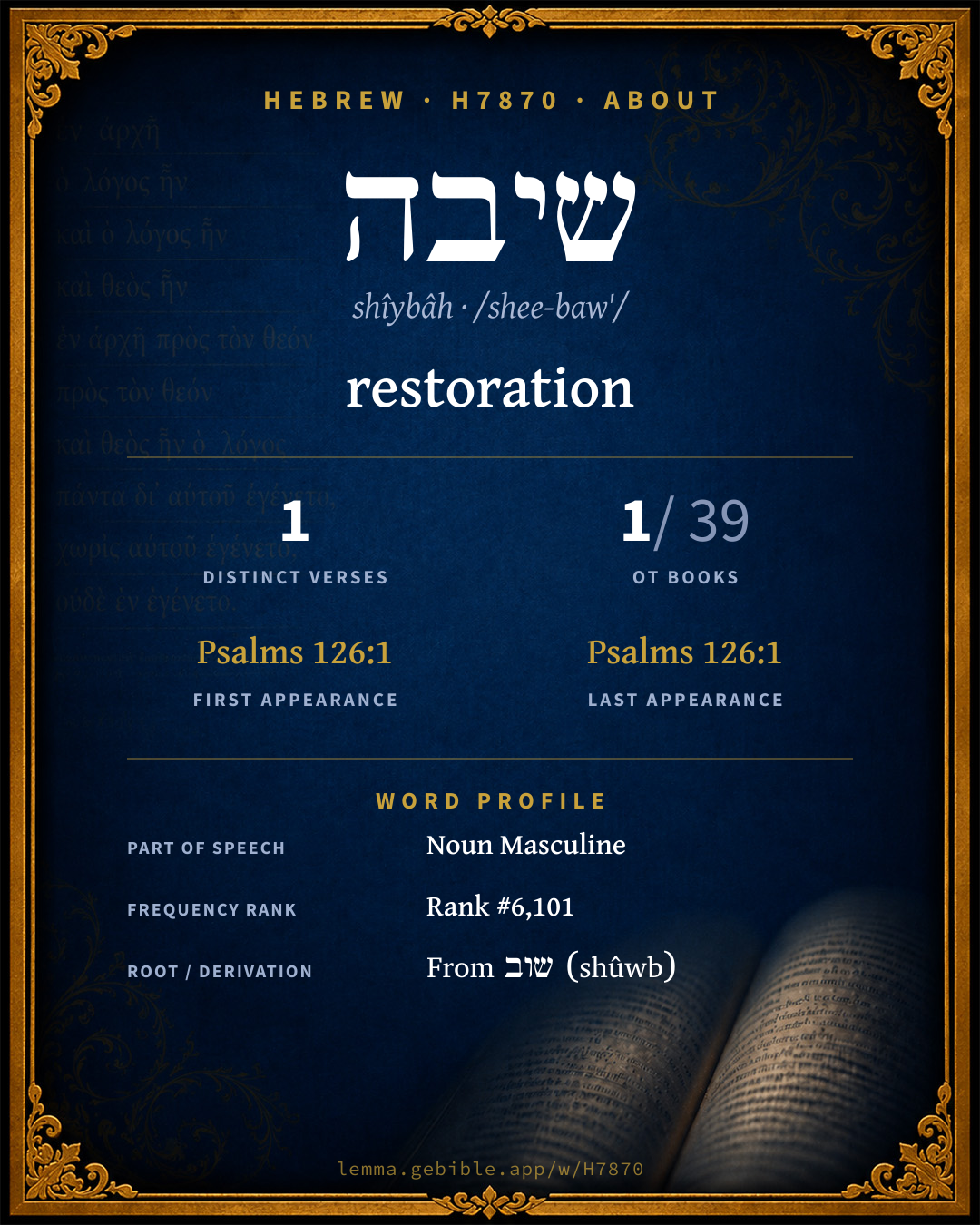
שִׁיבָה
restoration
Full lexicon entry — Brown-Driver-Briggs (BDB)
From Brown-Driver-Briggs (BDB)
Where this word appears
Grammar key — what these labels mean
Part of speech
- Noun
- A naming word — a person, place, thing, or idea.
Noun type
- Common
- A common noun — a general class of person, place, or thing (“king,” “city,” “water”), not a specific name.
State
- Construct
- A noun bound to a following noun in a possessive / “of” relationship (the construct chain).
Gender
- Feminine
- Grammatically feminine.
Number
- Singular
- One.
Every verse where H7870 appears — 1 distinct verse across 1 book. Click any verse to open its interlinear word-by-word view. Verse text shown in the World English Bible for context — . Each verse’s Hebrew form is shown with its reference; the English is not keyword-highlighted, since the data carries no word-level English alignment. Use “Compare translations” on any verse to read it across multiple English versions. This concordance covers the Hebrew Bible; Septuagint (Greek Old Testament) occurrences are not indexed here.
Psalms 1 verse
About this entry
At a glance — auto-summarized from this page’s data, not written by a person. Every figure links to its source below. This summary describes the numbers; it doesn’t interpret them.
שיבה — transliterated shîybâh — is a Hebrew noun carrying the sense “restoration.” The Hebrew Bible uses it only 1 verse. Its uses cluster heavily in Psalms (100% of all occurrences). A true hapax — its single appearance is Psalms 126:1. Sharing its root, it stands alongside שוב, משובה and שובב. Each statement above links to its evidence; the full detail follows below.
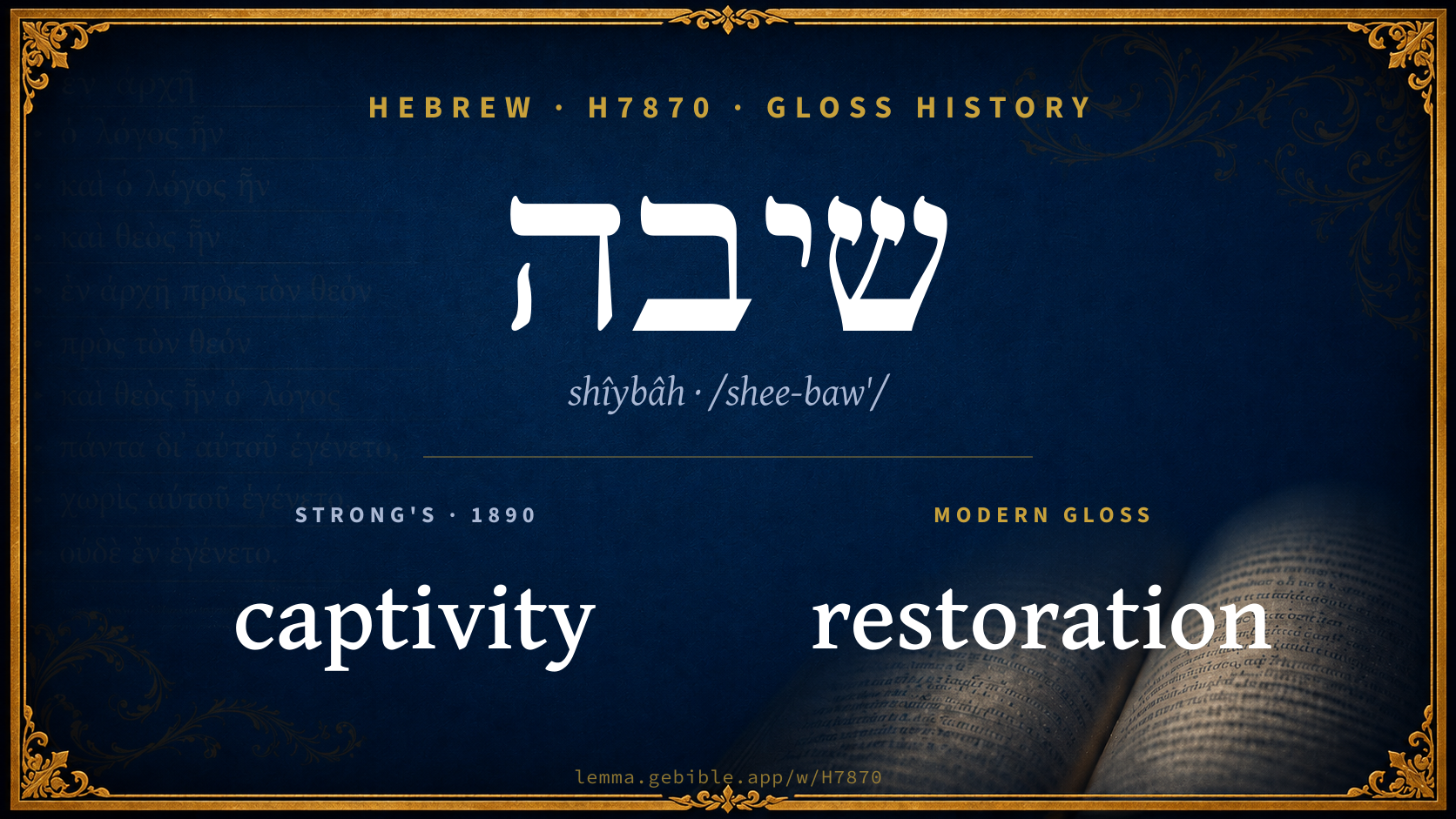
Gloss history
Strong's 1890 vs modern scholarship
About this word
Strong's H7870 catalogs a Hebrew word from the Hebrew Old Testament.
These counts are not copied from any lexicon or concordance. They are computed here, from the morphology-tagged Hebrew Old Testament. What Lemma adds →
- 1
- distinct verses
- The word appears in 1 distinct verse.
- 1 / 39
- OT books
- The word appears in 1 of 39 Old Testament books.
- #6,101
- by frequency
- Rank #6,101 (rank 6,101 of 8,640 Hebrew words by occurrence).
View all 1 occurrence in the concordance →
Most concentrated in
- Psalms 1 verse 100%
By section of the Old Testament
By traditional corpus
Conventional, traditional groupings — biblical authorship is debated, so this is a traditional corpus grouping, not an authorship claim. Each share is this word’s portion of its verses in that division of the Hebrew canon. Each figure is a share of the word’s 1 distinct verse.
- Writings (Ketuvim) 1 verse · 100%
How translations render this word
Counts come from each version’s own published word-to-Strong’s tagging or interlinear alignment — an approximate guide to how each version renders this word, not a word-level alignment the data otherwise carries. Because each total is that version’s own tagged count, the per-version totals vary from one another and need not match the appearance or distinct-verse counts above. These counts may also differ from a printed concordance because Lemma counts each distinctly tagged rendering and does not collapse phrase taggings into a single head-word total. This is a fixed set of word-tagged versions (KJV, ASV, BSB, ULT) and does not change with the reading translation you choose elsewhere. Each version’s license is shown beside its name below (and on Sources).
- King James Version: Captivity 1×
- Berean Standard Bible: Captives 1×
- unfoldingWord Literal Text: Captivity of 1×
King James Version Public Domain
Renders H7870 across 1 tagged occurrence — most commonly:
Berean Standard Bible Public Domain
Renders H7870 across 1 tagged occurrence — most commonly:
unfoldingWord Literal Text CC BY-SA 4.0
Renders H7870 across 1 tagged occurrence — most commonly:
Senses in BDB
The 1 sense BDB distinguishes for this word, in lexicon order (not ranked by frequency or importance). The full entry — with sub-senses — is in the Lexicon Entry tab.
- restoration
Word origin
Derived from שוב (shûwb) (H7725) — to return.
Jastrow Dictionary
A second Hebrew/Aramaic lexicon for comparison, covering Aramaic and post-biblical (Talmudic, Targumic, Midrashic) usage that the biblical-Hebrew BDB does not. Matched by lemma rather than by Strong’s number, so a lemma may carry more than one Jastrow headword (shown separately below), and the entries cover usage well beyond the Bible.
שִׁיבָה
- going back, return; use of the root שׁוּב. Sifra M’tsora, Neg., ch. IV, Par. 7 (ref. to Lev. XIV, 39, a. 43) מה ש׳ האמורה להלן וכ׳ as the coming back mentioned there refers to the lapse of a week, so it does here. Ib. זו היא ש׳, v. בִּיאָה II; Men. 4ᵃ. Macc. 13ᵃ גמר ש׳ ש׳ מהתם we learn the meaning of שוב (Num. XXXV, 28) from שוב there (Lev. XXV, 41), i.e. he is restored to his ancestral estate; a. e. e.g. Leviticus 14:39
שֵׂיבָה
- v. סָב) gray hair, old age, venerability of old age. Pirké d’R. El. ch. LII מיום שברא … לא נזרקה ש׳ וכ׳ since heaven and earth were created, the white of old age was not sprinkled upon men, until Abraham came &c. Gen. R. s. 59 (ref. to Ps. LXXI, 18) לא היא זקנה ולא היא ש׳ אלא … תן לי ש׳ are not ziḳnah and sebah the same? But (David prayed), if thou givest me old age, give me its venerable appearance with it. Ab. V, 21 בן שבעים לש׳ when seventy years old, man enters hoary age, contrad. to זקנה; a. fr. e.g. Psalms 71:18
A Dictionary of the Targumim, the Talmud Babli and Yerushalmi, and the Midrashic Literature (Marcus Jastrow; London, Luzac, 1903) — Public Domain. Digitized via Sefaria. Digitized via Sefaria. Full attribution on Sources.
Same root — word family
Other BDB entries built from the same root as H7870, grouped by Strong’s listed origin. These share a root / origin per the lexicon — not necessarily a shared meaning. Each links to that word’s own entry.
Derives from
Shares the same root
- משובה mᵉshûwbâh H4878 apostasy
- שובב shôwbâb H7726 backsliding
- שובב shôwbêb H7728 backsliding
- שובה shûwbâh H7729 withdrawal
- תוב tûwb H8421 to return
- תשובה tᵉshûwbâh H8666 answer
Proper names from this root
People and places named from this root — a name, not an additional meaning of the word.
- יושב חסד Yûwshab Cheçed H3142 Jushab-hesed
- ישבי לחם Yâshubîy Lechem H3433 Jashubi-lehem
- ישבעם Yâshobʻâm H3434 Jashobeam
- ישוב Yâshûwb H3437 Jashub
- משובב Mᵉshôwbâb H4877 Meshobab
Compare all same-root words → Showing 4 of 13 — not the complete family. 5 of the same-root words are proper names (people or places). They share a root, not necessarily a meaning.
Septuagint verse parallels
This word appears in 1 verse that also exists in the Greek Old Testament (Septuagint), out of the 1 Hebrew verse it occurs in. You can read those verses in Greek by switching the Old Testament edition to the Septuagint.
Read these verses in the Septuagint
This is a verse-level parallel only — the same verses exist in both the Hebrew and Greek Old Testaments. No word-level Hebrew↔Greek correspondence is claimed: the data carries no such alignment, so no Greek word is shown as this Hebrew word’s translation. Coverage is not total — the Septuagint omits the deuterocanon and renumbers the Psalms, so some Hebrew verses have no direct Greek parallel.