Jonah 1:13

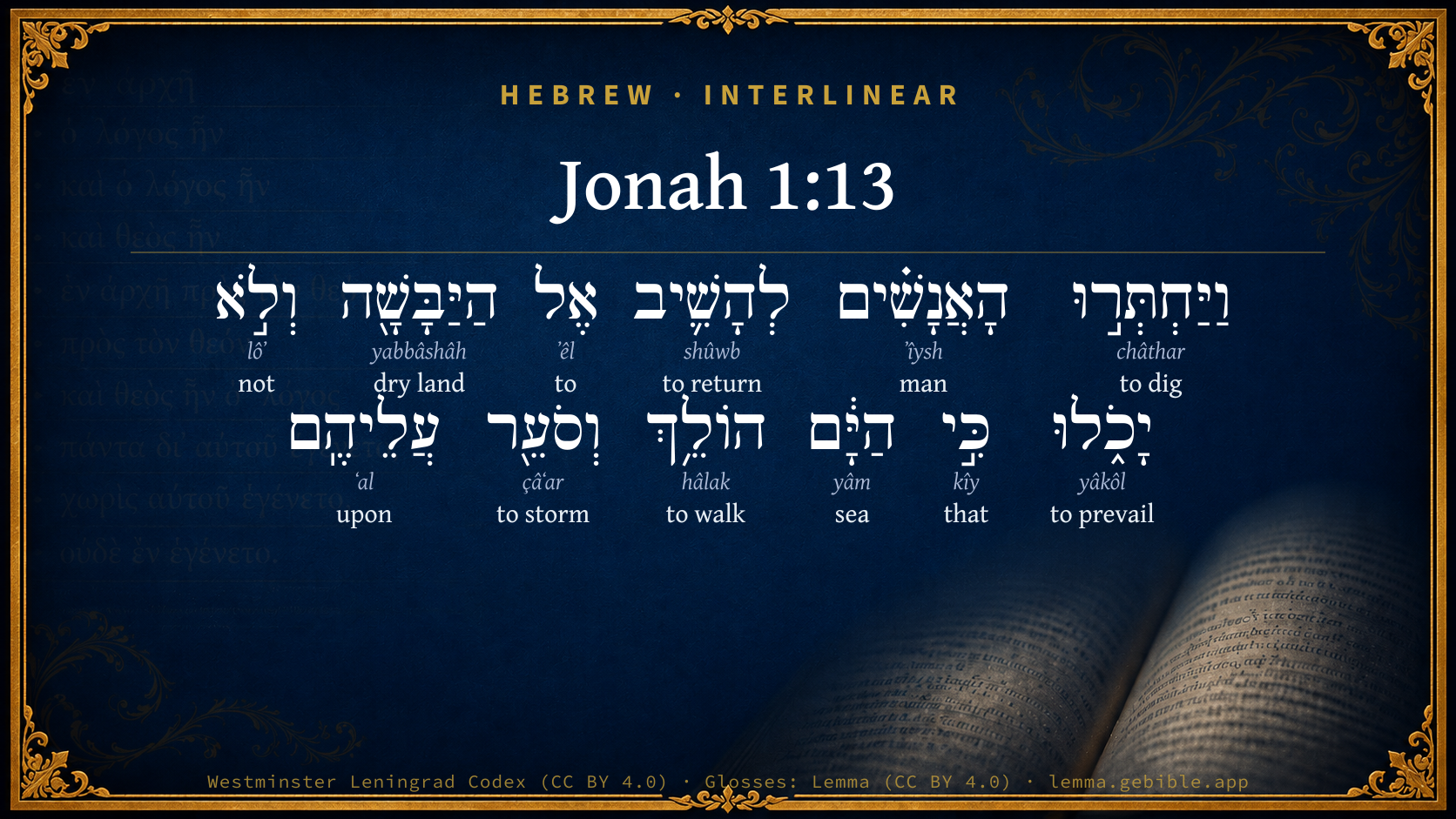
Hebrew (Westminster Leningrad Codex) Jonah 1:13 appears in the Hebrew Old Testament. The text above is from the Westminster Leningrad Codex. Each word links to its Strong’s number, a concise gloss, and parsing drawn from the Open Scriptures Hebrew Bible morphology. Click any word for its full Brown-Driver-Briggs (BDB) entry.
Download image
Cite this verse

Jonah 1:13 (World English Bible). Public Domain. Lemma interlinear Bible study tool, https://lemma.gebible.app/v/jonah/1/13.

Show BibTeX & RIS
BibTeX
RIS
English Translation
Nevertheless the men rowed hard to get them back to the land; but they could not, for the sea grew more and more tempestuous against them.
World English Bible · Public Domain
Download a study sheet

One document with this verse’s original text, its word-by-word gloss line, the meaning frame, cross-references with their text, attributed commentary, and full source and license credits — printable, and it pastes into notes with its structure intact.

This verse Autodidact and up

Study sheet (.html) Plain text (.txt)

A passage Seminary Student

Up to 50 verses in one chapter. A passage sheet keeps up to 6 commentary sources and 12 cross-references per verse, in the order this page ranks them, and says so on the sheet whenever that leaves anything out. Ask for a single verse and you get the Autodidact verse sheet above.

Everything on this page stays free to read, with no account — the sheet is a download of what is already on screen, not access to it.

Want to remove ads? Support Godless Engineer
Compare translations 3

The same verse in 3 English versions, stacked beneath the original-language interlinear above. Click any original word for its lexicon entry.

Each is an independent rendering of the whole verse — the interlinear is not word-aligned to these translations.

Highlighted words mark where these versions differ — a whole-verse word diff, not a word-by-word alignment.

  • World English Bible Public Domain
    Nevertheless the men rowed hard to get them back to the land; but they could not, for the sea grew more and more tempestuous against them.
  • King James Version Public Domain
    Nevertheless the men rowed hard to bring it to the land; but they could not: for the sea wrought, and was tempestuous against them.
  • unfoldingWord Literal Text CC BY-SA 4.0
    But the men rowed hard to return themselves to the land, but they could not, because the sea was progressing and storming over them.

unfoldingWord Literal Text — © unfoldingWord, licensed CC BY-SA 4.0. Word-aligned USFM3 via Door43 (git.door43.org/unfoldingWord/en_ult).

Versions to compare (up to 4)

3 of 4 selected

Show all 18 translations

Every available English version of this verse, each an independent rendering of the whole verse.

  • World English Bible Public Domain
    Nevertheless the men rowed hard to get them back to the land; but they could not, for the sea grew more and more tempestuous against them.
  • Berean Standard Bible Public Domain
    Nevertheless, the men rowed hard to get back to dry land, but they could not, for the sea was raging against them more and more.
  • Majority Standard Bible Public Domain
    Nevertheless, the men rowed hard to get back to dry land, but they could not, for the sea was raging against them more and more.
  • King James Version Public Domain
    Nevertheless the men rowed hard to bring it to the land; but they could not: for the sea wrought, and was tempestuous against them.
  • American Standard Version (1901) Public Domain
    Nevertheless the men rowed hard to get them back to the land; but they could not: for the sea grew more and more tempestuous against them.
  • Revised Version (1885) Public Domain
    Nevertheless the men rowed hard to get them back to the land; but they could not: for the sea grew more and more tempestuous against them.
  • Geneva Bible (1599) Public Domain
    Neuerthelesse, the men rowed to bring it to the lande, but they coulde not: for the sea wrought, and was troublous against them.
  • Douay-Rheims (1899) Public Domain
    And the men rowed hard to return to land, but they were not able: because the sea tossed and swelled upon them.
  • Young's Literal Translation Public Domain
    And the men row to turn back unto the dry land, and are not able, for the sea is more and more tempestuous against them.
  • Literal Standard Version CC BY-SA 4.0
    And the men row to turn back to the dry land, and are not able, for the sea is more and more turbulent against them.
  • Unlocked Literal Bible CC BY-SA 4.0
    Nevertheless, the men rowed hard to get them back to the land, but they could not do it because the sea was becoming more and more violent against them.
  • unfoldingWord Literal Text CC BY-SA 4.0
    But the men rowed hard to return themselves to the land, but they could not, because the sea was progressing and storming over them.
  • Darby Bible Public Domain
    But the men rowed hard to regain the land; but they could not; for the sea grew more and more tempestuous against them.
  • World Messianic Bible Public Domain
    Nevertheless the men rowed hard to get them back to the land; but they could not, for the sea grew more and more stormy against them.
  • Webster's Bible Public Domain
    Nevertheless the men rowed hard to bring it to the land; but they could not: for the sea wrought, and was tempestuous against them.
  • Free Bible Version CC BY-SA 4.0
    Instead the sailors tried to row to get back to the shore, but they couldn't because the sea had become so wild from the worsening storm.
  • Bible in Basic English Public Domain
    And the men were working hard to get back to the land, but they were not able to do so: for the sea got rougher and rougher against them.
  • JPS Tanakh (1917) Public Domain
    Nevertheless the men rowed hard to bring it to the land; but they could not; for the sea grew more and more tempestuous against them.

Literal Standard Version (2020), Covenant Press — licensed CC BY-SA 4.0. Text via the HelloAO Bible API (eBible.org). Unlocked Literal Bible (unfoldingWord) — licensed CC BY-SA 4.0. Text via the HelloAO Bible API (eBible.org). unfoldingWord Literal Text — © unfoldingWord, licensed CC BY-SA 4.0. Word-aligned USFM3 via Door43 (git.door43.org/unfoldingWord/en_ult). Free Bible Version, Dr. Jonathan Gallagher — licensed CC BY-SA 4.0. Text via the HelloAO Bible API (eBible.org).

Word by word

More ways to search: Search by grammar → Find every occurrence → Compare this word →

Practice this passage: Drill this verse → Learn its vocabulary →

וְסֹעֵ֖ר
çâʻar
H5590
“and · storming”
Conjunction + Verb, Qal, Participle Active, Masculine, Singular, Absolute
Part of Speech
Conjunction + Verb
Stem
Qal
Form
Participle Active
Gender
Masculine
Number
Singular
State
Absolute
Full BDB Definition

Origin: a primitive root

TWOT: 1528b

to storm, rage - (Qal) - to storm - stormy, growing storm (participle) - (Niphal) to be enraged - (Piel) to storm away - (Pual) to be driven by storm
  1. וַיַּחְתְּר֣וּ châthar H2864 “and · to dig” Conjunction + Verb, Qal, Sequential Imperfect, 3rd Person, Masculine, Plural
  2. הָאֲנָשִׁ֗ים ʼîysh H376 “the · men” Particle, Definite Article + Noun, Common, Masculine, Plural, Absolute
  3. לְהָשִׁ֛יב shûwb H7725 “to return” Preposition + Verb, Hiphil, Infinitive Construct
  4. אֶל ʼêl H413 “to” Preposition
  5. הַיַּבָּשָׁ֖ה yabbâshâh H3004 “the · dry land” Particle, Definite Article + Noun, Common, Feminine, Singular, Absolute
  6. וְלֹ֣א lôʼ H3808 “and · not” Conjunction + Particle, Negative
  7. יָכֹ֑לוּ yâkôl H3201 “to prevail” Verb, Qal, Perfect, 3rd Person, Common, Plural
  8. כִּ֣י kîy H3588 “that” Conjunction
  9. הַיָּ֔ם yâm H3220 “the · sea” Particle, Definite Article + Noun, Common, Masculine, Singular, Absolute
  10. הוֹלֵ֥ךְ hâlak H1980 “walking” Verb, Qal, Participle Active, Masculine, Singular, Absolute
  11. עֲלֵיהֶֽם ʻal H5921 “upon · them” Preposition + Suffix, Personal, 3rd Person, Masculine, Plural

About this verse

These counts appear in no published source. They are computed here, from the morphology-tagged text and Lemma’s own curated glosses. What Lemma adds →

12
words
12
distinct lemmas
Prophets
section

Notable vocabulary

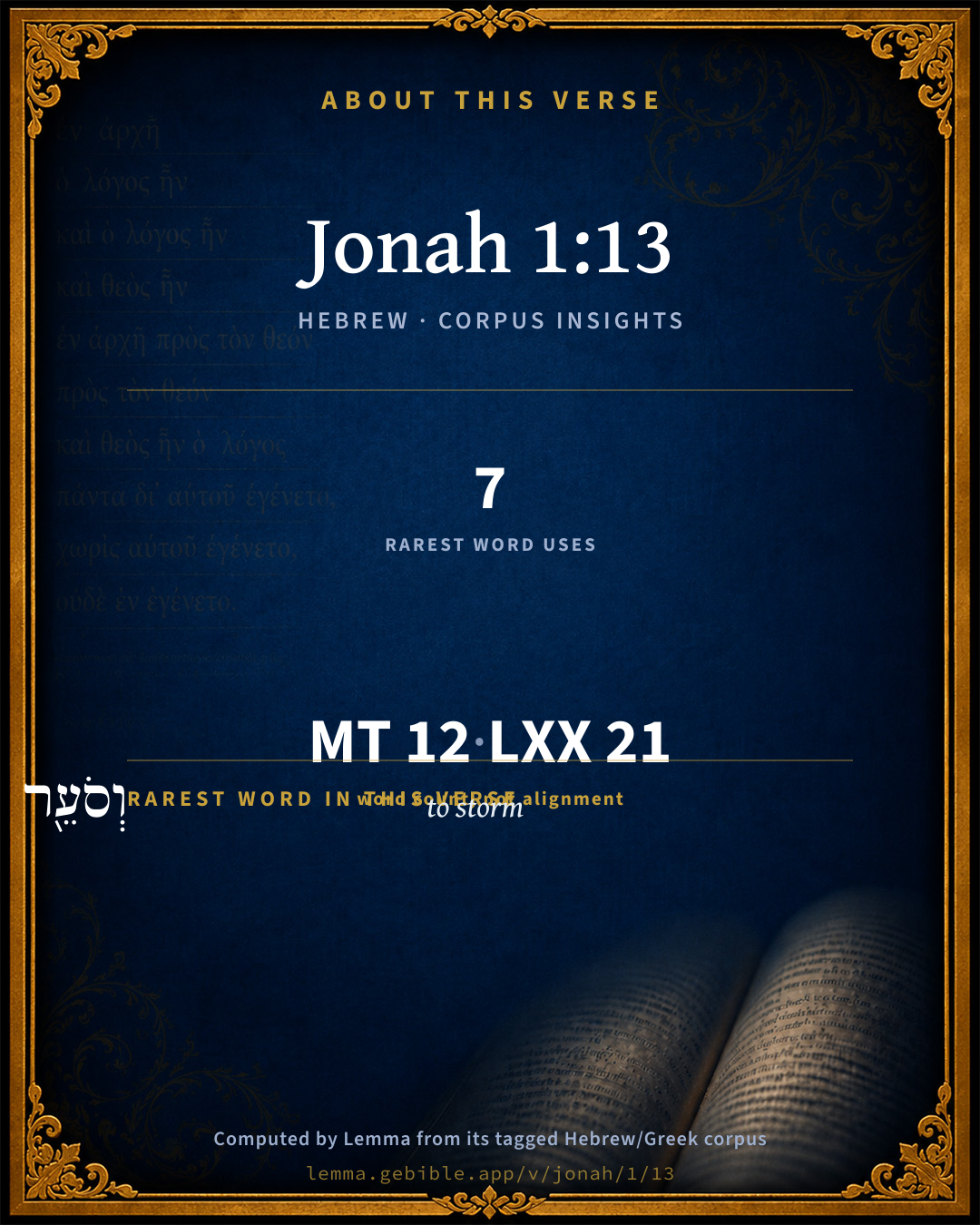
The rarest word here is וְסֹעֵ֖ר to storm H5590 — appearing just 7 times in the whole Hebrew Bible.

Shared distinctive vocabulary

וְסֹעֵ֖ר to storm H5590 occurs in 7 verses of the Hebrew Bible. Also found in:

Grammatical profile

  • 5 verbs
  • 3 nouns
  • 2 prepositions
  • 1 conjunction
  • 1 particle

Verb forms

  • וַיַּחְתְּר֣וּ Qal · Sequential Imperfect
  • לְהָשִׁ֛יב Hiphil · Infinitive Construct
  • יָכֹ֑לוּ Qal · Perfect
  • הוֹלֵ֥ךְ Qal · Participle Active
  • וְסֹעֵ֖ר Qal · Participle Active

Hebrew & Septuagint length

In English translation the verse runs 26 words from the Hebrew and 26 from the Septuagint (LXX English) — the same length.

A rough comparison of the two English renderings, which tokenize alike — not a word-level alignment.

Word counts can differ between the Hebrew and the Greek without any difference in meaning — e.g. the Hebrew direct-object marker אֵת has no separate Greek word, and Greek often adds the article ὁ.

In the original languages it is 12 Hebrew tokens and 21 Greek tokens — but the two are counted differently (Hebrew bundles its prefixes and suffixes into one token; the Greek is in lemma form), so that isn’t a like-for-like length.

Cross-references

2

Topical passages linked to Jonah 1:13 in the Treasury of Scripture Knowledge — connected by theme and wording, ordered by reader-vote popularity; previews shown in the World English Bible.

  • Proverbs 21:30 There is no wisdom nor understanding Nor counsel against Yahweh.
  • Job 34:29 When he gives quietness, who then can condemn? When he hides his face, who then can see him? Alike whether to a nation, or to a man:

Cross-references courtesy of OpenBible.info (CC BY 4.0).

Hebrew and Greek witnesses Masoretic Hebrew ↔ Greek Septuagint

The same verse in the two great witnesses to the Old Testament, shown verse-for-verse.

These are two independent witnesses, not word-aligned to each other, and the Septuagint is shown in lemma (dictionary) form.

Hebrew Jonah 1:13 Masoretic · Westminster Leningrad Codex

וַיַּחְתְּר֣וּ הָאֲנָשִׁ֗ים לְהָשִׁ֛יב אֶל הַיַּבָּשָׁ֖ה וְלֹ֣א יָכֹ֑לוּ כִּ֣י הַיָּ֔ם הוֹלֵ֥ךְ וְסֹעֵ֖ר עֲלֵיהֶֽם

Nevertheless the men rowed hard to get them back to the land; but they could not, for the sea grew more and more tempestuous against them.

World English Bible · Public Domain

Greek LXX Jonah 1:13 Septuagint · lemma form

καί παραβιάζομαι ὁ ἀνήρ ὁ ἐπιστρέφω πρός ὁ γῆ καί οὐ δύναμαι ὅτι ὁ θάλασσα πορεύομαι καί ἐκἀγείρω μᾶλλον ἐπί αὐτός

And the men tried hard to return to the land, and were not able: for the sea rose and grew more and more tempestuous against them.

LXX2012 (modern English Septuagint) · Public Domain

On this verse, The Pulpit Commentary discusses the Septuagint’s reading. Read the note in Commentary ↓

Hebrew: Westminster Leningrad Codex (CC BY 4.0). Greek: Septuagint (public domain); English from LXX2012 (modern English Septuagint) (Public Domain). How the Septuagint differs from the Hebrew →

Targum (Aramaic paraphrase)

1

The Targum is the ancient Jewish Aramaic paraphrase of the Hebrew Scriptures — an interpretive translation, not the Hebrew text itself. Onkelos (literal) and Pseudo-Jonathan (expansive) render the Torah, and Jonathan the Prophets. Coverage is partial: where no permissively-licensed English translation exists for a verse, only the Aramaic is shown. This is verse-level text, not a word-by-word alignment to the Hebrew.

  1. Targum Jonathan Prophets (Joshua–Malachi)
    וְשָׁיְטִין גַבְרַיָא לַאֲתָבָא לְיַבֶּשְׁתָּא וְלָא יְכִילוּ אֲרֵי יַמָא אָזֵיל וְנַחְשׁוֹלֵיהּ תַּקִיף עֲלֵיהוֹן:

    And the men sailed about to come to dry land, but they could not, because the sea was going and its cyclone was strengthening upon them.

    Targum Jonathan — Aramaic: “Mikraot Gedolot” (public domain). English: “Sefaria Community Translation” (CC0 1.0 (public-domain dedication)); “London "Chaldee Paraphrase," 1871” (public domain). Text via Sefaria.

Commentary

Notes on Jonah 1:13 from classic Christian and Jewish commentators (each source and its license shown beneath its notes). The classic Christian expositions comment on the surrounding passage and are grouped to its opening verse, so a note may address several verses; the Jewish commentaries on the Tanakh (Rashi and others) are per-verse, so they appear only where the commentator wrote on this verse.

Lemma curates 59 commentaries, every one of them public domain or Creative Commons licensed, each selected and text-cleaned for this edition rather than reprinted as found. About our sources →

Trapp's Complete Commentary

John Trapp

Jon 1:13 Nevertheless the men rowed hard to bring [it] to the land; but they could not: for the sea wrought, and was tempestuous against them.

Ver. 13. Nevertheless the men rowed] Heb. digged: for so they that row seem to do with their oars as with spades. Hence also the Latin poets say, that boatmen cut, plough, furrow the waters (Virg. Aeneid.), Vastum sulcavimus aequor. Infindunt pariter sulcos. The Seventy render it παρεβιαζοντο, they did their utmost endeavour, with violence, to bring the ship to shore, and to save Jonah: and not as those bloody emperors, Tiberius, Caligula, and Claudius, who took delight in the punishment of offenders, and used to come early in the morning into the marketplace to behold their executions. Non nisi coactus, said that better emperor, when he was to subscribe a sentence of death; and, Oh, that I could not write mine own name ( Utinam literas nescirem), said another upon the like occasion.

But they could not] They did but strive against the stream, for the Lord had otherwise determined it; and Voluntas Dei necessitas rei, who hath resisted his will?

For the sea wrought, and was tempestuous against them.] As Jon 1:11. Praesentemque viris intentant omnia mortem.

John Trapp, A Commentary or Exposition upon All the Books of the Old and New Testament (1647–1656) — public domain. Text from a community e-Sword module.

Joseph Benson's Commentary

Jon 1:13-14. Nevertheless, the men rowed hard, &c. — Whoever these mariners were, they are to be admired for their generosity; for though Jonah had told them that he was the cause of the tempest, and had advised them to cast him into the sea, yet they were very unwilling to do it, and generously redoubled their efforts, strained every nerve, and exposed themselves unto still greater danger of sinking, for some time longer, in order, if possible, to gain the shore without throwing him overboard. Wherefore they cried unto the Lord — Hebrew, unto JEHOVAH, the Maker of heaven and earth. They were convinced, by the account which Jonah gave of himself, that the God whom he worshipped, Jon 1:9, had brought this tempest upon them; therefore they made their petitions to him. Let us not perish for this man’s life — For doing that to him which in all probability will prove his destruction. And lay not upon us innocent blood —

Although this man has committed nothing against us worthy of death, according to human laws, and nevertheless we are about to take away his life; yet do not impute to us the crime of shedding innocent blood, inasmuch as we take it away through extreme necessity to save our own lives, and by his own desire. For thou, O Lord, hast done as it pleased thee — “Who hast raised this storm manifestly extraordinarily, who hast caused the lot to fall upon Jonah, who hast compelled him to confess himself to be guilty, and the cause of this calamity.” — Grotius. Or, as Bishop Newcome expresses their meaning, “Punish us not as murderers of an innocent man: for we judge, from the whole transaction, that we are conforming ourselves to thy will.”

Joseph Benson's Commentary on the Old and New Testaments (1811–1818) — public domain. Text from a community e-Sword module.

Tyndale Open Study Notes

Tyndale Open Resources

1:13-14 Instead, the sailors rowed even harder: It was now clear that Jonah was the one who had offended the Lord, but the sailors were apparently concerned that the Lord would be more offended if they killed one of his prophets.

Tyndale Open Study Notes — © Tyndale Open Resources, licensed CC BY-SA 4.0. Text via the HelloAO Bible API.

Jamieson, Fausset & Brown

Robert Jamieson, A. R. Fausset & David Brown

they could not-- (). Wind and tide--God's displeasure and God's counsel were against them.

Jamieson, Fausset & Brown — Commentary Critical and Explanatory on the Whole Bible (1871) — public domain (CC PDM 1.0). Text via the HelloAO Bible API.

Adam Clarke's Commentary

Verse 13. The men rowed hard] Were very unwilling to proceed to this extremity, and thought they would risk every thing rather than cast this disobedient prophet into the great deep.

Adam Clarke's Commentary on the Bible (1810–1826) — public domain. Text from a community e-Sword/MySword module.

John Calvin's Commentaries

This verse shows that the sailors and the rest were more inclined to mercy, when they saw that the holy Prophet was willing to undergo the punishment which he had deserved. When therefore, he confessed that he was guilty, and refused not to be punished, they became anxious to spare his life, though they were heathens, and also for the most part barbarians: and as each of them could not but be frightened with his immediate danger, the wonder is increased, that they had such regard for the life of one who alone was in fault, and who had now freely confessed this. But the Lord so turned their hearts, that they now saw more clearly how grievous a sin it was to flee away from the call of God, and not to yield obedience, as we have before observed, to his command. Many think that this is a light offense, and readily indulge themselves in it: but it is not in the power of men to weigh sins; the balance is deceitful when men estimate their sins according to their own judgment. Let us then learn to ascribe to God his own honor, — that he alone is Judge, and is far above us, and can alone determine how grievous or how slight any sin is. But common sense, except when men willfully deceive themselves by vain flatteries, clearly teaches this, — that it is no light offense when we evade the command of God; for, as we have stated, men do thus take away from God his supreme authority; and what is left to God, when he governs not the creatures whom he has formed, and whom he sustains by his power? The Lord, then, designed to show here, that his displeasure could not be otherwise pacified than by drowning Jonah in the sea; though, as we shall presently see, he had something greater in view. But, in the meantime, this is worthy of being observed, — that the Lord intended to make Jonah an example, that all may now know that he is not to be trifled with, but that he ought to be obeyed as soon as he commands any thing.

The word which the Prophet uses has been variously explained by interpreters. חתר, chetar, is properly, to dig; so that some think it to be a metaphorical expression, as rowers seem to dig the sea; and this sense is not unsuitable. Others carry the metaphor still higher, — that the sailors searched out or sought means by which they might drive the ship to land. But the other metaphor, as being less remote, is more to be approved. The Latins call it to toil, (moliri) when the rowers not only apply gently their oars, but when they make a greater effort. The sailors, then, toiled to bring back the ship But for what purpose? To spare the life of the man who had already confessed that he was guilty before God, and that the storm, which threatened them all with a shipwreck, had arisen through his fault: but he says that they could not, for the sea was tempestuous, as we have already seen in our yesterday’s lecture.

John Calvin's Commentaries (1540-1563) — public domain. Text from the Calvin Translation Society English edition (1840s-50s) via the Christian Classics Ethereal Library (ccel.org). Calvin's coverage is partial (roughly two-thirds of the Bible); uncommented books and verses are honest gaps, never fabricated. The 19th-century editor's footnotes and remarks are omitted so the notes are faithfully Calvin's own voice.

Ellicott's Commentary for English Readers

(13) Rowed hard.—This is a sufficient rendering of the Hebrew verb, though it misses the metaphor. In every other instance of its use the word refers to the violence employed in breaking through a wall or enclosure. (See Eze_8:8; Eze_12:5; Eze_12:7; Job_24:16; Amo_9:2; and compare the use of the derivative noun in Exo_22:2; Jer_2:34.) The figure of forcing the ship through the great wave wall is very striking. The Latin infindere sulcos and our ploughing the main are kindred metaphors.

It is a fine trait in these sailors that they will not obey the prophet’s request to throw him overboard till all efforts to save the ship have been tried.

A Bible Commentary for English Readers, edited by Charles John Ellicott (1878–1897) — public domain. Text from a community e-Sword module.

The Cambridge Bible for Schools and Colleges

gen. ed. J. J. S. Perowne

13. rowed hard] Lit., digged. The word is used for digging or breaking through a wall, Job_24:16; Eze_12:5; Eze_12:7. The figurative use of it does not occur again in the O.T., where, as has been before observed, the references to maritime affairs are very few, but the figure itself is common in other languages. Rosenm. compares the phrases “infindere sulcos,” “arare aquas,” “scindere freta.” Virg. Æn. v. 142, Ovid, Trist. III. Eleg. XII. 36, Metamorph. XI. 463. They used their-utmost endeavours to bring her to land again, but in vain, for the tempest, so far from abating, only raged more furiously.

The Cambridge Bible for Schools and Colleges (gen. ed. J. J. S. Perowne; Cambridge University Press, 1878–1918) — public domain. Text from a community e-Sword module.

John Gill's Exposition

Nevertheless, the men rowed hard to bring it to the land,

but they could not,.... Or, "they digged" (l); that is, the waters of the sea with their oars; not by casting anchor, as Abendana; they used all their skill and exerted all their strength; they laboured with all their might and main, as a man digs in a pit; they ploughed the ocean, and furrowed the sea, as the Latins speak, but all in vain; they rowed against wind and tide; God, his purposes and providence, were against them; and it was not possible for them to make land, and get the ship ashore, which they were desirous of, to save the life of Jonah, as well as their own; for, seeing him penitent, they had compassion on him; his character and profession as a prophet, the gravity of the man, the sedateness of his countenance, his openness of mind, and his willingness to die, wrought greatly upon the men, that they would fain have saved him if they could; and perhaps being Heathens, and not knowing thoroughly the nature of his offence, might think he did not deserve to die; but all their endeavours to save him were to no purpose:

for the sea wrought, and was tempestuous against them; it grew more and more so; the storm beat right against them, and drove them back faster than they came; so that it was impossible to stand against it.

(l) "et fodiebant", Montanus, Calvin, Piscator, Tarnovius; "foderunt", Vatablus, Liveleus.

John Gill's Exposition of the Whole Bible (1746–1763) — public domain (CC PDM 1.0). Text via the HelloAO Bible API.

Albert Barnes' Notes on the Bible

The men rowed hard - , literally “dug.” The word, like our “plowed the main,” describes the great efforts which they made. Amid the violence of the storm, they had furled their sails. These were worse than useless. The wind was off shore, since by rowing alpine they hoped to get back to it. They put their oars well and firmly in the sea, and turned up the water, as men turn up earth by digging. But in vain! God willed it not. The sea went on its way, as before. In the description of the deluge, it is repeated Gen 7:17-18, “the waters increased and bare up the ark, and it was lifted up above the earth; the waters increased greatly upon the earth; and the ark went upon the face of the waters.” The waters raged and swelled, drowned the whole world, yet only bore up the ark, as a steed bears its rider: man was still, the waters obeyed. In this tempest, on the contrary, man strove, but, instead of the peace of the ark, the burden is, the violence of the tempest; “the sea wrought and was tempestuous against them” . “The prophet had pronounced sentence against himself, but they would not lay hands upon him, striving hard to get back to land, and escape the risk of bloodshed, willing to lose life rather than cause its loss. O what a change was there. The people who had served God, said, Crucify Him, Crucify Him! These are bidden to put to death; the sea rageth; the tempest commandeth; and they are careless its to their own safety, while anxious about another’s.”

Albert Barnes' Notes on the Bible (1834–1885) — public domain. Text from a community e-Sword/MySword module.

Haydock's Catholic Bible Commentary

Hard. They were unwilling to destroy the prophet, (Calmet) fearing to incur fresh guilt by thus treating one who had intrusted his life to them. (Josephus, Antiquities ix. 11.)

George Leo Haydock (1774–1849), Haydock's Catholic Family Bible and Commentary, 1859 edition — public domain. Excludes Psalms (Douay-Rheims chapter numbering differs from Protestant) and Deuterocanonical books (Catholic canon only).

Matthew Poole's English Annotations

Nevertheless, Heb. And; but rightly to the proper sense of the phrase rendered here

nevertheless: Notwithstanding the lot fell on Jonah, he confessed his fault, directs them to cast him overboard, and in all this avoweth himself to be a prophet of God, and assures them of a calm sea if they do this; yet, very willing to save him,

the men rowed hard; they contrived all ways, and are willing to be at any labour to save him; they ply their oars, and strain their strength, with deep strokes tb force the ship to shore.

But they could not; all was lost labour; God had given other order to his servants, the wind and sea; both obey him, and both keep Jonah a prisoner, self-condemned, and desirous of what the mariners were very unwilling to.

For the sea wrought, and was tempestuous against them: see Jon 1:11; the sea tossed itself more violently, and by unsteady motions, like some hurricane, every moment endangered them.

Matthew Poole's English Annotations on the Holy Bible (1683–1685) — public domain. Text from a community e-Sword/MySword module.

Whedon's Commentary on the Bible

Daniel D. Whedon

13. The men rowed hard — Literally, broke through. They tried to break through the waves (Amo_9:2). The manly attitude of Jonah may have aroused the sympathy of the sailors; they did their best to save him, but in vain. The tempest only increased in fury. 14. When all efforts failed they finally decided to cast Jonah overboard, but first they prayed to Jonah’s God that he would not hold them guilty of murder.

They cried unto Jehovah — Jonah, as the worshiper of Jehovah, was under the latter’s protection. He might avenge any injury done to his prophet. Against this divine vengeance they sought to protect themselves.

For this man’s life — Which is about to be destroyed (Deu_19:21; 2Sa_14:7).

Lay not upon us innocent blood — These words do not imply that they considered Jonah innocent, and they do not mean that they prayed Jehovah to interfere so that they might not be compelled to destroy the life of an innocent man. The casting of the lot had settled the question of Jonah’s guilt; but they, with other ancients, believed that a deity might act arbitrarily, and were afraid that, after they had thrown Jonah overboard, Jehovah might impute his death upon them as blood-guiltiness (Deu_21:8), as if he were an innocent man, and thus demand their death in turn.

Thou… hast done as it pleased thee — In sending the storm and in overruling the lot. In casting Jonah overboard they were only carrying out the divine pleasure as revealed in the acts of the divine providence.

Daniel D. Whedon (gen. ed.), Commentary on the Old and New Testaments (1874–1909) — public domain. Text from a community e-Sword module.

The Pulpit Commentary

The generous sailors, however, are loth to execute this sentence on a prophet of the Lord, and make a supreme effort to reach the land, and thus obviate this severe alternative. Rowed hard; literally, digged; (Job_24:16 Eze_12:7) Septuagint, parebiazonto , "used violent efforts." They endeavoured to force their way through the waves with oars, as the use of sails was impracticable. The expression is like the classical phrases, infindere sulcos, scindere freta, arare aquas, and our "to plough the main." To the land; to get them back to land. The wind was off shore, and they had taken down the sails, and tried to row back to the harbour. Tou epitreqai pro , "to return to the land" (Septuagint). The sea wrought (see note on ver. 11).

Vers. 13, 14. Effort and prayer.

It has always been acknowledged that there was in the conduct of these heathen sailors something peculiarly generous. Although they believed themselves to have been brought into danger by the companionship of Jonah, although he himself invited them to cast him overboard and so secure their safety, this they would not do until they had exhausted every means of deliverance.

I IN TIMES OF DIFFICULTY AND DANGER WE ARE SUMMONED TO EXERT ALL OUR POWERS FOR OUR ESCAPE AND PRESERVATION. There is a false piety which is true fatalism, which is content with prayer and indisposed to effort. But such is not the piety sanctioned in Scripture. Courage, effort, perseverance, these are the qualities which are always mentioned with commendation. In fact, effort is the use of the natural powers with which our Creator has endowed us, the employment of the means which Providence has put within our reach. In striving for safety and for success men are honouring God. Endeavours may be unsuccessful, but it is better to fail while doing our very best than to fail by sloth and negligence.

II IN TIMES OF DIFFICULTY AND DANGER THERE IS NO RESOURCE SO PROPER AND SO PRECIOUS AS PRAYER. The conduct of these heathen sailors, as here described, is beyond all praise. What they did was to put forth every effort for their own and their fellow voyager"s safety, and then to commend themselves to the guidance and the mercy of the Most High. With their slender knowledge they could not have prayed with much intelligence; but they prayed with much good feeling towards man, with much submission towards God; and with much fervour. The lesson is obvious. Whilst we can work it is well to work in a prayerful spirit, with dependence upon God. When we can no longer work, when human effort is of no avail, then it is well to call upon God and to leave ourselves entirely in his hands.

Vers. 13-16. Storm stilling extraordinary.

We see in this passage, under favourable circumstances, the workings of the heathen mind in its first glimpses of God. And the study is one of lively interest, and important withal. The sailors have, innocently and involuntarily, been made actors in a drama that is not unlike to turn out a tragedy. A stranger, pursued by the vengeance of his (to them) unknown God, has got on board their ship, and mixed them up in his troubles to the extent of bringing them to the very brink of death. From their standpoint it was rather a hard case. They might well have felt resentment and given the cold shoulder to the not guiltless occasion of their evil plight. Their prudence, their considerateness, their conscientiousness, and their ultimate devoutness are qualities that come on us as an agreeable but complete surprise. There is a philosophy of these qualities, however, which it will be worth our while to endeavour to trace out.

I THEY SHOWED AN ENLIGHTENED REGARD FOR HUMAN LIFE. They might well have been excused if, in imminent danger of death through the guilty Jonah"s presence in their ship, they had jumped at his proposal to throw him overboard. They knew, for he an inspired prophet had told them, that he had deserved it by his crime, and that to do so would calm the sea forthwith. Yet they make no movement in that direction, but redouble their efforts at the oar in their last desperate attempt to reach the land. This course was unlike a heathen crew. Heathenism has always been reckless about shedding blood. It is the Bible that teaches, and believers in it who recognize, the sacredness of human life. Its command, "Thou shalt not kill," is illustrated and enforced by its history and entire legislation. The murderer was to suffer death, though he should be dragged to it from the veiny horns of the altar. (Num_35:31 1Ki_2:29) The very ox that took a human life must die, and might not be eaten. (Exo_21:28) Even the man who slew another by misadventure made his life forfeit to the avenger of blood if he were caught outside the city of refuge. (Deu_19:5) Blood, in fact, according to Scripture, must have blood. (Gen_9:5, Gen_9:6) There is no other satisfaction for it. The value of it cannot be expressed in any earthly currency. Even the whole world is no compensation for a lost life. (Mar_8:36) Those principles find little place in the consciousness of heathendom. It is filled with "the habitations of cruelty." You will get no heathen nation in any age exhibiting either in private life or public an adequate sense of the inviolability of human life. It is evident that in the case before us the sailors have been impressed by the Divine portents on the occasion, and under their impulse act for a time on a higher than the heathen plane. Not in their heathenism, but in the theism it is for the time in contact with, must we look for the explanation of their humane and generous conduct. The knowledge of God is early and inevitably practical. By it "grace is multiplied" and the "pollutions of the world" escaped. (2Pe_1:2 2Pe_2:20)

II THEY RECOGNIZED THE BELIEVING LIFE AS SPECIALLY SACRED. It will be conceded that, other things being equal, the life of a believer is more important than that of an unbeliever. Not only has it elements and functions which are all its own, but these are intrinsically more excellent than any others. God treats it as precious in a peculiar sense, (Psa_72:14 Psa_116:15) keeping count of the very hairs of his people"s, (Mat_10:30) and using, (1Co_3:21, 22 2Co_4:15) and even sacrificing, the lives of the wicked for their preservation. (Isa_43:4) He also safeguards it by a double rampart of threat and promise. The death or the hurt of the saints he will avenge with punishment worse than death; (Luk_18:8 Mat_18:7) whilst even a cup of water to the least of them shall meet with eternal recognition and reward. (Mat_10:42 Mat_25:40) Of the inviolable sacredness of the saint"s life the sailors had evidently an intuitive idea "Although himself accuse himself, and lay his fault plain before them, although winds and waves did confirm it, although the lot thrown did assure it, although in words he did desire to be cast into the water, yet those who should have done it do so ill like of the matter, that if sails or oars can serve they will back again to the land rather leave their intended journey than use any violence towards him" (Abbot). It was not on the score of his humanity merely that Jonah was so tenderly dealt with. The hurricane, the power and wrath of God speaking in it, Jonah"s revealed connection with both, his acknowledgment and denunciation of his fault, and the meek manhood of his offer to die that they might live, were all circumstances to awe and soften them. "Disobedient though he may be, Jonah they perceive is God"s prophet, and his servant still. Revering his God, they respect him. They feel that it is a solemn thing to have to do with anything that this God marks as his own marks as his own even by his displeasure. Hence they pause" (Martin). This is godliness in its normal operation, and realizing its "promise of the life that now is" by surrounding it with an invisible yet inviolable guard.

III THEY SHAPED THEIR CONDUCT IN THE EMERGENCY AS FAR AS POSSIBLE BY GOD"S. "Thou, O Lord, hast done as it pleased thee" (ver. 14). They would have spared the prophet"s life had the thing been possible. It is only when Providence fights against them, and logically shuts them up to it, that they accept the inevitable, and throw him overboard. As their words imply, they "assume that to be righteous which God will have to be done; and because they see him will it, and that he will take no nay, therefore they know it is just, and accordingly yield unto it" (Abbot). The rule of right is God"s will The expression of this in a particular case supersedes the general law. "Thou shalt not kill" and "Thou shalt not steal" are canons in the universal moral code. Yet Abraham would have killed Isaac, and Samuel killed Agag, whilst Israel spoiled the Egyptians at the command of God. Then, from the general law forbidding homicide, was excepted the whole class of cases in which it was necessary for self-defence; and to take spoil in war, or as much food from a neighbour"s field as would save the life, was excepted from the general law forbidding theft. On the same principle the execution of Jonah was legalized by the expressed will of God to that effect, and became to the sailors an act of simple duty. And their course was exemplary. Obedience to God is the highest morality. Whatever is done so is done well. It may seem anomalous and unfit. But that is only on the surface. Some of the finest passages in literature are least obviously conformable to grammatical rule. The conformity is there, and in the highest sense; it is only the tyro who cannot see it. So with actions done in the highest moral plane. The actor is too intent on doing what God says to look after the minor congruities. But the thing he does has an essential and fundamental rightness which lifts details into a new connection where they also become appropriate. "Whatsoever the Lord saith, that will we do." The men who accentuate the "whatsoever," and do it honestly, are seldom favourites with the crowd, but they have scaled the loftiest moral heights, where the voice of human opinion is neither listened for nor heard.

IV THEY FOUND DELIVERANCE IN FOLLOWING GOD"S LEAD. (Ver. 15) Attempts at escape in every other direction were made persistently, but all in vain. The ship lightening, the prayers to idols, the strenuous rowing, were so many exercises in the bootless task of fighting against God. Against the wind and tide of his purpose no human power can sail. "God was pursuing this matter to his own appointed issue, and would allow no effort, however well meant, to baffle his purpose" (Martin). This obvious fact the sailors are compelled at length to recognize. Reluctantly they give up their unavailing struggle, and take the course to which all along events had been conspiring to shut them up. And on the instant the face of affairs is changed. The elemental war is hushed in peace. The hurricane in which earth and heaven reeled becomes the calm as of a tropical night. The waters which had "gaped at their widest to glut him" swallow their prey, and forthwith cease their raging. How easy the end if we only take God"s way! How swift the transition from impossibility to attainment! Yet it is just the transition from man"s way to God"s. Have we not all experiences on which by analogy the event may throw light? Aiming at a legitimate object, we adopt what seems to us a fitting course. But we never get on in it. Disappointment awaits us at every step. Disaster springs on us from every covert. It seems as if men and things were joined together in a universal conspiracy to baulk us. Discouraged at last, and bitter at heart, we take without definite intention or expectation a step in a new direction, and which circumstances seem to thrust upon us; and lo, before we are aware, and almost without an effort, our object is attained. God works, not against means but with them, not apart from means, but by them; yet everywhere and always he works his own will in his own way. As we recognize that way and take it, are we on the moral rectilineal the shortest line between our present and God"s future.

V THEY ARE FINALLY WON TO GOD"S SERVICE BY THE EXHIBITION OF HIS CHARACTER. In the incidents of the day the sailors read a revelation of God. "The storm they clearly saw was in his hand; a reason for it, they saw, was in his heart. And that reason they saw as clearly as they saw the storm. His hand they saw was almighty. His heart they saw was righteous. They even became executioners of his wrath. It was a solemn initiation into the knowledge of his name" (Martin). And what but the revelation of God"s character wins men to his service everywhere? (Psa_36:7 Rev_15:4 2Co_5:14, 2Co_5:15) Conversion has many elements leading up to and meeting in it. There is the truth, the instrument in all saving change. There is the Holy Spirit interpreting the truth and bringing it home. But there is something else to which both refer. The power of the truth, even as applied by the Holy Ghost, must lie in the subject matter of it, and that subject matter is God. (Joh_5:39 Rom_1:16) God is the Infinite Beauty. God made manifest means men attracted, all minds dazzled, and all hearts won. (Psa_9:10) His Character commands confidence and challenges fealty. He is one whom to know is to trust, whom to see is to love and choose. It is on this fact that inspiration founds in a familiar maxim of the kingdom. (Joh_17:3) Knowledge of God is salvation, for every saving grace inheres in it or goes with it.

VI THEIR RELIGIOUS LIFE GAVE EVIDENCE OF ITS GENUINENESS BY FOLLOWING SCRIPTURAL LINES. (Vers. 14-16) Prayer, fear, sacrifice, and vows; what essential element in religious life or worship do not these exercises cover? (Act_2:21 Psa_3:1 Isa_44:5) In prayer is the coming to God for the things that are his gift if they come at all. In sacrifice is the coming symbolically by atonement., the only coming to which blessing is promised. Fear epitomizes the attitude and line of action in which practical religion may be summed up. A vow is a testimony that the ideal life is consecration a pledge that they will freely give who have received so freely. Wewonder at the propriety and fitness of the sailors" entire action. They had no Bible. They learned nothing from the prophet. Yet they took a distinctly scriptural course. They rendered God service in God"s appointed way. Does it not seem as if they were somehow taught by his Holy Spirit; their minds enlightened, their hearts renewed, their activity shaped by almighty grace? As to salvation without the Bible, we must say, with a leading Reformation Symbol, that "there is no ordinary possibility" of it; but might it not be going too far to say that it is absolutely and in the nature of the case impossible? The rule is "salvation by faith, and faith by hearing;" but if the rule does not cover the case of infants, why must it be taken to cover that of all other human beings? The mere light of nature is doubtless insufficient to give saving knowledge of God; but saving enlightenment can hardly be held impossible in a mind to which God has access direct. Humility and charity will alike refuse to mark out a path for him whose "footsteps are not known." It is ill trying to make the voyage of the religious life with a spiritual Jonah on board. Yet the Church is full of such would be navigators. There is the Jonah of a demoralizing occupation occupation having to do, e.g., with gambling, or betting, or drunkenness, or fraudulent manufacture, and it must be thrown overboard or the ship of personal religion will go down. There is the Jonah of some pet sin, which, like Herod to Herodias, we cling to and prefer to Christ; and if we would escape the lake of fire we must "pluck it out and cast it from us." There is above all the Jonah of an unbelieving heart. Men wilt have a religion without self-surrender; will do anything and everything but yield themselves to God. Yet they must do this, or all else is vain. Unbelief is in its nature fatal, cuts off the dead soul from its life in Christ. We ask you one question Will you give yourself now and here to Christ? If you answer, "Yes," you are a saved man. If you answer, "No," we need pursue the inquiry no further, for heaven is as inaccessible to you as if Christ the Way to it had never come. J.E.H.

The Pulpit Commentary (1880–1919), ed. H.D.M. Spence-Jones & Joseph S. Exell — public domain. Text from a community e-Sword module.

John Wesley's Explanatory Notes

Rowed hard - They were willing to be at any labour to save him.

John Wesley, Explanatory Notes Upon the Whole Bible (1754–1765) — public domain. Text via the GEBible commentary corpus.

Keil & Delitzsch

C. F. Keil & F. Delitzsch

But the men (the seamen) do not venture to carry out this sentence at once. They try once more to reach the land and escape from the storm, which is threatening them with destruction, without so serious a sacrifice. יחתּרוּ, lit., they broke through, sc. through the waves, to bring (the ship) back to the land, i.e., they tried to reach the land by rowing and steering. Châthar does not mean to row, still less to twist or turn round (Hitzig), but to break through; here to break through the waves, to try to overcome them, to which the παρεβιάζοντο of the lxx points. As they could not accomplish this, however, because the sea continued to rage against them (סער עליהם, was raging against them), they prayed thus to Jehovah: "We beseech Thee, let us not (אנּא = אל־נא) perish for the sake of the soul of this man (בּנפשׁ, lit., for the soul, as in Sa2 14:7 after Deu 19:21), and lay not upon us innocent blood," - that is to say, not "do not let us destroy an innocent man in the person of this man" (Hitzig), but, according to Deu 21:8, "do not impute his death to us, if we cast him into the sea, as bloodguiltiness deserving death;" "for Thou, O Jehovah, hast done as it pleased Thee," - namely, inasmuch as, by sending the storm and determining the lot, Thou hast so ordained that we must cast him into the sea as guilty, in order to expiate Thy wrath. They offer this prayer, not because they have no true conception of the guilt of Jonah, who is not a murderer or blasphemer, inasmuch as according to their notions, he is not a sinner deserving death (Hitzig), but because they regard Jonah as a prophet or servant of the Almighty God, upon whom, from fear of his God, they do not venture to lay their hand. "We see, therefore, that although they had never enjoyed the teaching of the law, they had been so taught by nature, that they knew very well that the blood of man was dear to God, and precious in His sight" (Calvin).

Keil & Delitzsch — Biblical Commentary on the Old Testament (1861–1891) — public domain (CC PDM 1.0). Text via the HelloAO Bible API. (Old Testament only.)

Rashi

Rabbi Shlomo Yitzchaki (Rashi)

And the men rowed vigorously Heb. וַיַחְתְּרוּ, they toiled and busied themselves like one who digs a tunnel.

Rashi on the Tanakh — English translations: “The Judaica Press complete Tanach with Rashi, translated by A. J. Rosenberg” (CC BY 4.0); “Pentateuch with Rashi's commentary by M. Rosenbaum and A.M. Silbermann, 1929-1934” (public domain); “The Metsudah Tanach series, Lakewood, N.J” (CC BY 4.0); and “The Book of Joshua, Metsudah Publications, 1997” (CC BY 4.0). Text via Sefaria.

Lesson kit

Teaching starters — assembled from the data on this page, not authored interpretation. Every prompt links to the verse data it draws on. Edit before teaching.

Jonah, in the Prophets, opens this verse with 12 words (12 distinct Hebrew lemmas). Its most distinctive word is çâʻar (“to storm”). A historical commentator’s framing appears above. Read the whole chapter for the surrounding context.

Discussion questions

  1. How does “to storm” (çâʻar) shape what this verse is saying?
  2. How does 2 Kings 6:11, which shares the word «to storm», read alongside this verse?
  3. The translations on this page render this verse differently — a whole-verse word diff, not a word-by-word alignment. What might account for the different wordings?
  4. «וַיַּחְתְּר֣וּ» is a Qal Sequential Imperfect verb. How does that grammatical form shape the action described?
  5. Compare how Trapp's Complete Commentary and Joseph Benson's Commentary read this verse. Where do they agree or differ?

Things to notice

Reading settings

Reading text

Shown beneath each verse's original-language words.

Old Testament
Old Testament edition

Read the OT as the Masoretic Hebrew (MT) or the Greek Septuagint (LXX).

English shown for the Greek Septuagint (in the Hebrew ↔ Greek comparison).

Comparing translations? Open the Compare panel on any verse page to stack up to four side by side.