
Genesis 38:29

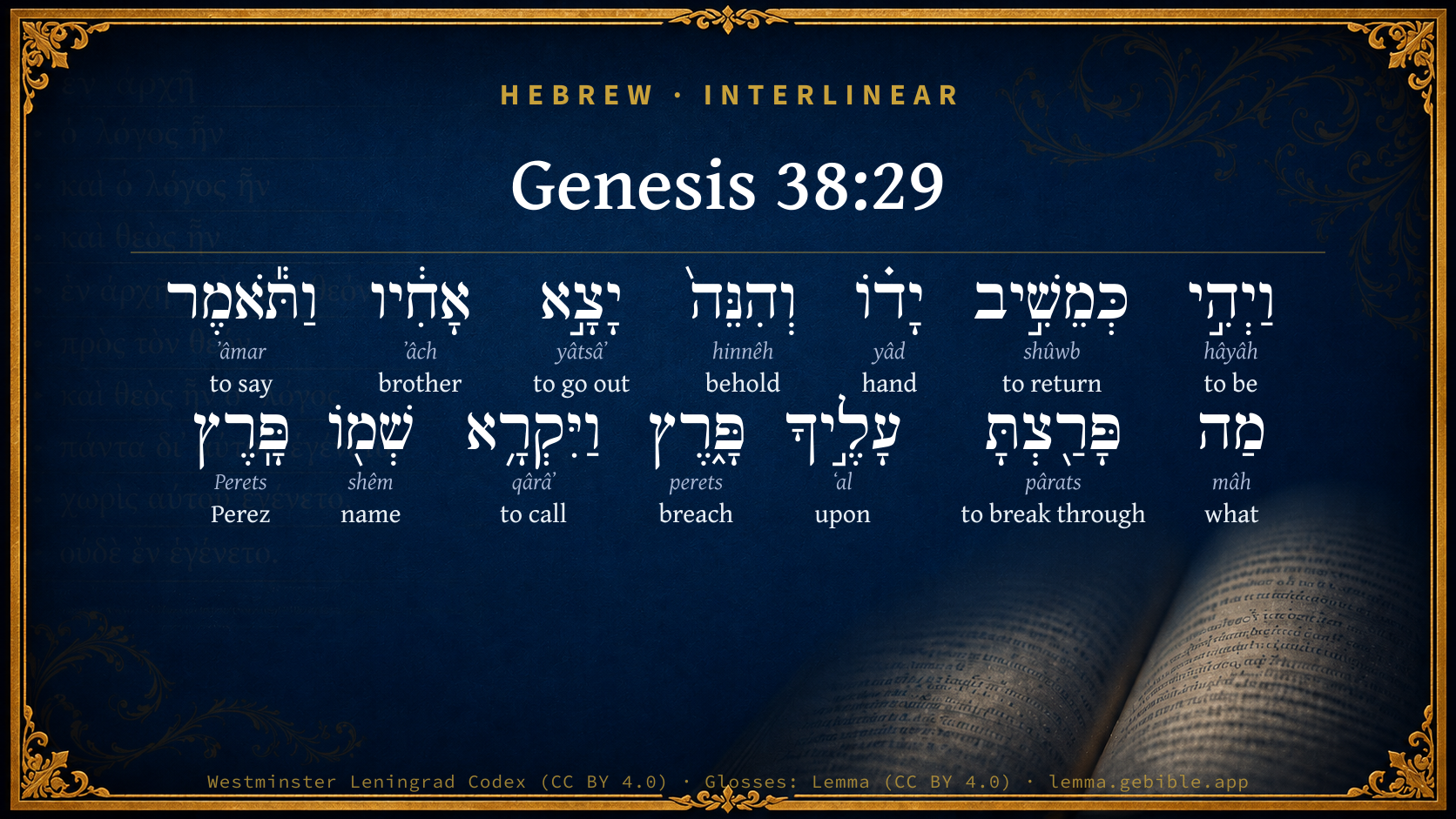
Hebrew (Westminster Leningrad Codex) Genesis 38:29 appears in the Hebrew Old Testament. The text above is from the Westminster Leningrad Codex. Each word links to its Strong’s number, a concise gloss, and parsing drawn from the Open Scriptures Hebrew Bible morphology. Click any word for its full Brown-Driver-Briggs (BDB) entry.
Download image
Cite this verse

Genesis 38:29 (World English Bible). Public Domain. Lemma interlinear Bible study tool, https://lemma.gebible.app/v/genesis/38/29.

Show BibTeX & RIS
BibTeX
RIS
English Translation
It happened, as he drew back his hand, that behold, his brother came out, and she said, "Why have you made a breach for yourself?" Therefore his name was called Perez.
World English Bible · Public Domain
Highlights
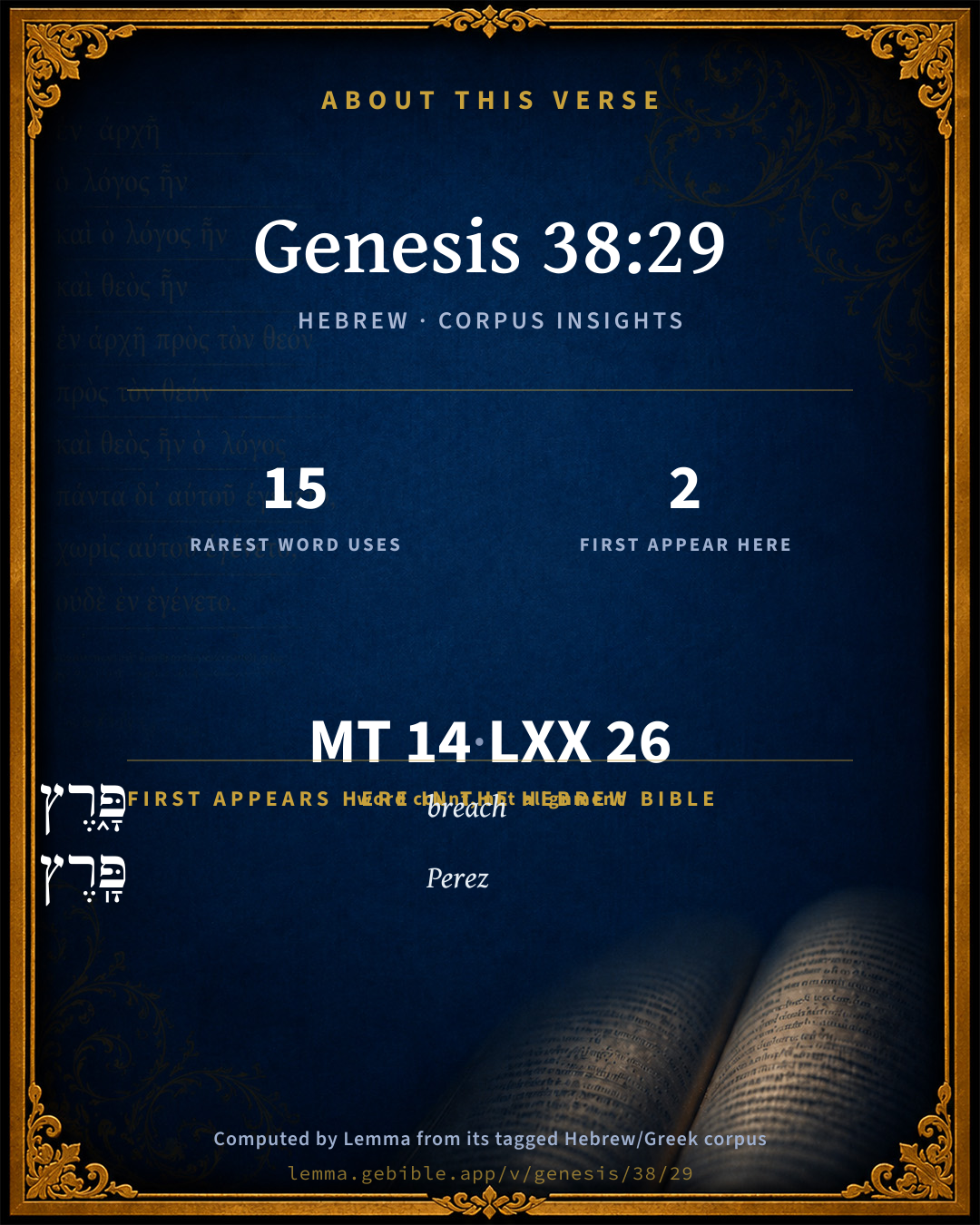
  • 2 first appearances in the Hebrew Bible
Full analysis ↓
Download a study sheet

One document with this verse’s original text, its word-by-word gloss line, the meaning frame, cross-references with their text, attributed commentary, and full source and license credits — printable, and it pastes into notes with its structure intact.

This verse Autodidact and up

Study sheet (.html) Plain text (.txt)

A passage Seminary Student

Up to 50 verses in one chapter. A passage sheet keeps up to 6 commentary sources and 12 cross-references per verse, in the order this page ranks them, and says so on the sheet whenever that leaves anything out. Ask for a single verse and you get the Autodidact verse sheet above.

Everything on this page stays free to read, with no account — the sheet is a download of what is already on screen, not access to it.

Want to remove ads? Support Godless Engineer
Compare translations 3

The same verse in 3 English versions, stacked beneath the original-language interlinear above. Click any original word for its lexicon entry.

Each is an independent rendering of the whole verse — the interlinear is not word-aligned to these translations.

Highlighted words mark where these versions differ — a whole-verse word diff, not a word-by-word alignment.

  • World English Bible Public Domain
    It happened, as he drew back his hand, that behold, his brother came out, and she said, "Why have you made a breach for yourself?" Therefore his name was called Perez.
  • King James Version Public Domain
    And it came to pass, as he drew back his hand, that, behold, his brother came out: and she said, How hast thou broken forth? this breach be upon thee: therefore his name was called Pharez.
  • unfoldingWord Literal Text CC BY-SA 4.0
    But it happened, when he drew his hand back in, then behold, his brother came out. Then she said, “How have you breached for yourself a breach?” So he called his name Perez.

unfoldingWord Literal Text — © unfoldingWord, licensed CC BY-SA 4.0. Word-aligned USFM3 via Door43 (git.door43.org/unfoldingWord/en_ult).

Versions to compare (up to 4)

3 of 4 selected

Show all 17 translations

Every available English version of this verse, each an independent rendering of the whole verse.

  • World English Bible Public Domain
    It happened, as he drew back his hand, that behold, his brother came out, and she said, "Why have you made a breach for yourself?" Therefore his name was called Perez.
  • Berean Standard Bible Public Domain
    But when he pulled his hand back and his brother came out, she said, “You have broken out first!” So he was named Perez.
  • Majority Standard Bible Public Domain
    But when he pulled his hand back and his brother came out, she said, “You have broken out first!” So he was named Perez.
  • King James Version Public Domain
    And it came to pass, as he drew back his hand, that, behold, his brother came out: and she said, How hast thou broken forth? this breach be upon thee: therefore his name was called Pharez.
  • American Standard Version (1901) Public Domain
    And it came to pass, as he drew back his hand, that, behold, his brother came out: and she said, Wherefore hast thou made a breach for thyself? Therefore his name was called Perez.
  • Revised Version (1885) Public Domain
    And it came to pass, as he drew back his hand, that, behold, his brother came out: and she said, Wherefore hast thou made a breach for thyself? therefore his name was called Perez.
  • Geneva Bible (1599) Public Domain
    But when he plucked his hand backe againe, loe, his brother came out, and the midwife said, How hast thou broken the breach vpon thee? and his name was called Pharez.
  • Young's Literal Translation Public Domain
    And it cometh to pass as he draweth back his hand, that lo, his brother hath come out, and she saith, `What! thou hast broken forth -- on thee `is' the breach;' and he calleth his name Pharez;
  • Literal Standard Version CC BY-SA 4.0
    And it comes to pass as he draws back his hand, that behold, his brother has come out, and she says, “What! You have broken forth—the breach [is] on you”; and he calls his name Perez;
  • Unlocked Literal Bible CC BY-SA 4.0
    But then he drew back his hand, and, behold, his brother came out first. The midwife said, “How you have broken out!” So he was named Perez.
  • unfoldingWord Literal Text CC BY-SA 4.0
    But it happened, when he drew his hand back in, then behold, his brother came out. Then she said, “How have you breached for yourself a breach?” So he called his name Perez.
  • Darby Bible Public Domain
    And it came to pass as he drew back his hand, that behold, his brother came out; and she said, How hast thou broken forth! on thee be the breach! And they called his name Pherez.
  • World Messianic Bible Public Domain
    As he drew back his hand, behold, his brother came out, and she said, “Why have you made a breach for yourself?” Therefore his name was called Perez.
  • Webster's Bible Public Domain
    And it came to pass as he drew back his hand, that behold, his brother came out; and she said, How hast thou broken forth? this breach be upon thee: therefore his name was called Pharez.
  • Free Bible Version CC BY-SA 4.0
    But then he pulled back his hand and his brother was born, she said, “How did you burst out?” So he was named Perez.
  • Bible in Basic English Public Domain
    But then he took his hand back again, and his brother came first to birth: and the woman said, What an opening you have made for yourself! So he was named Perez.
  • JPS Tanakh (1917) Public Domain
    And it came to pass, as he drew back his hand, that, behold his brother came out; and she said: 'Wherefore hast thou made a breach for thyself?' Therefore his name was called Perez.

Literal Standard Version (2020), Covenant Press — licensed CC BY-SA 4.0. Text via the HelloAO Bible API (eBible.org). Unlocked Literal Bible (unfoldingWord) — licensed CC BY-SA 4.0. Text via the HelloAO Bible API (eBible.org). unfoldingWord Literal Text — © unfoldingWord, licensed CC BY-SA 4.0. Word-aligned USFM3 via Door43 (git.door43.org/unfoldingWord/en_ult). Free Bible Version, Dr. Jonathan Gallagher — licensed CC BY-SA 4.0. Text via the HelloAO Bible API (eBible.org).

Word by word

More ways to search: Search by grammar → Find every occurrence → Compare this word →

Practice this passage: Drill this verse → Learn its vocabulary →

פָּֽרֶץ
Perets
H6557
“Perez”
Noun, Proper
Part of Speech
Noun
Type
Proper
Full BDB Definition

Origin: the same as H6556

TWOT: None

Perez or Pharez = "breach" - twin son with Zarah of Judah by Tamar and ancestor of two families of Judah, the Hezronites and Hamulites; from the Hezronites came the royal line of David and Christ
  1. וַיְהִ֣י hâyâh H1961 “and · to be” Conjunction + Verb, Qal, Sequential Imperfect, 3rd Person, Masculine, Singular
  2. כְּמֵשִׁ֣יב shûwb H7725 “like/as · returning” Preposition + Verb, Hiphil, Participle Active, Masculine, Singular, Absolute
  3. יָד֗וֹ yâd H3027 “hand · his” Noun, Common, Both, Singular, Construct + Suffix, Personal, 3rd Person, Masculine, Singular
  4. וְהִנֵּה֙ hinnêh H2009 “and · behold” Conjunction + Particle, Demonstrative
  5. יָצָ֣א yâtsâʼ H3318 “to go out” Verb, Qal, Perfect, 3rd Person, Masculine, Singular
  6. אָחִ֔יו ʼâch H251 “brother · his” Noun, Common, Masculine, Singular, Construct + Suffix, Personal, 3rd Person, Masculine, Singular
  7. וַתֹּ֕אמֶר ʼâmar H559 “and · to say” Conjunction + Verb, Qal, Sequential Imperfect, 3rd Person, Feminine, Singular
  8. מַה mâh H4100 “what” Particle, Interrogative
  9. פָּרַ֖צְתָּ pârats H6555 “to break through” Verb, Qal, Perfect, 2nd Person, Masculine, Singular
  10. עָלֶ֣יךָ ʻal H5921 “upon · you” Preposition + Suffix, Personal, 2nd Person, Masculine, Singular
  11. פָּ֑רֶץ perets H6556 “breach” Noun, Common, Masculine, Singular, Absolute
  12. וַיִּקְרָ֥א qârâʼ H7121 “and · to call” Conjunction + Verb, Qal, Sequential Imperfect, 3rd Person, Masculine, Singular
  13. שְׁמ֖וֹ shêm H8034 “name · his” Noun, Common, Masculine, Singular, Construct + Suffix, Personal, 3rd Person, Masculine, Singular

About this verse

These counts appear in no published source. They are computed here, from the morphology-tagged text and Lemma’s own curated glosses. What Lemma adds →

14
words
14
distinct lemmas
Pentateuch
section

Notable vocabulary

The rarest word here is פָּֽרֶץ Perez H6557 — appearing just 15 times in the whole Hebrew Bible.

First appearance in Scripture

These words make their first canonical appearance in the Hebrew Bible here:

  • פָּ֑רֶץ breach H6556
  • פָּֽרֶץ Perez H6557

Shared distinctive vocabulary

פָּֽרֶץ Perez H6557 occurs in 13 verses of the Hebrew Bible. Also found in:

Grammatical profile

  • 6 verbs
  • 5 nouns
  • 1 preposition
  • 2 particles

Verb forms

  • וַיְהִ֣י Qal · Sequential Imperfect
  • כְּמֵשִׁ֣יב Hiphil · Participle Active
  • יָצָ֣א Qal · Perfect
  • וַתֹּ֕אמֶר Qal · Sequential Imperfect
  • פָּרַ֖צְתָּ Qal · Perfect
  • וַיִּקְרָ֥א Qal · Sequential Imperfect

Hebrew & Septuagint length

In English translation the verse runs 31 words from the Hebrew and 32 from the Septuagint (LXX English) — closely comparable.

A rough comparison of the two English renderings, which tokenize alike — not a word-level alignment.

Word counts can differ between the Hebrew and the Greek without any difference in meaning — e.g. the Hebrew direct-object marker אֵת has no separate Greek word, and Greek often adds the article ὁ.

In the original languages it is 14 Hebrew tokens and 26 Greek tokens — but the two are counted differently (Hebrew bundles its prefixes and suffixes into one token; the Greek is in lemma form), so that isn’t a like-for-like length.

Cross-references

9

Topical passages linked to Genesis 38:29 in the Treasury of Scripture Knowledge — connected by theme and wording, ordered by reader-vote popularity; previews shown in the World English Bible.

  • Genesis 46:12 The sons of Judah: Er, Onan, Shelah, Perez, and Zerah; but Er and Onan died in the land of Canaan. The sons of Perez were Hezron and Hamul.
  • Numbers 26:20 The sons of Judah after their families were: of Shelah, the family of the Shelanites; of Perez, the family of the Perezites; of Zerah, the family of the Zerahites.
  • 1 Chronicles 2:4 Tamar his daughter-in-law bore him Perez and Zerah. All the sons of Judah were five.
  • Matthew 1:3 Judah became the father of Perez and Zerah by Tamar. Perez became the father of Hezron. Hezron became the father of Ram.
  • Ruth 4:12 and let your house be like the house of Perez, whom Tamar bore to Judah, of the seed which Yahweh shall give you of this young woman.
  • Nehemiah 11:6 All the sons of Perez who lived in Jerusalem were four hundred sixty-eight valiant men.
  • 1 Chronicles 9:4 Uthai the son of Ammihud, the son of Omri, the son of Imri, the son of Bani, of the children of Perez the son of Judah.
  • Nehemiah 11:4 In Jerusalem lived certain of the children of Judah, and of the children of Benjamin. Of the children of Judah: Athaiah the son of Uzziah, the son of Zechariah, the son of Amariah, the son of Shephatiah, the son of Mahalalel, of the children of Perez;
  • Luke 3:33 the son of Amminadab, the son of Aram, the son of Joram, the son of Hezron, the son of Perez, the son of Judah,

Cross-references courtesy of OpenBible.info (CC BY 4.0).

Hebrew and Greek witnesses Masoretic Hebrew ↔ Greek Septuagint

The same verse in the two great witnesses to the Old Testament, shown verse-for-verse.

These are two independent witnesses, not word-aligned to each other, and the Septuagint is shown in lemma (dictionary) form.

Hebrew Genesis 38:29 Masoretic · Westminster Leningrad Codex

וַיְהִ֣י כְּמֵשִׁ֣יב יָד֗וֹ וְהִנֵּה֙ יָצָ֣א אָחִ֔יו וַתֹּ֕אמֶר מַה פָּרַ֖צְתָּ עָלֶ֣יךָ פָּ֑רֶץ וַיִּקְרָ֥א שְׁמ֖וֹ פָּֽרֶץ

It happened, as he drew back his hand, that behold, his brother came out, and she said, "Why have you made a breach for yourself?" Therefore his name was called Perez.

World English Bible · Public Domain

Greek LXX Genesis 38:29 Septuagint · lemma form

ὡς δέ ἐπι συνἄγω ὁ χείρ καί εὐθύς ἐκἔρχομαι ὁ ἀδελφός αὐτός ὁ δέ εἶπον τίς διακόπτω διά σύ φραγμός καί καλέω ὁ ὄνομα αὐτός φαρες

And when he drew back his hand, then immediately came forth his brother; and she said, Why has the barrier been cut through because of you? and she called his name, Phares.

LXX2012 (modern English Septuagint) · Public Domain

Hebrew: Westminster Leningrad Codex (CC BY 4.0). Greek: Septuagint (public domain); English from LXX2012 (modern English Septuagint) (Public Domain). How the Septuagint differs from the Hebrew →

Targum (Aramaic paraphrase)

2

The Targum is the ancient Jewish Aramaic paraphrase of the Hebrew Scriptures — an interpretive translation, not the Hebrew text itself. Onkelos (literal) and Pseudo-Jonathan (expansive) render the Torah, and Jonathan the Prophets. Coverage is partial: where no permissively-licensed English translation exists for a verse, only the Aramaic is shown. This is verse-level text, not a word-by-word alignment to the Hebrew.

  1. Targum Onkelos Torah (Genesis–Deuteronomy)
    וַהֲוָה כַּד אֲתֵיב יְדֵהּ וְהָא נְפַק אֲחוּהִי וַאֲמֶרֶת מָה תְקוֹף סַגִּי עֲלָךְ לְמִתְקָף וּקְרָא שְׁמֵהּ פָּרֶץ

    (no public-domain English translation for this verse)

    Targum Onkelos — Aramaic: “Onkelos Genesis” (public domain); “Onkelos Exodus” (public domain); “Onkelos Leviticus” (public domain); “Onkelos Numbers” (public domain); “Onkelos Deuteronomy” (public domain). English: “Sefaria Community Translation” (CC0 1.0 (public-domain dedication)); “J.W. Etheridge. The Targums of Onkelos and Jonathan Ben Uzziel on the Pentateuch. London: Longmans, Green, 1862” (public domain). Text via Sefaria.

  2. Targum Pseudo-Jonathan Torah (Genesis–Deuteronomy)
    וַהֲוָה כַּד אָתֵיב יוֹלְדָא יַת יְדֵיהּ וְהָא נְפַק אָחוֹי וַאֲמַרַת מַה תְּקוֹף סַגִי תְּקִיפְתָּא וְעָלָךְ אִית לְמִיתְקוֹף דְאַנְתְּ עָתִיד לְמֶחֱסַן מַלְכְּוָותָא וּקְרַת שְׁמֵיהּ פָּרֶץ

    And after the child had withdrawn his hand, behold, his brother came forth, and she said, With what great power hast thou prevailed, and for thee will it be to prevail; for thou wilt possess the kingdom. And she called his name Pharets.

    Targum Pseudo-Jonathan — Aramaic: “Targum Jonathan on Genesis” (public domain); “Targum Jonathan on Exodus” (public domain); “Targum Jonathan on Leviticus” (public domain); “Targum Jonathan on Numbers” (public domain); “Targum Jonathan on Deuteronomy” (public domain). English: “The Targum of Jonathan ben Uzziel, trans. J. W. Etheridge, London, 1862” (public domain). Text via Sefaria.

Commentary

Notes on Genesis 38:29 from classic Christian and Jewish commentators (each source and its license shown beneath its notes). The classic Christian expositions comment on the surrounding passage and are grouped to its opening verse, so a note may address several verses; the Jewish commentaries on the Tanakh (Rashi and others) are per-verse, so they appear only where the commentator wrote on this verse.

Lemma curates 59 commentaries, every one of them public domain or Creative Commons licensed, each selected and text-cleaned for this edition rather than reprinted as found. About our sources →

Tyndale Open Study Notes

Tyndale Open Resources

38:29-30 Perez pushed past his brother, just as Joseph would soon do in relation to his brothers (chs 39–47).

Tyndale Open Study Notes — © Tyndale Open Resources, licensed CC BY-SA 4.0. Text via the HelloAO Bible API.

Geneva Bible (1599)

Geneva Bible translators

Their heinous sin was signified by this monstrous birth.

Or the separation between thee and thy brother.

Geneva Bible (1599) marginal notes — public domain. Text via Bolls.life.

Adam Clarke's Commentary

Verse 29. How hast thou broken forth?] מה פרצת mah paratsta, this breach be upon thee, עליך פרץ aleycka parets; thou shalt bear the name of the breach thou hast made, i. e., in coming first into the world. Therefore his name was called פרץ Parets, i. e., the person who made the breach. The breach here mentioned refers to a certain circumstance in parturition which it is unnecessary to explain.

Adam Clarke's Commentary on the Bible (1810–1826) — public domain. Text from a community e-Sword/MySword module.

The Cambridge Bible for Schools and Colleges

gen. ed. J. J. S. Perowne

27–30. Birth of Perez and Zerah

29. Wherefore hast, &c.] How hast thou made a breach! a breach be upon thee!

Perez] That is, a breach. For Perez, see Rth_4:12; Rth_4:18.

The Cambridge Bible for Schools and Colleges (gen. ed. J. J. S. Perowne; Cambridge University Press, 1878–1918) — public domain. Text from a community e-Sword module.

John Gill's Exposition

And afterward came out his brother that had the scarlet thread upon his hand,.... By which it was known that he so far came out first; which confirms the remarkable birth of his brother, who notwithstanding got the start of him:

and his name was called Zarah; not from "rising", or his coming forth like the rising sun, as is usually observed; but rather from his return, or drawing back his hand, and as it were returning to his mother's womb; and so, according to Hillerus (l), Zarah, by a transposition of letters, comes from "Chazar", to return: but Jarchi thinks he had his name from the refulgent appearance of the scarlet thread on his wrist.

(l) Onomastic. Sacr. p. 372.

Next: Genesis Chapter 39

John Gill's Exposition of the Whole Bible (1746–1763) — public domain (CC PDM 1.0). Text via the HelloAO Bible API.

Haydock's Catholic Bible Commentary

Partition; the secundinæ. The midwife was apprehensive of danger. (Menochius) --- Phares. That is, a breach or division. (Challoner)

George Leo Haydock (1774–1849), Haydock's Catholic Family Bible and Commentary, 1859 edition — public domain. Excludes Psalms (Douay-Rheims chapter numbering differs from Protestant) and Deuterocanonical books (Catholic canon only).

The Pulpit Commentary

And it came to pass, as he drew back his hand, that, behold, his brother came out: and she (i.e. the midwife) said, How hast thou broken forth! this breach be upon thee: literally, What a breach hast thou made! upon thee, a breach, or, Why hast thou broken forth for thyself a breach (Delitzsch)? or, How hast thou made for thee a breach? (Murphy)therefore his name was called Pharez or Breach (cf. Gen_46:12; Num_26:20; 1Ch_2:4; Mat_1:3)

The Pulpit Commentary (1880–1919), ed. H.D.M. Spence-Jones & Joseph S. Exell — public domain. Text from a community e-Sword module.

unfoldingWord translationNotes

Door43 World Missions Community

behold

The word "behold" here alerts us to pay attention to the surprising information that follows.

How you have broken out!

This shows the midwife's surprise to seeing the second baby come out first. AT: "So this is how you break your way out first!" or "You have burst out first!" (See: Assumed Knowledge and Implicit Information)

he was named

This can be stated in active form. AT: "she named him" (See: Active or Passive)

Perez

This is the name of a boy. Translators may add a footnote that says: "The name Perez means 'breaking out.'" (See: How to Translate Names)

Zerah

This is the name of a boy. Translators may add a footnote that says: "The name Zerah means 'scarlet or bright red.'" (See: How to Translate Names)

unfoldingWord translationNotes — © Distant Shores Media and the Door43 World Missions Community, licensed CC BY-SA 4.0. Source: git.door43.org/Door43/en_tn.

Rashi

Rabbi Shlomo Yitzchaki (Rashi)

פרצת THOU HAST BURST FORTH — What a strong effort hast thou made!

Rashi on the Tanakh — English translations: “The Judaica Press complete Tanach with Rashi, translated by A. J. Rosenberg” (CC BY 4.0); “Pentateuch with Rashi's commentary by M. Rosenbaum and A.M. Silbermann, 1929-1934” (public domain); “The Metsudah Tanach series, Lakewood, N.J” (CC BY 4.0); and “The Book of Joshua, Metsudah Publications, 1997” (CC BY 4.0). Text via Sefaria.

Ramban (Nachmanides)

Rabbi Moshe ben Nachman (Ramban / Nachmanides)

HOW HAST THOU BURST FORTH? THIS BURSTING UPON THYSELF (‘PARATZTA ALECHA’). “What a strong effort you have made!” thus the language of Rashi.But the word paretz, wherever used, signifies the breaching of a fence and passing through, just as: I will break down (‘p’rotz’) the fence thereof; Why hast Thou broken down (‘paratzta’) her fences? And in the language of the Rabbis: “Pirtzah (a breach in a wall) calleth forth to the thief.” Indeed, the Sacred Language uses the term p’rotz when referring to anything that oversteps its boundary: And thou shalt break forth (‘upharatzta’) to the west, and to the east; And the man broke forth (‘vayiphrotz’) exceedingly., 30:43. Here referring to an unusual increase in wealth. It is thus clear that the word p’rotz is used to refer to anything which breaks forth from its normal boundary. It is for this reason that the verse here is saying, at the time that the first child drew back his hand, and this one hurriedly came out, “What great breach hast thou made in the fence in order to hurry out before him?” The verse says, alecha (upon thee), to indicate that ‘the fence’ was upon him, and he was imprisoned in it. The sense of the verse is thus: “What great breach did you take upon yourself to make in the fence, with the result that you came out of it?”Rabbi Abraham ibn Ezra said in explanation of the verse: “Mah paratzta? What have you broken, in the manner of a man who makes a breach in a fence and exits through it, and now the responsibility for this breach is upon you.” There is no point to this interpretation. In the Midrash of Rabbi Nechunya ben Hakaneh. there is mentioned a mystic principle in connection with the name of these children, Peretz and Zerach. Thus they said: “He was called Zerach (shining) on account of the sun which always shines, and Peretz (breaking) on account of the moon which is sometimes dismantled and sometimes whole. Now was not Peretz the firstborn, and yet the sun is greater than the moon? This presents no difficulty, for it does indeed say, And he [Zerach] put out his hand, and it is further written, And afterwards came out his brother.”, thus indicating the importance of his having put out his hand first. Now according to their opinion, the moon is associated with the name Peretz on account of the kingdom of the House of David. Peretz and Zerach were born twins since the moon functions by means of the sun. Thus Peretz is the twin of Zerach who gives forth the hand, while he is the firstborn by virtue of the power of the Supreme One, as is said, I also appoint him first-born. This is the purport of the saying of the Sages with respect to the Sanctification of the Moon: “David King of Israel lives and exists.” The man learned [in the mystic teachings of the Cabala] will understand.

Ramban (Nachmanides) on the Tanakh — English translation: “Commentary on the Torah by Ramban (Nachmanides). Translated and annotated by Charles B. Chavel. New York, Shilo Pub. House, 1971-1976” (CC BY 4.0). Text via Sefaria.

Radak

Rabbi David Kimhi (Radak)

ויהי כמשיב ידו, at the time when he withdrew his hand his brother pushed ahead and emerged first. We have a similar construction to this in 40,10 והיא כפורחת, which also describes a process which was deceptive. [that which blossoms first does not always ripen first. Ed.]

ותאמר, these words were addressed by the midwife to the newly born infant who had pushed to displace his brother. פרצת, why have you burst forth from the confines of the womb displacing your brother who had been in the process of emerging?

עליך פרץ, you have acted precipitously, inappropriately, in claiming something which was not meant to be yours, the birthright.

ויקרא, Yehudah called his name Peretz in agreement with the comments of the midwife.

Radak on the Tanakh — English translations: “Sefaria Community Translation” (CC0 1.0 (public-domain dedication)); “Eliyahu Munk, HaChut Hameshulash” (CC BY 4.0); “Rabbi Mike Feuer, Jerusalem Anthology” (CC BY 4.0); and “R. David Kimhi on the first book of Psalms, Translated by R.G. Finch, London, 1919” (public domain). Text via Sefaria.

Lesson kit

Teaching starters — assembled from the data on this page, not authored interpretation. Every prompt links to the verse data it draws on. Edit before teaching.

Genesis, in the Pentateuch, opens this verse with 14 words (14 distinct Hebrew lemmas). Its most distinctive word is Perets (“Perez”). A historical commentator’s framing appears above. Read the whole chapter for the surrounding context.

Discussion questions

  1. What does “Perez” (Perets) contribute to the verse as a whole?
  2. 2 words here appear for the first time in Scripture. What is being introduced at this debut?
  3. Genesis 46:12 shares the word «Perez» with this verse. How do the two illuminate each other?
  4. The translations on this page render this verse differently — a whole-verse word diff, not a word-by-word alignment. What might account for the different wordings?
  5. The verb «וַיְהִ֣י» is Qal Sequential Imperfect. How does its form color the action?
  6. Reading how Tyndale Open Study Notes and Geneva Bible (1599) read this verse, where do the two commentators agree and where do they part?

Things to notice

Reading settings

Reading text

Shown beneath each verse's original-language words.

Old Testament
Old Testament edition

Read the OT as the Masoretic Hebrew (MT) or the Greek Septuagint (LXX).

English shown for the Greek Septuagint (in the Hebrew ↔ Greek comparison).

Comparing translations? Open the Compare panel on any verse page to stack up to four side by side.