Ecclesiastes 5:15

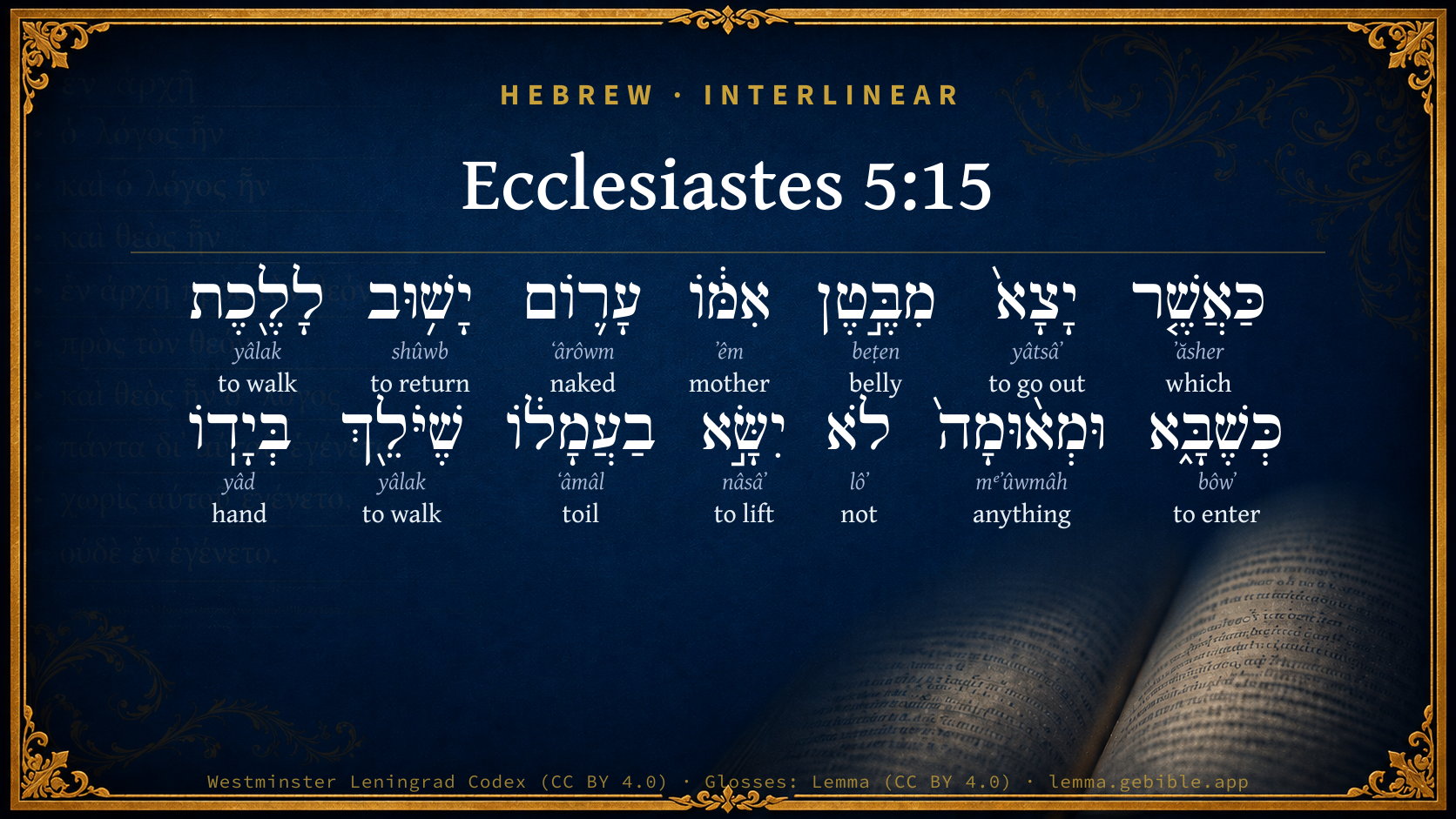
Hebrew (Westminster Leningrad Codex) Ecclesiastes 5:15 appears in the Hebrew Old Testament. The text above is from the Westminster Leningrad Codex. Each word links to its Strong’s number, a concise gloss, and parsing drawn from the Open Scriptures Hebrew Bible morphology. Click any word for its full Brown-Driver-Briggs (BDB) entry.
Download image
Cite this verse

Ecclesiastes 5:15 (World English Bible). Public Domain. Lemma interlinear Bible study tool, https://lemma.gebible.app/v/ecclesiastes/5/15.

Show BibTeX & RIS
BibTeX
RIS
English Translation
As he came forth from his mother's womb, naked shall he go again as he came, and shall take nothing for his labor, which he may carry away in his hand.
World English Bible · Public Domain
Download a study sheet

One document with this verse’s original text, its word-by-word gloss line, the meaning frame, cross-references with their text, attributed commentary, and full source and license credits — printable, and it pastes into notes with its structure intact.

This verse Autodidact and up

Study sheet (.html) Plain text (.txt)

A passage Seminary Student

Up to 50 verses in one chapter. A passage sheet keeps up to 6 commentary sources and 12 cross-references per verse, in the order this page ranks them, and says so on the sheet whenever that leaves anything out. Ask for a single verse and you get the Autodidact verse sheet above.

Everything on this page stays free to read, with no account — the sheet is a download of what is already on screen, not access to it.

Want to remove ads? Support Godless Engineer
Compare translations 3

The same verse in 3 English versions, stacked beneath the original-language interlinear above. Click any original word for its lexicon entry.

Each is an independent rendering of the whole verse — the interlinear is not word-aligned to these translations.

Highlighted words mark where these versions differ — a whole-verse word diff, not a word-by-word alignment.

  • World English Bible Public Domain
    As he came forth from his mother's womb, naked shall he go again as he came, and shall take nothing for his labor, which he may carry away in his hand.
  • King James Version Public Domain
    As he came forth of his mother's womb, naked shall he return to go as he came, and shall take nothing of his labour, which he may carry away in his hand.
  • unfoldingWord Literal Text CC BY-SA 4.0
    As he went out from the womb of his mother, naked, he will go again, just as he came. And he will not take anything in exchange for his toil that he will take in his hand.

unfoldingWord Literal Text — © unfoldingWord, licensed CC BY-SA 4.0. Word-aligned USFM3 via Door43 (git.door43.org/unfoldingWord/en_ult).

Versions to compare (up to 4)

3 of 4 selected

Show all 18 translations

Every available English version of this verse, each an independent rendering of the whole verse.

  • World English Bible Public Domain
    As he came forth from his mother's womb, naked shall he go again as he came, and shall take nothing for his labor, which he may carry away in his hand.
  • Berean Standard Bible Public Domain
    As a man came from his mother’s womb, so he will depart again, naked as he arrived. He takes nothing for his labor to carry in his hands.
  • Majority Standard Bible Public Domain
    As a man came from his mother’s womb, so he will depart again, naked as he arrived. He takes nothing for his labor to carry in his hands.
  • King James Version Public Domain
    As he came forth of his mother's womb, naked shall he return to go as he came, and shall take nothing of his labour, which he may carry away in his hand.
  • American Standard Version (1901) Public Domain
    As he came forth from his mother's womb, naked shall he go again as he came, and shall take nothing for his labor, which he may carry away in his hand.
  • Revised Version (1885) Public Domain
    As he came forth of his mother’s womb, naked shall he go again as he came, and shall take nothing for his labour, which he may carry away in his hand.
  • Geneva Bible (1599) Public Domain
    And this also is an euill sickenes that in all pointes as he came, so shall he goe, and what profit hath he that he hath traueiled for the winde?
  • Douay-Rheims (1899) Public Domain
    A most deplorable evil: as he came, so shall he return. What then doth it profit him that he hath laboured for the wind?
  • Young's Literal Translation Public Domain
    As he came out from the belly of his mother, naked he turneth back to go as he came, and he taketh not away anything of his labour, that doth go in his hand.
  • Literal Standard Version CC BY-SA 4.0
    As he came out from the belly of his mother, naked he turns back to go as he came, and he does not take away anything of his labor, that goes in his hand.
  • Unlocked Literal Bible CC BY-SA 4.0
    As a man comes from his mother's womb, so also he will leave naked. He can take none of the fruits of his labor in his hand.
  • unfoldingWord Literal Text CC BY-SA 4.0
    As he went out from the womb of his mother, naked, he will go again, just as he came. And he will not take anything in exchange for his toil that he will take in his hand.
  • Darby Bible Public Domain
    As he came forth from his mother's womb, naked shall he go away again as he came, and shall take nothing of his labour, which he may carry away in his hand.
  • World Messianic Bible Public Domain
    As he came out of his mother’s womb, naked shall he go again as he came, and shall take nothing for his labor, which he may carry away in his hand.
  • Webster's Bible Public Domain
    \\5:16\\And this also is a grievous evil, that in all points as he came, so shall he go: and what profit hath he that hath labored for the wind?
  • Free Bible Version CC BY-SA 4.0
    When we die, we leave just as naked as when we were born, taking nothing with us from all we've worked for.
  • Bible in Basic English Public Domain
    And this again is a great evil, that in all points as he came so will he go; and what profit has he in working for the wind?
  • JPS Tanakh (1917) Public Domain
    (5-14) As he came forth of his mother's womb, naked shall he go back as he came, and shall take nothing for his labour, which he may carry away in his hand.

Literal Standard Version (2020), Covenant Press — licensed CC BY-SA 4.0. Text via the HelloAO Bible API (eBible.org). Unlocked Literal Bible (unfoldingWord) — licensed CC BY-SA 4.0. Text via the HelloAO Bible API (eBible.org). unfoldingWord Literal Text — © unfoldingWord, licensed CC BY-SA 4.0. Word-aligned USFM3 via Door43 (git.door43.org/unfoldingWord/en_ult). Free Bible Version, Dr. Jonathan Gallagher — licensed CC BY-SA 4.0. Text via the HelloAO Bible API (eBible.org).

Word by word

More ways to search: Search by grammar → Find every occurrence → Compare this word →

Practice this passage: Drill this verse → Learn its vocabulary →

עָר֛וֹם
ʻârôwm
H6174
“naked”
Adjective, Adjective, Masculine, Singular, Absolute
Part of Speech
Adjective
Type
Adjective
Gender
Masculine
Number
Singular
State
Absolute
Full BDB Definition

Origin: from H6191 (in its original sense)

TWOT: 1588c

naked, bare
  1. כַּאֲשֶׁ֤ר ʼăsher H834 “like/as · which” Preposition + Particle, Relative
  2. יָצָא֙ yâtsâʼ H3318 “to go out” Verb, Qal, Perfect, 3rd Person, Masculine, Singular
  3. מִבֶּ֣טֶן beṭen H990 “from · belly of” Preposition + Noun, Common, Feminine, Singular, Construct
  4. אִמּ֔וֹ ʼêm H517 “mother · his” Noun, Common, Feminine, Singular, Construct + Suffix, Personal, 3rd Person, Masculine, Singular
  5. יָשׁ֥וּב shûwb H7725 “to return” Verb, Qal, Imperfect, 3rd Person, Masculine, Singular
  6. לָלֶ֖כֶת yâlak H3212 “to walk” Preposition + Verb, Qal, Infinitive Construct
  7. כְּשֶׁבָּ֑א bôwʼ H935 “like/as · who/which · to enter” Preposition + Particle, Relative + Verb, Qal, Perfect, 3rd Person, Masculine, Singular
  8. וּמְא֨וּמָה֙ mᵉʼûwmâh H3972 “and · anything” Conjunction + Noun, Common, Feminine, Singular, Absolute
  9. לֹא lôʼ H3808 “not” Particle, Negative
  10. יִשָּׂ֣א nâsâʼ H5375 “to lift” Verb, Qal, Imperfect, 3rd Person, Masculine, Singular
  11. בַעֲמָל֔וֹ ʻâmâl H5999 “in/at · toil · his” Preposition + Noun, Common, Both, Singular, Construct + Suffix, Personal, 3rd Person, Masculine, Singular
  12. שֶׁיֹּלֵ֖ךְ yâlak H3212 “who/which · to walk” Particle, Relative + Verb, Hiphil, Imperfect, 3rd Person, Masculine, Singular
  13. בְּיָדֽוֹ yâd H3027 “in/at · hand · his” Preposition + Noun, Common, Both, Singular, Construct + Suffix, Personal, 3rd Person, Masculine, Singular

About this verse

These counts appear in no published source. They are computed here, from the morphology-tagged text and Lemma’s own curated glosses. What Lemma adds →

14
words
13
distinct lemmas
Wisdom
section

Notable vocabulary

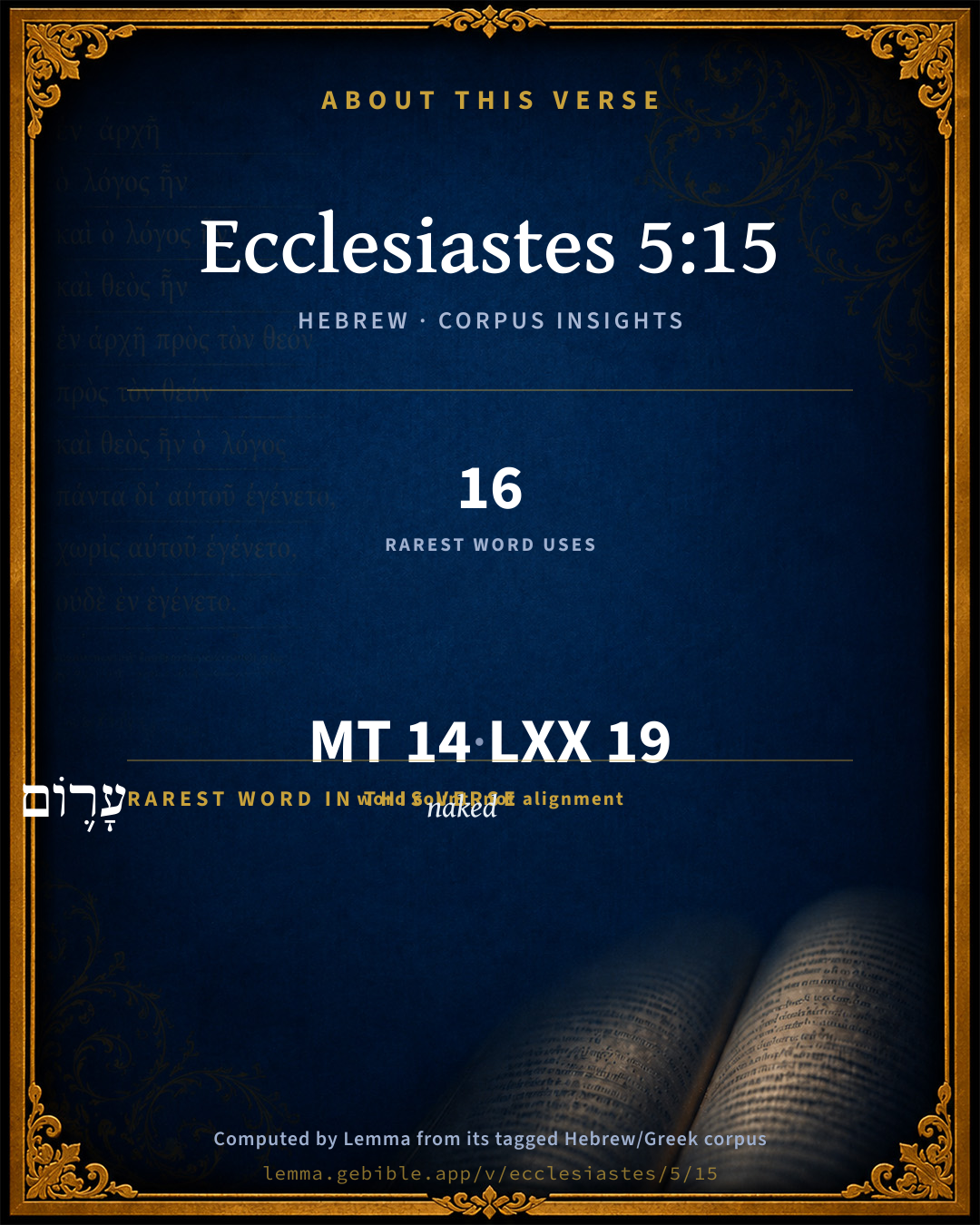
The rarest word here is עָר֛וֹם naked H6174 — appearing just 16 times in the whole Hebrew Bible.

Shared distinctive vocabulary

עָר֛וֹם naked H6174 occurs in 15 verses of the Hebrew Bible. Also found in:

Grammatical profile

  • 6 verbs
  • 5 nouns
  • 1 adjective
  • 2 particles

Verb forms

  • יָצָא֙ Qal · Perfect
  • יָשׁ֥וּב Qal · Imperfect
  • לָלֶ֖כֶת Qal · Infinitive Construct
  • כְּשֶׁבָּ֑א Qal · Perfect
  • יִשָּׂ֣א Qal · Imperfect
  • שֶׁיֹּלֵ֖ךְ Hiphil · Imperfect

Repetition

A word recurs within this verse — often emphatic in Hebrew:

  • לָלֶ֖כֶת to walk H3212 ×2

Hebrew & Septuagint length

In English translation the verse runs 31 words from the Hebrew and 26 from the Septuagint (LXX English) — closely comparable.

A rough comparison of the two English renderings, which tokenize alike — not a word-level alignment.

Word counts can differ between the Hebrew and the Greek without any difference in meaning — e.g. the Hebrew direct-object marker אֵת has no separate Greek word, and Greek often adds the article ὁ.

In the original languages it is 14 Hebrew tokens and 19 Greek tokens — but the two are counted differently (Hebrew bundles its prefixes and suffixes into one token; the Greek is in lemma form), so that isn’t a like-for-like length.

Cross-references

4

Topical passages linked to Ecclesiastes 5:15 in the Treasury of Scripture Knowledge — connected by theme and wording, ordered by reader-vote popularity; previews shown in the World English Bible.

  • Job 1:21 He said, "Naked I came out of my mother's womb, and naked shall I return there. Yahweh gave, and Yahweh has taken away. Blessed be the name of Yahweh."
  • Psalms 49:17 For when he dies he shall carry nothing away. His glory shall not descend after him.
  • 1 Timothy 6:7 For we brought nothing into the world, and we certainly can't carry anything out.
  • Luke 12:20 "But God said to him, 'You foolish one, tonight your soul is required of you. The things which you have prepared--whose will they be?'

Cross-references courtesy of OpenBible.info (CC BY 4.0).

Hebrew and Greek witnesses Masoretic Hebrew ↔ Greek Septuagint

The same verse in the two great witnesses to the Old Testament, shown verse-for-verse.

These are two independent witnesses, not word-aligned to each other, and the Septuagint is shown in lemma (dictionary) form.

Hebrew Ecclesiastes 5:15 Masoretic · Westminster Leningrad Codex

כַּאֲשֶׁ֤ר יָצָא֙ מִבֶּ֣טֶן אִמּ֔וֹ עָר֛וֹם יָשׁ֥וּב לָלֶ֖כֶת כְּשֶׁבָּ֑א וּמְא֨וּמָה֙ לֹא יִשָּׂ֣א בַעֲמָל֔וֹ שֶׁיֹּלֵ֖ךְ בְּיָדֽוֹ

As he came forth from his mother's womb, naked shall he go again as he came, and shall take nothing for his labor, which he may carry away in his hand.

World English Bible · Public Domain

Greek LXX Ecclesiastes 5:15 Septuagint · lemma form

καί γέ οὗτος πονηρός ἀρρωστία ὥσπερ γάρ παραγίγνομαι οὕτως καί ἀποἔρχομαι καί τίς περισσεία αὐτός ὅς μοχθέω εἰς ἄνεμος

And this is also an evil infirmity: for as he came, so also shall he return: and what is his gain, for which he vainly labors?

LXX2012 (modern English Septuagint) · Public Domain

On this verse, Keil & Delitzsch discusses the Septuagint’s reading. Read the note in Commentary ↓

Hebrew: Westminster Leningrad Codex (CC BY 4.0). Greek: Septuagint (public domain); English from LXX2012 (modern English Septuagint) (Public Domain). How the Septuagint differs from the Hebrew →

Commentary

Notes on Ecclesiastes 5:15 from classic Christian and Jewish commentators (each source and its license shown beneath its notes). The classic Christian expositions comment on the surrounding passage and are grouped to its opening verse, so a note may address several verses; the Jewish commentaries on the Tanakh (Rashi and others) are per-verse, so they appear only where the commentator wrote on this verse.

Lemma curates 59 commentaries, every one of them public domain or Creative Commons licensed, each selected and text-cleaned for this edition rather than reprinted as found. About our sources →

Trapp's Complete Commentary

John Trapp

Ecc 5:15 As he came forth of his mother’s womb, naked shall he return to go as he came, and shall take nothing of his labour, which he may carry away in his hand.

Ver. 15. As he came forth of his mother’s womb,] q.d., If riches leave not us while we live, yet we are sure to leave them when we die. {a} Look how a false harlot leaves her lover when arrested for debt, and follows other customers; so is it here. And as dogs, though they go along with us in company, yet at parting they run every one to his own master. So do these to the world, when we come to leave the world. Death, as a porter, stands at the gate, and strips us of all our thick clay wherewith we are laden. {See Trapp on "Ecc 2:22"}

To go as he came.] Like an unwelcome guest, or an unprofitable servant, a cipher, and excrement. Oh live, live, live, saith a reverend man, {b} quickly, much, long; so you are welcome to the world: else you are but hissed and kicked off this stage of the world, as Phocas was by Heraclius; nay, many {as Job 27:23} who were buried before half dead, &c.

And shall take nothing of hls labour.] Ne obolum quo naulum Charonti solvant. Some have had great store of gold and silver buried with them, and others would needs be buried in a monk’s cowl, out of a superstitious conceit of speeding the better in another world; but it hath profited them nothing at all. {Ecc 9:10}

{a} Haud ullas portabis opes Acherontis ad undas: Nudas ab inferna stulte vehere rate. - Propert.

{b} "Abner’s funeral," by Dr Harris.

John Trapp, A Commentary or Exposition upon All the Books of the Old and New Testament (1647–1656) — public domain. Text from a community e-Sword module.

Joseph Benson's Commentary

Ecc 5:15-17. As he came forth, &c., naked shall he return — Into the womb, or belly of the earth, the common mother of all mankind. And shall take nothing of his labour — This is another vanity. If his estate be neither lost nor kept to his hurt, yet when he dies he must leave it behind him, and cannot carry one handful of it into another world. And what profit hath he that hath laboured for the wind — For riches, which are empty and unsatisfying, uncertain and transitory; which no man can hold or stay in their course; all which are the properties of the wind. All his days also — Namely, of his life; he eateth in darkness — He hath no comfort in his estate, but even when he eats, he doth it with anxiety and discontent. And wrath with his sickness — When he falls sick, and presages his death, he is filled with rage, because he is cut off before he hath accomplished his designs, and because he must leave that wealth and world in which all his hopes and happiness lie.

Joseph Benson's Commentary on the Old and New Testaments (1811–1818) — public domain. Text from a community e-Sword module.

MacLaren's Expositions of Holy Scripture

Alexander MacLaren

Ecclesiastes

NAKED OR CLOTHED?

Ecc 5:15. - Rev 14:13.

It is to be observed that these two sharply contrasted texts do not refer to the same persons. The former is spoken of a rich worldling, the latter of ‘the dead who die in the Lord.’ The unrelieved gloom of the one is as a dark background against which the triumphant assurance of the other shines out the more brightly, and deepens the gloom which heightens it. The end of the man who has to go away from earth naked and empty-handed acquires new tragic force when set against the lot of those ‘whose works do follow them.’ Well-worn and commonplace as both sets of thought may be, they may perhaps be flashed up into new vividness by juxtaposition; and if in this sermon we have nothing new to say, old truth is not out of place till it has been wrought into and influenced our daily practice. We shall best gather the lessons of our text if we consider what we must leave, what we must take, and what we may take.

I. What we must leave.

The Preacher in the context presses home a formidable array of the limitations and insufficiencies of wealth. Possessed, it cannot satisfy, for the appetite grows with indulgence. Its increase barely keeps pace with the increase of its consumers. It contributes nothing to the advantage of its so-called owner except ‘the beholding of it with his eyes,’ and the need of watching it keeps them open when he would fain sleep. It is often kept to the owner’s hurt, it often disappears in unfortunate speculation, and the possessor’s heirs are paupers. But, even if all these possibilities are safely weathered, the man has to die and leave it all behind. ‘He shall take nothing of his labour which he can carry away in his hand’; that is to say, death separates from all with whom the life of the body brings us into connection. The things which are no parts of our true selves are ours in a very modified sense even whilst we seem to possess them, and the term of possession has a definite close. ‘Shrouds have no pockets,’ as the stern old proverb says. How many men have lived in the houses which we call ours, sat on our seats, walked over our lands, carried in their purses the money that is in ours! Is ‘the game worth the candle’ when we give our labour for so imperfect and brief a possession as at the fullest and the longest we enjoy of all earthly good? Surely a wise man will set little store by possessions of all which a cold, irresistible hand will come to strip him. Surely the life is wasted which spends its energy in robing itself in garments which will all be stripped from it when the naked self ‘returns to go as he came.’

But there are other things than these earthly possessions from which death separates us. It carries us far away from the sound of human voices and isolates us from living men. Honour and reputation cease to be audible. When a prominent man dies, what a clatter of conflicting judgments contends over his grave! and how utterly he is beyond them all! Praise or blame, blessing or banning are equally powerless to reach the unhearing ear or to agitate the unbeating heart. And when one of our small selves passes out of life, we hear no more the voice of censure or of praise, of love or of hate. Is it worth while to toil for the ‘hollow wraith of dying fame,’ or even for the clasp of loving hands which have to be loosened so surely and so soon?

Then again, there are other things which must be left behind as belonging only to the present order, and connected with bodily life. There will be no scope for material work, and much of all our knowledge will be antiquated when the light beyond shines in. As we shall have occasion to see presently, there is a permanent element in the most material work, and if in handling the transient we have been living for the eternal, such work will abide; but if we think of the spirit in which a sad majority do their daily tasks, whether of a more material or of a more intellectual sort, we must recognise that a very large proportion of all the business of life must come to an end here. There is nothing in it that will stand the voyage across the great deep, or that can survive in the order of things to which we go. What is a man to do in another world, supposing there is another world, where ledgers and mills are out of date? Or what has a scholar or scientist to do in a state of things where there is no place for dictionaries and grammars, for acute criticism, or for a careful scientific research?

Physical science, linguistic knowledge, political wisdom, will be antiquated. The poetry which glorifies afresh and interprets the present will have lost its meaning. Half the problems that torture us here will cease to have existence, and most of the other half will have been solved by simple change of position. ‘Whether there be tongues, they shall cease; whether there be knowledge, it shall vanish away’; and it becomes us all to bethink ourselves whether there is anything in our lives that we can carry away when all that is ‘of the earth earthy’ has sunk into nothingness.

II. What we must take.

We must take ourselves. It is the same ‘he’ who goes ‘naked as he came’; it is the same ‘he’ who ‘came from his mother’s womb,’ and is ‘born again’ as it were into a new life, only ‘he’ has by his earthly life been developed and revealed. The plant has flowered and fruited. What was mere potentiality has become fact. There is now fixed character. The transient possessions, relationships, and occupations of the earthly life are gone, but the man that they have made is there. And in the character there are predominant habits which insist upon having their sway, and a memory of which, as we may believe, there is written indelibly all the past. Whatever death may strip from us, there is no reason to suppose that it touches the consciousness and personal identity, or the prevailing set and inclination of our characters. And if we do indeed pass into another life ‘not in entire forgetfulness, and not in utter nakedness,’ but carrying a perfected memory and clothed in a garment woven of all our past actions, there needs no more to bring about a solemn and continuous act of judgment.

III. What we may take.

‘Their works do follow them.’ These are the words of the Spirit concerning ‘the dead who die in the Lord.’ We need not fear marring the great truth that ‘not by works of righteousness but by His mercy He saved us,’ if we firmly grasp the large assurance which this text blessedly contains. A Christian man’s works are perpetual in the measure in which they harmonise with the divine will, in the measure they have eternal consequences in himself whatever they may have on others. If we live opening our minds and hearts to the influx of the divine power ‘that worketh in us both to will and to do of His good pleasure,’ then we may be humbly sure that these ‘works’ are eternal; and though they will never constitute the ground of our acceptance, they will never fail to secure ‘a great recompence of reward.’ To many a humble saint there will be a moment of wondering thankfulness when he sees these his ‘children whom God hath given him’ clustered round him, and has to say, ‘Lord, when saw I Thee naked, or in prison, and visited Thee?’ There will be many an apocalypse of grateful surprise in the revelations of the heavens. We remember Milton’s noble explanation of these great words which may well silence our feeble attempts to enforce them-

‘Thy works and alms and all thy good endeavour

Stood not behind, nor in the grave were trod,

But as faith pointed with her golden rod,

Followed them up to joy and bliss for ever.’

So then, life here and yonder will for the Christian soul be one continuous whole, only that there, while ‘their works do follow them,’ ‘they rest from their labours.’

Alexander MacLaren, Expositions of Holy Scripture (1904–1910) — public domain. Text from a community e-Sword module.

Geneva Bible (1599)

Geneva Bible translators

Meaning, in vain, and without profit.

Geneva Bible (1599) marginal notes — public domain. Text via Bolls.life.

Adam Clarke's Commentary

Verse 15. As he came forth] However it may be, he himself shall carry nothing with him into the eternal world. If he die worth millions, those millions are dead to him for ever; so he has had no real profit from all his labours, cares, anxieties, and vast property!

Adam Clarke's Commentary on the Bible (1810–1826) — public domain. Text from a community e-Sword/MySword module.

Ellicott's Commentary for English Readers

(15) There is a clear use of Job_1:21. (See also Psa_139:15.) And this passage itself is used in Sir_40:1.

A Bible Commentary for English Readers, edited by Charles John Ellicott (1878–1897) — public domain. Text from a community e-Sword module.

The Cambridge Bible for Schools and Colleges

gen. ed. J. J. S. Perowne

15. As he came forth of his mother’s womb] The words so closely resemble those of Job_1:21 that it is natural to infer that the writer had that history in his mind as an example of a sudden reverse of fortune. In both, earth, as the mother of all living, is thought of as the womb out of which each man comes (Psa_139:15) and to which he must return at last, carrying none of his earthly possessions with him. Comp. a striking parallel in Sir_40:1.

The Cambridge Bible for Schools and Colleges (gen. ed. J. J. S. Perowne; Cambridge University Press, 1878–1918) — public domain. Text from a community e-Sword module.

John Gill's Exposition

As he came forth of his mother's womb, naked shall he return to go as he came,.... This may be understood either of the covetous rich man, or of his son; and that supposing what is before said should not be the case of either of them, but they should possess their substance as long as they live; yet, when they come to die, they will be stripped of them all; of their gold and silver, their plate and jewels, and rich household furniture; of their cattle and possessions, farms and estates, which are no longer theirs; and even of their very clothes, and be as naked as they were when they came into the world; and which is indeed the case of every man, Job 1:21; and is used as an argument, and a very forcible one, against covetousness;

and shall take nothing of his labour, which he may carry away in his hand; nothing of his substance, which he has got by his labour, and hoarded up with great care; not the least portion of it can he carry away with him when he dies; not any of his jewels, nor bags of gold and silver; and if any of these should be put into his grave, which has been sometimes done at the interment of great personages, these are of no manner of use and service to him, either to comfort and refresh his body, or to save his soul from hell, and procure it an entrance into the heavenly glory; see Ti1 6:7. The Targum allegorizes this in a very orthodox way, not very usual, in favour of original sin, and against the doctrine of merit;

"as he goes out of his mother's womb naked, without a covering, and without any good; so he shall return to go to the house of his grave, indigent of merit, as he came into this world; and no good reward shall he receive by his labour, to take with him into the world to which he goes, that it may be for merit in his hand.''

John Gill's Exposition of the Whole Bible (1746–1763) — public domain (CC PDM 1.0). Text via the HelloAO Bible API.

Matthew Poole's English Annotations

Return to go into the womb or belly of the earth, the common mother of all mankind. See Poole "Job 1:21", See Poole "Ecc 12:7". And return to go, is put for return and go; and going is here put for dying, as Job 16:22; Psa 39:13. This is another vanity: if his estate be neither lost, nor kept to his hurt, but enjoyed by him with safety and comfort all his days, yet when he dies he must leave it behind him, and cannot carry one handful of it with him into another world.

Matthew Poole's English Annotations on the Holy Bible (1683–1685) — public domain. Text from a community e-Sword/MySword module.

Whedon's Commentary on the Bible

Daniel D. Whedon

15. Nothing of his labour — He never recovers his money thus lost, but dies as destitute as infancy, leaving nothing from the wealth of his father for the possession of his children. In a greedy effort to get more he has lost all.

Daniel D. Whedon (gen. ed.), Commentary on the Old and New Testaments (1874–1909) — public domain. Text from a community e-Sword module.

The Pulpit Commentary

The case of the rich man who has lost his property is here generalized. What is true of him is, in a measure, true of every one, so far as he can carry nothing away with him when he dies. (Psa_49:17) As he came forth of his mother"s womb, naked shall he return to go as he came. There is a plain reference to Job_1:21, "Naked came I out of my mother"s womb, and naked shall I return thither." The mother is the earth, human beings being regarded as her offspring. So the psalmist says, "My frame was curiously wrought in the lowest parts of the earth". (Psa_139:15) And Ben-Sira, "Great trouble is created for every man, and a heavy yoke is upon the sons of Adam, from the day that they go out of their mother"s womb till the day that they return to the mother of all things." 1Ti_6:7, "We brought nothing into the world, neither can we carry anything out." Thus Propertius, "Eleg.," 3:5. 13

Hand ullas portabis opes Acherontis ad undas, Nudus ab inferna, stulte, vehere rate.

No wealth thou"lt take to Acheron"s dark shore, Naked, th" infernal bark will bear thee o"er.

Shall take nothing of his labor; rather, for his labor, the preposition being B of price. He gets nothing by his long toil in amassing wealth. Which he may carry away in his hand, as his own possession. The ruined Dives points a moral for all men.

Vers. 15, 16.

The difference at death.

Even when we have been long looking for the departure of one whose powers as well as his days are spent, his death, when it does come, makes a great difference to us. Between life at its lowest and death there is a great and felt interval. How much more must this be the case to the departed himself! What a difference to him between this life and that to which he goes! Perhaps less than we imagine, yet doubtless very great. The text suggests to us

I WHAT WE MUST LEAVE BEHIND US AT DEATH.

1. Our worldly goods. This is an obvious fact, which painfully impressed the Preacher (text), and which comforted the psalmist. (Psa_49:16, Psa_49:17) It is a fact that should make the wise less careful to acquire and to save.

2. Our reputation. The reputation for wisdom or folly, for integrity or dishonesty, for kindness or severity, which our life has been building up, death cannot destroy, through whatever experiences we may then pass. We must be content to leave that behind to be associated with our name in the memories of men, for their benediction or for their reproach.

3. The influence for good or evil we have exerted on human souls. These we cannot remove, nor can we stay to deepen or to counteract them; they are our most important legacies.

II WHAT WE MAY LEAVE BEHIND US.

1. A wise disposition of our property. A sagacious statesman once said that he never quite made up his mind about his neighbor"s character until he had seen his will. What disposition we make of that we leave behind is a very serious act of our life; there are very few single acts so serious.

(1) It is usually a good thing for a man to dispose of a large proportion of all that he has earned during his life when he is here to superintend it.

(2) It is criminally careless to cause additional sorrow at death by negligence in the matter of disposition of means.

(3) The kindest thing we can do for our relatives is not to provide absolutely for their wants, but to facilitate their own self-support.

1. Wise counsels to those who will heed them. There are usually those who will pay Meat regard to the wishes of the dying, apart from any "legal instructions." We may leave with those we love such recommendations as shall save them from grave mistakes, and guide them to good and happy courses.

2. A valued testimony to the power and preciousness of the gospel of Jesus Christ.

III WHAT WE MAY TAKE WITH US.

1. Our faith in Jesus Christ; that settled attitude of the soul toward him which is one of trustfulness and love, which determines our place in the kingdom of God. (Joh_3:15, Joh_3:16, Joh_3:18, Joh_3:36)

2. Our Christian life its record in the heavenly chronicles; that Christian service which, in its faithfulness-or its imperfection, will gain for us the larger or the smaller measure of our Lord"s approval. (Luk_19:16-19)

3. Qualification, gained by steadfastness, patience, zeal, for the sphere which "the righteous Judge" will award us and will have ready for us. C.

The Pulpit Commentary (1880–1919), ed. H.D.M. Spence-Jones & Joseph S. Exell — public domain. Text from a community e-Sword module.

John Wesley's Explanatory Notes

To go - Into the womb of the earth, the common mother of all mankind. Take nothing - This is another vanity. If his estate be neither lost, nor kept to his hurt, yet when he dies he must leave it behind him, and cannot carry one handful of it into another world.

John Wesley, Explanatory Notes Upon the Whole Bible (1754–1765) — public domain. Text via the GEBible commentary corpus.

Keil & Delitzsch

C. F. Keil & F. Delitzsch

"As he came forth from his mother's womb, naked shall he again depart as he came, and not the least will he carry away for his labour, which he could take with him in his hand." In 13a the author has the case of Job in his mind; this verse before us is a reminiscence from Job 1:21, with the setting aside of the difficult word שׁמּה found there, which Sirach 40:1 exhibits. With "naked" begins emphatically the main subject; כּשׁבּא = בא כּאשׁר is the intensifying resumption of the comparison; the contrast of לכת f, going away, excedere vit, is בּיא of the entrance on life, coming into the world. מאוּמה (according to the root meaning and use, corresponding to the French point, Olsh. 205a) emphatically precedes the negation, as at Jdg 14:6 (cf. the emphasis reached in a different way, Psa 49:18). נשׂא signifies here, as at Ecc 5:18, Psa 24:5, to take hence, to take forth, to carry away. The ב of בּע is not partitive (Aben Ezra compares Lev 8:32), according to which Jerome and Luther translate de labore suo, but is the Beth pretii, as e.g., at Kg1 16:34, as the Chald. understands it; Nolde cites for this Beth pretii passages such as Ecc 2:24, but incorrectly. Regarding the subjunctive שׁיּלך, quod auferat. We might also with the lxx and Symm. punctuate שׁיּלך: which might accompany him in his hand, but which could by no means denote, as Hitzig thinks: (for his trouble), which goes through his hand. Such an expression is not used; and Hitzig's supposition, that here the rich man who has lost his wealth is the subject, does not approve itself.

Keil & Delitzsch — Biblical Commentary on the Old Testament (1861–1891) — public domain (CC PDM 1.0). Text via the HelloAO Bible API. (Old Testament only.)

unfoldingWord translationNotes

Door43 World Missions Community

As a man comes from his mother's womb ... he will leave naked

It is implied that a man is naked when he is born. In addition to being without clothing, here the word "naked" emphasizes that people are born without any possessions. AT: "As a man is naked and owns nothing when he is born ... he will leave this life the same way" (See: Metaphor)

comes from his mother's womb

"is born"

he will leave

This refers to dying. AT: "he will die" (See: Euphemism)

He can take none of the fruits of his labor in his hand

Here a man's possessions are spoken of as if they are fruit that he grew with his labor. AT: "He can not take any of his possessions with him" (See: Metonymy)

as a person comes, so he goes away

This refers to the birth and death of a person and expresses the same idea as the previous verse. This refers to women as well as men. AT: "as people bring nothing into the world when they are born, so they take nothing with them when they die and leave this world" (See: Assumed Knowledge and Implicit Information and When Masculine Words Include Women)

So what profit is there for him who works for the wind?

The writer uses this rhetorical question to emphasize that there is no benefit in working for the wind. This question can be written as a statement. AT: "No one gets any profit in working for the wind." (See: Rhetorical Question)

works for the wind

Possible meanings are 1) This speaks of the person receiving no lasting profit as if he were trying to control the wind. AT: "tries to shepherd the wind" or "work that is as useless as trying to shepherd the wind" or 2) This implies that the person only receives the air that he breaths as his profit. AT: "works to receive the air he breathes" (See: Metaphor and Assumed Knowledge and Implicit Information)

During his days he eats with darkness

This speaks of a person mourning throughout his life as if he always ate in darkness. Here "darkness" represents sadness and mourning. AT: "He spends his life in mourning and sadness" (See: Metaphor)

his days

Here a person's "days" represent his life. AT: "his life" (See: Metonymy)

is greatly distressed with sickness and anger

The words "sickness" and "anger" can be expressed as adjectives. AT: "suffers greatly, being sick and angry" (See: Abstract Nouns)

translationWords

womb

life

evil

profit

darkness

anger

unfoldingWord translationNotes — © Distant Shores Media and the Door43 World Missions Community, licensed CC BY-SA 4.0. Source: git.door43.org/Door43/en_tn.

Rashi

Rabbi Shlomo Yitzchaki (Rashi)

just as it came that money, so will it go.

Rashi on the Tanakh — English translations: “The Judaica Press complete Tanach with Rashi, translated by A. J. Rosenberg” (CC BY 4.0); “Pentateuch with Rashi's commentary by M. Rosenbaum and A.M. Silbermann, 1929-1934” (public domain); “The Metsudah Tanach series, Lakewood, N.J” (CC BY 4.0); and “The Book of Joshua, Metsudah Publications, 1997” (CC BY 4.0). Text via Sefaria.

Lesson kit

Teaching starters — assembled from the data on this page, not authored interpretation. Every prompt links to the verse data it draws on. Edit before teaching.

Ecclesiastes, in the Wisdom, opens this verse with 14 words (13 distinct Hebrew lemmas). Its most distinctive word is ʻârôwm (“naked”). A historical commentator’s framing appears above. Read the whole chapter for the surrounding context.

Discussion questions

  1. How does “naked” (ʻârôwm) shape what this verse is saying?
  2. How does Genesis 2:25, which shares the word «naked», read alongside this verse?
  3. What does the repetition of “to walk” (2× in this one verse) do in this verse?
  4. These translations render this verse differently. What is at stake in choosing one wording over another?
  5. «יָצָא֙» is a Qal Perfect verb. How does that grammatical form shape the action described?
  6. Compare how Trapp's Complete Commentary and Joseph Benson's Commentary read this verse. Where do they agree or differ?

Things to notice

Reading settings

Reading text

Shown beneath each verse's original-language words.

Old Testament
Old Testament edition

Read the OT as the Masoretic Hebrew (MT) or the Greek Septuagint (LXX).

English shown for the Greek Septuagint (in the Hebrew ↔ Greek comparison).

Comparing translations? Open the Compare panel on any verse page to stack up to four side by side.