
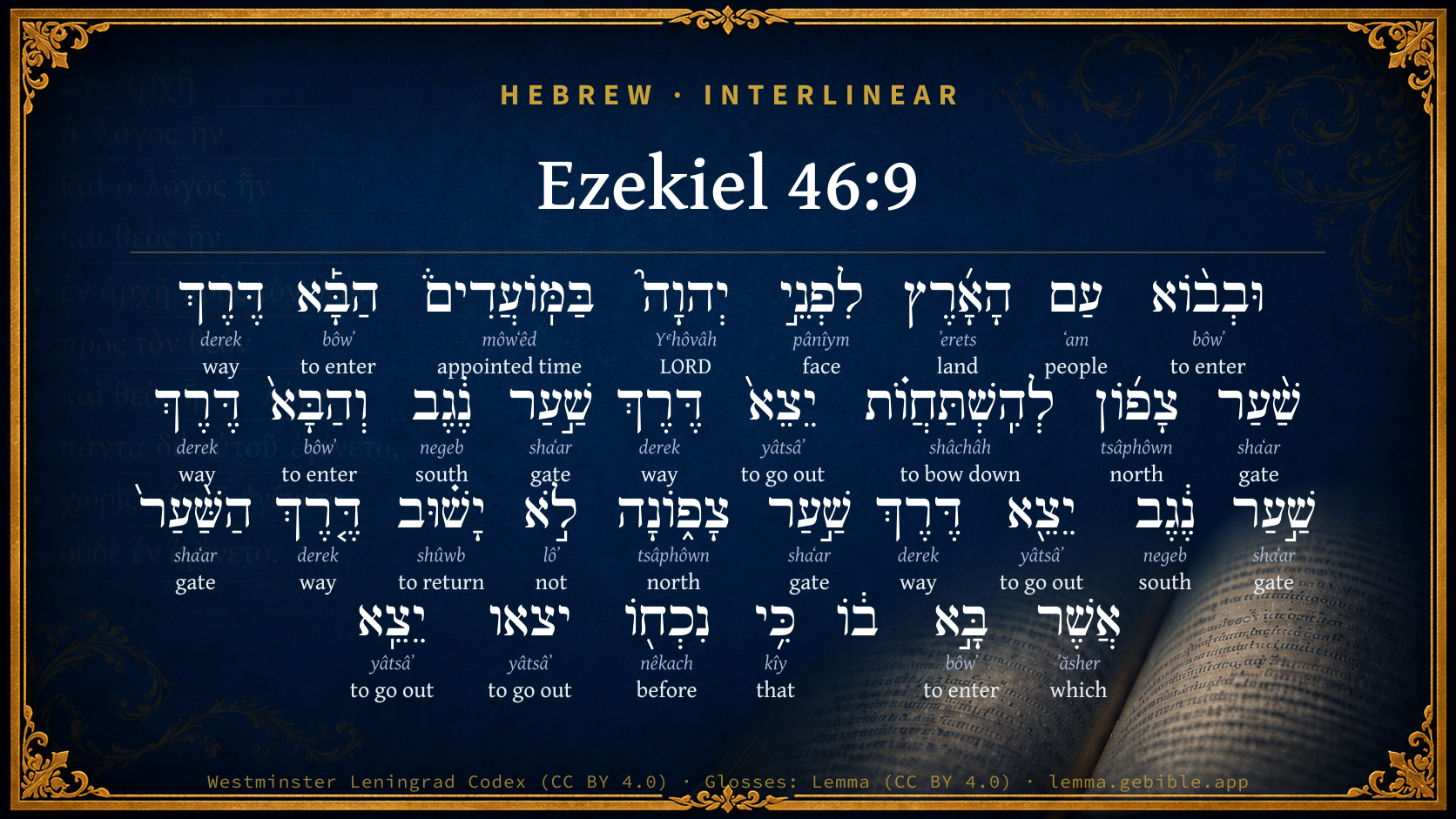
Ezekiel 46:9

Hebrew (Westminster Leningrad Codex) Ezekiel 46:9 appears in the Hebrew Old Testament. The text above is from the Westminster Leningrad Codex. Each word links to its Strong’s number, a concise gloss, and parsing drawn from the Open Scriptures Hebrew Bible morphology. Click any word for its full Brown-Driver-Briggs (BDB) entry.
Download image
Cite this verse

Ezekiel 46:9 (World English Bible). Public Domain. Lemma interlinear Bible study tool, https://lemma.gebible.app/v/ezekiel/46/9.

Show BibTeX & RIS
BibTeX
RIS
English Translation
But when the people of the land shall come before Yahweh in the appointed feasts, he who enters by the way of the north gate to worship shall go forth by the way of the south gate; and he who enters by the way of the south gate shall go forth by the way of the north gate: he shall not return by the way of the gate by which he came in, but shall go forth straight before him.
World English Bible · Public Domain
Download a study sheet

One document with this verse’s original text, its word-by-word gloss line, the meaning frame, cross-references with their text, attributed commentary, and full source and license credits — printable, and it pastes into notes with its structure intact.

This verse Autodidact and up

Study sheet (.html) Plain text (.txt)

A passage Seminary Student

Up to 50 verses in one chapter. A passage sheet keeps up to 6 commentary sources and 12 cross-references per verse, in the order this page ranks them, and says so on the sheet whenever that leaves anything out. Ask for a single verse and you get the Autodidact verse sheet above.

Everything on this page stays free to read, with no account — the sheet is a download of what is already on screen, not access to it.

Want to remove ads? Support Godless Engineer
Compare translations 3

The same verse in 3 English versions, stacked beneath the original-language interlinear above. Click any original word for its lexicon entry.

Each is an independent rendering of the whole verse — the interlinear is not word-aligned to these translations.

Highlighted words mark where these versions differ — a whole-verse word diff, not a word-by-word alignment.

  • World English Bible Public Domain
    But when the people of the land shall come before Yahweh in the appointed feasts, he who enters by the way of the north gate to worship shall go forth by the way of the south gate; and he who enters by the way of the south gate shall go forth by the way of the north gate: he shall not return by the way of the gate by which he came in, but shall go forth straight before him.
  • King James Version Public Domain
    But when the people of the land shall come before the LORD in the solemn feasts, he that entereth in by the way of the north gate to worship shall go out by the way of the south gate; and he that entereth by the way of the south gate shall go forth by the way of the north gate: he shall not return by the way of the gate whereby he came in, but shall go forth over against it.
  • unfoldingWord Literal Text CC BY-SA 4.0
    But when the people of the land come before Yahweh at the appointed festivals, anyone entering through the north gate to worship must leave through the south gate; and anyone entering through the south gate must leave through the north gate. No one may turn back to the gate through which he entered, for he must go out straight ahead.

unfoldingWord Literal Text — © unfoldingWord, licensed CC BY-SA 4.0. Word-aligned USFM3 via Door43 (git.door43.org/unfoldingWord/en_ult).

Versions to compare (up to 4)

3 of 4 selected

Show all 18 translations

Every available English version of this verse, each an independent rendering of the whole verse.

  • World English Bible Public Domain
    But when the people of the land shall come before Yahweh in the appointed feasts, he who enters by the way of the north gate to worship shall go forth by the way of the south gate; and he who enters by the way of the south gate shall go forth by the way of the north gate: he shall not return by the way of the gate by which he came in, but shall go forth straight before him.
  • Berean Standard Bible Public Domain
    When the people of the land come before the LORD at the appointed feasts, whoever enters by the north gate to worship must go out by the south gate, and whoever enters by the south gate must go out by the north gate. No one is to return through the gate by which he entered, but each must go out by the opposite gate.
  • Majority Standard Bible Public Domain
    When the people of the land come before the LORD at the appointed feasts, whoever enters by the north gate to worship must go out by the south gate, and whoever enters by the south gate must go out by the north gate. No one is to return through the gate by which he entered, but each must go out by the opposite gate.
  • King James Version Public Domain
    But when the people of the land shall come before the LORD in the solemn feasts, he that entereth in by the way of the north gate to worship shall go out by the way of the south gate; and he that entereth by the way of the south gate shall go forth by the way of the north gate: he shall not return by the way of the gate whereby he came in, but shall go forth over against it.
  • American Standard Version (1901) Public Domain
    But when the people of the land shall come before Jehovah in the appointed feasts, he that entereth by the way of the north gate to worship shall go forth by the way of the south gate; and he that entereth by the way of the south gate shall go forth by the way of the north gate: he shall not return by the way of the gate whereby he came in, but shall go forth straight before him.
  • Revised Version (1885) Public Domain
    But when the people of the land shall come before the LORD in the appointed feasts, he that entereth by the way of the north gate to worship shall go forth by the way of the south gate; and he that entereth by the way of the south gate shall go forth by the way of the north gate: he shall not return by the way of the gate whereby he came in, but shall go forth straight before him.
  • Geneva Bible (1599) Public Domain
    But when the people of the land shall come before the Lord in the solemne feastes, hee that entreth in by the way of the North gate to worship, shall goe out by the way of the South gate: and he that entreth by the way of the South gate, shall goe foorth by the way of the North gate: hee shall not returne by the way of the gate whereby hee came in, but they shall goe forth ouer against it.
  • Douay-Rheims (1899) Public Domain
    But when the people of the land shall go in before the Lord in the solemn feasts, he that goeth in by the north gate to adore, shall go out by the way of the south gate: and he that; goeth in by the way of the south gate, shall go out by the way of the north gate: he shall not return by the way of the gate whereby he came in, but shall go out at that over against it.
  • Young's Literal Translation Public Domain
    And in the coming in of the people of the land before Jehovah at appointed times, he who hath come in the way of the north gate to bow himself, goeth out the way of the south gate, and he who hath come in the way of the south gate, goeth out by the way of the north gate: he doth not turn back the way of the gate by which he came in, but over-against it he goeth out.
  • Literal Standard Version CC BY-SA 4.0
    And in the coming in of the people of the land before YHWH at appointed times, he who has come in the way of the north gate to bow himself, goes out the way of the south gate, and he who has come in the way of the south gate, goes out by the way of the north gate: he does not turn back the way of the gate by which he came in, but he goes out opposite it.
  • Unlocked Literal Bible CC BY-SA 4.0
    But when the people of the land come before Yahweh at the appointed festivals, anyone entering through the north gate to worship must leave through the south gate; and anyone entering through the south gate must leave through the north gate. No one may turn back to the gate through which he entered, for he must go out straight ahead.
  • unfoldingWord Literal Text CC BY-SA 4.0
    But when the people of the land come before Yahweh at the appointed festivals, anyone entering through the north gate to worship must leave through the south gate; and anyone entering through the south gate must leave through the north gate. No one may turn back to the gate through which he entered, for he must go out straight ahead.
  • Darby Bible Public Domain
    And when the people of the land come in before Jehovah in the set feasts, he that cometh in by the way of the north gate to worship shall go out by the way of the south gate; and he that cometh in by the way of the south gate shall go out by the way of the north gate: he shall not return by the way of the gate by which he came in, but shall go out straight before him.
  • World Messianic Bible Public Domain
    “‘“But when the people of the land come before the LORD in the appointed feasts, he who enters by the way of the north gate to worship shall go out by the way of the south gate; and he who enters by the way of the south gate shall go out by the way of the north gate. He shall not return by the way of the gate by which he came in, but shall go out straight before him.
  • Webster's Bible Public Domain
    But when the people of the land shall come before the LORD in the solemn feasts, he that entereth in by the way of the north gate to worship shall go out by the way of the south gate; and he that entereth by the way of the south gate shall go forth by the way of the north gate: he shall not return by the way of the gate by which he came in, but shall go forth over against it.
  • Free Bible Version CC BY-SA 4.0
    When the people of Israel gather before the Lord at the regular religious festivals, anyone who enters through the north gate to worship has to leave through the south gate, and anyone who enters through the south gate leave through the north gate. No one is allowed to go back through the same gate through which they entered. Everyone must leave by the opposite gate.
  • Bible in Basic English Public Domain
    But when the people of the land come before the Lord at the fixed feasts, he who comes in by the north doorway to give worship is to go out by the south doorway; and he who comes in by the south doorway is to go out by the north doorway: he is not to come back by the doorway through which he went in, but is to go straight before him.
  • JPS Tanakh (1917) Public Domain
    But when the people of the land shall come before the LORD in the appointed seasons, he that entereth by the way of the north gate to worship shall go forth by the way of the south gate; and he that entereth by the way of the south gate shall go forth by the way of the north gate; he shall not return by the way of the gate whereby he came in, but shall go forth straight before him.

Literal Standard Version (2020), Covenant Press — licensed CC BY-SA 4.0. Text via the HelloAO Bible API (eBible.org). Unlocked Literal Bible (unfoldingWord) — licensed CC BY-SA 4.0. Text via the HelloAO Bible API (eBible.org). unfoldingWord Literal Text — © unfoldingWord, licensed CC BY-SA 4.0. Word-aligned USFM3 via Door43 (git.door43.org/unfoldingWord/en_ult). Free Bible Version, Dr. Jonathan Gallagher — licensed CC BY-SA 4.0. Text via the HelloAO Bible API (eBible.org).

Word by word

More ways to search: Search by grammar → Find every occurrence → Compare this word →

Practice this passage: Drill this verse → Learn its vocabulary →

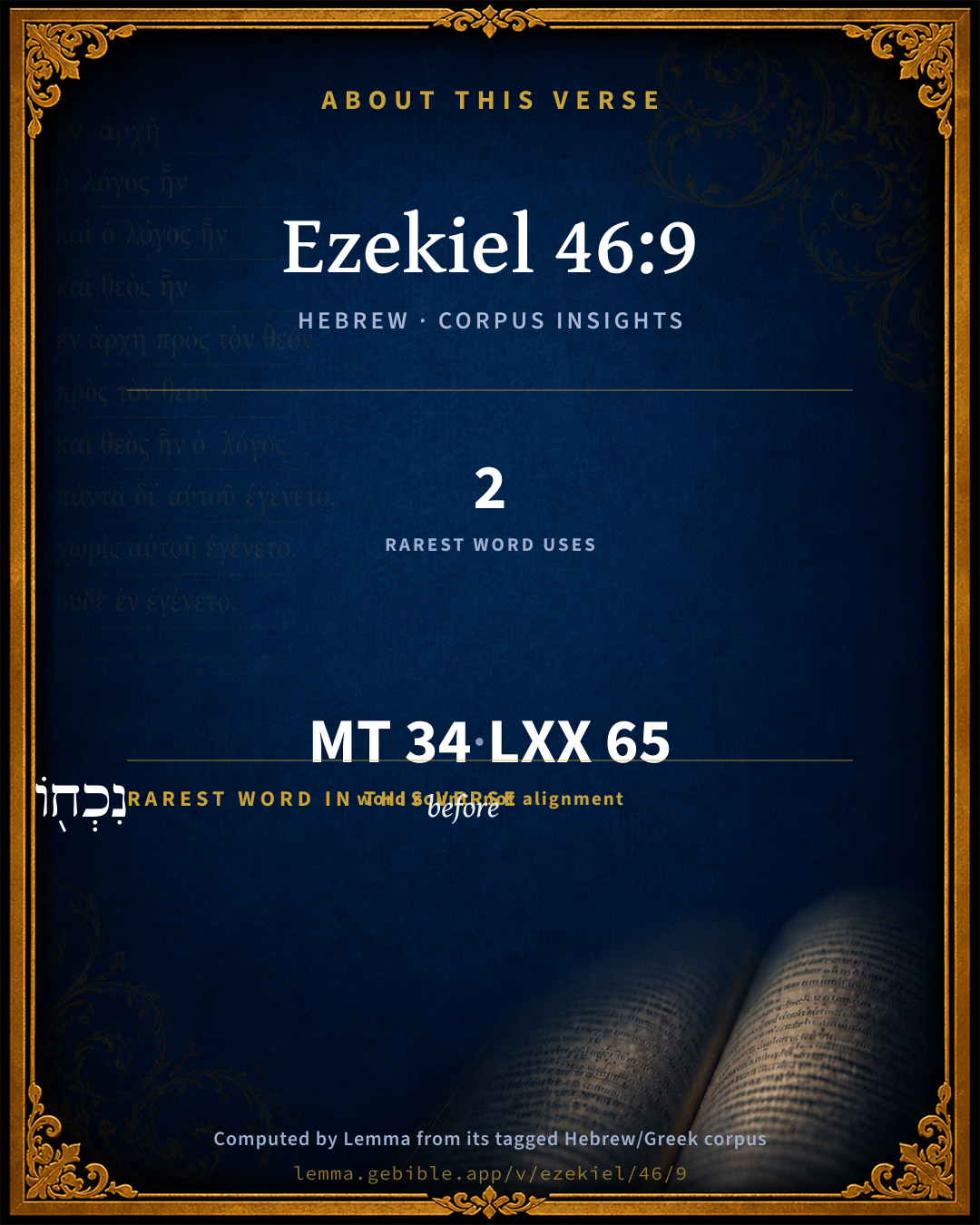
נִכְח֖וֹ
nêkach
H5226
“before · him”
Preposition + Suffix, Personal, 3rd Person, Masculine, Singular
Part of Speech
Preposition
Full BDB Definition

Origin: from an unused root meaning to be straightforward

TWOT: 1365a

be in front of - in front of, opposite to, in the sight of, before, to the front, right on - towards the front of, in front of, on behalf of, as far as in front of
  1. וּבְב֨וֹא bôwʼ H935 “and · in/at · to enter” Conjunction + Preposition + Verb, Qal, Infinitive Construct
  2. עַם ʻam H5971 “people of” Noun, Common, Masculine, Singular, Construct
  3. הָאָ֜רֶץ ʼerets H776 “the · land” Particle, Definite Article + Noun, Common, Both, Singular, Absolute
  4. לִפְנֵ֣י pânîym H6440 “to/for · face(s) of” Preposition + Noun, Common, Both, Plural, Construct
  5. יְהוָה֮ Yᵉhôvâh H3068 “LORD” Noun, Proper
  6. בַּמּֽוֹעֲדִים֒ môwʻêd H4150 “in/at the · appointed times” Preposition, Determined + Noun, Common, Masculine, Plural, Absolute
  7. הַבָּ֡א bôwʼ H935 “the · entering” Particle, Definite Article + Verb, Qal, Participle Active, Masculine, Singular, Absolute
  8. דֶּרֶךְ derek H1870 “way of” Noun, Common, Both, Singular, Construct
  9. שַׁ֨עַר shaʻar H8179 “gate of” Noun, Common, Masculine, Singular, Construct
  10. צָפ֜וֹן tsâphôwn H6828 “north” Noun, Common, Feminine, Singular, Absolute
  11. לְהִֽשְׁתַּחֲוֺ֗ת shâchâh H7812 “to bow down” Preposition + Verb, Hithpael, Infinitive Construct
  12. יֵצֵא֙ yâtsâʼ H3318 “to go out” Verb, Qal, Imperfect, 3rd Person, Masculine, Singular
  13. דֶּרֶךְ derek H1870 “way of” Noun, Common, Both, Singular, Construct
  14. שַׁ֣עַר shaʻar H8179 “gate of” Noun, Common, Masculine, Singular, Construct
  15. נֶ֔גֶב negeb H5045 “south” Noun, Common, Masculine, Singular, Absolute
  16. וְהַבָּא֙ bôwʼ H935 “and · the · entering” Conjunction + Particle, Definite Article + Verb, Qal, Participle Active, Masculine, Singular, Absolute
  17. דֶּרֶךְ derek H1870 “way of” Noun, Common, Both, Singular, Construct
  18. שַׁ֣עַר shaʻar H8179 “gate of” Noun, Common, Masculine, Singular, Construct
  19. נֶ֔גֶב negeb H5045 “south” Noun, Common, Masculine, Singular, Absolute
  20. יֵצֵ֖א yâtsâʼ H3318 “to go out” Verb, Qal, Imperfect, 3rd Person, Masculine, Singular
  21. דֶּרֶךְ derek H1870 “way of” Noun, Common, Both, Singular, Construct
  22. שַׁ֣עַר shaʻar H8179 “gate of” Noun, Common, Masculine, Singular, Construct
  23. צָפ֑וֹנָה tsâphôwn H6828 “north · toward” Noun, Common, Feminine, Singular, Absolute + Suffix, Demonstrative
  24. לֹ֣א lôʼ H3808 “not” Particle, Negative
  25. יָשׁ֗וּב shûwb H7725 “to return” Verb, Qal, Imperfect, 3rd Person, Masculine, Singular
  26. דֶּ֤רֶךְ derek H1870 “way of” Noun, Common, Both, Singular, Construct
  27. הַשַּׁ֨עַר֙ shaʻar H8179 “the · gate” Particle, Definite Article + Noun, Common, Masculine, Singular, Absolute
  28. אֲשֶׁר ʼăsher H834 “which” Particle, Relative
  29. בָּ֣א bôwʼ H935 “to enter” Verb, Qal, Perfect, 3rd Person, Masculine, Singular
  30. כִּ֥י kîy H3588 “that” Conjunction
  31. יצאו yâtsâʼ H3318 “to go out” Verb, Qal, Imperfect, 3rd Person, Masculine, Plural
  32. יֵצֵֽא yâtsâʼ H3318 “to go out” Verb, Qal, Imperfect, 3rd Person, Masculine, Singular

About this verse

These counts appear in no published source. They are computed here, from the morphology-tagged text and Lemma’s own curated glosses. What Lemma adds →

34
words
17
distinct lemmas
Prophets
section

Notable vocabulary

The rarest word here is נִכְח֖וֹ before H5226 — appearing just 2 times in the whole Hebrew Bible.

Shared distinctive vocabulary

נִכְח֖וֹ before H5226 occurs in 2 verses of the Hebrew Bible. Also found in:

Grammatical profile

  • 10 verbs
  • 19 nouns
  • 2 prepositions
  • 1 conjunction
  • 2 particles

Verb forms

  • וּבְב֨וֹא Qal · Infinitive Construct
  • הַבָּ֡א Qal · Participle Active
  • לְהִֽשְׁתַּחֲוֺ֗ת Hithpael · Infinitive Construct
  • יֵצֵא֙ Qal · Imperfect
  • וְהַבָּא֙ Qal · Participle Active
  • יֵצֵ֖א Qal · Imperfect
  • יָשׁ֗וּב Qal · Imperfect
  • בָּ֣א Qal · Perfect
  • יצאו Qal · Imperfect
  • יֵצֵֽא Qal · Imperfect

Repetition

Words recur within this verse — often emphatic in Hebrew:

  • דֶּרֶךְ way H1870 ×5
  • שַׁ֨עַר gate H8179 ×5
  • וּבְב֨וֹא to enter H935 ×4
  • יֵצֵא֙ to go out H3318 ×4
  • צָפ֜וֹן north H6828 ×2
  • נֶ֔גֶב south H5045 ×2

Hebrew & Septuagint length

In English translation the verse runs 80 words from the Hebrew and 79 from the Septuagint (LXX English) — closely comparable.

A rough comparison of the two English renderings, which tokenize alike — not a word-level alignment.

Word counts can differ between the Hebrew and the Greek without any difference in meaning — e.g. the Hebrew direct-object marker אֵת has no separate Greek word, and Greek often adds the article ὁ.

In the original languages it is 34 Hebrew tokens and 65 Greek tokens — but the two are counted differently (Hebrew bundles its prefixes and suffixes into one token; the Greek is in lemma form), so that isn’t a like-for-like length.

Cross-references

10

Topical passages linked to Ezekiel 46:9 in the Treasury of Scripture Knowledge — connected by theme and wording, ordered by reader-vote popularity; previews shown in the World English Bible.

  • Deuteronomy 16:16 Three times in a year shall all your males appear before Yahweh your God in the place which he shall choose: in the feast of unleavened bread, and in the feast of weeks, and in the feast of tents; and they shall not appear before Yahweh empty:
  • Exodus 23:14–17 "You shall observe a feast to me three times a year.
  • Exodus 34:23 Three times in the year all your males shall appear before the Lord Yahweh, the God of Israel.
  • Psalms 84:7 They go from strength to strength. Everyone of them appears before God in Zion.
  • 2 Peter 2:20–21 For if, after they have escaped the defilement of the world through the knowledge of the Lord and Savior Jesus Christ, they are again entangled therein and overcome, the last state has become worse with them than the first.
  • Ezekiel 1:17 When they went, they went in their four directions: they didn't turn when they went.
  • Malachi 4:4 "Remember the law of Moses my servant, which I commanded to him in Horeb for all Israel, even statutes and ordinances.
  • Philippians 3:13–14 Brothers, I don't regard myself as yet having taken hold, but one thing I do. Forgetting the things which are behind, and stretching forward to the things which are before,
  • Hebrews 10:38 But the righteous will live by faith. If he shrinks back, my soul has no pleasure in him."
  • Ezekiel 1:12 They went everyone straight forward: where the spirit was to go, they went; they didn't turn when they went.

Cross-references courtesy of OpenBible.info (CC BY 4.0).

Hebrew and Greek witnesses Masoretic Hebrew ↔ Greek Septuagint

The same verse in the two great witnesses to the Old Testament, shown verse-for-verse.

These are two independent witnesses, not word-aligned to each other, and the Septuagint is shown in lemma (dictionary) form.

Hebrew Ezekiel 46:9 Masoretic · Westminster Leningrad Codex

וּבְב֨וֹא עַם הָאָ֜רֶץ לִפְנֵ֣י יְהוָה֮ בַּמּֽוֹעֲדִים֒ הַבָּ֡א דֶּרֶךְ שַׁ֨עַר צָפ֜וֹן לְהִֽשְׁתַּחֲוֺ֗ת יֵצֵא֙ דֶּרֶךְ שַׁ֣עַר נֶ֔גֶב וְהַבָּא֙ דֶּרֶךְ שַׁ֣עַר נֶ֔גֶב יֵצֵ֖א דֶּרֶךְ שַׁ֣עַר צָפ֑וֹנָה לֹ֣א יָשׁ֗וּב דֶּ֤רֶךְ הַשַּׁ֨עַר֙ אֲשֶׁר בָּ֣א ב֔וֹ כִּ֥י נִכְח֖וֹ יצאו יֵצֵֽא

But when the people of the land shall come before Yahweh in the appointed feasts, he who enters by the way of the north gate to worship shall go forth by the way of the south gate; and he who enters by the way of the south gate shall go forth by the way of the north gate: he shall not return by the way of the gate by which he came in, but shall go forth straight before him.

World English Bible · Public Domain

Greek LXX Ezekiel 46:9 Septuagint · lemma form

καί ὅταν εἰςπορεύομαι ὁ λαός ὁ γῆ ἐναντίον κύριος ἐν ὁ ἑορτή ὁ εἰςπορεύομαι κατά ὁ ὁδός ὁ πύλη ὁ πρός βορέας προςκυνέω ἐκἔρχομαι κατά ὁ ὁδός ὁ πύλη ὁ πρός νότος καί ὁ εἰςπορεύομαι κατά ὁ ὁδός ὁ πύλη ὁ πρός νότος ἐκἔρχομαι κατά ὁ ὁδός ὁ πύλη ὁ πρός βορέας οὐ ἀναστρέφω κατά ὁ πύλη ὅς εἰςἔρχομαι ἀλλά ἤ κατά εὐθύς αὐτός ἐκἔρχομαι

And whenever the people of the land shall go in before the Lord at the feasts, he that goes in by the way of the north gate to worship shall go forth by the way of the south gate; and he that goes in by the way of the south gate shall go forth by the way of the north gate: he shall not return by the gate by which he entered, but he shall go forth opposite it.

LXX2012 (modern English Septuagint) · Public Domain

Hebrew: Westminster Leningrad Codex (CC BY 4.0). Greek: Septuagint (public domain); English from LXX2012 (modern English Septuagint) (Public Domain). How the Septuagint differs from the Hebrew →

Targum (Aramaic paraphrase)

1

The Targum is the ancient Jewish Aramaic paraphrase of the Hebrew Scriptures — an interpretive translation, not the Hebrew text itself. Onkelos (literal) and Pseudo-Jonathan (expansive) render the Torah, and Jonathan the Prophets. Coverage is partial: where no permissively-licensed English translation exists for a verse, only the Aramaic is shown. This is verse-level text, not a word-by-word alignment to the Hebrew.

  1. Targum Jonathan Prophets (Joshua–Malachi)
    וּבְמֵיעַל עַמָא דְאַרְעָא לְמִסְגַד קֳדָם יְיָ בְּמוֹעֲדַיָא דְעָלֵיל בְּאוֹרַח תְּרַע צִפּוּנָא לְמִסְגַד יִפּוֹק בְּאוֹרַח תְּרַע דָרוֹמָא וּדְיֵעוֹל בְּאוֹרַח תְּרַע דָרוֹמָא יִפּוֹק בְּאוֹרַח תְּרַע צִפּוּנָא לָא יְתוּב בְּאוֹרַח תְּרַע דִי עָל בֵּיהּ אֲרֵי לְקִבְלֵיהּ יִפּוֹק:

    (no public-domain English translation for this verse)

    Targum Jonathan — Aramaic: “Mikraot Gedolot” (public domain). English: “Sefaria Community Translation” (CC0 1.0 (public-domain dedication)); “London "Chaldee Paraphrase," 1871” (public domain). Text via Sefaria.

Commentary

Notes on Ezekiel 46:9 from classic Christian and Jewish commentators (each source and its license shown beneath its notes). The classic Christian expositions comment on the surrounding passage and are grouped to its opening verse, so a note may address several verses; the Jewish commentaries on the Tanakh (Rashi and others) are per-verse, so they appear only where the commentator wrote on this verse.

Lemma curates 59 commentaries, every one of them public domain or Creative Commons licensed, each selected and text-cleaned for this edition rather than reprinted as found. About our sources →

Trapp's Complete Commentary

John Trapp

Eze 46:9 But when the people of the land shall come before the LORD in the solemn feasts, he that entereth in by the way of the north gate to worship shall go out by the way of the south gate; and he that entereth by the way of the south gate shall go forth by the way of the north gate: he shall not return by the way of the gate whereby he came in, but shall go forth over against it.

Ver. 9. Shall go out the way of the south gate.] For more easy passage sake, in such a multitude of people. But withal to teach us many things; as (1.) Not to turn our backs upon the holy ordinances; {a} (2.) To "make straight paths for our feet"; {Heb 12:13} not looking back with Lot’s wife; {Luk 17:32} not longing for the onions of Egypt, as those rebels in the wilderness, but advancing forward with St Paul, {Php 3:13-14} looking forthright, {Pro 4:25} having our eye upon the mark, and making daily progress toward perfection; (3.) That our memories are frail, and here we shall meet with many things that will withdraw us from thinking upon God; (4.) That our life is but short; a very passage from one gate to another: where to go back - i.e., to add anything to our lives - it is not granted, since our time is limited, {Job 14:3 Act 17:26} and we are all hastening to our long home. {Ecc 12:5} One being asked what life was? made an answer answerless; for he presently went his way.

{a} The Jews at this day depart out of the synagogue with their faces still toward the ark, like crabs going backward.

John Trapp, A Commentary or Exposition upon All the Books of the Old and New Testament (1647–1656) — public domain. Text from a community e-Sword module.

The Biblical Illustrator

Joseph S. Exell

Eze_46:9

The north gate . . . the south gate.

North and south in religion

Ezekiels temple sets forth the order, grandeur, and beauty of the Church in its vigour, and the life that shall go out from it in floods all over the world. It is the picture of the Gospel of Christ in its social aspect and in its healing and regenerating influence. What can be meant, then, by declaring regarding this temple that those who go in by the south door shall go out by the north, and that those who go in by the north shall go out by the south? A man may enter either by the north deer or the south. There is perfect liberty here. But there is no liberty as to what he shall do after that. He shall go right through. He shall make for the over against. Has not this a very plain meaning for us--that we should not sit still at that side of religion which first attracted us, not keep going beck over the old ground, but strive to go through the whole breadth of religion. There is a north and a south in religion. There is a bright, sunny side. It is always warm and genial there. And there is a cold, dark side, which only gets the sun on the longest days. Some come in by the one side, and some by the other. Some come with grief and tears, driven by bitter cold or wild blasts. Others come in by the door of hope and joy, drawn by bright promises. They come calm, easy, and radiant, as to an old home which they had never lost. Religion has many opposites, though no contradictions. The Bible is continually speaking of the importance of joining opposites together, such as prayer and praise, working and waiting, digging and crying, resting and running, weeping and rejoicing, past and future, time and eternity. The truth taught in the text, then, is a most practical as well as suggestive one, and one that lies very near to the root of success--that we should go on to the opposite good of that which we possess, not simply further than where we are, but that we should strive to reach and embrace the directly opposite attainment, not leaving or undervaluing what is possessed, but uniting to it that which may seem contrary or which may possibly have been considered by us as wholly antagonistic and incompatible. We shall find that it is these opposites which not only preserve from exaggeration and caricature, but that they are needful even for proper rooting and strength. When one finds out how opposites coalesce and help each other, need each other, claim each other, and are only themselves when they find each other, he is fortified against moral scepticism and against religious unrest. What I contend for is not a compromise, but a junction in which each remains to strengthen and develop the other. Do we wish to see examples of this in human life? Are not great generals who have a power of wide and far arrangement also remarkable for the opposite, the attention to small details? So men who have organised and sustained large mercantile enterprises have been remarkable combinations of opposite qualities, cautious and bold, cool and intense, patient and ardent, careful of little things, observant of the slightest signs, while conceiving great projects. If a painter is happy in outlines, it will not profit him much unless he studies minute effects; if he excels in form, he must try to excel also in colour. Everything in actual life needs its opposite to give it substance, pith, and permanence. We need to be often reminded of this truth, for everyone is inclined to some particular side of things, by temperament, by habit, or surroundings.

I. Truth. The truth of God has many sides, and there are truths which stand as opposites: whole classes of truths stand as opposites. A healthy, religious life seeks to lay hold of both of these.

1. Religion embraces truths that are mysterious and truths that are clear and plain. Can we be right if we seek merely clear things and neglect the vast mysteries, or if we are fascinated by the mysteries and despise or forget things easy to understand? Every man needs the plainest truths constantly, for religion is not mainly an exercise for the intellect or a discipline for faith, but rest and food for the feeblest. But let no man say, The plain and simple things are all I want; I care not for mysteries. They perplex me; they weigh upon me. I avoid them, I pass them by. Do you really think, then, that you have got hold of these plain truths while you thus act? The plain truths need the vast and unsearchable to give them force. You yourself need to be awed and mastered, ay, even bewildered and perplexed by the inscrutable.

2. There are truths of theory and truths of practice. Let the one class be added to the other. Theology ought to be the most inspiring of all sciences. If you have entered the temple by this door, it is well; but do not stay there. Religion is more than theology. A man may be very theological, and only a very little religious. But you never get a real hold of theology till you learn the elementary experiences of religion. Truly to pray and be contrite, and hold fellowship with God opens up theology.

II. Worship. Worship has many sides. It also abounds in opposites. Such are sorrow and joy, hope and fear, prayer and praise, supplication and promise, or resolve. How fully and impartially these are presented in the Word of God; yet how frequent it is for men to cling to one side of worship. How many enter at the north door of entreaty, and never really approach the south door of joy and praise. You must not remain in sorrow. Whoever has brought to God tears, sorrows, fears, doubts, burdens, let him bring great joy. He may find it hard to do this. It is called in the Psalms the sacrifice of joy. And truly it is a sacrifice and often the most costly that one can bring. It may cost you far more to bring joy to God than to bring labour and tears. So to pass over to the side of joy would really be the wholesomest endeavour that many a one could make. It would revolutionise his life. He would be renewed and made a spiritual man in the mere effort to bring to God joy. But there are those who find it easy to be glad and grateful, Depression, the awful burden of sin, bitter tears, or a sorrow that would find relief in tears, they have no experience of. Are they, then, under no obligation to sorrow! Can they ignore all that side of religion? Have they found their way to a region where it is superfluous? That cannot be if they are sinful men. He that does not know the secret of grief must be very much on the surface of things. There are those, again, who have been very earnest for themselves. They have pleaded and wrestled for pardon. They have cried many and many a time with all the earnestness of their nature after renewal, after deliverance from evil and attainment of Divine freedom; they have felt, as a crushing load, the burden of their own souls; but they have never felt the burden of the worlds evil and bondage. They must learn to be in thorough earnest about some object, and some person not their own, and that can bring no benefit to them. Only then is a soul truly emancipated, only then, when it takes up Gods cause and mans and forgets itself, does it know the greatness of prayer.

III. Moral and spiritual life.

1. How common it is to decry feeling and exalt conduct and action. The tendency is certainly right as to the comparative value of these opposites if they are regarded as antagonistic. Action, conduct in the full sense of the word, the action of the man is the end and aim of all. But, on the other hand, feeling is the proper basis of action and conduct. Pity and compassion are feelings; can anyone be acting a wise or noble part who decries or ignores them? Sympathy and benevolence are feelings. Admiration is a feeling. Taken together, these form that supreme feeling called love. Zeal and enthusiasm are feelings. Men who speak slightingly of feeling must surely be uneasy when they reflect on the value which the great human heart sets on these things, and the immense sway they wield. Surely they must be uneasy when they reflect how very differently the Word of God speaks, and how intent it is on expelling wrong feelings and awaking right ones. No! The true course is for men not to excuse or vindicate their want of feeling, but to lament it, to bewail their poverty, and press across that they may become rich. There are those who, on the other hand, rest in emotion, who are pleased with themselves that they are so susceptible, and have such fine, earnest, lofty desires. This is a huge danger. Feeling is for the purpose of action. Those, therefore, who feel strongly should of all men particularly set their hearts on action, on being extremely, thoroughly, minutely practical. It is easier for them than other men to be diligent and thorough. Their glow and enthusiasm ought to give them wings.

2. Devotion and righteousness in like manner stand over against each other; in other words, some are mainly for God, others mainly for man. There are those who feel strongly the claims of God and have a constant drawing to worship. The pleasure they take in devotion is real, but their conscience and their human affections are dormant. They need to have it strongly brought home to them that there is a whole side of things of the utmost moment which they are ignoring, that if a man love God he must love his brother also, and that this is the love of God to keep His commandments. And is not the opposite type frequent? The feeling of this class is expressed in such phrases as, The best worship of God is to do what is right. The best worship of God is to help men. The best worship of God is to be like Him. What shall we say to this? The helping of men may be a worship of God, but it may not. It will not be a worship of God unless there is first, and as the foundation of the life, direct worship of God. God claims direct worship, and the soul needs it. From whence will you draw your inspiration and your power to help men if you do not come into contact with God? (J. Leckie, D. D.)

The Biblical Illustrator, edited by Joseph S. Exell (c. 1880s–1900s) — public domain. Text from a community e-Sword module.

Tyndale Open Study Notes

Tyndale Open Resources

46:9-10 During religious festivals, the people were to present themselves before the Lord by proceeding through the Temple from north to south or vice versa, with the prince in their midst. Their motion was to follow the profane north–south axis rather than the sacred east–west axis along which the priests’ activities took place.

Tyndale Open Study Notes — © Tyndale Open Resources, licensed CC BY-SA 4.0. Text via the HelloAO Bible API.

Jamieson, Fausset & Brown

Robert Jamieson, A. R. Fausset & David Brown

The worshippers were on the great feasts to pass from one side to the other, through the temple courts, in order that, in such a throng as should attend the festivals, the ingress and egress should be the more unimpeded, those going out not being in the way of those coming in.

Jamieson, Fausset & Brown — Commentary Critical and Explanatory on the Whole Bible (1871) — public domain (CC PDM 1.0). Text via the HelloAO Bible API.

Adam Clarke's Commentary

Verse 9. He that entereth in by the way of the north, c.] As the north and the south gates were opposite to each other, he that came in at the north must go out at the south he that came in at the south must go out at the north. No person was to come in at the east gate, because there was no gate at the west; and the people were not permitted to turn round and go out at the same place by which they came in; for this was like turning their backs on God, and the decorum and reverence with which public worship was to be conducted would not admit of this. Besides, returning by the same way must have occasioned a great deal of confusion, where so many people must have jostled each other, in their meetings in different parts of this space.

Adam Clarke's Commentary on the Bible (1810–1826) — public domain. Text from a community e-Sword/MySword module.

Ellicott's Commentary for English Readers

(9) In the solemn feasts.—Different arrangements were required for the great or “solemn” feasts, because at these all the males of Israel were commanded to be present, and therefore the numbers were very large. This affects both the people and (Eze_46:10) the prince. The first provision is one for securing order in the vast concourse of people: by whichever (outer) gate any one enters (the north or the south), he shall pass out by the opposite one.

A Bible Commentary for English Readers, edited by Charles John Ellicott (1878–1897) — public domain. Text from a community e-Sword module.

John Gill's Exposition

And the prince in the midst of them,.... Christ in the midst of his people while worshipping; this situation of him agrees with all the descriptions of him; as the Angel in the midst of the bush on fire, and not consumed; as among the myrtle trees in the bottom; as walking in the midst of his golden candlesticks; as the tree of life in the midst of the paradise of God; and as King, Priest, and Prophet, in his house; and with all the declarations and promises of his grace; and which is true in fact: and the phrase is expressive of his presence, not merely of his essential, powerful, and providential presence, common to all, but of his gracious presence with his people; he is in the midst of them, to assist them in every service; to protect them from every enemy; to sympathize with them in all their troubles; to deliver out of them; to supply them with all needful grace; and to rule over them, and defend them: and his being here shows that he is to be seen of all, to be come at and enjoyed by them; than which nothing is more desirable, and nothing more encouraging in the worship of God:

when they go in, shall go in; and when they go forth, shall go forth; when they go to the throne of grace, for grace and mercy to help in time of need, he goes with them; their access is through him; he introduces their persons, presents their petitions, is their advocate and intercessor for them, and for his sake they are heard and accepted: when they go into the house of God, and to the ordinances of it; when they go in and out to find pasture, he goes in with them, and before them, as the shepherd of the flock, and leads them into green pastures; he teaches them how to go in and out, and to behave themselves in the church of God; he is their guide, by way of instruction, both by his word and by his Spirit: when they go out from public service to their own houses, he goes with them, and by his Spirit brings to their remembrance what they have heard; and when they go forth into the world again, and the business of it, he goes forth with them, to preserve them from the evil of the world, and to keep them from falling; and when they go forth out of the world at death, he is with them through the dark valley; he sees them safe over Jordan's river, and introduces them into the heavenly Canaan, into his kingdom and glory, where they are for ever with him.

John Gill's Exposition of the Whole Bible (1746–1763) — public domain (CC PDM 1.0). Text via the HelloAO Bible API.

Albert Barnes' Notes on the Bible

The whole body of the people gathered together in the outer court, and from thence bodies went in turn into the inner court to worship, and then again out into the outer court.

Albert Barnes' Notes on the Bible (1834–1885) — public domain. Text from a community e-Sword/MySword module.

Haydock's Catholic Bible Commentary

It, perhaps to avoid confusion, (Menochius) and turning the back on the temple, (Calmet) or to exercise their obedience. As many might enter by one gate as by another, and thus the concourse would not be diminished. (Haydock)

George Leo Haydock (1774–1849), Haydock's Catholic Family Bible and Commentary, 1859 edition — public domain. Excludes Psalms (Douay-Rheims chapter numbering differs from Protestant) and Deuterocanonical books (Catholic canon only).

Matthew Poole's English Annotations

All except the prince, when they come to worship, must observe to go out at that door that is over against the door at which they came in.

Come before the Lord, present themselves and their sacrifices, in the solemn feasts, the three great annual feasts, the new moons, and the weekly sabbaths.

He that entereth in, & c.: the east gate they might not enter at, as already is observed, and whatever reason might be given besides, this passage in this verse gives one, they could not go right forward to go out, at a west gate; for the temple and the entrance into it stood in a straight line from every one of the east gates from the outmost court, so that if any should go straight forward, they would go into the temple and oracle, which was not to be. There were but two gates the people might enter at, the south or north.

He shall not return, & c.: none might turn their back on the temple, nor do that which looked like a going away from God, which may give us somewhat the meaning of Jer 2:27; 32:33, their turning the back on God.

Matthew Poole's English Annotations on the Holy Bible (1683–1685) — public domain. Text from a community e-Sword/MySword module.

The Pulpit Commentary

But when the people of the land shall come before the Lord. As the preceding verse referred to the prince"s entrance into and departure from the inner gate, this was intended to regulate the movements of the prince"s subjects when they should enter the outer court at any of the festal seasons not the high festivals alone, such as the Passover and the Feast of Tabernacles, which are usually denominated but the ordinary, appointed feasts ( including, besides the high festivals, the sabbaths and the new moons and such other religions celebrations as were or should be prescribed in the new Torah. In order to prevent confusion, and that all might be conducted with propriety, (comp. 1Co_14:40) no one should depart by the gate through which he had entered, but by the opposite, i.e. he who had entered by the north gate should retire through the south gate, and vice versa. Hengstenberg thinks the reason for this regulation "cannot be sought in the endeavor to avoid a throng," since "in that case it must have been ordained that all should go in by the same gate and go out by the opposite one;" it must, he holds, have been "a theological one," viz. "to signify that each should go out of the sanctuary another man than he came in.

The soul"s growth in goodness.

The wisdom of God has been clearly evinced in the spiritual training of the human family. The forbidden fruit was the wisest test that God could impose on Adam. The simple sacrifice of a lamb was the fittest training of men"s souls during the patriarchal age. And as the race developed from infancy into youth, and from youth to manhood, God"s methods for unfolding and maturing the spiritual nature have been singularly appropriate. The highest good man can obtain is the development of his spirit the expansion of his highest powers. To this end all religious worship is designed to contribute.

I MAN"S SPIRITUAL LIFE BEGINS AT ZERO. In all God"s works we see development from a simple germ to highest perfection. For high reasons God does not produce perfected natures at a single stroke. Even this unconscious earth passed through long stages of preparation before it was fit for human habitation. The rose does not reach perfection except by patient culture. Everything about us is in transition, and is moving onward in a course of development. Art is not yet perfected. Our bodily nature begins with a microscopic germ, and slowly develops towards maturity. If anything is plainly revealed in Scripture, it is this that the life of the soul begins at the lowest point and is intended to reach the highest. We do not begin our earthly career with robust faith in the unseen God, nor yet with a sensitive conscience, nor yet with strong aspirations after moral excellence. All this is the result of research and self-discipline and prayer. Clearly there is an intimate analogy between all the varieties of life known to us. With respect to the grain there is first the seed, then the blade, then stalk, then ear, then full corn in the ear. With respect to the body there is babyhood, infancy, youth, manhood, maturity. And the life of the soul begins with a thought, a feeling, a wish, a prayer. It begins in the understanding, passes into the conscience, touches the emotions, moves the desires, constrains the will, moulds the life. It begins in feebleness and develops into world-controlling power. Probably the main reason for this is that the spiritual life, to have any beauty or excellence, must be the spontaneous desire and endeavor of the man himself. If, by the constitution of his nature, a man must be holy and benevolent, there would be no merit in holiness, no worth in benevolence. Therefore scope is given to a man, greater or lesser, to foster the young germ of spiritual life, and to develop it unto the noblest perfection. This is our supreme business during our mortal career.

II MAN"S SPIRITUAL LIFE CAN BE NOURISHED BY ACTS OF PUBLIC WORSHIP. The temple in the olden time, and Christian sanctuaries now, are designed by God for this end.

1. Instruction is provided. In the former ages this was furnished in the form of rite and emblem; now, almost entirely, by oral utterance. There is conveyed information respecting God, his nature, his kingdom, his will, his doings; information respecting man, his nature, his fall, his redemption, his possible elevation to purity, his destinies in a future state.

2. Access to God is allowed. Self-inspection is encouraged. Interior sin, in inclination and desire, is detected. The eye is turned inward upon the soul. The best sensibilities of the heart are strengthened and expanded. A vision of holiness is obtained. New aspirations begin to bud. The sacred influence of God is felt upon the soul. True prayer is stimulated.

3. Right habits are confirmed. Every man is more or less influenced by his fellow-man, so contact with holy men produces salutary impressions upon every sensitive mind. The forceful presentation of truth upon the moral nature tends to elevate it. Convictions of religious duty are inwrought. Regard for God"s revelation and for God"s will is deepened. Resolution to follow a right course is often formed. The energies of the soul are braced up for high endeavor. Familiarity with God and with eternal things is increased. As a plant grows and buds under the influence of the vernal sun, so a man"s soul unfolds amid the surroundings of public worship.

4. A Divine influence is present.

III MAN"S SPIRITUAL LIFE IS EITHER HELPED OR CHECKED BY EVERY VISIT TO THE SANCTUARY. This is the main truth taught in this verse. Men were not allowed, in the second temple, to retrace their steps. They might not depart by the same path as that by which they approached the altar. Without doubt this was ordained in order to leave an impressive lesson on their minds. The law yet remains. It is written on man"s spiritual constitution. It is written in the very structure of the temple. No man leaves God"s house precisely the same man as he went in. He is either worse or better for his visit. If he has yielded in any measure to the claims of God, he is the better. If he has resisted them afresh, he is the worse.

1. Let us contemplate the foolish man.

(1) If he enter by the gate of self-righteousness he will in all probability leave by the gate of insensibility. His soul will be hardened under the process. The sun that melts wax hardens clay.

(2) If he enter by the gate of unbelief he will leave by the gate of despair. Foregone conclusions fasten like a bandage upon the eyes. The root of blindness is a perverse will. The man without God is without hope.

(3) If he enter by the gate of formal custom he will leave by the gate of bondage. His carnal fetters will have been more firmly riveted by the visit.

2. Let us contemplate the wise man the beneficial visit.

(1) He who enters by the gate of inquiry leaves by the gate of knowledge.

(2) He who enters by the gate of penitence leaves by the gate of peace.

(3) He who enters by the gate of prayer leaves by the gate of triumph.

(4) He who enters by the gate of consecration leaves by the gate of immortal hope. D.

The Pulpit Commentary (1880–1919), ed. H.D.M. Spence-Jones & Joseph S. Exell — public domain. Text from a community e-Sword module.

John Wesley's Explanatory Notes

Go forth over against it - Perhaps, only to prevent all jostling and confusion.

John Wesley, Explanatory Notes Upon the Whole Bible (1754–1765) — public domain. Text via the GEBible commentary corpus.

unfoldingWord translationNotes

Door43 World Missions Community

before Yahweh

"in front of Yahweh" or "in the presence of Yahweh." See how you translated this in Ezekiel 44:3.

appointed festivals

Translate as you translated "appointed feasts" in Ezekiel 36:37.

translationWords

appoint

worship

unfoldingWord translationNotes — © Distant Shores Media and the Door43 World Missions Community, licensed CC BY-SA 4.0. Source: git.door43.org/Door43/en_tn.

Rashi

Rabbi Shlomo Yitzchaki (Rashi)

But when the people of the land come, etc., by way of the north gate, etc., but he shall go out by that which is opposite it It is incumbent upon them to be seen in full view in the Court.

Rashi on the Tanakh — English translations: “The Judaica Press complete Tanach with Rashi, translated by A. J. Rosenberg” (CC BY 4.0); “Pentateuch with Rashi's commentary by M. Rosenbaum and A.M. Silbermann, 1929-1934” (public domain); “The Metsudah Tanach series, Lakewood, N.J” (CC BY 4.0); and “The Book of Joshua, Metsudah Publications, 1997” (CC BY 4.0). Text via Sefaria.

Lesson kit

Teaching starters — assembled from the data on this page, not authored interpretation. Every prompt links to the verse data it draws on. Edit before teaching.

Ezekiel, in the Prophets, opens this verse with 34 words (17 distinct Hebrew lemmas). Its most distinctive word is nêkach (“before”). A historical commentator’s framing appears above. Read the whole chapter for the surrounding context.

Discussion questions

  1. What does “before” (nêkach) contribute to the verse as a whole?
  2. Exodus 14:2 shares the word «before» with this verse. How do the two illuminate each other?
  3. “way” occurs 5× in this one verse. What is the effect of the repetition?
  4. The translations on this page render this verse differently — a whole-verse word diff, not a word-by-word alignment. What might account for the different wordings?
  5. The verb «וּבְב֨וֹא» is Qal Infinitive Construct. How does its form color the action?
  6. Reading how Trapp's Complete Commentary and The Biblical Illustrator read this verse, where do the two commentators agree and where do they part?

Things to notice

Reading settings

Reading text

Shown beneath each verse's original-language words.

Old Testament
Old Testament edition

Read the OT as the Masoretic Hebrew (MT) or the Greek Septuagint (LXX).

English shown for the Greek Septuagint (in the Hebrew ↔ Greek comparison).

Comparing translations? Open the Compare panel on any verse page to stack up to four side by side.