Ezekiel 33:19

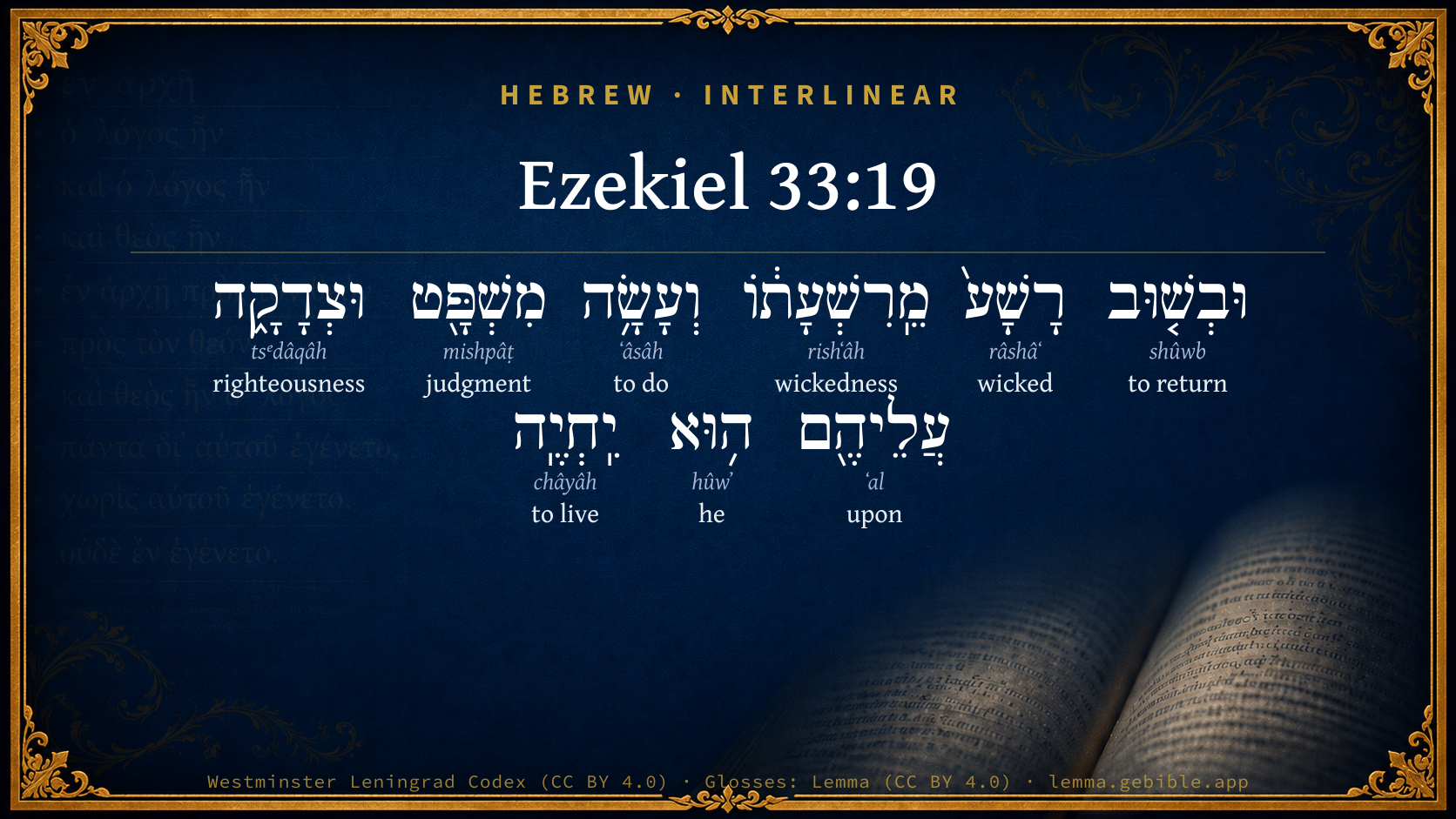
Hebrew (Westminster Leningrad Codex) Ezekiel 33:19 appears in the Hebrew Old Testament. The text above is from the Westminster Leningrad Codex. Each word links to its Strong’s number, a concise gloss, and parsing drawn from the Open Scriptures Hebrew Bible morphology. Click any word for its full Brown-Driver-Briggs (BDB) entry.
Download image
Cite this verse

Ezekiel 33:19 (World English Bible). Public Domain. Lemma interlinear Bible study tool, https://lemma.gebible.app/v/ezekiel/33/19.

Show BibTeX & RIS
BibTeX
RIS
English Translation
When the wicked turns from his wickedness, and does that which is lawful and right, he shall live thereby.
World English Bible · Public Domain
Download a study sheet

One document with this verse’s original text, its word-by-word gloss line, the meaning frame, cross-references with their text, attributed commentary, and full source and license credits — printable, and it pastes into notes with its structure intact.

This verse Autodidact and up

Study sheet (.html) Plain text (.txt)

A passage Seminary Student

Up to 50 verses in one chapter. A passage sheet keeps up to 6 commentary sources and 12 cross-references per verse, in the order this page ranks them, and says so on the sheet whenever that leaves anything out. Ask for a single verse and you get the Autodidact verse sheet above.

Everything on this page stays free to read, with no account — the sheet is a download of what is already on screen, not access to it.

Want to remove ads? Support Godless Engineer
Compare translations 3

The same verse in 3 English versions, stacked beneath the original-language interlinear above. Click any original word for its lexicon entry.

Each is an independent rendering of the whole verse — the interlinear is not word-aligned to these translations.

Highlighted words mark where these versions differ — a whole-verse word diff, not a word-by-word alignment.

  • World English Bible Public Domain
    When the wicked turns from his wickedness, and does that which is lawful and right, he shall live thereby.
  • King James Version Public Domain
    But if the wicked turn from his wickedness, and do that which is lawful and right, he shall live thereby.
  • unfoldingWord Literal Text CC BY-SA 4.0
    When the wicked turns away from his wickedness and does what is just and righteous, he will live because of those things!

unfoldingWord Literal Text — © unfoldingWord, licensed CC BY-SA 4.0. Word-aligned USFM3 via Door43 (git.door43.org/unfoldingWord/en_ult).

Versions to compare (up to 4)

3 of 4 selected

Show all 18 translations

Every available English version of this verse, each an independent rendering of the whole verse.

  • World English Bible Public Domain
    When the wicked turns from his wickedness, and does that which is lawful and right, he shall live thereby.
  • Berean Standard Bible Public Domain
    But if a wicked man turns from his wickedness and does what is just and right, he will live because of this.
  • Majority Standard Bible Public Domain
    But if a wicked man turns from his wickedness and does what is just and right, he will live because of this.
  • King James Version Public Domain
    But if the wicked turn from his wickedness, and do that which is lawful and right, he shall live thereby.
  • American Standard Version (1901) Public Domain
    And when the wicked turneth from his wickedness, and doeth that which is lawful and right, he shall live thereby.
  • Revised Version (1885) Public Domain
    And when the wicked turneth from his wickedness, and doeth that which is lawful and right, he shall live thereby.
  • Geneva Bible (1599) Public Domain
    But if the wicked returne from his wickednesse, and doe that which is lawfull and right, hee shall liue thereby.
  • Douay-Rheims (1899) Public Domain
    And when the wicked shall depart from his wickedness, and shall do judgments, and justice: be shall live in them.
  • Young's Literal Translation Public Domain
    And in the turning back of the wicked from his wickedness, And he hath done judgment and righteousness, by them he liveth.
  • Literal Standard Version CC BY-SA 4.0
    And in the turning back of the wicked from his wickedness, || And he has done judgment and righteousness—he lives by them.
  • Unlocked Literal Bible CC BY-SA 4.0
    When the wicked turns away from his wickedness and does what is just and righteous, he will live because of those things!
  • unfoldingWord Literal Text CC BY-SA 4.0
    When the wicked turns away from his wickedness and does what is just and righteous, he will live because of those things!
  • Darby Bible Public Domain
    And when the wicked turneth from his wickedness, and doeth judgment and justice, he shall live for these things.
  • World Messianic Bible Public Domain
    When the wicked turns from his wickedness and does that which is lawful and right, he will live by it.
  • Webster's Bible Public Domain
    But if the wicked shall turn from his wickedness, and do that which is lawful and right, for that he shall live.
  • Free Bible Version CC BY-SA 4.0
    On the other hand, if a bad person turns from their sins and they do what is good and right, they will live as a result.
  • Bible in Basic English Public Domain
    And when the evil man, turning away from his evil-doing, does what is ordered and right, he will get life by it.
  • JPS Tanakh (1917) Public Domain
    And when the wicked turneth from his wickedness, and doeth that which is lawful and right, he shall live thereby.

Literal Standard Version (2020), Covenant Press — licensed CC BY-SA 4.0. Text via the HelloAO Bible API (eBible.org). Unlocked Literal Bible (unfoldingWord) — licensed CC BY-SA 4.0. Text via the HelloAO Bible API (eBible.org). unfoldingWord Literal Text — © unfoldingWord, licensed CC BY-SA 4.0. Word-aligned USFM3 via Door43 (git.door43.org/unfoldingWord/en_ult). Free Bible Version, Dr. Jonathan Gallagher — licensed CC BY-SA 4.0. Text via the HelloAO Bible API (eBible.org).

Word by word

More ways to search: Search by grammar → Find every occurrence → Compare this word →

Practice this passage: Drill this verse → Learn its vocabulary →

מֵֽרִשְׁעָת֔וֹ
rishʻâh
H7564
“from · wickedness · his”
Preposition + Noun, Common, Feminine, Singular, Construct + Suffix, Personal, 3rd Person, Masculine, Singular
Part of Speech
Preposition + Noun
Type
Common
Gender
Feminine
Number
Singular
State
Construct
Full BDB Definition

Origin: from H7562

TWOT: 2222c

wickedness, guilt - wickedness (in civil relations) - wickedness (of enemies) - wickedness (ethical and religious)
  1. וּבְשׁ֤וּב shûwb H7725 “and · in/at · to return” Conjunction + Preposition + Verb, Qal, Infinitive Construct
  2. רָשָׁע֙ râshâʻ H7563 “wicked” Adjective, Adjective, Masculine, Singular, Absolute
  3. וְעָשָׂ֥ה ʻâsâh H6213 “and · to do” Conjunction + Verb, Qal, Sequential Perfect, 3rd Person, Masculine, Singular
  4. מִשְׁפָּ֖ט mishpâṭ H4941 “judgment” Noun, Common, Masculine, Singular, Absolute
  5. וּצְדָקָ֑ה tsᵉdâqâh H6666 “and · righteousness” Conjunction + Noun, Common, Feminine, Singular, Absolute
  6. עֲלֵיהֶ֖ם ʻal H5921 “upon · them” Preposition + Suffix, Personal, 3rd Person, Masculine, Plural
  7. ה֥וּא hûwʼ H1931 “he” Pronoun, Personal, 3rd Person, Masculine, Singular
  8. יִֽחְיֶֽה châyâh H2421 “to live” Verb, Qal, Imperfect, 3rd Person, Masculine, Singular

About this verse

These counts appear in no published source. They are computed here, from the morphology-tagged text and Lemma’s own curated glosses. What Lemma adds →

9
words
9
distinct lemmas
Prophets
section

Notable vocabulary

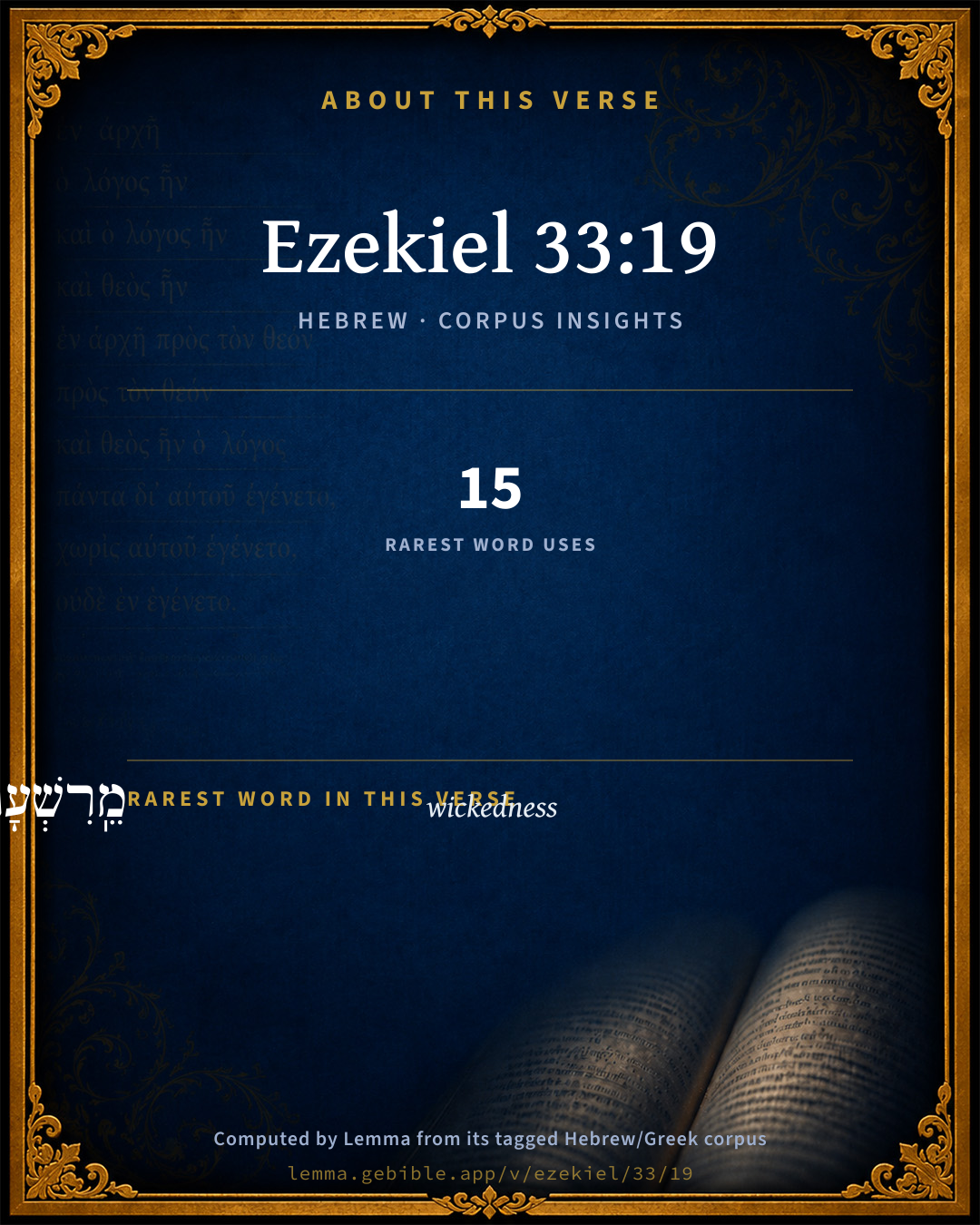
The rarest word here is מֵֽרִשְׁעָת֔וֹ wickedness H7564 — appearing just 15 times in the whole Hebrew Bible.

Shared distinctive vocabulary

מֵֽרִשְׁעָת֔וֹ wickedness H7564 occurs in 15 verses of the Hebrew Bible. Also found in:

Grammatical profile

  • 3 verbs
  • 3 nouns
  • 1 adjective
  • 1 pronoun
  • 1 preposition

Verb forms

  • וּבְשׁ֤וּב Qal · Infinitive Construct
  • וְעָשָׂ֥ה Qal · Sequential Perfect
  • יִֽחְיֶֽה Qal · Imperfect

Hebrew & Septuagint length

In English translation the verse runs 19 words from the Hebrew and 19 from the Septuagint (LXX English) — the same length.

A rough comparison of the two English renderings, which tokenize alike — not a word-level alignment.

Word counts can differ between the Hebrew and the Greek without any difference in meaning — e.g. the Hebrew direct-object marker אֵת has no separate Greek word, and Greek often adds the article ὁ.

Cross-references

2

Topical passages linked to Ezekiel 33:19 in the Treasury of Scripture Knowledge — connected by theme and wording, ordered by reader-vote popularity; previews shown in the World English Bible.

  • Ezekiel 18:27–28 Again, when the wicked man turns away from his wickedness that he has committed, and does that which is lawful and right, he shall save his soul alive.
  • Ezekiel 33:14 Again, when I say to the wicked, You shall surely die; if he turn from his sin, and do that which is lawful and right;

Cross-references courtesy of OpenBible.info (CC BY 4.0).

Hebrew and Greek witnesses Masoretic Hebrew ↔ Greek Septuagint

The same verse in the two great witnesses to the Old Testament, shown verse-for-verse.

These are two independent witnesses, not word-aligned to each other, and the Septuagint is shown in lemma (dictionary) form.

Hebrew Ezekiel 33:19 Masoretic · Westminster Leningrad Codex

וּבְשׁ֤וּב רָשָׁע֙ מֵֽרִשְׁעָת֔וֹ וְעָשָׂ֥ה מִשְׁפָּ֖ט וּצְדָקָ֑ה עֲלֵיהֶ֖ם ה֥וּא יִֽחְיֶֽה

When the wicked turns from his wickedness, and does that which is lawful and right, he shall live thereby.

World English Bible · Public Domain

Greek LXX Ezekiel 33:19 Septuagint · lemma form

καί ἐν ὁ ἀποστρέφω ὁ ἁμαρτωλός ἀπό ὁ ἀνομία αὐτός καί ποιέω κρίμα καί δικαιοσύνη ἐν αὐτός αὐτός ζάω

And when the sinner turns from his iniquity, and shall do judgment and righteousness, he shall live by them.

LXX2012 (modern English Septuagint) · Public Domain

Hebrew: Westminster Leningrad Codex (CC BY 4.0). Greek: Septuagint (public domain); English from LXX2012 (modern English Septuagint) (Public Domain). How the Septuagint differs from the Hebrew →

Targum (Aramaic paraphrase)

1

The Targum is the ancient Jewish Aramaic paraphrase of the Hebrew Scriptures — an interpretive translation, not the Hebrew text itself. Onkelos (literal) and Pseudo-Jonathan (expansive) render the Torah, and Jonathan the Prophets. Coverage is partial: where no permissively-licensed English translation exists for a verse, only the Aramaic is shown. This is verse-level text, not a word-by-word alignment to the Hebrew.

  1. Targum Jonathan Prophets (Joshua–Malachi)
    וְכַד יְתוּב רַשִׁיעָא מֵחוֹבוֹהִי וְיַעְבֵּיד דִין דִקְשׁוֹט וּזְכוּ עֲלֵיהוֹן הוּא יִתְקַיָם:

    (no public-domain English translation for this verse)

    Targum Jonathan — Aramaic: “Mikraot Gedolot” (public domain). English: “Sefaria Community Translation” (CC0 1.0 (public-domain dedication)); “London "Chaldee Paraphrase," 1871” (public domain). Text via Sefaria.

Commentary

Notes on Ezekiel 33:19 from classic Christian and Jewish commentators (each source and its license shown beneath its notes). The classic Christian expositions comment on the surrounding passage and are grouped to its opening verse, so a note may address several verses; the Jewish commentaries on the Tanakh (Rashi and others) are per-verse, so they appear only where the commentator wrote on this verse.

Lemma curates 59 commentaries, every one of them public domain or Creative Commons licensed, each selected and text-cleaned for this edition rather than reprinted as found. About our sources →

Trapp's Complete Commentary

John Trapp

Eze 33:19 But if the wicked turn from his wickedness, and do that which is lawful and right, he shall live thereby.

Ver. 19. He shall live thereby.] Provided that he rest not in his righteousness, but learn to live by the faith of the Son of God. {Gal 2:20}

John Trapp, A Commentary or Exposition upon All the Books of the Old and New Testament (1647–1656) — public domain. Text from a community e-Sword module.

Adam Clarke's Commentary

Verse 19. He shall live thereby] "The wages of sin is death;" the "gift of God is eternal life." It is a miserable trade by which a man cannot live; such a trade is sin.

Adam Clarke's Commentary on the Bible (1810–1826) — public domain. Text from a community e-Sword/MySword module.

John Gill's Exposition

And it came to pass in the twelfth year of our captivity,.... Of Jeconiah's captivity, when Ezekiel with others were carried into Babylon; see Eze 1:2.

in the tenth month, in the fifth day of the month; which was a year, four months, and some days, after the city of Jerusalem was taken; for that was destroyed in the eleventh year of Zedekiah, and so of the captivity, and in the fifth month, and tenth day of the month. Kg2 25:2. It is much it was not known at Babylon before; though so it might, and yet not one that escaped came to Ezekiel sooner to give him an account of it, which he had seen with his eyes. The Syriac version reads it, in the "eleventh year"; and so makes it but a few months after the destruction; and it may be observed that it is promised by the Lord, Eze 24:26, that on the day the city was taken, one should escape, and bring the prophet the news; that is, directly, immediately, in a very short time, as soon as it was possible that he could arrive to him; and yet, as taken notice, here were a year and almost five months before he reached him, which seems pretty strange. The difficulty may be solved in this manner: Ezekiel reckons from the captivity of Jeconiah, which began in the month Chisleu; and the computation in Kg2 25:2, is from Zedekiah's reign, which is to be reckoned from the month Nisan, and from the first Nisan of his reign; for it is a rule with the Jews, (h) that the beginning of the year for kings is the first of Nisan; so that the tenth month from the captivity is the sixth from Nisan; whence it appears there was not a full month from the city being burnt to the news being brought to Ezekiel; which was time short enough, in such a troublesome season, to take a journey from Jerusalem to Babylon; for Zedekiah not being crowned before the Nisan following the captivity, the computation of his reign did not begin till that Nisan, which makes this difference in the chronology. According to Bishop Usher (i), this messenger came to Ezekiel the twenty fifth of January, the fourth day of the week (Wednesday), in 3417 A.M. or before Christ 587:

that one that had escaped out of Jerusalem came unto me; as it was foretold and promised he should, Eze 24:26,

saying, the city is smitten; the city of Jerusalem; the walls were broken down, the houses burnt, and the whole destroyed.

(h) Misn. Roshhashanah, c. 1. sect. 1. (i) Annales Vet. Test. A. M. 3417.

John Gill's Exposition of the Whole Bible (1746–1763) — public domain (CC PDM 1.0). Text via the HelloAO Bible API.

Matthew Poole's English Annotations

In these two verses the cases are so clearly stated, that it is as clear as the sun the ways of God are very just, and that none but ignorant atheists would think or surmise otherwise.

Matthew Poole's English Annotations on the Holy Bible (1683–1685) — public domain. Text from a community e-Sword/MySword module.

Lesson kit

Teaching starters — assembled from the data on this page, not authored interpretation. Every prompt links to the verse data it draws on. Edit before teaching.

Ezekiel, in the Prophets, opens this verse with 9 words (9 distinct Hebrew lemmas). Its most distinctive word is rishʻâh (“wickedness”). A historical commentator’s framing appears above. Read the whole chapter for the surrounding context.

Discussion questions

  1. The word rishʻâh carries the sense “wickedness.” How does it shape the verse?
  2. How does Deuteronomy 9:4, which shares the word «wickedness», read alongside this verse?
  3. These translations render this verse differently; the difference is in the English rendering, not the original. What questions does that raise?
  4. «וּבְשׁ֤וּב» is a Qal Infinitive Construct verb. How does that grammatical form shape the action described?
  5. Compare how Trapp's Complete Commentary and Adam Clarke's Commentary read this verse. Where do they agree or differ?

Things to notice

Reading settings

Reading text

Shown beneath each verse's original-language words.

Old Testament
Old Testament edition

Read the OT as the Masoretic Hebrew (MT) or the Greek Septuagint (LXX).

English shown for the Greek Septuagint (in the Hebrew ↔ Greek comparison).

Comparing translations? Open the Compare panel on any verse page to stack up to four side by side.