
Hosea 12:6

Hebrew (Westminster Leningrad Codex) Hosea 12:6 appears in the Hebrew Old Testament. The text above is from the Westminster Leningrad Codex. Each word links to its Strong’s number, a concise gloss, and parsing drawn from the Open Scriptures Hebrew Bible morphology. Click any word for its full Brown-Driver-Briggs (BDB) entry.
Download image
Cite this verse

Hosea 12:6 (World English Bible). Public Domain. Lemma interlinear Bible study tool, https://lemma.gebible.app/v/hosea/12/6.

Show BibTeX & RIS
BibTeX
RIS
English Translation
Therefore turn to your God. Keep kindness and justice, And wait for your God continually.
World English Bible · Public Domain
Download a study sheet

One document with this verse’s original text, its word-by-word gloss line, the meaning frame, cross-references with their text, attributed commentary, and full source and license credits — printable, and it pastes into notes with its structure intact.

This verse Autodidact and up

Study sheet (.html) Plain text (.txt)

A passage Seminary Student

Up to 50 verses in one chapter. A passage sheet keeps up to 6 commentary sources and 12 cross-references per verse, in the order this page ranks them, and says so on the sheet whenever that leaves anything out. Ask for a single verse and you get the Autodidact verse sheet above.

Everything on this page stays free to read, with no account — the sheet is a download of what is already on screen, not access to it.

Want to remove ads? Support Godless Engineer
Compare translations 3

The same verse in 3 English versions, stacked beneath the original-language interlinear above. Click any original word for its lexicon entry.

Each is an independent rendering of the whole verse — the interlinear is not word-aligned to these translations.

Highlighted words mark where these versions differ — a whole-verse word diff, not a word-by-word alignment.

  • World English Bible Public Domain
    Therefore turn to your God. Keep kindness and justice, And wait for your God continually.
  • King James Version Public Domain
    Therefore turn thou to thy God: keep mercy and judgment and wait on thy God continually.
  • unfoldingWord Literal Text CC BY-SA 4.0
    And you, by your God you must return. Keep covenant faithfulness and justice, and wait for your God continually.

unfoldingWord Literal Text — © unfoldingWord, licensed CC BY-SA 4.0. Word-aligned USFM3 via Door43 (git.door43.org/unfoldingWord/en_ult).

Versions to compare (up to 4)

3 of 4 selected

Show all 18 translations

Every available English version of this verse, each an independent rendering of the whole verse.

  • World English Bible Public Domain
    Therefore turn to your God. Keep kindness and justice, And wait for your God continually.
  • Berean Standard Bible Public Domain
    But you must return to your God, maintaining love and justice, and always waiting on your God.
  • Majority Standard Bible Public Domain
    But you must return to your God; maintain love and justice, and always wait on your God.
  • King James Version Public Domain
    Therefore turn thou to thy God: keep mercy and judgment and wait on thy God continually.
  • American Standard Version (1901) Public Domain
    Therefore turn thou to thy God: keep kindness and justice, and wait for thy God continually.
  • Revised Version (1885) Public Domain
    Therefore turn thou to thy God: keep mercy and judgment, and wait on thy God continually.
  • Geneva Bible (1599) Public Domain
    Therefore turne thou to thy God: keepe mercy and iudgement, and hope still in thy God.
  • Douay-Rheims (1899) Public Domain
    Therefore turn thou to thy God: keep mercy and judgment, and hope in thy God always.
  • Young's Literal Translation Public Domain
    And thou, through thy God, dost turn, Kindness and judgment keep thou, And wait on thy God continually.
  • Literal Standard Version CC BY-SA 4.0
    And you, through your God, turn, || Keep kindness and judgment, || And wait on your God continually.
  • Unlocked Literal Bible CC BY-SA 4.0
    So turn to your God. Keep covenantal faithfulness and justice, and wait continually for your God.
  • unfoldingWord Literal Text CC BY-SA 4.0
    And you, by your God you must return. Keep covenant faithfulness and justice, and wait for your God continually.
  • Darby Bible Public Domain
    And thou, return unto thy God: keep loving-kindness and judgment, and wait on thy God continually.
  • World Messianic Bible Public Domain
    Therefore turn to your God. Keep kindness and justice, and wait continually for your God.
  • Webster's Bible Public Domain
    \\12:5\\Even the LORD God of hosts; the LORD is his memorial.
  • Free Bible Version CC BY-SA 4.0
    You must return to your God. Act lovingly and do what is right, and always wait for your God.
  • Bible in Basic English Public Domain
    Even the Lord, the God of armies; the Lord is his name.
  • JPS Tanakh (1917) Public Domain
    (12-7) Therefore turn thou to thy God; keep mercy and justice, and wait for thy God continually.

Literal Standard Version (2020), Covenant Press — licensed CC BY-SA 4.0. Text via the HelloAO Bible API (eBible.org). Unlocked Literal Bible (unfoldingWord) — licensed CC BY-SA 4.0. Text via the HelloAO Bible API (eBible.org). unfoldingWord Literal Text — © unfoldingWord, licensed CC BY-SA 4.0. Word-aligned USFM3 via Door43 (git.door43.org/unfoldingWord/en_ult). Free Bible Version, Dr. Jonathan Gallagher — licensed CC BY-SA 4.0. Text via the HelloAO Bible API (eBible.org).

Word by word

More ways to search: Search by grammar → Find every occurrence → Compare this word →

Practice this passage: Drill this verse → Learn its vocabulary →

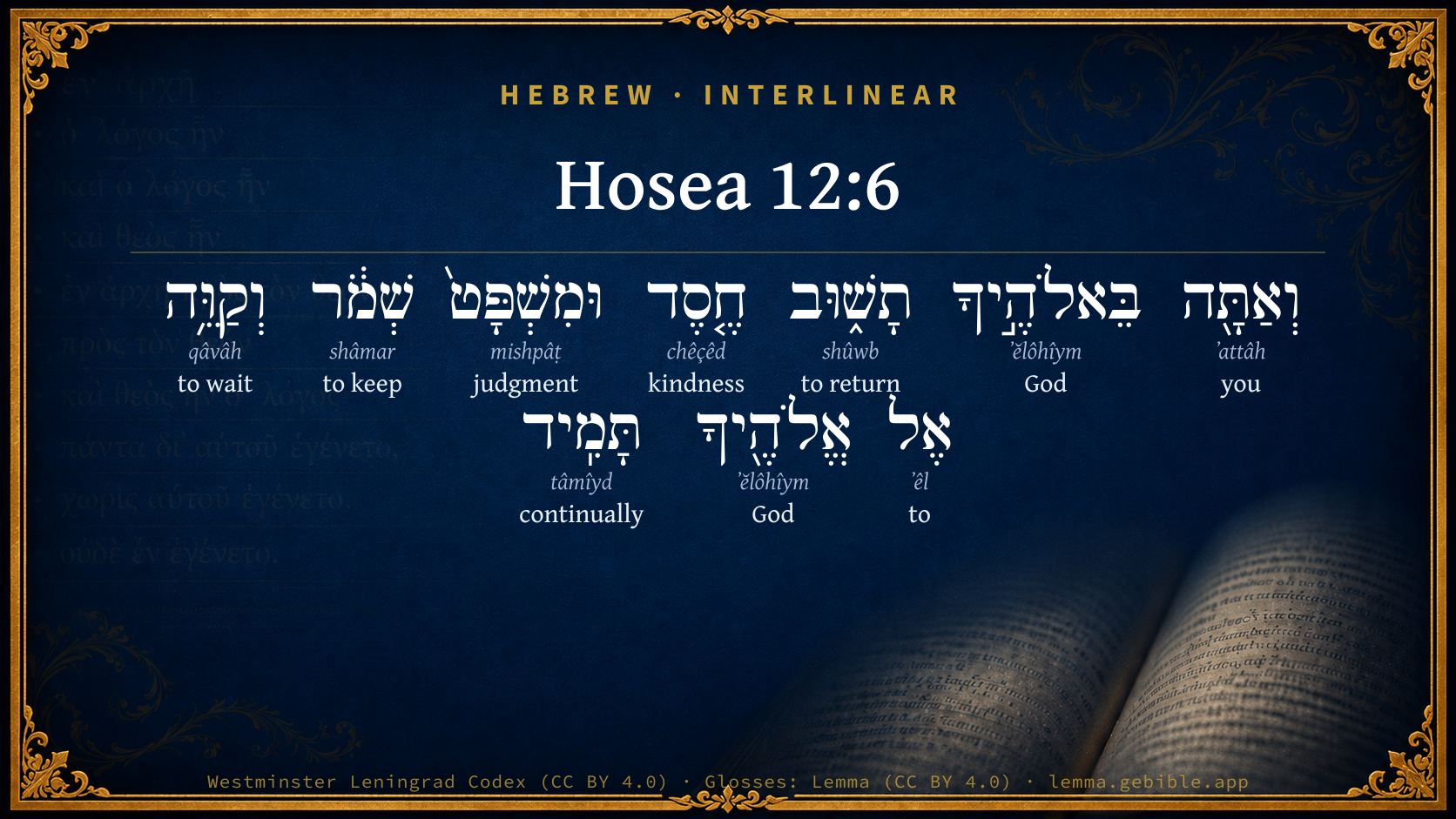
וְקַוֵּ֥ה
qâvâh
H6960
“and · wait”
Conjunction + Verb, Piel, Imperative, 2nd Person, Masculine, Singular
Part of Speech
Conjunction + Verb
Stem
Piel
Form
Imperative
Person
2nd Person
Gender
Masculine
Number
Singular
Full BDB Definition

Origin: a primitive root

TWOT: 1994 , 1995

to wait, look for, hope, expect - (Qal) waiting (participle) - (Piel) - to wait or look eagerly for - to lie in wait for - to wait for, linger for - to collect, bind together - (Niphal) to be collected
  1. וְאַתָּ֖ה ʼattâh H859 “and · you” Conjunction + Pronoun, Personal, 2nd Person, Masculine, Singular
  2. בֵּאלֹהֶ֣יךָ ʼĕlôhîym H430 “in/at · God(s) · your” Preposition + Noun, Common, Masculine, Plural, Construct + Suffix, Personal, 2nd Person, Masculine, Singular
  3. תָשׁ֑וּב shûwb H7725 “to return” Verb, Qal, Imperfect, 2nd Person, Masculine, Singular
  4. חֶ֤סֶד chêçêd H2617 “kindness” Noun, Common, Masculine, Singular, Absolute
  5. וּמִשְׁפָּט֙ mishpâṭ H4941 “and · judgment” Conjunction + Noun, Common, Masculine, Singular, Absolute
  6. שְׁמֹ֔ר shâmar H8104 “keep” Verb, Qal, Imperative, 2nd Person, Masculine, Singular
  7. אֶל ʼêl H413 “to” Preposition
  8. אֱלֹהֶ֖יךָ ʼĕlôhîym H430 “God(s) · your” Noun, Common, Masculine, Plural, Construct + Suffix, Personal, 2nd Person, Masculine, Singular
  9. תָּמִֽיד tâmîyd H8548 “continually” Noun, Common, Masculine, Singular, Absolute

About this verse

These counts appear in no published source. They are computed here, from the morphology-tagged text and Lemma’s own curated glosses. What Lemma adds →

10
words
9
distinct lemmas
Prophets
section

Shared distinctive vocabulary

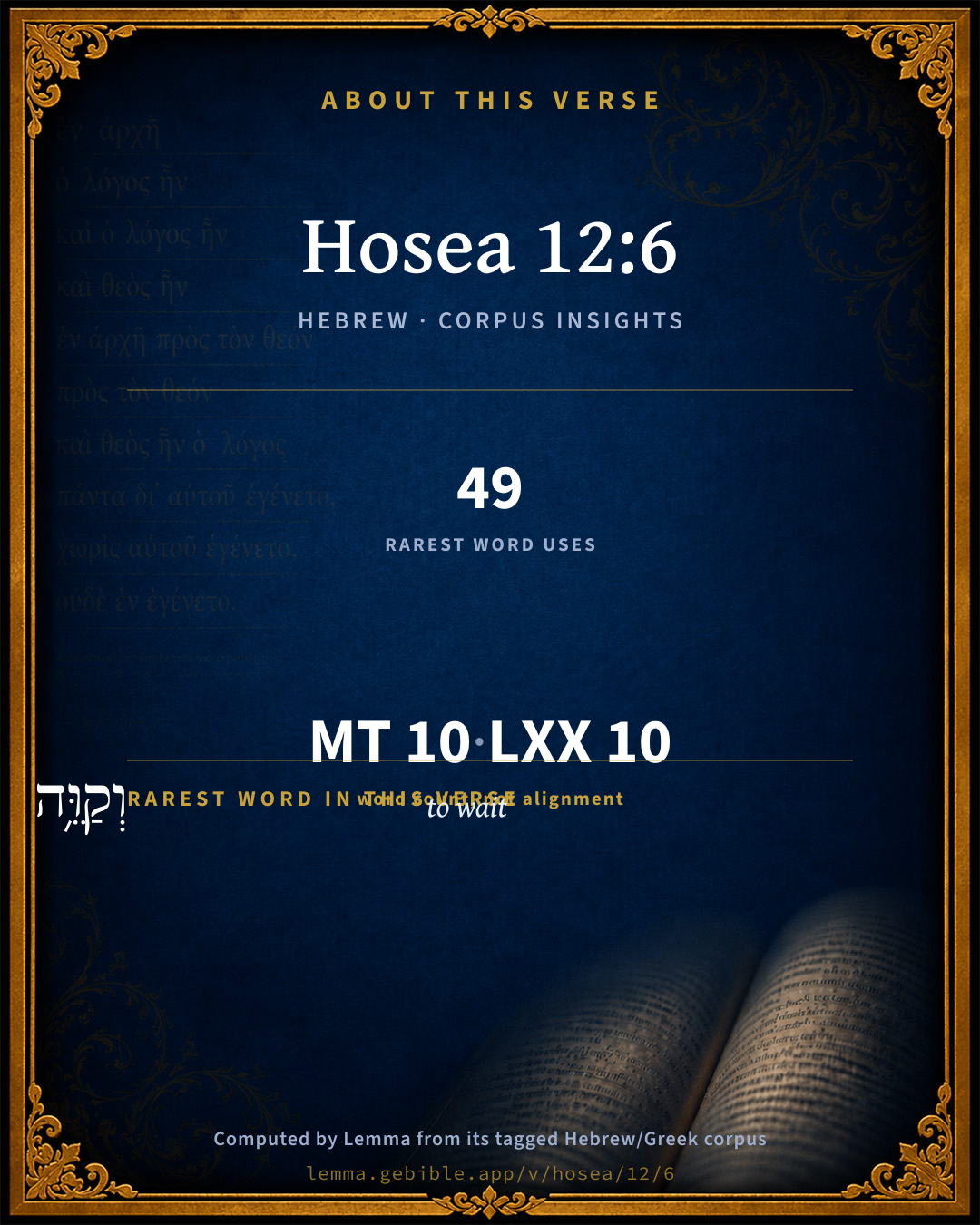
וְקַוֵּ֥ה to wait H6960 occurs in 45 verses of the Hebrew Bible. Also found in:

Grammatical profile

  • 3 verbs
  • 5 nouns
  • 1 pronoun
  • 1 preposition

Verb forms

  • תָשׁ֑וּב Qal · Imperfect
  • שְׁמֹ֔ר Qal · Imperative
  • וְקַוֵּ֥ה Piel · Imperative

Repetition

A word recurs within this verse — often emphatic in Hebrew:

  • בֵּאלֹהֶ֣יךָ God H430 ×2

Hebrew & Septuagint length

In English translation the verse runs 15 words from the Hebrew and 19 from the Septuagint (LXX English) — closely comparable.

A rough comparison of the two English renderings, which tokenize alike — not a word-level alignment.

Word counts can differ between the Hebrew and the Greek without any difference in meaning — e.g. the Hebrew direct-object marker אֵת has no separate Greek word, and Greek often adds the article ὁ.

In the original languages it is 10 Hebrew tokens and 10 Greek tokens — but the two are counted differently (Hebrew bundles its prefixes and suffixes into one token; the Greek is in lemma form), so that isn’t a like-for-like length.

Cross-references

35

Topical passages linked to Hosea 12:6 in the Treasury of Scripture Knowledge — connected by theme and wording, ordered by reader-vote popularity; previews shown in the World English Bible.

  • Micah 6:8 He has shown you, O man, what is good. What does Yahweh require of you, but to act justly, To love mercy, and to walk humbly with your God?
  • Lamentations 3:25–26 Yahweh is good to those who wait for him, to the soul that seeks him.
  • Hosea 14:1 Israel, return to Yahweh your God; For you have fallen because of your sin.
  • Micah 7:7 But as for me, I will look to Yahweh. I will wait for the God of my salvation. My God will hear me.
  • Hosea 6:1–3 "Come, and let us return to Yahweh; For he has torn us to pieces, And he will heal us; He has injured us, And he will bind up our wounds.
  • Zechariah 7:9 "Thus has Yahweh of Hosts spoken, saying, 'Execute true judgment, and show kindness and compassion every man to his brother.
  • Acts 2:38 Peter said to them, "Repent, and be baptized, everyone of you, in the name of Jesus Christ for the forgiveness of sins, and you will receive the gift of the Holy Spirit.
  • Genesis 49:18 I have waited for your salvation, Yahweh.
  • Psalms 27:14 Wait for Yahweh. Be strong, and let your heart take courage. Yes, wait for Yahweh.
  • Psalms 37:7 Rest in Yahweh, and wait patiently for him. Don't fret because of him who prospers in his way, Because of the man who makes wicked plots happen.
  • Psalms 123:2 Behold, as the eyes of servants look to the hand of their master, As the eyes of a maid to the hand of her mistress; So our eyes look to Yahweh, our God, Until he has mercy on us.
  • Psalms 130:5–7 I wait for Yahweh. My soul waits. I hope in his word.
  • Proverbs 1:23 Turn at my reproof. Behold, I will pour out my spirit on you. I will make known my words to you.
  • Proverbs 21:3 To do righteousness and justice Is more acceptable to Yahweh than sacrifice.
  • Isaiah 1:16 Wash yourselves, make yourself clean. Put away the evil of your doings from before my eyes; Cease to do evil.
  • Isaiah 8:17 I will wait for Yahweh, who hides his face from the house of Jacob, and I will look for him.
  • Isaiah 30:18 Therefore will Yahweh wait, that he may be gracious to you; and therefore will he be exalted, that he may have mercy on you: for Yahweh is a God of justice; blessed are all those who wait for him.
  • Isaiah 31:6 Turn you to him from whom you have deeply revolted, children of Israel.
  • Isaiah 40:31 but those who wait for Yahweh shall renew their strength; they shall mount up with wings as eagles; they shall run, and not be weary; they shall walk, and not faint.
  • Isaiah 55:6–7 Seek you Yahweh while he may be found; call you on him while he is near:
  • Isaiah 58:6 Isn't this the fast that I have chosen: to loose the bonds of wickedness, to undo the bands of the yoke, and to let the oppressed go free, and that you break every yoke?
  • Jeremiah 3:14–22 Return, backsliding children, says Yahweh; for I am a husband to you: and I will take you one of a city, and two of a family, and I will bring you to Zion:
  • Jeremiah 22:15 Shall you reign, because you strive to excel in cedar? Didn't your father eat and drink, and do justice and righteousness? then it was well with him.
  • Lamentations 3:39–41 Why does a living man complain, a man for the punishment of his sins?
  • Hosea 4:1 Hear the word of Yahweh, you children of Israel; For Yahweh has a charge against the inhabitants of the land: "Indeed there is no truth, Nor goodness, Nor knowledge of God in the land.
  • Hosea 10:12 Sow to yourselves in righteousness, Reap according to kindness. Break up your fallow ground; For it is time to seek Yahweh, Until he comes and rains righteousness on you.
  • Joel 2:13 Tear your heart, and not your garments, And turn to Yahweh, your God; For he is gracious and merciful, Slow to anger, and abundant in loving kindness, And relents from sending calamity.
  • Amos 5:24 But let justice roll on like rivers, And righteousness like a mighty stream.
  • Habakkuk 2:3 For the vision is yet for the appointed time, and it hurries toward the end, and won't prove false. Though it takes time, wait for it; because it will surely come. It won't delay.
  • Zephaniah 3:8 "Therefore wait for me," says Yahweh, "until the day that I rise up to the prey, for my determination is to gather the nations, that I may assemble the kingdoms, to pour on them my indignation, even all my fierce anger, for all the earth will be devoured with the fire of my jealousy.
  • Zechariah 1:3 Therefore tell them: Thus says Yahweh of Hosts: 'Return to me,' says Yahweh of Hosts, 'and I will return to you,' says Yahweh of Hosts.
  • Acts 26:20 but declared first to them of Damascus, at Jerusalem, and throughout all the country of Judea, and also to the Gentiles, that they should repent and turn to God, doing works worthy of repentance.
  • James 1:27 Pure religion and undefiled before our God and Father is this: to visit the fatherless and widows in their affliction, and to keep oneself unstained by the world.
  • James 2:13 For judgment is without mercy to him who has shown no mercy. Mercy triumphs over judgment.
  • Zechariah 8:16 These are the things that you shall do: speak every man the truth with his neighbor. Execute the judgment of truth and peace in your gates,

Cross-references courtesy of OpenBible.info (CC BY 4.0).

Hebrew and Greek witnesses Masoretic Hebrew ↔ Greek Septuagint

The same verse in the two great witnesses to the Old Testament, shown verse-for-verse.

These are two independent witnesses, not word-aligned to each other, and the Septuagint is shown in lemma (dictionary) form.

Hebrew Hosea 12:6 Masoretic · Westminster Leningrad Codex

וְאַתָּ֖ה בֵּאלֹהֶ֣יךָ תָשׁ֑וּב חֶ֤סֶד וּמִשְׁפָּט֙ שְׁמֹ֔ר וְקַוֵּ֥ה אֶל אֱלֹהֶ֖יךָ תָּמִֽיד

Therefore turn to your God. Keep kindness and justice, And wait for your God continually.

World English Bible · Public Domain

Greek LXX Hosea 12:6 Septuagint · lemma form

ὁ δέ κύριος ὁ θεός ὁ παντοκράτωρ εἰμί μνημόσυνον αὐτός

You therefore shall return to your God: keep you mercy and judgment, and draw near to your God continually.

LXX2012 (modern English Septuagint) · Public Domain

On this verse, The Pulpit Commentary discusses the Septuagint’s reading. Read the note in Commentary ↓

Hebrew: Westminster Leningrad Codex (CC BY 4.0). Greek: Septuagint (public domain); English from LXX2012 (modern English Septuagint) (Public Domain). How the Septuagint differs from the Hebrew →

Targum (Aramaic paraphrase)

1

The Targum is the ancient Jewish Aramaic paraphrase of the Hebrew Scriptures — an interpretive translation, not the Hebrew text itself. Onkelos (literal) and Pseudo-Jonathan (expansive) render the Torah, and Jonathan the Prophets. Coverage is partial: where no permissively-licensed English translation exists for a verse, only the Aramaic is shown. This is verse-level text, not a word-by-word alignment to the Hebrew.

  1. Targum Jonathan Prophets (Joshua–Malachi)
    נְבִיָא אֱמַר לְהוֹן הוּא יְיָ אֱלֹהֵי צְבָאוֹת דְאִתְגְלֵי עַל אַבְרָהָם יִצְחָק וְיַעֲקֹב וּכְמָא דַאֲמִיר עַל יְדֵי מֹשֶׁה דָכְרָנֵיהּ לְכָל דָר וְדָר:

    (no public-domain English translation for this verse)

    Targum Jonathan — Aramaic: “Mikraot Gedolot” (public domain). English: “Sefaria Community Translation” (CC0 1.0 (public-domain dedication)); “London "Chaldee Paraphrase," 1871” (public domain). Text via Sefaria.

Commentary

Notes on Hosea 12:6 from classic Christian and Jewish commentators (each source and its license shown beneath its notes). The classic Christian expositions comment on the surrounding passage and are grouped to its opening verse, so a note may address several verses; the Jewish commentaries on the Tanakh (Rashi and others) are per-verse, so they appear only where the commentator wrote on this verse.

Lemma curates 59 commentaries, every one of them public domain or Creative Commons licensed, each selected and text-cleaned for this edition rather than reprinted as found. About our sources →

Trapp's Complete Commentary

John Trapp

Hos 12:6 Therefore turn thou to thy God: keep mercy and judgment, and wait on thy God continually.

Ver. 6. Therefore turn thou to thy God] The premises considered, repent; and so return to God, from whom thou hast deeply revolted. It is "to thy God" to whom thou art exhorted to turn; not to a tyrant, but to a God in covenant; yea, it is "with thy God" (as the Hebrew hath it), with his good help, that thou shalt turn. Only cry unto him, Turn us, Lord, and we shall be turned, draw us, and we will run after thee. Of turning to the Lord see the note on Zec 1:3.

Keep mercy and judgment] Those magnalia legis, those weightier matters of the law (as our Saviour calleth them, Mat 23:23) which Ephraim had made light of, Hos 4:1 He is therefore called upon to evidence the truth of his turning to God, by bringing forth fruits meet for repentance, Mat 3:8, such as are tantamount, and weigh just as much as repentance comes to. Optima et aptissima poenitentia est nova vita, saith Luther; The best and most fit repentance is a new life, universal obedience to both tables of the law. Mercy and judgment are here put (by a figure) for the duties of the second table; as constant waiting upon God for the duties of the first; for the prophet here observeth not the order of nature, but of our knowledge, when he instanceth first in the second table, as doth also the prophet Micah, Hos 6:8. Mercy must be kept and exercised, by 1. Giving, 2. Forgiving ( donando, condonando). This, God prefers before sacrifice, Hos 6:7. This, Chrysostom saith, is a more glorious work than to raise from the dead. And here let those that would keep mercy (and not show it only sometimes, when they are in a good mood) steep their thoughts in the mercies of God; and so strive to be merciful, as their heavenly Father is, Mat 6:24-34. Judgment also must be kept, and justice done, Isa 56:1, after the example of God, who is said to "exercise lovingkindness," but with all "judgment and righteousness in the earth," Jer 9:24. "Gracious is the Lord, and righteous; yea, our God is merciful," Psa 116:5 : the mixture of mercy and judgment is very comely; as in public persons, Psa 101:1 (where we see that David’s ditty was composed of discords, which made an excellent harmony), so in others of all sorts, Pro 21:21, who are required to be mercifully just and justly merciful in all their interdealings; according to that golden rule, given by our Saviour, Luk 6:31, "Whatever ye would that men should do unto you, do ye to them likewise." This is the standard.

And wait on thy God continually] First, believe him to be thy God by a particular individuating faith; and then thou wilt be easily drawn to wait upon him, who waiteth to be gracious; or to draw near unto him (as the Seventy here render it, εγγιζε), and "come boldly to the throne of grace," Heb 4:16; for as the ark of the covenant and the mercy seat were never separated, so neither is the mercy of God from those that are in covenant with him, and can truly call him theirs. Hope is compared to a line (the same Hebrew word that signifieth the one signifieth the other), and waiting on God is nothing else but hope and trust lengthened or drawn out. Sure it is that trust in God at length will triumph; and all his dispensations will appear beautiful in their season. Hold out therefore faith and patience. "Wait upon the Lord: be of good courage, and he shall strengthen thy heart: wait, I say, upon the Lord," Psa 27:14. Ponder that sweet promise, Hab 2:3, not delivered only, but doubled and trebled for more surety. And then consider, first, thy distance from God in worth and degree; next, thy dependence upon him, thine undone condition if he desert thee and then thou wilt be content to wait upon him continually, to stay his leisure, as David did for the kingdom, and as those in Esther did for deliverance; to say with those good souls in the Acts, "The will of the Lord be done."

John Trapp, A Commentary or Exposition upon All the Books of the Old and New Testament (1647–1656) — public domain. Text from a community e-Sword module.

The Biblical Illustrator

Joseph S. Exell

Hos_12:6

Therefore turn thou to thy God: keep mercy and Judgment, and wait on thy God continually.

Instructions to the unconverted and to the converted

As encouragement to repentance, the example of the patriarch Jacob is presented. Let the descendants of the patriarch copy his example; let them seek God and walk with Him, as Jacob had done, and they would surely find Him, and receive a blessing from Him in their turn. The advice was most seasonable. It directed them to turn to God; and then to walk with Him in the duties and comforts of true religion.

I. The instruction to the unconverted. Turn thou to thy God. An unconverted person is one whose heart is not changed and turned to God. Every person who is habitually proud, sensual, or covetous, indulging a self-righteous spirit, or following sin with greediness; or leading a worldly life, careless of his soul and eternity; every ]person who sins without remorse, and has, in fact, no other rule for his conduct but his own interest, gain, or will--every such person is an unconverted person. All unconverted persons are turned from God., They are estranged from Him in heart and affections. Those who are turned away from God must be miserable the first step in real religion is conversion, that is, the turning of the heart to God. There can be no real religion till this step be taken. Do you inquire the way? There is but one way, even Jesus Christ. He is the way Would you then turn to God, you must come to Him by this way. You must draw nigh to God in faith; and pray to Him for Christs sake to be reconciled unto you. You must beseech Him to grant to you the Spirit of Christ, to work in you true repentance. Thus turning to Him, you will be graciously and favourably received. He never casts out any souls that turn to Him through Jesus Christ.

II. The instruction vouchsafed to those who are already converted. Keep mercy and judgment and wait on thy God continually. The converted are those who, having through grace renounced the ways of sin and the course of this world, have turned unto God by faith in Jesus Christ their Saviour; with penitent hearts have joined themselves unto Him, and, being justified by faith, have peace with God. The instruction divides itself into two parts--

1. Keep mercy and judgment. All who turn to God should be careful to maintain good works. They are called with a holy calling, and their life and conversation should accord with it. In mercy. In exercising kindness and compassion to all. In judgment. In doing justice and righteousness; in rendering, to all their due; in making restitution for wrongs or injuries committed.

2. Wait on thy God continually. To wait upon God is to depend upon Him; to exercise a believing expectation of receiving from Him all those supplies and succours of which we stand in need. (E. Cooper.)

The power room

The quietest room in a Lancashire cotton mill is the engine room. It is significantly called the power room of the mill. But from that quietest room emerges all the force which speeds the busy looms in their process of production. Let the engine be neglected, let countless looms be added without proportional increase of power, and the mill breaks down. We have been neglecting our quietest room, our power room; we have been adding to the strain without multiplying the force, and the effects are seen in weariness, joylessness, and ineffectiveness. We must not work less, but we must pray more. (Life of C. A. Berry, D. D.)

The Biblical Illustrator, edited by Joseph S. Exell (c. 1880s–1900s) — public domain. Text from a community e-Sword module.

Joseph Benson's Commentary

Hos 12:6. Therefore turn thou to thy God — “Thou therefore, O Israel, encouraged by the memory of God’s love to thy progenitor, and by the example which thou hast in him, of the efficacy of weeping and supplication, turn to thy God in penitence and prayer, and in the [practice of] works of righteousness.” — Horsley. Leave your idolatries and all your sins. Jacob worshipped God alone, do you so; he cast all idols out of his family, do you so too; be Jacob’s children herein. Keep mercy and judgment — Show kindness to all who need it, and do wrong to none; but, with justice in all your dealings, in judicatures, and public offices, render to all their due. And wait on thy God continually — In public worship, and private duties, serve and trust in God alone: let not idols have either sacrifice, prayer, praise, or trust from you, and let your hope and worship be ever continued.

Joseph Benson's Commentary on the Old and New Testaments (1811–1818) — public domain. Text from a community e-Sword module.

The Preacher's Complete Homiletical Commentary

Joseph S. Exell (gen. ed.)

TRUE CONVERSION TO GOD.—Hos_12:6

CRITICAL NOTES.]

Hos_12:6. Turn] Lit. thou shalt turn, so turn as to enter into vital fellowship with God (Isa_10:22). Thou] who wishest to be a true descendant, pray and act as Jacob.

“Therefore” to this God, who rules heaven and earth, Israel had only to turn in truth, and they would find in him what Jacob found. God offers himself to his apostate people, and all may claim a covenant right in him if they sincerely return to him. This return or conversion to God is described.

I. Induced by the revelation of God’s character. “Therefore,” if God is good, and able to save, they need not seek help from any other source.

1. Revelations in his word. “Thy God.” We may disown, but can never cast off, our relationship to God as dependent, guilty creatures. He claims us in our sin, and does not reject us when we return to him. He is a God of love, not revengeful and unmerciful. The revelations of his word are suited to quicken our hearts, to destroy our “enmity with God,” and draw us to him in penitence and faith. We clothe God in attributes of vengeance and thunder. But a persuasion of personal love wrought in the soul will induce the sinner to return. “He hath loved me.” This is “the excellency of the knowledge of Christ Jesus,” and revealed only in him.

2. Revelations of his mercy to others. What God has done for others he can do for us. Paul obtained mercy for a pattern to others. Bunyan and Newton were sinners saved by grace. Men in every age and in every degree of guilt have been monuments of God’s mercy, and living examples of the power of God’s word. “To show in the ages to come the exceeding riches of his grace in his kindness toward us by Christ Jesus.”

II. Evidenced by the practical duties of life. When the sinner turns to God, he will bring forth fruits meet for repentance (Mat_3:8). His life will not be empty profession, but filled with fruits of righteousness to God and man.

1. Duties to man. The duties of the second table, the weightier matters of the law, must not be overlooked. For if we disregard man, whatever professions we make before God, our religion is vain. “He that loveth not his brother whom he hath seen, how can he love God whom he hath not seen?” (a) Mercy. Men are weak and miserable, and need sympathy and compassion. We must not treat them with cruelty and injustice. Mercy wins and “blesseth him that gives and him that takes.” On one occasion the ministers of Alphonsus, king of Naples, complained that his lenity did not become a prince. “What, then,” said he, “would you have lions and tigers reign over you? Know you not that cruelty is the attribute of wild beasts—clemency that of man?” “Blessed are the merciful, for they shall obtain mercy.” (b) Judgment. Justice, by which we give to all men their due. It is opposed to dishonesty, fraud, and unfairness of any kind. “A just man,” says Jeremy Taylor, “does justice to every man and to every thing; and then, if he be also wise, he knows there is a debt of mercy and compassion due to the infirmities of man’s nature, and that is to be paid, and he that is cruel and ungentle to a sinning person, and does the worst to him, dies in his debt and is unjust.” “All things whatsoever ye would that men should do unto you, do ye even so unto them, for this is the law and the prophets.”

2. Duties to God. To cherish and keep up the fruits of conversion, we must “wait,” in communion with God. He only who begins can perfect the good work. Our sufficiency in every duty can only come from God. Hence, “wait on thy God continually.” (a) Wait in dependence upon God. Such as turn to God truly will be careful to keep closely to God, and will feel their need of God daily. In him we live, and move, and have our being naturally and spiritually. Dependence is essential to spiritual life. Just as human wants promote human efforts and energies, so trust in God will prompt to love and duty. (b) Wait with hope in God. Waiting implies hoping. The longer we wait the more we prove that our expectation is not crushed. The hopeless will be a lifeless soul; but hope kindles desire, and makes “expectation rise.” “If we hope for that we see not, then do we with patience wait for it.” (c) Wait continually upon God. There must be no cessation, no interruption of this duty. The greatest joy destroys not our dependence; the greatest failure should not drive us to despair. Sad desertions and apparent rejections do not warrant us to give up. “Wait on the Lord: be of good courage, and he shall strengthen thine heart: wait, I say, on the Lord.”

ILLUSTRATIONS TO CHAPTER 12

Hos_12:6. Judgment. The one thing constantly reiterated by our master; the order of all others that is given oftenest, “Do justice and judgment.” That’s your Bible order; that’s the “service of God,” not praying or psalm-singing. Unless we perform Divine service in every willing act of life we never perform it at all. The one Divine work—the one ordered sacrifice—is to do justice; and it is the last we are ever inclined to do [Ruskin].

The Preacher's Complete Homiletical Commentary (gen. ed. Joseph S. Exell; Funk & Wagnalls, c. 1892) — public domain (pre-1929). A full-Bible homiletical/sermon-outline anthology covering 65 of 66 books (2 John is absent from the source module). Text from a community e-Sword module.

Keil & Delitzsch

C. F. Keil & F. Delitzsch

To this God Israel is now to return. Hos 12:6. "And thou, to thy God shalt thou turn: keep love and right, and hope continually in thy God." שׁוּב with ב is a pregnant expression, as in Isa 10:22 : "so to turn as to enter into vital fellowship with God;" i.e., to be truly converted. The next two clauses, as the omission of the copula before chesed and the change in the tense clearly show, are to be taken as explanatory of תּשׁוּב. The conversion is to show itself in the perception of love and right towards their brethren, and in constant trust in God. But Israel is far removed from this now. This thought leads the way to the next strophe (Hos 12:8 -15), which commences afresh with a disclosure of the apostasy of the people.

Keil & Delitzsch — Biblical Commentary on the Old Testament (1861–1891) — public domain (CC PDM 1.0). Text via the HelloAO Bible API. (Old Testament only.)

Tyndale Open Study Notes

Tyndale Open Resources

12:6 The Lord admonished Israel to live no longer as Jacob did, but to return to God and act with love and justice.

Tyndale Open Study Notes — © Tyndale Open Resources, licensed CC BY-SA 4.0. Text via the HelloAO Bible API.

Jamieson, Fausset & Brown

Robert Jamieson, A. R. Fausset & David Brown

thou--who dost wish to be a true descendant of Jacob.

to THY God--who is therefore bound by covenant to hear thy prayers.

keep mercy and judgment-- (Mic 6:8). These two include the second-table commandments, duty towards one's neighbor, the most visible test of the sincerity on one's repentance.

wait on thy God--alone, not on thy idols. Including all the duties of the first table (Psa 37:3, Psa 37:5, Psa 37:7; Psa 40:1).

Jamieson, Fausset & Brown — Commentary Critical and Explanatory on the Whole Bible (1871) — public domain (CC PDM 1.0). Text via the HelloAO Bible API.

Adam Clarke's Commentary

Verse 6. Therefore turn thou to thy God] Because he is the same, and cannot change. Seek him as faithfully and as fervently as Jacob did, and you will find him the same merciful and compassionate Being.

Adam Clarke's Commentary on the Bible (1810–1826) — public domain. Text from a community e-Sword/MySword module.

John Calvin's Commentaries

The Prophet is now here urgent on the people. Having referred to the example of the patriarch, he shows how unlike him were his posterity, with whom God could avail nothing by sound teaching, though he was constantly solicitous for their salvation, and stirred up his Prophets to bring back the lost and scattered to the way of safety. Since then it was so, the Prophet accuses them of ingratitude. But he speaks first of repentance; and then he shows that he and other ministers of God had laboured in vain; for such was the perversity of the people, that teaching had no effect. His sermon is short, but yet it contains much.

Turn, he says, to thy God. He glances here at the apostasy of the people, by bidding them to turn to their God, and, at the same time, condemns whatever the Israelites were wont to set up as a defence, when the Prophets reproved them. For they wished their own fictitious modes of worship to come in as a reason; they wished the gods devised by themselves to occupy the place of the true God. The Prophet cuts off the handle from subterfuges of this kind by commanding the people to turn to their God. “Why,” he says, “you do indeed worship gods, and greatly weary yourselves in your superstitions; but confess that you are apostates, who have rejected the law delivered to you by the true God. Return, then, to your God.” And he calls God the God of Israel, not to honour them, but to-reproach them, because they had willingly and designedly cast off the worship of the true God, who had made himself known to them.

There is afterwards shown the true way of repentance. The beginning of the verse, as I have already said, requires the people to repent; but as we know that men trifle with God when they are called to repentance, it is not in vain that a definitive, or, at least, a short description of repentance, is added by which is made evident what it is to repent, or to turn to God. Then the Prophet says, — Keep mercy, or kindness and judgement He begins with the second table, and then he adds piety towards God. But he lays down two things only, in which he included the whole teaching of the second table. For what is God’s design, from the fifth to the last commandment, but to teach us to shape our life according to the rule of love? We are then taught in the second table of the law how we ought to act towards our brethren; or if one wishes to have a shorter summary, in the second table of the law are shown the mutual duties of men. But the Prophet begins here with the second part of the law; for the Prophets are not wont strictly to observe order, Nor do they always observe a regular method; but it is enough with them to mention the main things by which they explain their subject; and hence, it is no wonder that the Prophet here, according to his usual manner, mentions love in the first place, and then goes on to the worship of God. This order, as I have said, is not indeed either natural or legitimate; but this is of no importance; nay, it was not without the best reason that the Prophets usually did this; for repentance is better tested by the observance of the second table, than by that of divine worship. For as hypocrites dissemble, and hide themselves with wonderful coverings, the Lord applies a touchstone, and this he does whenever he draws them to the light, and exposes to public view their frauds, robberies, cruelty, perjuries, thefts, and such like vices. Since, then, hypocrites can be better convicted by the second table of the law, the Lord rightly appeals to this when he speaks of repentance; as though he said, “Let it now be made evident what your repentance is, whether it be feigned or sincere; for if you act justly and uprightly towards your neighbours, if you observe equity and rectitude, it is a sure evidence of your repentance.”

At the same time, the Prophet overlooks not the worship of God; for he adds, — Hope always in thy God By the word, hope, he first requires faith, and then prayer, which arises from it, and thanksgiving, which necessarily follows. Thus the whole worship of God is briefly included, as a part for the whole, in the word, hope. The meaning of the Prophet then is, that Israel, forsaking their own superstitions, should recumb on the one true God, and place all their salvation on him, that they should fly to him, and ascribe to him alone the praise due for all blessings. By so doing, they would restore the pure worship of God, and cast away all their adulterous superstitions. He had spoken already of the second table of the law.

We hence see that repentance is nothing else but a reformation of the whole life according to the law of God. For God has explained his will in his law; and as much as we depart or deviate from it, so much we depart from the Lord. But when we turn to God, the true proof is, when we amend our life according to his law, and begin with worshipping him spiritually, the main part of which worship is faith, from which proceeds prayer; and when, in addition to this, we act kindly and justly towards our neighbours, and abstain from all injuries, frauds, robberies, and all kinds of wickedness. This is the true evidence of repentance.

John Calvin's Commentaries (1540-1563) — public domain. Text from the Calvin Translation Society English edition (1840s-50s) via the Christian Classics Ethereal Library (ccel.org). Calvin's coverage is partial (roughly two-thirds of the Bible); uncommented books and verses are honest gaps, never fabricated. The 19th-century editor's footnotes and remarks are omitted so the notes are faithfully Calvin's own voice.

Ellicott's Commentary for English Readers

(6) Therefore . . .—More correctly, But do thou return to thy God. There is an implied contrast between the patriarch and his degenerate descendants in the days of Hosea.

A Bible Commentary for English Readers, edited by Charles John Ellicott (1878–1897) — public domain. Text from a community e-Sword module.

The Cambridge Bible for Schools and Colleges

gen. ed. J. J. S. Perowne

6. Therefore turn thou to thy God] Lit., ‘And thou—return thou in thy God’; i.e., such being the character of God, who lets Himself be won by wrestling prayer, return thou to thy God, and rest in Him. (For this condensed expression there is no exact parallel.) And how is this ‘return’ or repentance to have its reality proved? By thine observance of the rules of blended justice and kindness towards man and trustfulness towards God (comp. Mic_6:8).

The Cambridge Bible for Schools and Colleges (gen. ed. J. J. S. Perowne; Cambridge University Press, 1878–1918) — public domain. Text from a community e-Sword module.

John Gill's Exposition

Therefore turn thou to thy God,.... Judah, with whom the Lord had a controversy, is here addressed and exhorted to return to the Lord, from whom they had backslidden; and this is urged, from the consideration of their being the descendants of so great a man as Jacob; whose example they should follow, and make supplication to the Lord as he did; and from this instance of their progenitor might encourage themselves, that God, who was his God, and their God, would be gracious and merciful to them, and that they should prevail with him likewise, and obtain the blessing, and especially since he is the everlasting and unchangeable Jehovah. Turning to the Lord, as it supposes a going astray from him, so it signifies a turning from idols, and all vain confidences; and is done by renewed acts of faith and trust in the Lord, and repentance towards him; and cannot be performed aright without grace and strength from him, of which Ephraim was sensible, Jer 31:18; as well as the encouragement to it is from a view of God as a covenant God, and as gracious and merciful, So Aben Ezra interprets it of divine help, of turning by thy God, that is, by the help and assistance of thy God; and, indeed, conversion to God, whether at first, or after, is through his powerful and efficacious grace. Kimchi explains it, "thou shalt rest in thy God" (w); when want follows is performed, comparing it with Isa 30:15. The Targum is,

"and thou shall be strong in the worship of thy God;''

keep mercy and judgment; or, "observe" (x) them to do them; to show mercy to persons in misery, to the poor and indigent, which is what the Lord desires and delights in, more than in ceremonial sacrifices; and is a principal part of the moral law, as "judgment" is another; the exercise of justice, both public and private; passing a righteous sentence in courts of judicature, and doing that which is right between man and man; owing no man anything, but giving to all their due; doing no injury to any man's person, property, or character; which are fruits meet for true repentance; and when they spring from faith and love, and are done with a view to the glory of God, and good of men, are acceptable to the Lord; these are the weightier matters of the law, Mat 23:23;

and wait on thy God continually; both in private prayer, and for an answer to it, and in public worship and ordinances, in hope of meeting with him, and enjoying his presence; for this takes in the whole of religious worship, private and public, and all religious exercises, as invocation of God, trust in him, and expectation of seed things from him; and may have a respect to the Messiah, and salvation by him, and a waiting for him and that; as Jacob did, and his posterity should, and many of them were in this posture, before and at his coming; see Gen 49:18; Agreeable to this the Targum is,

"and wait for the redemption or salvation of thy God continually.''

(w) "in Deo tuo conquiesce", Drusius. (x) "observa", Junius & Tremellius, Piscator.

John Gill's Exposition of the Whole Bible (1746–1763) — public domain (CC PDM 1.0). Text via the HelloAO Bible API.

Albert Barnes' Notes on the Bible

Therefore turn thou to thy God - (Literally, “And thou, thou shalt turn” so as to lean “on thy God.”) “And thou” unlike, he would say, as thou art to thy great forefather, now at least, “turn to thy God;” hope in Him, as Jacob hoped; and thou too shalt be accepted. God was the Same. They then had only to turn to Him in truth, and they too would find Him, such as Jacob their father had found Him, and then “trust in him continually. mercy and judgment” include all our duty to our neighbor, love and justice. The prophet. selects the duties of the second table, as Micah also places them first, “What doth the Lord require of thee, but to do justly and love mercy, and walk humbly with thy God?” Mic 6:8, and our Lord chooses those same commandments, in answer to the rich young man, who asked him, “What shall I do, in order to enter into life?” Mat 19:17. For people cannot deceive themselves so easily about their duties to their neighbor, as about their duty to God. It was in love to his neighbor that the rich young man failed.

Thou shalt turn - that is, it is commonly said, thou oughtest to turn; as our’s has it, “turn.” But it may also include the promise that, at one time, “Israel shall turn to the Lord,” as Paul says, “so shall all Israel be saved.”

And wait on thy God continually - If they did so, they should not wait in vain. : “This word, “continually,” hath no small weight in it, shewing with what circumstances or properties their waiting or hope on God ought to be attended; that it ought to be on Him alone, on Him always, without doubting, fainting, failing, intermission or ceasing, in all occasions and conditions which may befall them, without exception of time, even in their adversity.” “Turn to ‘thy’ God,” he saith, “wait on ‘thy’ God,” as the great ground of repentance and of trust. “God had avouched them for His peculiar people” Deu 26:17-18, and they had “avouched Him for” their only “God.” He then was still their God, ready to receive them, if they would return to Him.

Albert Barnes' Notes on the Bible (1834–1885) — public domain. Text from a community e-Sword/MySword module.

Matthew Poole's English Annotations

Therefore; no more vainly boast of Jacob; but, as he, do you approve yourselves to God.

Turn thou to thy God; repent, leave idols, and all sins. He worshipped God alone, do you so; he cast idols out of his family, do you so too, be Jacob’s children herein.

Keep mercy; show kindness to all who need it, cast off cruelty and inhumanity, and be merciful to the afflicted: this contains all the duties we owe to any that are in straits.

And judgment; wrong none, but with justice in dealings, in judicatures, and public offices, render to every one their due. Acquit the innocent, and condemn the guilty, and let none have just cause to complain of injuries.

Wait on thy God; in public worship, and private duties of prayer, and seeking God, him only serve and, trust, let not idols have either sacrifice, prayer, praise, or trust from you.

Continually: and let your hope and worship be perpetuated, for ever continued towards God, till he save and rescue; trust, pray, and resign yourselves to him, who will be yours as he was Jacob’s God, on these terms and no other. This short phrase, wait on they God, includes all duties of the first table of the law, all religions worship of the true God; do this, and the Lord will be to you. as to Jacob, defence against danger and fullness in your wants.

Matthew Poole's English Annotations on the Holy Bible (1683–1685) — public domain. Text from a community e-Sword/MySword module.

Whedon's Commentary on the Bible

Daniel D. Whedon

6. Therefore — Because thy God is identical with the God of thy ancestor Jacob, a God whose pleasure it is to show mercy to every one who earnestly seeks him.

To thy God — The Hebrew reads “in” or “into,” the real force of which can be expressed only by a paraphrase: “Turn to thy God in such a manner as to enter into fellowship with him” (compare Isa_10:22). A turning such as that described in Hos_6:1-3, is not sufficient. Wherein does the turning consist?

Keep mercy [“kindness”] — Now lacking completely (Hos_4:1; compare Hos_6:6).

Judgment [“justice”] — See on Mic_6:8 (compare Amo_5:24).

Wait on [“for”] thy God continually — Exercise implicit faith in Jehovah; cease from putting confidence in human alliances and human defenses (Hos_12:1; Hos_7:11; Hos_10:13, etc.).

Daniel D. Whedon (gen. ed.), Commentary on the Old and New Testaments (1874–1909) — public domain. Text from a community e-Sword module.

The Pulpit Commentary

Therefore turn thou to thy God: keep mercy and judgment, and wait on thy God continually. God"s character in itself, and his conduct towards the great forefather of the Hebrew race, call at once for confidence and contrition. The evidence of their repentance is twofold: one aspect is manward, consisting of mercy and judgment; the other is Godward, being a constant waiting upon God. The literal rendering brings out the meaning more clearly; it is, "And thou, in or, "by thy God thou shalt return." If we render the preposition by "in," we may understand it to imply entire dependence on God, or close and cordial fellowship with God; if we take it to mean "by," it signifies the power or help of God; while the return is moral and spiritual, with perhaps material and literal restoration implied A parallel for b e in the signification of "by" occurs in the first chapter of this book at the seventh verse: "I will save them by (be) the Lord their God;" also in Deu_33:29, "O people saved by (be) the Lord." We prefer the former sense as more simple and suitable; it is concisely and correctly explained by Keil as follows: with b is a pregnant expression, as in Isa_10:22, "So turn as to enter into vital fellowship with God;" that is, to be truly converted.... The next two clauses are to be taken as explanatory of bw The conversion is to show itself, "the perception of love and right towards their brethren, and in constant trust in God." The difference between B bWv and la, bW is that the latter signifies "to return to," and the former "to return into," and thus expresses inward union with him. The general sense of the clause is thus expressed by Aben Ezra: "If thou wouldst return to God, he would be thy help to bring thee back to him;" and by Kimchi as follows: "But thou who art the seed of Jacob, if thou art willing, canst return unto thy God, i.e. thou canst rest in him, as "In returning and rest shall ye be saved"." (Isa_30:15) The second point of the verse has an instructive parallel in Mic_6:8, "What doth the Lord require of thee, but to do justly, and to love mercy, and to walk humbly with thy God?" In regard to the waiting upon God, of which the last clause speaks, Aben Ezra has the pithy remark, "Depend not upon thy riches nor thy strength, for the strength thou hadst from him, also the riches." Kimchi comments on the same more fully, as follows: "On this condition thou canst rest and not be afraid of the enemy, if thou wilt observe to do mercy and judgment: for his conditions are as he said, "I am the Lord which exercise loving-kindness, judgment, and righteousness in the earth: for in these things I delight, saith the Lord." And although he does not mention righteousness here, yet he has said in another place, "Keep ye judgment, and to justice literally, "righteousness." And he says here, "And wait upon thy God continually;" now it is righteousness and equity that thou waitest on thy God continually. And even when thou shalt have great possession and riches and wealth, thou shalt say to thyself, "It is all from him; thou shall remember him continually and wait on him, as he says in the Law, (Deu_8:18) Thou shalt remember the Lord thy God, for it is he that giveth thee power to get wealth; not like Ephraim, who says, "I am become rich, I have found me out substance. The Septuagint has eggize , equivalent to "draw near to," having probably read broq instead of hWeq.

"Turn thou to thy God.

If there is one message more frequently repeated than another in the Scriptures, both of the Old and New Testaments, it is this message requiring repentance. There has been no generation of men, nay, there has been no individual man, to whom it might not justly be said, Repent!

I HUMAN CHARACTER AND LIFE ARE SUCH AS TO RENDER NECESSARY THIS TURNING TO GOD. One who is on the right road already has no need to turn; but he who is traveling in the wrong direction must first of all reverse his steps, his course. As sin and error have been universal, no limit can be placed to the appropriateness of the summons of the text.

II MAN MAY FIND IN HIMSELF MANY AND SUFFICIENT REASONS FOR REPENTANCE. His interests demand, his conscience enjoins, his best feelings urge, that he should turn unto God. His present happiness and his future prospects are imperiled by his remaining estranged from his God.

III IN GOD HIMSELF, AND IN HIS REVELATION, ARE MANY GROUNDS FOR REPENTANCE.

1. First of all there is the fact that he is our God. "Turn thou to thy God." How just and proper, then, that, instead of looking away from him, men should look towards him!

2. It must be considered that all our happiness is bound up with his favor and fellowship. To turn to him is to turn to the light of the sun, to the source of life.

3. The Divine directions and promises furnish the most persuasive motive add the most authoritative justification for turning unto God. T.

"Wait on thy God.

It is very instructive that the prophet in this passage admonished, not only to repentance, reformation, and righteousness, but also to "waiting on God." Many of the effects of repentance, and especially the moral, subjective effects, might be felt immediately, but there were other consequences which might probably be delayed. Hence the admonition of the text.

I IT IS HONORING TO GOD THAT HIS PEOPLE SHOULD WAIT UPON HIM. It is not for man to dictate to his Maker, to seek to prescribe when, how, and where God should intervene upon behalf of a suppliant. His wisdom is not to be questioned; his goodness is not to be impugned.

II IT IS PROFITABLE TO GOD"S PEOPLE TO WAIT UPON HIM. Thus faith and patience are cultivated virtues which are most serviceable to Christians, and which are a true ornament to the godly character.

III IT IS WELL TO WAIT UPON GOD CONTINUALLY. Remissness in so doing is to be condemned; weariness in waiting is dangerous. Just at the moment when the Helper draws nigh the needy soul may be in slumber or may be otherwise engaged. Waiting means watching.

IV GOD"S PEOPLE CANNOT WAIT FOR HIM IN VAIN. They may wait long, but their waiting shall be rewarded. Then shall they sing aloud for joy, "This is our God; we have waited for him." Wait for the harvest, and you shall reap. Wait for the morning, and the sun shall rise upon your expectant soul. T.

Genuine human goodness.

"Therefore turn thou to thy God: keep mercy and judgment, and wait on thy God continually." Delitzsch renders the verse thus: "And thou to thy God shall return, keep love, and right, and hope continually in thy God." The new translation gives no new idea. The few words may be regarded as representing genuine human goodness. Looking at it in this respect it includes three things.

I SPIRITUAL CONVERSION. "Turn thou to thy God." An expression implying that their moral mind was in a different direction, away from God. It was so with Ephraim; it was after idols. It is so with all unregenerate souls; they are alienated from God. Terrible fact this. God"s intelligent creatures turned from him and against him. Turning to him includes at least two things.

1. Accepting him as the supreme Monarch to obey. It means the making of his will the law of all their laws, the test of all their conduct, the guide of all their activities.

2. Accepting him as the supreme Object to love. Man is so formed that he must have some one to love supremely. His crime, degradation, and curses are, that the objects which he has chosen on which to center his paramount love are imperfect creatures and vanities. He is the only Object worthy of the soul"s supreme love, and this he demands. He who renders him this will have his heart enlarged, and run with joyous alacrity in all the ways of his commandments. Here, then, is the first step in genuine human goodness conversion. "Repent, and be converted." This is the grand call of the gospel. God calls men everywhere to repent that is, to change their hearts, turn from themselves to him their Creator.

II SOCIAL MORALITY. "Keep mercy and judgment." Notice the latter first.

1. "Judgment," that is, justice. Justice means rendering to every man his due; it is compendiously expressed in the words of Christ, "Whatsoever ye would have men do unto you, do ye even so to them." It goes dead against all frauds, dishonesties, and cruelties.

2. "Mercy." Mercy is a modification of love; it is love in compassion, patience, forbearance, etc. Paul makes a distinction between a good man and a just man. There are men conventionally just, who are not good, nor generous, nor merciful. They would pay every man his due, but, like Shylock, they will extort the last grain. It is not, therefore, enough for a man to "keep judgment do justice to his fellowman; he must have mercy too. "Love is the fulfilling of the Law.

III LIFE-WORSHIP. "Wait continually on thy God." God must be the All in all; tile grand Figure in all the sceneries, and the ruling chord in all the melodies of life. Man is made to worship; but worship is not a ceremony, not a passing sentiment, not an occasional service; it is a life revealing itself everywhere in marts of business, hails of study, fields of recreation, as well as in conventional temples. It is not a something that appears on this mountain or on that mountain, on this day or that day, in this act or that, hut something that is every where and when. The grand pulse of being. True religion, sprung from God alone, Is like her Fountain, full of charity: Embracing all things with a tender love. Full of good will and meek expectancy: Full of true justice and sure verity, In heart and voice: free, large, even infinite, Not wedged in straight particularity, But grasping all in her vast, active spirit. Bright lamp of God, that men would joy in thy pure light! (Hannah More.) D.T.

The Pulpit Commentary (1880–1919), ed. H.D.M. Spence-Jones & Joseph S. Exell — public domain. Text from a community e-Sword module.

John Wesley's Explanatory Notes

Turn - Repent, leave idols and all sins. He worshipped God alone, do you so; he cast idols out of his family, do you so too; be Jacob's children herein. Mercy - Shew kindness to all who need it. Judgment - Wrong none; but with justice in dealings, in judicatures; and public offices, render to every one their due. Wait on thy God - In public worship and private duties serve and trust God alone: let not idols have either sacrifice, prayer, praise, or trust from you; and let your hope and worship, be forever continued.

John Wesley, Explanatory Notes Upon the Whole Bible (1754–1765) — public domain. Text via the GEBible commentary corpus.

Rashi

Rabbi Shlomo Yitzchaki (Rashi)

And the Lord is the God of the hosts Just as I was then, so am I now, and had you walked with Me wholeheartedly, like Jacob your father, I would have acted toward you as I acted toward him.

Rashi on the Tanakh — English translations: “The Judaica Press complete Tanach with Rashi, translated by A. J. Rosenberg” (CC BY 4.0); “Pentateuch with Rashi's commentary by M. Rosenbaum and A.M. Silbermann, 1929-1934” (public domain); “The Metsudah Tanach series, Lakewood, N.J” (CC BY 4.0); and “The Book of Joshua, Metsudah Publications, 1997” (CC BY 4.0). Text via Sefaria.

Lesson kit

Teaching starters — assembled from the data on this page, not authored interpretation. Every prompt links to the verse data it draws on. Edit before teaching.

Hosea, in the Prophets, opens this verse with 10 words (9 distinct Hebrew lemmas). Its most distinctive word is qâvâh (“to wait”). A historical commentator’s framing appears above. Read the whole chapter for the surrounding context.

Discussion questions

  1. What does “to wait” (qâvâh) contribute to the verse as a whole?
  2. How does Genesis 1:9, which shares the word «to wait», read alongside this verse?
  3. What does the repetition of “God” (2× in this one verse) do in this verse?
  4. These translations render this verse differently; the difference is in the English rendering, not the original. What questions does that raise?
  5. «תָשׁ֑וּב» is a Qal Imperfect verb. How does that grammatical form shape the action described?
  6. Compare how Trapp's Complete Commentary and The Biblical Illustrator read this verse. Where do they agree or differ?

Things to notice

Reading settings

Reading text

Shown beneath each verse's original-language words.

Old Testament
Old Testament edition

Read the OT as the Masoretic Hebrew (MT) or the Greek Septuagint (LXX).

English shown for the Greek Septuagint (in the Hebrew ↔ Greek comparison).

Comparing translations? Open the Compare panel on any verse page to stack up to four side by side.