
Judges 3:19

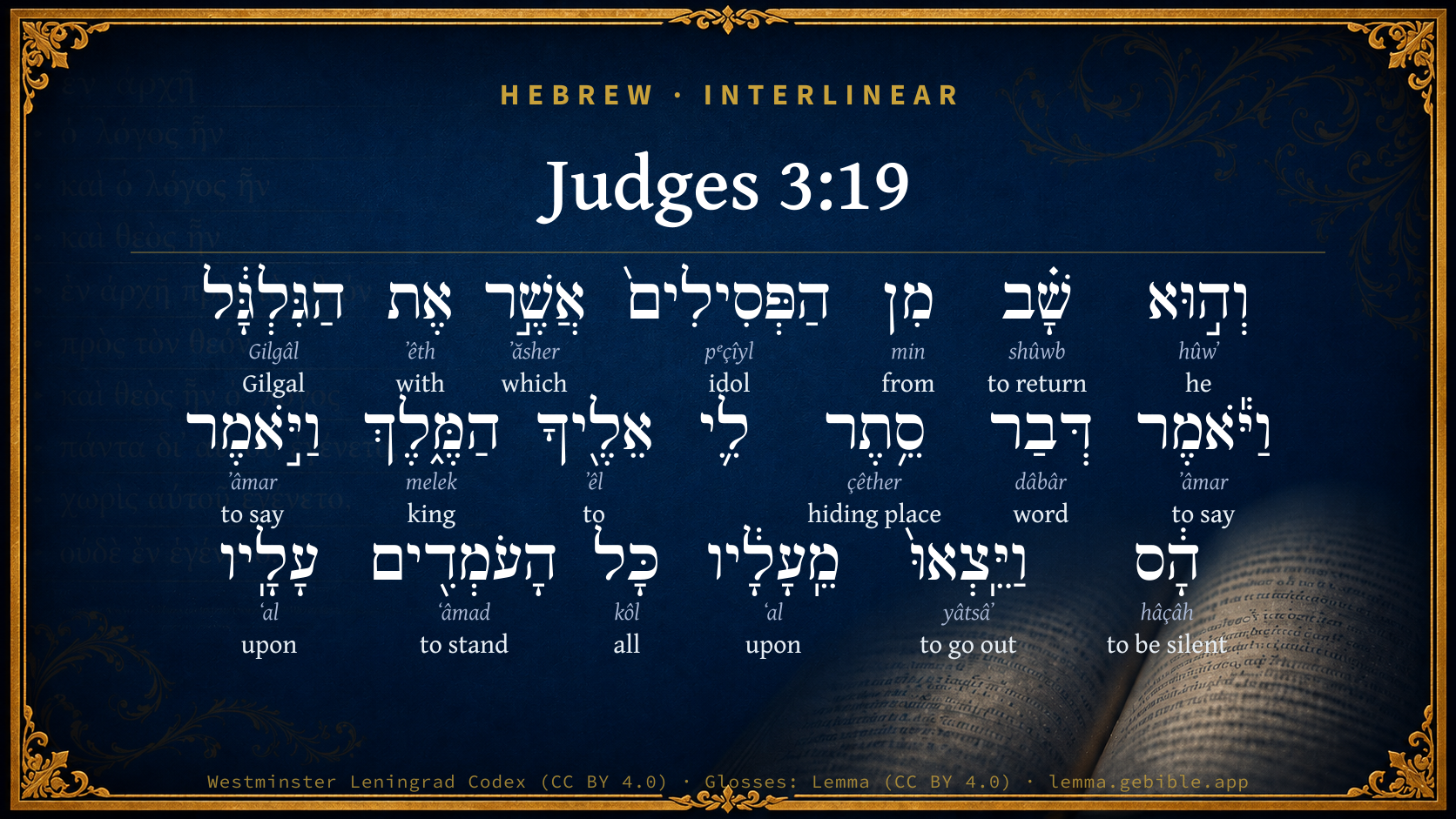
Hebrew (Westminster Leningrad Codex) Judges 3:19 appears in the Hebrew Old Testament. The text above is from the Westminster Leningrad Codex. Each word links to its Strong’s number, a concise gloss, and parsing drawn from the Open Scriptures Hebrew Bible morphology. Click any word for its full Brown-Driver-Briggs (BDB) entry.
Download image
Cite this verse

Judges 3:19 (World English Bible). Public Domain. Lemma interlinear Bible study tool, https://lemma.gebible.app/v/judges/3/19.

Show BibTeX & RIS
BibTeX
RIS
English Translation
But he himself turned back from the quarries that were by Gilgal, and said, I have a secret errand to you, king. He said, Keep silence. All who stood by him went out from him.
World English Bible · Public Domain
Download a study sheet

One document with this verse’s original text, its word-by-word gloss line, the meaning frame, cross-references with their text, attributed commentary, and full source and license credits — printable, and it pastes into notes with its structure intact.

This verse Autodidact and up

Study sheet (.html) Plain text (.txt)

A passage Seminary Student

Up to 50 verses in one chapter. A passage sheet keeps up to 6 commentary sources and 12 cross-references per verse, in the order this page ranks them, and says so on the sheet whenever that leaves anything out. Ask for a single verse and you get the Autodidact verse sheet above.

Everything on this page stays free to read, with no account — the sheet is a download of what is already on screen, not access to it.

Want to remove ads? Support Godless Engineer
Compare translations 3

The same verse in 3 English versions, stacked beneath the original-language interlinear above. Click any original word for its lexicon entry.

Each is an independent rendering of the whole verse — the interlinear is not word-aligned to these translations.

Highlighted words mark where these versions differ — a whole-verse word diff, not a word-by-word alignment.

  • World English Bible Public Domain
    But he himself turned back from the quarries that were by Gilgal, and said, I have a secret errand to you, king. He said, Keep silence. All who stood by him went out from him.
  • King James Version Public Domain
    But he himself turned again from the quarries that were by Gilgal, and said, I have a secret errand unto thee, O king: who said, Keep silence. And all that stood by him went out from him.
  • unfoldingWord Literal Text CC BY-SA 4.0
    But he, he turned back from the carved images that at Gilgal, and he said, “A word of secrecy to me for you, O king.” And he said, “Hush!” So all of the ones standing around him went out from around him.

unfoldingWord Literal Text — © unfoldingWord, licensed CC BY-SA 4.0. Word-aligned USFM3 via Door43 (git.door43.org/unfoldingWord/en_ult).

Versions to compare (up to 4)

3 of 4 selected

Show all 18 translations

Every available English version of this verse, each an independent rendering of the whole verse.

  • World English Bible Public Domain
    But he himself turned back from the quarries that were by Gilgal, and said, I have a secret errand to you, king. He said, Keep silence. All who stood by him went out from him.
  • Berean Standard Bible Public Domain
    But upon reaching the idols near Gilgal, he himself turned back and said, “I have a secret message for you, O king.” “Silence,” said the king, and all his attendants left him.
  • Majority Standard Bible Public Domain
    But upon reaching the idols near Gilgal, he himself turned back and said, “I have a secret message for you, O king.” “Silence,” said the king, and all his attendants left him.
  • King James Version Public Domain
    But he himself turned again from the quarries that were by Gilgal, and said, I have a secret errand unto thee, O king: who said, Keep silence. And all that stood by him went out from him.
  • American Standard Version (1901) Public Domain
    But he himself turned back from the quarries that were by Gilgal, and said, I have a secret errand unto thee, O king. And he said, Keep silence. And all that stood by him went out from him.
  • Revised Version (1885) Public Domain
    But he himself turned back from the quarries that were by Gilgal, and said, I have a secret errand unto thee, O king. And he said, Keep silence. And all that stood by him went out from him.
  • Geneva Bible (1599) Public Domain
    But he turned againe from the quarris, that were by Gilgal, and said, I haue a secret errand vnto thee, O King. Who said, Keepe silence: and all that stoode about him, went out from him.
  • Douay-Rheims (1899) Public Domain
    Then returning from Galgal, where the idols were, be said to the king: I have a secret message to thee, O king. And he commanded silence: and all being gone out that were about him,
  • Young's Literal Translation Public Domain
    and he himself hath turned back from the graven images which `are' at Gilgal, and saith, `A secret word I have unto thee, O king;' and he saith, `Hush!' and go out from him do all those standing by him.
  • Literal Standard Version CC BY-SA 4.0
    and he himself has turned back from the carved images which [are] at Gilgal and says, “I have a secret word for you, O king”; and he says, “Hush!” And all those standing by him go out from him.
  • Unlocked Literal Bible CC BY-SA 4.0
    As for Ehud himself, however, when he reached the place where the carved images were made near Gilgal, he turned and went back, and he said, “I have a secret message for you, my king.” Eglon said, “Silence!” So all those serving him left the room.
  • unfoldingWord Literal Text CC BY-SA 4.0
    But he, he turned back from the carved images that at Gilgal, and he said, “A word of secrecy to me for you, O king.” And he said, “Hush!” So all of the ones standing around him went out from around him.
  • Darby Bible Public Domain
    But he himself turned back at the sculptured stones near Gilgal, and said, "I have a secret message for you, O king." And he commanded, "Silence." And all his attendants went out from his presence.
  • World Messianic Bible Public Domain
    But he himself turned back from the stone idols that were by Gilgal, and said, “I have a secret message for you, O king.” The king said, “Keep silence!” All who stood by him left him.
  • Webster's Bible Public Domain
    But he himself turned again from the quarries that were by Gilgal, and said, I have a secret errand to thee, O king: who said, Keep silence. And all that stood by him went out from him.
  • Free Bible Version CC BY-SA 4.0
    But when he reached the stone idols near Gilgal, he turned back. He went to see Eglon, and told him, “Your Majesty, I have a secret message for you.” The king told his attendants, “Silence!” and they all left.
  • Bible in Basic English Public Domain
    But he himself, turning back from the stone images at Gilgal, said, I have something to say to you in secret, O king. And he said, Let there be quiet. Then all those who were waiting before him went out.
  • JPS Tanakh (1917) Public Domain
    But he himself turned back from the quarries that were by Gilgal, and said: 'I have a secret errand unto thee, O king.' And he said: 'Keep silence.' And all that stood by him went out from him.

Literal Standard Version (2020), Covenant Press — licensed CC BY-SA 4.0. Text via the HelloAO Bible API (eBible.org). Unlocked Literal Bible (unfoldingWord) — licensed CC BY-SA 4.0. Text via the HelloAO Bible API (eBible.org). unfoldingWord Literal Text — © unfoldingWord, licensed CC BY-SA 4.0. Word-aligned USFM3 via Door43 (git.door43.org/unfoldingWord/en_ult). Free Bible Version, Dr. Jonathan Gallagher — licensed CC BY-SA 4.0. Text via the HelloAO Bible API (eBible.org).

Word by word

More ways to search: Search by grammar → Find every occurrence → Compare this word →

Practice this passage: Drill this verse → Learn its vocabulary →

הָ֔ס
hâçâh
H2013
“be silent”
Verb, Piel, Imperative, 2nd Person, Masculine, Singular
Part of Speech
Verb
Stem
Piel
Form
Imperative
Person
2nd Person
Gender
Masculine
Number
Singular
Full BDB Definition

Origin: a primitive root

TWOT: 511

(Piel) hush, keep silence, be silent, hold peace, hold tongue, still (interjection) - (CLBL) to hush (verb) - (Hiphil) to command to be silent
  1. וְה֣וּא hûwʼ H1931 “and · he” Conjunction + Pronoun, Personal, 3rd Person, Masculine, Singular
  2. שָׁ֗ב shûwb H7725 “to return” Verb, Qal, Perfect, 3rd Person, Masculine, Singular
  3. מִן min H4480 “from” Preposition
  4. הַפְּסִילִים֙ pᵉçîyl H6456 “the · idols” Particle, Definite Article + Noun, Common, Masculine, Plural, Absolute
  5. אֲשֶׁ֣ר ʼăsher H834 “which” Particle, Relative
  6. אֶת ʼêth H854 “with” Preposition
  7. הַגִּלְגָּ֔ל Gilgâl H1537 “the · Gilgal” Particle, Definite Article + Noun, Proper
  8. וַיֹּ֕אמֶר ʼâmar H559 “and · to say” Conjunction + Verb, Qal, Sequential Imperfect, 3rd Person, Masculine, Singular
  9. דְּבַר dâbâr H1697 “word of” Noun, Common, Masculine, Singular, Construct
  10. סֵ֥תֶר çêther H5643 “hiding place” Noun, Common, Masculine, Singular, Absolute
  11. אֵלֶ֖יךָ ʼêl H413 “to · you” Preposition + Suffix, Personal, 2nd Person, Masculine, Singular
  12. הַמֶּ֑לֶךְ melek H4428 “the · king” Particle, Definite Article + Noun, Common, Masculine, Singular, Absolute
  13. וַיֹּ֣אמֶר ʼâmar H559 “and · to say” Conjunction + Verb, Qal, Sequential Imperfect, 3rd Person, Masculine, Singular
  14. וַיֵּֽצְאוּ֙ yâtsâʼ H3318 “and · to go out” Conjunction + Verb, Qal, Sequential Imperfect, 3rd Person, Masculine, Plural
  15. מֵֽעָלָ֔יו ʻal H5921 “from · upon · him” Preposition + Preposition + Suffix, Personal, 3rd Person, Masculine, Singular
  16. כָּל kôl H3605 “all of” Noun, Common, Masculine, Singular, Construct
  17. הָעֹמְדִ֖ים ʻâmad H5975 “the · standing” Particle, Definite Article + Verb, Qal, Participle Active, Masculine, Plural, Absolute
  18. עָלָֽיו ʻal H5921 “upon · him” Preposition + Suffix, Personal, 3rd Person, Masculine, Singular

About this verse

These counts appear in no published source. They are computed here, from the morphology-tagged text and Lemma’s own curated glosses. What Lemma adds →

20
words
17
distinct lemmas
Historical
section

Notable vocabulary

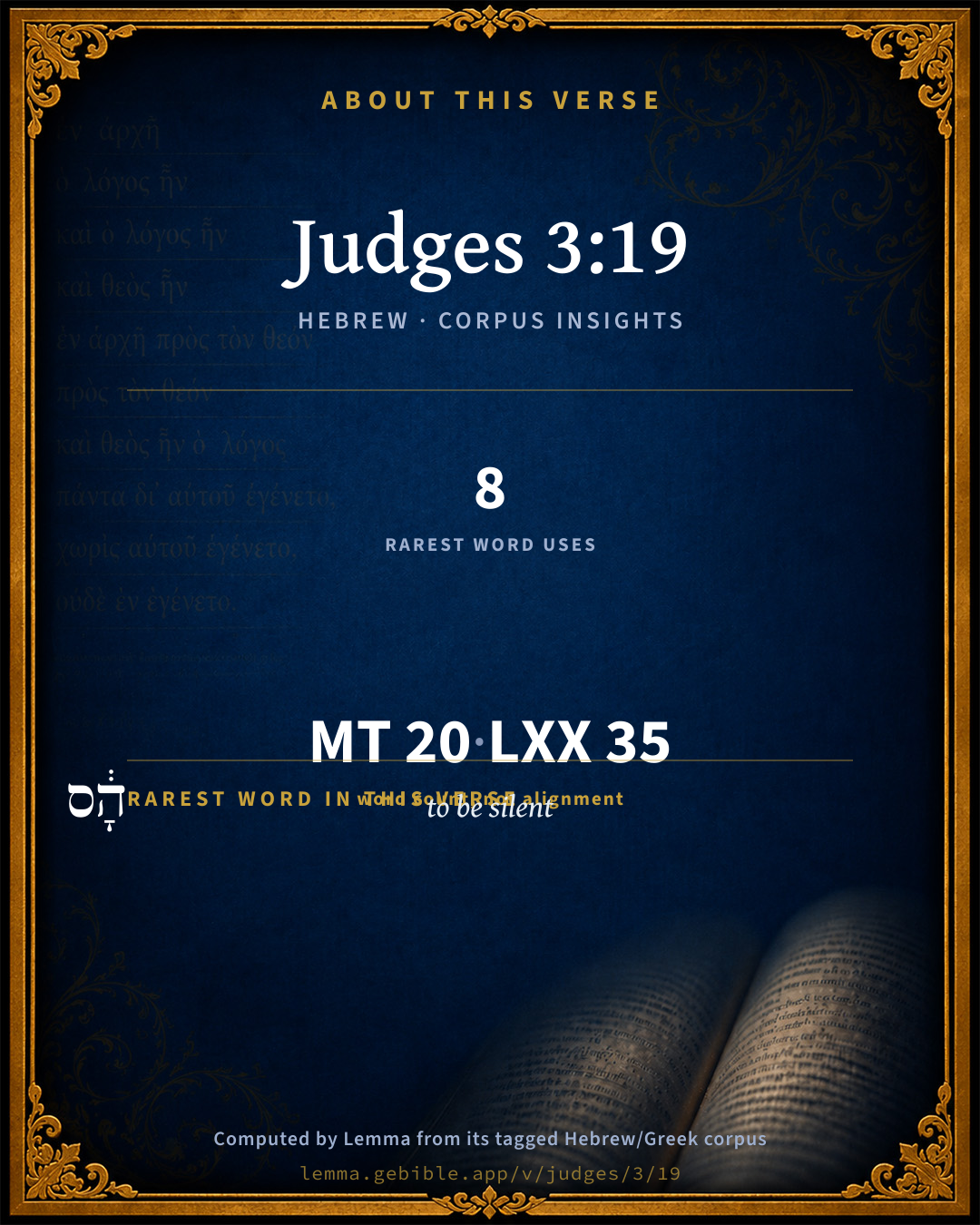
The rarest word here is הָ֔ס to be silent H2013 — appearing just 8 times in the whole Hebrew Bible.

Shared distinctive vocabulary

הָ֔ס to be silent H2013 occurs in 8 verses of the Hebrew Bible. Also found in:

Grammatical profile

  • 6 verbs
  • 6 nouns
  • 1 pronoun
  • 6 prepositions
  • 1 particle

Verb forms

  • שָׁ֗ב Qal · Perfect
  • וַיֹּ֕אמֶר Qal · Sequential Imperfect
  • וַיֹּ֣אמֶר Qal · Sequential Imperfect
  • הָ֔ס Piel · Imperative
  • וַיֵּֽצְאוּ֙ Qal · Sequential Imperfect
  • הָעֹמְדִ֖ים Qal · Participle Active

Repetition

Words recur within this verse — often emphatic in Hebrew:

  • וַיֹּ֕אמֶר to say H559 ×2
  • מֵֽעָלָ֔יו upon H5921 ×2

Hebrew & Septuagint length

In English translation the verse runs 35 words from the Hebrew and 42 from the Septuagint (LXX English) — closely comparable.

A rough comparison of the two English renderings, which tokenize alike — not a word-level alignment.

Word counts can differ between the Hebrew and the Greek without any difference in meaning — e.g. the Hebrew direct-object marker אֵת has no separate Greek word, and Greek often adds the article ὁ.

In the original languages it is 20 Hebrew tokens and 35 Greek tokens — but the two are counted differently (Hebrew bundles its prefixes and suffixes into one token; the Greek is in lemma form), so that isn’t a like-for-like length.

Cross-references

5

Topical passages linked to Judges 3:19 in the Treasury of Scripture Knowledge — connected by theme and wording, ordered by reader-vote popularity; previews shown in the World English Bible.

  • Joshua 4:20 Those twelve stones, which they took out of the Jordan, did Joshua set up in Gilgal.
  • Judges 3:20 Ehud came to him; and he was sitting by himself alone in the cool upper room. Ehud said, I have a message from God to you. He arose out of his seat.
  • 2 Kings 9:5–6 When he came, behold, the captains of the host were sitting; and he said, I have an errand to you, captain. Jehu said, To which of us all? He said, To you, O captain.
  • Acts 23:18–19 So he took him, and brought him to the commanding officer, and said, "Paul, the prisoner, summoned me and asked me to bring this young man to you, who has something to tell you."
  • Genesis 45:1 Then Joseph couldn't control himself before all those who stood before him, and he cried, "Cause every man to go out from me!" There stood no man with him, while Joseph made himself known to his brothers.

Cross-references courtesy of OpenBible.info (CC BY 4.0).

Hebrew and Greek witnesses Masoretic Hebrew ↔ Greek Septuagint

The same verse in the two great witnesses to the Old Testament, shown verse-for-verse.

These are two independent witnesses, not word-aligned to each other, and the Septuagint is shown in lemma (dictionary) form.

Hebrew Judges 3:19 Masoretic · Westminster Leningrad Codex

וְה֣וּא שָׁ֗ב מִן הַפְּסִילִים֙ אֲשֶׁ֣ר אֶת הַגִּלְגָּ֔ל וַיֹּ֕אמֶר דְּבַר סֵ֥תֶר לִ֛י אֵלֶ֖יךָ הַמֶּ֑לֶךְ וַיֹּ֣אמֶר הָ֔ס וַיֵּֽצְאוּ֙ מֵֽעָלָ֔יו כָּל הָעֹמְדִ֖ים עָלָֽיו

But he himself turned back from the quarries that were by Gilgal, and said, I have a secret errand to you, king. He said, Keep silence. All who stood by him went out from him.

World English Bible · Public Domain

Greek LXX Judges 3:19 Septuagint · lemma form

καί αὐτός ὑποστρέφω ἀπό ὁ γλυπτός ὁ μετά ὁ γαλγαλ καί εἶπον αωδ λόγος ἐγώ κρύφιος πρός σύ βασιλεύς καί εἶπον εγλωμ πρός αὐτός σιωπάω καί ἐκ ἀποστέλλω ἀπό ἑαυτοῦ πᾶς ὁ ἐπιἵστημι ἐπί αὐτός

And he himself returned from the quarries that are by Galgal; and Aod said, I have a secret errand to you, O king! and Eglom said to him, Be silent: and he sent away from his presence all who waited upon him.

LXX2012 (modern English Septuagint) · Public Domain

On this verse, The Cambridge Bible for Schools and Colleges discusses the Septuagint’s reading. Read the note in Commentary ↓

Hebrew: Westminster Leningrad Codex (CC BY 4.0). Greek: Septuagint (public domain); English from LXX2012 (modern English Septuagint) (Public Domain). How the Septuagint differs from the Hebrew →

Targum (Aramaic paraphrase)

1

The Targum is the ancient Jewish Aramaic paraphrase of the Hebrew Scriptures — an interpretive translation, not the Hebrew text itself. Onkelos (literal) and Pseudo-Jonathan (expansive) render the Torah, and Jonathan the Prophets. Coverage is partial: where no permissively-licensed English translation exists for a verse, only the Aramaic is shown. This is verse-level text, not a word-by-word alignment to the Hebrew.

  1. Targum Jonathan Prophets (Joshua–Malachi)
    וְהוּא תַב מִן מַחֲצָבַיָא דְעִם גִלְגָלָא וַאֲמַר פִּתְגָמָא דְסִתְרָא אִית לִי לְמַלָלָא עִמָךְ מַלְכָּא וַאֲמַר סְלִיק וּנְפַקוּ מֵעִלַווֹהִי כָּל דְקַיְמִין עֲלוֹהִי:

    (no public-domain English translation for this verse)

    Targum Jonathan — Aramaic: “Mikraot Gedolot” (public domain). English: “Sefaria Community Translation” (CC0 1.0 (public-domain dedication)); “London "Chaldee Paraphrase," 1871” (public domain). Text via Sefaria.

Commentary

Notes on Judges 3:19 from classic Christian and Jewish commentators (each source and its license shown beneath its notes). The classic Christian expositions comment on the surrounding passage and are grouped to its opening verse, so a note may address several verses; the Jewish commentaries on the Tanakh (Rashi and others) are per-verse, so they appear only where the commentator wrote on this verse.

Lemma curates 59 commentaries, every one of them public domain or Creative Commons licensed, each selected and text-cleaned for this edition rather than reprinted as found. About our sources →

The Cambridge Bible for Schools and Colleges

gen. ed. J. J. S. Perowne

19. the quarries] Everywhere else (e.g. Isa_21:9; Mic_5:13 etc.), and in the margin of A. and RV. here, the word (pesîlîm) is rendered graven images (cf. pesel ‘graven image’), and such is the meaning in this place; idols, or perhaps in a more general sense, sculptured stones (Moore). They were connected with the sanctuary of Gilgal (see on Jdg_2:1), which was marked by a circle of sacred stones, traditionally those which Joshua set up to commemorate the crossing of the Jordan (Jos_4:20). The rendering quarries goes back to the Targum, and is due to the wish to avoid an objectionable reference. The idols by Gilgal may be mentioned merely as a familiar land-mark on the W. of the Jordan, cf. Jdg_3:26; or rather, perhaps, to account for what follows in Jdg_3:20. Ehud waited at the sanctuary to find a pretext for returning unexpectedly to speak with the king; he had received an oracle there, ‘a message from God,’ which he must communicate to the king personally (so Lagrange). The position of Gilgal, between Jericho and the Jordan, shews that Eglon’s residence must have been not at Jericho, but on the other side of the river, in Moab.

Keep silence] Cf. Amo_6:10. The command is addressed to the courtiers, who are dismissed in order that the king may speak to Ehud in private. Ehud had entered the presence publicly.

20 And Ehud came unto him] i.e. from the public hall to a private room: the king was sitting in his cool roof-chamber, such as is often built on the flat roof of an Eastern house. Ehud’s words in Jdg_3:19, spoken publicly in the king’s presence, contain a request for a private audience; the king thereupon dismisses his attendants, retires to his chamber on the roof, where he receives Ehud in the manner desired. The transition from Jdg_3:19-20 is not clearly expressed: we should gather from Jdg_3:19 that, after the attendants had left, the interview took place in the public room; but in Jdg_3:20 Ehud finds the king alone in his cool chamber. There is no need, however, to regard the two verses as doublets; the narrative is compressed, and the omission of details leaves something to be supplied by the imagination.

a message from God unto thee] i.e. a divine communication. Josephus explains that it had been conveyed by a dream, Ant. Jdg_3:4; Jdg_3:2. The LXX adds O king, which may be right. Out of respect for the oracle the king rises from his chair; cf. Num_23:18.

The Cambridge Bible for Schools and Colleges (gen. ed. J. J. S. Perowne; Cambridge University Press, 1878–1918) — public domain. Text from a community e-Sword module.

Trapp's Complete Commentary

John Trapp

Jdg 3:19 But he himself turned again from the quarries that [were] by Gilgal, and said, I have a secret errand unto thee, O king: who said, Keep silence. And all that stood by him went out from him.

Ver. 19. From the quarries that were by Gilgal.] Or, Graven images; stone statues set up there to be worshipped, and haply to vex the Israelites, or to entice them to idolatry: at the sight whereof, saith Fetus, Ehud’s zeal so wrought with him, that he returned and killed the king. Or haply, saith another expositor, he made a show as if he had been at Gilgal to worship before the king’s idols set up there, and something touching the king revealed unto him that he might the better get an opportunity of being alone with him.

Keep silence,] viz., Till I have cleared the room of company. Kings are seldom without suitors and parasites; yet they have their retiring rooms, as here Eglon had a summer parlour for himself alone.

John Trapp, A Commentary or Exposition upon All the Books of the Old and New Testament (1647–1656) — public domain. Text from a community e-Sword module.

Geneva Bible (1599)

Geneva Bible translators

Till all be departed.

Or, as some read from the places of idols.

Geneva Bible (1599) marginal notes — public domain. Text via Bolls.life.

Jamieson, Fausset & Brown

Robert Jamieson, A. R. Fausset & David Brown

quarries--rather, "graven images" (Deu 7:25; Jer 8:19; Jer 51:52); statues of Moabite idols, the sight of which kindled the patriotic zeal of Ehud to avenge this public insult to Israel on its author.

I have a secret errand unto thee, O king: who said, Keep silence--"Privacy"--a signal for all to withdraw.

Jamieson, Fausset & Brown — Commentary Critical and Explanatory on the Whole Bible (1871) — public domain (CC PDM 1.0). Text via the HelloAO Bible API.

Adam Clarke's Commentary

Verse 19. He-turned - from the quarries] פסילים pesilim. Some of the versions understand this word as meaning idols or graven images, or some spot where the Moabites had a place of idolatrous worship. As pasal signifies to cut, hew, or engrave, it may be applied to the images thus cut, or to the place, or quarry whence they were digged: but it is most likely that idols are meant. Some think that trenches are meant, and that pesilim here may mean the boundaries of the two countries: and when Ehud had got thus far, he sent away the people that were with him, under pretense of having a secret message to Eglon, and so got rid of his attendants, in presence of whom he could not have executed his scheme, nor have secured his escape afterwards. But I do not see the evidence of this mode of interpretation.

Adam Clarke's Commentary on the Bible (1810–1826) — public domain. Text from a community e-Sword/MySword module.

Ellicott's Commentary for English Readers

(19) But he himself turned again.—The plan of Ehud was deeply laid. He wished (1) to secure his end, which would be more difficult amid the soldiers and attendants who would guard the king during the presentation of the tribute; (2) to avoid endangering his comrades; (3) to provide, if possible, for his own escape. By going away with the deputation of serfs

which he had introduced, he would still more lull suspicion asleep.

From the quarries.—The Hebrew word is pesilîm. The LXX., followed by our margin, render it “graven images;” and the Vulgate, “from Gilgal, where were idols.” (Luther, Götzen.) Such is the meaning of pesîlîm in Deu_7:5; 2Ki_17:41; Psa_97:7, &c. The rendering, “stone quarries,” is derived from the Chaldee and Rabbi Jarchi; but it probably means idols of some kind—probably those of Moab. Some explain it of the twelve stones which were taken out of Jordan, and pitched at Gilgal (Jos_4:2). The LXX. (in some MSS.) make it mean that Eglon returned, but this is clearly a mistake. Gilgal was near Jericho, and when Ehud had accompanied his comrades to some well-known landmark at Gilgal, he returned to Jericho. Josephus says he had “two attendants” with him; but the word “people” in Jdg_3:18 implies that many more had accompanied him.

By Gilgal.—Ewald thinks that Gilgal belonged to Ephraim, and that “he went to see if all was safe at this frontier-post.” If the pesîlîm were sacred stones to mark a boundary (cp. Jdg_5:26), they would, like the Greek Hermæ, have been condemned by the Jews as idolatrous.

I have a secret errand unto thee, O king.—Something in Ehud’s position and antecedents enabled him to reckon on the king’s credulity. Eglon, aware of discontent among the Israelites, may have supposed that Ehud had some secret to betray. Similarly Darius obtained an interview with the Pseudo-Smerdis, for the purpose of assassinating him, by pretending to have a secret message to him; and, in explaining it to his comrade, says, “When lying is necessary, lie” (Herod, iii. 72). In Josephus’s version of the story, Ehud pretends that he has a dream to narrate.

Who said, Keep silence.—Rather, “And he said, Hush!” (Heb., Hâs.) The narrative is very graphic, but it does not appear whether the “Hush!” was addressed to Ehud, to prevent him from saying any more in the presence of the attendants, or as an intimation to the attendants to retire. They at once understood that the king wished to be left alone.

All that stood by him.—Courtiers always stand in the presence of Eastern kings.

A Bible Commentary for English Readers, edited by Charles John Ellicott (1878–1897) — public domain. Text from a community e-Sword module.

John Gill's Exposition

And Ehud came unto him,.... Somewhat nearer him than he was before; it seems probable that Eglon retired from the presence chamber, where he received company, into his summer parlour; which was smaller and more private, and in which he had used to be alone, as follows, and whither Ehud went in unto him, as he directed him:

and he was sitting in a summer parlour, which he had for himself alone: into which he was wont to go and sit alone, for the sake of coolness and refreshment in the hot season of the year, which it seems it now was; a room this was, in which, as Kimchi and others observe, were many windows to let in air to cool and refresh; or it was in such a part of the palace that was cool, and sheltered from the heat of the sun; see Amo 3:15,

and Ehud said, I have a message from God unto thee; which was to kill him; and undoubtedly he was sent of God on this errand to him: whether it be rendered a "word" or "thing" from God, as it signifies both, it was true, and no lie; for it was the Lord that spoke to him by an impulse on his spirit, and the thing was from the Lord he was to do, for nothing less could have justified him in such an action; and therefore this instance can be no warrant for the assassination of princes; as Ehud did not this of himself, but of the Lord, so neither did he do it as a private man, but as a judge of Israel. Josephus (c) says, he told him that he had a dream at the order of God to declare unto him; but for this there is no warrant; however it seems pretty plain that his view in making mention of the name of God, and of Elohim, a name given to false gods as well as the true, rather than Jehovah, was to strike his mind with awe and reverence, and cause him to rise from his seat, that he might the better thrust him with his dagger; and it had the desired effect:

and he arose out of his seat; in reverence of God, from whom he expected to receive a message; this he did, though in his mind a blind ignorant idolater; in his body fat, corpulent, and unwieldy; and in his office a king, and a proud and tyrannical man. The above writer says, that, for joy at the dream he was to hear, he rose from his throne.

(c) Antiqu. l. 5. c. 4. sect. 2.

John Gill's Exposition of the Whole Bible (1746–1763) — public domain (CC PDM 1.0). Text via the HelloAO Bible API.

Albert Barnes' Notes on the Bible

Gilgal was in the immediate neighborhood of Jericho Jdg 2:1, where doubtless Eglon held his court at this time Jdg 3:13.

Quarries - Some take the original of this word in its common meaning of carved images or idols (see the margin).

Albert Barnes' Notes on the Bible (1834–1885) — public domain. Text from a community e-Sword/MySword module.

Haydock's Catholic Bible Commentary

Idols. Hebrew pesilim. Some take these to be only heaps of stones. Protestants, "quarries." (Haydock) --- But the Septuagint, &c., represent them as "carved" idols. The same expression is used [in] Exodus xx. 4., &c. The Moabites had probably placed idols here, to profane that sacred place, which was resorted to out of devotion by the Israelites, Osee iv. 14., and Amos iv. 5. Here also the prophets inform us that the ten tribes adored and consulted idols; resembling perhaps that of Michas, chap. xvii. 4. --- Silence to Aod, (Calmet) that none of the people might be able to divulge the secret. Hebrew, "be thou silent." (Menochius)

George Leo Haydock (1774–1849), Haydock's Catholic Family Bible and Commentary, 1859 edition — public domain. Excludes Psalms (Douay-Rheims chapter numbering differs from Protestant) and Deuterocanonical books (Catholic canon only).

Matthew Poole's English Annotations

He turned again, as if he had forgot and neglected some important business.

From the quarries; either, first, Whence they hewed stones. Or, secondly, The twelve stones which Joshua set up there; by the sight whereof he was animated to his work. Or, thirdly, The idols, as the word also signifies, which that heathen king might place there, either in spite and contempt to the Israelites, who had that place in great veneration; or that he might ascribe his conquest of the land to his idols, as the Israelites did to the true God, by setting up this monument in the entrance or beginning of it.

Keep silence till my servants be gone; whom he would not have acquainted with a business which he supposed to be of great and close importance.

Matthew Poole's English Annotations on the Holy Bible (1683–1685) — public domain. Text from a community e-Sword/MySword module.

Whedon's Commentary on the Bible

Daniel D. Whedon

19. He himself turned again — At the ceremony of offering the present to Eglon “Ehud had no opportunity to attempt anything, for he neither came near the king nor saw him alone; nor yet was he willing, among so many bystanders, to involve his companions in the consequences of a possible failure. On the contrary, he accompanied them back to the border, in order to be sure that he was alone when making the dangerous attempt.” — Cassel.

The quarries — Our version follows the Chaldee in this rendering of the Hebrew word פסילים, pesilim, and Keil adopts this interpretation. But the word elsewhere always means graven images, or idols, and so the Septuagint and Vulgate here translate it. These pesilim were graven images set up by Gilgal, probably by the Moabites, to commemorate their conquests in that part of Palestine. It would especially vex and trouble the better part of Israel to have the site of their ancient camp profaned by idolatrous images. Some suggest that the sight of these images nerved Ehud for his daring work.

A secret errand — Ehud affects to be Eglon’s friend, and seems to the king to have gone to such pains to favour him with a secret that his deadly purpose is not suspected.

Keep silence — הס, hist! hush! To the king’s attendants it implied that they should leave the room.

Daniel D. Whedon (gen. ed.), Commentary on the Old and New Testaments (1874–1909) — public domain. Text from a community e-Sword module.

The Pulpit Commentary

The quarries. It is uncertain whether this is the meaning of the Hebrew word. Its common meaning is images, as Deu_7:25, and elsewhere.

The Pulpit Commentary (1880–1919), ed. H.D.M. Spence-Jones & Joseph S. Exell — public domain. Text from a community e-Sword module.

John Wesley's Explanatory Notes

Turned again - As if he had forgot some important business. Keep silence - 'Till my servants be gone: whom he would not have acquainted with a business which he supposed to be of great importance.

John Wesley, Explanatory Notes Upon the Whole Bible (1754–1765) — public domain. Text via the GEBible commentary corpus.

unfoldingWord translationNotes

Door43 World Missions Community

when he reached the place where the carved images were made near Gilgal

This can be stated in active form. AT: "when he arrived at the place near Gilgal where people made carved images" (See: Active or Passive)

in the coolness of the upper room

This is a room above the lower level that was used for rest and to remain cool during the hot part of the day.

The king got up out of his seat

Standing up was a sign of honoring God will listening to his message. (See: Symbolic Action)

translationWords

image

Gilgal

king

servant

God

unfoldingWord translationNotes — © Distant Shores Media and the Door43 World Missions Community, licensed CC BY-SA 4.0. Source: git.door43.org/Door43/en_tn.

Rashi

Rabbi Shlomo Yitzchaki (Rashi)

He then returned alone.

From the quarries. An area where stones were excavated from the mountain. Similarly, Yonasan renders "from the quarries." Then he went to Eglon, and declared to him.

He said, "Hsst." Eglon said, "Silence everyone near me!" Yonasan renders, "Leave!"—remove everyone. Still, the term connotes silence.

Rashi on the Tanakh — English translations: “The Judaica Press complete Tanach with Rashi, translated by A. J. Rosenberg” (CC BY 4.0); “Pentateuch with Rashi's commentary by M. Rosenbaum and A.M. Silbermann, 1929-1934” (public domain); “The Metsudah Tanach series, Lakewood, N.J” (CC BY 4.0); and “The Book of Joshua, Metsudah Publications, 1997” (CC BY 4.0). Text via Sefaria.

Lesson kit

Teaching starters — assembled from the data on this page, not authored interpretation. Every prompt links to the verse data it draws on. Edit before teaching.

Judges, in the Historical, opens this verse with 20 words (17 distinct Hebrew lemmas). Its most distinctive word is hâçâh (“to be silent”). A historical commentator’s framing appears above. Read the whole chapter for the surrounding context.

Discussion questions

  1. How does “to be silent” (hâçâh) shape what this verse is saying?
  2. How does Numbers 13:30, which shares the word «to be silent», read alongside this verse?
  3. What does the repetition of “to say” (2× in this one verse) do in this verse?
  4. These translations render this verse differently. What is at stake in choosing one wording over another?
  5. «שָׁ֗ב» is a Qal Perfect verb. How does that grammatical form shape the action described?
  6. Compare how The Cambridge Bible for Schools and Colleges and Trapp's Complete Commentary read this verse. Where do they agree or differ?

Things to notice

Reading settings

Reading text

Shown beneath each verse's original-language words.

Old Testament
Old Testament edition

Read the OT as the Masoretic Hebrew (MT) or the Greek Septuagint (LXX).

English shown for the Greek Septuagint (in the Hebrew ↔ Greek comparison).

Comparing translations? Open the Compare panel on any verse page to stack up to four side by side.