
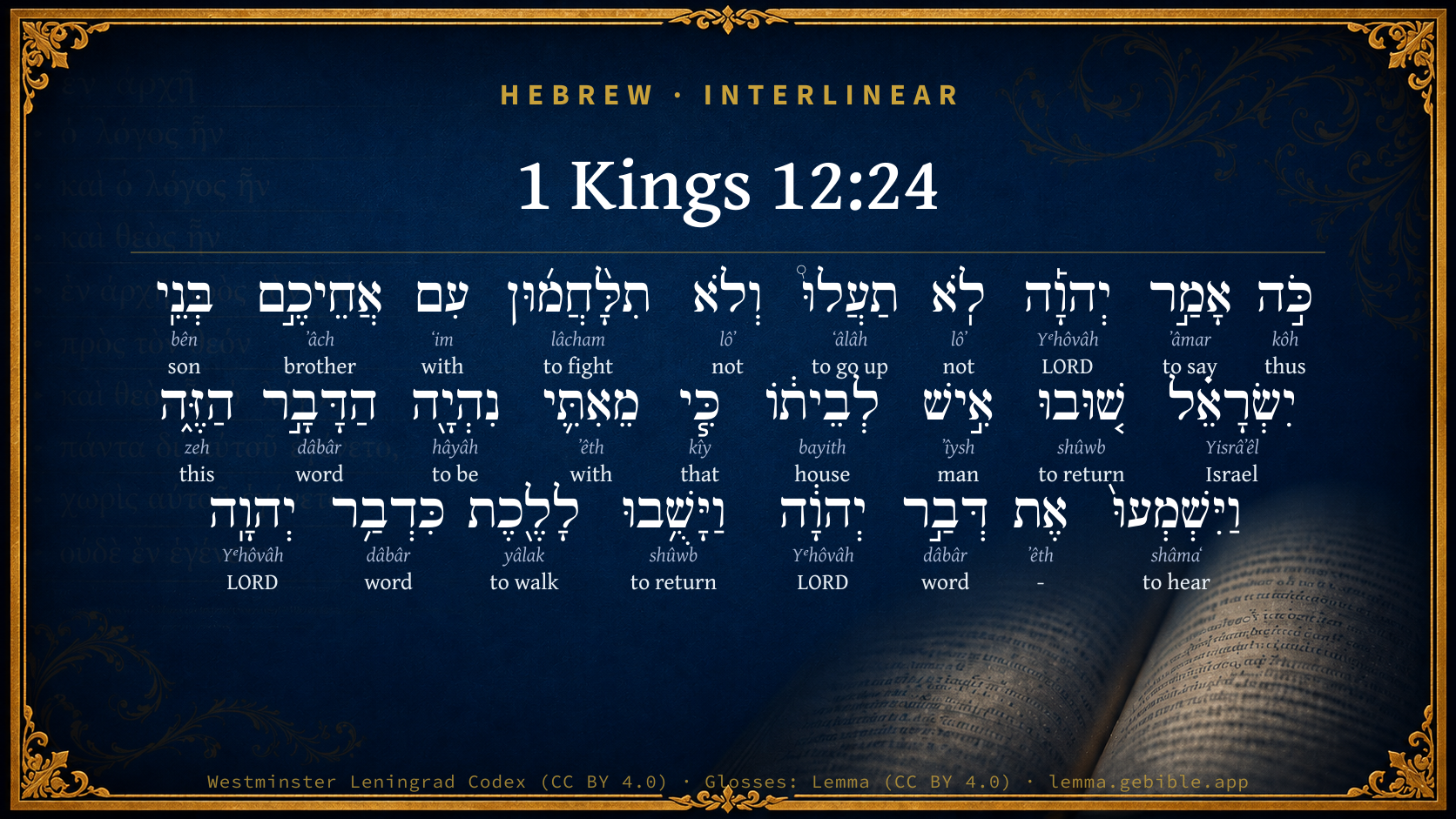
1 Kings 12:24

Hebrew (Westminster Leningrad Codex) 1 Kings 12:24 appears in the Hebrew Old Testament. The text above is from the Westminster Leningrad Codex. Each word links to its Strong’s number, a concise gloss, and parsing drawn from the Open Scriptures Hebrew Bible morphology. Click any word for its full Brown-Driver-Briggs (BDB) entry.
Download image
Cite this verse

1 Kings 12:24 (World English Bible). Public Domain. Lemma interlinear Bible study tool, https://lemma.gebible.app/v/1-kings/12/24.

Show BibTeX & RIS
BibTeX
RIS
English Translation
Thus says Yahweh, You shall not go up, nor fight against your brothers the children of Israel: return every man to his house; for this thing is of me. So they listened to the word of Yahweh, and returned and went their way, according to the word of Yahweh.
World English Bible · Public Domain
Download a study sheet

One document with this verse’s original text, its word-by-word gloss line, the meaning frame, cross-references with their text, attributed commentary, and full source and license credits — printable, and it pastes into notes with its structure intact.

This verse Autodidact and up

Study sheet (.html) Plain text (.txt)

A passage Seminary Student

Up to 50 verses in one chapter. A passage sheet keeps up to 6 commentary sources and 12 cross-references per verse, in the order this page ranks them, and says so on the sheet whenever that leaves anything out. Ask for a single verse and you get the Autodidact verse sheet above.

Everything on this page stays free to read, with no account — the sheet is a download of what is already on screen, not access to it.

Want to remove ads? Support Godless Engineer
Compare translations 3

The same verse in 3 English versions, stacked beneath the original-language interlinear above. Click any original word for its lexicon entry.

Each is an independent rendering of the whole verse — the interlinear is not word-aligned to these translations.

Highlighted words mark where these versions differ — a whole-verse word diff, not a word-by-word alignment.

  • World English Bible Public Domain
    Thus says Yahweh, You shall not go up, nor fight against your brothers the children of Israel: return every man to his house; for this thing is of me. So they listened to the word of Yahweh, and returned and went their way, according to the word of Yahweh.
  • King James Version Public Domain
    Thus saith the LORD, Ye shall not go up, nor fight against your brethren the children of Israel: return every man to his house; for this thing is from me. They hearkened therefore to the word of the LORD, and returned to depart, according to the word of the LORD.
  • unfoldingWord Literal Text CC BY-SA 4.0
    ‘Thus says Yahweh, “You shall not go up and you shall not fight with your brothers, the sons of Israel. Return, a man to his house, for this thing has been from with me.”’” And they heard the word of Yahweh, and they returned to go, according to the word of Yahweh.

unfoldingWord Literal Text — © unfoldingWord, licensed CC BY-SA 4.0. Word-aligned USFM3 via Door43 (git.door43.org/unfoldingWord/en_ult).

Versions to compare (up to 4)

3 of 4 selected

Show all 18 translations

Every available English version of this verse, each an independent rendering of the whole verse.

  • World English Bible Public Domain
    Thus says Yahweh, You shall not go up, nor fight against your brothers the children of Israel: return every man to his house; for this thing is of me. So they listened to the word of Yahweh, and returned and went their way, according to the word of Yahweh.
  • Berean Standard Bible Public Domain
    that this is what the LORD says: ‘You are not to go up and fight against your brothers, the Israelites. Each of you must return home, for this word is from Me.’” So they listened to the word of the LORD and turned back according to the word of the LORD.
  • Majority Standard Bible Public Domain
    that this is what the LORD says: ‘You are not to go up and fight against your brothers, the Israelites. Each of you must return home, for this is My doing.’” So they listened to the word of the LORD and turned back according to the word of the LORD.
  • King James Version Public Domain
    Thus saith the LORD, Ye shall not go up, nor fight against your brethren the children of Israel: return every man to his house; for this thing is from me. They hearkened therefore to the word of the LORD, and returned to depart, according to the word of the LORD.
  • American Standard Version (1901) Public Domain
    Thus saith Jehovah, Ye shall not go up, nor fight against your brethren the children of Israel: return every man to his house; for this thing is of me. So they hearkened unto the word of Jehovah, and returned and went their way, according to the word of Jehovah.
  • Revised Version (1885) Public Domain
    Thus saith the LORD, Ye shall not go up, nor fight against your brethren the children of Israel: return every man to his house; for this thing is of me. So they hearkened unto the word of the LORD, and returned and went their way, according to the word of the LORD.
  • Geneva Bible (1599) Public Domain
    Thus saith the Lord, Ye shall not go vp, nor fight against your brethren the children of Israel: returne euery man to his house: for this thing is done by me. They obeyed therefore the worde of the Lord and returned, and departed, according to the worde of the Lord.
  • Douay-Rheims (1899) Public Domain
    Thus saith the Lord: You shall not go up nor fight against your brethren the children of Israel: let every man return to his house, for this thing is from me. They hearkened to the word of the Lord, and returned from their journey, as the Lord had commanded them.
  • Young's Literal Translation Public Domain
    Thus said Jehovah, Ye do not go up nor fight with your brethren the sons of Israel; turn back each to his house, for from Me hath this thing been;' and they hear the word of Jehovah, and turn back to go according to the word of Jehovah.
  • Literal Standard Version CC BY-SA 4.0
    Thus said YHWH: You do not go up nor fight with your brothers the sons of Israel; let each return to his house, for this thing has been from Me”; and they hear the word of YHWH, and turn back to go according to the word of YHWH.
  • Unlocked Literal Bible CC BY-SA 4.0
    'Yahweh says this: You must not attack or fight against your brothers the people of Israel. Each man must return to his home, for this thing has been made to happen by me.'” So they listened to the word of Yahweh and turned back and went their way, and they obeyed his word.
  • unfoldingWord Literal Text CC BY-SA 4.0
    ‘Thus says Yahweh, “You shall not go up and you shall not fight with your brothers, the sons of Israel. Return, a man to his house, for this thing has been from with me.”’” And they heard the word of Yahweh, and they returned to go, according to the word of Yahweh.
  • Darby Bible Public Domain
    Thus saith Jehovah: Go not up, nor fight with your brethren, the children of Israel; return every man to his house, for this thing is from me. And they hearkened to the word of Jehovah, and returned to depart, according to the word of Jehovah.
  • World Messianic Bible Public Domain
    ‘The LORD says, “You shall not go up or fight against your brothers, the children of Israel. Everyone return to his house; for this thing is from me.”’” So they listened to the LORD’s word, and returned and went their way, according to the LORD’s word.
  • Webster's Bible Public Domain
    Thus saith the LORD, Ye shall not go up, nor fight against your brethren the children of Israel: return every man to his house; for this thing is from me. They hearkened therefore to the word of the LORD, and returned to depart, according to the word of the LORD.
  • Free Bible Version CC BY-SA 4.0
    ‘This is what the Lord says. Don't fight against your Israelite relatives. Every one of you, go home! For it was me that made this happen.’” So they obeyed what the Lord told them and went home, as the Lord had said.
  • Bible in Basic English Public Domain
    The Lord has said, You are not to go to war against your brothers, the children of Israel; go back, every man to his house, because this thing is my purpose. So they gave ear to the word of the Lord, and went back, as the Lord had said.
  • JPS Tanakh (1917) Public Domain
    Thus saith the LORD: Ye shall not go up, nor fight against your brethren the children of Israel; return every man to his house; for this thing is of Me.' So they hearkened unto the word of the LORD, and returned and went their way, according to the word of the LORD.

Literal Standard Version (2020), Covenant Press — licensed CC BY-SA 4.0. Text via the HelloAO Bible API (eBible.org). Unlocked Literal Bible (unfoldingWord) — licensed CC BY-SA 4.0. Text via the HelloAO Bible API (eBible.org). unfoldingWord Literal Text — © unfoldingWord, licensed CC BY-SA 4.0. Word-aligned USFM3 via Door43 (git.door43.org/unfoldingWord/en_ult). Free Bible Version, Dr. Jonathan Gallagher — licensed CC BY-SA 4.0. Text via the HelloAO Bible API (eBible.org).

Word by word

More ways to search: Search by grammar → Find every occurrence → Compare this word →

Practice this passage: Drill this verse → Learn its vocabulary →

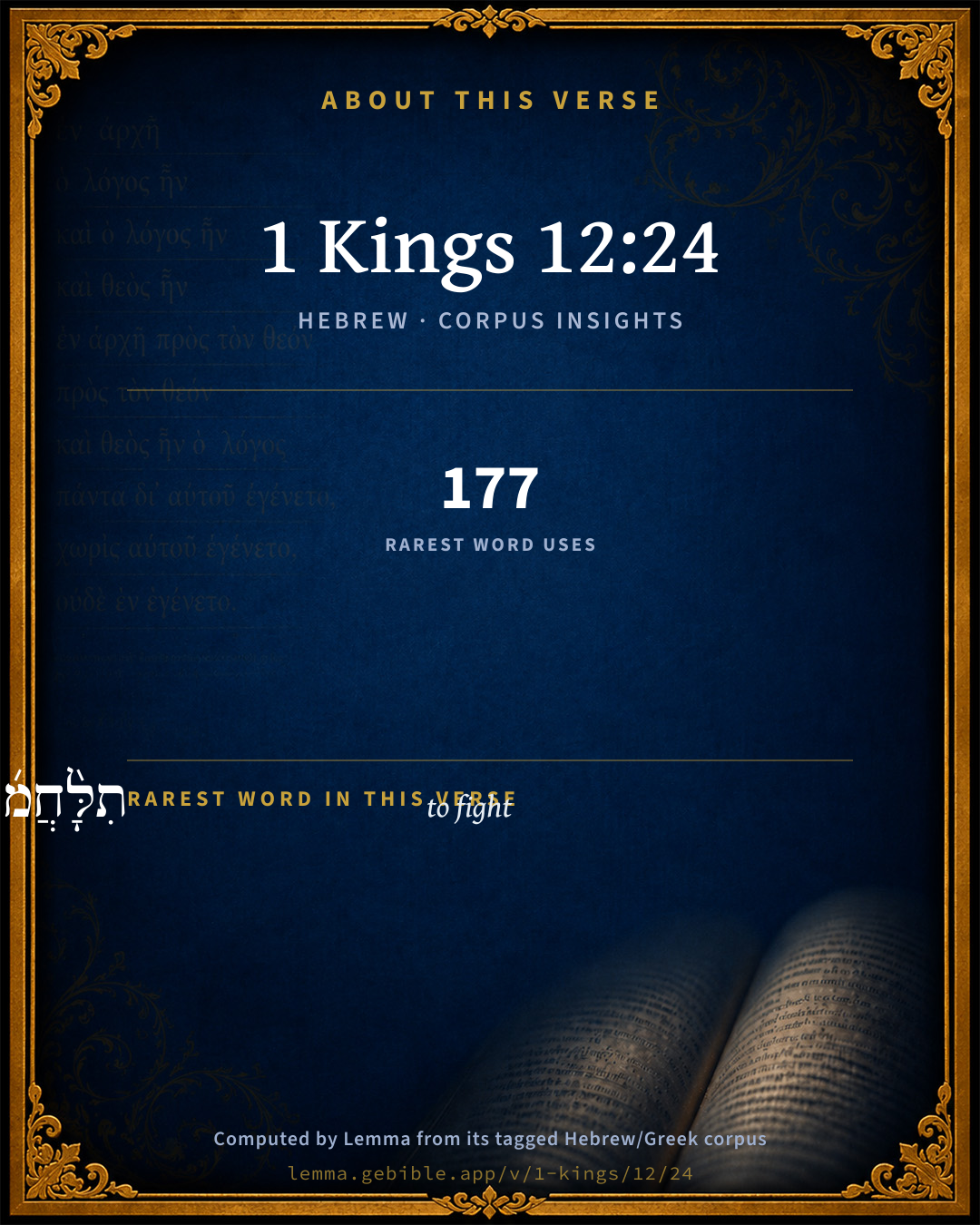
תִלָּ֨חֲמ֜וּן
lâcham
H3898
“to fight”
Verb, Niphal, Imperfect, 2nd Person, Masculine, Plural + Suffix, n
Part of Speech
Verb
Stem
Niphal
Form
Imperfect
Person
2nd Person
Gender
Masculine
Number
Plural
Full BDB Definition

Origin: a primitive root

TWOT: 1104 , 1105

to fight, do battle, make war - (Qal) to fight, do battle - (Niphal) to engage in battle, wage war - (Qal) to eat, use as food
  1. כֹּ֣ה kôh H3541 “thus” Adverb
  2. אָמַ֣ר ʼâmar H559 “to say” Verb, Qal, Perfect, 3rd Person, Masculine, Singular
  3. יְהוָ֡ה Yᵉhôvâh H3068 “LORD” Noun, Proper
  4. לֹֽא lôʼ H3808 “not” Particle, Negative
  5. תַעֲלוּ֩ ʻâlâh H5927 “to go up” Verb, Qal, Imperfect, 2nd Person, Masculine, Plural
  6. וְלֹא lôʼ H3808 “and · not” Conjunction + Particle, Negative
  7. עִם ʻim H5973 “with” Preposition
  8. אֲחֵיכֶ֣ם ʼâch H251 “brothers · your” Noun, Common, Masculine, Plural, Construct + Suffix, Personal, 2nd Person, Masculine, Plural
  9. בְּנֵֽי bên H1121 “sons of” Noun, Common, Masculine, Plural, Construct
  10. יִשְׂרָאֵ֗ל Yisrâʼêl H3478 “Israel” Noun, Proper
  11. שׁ֚וּבוּ shûwb H7725 “return” Verb, Qal, Imperative, 2nd Person, Masculine, Plural
  12. אִ֣ישׁ ʼîysh H376 “man” Noun, Common, Masculine, Singular, Absolute
  13. לְבֵית֔וֹ bayith H1004 “to/for · house · his” Preposition + Noun, Common, Masculine, Singular, Construct + Suffix, Personal, 3rd Person, Masculine, Singular
  14. כִּ֧י kîy H3588 “that” Conjunction
  15. מֵאִתִּ֛י ʼêth H854 “from · with · me” Preposition + Preposition + Suffix, Personal, 1st Person, Common, Singular
  16. נִהְיָ֖ה hâyâh H1961 “to be” Verb, Niphal, Perfect, 3rd Person, Masculine, Singular
  17. הַדָּבָ֣ר dâbâr H1697 “the · word” Particle, Definite Article + Noun, Common, Masculine, Singular, Absolute
  18. הַזֶּ֑ה zeh H2088 “the · this” Particle, Definite Article + Pronoun, Demonstrative, Masculine, Singular
  19. וַיִּשְׁמְעוּ֙ shâmaʻ H8085 “and · to hear” Conjunction + Verb, Qal, Sequential Imperfect, 3rd Person, Masculine, Plural
  20. אֶת ʼêth H853 “-” Particle, Direct Object
  21. דְּבַ֣ר dâbâr H1697 “word of” Noun, Common, Masculine, Singular, Construct
  22. יְהוָ֔ה Yᵉhôvâh H3068 “LORD” Noun, Proper
  23. וַיָּשֻׁ֥בוּ shûwb H7725 “and · to return” Conjunction + Verb, Qal, Sequential Imperfect, 3rd Person, Masculine, Plural
  24. לָלֶ֖כֶת yâlak H3212 “to walk” Preposition + Verb, Qal, Infinitive Construct
  25. כִּדְבַ֥ר dâbâr H1697 “like/as · word of” Preposition + Noun, Common, Masculine, Singular, Construct
  26. יְהוָֽה Yᵉhôvâh H3068 “LORD” Noun, Proper

About this verse

These counts appear in no published source. They are computed here, from the morphology-tagged text and Lemma’s own curated glosses. What Lemma adds →

27
words
21
distinct lemmas
Historical
section

Grammatical profile

  • 8 verbs
  • 11 nouns
  • 1 pronoun
  • 2 prepositions
  • 1 conjunction
  • 1 adverb
  • 3 particles

Verb forms

  • אָמַ֣ר Qal · Perfect
  • תַעֲלוּ֩ Qal · Imperfect
  • תִלָּ֨חֲמ֜וּן Niphal · Imperfect
  • שׁ֚וּבוּ Qal · Imperative
  • נִהְיָ֖ה Niphal · Perfect
  • וַיִּשְׁמְעוּ֙ Qal · Sequential Imperfect
  • וַיָּשֻׁ֥בוּ Qal · Sequential Imperfect
  • לָלֶ֖כֶת Qal · Infinitive Construct

Repetition

Words recur within this verse — often emphatic in Hebrew:

  • יְהוָ֡ה LORD H3068 ×3
  • הַדָּבָ֣ר word H1697 ×3
  • שׁ֚וּבוּ to return H7725 ×2
  • לֹֽא not H3808 ×2

Hebrew & Septuagint length

In English translation the verse runs 49 words from the Hebrew and 1262 from the Septuagint (LXX English) — the Septuagint runs noticeably longer here. See the side-by-side →

A rough comparison of the two English renderings, which tokenize alike — not a word-level alignment.

Word counts can differ between the Hebrew and the Greek without any difference in meaning — e.g. the Hebrew direct-object marker אֵת has no separate Greek word, and Greek often adds the article ὁ.

Cross-references

8

Topical passages linked to 1 Kings 12:24 in the Treasury of Scripture Knowledge — connected by theme and wording, ordered by reader-vote popularity; previews shown in the World English Bible.

  • Numbers 14:42 Don't go up, for Yahweh isn't among you; that you not be struck down before your enemies.
  • 1 Kings 11:29–38 It happened at that time, when Jeroboam went out of Jerusalem, that the prophet Ahijah the Shilonite found him in the way; now [Ahijah] had clad himself with a new garment; and they two were alone in the field.
  • 1 Kings 12:15 So the king didn't listen to the people; for it was a thing brought about of Yahweh, that he might establish his word, which Yahweh spoke by Ahijah the Shilonite to Jeroboam the son of Nebat.
  • 2 Chronicles 11:4 Thus says Yahweh, You shall not go up, nor fight against your brothers: return every man to his house; for this thing is of me. So they listened to the words of Yahweh, and returned from going against Jeroboam.
  • 2 Chronicles 25:7–8 But there came a man of God to him, saying, O king, don't let the army of Israel go with you; for Yahweh is not with Israel, [to wit], with all the children of Ephraim.
  • 2 Chronicles 25:10 Then Amaziah separated them, [to wit], the army that had come to him out of Ephraim, to go home again: therefore their anger was greatly kindled against Judah, and they returned home in fierce anger.
  • Hosea 8:4 They have set up kings, but not by me. They have made princes, and I didn't approve. Of their silver and their gold they have made themselves idols, That they may be cut off.
  • 2 Chronicles 28:9–15 But a prophet of Yahweh was there, whose name was Oded: and he went out to meet the host that came to Samaria, and said to them, Behold, because Yahweh, the God of your fathers, was angry with Judah, he has delivered them into your hand, and you have slain them in a rage which has reached up to heaven.

Cross-references courtesy of OpenBible.info (CC BY 4.0).

Hebrew and Greek witnesses Masoretic Hebrew ↔ Greek Septuagint

The same verse in the two great witnesses to the Old Testament, shown verse-for-verse.

Here the Septuagint runs noticeably longer than the Hebrew — LXX2012 (modern English Septuagint) 1262 words vs World English Bible 49. A rough length comparison of the two English translations, not a word-level alignment — read both below.

These are two independent witnesses, not word-aligned to each other, and the Septuagint is shown in lemma (dictionary) form.

Hebrew 1 Kings 12:24 Masoretic · Westminster Leningrad Codex

כֹּ֣ה אָמַ֣ר יְהוָ֡ה לֹֽא תַעֲלוּ֩ וְלֹא תִלָּ֨חֲמ֜וּן עִם אֲחֵיכֶ֣ם בְּנֵֽי יִשְׂרָאֵ֗ל שׁ֚וּבוּ אִ֣ישׁ לְבֵית֔וֹ כִּ֧י מֵאִתִּ֛י נִהְיָ֖ה הַדָּבָ֣ר הַזֶּ֑ה וַיִּשְׁמְעוּ֙ אֶת דְּבַ֣ר יְהוָ֔ה וַיָּשֻׁ֥בוּ לָלֶ֖כֶת כִּדְבַ֥ר יְהוָֽה

Thus says Yahweh, You shall not go up, nor fight against your brothers the children of Israel: return every man to his house; for this thing is of me. So they listened to the word of Yahweh, and returned and went their way, according to the word of Yahweh.

World English Bible · Public Domain

Greek LXX 1 Kings 12:24 Septuagint · lemma form

ὅδε λέγω κύριος οὐ ἀναβαίνω οὐδέ πολεμέω μετά ὁ ἀδελφός σύ υἱός ἰσραήλ ἀναστρέφω ἕκαστος εἰς ὁ οἶκος ἑαυτοῦ ὅτι παρά ἐγώ γίγνομαι ὁ ῥῆμα οὗτος καί ἀκούω ὁ λόγος κύριος καί καταπαύω ὁ πορεύομαι κατά ὁ ῥῆμα κύριος καί ὁ βασιλεύς σαλωμών κοιμάω μετά ὁ πατήρ αὐτός καί θάπτω μετά ὁ πατήρ αὐτός ἐν πόλις δαυίδ καί βασιλεύω ροβοαμ υἱός αὐτός ἀντί αὐτός ἐν ἰερουσαλήμ υἱός εἰμί ἑκκαίδεκα ἔτος ἐν ὁ βασιλεύω αὐτός καί δώδεκα ἔτος βασιλεύω ἐν ἰερουσαλήμ καί ὄνομα ὁ μήτηρ αὐτός νααναν θυγάτηρ αναν υἱός ναας βασιλεύς υἱός αμμων καί ποιέω ὁ πονηρός ἐνώπιον κύριος καί οὐ πορεύομαι ἐν ὁδός δαυίδ ὁ πατήρ αὐτός καί εἰμί ἄνθρωπος ἐκ ὄρος ἐφράιμ δοῦλος ὁ σαλωμών καί ὄνομα αὐτός ιεροβοαμ καί ὄνομα ὁ μήτηρ αὐτός σαριρα γυνή πόρνη καί δίδωμι αὐτός σαλωμών εἰς ἄρχων σκυτάλη ἐπί ὁ ἄρσις οἶκος ιωσηφ καί οἰκοδομέω ὁ σαλωμών ὁ σαριρα ὁ ἐν ὄρος ἐφράιμ καί εἰμί αὐτός ἅρμα τριακόσιοι ἵππος οὗτος οἰκοδομέω ὁ ἄκρος ἐν ὁ ἄρσις οἶκος ἐφράιμ οὗτος συνκλείω ὁ πόλις δαυίδ καί εἰμί ἐπιαἴρω ἐπί ὁ βασιλεία καί ζητέω σαλωμών θανατόω αὐτός καί φοβέω καί ἀποδιδράσκω αὐτός πρός σουσακιμ βασιλεύς αἴγυπτος καί εἰμί μετά αὐτός ἕως ἀποθνήσκω σαλωμών καί ἀκούω ιεροβοαμ ἐν αἴγυπτος ὅτι θνήσκω σαλωμών καί λαλέω εἰς ὁ οὖς σουσακιμ βασιλεύς αἴγυπτος λέγω ἐκ ἀποστέλλω ἐγώ καί ἀποἔρχομαι ἐγώ εἰς ὁ γῆ ἐγώ καί εἶπον αὐτός σουσακιμ αἰτέω τις αἴτημα καί δίδωμι σύ καί σουσακιμ δίδωμι ὁ ιεροβοαμ ὁ ανω ἀδελφή θεκεμινας ὁ πρεσβύτερος ὁ γυνή αὐτός αὐτός εἰς γυνή οὗτος εἰμί μέγας ἐν μέσος ὁ θυγάτηρ ὁ βασιλεύς καί τίκτω ὁ ιεροβοαμ ὁ αβια υἱός αὐτός καί εἶπον ιεροβοαμ πρός σουσακιμ ὄντως ἐκ ἀποστέλλω ἐγώ καί ἀποἔρχομαι καί ἐκἔρχομαι ιεροβοαμ ἐκ αἴγυπτος καί ἔρχομαι εἰς γῆ σαριρα ὁ ἐν ὄρος ἐφράιμ καί συνἄγω ἐκεῖ πᾶς σκῆπτρον ἐφράιμ καί οἰκοδομέω ιεροβοαμ ἐκεῖ χάραξ καί ἀρρωστέω ὁ παιδάριον αὐτός ἀρρωστία κραταιός σφόδρα καί πορεύομαι ιεροβοαμ ἐπιἐρωτάω ὑπέρ ὁ παιδάριον καί εἶπον πρός ανω ὁ γυνή αὐτός ἀναἵστημι καί πορεύομαι ἐπιἐρωτάω ὁ θεός ὑπέρ ὁ παιδάριον εἰ ζάω ἐκ ὁ ἀρρωστία αὐτός καί ἄνθρωπος εἰμί ἐν σηλω καί ὄνομα αὐτός αχια καί οὗτος εἰμί υἱός ἑξήκοντα ἔτος καί ῥῆμα κύριος μετά αὐτός καί εἶπον ιεροβοαμ πρός ὁ γυνή αὐτός ἀναἵστημι καί λαμβάνω εἰς ὁ χείρ σύ ὁ ἄνθρωπος ὁ θεός ἄρτος καί κολλύριον ὁ τέκνον αὐτός καί σταφυλή καί στάμνος μέλι καί ἀναἵστημι ὁ γυνή καί λαμβάνω εἰς ὁ χείρ αὐτός ἄρτος καί δύο κολλύριον καί σταφυλή καί στάμνος μέλι ὁ αχια καί ὁ ἄνθρωπος πρεσβύτερος καί ὁ ὀφθαλμός αὐτός ἀμβλυωπέω ὁ βλέπω καί ἀναἵστημι ἐκ σαριρα καί πορεύομαι καί γίγνομαι εἰςἔρχομαι αὐτός εἰς ὁ πόλις πρός αχια ὁ σηλωνίτης καί εἶπον αχια ὁ παιδάριον αὐτός ἐκἔρχομαι δή εἰς ἀπαντή ανω ὁ γυνή ιεροβοαμ καί εἶπον αὐτός εἰςἔρχομαι καί μή ἵστημι ὅτι ὅδε λέγω κύριος σκληρός ἐγώ ἐπι ἀποστέλλω ἐπί σύ καί εἰςἔρχομαι ανω πρός ὁ ἄνθρωπος ὁ θεός καί εἶπον αὐτός αχια ἵνα τίς ἐγώ φέρω ἄρτος καί σταφυλή καί κολλύριον καί στάμνος μέλι ὅδε λέγω κύριος ἰδού σύ ἀποἔρχομαι ἀπό ἐγώ καί εἰμί εἰςἔρχομαι σύ ὁ πύλη εἰς σαριρα καί ὁ κοράσιον σύ ἐκἔρχομαι σύ εἰς συνάντησις καί εἶπον σύ ὁ παιδάριον θνήσκω ὅτι ὅδε λέγω κύριος ἰδού ἐγώ ἐκὀλεθρεύω ὁ ιεροβοαμ οὐρέω πρός τοῖχος καί εἰμί ὁ θνήσκω ὁ ιεροβοαμ ἐν ὁ πόλις καταἐσθίω ὁ κύων καί ὁ θνήσκω ἐν ὁ ἀγρός καταἐσθίω ὁ πετεινόν ὁ οὐρανός καί ὁ παιδάριον κόπτω οὐαί κύριος ὅτι εὑρίσκω ἐν αὐτός ῥῆμα καλός περί ὁ κύριος καί ἀποἔρχομαι ὁ γυνή ὡς ἀκούω καί γίγνομαι ὡς εἰςἔρχομαι εἰς ὁ σαριρα καί ὁ παιδάριον ἀποθνήσκω καί ἐκἔρχομαι ὁ κραυγή εἰς ἀπαντή καί πορεύομαι ιεροβοαμ εἰς σικιμα ὁ ἐν ὄρος ἐφράιμ καί συνἀθροίζω ἐκεῖ ὁ φυλή ὁ ἰσραήλ καί ἀναβαίνω ἐκεῖ ροβοαμ υἱός σαλωμών καί λόγος κύριος γίγνομαι πρός σαμαιας ὁ ελαμι λέγω λαμβάνω σεαυτοῦ ἱμάτιον καινός ὁ οὐ εἰςἔρχομαι εἰς ὕδωρ καί ῥηγνύναι αὐτός δώδεκα ῥήγμα καί δίδωμι ὁ ιεροβοαμ καί εἶπον αὐτός ὅδε λέγω κύριος λαμβάνω σεαυτοῦ δέκα ῥήγμα ὁ περιβάλλω σύ καί λαμβάνω ιεροβοαμ καί εἶπον σαμαιας ὅδε λέγω κύριος ἐπί ὁ δέκα φυλή ὁ ἰσραήλ καί εἶπον ὁ λαός πρός ροβοαμ υἱός σαλωμών ὁ πατήρ σύ βαρύνω ὁ κλοιός αὐτός ἐπί ἐγώ καί βαρύνω ὁ βρῶμα ὁ τράπεζα αὐτός καί νῦν εἰ κουφίζω σύ ἐπί ἐγώ καί δουλεύω σύ καί εἶπον ροβοαμ πρός ὁ λαός ἔτι τρεῖς ἡμέρα καί ἀποκρίνω σύ ῥῆμα καί εἶπον ροβοαμ εἰςἄγω ἐγώ ὁ πρεσβύτερος καί συνβουλεύω μετά αὐτός τίς ἀποκρίνω ὁ λαός ῥῆμα ἐν ὁ ἡμέρα ὁ τρίτος καί λαλέω ροβοαμ εἰς ὁ οὖς αὐτός καθώς ἀποστέλλω ὁ λαός πρός αὐτός καί εἶπον ὁ πρεσβύτερος ὁ λαός οὕτως λαλέω πρός σύ ὁ λαός καί διασκεδάζω ροβοαμ ὁ βουλή αὐτός καί οὐ ἀρέσκω ἐνώπιον αὐτός καί ἀποστέλλω καί εἰςἄγω ὁ σύντροφος αὐτός καί λαλέω αὐτός ὁ αὐτός καί οὗτος ἀποστέλλω πρός ἐγώ λέγω ὁ λαός καί εἶπον ὁ σύντροφος αὐτός οὕτως λαλέω πρός ὁ λαός λέγω ὁ μικρότης ἐγώ παχύς ὑπέρ ὁ ὀσφύς ὁ πατήρ ἐγώ ὁ πατήρ ἐγώ μαστιγόω σύ μάστιξ ἐγώ δέ καταἄρχω σύ ἐν σκορπίος καί ἀρέσκω ὁ ῥῆμα ἐνώπιον ροβοαμ καί ἀποκρίνω ὁ λαός καθώς συνβουλεύω αὐτός ὁ σύντροφος αὐτός ὁ παιδάριον καί εἶπον πᾶς ὁ λαός ὡς ἀνήρ εἷς ἕκαστος ὁ πλησίον αὐτός καί ἀνακράζω ἅπας λέγω οὐ μερίς ἐγώ ἐν δαυίδ οὐδέ κληρονομία ἐν υἱός ιεσσαι εἰς ὁ σκήνωμα σύ ἰσραήλ ὅτι οὗτος ὁ ἄνθρωπος οὐ εἰς ἄρχων οὐδέ εἰς ἡγέομαι καί διασπείρω πᾶς ὁ λαός ἐκ σικιμα καί ἀποἔρχομαι ἕκαστος εἰς ὁ σκήνωμα αὐτός καί κατακρατέω ροβοαμ καί ἀποἔρχομαι καί ἀναβαίνω ἐπί ὁ ἅρμα αὐτός καί εἰςἔρχομαι εἰς ἰερουσαλήμ καί πορεύομαι ὀπίσω αὐτός πᾶς σκῆπτρον ιουδα καί πᾶς σκῆπτρον βενιαμίν καί γίγνομαι ἐνἵστημι ὁ ἐνιαυτός καί συνἀθροίζω ροβοαμ πᾶς ἀνήρ ιουδα καί βενιαμίν καί ἀναβαίνω ὁ πολεμέω πρός ιεροβοαμ εἰς σικιμα καί γίγνομαι ῥῆμα κύριος πρός σαμαιας ἄνθρωπος ὁ θεός λέγω λέγω ὁ ροβοαμ βασιλεύς ιουδα καί πρός πᾶς οἶκος ιουδα καί βενιαμίν καί πρός ὁ κατάλειμμα ὁ λαός λέγω ὅδε λέγω κύριος οὐ ἀναβαίνω οὐδέ πολεμέω πρός ὁ ἀδελφός σύ υἱός ἰσραήλ ἀναστρέφω ἕκαστος εἰς ὁ οἶκος αὐτός ὅτι παρά ἐγώ γίγνομαι ὁ ῥῆμα οὗτος καί ἀκούω ὁ λόγος κύριος καί ἀναἔχω ὁ πορεύομαι κατά ὁ ῥῆμα κύριος

Thus says the Lord, You⌃ shall not go up, neither shall you⌃ fight with your brethren the sons of Israel: return each man to his own home; for this thing is from me; and they listened to the word of the Lord, and they ceased from going up, according to the word of the Lord. So king Solomon sleeps with his fathers, and is buried with his fathers in the city of David; and Roboam his son reigned in his stead in Jerusalem, being sixteen years old when he began to reign, and he reigned twelve years in Jerusalem: and his mother's name was Naanan, daughter of Ana son of Naas king of the children of Ammon. And he did that which was evil in the sight of the Lord, and walked not in the way of David his father. And there was a man of mount Ephraim, a servant to Solomon, and his name was Jeroboam: and the name of his mother was Sarira, a harlot: and Solomon made him head of the levies of the house of Joseph: and he built for Solomon Sarira in mount Ephraim; and he had three hundred chariots of horses: he built the citadel with the levies of the house of Ephraim; he fortified the city of David, and aspired to the kingdom, And Solomon sought to kill him; and he was afraid, and escaped to Susakim king of Egypt, and was with him until Solomon died. And Jeroboam heard in Egypt that Solomon was dead: and he spoke in the ears of Susakim king of Egypt, saying, Let me go, and I will depart into my land: and Susakim said to him, Ask and request, and I will grant it you. And Susakim gave to Jeroboam Ano the oldest sister of Thekemina his wife: she was great among the daughters of the king, and she bore to Jerobaom Abia his son: and Jeroboam said to Susakim, Let me indeed go, and I will depart. And Jeroboam departed out of Egypt, and came into the land of Saria that was in mount Ephraim, and there the whole in mount Ephraim, and there the whole tribe of Ephraim assembles, and Jeroboam built a fortress there. And his young child was sick with a very severe sickness; and Jeroboam went to enquire concerning the child: and he said to Ano his wife, Arise, go, enquire of God concerning the child, whether he shall recover from his sickness. Now there was a man in Selom, an his name was Achia: and he was sixty years old, and the word of the Lord was with him. And Jeroboam said to his wife, Arise, and take in your hand loaves for the man of God, and cakes for his children, and grapes, and a pot of honey. And the woman arose, and took in her hand bread, and two cakes, and grapes, and a pot of honey, for Achia: and the man was old, and his eyes were dim, so that he could not see. And she arose, up from Sarira and went; and it came to pass when she had come into the city to Achia the Selonite, that Achia said to his servant, Go out now to meet Ano the wife of Jeroboam, and you shall say to her, Come in, and stand not still: for thus says the Lord, I send grievous tidings to you. And Ano went in to the man of God; and Achia said to her, Why have you brought me bread and grapes, and cakes, and a pot of honey? Thus says the Lord, Behold, you shall depart from me, and it shall come to pass when you have entered into the city, even into Sarira, that your maidens shall come out to meet you, and shall say to you, The child is dead: for thus says the Lord, Behold, I will destroy every male of Jeroboam, and there shall be the dead of Jeroboam in the city, them the dogs shall eat, and him that eat, and he shall lament for the child, saying, Woe is me, Lord! For there has been found in him some good thing touching the Lord. And the woman departed, when she heard this: and it came to pass as she entered into Sarira, that the child died; and there came forth a wailing to meet her. And Jeroboam went to Sikima in mount Ephraim, and assembled there the tribes of Israel; and Roboam the son of Solomon went up there. And the word of the Lord came to Samaias son of Enlami, saying, Take to yourself a new garment which has not gone into the water, and rend it into twelve pieces; and you shall five some to Jeroboam, and shall say to him, thus says the Lord, Take to yourself ten pieces to cover you: and Jeroboam took them: and Samaias said, Thus says the Lord concerning the ten tribes of Israel. And the people said to Roboam the son of Solomon, Your father make his yoke heavy upon us, and made the meat of his table heavy; and now you shall lighten them upon us, and we will serve you. And Roboam said to the people, Wait three days, and I will return you an answer: and Roboam said, Bring in to me the elders, and I will take counsel with them what I shall answer to the people on the third day, So Roboam spoke in their ears, as the people sent to him to say: and the elders of the people said, Thus the people have spoken to you. And Roboam rejected their counsel, and it pleased him not: and he sent and brought in those who had been brought up with him; and he said to them, Thus and thus has the people sent to me to say: and they that had been brought up with him said, Thus shall you speak to the people saying, My little finger shall be thicker than my father's loins; my father scourged you with whips, but I will rule you with scorpions. And the saying pleased Roboam, and he answered the people as the young men, they that were brought up with him, counselled him: and all the people spoke as one man, every one to his neighbor, and they cried out all together, saying, We have no part in David, nor inheritance in the son of Jessae: to they tents, O Israel, every one; for this man is not for a prince or a ruler over us. And all the people was dispersed from Sikima, and they departed every one to his tent: and Roboam strengthened him self and departed, and mounted his chariot, and entered into Jerusalem: and there follow him the whole tribe of Juda, and the whole tribe of Benjamin. And it came to pass at the beginning of the year, that Roboam gathered all the men of Juda and Benjamin, and went up to fight with Jeroboam at Sikima. And the word of the Lord came to Sameas the man of God, saying, Speak to Roboam king of Juda, and to all the house of Juda and Benjamin, and to the remnant of the people, saying, Thus says the Lord, You⌃ shall not go up, neither shall you⌃ fight with your brethren the sons of Israel: return every man to his house, for this thing is from me. And they listened to the word of the Lord, and forbore to go up, according to the word of the Lord.

LXX2012 (modern English Septuagint) · Public Domain

On this verse, The Cambridge Bible for Schools and Colleges discusses the Septuagint’s reading. Read the note in Commentary ↓

Hebrew: Westminster Leningrad Codex (CC BY 4.0). Greek: Septuagint (public domain); English from LXX2012 (modern English Septuagint) (Public Domain). How the Septuagint differs from the Hebrew →

Targum (Aramaic paraphrase)

1

The Targum is the ancient Jewish Aramaic paraphrase of the Hebrew Scriptures — an interpretive translation, not the Hebrew text itself. Onkelos (literal) and Pseudo-Jonathan (expansive) render the Torah, and Jonathan the Prophets. Coverage is partial: where no permissively-licensed English translation exists for a verse, only the Aramaic is shown. This is verse-level text, not a word-by-word alignment to the Hebrew.

  1. Targum Jonathan Prophets (Joshua–Malachi)
    כִּדְנַן אֲמַר יְיָ לָא תִסְקוּן וְלָא תְגִיחוּן קְרָבָא עִם אֲחֵיכוֹן בְּנֵי יִשְׂרָאֵל תּוּבוּ גְבַר לְבֵיתֵיהּ אֲרֵי מִן קֳדָם מֵימְרִי הֲוָה פִתְגָמָא הָדֵין וְקַבִּילוּ לְפִתְגָמָא דַייָ וְתָבוּ לְמֵיזַל כְּפִתְגָמָא דַיְיָ:

    (no public-domain English translation for this verse)

    Targum Jonathan — Aramaic: “Mikraot Gedolot” (public domain). English: “Sefaria Community Translation” (CC0 1.0 (public-domain dedication)); “London "Chaldee Paraphrase," 1871” (public domain). Text via Sefaria.

Commentary

Notes on 1 Kings 12:24 from classic Christian and Jewish commentators (each source and its license shown beneath its notes). The classic Christian expositions comment on the surrounding passage and are grouped to its opening verse, so a note may address several verses; the Jewish commentaries on the Tanakh (Rashi and others) are per-verse, so they appear only where the commentator wrote on this verse.

Lemma curates 59 commentaries, every one of them public domain or Creative Commons licensed, each selected and text-cleaned for this edition rather than reprinted as found. About our sources →

The Cambridge Bible for Schools and Colleges

gen. ed. J. J. S. Perowne

24. for this thing is from me] See above on 1Ki_12:15.

and returned to depart] This is the literal rendering of the original, but is Hebrew rather than English. In R.V. the sense is given by ‘and returned and went their way.’ The LXX. has καὶ κατέπαυσαν τοῦ πορευθῆναι, ‘and they ceased from going.’

At this point the LXX. (Vat.) has a long passage inserted, for an account of which see additional note at the end of this chapter.

On the addition in the LXX. after 1Ki_12:24

This long passage has many peculiarities not only in the arrangement, which differs considerably from that of the narrative of the Hebrew text, but also in some portions of its contents. It takes up the history at 1Ki_11:43 with Solomon’s death and Rehoboam’s accession. But it gives different numbers, both for the age of Rehoboam when he began to reign and for the duration of his reign, from those in the Hebrew text. Instead of 41 years old (as in 1Ki_14:21) he is here stated to have been 16, and to have reigned 12 and not 17 years. It must be owned that the conduct of Rehoboam is much more like that of a very young man than of one who had passed middle-age. The LXX. continues the history with an account of Jeroboam, stating that his mother’s name was Sarira, γυνὴ πόρνη, and that he was put over the levy of the house of Joseph. And Jeroboam built for Solomon a city, also called Sarira, in the hill country of Ephraim, and was employed in the buildings around Jerusalem, and began to aspire to the kingdom. Then follows Solomon’s attempt to kill him, and his flight into Egypt, the king of which is Shishak (Σουσακίμ). After this the story is an exact parallel of what is given in the Hebrew about Hadad (1Ki_11:19-22). Jeroboam finds favour with Shishak, and marries Ano, the elder sister of Thekemina, the wife of the king. He seeks to return, but is hardly allowed to go. At length he comes back to Sarira, gathers the people and fortifies the place. After this follows the sickness of his son and his wife’s visit to Ahijah, somewhat like the narrative in 1Ki_14:1-13. Next we are told of a gathering at Shechem where both Rehoboam and Jeroboam are present, and it is said that on this occasion Shemaiah the prophet (and not Ahijah) rent his garment and gave ten parts to Jeroboam to signify the ten tribes over which he was hereafter to be king. Next comes the account of the popular petition to Rehoboam, and his delay and final answer; then his flight from Shechem to Jerusalem and the preparations for war, which is forbidden by Shemaiah.

Among other peculiarities of this form of the story may be added that the Egyptian wife is said to have been given to Jeroboam after his first request to be allowed to depart, apparently with a view to make him more contented. In the account of the visit of inquiry about the sick child, Ahijah says, ‘Thou shalt go forth from me, and it shall be when thou enterest into the city, into Sarira, that thy maidens shall come out to meet thee, and shall say, ‘The child is dead,’ and further on it is added ‘and the cry of mourning came to meet her.’ There is an addition also to the complaint which is presented to Rehoboam, ‘Thy father made his yoke heavy upon us’, καὶ ἐβάρυνε τὰ βρώματα τῆς τραπέζης αὐτοῦ, ‘and he made burdensome the meat of his table’; a sentence which seems to relate to the demands made so largely on the various districts for the supply of Solomon’s table. A different form is given also when the revolt begins, ‘And all the people spake, as one man, each to his neighbour, and they all cried out, saying, We have no part in David &c.… Each of you to your tents, O Israel, for this man is not to be our prince or our leader.’ It is also said that Rehoboam’s preparation for war was made ἐνισταμένου τοῦ ἐνιαυτοῦ, ‘when the year came round’: a phrase which has very close parallels in the Greek of 2Sa_11:1; 1Ki_20:22; 1Ki_20:26; and is so completely after the Hebrew manner that from this and much beside in the passage we can hardly doubt that it is derived from some Hebrew original. But the numerous inconsistencies found in it make it unworthy to be put in comparison with the story as recorded in the sacred text. It partakes very much of the character of those additions which we find made in the LXX. to the story of Ezra and Daniel, and, though of interest as a specimen of this kind of literature, cannot be accepted as raising any serious questions about the general correctness of the Massoretic text in the history of Jeroboam.

The Cambridge Bible for Schools and Colleges (gen. ed. J. J. S. Perowne; Cambridge University Press, 1878–1918) — public domain. Text from a community e-Sword module.

Trapp's Complete Commentary

John Trapp

1Ki 12:24 Thus saith the LORD, Ye shall not go up, nor fight against your brethren the children of Israel: return every man to his house; for this thing is from me. They hearkened therefore to the word of the LORD, and returned to depart, according to the word of the LORD.

Ver. 24. They hearkened therefore.] This was much; but yet no more than hath been done here in Albion at the command of one of their Bardi, which were a kind of poets or priests among our heathen ancestors

John Trapp, A Commentary or Exposition upon All the Books of the Old and New Testament (1647–1656) — public domain. Text from a community e-Sword module.

The Biblical Illustrator

Joseph S. Exell

1Ki_12:24

This thing is from me.

This thing is from me

I. Some events are specially from God. God is in events which are produced by the sin and the stupidity of men. This breaking up of the kingdom of Solomon into two parts was the result of Solomons sin and Rehoboams folly; yet God was in it. God had nothing to do with the sin or the folly, but in some way, which we can never explain, God was in it alL The most notable instance of this truth is the death of our Lord Jesus Christ; that was the greatest of human crimes, yet it was foreordained and predetermined of the Most High, to whom there can be no such thing as crime, nor any sort of compact with sire How, then, was this thing from God?

1. First, it was so as a matter of prophecy.

2. And, secondly, this thing was from God as a matter of punishment. God setteth evil against evil that He may destroy evil, and He uses that which cometh of human folly that He may manifest His own wisdom.

II. When events are seen to be from the Lord, they are not to be fought against. Rehoboam had summoned his soldiers to go to war against the house of Israel; but, inasmuch as it was from God that the ten tribes had revolted from him, he must not march into the territories of Israel, nor even shoot an arrow against them.

1. The thing that is happening to you is of the Lord, therefore resist it not, for it would be wicked to do so. If it be the Lords will, so may it be.

2. But, next, it is also vain, for what can we do against the will of God?

3. Next, it would be mischievous, and would be sure to bring a greater evil upon us if we did resist.

III. This general principle has many special applications. I believe it often happens that events are most distinctly from the Lord, and when it is so, our right and proper way is to yield to them.

1. A case in which this principle applies is when severe afflictions arise.

2. Sometimes, also, we are troubled by certain disquieting plans proposed by our friends or our children.

3. A very pleasant phase of this same truth is when some singular mercy comes. (C. H. Spurgeon.)

Tracing events back to the final cause

The scribe is more properly said to write than the pen, and he that maketh and keepeth the clock is more properly said to make it go and strike than the wheels and poises that hang upon it, and every workman to effect his works rather than the tools which he useth as his instruments. So the Lord, who is the chief agent and mover in all actions, may more fitly be said to bring to pass all things which are done in the earth than any subordinate causes, as meat to nourish, clothes to keep us warm, the sun to lighten us, friends to provide for us, etc., seeing that they are but His instruments. (T. Downame.)

Gods overrule of national events

Those who care to watch the hand of God in history may soon discern this truth in this incident. The attempts of France to acquire the sovereignty of the British Isles, and the corresponding efforts of the earlier English kings to become what their coins so long styled them, King of France, have all been marvellously foiled by the Almighty Ruler of nations to the true welfare of both. Sir A. Alison has described the scene on the French coast in 1804, when the first Napoleon surveyed the flotilla which was to carry an invading army across the Channel, and saw them broken and dispersed by Him who rules the waves. God will not suffer the might or the cunning of man to wrest the sceptre from His hands.

God in history

The Old Testament philosophy of history regards all events as at once the results of human forces and of Gods purposes, and finds no contradiction in the double aspect. Rehoboam was no less a criminal fool, Jeroboam no less a crafty traitor, because they were both working out Gods purpose. The possible co-existence of freedom of action, necessarily involving responsibility, and Gods sovereignty, is inexplicable, and as certain as it is inexplicable. Metaphysicians and metaphysical theologians may fumble at, or cut, the knot till doomsday, but it will not be untied or denied. Rehoboam ran the ship on the rocks, but God willed that it should be wrecked. But another mystery emerges, for the Divine resolve to shatter the kingdom was due to the thwarting of the Divine purpose in establishing it. Sovereign as that Divine will is, man has power to oppose it and to block its course, and lead to changes of its direction, as we sometimes hear of an army of caterpillars stopping a train. Gods methods vary, but His purposes remain the same. The ship tacks as the wind shifts, but its always steering for the one port. The unifying of the tribes into a kingdom, and the disruption of the kingdom, were equally in the Divine plan, and were both, in a real sense, also the direct results of mens sin and opposition to God. Hence it follows that the history of the world is the judgment of the world. The natural consequences of national acts are the punishments or rewards of these acts. Solomons tyranny, Rehoboams folly, the rebels indifference to the unity of the nation worked out the catastrophe, which was both a political effect, produced by political causes, and a Divine judgment, and was the latter just because it was the former. For nations, and for individuals, God makes whips to scourge them of their vices, and in the mighty maze of human acts, has so ordered the issues of things that every transgression and disobedience receives its just recompense of reward. So the undevout historian is mad. (A. Maclaren, D. D.)

The Biblical Illustrator, edited by Joseph S. Exell (c. 1880s–1900s) — public domain. Text from a community e-Sword module.

Geneva Bible (1599)

Geneva Bible translators

Who of his just judgment will punish the trespasser, and of his mercy spare the innocent people.

Geneva Bible (1599) marginal notes — public domain. Text via Bolls.life.

Adam Clarke's Commentary

Verse 24. For this thing is from me.] That is, the separation of the ten tribes from the house of David.

They - returned to depart] This was great deference, both in Rehoboam and his officers, to relinquish, at the demand of the prophet, a war which they thought they had good grounds to undertake. The remnant of the people heard the Divine command gratefully, for the mass of mankind are averse from war. No nations would ever rise up against each other, were they not instigated to it or compelled by the rulers.

Adam Clarke's Commentary on the Bible (1810–1826) — public domain. Text from a community e-Sword/MySword module.

John Gill's Exposition

And Jeroboam said in his heart, As he was musing about the state of his kingdom and the affairs of it:

now shall the kingdom return to the house of David; such were his fears, unless some method could be taken to prevent it, particularly with respect to religion, which was what his thoughts were employed about.

John Gill's Exposition of the Whole Bible (1746–1763) — public domain (CC PDM 1.0). Text via the HelloAO Bible API.

Haydock's Catholic Bible Commentary

Them. This shews the great authority of Semeias. He wrote the history of Roboam, 2 Paralipomenon xii. 15. He also foretold the irruption of Sesac, to punish the house of Israel; but not to destroy it. (Calmet) --- The obedience of Roboam deserves applause; though it would have been a vain attempt to resist God, who was resolved to punish his family. (Menochius) --- God must have touched the hearts of the leaders, to convince them that he spoke by the mouth of Semeias. (Salien) --- The Vatican Septuagint here subjoins almost the whole history of Jeroboam, improperly. (Haydock) See chap. xiv.

George Leo Haydock (1774–1849), Haydock's Catholic Family Bible and Commentary, 1859 edition — public domain. Excludes Psalms (Douay-Rheims chapter numbering differs from Protestant) and Deuterocanonical books (Catholic canon only).

Matthew Poole's English Annotations

This thing is from me; this event is from my counsel and providence, to punish Solomon’s apostacy, though they procured it by sinful means; and therefore, if you proceed, you must fight with me as well as them.

They hearkened therefore to the word of the Lord; either from conscience of their duty, or because they durst not oppose so potent an adversary.

Matthew Poole's English Annotations on the Holy Bible (1683–1685) — public domain. Text from a community e-Sword/MySword module.

Whedon's Commentary on the Bible

Daniel D. Whedon

24. Returned to depart — They turned from their attempt to go and fight Jeroboam, and went or returned to their homes. The reading in 2Ch_11:4, is, They returned from going against Jeroboam.

Daniel D. Whedon (gen. ed.), Commentary on the Old and New Testaments (1874–1909) — public domain. Text from a community e-Sword module.

The Pulpit Commentary

Thus saith the Lord, Ye shall not go up, nor fight against your brethren a timely reminder of the unity of the race, notwithstanding the division of the kingdom the children of Israel: return every man to his house: for this thing i.e., the division, rupture is lit., was from me. A prophet of Judah now confirms what a prophet of Israel had already announced. They hearkened therefore unto the word of the Lord, and returned not "because they probably saw that a war with the numerically greater, and just now bitterly excited, ten tribes would bring them into a worse condition still" (Bahr), but because of the "word of the Lord." It was the remonstrance of the prophet alone restrained them. They knew their numerical inferiority before, but they nevertheless mustered for battle to depart a common Hebraism. The phrase in 2Ch_11:4, Tk,l,mi WbWvy; "they returned from going," was probably designed as an explanation, according to the word of the Lord.

At this point the Vat. LXX inserts along addition, which differs from, and indeed contradicts, the Hebrew text in some important particulars. Rehoboam is represented as 16 years of age (Hebrews 40), as reigning 12 years (Hebrews 17); his mother is Naanan (Heb. Naamah), and is the daughter of Ana, son of Nahash, king of Ammon. Jeroboam is described as son of Sarira, a harlot. He is appointed by Solomon superintendent of the levy of Ephraim, and builds for him a city Sarira, and also completes the circumvallation of Jerusalem. He has 300 chariots and aims at royalty. Solomon seeking to slay him, he flees to Shishak, king of Egypt, who treats him with distinction, giving him the sister of his own wife in marriage. Here his son Abijah is born, when Rehoboam has been, something like a year upon the throne. After his birth, Jeroboam asks a second time to be released: he returns to his own country, takes up his abode at Sarira, fortifies it, and gathers the tribe of Ephraim round him. Here Abijah falls sick, and the visit to the prophet, narrated in chap. 14., takes place. The child dies; there is general mourning, after which Jeroboam goes to Shechem, and collects the tribes. Here the prophet Shemaiah (not Ahijah) tears a new garment in twelve pieces, gives him ten, and promises him the dominion over ten tribes. After which follow the events of vers. 5-24 of this chapter.

The great circumstantiality of this narrative has led some scholars Dean Stanley among them to prefer it before the Hebrew version. But its details will not bear careful examination, and there is little doubt that it is a compilation of later date. Its untrustworthiness has been well shown among others by Rawlinson, Speaker"s Commentary in loc. But he omits to notice what is perhaps its strongest condemnation, viz., that this LXX addition is in conflict with the LXX (and Hebrews) text of chap. 11. The account of Jeroboam"s marriage with the sister of the queen, e.g., is manifestly a variation of the history of Hadad (ch. 11. ver. 19; see also ver. 22). Nor does it harmonize with the preceding history of this chapter, as given by the LXX

The Pulpit Commentary (1880–1919), ed. H.D.M. Spence-Jones & Joseph S. Exell — public domain. Text from a community e-Sword module.

John Wesley's Explanatory Notes

From me - This event is from my counsel and providence, to punish Solomon's apostasy.

John Wesley, Explanatory Notes Upon the Whole Bible (1754–1765) — public domain. Text via the GEBible commentary corpus.

Lesson kit

Teaching starters — assembled from the data on this page, not authored interpretation. Every prompt links to the verse data it draws on. Edit before teaching.

1 Kings, in the Historical, opens this verse with 27 words (21 distinct Hebrew lemmas). Its most distinctive word is lâcham (“to fight”). The Greek Septuagint runs longer here. A historical commentator’s framing appears above. Read the whole chapter for the surrounding context.

Discussion questions

  1. How does “to fight” (lâcham) shape what this verse is saying?
  2. Numbers 14:42 shares this passage’s theme. How do the two illuminate each other?
  3. “LORD” occurs 3× in this one verse. What is the effect of the repetition?
  4. Compared with the Hebrew, the Septuagint runs longer here. What questions does that raise?
  5. These translations render this verse differently. What is at stake in choosing one wording over another?
  6. The verb «אָמַ֣ר» is Qal Perfect. How does its form color the action?
  7. Reading how The Cambridge Bible for Schools and Colleges and Trapp's Complete Commentary read this verse, where do the two commentators agree and where do they part?

Things to notice

Reading settings

Reading text

Shown beneath each verse's original-language words.

Old Testament
Old Testament edition

Read the OT as the Masoretic Hebrew (MT) or the Greek Septuagint (LXX).

English shown for the Greek Septuagint (in the Hebrew ↔ Greek comparison).

Comparing translations? Open the Compare panel on any verse page to stack up to four side by side.