Ezekiel 39:2

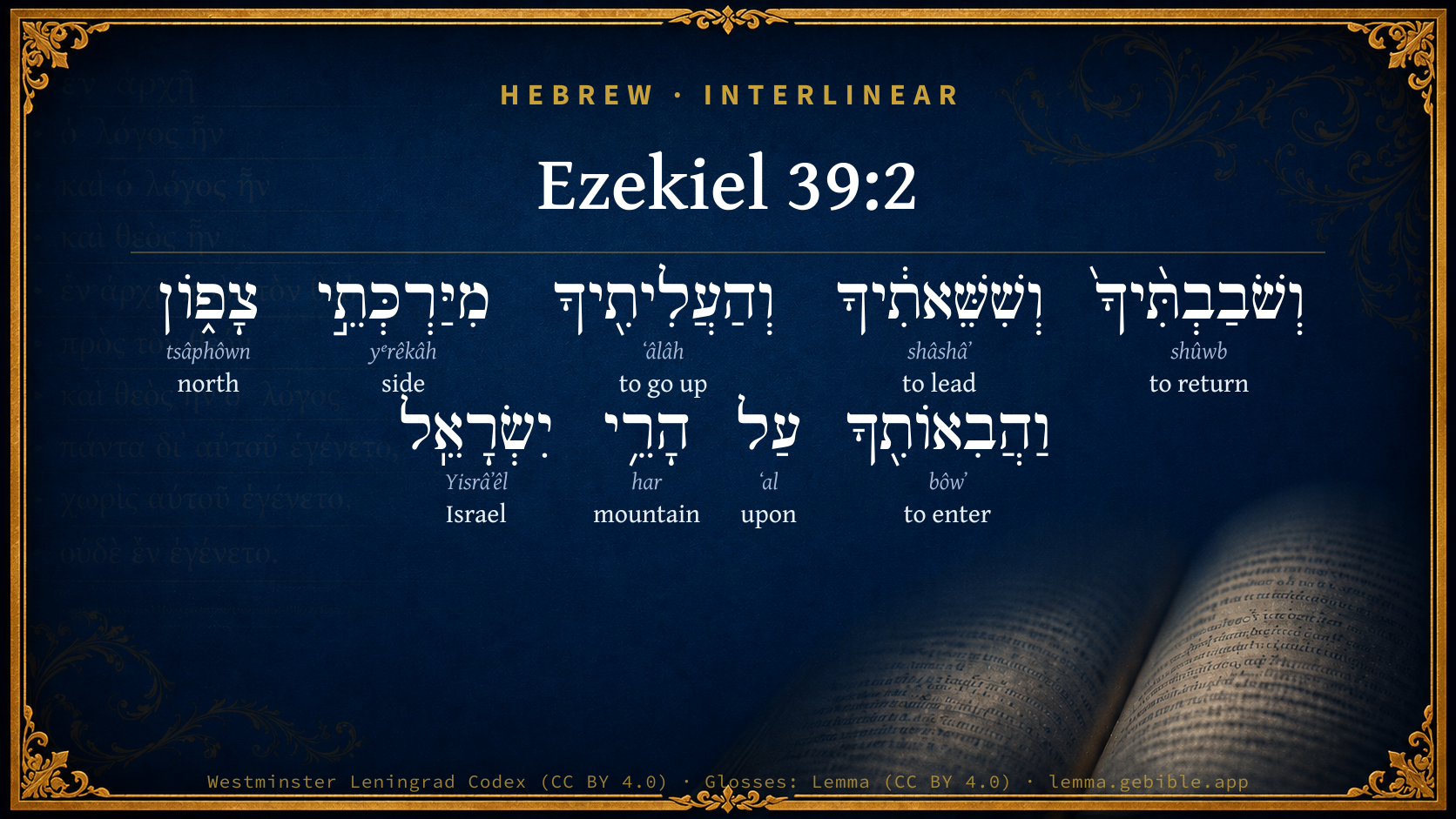
Hebrew (Westminster Leningrad Codex) Ezekiel 39:2 appears in the Hebrew Old Testament. The text above is from the Westminster Leningrad Codex. Each word links to its Strong’s number, a concise gloss, and parsing drawn from the Open Scriptures Hebrew Bible morphology. Click any word for its full Brown-Driver-Briggs (BDB) entry.
Download image
Cite this verse

Ezekiel 39:2 (World English Bible). Public Domain. Lemma interlinear Bible study tool, https://lemma.gebible.app/v/ezekiel/39/2.

Show BibTeX & RIS
BibTeX
RIS
English Translation
and I will turn you about, and will lead you on, and will cause you to come up from the uttermost parts of the north; and I will bring you on the mountains of Israel;
World English Bible · Public Domain
Highlights
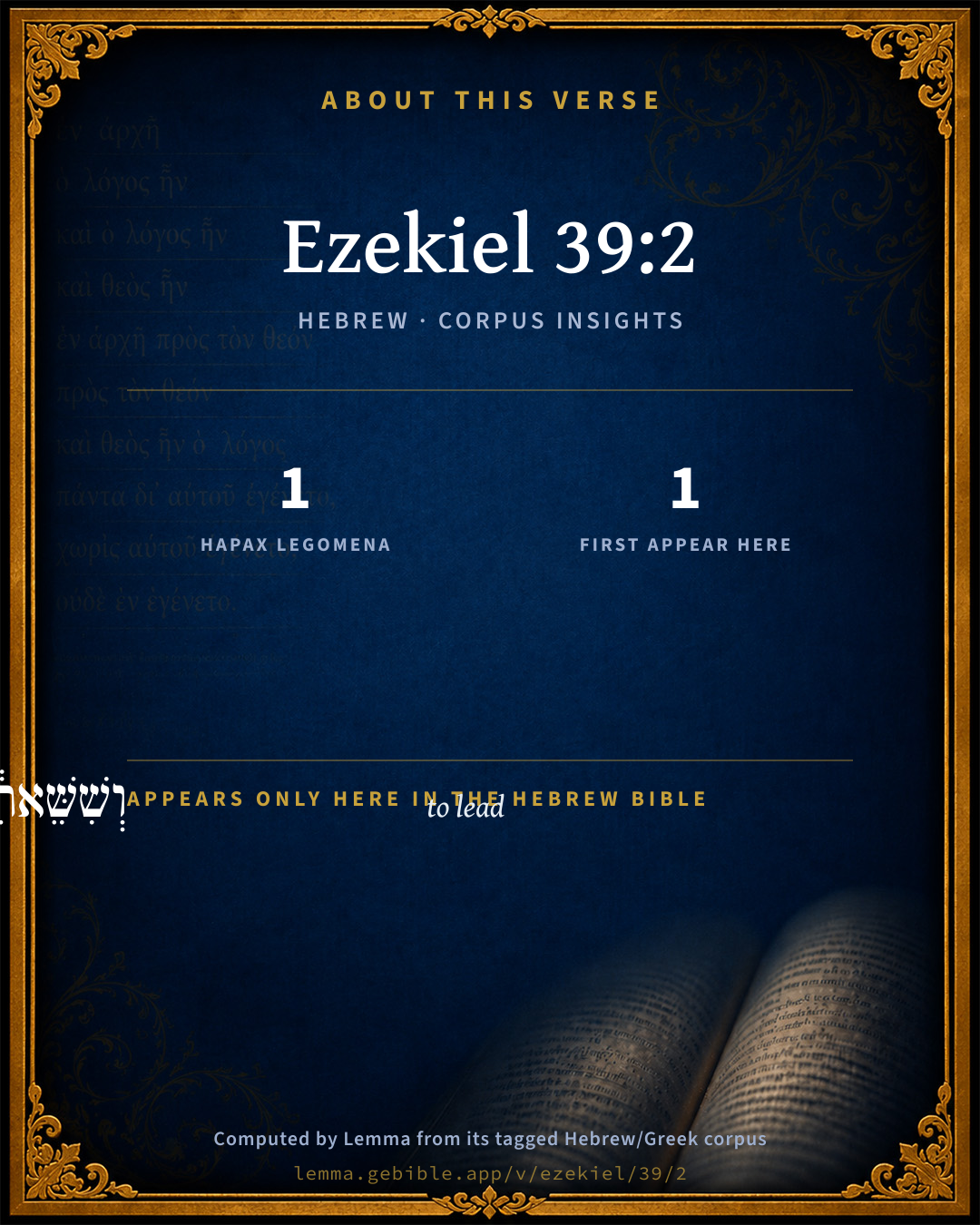
  • 1 hapax legomenon — only here in the Hebrew Bible
  • 1 first appearance in the Hebrew Bible
Full analysis ↓
Download a study sheet

One document with this verse’s original text, its word-by-word gloss line, the meaning frame, cross-references with their text, attributed commentary, and full source and license credits — printable, and it pastes into notes with its structure intact.

This verse Autodidact and up

Study sheet (.html) Plain text (.txt)

A passage Seminary Student

Up to 50 verses in one chapter. A passage sheet keeps up to 6 commentary sources and 12 cross-references per verse, in the order this page ranks them, and says so on the sheet whenever that leaves anything out. Ask for a single verse and you get the Autodidact verse sheet above.

Everything on this page stays free to read, with no account — the sheet is a download of what is already on screen, not access to it.

Want to remove ads? Support Godless Engineer
Compare translations 3

The same verse in 3 English versions, stacked beneath the original-language interlinear above. Click any original word for its lexicon entry.

Each is an independent rendering of the whole verse — the interlinear is not word-aligned to these translations.

Highlighted words mark where these versions differ — a whole-verse word diff, not a word-by-word alignment.

  • World English Bible Public Domain
    and I will turn you about, and will lead you on, and will cause you to come up from the uttermost parts of the north; and I will bring you on the mountains of Israel;
  • King James Version Public Domain
    And I will turn thee back, and leave but the sixth part of thee, and will cause thee to come up from the north parts, and will bring thee upon the mountains of Israel:
  • unfoldingWord Literal Text CC BY-SA 4.0
    I will turn you and lead you on; I will bring you up from the far north and bring you to the mountains of Israel.

unfoldingWord Literal Text — © unfoldingWord, licensed CC BY-SA 4.0. Word-aligned USFM3 via Door43 (git.door43.org/unfoldingWord/en_ult).

Versions to compare (up to 4)

3 of 4 selected

Show all 18 translations

Every available English version of this verse, each an independent rendering of the whole verse.

  • World English Bible Public Domain
    and I will turn you about, and will lead you on, and will cause you to come up from the uttermost parts of the north; and I will bring you on the mountains of Israel;
  • Berean Standard Bible Public Domain
    I will turn you around, drive you along, bring you up from the far north, and send you against the mountains of Israel.
  • Majority Standard Bible Public Domain
    I will turn you around, drive you along, bring you up from the far north, and send you against the mountains of Israel.
  • King James Version Public Domain
    And I will turn thee back, and leave but the sixth part of thee, and will cause thee to come up from the north parts, and will bring thee upon the mountains of Israel:
  • American Standard Version (1901) Public Domain
    and I will turn thee about, and will lead thee on, and will cause thee to come up from the uttermost parts of the north; and I will bring thee upon the mountains of Israel;
  • Revised Version (1885) Public Domain
    and I will turn thee about, and will lead thee on, and will cause thee to come up from the uttermost parts of the north; and I will bring thee upon the mountains of Israel:
  • Geneva Bible (1599) Public Domain
    And I will destroy thee and leaue but the sixt part of thee, and will cause thee to come vp from the North partes and will bring thee vpon the mountaines of Israel:
  • Douay-Rheims (1899) Public Domain
    And I will turn thee round, and I will lead thee out, and will make thee go up from the northern parts: and will bring thee upon the mountains of Israel.
  • Young's Literal Translation Public Domain
    And have turned thee back, and enticed thee, And caused thee to come up from the sides of the north, And brought thee in against mountains of Israel,
  • Literal Standard Version CC BY-SA 4.0
    And have turned you back, and enticed you, || And caused you to come up from the sides of the north, || And brought you in against mountains of Israel,
  • Unlocked Literal Bible CC BY-SA 4.0
    I will turn you and lead you on; I will bring you up from the far north and bring you to the mountains of Israel.
  • unfoldingWord Literal Text CC BY-SA 4.0
    I will turn you and lead you on; I will bring you up from the far north and bring you to the mountains of Israel.
  • Darby Bible Public Domain
    and I will turn thee back, and lead thee, and will cause thee to come up from the uttermost north, and will bring thee upon the mountains of Israel.
  • World Messianic Bible Public Domain
    I will turn you around, will lead you on, and will cause you to come up from the uttermost parts of the north; and I will bring you onto the mountains of Israel.
  • Webster's Bible Public Domain
    And I will turn thee back, and leave but the sixth part of thee, and will cause thee to come from the north parts, and will bring thee upon the mountains of Israel:
  • Free Bible Version CC BY-SA 4.0
    I will send you in a different direction, drag you along, bring you from the distant places of the north, and send you to attack the mountains of Israel.
  • Bible in Basic English Public Domain
    And turning you round, I will be your guide, and make you come up from the inmost parts of the north; I will make you come on to the mountains of Israel:
  • JPS Tanakh (1917) Public Domain
    and I will turn thee about and lead thee on, and will cause thee to come up from the uttermost parts of the north; and I will bring thee upon the mountains of Israel;

Literal Standard Version (2020), Covenant Press — licensed CC BY-SA 4.0. Text via the HelloAO Bible API (eBible.org). Unlocked Literal Bible (unfoldingWord) — licensed CC BY-SA 4.0. Text via the HelloAO Bible API (eBible.org). unfoldingWord Literal Text — © unfoldingWord, licensed CC BY-SA 4.0. Word-aligned USFM3 via Door43 (git.door43.org/unfoldingWord/en_ult). Free Bible Version, Dr. Jonathan Gallagher — licensed CC BY-SA 4.0. Text via the HelloAO Bible API (eBible.org).

Word by word

More ways to search: Search by grammar → Find every occurrence → Compare this word →

Practice this passage: Drill this verse → Learn its vocabulary →

וְשִׁשֵּׁאתִ֔יךָ
shâshâʼ
H8338
“and · to lead · you”
Conjunction + Verb, Piel, Sequential Perfect, 1st Person, Common, Singular + Suffix, Personal, 2nd Person, Masculine, Singular
Part of Speech
Conjunction + Verb
Stem
Piel
Form
Sequential Perfect
Person
1st Person
Gender
Common
Number
Singular
Full BDB Definition

Origin: a primitive root

TWOT: 2474

(Piel) to lead, lead on - meaning apparent
  1. וְשֹׁבַבְתִּ֨יךָ֙ shûwb H7725 “and · to return · you” Conjunction + Verb, Polel, Sequential Perfect, 1st Person, Common, Singular + Suffix, Personal, 2nd Person, Masculine, Singular
  2. וְהַעֲלִיתִ֖יךָ ʻâlâh H5927 “and · to go up · you” Conjunction + Verb, Hiphil, Sequential Perfect, 1st Person, Common, Singular + Suffix, Personal, 2nd Person, Masculine, Singular
  3. מִיַּרְכְּתֵ֣י yᵉrêkâh H3411 “from · sides of” Preposition + Noun, Common, Feminine, Dual, Construct
  4. צָפ֑וֹן tsâphôwn H6828 “north” Noun, Common, Feminine, Singular, Absolute
  5. וַהֲבִאוֹתִ֖ךָ bôwʼ H935 “and · to enter · you” Conjunction + Verb, Hiphil, Sequential Perfect, 1st Person, Common, Singular + Suffix, Personal, 2nd Person, Masculine, Singular
  6. עַל ʻal H5921 “upon” Preposition
  7. הָרֵ֥י har H2022 “mountains of” Noun, Common, Masculine, Plural, Construct
  8. יִשְׂרָאֵֽל Yisrâʼêl H3478 “Israel” Noun, Proper

About this verse

These counts appear in no published source. They are computed here, from the morphology-tagged text and Lemma’s own curated glosses. What Lemma adds →

9
words
9
distinct lemmas
Prophets
section

Notable vocabulary

1 hapax legomenon — a word that appears only here in the entire Hebrew Bible:

  • וְשִׁשֵּׁאתִ֔יךָ to lead H8338

First appearance in Scripture

This word makes its first canonical appearance in the Hebrew Bible here:

  • וְשִׁשֵּׁאתִ֔יךָ to lead H8338

Shared distinctive vocabulary

מִיַּרְכְּתֵ֣י side H3411 occurs in 28 verses of the Hebrew Bible. Also found in:

Grammatical profile

  • 4 verbs
  • 4 nouns
  • 1 preposition

Verb forms

  • וְשֹׁבַבְתִּ֨יךָ֙ Polel · Sequential Perfect
  • וְשִׁשֵּׁאתִ֔יךָ Piel · Sequential Perfect
  • וְהַעֲלִיתִ֖יךָ Hiphil · Sequential Perfect
  • וַהֲבִאוֹתִ֖ךָ Hiphil · Sequential Perfect

Hebrew & Septuagint length

In English translation the verse runs 35 words from the Hebrew and 29 from the Septuagint (LXX English) — closely comparable.

A rough comparison of the two English renderings, which tokenize alike — not a word-level alignment.

Word counts can differ between the Hebrew and the Greek without any difference in meaning — e.g. the Hebrew direct-object marker אֵת has no separate Greek word, and Greek often adds the article ὁ.

Cross-references

5

Topical passages linked to Ezekiel 39:2 in the Treasury of Scripture Knowledge — connected by theme and wording, ordered by reader-vote popularity; previews shown in the World English Bible.

  • Psalms 40:14 Let them be disappointed and confounded together who seek after my soul to destroy it. Let them be turned backward and brought to dishonor who delight in my hurt.
  • Isaiah 37:29 Because of your raging against me, and because your arrogance is come up into my ears, therefore will I put my hook in your nose, and my bridle in your lips, and I will turn you back by the way by which you came.
  • Ezekiel 38:15 You shall come from your place out of the uttermost parts of the north, you, and many peoples with you, all of them riding on horses, a great company and a mighty army;
  • Psalms 68:2 As smoke is driven away, So drive them away. As wax melts before the fire, So let the wicked perish at the presence of God.
  • Daniel 11:40 At the time of the end shall the king of the south contend with him; and the king of the north shall come against him like a whirlwind, with chariots, and with horsemen, and with many ships; and he shall enter into the countries, and shall overflow and pass through.

Cross-references courtesy of OpenBible.info (CC BY 4.0).

Hebrew and Greek witnesses Masoretic Hebrew ↔ Greek Septuagint

The same verse in the two great witnesses to the Old Testament, shown verse-for-verse.

These are two independent witnesses, not word-aligned to each other, and the Septuagint is shown in lemma (dictionary) form.

Hebrew Ezekiel 39:2 Masoretic · Westminster Leningrad Codex

וְשֹׁבַבְתִּ֨יךָ֙ וְשִׁשֵּׁאתִ֔יךָ וְהַעֲלִיתִ֖יךָ מִיַּרְכְּתֵ֣י צָפ֑וֹן וַהֲבִאוֹתִ֖ךָ עַל הָרֵ֥י יִשְׂרָאֵֽל

and I will turn you about, and will lead you on, and will cause you to come up from the uttermost parts of the north; and I will bring you on the mountains of Israel;

World English Bible · Public Domain

Greek LXX Ezekiel 39:2 Septuagint · lemma form

καί συνἄγω σύ καί καταὁδηγέω σύ καί ἀναβιβάζω σύ ἀπό ἔσχατος ὁ βορέας καί ἀναἄγω σύ ἐπί ὁ ὄρος ὁ ἰσραήλ

and I will assemble you, and guide you, and raise you up on the extremity of the north, and I will bring you up upon the mountains of Israel.

LXX2012 (modern English Septuagint) · Public Domain

On this verse, Jamieson, Fausset & Brown discusses the Septuagint’s reading. Read the note in Commentary ↓

Hebrew: Westminster Leningrad Codex (CC BY 4.0). Greek: Septuagint (public domain); English from LXX2012 (modern English Septuagint) (Public Domain). How the Septuagint differs from the Hebrew →

Targum (Aramaic paraphrase)

1

The Targum is the ancient Jewish Aramaic paraphrase of the Hebrew Scriptures — an interpretive translation, not the Hebrew text itself. Onkelos (literal) and Pseudo-Jonathan (expansive) render the Torah, and Jonathan the Prophets. Coverage is partial: where no permissively-licensed English translation exists for a verse, only the Aramaic is shown. This is verse-level text, not a word-by-word alignment to the Hebrew.

  1. Targum Jonathan Prophets (Joshua–Malachi)
    וַאֲשַׁדְלִינָךְ וְאַטְעִינָךְ וְאַסְקִינָךְ מִסְיָפֵי צִפּוּנָא וְאַיְתִינָךְ עַל טוּרֵי יִשְׂרָאֵל:

    (no public-domain English translation for this verse)

    Targum Jonathan — Aramaic: “Mikraot Gedolot” (public domain). English: “Sefaria Community Translation” (CC0 1.0 (public-domain dedication)); “London "Chaldee Paraphrase," 1871” (public domain). Text via Sefaria.

Commentary

Notes on Ezekiel 39:2 from classic Christian and Jewish commentators (each source and its license shown beneath its notes). The classic Christian expositions comment on the surrounding passage and are grouped to its opening verse, so a note may address several verses; the Jewish commentaries on the Tanakh (Rashi and others) are per-verse, so they appear only where the commentator wrote on this verse.

Lemma curates 59 commentaries, every one of them public domain or Creative Commons licensed, each selected and text-cleaned for this edition rather than reprinted as found. About our sources →

Trapp's Complete Commentary

John Trapp

Eze 39:2 And I will turn thee back, and leave but the sixth part of thee, and will cause thee to come up from the north parts, and will bring thee upon the mountains of Israel:

Ver. 2. And I will turn thee back.] Convertam vel conteram te. {a} See Eze 38:3.

And leave but the sixth part of thee.] Or, Strike thee with six plagues, or draw thee back with a hook of six teeth. {as Eze 38:4} Sextabo re.

And will cause thee to come.] This is much and often inculcated, that it is God who brings in and drives out the Church’s enemies. This is a quieting consideration.

{a} In frusta vel scintillas redigam te. - Pintus.

John Trapp, A Commentary or Exposition upon All the Books of the Old and New Testament (1647–1656) — public domain. Text from a community e-Sword module.

Tyndale Open Study Notes

Tyndale Open Resources

39:2 I will turn you around and drive you: The Lord would be bringing Gog against Israel in order to break him.

Tyndale Open Study Notes — © Tyndale Open Resources, licensed CC BY-SA 4.0. Text via the HelloAO Bible API.

Geneva Bible (1599)

Geneva Bible translators

Or, destroy thee with six plagues, as Ezek. 38:22.

Geneva Bible (1599) marginal notes — public domain. Text via Bolls.life.

Jamieson, Fausset & Brown

Robert Jamieson, A. R. Fausset & David Brown

leave but the sixth part of thee--Margin, "strike thee with six plagues" (namely, pestilence, blood, overflowing rain, hailstones, fire, brimstone, Eze 38:22); or, "draw thee back with an hook of six teeth" (Eze 38:4), the six teeth being those six plagues. Rather, "lead thee about" [LUDOVICUS DE DIEU and Septuagint]. As Antiochus was led (to his ruin) to leave Egypt for an expedition against Palestine, so shall the last great enemy of God be.

north parts--from the extreme north [FAIRBAIRN].

Jamieson, Fausset & Brown — Commentary Critical and Explanatory on the Whole Bible (1871) — public domain (CC PDM 1.0). Text via the HelloAO Bible API.

Adam Clarke's Commentary

Verse 2. And leave but the sixth part of thee] The margin has, strike thee with six plagues; or, draw thee back with a hook of six teeth.

Adam Clarke's Commentary on the Bible (1810–1826) — public domain. Text from a community e-Sword/MySword module.

Ellicott's Commentary for English Readers

(2) Leave but the sixth part of thee.—This word occurs only here, and the translation is based on the supposition that it is derived from the word meaning six; but even on this supposition the renderings in the margin are as likely to be right as that of the text. This derivation, however, is probably wrong; all the ancient versions give a sense corresponding to Eze_38:4; Eze_38:16, and also to the clauses immediately before and after, “I will lead thee along.” The greater part of the modern commentators concur in this view.

A Bible Commentary for English Readers, edited by Charles John Ellicott (1878–1897) — public domain. Text from a community e-Sword module.

The Cambridge Bible for Schools and Colleges

gen. ed. J. J. S. Perowne

2. turn thee back … sixth part] Perhaps: turn thee about and lead thee. The word “lead” does not elsewhere occur. A.V. derived from numeral “six.”

The Cambridge Bible for Schools and Colleges (gen. ed. J. J. S. Perowne; Cambridge University Press, 1878–1918) — public domain. Text from a community e-Sword module.

John Gill's Exposition

And I will turn thee back,.... Not from the land of Israel; for thither it is said in the latter part of the text he would bring him; but the meaning is, that he would "turn him about", as the word (w) signifies, in his own land, and lead him about at his pleasure, and bring him out of it, unto the land of Israel; signifying hereby that the providence of God would be greatly concerned in this affair; and in which much glory would be brought unto him by the destruction of such a potent enemy of his people; which is the design of bringing him out; See Gill on Eze 38:4,

and leave but a sixth part of thee; meaning, not that a sixth part only should escape the vengeance of God, and all but a sixth part be destroyed in the land of Israel; for it looks as if the whole army would be utterly destroyed, and none left; but that, when he should come out of his own country upon this expedition, a sixth part of his subjects only should be left behind; five out of six should accompany him; so numerous should his army be, and so drained his country by this enterprise of his. Some render the words, "will draw thee out with an hook of six teeth" (x); that is, out of his own land; and this clause stands in the same place and order as the phrase and "put hooks into thy jaws" does in Eze 38:4 and so may be thought to explain one another, and agrees with what follows: for, as for the sense of it given by Joseph Kimchi and others,

"I will judge thee with six judgments (y), Eze 38:12, pestilence, blood, an overflowing rain, hailstones, fire, and brimstone,''

it must be rejected; seeing as yet the account of his punishment is not come to; only an account is given how and by what means he shall be drawn out of his own land; wherefore much better is the Targum,

"I will persuade thee, and I will seduce thee;''

so Jarchi seems to understand it: and the Septuagint and Arabic versions render it, "I will lead thee", agreeably to what follows:

and will cause thee to come up from the north parts; See Gill on Eze 38:15.

and will bring thee upon the mountains of Israel; not to inherit them, but to fall upon them, as in Eze 39:4.

(w) "circumducam te", Piscator; "circumagam", Grotius. (x) "harpagone sextuplici extraham te", Vinarienses apud Starckius. So Buxtorf. (y) "Sex poenis, sive plagis afficiam te", Munster, Tigurine version.

John Gill's Exposition of the Whole Bible (1746–1763) — public domain (CC PDM 1.0). Text via the HelloAO Bible API.

Albert Barnes' Notes on the Bible

The chief prince - Or, “prince of Rosh.”

And leave but the sixth part of thee - Or, and lead thee along (Septuagint and Vulgate).

Albert Barnes' Notes on the Bible (1834–1885) — public domain. Text from a community e-Sword/MySword module.

Matthew Poole's English Annotations

Turn thee back: see Eze 38:4; or else, when Gog or his assistants shall go into their countries to compose disorders risen since this enterprise was set on foot, they shall return to the rest of the confederates.

Leave but the sixth part of thee: some read, as our margin notes, I will draw thee back with a hook of six teeth, alluding to the drawing fish out of the water; others, I will strike thee with six plagues; others, I will kill five of six, and leave but the sixth part of thee: let me conjecture too, I will leave in thy country but one in six, and I will bring forth thy people with thee in so great numbers, that five of six shall march on this expedition. This runs more compliant with what follows.

Will cause thee to come up; by his all wise providence God will dispose things so, that Gog shall deliberately choose this expedition; so God will bring him, as Eze 38:4. See Eze 38:4,8,15,21.

Matthew Poole's English Annotations on the Holy Bible (1683–1685) — public domain. Text from a community e-Sword/MySword module.

The Pulpit Commentary

I will...leave but the sixth part of thee. The word is derived either from the numeral six, vve, or from the root avv the import of which is uncertain, although a cognate root in Ethiopic suggests the idea of "going on" or "proceeding a meaning Havernick also finds in the Hebrew. The former derivation has been followed by the Authorized Version, which renders in the margin, "I will strike thee with six plagues," or "draw thee back with a hook of six teeth," and by Hengstenberg, With whom Plumptre agrees, "I will six thee," i.e. "afflict thee with six plagues," viz. those mentioned in Eze_38:22. The latter derivation, presumably the more correct, is adopted by the LXX (kaqodogh) the Vulgate (educam), the Revised Version ("I will lead thee on"), and by modern expositors generally. Hitzig and Smend approve of Ewald"s translation, "I entice thee astray, and lead thee with leading, strings."

The Pulpit Commentary (1880–1919), ed. H.D.M. Spence-Jones & Joseph S. Exell — public domain. Text from a community e-Sword module.

John Wesley's Explanatory Notes

The sixth part - I will leave in thy country but one in six.

John Wesley, Explanatory Notes Upon the Whole Bible (1754–1765) — public domain. Text via the GEBible commentary corpus.

Rashi

Rabbi Shlomo Yitzchaki (Rashi)

and I will entice you [Heb. וְשִּׁשֵּׁאתִיךָ,] like וְהִשֵּׁאתִיךָ, I will entice you upon My people, as in (Ps. 89: 23): “No enemy will entice (יַשִׂיא) him.”

Rashi on the Tanakh — English translations: “The Judaica Press complete Tanach with Rashi, translated by A. J. Rosenberg” (CC BY 4.0); “Pentateuch with Rashi's commentary by M. Rosenbaum and A.M. Silbermann, 1929-1934” (public domain); “The Metsudah Tanach series, Lakewood, N.J” (CC BY 4.0); and “The Book of Joshua, Metsudah Publications, 1997” (CC BY 4.0). Text via Sefaria.

Lesson kit

Teaching starters — assembled from the data on this page, not authored interpretation. Every prompt links to the verse data it draws on. Edit before teaching.

Ezekiel, in the Prophets, opens this verse with 9 words (9 distinct Hebrew lemmas). Its most distinctive word is shâshâʼ (“to lead”). A historical commentator’s framing appears above. Read the whole chapter for the surrounding context.

Discussion questions

  1. What does “to lead” (shâshâʼ) contribute to the verse as a whole?
  2. 1 word here appears nowhere else in the Hebrew Bible. Why might the author reach for such rare wording?
  3. This is the first place “to lead” appears in Scripture (first appears here). What does its debut here establish?
  4. How does Genesis 49:13, which shares the word «side», read alongside this verse?
  5. These translations render this verse differently. What is at stake in choosing one wording over another?
  6. «וְשֹׁבַבְתִּ֨יךָ֙» is a Polel Sequential Perfect verb. How does that grammatical form shape the action described?
  7. Compare how Trapp's Complete Commentary and Tyndale Open Study Notes read this verse. Where do they agree or differ?

Things to notice

  • 1 word in this verse appears nowhere else in the Hebrew Bible.
  • 1 word makes its first canonical appearance in Scripture here.
  • These translations choose different wording for 13 words in this verse.
  • 9 distinct Hebrew lemmas span 9 words in this verse.

Reading settings

Reading text

Shown beneath each verse's original-language words.

Old Testament
Old Testament edition

Read the OT as the Masoretic Hebrew (MT) or the Greek Septuagint (LXX).

English shown for the Greek Septuagint (in the Hebrew ↔ Greek comparison).

Comparing translations? Open the Compare panel on any verse page to stack up to four side by side.