Hosea 12:14

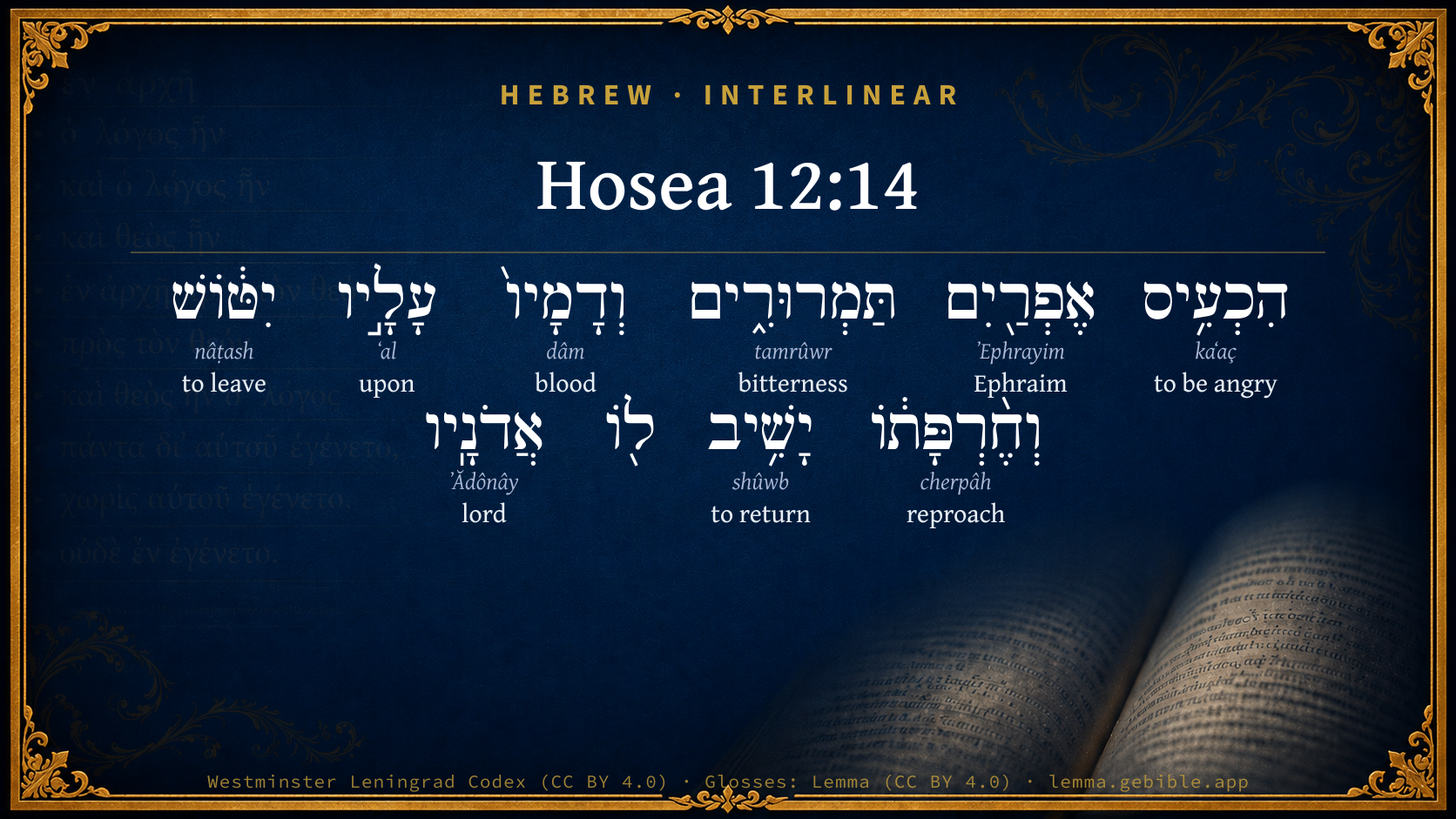
Hebrew (Westminster Leningrad Codex) Hosea 12:14 appears in the Hebrew Old Testament. The text above is from the Westminster Leningrad Codex. Each word links to its Strong’s number, a concise gloss, and parsing drawn from the Open Scriptures Hebrew Bible morphology. Click any word for its full Brown-Driver-Briggs (BDB) entry.
Download image
Cite this verse

Hosea 12:14 (World English Bible). Public Domain. Lemma interlinear Bible study tool, https://lemma.gebible.app/v/hosea/12/14.

Show BibTeX & RIS
BibTeX
RIS
English Translation
Ephraim has provoked to anger most bitterly. Therefore his blood will be left on him, And his his Lord will repay his contempt.
World English Bible · Public Domain
Download a study sheet

One document with this verse’s original text, its word-by-word gloss line, the meaning frame, cross-references with their text, attributed commentary, and full source and license credits — printable, and it pastes into notes with its structure intact.

This verse Autodidact and up

Study sheet (.html) Plain text (.txt)

A passage Seminary Student

Up to 50 verses in one chapter. A passage sheet keeps up to 6 commentary sources and 12 cross-references per verse, in the order this page ranks them, and says so on the sheet whenever that leaves anything out. Ask for a single verse and you get the Autodidact verse sheet above.

Everything on this page stays free to read, with no account — the sheet is a download of what is already on screen, not access to it.

Want to remove ads? Support Godless Engineer
Compare translations 3

The same verse in 3 English versions, stacked beneath the original-language interlinear above. Click any original word for its lexicon entry.

Each is an independent rendering of the whole verse — the interlinear is not word-aligned to these translations.

Highlighted words mark where these versions differ — a whole-verse word diff, not a word-by-word alignment.

  • World English Bible Public Domain
    Ephraim has provoked to anger most bitterly. Therefore his blood will be left on him, And his his Lord will repay his contempt.
  • King James Version Public Domain
    Ephraim provoked him to anger most bitterly: therefore shall he leave his blood upon him, and his reproach shall his LORD return unto him.
  • unfoldingWord Literal Text CC BY-SA 4.0
    Ephraim has provoked bitternesses, and his Lord will leave his bloodguilt on him and will return his reproach to him.

unfoldingWord Literal Text — © unfoldingWord, licensed CC BY-SA 4.0. Word-aligned USFM3 via Door43 (git.door43.org/unfoldingWord/en_ult).

Versions to compare (up to 4)

3 of 4 selected

Show all 18 translations

Every available English version of this verse, each an independent rendering of the whole verse.

  • World English Bible Public Domain
    Ephraim has provoked to anger most bitterly. Therefore his blood will be left on him, And his his Lord will repay his contempt.
  • Berean Standard Bible Public Domain
    Ephraim has provoked bitter anger, so his Lord will leave his bloodguilt upon him and repay him for his contempt.
  • Majority Standard Bible Public Domain
    Ephraim has provoked bitter anger, so his Lord will leave his bloodguilt upon him and repay him for his contempt.
  • King James Version Public Domain
    Ephraim provoked him to anger most bitterly: therefore shall he leave his blood upon him, and his reproach shall his LORD return unto him.
  • American Standard Version (1901) Public Domain
    Ephraim hath provoked to anger most bitterly: therefore shall his blood be left upon him, and his reproach shall his Lord return unto him.
  • Revised Version (1885) Public Domain
    Ephraim hath provoked to anger most bitterly: therefore shall his blood be left upon him, and his reproach shall his Lord return unto him.
  • Geneva Bible (1599) Public Domain
    But Ephraim prouoked him with hie places: therefore shall his blood be powred vpon him, and his reproche shall his Lord reward him.
  • Douay-Rheims (1899) Public Domain
    Ephraim hath provoked me to wrath with his bitterness, and his blood shall come upon him, and his Lord will render his reproach unto him.
  • Young's Literal Translation Public Domain
    Ephraim hath provoked most bitterly, And his blood on himself he leaveth, And his reproach turn back to him doth his Lord!
  • Literal Standard Version CC BY-SA 4.0
    Ephraim has most bitterly provoked, || And he leaves his blood on himself, || And his Lord turns his reproach back to him!”
  • Unlocked Literal Bible CC BY-SA 4.0
    Ephraim has bitterly angered Yahweh. So his Lord will leave his blood on him and will turn back on him his disgrace.
  • unfoldingWord Literal Text CC BY-SA 4.0
    Ephraim has provoked bitternesses, and his Lord will leave his bloodguilt on him and will return his reproach to him.
  • Darby Bible Public Domain
    Ephraim provoked [him] to anger most bitterly; and his Lord shall leave his blood upon him, and recompense unto him his reproach.
  • World Messianic Bible Public Domain
    Ephraim has bitterly provoked anger. Therefore his blood will be left on him, and his Lord will repay his contempt.
  • Webster's Bible Public Domain
    \\12:13\\And by a prophet the LORD brought Israel out of Egypt, and by a prophet was he preserved.
  • Free Bible Version CC BY-SA 4.0
    Ephraim has really upset the Lord, and the Lord will let them have the consequences of their bloodshed and pay them back for their contempt.
  • Bible in Basic English Public Domain
    And by a prophet the Lord made Israel come up out of Egypt, and by a prophet he was kept safe.
  • JPS Tanakh (1917) Public Domain
    (12-15) Ephraim hath provoked most bitterly; therefore shall his blood be cast upon him, and his reproach shall his Lord return unto him.

Literal Standard Version (2020), Covenant Press — licensed CC BY-SA 4.0. Text via the HelloAO Bible API (eBible.org). Unlocked Literal Bible (unfoldingWord) — licensed CC BY-SA 4.0. Text via the HelloAO Bible API (eBible.org). unfoldingWord Literal Text — © unfoldingWord, licensed CC BY-SA 4.0. Word-aligned USFM3 via Door43 (git.door43.org/unfoldingWord/en_ult). Free Bible Version, Dr. Jonathan Gallagher — licensed CC BY-SA 4.0. Text via the HelloAO Bible API (eBible.org).

Word by word

More ways to search: Search by grammar → Find every occurrence → Compare this word →

Practice this passage: Drill this verse → Learn its vocabulary →

תַּמְרוּרִ֑ים
tamrûwr
H8563
“bitterness”
Noun, Common, Masculine, Plural, Absolute
Part of Speech
Noun
Type
Common
Gender
Masculine
Number
Plural
State
Absolute
Full BDB Definition

Origin: from H4843

TWOT: 1248 L

bitterness
  1. הִכְעִ֥יס kaʻaç H3707 “to be angry” Verb, Hiphil, Perfect, 3rd Person, Masculine, Singular
  2. אֶפְרַ֖יִם ʼEphrayim H669 “Ephraim” Noun, Proper
  3. וְדָמָיו֙ dâm H1818 “and · blood · his” Conjunction + Noun, Common, Masculine, Plural, Construct + Suffix, Personal, 3rd Person, Masculine, Singular
  4. עָלָ֣יו ʻal H5921 “upon · him” Preposition + Suffix, Personal, 3rd Person, Masculine, Singular
  5. יִטּ֔וֹשׁ nâṭash H5203 “to leave” Verb, Qal, Imperfect, 3rd Person, Masculine, Singular
  6. וְחֶ֨רְפָּת֔וֹ cherpâh H2781 “and · reproach · his” Conjunction + Noun, Common, Feminine, Singular, Construct + Suffix, Personal, 3rd Person, Masculine, Singular
  7. יָשִׁ֥יב shûwb H7725 “to return” Verb, Hiphil, Imperfect, 3rd Person, Masculine, Singular
  8. אֲדֹנָֽיו ʼĂdônây H136 “Lord · his” Noun, Common, Masculine, Plural, Construct + Suffix, Personal, 3rd Person, Masculine, Singular

About this verse

These counts appear in no published source. They are computed here, from the morphology-tagged text and Lemma’s own curated glosses. What Lemma adds →

10
words
9
distinct lemmas
Prophets
section

Notable vocabulary

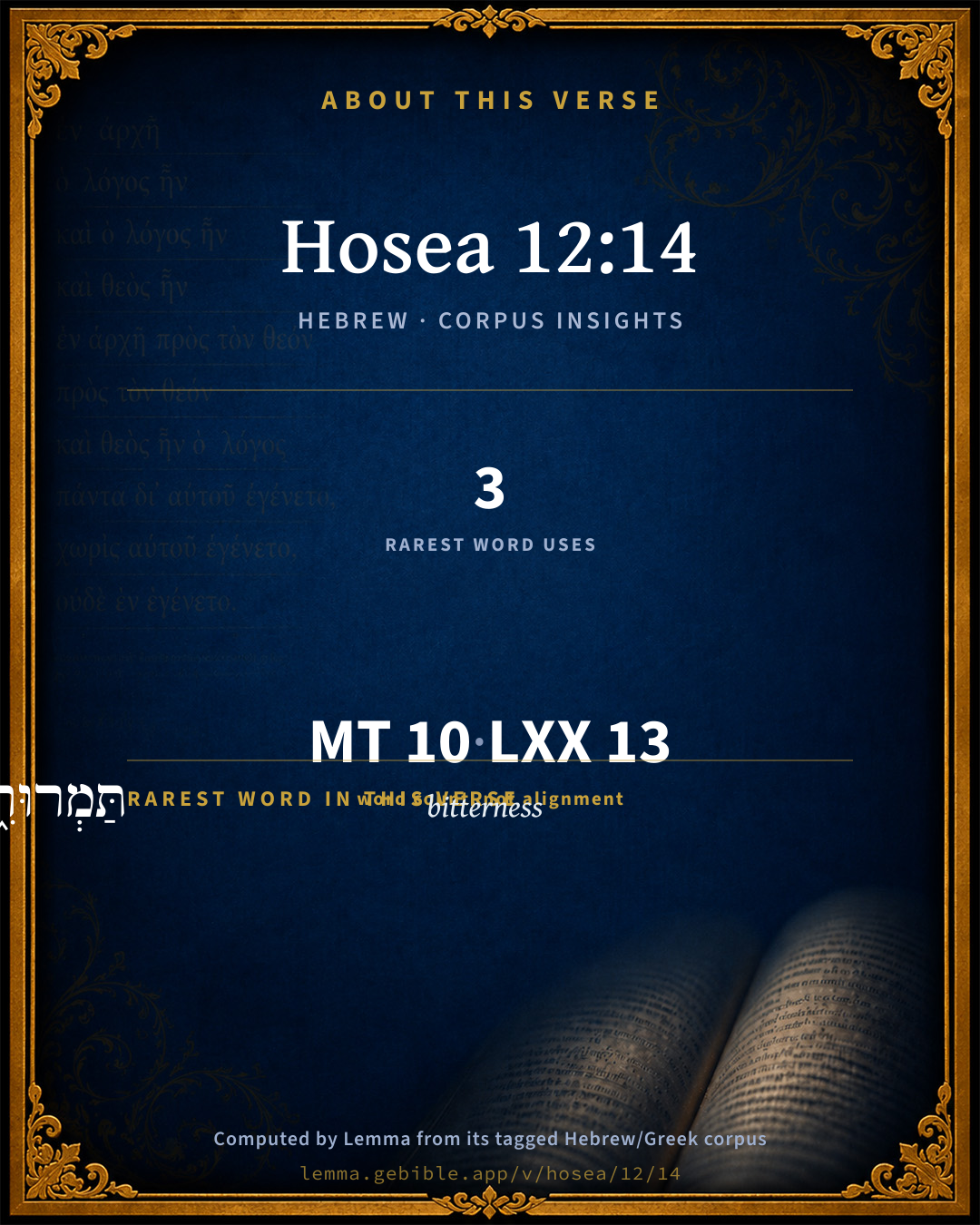
The rarest word here is תַּמְרוּרִ֑ים bitterness H8563 — appearing just 3 times in the whole Hebrew Bible.

Shared distinctive vocabulary

תַּמְרוּרִ֑ים bitterness H8563 occurs in 3 verses of the Hebrew Bible. Also found in:

Grammatical profile

  • 3 verbs
  • 5 nouns
  • 2 prepositions

Verb forms

  • הִכְעִ֥יס Hiphil · Perfect
  • יִטּ֔וֹשׁ Qal · Imperfect
  • יָשִׁ֥יב Hiphil · Imperfect

Hebrew & Septuagint length

In English translation the verse runs 23 words from the Hebrew and 23 from the Septuagint (LXX English) — the same length.

A rough comparison of the two English renderings, which tokenize alike — not a word-level alignment.

Word counts can differ between the Hebrew and the Greek without any difference in meaning — e.g. the Hebrew direct-object marker אֵת has no separate Greek word, and Greek often adds the article ὁ.

In the original languages it is 10 Hebrew tokens and 13 Greek tokens — but the two are counted differently (Hebrew bundles its prefixes and suffixes into one token; the Greek is in lemma form), so that isn’t a like-for-like length.

Cross-references

11

Topical passages linked to Hosea 12:14 in the Treasury of Scripture Knowledge — connected by theme and wording, ordered by reader-vote popularity; previews shown in the World English Bible.

  • Ezekiel 18:13 has given forth on interest, and has taken increase; shall he then live? he shall not live: he has done all these abominations; he shall surely die; his blood shall be on him.
  • Daniel 11:18 After this shall he turn his face to the isles, and shall take many: but a prince shall cause the reproach offered by him to cease; yes, moreover, he shall cause his reproach to turn on him.
  • 2 Kings 17:7–18 It was so, because the children of Israel had sinned against Yahweh their God, who brought them up out of the land of Egypt from under the hand of Pharaoh king of Egypt, and had feared other gods,
  • Deuteronomy 28:37 You shall become an astonishment, a proverb, and a byword, among all the peoples where Yahweh shall lead you away.
  • 1 Samuel 2:30 Therefore Yahweh, the God of Israel, says, I said indeed that your house, and the house of your father, should walk before me forever: but now Yahweh says, Be it far from me; for those who honor me I will honor, and those who despise me shall be lightly esteemed.
  • 2 Samuel 1:16 David said to him, Your blood be on your head; for your mouth has testified against you, saying, I have slain Yahweh's anointed.
  • 1 Kings 2:33–34 So shall their blood return on the head of Joab, and on the head of his seed forever: but to David, and to his seed, and to his house, and to his throne, shall there be peace for ever from Yahweh.
  • Ezekiel 23:2–10 Son of man, there were two women, the daughters of one mother:
  • Ezekiel 24:7–8 For her blood is in the midst of her; she set it on the bare rock; she didn't pour it on the ground, to cover it with dust.
  • Hosea 7:16 They return, but not to the Most High. They are like a faulty bow. Their princes will fall by the sword for the rage of their tongue. This will be their derision in the land of Egypt.
  • Ezekiel 33:5 He heard the sound of the trumpet, and didn't take warning; his blood shall be on him; whereas if he had taken warning, he would have delivered his soul.

Cross-references courtesy of OpenBible.info (CC BY 4.0).

Hebrew and Greek witnesses Masoretic Hebrew ↔ Greek Septuagint

The same verse in the two great witnesses to the Old Testament, shown verse-for-verse.

These are two independent witnesses, not word-aligned to each other, and the Septuagint is shown in lemma (dictionary) form.

Hebrew Hosea 12:14 Masoretic · Westminster Leningrad Codex

הִכְעִ֥יס אֶפְרַ֖יִם תַּמְרוּרִ֑ים וְדָמָיו֙ עָלָ֣יו יִטּ֔וֹשׁ וְחֶ֨רְפָּת֔וֹ יָשִׁ֥יב ל֖וֹ אֲדֹנָֽיו

Ephraim has provoked to anger most bitterly. Therefore his blood will be left on him, And his his Lord will repay his contempt.

World English Bible · Public Domain

Greek LXX Hosea 12:14 Septuagint · lemma form

καί ἐν προφήτης ἀναἄγω κύριος ὁ ἰσραήλ ἐκ αἴγυπτος καί ἐν προφήτης διαφυλάσσω

Ephraim was angry and excited, therefore his blood shall be poured out upon him, and the Lord shall recompense to him his reproach.

LXX2012 (modern English Septuagint) · Public Domain

Hebrew: Westminster Leningrad Codex (CC BY 4.0). Greek: Septuagint (public domain); English from LXX2012 (modern English Septuagint) (Public Domain). How the Septuagint differs from the Hebrew →

Targum (Aramaic paraphrase)

1

The Targum is the ancient Jewish Aramaic paraphrase of the Hebrew Scriptures — an interpretive translation, not the Hebrew text itself. Onkelos (literal) and Pseudo-Jonathan (expansive) render the Torah, and Jonathan the Prophets. Coverage is partial: where no permissively-licensed English translation exists for a verse, only the Aramaic is shown. This is verse-level text, not a word-by-word alignment to the Hebrew.

  1. Targum Jonathan Prophets (Joshua–Malachi)
    וְאַף כַּד נְחַתוּ אֲבָהָתְכוֹן לְמִצְרַיִם נְבִיָא שְׁלַח יְיָ וַאֲסֵיק יַת יִשְׂרָאֵל מִמִצְרַיִם וְעַל יְדֵי נְבִיָא אִתְנְטַר:

    (no public-domain English translation for this verse)

    Targum Jonathan — Aramaic: “Mikraot Gedolot” (public domain). English: “Sefaria Community Translation” (CC0 1.0 (public-domain dedication)); “London "Chaldee Paraphrase," 1871” (public domain). Text via Sefaria.

Commentary

Notes on Hosea 12:14 from classic Christian and Jewish commentators (each source and its license shown beneath its notes). The classic Christian expositions comment on the surrounding passage and are grouped to its opening verse, so a note may address several verses; the Jewish commentaries on the Tanakh (Rashi and others) are per-verse, so they appear only where the commentator wrote on this verse.

Lemma curates 59 commentaries, every one of them public domain or Creative Commons licensed, each selected and text-cleaned for this edition rather than reprinted as found. About our sources →

Trapp's Complete Commentary

John Trapp

Hos 12:14 Ephraim provoked [him] to anger most bitterly: therefore shall he leave his blood upon him, and his reproach shall his Lord return unto him.

Ver. 14. Ephraim hath provoked him to anger, most bitterly] Heb. with bitterness, or unto bitter displeasure, or with bitter things, that is, sins that embitter God’s Spirit and put thunderbolts into his hands. Excusserunt ex suavissimo pectore meo suavitatem. As a bee stings not till provoked, so neither doth God punish till there be no remedy, 2Ch 36:16. If Ephraim will provoke him to anger (which he will not dare to do to his landlord), if he will put it to the trial, whether God can be angry, as those did (εδοκιμασαν), Heb 3:9, he shall know the power of his wrath, Psa 90:11, he shall feel, to his sorrow, that it is an evil thing and bitter, that he hath forsaken the Lord, and that his fear is not in them, Jer 2:19. There will be bitterness in the end. Principium dulce est, sed finis amoris amarus. Amor amaror. Lust is a lie, as Amnon proved. "Her end is bitter as wormwood, though her lips drop as an honeycomb," saith Solomon of sinful pleasure, Pro 5:3. It is like Jonathan’s honey, or Esau’s pottage, or Judas’ thirty pence, which he would gladly have been rid of, but could not. Those that provoke God shall one day hear, "Do ye provoke me to anger? Are ye stronger than I?" they shall be taught to meddle with their match, and not to contend with him that is mightier than they, Ecc 6:10; they shall cry out in the bitterness of their souls, as Lam 3:15, "He hath filled me with bitternesses, he hath made me drunk with wormwood." And God shall reply, as Jer 4:18, "Thy way and thy doings have procured these things unto thee; and this is thy wickedness, because it is bitter."

Therefore shall he leave his blood upon him] God shall bring upon him deserved destruction; he shall bring him into the fire, and leave him there, Eze 22:20; the guilt of his sin shall remain upon his soul, and then punishment cannot be far off. See Eze 24:7-8; cf. Eze 18:13 Jos 2:19. Or, the enemy shall leave him all bloody.

And his reproach shall his Lord return unto him] His Lord, not the Assyrian, as some sense it, but his liege lord (whom he hath reproached, by changing his glory into the similitude of a calf, and other corruptible things), shall cry quittance with him, as Hos 12:2, cast utter contempt upon him, according to 1Sa 2:30, and make him know that he is his Lord.

John Trapp, A Commentary or Exposition upon All the Books of the Old and New Testament (1647–1656) — public domain. Text from a community e-Sword module.

Albert Barnes' Notes on the Bible

Ephraim provoked - the Lord most bitterly Literally, “with bitternesses,” i. e., with most heinous sins, such as are most grievously displeasing to God, and were a most bitter requital of all His goodness. “Wherefore He shall leave” (or, “cast”) “his blood” (literally, “bloods”) “upon him.” The plural “bloods” expresses the manifoldness of the bloodshed . It is not used in Holy Scripture of mere guilt. Ephraim had shed blood profusely, so that it ran like water in the land (see the notes above at Hos 4:2; Hos 5:2). He had sinned with a high hand against God, in destroying man made in the image of God. Amid that bloodshed, had been the blood not of the innocent only, but of those whom God sent to rebuke them for their idolatry, their rapine, their bloodshed. “Jezebel cut off the prophets of the Lord” 1Ki 18:4, as far as in her lay, with a complete excision. Ephraim thought his sins past; they were out of his sight; he thought that they were out of God’s also; but they were laid up with God; and God, the prophet says, would cast them down upon him, so that they would crush him.

And his reproach shall his Lord return unto him - For the blood which he had shed, should his own blood be shed, for the reproaches which he had in divers ways cast against God or brought upon Him, he should inherit reproach. Those who rebel against God, bring reproach on Him by their sins, reproach Him by their excuses for their sins reproach Him in those whom He sends to recall them from their sins, reproach Him for chastening them for their sins. All who sin against the knowledge of God, bring reproach upon Him by acting sinfully against that knowledge. So Nathan says to David, “Thou hast given much occasion to the enemies of God to blaspheme” 2Sa 12:14. The reproachful words of the enemies of God are but the echo of the opprobrious deeds of His unfaithful servants. The reproach is therefore, in an special manner, “their reproach” who caused it. All Israel’s idolatries had this aggravation.

Their worship of the calves or of Baal or of any other gods of the nations, was a triumph of the false gods over God. Then, all sin must find some plea for itself, by impugning the wisdom or goodness of God who forbad it. Jeroboam, and Ephraim by adhering to Jeroboam’s sin reproached God, as though the going up to Jerusalem was a hard service. “It is too much for you to go up to Jerusalem; Behold thy gods, O Israel, which brought thee up out of the land of Egypt.” : “It was an open injury and reproach to God, to attribute to dead lifeless things those great and wonderful things done by Him for them.” All the reproach, which they, in these ways, brought, or cast upon God, he says, “his Lord shall return” or “restore” to them. Their’s it was; He would give it back to them, as He says, “Them that honor Me, I will honor; and they that despise Me, shall be lightly esteemed” 1Sa 2:30.

Truly shame and reproach have been for centuries the portion of God’s unfaithful people. To those who are lost, He gives back their reproach, in that they “rise to reproaches Dan 12:2 and everlasting abhorrence . It is an aggravation of this misery, that He who shall “give back to him” his reproach, had been “his God.” Since “his God” was against him, who could be for him? “For whither should we go for refuge, save to Him? If we find wrath with Him, with whom should we find ruth?” Ephraim did not, the sinner will not, allow God to be “his God” in worship and service and love: but whether he willed or no, God would remain his Lord. He was, and might still have been their Lord for good; they would not have Him so, and so they should find Him still their Lord, as an Avenger, returning their own evil to them.

Albert Barnes' Notes on the Bible (1834–1885) — public domain. Text from a community e-Sword/MySword module.

The Biblical Illustrator

Joseph S. Exell

Hos_12:14

Therefore shall He leave his blood upon him.

The blood-figure: sin and guilt left upon the sinner

That is, he shall bring his sin upon his own head. Those that be wilful in sin, their blood be upon their own heads that is the meaning. Never stand excusing any more, you have warning enough. If you will go on in your way, the blood be upon your own head, you will undo yourselves, and there is no help. Mark the phrase, Therefore shall He leave his blood upon him. When God brings the guilt and punishment of sin on a mans own head, and there leaves it, that is sad indeed. It is happiness when it may be said of God, He has made the sin and the guilt to pass away from the sinner. But on the other side, when God leaves the sin, with its attendant guilt, upon the sinner, there is woe indeed. The Lord many times brings His saints unto the fire of afflictions, but He will not leave them there; but when He brings the wicked into the fire, there He leaves them. (Jeremiah Burroughs.)

.

The Biblical Illustrator, edited by Joseph S. Exell (c. 1880s–1900s) — public domain. Text from a community e-Sword module.

Joseph Benson's Commentary

Hos 12:14. Ephraim provoked him to anger, &c. — Notwithstanding all God’s favours showed to these people and their ancestors, they provoked him by their idolatries and other sins in a most outrageous manner. The word תמורים, translated, most bitterly, some render, with his bitterness; that is, by his wicked or impious deeds; and Schindler renders it, by his heaps, that is, his altars. Therefore shall he have his blood upon him — The Chaldee paraphrase renders it, His blood shall return upon him. Ephraim’s wickedness, and in particular the innocent blood he has shed, shall bring down punishment or destruction upon him. And his reproach shall his Lord return unto him — The reproach which Ephraim hath cast upon the prophets, upon the worshippers of God, and on God himself, in preferring idols before him, shall God, who is Lord of all, recompense upon him, in making him a reproach and by-word among the heathen. Instead of his Lord, Bp. Horsley reads, his Master, that is, says he, “his conqueror, who shall hold him in servitude, and be the instrument of God’s just vengeance to him.”

Joseph Benson's Commentary on the Old and New Testaments (1811–1818) — public domain. Text from a community e-Sword module.

Jamieson, Fausset & Brown

Robert Jamieson, A. R. Fausset & David Brown

provoked him--that is, God.

leave his blood upon him--not take away the guilt and penalty of the innocent blood shed by Ephraim in general, and to Moloch in particular.

his reproach shall his Lord return unto him--Ephraim's dishonor to God in worshipping idols, God will repay to him. That God is "his Lord" by right redemption and special revelation to Ephraim only aggravates his guilt, instead of giving him hope of escape. God does not give up His claim to them as His, however they set aside His dominion.

Next: Hosea Chapter 13

Jamieson, Fausset & Brown — Commentary Critical and Explanatory on the Whole Bible (1871) — public domain (CC PDM 1.0). Text via the HelloAO Bible API.

Adam Clarke's Commentary

Verse 14. Therefore shall he leave his blood upon him] He will not remove his guilt. These are similar to our Lord's words, Joh 3:36; Joh 9:41: "He that believeth not on the Son of God, shall not see life, for the wrath of God ABIDETH ON HIM" - shall not be removed by any remission, as he rejects the only way in which he can be saved. Because ye say, We see; therefore, YOUR SIN REMAINETH, i.e., it still stands charged against you. Your miseries and destruction are of your own procuring; your perdition is of yourselves. God is as merciful as he is just.

Adam Clarke's Commentary on the Bible (1810–1826) — public domain. Text from a community e-Sword/MySword module.

John Calvin's Commentaries

The Prophet says first, that Ephraim had provoked God by his high places Some, however, take the word תמרורים, tamerurim, for bitternesses. Then it is, “Israel or Ephraim have provoked God to bitterness.” But since this word in other places as in the thirty-first of Jeremiah, is taken for high places and as it clearly appears that the Prophet here inveighs avowedly against Israel and their vicious worship, I doubt not but that he points out these high places in which the Israelites appointed their false and impious modes of worship. Ephraim then have provoked him with their high places: Ephraim having in so many ways immersed themselves in their superstitions, provoked God in their high places.

Then his blood shall remain on him. As the word נתש, nuthesh, signifies “to pour out,” and signifies also to “remain,” some render it, “His blood shall remain;” others “Shall be poured upon him.” But this makes but a little difference as to what is meant; for the Prophet intends to show, that Ephraim would have to suffer the punishment of their impiety; as though he said, “They shall not at last escape from the hand of God, they shall receive the wages of their iniquities.”

And his reproach shall his Lord return unto him Here he calls God himself the Lord of Israel, though Israel had shaken off the yoke, and alienated themselves from the service of God. They cannot, he says, escape the authority of God, though they have spurned his law; though they have become wanton in their superstitions, they shall yet know that they remain under the hand and power of God, they shall know that they effect nothing by this their petulance; though they thus wander after their abominations, yet the Lord will not lose his right, which he had obtained for himself by redeeming Israel. Their Lord then shall render to them their own reproach, of which they are worthy.

John Calvin's Commentaries (1540-1563) — public domain. Text from the Calvin Translation Society English edition (1840s-50s) via the Christian Classics Ethereal Library (ccel.org). Calvin's coverage is partial (roughly two-thirds of the Bible); uncommented books and verses are honest gaps, never fabricated. The 19th-century editor's footnotes and remarks are omitted so the notes are faithfully Calvin's own voice.

Ellicott's Commentary for English Readers

(14) But the rift in the clouds closes again, and another severe rebuke follows. “Jacob” and “Israel” give place to the proud tribal name of Ephraim. This portion of the whole house of Israel incurs the charge. Read, Ephraim hath provoked bitter feeling. The bloodguiltinese of Moloch sacrifices and other iniquity God will not remove. (Comp. Gen_27:43; Gen_27:28-29, for the foundation of these references.)

A Bible Commentary for English Readers, edited by Charles John Ellicott (1878–1897) — public domain. Text from a community e-Sword module.

The Cambridge Bible for Schools and Colleges

gen. ed. J. J. S. Perowne

14. This verse would be less abrupt if it immediately followed Hos_12:11, of which it might be taken to furnish a fuller justification.

provoked] Rather, hath provoked.

therefore shall he leave his blood] Rather, and his bloodshed will he cast; i.e. Jehovah will bring sudden retribution upon him for his bloodguiltiness (comp. Hos_1:4, Hos_4:2).

his reproach] i.e., the insult to Jehovah in Israel’s idolatry (comp. Isa_65:7).

The Cambridge Bible for Schools and Colleges (gen. ed. J. J. S. Perowne; Cambridge University Press, 1878–1918) — public domain. Text from a community e-Sword module.

John Gill's Exposition

Ephraim provoked him to anger most bitterly,.... The Vulgate Latin version supplies it, me; that is, God, as Kimchi; or his Lord, as it may be supplied from the last clause of the verse; the sense is the same either way: it was God that Ephraim or the ten tribes provoked to stir up his wrath and vengeance against them; notwithstanding all the favours that they and their ancestors had received from him, they provoked him in a most bitter manner, to bitter anger, vehement wrath and fury: or, "with bitternesses" (n); with their sins, which are in their own nature bitter, displeasing to God; and in their effects bring bitterness and death on those that commit them; meaning particularly their idolatry, and all belonging to it; their idols, high places, altars, &c. The word here used is rendered "high heaps" (o), Jer 31:21; and is here by Kimchi interpreted of altars, with which, and their sacrifices on them, they provoked the Lord to anger:

therefore shall he leave his blood upon him; the blood of innocent persons, prophets, and other good men shed by him; the sin of it shall be charged upon him, and he shall bear the punishment of it. So the Targum,

"the fault of innocent blood which he shed shall return upon him:''

or "his own blood shall be poured out upon him" (p); in just retaliation for the blood of others shed by him, and for all the blood sired by him in idolatrous sacrifices, and other bloody sins; or his own blood being shed by the enemy shall remain upon him unrevenged; God will not punish those that shed it:

and his reproach shall his Lord return unto him: that is, as he has reproached the prophets of the Lord for reproving him for his idolatry, and reproached fire Lord himself, by revolting from him, and neglecting his worship, and preferring the worship of idols to him; so, as a just recompence, he shall be delivered up into the hands of the enemy, and become a reproach, a taunt, and a proverb, in all places into which he shall be brought. God is called "his Lord", though he had rebelled against him, and shook off his yoke, and would not obey him; yet, whether he will or not, he is his Lord, and will show himself to be so by his sovereignty and authority over him, and by the judgments exercised on him. Some understand this of the Assyrian king, become his lord, by taking and carrying him captive, the instrument in God's hand of bringing him to reproach; but the former sense seems best.

(n) "amaritudinibus", Pagninus, Vatablus, Piscator, Schmidt. (o) And is so understood by R. Sol. Urbin. Ohel Moed, fol. 64. 1. (p) , Sept. so Syr. & Ar. "ideo sanguis ejus super eum diffundetur, sive effundetur", Zanchius.

Next: Hosea Chapter 13

John Gill's Exposition of the Whole Bible (1746–1763) — public domain (CC PDM 1.0). Text via the HelloAO Bible API.

Haydock's Catholic Bible Commentary

Him. He shall suffer for his crimes. (Menochius) --- He can blame only himself. (Calmet)

George Leo Haydock (1774–1849), Haydock's Catholic Family Bible and Commentary, 1859 edition — public domain. Excludes Psalms (Douay-Rheims chapter numbering differs from Protestant) and Deuterocanonical books (Catholic canon only).

Matthew Poole's English Annotations

Ephraim provoked him to anger most bitterly: after all the means used from time to time to reclaim idolatrous sinning Israel, yet still they provoked God to indignation by their idolatries, perjuries, oppressions, murders, and all manner of sins which use to be rife among idolaters; these things were bitterness unto God.

Therefore, seeing he will incorrigibly persist as he hath begun, and end in sin and misery,

shall he leave his blood upon him; he shall bear the guilt and punishment of all his blood, his murders of the innocent, of those that testified against him, and, as one who hath murdered himself, shall bear his own guilt too.

His reproach, which Ephraim hath east upon the prophets and pious worshippers of God, all the reproach Ephraim hath cast on God, preferring idols before him,

shall his Lord return unto him; either God, who is Lord of all, or the Assyrian king and his princes, lording it over captive Ephraim; God shall by these return the shame on Ephraim which he cast on God, his worship, temple, and prophets.

Matthew Poole's English Annotations on the Holy Bible (1683–1685) — public domain. Text from a community e-Sword/MySword module.

Whedon's Commentary on the Bible

Daniel D. Whedon

14. Surely Jehovah was justified in expecting gratitude; but he was disappointed.

Ephraim — Israel (13).

Provoked… to anger — By its lack of gratitude and open rebellion. The anger of Jehovah is one phase of his holiness, which manifests itself in intense love for everything that is pure and good and in intense hatred for everything that is impure and bad.

Blood — Bloodguiltiness (G.-K., 124n).

Shall he leave — R.V., “shall… be left.” The Hebrew verb is even stronger, “shall be thrust upon him.”

Under no consideration will it be removed, and being left upon the criminal it will surely bring punishment.

His reproach — Or, insult; the dishonor heaped upon Jehovah by the sin and rebellion of Ephraim (Isa_65:7).

Unto him — Ephraim “Whatsoever a man soweth, that shall he also reap.”

Daniel D. Whedon (gen. ed.), Commentary on the Old and New Testaments (1874–1909) — public domain. Text from a community e-Sword module.

The Pulpit Commentary

Ephraim provoked him to auger most bitterly: therefore shall he leave his blood upon him, and his reproach shall his Lord return unto him. Instead of humble thankfulness and due devotedness, Ephraim provoked him to anger most bitterly. Therefore his blood-guiltiness and consequent punishment are left upon him; his sin and its consequences are not taken away. The dishonor done to God by Ephraim"s idolatry and sins shall bring back a sure recompense and severe retribution.

The Pulpit Commentary (1880–1919), ed. H.D.M. Spence-Jones & Joseph S. Exell — public domain. Text from a community e-Sword module.

John Wesley's Explanatory Notes

His blood - He shall bear the punishment of all his blood; his murders of the innocent, and his own guilt too. His reproach - Which Ephraim hath cast upon the prophets, the worshippers of God, and on God; preferring idols before him. His Lord - God who is Lord of all.

John Wesley, Explanatory Notes Upon the Whole Bible (1754–1765) — public domain. Text via the GEBible commentary corpus.

Rashi

Rabbi Shlomo Yitzchaki (Rashi)

And, through a prophet, the Lord brought up etc. And, insofar as you disgrace the prophets and mock their words, is it not so that through a prophet God brought us etc.?

Rashi on the Tanakh — English translations: “The Judaica Press complete Tanach with Rashi, translated by A. J. Rosenberg” (CC BY 4.0); “Pentateuch with Rashi's commentary by M. Rosenbaum and A.M. Silbermann, 1929-1934” (public domain); “The Metsudah Tanach series, Lakewood, N.J” (CC BY 4.0); and “The Book of Joshua, Metsudah Publications, 1997” (CC BY 4.0). Text via Sefaria.

Lesson kit

Teaching starters — assembled from the data on this page, not authored interpretation. Every prompt links to the verse data it draws on. Edit before teaching.

Hosea, in the Prophets, opens this verse with 10 words (9 distinct Hebrew lemmas). Its most distinctive word is tamrûwr (“bitterness”). A historical commentator’s framing appears above. Read the whole chapter for the surrounding context.

Discussion questions

  1. What does “bitterness” (tamrûwr) contribute to the verse as a whole?
  2. Jeremiah 6:26 shares the word «bitterness» with this verse. How do the two illuminate each other?
  3. These translations render this verse differently. What is at stake in choosing one wording over another?
  4. The verb «הִכְעִ֥יס» is Hiphil Perfect. How does its form color the action?
  5. Reading how Trapp's Complete Commentary and Albert Barnes' Notes on the Bible read this verse, where do the two commentators agree and where do they part?

Things to notice

Reading settings

Reading text

Shown beneath each verse's original-language words.

Old Testament
Old Testament edition

Read the OT as the Masoretic Hebrew (MT) or the Greek Septuagint (LXX).

English shown for the Greek Septuagint (in the Hebrew ↔ Greek comparison).

Comparing translations? Open the Compare panel on any verse page to stack up to four side by side.