Hosea 4:9

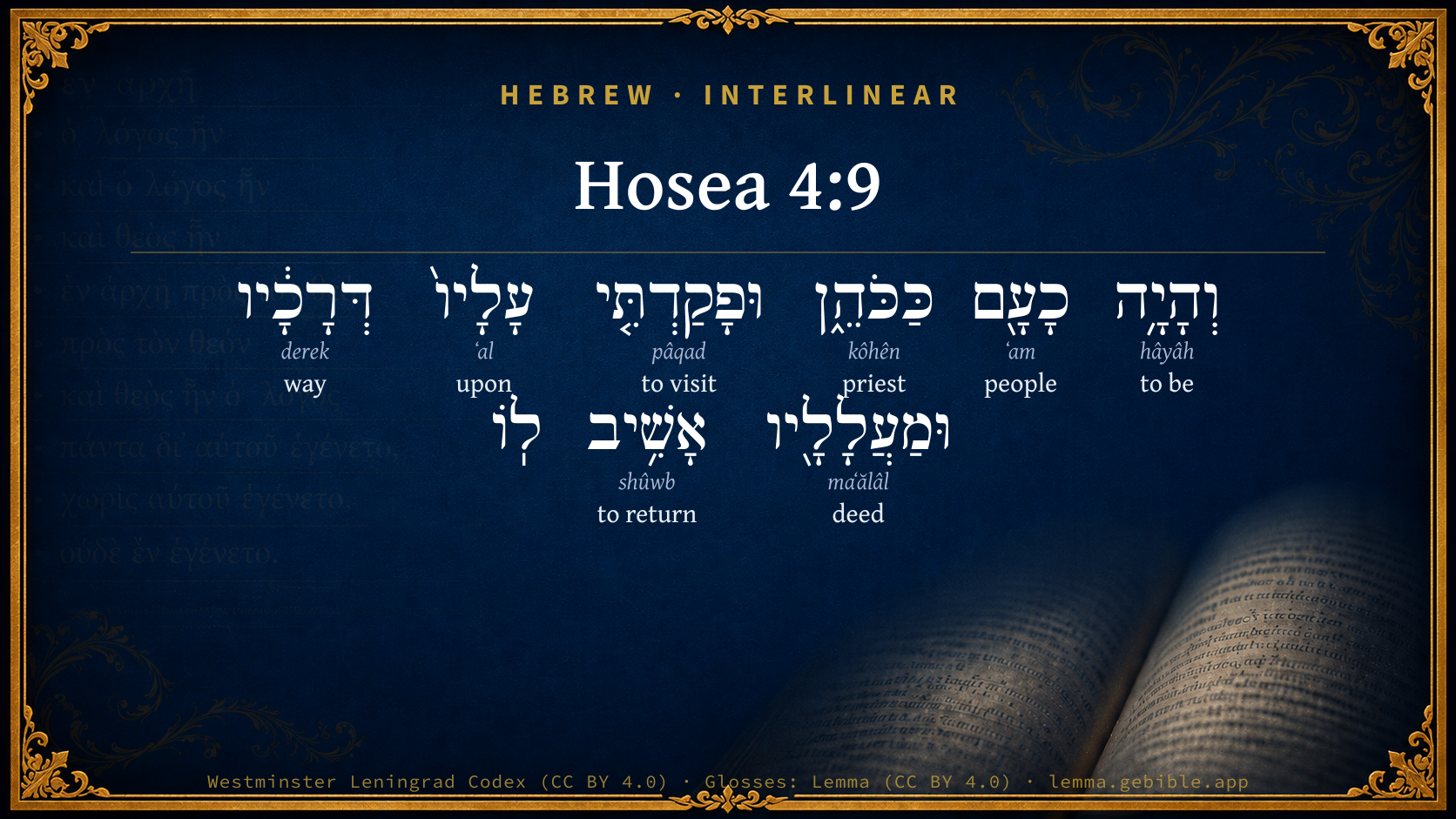
Hebrew (Westminster Leningrad Codex) Hosea 4:9 appears in the Hebrew Old Testament. The text above is from the Westminster Leningrad Codex. Each word links to its Strong’s number, a concise gloss, and parsing drawn from the Open Scriptures Hebrew Bible morphology. Click any word for its full Brown-Driver-Briggs (BDB) entry.
Download image
Cite this verse

Hosea 4:9 (World English Bible). Public Domain. Lemma interlinear Bible study tool, https://lemma.gebible.app/v/hosea/4/9.

Show BibTeX & RIS
BibTeX
RIS
English Translation
It will be, like people, like priest; And I will punish them for their ways, And will repay them for their deeds.
World English Bible · Public Domain
Download a study sheet

One document with this verse’s original text, its word-by-word gloss line, the meaning frame, cross-references with their text, attributed commentary, and full source and license credits — printable, and it pastes into notes with its structure intact.

This verse Autodidact and up

Study sheet (.html) Plain text (.txt)

A passage Seminary Student

Up to 50 verses in one chapter. A passage sheet keeps up to 6 commentary sources and 12 cross-references per verse, in the order this page ranks them, and says so on the sheet whenever that leaves anything out. Ask for a single verse and you get the Autodidact verse sheet above.

Everything on this page stays free to read, with no account — the sheet is a download of what is already on screen, not access to it.

Want to remove ads? Support Godless Engineer
Compare translations 3

The same verse in 3 English versions, stacked beneath the original-language interlinear above. Click any original word for its lexicon entry.

Each is an independent rendering of the whole verse — the interlinear is not word-aligned to these translations.

Highlighted words mark where these versions differ — a whole-verse word diff, not a word-by-word alignment.

  • World English Bible Public Domain
    It will be, like people, like priest; And I will punish them for their ways, And will repay them for their deeds.
  • King James Version Public Domain
    And there shall be, like people, like priest: and I will punish them for their ways, and reward them their doings.
  • unfoldingWord Literal Text CC BY-SA 4.0
    And it will be like people, like priest. And I will visit upon him his ways, and I will return his deeds to him.

unfoldingWord Literal Text — © unfoldingWord, licensed CC BY-SA 4.0. Word-aligned USFM3 via Door43 (git.door43.org/unfoldingWord/en_ult).

Versions to compare (up to 4)

3 of 4 selected

Show all 18 translations

Every available English version of this verse, each an independent rendering of the whole verse.

  • World English Bible Public Domain
    It will be, like people, like priest; And I will punish them for their ways, And will repay them for their deeds.
  • Berean Standard Bible Public Domain
    And it shall be like people, like priest. I will punish both of them for their ways and repay them for their deeds.
  • Majority Standard Bible Public Domain
    And it shall be like people, like priest. I will punish both of them for their ways and repay them for their deeds.
  • King James Version Public Domain
    And there shall be, like people, like priest: and I will punish them for their ways, and reward them their doings.
  • American Standard Version (1901) Public Domain
    And it shall be, like people, like priest; and I will punish them for their ways, and will requite them their doings.
  • Revised Version (1885) Public Domain
    And it shall be, like people, like priest: and I will punish them for their ways, and will reward them their doings.
  • Geneva Bible (1599) Public Domain
    And there shalbe like people, like Priest: for I wil visite their wayes vpon them, and reward them their deedes.
  • Douay-Rheims (1899) Public Domain
    And there shall be like people like priest: and I will visit their ways upon them, and I will repay them their devices.
  • Young's Literal Translation Public Domain
    And it hath been, like people, like priest, And I have charged on it its ways, And its habitual doings I return to it.
  • Literal Standard Version CC BY-SA 4.0
    And it has been, like people, like priest, || And I have charged on it its ways, || And its habitual doings I return to it.
  • Unlocked Literal Bible CC BY-SA 4.0
    It will be the same for the people as for the priests: I will punish them all for their practices; I will repay them for their deeds.
  • unfoldingWord Literal Text CC BY-SA 4.0
    And it will be like people, like priest. And I will visit upon him his ways, and I will return his deeds to him.
  • Darby Bible Public Domain
    And it shall be as the people so the priest; and I will visit their ways upon them, and recompense to them their doings;
  • World Messianic Bible Public Domain
    It will be like people, like priest; and I will punish them for their ways, and will repay them for their deeds.
  • Webster's Bible Public Domain
    And there shall be, like people, like priest: and I will punish them for their ways, and reward them their doings.
  • Free Bible Version CC BY-SA 4.0
    So it will be for the people like the priests: I will punish them for what they have done, repaying them for their actions.
  • Bible in Basic English Public Domain
    And the priest will be like the people; I will give them punishment for their evil ways, and the reward of their acts.
  • JPS Tanakh (1917) Public Domain
    And it is like people, like priest; and I will punish him for his ways, and will recompense him his doings.

Literal Standard Version (2020), Covenant Press — licensed CC BY-SA 4.0. Text via the HelloAO Bible API (eBible.org). Unlocked Literal Bible (unfoldingWord) — licensed CC BY-SA 4.0. Text via the HelloAO Bible API (eBible.org). unfoldingWord Literal Text — © unfoldingWord, licensed CC BY-SA 4.0. Word-aligned USFM3 via Door43 (git.door43.org/unfoldingWord/en_ult). Free Bible Version, Dr. Jonathan Gallagher — licensed CC BY-SA 4.0. Text via the HelloAO Bible API (eBible.org).

Word by word

More ways to search: Search by grammar → Find every occurrence → Compare this word →

Practice this passage: Drill this verse → Learn its vocabulary →

וּמַעֲלָלָ֖יו
maʻălâl
H4611
“and · deeds · his”
Conjunction + Noun, Common, Masculine, Plural, Construct + Suffix, Personal, 3rd Person, Masculine, Singular
Part of Speech
Conjunction + Noun
Type
Common
Gender
Masculine
Number
Plural
State
Construct
Full BDB Definition

Origin: from H5953

TWOT: 1627e

deed, practice - practice (usually bad) - deeds - acts
  1. וְהָיָ֥ה hâyâh H1961 “and · to be” Conjunction + Verb, Qal, Sequential Perfect, 3rd Person, Masculine, Singular
  2. כָעָ֖ם ʻam H5971 “like/as the · people” Preposition, Determined + Noun, Common, Masculine, Singular, Absolute
  3. כַּכֹּהֵ֑ן kôhên H3548 “like/as the · priest” Preposition, Determined + Noun, Common, Masculine, Singular, Absolute
  4. וּפָקַדְתִּ֤י pâqad H6485 “and · to visit” Conjunction + Verb, Qal, Sequential Perfect, 1st Person, Common, Singular
  5. עָלָיו֙ ʻal H5921 “upon · him” Preposition + Suffix, Personal, 3rd Person, Masculine, Singular
  6. דְּרָכָ֔יו derek H1870 “ways · his” Noun, Common, Both, Plural, Construct + Suffix, Personal, 3rd Person, Masculine, Singular
  7. אָשִׁ֥יב shûwb H7725 “to return” Verb, Hiphil, Imperfect, 1st Person, Common, Singular

About this verse

These counts appear in no published source. They are computed here, from the morphology-tagged text and Lemma’s own curated glosses. What Lemma adds →

9
words
8
distinct lemmas
Prophets
section

Shared distinctive vocabulary

וּמַעֲלָלָ֖יו deed H4611 occurs in 41 verses of the Hebrew Bible. Also found in:

Grammatical profile

  • 3 verbs
  • 4 nouns
  • 2 prepositions

Verb forms

  • וְהָיָ֥ה Qal · Sequential Perfect
  • וּפָקַדְתִּ֤י Qal · Sequential Perfect
  • אָשִׁ֥יב Hiphil · Imperfect

Hebrew & Septuagint length

In English translation the verse runs 22 words from the Hebrew and 24 from the Septuagint (LXX English) — closely comparable.

A rough comparison of the two English renderings, which tokenize alike — not a word-level alignment.

Word counts can differ between the Hebrew and the Greek without any difference in meaning — e.g. the Hebrew direct-object marker אֵת has no separate Greek word, and Greek often adds the article ὁ.

Cross-references

14

Topical passages linked to Hosea 4:9 in the Treasury of Scripture Knowledge — connected by theme and wording, ordered by reader-vote popularity; previews shown in the World English Bible.

  • Jeremiah 5:31 the prophets prophesy falsely, and the priests bear rule by their means; and my people love to have it so: and what will you do in the end of it?
  • Isaiah 24:2 It shall be, as with the people, so with the priest; as with the servant, so with his master; as with the maid, so with her mistress; as with the buyer, so with the seller; as with the creditor, so with the debtor; as with the taker of interest, so with the giver of interest to him.
  • Matthew 15:14 Leave them alone. They are blind guides of the blind. If the blind guide the blind, both will fall into a pit."
  • Jeremiah 23:11–12 for both prophet and priest are profane; yes, in my house have I found their wickedness, says Yahweh.
  • Hosea 1:4 Yahweh said to him, "Call his name Jezreel; for yet a little while, and I will avenge the blood of Jezreel on the house of Jehu, and will cause the kingdom of the house of Israel to cease.
  • Psalms 109:17–18 Yes, he loved cursing, and it came to him. He didn't delight in blessing, and it was far from him.
  • Proverbs 5:22 The evil deeds of the wicked ensnare him. The cords of his sin hold him firmly.
  • Isaiah 3:10 Tell the righteous "Good!" For they shall eat the fruit of their deeds.
  • Isaiah 9:14–16 Therefore Yahweh will cut off from Israel head and tail, palm-branch and rush, in one day.
  • Jeremiah 8:10–12 Therefore will I give their wives to others, and their fields to those who shall possess them: for everyone from the least even to the greatest is given to covetousness; from the prophet even to the priest every one deals falsely.
  • Ezekiel 22:26–31 Her priests have done violence to my law, and have profaned my holy things: they have made no distinction between the holy and the common, neither have they caused men to discern between the unclean and the clean, and have hid their eyes from my Sabbaths, and I am profaned among them.
  • Hosea 8:13 As for the sacrifices of my offerings, they sacrifice flesh and eat it; But Yahweh doesn't accept them. Now he will remember their iniquity, And punish their sins. They will return to Egypt.
  • Hosea 9:9 They have deeply corrupted themselves, As in the days of Gibeah. He will remember their iniquity. He will punish them for their sins.
  • Zechariah 1:6 But my words and my decrees, which I commanded my servants the prophets, didn't they overtake your fathers? "Then they repented and said, 'Just as Yahweh of Hosts determined to do to us, according to our ways, and according to our practices, so he has dealt with us.'"

Cross-references courtesy of OpenBible.info (CC BY 4.0).

Hebrew and Greek witnesses Masoretic Hebrew ↔ Greek Septuagint

The same verse in the two great witnesses to the Old Testament, shown verse-for-verse.

These are two independent witnesses, not word-aligned to each other, and the Septuagint is shown in lemma (dictionary) form.

Hebrew Hosea 4:9 Masoretic · Westminster Leningrad Codex

וְהָיָ֥ה כָעָ֖ם כַּכֹּהֵ֑ן וּפָקַדְתִּ֤י עָלָיו֙ דְּרָכָ֔יו וּמַעֲלָלָ֖יו אָשִׁ֥יב לֽוֹ

It will be, like people, like priest; And I will punish them for their ways, And will repay them for their deeds.

World English Bible · Public Domain

Greek LXX Hosea 4:9 Septuagint · lemma form

καί εἰμί καθώς ὁ λαός οὕτως καί ὁ ἱερεύς καί ἐκδικέω ἐπί αὐτός ὁ ὁδός αὐτός καί ὁ διαβούλιον αὐτός ἀντι ἀποδίδωμι αὐτός

And the priest shall be as the people: and I will avenge on them their ways, and I will recompense to them their counsels.

LXX2012 (modern English Septuagint) · Public Domain

Hebrew: Westminster Leningrad Codex (CC BY 4.0). Greek: Septuagint (public domain); English from LXX2012 (modern English Septuagint) (Public Domain). How the Septuagint differs from the Hebrew →

Targum (Aramaic paraphrase)

1

The Targum is the ancient Jewish Aramaic paraphrase of the Hebrew Scriptures — an interpretive translation, not the Hebrew text itself. Onkelos (literal) and Pseudo-Jonathan (expansive) render the Torah, and Jonathan the Prophets. Coverage is partial: where no permissively-licensed English translation exists for a verse, only the Aramaic is shown. This is verse-level text, not a word-by-word alignment to the Hebrew.

  1. Targum Jonathan Prophets (Joshua–Malachi)
    וִיהֵי כְמָא דַאֲשַׁוֵי חִילוֹנָאָה כְּכָהֲנָא לַאֲפָסָא קוּדְשֵׁיהוֹן אֲפִיס יַת יְקָרֵהוֹן וַאֲשַׁוֵי דְיַקִיר לְבַסִיר בְּדִיל לְאִתְפְּרַע מִנְהוֹן כְּאוֹרְחַתְהוֹן בִּישְׁתָא וּכְעוֹבָדֵיהוֹן מְקַלְקְלַיָא אָתִיב לְהוֹן:

    (no public-domain English translation for this verse)

    Targum Jonathan — Aramaic: “Mikraot Gedolot” (public domain). English: “Sefaria Community Translation” (CC0 1.0 (public-domain dedication)); “London "Chaldee Paraphrase," 1871” (public domain). Text via Sefaria.

Commentary

Notes on Hosea 4:9 from classic Christian and Jewish commentators (each source and its license shown beneath its notes). The classic Christian expositions comment on the surrounding passage and are grouped to its opening verse, so a note may address several verses; the Jewish commentaries on the Tanakh (Rashi and others) are per-verse, so they appear only where the commentator wrote on this verse.

Lemma curates 59 commentaries, every one of them public domain or Creative Commons licensed, each selected and text-cleaned for this edition rather than reprinted as found. About our sources →

Trapp's Complete Commentary

John Trapp

Hos 4:9 And there shall be, like people, like priest: and I will punish them for their ways, and reward them their doings.

Ver. 9. And there shall be like people like priest] i.e. they shall share alike in punishment, as they have done in sin; neither shall their priesthood protect them, any more than it did Eli’s two sons, whose white ephod covered foul sins. A wicked priest is the worst creature upon earth. Who are devils but they that were once angels of light? and who shall have their portion with the devil and his angels but those dehonestamenta cleri malae monetae ministri, bad lived ministers. It was grown to a proverb in times of Popery, that the pavement of hell was pitched with soldiers’ helmets and shavelings’ crowns. Letters also were framed and published as sent from hell; wherein the devil gave the Popish clergy no small thanks, for so many millions of souls as by them were daily sent down to him. The priests might haply hope to be privileged and provided for in a common calamity, for their office sake; as Chrysostom saith that Aaron (though in the same fault with Miriam, Num 12:1, yet) was not smitten with leprosy as she, for the honour of the priesthood (δια το της ειροσυνης αξιωμα. Chrys.), lest such a foul disease on his person should redound to the disgrace of his office. But I rather think he escaped by his true and timely repentance; whereby he disarmed God’s indignation, and redeemed his own sorrow and shame. For God is an impartial judge; neither is there with him respect of persons: priest and people shall all be carried captive one with another (the priests for the people, according to that of Isa 6:5, "I am a man of polluted lips": for what reason? "I live among a people of polluted lips," and have learned their language; and especially the people for the priests, Jer 23:10; Jer 23:14-15; from the prophets there goes profaneness quite through the land), so they shall fare the worse one for another; they shall all be involved in the same punishment. Only it shall be more grievous to the priest, by how much higher thoughts he had of himself; looking on the people as his underlings, as they did, Joh 7:49.

And I will punish them for their ways] Heb. visit them. So Exo 32:34, "In the day when I visit I will visit their sin upon them." God hath his visitation days wherein to visit those visitors, the priests; and his articles will be as strict and as critical (saith one) as ever was the Inquisition of Spain or Lambeth. It was therefore good counsel that a martyr gave his wife in a letter, Among all other prisoners visit your own soul, and set all to rights there: for else, what will you do when God riseth up? and when he visiteth, what will you answer him? Job 31:14. And that which Tertullian gave Scapula, a pagan persecutor; Si nobis non parcis, tibi parce: si non tibi, Carthagini: God will surely make inquisition for our blood: therefore if thou wilt not spare us, yet spare thyself; if not thyself, yet spare thy country, which must be responsible when God comes to visit.

And reward them for their deed] Heb. I will make to return your doings. Hence this is well observed, by a good interpreter: Sin passeth away in the act of it with much sweetness; but God will make it return back again in the guilt of it, with much bitterness.

John Trapp, A Commentary or Exposition upon All the Books of the Old and New Testament (1647–1656) — public domain. Text from a community e-Sword module.

The Biblical Illustrator

Joseph S. Exell

Hos_4:9

And there shall be, like people, like priest.

Hoseas proverb

Like princes, like people; but also, alas! like people, like priests,--a proverb which has acquired currency from its fatal truth, but which Hosea originated. The causes for the widespread immorality were twofold, as Hosea, resident perhaps in Samaria, saw more clearly, and pointed out more definitely than Amos. They were--

1. The detestable vileness and hypocrisy of the priests, with whom, as usual, the false prophets were in league. From Hosea, the earliest of the northern prophets whose works are extant, to Malachi the latest prophet of the returned exiles, the priests had very little right to be proud of their title. Their pretensions were, for the most part, in inverse proportion to their merits. The neutrality, or the direct wickedness, of the religious teachers of a country, torpid in callous indifference and stereotyped in false traditions, is always the worst sign of a nations decadence. Hosea was no exception to the rule that the true teacher must be prepared to bear the beatitude of malediction, and not least from those who ought to share his responsibilities. Amos had found by experience that for any man who desired a reputation for worldly prudence, the wisest rule was to hold his tongue; but for Hosea, for whom there was no escape from his native land, nothing remained but to bear the reproach that the prophet is a fool, and the spiritual man is mad, uttered by men full of iniquity and hatred. A fowlers snare was laid for him in all his ways, and he found nothing but enmity in the house of his God. The priests suffered the people to perish for lack of knowledge. They set their hearts on their iniquity, and contentedly connived at, if they did not directly foster, the sinfulness of the people, which at any rate secured them an abundance of sin-offerings. So far had they apostatised from their functions as moral teachers. And there was worse behind. They were active fomenters of evil. But the second cause of the national apostasy lay deeper still.

2. The corruption of worship and religion at its source. The calf-worship was now beginning to produce its natural fruit. It would have indignantly disclaimed the stigma of idolatry. It was represented as image-worship, the adoration of cherubic symbols, which were in themselves regarded as being so little a violation of the second commandment that they were consecrated even in the temple at Jerusalem. The centralisation of worship, it must be borne in mind, was a new thing. Local sanctuaries and local altars had been sanctioned by kings and used by prophets from time immemorial. The worship at Dan and Bethel could have claimed to be, in the fullest sense of the word, a worship of Jehovah, as national and as ancient as that at Jerusalem. For the ox was the most distinctive emblem of the cherub, and even in the wilderness, cherubs--possibly winged oxen--had bent over the mercy-seat and been woven on the curtains, and in the temple of Solomon had been embossed upon the walls, and formed the support of the great brazen laver. We read of no protest against this symbolism either by Elijah, Elisha, or Jonah. Hosea could more truly estimate its effects, and he judged it by its fruits. He saw the fatal facility with which the title Baal, Lord, might be transferred from the Lord of lords to the heathen Baalim. He saw how readily the emblem of Jehovah might be identified with the idol of Phoenicia. Jehovah-worship was perverted into nature-worship, and the coarse emblems of Asherah and Ashtoreth smoothed the way for a cultus of which the basis was open sensuality. The festal dances of Israel, in honour of God, which were as old as the days of the Judges, became polluted with all the abominations of Phoenician worship. The adultery and whoredom, which are denounced so incessantly on the page of Hosea, are not only the metaphors for idolatry, but the literal description of the lives which that idolatry corrupted. (Dean Farrar, D. D.)

Priests become time-servers

No greater calamity can come upon a people, because--

1. Such priests cannot exert the influence which they should exert. They should be men of God, supremely loyal to God, and witnessing for the supreme claim of spiritual and eternal things.

2. Their example is positively mischievous. Men need no aid from their leaders in living selfish, self-indulgent, covetous lives.

3. Time-serving utterly ruins personal character. Nobility, heroism, devotion can only be nourished by living outside ourselves, for God and our fellows. Time-servers are self-servers. (Robert Tuck, B. A.)

The degradation of holy office

The people may have what they like, and the priest will say, You could not help it. The priest will reproduce what the people are doing, and the people will take encouragement from the priest to go out and do double wickedness, and thus they shall keep the action even. To this degree of corruption may holiest institutions be dragged. The priest--meaning by that word teacher, preacher, minister, apostle--should always be strong enough to condemn; he can condemn generally, but not particularly; he can damn the distant, he must pet and flatter and gratify the near. He will outgrow this--when he knows Christ better; when he is enabled to complete his faith by feeling that it is not necessary for him to live, but it is necessary for him to speak the truth; when he comes to the point of feeling, that it is not at all needful he should have a roof over his head, but it is necessary that he should have an approving conscience; when he completes his theology by this Divinest morality, he will be a rare man in the earth, with a great voice thundering its judgments, and with a tender voice uttering its benedictions and solaces where hearts are broken with real contrition. Priests should lead; priests should not neglect denunciation, even where they are unable to follow their denunciations with examples to the contrary. The Word should be spoken boldly, roundly, grandly, in all its simplicity, purity, rigour, tenderness. (Joseph Parker, D. D.)

The reciprocal influence of priest-hood and people

I. There is sometimes a disgraceful reciprocal influence.

1. It is a disgrace to a true priest to become like the people. One who is not above the average man is no priest, he is out of his place. A priest is a man to mould, not to be moulded; to control, not to cringe; to lead, not to be led. His thoughts should sway the thoughts of the people, and his character should command their reverence. Sometimes you see priests become like the people, mean, sordid, grovelling.

2. It is a disgrace to a people to become like a bad priest. There are priests whose natures are lean, whose capacities are feeble, whose religion is sensuous, whose sympathies are exclusive, whose opinions are stereotyped, whose spirit is intolerant. Shame on the people who allow them selves to become like such a priest!

II. There is sometimes an honourable reciprocal influence.

1. It is honourable when people become like a true priest; when they feel one with him in spiritual interests and Christly pursuits.

2. It is honourable to the true priest when he has succeeded in making the people like him. He may well feel a devout exultation as he moves amongst them that their moral hearts beat in unison with his, that their lives are set to the same keynote, that they are of one mind and one heart in relation to the grand purpose of life. (Homilist.)

Naughty ministers

1. Evil ministers are a great cause of sin and misery upon the people they have charge of. It is an addition to the priests judgment that they drag so many with them into it.

2. Albeit naughty ministers be great plagues and snares to people, yet that will not excuse a peoples sin, nor exempt them from judgment, and therefore the people are threatened also. The sending of evil ministers may be so much the fruit of peoples former sins, and they may be so well satisfied with it as may justly ripen them for a stroke.

3. As pastors and people are ordinarily like each other in sin, and mutual plagues to each other, so will they be joined together in judgments, for there shall be, like people, like priest, that is, both shall be involved in judgment (though possibly in different measure, according to the degree Of their sin), and none of them able to help or comfort another.

4. Albeit the Lord may spare for a time, and seem to let things lie in confusion, yet He hath a day of visitation, wherein He will call men to an account, and recompense them, not according to their pretences, but their real deeds and practices.

5. When men have made no conscience of sin, so they might compass these delights, which they think will make them up, yet it is easy for God to prove that the blessing of these delights is only in His hand.

6. As no means can prosper where God deserts and withdraws His blessing, so what a man prosecutes unlawfully, He cannot look it should be blessed. (George Hutcheson.)

A courageous ministerial reproof

The great northern apostle, Bernard Gilpin, who refused a bishopric, did not confine his Christian labours to the church of Houghton, of which he was minister, but at his own expense visited the then desolate churches of Northumberland once every year to preach the Gospel. The Bishop of Durham commanded him to preach before the clergy. Gilpin then went into the pulpit, and selected for his subject the important charge of a Christian bishop. Having exposed the corruption of the clergy, he boldly addressed himself to his lordship, who was present. Let not your lordship, said he, say these crimes have been committed without your knowledge; for whatever you yourself do in person, or suffer through your connivance to be done by others, is wholly your own; therefore in the presence of God, angels, and men, I pronounce your fatherhood to be the author of all these evils; and I, and this whole congregation, will be a witness in the day of judgment that these things have come to your ears. The bishop thanked Mr. Gilpin for his faithful words, and gave him permission to preach throughout his diocese.

The Biblical Illustrator, edited by Joseph S. Exell (c. 1880s–1900s) — public domain. Text from a community e-Sword module.

Tyndale Open Study Notes

Tyndale Open Resources

4:9 The people followed the evil example of their religious leaders; as a result, God would punish both priests and people for their wicked deeds.

Tyndale Open Study Notes — © Tyndale Open Resources, licensed CC BY-SA 4.0. Text via the HelloAO Bible API.

Geneva Bible (1599)

Geneva Bible translators

Signifying, that as they have sinned together, so shall they be punished together.

Geneva Bible (1599) marginal notes — public domain. Text via Bolls.life.

Jamieson, Fausset & Brown

Robert Jamieson, A. R. Fausset & David Brown

like people, like priest--They are one in guilt; therefore they shall be one in punishment (Isa 24:2).

reward them their doings--in homely phrase, "pay them back in their own coin" (Pro 1:31).

Jamieson, Fausset & Brown — Commentary Critical and Explanatory on the Whole Bible (1871) — public domain (CC PDM 1.0). Text via the HelloAO Bible API.

Adam Clarke's Commentary

Verse 9. Like people, like priest]

"The priest a wanderer from the narrow way;

The silly sheep, no wonder that they stray."

I will punish them] Both priest and people; both equally bad.

Adam Clarke's Commentary on the Bible (1810–1826) — public domain. Text from a community e-Sword/MySword module.

John Calvin's Commentaries

The Prophet here again denounces on both a common punishment, as neither was free from guilt. As the people, he says, so shall be the priest; that is “I will spare neither the one nor the other; for the priest has abused the honor conferred on him; for though divinely appointed over the Church for this purpose, to preserve the people in piety and holy life, he has yet broken through and violated every right principle: and then the people themselves wished to have such teachers, that is, such as were mute. I will therefore now” the Lord says, “inflict punishment on them all alike. As the people then, so shall the priest be.”

Some go farther, and say, that it means that God would rob the priests of their honor, that they might differ nothing from the people; which is indeed true: but then they think that the Prophet threatens not others as well as the priests; which is not true. For though God, when he punishes the priests and the people for the contempt of his law, blots out the honor of the priesthood, and so abolishes it as to produce an equality between the great and the despised; yet the Prophet declares here, no doubt, that God would become the vindicator of his law against other sinners as well as against the priests. This subject expands wider than what they mean. The rest we must defer till to-morrow.

John Calvin's Commentaries (1540-1563) — public domain. Text from the Calvin Translation Society English edition (1840s-50s) via the Christian Classics Ethereal Library (ccel.org). Calvin's coverage is partial (roughly two-thirds of the Bible); uncommented books and verses are honest gaps, never fabricated. The 19th-century editor's footnotes and remarks are omitted so the notes are faithfully Calvin's own voice.

Ellicott's Commentary for English Readers

(9, 10) As the people will be punished, so will the priest. The latter will not be saved by wealth or dignity. And I will visit upon him his ways (observe here the collective singular in the pronoun), and cause his doings to return upon him. The form of the punishment is to be noticed. The eating of the sin of the people shall leave them hungry, and their licentiousness shall leave them childless.

A Bible Commentary for English Readers, edited by Charles John Ellicott (1878–1897) — public domain. Text from a community e-Sword module.

The Cambridge Bible for Schools and Colleges

gen. ed. J. J. S. Perowne

9. like people, like priest] i.e. the priest shall fare no better than the people. His official ‘nearness’ to Jehovah shall be no safeguard to him.

I will punish them …] Rather, punish him, viz. the priest representing the order.

The Cambridge Bible for Schools and Colleges (gen. ed. J. J. S. Perowne; Cambridge University Press, 1878–1918) — public domain. Text from a community e-Sword module.

John Gill's Exposition

And there shall be, like people, like priest,.... No difference between them in their festivals, the one being as greedy of committing intemperance and uncleanness as the other, and in their common conversation of life; though the priests ought both to have given good instructions, and to have set good examples; but instead of that were equally guilty as the people, and so would be alike in their punishment, as it follows:

and I will punish them for their ways; their evil ways, as the Targum; their wicked manner of life and conversation, both of the people and the priests; especially the latter are meant: or, "I will visit upon him his ways" (w); upon everyone of the priests, as well as the people; which visit must be understood in a way of wrath and vengeance:

and reward them their doings; reward them according to their doings, as their sins deserve, and as it is explained in the next verse: or, "I will return their doings to them" (x); bring them back again, when they seemed to be past and gone, and set them before them, and charge them with them, and punish for them.

(w) "et visitabo super eum vias ejus", V. L. Pagninus, Montanus, Cocceius, Schmidt. (x) "et opera ejus redire faciam", Zanchius.

John Gill's Exposition of the Whole Bible (1746–1763) — public domain (CC PDM 1.0). Text via the HelloAO Bible API.

Albert Barnes' Notes on the Bible

And there shall be like people, like priest - Priest and people were alike in sin. Yea they are wont, if bad, to foment each other’s sin. The bad priest copies the sins which he should reprove, and excuses himself by the frailty of our common nature. The people, acutely enough, detect the worldliness or self-indulgence of the priest, and shelter themselves under his example. Their defense stands good before people; but what before God? Alike in sin, priest and people should be alike in punishment. “Neither secular greatness should exempt the laity, nor the dignity of his order, the priest.” Both shall be swept away in one common heap, in one disgrace, into one damnation. “They shall bind them in bundles to burn them.”

And I will punish them for their ways, and reward them their doings - Literally, “I will visit upon him his ways, and his doings I will make to return to him.” People and priests are spoken of as one man. None should escape. The judgment comes down “upon” them, overwhelming them. Man’s deeds are called his “ways,” because the soul holds on the tenor of its life along them, and those ways lead him on to his last end, heaven or hell. The word rendered “doings ” signifies “great doings,” when used of God; “bold doings,” on the part of man. Those bold presumptuous doings against the law and will of God, God will bring back to the sinner’s bosom.

Albert Barnes' Notes on the Bible (1834–1885) — public domain. Text from a community e-Sword/MySword module.

Haydock's Catholic Bible Commentary

Priest. They are equally dissolute, and shall meet the like punishment. --- Devices, or thoughts. (Calmet) --- Cogitatio mali operis pænas luet. (St. Jerome)

George Leo Haydock (1774–1849), Haydock's Catholic Family Bible and Commentary, 1859 edition — public domain. Excludes Psalms (Douay-Rheims chapter numbering differs from Protestant) and Deuterocanonical books (Catholic canon only).

Matthew Poole's English Annotations

The sum of these words is this, that God will certainly punish; for the sins both of priests and people are such that God will no further forbear either; and when he comes to punish, he will do it according to the ways and doings of both; where sins have been equal, punishment shall be equal too, both priest and people shall be led into captivity, and there used without any differencing respect of one or other.

Matthew Poole's English Annotations on the Holy Bible (1683–1685) — public domain. Text from a community e-Sword/MySword module.

Whedon's Commentary on the Bible

Daniel D. Whedon

9, 10. The judgment to fall upon priest and people alike.

And there [“it”] shall be, like people, like priest — Priest and people shall perish alike. The fact that the former enjoys in his official capacity special nearness to Jehovah will not save him. This interpretation, which brings out the meaning of the Hebrew most naturally, is preferable to that which sees in these words a summing up of the preceding accusations and makes the next clause the beginning of the threat. Having made the general announcement of judgment, the prophet proceeds to describe in detail its character.

Them — Hebrew, singular, the priest, that is, the priestly class, so throughout this section. The corrupt priests will be dealt with according to their deserts. The retribution is according to the lex talionis; the unholy greed will be punished with insufficiency of food (Lev_26:16; Mic_6:14).

They shall… not have enough — Referring back to Hos_4:8.

Commit whoredom — To be understood not as in chapters 1-3 in a symbolic sense, but as in Hos_4:11; Hos_4:13-14, literally. This interpretation is supported by the character of the judgment threatened.

They… shall not increase — They will be cursed with childlessness. Jehovah will withdraw his blessings because they, probably both priest and people, have left off to take [“taking”] heed — Had no regard for Jehovah or for his will.

Daniel D. Whedon (gen. ed.), Commentary on the Old and New Testaments (1874–1909) — public domain. Text from a community e-Sword module.

The Pulpit Commentary

Like people, like priest. As it had fared with the people who had sinned and had been punished, as is stated in the third and fifth verses; so shall it be with the priest or whole priestly order. He has involved himself in sin and punishment like the people, and that as the consequence of his extreme unfaithfulness; whereas by faithful dealing with the people and discharge of his duty he might have delivered his own soul, as stated Eze_33:9, "Nevertheless, if thou warn the wicked of his way to turn from it; if he do not turn from his way, he shall die in his iniquity; but thou hast delivered thy soul." It is well explained by Kimchi as follows: "These two caphs of likeness are by way of abbreviation, and the explanation is the people are like the priest and the priest is like the people. And the meaning is that, as the people and the priest are equal with respect to sin, so shall they be equal in relation to punishment." And I will visit upon his ways, and his doings I will bring back to him. The retribution here threatened includes the whole priestly order, not people and priest as one man, according to Pusey, who, however, makes the following excellent comment on wyllm: "The word rendered doings signifies great doings when used of God, bold doings on the part of man. These bold presumptuous doings against the Law and will of God, God will bring back to the sinner"s bosom," or rather, down overwhelmingly upon his head. The singular individualizes; so both Aben Ezra and Kimchi: "Upon every one of them.

"Like people, like priest.

In this passage" the Lord charges the priests of the ten tribes with having grievously abetted the idolatry and immorality which were rampant in Israel; and in the verse before us he declares that, as people and priest have been one in guilt, they shall be one also in punishment. When the judgment falls, there shall be no benefit of clergy." The four words of the text sound like a proverb. (Isa_24:2) We may justly view them as an apothegm respecting the mutual relation of pastor and people. We read the word "priest" here "writ large" as "presbyter." We use it in its widest sense as denoting a minister of religion one who officiates in the sacred service of the Church.

I THERE IS A LIKENESS IN THE NATURE OF THINGS. In their relations to God and to their fellow-men, it is "like people, like priest.

1. The principle applies to matters of personal life. The priest is "taken from among men". (Heb_5:1-3) He is by nature guilty, sinful, polluted, helpless, like every other member of the congregation. If he be a true believer, he has been washed in the blood of Christ, and justified by the grace of God, and made a partaker of the Spirit, like other believers. He is exposed to temptations, and prone to backslidings, as they are. He must "fight the good fight of faith," just like others.

2. The principle applies to social relations. A minister does not cease to be a man when he becomes a minister. He is to be "one that ruleth well his own house" (l Timothy 3:4). Like other citizens, he ought to interest himself in politics. The cause of liberty and righteousness, the redress of wrongs, and the elevation of the masses, should be specially dear to him. He must not allow himself to seem an emasculated man, who either has no opinions on public questions, or is afraid to avow them.

3. The principle applies to business habits. The priest is to eat his bread "in the sweat of his face," like other men. Observation of his habits ought not to produce the impression that he is without any engrossing occupation. No man in the congregation should be busier. No other work makes so constant a demand upon all the best energies of human nature as the work of the Christian pastor.

4. The principle applies to the matter of his work itself. According to the spirit of New Testament teaching, no hard-and-fast line is to be drawn between the Christian ministry and other useful occupations. The pastor ministers to a higher part of man"s nature than the merchant does; that is all. "Whatsoever ye do, in word or deed, do all in the name of the Lord Jesus"; (Col_3:17) that is the Christian law of work for all godly men alike. The life of the priesthood has no halo around it which does not belong to the life of the people.

5. The principle applies to spiritual privileges. The pastor enjoys the blessings of grace in common with the people all of them, and no more. He has the same access to God which other Christian men and women have; no other access, and no nearer. He does not belong to a sacerdotal caste. He is in no respect a mediator. The special application of the term "priest," as denoting one who offers sacrifice, is not for the Christian pastor. In that sense the Lord Jesus Christ is the only Priest of the Church. The one respect in which the pastor is a "priest to God" is that in which, as Archbishop Leighton has put it, "all Christians are God"s clergy.

6. The principle applies to the final account. It shall be "like people, like priest," at the day of judgment. His reward, like theirs, shall be in proportion to his diligence, efficiency, and success. And, contrariwise, the punishments inflicted for indolence shall be equally impartial. This is the very point of the text: "I will punish them for their ways, and reward them their doings." This general principle is so obvious, and so constantly enforced in the teaching of the New Testament, that it seems strange that it should ever have been contravened. Yet the subversion of it has been one of the most cherished errors of the Christian Church. Is not the denial of this principle the cornerstone of the Papacy? The Romish Church exalts one man, and one class of men, to absolute control over the consciences of their fellows. And does not the ritualism of our time at home involve the same error? Ritualism might be harmless if it meant only an ornate and beautiful service; but, meaning as it does a return to sacerdotalism, and the fettering of the spiritual liberty of the Christian people, it is full of deadly poison. Many communions, also, which are free from the temptations to clericalism in its grosser forms, are often in danger of separating those responsibilities, on the part of minister and people, which God has joined together. E.g. do not some minds harbor the notion that a higher standard of piety is appropriate for the pulpit than what is necessary for the pew? And are there not some popular amusements which it is thought quite lawful for other members of the Church to indulge in, but which a minister is expected to abstain from, under peril of being judged an unspiritual man? There is, however, no mention in the Bible of a broader and a narrower gauge of righteousness There, it is" like people, like priest.

II THERE IS A LIKENESS PRODUCED BY RECIPROCAL INFLUENCE. The relationship between pastor and people is a very sacred one. It is a union in which the one party does not absorb the other; rather, they tend to become filled with the same common life, and to be mutually assimilated in views, sentiments, and spiritual tone. We need not stay to speak of, the influence which the priest has upon the people. For the one direct end of the ministry is to move men to live for God and Christ.]t is designed, through the power of the Holy Spirit, to influence the hearts and habits of the people, not only upon the Lord"s day, but during every hour of their lives. In what remains we shall rather consider the influence; which the people exercise upon the priest, to mould his character as a man, and to affect his efficiency as a pastor. The text does not read, Like priest, like people," although it is frequently misquoted so. It reads, "Like people, like priest;" and thus it invites us to view more especially the influence which the pew has upon the pulpit an influence which is everywhere present, and which is very subtle and powerful. The priest springs from the people. He enters the ministry with his mind already largely molded by the intellectual and religious influences which obtain amongst them. He may be expected to reflect in his own character the prevalent spirit in relation to Divine things amidst which he has been brought up. A long barren period of spiritual indifference will inevitably give to the Church a race of sapless anti-evangelical ministers; but when, on the other hand, there is a general revival of religion, many earnest young men from among the new converts will be found devoting their lives to the work of spreading the knowledge of salvation. Again, this influence is greatly promoted in connection with the more democratic systems of Church government. The writer of this homily, as a Presbyterian, may be allowed to point out that in every free Presbyterian communion the sap of the Church"s influence rises from the people through sessions and presbyteries to the supreme court; and so, peculiarly under this system, it is, "like people, like priest.

1. Sometimes ibis influence is for evil. Take, e.g., the sin of priestcraft itself. It is the corruption of the people, in the first instance, that makes this sin possible. Look at the case of the golden ox at Horeb. (Exo_32:1) Or take that of the golden calves at Bethel and Dan. Jeroboam was trading with the spiritual degradation of the ten tribes when he instituted his false gods and his false priests. The malign influence continued down to the time of Hosea, and by-and-by involved the northern kingdom in destruction. Meanwhile, too, the evil leaven was spreading into the yet surviving monarchy of Judah. (Jer_5:31) And thus is it still. Whenever the blood of religion runs cold, and opposition to the doctrines of grace prevails, the Church will seek out teachers after her own degenerate heart. (2Ti_4:3) At such times the congregation desires to have a tacit understanding with the prophet that he is not to use great plainness of speech". (Isa_30:10) Every true minister has sometimes to contend against the temptation to suppress unpalatable truth. It is little more than a generation since thousands of pulpits in the United States submitted to be muzzled regarding the wickedness of Negro slavery; and since hundreds of ministers in the Southern States were laboring to prove that slavery was the proper condition of the Negro. In our own country, on the other hand, the warning voice of the pulpit in relation to the evil of the drinking customs is still a somewhat muffled one compared with what it has long been in New England. Finally, here, the priest"s personal relations to his people are so intimate that their attitude towards him goes largely to affect even the moral tone and fiber of his character. If he submit to be continually petted, the danger is that all manliness will gradually ooze out of him, and that he will come to expect on all occasions different treatment from other men. But surely the Christian ministry ought to be the manliest of callings. The pastor should be one of the hardiest of the trees of grace, and not a mere greenhouse plant. He should desire no allowances to be made for him which are not made for men of other callings. The whole Church should take care that it is not her fault if he is not every inch a man.

2. But often the influence of the people upon the priest is good and honorable. A congregation whose conception of the ministry is formed as the result of the devout study of the New Testament, will look and pray for men in the pulpit who possess the tongue of fire, i.e. the power of the Holy Ghost; not the power to compose eloquent paragraphs and perorations, but power to arouse, convert, edify power under which hearts will melt, and lives will begin anew. When conversions occur, the pastor preaches with an enlarged heart and prays with redoubled fervor, and his path seems bathed in sunshine. After all, too, it is the people, quite as much as the priests, who guard the orthodoxy, purity, liberties, and spiritual life of the Church. For it is they who constitute the body of Christ; the pastors are only the servants of the Church for Jesus" sake.

CONCLUSION.

1. It is doubtless sometimes the fact that the priest and the people never become assimilated to each other at all. It was so, e.g., in the case of Hosea; in that of Jeremiah; in that of the Lord Jesus himself, during his earthly ministry. But what the text expresses is simply an ordinary tendency in connection with this sacred relationship.

2. Let our closing thought be this, that the obligation involved in the pastoral tie is a mutual one. If his Church responsibilities should weigh heavily upon the minister"s heart, they should also press upon the conscience of each member. Both are responsible for the results of the tie. It is, "like people, like priest. C.J.

"Like people, like priest.

This and similar passages show the justice and impartiality with which the inspired prophets fulfilled the office to which they were called. Neither the fear of the priest nor the favor of the people was allowed to act as a motive to deter them from plain speech and faithful dealing with men"s souls.

I THERE IS ACTION AND REACTION BETWEEN THE PEOPLE AND THEIR RELIGIOUS LEADERS. A spiritual and vigorous ministry tells lamentably upon the moral and religious habits of the community, and a formal and selfish ministry is a check to moral improvement and a hindrance to national purification. The importance is manifest of securing for every community clergy and teachers who shall raise the moral tone of society. Yet it is only here and there that a minister of religion will be found truly alive to God in the midst of a corrupt and worldly society. For good and for evil, teachers and taught, leaders and led, rise and fall together. "Like people, like priest.

II THE PEOPLE AND THEIR RELIGIOUS LEADERS ARE ALIKE AMENABLE TO THE RIGHTEOUS RULE OF GOD. If the watchman be faithful amidst general corruption and defection, if he give the people warning, he shall deliver his soul. But if he neglect to do this, and the people perish, shall the slothful or unfaithful watchman escape, in the day of inquisition and of judgment? No! when the people are punished for their ways and rewarded for their doings, the pastors who have encouraged the sheep in their wanderings, and left them to perish in the wilderness, shall be overtaken by the penalties attaching to sinful neglect and abuse of trust. Their official position, even the formal fulfillment of their official duties, shall not exempt them from the fate of the faithless, "Like people, like priest.

APPLICATION.

1. Let people value a faithful ministry, and give heed to wise and righteous warnings, ere it be too late.

2. Let ministers of religion beware lest they fall into negligent habits, and perform their services in a perfunctory and unspiritual manner, and thus encourage the people in impiety. T.

The reciprocal influence of priesthood and people.

"There shall be, like people, like priest." Though perhaps the translation of Keil and Delitzsch it will happen as to the people, so to the priest may give the literal idea, I take the words as they stand, which have become a proverb, "Like people, like priest." Instead of taking up the primary idea of the words, viz. that the rank and wealth of the priests would not exempt them from sharing the same fate as the rest of the nation, I would put into prominence for a moment the idea of the reciprocal influence of priesthood and people. And I make two general remarks on this idea.

I THERE IS SOMETIMES A DISGRACEFUL RECIPROCAL INFLUENCE.

1. It is a disgrace to a true priest to become like the people. A true priest that is, a God-made priest is a man above the average in brain, heart, being, culture, intelligence, and virtue. He who is not above the average is no priest; he is out of his place. A priest is a man to mould, not to be molded; to control, not to cringe; to lead, not to be led. His thoughts should away the thoughts of the people, and his character should command their reverence. Sometimes, nay, too frequently, you see priests become like the people mean, sordid, groveling. There are men who call themselves priests that are the mere creatures of the people. The true priest is the prince of the people; his ministry is a "royal priesthood.

2. It is a disgrace to a people to become like a bad priest. There are priests whose natures are lean, whose capacities are feeble, whose religion is sensuous, whose sympathies are exclusive, whose opinions are stereotyped, whose spirit is intolerant. Shame on the people that allow themselves to become like such a priest! And yet the transformation is pretty general. How often one meets in a social circle with those who represent the miserable spirit of their little priest!

II THERE IS SOMETIMES AN HONORABLE RECIPROCAL INFLUENCE.

1. It is honorable when people become like a true priest. When they catch his broad spirit, cherish his soul-quickening thought, and grasp his lofty aims, when they feel one with him in spiritual interests and Christly pursuits.

2. It is honorable to the true priest when he has succeeded in making the people like him. He may welt feel a devout exultation as he moves amongst them that their moral hearts beat in unison with his, that their lives are set to the same key-note, that they are of one mind and one heart in relation to the grand purpose of life. "I venerate the man whose heart is warm, Whose hands are pure, whose doctrine and whose life Coincident, exhibit lucid proof That he is honest in the sacred cause. To such I render more than mere respect, Whose actions say that they respect themselves. (Cowper.) D.T.

The Pulpit Commentary (1880–1919), ed. H.D.M. Spence-Jones & Joseph S. Exell — public domain. Text from a community e-Sword module.

Keil & Delitzsch

C. F. Keil & F. Delitzsch

"Therefore it will happen as to the people so to the priest; and I will visit his ways upon him, and I repay to him his doing." Since the priests had abused their office for the purpose of filling their own bellies, they would perish along with the nation. The suffixes in the last clauses refer to the priest, although the retribution threatened would fall upon the people also, since it would happen to the priest as to the people. This explains the fact that in Hos 4:10 the first clause still applies to the priest; whereas in the second clause the prophecy once more embraces the entire nation.

Keil & Delitzsch — Biblical Commentary on the Old Testament (1861–1891) — public domain (CC PDM 1.0). Text via the HelloAO Bible API. (Old Testament only.)

Rashi

Rabbi Shlomo Yitzchaki (Rashi)

like people, like priest I will equate the nation to the disgrace of the priests whom I desecrated from administering to them. So will I desecrate them among the nations. So had Jonathan translated.

Rashi on the Tanakh — English translations: “The Judaica Press complete Tanach with Rashi, translated by A. J. Rosenberg” (CC BY 4.0); “Pentateuch with Rashi's commentary by M. Rosenbaum and A.M. Silbermann, 1929-1934” (public domain); “The Metsudah Tanach series, Lakewood, N.J” (CC BY 4.0); and “The Book of Joshua, Metsudah Publications, 1997” (CC BY 4.0). Text via Sefaria.

Lesson kit

Teaching starters — assembled from the data on this page, not authored interpretation. Every prompt links to the verse data it draws on. Edit before teaching.

Hosea, in the Prophets, opens this verse with 9 words (8 distinct Hebrew lemmas). Its most distinctive word is maʻălâl (“deed”). A historical commentator’s framing appears above. Read the whole chapter for the surrounding context.

Discussion questions

  1. How does “deed” (maʻălâl) shape what this verse is saying?
  2. How does Deuteronomy 28:20, which shares the word «deed», read alongside this verse?
  3. These translations render this verse differently. What is at stake in choosing one wording over another?
  4. «וְהָיָ֥ה» is a Qal Sequential Perfect verb. How does that grammatical form shape the action described?
  5. Compare how Trapp's Complete Commentary and The Biblical Illustrator read this verse. Where do they agree or differ?

Things to notice

Reading settings

Reading text

Shown beneath each verse's original-language words.

Old Testament
Old Testament edition

Read the OT as the Masoretic Hebrew (MT) or the Greek Septuagint (LXX).

English shown for the Greek Septuagint (in the Hebrew ↔ Greek comparison).

Comparing translations? Open the Compare panel on any verse page to stack up to four side by side.