
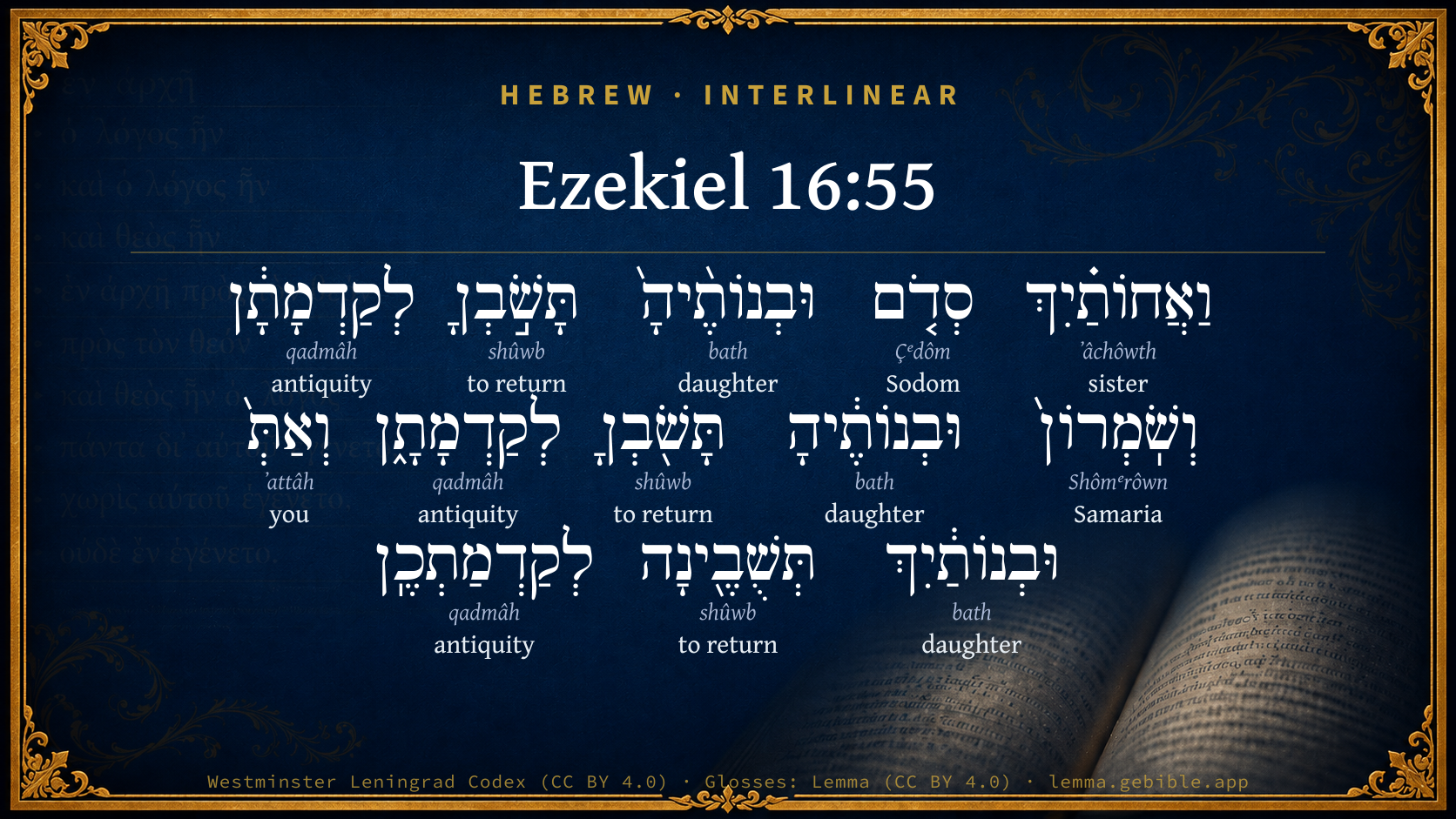
Ezekiel 16:55

Hebrew (Westminster Leningrad Codex) Ezekiel 16:55 appears in the Hebrew Old Testament. The text above is from the Westminster Leningrad Codex. Each word links to its Strong’s number, a concise gloss, and parsing drawn from the Open Scriptures Hebrew Bible morphology. Click any word for its full Brown-Driver-Briggs (BDB) entry.
Download image
Cite this verse

Ezekiel 16:55 (World English Bible). Public Domain. Lemma interlinear Bible study tool, https://lemma.gebible.app/v/ezekiel/16/55.

Show BibTeX & RIS
BibTeX
RIS
English Translation
Your sisters, Sodom and her daughters, shall return to their former estate; and Samaria and her daughters shall return to their former estate; and you and your daughters shall return to your former estate.
World English Bible · Public Domain
Download a study sheet

One document with this verse’s original text, its word-by-word gloss line, the meaning frame, cross-references with their text, attributed commentary, and full source and license credits — printable, and it pastes into notes with its structure intact.

This verse Autodidact and up

Study sheet (.html) Plain text (.txt)

A passage Seminary Student

Up to 50 verses in one chapter. A passage sheet keeps up to 6 commentary sources and 12 cross-references per verse, in the order this page ranks them, and says so on the sheet whenever that leaves anything out. Ask for a single verse and you get the Autodidact verse sheet above.

Everything on this page stays free to read, with no account — the sheet is a download of what is already on screen, not access to it.

Want to remove ads? Support Godless Engineer
Compare translations 3

The same verse in 3 English versions, stacked beneath the original-language interlinear above. Click any original word for its lexicon entry.

Each is an independent rendering of the whole verse — the interlinear is not word-aligned to these translations.

Highlighted words mark where these versions differ — a whole-verse word diff, not a word-by-word alignment.

  • World English Bible Public Domain
    Your sisters, Sodom and her daughters, shall return to their former estate; and Samaria and her daughters shall return to their former estate; and you and your daughters shall return to your former estate.
  • King James Version Public Domain
    When thy sisters, Sodom and her daughters, shall return to their former estate, and Samaria and her daughters shall return to their former estate, then thou and thy daughters shall return to your former estate.
  • unfoldingWord Literal Text CC BY-SA 4.0
    So your sister Sodom and her daughters will be restored to their former condition, and Samaria and her daughters will be restored to their former estate. Then you and your daughters will be restored to your former condition.

unfoldingWord Literal Text — © unfoldingWord, licensed CC BY-SA 4.0. Word-aligned USFM3 via Door43 (git.door43.org/unfoldingWord/en_ult).

Versions to compare (up to 4)

3 of 4 selected

Show all 18 translations

Every available English version of this verse, each an independent rendering of the whole verse.

  • World English Bible Public Domain
    Your sisters, Sodom and her daughters, shall return to their former estate; and Samaria and her daughters shall return to their former estate; and you and your daughters shall return to your former estate.
  • Berean Standard Bible Public Domain
    And your sisters, Sodom with her daughters and Samaria with her daughters, will return to their former state. You and your daughters will also return to your former state.
  • Majority Standard Bible Public Domain
    And your sisters, Sodom with her daughters and Samaria with her daughters, will return to their former state. You and your daughters will also return to your former state.
  • King James Version Public Domain
    When thy sisters, Sodom and her daughters, shall return to their former estate, and Samaria and her daughters shall return to their former estate, then thou and thy daughters shall return to your former estate.
  • American Standard Version (1901) Public Domain
    And thy sisters, Sodom and her daughters, shall return to their former estate; and Samaria and her daughters shall return to their former estate; and thou and thy daughters shall return to your former estate.
  • Revised Version (1885) Public Domain
    And thy sisters, Sodom and her daughters, shall return to their former estate, and Samaria and her daughters shall return to their former estate, and thou and thy daughters shall return to your former estate.
  • Geneva Bible (1599) Public Domain
    And thy sister Sodom and her daughters shall returne to their former state: Samaria also and her daughters shall returne to their former state, when thou and thy daughters shall returne to your former state.
  • Douay-Rheims (1899) Public Domain
    And thy sister Sodom and her daughters shall return to their ancient state: and Samaria and her daughters shall return to their ancient state: and thou and thy daughters shall return to your ancient state.
  • Young's Literal Translation Public Domain
    And thy sisters, Sodom and her daughters, Do turn back to their former state, And Samaria and her daughters Do turn back to their former state, And thou and thy daughters do turn back to your former state.
  • Literal Standard Version CC BY-SA 4.0
    And your sisters, Sodom and her daughters, || Return to their former state, || And Samaria and her daughters return to their former state, || And you and your daughters return to your former state.
  • Unlocked Literal Bible CC BY-SA 4.0
    So your sister Sodom and her daughters will be restored to their former condition, and Samaria and her daughters will be restored to their former estate. Then you and your daughters will be restored to your former condition.
  • unfoldingWord Literal Text CC BY-SA 4.0
    So your sister Sodom and her daughters will be restored to their former condition, and Samaria and her daughters will be restored to their former estate. Then you and your daughters will be restored to your former condition.
  • Darby Bible Public Domain
    And thy sisters, Sodom and her daughters, shall return to their former estate, and Samaria and her daughters shall return to their former estate; thou also and thy daughters, ye shall return to your former estate.
  • World Messianic Bible Public Domain
    Your sisters, Sodom and her daughters, will return to their former estate; and Samaria and her daughters will return to their former estate; and you and your daughters will return to your former estate.
  • Webster's Bible Public Domain
    When thy sisters, Sodom and her daughters, shall return to their former state, and Samaria and her daughters shall return to their former state, then thou and thy daughters shall return to your former state.
  • Free Bible Version CC BY-SA 4.0
    Your sisters, Sodom with her daughters and Samaria with her daughters, will be restored to what they were before. You and your daughters will also be restored to what you were before.
  • Bible in Basic English Public Domain
    And your sisters, Sodom and her daughters, will go back to their first condition, and Samaria and her daughters will go back to their first condition, and you and your daughters will go back to your first condition.
  • JPS Tanakh (1917) Public Domain
    And thy sisters, Sodom and her daughters, shall return to their former estate, and Samaria and her daughters shall return to their former estate, and thou and thy daughters shall return to your former estate.

Literal Standard Version (2020), Covenant Press — licensed CC BY-SA 4.0. Text via the HelloAO Bible API (eBible.org). Unlocked Literal Bible (unfoldingWord) — licensed CC BY-SA 4.0. Text via the HelloAO Bible API (eBible.org). unfoldingWord Literal Text — © unfoldingWord, licensed CC BY-SA 4.0. Word-aligned USFM3 via Door43 (git.door43.org/unfoldingWord/en_ult). Free Bible Version, Dr. Jonathan Gallagher — licensed CC BY-SA 4.0. Text via the HelloAO Bible API (eBible.org).

Word by word

More ways to search: Search by grammar → Find every occurrence → Compare this word →

Practice this passage: Drill this verse → Learn its vocabulary →

לְקַדְמָתָ֔ן
qadmâh
H6927
“to/for · antiquity · their”
Preposition + Noun, Common, Feminine, Singular, Construct + Suffix, Personal, 3rd Person, Feminine, Plural
Part of Speech
Preposition + Noun
Type
Common
Gender
Feminine
Number
Singular
State
Construct
Full BDB Definition

Origin: from H6923

TWOT: 1988c

antiquity, former state or estate or situation, before, origin - antiquity, beginning, origin - former state or situation - before
  1. וַאֲחוֹתַ֗יִךְ ʼâchôwth H269 “and · sisters · your” Conjunction + Noun, Common, Feminine, Plural, Construct + Suffix, Personal, 2nd Person, Feminine, Singular
  2. סְדֹ֤ם Çᵉdôm H5467 “Sodom” Noun, Proper
  3. וּבְנוֹתֶ֨יהָ֙ bath H1323 “and · daughters · her” Conjunction + Noun, Common, Feminine, Plural, Construct + Suffix, Personal, 3rd Person, Feminine, Singular
  4. תָּשֹׁ֣בְןָ shûwb H7725 “to return” Verb, Qal, Imperfect, 3rd Person, Feminine, Plural
  5. וְשֹֽׁמְרוֹן֙ Shômᵉrôwn H8111 “and · Samaria” Conjunction + Noun, Proper
  6. וּבְנוֹתֶ֔יהָ bath H1323 “and · daughters · her” Conjunction + Noun, Common, Feminine, Plural, Construct + Suffix, Personal, 3rd Person, Feminine, Singular
  7. תָּשֹׁ֖בְןָ shûwb H7725 “to return” Verb, Qal, Imperfect, 3rd Person, Feminine, Plural
  8. לְקַדְמָתָ֑ן qadmâh H6927 “to/for · antiquity · their” Preposition + Noun, Common, Feminine, Singular, Construct + Suffix, Personal, 3rd Person, Feminine, Plural
  9. וְאַתְּ֙ ʼattâh H859 “and · you” Conjunction + Pronoun, Personal, 2nd Person, Feminine, Singular
  10. וּבְנוֹתַ֔יִךְ bath H1323 “and · daughters · your” Conjunction + Noun, Common, Feminine, Plural, Construct + Suffix, Personal, 2nd Person, Feminine, Singular
  11. תְּשֻׁבֶ֖ינָה shûwb H7725 “to return” Verb, Qal, Imperfect, 2nd Person, Feminine, Plural
  12. לְקַדְמַתְכֶֽן qadmâh H6927 “to/for · antiquity · your” Preposition + Noun, Common, Feminine, Singular, Construct + Suffix, Personal, 2nd Person, Feminine, Plural

About this verse

These counts appear in no published source. They are computed here, from the morphology-tagged text and Lemma’s own curated glosses. What Lemma adds →

13
words
7
distinct lemmas
Prophets
section

Notable vocabulary

The rarest word here is לְקַדְמָתָ֔ן antiquity H6927 — appearing just 6 times in the whole Hebrew Bible.

Shared distinctive vocabulary

לְקַדְמָתָ֔ן antiquity H6927 occurs in 4 verses of the Hebrew Bible. Also found in:

Grammatical profile

  • 3 verbs
  • 9 nouns
  • 1 pronoun

Verb forms

  • תָּשֹׁ֣בְןָ Qal · Imperfect
  • תָּשֹׁ֖בְןָ Qal · Imperfect
  • תְּשֻׁבֶ֖ינָה Qal · Imperfect

Repetition

Words recur within this verse — often emphatic in Hebrew:

  • וּבְנוֹתֶ֨יהָ֙ daughter H1323 ×3
  • תָּשֹׁ֣בְןָ to return H7725 ×3
  • לְקַדְמָתָ֔ן antiquity H6927 ×3

Hebrew & Septuagint length

In English translation the verse runs 34 words from the Hebrew and 30 from the Septuagint (LXX English) — closely comparable.

A rough comparison of the two English renderings, which tokenize alike — not a word-level alignment.

Word counts can differ between the Hebrew and the Greek without any difference in meaning — e.g. the Hebrew direct-object marker אֵת has no separate Greek word, and Greek often adds the article ὁ.

Cross-references

3

Topical passages linked to Ezekiel 16:55 in the Treasury of Scripture Knowledge — connected by theme and wording, ordered by reader-vote popularity; previews shown in the World English Bible.

  • Ezekiel 16:53 I will turn again their captivity, the captivity of Sodom and her daughters, and the captivity of Samaria and her daughters, and the captivity of your captives in the midst of them;
  • Ezekiel 36:11 and I will multiply on you man and animal; and they shall increase and be fruitful; and I will cause you to be inhabited after your former estate, and will do better [to you] than at your beginnings: and you shall know that I am Yahweh.
  • Malachi 3:4 Then the offering of Judah and Jerusalem will be pleasant to Yahweh, as in the days of old, and as in ancient years.

Cross-references courtesy of OpenBible.info (CC BY 4.0).

Hebrew and Greek witnesses Masoretic Hebrew ↔ Greek Septuagint

The same verse in the two great witnesses to the Old Testament, shown verse-for-verse.

These are two independent witnesses, not word-aligned to each other, and the Septuagint is shown in lemma (dictionary) form.

Hebrew Ezekiel 16:55 Masoretic · Westminster Leningrad Codex

וַאֲחוֹתַ֗יִךְ סְדֹ֤ם וּבְנוֹתֶ֨יהָ֙ תָּשֹׁ֣בְןָ לְקַדְמָתָ֔ן וְשֹֽׁמְרוֹן֙ וּבְנוֹתֶ֔יהָ תָּשֹׁ֖בְןָ לְקַדְמָתָ֑ן וְאַתְּ֙ וּבְנוֹתַ֔יִךְ תְּשֻׁבֶ֖ינָה לְקַדְמַתְכֶֽן

Your sisters, Sodom and her daughters, shall return to their former estate; and Samaria and her daughters shall return to their former estate; and you and your daughters shall return to your former estate.

World English Bible · Public Domain

Greek LXX Ezekiel 16:55 Septuagint · lemma form

καί ὁ ἀδελφή σύ σοδομα καί ὁ θυγάτηρ αὐτός ἀπο καταἵστημι καθώς εἰμί ἀπό ἀρχή καί σαμαρεία καί ὁ θυγάτηρ αὐτός ἀπο καταἵστημι καθώς εἰμί ἀπό ἀρχή καί σύ καί ὁ θυγάτηρ σύ ἀπο καταἵστημι καθώς ἀπό ἀρχή εἰμί

And your sister Sodom and her daughters shall be restored as they were at the beginning, and you and your daughters shall be restored as you⌃ were at the beginning.

LXX2012 (modern English Septuagint) · Public Domain

Hebrew: Westminster Leningrad Codex (CC BY 4.0). Greek: Septuagint (public domain); English from LXX2012 (modern English Septuagint) (Public Domain). How the Septuagint differs from the Hebrew →

Targum (Aramaic paraphrase)

1

The Targum is the ancient Jewish Aramaic paraphrase of the Hebrew Scriptures — an interpretive translation, not the Hebrew text itself. Onkelos (literal) and Pseudo-Jonathan (expansive) render the Torah, and Jonathan the Prophets. Coverage is partial: where no permissively-licensed English translation exists for a verse, only the Aramaic is shown. This is verse-level text, not a word-by-word alignment to the Hebrew.

  1. Targum Jonathan Prophets (Joshua–Malachi)
    וַאֲחָתַיִךְ סְדוֹם וְכַפְרָנָהָא יְתוּבָן לְאַוְלְהֶן וְשֹׁמְרוֹן וְכַפְרָנָהָא יְתוּבוּן לְאַוְלְהֶן וְאַתְּ וְכַפְרָנָךְ תְּתוּבוּן לְאַוְלְכֶן:

    (no public-domain English translation for this verse)

    Targum Jonathan — Aramaic: “Mikraot Gedolot” (public domain). English: “Sefaria Community Translation” (CC0 1.0 (public-domain dedication)); “London "Chaldee Paraphrase," 1871” (public domain). Text via Sefaria.

Commentary

Notes on Ezekiel 16:55 from classic Christian and Jewish commentators (each source and its license shown beneath its notes). The classic Christian expositions comment on the surrounding passage and are grouped to its opening verse, so a note may address several verses; the Jewish commentaries on the Tanakh (Rashi and others) are per-verse, so they appear only where the commentator wrote on this verse.

Lemma curates 59 commentaries, every one of them public domain or Creative Commons licensed, each selected and text-cleaned for this edition rather than reprinted as found. About our sources →

Trapp's Complete Commentary

John Trapp

Eze 16:55 When thy sisters, Sodom and her daughters, shall return to their former estate, and Samaria and her daughters shall return to their former estate, then thou and thy daughters shall return to your former estate.

Ver. 55. When thy sister Sodom and her daughters.] See on Eze 16:53. The Jews still dream that all this shall be done at the coming of their long looked for Messiah, and in his reign on earth for a thousand years. {a} That then also Jerusalem shall be rebuilt and made up of gold, silver, and precious stones, &c. So apt are they to work themselves into the fool’s paradise of a sublime dotage.

{a} Jerome in loc.

John Trapp, A Commentary or Exposition upon All the Books of the Old and New Testament (1647–1656) — public domain. Text from a community e-Sword module.

Geneva Bible (1599)

Geneva Bible translators

Meaning, that it should never come to pass.

Geneva Bible (1599) marginal notes — public domain. Text via Bolls.life.

Jamieson, Fausset & Brown

Robert Jamieson, A. R. Fausset & David Brown

(See on Eze 16:53).

Jamieson, Fausset & Brown — Commentary Critical and Explanatory on the Whole Bible (1871) — public domain (CC PDM 1.0). Text via the HelloAO Bible API.

John Calvin's Commentaries

A clearer explanation of the former doctrine now follows, that the Jews, should thus feel God merciful when his mercy reached Samaria and Sodom; but that never could be done, and hence the Jews were reduced to despair; for, as I have said, the Prophet argues from what is impossible and almost absurd. Just as Virgil writes —

“The inhabitants of seas and skies shall change, And fish on shore, and stags in air shall range:” Virgil, Dryden’s, Eclogue 1. V. 60 —

which can never take place: so that it implies the complete denial of what might seem doubtful. This way of speaking is proverbial, when Ezekiel says that the Sodomites and Israelites should return to their ancient state or their former dignity; and that could never be hoped for, as I have said: hence it follows, that the Jews could not be safe when God draws them into the same punishment. Besides, the Prophet speaks as if the city should be cut off and temple overthrown, since the Jews had often been threatened with this, and he had shown them the wrath of God present before their eyes. But, although they had always hoped well, yet he despises their pride by which they were blinded, and utters his prophecies openly as if God had executed whatever he had threatened. For this reason he says, the captivity of thy captivities shall be in the midst of them. But they might object, that they enjoyed their country, that they still cultivated their fields, and had sufficient food for their support although besieged by their enemies. But the Prophet looked down upon it all, because before God the city was as it were taken and all were exiles, since God had not threatened them in vain. Weakness here compels me to break off.

John Calvin's Commentaries (1540-1563) — public domain. Text from the Calvin Translation Society English edition (1840s-50s) via the Christian Classics Ethereal Library (ccel.org). Calvin's coverage is partial (roughly two-thirds of the Bible); uncommented books and verses are honest gaps, never fabricated. The 19th-century editor's footnotes and remarks are omitted so the notes are faithfully Calvin's own voice.

The Cambridge Bible for Schools and Colleges

gen. ed. J. J. S. Perowne

55. When thy sisters] Better: and thy sisters … and thou and thy daughters. In this idea of the restoration of Israel’s heathen neighbours to their own land after being plucked up out of it Ezekiel as usual follows Jeremiah; cf. in general, Jer_12:14-17; Moab, ch. Jer_48:47, Ammon, Jer_49:6, and Elam, Jer_49:39.

The Cambridge Bible for Schools and Colleges (gen. ed. J. J. S. Perowne; Cambridge University Press, 1878–1918) — public domain. Text from a community e-Sword module.

John Gill's Exposition

For thy sister Sodom was not mentioned by thy mouth,.... Or, "was not for a hearing", or "a report, in thy mouth" (g); the destruction of Sodom, though it was such an awful judgment of God, so flagrant and notorious, was visible and just at hand; yet it was not taken notice of, nor talked of; it was not the subject of conversation among friends; it was not reported from father to son, or heard of the one by the other; it was not regarded, nor was warning taken by it, which might have been, had it been more frequently mentioned; but they did not care, or neglected to speak of it; though it was "an ensample to those that should after live ungodly", Pe2 2:6; yet it was not for instruction to them, as the Targum paraphrases it; they learned nothing by it; or Sodom was so infamous for sin and punishment, that they scorned to make mention of its name; and yet they were as great Or greater sinners, and deserving of sorer punishment:

in the day of thy pride; or "prides", or "excellencies" (h); in the time of their prosperity, in the days of David and Solomon, and other kings of Judah. Prosperity is apt to make men proud, and to lift them above themselves; and to forget what they have been, and what they may be; and to neglect observing the judgments of God on others, and to take warning by them.

(g) "in auditu in ore tuo", Pagninus, Montanus; "in auditum", Vatablus. (h) "in die superbiarum tuarum", Pagninus, Montanus, Calvin; "in die excellentiarum tuarum", Piscator; "in die erectionum tuarum", Cocceius, Starckius.

John Gill's Exposition of the Whole Bible (1746–1763) — public domain (CC PDM 1.0). Text via the HelloAO Bible API.

Haydock's Catholic Bible Commentary

Ancient state. That is, to their former state of liberty, and their ancient possessions. In the spiritual sense, to the true liberty and the happy inheritance of the children of God, through faith in Christ. (Challoner) --- All will be treated alike, whether Jew or Gentile. (Haydock) --- When Sodom or the Gentiles shall have embraced the gospel, then also will the Jews, Romans x. (Worthington)

George Leo Haydock (1774–1849), Haydock's Catholic Family Bible and Commentary, 1859 edition — public domain. Excludes Psalms (Douay-Rheims chapter numbering differs from Protestant) and Deuterocanonical books (Catholic canon only).

Matthew Poole's English Annotations

This verse is explained in Eze 16:53, and needs not a repeated explication; it threatens a perpetual continuance of their low, abject, and miserable state in their outward concerns.

Matthew Poole's English Annotations on the Holy Bible (1683–1685) — public domain. Text from a community e-Sword/MySword module.

Whedon's Commentary on the Bible

Daniel D. Whedon

55. See note on Eze_16:53. The Israelites always thought of Sodom and Samaria as being the superlative sinners. Only the extremest limit of God’s mercy could reach them. A Midrash on Exo_12:12, speaks of ten things which shall be renewed in the far future and the fourth is, “even Sodom and Gomorrah shall be rebuilt.”

Daniel D. Whedon (gen. ed.), Commentary on the Old and New Testaments (1874–1909) — public domain. Text from a community e-Sword module.

The Pulpit Commentary

Read and for when, as in ver. 53.

The Pulpit Commentary (1880–1919), ed. H.D.M. Spence-Jones & Joseph S. Exell — public domain. Text from a community e-Sword module.

Lesson kit

Teaching starters — assembled from the data on this page, not authored interpretation. Every prompt links to the verse data it draws on. Edit before teaching.

Ezekiel, in the Prophets, opens this verse with 13 words (7 distinct Hebrew lemmas). Its most distinctive word is qadmâh (“antiquity”). A historical commentator’s framing appears above. Read the whole chapter for the surrounding context.

Discussion questions

  1. What does “antiquity” (qadmâh) contribute to the verse as a whole?
  2. Psalms 129:6 shares the word «antiquity» with this verse. How do the two illuminate each other?
  3. “daughter” occurs 3× in this one verse. What is the effect of the repetition?
  4. These translations render this verse differently. What is at stake in choosing one wording over another?
  5. The verb «תָּשֹׁ֣בְןָ» is Qal Imperfect. How does its form color the action?
  6. Reading how Trapp's Complete Commentary and Geneva Bible (1599) read this verse, where do the two commentators agree and where do they part?

Things to notice

  • These translations choose different wording for 9 words in this verse.
  • “daughter” occurs 3× in this single verse.
  • 7 distinct Hebrew lemmas span 13 words in this verse.

Reading settings

Reading text

Shown beneath each verse's original-language words.

Old Testament
Old Testament edition

Read the OT as the Masoretic Hebrew (MT) or the Greek Septuagint (LXX).

English shown for the Greek Septuagint (in the Hebrew ↔ Greek comparison).

Comparing translations? Open the Compare panel on any verse page to stack up to four side by side.