Judges 9:56

Hebrew (Westminster Leningrad Codex) Judges 9:56 appears in the Hebrew Old Testament. The text above is from the Westminster Leningrad Codex. Each word links to its Strong’s number, a concise gloss, and parsing drawn from the Open Scriptures Hebrew Bible morphology. Click any word for its full Brown-Driver-Briggs (BDB) entry.
Download image
Cite this verse

Judges 9:56 (World English Bible). Public Domain. Lemma interlinear Bible study tool, https://lemma.gebible.app/v/judges/9/56.

Show BibTeX & RIS
BibTeX
RIS
English Translation
Thus God requited the wickedness of Abimelech, which he did to his father, in killing his seventy brothers;
World English Bible · Public Domain
Download a study sheet

One document with this verse’s original text, its word-by-word gloss line, the meaning frame, cross-references with their text, attributed commentary, and full source and license credits — printable, and it pastes into notes with its structure intact.

This verse Autodidact and up

Study sheet (.html) Plain text (.txt)

A passage Seminary Student

Up to 50 verses in one chapter. A passage sheet keeps up to 6 commentary sources and 12 cross-references per verse, in the order this page ranks them, and says so on the sheet whenever that leaves anything out. Ask for a single verse and you get the Autodidact verse sheet above.

Everything on this page stays free to read, with no account — the sheet is a download of what is already on screen, not access to it.

Want to remove ads? Support Godless Engineer
Compare translations 3

The same verse in 3 English versions, stacked beneath the original-language interlinear above. Click any original word for its lexicon entry.

Each is an independent rendering of the whole verse — the interlinear is not word-aligned to these translations.

Highlighted words mark where these versions differ — a whole-verse word diff, not a word-by-word alignment.

  • World English Bible Public Domain
    Thus God requited the wickedness of Abimelech, which he did to his father, in killing his seventy brothers;
  • King James Version Public Domain
    Thus God rendered the wickedness of Abimelech, which he did unto his father, in slaying his seventy brethren:
  • unfoldingWord Literal Text CC BY-SA 4.0
    So God turned back the evil of Abimelech, which he did to his father by killing his 70 brothers.

unfoldingWord Literal Text — © unfoldingWord, licensed CC BY-SA 4.0. Word-aligned USFM3 via Door43 (git.door43.org/unfoldingWord/en_ult).

Versions to compare (up to 4)

3 of 4 selected

Show all 18 translations

Every available English version of this verse, each an independent rendering of the whole verse.

  • World English Bible Public Domain
    Thus God requited the wickedness of Abimelech, which he did to his father, in killing his seventy brothers;
  • Berean Standard Bible Public Domain
    In this way God repaid the wickedness that Abimelech had done to his father in murdering his seventy brothers.
  • Majority Standard Bible Public Domain
    In this way God repaid the wickedness that Abimelech had done to his father in murdering his seventy brothers.
  • King James Version Public Domain
    Thus God rendered the wickedness of Abimelech, which he did unto his father, in slaying his seventy brethren:
  • American Standard Version (1901) Public Domain
    Thus God requited the wickedness of Abimelech, which he did unto his father, in slaying his seventy brethren;
  • Revised Version (1885) Public Domain
    Thus God requited the wickedness of Abimelech, which he did unto his father, in slaying his seventy brethren:
  • Geneva Bible (1599) Public Domain
    Thus God rendred the wickednes of Abimelech, which he did vnto his father, in slaying his seuentie brethren.
  • Douay-Rheims (1899) Public Domain
    And God repaid the evil, that Abimelech had done against his father, killing his seventy brethren.
  • Young's Literal Translation Public Domain
    and God turneth back the evil of Abimelech which he did to his father to slay his seventy brethren;
  • Literal Standard Version CC BY-SA 4.0
    and God turns back the evil of Abimelech which he did to his father to slay his seventy brothers;
  • Unlocked Literal Bible CC BY-SA 4.0
    So God avenged the evil of Abimelech that he did to his father by murdering his seventy brothers.
  • unfoldingWord Literal Text CC BY-SA 4.0
    So God turned back the evil of Abimelech, which he did to his father by killing his 70 brothers.
  • Darby Bible Public Domain
    Thus God requited the crime of Abim'elech, which he committed against his father in killing his seventy brothers;
  • World Messianic Bible Public Domain
    Thus God repaid the wickedness of Abimelech, which he did to his father in killing his seventy brothers;
  • Webster's Bible Public Domain
    Thus God rendered the wickedness of Abimelech, which he did to his father, in slaying his seventy brethren:
  • Free Bible Version CC BY-SA 4.0
    This is how God paid back Abimelech's crime against his father of murdering his seventy brothers.
  • Bible in Basic English Public Domain
    In this way Abimelech was rewarded by God for the evil he had done to his father in putting his seventy brothers to death;
  • JPS Tanakh (1917) Public Domain
    Thus God requited the wickedness of Abimelech, which he did unto his father, in slaying his seventy brethren;

Literal Standard Version (2020), Covenant Press — licensed CC BY-SA 4.0. Text via the HelloAO Bible API (eBible.org). Unlocked Literal Bible (unfoldingWord) — licensed CC BY-SA 4.0. Text via the HelloAO Bible API (eBible.org). unfoldingWord Literal Text — © unfoldingWord, licensed CC BY-SA 4.0. Word-aligned USFM3 via Door43 (git.door43.org/unfoldingWord/en_ult). Free Bible Version, Dr. Jonathan Gallagher — licensed CC BY-SA 4.0. Text via the HelloAO Bible API (eBible.org).

Word by word

More ways to search: Search by grammar → Find every occurrence → Compare this word →

Practice this passage: Drill this verse → Learn its vocabulary →

אֲבִימֶ֑לֶךְ
ʼĂbîymelek
H40
“Abimelech”
Noun, Proper
Part of Speech
Noun
Type
Proper
Full BDB Definition

Origin: from H1 and H4428

TWOT: None

Abimelech = "Melek is father" or " my father is king" - king of Gerar in Abraham's time - king of Gath in David's time; maybe title of Philistine kings - son of Gideon by a concubine - priest, son of Abiathar
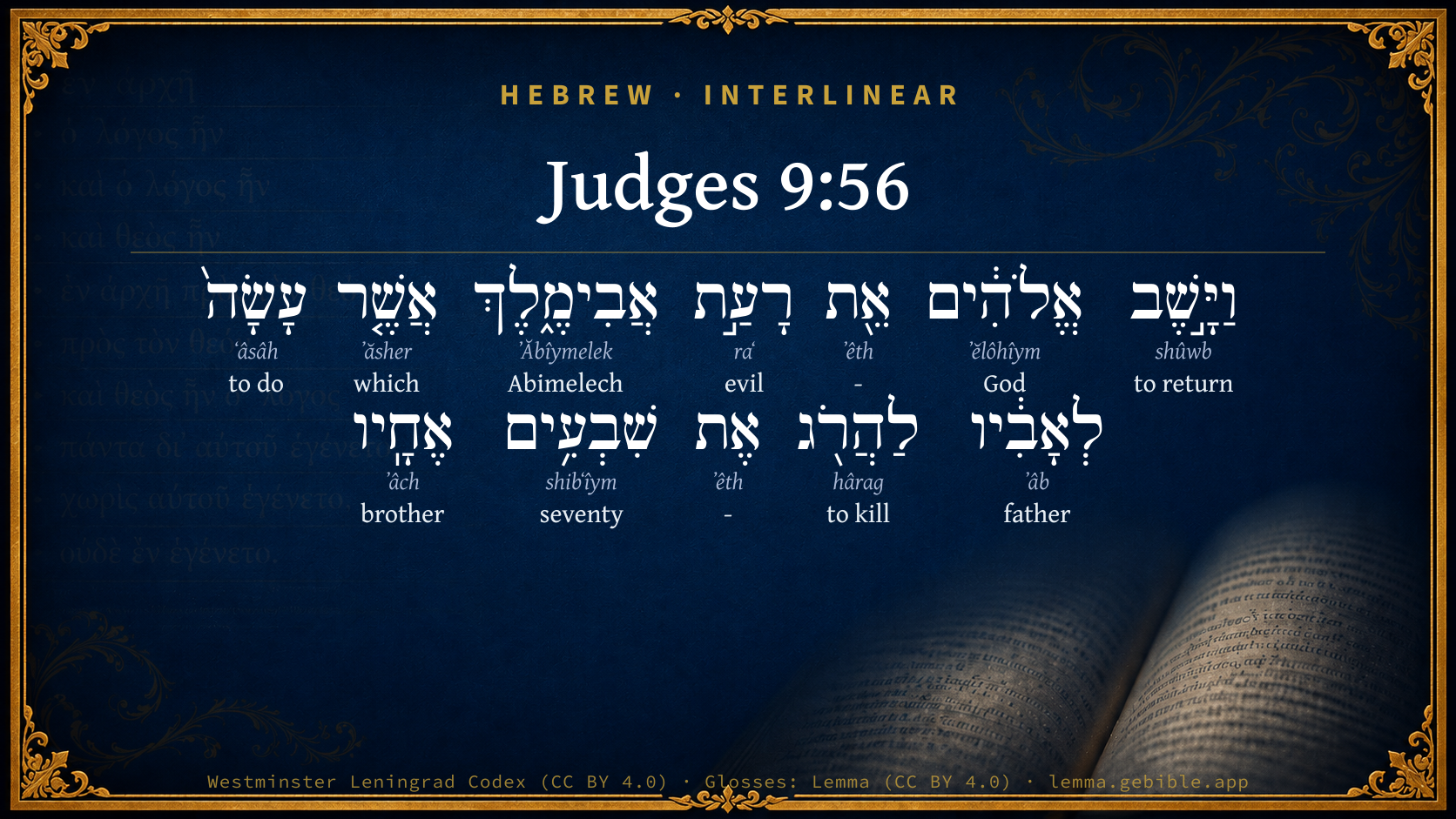
  1. וַיָּ֣שֶׁב shûwb H7725 “and · to return” Conjunction + Verb, Hiphil, Sequential Imperfect, 3rd Person, Masculine, Singular
  2. אֱלֹהִ֔ים ʼĕlôhîym H430 “God(s)” Noun, Common, Masculine, Plural, Absolute
  3. אֵ֖ת ʼêth H853 “-” Particle, Direct Object
  4. רָעַ֣ת raʻ H7451 “evil of” Noun, Common, Feminine, Singular, Construct
  5. אֲשֶׁ֤ר ʼăsher H834 “which” Particle, Relative
  6. עָשָׂה֙ ʻâsâh H6213 “to do” Verb, Qal, Perfect, 3rd Person, Masculine, Singular
  7. לְאָבִ֔יו ʼâb H1 “to/for · father · his” Preposition + Noun, Common, Masculine, Singular, Construct + Suffix, Personal, 3rd Person, Masculine, Singular
  8. לַהֲרֹ֖ג hârag H2026 “to kill” Preposition + Verb, Qal, Infinitive Construct
  9. אֶת ʼêth H853 “-” Particle, Direct Object
  10. שִׁבְעִ֥ים shibʻîym H7657 “seventy” Adjective, Cardinal number, Both, Plural, Absolute
  11. אֶחָֽיו ʼâch H251 “brothers · his” Noun, Common, Masculine, Plural, Construct + Suffix, Personal, 3rd Person, Masculine, Singular

About this verse

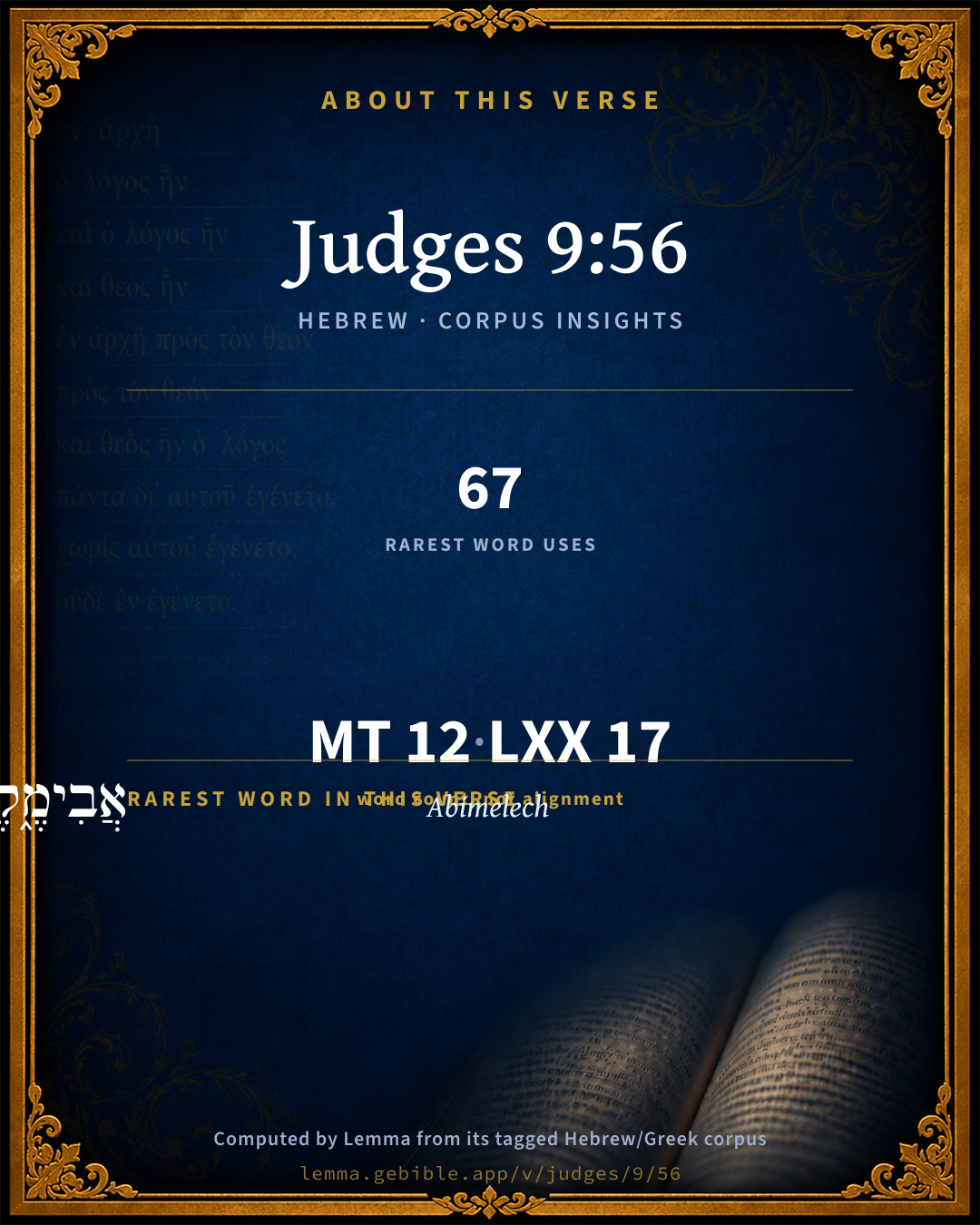
These counts appear in no published source. They are computed here, from the morphology-tagged text and Lemma’s own curated glosses. What Lemma adds →

12
words
11
distinct lemmas
Historical
section

Grammatical profile

  • 3 verbs
  • 5 nouns
  • 1 adjective
  • 3 particles

Verb forms

  • וַיָּ֣שֶׁב Hiphil · Sequential Imperfect
  • עָשָׂה֙ Qal · Perfect
  • לַהֲרֹ֖ג Qal · Infinitive Construct

Hebrew & Septuagint length

In English translation the verse runs 18 words from the Hebrew and 18 from the Septuagint (LXX English) — the same length.

A rough comparison of the two English renderings, which tokenize alike — not a word-level alignment.

Word counts can differ between the Hebrew and the Greek without any difference in meaning — e.g. the Hebrew direct-object marker אֵת has no separate Greek word, and Greek often adds the article ὁ.

In the original languages it is 12 Hebrew tokens and 17 Greek tokens — but the two are counted differently (Hebrew bundles its prefixes and suffixes into one token; the Greek is in lemma form), so that isn’t a like-for-like length.

Cross-references

11

Topical passages linked to Judges 9:56 in the Treasury of Scripture Knowledge — connected by theme and wording, ordered by reader-vote popularity; previews shown in the World English Bible.

  • Psalms 94:23 He has brought on them their own iniquity, And will cut them off in their own wickedness. Yahweh, our God, will cut them off.
  • Proverbs 5:22 The evil deeds of the wicked ensnare him. The cords of his sin hold him firmly.
  • Judges 9:24 that the violence done to the seventy sons of Jerubbaal might come, and that their blood might be laid on Abimelech their brother, who killed them, and on the men of Shechem, who strengthened his hands to kill his brothers.
  • Psalms 9:12 For he who avenges blood remembers them. He doesn't forget the cry of the afflicted.
  • Psalms 11:6 On the wicked he will rain blazing coals; Fire, sulfur, and scorching wind shall be the portion of their cup.
  • Psalms 58:10–11 The righteous shall rejoice when he sees the vengeance. He shall wash his feet in the blood of the wicked;
  • Matthew 7:2 For with whatever judgment you judge, you will be judged; and with whatever measure you measure, it will be measured to you.
  • Galatians 6:7 Don't be deceived. God is not mocked, for whatever a man sows, that will he also reap.
  • Job 31:3 Is it not calamity to the unrighteous, And disaster to the workers of iniquity?
  • Acts 28:4 When the natives saw the creature hanging from his hand, they said one to another, "No doubt this man is a murderer, whom, though he has escaped from the sea, yet Justice has not allowed to live."
  • Revelation 19:20–21 The beast was taken, and with him the false prophet who worked the signs in his sight, with which he deceived those who had received the mark of the beast and those who worshiped his image. These two were thrown alive into the lake of fire that burns with sulfur.

Cross-references courtesy of OpenBible.info (CC BY 4.0).

Hebrew and Greek witnesses Masoretic Hebrew ↔ Greek Septuagint

The same verse in the two great witnesses to the Old Testament, shown verse-for-verse.

These are two independent witnesses, not word-aligned to each other, and the Septuagint is shown in lemma (dictionary) form.

Hebrew Judges 9:56 Masoretic · Westminster Leningrad Codex

וַיָּ֣שֶׁב אֱלֹהִ֔ים אֵ֖ת רָעַ֣ת אֲבִימֶ֑לֶךְ אֲשֶׁ֤ר עָשָׂה֙ לְאָבִ֔יו לַהֲרֹ֖ג אֶת שִׁבְעִ֥ים אֶחָֽיו

Thus God requited the wickedness of Abimelech, which he did to his father, in killing his seventy brothers;

World English Bible · Public Domain

Greek LXX Judges 9:56 Septuagint · lemma form

καί ἐπιστρέφω ὁ θεός ὁ πονηρία αβιμελεχ ὅς ποιέω ὁ πατήρ αὐτός ἀποκτείνω ὁ ἑβδομήκοντα ἀδελφός αὐτός

So God requited the wickedness of Abimelech, which he wrought against his father, in slaying his seventy brethren.

LXX2012 (modern English Septuagint) · Public Domain

Hebrew: Westminster Leningrad Codex (CC BY 4.0). Greek: Septuagint (public domain); English from LXX2012 (modern English Septuagint) (Public Domain). How the Septuagint differs from the Hebrew →

Targum (Aramaic paraphrase)

1

The Targum is the ancient Jewish Aramaic paraphrase of the Hebrew Scriptures — an interpretive translation, not the Hebrew text itself. Onkelos (literal) and Pseudo-Jonathan (expansive) render the Torah, and Jonathan the Prophets. Coverage is partial: where no permissively-licensed English translation exists for a verse, only the Aramaic is shown. This is verse-level text, not a word-by-word alignment to the Hebrew.

  1. Targum Jonathan Prophets (Joshua–Malachi)
    וַאֲתֵיב יְיָ יַת בִּישַׁת אֲבִימֶלֶךְ דַעֲבַד לַאֲבוּהִי לְמִקְטַל יַת שַׁבְעִין אֲחוֹהִי:

    (no public-domain English translation for this verse)

    Targum Jonathan — Aramaic: “Mikraot Gedolot” (public domain). English: “Sefaria Community Translation” (CC0 1.0 (public-domain dedication)); “London "Chaldee Paraphrase," 1871” (public domain). Text via Sefaria.

Commentary

Notes on Judges 9:56 from classic Christian and Jewish commentators (each source and its license shown beneath its notes). The classic Christian expositions comment on the surrounding passage and are grouped to its opening verse, so a note may address several verses; the Jewish commentaries on the Tanakh (Rashi and others) are per-verse, so they appear only where the commentator wrote on this verse.

Lemma curates 59 commentaries, every one of them public domain or Creative Commons licensed, each selected and text-cleaned for this edition rather than reprinted as found. About our sources →

Trapp's Complete Commentary

John Trapp

Jdg 9:56 Thus God rendered the wickedness of Abimelech, which he did unto his father, in slaying his seventy brethren:

Ver. 56. Which he did unto his father.] Wrong done to a parent in any kind, is a heinous sin, and hath a heavy punishment.

John Trapp, A Commentary or Exposition upon All the Books of the Old and New Testament (1647–1656) — public domain. Text from a community e-Sword module.

Joseph Benson's Commentary

Jdg 9:56. Thus God rendered, &c. — This and the following verse conclude the history of Abimelech with a divine admonition, that no man might think such things come to pass by chance. We see God, the judge of all, punished both Abimelech and the men of Shechem according to their deserts, and made them the instruments of each other’s destruction. And it is remarkable that this punishment overtook them speedily, within less than four years after their crime was committed. The wickedness of Abimelech — In rooting out, as far as he could, the name and memory of his father.

Joseph Benson's Commentary on the Old and New Testaments (1811–1818) — public domain. Text from a community e-Sword module.

Adam Clarke's Commentary

Verse 56. Thus God rendered, c.] Both the fratricide Abimelech, and the unprincipled men of Shechem, had the iniquity visited upon them of which they had been guilty. Man's judgment may be avoided but there is no escape from the judgments of God.

I HAVE said that the fable of Jotham is the oldest, and perhaps the best, in the world; and referred for other particulars to the end of the chapter.

On the general subject of fable, apologue, and parable, the reader will find a considerable dissertation at the end of Mt 13:58; I shall add but a few things here, and they shall refer to the oldest collection of fables extant. These are of Indian origin, and are preserved in the Sanscreet, from which they have been translated into different languages, both Asiatic and European, under various titles. The collection is called Hitopadesa, and the author Veshnoo Sarma; but they are known in Europe by The Tales and Fables of Bidpay, or Pilpay, an ancient Indian Philosopher. Of this collection Sir William Jones takes the following notice: - "The fables of Veshnoo Sarma, whom we ridiculously call Pilpay, are the most beautiful, if not the most ancient, collection of apologues in the world. They were first translated from the Sanscreet, in the sixth century, by Buzerchumihr, or bright as the sun, the chief physician, and afterwards the vizir of the great Anushirwan; and are extant under various names, in more than twenty languages. But their original title is Hitopadesa, or amicable instruction; and as the very existence of AEsop, whom the Arabs believe to have been an Abyssinian, appears rather doubtful, I am not disinclined to suppose that the first moral fables which appeared in Europe were of Indian or AEthiopian origin."

Mr. Frazer, in his collection of Oriental MSS. at the end of his History of Nadir Shah, gives us the following account of this curious and instructive work: -

"The ancient brahmins of India, after a good deal of time and labour, compiled a treatise, (which they called Kurtuk Dumnik,) in which were inserted the choicest treasure of wisdom and the most perfect rules for governing a people. This book they presented to their rajahs, who kept it with the greatest secrecy and care. About the time of Mohammed's birth or the latter end of the sixth century, Noishervan the Just, who then reigned in Persia, discovered a great inclination to see that book; for which purpose Burzuvia, a physician, who had a surprising talent in learning several languages, particularly Sanskerritt, was introduced to him as the most proper person to be employed to get a copy of it. He went to India, where, after some years' stay, and great trouble, he procured it. It was translated into the Pehluvi (the ancient Persian language) by him and Buzrjumehr, the vizir. Noishervan, ever after, and all his successors, the Persian kings, had this book in high esteem, and took the greatest care to keep it secret. At last Abu Jaffer Munsour zu Nikky, who was the second caliph of the Abassi reign, by great search got a copy of it in the Pehluvi language, and ordered Imam Hassan Abdal Mokaffa, who was the most learned of the age, to translate it into Arabic. This prince ever after made it his guide, not only in affairs relating to the government, but also in private life.

"In the year 380 of the Hegira, Sultan Mahmud Ghazi put into verse; and afterwards, in the year 515, by order of Bheram Shah ben Massaud, that which Abdal Mokaffa had translated was retranslated into Persic by Abdul Mala Nasser Allah Mustofi; and this is that Kulila Dumna which is now extant. As this latter had too many Arabic verses and obsolete phrases in it, Molana Ali beg Hessein Vaes, at the request of Emir Soheli, keeper of the seals to Sultan Hossein Mirza, put it into a more modern style, and gave it the title of Anuar Soheli.

"In the year 1002, the great moghul Jalal o Din Mohommed Akbar ordered his own secretary and vizir, the learned Abul Fazl, to illustrate the obscure passages, abridge the long digressions, and put it into such a style as would be most familiar to all capacities; which he accordingly did, and gave it the name of Ayar Danish, or the Criterion of Wisdom." This far Mr. Frazer, under the word Ayar Danish.

"In the year 1709," says Dr. Wilkins, "the Kulila Dumna, the Persian version of Abul Mala Nasser Allah Mustofi, made in the 515th year of the Hegira, was translated into French, with the title of Les Conseils et les Maximes de Pilpay, Philosophe Indien, sur les divers Etats de la Vie. This edition resembles the Hitopadesa more than any other then seen; and is evidently the immediate original of the English Instructive and entertaining Fables of Pilpay, an ancient Indian philosopher, which, in 1775, had gone through five editions.

"The Anuar Soheli, above mentioned, about the year 1540, was rendered into the Turkish language; and the translator is said to have bestowed twenty years' labour upon it. In the year 1724, this edition M. Galland began to translate into French, and the first four chapters were then published; but, in the year 1778, M. Cardonne completed the work, in three volumes, giving it the name of Contes et Fables Indiennes de Bidpai et de Lokman; traduites d' Ali Tcheleby ben Saleh, amateur Turk; 'Indian Tales and Fables of Bidpay and Lockman, translated from Aly Tcheleby ben Saleh, a Turkish author.'"

The fables of Lockman were published in Arabic and Latin, with notes, by Erpenius, 4to. Amstel., 1636; and by the celebrated Golius, at the end of his edition of Erpen's Arabic Grammar, Lugd. Bat., 1656, with additional notes; and also in the edition of the same Grammar, by Albert Schultens, Lugd. Bat., 1748, 4to. They are only thirty-seven in number.

Of the Hitopadesa, or fables of Veshnoo Sarma, we have two very elegant English translations from the original Sanscreet: one by Sir William Jones, printed in his works, 4to., vol. 6, Lond. 1799; the other by the father of Sanscreet literature in Europe, Dr. Charles Wilkins, of the India House, 8vo., Bath, 1787, with a collection of very important notes.

The Bahar Danush, or Sea of Wisdom, abounds with maxims, apothegms, c., similar to those in the preceding works this was most faithfully translated from the Persian, by Dr. Jonathan Scott, late Persian secretary to his excellency Warren Hastings, published in three vols. 12mo., with notes, Shrewsbury, 1799. This is the most correct version of any Persian work yet offered to the public. The original is by Einaut Ullah. Of these works it may be said, they contain the wisdom of the oriental world; and many of the numerous maxims interspersed through them yield in importance only to those in the sacred writings. The fables attributed to AEsop have been repeatedly published in Greek and Latin, as well as in all the languages of Europe, and are well known. Those of Phaedrus are in general only a metrical version of the fables of AEsop. The compositions of La Fontaine, in French, and those of Mr. Gay, in English, are very valuable.

Adam Clarke's Commentary on the Bible (1810–1826) — public domain. Text from a community e-Sword/MySword module.

Ellicott's Commentary for English Readers

(56, 57) Thus.—These impressive verses give the explanation of the whole narrative. They are inserted to show that God punishes both individual and national crimes, and that men’s pleasant vices are made the instruments to scourge them. The murderer of his brothers “on one stone” is slain by a stone flung on his head, and the treacherous idolaters are treacherously burnt in the temple of their idol.

A Bible Commentary for English Readers, edited by Charles John Ellicott (1878–1897) — public domain. Text from a community e-Sword module.

John Gill's Exposition

And all the evil of the men of Shechem,.... In aiding Abimelech to slay his brethren, and in making him king after so foul a fact committed:

did God render upon their heads; by suffering Abimelech to beat down their city, and destroy the inhabitants of it, and by burning the hold in which the men of the tower of Shechem were, and them in it:

and upon them came the curse of Jotham the son of Jerubbaal; both upon Abimelech, and the men of Shechem, they being destroyed by one another, as Jotham imprecated they might, and foretold they would, see Jdg 9:20.

Next: Judges Chapter 10

John Gill's Exposition of the Whole Bible (1746–1763) — public domain (CC PDM 1.0). Text via the HelloAO Bible API.

Matthew Poole's English Annotations

The wickedness which he did unto his father, in rooting out, as far as he could, the name, and memory, and remainders of his father.

Matthew Poole's English Annotations on the Holy Bible (1683–1685) — public domain. Text from a community e-Sword/MySword module.

The Pulpit Commentary

Which he did unto his father. It is remarkable that the sacred writer, in calling attention to the righteous vengeance which fell upon the head of Abimelech, marks especially the conduct of Abimelech as undutiful to his father. (see Exo_21:17 Mat_15:4; cf. also Gen_9:24-26)

The Pulpit Commentary (1880–1919), ed. H.D.M. Spence-Jones & Joseph S. Exell — public domain. Text from a community e-Sword module.

John Wesley's Explanatory Notes

Wickedness - In rooting out, as far as he could, the name and memory of his father.

John Wesley, Explanatory Notes Upon the Whole Bible (1754–1765) — public domain. Text via the GEBible commentary corpus.

Lesson kit

Teaching starters — assembled from the data on this page, not authored interpretation. Every prompt links to the verse data it draws on. Edit before teaching.

Judges, in the Historical, opens this verse with 12 words (11 distinct Hebrew lemmas). Its most distinctive word is ʼĂbîymelek (“Abimelech”). A historical commentator’s framing appears above. Read the whole chapter for the surrounding context.

Discussion questions

  1. The word ʼĂbîymelek carries the sense “Abimelech.” How does it shape the verse?
  2. Psalms 94:23 shares this passage’s theme. How do the two illuminate each other?
  3. These translations render this verse differently. What is at stake in choosing one wording over another?
  4. The verb «וַיָּ֣שֶׁב» is Hiphil Sequential Imperfect. How does its form color the action?
  5. Reading how Trapp's Complete Commentary and Joseph Benson's Commentary read this verse, where do the two commentators agree and where do they part?

Things to notice

Reading settings

Reading text

Shown beneath each verse's original-language words.

Old Testament
Old Testament edition

Read the OT as the Masoretic Hebrew (MT) or the Greek Septuagint (LXX).

English shown for the Greek Septuagint (in the Hebrew ↔ Greek comparison).

Comparing translations? Open the Compare panel on any verse page to stack up to four side by side.