Micah 5:3

Hebrew (Westminster Leningrad Codex) Micah 5:3 appears in the Hebrew Old Testament. The text above is from the Westminster Leningrad Codex. Each word links to its Strong’s number, a concise gloss, and parsing drawn from the Open Scriptures Hebrew Bible morphology. Click any word for its full Brown-Driver-Briggs (BDB) entry.
Download image
Cite this verse

Micah 5:3 (World English Bible). Public Domain. Lemma interlinear Bible study tool, https://lemma.gebible.app/v/micah/5/3.

Show BibTeX & RIS
BibTeX
RIS
English Translation
Therefore he will abandon them until the time that she who is in labor gives birth. Then the rest of his brothers will return to the children of Israel.
World English Bible · Public Domain
Download a study sheet

One document with this verse’s original text, its word-by-word gloss line, the meaning frame, cross-references with their text, attributed commentary, and full source and license credits — printable, and it pastes into notes with its structure intact.

This verse Autodidact and up

Study sheet (.html) Plain text (.txt)

A passage Seminary Student

Up to 50 verses in one chapter. A passage sheet keeps up to 6 commentary sources and 12 cross-references per verse, in the order this page ranks them, and says so on the sheet whenever that leaves anything out. Ask for a single verse and you get the Autodidact verse sheet above.

Everything on this page stays free to read, with no account — the sheet is a download of what is already on screen, not access to it.

Want to remove ads? Support Godless Engineer
Compare translations 3

The same verse in 3 English versions, stacked beneath the original-language interlinear above. Click any original word for its lexicon entry.

Each is an independent rendering of the whole verse — the interlinear is not word-aligned to these translations.

Highlighted words mark where these versions differ — a whole-verse word diff, not a word-by-word alignment.

  • World English Bible Public Domain
    Therefore he will abandon them until the time that she who is in labor gives birth. Then the rest of his brothers will return to the children of Israel.
  • King James Version Public Domain
    Therefore will he give them up, until the time that she which travaileth hath brought forth: then the remnant of his brethren shall return unto the children of Israel.
  • unfoldingWord Literal Text CC BY-SA 4.0
    Therefore he will give them up until the time the bearing gives birth, and the remainder of his brothers will return to the sons of Israel.

unfoldingWord Literal Text — © unfoldingWord, licensed CC BY-SA 4.0. Word-aligned USFM3 via Door43 (git.door43.org/unfoldingWord/en_ult).

Versions to compare (up to 4)

3 of 4 selected

Show all 18 translations

Every available English version of this verse, each an independent rendering of the whole verse.

  • World English Bible Public Domain
    Therefore he will abandon them until the time that she who is in labor gives birth. Then the rest of his brothers will return to the children of Israel.
  • Berean Standard Bible Public Domain
    Therefore Israel will be abandoned until she who is in labor has given birth; then the rest of His brothers will return to the children of Israel.
  • Majority Standard Bible Public Domain
    Therefore Israel will be abandoned until she who is in labor has given birth; then the rest of His brothers will return to the children of Israel.
  • King James Version Public Domain
    Therefore will he give them up, until the time that she which travaileth hath brought forth: then the remnant of his brethren shall return unto the children of Israel.
  • American Standard Version (1901) Public Domain
    Therefore will he give them up, until the time that she who travaileth hath brought forth: then the residue of his brethren shall return unto the children of Israel.
  • Revised Version (1885) Public Domain
    Therefore will he give them up, until the time that she which travaileth hath brought forth: then the residue of his brethren shall return unto the children of Israel.
  • Geneva Bible (1599) Public Domain
    Therefore will he giue them vp, vntill the time that shee which shall beare, shall trauaile: then the remnant of their brethren shall returne vnto the children of Israel.
  • Douay-Rheims (1899) Public Domain
    Therefore will he give them up even till the time wherein she that travaileth shall bring forth: and the remnant of his brethren shall be converted to the children of Israel.
  • Young's Literal Translation Public Domain
    Therefore he doth give them out till the time She who bringeth forth hath brought forth, And the remnant of his brethren return to the sons of Israel.
  • Literal Standard Version CC BY-SA 4.0
    Therefore He gives them up until the time she who brings forth has brought forth, || And the remnant of His brothers return to the sons of Israel.
  • Unlocked Literal Bible CC BY-SA 4.0
    Therefore God will give them up, until the time when she who is in labor bears a child, and the rest of his brothers return to the people of Israel.
  • unfoldingWord Literal Text CC BY-SA 4.0
    Therefore he will give them up until the time the bearing gives birth, and the remainder of his brothers will return to the sons of Israel.
  • Darby Bible Public Domain
    Therefore will he give them up, until the time when she which travaileth shall have brought forth: and the residue of his brethren shall return unto the children of Israel.
  • World Messianic Bible Public Domain
    Therefore he will abandon them until the time that she who is in labor gives birth. Then the rest of his brothers will return to the children of Israel.
  • Webster's Bible Public Domain
    \\5:4\\And he will stand and feed in the strength of the LORD, in the majesty of the name of the LORD his God; and they shall abide: for now will he be great to the ends of the earth.
  • Free Bible Version CC BY-SA 4.0
    So the Lord will give up on them until the woman in labor has given birth. Then the rest of his brothers will return to the people of Israel.
  • Bible in Basic English Public Domain
    And he will take his place and give food to his flock in the strength of the Lord, in the glory of the name of the Lord his God; and their resting-place will be safe: for now he will be great to the ends of the earth.
  • JPS Tanakh (1917) Public Domain
    (5-2) Therefore will He give them up, until the time that she who travaileth hath brought forth; then the residue of his brethren shall return with the children of Israel.

Literal Standard Version (2020), Covenant Press — licensed CC BY-SA 4.0. Text via the HelloAO Bible API (eBible.org). Unlocked Literal Bible (unfoldingWord) — licensed CC BY-SA 4.0. Text via the HelloAO Bible API (eBible.org). unfoldingWord Literal Text — © unfoldingWord, licensed CC BY-SA 4.0. Word-aligned USFM3 via Door43 (git.door43.org/unfoldingWord/en_ult). Free Bible Version, Dr. Jonathan Gallagher — licensed CC BY-SA 4.0. Text via the HelloAO Bible API (eBible.org).

Word by word

More ways to search: Search by grammar → Find every occurrence → Compare this word →

Practice this passage: Drill this verse → Learn its vocabulary →

וְיֶ֣תֶר
yether
H3499
“and · remainder of”
Conjunction + Noun, Common, Masculine, Singular, Construct
Part of Speech
Conjunction + Noun
Type
Common
Gender
Masculine
Number
Singular
State
Construct
Full BDB Definition

Origin: from H3498

TWOT: 936a

remainder, excess, rest, remnant, excellence - remainder, remnant - remainder, rest, other part - excess - abundantly (adverb) - abundance, affluence - superiority, excellency
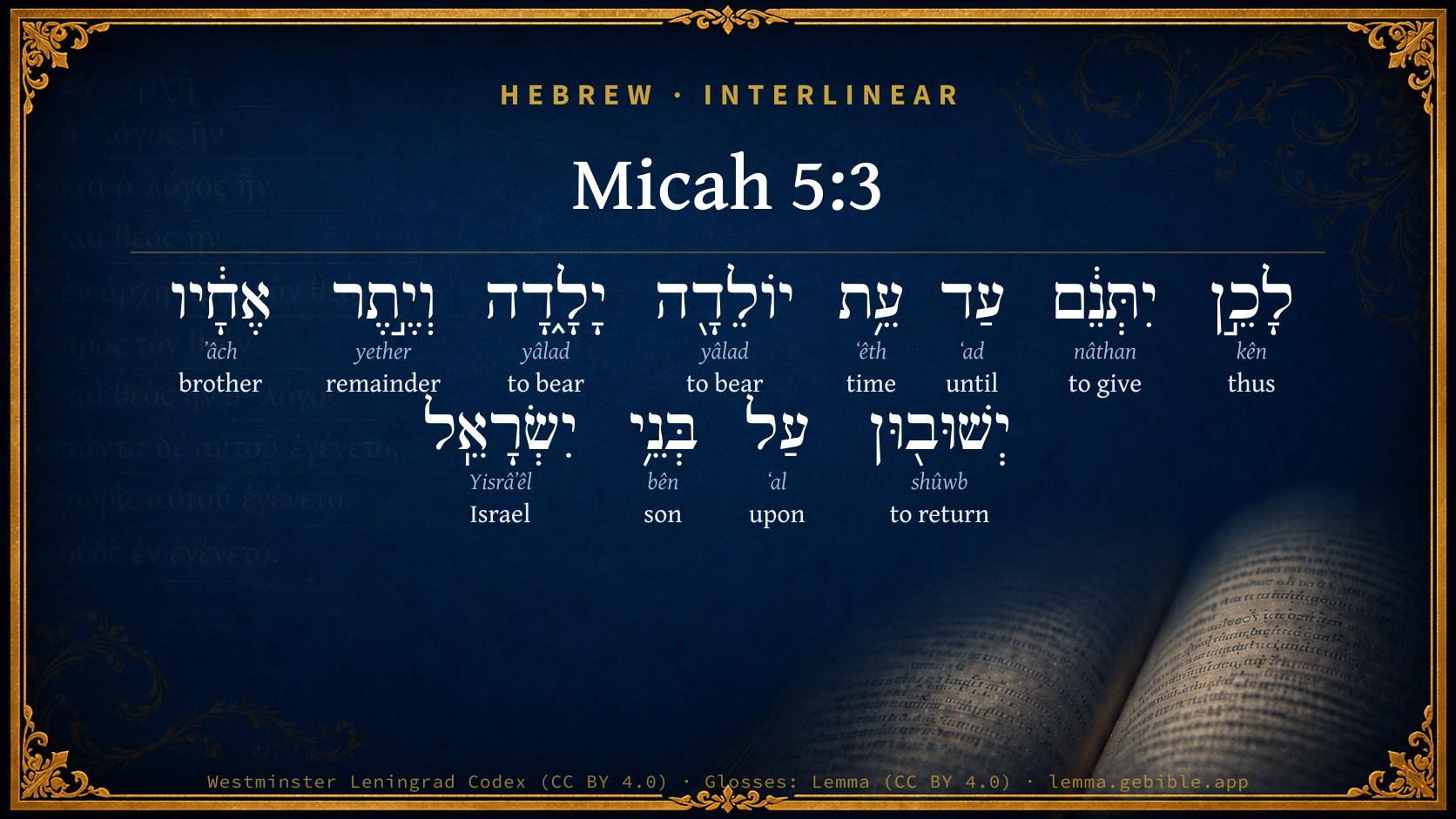
  1. לָכֵ֣ן kên H3651 “to/for · thus” Preposition + Adverb
  2. יִתְּנֵ֔ם nâthan H5414 “to give · them” Verb, Qal, Imperfect, 3rd Person, Masculine, Singular + Suffix, Personal, 3rd Person, Masculine, Plural
  3. עַד ʻad H5704 “until” Preposition
  4. עֵ֥ת ʻêth H6256 “time” Noun, Common, Both, Singular, Absolute
  5. יוֹלֵדָ֖ה yâlad H3205 “bearing” Verb, Qal, Participle Active, Feminine, Singular, Absolute
  6. יָלָ֑דָה yâlad H3205 “to bear” Verb, Qal, Perfect, 3rd Person, Feminine, Singular
  7. אֶחָ֔יו ʼâch H251 “brothers · his” Noun, Common, Masculine, Plural, Construct + Suffix, Personal, 3rd Person, Masculine, Singular
  8. יְשׁוּב֖וּן shûwb H7725 “to return” Verb, Qal, Imperfect, 3rd Person, Masculine, Plural + Suffix, n
  9. עַל ʻal H5921 “upon” Preposition
  10. בְּנֵ֥י bên H1121 “sons of” Noun, Common, Masculine, Plural, Construct
  11. יִשְׂרָאֵֽל Yisrâʼêl H3478 “Israel” Noun, Proper

About this verse

These counts appear in no published source. They are computed here, from the morphology-tagged text and Lemma’s own curated glosses. What Lemma adds →

12
words
11
distinct lemmas
Prophets
section

Grammatical profile

  • 4 verbs
  • 5 nouns
  • 2 prepositions
  • 1 adverb

Verb forms

  • יִתְּנֵ֔ם Qal · Imperfect
  • יוֹלֵדָ֖ה Qal · Participle Active
  • יָלָ֑דָה Qal · Perfect
  • יְשׁוּב֖וּן Qal · Imperfect

Repetition

A word recurs within this verse — often emphatic in Hebrew:

  • יוֹלֵדָ֖ה to bear H3205 ×2

Hebrew & Septuagint length

In English translation the verse runs 29 words from the Hebrew and 32 from the Septuagint (LXX English) — closely comparable.

A rough comparison of the two English renderings, which tokenize alike — not a word-level alignment.

Word counts can differ between the Hebrew and the Greek without any difference in meaning — e.g. the Hebrew direct-object marker אֵת has no separate Greek word, and Greek often adds the article ὁ.

Cross-references

22

Topical passages linked to Micah 5:3 in the Treasury of Scripture Knowledge — connected by theme and wording, ordered by reader-vote popularity; previews shown in the World English Bible.

  • Revelation 12:1–2 A great sign was seen in heaven: a woman clothed with the sun, and the moon under her feet, and on her head a crown of twelve stars.
  • Micah 4:7 And I will make that which was lame a remnant, And that which was cast far off a strong nation: And Yahweh will reign over them on Mount Zion from then on, even forever.
  • Matthew 1:21 She shall bring forth a son. You shall call his name Jesus, for it is he who shall save his people from their sins."
  • Romans 9:27–28 Isaiah cries concerning Israel, "If the number of the children of Israel are as the sand of the sea, It is the remnant who will be saved;
  • Isaiah 10:20–21 It shall come to pass in that day, that the remnant of Israel, and those who are escaped of the house of Jacob, shall no more again lean on him who struck them, but shall lean on Yahweh, the Holy One of Israel, in truth.
  • Hosea 11:8 "How can I give you up, Ephraim? How can I hand you over, Israel? How can I make you like Admah? How can I make you like Zeboiim? My heart is turned within me, My compassion is aroused.
  • Micah 4:9–10 Now why do you cry out aloud? Is there no king in you? Has your counselor perished, That pains have taken hold of you as of a woman in travail?
  • Hosea 2:9 Therefore I will take back my grain in its time, And my new wine in its season, And will pluck away my wool and my flax which should have covered her nakedness.
  • Hosea 2:14 "Therefore, behold, I will allure her, And bring her into the wilderness, And speak tenderly to her.
  • Micah 7:13 Yet the land will be desolate because of those who dwell therein, For the fruit of their doings.
  • Romans 11:4–6 But how does God answer him? "I have reserved for myself seven thousand men, who have not bowed the knee to Baal."
  • Hebrews 1:11–12 They will perish, but you continue. They all will grow old like a garment does.
  • 1 Kings 14:16 He will give Israel up because of the sins of Jeroboam, which he has sinned, and with which he has made Israel to sin.
  • 2 Chronicles 30:7 Don't be you like your fathers, and like your brothers, who trespassed against Yahweh, the God of their fathers, so that he gave them up to desolation, as you see.
  • Isaiah 11:11 It shall happen in that day, that the Lord will set his hand again the second time to recover the remnant of his people, who shall remain, from Assyria, and from Egypt, and from Pathros, and from Cush, and from Elam, and from Shinar, and from Hamath, and from the islands of the sea.
  • Isaiah 66:7–8 Before she travailed, she brought forth; before her pain came, she was delivered of a man-child.
  • Jeremiah 31:1 At that time, says Yahweh, will I be the God of all the families of Israel, and they shall be my people.
  • Jeremiah 31:7–9 For thus says Yahweh, Sing with gladness for Jacob, and shout for the chief of the nations: publish you, praise you, and say, Yahweh, save your people, the remnant of Israel.
  • Micah 6:14 You shall eat, but not be satisfied. Your humiliation will be in your midst. You will store up, but not save; And that which you save I will give up to the sword.
  • Matthew 12:50 For whoever does the will of my Father who is in heaven, he is my brother, and sister, and mother."
  • Matthew 25:40 "The King will answer them, 'Most assuredly I tell you, inasmuch as you did it to one of the least of these my brothers, you did it to me.'
  • Romans 8:29 For whom he foreknew, he also predestined to be conformed to the image of his Son, that he might be the firstborn among many brothers.

Cross-references courtesy of OpenBible.info (CC BY 4.0).

Hebrew and Greek witnesses Masoretic Hebrew ↔ Greek Septuagint

The same verse in the two great witnesses to the Old Testament, shown verse-for-verse.

These are two independent witnesses, not word-aligned to each other, and the Septuagint is shown in lemma (dictionary) form.

Hebrew Micah 5:3 Masoretic · Westminster Leningrad Codex

לָכֵ֣ן יִתְּנֵ֔ם עַד עֵ֥ת יוֹלֵדָ֖ה יָלָ֑דָה וְיֶ֣תֶר אֶחָ֔יו יְשׁוּב֖וּן עַל בְּנֵ֥י יִשְׂרָאֵֽל

Therefore he will abandon them until the time that she who is in labor gives birth. Then the rest of his brothers will return to the children of Israel.

World English Bible · Public Domain

Greek LXX Micah 5:3 Septuagint · lemma form

καί ἵστημι καί ὁράω καί ποιμαίνω ὁ ποίμνιον αὐτός ἐν ἰσχύς κύριος καί ἐν ὁ δόξα ὁ ὄνομα κύριος ὁ θεός αὐτός ὑποἄρχω διότι νῦν μεγαλύνω ἕως ἄκρος ὁ γῆ

Therefore shall he appoint them to wait till the time of her that travails: she shall bring forth, and then the remnant of their brethren shall return to the children of Israel.

LXX2012 (modern English Septuagint) · Public Domain

On this verse, Joseph Benson's Commentary discusses the Septuagint’s reading. Read the note in Commentary ↓

Hebrew: Westminster Leningrad Codex (CC BY 4.0). Greek: Septuagint (public domain); English from LXX2012 (modern English Septuagint) (Public Domain). How the Septuagint differs from the Hebrew →

Targum (Aramaic paraphrase)

1

The Targum is the ancient Jewish Aramaic paraphrase of the Hebrew Scriptures — an interpretive translation, not the Hebrew text itself. Onkelos (literal) and Pseudo-Jonathan (expansive) render the Torah, and Jonathan the Prophets. Coverage is partial: where no permissively-licensed English translation exists for a verse, only the Aramaic is shown. This is verse-level text, not a word-by-word alignment to the Hebrew.

  1. Targum Jonathan Prophets (Joshua–Malachi)
    וִיקוּם וְיִשְׁלוֹט בִּתְקוֹף מִן קֳדָם יְיָ בִּרְבוֹת שְׁמָא דַייָ אֱלָהֵיהּ וִיתוּבוּן מִבֵּינֵי גָלוּתְהוֹן אֲרֵי כְעַן יַסְגֵי שְׁמֵיהּ עַד סְיָפֵי אַרְעָא:

    (no public-domain English translation for this verse)

    Targum Jonathan — Aramaic: “Mikraot Gedolot” (public domain). English: “Sefaria Community Translation” (CC0 1.0 (public-domain dedication)); “London "Chaldee Paraphrase," 1871” (public domain). Text via Sefaria.

Commentary

Notes on Micah 5:3 from classic Christian and Jewish commentators (each source and its license shown beneath its notes). The classic Christian expositions comment on the surrounding passage and are grouped to its opening verse, so a note may address several verses; the Jewish commentaries on the Tanakh (Rashi and others) are per-verse, so they appear only where the commentator wrote on this verse.

Lemma curates 59 commentaries, every one of them public domain or Creative Commons licensed, each selected and text-cleaned for this edition rather than reprinted as found. About our sources →

Trapp's Complete Commentary

John Trapp

Mic 5:3 Therefore will he give them up, until the time [that] she which travaileth hath brought forth: then the remnant of his brethren shall return unto the children of Israel.

Ver. 3. Therefore will he give them up] As a little before the day springeth it is darker than ordinary; so before the day spring from on high visited God’s people they were under very hard and heavy pressures and miseries; whereby their desires after him were increased and ineagered. The enemy oppressed them, by God’s permission, yea, by his active providence; that they might pant after a Saviour, and sigh out with old Jacob, their father, Gen 49:18, "O Lord, I have waited for thy salvation."

Until the time that she which travaileth hath brought forth] She, that is, the Virgin Mary, say some: or, she, that is, say others, the afflicted Church, according to Mic 4:9-10; {See Trapp on "Mic 4:9"} {See Trapp on "Mic 4:10"} She must have a time of travail, of trouble, before she can bring forth, and be delivered. Luther saith well, that the Church is haeres crucis, cling to the cross and that every Christian is a Crucian; we must suffer before we can reign, and bear the cross or e’er we wear the crown.

Then the remnant of his brethren] i.e. The converted Gentiles, whom Christ is not ashamed to call his brethren, Heb 2:11-12.

Shall return unto the children of Israel] Shall be proselyted, and conjoined to the elect Jews, that there may be one sheepfold under one shepherd. "And the Lord shall be king over all the earth: in that day there shall be one Lord, and his name one," Zec 14:9. {See Trapp on "Zec 14:9"}

John Trapp, A Commentary or Exposition upon All the Books of the Old and New Testament (1647–1656) — public domain. Text from a community e-Sword module.

Joseph Benson's Commentary

Mic 5:3. Therefore will he give them up — The particle לכןrendered therefore, should rather be here rendered, nevertheless. The meaning is, Notwithstanding the promise of so great a blessing, God would give up his people into the hands of their enemies, or leave them to be exercised with troubles and afflictions, till the appointed time of their deliverance should come. Until the time that she which travaileth hath brought forth — Until the daughter of Zion, compared here to a woman in travail, shall be delivered out of captivity. Or rather, till the church of God, of which the daughter of Zion was a type, shall bring forth spiritual children of Jew and Gentile extraction unto God, by the preaching of the gospel: see Gal 4:27. This prophecy will be more fully completed in the general conversion and restoration of the Jewish nation in the latter days: see Isa 66:7-11. Then the remnant of his brethren — The brethren of the Messiah, those of Judah and Benjamin especially, who were carried captive; shall return unto the children of Israel — Or, be converted with the children of Israel. Then the remnant of the dispersed Jews, upon their conversion, shall join themselves to the true Israelites, and make one church with them. Both the LXX. and Chaldee read, the remnant of their brethren: but if we follow the present Hebrew, we may understand it of the believers that were to be added to the church; for Christ vouchsafes to call all believers his brethren: see Heb 2:11; Mat 12:50.

Joseph Benson's Commentary on the Old and New Testaments (1811–1818) — public domain. Text from a community e-Sword module.

Keil & Delitzsch

C. F. Keil & F. Delitzsch

"Therefore will He give them up until the time when a travailing woman hath brought forth, and the remnant of His brethren will return, together with the sons of Israel. Mic 5:4. And He will stand and feed in the strength of Jehovah, in the majesty of the name of Jehovah His God, and they will dwell, for now will He be great to the ends of the earth." "Therefore" (lâkhēn): i.e., "because the great divine Ruler of Israel, from whom alone its redemption can proceed, will spring from the little Bethlehem, and therefore from the degraded family of David" (Caspari). This is the correct explanation; for the reason why Israel is to be given up to the power of the nations of the world, and not to be rescued earlier, does not lie in the appearance of the Messiah as such, but in His springing from little Bethlehem. The birth of the Messiah in Bethlehem, and not in Jerusalem the city of David, presupposes that the family of David, out of which it is to spring, will have lost the throne, and have fallen into poverty. This could only arise from the giving up of Israel into the power of its enemies. Micah had already stated clearly enough in what precedes, that this fate would fall upon the nation and the royal house of David, on account of its apostasy from the Lord; so that he could overlook this here, and give prominence to the other side alone, namely to the fact that, according to the counsel of God, the future Deliverer and Ruler of Israel would also resemble His royal ancestor David in the fact that He was not to spring from Zion the royal city built on high, but from the insignificant country town of Bethlehem, and that for this very reason Israel was to remain so long under the power of the nations of the world. The suffix attached to יתּנם points to ישׂראל in Mic 5:1; and נתן is applied, as in Kg1 14:16, to the surrender of Israel into the power of its enemies as a punishment for its sins. This surrender is not the last of many oppressions, which are to take place in the period before the birth of the Messiah (the Roman oppression), but a calamity lasting from the present time, or the coming of the judgment threatened in ch. 3, until the time of the Messiah's coming; and יתּנם points back not merely to Mic 5:1, but also to Mic 4:9-10. The travailing woman (yōlēdâh) is not the community of Israel (Theodoret, Calvin, Vitringa, and others), but the mother of the Messiah (Cyril, and most of the Christian expositors, including even Ewald and Hitzig). The supposition that the congregation is personified here, is precluded not only by the fact that in the very same sentence the sons of Israel are spoken of in the plural, but still more by the circumstance that in that case the bringing forth would be only a figurative representation of the joy following the pain, in which the obvious allusion in the words to the Messiah, which is required by the context, and especially by the suffix to אחיו, which refers to the Messiah, and presupposes that His birth is referred to in יולדה ילדה, would entirely fall away. But Micah had all the more ground for speaking of this, inasmuch as Isaiah had already predicted the birth of the Messiah (Isa 7:14). יולדה has no article, and the travailing woman is thereby left indefinite, because the thought, "till He is born," or "till a mother shall bring Him forth," upon which alone the whole turns, did not require any more precise definition.

In the second clause of the verse there commences the description of the blessing, which the birth of the Messiah will bring to Israel. The first blessing will be the return of those that remain of Israel to the Lord their God. אחיו, the brethren of the Ruler born at Bethlehem, are the Judaeans as the members of the Messiah's own tribe; just as, in Sa2 19:13, David calls the Judaeans his brethren, his flesh and bone, in contrast with the rest of the Israelites. יתר אחיו, the remnant of his brethren, are those who are rescued from the judgment that has fallen upon Judah; yether, as in Zep 2:9 and Zac 14:2, denoting the remnant, in distinction from those who have perished (= שׁארית, Mic 2:12; Mic 4:7, etc.). ישׁוּבוּן, to return, not from exile to Canaan, but to Jehovah, i.e., to be concerted. על־בּגי ישׂ, not "to the sons of Israel;" for although שׁוּב, construed with על, is met with in the sense of outward return (e.g., Pro 26:11) as well as in that of spiritual return to the Lord (Ch2 30:9), the former explanation would not give any suitable meaning here, not only because "the sons of Israel," as distinguished from the brethren of the Messiah, could not possibly denote the true members of the nation of God, but also because the thought that the Judaeans are to return, or be converted, to the Israelites of the ten tribes, is altogether unheard of, and quite at variance with the idea which runs through all the prophetic Scriptures of the Old Testament, - namely, that after the division of the kingdom, Judah formed the kernel of the covenant nation, with which the rebellious Israelites were to be united once more. על signifies here together with, at the same time as (Hofmann, Caspari), as in Jer 3:18 with the verb ילכוּ, and in Exo 35:22 with בּוא; and "the sons of Israel" are the Israelites of the ten tribes, and, in this connection, those that are left of the ten tribes. There is no ground for the objection offered by Hengstenberg to this explanation, namely, that "it is absurd that the ten tribes should appear to be the principal persons redeemed;" for this is not implied in the words. The meaning "together with," for על, is not derived from the primary meaning, thereupon, in addition to, insuper, as Ewald supposes (217, i), nor from the idea of accompanying, as Ges. and Dietrich maintain. The persons introduced with על are never the principal objects, as the two passages quoted sufficiently prove. The women in Exo 35:22 (על הנּשׁים) are not the principal persons, taking precedence of the men; nor is the house of Israel placed above the house of Judah in Jer 3:18. The use of על in the sense of together with has been developed rather from the idea of protecting, shielding, as in Gen 32:12, slaying the mothers upon, i.e., together with, the children, the mothers being thought of as screening the children, as Hos 10:14 and other passages clearly show. Consequently the person screening the other is the principal person, and not the one covered or screened. And so here, the brethren of the Messiah, like the sons of Judah in Jer 3:18, which passages is generally so like the one before us that it might be regarded as an exposition of it, are those who first receive the blessing coming from the Messiah; and the sons of Israel are associated with them as those to whom this blessing only comes in fellowship with them. In Mic 5:3 there follows what the Messiah will do for Israel when it has returned to God. He will feed it (עמר simply belongs to the pictorial description, as in Isa 61:5) in the strength of Jehovah. The feeding, as a frequent figure for governing, reminds of David, whom the Lord had called from the flock to be the shepherd of His people (Sa2 5:2). This is done in the strength of Jehovah, with which He is invested, to defend His flock against wolves and robbers (see Joh 10:11-12).

(Note: The word "feed" expresses what Christ is towards His people, the flock committed to His care. He does not rule over the church like a formidable tyrant, who oppresses his people by fear; but He is a shepherd, and leads His sheep with all the gentleness to be desired. And inasmuch as we are surrounded on all sides by enemies, the prophet adds, "He will feed in the strength," etc.; i.e., as much power as there is in God, so much protection will there be in Christ, whenever it shall be necessary to defend the church, and guard it against its foes (Calvin).)

This strength is not merely the divine authority with which earthly rulers are usually endowed (Sa1 2:10), but גּאון, i.e., the exaltation or majesty of the name of Jehovah, the majesty in which Jehovah manifests His deity on earth. The Messiah is El gibbōr (the Mighty God, Isa 9:5), and equipped with the spirit of might (rūăch gebhūrâh, Isa 11:2). "Of His God;" for Jehovah is the God of this Shepherd or Ruler, i.e., He manifests Himself as God to Him more than to any other; so that the majesty of Jehovah is revealed in what He does. In consequence of this feeding, they (the sons of Israel) sit (yâshâbhū), without being disturbed (cf. Mic 4:4; Lev 26:5-6; Sa2 7:10), i.e., will live in perfect undisturbed peace under His pastoral care. For He (the Messiah) will now (עתּה, now, referring to the time when He feeds Israel, in contrast with the former oppression) be great (auctoritate et potentia valebit: Maurer) to the ends of the earth, i.e., His authority will extend over the whole earth. Compare the expression in Luk 1:32, οὗτος ἔσται μέγας, which has sprung from the passage before us, and the parallel in Mal 1:14.

Keil & Delitzsch — Biblical Commentary on the Old Testament (1861–1891) — public domain (CC PDM 1.0). Text via the HelloAO Bible API. (Old Testament only.)

Geneva Bible (1599)

Geneva Bible translators

He compareth the Jews to women with child, who for a time should have great sorrows, but at length they should have a comfortable deliverance, John 16:21.

Geneva Bible (1599) marginal notes — public domain. Text via Bolls.life.

Jamieson, Fausset & Brown

Robert Jamieson, A. R. Fausset & David Brown

"Therefore (because of His settled plan) will God give up to their foes His people Israel, until," &c.

she which travaileth hath brought forth--namely, "the virgin" mother, mentioned by Micah's contemporary, Isa 7:14. Zion "in travail" (Mic 4:9-10) answers to the virgin in travail of Messiah. Israel's deliverance from her long travail-pains of sorrow will synchronize with the appearance oœ Messiah as her Redeemer (Rom 11:26) in the last days, as the Church's spiritual deliverance synchronized with the virgin's giving birth to Him at His first advent. The ancient Church's travail-like waiting for Messiah is represented by the virgin's travail. Hence, both may be meant. It cannot be restricted to the Virgin Mary: for Israel is still "given up," though Messiah has been "brought forth" almost two thousand years ago. But the Church's throes are included, which are only to be ended when Christ, having been preached for a witness to all nations, shall at last appear as the Deliverer of Jacob, and when the times of the Gentiles shall be fulfilled, and Israel as a nation shall be born in a day (Isa 66:7-11; Luk 21:24; Rev 12:1-2, Rev 12:4; compare Rom 8:22).

the remnant of his brethren shall return unto the children of Israel--(Compare Mic 4:7). The remainder of the Israelites dispersed in foreign lands shall return to join their countrymen in Canaan. The Hebrew for "unto" is, literally, "upon," implying superaddition to those already gathered.

Jamieson, Fausset & Brown — Commentary Critical and Explanatory on the Whole Bible (1871) — public domain (CC PDM 1.0). Text via the HelloAO Bible API.

Adam Clarke's Commentary

Verse 3. Therefore will he give them up] Jesus Christ shall give up the disobedient and rebellious Jews into the hands of all the nations of the earth, till she who travaileth hath brought forth; that is, till the Christian Church, represented Re 12:1, under the notion of a woman in travail, shall have had the fulness of the Gentiles brought in. Then the remnant of his brethren shall return; the Jews also shall be converted unto the Lord; and thus all Israel shall be saved, according to Ro 11:26.

Unto the children of Israel.] Taking in both families, that of Judah and that of Israel. The remnant of the ten tribes, wherever they are, shall be brought in under Christ; and though now lost among the nations of the earth, they will then not only be brought in among the fulness of the Gentiles, but most probably be distinguished as Jews.

On this verse Abp. Newcome says, "The sense is, God will not fully vindicate and exalt his people, till the virgin mother shall have brought forth her Son; and till Judah and Israel, and all the true sons of Abraham among their brethren the Gentiles, be converted to Christianity.

Adam Clarke's Commentary on the Bible (1810–1826) — public domain. Text from a community e-Sword/MySword module.

John Calvin's Commentaries

The Prophet here again so moderates his words, that the Jews might understand, that they were to endure many evils before God relieved their miseries. He wished then here to prepare the minds of the godly to bear evils, that they might not despair in great troubles, nor be depressed by extreme fear. He then states these two things, — that the people, as they deserved, would be heavily afflicted, — and then that God, notwithstanding such severe punishment, would be mindful of his covenant, so as to gather at length some remnants and not to suffer his people to be wholly destroyed. He therefore promises a middle course between a prosperous state and destruction. The people, says the Prophet, shall not continue entire. — How so? For God will cut off the kingdom and the city; and yet he will afford relief to the miserable: When they shall think that they are given up to entire ruin, he will stretch forth his hand to them. This is the sum of the whole.

He then says that they shall be delivered up, that is, forsaken by God, until she who is in travail bringeth forth There are those who apply this to the blessed virgin; as though Micah had said that the Jews were to look forward to the time when the Virgin would bring forth Christ: but all may easily see that this is a forced interpretation. The Prophet, I have no doubt, in using this similitude, compares the body of the people to a woman with child. The similitude of a woman in travail is variously applied. The wicked, when they promise to themselves impunity, are suddenly and violently laid hold on: thus their destruction is like the travail of a woman with child. But the meaning of this passage is different; for the Prophet says that the Jews would be like pregnant women, for this reason, — that though they would have to endure the greatest sorrows, there yet would follow a joyful and happy issue. And Christ himself employs this example for the same purpose,

‘A woman,’ he says, ‘has sorrow when she brings forth, but immediately rejoices when she sees a man born into the world,’ (John 16:21.)

So Micah says in this place, that the chosen people would have a happy deliverance from their miseries, for they would bring forth. There shall indeed be the most grievous sorrows, but their issue will be joy, that is, when they shall know that they and their salvation had been the objects of God’s care, when they shall understand that their chastisements had been useful to them. Until then she who is in travail bringeth forth, God, he says, will forsake them

There are then two clauses in this verse; — the first is, that the Jews were for a time to be forsaken, as though they were no longer under the power and protection of God; — the other is that God would be always their guardian, for a bringing forth would follow their sorrows. The following passage in Isaiah is of an opposite character;

‘We have been in sorrow, we have been in travail, and we brought forth wind,’ (Isaiah 26:18.)

The faithful complain there that they had been oppressed with the severest troubles, and had come to the birth, but that they brought forth nothing but wind, that is, that they had been deceived by vain expectation, for the issue did not prove to be what they had hoped. But the Lord promises here by Micah something better, and that is, that the end of all their evils would be the happy restoration of the people, as when a woman receives a compensation for all her sorrows when she sees that a child is born.

And he confirms this sentence by another, when he says, To the children of Israel shall return, or be converted, the residue of his brethren The Prophet then intimates that it could not be otherwise but that God would not only scatter, but tread under foot his people, so that their calamity would threaten an unavoidable destruction. This is one thing; but in the meantime he promises that there would be some saved. But he speaks of a remnant, as we have observed elsewhere, lest hypocrites should think that they could escape unpunished, while they trifled with God. The Prophet then shows that there would come such a calamity as would nearly extinguish the people, but that some would be preserved through God’s mercy and that beyond ordinary expectation. We now perceive the intention of the Prophet. It now follows —

John Calvin's Commentaries (1540-1563) — public domain. Text from the Calvin Translation Society English edition (1840s-50s) via the Christian Classics Ethereal Library (ccel.org). Calvin's coverage is partial (roughly two-thirds of the Bible); uncommented books and verses are honest gaps, never fabricated. The 19th-century editor's footnotes and remarks are omitted so the notes are faithfully Calvin's own voice.

Ellicott's Commentary for English Readers

(3) Therefore will he give them up.—There is a suggestion here of a parable, setting forth the smallness of Bethlehem, which gave birth to the mighty Ruler that was to come from it. So the nation was to be brought very low before the nativity of the Virgin-born.

A Bible Commentary for English Readers, edited by Charles John Ellicott (1878–1897) — public domain. Text from a community e-Sword module.

The Cambridge Bible for Schools and Colleges

gen. ed. J. J. S. Perowne

3. Therefore] i.e. because the deliverance of Israel is to be a work of pure grace, and to proceed from the insignificant Bethlehem. It is assumed that the family of David will have sunk down as low as that of Jesse originally was—the same anticipation which we find expressed in Isa_11:1, ‘There shall come forth a shoot from the stump of Jesse.’

will he give them up] Jehovah will deliver Israel into the hands of its foes.

she which travaileth] i.e. she who is to bear. Probably (though this is not quite free from doubt) this is an allusion to Isaiah’s great prophecy of Immanuel (Isa_7:14)—a prophecy vague, it is true, and open to various interpretations, but most likely referring to the Messiah (see on Mic_5:5).

then the remnant of his brethren shall return] Rather, and (until) the remnant of his brethren return. ‘Return’ may be taken either in a physical or in a spiritual sense. If in the former, the ‘remnant’ will mean the exiles of Israel, wherever they might be scattered, including those of the Ten Tribes; if in the latter, it will refer rather to the Judæans who had escaped in the Judgment. The return of the long-lost tribes, and the thorough conversion of his own people, were equally upon the heart of the prophet.

unto] Or (if we explain ‘return’ = ‘be converted’), with.

The Cambridge Bible for Schools and Colleges (gen. ed. J. J. S. Perowne; Cambridge University Press, 1878–1918) — public domain. Text from a community e-Sword module.

John Gill's Exposition

Therefore will he give them up,.... Or "notwithstanding", as this particle signifies; see Hos 2:14; though all this shall be, yet, previous to the birth of this person, the Lord would give up the Jews to trouble and distress, and into the hands of their enemies; and the time from this prophet to the birth of Christ was a time for the most part of great trouble to, the Jews; not only was their country invaded and their city besieged by Sennacherib in Hezekiah's time, but, some years after that, they were wholly carried captive into Babylon: and when they returned it was troublesome times with them; they met with many enemies that disturbed them while they were rebuilding the city and temple; and after that they endured much tribulation, in the times of Antiochus Epiphanes, or of the Maccabees; nor were they long in any quiet, nor in any settled state, unto the coming of the Messiah. Or else this is to be understood of what should be after his coming; for though Jesus was born at Bethlehem, according to this plain prophecy, and had all the characters of the Messiah in him, yet the Jews rejected him, and would not have him to reign over them: wherefore he, the Messiah, as Japhet interprets it, gave them up to judicial blindness and hardness of heart, and into the hands of their enemies the Romans; by whom they were destroyed or carried captive, and dispersed among the nations; in which condition they still remain, and will, until the times of the Gentiles be fulfilled; so long will Jerusalem be trodden under foot, or the Jews be given up to their will, according to Luk 21:24; or, as here expressed,

until the time that she which travaileth hath brought forth: that is, according to the first sense until the Virgin Mary travailed in birth with the Messiah, and brought forth him her firstborn, Mat 1:25; or according to the latter, until Zion, or, the church of God, travailed in prayer, in the ministry of the word, and brought forth many children to Christ, both among Jews and Gentiles; and the sense is, that the Jews shall be given up to distress and trouble, till the time of their conversion, see Isa 66:7; The Jews have a tradition in their Talmud, that

"the son of David would not come until the kingdom spreads itself over the whole world for nine months; as it is said, "therefore will he give them up until the time that she that travaileth hath brought" forth; which is the time of a woman's going with child.''

This both Jarchi and Kimchi take notice of. In one place (p) it is called the kingdom of Aram or Syria; and in another (q) a blank is left for Edom, that is, Rome; for by the kingdom is meant the Roman empire, and which did extend all over the world before the coming of the Messiah Jesus, as appears from Luk 2:1; as well as from all profane history;

then the remnant of his brethren shall return to the children of Israel; that is, the brethren of the Messiah, as Kimchi and Abendana interpret it; who should return with the children of Israel, as both they and Jarchi explain it; to which the Targum agrees. Kimchi's note is,

""the remnant of his brethren"; they are the tribes of Judah and Benjamin, which remained when the ten tribes were carried captive; and the surnames, his brethren, relate to the Messiah.''

So Abendana (r),

"and "the remnant his brethren"; they are the tribes of Judah and Benjamin, they shall return with the children of Israel, who are the ten tribes; as if he should say, these and these shall return to their land, and King Messiah shall reign over them; and the surnames, his brethren, respect the Messiah.''

And to the same purpose R. Isaac (s),

"the remnant of the brethren of the Messiah, who are the children of Judah and Benjamin, that are left and remain of the calamities and persecutions of the captivities, shall return to their own land, together with the children of Israel, who are the ten tribes.''

Meaning either the remnant, according to the election of grace, among the Gentiles; who with those among the Jews should be converted to Christ in the first times of the Gospel, those immediately following the birth of Christ; the Gospel being preached both to the Jews and Gentiles, and some of both were called and converted, and whom Christ owned as his brethren, and were not ashamed of; see Mat 12:49 Heb 2:11; or the Lord's chosen people, and brethren of Christ, those of, he two tribes of Judah and Benjamin, and those of the ten tribes of Israel; who shall join and coalesce together in seeking the Messiah, embracing and professing him, and appointing him the one Head over them, when they will turn to the Lord, and all Israel shall be saved; see Jer 50:4.

(p) T. Bab. Yoma, fol. 10. 1. (q) T. Bab. Sanhedrin, fol. 98. 2. (r) Not. in Miclol Yophi in loc. (s) Chizzuk Emunah, par. 1. p. 281.

John Gill's Exposition of the Whole Bible (1746–1763) — public domain (CC PDM 1.0). Text via the HelloAO Bible API.

Albert Barnes' Notes on the Bible

Therefore - Since God has so appointed both to punish and to redeem, He, God, or the Ruler “whose goings forth have been from of old from everlasting,” who is God with God, “shall give them up, that is, withdraw His protection and the nearness of His Presence, “giving them up:”

(1) into the hands of their enemies. And indeed the far greater part never returned from the captivity, but remained, although willingly, in the enemy’s land, outwardly shut out from the land of the promise and the hope of their fathers (as in 2Ch 36:17).

(2) But also, all were, more than before, “given up” Act 7:42; Rom 1:24, Rom 1:26, Rom 1:28, to follow their own ways.

God was less visibly present among them. Prophecy ceased soon after the return from the captivity, and many tokens of the nearness of God and means of His communications with them, the Ark and the Urim and Thummim were gone. It was a time of pause and waiting, wherein the fullness of God’s gifts was withdrawn, that they might look on to Him who was to come. “Until the time that she which travaileth hath brought forth,” that is, until the Virgin who should conceive and bear a Son and call His Name Emmanuel, God with us, shall give birth to Him who shall save them. And then shall be redemption and joy and assured peace. God provides against the fainting of hearts in the long time before our Lord should come.

Then - (And). There is no precise mark of time such as our word then expresses. He speaks generally of what should be after the Birth of the Redeemer. “The remnant of His brethren shall return unto the children of Israel.” “The children of Israel” are the true Israel, “Israelites indeed” Joh 1:47; they who are such, not in name (Rom 9:6, etc.) only, but indeed and in truth. His brethren are plainly the brethren of the Christ; either because Jesus vouchsafed to be born “of the seed of David according to the flesh” Rom 1:3, and of them “as concerning the flesh Christ came, who is over all, God blessed forever” Rom 9:5; or as such as He makes and accounts and “is not ashamed to call, brethren” Heb 2:11, being sons of God by grace, as He is the Son of God by nature. As He says, “Whosoever shall do the will of My Father which is in Heaven, the same is My brother and sister and mother” Mat 12:50; and, “My brethren are these who hear the word of God and do it” Luk 8:21.

The residue of these, the prophet says, shall return to, so as to be joined with , the children of Israel; as Malachi prophesies, “He shall bring back the heart of the fathers to the children, and the heart of the children to the fathers” (Mal. 3:24, Hebrew). In the first sense, Micah foretells the continual inflow of the Jews to that true Israel who should first be called. All in each generation, who are the true Israel, shall be converted, made one in Christ, saved. So, whereas, since Solomon, all had been discord, and, at last, the Jews were scattered abroad everywhere, all, in the true Prince of Peace, shall be one (see Hos 1:11; Isa 11:10, etc.). This has been fulfilled in each generation since our Lord came, and shall be yet further in the end, when they shall haste and pour into the Church, and so “all Israel shall be saved” Rom 11:26.

But “the promise of God was not only to Israel after the flesh, but to all” also that were afar off, even as many as the Lord our God should call Act 2:39. All these may be called the remnant of His brethren, even those that were, before, aliens from the commonwealth of Israel and afar off Eph 2:12-14, but now, in Christ Jesus, made one with them; all, brethren among themselves and to Christ their ruler. : “Having taken on Him their nature in the flesh, He is not ashamed to call them so, as the Apostle speaketh, confirming it out of the Psalm, where in the Person of Christ he saith, “I will declare Thy name unto My brethren” Psa 22:22. There is no reason to take the name, brethren, here in a narrower sense than so to comprehend all “the remnant whom the Lord shall call” Joe 2:32, whether Jews or Gentiles. The word “brethren” in its literal sense includes both, and, as to both, the words were fulfilled.

Albert Barnes' Notes on the Bible (1834–1885) — public domain. Text from a community e-Sword/MySword module.

Haydock's Catholic Bible Commentary

Forth, till Babylon let them go; (Sanct.) or the Jews shall enjoy the land till Christ come; (St. Jerome, exp. ii.) or he will leave them in their blindness till the nations shall have received the gospel, when there shall be one fold, John x. 16., and Romans ix. 25.

George Leo Haydock (1774–1849), Haydock's Catholic Family Bible and Commentary, 1859 edition — public domain. Excludes Psalms (Douay-Rheims chapter numbering differs from Protestant) and Deuterocanonical books (Catholic canon only).

Matthew Poole's English Annotations

Therefore, or nevertheless, as the particle will bear,

will he, God, the God of Israel,

give them up, to the Chaldeans, to be wasted by them, and to be led into captivity, and to be afflicted there for their sins committed in their own land against God, until the time, until seventy years be expired, the time appointed for the punishing the Jews,

that she which travaileth, the daughter of Zion, compared here to a woman in travail,

hath brought forth; be delivered out of captivity, compared here to a woman’s bringing forth, as Mic 4:9,10.

Then the remnant of his brethren, i.e. the brethren of the Messiah, those of Judah and Benjamin who were carried captive, shall return unto the children of Israel; being set free by Cyrus, shall return to their own land, and be there established; and they shall return with Israel rather than to: all this referring in the letter to their redemption out of Babylon, (which was the effect of the Messiah’s power and mercy towards them, as Mic 4:10; 5:2) hath a further reference to a more glorious redemption, and to intervening afflictions which should fall upon the Jews, from after their restitution and resettling in Canaan. unto the coming of the Messiah in the flesh when born of the Virgin; and that of Isa 7:14 shall be fulfilled, when Messiah, Ben David, shall set up his kingdom, and deliver the whole Israel of God from their captivity under ignorance, sin, and hell, and shall bring in the Gentiles, that remnant of his brethren, and unite them to the true Israel, and make them one church to God.

Matthew Poole's English Annotations on the Holy Bible (1683–1685) — public domain. Text from a community e-Sword/MySword module.

The Pulpit Commentary

Therefore; i.e. because God hath designed to punish before delivering, and this deliverance is to arise from the little Bethlehem, not from Jerusalem. This presupposes that the house of David will have lost the throne and have been reduced to a low condition. Will he give them up. Jehovah will give up the people to its enemies; this is the way in which the house of David shall come to low estate. She which travaileth hath brought forth. Many commentators have taken the travailing woman to be the afflicted community of Israel, or Zion; but we may not altogether reject the old interpretation which regards this as a prophecy of the birth of Christ from the Virgin, in accordance with the received Messianic exposition of Isaiah"s great prediction, "Behold, the virgin shall conceive". (Isa_7:14) Such an announcement comes in naturally after the announcement of the Ruler coming forth from Bethlehem. Israel shall be oppressed until the time ordained when "she who is to bear" shall bring forth. Then (rather, and, i.e. until) the remnant of his brethren shall return unto (with) the children of Israel. The remnant of his brethren are the rescued of the Judaeans, who are the brethren of Messiah according to the flesh; these in a literal sense shall return from exile together with the others, and in a spiritual sense shall be converted and be joined with the true Israelites, the true seeder Abraham.

Success; but in God"s own time.

There is a certain degree of ambiguity about these words, yet amidst this we find certain practical teachings very clearly enunciated.

I WE ARE REMINDED OF DELAYS IN THE DIVINE WORKING. Seven hundred years must elapse ere the predictions respecting the advent of the Redeemer should be fulfilled and "the time" come. God"s purposes in grace, as well as in nature and providence, are developed gradually. He makes demands upon human patience, bidding us wait. He often, by slow processes, brings to pass that which he has planned. "Rest in the Lord,". (Psa_37:7)

II WE ARE REMINDED OF THE WITHDRAWAL OF PRIVILEGE. "Therefore will he give them up until," etc. The favoured people had slighted the privileges, which God had so richly bestowed upon them. He had not dealt so graciously with any other nation, but the blessings granted they had failed to improve, and hence these were now to be withdrawn. God had delivered them from their foes, but now they were to go into the land of captivity. The precious symbols of his near presence with them were no longer to be seen. The voice of prophecy, too, should soon become silent. Through sad and solemn losses they were to be led to look with ardent hope to the seining of "the Consolation of Israel.

III WE ARE REMINDED HERE OF ULTIMATE GLORIOUS INCREASE "Then the remnant of his brethren shall return unto the children of Israel." Some limit these words to the conversion of the Jews, and understand by "the children of Israel" the true spiritual Israelites like Simeon and Anna, who waited for the advent of a spiritual Redeemer, and regard the words as intimating that to these in Messianic times there should be gathered "the remnant of Christ"s brethren," i.e. the more spiritually minded amongst his own nation who should be constrained to welcome him to their hearts, and to consecrate themselves to his service. According to this interpretation the prophecy received its partial fulfilment in the conversion of the Jews in apostolic times, and shall yet be more completely fulfilled when the Jewish nation shall be brought in, and when "all Israel shall be saved." Others, however, give the words s yet wider meaning, and understand by "brethren" all who "hear the Word of God and keep it," and who are obedient to the will of Christ"s Father and theirs, whether they be Jews or Gentiles; and see in these words a pre-intimation in prophetic times of the coming of that happy am when "the Ruler in Israel" shall sway his sceptre over a ransomed and redeemed world. And to that bright day of God we look on with longing hearts. Dawn upon our darkened world it surely will. God has not totally "given up" and abandoned our sin-stricken and sin-stained world. Even his withdrawals are with a view to the spiritual good of his children, and are followed, when the discipline is accomplished, by brighter and more glorious manifestations of his love and grace. "At the Name of Jesus every knee shall bow, and every tongue shall confess him Lord." His kingdom shall come, and his "will be done on earth, even as it is done in heaven.

Vers. 3, 4. Christ as the great Shepherd of mankind.

"Therefore will he give them up, until the time that she which travaileth hath brought forth: then the remnant of his brethren shall return unto the children of Israel. And he shall stand and feed in the strength of the Lord, in the majesty of the Name of the Lord his God; and they shall abide: for now shall he be great unto the ends of the earth." "Therefore will he give them up, until the time when a travailing woman hath brought forth: and the remnant of his brethren will return, together with the sons of Israel. And he will stand and feed in the strength of Jehovah, in the majesty of the Name of Jehovah his God; and they will dwell: for now will he be great to the ends of the earth" (Delitzsch). The following quotation from Delitzsch on this passage we think the David, out of which it is to spring, will have lost the throne and have fallen into poverty. This could only arise from the giving up of Israel into the power of its enemies. Micah had already stated clearly enough, in what precedes, that this fate would fall upon the nation and the royal house of David, on account of its apostasy from the Lord; so that he could overlook this here, and give prominence to the other side alone, viz. to the fact that according to the counsel of God the future Deliverer and Ruler of Israel would also resemble his royal ancestor David in the fact that he was not to spring from Zion, the royal city built on high, but from the insignificant country town of Bethlehem, and that for this very reason Israel was to remain so long under the power of the nations of the world." These words may be regarded as presenting to us Christ as the great, Shepherd of mankind; and looking at them in this light the following points come up to notice.

I HIS INTRODUCTION TO THE WORLD AS A SHEPHERD. "Therefore will he give them up that is, leave them to suffer their calamities, until the time that she which travaileth hath brought forth." Christ came into the world through sufferings that may be fairly represented as parturient. The whole Jewish nation groaned and travailed together until he came; and although the throes of his mother are perhaps specially referred to here, the Hebrew people through all preceding times had struggled in agony in order to give birth to the Messiah. Herein is a mystery the world"s Deliverer came into the world through suffering. And does not all the good we have come out of anguish? Every true enjoyment, like every birth, implies previous pain. "Through much tribulation" we enter into kingdoms. "Our light afflictions, which are but for a moment," etc.

II HIS QUALIFICATION FOR HIS WORK AS A SHEPHERD. "He shall stand and feed in the strength of the Lord, in the majesty of the Name of the Lord his God." Observe:

1. His attitude. "He shall stand." The word "stand" here may mean one of two things either a commanding position, by which he can observe and direct all, or stability, indicating his endurance and unswerving perseverance. He is settled and fixed in his work as a Shepherd. Both these ideas are true. It is true that Christ, as a Shepherd, has a commanding view of all, and a controlling power over all; and it is also true that he stands immovable as a Shepherd. "He shall not fail nor be discouraged, until he hath set judgment in the earth". (Isa_42:4)

2. His Divinity. "In the strength of the Lord, in the majesty of the Name of the Lord his God." He is endowed with the strength of Omnipotence, he is invested with the majesty of God himself. He is "Almighty to save," he is the Image of the invisible God. Here is a competent Shepherd!

III HIS BENEFICENCE IN HIS WORK AS A SHEPHERD. He "shall feed in the strength of the Lord." The word "feed" means both "feed" and" rule;" indeed, feed implies rule, for human souls can scarcely be nourished without a wise and merciful control. "He shall feed his flock like a shepherd: he shall gather the lambs with his arm, and carry them in his bosom, and shall gently lead those that are with young"; (Isa_40:11) "They shall not hunger nor thirst, neither shall the heat or the sun smite them; for he that hath mercy on them shall lead them, even by the springs of water shall he guide them". (Isa_49:10)

IV THE EXTENSION OF HIS FAME ON THE EARTH AS A SHEPHERD. "For now shall he be great unto the ends of the earth." His authority on the earth as a spiritual Shepherd is limited today, but is wider than it has been; and it will widen and widen until it fills the earth. His Name will one day be above every name on the earth. All other names will be esteemed as mean and contemptible unless they reflect his.

CONCLUSION. "All we like sheep have gone astray," etc. But a Shepherd from heaven has come to seek and restore us. Would that all heard and responded to his Voice! "Come unto me, all that are weary and heavy laden." "Good Shepherd, hasten thou that glorious day, When we shall all in the one fold abide with thee for aye! D.T.

The Pulpit Commentary (1880–1919), ed. H.D.M. Spence-Jones & Joseph S. Exell — public domain. Text from a community e-Sword module.

John Wesley's Explanatory Notes

He - God. Give them up - To the Chaldeans. She - The daughter of Zion, compared here to a woman in travail, shall be delivered out of captivity. His brethren -- the brethren of the Messiah. Those of Judah and Benjamin who were carried captive.

John Wesley, Explanatory Notes Upon the Whole Bible (1754–1765) — public domain. Text via the GEBible commentary corpus.

Scofield Reference Notes

C. I. Scofield

remnant

(See Scofield "Jer 15:21")

The Scofield Reference Bible (1917 edition), notes by C. I. Scofield — public domain. Text from a community e-Sword module.

Rashi

Rabbi Shlomo Yitzchaki (Rashi)

and lead Heb. וְרָעָה. And lead (וּפִרְנֵס) Israel.

and they shall return Heb. וְיָשָׁבוּ. They shall return now from the exiles.

for then he shall become great I.e., their king.

until the ends of the earth—And they shall bring tribute to him [the Messiah] with horses and chariots.

Rashi on the Tanakh — English translations: “The Judaica Press complete Tanach with Rashi, translated by A. J. Rosenberg” (CC BY 4.0); “Pentateuch with Rashi's commentary by M. Rosenbaum and A.M. Silbermann, 1929-1934” (public domain); “The Metsudah Tanach series, Lakewood, N.J” (CC BY 4.0); and “The Book of Joshua, Metsudah Publications, 1997” (CC BY 4.0). Text via Sefaria.

Lesson kit

Teaching starters — assembled from the data on this page, not authored interpretation. Every prompt links to the verse data it draws on. Edit before teaching.

Micah, in the Prophets, opens this verse with 12 words (11 distinct Hebrew lemmas). Its most distinctive word is yether (“remainder”). A historical commentator’s framing appears above. Read the whole chapter for the surrounding context.

Discussion questions

  1. What does “remainder” (yether) contribute to the verse as a whole?
  2. Revelation 12:1–2 shares this passage’s theme. How do the two illuminate each other?
  3. “to bear” occurs 2× in this one verse. What is the effect of the repetition?
  4. These translations render this verse differently; the difference is in the English rendering, not the original. What questions does that raise?
  5. The verb «יִתְּנֵ֔ם» is Qal Imperfect. How does its form color the action?
  6. Reading how Trapp's Complete Commentary and Joseph Benson's Commentary read this verse, where do the two commentators agree and where do they part?

Things to notice

Reading settings

Reading text

Shown beneath each verse's original-language words.

Old Testament
Old Testament edition

Read the OT as the Masoretic Hebrew (MT) or the Greek Septuagint (LXX).

English shown for the Greek Septuagint (in the Hebrew ↔ Greek comparison).

Comparing translations? Open the Compare panel on any verse page to stack up to four side by side.