
Isaiah 38:8

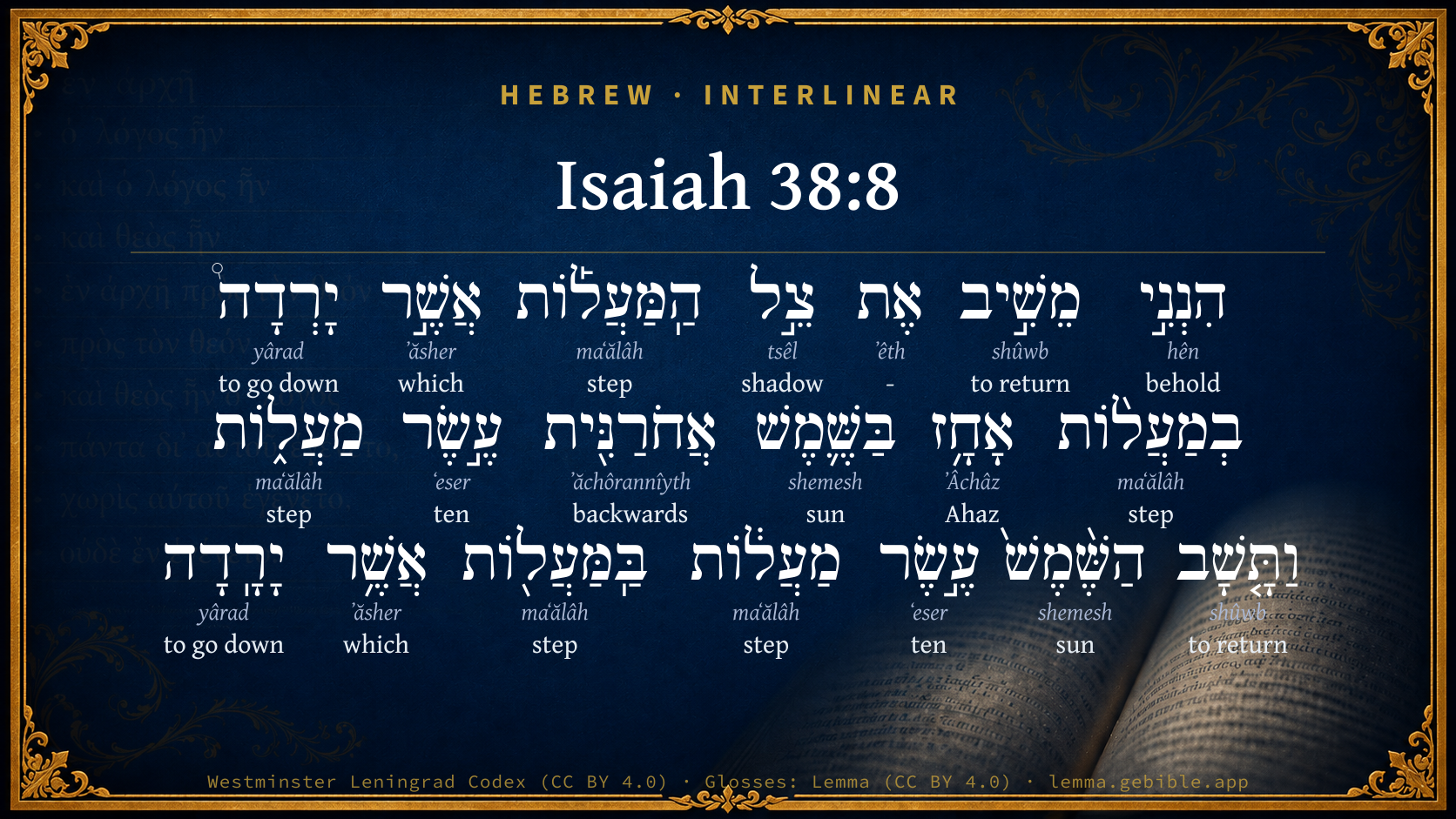
Hebrew (Westminster Leningrad Codex) Isaiah 38:8 appears in the Hebrew Old Testament. The text above is from the Westminster Leningrad Codex. Each word links to its Strong’s number, a concise gloss, and parsing drawn from the Open Scriptures Hebrew Bible morphology. Click any word for its full Brown-Driver-Briggs (BDB) entry.
Download image
Cite this verse

Isaiah 38:8 (World English Bible). Public Domain. Lemma interlinear Bible study tool, https://lemma.gebible.app/v/isaiah/38/8.

Show BibTeX & RIS
BibTeX
RIS
English Translation
behold, I will cause the shadow on the steps, which is gone down on the dial of Ahaz with the sun, to return backward ten steps. So the sun returned ten steps on the dial whereon it was gone down.
World English Bible · Public Domain
Download a study sheet

One document with this verse’s original text, its word-by-word gloss line, the meaning frame, cross-references with their text, attributed commentary, and full source and license credits — printable, and it pastes into notes with its structure intact.

This verse Autodidact and up

Study sheet (.html) Plain text (.txt)

A passage Seminary Student

Up to 50 verses in one chapter. A passage sheet keeps up to 6 commentary sources and 12 cross-references per verse, in the order this page ranks them, and says so on the sheet whenever that leaves anything out. Ask for a single verse and you get the Autodidact verse sheet above.

Everything on this page stays free to read, with no account — the sheet is a download of what is already on screen, not access to it.

Want to remove ads? Support Godless Engineer
Compare translations 3

The same verse in 3 English versions, stacked beneath the original-language interlinear above. Click any original word for its lexicon entry.

Each is an independent rendering of the whole verse — the interlinear is not word-aligned to these translations.

Highlighted words mark where these versions differ — a whole-verse word diff, not a word-by-word alignment.

  • World English Bible Public Domain
    behold, I will cause the shadow on the steps, which is gone down on the dial of Ahaz with the sun, to return backward ten steps. So the sun returned ten steps on the dial whereon it was gone down.
  • King James Version Public Domain
    Behold, I will bring again the shadow of the degrees, which is gone down in the sun dial of Ahaz, ten degrees backward. So the sun returned ten degrees, by which degrees it was gone down.
  • unfoldingWord Literal Text CC BY-SA 4.0
    Behold me, making return the shadow on the stairs, which has gone down with the sun on the stairs of Ahaz, back ten steps.’” And the sun went back ten steps on the stairs which it had gone down.

unfoldingWord Literal Text — © unfoldingWord, licensed CC BY-SA 4.0. Word-aligned USFM3 via Door43 (git.door43.org/unfoldingWord/en_ult).

Versions to compare (up to 4)

3 of 4 selected

Show all 18 translations

Every available English version of this verse, each an independent rendering of the whole verse.

  • World English Bible Public Domain
    behold, I will cause the shadow on the steps, which is gone down on the dial of Ahaz with the sun, to return backward ten steps. So the sun returned ten steps on the dial whereon it was gone down.
  • Berean Standard Bible Public Domain
    I will make the sun’s shadow that falls on the stairway of Ahaz go back ten steps.’” So the sunlight went back the ten steps it had descended.
  • Majority Standard Bible Public Domain
    I will make the sun’s shadow that falls on the stairway of Ahaz go back ten steps.’” So the sunlight went back the ten steps it had descended.
  • King James Version Public Domain
    Behold, I will bring again the shadow of the degrees, which is gone down in the sun dial of Ahaz, ten degrees backward. So the sun returned ten degrees, by which degrees it was gone down.
  • American Standard Version (1901) Public Domain
    behold, I will cause the shadow on the steps, which is gone down on the dial of Ahaz with the sun, to return backward ten steps. So the sun returned ten steps on the dial whereon it was gone down.
  • Revised Version (1885) Public Domain
    behold, I will cause the shadow on the steps, which is gone down on the dial of Ahaz with the sun, to return backward ten steps. So the sun returned ten steps on the dial whereon it was gone down.
  • Geneva Bible (1599) Public Domain
    Beholde, I will bring againe the shadowe of the degrees (whereby it is gone downe in the diall of Ahaz by the sunne) ten degrees backeward: so the sunne returned by tenne degrees, by the which degrees it was gone downe.
  • Douay-Rheims (1899) Public Domain
    Behold I will bring again the shadow of the lines, by which it is now gone down in the sun dial of Achaz with the sun, ten lines backward. And the sun returned ten lines by the degrees by which it was gone down.
  • Young's Literal Translation Public Domain
    Lo, I am bringing back the shadow of the degrees that it hath gone down on the degrees of Ahaz, by the sun, backward ten degrees:' and the sun turneth back ten degrees in the degrees that it had gone down.
  • Literal Standard Version CC BY-SA 4.0
    Behold, I am bringing back the shadow of the degrees that it has gone down on the degrees of Ahaz, by the sun, backward ten degrees”; and the sun turns back ten degrees in the degrees that it had gone down.
  • Unlocked Literal Bible CC BY-SA 4.0
    Look, I will cause the shadow on the stairs of Ahaz to go back ten steps.'” So the shadow went back ten steps of the stairs on which it had advanced.
  • unfoldingWord Literal Text CC BY-SA 4.0
    Behold me, making return the shadow on the stairs, which has gone down with the sun on the stairs of Ahaz, back ten steps.’” And the sun went back ten steps on the stairs which it had gone down.
  • Darby Bible Public Domain
    behold, I will bring again the shadow of the degrees which hath gone down with the sun on the dial of Ahaz, ten degrees backward. So the sun returned on the dial ten degrees, by which it had gone down.
  • World Messianic Bible Public Domain
    Behold, I will cause the shadow on the sundial, which has gone down on the sundial of Ahaz with the sun, to return backward ten steps.”’” So the sun returned ten steps on the sundial on which it had gone down.
  • Webster's Bible Public Domain
    Behold, I will bring again the shadow of the degrees, which hath gone down on the sun-dial of Ahaz ten degrees backward. So the sun returned ten degrees, by which degrees it had gone down.
  • Free Bible Version CC BY-SA 4.0
    Look, I will make the shadow made by the sun go back the ten steps that it has gone down on the stairway of Ahaz. So the sun went back the ten steps that it had gone down on the stairway of Ahaz.”
  • Bible in Basic English Public Domain
    See, I will make the shade which has gone down on the steps of Ahaz with the sun, go back ten steps. So the shade went back the ten steps by which it had gone down.
  • JPS Tanakh (1917) Public Domain
    behold, I will cause the shadow of the dial, which is gone down on the sun-dial of Ahaz, to return backward ten degrees.' So the sun returned ten degrees, by which degrees it was gone down.

Literal Standard Version (2020), Covenant Press — licensed CC BY-SA 4.0. Text via the HelloAO Bible API (eBible.org). Unlocked Literal Bible (unfoldingWord) — licensed CC BY-SA 4.0. Text via the HelloAO Bible API (eBible.org). unfoldingWord Literal Text — © unfoldingWord, licensed CC BY-SA 4.0. Word-aligned USFM3 via Door43 (git.door43.org/unfoldingWord/en_ult). Free Bible Version, Dr. Jonathan Gallagher — licensed CC BY-SA 4.0. Text via the HelloAO Bible API (eBible.org).

Word by word

More ways to search: Search by grammar → Find every occurrence → Compare this word →

Practice this passage: Drill this verse → Learn its vocabulary →

אֲחֹרַנִּ֖ית
ʼăchôrannîyth
H322
“backwards”
Adverb
Part of Speech
Adverb
Full BDB Definition

Origin: prolonged from H268

TWOT: 68d

backwards, back part, the rear
  1. הִנְנִ֣י hên H2005 “behold · me” Particle, Demonstrative + Suffix, Personal, 1st Person, Common, Singular
  2. מֵשִׁ֣יב shûwb H7725 “returning” Verb, Hiphil, Participle Active, Masculine, Singular, Absolute
  3. אֶת ʼêth H853 “-” Particle, Direct Object
  4. צֵ֣ל tsêl H6738 “shadow of” Noun, Common, Masculine, Singular, Construct
  5. הַֽמַּעֲל֡וֹת maʻălâh H4609 “the · steps” Particle, Definite Article + Noun, Common, Feminine, Plural, Absolute
  6. אֲשֶׁ֣ר ʼăsher H834 “which” Particle, Relative
  7. יָרְדָה֩ yârad H3381 “to go down” Verb, Qal, Perfect, 3rd Person, Feminine, Singular
  8. בְמַעֲל֨וֹת maʻălâh H4609 “in/at · steps of” Preposition + Noun, Common, Feminine, Plural, Construct
  9. אָחָ֥ז ʼÂchâz H271 “Ahaz” Noun, Proper
  10. בַּשֶּׁ֛מֶשׁ shemesh H8121 “in/at the · sun” Preposition, Determined + Noun, Common, Both, Singular, Absolute
  11. עֶ֣שֶׂר ʻeser H6235 “ten” Adjective, Cardinal number, Feminine, Singular, Absolute
  12. מַעֲל֑וֹת maʻălâh H4609 “steps” Noun, Common, Feminine, Plural, Absolute
  13. וַתָּ֤שָׁב shûwb H7725 “and · to return” Conjunction + Verb, Qal, Sequential Imperfect, 3rd Person, Feminine, Singular
  14. הַשֶּׁ֨מֶשׁ֙ shemesh H8121 “the · sun” Particle, Definite Article + Noun, Common, Both, Singular, Absolute
  15. עֶ֣שֶׂר ʻeser H6235 “ten” Adjective, Cardinal number, Feminine, Singular, Absolute
  16. מַעֲל֔וֹת maʻălâh H4609 “steps” Noun, Common, Feminine, Plural, Absolute
  17. בַּֽמַּעֲל֖וֹת maʻălâh H4609 “in/at the · steps” Preposition, Determined + Noun, Common, Feminine, Plural, Absolute
  18. אֲשֶׁ֥ר ʼăsher H834 “which” Particle, Relative
  19. יָרָֽדָה yârad H3381 “to go down” Verb, Qal, Perfect, 3rd Person, Feminine, Singular

About this verse

These counts appear in no published source. They are computed here, from the morphology-tagged text and Lemma’s own curated glosses. What Lemma adds →

20
words
11
distinct lemmas
Prophets
section

Notable vocabulary

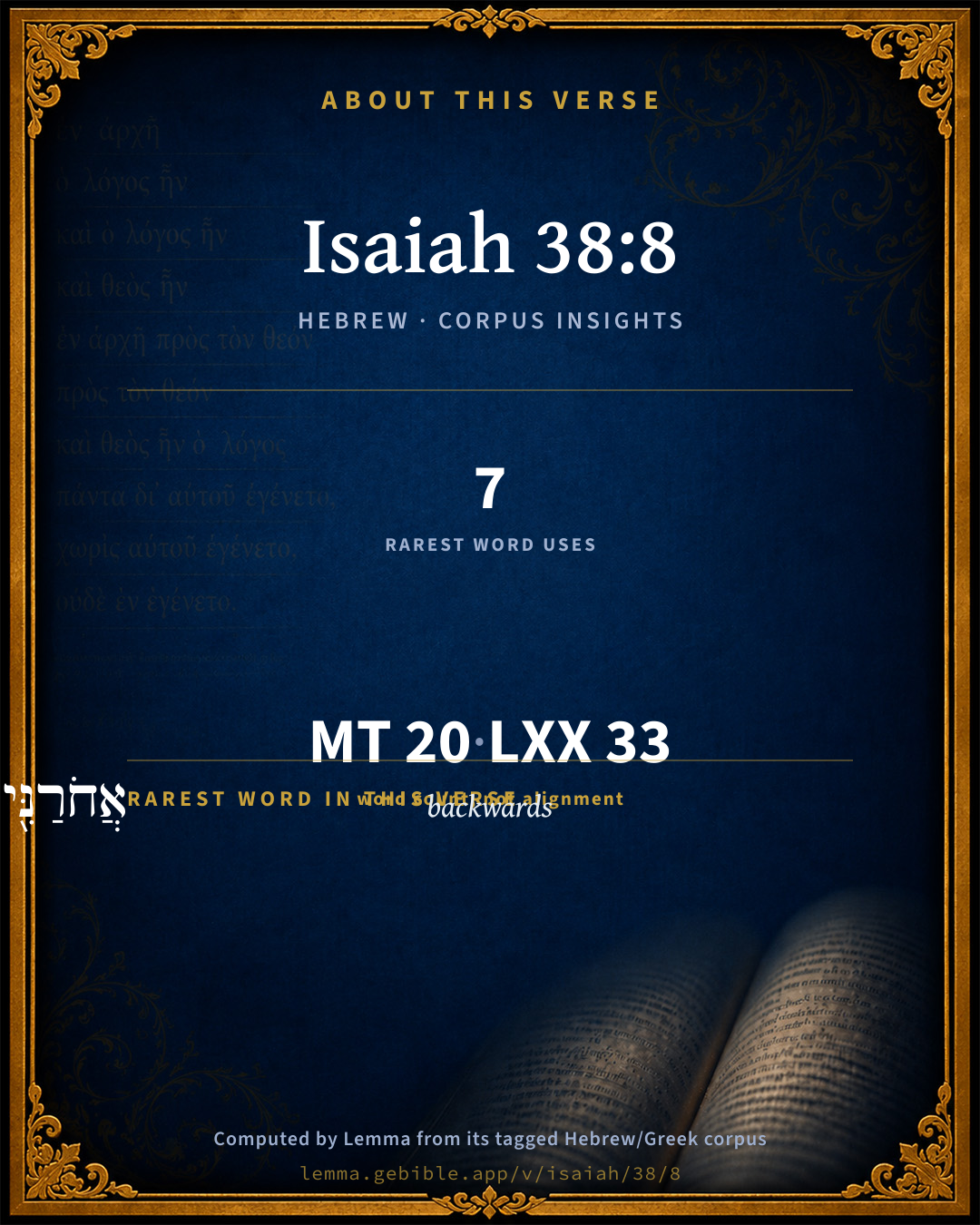
The rarest word here is אֲחֹרַנִּ֖ית backwards H322 — appearing just 7 times in the whole Hebrew Bible.

Shared distinctive vocabulary

אֲחֹרַנִּ֖ית backwards H322 occurs in 6 verses of the Hebrew Bible. Also found in:

Grammatical profile

  • 4 verbs
  • 9 nouns
  • 2 adjectives
  • 1 adverb
  • 4 particles

Verb forms

  • מֵשִׁ֣יב Hiphil · Participle Active
  • יָרְדָה֩ Qal · Perfect
  • וַתָּ֤שָׁב Qal · Sequential Imperfect
  • יָרָֽדָה Qal · Perfect

Repetition

Words recur within this verse — often emphatic in Hebrew:

  • הַֽמַּעֲל֡וֹת step H4609 ×5
  • מֵשִׁ֣יב to return H7725 ×2
  • יָרְדָה֩ to go down H3381 ×2
  • בַּשֶּׁ֛מֶשׁ sun H8121 ×2
  • עֶ֣שֶׂר ten H6235 ×2
  • אֲשֶׁ֣ר which H834 ×2

Hebrew & Septuagint length

In English translation the verse runs 40 words from the Hebrew and 51 from the Septuagint (LXX English) — closely comparable.

A rough comparison of the two English renderings, which tokenize alike — not a word-level alignment.

Word counts can differ between the Hebrew and the Greek without any difference in meaning — e.g. the Hebrew direct-object marker אֵת has no separate Greek word, and Greek often adds the article ὁ.

In the original languages it is 20 Hebrew tokens and 33 Greek tokens — but the two are counted differently (Hebrew bundles its prefixes and suffixes into one token; the Greek is in lemma form), so that isn’t a like-for-like length.

Cross-references

5

Topical passages linked to Isaiah 38:8 in the Treasury of Scripture Knowledge — connected by theme and wording, ordered by reader-vote popularity; previews shown in the World English Bible.

  • 2 Kings 20:9–11 Isaiah said, This shall be the sign to you from Yahweh, that Yahweh will do the thing that he has spoken: shall the shadow go forward ten steps, or go back ten steps?
  • Joshua 10:12–14 Then spoke Joshua to Yahweh in the day when Yahweh delivered up the Amorites before the children of Israel; and he said in the sight of Israel, Sun, stand you still on Gibeon; You, Moon, in the valley of Aijalon.
  • 2 Chronicles 32:24 In those days Hezekiah was sick even to death: and he prayed to Yahweh; and he spoke to him, and gave him a sign.
  • Matthew 16:1 The Pharisees and Sadducees came, and testing him, asked him to show them a sign from heaven.
  • 2 Chronicles 32:31 However in [the business of] the ambassadors of the princes of Babylon, who sent to him to inquire of the wonder that was done in the land, God left him, to try him, that he might know all that was in his heart.

Cross-references courtesy of OpenBible.info (CC BY 4.0).

Hebrew and Greek witnesses Masoretic Hebrew ↔ Greek Septuagint

The same verse in the two great witnesses to the Old Testament, shown verse-for-verse.

These are two independent witnesses, not word-aligned to each other, and the Septuagint is shown in lemma (dictionary) form.

Hebrew Isaiah 38:8 Masoretic · Westminster Leningrad Codex

הִנְנִ֣י מֵשִׁ֣יב אֶת צֵ֣ל הַֽמַּעֲל֡וֹת אֲשֶׁ֣ר יָרְדָה֩ בְמַעֲל֨וֹת אָחָ֥ז בַּשֶּׁ֛מֶשׁ אֲחֹרַנִּ֖ית עֶ֣שֶׂר מַעֲל֑וֹת וַתָּ֤שָׁב הַשֶּׁ֨מֶשׁ֙ עֶ֣שֶׂר מַעֲל֔וֹת בַּֽמַּעֲל֖וֹת אֲשֶׁ֥ר יָרָֽדָה

behold, I will cause the shadow on the steps, which is gone down on the dial of Ahaz with the sun, to return backward ten steps. So the sun returned ten steps on the dial whereon it was gone down.

World English Bible · Public Domain

Greek LXX Isaiah 38:8 Septuagint · lemma form

ὁ σκιά ὁ ἀναβαθμός ὅς καταβαίνω ὁ ἥλιος ὁ δέκα ἀναβαθμός ὁ οἶκος ὁ πατήρ σύ ἀποστρέφω ὁ ἥλιος ὁ δέκα ἀναβαθμός καί ἀναβαίνω ὁ ἥλιος ὁ δέκα ἀναβαθμός ὅς καταβαίνω ὁ σκιά

behold, I will turn back the shadow of the degrees of the dial by which ten degrees on the house of your father the sun has gone down—I will turn back the sun the ten degrees; so the sun went back the ten degrees by which the shadow had gone down.

LXX2012 (modern English Septuagint) · Public Domain

On this verse, Adam Clarke's Commentary discusses the Septuagint’s reading. Read the note in Commentary ↓

Hebrew: Westminster Leningrad Codex (CC BY 4.0). Greek: Septuagint (public domain); English from LXX2012 (modern English Septuagint) (Public Domain). How the Septuagint differs from the Hebrew →

Targum (Aramaic paraphrase)

1

The Targum is the ancient Jewish Aramaic paraphrase of the Hebrew Scriptures — an interpretive translation, not the Hebrew text itself. Onkelos (literal) and Pseudo-Jonathan (expansive) render the Torah, and Jonathan the Prophets. Coverage is partial: where no permissively-licensed English translation exists for a verse, only the Aramaic is shown. This is verse-level text, not a word-by-word alignment to the Hebrew.

  1. Targum Jonathan Prophets (Joshua–Malachi)
    הָא אֲנָא מֵתִיב יַת טוּל אֶבֶן שְׁעַיָא דְנָחְתַת בְּמַסְקָנָא דְאָחָז שִׁמְשָׁא לַאֲחוֹרוֹהִי עֲסַר שְׁעָן וְתַב שִׁמְשָׁא עֲסַר שְׁעָן בְּצוּרַת אֶבֶן שְׁעַיָא דְנָחֲתַת:

    Behold, I will turn back the shadow on the hour-lines by which the sun is gone down on the dial of Ahaz, ten hours backwards. And the sun returned ten hours on the figure of the hourlines, which it had gone down.

    Targum Jonathan — Aramaic: “Mikraot Gedolot” (public domain). English: “Sefaria Community Translation” (CC0 1.0 (public-domain dedication)); “London "Chaldee Paraphrase," 1871” (public domain). Text via Sefaria.

Commentary

Notes on Isaiah 38:8 from classic Christian and Jewish commentators (each source and its license shown beneath its notes). The classic Christian expositions comment on the surrounding passage and are grouped to its opening verse, so a note may address several verses; the Jewish commentaries on the Tanakh (Rashi and others) are per-verse, so they appear only where the commentator wrote on this verse.

Lemma curates 59 commentaries, every one of them public domain or Creative Commons licensed, each selected and text-cleaned for this edition rather than reprinted as found. About our sources →

Trapp's Complete Commentary

John Trapp

Isa 38:8 Behold, I will bring again the shadow of the degrees, which is gone down in the sun dial of Ahaz, ten degrees backward. So the sun returned ten degrees, by which degrees it was gone down.

Ver. 8. See 2Ki 20:9-12 {See Trapp on "2Ki 20:9"} {See Trapp on "2Ki 20:10"} {See Trapp on "2Ki 20:11"} {See Trapp on "2Ki 20:12"}

John Trapp, A Commentary or Exposition upon All the Books of the Old and New Testament (1647–1656) — public domain. Text from a community e-Sword module.

Geneva Bible (1599)

Geneva Bible translators

Read 2 Kings 20:10.

Geneva Bible (1599) marginal notes — public domain. Text via Bolls.life.

Jamieson, Fausset & Brown

Robert Jamieson, A. R. Fausset & David Brown

bring again--cause to return (Jos 10:12-14). In Kg2 20:9, Kg2 20:11, the choice is stated to have been given to Hezekiah, whether the shadow should go forward, or go back, ten degrees. Hezekiah replied, "It is a light thing (a less decisive miracle) for the shadow to go down (its usual direction) ten degrees: nay, but let it return backward ten degrees"; so Isaiah cried to Jehovah that it should be so, and it was so (compare Jos 10:12, Jos 10:14).

sundial of Ahaz--HERODOTUS (2.109) states that the sundial and the division of the day into twelve hours, were invented by the Babylonians; from them Ahaz borrowed the invention. He was one, from his connection with Tiglath-pileser, likely to have done so (Kg2 16:7, Kg2 16:10). "Shadow of the degrees" means the shadow made on the degrees. JOSEPHUS thinks these degrees were steps ascending to the palace of Ahaz; the time of day was indicated by the number of steps reached by the shadow. But probably a sundial, strictly so called, is meant; it was of such a size, and so placed, that Hezekiah, when convalescent, could witness the miracle from his chamber. Compare Isa 38:21-22 with Kg2 20:9, where translate, shall this shadow go forward, &c.; the dial was no doubt in sight, probably "in the middle court" (Kg2 20:4), the point where Isaiah turned back to announce God's gracious answers to Hezekiah. Hence this particular sign was given. The retrogression of the shadow may have been effected by refraction; a cloud denser than the air interposing between the gnomon and dial would cause the phenomenon, which does not take from the miracle, for God gave him the choice whether the shadow should go forward or back, and regulated the time and place. BOSANQUET makes the fourteenth year of Hezekiah to be 689 B.C., the known year of a solar eclipse, to which he ascribes the recession of the shadow. At all events, there is no need for supposing any revolution of the relative positions of the sun and earth, but merely an effect produced on the shadow (Kg2 20:9-11); that effect was only local, and designed for the satisfaction of Hezekiah, for the Babylonian astronomers and king "sent to enquire of the wonder that was done in the land" (Ch2 32:31), implying that it had not extended to their country. No mention of any instrument for marking time occurs before this dial of Ahaz, 700 B.C. The first mention of the "hour" is made by Daniel at Babylon (Dan 3:6).

Jamieson, Fausset & Brown — Commentary Critical and Explanatory on the Whole Bible (1871) — public domain (CC PDM 1.0). Text via the HelloAO Bible API.

Adam Clarke's Commentary

Verse 8. Which is gone down - "By which the sun is gone down"] For בשמש bashshemesh, the Septuagint, Syriac, and Chaldee read השמש, hashshemesh. - Houbigant. In the history of this miracle in the book of Kings, (2Kg 20:9-11,) there is no mention at all made of the sun, but only of the going backward of the shadow: which might be effected by a supernatural refraction. The first ὁ ἡλιος, the sun, in this verse is omitted in the Septuagint, MS. Pachom.

Adam Clarke's Commentary on the Bible (1810–1826) — public domain. Text from a community e-Sword/MySword module.

The Cambridge Bible for Schools and Colleges

gen. ed. J. J. S. Perowne

8. The R.V. has (after Ahaz) the phrase “with the sun,” which is wrongly taken by the A.V. as an adjunct of the word “dial” (the sun dial). It is necessary, however, to strike out the preposition “with” (as in the LXX.). The whole verse then reads literally: Behold I will turn the shadow of the steps which the sun has gone down on the steps of Ahaz backward ten steps; and the sun turned back ten steps on the steps which it had gone down. We must suppose that the “steps,” whatever they were, could be seen from the sick-chamber of Hezekiah, to whose mind the sign had an obvious symbolical significance. The retreating shadow, miraculously lengthening the day, was a pledge of the postponement of that “night in which no man can work” which had almost overtaken him. What kind of apparatus is denoted by the “steps of Ahaz” we have no means of determining. It is not clear, indeed, that a regularly constructed sun-dial of any kind is meant: a shadow falling on some fight of steps in the palace-court, and affording a rough and ready measure of time, would sufficiently explain the terms used.

The Cambridge Bible for Schools and Colleges (gen. ed. J. J. S. Perowne; Cambridge University Press, 1878–1918) — public domain. Text from a community e-Sword module.

John Gill's Exposition

The writing of Hezekiah king of Judah,.... The Septuagint and Arabic versions call it a "prayer": but the Targum, much better,

"a writing of confession;''

in which the king owns his murmurings and complaints under his affliction, and acknowledges the goodness of God in delivering him out of it: this he put into writing, as a memorial of it, for his own benefit, and for the good of posterity; very probably he carried this with him to the temple, whither he went on the third day of his illness, and hung it up in some proper place, that it might be read by all, and be sung by the priests and the Levites; and the Prophet Isaiah has thought fit to give it a place among his prophecies, that it might be transmitted to future ages:

when he had been sick, and was recovered of his sickness; or, "on his being sick (e)"; on his sickness and recovery, which were the subject matter of his writing, as the following show; though it is true also of the time of writing it, which was after he had been ill, and was well again.

(e) "in aegrotando ipsum", Montanus.

John Gill's Exposition of the Whole Bible (1746–1763) — public domain (CC PDM 1.0). Text via the HelloAO Bible API.

Albert Barnes' Notes on the Bible

Behold, I will bring again the shadow - The shadow, or shade which is made by the interception of the rays of the sun by the gnomon on the dial. The phrase ‘bring again’ (Hebrew, משׁיב mēshı̂yb) means to cause to return (Hiphil, from שׁוב shûb, to return); that is, I will cause it retrograde, or bring back. Septuagint, Στρέψω Strepsō - ‘I will turn back.’ Few subjects have perplexed commentators more than this account of the sun-dial of Ahaz. The only other place where a sun-dial is mentioned in the Scriptures is in the parallel place in 2Ki 20:9-10, where the account is somewhat more full, and the nature of the miracle more fully represented: ‘This sign shalt thou have of the Lord, that the Lord will do the thing which he hath spoken: Shall the shadow go forward ten degrees, or go back ten degrees? And Hezekiah answered, It is a light thing for the shadow to go down ten degrees; nay, but let the shadow return backward ten degrees.’ That is, it would be in the usual direction which the shadow takes, for it to go down, and there would be less that would be decisive in the miracle. He therefore asked that it might be moved backward from its common direction, and then there could be no doubt that it was from God; 2Ki 20:11 : ‘And Isaiah the prophet cried unto Yahweh, and he brought the shadow ten degrees backward, by which had gone down in the dial of Ahaz.’

The shadow of the degrees - That is, the shadow made on the degrees; or indicated by the degrees on the dial. But there has been much difficulty in regard to the meaning of the word degrees. The Hebrew word (מעלה ma‛ălâh from עלה ‛âlâh, to ascend, to go up) means properly an ascent; a going up from a lower to a higher region; then a step by which one ascends, applied to the steps on a staircase, etc. 1Ki 10:19; Eze 40:26, Eze 40:31, Eze 40:34. Hence, it may be applied to the ascending or descending figures or marks on a dial designating the ascent or descent of the sun; or the ascent or descent of the shadow going up or down by steps or hours marked on its face. The word is applied to a dial nowhere else but here. Josephus understands this as referring to the stem in the house or palace of Ahaz. ‘He desired that he would make the shadow of the sun which he had already made to go down ten steps in his house, to return again to the same place, and to make it as it was before;’ by which he evidently regarded Hezekiah as requesting that the shadow which had gone down on the steps of the palace should return to its place ten steps backward. It is possible that the time of day may have been indicated by the shadow of the sun on the steps of the palace, and that this may have constituted what was called the sun-dial of Ahaz; but the more probable interpretation is that which regards the dial as a distinct and separate contrivance. The Septuagint renders it by the word steps, yet understanding it as Josephus does, Ἀναβαθμοὺς τοῦ οικου τοῦ πατρός σου Anabathmous tou oikou tou patros sou - ‘The steps of the house of thy father.’

Which is gone down on the sun-dial of Ahaz - Margin, ‘Degrees by,’ or ‘with the sun.’ Hebrew, literally, ‘which has descended on the steps; or degrees of Ahaz by, or with the sun (בשׁמשׁ bashemesh), that is, by means of the sun, or caused by the progress of the sun. The shadow had gone down on the dial by the regular course of the sun. Ahaz was the father of Hezekiah; and it is evident from this, that the dial had been introduced by him, and had been used by him to measure time. There is no mention of any instrument for keeping time in the Bible before this, nor is it possible, perhaps, to determine the origin or character of this invention, or to know where Ahaz obtained it. Perhaps all that can be known on the subject has been collected by Calmer, to whose article (Dial) in his Dictionary, and to the Fragments of Taylor appended to his Dictionary (Fragments, ii.; cii.) the reader may be referred for a more full statement on this subject than is consistent with the design of these notes.

The mention of the dial does not occur before the time of Ahaz, who lived 726 b.c.; nor is it certainly known that even after his time the Jews generally divided their time by hours. The word ‘hour’ (καἱρικός kairikos) occurs first in Tobit; and it has been supposed that the invention of dials came from beyond the Euphrates (Herod. ii. 109). But others suppose that it came from the Phenicians, and that the first traces of it are discoverable in what Homer says (Odyss. xv. 402) of ‘an island called Syria lying above Ortygia, where the revolutions of the sun are observed.’ The Phenicians are supposed to have inhabited this island of Syria, and it is therefore presumed that they left there this monument of their skill in astronomy. About three hundred years after Homer, Pherecydes set up a sun-dial in the same island to distinguish the hours. The Greeks confess that Anaximander, who lived 547 b.c., under the reign of Cyrus, first divided time by hours, and introduced sun-dials among them.

This was during the time of the captivity at Babylon. Anaximander traveled into Chaldea, and it is not improbable that he brought the dial from Babylon. The Chaldeans were early distinguished for, their attention to astronomy, and it is probable that it was in Babylon that the sun-dial, and the division of the day into hours, was first used, and that the knowledge of that was conveyed in some way from Chaldea to Ahaz. Interpreters have differed greatly in regard to the form of the sun-dial used by Ahaz, and by the ancients generally. Cyril of Alexandria and Jerome believed it was a staircase so disposed, that the sun showed the hours on it by the shadow. This, as we have seen, was the opinion of Josephus; and this opinion has been followed by many others. Others suppose it was an obelisk or pillar in the middle of a smooth pavement on which the hours were engraved, or on which lines were drawn which would indicate the hours.

Grotius, in accordance with the opinion of rabbi Elias Chomer, describes it thus: ‘It was a concave hemisphere, in the midst of which was a globe, the shadow of which fell upon several lines engraved on the concavity of the hemisphere; these lines, they say, were eight-and-twenty in number.’ This description accords nearly with the kind of dial which the Greeks called scapha, a boat, or hemisphere, the invention of which the Greeks ascribed to a Cbaldean named Berosus (Vitruv. ix. 9). See the plate in Taylor’s Calmet, ‘Sun-dial of Ahaz’ (Figs. 1 and 2). Berosus was a priest of Belus in Babylon, and lived indeed perhaps 300 years after Ahaz; but there is no necessity of supposing that he was the inventor of the dial. It is sufficient to suppose that he was reputed to be the first who introduced it into Greece. He went from Babylon to Greece, where he taught astronomy first at Cos, and then at Athens, where one of his dials is still shown.

Herodotus expressly says (i. 109), ‘the pole, the gnomon, and the division of the day into twelve parts, the Greeks received from the Babylonians.’ This sun-dial was portable; it did not require to be constructed for a particular spot to which it should be subsequently confined; and therefore one ready-made might have been brought from Babylon to Ahaz. That be had commerce with these countries appears by his alliance with Tiglath-pileser 2Ki 16:7-8. And that Ahaz was a man who was desirous of availing himself of foreign inventions, and introducing them into his capital, appears evident from his desire to have an altar constructed in Jerusalem, similar to the one which he had seen in Damascus 2Ki 16:10. The dial is now a well-known instrument, the principle of which is, that the hours are marked on its face by a shadow cast from the sun by a gnomon. In order to the understanding of this miracle, it is not necessary to be acquainted with the form of the ancient dial. It will be understood by a reference to any dial, and would have been substantially the same, whatever was the form of the instrument. The essential idea is, that the shadow of the gnomon which thus indicated a certain degree or hour of the day, was made to go back ten degrees or places. It may conduce, however, to the illustration of this subject to have before the eye a representation of the usual form of the ancient dial. Therefore, see the three forms of dials which have been discovered and which are present in the book. The engraving represents:

1. A concave dial of white marble, found at Givita, in the year 1762.

2. Another concave dial, found at mount Tusculum, near Rome, in 1726.

3. A compound dial, preserved in the Elgin collection in the British Museum. It was found at Athens, supposed to have been used in marking the hours on one of the crossways of the city.

The first two are considered to resemble, if indeed they be not identical with the famous dial of Ahaz.’

In regard to this miracle, it seems only necessary to observe that all that is indispensable to be believed is, that the shadow on the dial was made suddenly to recede from any cause. It is evident that this may have been accomplished in several ways. It may have been by arresting the motion of the earth in its revolutions, and causing it to retrograde on its axis to the extent indicated by the return of the shadow, or it may have been by a miraculous bending, or inclining of the rays of the sun. As there is no evidence that the event was observed elsewhere; and as it is not necessary to suppose that the earth was arrested in its motion, and that the whole frame of the universe was adjusted to this change in the movement of the earth, it is most probable that it was an inclination of the rays of the sun; or a miraculous causing of the shadow itself to recede. This is the whole statement of the sacred writer, and this is all that is necessary to be supposed. What Hezekiah desired was a miracle; a sign that he should recover. That was granted. The retrocession of the shadow in this sudden manner was not a natural event. It could be caused only by God; and this was all that was needed. A simple exertion of divine power on the rays of the sun which rested on the dial, deflecting those rays, would accomplish the whole result. It may be added that it is not recorded, nor is it necessary to an understanding of the subject to suppose, that the bending of the rays was permanent, or that so much time was lost. The miracle was instantaneous, and was satisfactory to Hezekiah, though the rays of the sun casting the shadow may have again been soon returned to their regular position, and the shadow restored to the place in which it would have been had it not been interrupted. No infidel, therefore, can object to this statement, unless lie can prove that this could not be done by him who made the sun, and who is himself the fountain of power.

By which degrees it was gone down - By the same steps, or degrees on which the shadow had descended. So the Septuagint express it; ‘so the sun re-ascended the ten steps by which the shadow had gone down. It was the shadow on the dial which had gone down. The sun was ascending, and the consequence was, of course, that the shadow on a vertical dial would descend. The ‘sun’ here means, evidently, the sun as it appeared; the rays, or the shining of the sun. A return of the shadow was effected such as would be produced by the recession of the sun itself.

Albert Barnes' Notes on the Bible (1834–1885) — public domain. Text from a community e-Sword/MySword module.

The Pulpit Commentary

The sun-dial of Ahaz. We are informed by Herodotus that the sun-dial was an invention of the Babylonians (Herod., 2:109), from whom it would readily pass to the Assyrians. Ahaz may have obtained a knowledge of it, or an actual specimen, when he visited Tiglath-Pileser at Damascus, (2Ki_16:10) and, on his return to his capital, have caused one to be erected there. Sun-dials are of several kinds. The one here spoken of seems to have consisted of a set of steps, with a perpendicular gnomon or pole at the top, the shadow of which receded up the steps as the sun rose in the heavens, and descended down them as the sun declined. We must suppose that the sign was given in the forenoon, when the shadow was gradually creeping up the steps. Hezekiah thought that a sudden jump in the same direction would be as nothing compared with a reversal of the motion, and therefore required that the shadow should go back, which it did. How the effect was produced, whether by an eclipse as argued by Mr. Bosanquet ("Transactions of Society of Bibl. Archaeology," vol. 3. pp. 34-40), or by refraction, or by an actual alteration of the earth"s motion, we are not told; but there is reason to believe that the cause, whatever it was, was local, not general, since the King of Babylon subsequently sent ambassadors, to inquire concerning the wonder that was done in the land". (2Ch_32:31) The sun returned ten degrees. We must not press this expression as indicating a real alteration of the suns place in the heavens. The meaning is that the shadow cast by the sun re turned.

The Pulpit Commentary (1880–1919), ed. H.D.M. Spence-Jones & Joseph S. Exell — public domain. Text from a community e-Sword module.

J. A. Alexander on Isaiah

Joseph Addison Alexander

“Behold, I (am) causing the shadow to go back, the degrees which it has gone down (or which have gone down) on the degrees of Ahaz with the sun, ten degrees backward; and the sun returned ten degrees on the degrees which it had gone down.” As to the nature of the phenomenon here described, there are various opinions, but it is not a question of much exegetical or practical importance, since it neither can nor need be ascertained, whether the course of the sun (or of the earth around it) was miraculously changed, or the shadow miraculously rendered independent of the sun which caused it. The former hypothesis is favored by the statement that the sun went back, if taken in its strictest and most obvious sense, although it may be understood as a metonymy of the cause for the effect.

At any rate, little would appear to be gained by paring down a miracle to certain dimensions, when even on the lowest supposition it can only be ascribed to the almighty power of God, with whom all things are not only possible but equally easy. If shut up to the assumption of a miracle, it matters little whether it be great or small. It is enough that God alone could do it or infallibly predict it. If this be admitted, and the historical truth of the narrative assumed, the safest course is to expound it in its simplest and most obvious sense. Still less important is the question whether the degrees here mentioned were the graduated scale of a dial, or the steps of a staircase.

It was alleged by some early writers on the subject, that the use of dials was unknown in the days of Hezekiah. Later investigations have destroyed the force of this objection, and made it probable that solar chronometers of some sort were in use among the Babylonians at a very early period, and that Ahaz may have borrowed the invention from them, as he borrowed other things from the Assyrians (2Ki 16:10). There is therefore no historical necessity for assuming that the shadow here meant was the shadow cast upon the steps of the palace, called the stairs of Ahaz because he had built them or the house itself. The only question is, whether this is not the simplest and most obvious explanation of the words, and one which entirely exhausts their meaning. If so, we may easily suppose the shadow to have been visible from Hezekiah’s chamber, and the offered sign to have been suggested to the Prophet by the sight of it.

This hypothesis relieves us from the necessity of accounting for the division into ten or rather twenty degrees, as Hezekiah was allowed to choose between a precession and a retrocession of the same extent (2Ki 20:9). These two opinions are by no means so irreconcilable as they may at first sight seem. Even supposing the degrees of Ahaz to have been an instrument constructed for the purpose of measuring time, it does not follow that it must have been a dial of modern or of any very artificial structure. It is quite as probable that a column at the top of a staircase cast a shadow which was found available for a rude measurement of time.

Joseph Addison Alexander, The Prophecies of Isaiah (1846–1847; New York: Scribner, 1870–1878) — public domain. Text from a community e-Sword module.

Rashi

Rabbi Shlomo Yitzchaki (Rashi)

Behold I return the shade backwards ten steps which it went down.

the shade of the steps A sort of steps made opposite the sun to determine the hours of the day, like the clocks (horloge in French) that craftsmen make (sectarians make [Parshandatha]).

that it went down It hastened to go down, and the day was shortened by ten hours on the day Ahaz died, in order that they should not eulogize him, and now they went backwards on the day Hezekiah recovered, and ten hours were added to the day.

Rashi on the Tanakh — English translations: “The Judaica Press complete Tanach with Rashi, translated by A. J. Rosenberg” (CC BY 4.0); “Pentateuch with Rashi's commentary by M. Rosenbaum and A.M. Silbermann, 1929-1934” (public domain); “The Metsudah Tanach series, Lakewood, N.J” (CC BY 4.0); and “The Book of Joshua, Metsudah Publications, 1997” (CC BY 4.0). Text via Sefaria.

Lesson kit

Teaching starters — assembled from the data on this page, not authored interpretation. Every prompt links to the verse data it draws on. Edit before teaching.

Isaiah, in the Prophets, opens this verse with 20 words (11 distinct Hebrew lemmas). Its most distinctive word is ʼăchôrannîyth (“backwards”). A historical commentator’s framing appears above. Read the whole chapter for the surrounding context.

Discussion questions

  1. How does “backwards” (ʼăchôrannîyth) shape what this verse is saying?
  2. Genesis 9:23 shares the word «backwards» with this verse. How do the two illuminate each other?
  3. “step” occurs 5× in this one verse. What is the effect of the repetition?
  4. The translations on this page render this verse differently — a whole-verse word diff, not a word-by-word alignment. What might account for the different wordings?
  5. The verb «מֵשִׁ֣יב» is Hiphil Participle Active. How does its form color the action?
  6. Reading how Trapp's Complete Commentary and Geneva Bible (1599) read this verse, where do the two commentators agree and where do they part?

Things to notice

Reading settings

Reading text

Shown beneath each verse's original-language words.

Old Testament
Old Testament edition

Read the OT as the Masoretic Hebrew (MT) or the Greek Septuagint (LXX).

English shown for the Greek Septuagint (in the Hebrew ↔ Greek comparison).

Comparing translations? Open the Compare panel on any verse page to stack up to four side by side.