
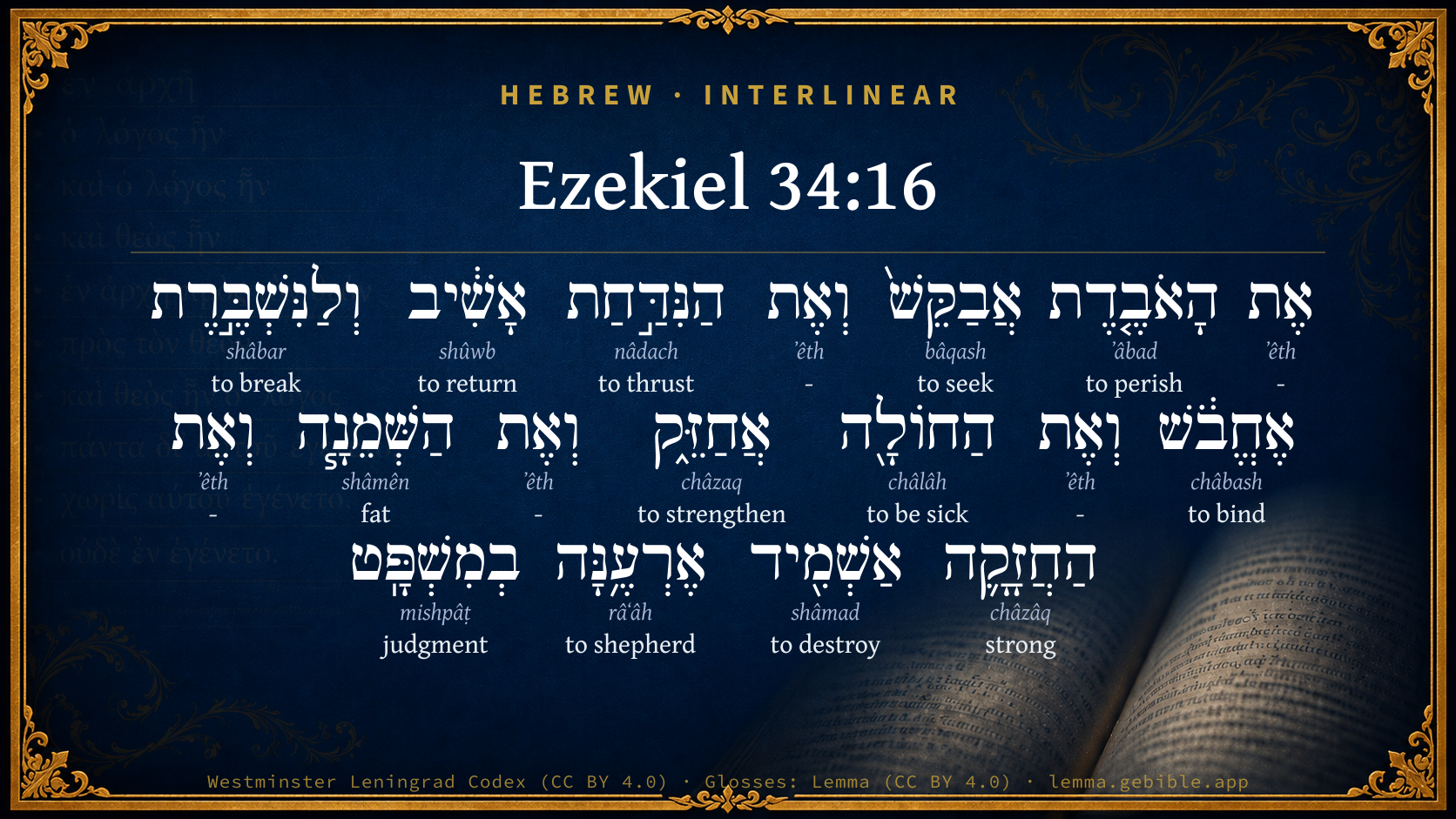
Ezekiel 34:16

Hebrew (Westminster Leningrad Codex) Ezekiel 34:16 appears in the Hebrew Old Testament. The text above is from the Westminster Leningrad Codex. Each word links to its Strong’s number, a concise gloss, and parsing drawn from the Open Scriptures Hebrew Bible morphology. Click any word for its full Brown-Driver-Briggs (BDB) entry.
Download image
Cite this verse

Ezekiel 34:16 (World English Bible). Public Domain. Lemma interlinear Bible study tool, https://lemma.gebible.app/v/ezekiel/34/16.

Show BibTeX & RIS
BibTeX
RIS
English Translation
I will seek that which was lost, and will bring back that which was driven away, and will bind up that which was broken, and will strengthen that which was sick: but the fat and the strong I will destroy; I will feed them in justice.
World English Bible · Public Domain
Download a study sheet

One document with this verse’s original text, its word-by-word gloss line, the meaning frame, cross-references with their text, attributed commentary, and full source and license credits — printable, and it pastes into notes with its structure intact.

This verse Autodidact and up

Study sheet (.html) Plain text (.txt)

A passage Seminary Student

Up to 50 verses in one chapter. A passage sheet keeps up to 6 commentary sources and 12 cross-references per verse, in the order this page ranks them, and says so on the sheet whenever that leaves anything out. Ask for a single verse and you get the Autodidact verse sheet above.

Everything on this page stays free to read, with no account — the sheet is a download of what is already on screen, not access to it.

Want to remove ads? Support Godless Engineer
Compare translations 3

The same verse in 3 English versions, stacked beneath the original-language interlinear above. Click any original word for its lexicon entry.

Each is an independent rendering of the whole verse — the interlinear is not word-aligned to these translations.

Highlighted words mark where these versions differ — a whole-verse word diff, not a word-by-word alignment.

  • World English Bible Public Domain
    I will seek that which was lost, and will bring back that which was driven away, and will bind up that which was broken, and will strengthen that which was sick: but the fat and the strong I will destroy; I will feed them in justice.
  • King James Version Public Domain
    I will seek that which was lost, and bring again that which was driven away, and will bind up that which was broken, and will strengthen that which was sick: but I will destroy the fat and the strong; I will feed them with judgment.
  • unfoldingWord Literal Text CC BY-SA 4.0
    I will seek the lost and restore the outcast. I will bind up the broken sheep and heal the sick sheep but the fat and the strong I will destroy. I will shepherd with justice.

unfoldingWord Literal Text — © unfoldingWord, licensed CC BY-SA 4.0. Word-aligned USFM3 via Door43 (git.door43.org/unfoldingWord/en_ult).

Versions to compare (up to 4)

3 of 4 selected

Show all 18 translations

Every available English version of this verse, each an independent rendering of the whole verse.

  • World English Bible Public Domain
    I will seek that which was lost, and will bring back that which was driven away, and will bind up that which was broken, and will strengthen that which was sick: but the fat and the strong I will destroy; I will feed them in justice.
  • Berean Standard Bible Public Domain
    I will seek the lost, bring back the strays, bind up the broken, and strengthen the weak; but the sleek and strong I will destroy. I will shepherd them with justice.’
  • Majority Standard Bible Public Domain
    I will seek the lost, bring back the strays, bind up the broken, and strengthen the weak; but the sleek and strong I will destroy. I will shepherd them with justice.’
  • King James Version Public Domain
    I will seek that which was lost, and bring again that which was driven away, and will bind up that which was broken, and will strengthen that which was sick: but I will destroy the fat and the strong; I will feed them with judgment.
  • American Standard Version (1901) Public Domain
    I will seek that which was lost, and will bring back that which was driven away, and will bind up that which was broken, and will strengthen that which was sick: but the fat and the strong I will destroy; I will feed them in justice.
  • Revised Version (1885) Public Domain
    I will seek that which was lost, and will bring again that which was driven away, and will bind up that which was broken, and will strengthen that which was sick: and the fat and the strong I will destroy; I will feed them in judgment.
  • Geneva Bible (1599) Public Domain
    I will seeke that which was lost, and bring againe that which was driue away, and will binde vp that which was broken, and will strengthen the weake but I wil destroy the fat and the strong, and I will feede them with iudgement.
  • Douay-Rheims (1899) Public Domain
    I will seek that which was lost: and that which was driven away, I will bring again: and I will bind up that which was broken, and I will strengthen that which was weak, and that which was fat and strong I will preserve: and I will feed them in judgment.
  • Young's Literal Translation Public Domain
    The lost I seek, and the driven away bring back, And the broken I bind up, and the sick I strengthen, And the fat and the strong I destroy, I feed it with judgment.
  • Literal Standard Version CC BY-SA 4.0
    I seek the lost, and bring back the driven away, || And I bind up the broken, and I strengthen the sick, || And I destroy the fat and the strong, || I feed it with judgment.
  • Unlocked Literal Bible CC BY-SA 4.0
    I will seek the lost and restore the outcast. I will bind up the broken sheep and heal the sick sheep but the fat and the strong I will destroy. I will shepherd with justice.
  • unfoldingWord Literal Text CC BY-SA 4.0
    I will seek the lost and restore the outcast. I will bind up the broken sheep and heal the sick sheep but the fat and the strong I will destroy. I will shepherd with justice.
  • Darby Bible Public Domain
    I will seek the lost, and bring again that which was driven away, and will bind up the broken, and will strengthen that which was sick; but I will destroy the fat and the strong: I will feed them with judgment.
  • World Messianic Bible Public Domain
    “I will seek that which was lost, and will bring back that which was driven away, and will bind up that which was broken, and will strengthen that which was sick; but I will destroy the fat and the strong. I will feed them in justice.”’
  • Webster's Bible Public Domain
    I will seek that which was lost, and bring again that which was driven away, and will bind up that which was broken, and will strengthen that which was sick: but I will destroy the fat and the strong; I will feed them with judgment.
  • Free Bible Version CC BY-SA 4.0
    I will go looking for the lost, bring home the strays, bandage the injured, and strengthen the weak. However, I will destroy those who are fat and strong. Because I do what's right, I will be sure to take care of them.
  • Bible in Basic English Public Domain
    I will go in search of that which had gone wandering from the way, and will get back that which had been sent in flight, and will put bands on that which was broken, and give strength to that which was ill: but the fat and the strong I will give up to destruction; I will give them for their food the punishment which is theirs by right.
  • JPS Tanakh (1917) Public Domain
    I will seek that which was lost, and will bring back that which was driven away, and will bind up that which was broken, and will strengthen that which was sick; and the fat and the strong I will destroy, I will feed them in justice.

Literal Standard Version (2020), Covenant Press — licensed CC BY-SA 4.0. Text via the HelloAO Bible API (eBible.org). Unlocked Literal Bible (unfoldingWord) — licensed CC BY-SA 4.0. Text via the HelloAO Bible API (eBible.org). unfoldingWord Literal Text — © unfoldingWord, licensed CC BY-SA 4.0. Word-aligned USFM3 via Door43 (git.door43.org/unfoldingWord/en_ult). Free Bible Version, Dr. Jonathan Gallagher — licensed CC BY-SA 4.0. Text via the HelloAO Bible API (eBible.org).

Word by word

More ways to search: Search by grammar → Find every occurrence → Compare this word →

Practice this passage: Drill this verse → Learn its vocabulary →

הַשְּׁמֵנָ֧ה
shâmên
H8082
“the · fat”
Particle, Definite Article + Adjective, Adjective, Feminine, Singular, Absolute
Part of Speech
Particle + Adjective
Type
Adjective
Gender
Feminine
Number
Singular
State
Absolute
Full BDB Definition

Origin: from H8080

TWOT: 2410a

fat, rich, robust - fat, rich (of food) - stout, robust (of men)
  1. אֶת ʼêth H853 “-” Particle, Direct Object
  2. הָאֹבֶ֤דֶת ʼâbad H6 “the · perishing” Particle, Definite Article + Verb, Qal, Participle Active, Feminine, Singular, Absolute
  3. אֲבַקֵּשׁ֙ bâqash H1245 “to seek” Verb, Piel, Imperfect, 1st Person, Common, Singular
  4. וְאֶת ʼêth H853 “and · -” Conjunction + Particle, Direct Object
  5. הַנִּדַּ֣חַת nâdach H5080 “the · thrust” Particle, Definite Article + Verb, Niphal, Participle Passive, Feminine, Singular, Absolute
  6. אָשִׁ֔יב shûwb H7725 “to return” Verb, Hiphil, Imperfect, 1st Person, Common, Singular
  7. וְלַנִּשְׁבֶּ֣רֶת shâbar H7665 “and · to/for the · broken” Conjunction + Preposition, Determined + Verb, Niphal, Participle Passive, Feminine, Singular, Absolute
  8. אֶחֱבֹ֔שׁ châbash H2280 “to bind” Verb, Qal, Imperfect, 1st Person, Common, Singular
  9. וְאֶת ʼêth H853 “and · -” Conjunction + Particle, Direct Object
  10. הַחוֹלָ֖ה châlâh H2470 “the · being sick” Particle, Definite Article + Verb, Qal, Participle Active, Feminine, Singular, Absolute
  11. אֲחַזֵּ֑ק châzaq H2388 “to strengthen” Verb, Piel, Imperfect, 1st Person, Common, Singular
  12. וְאֶת ʼêth H853 “and · -” Conjunction + Particle, Direct Object
  13. וְאֶת ʼêth H853 “and · -” Conjunction + Particle, Direct Object
  14. הַחֲזָקָ֛ה châzâq H2389 “the · strong” Particle, Definite Article + Adjective, Adjective, Feminine, Singular, Absolute
  15. אַשְׁמִ֖יד shâmad H8045 “to destroy” Verb, Hiphil, Imperfect, 1st Person, Common, Singular
  16. אֶרְעֶ֥נָּה râʻâh H7462 “to shepherd · her” Verb, Qal, Imperfect, 1st Person, Common, Singular + Suffix, Personal, 3rd Person, Feminine, Singular
  17. בְמִשְׁפָּֽט mishpâṭ H4941 “in/at · judgment” Preposition + Noun, Common, Masculine, Singular, Absolute

About this verse

These counts appear in no published source. They are computed here, from the morphology-tagged text and Lemma’s own curated glosses. What Lemma adds →

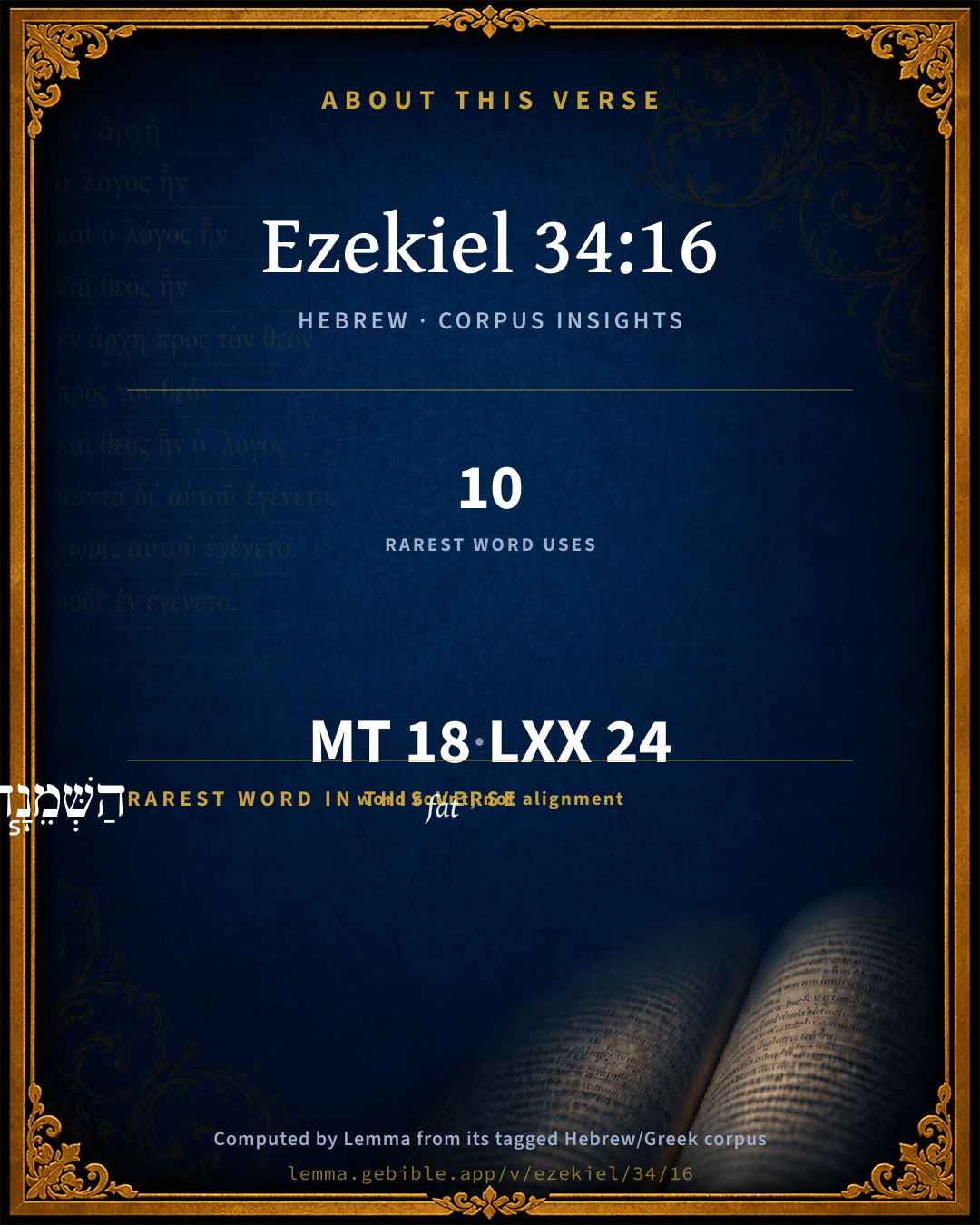
18
words
14
distinct lemmas
Prophets
section

Notable vocabulary

The rarest word here is הַשְּׁמֵנָ֧ה fat H8082 — appearing just 10 times in the whole Hebrew Bible.

Shared distinctive vocabulary

הַשְּׁמֵנָ֧ה fat H8082 occurs in 10 verses of the Hebrew Bible. Also found in:

Grammatical profile

  • 10 verbs
  • 1 noun
  • 2 adjectives
  • 5 particles

Verb forms

  • הָאֹבֶ֤דֶת Qal · Participle Active
  • אֲבַקֵּשׁ֙ Piel · Imperfect
  • הַנִּדַּ֣חַת Niphal · Participle Passive
  • אָשִׁ֔יב Hiphil · Imperfect
  • וְלַנִּשְׁבֶּ֣רֶת Niphal · Participle Passive
  • אֶחֱבֹ֔שׁ Qal · Imperfect
  • הַחוֹלָ֖ה Qal · Participle Active
  • אֲחַזֵּ֑ק Piel · Imperfect
  • אַשְׁמִ֖יד Hiphil · Imperfect
  • אֶרְעֶ֥נָּה Qal · Imperfect

Hebrew & Septuagint length

In English translation the verse runs 46 words from the Hebrew and 38 from the Septuagint (LXX English) — closely comparable.

A rough comparison of the two English renderings, which tokenize alike — not a word-level alignment.

Word counts can differ between the Hebrew and the Greek without any difference in meaning — e.g. the Hebrew direct-object marker אֵת has no separate Greek word, and Greek often adds the article ὁ.

In the original languages it is 18 Hebrew tokens and 24 Greek tokens — but the two are counted differently (Hebrew bundles its prefixes and suffixes into one token; the Greek is in lemma form), so that isn’t a like-for-like length.

Cross-references

22

Topical passages linked to Ezekiel 34:16 in the Treasury of Scripture Knowledge — connected by theme and wording, ordered by reader-vote popularity; previews shown in the World English Bible.

  • Luke 19:10 For the Son of Man came to seek and to save that which was lost."
  • Ezekiel 34:4 You haven't strengthened the diseased, neither have you healed that which was sick, neither have you bound up that which was broken, neither have you brought back that which was driven away, neither have you sought that which was lost; but with force and with rigor have you ruled over them.
  • Ezekiel 34:11 For thus says the Lord Yahweh: Behold, I myself, even I, will search for my sheep, and will seek them out.
  • Isaiah 49:26 I will feed those who oppress you with their own flesh; and they shall be drunken with their own blood, as with sweet wine: and all flesh shall know that I, Yahweh, am your Savior, and your Redeemer, the Mighty One of Jacob.
  • Luke 5:31–32 Jesus answered them, "Those who are healthy have no need for a physician, but those who are sick do.
  • Luke 15:4–7 "Which of you men, if you had one hundred sheep, and lost one of them, wouldn't leave the ninety-nine in the wilderness, and go after the one that was lost, until he found it?
  • Micah 4:6–7 "In that day," says Yahweh, "I will assemble that which is lame, And I will gather that which is driven away, And that which I have afflicted;
  • Ezekiel 39:18 You shall eat the flesh of the mighty, and drink the blood of the princes of the earth, of rams, of lambs, and of goats, of bulls, all of them fatlings of Bashan.
  • Mark 2:17 When Jesus heard it, he said to them, "Those who are healthy have no need for a physician, but those who are sick. I came not to call the righteous, but sinners to repentance."
  • Isaiah 5:17 Then the lambs will graze as in their pasture, And strangers will eat the ruins of the rich.
  • Isaiah 10:16 Therefore will the Lord, Yahweh of Hosts, send among his fat ones leanness; and under his glory there shall be kindled a burning like the burning of fire.
  • Jeremiah 10:24 Yahweh, correct me, but in measure: not in your anger, lest you bring me to nothing.
  • Micah 7:14 Shepherd your people with your staff, The flock of your heritage, Who dwell by themselves in a forest, In the midst of fertile pasture land, let them feed; In Bashan and Gilead, as in the days of old.
  • Isaiah 40:11 He will feed his flock like a shepherd, he will gather the lambs in his arm, and carry them in his bosom, [and] will gently lead those who have their young.
  • Jeremiah 9:15 therefore thus says Yahweh of Hosts, the God of Israel, Behold, I will feed them, even this people, with wormwood, and give them water of gall to drink.
  • Isaiah 61:1–3 The Spirit of the Lord Yahweh is on me; because Yahweh has anointed me to preach good news to the humble; he has sent me to bind up the broken-hearted, to proclaim liberty to the captives, and the opening [of the prison] to those who are bound;
  • Matthew 15:24 But he answered, "I wasn't sent to anyone but the lost sheep of the house of Israel."
  • Matthew 18:10–14 See that you don't despise one of these little ones, for I tell you that in heaven their angels always see the face of my Father who is in heaven.
  • Deuteronomy 32:15 But Jeshurun grew fat, and kicked: You have grown fat, you are grown thick, you are become sleek; Then he forsook God who made him, Lightly esteemed the Rock of his salvation.
  • Jeremiah 23:15 Therefore thus says Yahweh of Hosts concerning the prophets: Behold, I will feed them with wormwood, and make them drink the water of gall; for from the prophets of Jerusalem is ungodliness gone forth into all the land.
  • Jeremiah 50:11 Because you are glad, because you rejoice, O you who plunder my heritage, because you are wanton as a heifer that treads out [the grain], and neigh as strong horses;
  • Amos 4:1–3 Listen to this word, you cows of Bashan, who are on the mountain of Samaria, who oppress the poor, who crush the needy, who tell their lords, "Bring, and let us drink."

Cross-references courtesy of OpenBible.info (CC BY 4.0).

Hebrew and Greek witnesses Masoretic Hebrew ↔ Greek Septuagint

The same verse in the two great witnesses to the Old Testament, shown verse-for-verse.

These are two independent witnesses, not word-aligned to each other, and the Septuagint is shown in lemma (dictionary) form.

Hebrew Ezekiel 34:16 Masoretic · Westminster Leningrad Codex

אֶת הָאֹבֶ֤דֶת אֲבַקֵּשׁ֙ וְאֶת הַנִּדַּ֣חַת אָשִׁ֔יב וְלַנִּשְׁבֶּ֣רֶת אֶחֱבֹ֔שׁ וְאֶת הַחוֹלָ֖ה אֲחַזֵּ֑ק וְאֶת הַשְּׁמֵנָ֧ה וְאֶת הַחֲזָקָ֛ה אַשְׁמִ֖יד אֶרְעֶ֥נָּה בְמִשְׁפָּֽט

I will seek that which was lost, and will bring back that which was driven away, and will bind up that which was broken, and will strengthen that which was sick: but the fat and the strong I will destroy; I will feed them in justice.

World English Bible · Public Domain

Greek LXX Ezekiel 34:16 Septuagint · lemma form

ὁ ἀποὀλλύω ζητέω καί ὁ πλανάω ἐπιστρέφω καί ὁ συντρίβω καταδέω καί ὁ ἐκλείπω ἐνἰσχύω καί ὁ ἰσχυρός φυλάσσω καί βόσκω αὐτός μετά κρίμα

I will seek that which is lost, and I will recover the stray one, and will bind up that which was broken, and will strengthen the fainting, and will guard the strong, and will feed them with judgment.

LXX2012 (modern English Septuagint) · Public Domain

On this verse, Haydock's Catholic Bible Commentary discusses the Septuagint’s reading. Read the note in Commentary ↓

Hebrew: Westminster Leningrad Codex (CC BY 4.0). Greek: Septuagint (public domain); English from LXX2012 (modern English Septuagint) (Public Domain). How the Septuagint differs from the Hebrew →

Targum (Aramaic paraphrase)

1

The Targum is the ancient Jewish Aramaic paraphrase of the Hebrew Scriptures — an interpretive translation, not the Hebrew text itself. Onkelos (literal) and Pseudo-Jonathan (expansive) render the Torah, and Jonathan the Prophets. Coverage is partial: where no permissively-licensed English translation exists for a verse, only the Aramaic is shown. This is verse-level text, not a word-by-word alignment to the Hebrew.

  1. Targum Jonathan Prophets (Joshua–Malachi)
    יַת דַאֲבָּדוּ אֶתְבַּע וְיַת דְאִיטַלְטָלוּ אֲתִיב וְלִתְבִירַיָא אֶצְמוֹד וְלִמְרִיעַיָא אֱסוֹבַר וְיַת חֲטָאַיָא וְיַת חַיָבַיָא אֶשֵׁיצֵי וַאֲפַרְנֵיס עַמִי בְדִינָא:

    (no public-domain English translation for this verse)

    Targum Jonathan — Aramaic: “Mikraot Gedolot” (public domain). English: “Sefaria Community Translation” (CC0 1.0 (public-domain dedication)); “London "Chaldee Paraphrase," 1871” (public domain). Text via Sefaria.

Commentary

Notes on Ezekiel 34:16 from classic Christian and Jewish commentators (each source and its license shown beneath its notes). The classic Christian expositions comment on the surrounding passage and are grouped to its opening verse, so a note may address several verses; the Jewish commentaries on the Tanakh (Rashi and others) are per-verse, so they appear only where the commentator wrote on this verse.

Lemma curates 59 commentaries, every one of them public domain or Creative Commons licensed, each selected and text-cleaned for this edition rather than reprinted as found. About our sources →

Trapp's Complete Commentary

John Trapp

Eze 34:16 I will seek that which was lost, and bring again that which was driven away, and will bind up [that which was] broken, and will strengthen that which was sick: but I will destroy the fat and the strong; I will feed them with judgment.

Ver. 16. I will seek that which was lost, &c.] As he did Peter, Paul, the good thief, Matthew, Zaccheus, the disciples after their shameful flight, Augustine, all us who, like sheep, were gone astray, &c.

But I will destroy the fat.] Pinguem et petulcam; such as in whom fulness breedeth forgetfulness, as in Jeshurun. {Deu 32:15} Queen Elizabeth was told, in a sermon by Mr Deering, that once she was tanquam ovis, like a meek sheep, but now tanquam indomita iuvenca, as an untamed heifer; and therefore wished her to meet God by repentance. Here good Oecolampadius complaineth, and cause enough he had, of some of Christ’s fatter sheep who were too too haunty and troublesome to their fellows. The Lutherans of Suevia he might well mean, who, in their Syngramma, used him very coarsely; and Luther himself, in his book of private mass, set forth A.D. 1533, passeth a very uncharitable censure upon his disease and death.

And I will feed them with judgment.] Putting a difference, and dealing with them as it is fit.

John Trapp, A Commentary or Exposition upon All the Books of the Old and New Testament (1647–1656) — public domain. Text from a community e-Sword module.

The Biblical Illustrator

Joseph S. Exell

Eze_34:16

I will seek that which was lost, and bring again that which was driven away.

The good shepherd

In reading this verse hastily we are apt to overlook the new and very interesting idea introduced in each succeeding clause of it. Our feeling is that each clause is just meant to teach the idea of the former one in different terms. A little attention will satisfy us that this is far from doing justice to the verse.

I. The first class suggested to our notice comprehends the lost, of whom it is said that the Saviour will seek them. The language, every Gospel-hearer is familiar with, as descriptive, on the one hand, of mans natural state of spiritual stupidity and danger, and on the other, of the tender compassion of Christ, the great Shepherd, in redeeming and reclaiming him.

II. The driven away, whom the Saviour tells us He will bring again. It implies, no doubt, like the former, that the sheep is gone out of the fold, and cannot, therefore, for the present be in a situation of comfort or safety. But does it not imply that the sheep has left the fold reluctantly? It has not escaped of its own accord. It has been driven away by some enemy; and, wandering now in want and fear, it longs to return to the green pastures where it had hitherto fed in plenty and safety. What could be more descriptive than this of the case of the backsliding Christian? Was it not thus that, by the violence of temptation, David was for a time driven away into sin, so that he lost his previous consciousness of the saving care and countenance of his God? Was it not so, too, with Peter, whom the fear of man so far overcame in a moment of weakness that he denied his Lord, and so was for a season visibly separated from the fold of Christ? Even now, is not the voice of our great Shepherd lifted up amongst us, at once rebuking our wanderings and encouraging our return?

III. The broken, whom He graciously promises to bind up. Solemn pledges forgotten, broken through, trampled on,--mercies of every description slighted and abused,--the cause of Christ dishonoured,--perhaps, through their unaccountable folly, some neighbour, some companion, if not some relative or child, hardened against the Gospel, and led away to ruin! Oh! the very thought of such aggravated sin is heart rending, and the appalled backslider can only cry out in vexation and trembling, Mine iniquities have taken hold upon me, so that I am not able to look up; they are more than the hairs of my head, therefore my heart faileth me. Or, in another way still, may the heart of a backsliding Christian be broken. Think of the deep wounds of adversity to which Jesus has found it necessary to subject him, as the means of putting an end to his wanderings. Now by these and similar measures Jesus may have checked the believers wanderings, and won back his heart. He has recovered His straying sheep, and brought it home to His fold. But oh! is it not broken, suffering bitterly under the consequences of its wanderings, and therefore needing greatly the attention and sympathy of its Shepherd? Wounded and bleeding, it must now become the object of His tenderest care, and with skilful hand must He now apply the healing balm of His blood and grace. And He does so.

IV. I will strengthen that which was sick. This description refers to those more secret, insidious diseases by which the shepherds flock is liable to be infected, and which, if allowed to take their course, may prove as fatal as any of the seemingly more alarming casualties to which the wandering sheep may be subjected. The seat of this spiritual sickness is the heart; and it will be in operation there for months, perhaps, before the symptoms of it appear outwardly, or assume a serious aspect. It may receive a check at any stage of its progress, or it may be suffered to take its course, till at last it prostrates its victim before some gross temptation, so that his case becomes an astonishment to the world, and a grief to all who respect the honour of the Gospel. This is certain, it will receive a check, sooner or later, in the case of every true Christian. I will strengthen that which was sick. True, it may often seem to our narrow view as if He delayed the communication of spiritual strength long after it has become every way needful. Such delay, however, undoubtedly accords with His own sovereign and, wise plan, though we cannot understand it; and so far from indicating a want of interest in the individual, or a want of power or of determination eventually to restore his soul, it would be seen, if we rightly comprehended the case, to indicate the contrary; just as Lazaruss death, which could easily have been prevented, is allowed to take place, in order that the Saviours power and love may be the more signally displayed in His resurrection. (P. Hannay.)

Will strengthen that which was sick.

Sickness a strengthener

I. Sickness makes us contented to perform all the God-assigned tasks of life, severe as these tasks may be. When I hear people complaining of the burdens of life, and expressing a longing to die, I say to myself: They are only talking, and their words are empty words. A visitation of sickness would change their tone. A square look at death would make them satisfied to live, and to live right in the midst of the toils against which they speak. The ancients were fond of relating this tale which falls into the line of my thought. A discontented man heavily burdened was called to the task of carrying his burden to a town on the other side of a steep hill. Murmuringly he began the toil of ascent. The burden was heavy before, but it grew still heavier as he climbed. At last his discontent knew no bounds, and, disgusted and dissatisfied with his lot, he threw the burden from him and cast himself upon the ground, crying, O death, come and deliver me! O death, come and deliver me! Death heard the cry of the man and responded, and came to take him at his word. In the dim distance the discontented man saw the awful form coming into sight. There was a great gaunt figure, a skeleton form, sweeping toward him with tremendous gigantic strides. Instantly he leaped to his feet and laid hold of his burden and endeavoured to shoulder it. With a sepulchral voice Death greeted him: I believe you called me; now here I am. What do you want of me? With the look of the sweetest innocence the man replied: It was my voice that you heard, no doubt. My burden fell off my shoulder, and I was only calling for someone to come help me restore it to its place again. The sight and voice were enough. They were an inspiration to the man. Of his own strength he lifted his old burden, and with a positive pleasure carried it to the town over the hill. That story, whether it be fact or fiction, is true to life. We leave the sickroom, where we have looked death in the face, willing to take up the toils of life, and we find the heaviest task within the compass of our abilities a delight. Willing workers, satisfied workers, enthusiastic workers, bright-faced workers, mastering and performing the duties of life, and carrying forward the great enterprises of the age--these are the product of the sickroom. These are what the world needs. They carry in them a spirit that is contagious, and that generates faithfulness to duty in all whom they touch.

II. Sickness gives us a new appreciation of the Divine things in our lives. I knew a man who for years spent his Sabbaths in the machine shop, repairing engines, without a single desire toward the house of God. I begged him many a time to give up his irreligious life and worship with his family on the Sabbath; but to no purpose. The time came when he was imprisoned in the sickroom, and then his lament was that he had neglected the sanctuary. That man spent the first returning strength of convalescence in travelling three miles to my house, and for what purpose? That I might kneel with him at the Throne of Grace and offer prayer of thanksgiving for him. Not only is the Throne of Grace made appreciable by sickness; the Book of God also is made appreciable. The Bible of the invalid is a well-used book. It is thumb-marked--at the writings of Job; at the 23rd Psalm; at the 14th chapter of John; at the 15th chapter of 1 Corinthians; at the 21st and 22nd chapters of Revelation. These closing chapters of the Divine volume are studied until the geography of the heavenly land is as well known as that of the land in which we live.

III. Sickness teaches us the value of health and the duty of looking after the condition of the body.

IV. Sickness cuts up by the roots our conceit and pride and selfishness and develops in the places of these humility and sympathy. If this be true, then physical pains bring spiritual gains. Humility and sympathy help in the making of grand men. Humanity should be willing to pay a great price for the eradication of such evils as pride and selfishness, for they are social curses and social disorganisers. Humanity should count nothing too dear to pay as a purchase of humility and sympathy. Humility and sympathy were two of the virtues that made the Christ of history the Man who inaugurated the highest civilisation of the world. That which has the power of making men Christ-men is a most desirable factor in this world. It is easily seen why man is unsympathetic. The sense of power generates independence; the sense of independence closes the avenues of sympathy. Where there is no sympathy, where there is no recognition of the mutual dependence of man upon his brother man, man becomes selfish and proud and hard. The sense of dependence is the basis of sympathy. Sickness brings the sense of dependence. A man who has to be lifted and turned by his nurse, a man who has to be fed by a spoon in the hand of another, cannot look down and despise his fellow men. There, in the hour of weakness, he learns his indebtedness to man, and his duty to make a return for benefits received by willingly giving service and kindness and interest and care and his very life. These things he is constantly receiving from others, and these things make him what he is. These things it is his duty to pass on. At a railroad station a benevolent man found a schoolboy crying because he had not quite enough to pay his fare home. He remembered suddenly how years before he had been in the same plight, and had been helped by an unknown friend who enjoined upon him that some day he should pass that kindness on. Now he saw that the opportunity spoken of had come. He took the weeping boy aside, heard his story, and paid his fare, and asked him in turn to pass the kindness on. As the train moved off from the station the lad waved his hand to his benefactor and cried cheerily, I will pass it on, sir. That act of thoughtful love is being passed on through our globe, nor will it stay until its ripples have belted the globe and met again. To every man who has received kindness and sympathy in the hour of his sickness and trial God is saying, Pass these on. Remember there are hearts to be bound like thine; there are tears to be dried like thine; there are lives to be illumined like thine. Light up the lives of others. (D. Gregg, D. D.)

The Biblical Illustrator, edited by Joseph S. Exell (c. 1880s–1900s) — public domain. Text from a community e-Sword module.

Geneva Bible (1599)

Geneva Bible translators

Meaning, such as lift up themselves above their brethren, and think they have no need to be governed by me.

That is, by putting difference between the good and the bad, and so give to either as they deserve.

Geneva Bible (1599) marginal notes — public domain. Text via Bolls.life.

Jamieson, Fausset & Brown

Robert Jamieson, A. R. Fausset & David Brown

In contrast to the unfaithful shepherds (Eze 34:4). The several duties neglected by them I will faithfully discharge.

fat . . . strong--that is, those rendered wanton by prosperity (Deu 32:15; Jer 5:28), who use their strength to oppress the weak. Compare Eze 34:20, "the fat cattle" (Isa 10:16). The image is from fat cattle that wax refractory.

with judgment--that is, justice and equity, as contrasted with the "force" and "cruelty" with which the unfaithful shepherds ruled the flock (Eze 34:4).

Jamieson, Fausset & Brown — Commentary Critical and Explanatory on the Whole Bible (1871) — public domain (CC PDM 1.0). Text via the HelloAO Bible API.

Adam Clarke's Commentary

Verse 16. I will destroy the fat and the strong] I will destroy those cruel and imperious shepherds who abuse their authority, and tyrannize over the flock.

Adam Clarke's Commentary on the Bible (1810–1826) — public domain. Text from a community e-Sword/MySword module.

Ellicott's Commentary for English Readers

(16) The fat and the strong.—While fatness is in general an emblem of prosperity, it is frequently used in Scripture, as here, for that prosperity which begets hardness of heart and forgetfulness of God. (See Deu_32:15; Act_28:27, &c.)

With judgment.—This does not mean, as the ambiguous sense of the English word might make it possible to suppose, with wisdom, but with righteousness and authority, as is plainly seen from the connection with the following verses.

A Bible Commentary for English Readers, edited by Charles John Ellicott (1878–1897) — public domain. Text from a community e-Sword module.

The Cambridge Bible for Schools and Colleges

gen. ed. J. J. S. Perowne

16. The Lord’s treatment of his flock will be in all things the reverse of the treatment given them by the evil shepherds.

with judgment] i.e. just judgment; in rectitude and justice. Cf. such demands as those in Isa_1:17; Isa_3:15; Isa_5:8; Mic_2:1-2; Mic_3:1-4.

The Cambridge Bible for Schools and Colleges (gen. ed. J. J. S. Perowne; Cambridge University Press, 1878–1918) — public domain. Text from a community e-Sword module.

John Gill's Exposition

And as for you, O my flock, thus saith the Lord God,.... Having done with the shepherds, and the complaint against them, the Lord proceeds to take notice of the flock, or the people themselves, and the evils that were among them; for in the Lord's own flock, in the nation and church of Israel, as now in the visible congregated churches of Christ, there were two sorts of persons, some good, others bad; some that behaved well, and others ill; some were sheep, and others goats:

behold, I judge between cattle and cattle, between the rams and the he goats: between the smaller and weaker cattle, the sheep and the lambs; and the larger and stronger cattle, the rams and he goats; by which latter may he meant persons of superior power and authority, of greater wealth and riches, and of more wisdom and knowledge, at least in their own conceits; and who were oppressive and injurious to the poor and common people, and less knowing, at least as they thought; who may be intended by the former: now, the Lord, as he observed a difference between them, he would make this manifest, and take the part of the one against the other; even the part of the weaker against the stronger. The Targum is,

"behold, judge between man and man, sinners and the ungodly.''

John Gill's Exposition of the Whole Bible (1746–1763) — public domain (CC PDM 1.0). Text via the HelloAO Bible API.

Albert Barnes' Notes on the Bible

With judgment - It is characteristic of Yahweh as a shepherd that He judges between sheep and sheep, rejecting the proud and accepting the penitent and broken-hearted.

Albert Barnes' Notes on the Bible (1834–1885) — public domain. Text from a community e-Sword/MySword module.

Haydock's Catholic Bible Commentary

Preserve, (Septuagint, Syriac) which seems more natural than Hebrew and Chaldean, "destroy." I will not eat them, like bad shepherds, ver. 3. (Calmet) --- God and those whom he sends, will take care of the flock, Ephesians iv. (Worthington)

George Leo Haydock (1774–1849), Haydock's Catholic Family Bible and Commentary, 1859 edition — public domain. Excludes Psalms (Douay-Rheims chapter numbering differs from Protestant) and Deuterocanonical books (Catholic canon only).

Matthew Poole's English Annotations

In the former part of the 16th verse, God promiseth to his people that he will do all the offices of a good, watchful, tender, and faithful shepherd, which those shepherds did neglect. See also Eze 34:4.

I will destroy; severely punish; which is threatened, and was fulfilled in the ruin of the rulers of this people.

The fat; the powerful and rich, who by oppressing and devouring my people grew fat, proud, troublesome, and dangerous to the poor sheep.

The strong; by their authority I gave, and by the encroachments they have made to increase their power.

I will feed them with judgment: it is an irony; I will feed them, but with wormwood and gall, my sore but just judgments and displeasure, so some: but others refer judgment here to reason, decency, and fitness, the most convenient, beneficial, and safe way; as a wise shepherd will I feed these my sheep. And either may consist with the context.

Matthew Poole's English Annotations on the Holy Bible (1683–1685) — public domain. Text from a community e-Sword/MySword module.

The Pulpit Commentary

I will destroy the fat and the strong. What follows introduces another feature into the parable, and is hardly less than an anticipation of the great scene of judgment in Mat_25:32. The "fat and the strong," as contrasted with the "broken" and the "sick," are, when we interpret the Darable, the noble and wealthy who, under the kings of Judah, had been allowed to work their evil will upon the people. Of these he says that he will feed them with (better, in) judgment, that for them there must be the discipline of punishment. They too are his sheep, but they require a different treatment from the others.

The Pulpit Commentary (1880–1919), ed. H.D.M. Spence-Jones & Joseph S. Exell — public domain. Text from a community e-Sword module.

John Wesley's Explanatory Notes

The fat - The powerful and rich. I will feed - I will judge and punish them.

John Wesley, Explanatory Notes Upon the Whole Bible (1754–1765) — public domain. Text via the GEBible commentary corpus.

Rashi

Rabbi Shlomo Yitzchaki (Rashi)

the fat and the strong I will destroy who pushes and presses her fellows.

Rashi on the Tanakh — English translations: “The Judaica Press complete Tanach with Rashi, translated by A. J. Rosenberg” (CC BY 4.0); “Pentateuch with Rashi's commentary by M. Rosenbaum and A.M. Silbermann, 1929-1934” (public domain); “The Metsudah Tanach series, Lakewood, N.J” (CC BY 4.0); and “The Book of Joshua, Metsudah Publications, 1997” (CC BY 4.0). Text via Sefaria.

Lesson kit

Teaching starters — assembled from the data on this page, not authored interpretation. Every prompt links to the verse data it draws on. Edit before teaching.

Ezekiel, in the Prophets, opens this verse with 18 words (14 distinct Hebrew lemmas). Its most distinctive word is shâmên (“fat”). A historical commentator’s framing appears above. Read the whole chapter for the surrounding context.

Discussion questions

  1. The word shâmên carries the sense “fat.” How does it shape the verse?
  2. How does Genesis 49:20, which shares the word «fat», read alongside this verse?
  3. The translations on this page render this verse differently — a whole-verse word diff, not a word-by-word alignment. What might account for the different wordings?
  4. «הָאֹבֶ֤דֶת» is a Qal Participle Active verb. How does that grammatical form shape the action described?
  5. Compare how Trapp's Complete Commentary and The Biblical Illustrator read this verse. Where do they agree or differ?

Things to notice

Reading settings

Reading text

Shown beneath each verse's original-language words.

Old Testament
Old Testament edition

Read the OT as the Masoretic Hebrew (MT) or the Greek Septuagint (LXX).

English shown for the Greek Septuagint (in the Hebrew ↔ Greek comparison).

Comparing translations? Open the Compare panel on any verse page to stack up to four side by side.