1 Kings 19:15

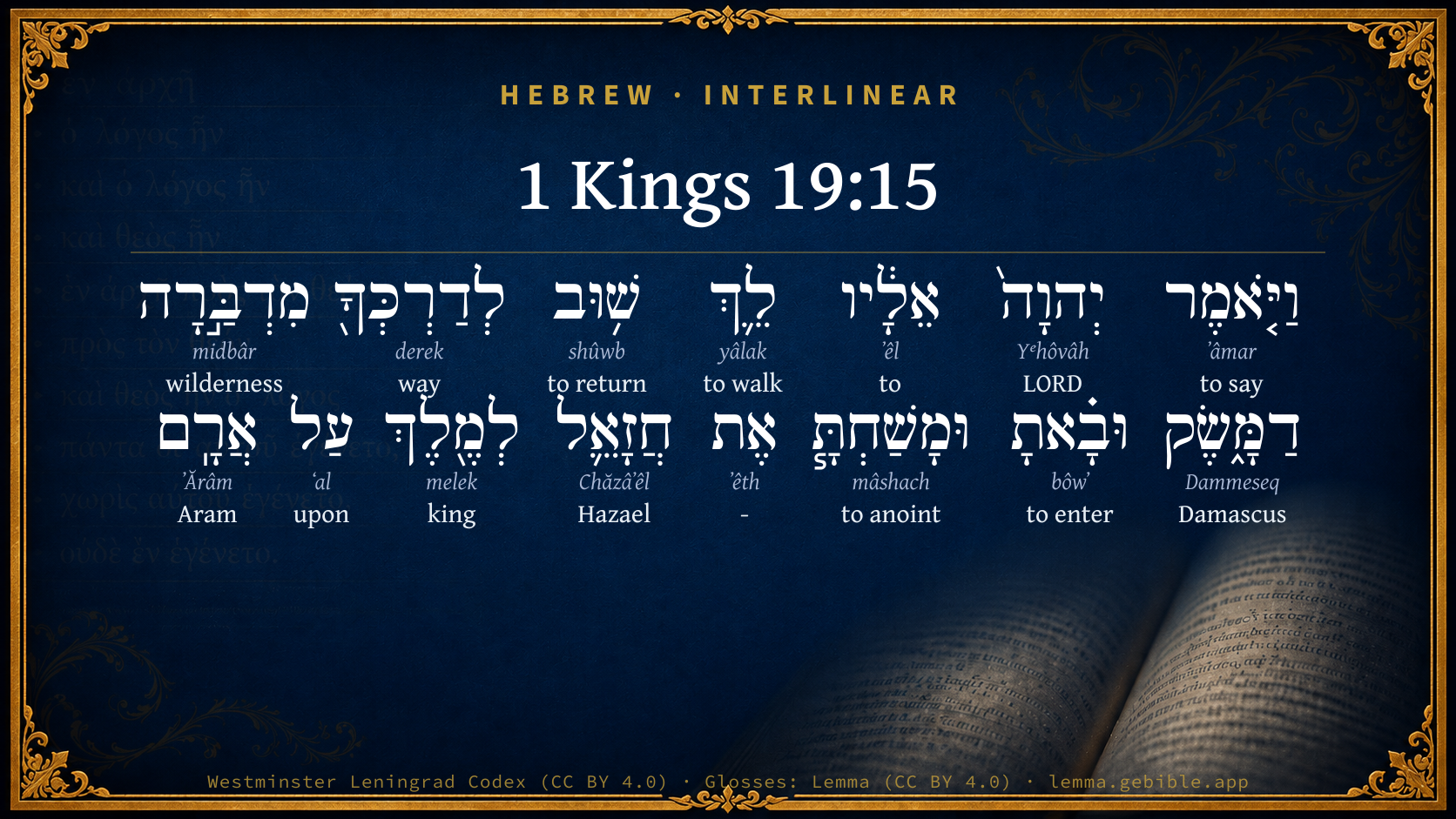
Hebrew (Westminster Leningrad Codex) 1 Kings 19:15 appears in the Hebrew Old Testament. The text above is from the Westminster Leningrad Codex. Each word links to its Strong’s number, a concise gloss, and parsing drawn from the Open Scriptures Hebrew Bible morphology. Click any word for its full Brown-Driver-Briggs (BDB) entry.
Download image
Cite this verse

1 Kings 19:15 (World English Bible). Public Domain. Lemma interlinear Bible study tool, https://lemma.gebible.app/v/1-kings/19/15.

Show BibTeX & RIS
BibTeX
RIS
English Translation
Yahweh said to him, Go, return on your way to the wilderness of Damascus: and when you come, you shall anoint Hazael to be king over Syria;
World English Bible · Public Domain
Highlights
  • 1 first appearance in the Hebrew Bible
Full analysis ↓
Download a study sheet

One document with this verse’s original text, its word-by-word gloss line, the meaning frame, cross-references with their text, attributed commentary, and full source and license credits — printable, and it pastes into notes with its structure intact.

This verse Autodidact and up

Study sheet (.html) Plain text (.txt)

A passage Seminary Student

Up to 50 verses in one chapter. A passage sheet keeps up to 6 commentary sources and 12 cross-references per verse, in the order this page ranks them, and says so on the sheet whenever that leaves anything out. Ask for a single verse and you get the Autodidact verse sheet above.

Everything on this page stays free to read, with no account — the sheet is a download of what is already on screen, not access to it.

Want to remove ads? Support Godless Engineer
Compare translations 3

The same verse in 3 English versions, stacked beneath the original-language interlinear above. Click any original word for its lexicon entry.

Each is an independent rendering of the whole verse — the interlinear is not word-aligned to these translations.

Highlighted words mark where these versions differ — a whole-verse word diff, not a word-by-word alignment.

  • World English Bible Public Domain
    Yahweh said to him, Go, return on your way to the wilderness of Damascus: and when you come, you shall anoint Hazael to be king over Syria;
  • King James Version Public Domain
    And the LORD said unto him, Go, return on thy way to the wilderness of Damascus: and when thou comest, anoint Hazael to be king over Syria:
  • unfoldingWord Literal Text CC BY-SA 4.0
    And Yahweh said to him, “Go, return to your way toward the wilderness of Damascus. And you shall come and anoint Hazael as king over Aram.

unfoldingWord Literal Text — © unfoldingWord, licensed CC BY-SA 4.0. Word-aligned USFM3 via Door43 (git.door43.org/unfoldingWord/en_ult).

Versions to compare (up to 4)

3 of 4 selected

Show all 18 translations

Every available English version of this verse, each an independent rendering of the whole verse.

  • World English Bible Public Domain
    Yahweh said to him, Go, return on your way to the wilderness of Damascus: and when you come, you shall anoint Hazael to be king over Syria;
  • Berean Standard Bible Public Domain
    Then the LORD said to him, “Go back by the way you came, and go to the Desert of Damascus. When you arrive, you are to anoint Hazael as king over Aram.
  • Majority Standard Bible Public Domain
    Then the LORD said to him, “Go back by the way you came, and go to the Desert of Damascus. When you arrive, you are to anoint Hazael as king over Aram.
  • King James Version Public Domain
    And the LORD said unto him, Go, return on thy way to the wilderness of Damascus: and when thou comest, anoint Hazael to be king over Syria:
  • American Standard Version (1901) Public Domain
    And Jehovah said unto him, Go, return on thy way to the wilderness of Damascus: and when thou comest, thou shalt anoint Hazael to be king over Syria;
  • Revised Version (1885) Public Domain
    And the LORD said unto him, Go return on thy way to the wilderness of Damascus: and when thou comest, thou shalt anoint Hazael to be king over Syria:
  • Geneva Bible (1599) Public Domain
    And the Lord said vnto him, Goe, returne by the wildernes vnto Damascus, and when thou commest there, anoint Hazael King ouer Aram.
  • Douay-Rheims (1899) Public Domain
    And the Lord said to him: Go, and return on thy way through the desert to Damascus: and when thou art come thither, thou shalt anoint Hazael to be king over Syria.
  • Young's Literal Translation Public Domain
    And Jehovah saith unto him, `Go turn back on thy way to the wilderness of Damascus, and thou hast gone in, and anointed Hazael for king over Aram,
  • Literal Standard Version CC BY-SA 4.0
    And YHWH says to him, “Go, return on your way to the wilderness of Damascus, and you have gone in, and anointed Hazael for king over Aram,
  • Unlocked Literal Bible CC BY-SA 4.0
    Then Yahweh said to him, “Go, return on your way to the wilderness of Damascus, and when you arrive you will anoint Hazael to be king over Aram,
  • unfoldingWord Literal Text CC BY-SA 4.0
    And Yahweh said to him, “Go, return to your way toward the wilderness of Damascus. And you shall come and anoint Hazael as king over Aram.
  • Darby Bible Public Domain
    And Jehovah said to him, Go, return on thy way to the wilderness of Damascus; and when thou comest, anoint Hazael king over Syria;
  • World Messianic Bible Public Domain
    The LORD said to him, “Go, return on your way to the wilderness of Damascus. When you arrive, anoint Hazael to be king over Syria.
  • Webster's Bible Public Domain
    And the LORD said to him, Go, return on thy way to the wilderness of Damascus: and when thou comest, anoint Hazael to be king over Syria:
  • Free Bible Version CC BY-SA 4.0
    The Lord told him, “Go back the way you came to the desert of Damascus. When you get there, go and anoint Hazael king of Aram.
  • Bible in Basic English Public Domain
    And the Lord said to him, Go back on your way through the waste land to Damascus; and when you come there, put the holy oil on Hazael to make him king over Aram;
  • JPS Tanakh (1917) Public Domain
    And the LORD said unto him: 'Go, return on thy way to the wilderness of Damascus; and when thou comest, thou shalt anoint Hazael to be king over Aram;

Literal Standard Version (2020), Covenant Press — licensed CC BY-SA 4.0. Text via the HelloAO Bible API (eBible.org). Unlocked Literal Bible (unfoldingWord) — licensed CC BY-SA 4.0. Text via the HelloAO Bible API (eBible.org). unfoldingWord Literal Text — © unfoldingWord, licensed CC BY-SA 4.0. Word-aligned USFM3 via Door43 (git.door43.org/unfoldingWord/en_ult). Free Bible Version, Dr. Jonathan Gallagher — licensed CC BY-SA 4.0. Text via the HelloAO Bible API (eBible.org).

Word by word

More ways to search: Search by grammar → Find every occurrence → Compare this word →

Practice this passage: Drill this verse → Learn its vocabulary →

חֲזָאֵ֛ל
Chăzâʼêl
H2371
“Hazael”
Noun, Proper
Part of Speech
Noun
Type
Proper
Full BDB Definition

Origin: from H2372 and H410

TWOT: None

Hazael = "one who sees God" - a king of Syria; sent by his master, Ben-hadad, to the prophet Elisha, to seek a remedy for Ben-hadad's leprosy; apparently later killed Ben-hadad, assumed the throne, and soon became engaged in a war with the kings of Judah and Israel for the possession of the city of Ramoth-gilead
  1. וַיֹּ֤אמֶר ʼâmar H559 “and · to say” Conjunction + Verb, Qal, Sequential Imperfect, 3rd Person, Masculine, Singular
  2. יְהוָה֙ Yᵉhôvâh H3068 “LORD” Noun, Proper
  3. אֵלָ֔יו ʼêl H413 “to · him” Preposition + Suffix, Personal, 3rd Person, Masculine, Singular
  4. לֵ֛ךְ yâlak H3212 “walk” Verb, Qal, Imperative, 2nd Person, Masculine, Singular
  5. שׁ֥וּב shûwb H7725 “return” Verb, Qal, Imperative, 2nd Person, Masculine, Singular
  6. לְדַרְכְּךָ֖ derek H1870 “to/for · way · your” Preposition + Noun, Common, Both, Singular, Construct + Suffix, Personal, 2nd Person, Masculine, Singular
  7. מִדְבַּ֣רָה midbâr H4057 “wilderness · toward” Noun, Common, Masculine, Singular, Construct + Suffix, Demonstrative
  8. דַמָּ֑שֶׂק Dammeseq H1834 “Damascus” Noun, Proper
  9. וּבָ֗אתָ bôwʼ H935 “and · to enter” Conjunction + Verb, Qal, Perfect, 2nd Person, Masculine, Singular
  10. וּמָשַׁחְתָּ֧ mâshach H4886 “and · to anoint” Conjunction + Verb, Qal, Sequential Perfect, 2nd Person, Masculine, Singular
  11. אֶת ʼêth H853 “-” Particle, Direct Object
  12. לְמֶ֖לֶךְ melek H4428 “to/for · king” Preposition + Noun, Common, Masculine, Singular, Absolute
  13. עַל ʻal H5921 “upon” Preposition
  14. אֲרָֽם ʼĂrâm H758 “Aram” Noun, Proper

About this verse

These counts appear in no published source. They are computed here, from the morphology-tagged text and Lemma’s own curated glosses. What Lemma adds →

15
words
15
distinct lemmas
Historical
section

Notable vocabulary

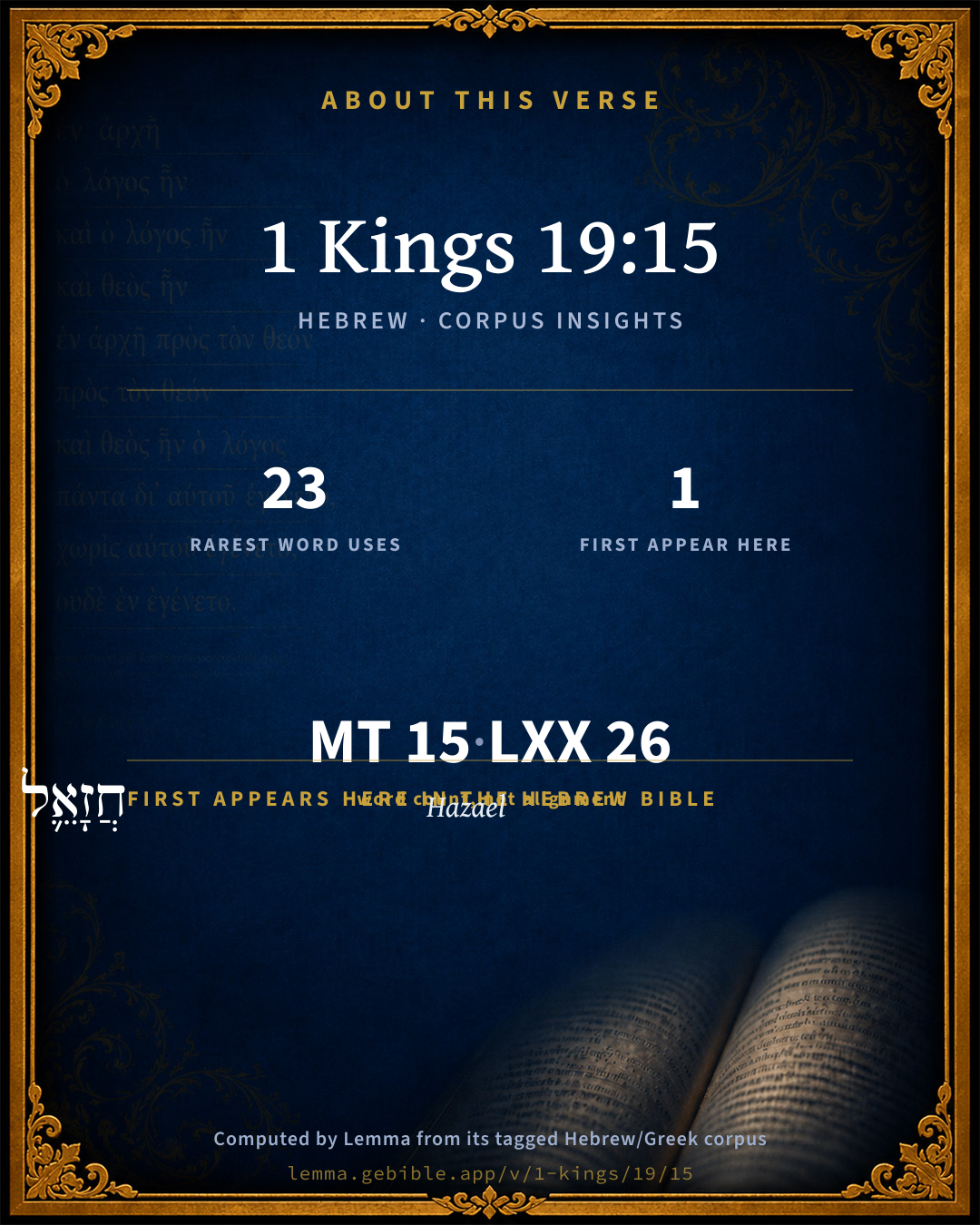
The rarest word here is חֲזָאֵ֛ל Hazael H2371 — appearing just 23 times in the whole Hebrew Bible.

First appearance in Scripture

This word makes its first canonical appearance in the Hebrew Bible here:

  • חֲזָאֵ֛ל Hazael H2371

Shared distinctive vocabulary

חֲזָאֵ֛ל Hazael H2371 occurs in 21 verses of the Hebrew Bible. Also found in:

Grammatical profile

  • 5 verbs
  • 7 nouns
  • 2 prepositions
  • 1 particle

Verb forms

  • וַיֹּ֤אמֶר Qal · Sequential Imperfect
  • לֵ֛ךְ Qal · Imperative
  • שׁ֥וּב Qal · Imperative
  • וּבָ֗אתָ Qal · Perfect
  • וּמָשַׁחְתָּ֧ Qal · Sequential Perfect

Hebrew & Septuagint length

In English translation the verse runs 27 words from the Hebrew and 32 from the Septuagint (LXX English) — closely comparable.

A rough comparison of the two English renderings, which tokenize alike — not a word-level alignment.

Word counts can differ between the Hebrew and the Greek without any difference in meaning — e.g. the Hebrew direct-object marker אֵת has no separate Greek word, and Greek often adds the article ὁ.

In the original languages it is 15 Hebrew tokens and 26 Greek tokens — but the two are counted differently (Hebrew bundles its prefixes and suffixes into one token; the Greek is in lemma form), so that isn’t a like-for-like length.

Cross-references

9

Topical passages linked to 1 Kings 19:15 in the Treasury of Scripture Knowledge — connected by theme and wording, ordered by reader-vote popularity; previews shown in the World English Bible.

  • Isaiah 45:1 Thus says Yahweh to his anointed, to Cyrus, whose right hand I have held, to subdue nations before him, and I will loose the loins of kings; to open the doors before him, and the gates shall not be shut:
  • Jeremiah 1:10 behold, I have this day set you over the nations and over the kingdoms, to pluck up and to break down and to destroy and to overthrow, to build and to plant.
  • 2 Kings 8:7–15 Elisha came to Damascus; and Benhadad the king of Syria was sick; and it was told him, saying, The man of God is come here.
  • Genesis 14:15 He divided himself against them by night, he and his servants, and struck them, and pursued them to Hobah, which is on the left hand of Damascus.
  • 2 Kings 8:28 He went with Joram the son of Ahab to war against Hazael king of Syria at Ramoth-gilead: and the Syrians wounded Joram.
  • 2 Kings 9:14 So Jehu the son of Jehoshaphat the son of Nimshi conspired against Joram. (Now Joram was keeping Ramoth-gilead, he and all Israel, because of Hazael king of Syria;
  • Jeremiah 27:2–22 Thus says Yahweh to me: Make you bonds and bars, and put them on your neck;
  • Amos 1:4 But I will send a fire into the house of Hazael, And it will devour the palaces of Ben Hadad.
  • Acts 9:2–3 and asked for letters from him to the synagogues of Damascus, that if he found any who were of the Way, whether men or women, he might bring them bound to Jerusalem.

Cross-references courtesy of OpenBible.info (CC BY 4.0).

Hebrew and Greek witnesses Masoretic Hebrew ↔ Greek Septuagint

The same verse in the two great witnesses to the Old Testament, shown verse-for-verse.

These are two independent witnesses, not word-aligned to each other, and the Septuagint is shown in lemma (dictionary) form.

Hebrew 1 Kings 19:15 Masoretic · Westminster Leningrad Codex

וַיֹּ֤אמֶר יְהוָה֙ אֵלָ֔יו לֵ֛ךְ שׁ֥וּב לְדַרְכְּךָ֖ מִדְבַּ֣רָה דַמָּ֑שֶׂק וּבָ֗אתָ וּמָשַׁחְתָּ֧ אֶת חֲזָאֵ֛ל לְמֶ֖לֶךְ עַל אֲרָֽם

Yahweh said to him, Go, return on your way to the wilderness of Damascus: and when you come, you shall anoint Hazael to be king over Syria;

World English Bible · Public Domain

Greek LXX 1 Kings 19:15 Septuagint · lemma form

καί εἶπον κύριος πρός αὐτός πορεύομαι ἀναστρέφω εἰς ὁ ὁδός σύ καί ἥκω εἰς ὁ ὁδός ἔρημος δαμασκός καί χρίνω ὁ αζαηλ εἰς βασιλεύς ὁ συρία

And the Lord said to him, Go, return, and you shall come into the way of the wilderness of Damascus: and you shall go and anoint Azael to be king over Syria.

LXX2012 (modern English Septuagint) · Public Domain

On this verse, The Pulpit Commentary discusses the Septuagint’s reading. Read the note in Commentary ↓

Hebrew: Westminster Leningrad Codex (CC BY 4.0). Greek: Septuagint (public domain); English from LXX2012 (modern English Septuagint) (Public Domain). How the Septuagint differs from the Hebrew →

Targum (Aramaic paraphrase)

1

The Targum is the ancient Jewish Aramaic paraphrase of the Hebrew Scriptures — an interpretive translation, not the Hebrew text itself. Onkelos (literal) and Pseudo-Jonathan (expansive) render the Torah, and Jonathan the Prophets. Coverage is partial: where no permissively-licensed English translation exists for a verse, only the Aramaic is shown. This is verse-level text, not a word-by-word alignment to the Hebrew.

  1. Targum Jonathan Prophets (Joshua–Malachi)
    וַאֲמַר יְיָ לֵיהּ אֱזֵיל תּוּב לְאוֹרְחָךְ לְמַדְבְרָא דַמָשֶׂק וּתְהָךְ וְתִמְשַׁח יַת חֲזָאֵל לְמֶהֱוֵי מַלְכָּא עַל אֲרָם:

    (no public-domain English translation for this verse)

    Targum Jonathan — Aramaic: “Mikraot Gedolot” (public domain). English: “Sefaria Community Translation” (CC0 1.0 (public-domain dedication)); “London "Chaldee Paraphrase," 1871” (public domain). Text via Sefaria.

Commentary

Notes on 1 Kings 19:15 from classic Christian and Jewish commentators (each source and its license shown beneath its notes). The classic Christian expositions comment on the surrounding passage and are grouped to its opening verse, so a note may address several verses; the Jewish commentaries on the Tanakh (Rashi and others) are per-verse, so they appear only where the commentator wrote on this verse.

Lemma curates 59 commentaries, every one of them public domain or Creative Commons licensed, each selected and text-cleaned for this edition rather than reprinted as found. About our sources →

Trapp's Complete Commentary

John Trapp

1Ki 19:15 And the LORD said unto him, Go, return on thy way to the wilderness of Damascus: and when thou comest, anoint Hazael [to be] king over Syria:

Ver. 15. To the wilderness of Damascus.] Where it is probable that Elijah with his own hand anointed Hazael, and afterwards Jehu and Elisha, though these unctions might be reiterated at the time of their accomplishment.

John Trapp, A Commentary or Exposition upon All the Books of the Old and New Testament (1647–1656) — public domain. Text from a community e-Sword module.

The Biblical Illustrator

Joseph S. Exell

1Ki_19:15

And the Lord said unto him, Go, return.

Go, return

It is a very solemn thought, that one sin may for ever, so far as this world is concerned, wreck our usefulness. It is not always so. Sometimes--as in the case of the Apostle Peter--the Lord graciously restores, and re-commissions for His work, the one who might have been counted unfit ever again to engage in it. Feed My sheep. Feed My lambs. But against this one case we may put three others, in each of which it would seem as if the sentry angel, who forbade the return of our parents to Paradise, were stationed with strict injunctions to forbid any return to the former position of noble service. The first case is that of Moses; the meekest of men; the servant of the Lord; the foster-nurse of the Jewish nation, whose intercessions saved them again and again from destruction. Yet because he spake unadvisedly with his lips, and smote the rock twice, in unbelief and passion, he was compelled to bear the awful sentence: Because ye believed Me not, to sanctify Me in the eyes of the children of Israel, therefore ye shall not bring this congregation into the land which I have given them. The second case is that of Saul, the first ill-fated King of Israel, whose reign opened so auspiciously, as a morning without clouds, but who soon brought upon himself the sentence of deposition. Yet it was only for one single act. Alarmed at Samuels long delay, and at the scattering of the people, he intruded rashly into a province from which he was expressly excluded, and offered the sacrifice with which the Israelites were wont to prepare for battle. The third case is that of Elijah. He was never reinstated in quite the position which he had occupied before his fatal flight. True he was bidden to return on his way, and work was indicated for him to do. But that work was the anointing of three men, who were to share amongst them the ministry which he might have fulfilled if only he had been true to his opportunities and faithful to his God. Gods work must go on; if not by us, then, through our failures, by others brought in to supply our place. Go, return on thy way to the wilderness of Damascus, etc.

I. The variety of Gods instruments. Hazael, King of Syria; Jehu, the rude captain; and Elisha, the young farmer. It is remarkable how God accomplishes His purposes through men who only think of working their own wild way. Their sin is not diminished or condoned because they are executing the designs of Heaven; it still stands out in all its malignant deformity. And yet, though they are held accountable for the evil, it is none the less evident that they do whatsoever Gods hand and Gods counsel determined before to be done. Joseph comforted his brethren, after his fathers death, by telling them that though they thought evil against him, God meant it unto good, to save much people alive.

II. No one can entirely escape from Gods personal dealings. Gods nets are not all constructed with the same meshes. Men may escape through some of them; but they cannot escape through all. If they elude the Gospel ministry, they will be caught by some earnest worker, apt at personal dealing. If they manage to evade all contact with the living voice, they may yet be reached by the printed page. If they evade all religious literature, they may still be the sudden subjects of the strivings of the Spirit. Him that escapeth the sword of Hazael shall Jehu slay; and him that escapeth from the sword of Jehu shall Elisha slay.

III. God never overlooks one of His own. Elijah thought that he alone was left as a lover and worshipper of God. It was a great mistake. God had many hidden ones. Yet I have left Me seven thousand in Israel, all the knees which have not bowed unto Baal, and every mouth which hath not kissed him. We know nothing of their names or history. They were probably unknown in camp or court--obscure, simple-hearted, and humble. Their only testimony was one long refusal to the solicitations of the foul rites of idolatry. They groaned and wept in secret; and spake often one to another, while the Lord hearkened and heard. But they were all known to God, and enrolled amongst His jewels, and counted as a shepherd tells his sheep. He cared for them with an infinite solicitude; and it was for their sake that He raised up the good and gentle Elisha to carry on the nurture and discipline of their souls. (F. B. Meyer, B. A.)

Return to duty

I. As Elijah journeyed back through the desert, one of his feelings doubtless would be this--deep sorrow on account of his past faithlessness, and a salutary sense of his weakness for the time to come. Every step of that backward journey must have recalled, with sorrow and shame, the remembrance of his unworthy flight and unworthy unbelief.

II. Another feeling Elijah had, in leaving his cave, must have been a lively sense and apprehension of Gods great mercy. What, in the retrospect of the recent wondrous manifestation, would more especially linger in the prophets recollection? Not the wind, not the earthquake, not the fire; but the still small voice.

III. We may suppose another feeling entertained by Elijah in departing from his cave and returning through the wilderness, would be, a fixed purpose and resolution of new and more devoted obedience. Mourning an unworthy past--penetrated by a lively sense of Jehovahs love,--he would go onward and forward, resolved more than ever on a life of grateful love and of active and unwavering service, until God saw meet to take him up in His chariot of fire. (J. R. Macduff, D. D.)

The Biblical Illustrator, edited by Joseph S. Exell (c. 1880s–1900s) — public domain. Text from a community e-Sword module.

Joseph Benson's Commentary

1Ki 19:15-16. Go, return on thy way — The way by which thou camest; for the way from Horeb to Damascus was, in part, the same with that by which he had come. Anoint Hazael to be king over Syria — It seems, the word anoint must here be taken figuratively for appoint, or declare, which was done by Elisha, 2Ki 8:12; for the word is often used of them who were never anointed with oil: Elijah, however, might anoint him, though it be not related; or, as some think, when he understood what scourges he and Jehu would be to Israel, and what destruction they would bring upon them, he perhaps earnestly entreated God, and obtained his request, that the execution of the command should be deferred to another time. And Jehu the son of Nimshi — That is, his grandson; for he was the son of Jehoshaphat, 2Ki 9:2. And Elisha shalt thou anoint — Whom he constituted prophet by casting his mantle over him. This was intended as a prediction, that by these persons God would punish the degenerate Israelites, plead his own cause among them, and avenge the quarrel of his covenant.

Joseph Benson's Commentary on the Old and New Testaments (1811–1818) — public domain. Text from a community e-Sword module.

Tyndale Open Study Notes

Tyndale Open Resources

19:15-17 Go back . . . and travel: In loving patience, God renewed his prophet’s commission (cp. John 21:15-19). God directed Elijah to retrace his steps back to the place where he had strayed from God’s mission; from there he could move forward. • Hazael and Jehu both became instruments of God’s judgment (2 Kgs 8:7-15; 9:14-37). • Elisha, Elijah’s successor, would bring spiritual discernment and the Lord’s further judgment to Israel (2 Kgs 3:10-19; 8:7-15; 9:1–10:31; 13:3, 15-19). • Abel-meholah was located south of Beth-shan, where the valley of Jezreel and the Jordan Valley come together (see 1 Kgs 4:12; Judg 7:22).

Tyndale Open Study Notes — © Tyndale Open Resources, licensed CC BY-SA 4.0. Text via the HelloAO Bible API.

Geneva Bible (1599)

Geneva Bible translators

Or, Syria.

Geneva Bible (1599) marginal notes — public domain. Text via Bolls.life.

Adam Clarke's Commentary

Verse 15. To the wilderness of Damascus] He does not desire him to take a road by which he might be likely to meet Jezebel, or any other of his enemies.

Anoint Hazael] For what reason the Lord was about to make all these revolutions, we are told in 1Kg 19:17. God was about to bring his judgments upon the land, and especially on the house of Ahab. This he exterminated by means of Jehu; and Jehu himself was a scourge of the Lord to the people. Hazael also grievously afflicted Israel; see the accomplishment of these purposes, 2 Kings 8, and 9.

Adam Clarke's Commentary on the Bible (1810–1826) — public domain. Text from a community e-Sword/MySword module.

Ellicott's Commentary for English Readers

(15) Go, return.—The charge conveys indirectly a double rebuke. His cry of disappointment, “Lord . . . I am not better than my fathers,” implying that he stood out beyond all others, to meet the stern requirements of the time, is met by the charge to delegate the task of vengeance for God to others; the complaint, “I, even I alone, am left,” by the revelation of the faithful remnant—the seven thousand who had not bowed to Baal—unknown to him, perhaps to one another, but known and loved by God.

A Bible Commentary for English Readers, edited by Charles John Ellicott (1878–1897) — public domain. Text from a community e-Sword module.

The Cambridge Bible for Schools and Colleges

gen. ed. J. J. S. Perowne

15. Go, return on thy way to the wilderness of Damascus] It seems from what follows that the margin of the R.V. gives the truer sense, viz. ‘by the wilderness to Damascus.’ Elijah was to go back through the wilderness, the way by which he had come to Horeb, and we see that he came first to Abel-meholah, which was on the west of the Jordan, not far from Bethshean (see note above on 1Ki_4:12). Thus he was sent by God’s encouragement, and with His protection, through the land of Israel from which he had fled.

anoint Hazael to be king over Syria] So far as the Scripture record goes we have no notice that Elijah performed this command in its literal sense, Hazael being subsequently informed by Elisha (2Ki_8:13) that the Lord had made known that he should become king over Israel, though even then he was not anointed. We must interpret the meaning of the command in accordance with the prophet’s action, judging that he understood what was intended by the words. The word ‘anoint’ is used concerning Jehu and Elisha as well as Hazael; and we know that Elijah did not anoint Elisha, though he could easily have done so, but only made known, by the act of casting his prophetic mantle upon him, that he was called to that office. In the same way then we may understand the rest of the divine order. Elijah was to receive assurance for himself, and to make known that assurance to others, as he found occasion, that God was still ruling Israel both from without and from within, and would call to the throne of Syria one who should execute His judgements upon His rebellious people, and to the throne of Israel one who should destroy Baal and his worship out of the land. We shall not err, it seems, if we suppose that the knowledge, which Elisha had (2Ki_8:13) when he says ‘The Lord hath shewed me that thou shalt be king over Syria,’ was derived from Elijah’s communication, as also the instruction which led him, at a future day (2Ki_9:1-2), to send one of the sons of the prophets to Ramoth-Gilead to anoint Jehu. Hence ‘anoint’ in the text becomes equivalent to ‘point them out as the anointed ones.’

On Hazael’s wars at a subsequent time with Israel and Judah, see 2Ki_8:28-29. He subsequently invaded the territory of Israel and especially overran the district East of Jordan (2Ki_10:32-33), and held Israel in subjection ‘all the days of Jehoahaz’ (2Ki_13:3; 2Ki_13:22). Through him, we are told, ‘the Lord began to cut Israel short’ (2Ki_10:32), and there are many indications that this king was for Israel, the rod of God’s anger, a divinely appointed minister of His judgements.

For ‘anoint’ the R.V. reads thou shalt anoint, a change required by the Hebrew which is not an imperative.

The Cambridge Bible for Schools and Colleges (gen. ed. J. J. S. Perowne; Cambridge University Press, 1878–1918) — public domain. Text from a community e-Sword module.

John Gill's Exposition

And the Lord said unto him, go, return on thy way to the wilderness of Damascus,.... He is bid to go back the way he came, through the wilderness of Arabia, which was part of his way to Damascus, near to which was another wilderness, which took its name from thence; though Fortunatus Schacchus (x) thinks no other is meant by this phrase than returning to his former course and custom of preach the law of God, and reclaiming men from the error of their ways:

and when thou comest, anoint Hazael to be king over Syria; it is nowhere related that Elijah did go to Damascus, and anoint Hazael, though it may be he did; however he acquainted Elisha with it, and he declared it to Hazael, that he should be king of Syria, and which perhaps is all that is meant by anointing; that is, that he should be made king, and which was declared by both these prophets, see Kg2 8:13.

(x) Elaeochrism. Myrothec. l. 1. c. 39. col. 198.

John Gill's Exposition of the Whole Bible (1746–1763) — public domain (CC PDM 1.0). Text via the HelloAO Bible API.

Albert Barnes' Notes on the Bible

The answer is not a justification of the ways of God, nor a direct reproof of the prophet’s weakness and despondency, nor an explanation or application of what Elijah had seen. For the present, he is simply directed back into the path of practical duty. His mission is not yet over, there is still work for him to do. He receives special injunctions with respect to Hazael, Jehu, and Elisha; and he is comforted with a revelation well adapted to rouse him from his despondency: there are seven thousand who will sympathize with him in his trials, and who need his care and attention.

The wilderness of Damascus - Probably the district north of the prophet’s own country, between Bashan and Damascus itself, and which was known in later times as Iturea and Gaulanitis. Here the prophet might be secure from Jezebel, while he could readily communicate with both Israel and Damascus, and execute the commissions with which he was entrusted.

When thou comest, anoint - Rather, “and thou shalt go and anoint,” Elijah performed one only of the three commissions given to him. He appears to have been left free to choose the time for executing his commissions, and it would seem that he thought the proper occasion had not arisen either for the first or the second before his own translation. But he took care to communicate the divine commands to his successor, who performed them at the fitting moment (marginal references).

Albert Barnes' Notes on the Bible (1834–1885) — public domain. Text from a community e-Sword/MySword module.

Haydock's Catholic Bible Commentary

Desert, avoiding the towns as much as possible, (Calmet) and travelling through the country of Ammon to Damascus. (Menochius) --- God does not send Elias again into the midst of danger, at Achab’s court. (Haydock) --- Hazael. God exercises his authority over all nations, and disposes of crowns. He appoints Hazael to punish his people. It does not appear that Elias performed this commission in person, but by the hand of Eliseus, 4 Kings viii. 12. Neither do we find that Hazael was anointed, but he was "declared king;" in which sense the term is used, Judges ix. 8. (Salien) (Calmet) --- Yet Torniel believes, that Elias really anointed both Hazael and Jehu. He foretold, at least, (Haydock) that they should reign. (Worthington)

George Leo Haydock (1774–1849), Haydock's Catholic Family Bible and Commentary, 1859 edition — public domain. Excludes Psalms (Douay-Rheims chapter numbering differs from Protestant) and Deuterocanonical books (Catholic canon only).

Matthew Poole's English Annotations

Return on thy way, by which thou camest; for so in part lay the way from Horeb to Damascus.

Anoint Hazael to be king over Syria: anoint; either, first, Figuratively, i.e. appoint or declare him king; which was done, 2Ki 8:12; for this word is oft used of them who were never anointed with oil, Psa 45:7; Isa 45:1; 41:1; Zec 4:14; Dan 9:24. Or, secondly, Properly; which might be done, though it be not related. Again, anoint, either by thyself, or by another; for so he anointed Jehu by Elisha, 2Ki 9:1,6.

Matthew Poole's English Annotations on the Holy Bible (1683–1685) — public domain. Text from a community e-Sword/MySword module.

Whedon's Commentary on the Bible

Daniel D. Whedon

15. Return on thy way — Go forth into the fields of labour where my Spirit shall hereafter lead thee, and let my Spirit, not thy frail judgment, guide thee.

To the wilderness of Damascus — The wild country between Gilead and Damascus is probably meant. This was near Elijah’s early home, (see note on 1Ki_17:1,) and a place whence he might easily go forth to utter the word of God to either Israelite or Syrian, and again quickly retire into solitude. The wilderness near where Israel’s and Jehovah’s interests are pending, not the wilderness of Horeb, is now the place where the prophet is needed. There must he instruct Elisha and other prophets in the revelations of the Divine nature which he has received.

When thou comest, anoint Hazael — Rather, (for these verbs are not in the imperative, like Go and Return,) and thou wilt come and anoint Hazael. It is the word of the Lord foretelling the agencies by which the wicked house of Ahab shall be destroyed. We know not that Elijah ever saw or anointed Hazael or Jehu, though he may have done so privately, as Samuel did Saul, (1Sa_9:27; 1Sa_10:1,) and no account of it have been preserved. But as this was actually done by Elisha (who was anointed prophet in Elijah’s room, 1Ki_19:16) and another prophet whom Elisha, in turn, commissioned, the spirit and real import of this prediction was thoroughly fulfilled. 2Ki_8:10-13; 2Ki_9:1-7. This fulfilment by Elisha instead of Elijah was specially significant in this case, since it was partly the design of this communication at Horeb to indicate to Elijah, and through him to all who read this history, how manifold may be the agencies which accomplish the Divine purposes. Hence, too, Jehovah speaks in these words not to Elijah only, but also to his successors in office.

Daniel D. Whedon (gen. ed.), Commentary on the Old and New Testaments (1874–1909) — public domain. Text from a community e-Sword module.

The Pulpit Commentary

And the Lord said unto him, Go, return on thy way Heb. to thy way, as in Gen_19:2 Gen_32:2; Num_24:25, etc. to the wilderness of Damacus The construct case with h local. Keil refers to Deu_4:41; Jos_12:1; and Ewald 216 b. This cannot mean "through the desert to Damascus," for he could not possibly go any other way, nor yet "to the desert (through which he had just come) to Damascus," for he was then in the heart of the desert. He was to find a hiding place we find the king of Damascus at war with Ahab, ch. 20. or possibly a sphere for work, he would be near Hazael in the rugged desert which stretches south and east of the Syrian capital. (See Stanley, "Sinai and Palestine," p. 410; Porter"s "Five Years in Damascus," vol. 2. p. 254 sqq.) Here, too, the prophet would be at no great distance from his own country. (See on 1Ki_17:3) and Wheel thou comest, anoint Heb. and thou shalt come and anoint. LXX kai hxeiv kaiseiv. The A.V increases the difficulty. In the Hebrew the time of the anointing is indefinite. This commission has long been a crux interpretum. For neither Hazael, nor Jehu, nor Elisha, so far as we have any record, was ever anointed by Elijah. Elisha was called by him to the prophetic office. Hazael, it is barely possible, may have been anointed secretly, like David, (1Sa_16:2, 1Sa_16:13) but all that we gather from Scripture is, that he was called in an indirect way, and certainly not anointed, by Elisha. (2Ki_8:12-15) Jehu was certainly anointed, but it was neither by Elisha nor Elijah, (2Ki_9:1, 2Ki_9:6) but by one of the sons of the prophets.All we can say, consequently, is that the command was obeyed in the spirit, and no doubt in the best possible time and way. There may have been good reasons, of which we know nothing, why Elijah should devolve the appointment of the two kings upon his successor, and we can readily understand that the word anoint" was, as in Jud_1:9:8, Isa_61:1, never meant to be construed literally. For in the first place, we have no record elsewhere of the anointing of any prophet; and secondly, it is remarkable that when Elijah might so easily have anointed Elisha, he did nothing of the kind. It is clear, therefore, that he understood the word to mean "appoint." And the root idea of anointing, it must be remembered, was the setting apart for the service of God. (Exo_29:6) Hence it was (Bahr) that vessels, (Exo_30:26 sqq.) and even stones, (Gen_28:18) were anointed. And when we find that these three persons were set apart sooner or later, and in different ways, to fulfil the high purposes of God, that ought to suffice us. The author of this history clearly found no difficulty in reconciling this account and that of 2Ki_8:9. It has also been objected to this charge (Rawlinson) that it is no explanation or application of the preceding parable." But this is precisely what it appears to have been intended to be. The prophet is here taught by word much the same lesson that had been conveyed by signs, in the preceding vision. 1% doubt there are additional particulars the vision dealt only with principles, the charge descends to &tans and prescribes duties but still the great lesson that souls are to be won, that God"s kingdom is to be advanced, not by wrath and vengeance, by fire and sword, but by meekness and gentleness, through the reason and the conscience, is proclaimed. Hazael and Jehu, each was God"s instrument to punish; each was like the sweeping siena or the devouring fire, each was an engine of destruction; but by neither of these were the hearts Of men turned to the Lord. It was the sword of Elisha, the sword of his mouth (cf. Isa_11:4; 49:2; Rev_1:16 Rev_2:16) should constrain men to hide their faces and humble themselves before God Hazael the seer of God. This name, viewed in connection with Elijah"s vision of God, is noticeable to be king over Syria:

Go, return." This is God"s answer to the question, "What doest thou here?" "Thou hast now no business here. Thou hast a work to do elsewhere. Thou art not left alone, nor has God ceased to watch over and care for His Church. His ministers of wrath are already nominated; it is for thee to call them to their work." Which of God"s servants has not desponded like Elijah? Who has not been tempted to think his work a failure? Who has not had to complain of a gainsaying and disobedient people? How many have been induced to desert their posts? But no man"s work can be a failure unless he is a failure himself. Our work is to witness, whether men will hear or whether they will forbear. If they forbear, who shall say that that work is not successful? And it may be suggested here that work is often the very best remedy for despondency and doubt. The diligent sour has no time for self. torture. Its eye is fixed on others. There is a quaint legend which tells how, some years after the event, St. Thomas was again troubled with agonizing doubts as to our Lord"s resurrection. He sought the apostles, and began to pour his soul"s troubles into their ears. But first one, then the other, looked at him in astonishment, and told the unhappy doubter that he was sorry for him, but really he had so much to do he had no time to listen to his tale. Then he was fain to impart his woes to some devout women. But they, as busy as Dorcas and in like employment, soon made him understand that they had no leisure for such thoughts as these. At last it dawned upon him that perhaps it was because they were so busy that they were free from the doubts by which he was tortured. He took the hint; he went to Parthia; occupied himself in preaching Christ"s gospel, and was never troubled with doubts any more.

The Pulpit Commentary (1880–1919), ed. H.D.M. Spence-Jones & Joseph S. Exell — public domain. Text from a community e-Sword module.

unfoldingWord translationNotes

Door43 World Missions Community

prophet in your place

"prophet instead of you"

translationWords

Yahweh

desert

Damascus

anoint

king

Aram

Jehu

kingdom of Israel

Elisha

prophet

unfoldingWord translationNotes — © Distant Shores Media and the Door43 World Missions Community, licensed CC BY-SA 4.0. Source: git.door43.org/Door43/en_tn.

Lesson kit

Teaching starters — assembled from the data on this page, not authored interpretation. Every prompt links to the verse data it draws on. Edit before teaching.

1 Kings, in the Historical, opens this verse with 15 words (15 distinct Hebrew lemmas). Its most distinctive word is Chăzâʼêl (“Hazael”). A historical commentator’s framing appears above. Read the whole chapter for the surrounding context.

Discussion questions

  1. What does “Hazael” (Chăzâʼêl) contribute to the verse as a whole?
  2. This is the first place “Hazael” appears in Scripture (first appears here). What does its debut here establish?
  3. How does 1 Kings 19:17, which shares the word «Hazael», read alongside this verse?
  4. These translations render this verse differently. What is at stake in choosing one wording over another?
  5. «וַיֹּ֤אמֶר» is a Qal Sequential Imperfect verb. How does that grammatical form shape the action described?
  6. Compare how Trapp's Complete Commentary and The Biblical Illustrator read this verse. Where do they agree or differ?

Things to notice

Reading settings

Reading text

Shown beneath each verse's original-language words.

Old Testament
Old Testament edition

Read the OT as the Masoretic Hebrew (MT) or the Greek Septuagint (LXX).

English shown for the Greek Septuagint (in the Hebrew ↔ Greek comparison).

Comparing translations? Open the Compare panel on any verse page to stack up to four side by side.