
Amos 1:8

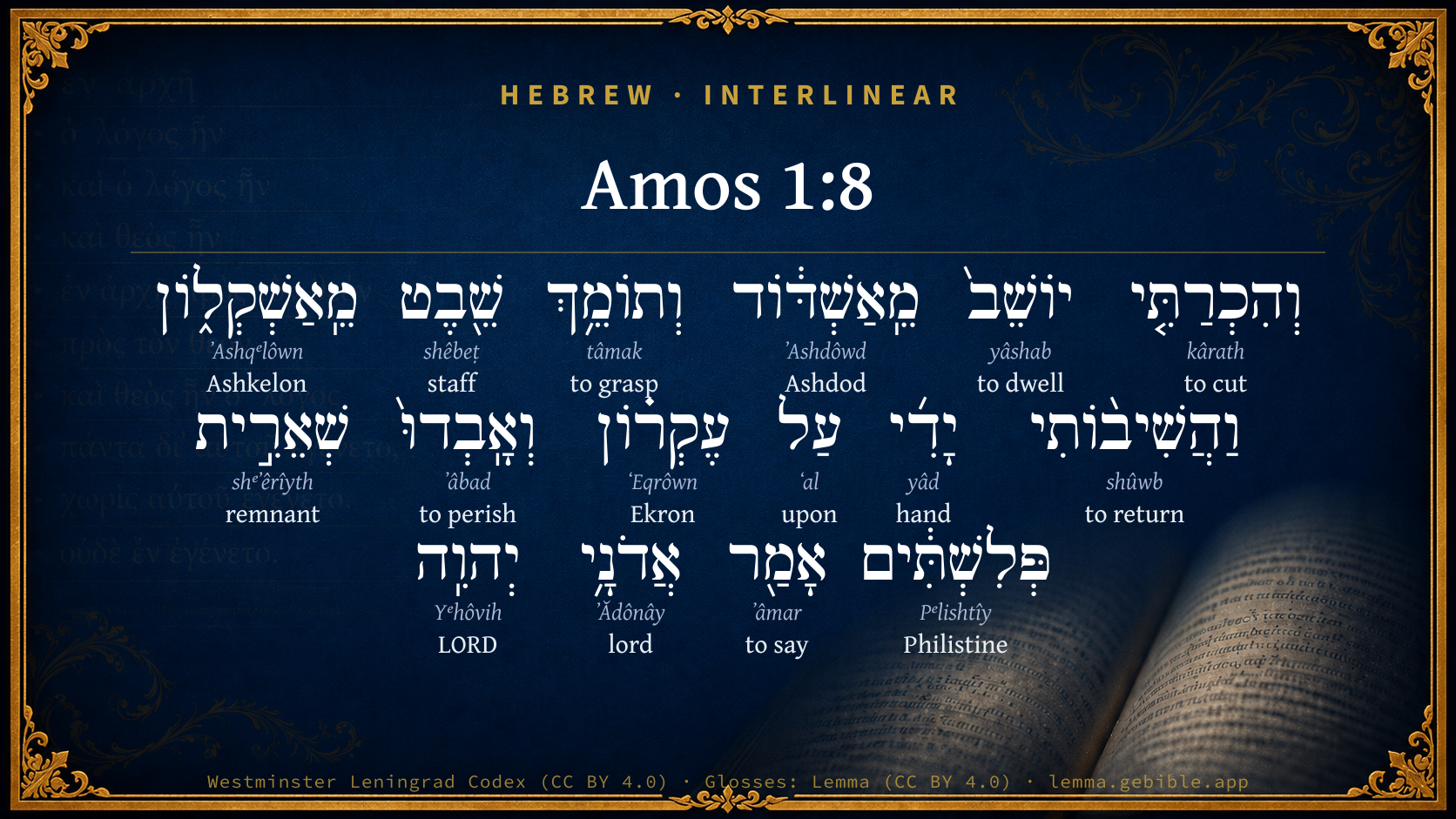
Hebrew (Westminster Leningrad Codex) Amos 1:8 appears in the Hebrew Old Testament. The text above is from the Westminster Leningrad Codex. Each word links to its Strong’s number, a concise gloss, and parsing drawn from the Open Scriptures Hebrew Bible morphology. Click any word for its full Brown-Driver-Briggs (BDB) entry.
Download image
Cite this verse

Amos 1:8 (World English Bible). Public Domain. Lemma interlinear Bible study tool, https://lemma.gebible.app/v/amos/1/8.

Show BibTeX & RIS
BibTeX
RIS
English Translation
I will cut off the inhabitant from Ashdod, And him who holds the scepter from Ashkelon; And I will turn my hand against Ekron; And the remnant of the Philistines will perish," says the Lord Yahweh.
World English Bible · Public Domain
Download a study sheet

One document with this verse’s original text, its word-by-word gloss line, the meaning frame, cross-references with their text, attributed commentary, and full source and license credits — printable, and it pastes into notes with its structure intact.

This verse Autodidact and up

Study sheet (.html) Plain text (.txt)

A passage Seminary Student

Up to 50 verses in one chapter. A passage sheet keeps up to 6 commentary sources and 12 cross-references per verse, in the order this page ranks them, and says so on the sheet whenever that leaves anything out. Ask for a single verse and you get the Autodidact verse sheet above.

Everything on this page stays free to read, with no account — the sheet is a download of what is already on screen, not access to it.

Want to remove ads? Support Godless Engineer
Compare translations 3

The same verse in 3 English versions, stacked beneath the original-language interlinear above. Click any original word for its lexicon entry.

Each is an independent rendering of the whole verse — the interlinear is not word-aligned to these translations.

Highlighted words mark where these versions differ — a whole-verse word diff, not a word-by-word alignment.

  • World English Bible Public Domain
    I will cut off the inhabitant from Ashdod, And him who holds the scepter from Ashkelon; And I will turn my hand against Ekron; And the remnant of the Philistines will perish," says the Lord Yahweh.
  • King James Version Public Domain
    And I will cut off the inhabitant from Ashdod, and him that holdeth the sceptre from Ashkelon, and I will turn mine hand against Ekron: and the remnant of the Philistines shall perish, saith the Lord GOD.
  • unfoldingWord Literal Text CC BY-SA 4.0
    I will cut off the one who lives in Ashdod and the one who holds the scepter from Ashkelon. I will turn my hand against Ekron, and the rest of the Philistines will perish,” says the Lord Yahweh.

unfoldingWord Literal Text — © unfoldingWord, licensed CC BY-SA 4.0. Word-aligned USFM3 via Door43 (git.door43.org/unfoldingWord/en_ult).

Versions to compare (up to 4)

3 of 4 selected

Show all 18 translations

Every available English version of this verse, each an independent rendering of the whole verse.

  • World English Bible Public Domain
    I will cut off the inhabitant from Ashdod, And him who holds the scepter from Ashkelon; And I will turn my hand against Ekron; And the remnant of the Philistines will perish," says the Lord Yahweh.
  • Berean Standard Bible Public Domain
    I will cut off the ruler of Ashdod and the one who wields the scepter in Ashkelon. I will turn My hand against Ekron, and the remnant of the Philistines will perish,” says the Lord GOD.
  • Majority Standard Bible Public Domain
    I will cut off the ruler of Ashdod and the one who wields the scepter in Ashkelon. I will turn My hand against Ekron, and the remnant of the Philistines will perish,” says the Lord GOD.
  • King James Version Public Domain
    And I will cut off the inhabitant from Ashdod, and him that holdeth the sceptre from Ashkelon, and I will turn mine hand against Ekron: and the remnant of the Philistines shall perish, saith the Lord GOD.
  • American Standard Version (1901) Public Domain
    And I will cut off the inhabitant from Ashdod, and him that holdeth the sceptre from Ashkelon; and I will turn my hand against Ekron; and the remnant of the Philistines shall perish, saith the Lord Jehovah.
  • Revised Version (1885) Public Domain
    And I will cut off the inhabitant from Ashdod, and him that holdeth the sceptre from Ashkelon; and I will turn mine hand against Ekron, and the remnant of the Philistines shall perish, saith the Lord GOD.
  • Geneva Bible (1599) Public Domain
    And I will cut off the inhabitant from Ashdod, and him that holdeth the scepter from Ashkelon, and turne mine hande to Ekron, and the remnant of the Philistims shall perish, sayth the Lord God.
  • Douay-Rheims (1899) Public Domain
    And I will cut off the inhabitant from Azotus, and him that holdeth the sceptre from Ascalon: and I will turn my hand against Accaron, and the rest of the Philistines shall perish, saith the Lord God.
  • Young's Literal Translation Public Domain
    And I have cut off the inhabitant from Ashdod, And a holder of a sceptre from Ashkelon, And have turned back My hand against Ekron, And perished have the remnant of the Philistines, Said the Lord Jehovah.
  • Literal Standard Version CC BY-SA 4.0
    And I have cut off the inhabitant from Ashdod, || And a holder of a scepter from Ashkelon, || And have turned back My hand against Ekron, || And the remnant of the Philistines have perished,” said Lord YHWH.
  • Unlocked Literal Bible CC BY-SA 4.0
    I will cut off the man who lives in Ashdod and the man who holds the scepter from Ashkelon. I will turn my hand against Ekron, and the rest of the Philistines will perish,” says the Lord Yahweh.
  • unfoldingWord Literal Text CC BY-SA 4.0
    I will cut off the one who lives in Ashdod and the one who holds the scepter from Ashkelon. I will turn my hand against Ekron, and the rest of the Philistines will perish,” says the Lord Yahweh.
  • Darby Bible Public Domain
    And I will cut off the inhabitant from Ashdod, and him that holdeth the sceptre from Ashkelon, and I will turn my hand against Ekron; and the remnant of the Philistines shall perish, saith the Lord Jehovah.
  • World Messianic Bible Public Domain
    I will cut off the inhabitant from Ashdod, and him who holds the scepter from Ashkelon; and I will turn my hand against Ekron; and the remnant of the Philistines will perish,” says the Lord GOD.
  • Webster's Bible Public Domain
    And I will cut off the inhabitant from Ashdod, and him that holdeth the scepter from Ashkelon, and I will turn my hand against Ekron: and the remnant of the Philistines shall perish, saith the Lord GOD.
  • Free Bible Version CC BY-SA 4.0
    I will cut down those who live in Ashdod and the ruler of Ashkelon. I will turn to punish Ekron and the Philistines who remain will die, says the Lord God.
  • Bible in Basic English Public Domain
    Him who is seated in power I will have cut off from Ashdod, and him in whose hand is the rod from Ashkelon; and my hand will be turned against Ekron, and the rest of the Philistines will come to destruction, says the Lord God.
  • JPS Tanakh (1917) Public Domain
    And I will cut off the inhabitant from Ashdod, and him that holdeth the sceptre from Ashkelon; and I will turn My hand against Ekron, and the remnant of the Philistines shall perish, saith the Lord GOD.

Literal Standard Version (2020), Covenant Press — licensed CC BY-SA 4.0. Text via the HelloAO Bible API (eBible.org). Unlocked Literal Bible (unfoldingWord) — licensed CC BY-SA 4.0. Text via the HelloAO Bible API (eBible.org). unfoldingWord Literal Text — © unfoldingWord, licensed CC BY-SA 4.0. Word-aligned USFM3 via Door43 (git.door43.org/unfoldingWord/en_ult). Free Bible Version, Dr. Jonathan Gallagher — licensed CC BY-SA 4.0. Text via the HelloAO Bible API (eBible.org).

Word by word

More ways to search: Search by grammar → Find every occurrence → Compare this word →

Practice this passage: Drill this verse → Learn its vocabulary →

מֵֽאַשְׁקְל֑וֹן
ʼAshqᵉlôwn
H831
“from · Ashkelon”
Preposition + Noun, Proper
Part of Speech
Preposition + Noun
Type
Proper
Full BDB Definition

Origin: probably from H8254 in the sense of weighing-place (i.e. mart)

TWOT: None

Askelon or Ashkelon = "the fire of infamy: I shall be weighed" - a maritime city of the Philistines, southwest of Jerusalem
  1. וְהִכְרַתִּ֤י kârath H3772 “and · to cut” Conjunction + Verb, Hiphil, Sequential Perfect, 1st Person, Common, Singular
  2. יוֹשֵׁב֙ yâshab H3427 “dwelling” Verb, Qal, Participle Active, Masculine, Singular, Absolute
  3. מֵֽאַשְׁדּ֔וֹד ʼAshdôwd H795 “from · Ashdod” Preposition + Noun, Proper
  4. וְתוֹמֵ֥ךְ tâmak H8551 “and · grasping” Conjunction + Verb, Qal, Participle Active, Masculine, Singular, Construct
  5. שֵׁ֖בֶט shêbeṭ H7626 “staff” Noun, Common, Masculine, Singular, Absolute
  6. וַהֲשִׁיב֨וֹתִי shûwb H7725 “and · to return” Conjunction + Verb, Hiphil, Sequential Perfect, 1st Person, Common, Singular
  7. יָדִ֜י yâd H3027 “hand · my” Noun, Common, Both, Singular, Construct + Suffix, Personal, 1st Person, Common, Singular
  8. עַל ʻal H5921 “upon” Preposition
  9. עֶקְר֗וֹן ʻEqrôwn H6138 “Ekron” Noun, Proper
  10. וְאָֽבְדוּ֙ ʼâbad H6 “and · to perish” Conjunction + Verb, Qal, Sequential Perfect, 3rd Person, Common, Plural
  11. שְׁאֵרִ֣ית shᵉʼêrîyth H7611 “remnant of” Noun, Common, Feminine, Singular, Construct
  12. פְּלִשְׁתִּ֔ים Pᵉlishtîy H6430 “Philistines” Noun, Gentilic, Masculine, Plural, Absolute
  13. אָמַ֖ר ʼâmar H559 “to say” Verb, Qal, Perfect, 3rd Person, Masculine, Singular
  14. אֲדֹנָ֥י ʼĂdônây H136 “Lord · my” Noun, Common, Masculine, Plural, Construct + Suffix, Personal, 1st Person, Common, Singular
  15. יְהוִֽה Yᵉhôvih H3069 “LORD” Noun, Proper

About this verse

These counts appear in no published source. They are computed here, from the morphology-tagged text and Lemma’s own curated glosses. What Lemma adds →

16
words
16
distinct lemmas
Prophets
section

Notable vocabulary

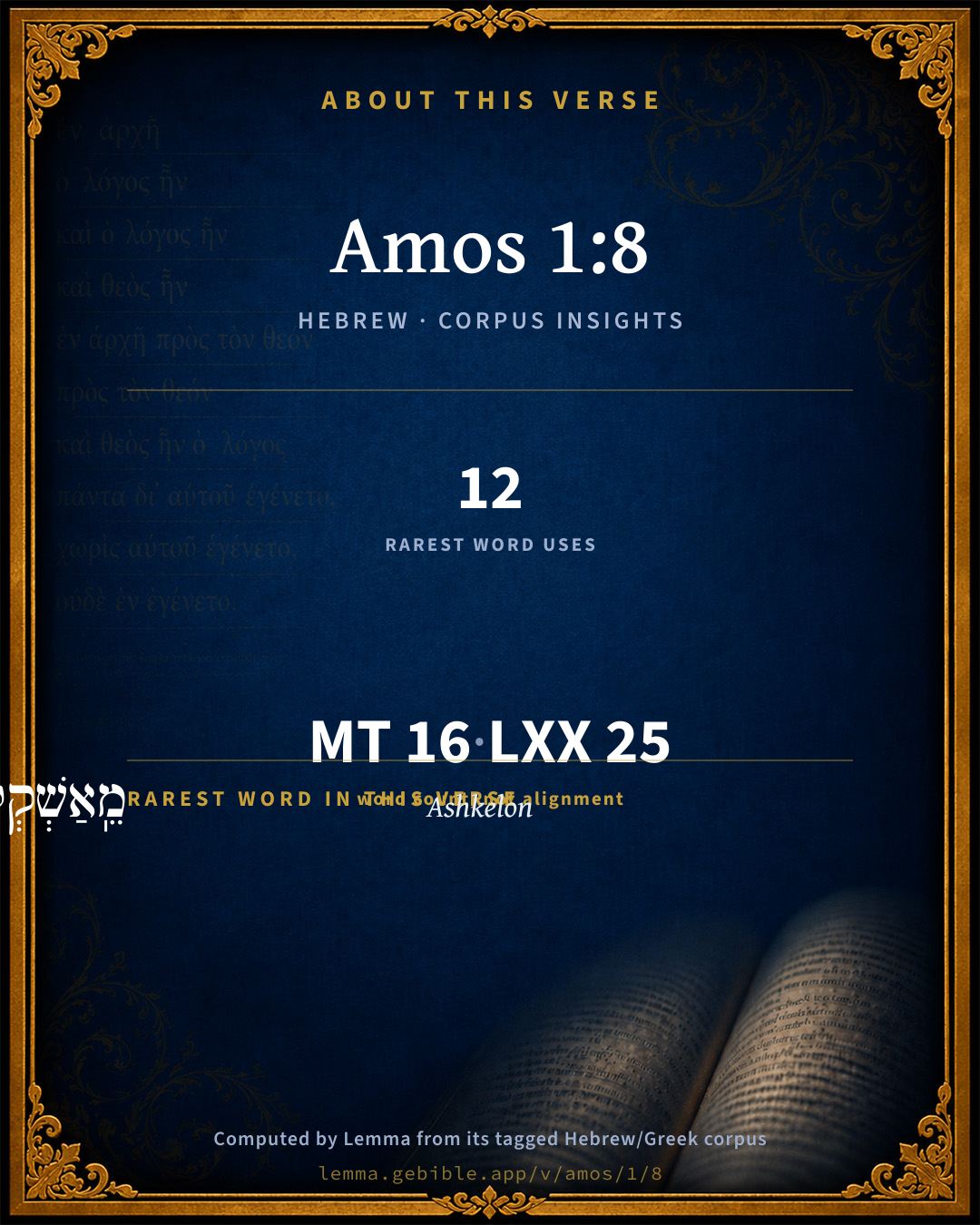
The rarest word here is מֵֽאַשְׁקְל֑וֹן Ashkelon H831 — appearing just 12 times in the whole Hebrew Bible.

Shared distinctive vocabulary

מֵֽאַשְׁקְל֑וֹן Ashkelon H831 occurs in 11 verses of the Hebrew Bible. Also found in:

Grammatical profile

  • 6 verbs
  • 9 nouns
  • 1 preposition

Verb forms

  • וְהִכְרַתִּ֤י Hiphil · Sequential Perfect
  • יוֹשֵׁב֙ Qal · Participle Active
  • וְתוֹמֵ֥ךְ Qal · Participle Active
  • וַהֲשִׁיב֨וֹתִי Hiphil · Sequential Perfect
  • וְאָֽבְדוּ֙ Qal · Sequential Perfect
  • אָמַ֖ר Qal · Perfect

Hebrew & Septuagint length

In English translation the verse runs 36 words from the Hebrew and 38 from the Septuagint (LXX English) — closely comparable.

A rough comparison of the two English renderings, which tokenize alike — not a word-level alignment.

Word counts can differ between the Hebrew and the Greek without any difference in meaning — e.g. the Hebrew direct-object marker אֵת has no separate Greek word, and Greek often adds the article ὁ.

In the original languages it is 16 Hebrew tokens and 25 Greek tokens — but the two are counted differently (Hebrew bundles its prefixes and suffixes into one token; the Greek is in lemma form), so that isn’t a like-for-like length.

Cross-references

11

Topical passages linked to Amos 1:8 in the Treasury of Scripture Knowledge — connected by theme and wording, ordered by reader-vote popularity; previews shown in the World English Bible.

  • Ezekiel 25:16 therefore thus says the Lord Yahweh, Behold, I will stretch out my hand on the Philistines, and I will cut off the Cherethites, and destroy the remnant of the sea coast.
  • Isaiah 14:29–31 Don't rejoice, O Philistia, all of you, because the rod that struck you is broken; for out of the serpent's root shall come forth an adder, and his fruit shall be a fiery flying serpent.
  • Jeremiah 47:4–5 because of the day that comes to destroy all the Philistines, to cut off from Tyre and Sidon every helper who remains: for Yahweh will destroy the Philistines, the remnant of the isle of Caphtor.
  • Zephaniah 2:4–7 For Gaza will be forsaken, and Ashkelon a desolation. They will drive out Ashdod at noonday, and Ekron will be rooted up.
  • 2 Chronicles 26:6 He went forth and warred against the Philistines, and broke down the wall of Gath, and the wall of Jabneh, and the wall of Ashdod; and he built cities in [the country of] Ashdod, and among the Philistines.
  • Psalms 81:14 I would soon subdue their enemies, And turn my hand against their adversaries.
  • Isaiah 20:1 In the year that Tartan came to Ashdod, when Sargon the king of Assyria sent him, and he fought against Ashdod and took it;
  • Zechariah 9:6 Foriegners will dwell in Ashdod, And I will cut off the pride of the Philistines.
  • Isaiah 1:25 And I will turn my hand on you, Thoroughly purge away your dross, And will take away all your tin.
  • Amos 3:9 Proclaim in the palaces at Ashdod, And in the palaces in the land of Egypt, And say, "Assemble yourselves on the mountains of Samaria, And see what unrest is in her, And what oppression is among them."
  • Zechariah 13:7 "Awake, sword, against my shepherd, And against the man who is close to me," says Yahweh of Hosts. Strike the shepherd, and the sheep will be scattered; And I will turn my hand against the little ones.

Cross-references courtesy of OpenBible.info (CC BY 4.0).

Hebrew and Greek witnesses Masoretic Hebrew ↔ Greek Septuagint

The same verse in the two great witnesses to the Old Testament, shown verse-for-verse.

These are two independent witnesses, not word-aligned to each other, and the Septuagint is shown in lemma (dictionary) form.

Hebrew Amos 1:8 Masoretic · Westminster Leningrad Codex

וְהִכְרַתִּ֤י יוֹשֵׁב֙ מֵֽאַשְׁדּ֔וֹד וְתוֹמֵ֥ךְ שֵׁ֖בֶט מֵֽאַשְׁקְל֑וֹן וַהֲשִׁיב֨וֹתִי יָדִ֜י עַל עֶקְר֗וֹן וְאָֽבְדוּ֙ שְׁאֵרִ֣ית פְּלִשְׁתִּ֔ים אָמַ֖ר אֲדֹנָ֥י יְהוִֽה

I will cut off the inhabitant from Ashdod, And him who holds the scepter from Ashkelon; And I will turn my hand against Ekron; And the remnant of the Philistines will perish," says the Lord Yahweh.

World English Bible · Public Domain

Greek LXX Amos 1:8 Septuagint · lemma form

καί ἐκὀλεθρεύω καταοἰκέω ἐκ ἄζωτος καί ἐκαἴρω φυλή ἐκ ἀσκαλών καί ἐπιἄγω ὁ χείρ ἐγώ ἐπί ακκαρων καί ἀποὀλλύω ὁ κατάλοιπος ὁ ἀλλόφυλος λέγω κύριος

And I will destroy the inhabitants out of Azotus, and a tribe shall be cut off from Ascalon, and I will stretch out my hand upon Accaron: and the remnant of the Philistines shall perish, says the Lord.

LXX2012 (modern English Septuagint) · Public Domain

Hebrew: Westminster Leningrad Codex (CC BY 4.0). Greek: Septuagint (public domain); English from LXX2012 (modern English Septuagint) (Public Domain). How the Septuagint differs from the Hebrew →

Targum (Aramaic paraphrase)

1

The Targum is the ancient Jewish Aramaic paraphrase of the Hebrew Scriptures — an interpretive translation, not the Hebrew text itself. Onkelos (literal) and Pseudo-Jonathan (expansive) render the Torah, and Jonathan the Prophets. Coverage is partial: where no permissively-licensed English translation exists for a verse, only the Aramaic is shown. This is verse-level text, not a word-by-word alignment to the Hebrew.

  1. Targum Jonathan Prophets (Joshua–Malachi)
    וָאֳשֵׁיצֵי יָתֵיב מֵאַשְׁדוֹד וְעָבֵיד שׁוּלְטַן מֵאַשְׁקְלוֹן וְאָתִיב מְחַת גְבוּרְתִּי עַל עֶקְרוֹן וְיֵיבְדוּן שְׁאָרָא דִפְלִשְׁתָּאֵי אֲמַר יְיָ אֱלֹהִים:

    (no public-domain English translation for this verse)

    Targum Jonathan — Aramaic: “Mikraot Gedolot” (public domain). English: “Sefaria Community Translation” (CC0 1.0 (public-domain dedication)); “London "Chaldee Paraphrase," 1871” (public domain). Text via Sefaria.

Commentary

Notes on Amos 1:8 from classic Christian and Jewish commentators (each source and its license shown beneath its notes). The classic Christian expositions comment on the surrounding passage and are grouped to its opening verse, so a note may address several verses; the Jewish commentaries on the Tanakh (Rashi and others) are per-verse, so they appear only where the commentator wrote on this verse.

Lemma curates 59 commentaries, every one of them public domain or Creative Commons licensed, each selected and text-cleaned for this edition rather than reprinted as found. About our sources →

The Cambridge Bible for Schools and Colleges

gen. ed. J. J. S. Perowne

8. the inhabitant] See on Amo_1:5.

from Ashdod] Another of the five chief Philistine cities (Jos_13:3; 1Sa_6:17 f.) is here specified, Ashdod, about 21 miles N.N.E. of Gaza, and 3 miles from the sea-coast. It was a strong fortress, and served also as a half-way station on the great caravan-route between Gaza and Joppa. According to Herodotus (ii. 157), when attacked by Psammetichus king of Egypt (c. 650 b.c.), it sustained a siege of 29 years, the longest on record: how severely it suffered on this occasion may be inferred from the expression ‘remnant of Ashdod’ used shortly afterwards by Jeremiah (Jer_25:20). But it recovered from this blow: it is alluded to as a place of some importance in the time of Nehemiah (Neh_4:7); and it is mentioned frequently afterwards.

and him that holdeth the sceptre] as Amo_1:5. The independent kings of the different Philistine cities are often mentioned in the Assyrian Inscriptions (cf. below).

from Ashkelon] a third chief Philistine city, situated actually on the coast, in a rocky amphitheatre, about half-way between Gaza and Ashdod. In the Middle Ages it became the most considerable of all the Philistine fortresses, its position on the sea constituting it then the key to S.W. Palestine. In ancient times little that is distinctive is recorded of it; though it may be reasonably inferred to have been already important for purposes of marine communication with the West.

turn mine hand against] Isa_1:25; Zec_13:7; Psa_81:14.

Ekron] a fourth chief city of the Philistines, situated inland, about 12 miles N.E. of Ashdod, and nearer the territory of Judah than any of the cities before mentioned. Ekron was the seat of a celebrated oracle, that of Baal-zebub (2Ki_1:2); but otherwise it does not appear in the Old Testament as a place of great importance. Gath, the fifth chief Philistine city, is not named: either, as some suppose (see on Amo_6:2) it was already destroyed, or it is included implicitly in the expression ‘remnant of the Philistines,’ immediately following.

and the remnant of the Philistines shall perish] i.e. whatever among them escapes the destruction announced in the previous clauses shall perish by a subsequent one: ‘remnant’ (she’çrith), as Amo_5:15, Amo_9:12 &c. The rendering rest, i.e. those unmentioned in the previous enumeration (Jer_39:3; Neh_7:72), is less probable. The verse declares that the whole Philistine name will be blotted out.

saith the Lord God] the Lord Jehovah (אדני יהוה), Amos’ favourite title for God, occurring in his prophecy twenty times (Amo_1:8, Amo_3:7-8; Amo_3:11, Amo_4:2; Amo_4:5, Amo_5:3, Amo_6:8, Amo_7:1-2; Amo_7:4; Amo_7:4-6, Amo_8:1; Amo_8:3; Amo_8:9; Amo_8:11, Amo_9:8; and followed by God of hosts, Amo_3:13). It is likewise a standing title with Ezekiel, who uses it with great frequency. It is employed sometimes by Isaiah, Jeremiah, and Deutero-Isaiah, as well as here and there by other prophets; and also occurs occasionally in the historical books (as Gen_15:2; Gen_15:8; Jos_7:7).

Successes, of at least a temporary character, gained against the Philistines by Uzziah and Hezekiah, are recorded in 2Ch_26:6 f. and 2Ki_18:8; but the foes from whom they suffered more severely were the Assyrians. Gaza was attacked by Tiglath-pileser (c. b.c. 734); its king Hanno was compelled to take refuge in Egypt; much spoil was taken, and a heavy tribute imposed (K.A.T[116][117] p. 256). In 711, Azuri, king of Ashdod, refused his accustomed tribute: the result was the siege by the Assyrian ‘Tartan,’ or general-in-chief, alluded to in Isaiah 20, which ended in the reduction of the city and exile of its inhabitants. Ten years later, in 701, Ashkelon and Ekron joined the Phoenician cities and Judah, in revolting from Sennacherib, and were both punished by the Assyrian king[118]. It seems, however, that though the power of the Philistines must have been seriously crippled by these blows, it was by no means destroyed: the kings of Gaza, Ashkelon, Ekron, and Ashdod are all named as tributary to Esarhaddon and Asshurbanipal (K.A.T[119][120] 356); oracles are uttered against the Philistines by several of the later prophets; their cities are mentioned as places of importance in the times of Nehemiah (Neh_4:7, Neh_13:23 f.) and the Maccabees. The passages in which other prophets foretell disaster for the Philistines—chiefly at the hands of the Assyrians or the Chaldaeans—should be compared: see Isa_11:14 (a picture of united Israel’s successes against them in the ideal future), Isa_14:29-32; Jer_25:20; Jeremiah 47; Zep_2:4-7; Eze_25:15-17; Zec_9:5-7.

[116] .A.T. … Eb. Schrader, Die Keilinschriften und das A. T., ed. 2, 1883 (translated under the title The Cuneiform Inscriptions and the O. T. 1885, 1888). The references are to the pagination of the German, which is given on the margin of the English translation.

[117] … Eb. Schrader, Die Keilinschriften und das A. T., ed. 2, 1883 (translated under the title The Cuneiform Inscriptions and the O. T. 1885, 1888). The references are to the pagination of the German, which is given on the margin of the English translation.

[118] See K.A. T.2 pp. 397 ff., 291 ff.; or the writer’s Isaiah, pp. 45, 67 f., 73.

[119] .A.T. … Eb. Schrader, Die Keilinschriften und das A. T., ed. 2, 1883 (translated under the title The Cuneiform Inscriptions and the O. T. 1885, 1888). The references are to the pagination of the German, which is given on the margin of the English translation.

[120] … Eb. Schrader, Die Keilinschriften und das A. T., ed. 2, 1883 (translated under the title The Cuneiform Inscriptions and the O. T. 1885, 1888). The references are to the pagination of the German, which is given on the margin of the English translation.

The Cambridge Bible for Schools and Colleges (gen. ed. J. J. S. Perowne; Cambridge University Press, 1878–1918) — public domain. Text from a community e-Sword module.

Trapp's Complete Commentary

John Trapp

Amo 1:8 And I will cut off the inhabitant from Ashdod, and him that holdeth the sceptre from Ashkelon, and I will turn mine hand against Ekron: and the remnant of the Philistines shall perish, saith the Lord GOD.

Ver. 8. And I will cut off the inhabitant from Ashdod] These other four Satrapies of the Philistines (Gath is not mentioned, because happily time had now triumphed over it, so that it lived by fame only) were the worse likely, and fared the worse for Gaza’s ill neighbourhood; like as Hamath did for Damascus, Zec 9:2.

And I will turn mine hand] Not in mercy, as Zec 13:7, but for further mischief; I will have a double blow at Ekron, where Beelzebub the Grandiabolo is worshipped, Iterabo plagam: and when I have done with the rest I will begin again with Ekron; Acheronta movebo.

And the remnant of the Philistines] This is dreadful, but due to them, and just upon them for their savage dealing with Israel, Amo 1:6. This was fulfilled by Hezekiah conquering all that country, 2Ki 18:8. See Josephus, lib. ix. 13.

John Trapp, A Commentary or Exposition upon All the Books of the Old and New Testament (1647–1656) — public domain. Text from a community e-Sword module.

Tyndale Open Study Notes

Tyndale Open Resources

1:8 The Philistine cities of Ashdod and Ashkelon were on or near the seacoast, while Ekron lay inland. Gath is not mentioned here, as it had been conquered earlier by Hazael (2 Kgs 12:17) and then Uzziah (2 Chr 26:6). • the few Philistines still left: The Philistines maintained their ethnic identity through the Assyrian period, but this distinction faded by the time of the Persians (Zech 9:5-7).

Tyndale Open Study Notes — © Tyndale Open Resources, licensed CC BY-SA 4.0. Text via the HelloAO Bible API.

Jamieson, Fausset & Brown

Robert Jamieson, A. R. Fausset & David Brown

Ashdod, &c.--Gath alone is not mentioned of the five chief Philistine cities. It had already been subdued by David; and it, as well as Ashdod, was taken by Uzziah (Ch2 26:6). Gath perhaps had lost its position as one of the five primary cities before Amos uttered this prophecy, whence arose his omission of it. So Zep 2:4-5. Compare Jer 47:4; Eze 25:16. Subsequently to the subjugation of the Philistines by Uzziah, and then by Hezekiah, they were reduced by Psammetichus of Egypt, Nebuchadnezzar, the Persians, Alexander, and lastly the Asmoneans.

Jamieson, Fausset & Brown — Commentary Critical and Explanatory on the Whole Bible (1871) — public domain (CC PDM 1.0). Text via the HelloAO Bible API.

John Calvin's Commentaries

He therefore adds, that Jehovah Lord had spoken, saith the Lord Jehovah This was added for confirmation; for the Philistine were then in possession of many and strong defenses, so that they boldly laughed to scorn the threatening of the Prophet. He therefore brings forward here the name of God. Now follows the prediction respecting Tyrus: —

John Calvin's Commentaries (1540-1563) — public domain. Text from the Calvin Translation Society English edition (1840s-50s) via the Christian Classics Ethereal Library (ccel.org). Calvin's coverage is partial (roughly two-thirds of the Bible); uncommented books and verses are honest gaps, never fabricated. The 19th-century editor's footnotes and remarks are omitted so the notes are faithfully Calvin's own voice.

John Gill's Exposition

I will cut off the inhabitants from Ashdod,.... The same with Azotus, Act 8:40; another principal city of the Philistines: this perhaps was fulfilled when Tartan was sent against it by Sargon king of Assyria, and took it, Isa 20:1; or however in the times of the Maccabees, when Jonathan took it, and burnt it, and the cities round about it; and took their spoils, and burnt the temple of Dagon, and those that fled to it; and what with those that were burnt, and those that fell by the sword, there perished about eight thousand,

"84 But Jonathan set fire on Azotus, and the cities round about it, and took their spoils; and the temple of Dagon, with them that were fled into it, he burned with fire. 85 Thus there were burned and slain with the sword well nigh eight thousand men.'' (1 Maccabees 10)

this was so strong a place, that, according to Herodotus (t), it held out a siege of twenty nine years, under Psammitichus king of Egypt. It was, according to Diodorus Siculus (u), thirty four miles, from Gaza before mentioned; and it was about eight or nine from Ashkelon, and fourteen or fifteen from Ekron after mentioned:

and him that holdeth the sceptre from Ashkelon; another of the five lordships of the Philistines, whose king or governor should be cut off, with the inhabitants of it; this was done by Nebuchadnezzar, Jer 47:5. This place was about fifteen miles from Gaza, Mr. Sandys (w) says ten, but it was eight or nine miles from Ashdod; and, as Josephus (x) says, was sixty five miles from Jerusalem. It was the birth place of Herod the great, who from thence is called an Ashkelonite; but the king or governor of it was cut off before his time. It was governed by kings formerly. Justin (y) makes mention of a king of Ashkelon; according to the Samaritan interpreter, Gen 20:1; it is the same with Gerar, which had a king in the times of Abraham; hence a sceptre is here ascribed to it:

and I will turn mine hand against Ekron: to destroy that; another of the chief cities of the Philistines. It was about ten miles from Gath; four of the five lordships are here mentioned, but not Gath, which was the fifth; see Sa1 6:17; because, as Kimchi says, it was in the hands of Judah. All these places were inhabited by Heathens, and guilty of gross idolatry, which must be one of the transgressions for which they were punished. Gaza was a place much given to idolatry, as it was even in later times; when other neighbouring cities embraced the Christian religion, the inhabitants of it were violent persecutors; hence that saying of Gregory Nazianzen (z),

"who knows not the madness of the inhabitants of Gaza?''

here stood the temple of the god Marnas (a), which with the Syrians signified the lord of men: at Ashdod or Azotus stood the temple of Dagon, where he was worshipped, Sa1 5:2;

"But Jonathan set fire on Azotus, and the cities round about it, and took their spoils; and the temple of Dagon, with them that were fled into it, he burned with fire.'' (1 Maccabees 10:84)

Near Ashkelon, as Diodorus Siculus (b) relates, was a large and deep lake, full of fishes; and by it was a temple of a famous goddess, called by the Syrians Derceto, who had a woman's face, but the rest of her body in the form of a fish; being, as the fable goes, changed into one upon her casting herself into the above lake on a certain occasion; hence the Syrians abstained from fishes, and worshipped them as gods. Herodotus (c) calls this city a city of Syria, and speaks of a temple dedicated to Urania Venus; and in the Talmud (d) mention is made of the temple of Zeripha, or of a molten image at Ashkelon; and, besides idolatry, this place seems to have been famous for witchcraft; for it is said (e) that Simeon ben Shetach hung on one day at Ashkelon fourscore women for being witches; and, at Ekron, Baalzebub or the god of the fly was worshipped:

and the remnant of the Philistines shall perish, saith the Lord God; all the other towns and cities belonging to them, besides those mentioned; which very likely had its accomplishment in the times of the Maccabees, when they fell into the hands of the Jews.

(t) Euterpe, sive l. 2. c. 157. (u) Bibliothec. l. 19. p. 723. (w) Travels, p. 151. (x) De Bello Jud. l. 3. c. 2. sect. 1. (y) E Trogo, l. 19. c. 3. (z) Orat. 3. adv. Julian. p. 87. (a) Hieronymul in lsa. xvii. fol. 39. K. (b) Bibliothec. l. 2. p. 92. (c) Clio, sive l. 1. c. 105. (d) T. Bab. Avoda Zara, fol. 11. 2. (e) T. Hieros. Sanhedrin, fol. 23. 3.

John Gill's Exposition of the Whole Bible (1746–1763) — public domain (CC PDM 1.0). Text via the HelloAO Bible API.

Albert Barnes' Notes on the Bible

And I will cut off the inhabitant from Ashdod - Ashdod, as well as Ekron, have their names from their strength; Ashdod, “the mighty,” like Valentia; Ekron, “the firm-rooted.” The title of Ashdod implied that it was powerful to inflict as to resist. It may have meant, “the waster.” It too was eminent in its idolatry. The ark, when taken, was first placed in its Dagon-temple 1Sa 5:1-7; and, perhaps, in consequence, its lord is placed first of the five, in recounting the trespass-offerings which they sent to the Lord 1Sa 6:17. Ashdod (Azotus in the New Testament now a village, Esdud or Shdood ), lay 34 or 36 miles from Gaza , on the great route from Egypt northward, on that which now too is most used even to Jerusalem. Ashkelon lay to the left of the road, near the sea, rather more than halfway.

Ekron (Akir, now a village of 50 mud-houses ), lay a little to the right of the road northward from Gaza to Lydda (in the same latitude as Jamnia, Jabneel) on the road from Ramleh to Belt Jibrin (Eleutheropolis). Ekron, the furthest from the sea, lay only 15 miles from it. They were then a succession of fortresses, strong from their situation, which could molest any army, which should come along their coast. Transversely, in regard to Judah, they enclosed a space parallel to most of Judah and Benjamin. Ekron, which by God’s gift was the northern line of Judah Jos 15:11, is about the same latitude as Ramah in Benjamin; Gaza, the same as Carmel (Kurmul). From Gaza lay a straight road to Jerusalem; but Ashkelon too, Ashdod, and Ekron lay near the heads of valleys, which ran up to the hill-country near Jerusalem .

This system of rich valleys, in which, either by artificial irrigation or natural absorption, the streams which ran from the mountains of Judah westward fertilized the grainfields of Philistia, aforded equally a ready approach to Philistine marauders into the very heart of Judah. The Crusaders had to crown with castles the heights in a distant circle around Ashkelon , in order to restrain the incursions of the Muslims. (In such occasions doubtless, the same man-stealing was often practiced on lesser scales, which here, on a larger scale, draws down the sentence of God. Gath, much further inland, probably formed a center to which these maritime towns converged, and united their system of inroads on Judah.

These five cities of Philistia had each its own petty king (Seren, our “axle”). But all formed one whole; all debated and acted together on any great occasion; as in the plot against Samson Jdg 16:5, Jdg 16:8, Jdg 16:18, the sacrifice to Dagon in triumph over him, where they perished Jdg 16:23, Jdg 16:27, Jdg 16:30; the inflictions on account of the ark 1Sa 5:8, 1Sa 5:11; 1Sa 6:4, 1Sa 6:12, 1Sa 6:16, 1Sa 6:18; the great attack on Israel 1Sa 7:7, which God defeated the Mizpeh; the battle when Saul fell, and the dismissal of David 1Sa 31:2, 1Sa 31:6-7; 1Ch 12:19. The cities divided their idolatry also, in a manner, between them, Ashdod being the chief seat of the worship of Dagon , Ashkelon, of the corresponding worship of Derceto , the fish-goddess, the symbol of the passive principle in re-production. Ekron was the seat of the worship of Baalzebub and his oracle, from where he is called “the god of Ekron” 2Ki 1:2-3, 2Ki 1:16.

Gaza, even after it had become an abode of Greek idolatry and had seven temples of Greek gods, still retained its worship of its god Marna (“our Lord”) as the chief . It too was probably “nature” and to its worship they were devoted. All these cities were as one; all formed one state; all were one in their sin; all were to be one in their punishment. So then for greater vividness, one part of the common infliction is related of each, while in fact, according to the custom of prophetic diction, what is said of each is said of all. King and people were to be cut off from all; all were to be consumed with fire in war; on all God would, as it were, “turn” (literally, “bring back”) His Hand, visiting them anew, and bringing again the same punishment upon them. In truth these destructions came upon them, again and again, through Sargon, Hezekiah, Pharaoh, Nebuchadnezzar, Alexander, the Maccabees.

Ashdod - Uzziah about this time “brake down its walls and built cities about” 2Ch 26:6 it, to protect his people from its inroads. It recovered, and was subsequently besieged and taken by Tartan, the Assyrian General under Sargon Isa 20:1 (about 716 b.c.). Somewhat later, it sustained the longest siege in man’s knowlege, for 29 years, from Psammetichus king of Egypt (about 635 b.c.). Whence, probably Jeremiah, while he speaks of Ashkelon, Gaza, Ekron, mentions “the remnant of Ashdod” Jer 25:20 only. Yet, after the captivity, it seems to have been the first Philistine city, so that the Philistines were called Ashdodites Neh 4:7, and their dialect Ashdodite Neh 13:24. They were still hostile to the Jews Neh 4:7. The war, in which Judas Maccabaeus spoiled Ashdod and other Philistine cities (1 Macc. 5:68), was a defensive war against a war of extermination. “The nations round about” (1 Macc. 5:1, 2), it is said at the beginning of the account of that year’s campaign, “thought to destroy the generation of Jacob that was among them, and thereupon they began to slay and destroy the people.” Jonathan, the brother of Judas, “set fire to Azotus and the cities round about it (1 Macc. 10:82, 84), after a battle under its walls, to which his enemies had challenged him. The temple of Dagon in it was a sort of citadel (1 Macc. 10:83).

Ashkelon is mentioned as a place of strength, taken by the great conqueror, Raamses II. Its resolute defense and capture are represented, with its name as a city of Canaanites, on a monument of Karnac . Its name most naturally signifies “hanging.” This suits very well with the site of its present ruins, which “hang” on the side of the theater or arc of hills, whose base is the sea. This, however, probably was not its ancient site (see the note at Zep 2:4). Its name occurs in the wars of the Maccabees, but rather as submitting readily (1 Macc. 10:86; 11:60). Perhaps the inhabitants had been changed in the intervening period. Antipater, the Edomite father of Herod, courted, we are told , “the Arabs and the Ascalonites and the Gazites.” “Toward the Jews their neighbors, the inhabitants of the Holy land,” Philo says to the Roman emperor, “the Ascalonites have an irreconcilable aversion, which will come to no terms.” This abiding hatred burst out at the beginning of the war with the Romans, in which Jerusalem perished. The Ascalonites massacred 2500 Jews dwelling among them . The Jews “fired Ascalon and utterly destroyed Gaza” .

Ekron was apparently not important enough in itself to have any separate history. We hear of it only as given by Alexander Bales “with the borders thereof in possession” (1 Macc. 10:89) to Jonathan the Maccabee. The valley of Surar gave the Ekronites a readier entrance into the center of Judaea, than Ascalon or Ashdod had. In Jerome’s time, it had sunk to “a very large village.”

The residue of the Philistines shall perish - This has been thought to mean “the rest” (as in Jer 39:3; Neh 7:72) that is, Gath, (not mentioned by name anymore as having ceased to be of any account (see the note at Amo 6:3)) and the towns, dependent on those chief cities . The common (and, with a proper name, universal ) meaning of the idiom is, “the remnant,” those who remain over after a first destruction. The words then, like those just before, “I will bring again my hand against Ekron,” foretell a renewal of those first judgments. The political strength which should survive one desolation should be destroyed in those which should succeed it. In tacit contrast with the promises of mercy to the remnant of Judah (see above the note at Joe 2:32), Amos foretells that judgment after judgment should fall upon Philistia, until the Philistines ceased to be anymore a people; as they did.

Albert Barnes' Notes on the Bible (1834–1885) — public domain. Text from a community e-Sword/MySword module.

Matthew Poole's English Annotations

The inhabitant: see Amo 1:5.

Ashdod: see Zep 2:4; Zec 9:6. This was one of the five cities of the Philistines, and had its roitelet. it was afterwards called

Azotus, Act 8:40. In this city was Dagon’s temple and statue, 1Sa 5:1-3. The like threat against Ashdod did Jeremiah denounce, Jer 25:16, with Jer 25:20.

Him that holdeth the sceptre: see Amo 1:5. Ashkelon; another city of the Palestine pentarchy, and a very strong one, of which see Zep 2:7; Zec 9:5,6, which shall perish with the king and inhabitants thereof; which (besides what Shalmaneser, Sennacherib, or Sargon, kings of Assyria, did, and besides what Hezekiah did against Ashkelon) had some accomplishment in Nabopolassar’s and Nebuchadnezzar’s time, and in Alexander the Great, to whom this city, as well as Gaza and Ashdod, became subject.

I will turn mine hand against Ekron; having destroyed these, saith the Lord, I will proceed on to Ekron, another of the five cities of the Philistines, strong, but, as the rest, cruel to Israel, and very sinfully idolatrous, worshipping Baal-zebub, for which this shall be destroyed also: see Zep 2:4; Zec 9:5.

The remnant of the Philistines; what remaineth either of cities, towns, or people, not already expressly mentioned and threatened.

Shall perish; be cut off, and wasted utterly.

Saith the Lord God; when all this shall be done, though perhaps ye may not know, yet know ye this, that assuredly it shall be done in its time, for the Lord hath said it.

Matthew Poole's English Annotations on the Holy Bible (1683–1685) — public domain. Text from a community e-Sword/MySword module.

The Pulpit Commentary

Ashdod, "the Waster," hod. Esdud, or Shdood (called Azotus, (Act_8:40) and still a large village, lay about thirty-five miles north of Gaza, three miles from the sea. Ashkelon was situated between the two. "Askelon differs from the other celebrated cities of the Philistines, being seated on the sea, while Ekron, Garb, Jamnia, Ashdod, and Gaza are in the interior. It never could have had a harbour of any considerable size, however.... The topography of the place is peculiar. An abrupt ridge begins near the shore, runs up eastward, bends round to the south, then to the west, and finally northwest to the sea again, forming an irregular amphitheatre. On the top of this ridge ran the wall, which was defended at its salient angles by strong towers. The specimens which still exist show that it was very high and thick, built, however, of small stones, and bound together by broken columns of granite and marble. This clearly proves that it is patchwork, and not Askelon"s original rampart....The position is one of the fairest along this part of the Mediterranean coast; and when the interior of the amphitheatre was adorned with splendid temples and palaces, ascending, rank above rank, from the shore to the summit, the appearance from the sea must have been very imposing. Now the whole area is planted over with orchards of the various kinds of fruit which flourish in this region" (Thomson, "The Land and the Book," Southern Palestine, p. 171). In spite of its bad harbour, it carried on a lucrative foreign commerce, which was the chief cause of its power and importance (Ewald, "Hist. of Israel," 1:247, Eng. transl.). It was about fifty Roman miles from Jerusalem. In mediaeval times there were two cities of the name, one on the coast, (Jer_47:7) the same as Herod"s Ascalon, and one inland. In its palmiest days the former could never have had a real harbour ("Survey Memoirs," 3, pp. 245, 246). Ekron, hod. Akir, was twelve miles northeast of Ashdod, and some nine from the coast. Ashdod was taken by Uzziah, (2Ch_26:6) by the tartan, or commander-in-chief, of Sargon, (Isa_20:1) and by Psammetichus King of Egypt (so. 635), when it sustained a siege of twenty-nine years (Herod., 2:157). Sennacherib, in a cuneiform inscription, records how he treated the two other cities: "Zedekiah King of Ashkelon," he says, "who had not submitted himself to my yoke, himself, the gods of the house of his fathers, his wife, his sons, his daughters, and his brothers, the seed of the house of his fathers, I removed, and I sent him to Assyria. I set over the men of Ashkelon, Sarludari, the son of Rukipti, their former king, and I imposed upon him the payment of tribute, and the homage due to my majesty, and he became a vassal. I marched against the city of Ekron, and put to death the priests and the chief men who had committed the sin (of rebellion), and I hung up their bodies on stakes all round the city. The citizens who had done wrong and wickedness I counted as a spoil" (Professor Sayce, "Fresh Light from the Monuments," pp. 120, 121). I will turn mine hand; literally, will bring back my hand; visit again with punishment, or repeat the blow. (Isa_1:25; Jer_6:9; see note Zec_13:7) The remnant. All the Philistines who had as yet escaped destruction. (comp. Amo_9:12; Jer_6:9)

The Pulpit Commentary (1880–1919), ed. H.D.M. Spence-Jones & Joseph S. Exell — public domain. Text from a community e-Sword module.

John Wesley's Explanatory Notes

Ashkelon - Another city of the Philistines, and a very strong one, which shall perish with the king and the inhabitants thereof.

John Wesley, Explanatory Notes Upon the Whole Bible (1754–1765) — public domain. Text via the GEBible commentary corpus.

unfoldingWord translationNotes

Door43 World Missions Community

Connecting Statement:

Yahweh continues his message of judgment on Gaza.

cut off the man

Here to "cut off" means either to destroy or to drive away, as one would cut a piece of cloth or cut a branch from a tree. AT: "destroy the man" or "drive away the man" (See: Metaphor)

the man who holds the scepter

This is a metonym for the ruler of that city or region. AT: "the ruler" (See: Metonymy)

I will turn my hand against Ekron

Here "hand" represents Yahweh's power that he would use against Ekron. AT: "I will strike Ekron" or "I will destroy Ekron" (See: Metonymy)

Ekron

Here "Ekron" represents the people of the city of Ekron. AT: "the people of Ekron" (See: Metonymy)

translationWords

Ashdod

scepter

Ashkelon

hand

Ekron

Philistines

perish

Lord Yahweh

unfoldingWord translationNotes — © Distant Shores Media and the Door43 World Missions Community, licensed CC BY-SA 4.0. Source: git.door43.org/Door43/en_tn.

Rashi

Rabbi Shlomo Yitzchaki (Rashi)

Ashdod... Ashkelon... Ekron—They were the lords of the Philistines.

and I will return My hand—I will smite them repeatedly.

Rashi on the Tanakh — English translations: “The Judaica Press complete Tanach with Rashi, translated by A. J. Rosenberg” (CC BY 4.0); “Pentateuch with Rashi's commentary by M. Rosenbaum and A.M. Silbermann, 1929-1934” (public domain); “The Metsudah Tanach series, Lakewood, N.J” (CC BY 4.0); and “The Book of Joshua, Metsudah Publications, 1997” (CC BY 4.0). Text via Sefaria.

Lesson kit

Teaching starters — assembled from the data on this page, not authored interpretation. Every prompt links to the verse data it draws on. Edit before teaching.

Amos, in the Prophets, opens this verse with 16 words (16 distinct Hebrew lemmas). Its most distinctive word is ʼAshqᵉlôwn (“Ashkelon”). A historical commentator’s framing appears above. Read the whole chapter for the surrounding context.

Discussion questions

  1. What does “Ashkelon” (ʼAshqᵉlôwn) contribute to the verse as a whole?
  2. How does Judges 1:18, which shares the word «Ashkelon», read alongside this verse?
  3. These translations render this verse differently. What is at stake in choosing one wording over another?
  4. «וְהִכְרַתִּ֤י» is a Hiphil Sequential Perfect verb. How does that grammatical form shape the action described?
  5. Compare how The Cambridge Bible for Schools and Colleges and Trapp's Complete Commentary read this verse. Where do they agree or differ?

Things to notice

Reading settings

Reading text

Shown beneath each verse's original-language words.

Old Testament
Old Testament edition

Read the OT as the Masoretic Hebrew (MT) or the Greek Septuagint (LXX).

English shown for the Greek Septuagint (in the Hebrew ↔ Greek comparison).

Comparing translations? Open the Compare panel on any verse page to stack up to four side by side.