
Ezekiel 39:25

Hebrew (Westminster Leningrad Codex) Ezekiel 39:25 appears in the Hebrew Old Testament. The text above is from the Westminster Leningrad Codex. Each word links to its Strong’s number, a concise gloss, and parsing drawn from the Open Scriptures Hebrew Bible morphology. Click any word for its full Brown-Driver-Briggs (BDB) entry.
Download image
Cite this verse

Ezekiel 39:25 (World English Bible). Public Domain. Lemma interlinear Bible study tool, https://lemma.gebible.app/v/ezekiel/39/25.

Show BibTeX & RIS
BibTeX
RIS
English Translation
Therefore thus says the Lord Yahweh: Now will I bring back the captivity of Jacob, and have mercy on the whole house of Israel; and I will be jealous for my holy name.
World English Bible · Public Domain
Download a study sheet

One document with this verse’s original text, its word-by-word gloss line, the meaning frame, cross-references with their text, attributed commentary, and full source and license credits — printable, and it pastes into notes with its structure intact.

This verse Autodidact and up

Study sheet (.html) Plain text (.txt)

A passage Seminary Student

Up to 50 verses in one chapter. A passage sheet keeps up to 6 commentary sources and 12 cross-references per verse, in the order this page ranks them, and says so on the sheet whenever that leaves anything out. Ask for a single verse and you get the Autodidact verse sheet above.

Everything on this page stays free to read, with no account — the sheet is a download of what is already on screen, not access to it.

Want to remove ads? Support Godless Engineer
Compare translations 3

The same verse in 3 English versions, stacked beneath the original-language interlinear above. Click any original word for its lexicon entry.

Each is an independent rendering of the whole verse — the interlinear is not word-aligned to these translations.

Highlighted words mark where these versions differ — a whole-verse word diff, not a word-by-word alignment.

  • World English Bible Public Domain
    Therefore thus says the Lord Yahweh: Now will I bring back the captivity of Jacob, and have mercy on the whole house of Israel; and I will be jealous for my holy name.
  • King James Version Public Domain
    Therefore thus saith the Lord GOD; Now will I bring again the captivity of Jacob, and have mercy upon the whole house of Israel, and will be jealous for my holy name;
  • unfoldingWord Literal Text CC BY-SA 4.0
    Therefore the Lord Yahweh says this: Now I will restore the fortunes of Jacob, and I will have compassion on all the house of Israel, when I act with zeal for my holy name.

unfoldingWord Literal Text — © unfoldingWord, licensed CC BY-SA 4.0. Word-aligned USFM3 via Door43 (git.door43.org/unfoldingWord/en_ult).

Versions to compare (up to 4)

3 of 4 selected

Show all 18 translations

Every available English version of this verse, each an independent rendering of the whole verse.

  • World English Bible Public Domain
    Therefore thus says the Lord Yahweh: Now will I bring back the captivity of Jacob, and have mercy on the whole house of Israel; and I will be jealous for my holy name.
  • Berean Standard Bible Public Domain
    Therefore this is what the Lord GOD says: Now I will restore Jacob from captivity and will have compassion on the whole house of Israel, and I will be jealous for My holy name.
  • Majority Standard Bible Public Domain
    Therefore this is what the Lord GOD says: Now I will restore Jacob from captivity and will have compassion on the whole house of Israel, and I will be jealous for My holy name.
  • King James Version Public Domain
    Therefore thus saith the Lord GOD; Now will I bring again the captivity of Jacob, and have mercy upon the whole house of Israel, and will be jealous for my holy name;
  • American Standard Version (1901) Public Domain
    Therefore thus saith the Lord Jehovah: Now will I bring back the captivity of Jacob, and have mercy upon the whole house of Israel; and I will be jealous for my holy name.
  • Revised Version (1885) Public Domain
    Therefore thus saith the Lord GOD: Now will I bring again the captivity of Jacob, and have mercy upon the whole house of Israel; and I will be jealous for my holy name.
  • Geneva Bible (1599) Public Domain
    Therefore thus sayth the Lord God, Nowe will I bring againe the captiuitie of Iaakob, and haue compassion vpon the whole house of Israel, and wil be ielous for mine holy Name,
  • Douay-Rheims (1899) Public Domain
    Therefore, thus saith the Lord God: Now will I bring back the captivity of Jacob, and will have mercy on all the house of Israel: and I will be jealous for my holy name.
  • Young's Literal Translation Public Domain
    Therefore, thus said the Lord Jehovah: Now do I bring back the captivity of Jacob, And I have pitied all the house of Israel, And have been zealous for My holy name.
  • Literal Standard Version CC BY-SA 4.0
    Therefore, thus said Lord YHWH: Now I bring back the captivity of Jacob, || And I have pitied all the house of Israel, || And have been zealous for My holy Name.
  • Unlocked Literal Bible CC BY-SA 4.0
    Therefore the Lord Yahweh says this: Now I will restore the fortunes of Jacob, and I will have compassion on all the house of Israel, when I act with zeal for my holy name.
  • unfoldingWord Literal Text CC BY-SA 4.0
    Therefore the Lord Yahweh says this: Now I will restore the fortunes of Jacob, and I will have compassion on all the house of Israel, when I act with zeal for my holy name.
  • Darby Bible Public Domain
    Therefore, thus saith the Lord Jehovah: Now will I bring again the captivity of Jacob, and have mercy upon the whole house of Israel, and will be jealous for my holy name:
  • World Messianic Bible Public Domain
    “Therefore the Lord GOD says: ‘Now I will reverse the captivity of Jacob and have mercy on the whole house of Israel. I will be jealous for my holy name.
  • Webster's Bible Public Domain
    Therefore thus saith the Lord GOD; Now will I bring again the captivity of Jacob, and have mercy upon the whole house of Israel, and will be jealous for my holy name;
  • Free Bible Version CC BY-SA 4.0
    So this is what the Lord God says: Now I will bring back the descendants of Jacob from exile and I will show mercy to all the people of Israel, and I will demonstrate my reputation for holiness.
  • Bible in Basic English Public Domain
    For this cause the Lord has said, Now I will let the fate of Jacob be changed, and I will have mercy on all the children of Israel, and will take care of the honour of my holy name.
  • JPS Tanakh (1917) Public Domain
    Therefore thus saith the Lord GOD: Now will I bring back the captivity of Jacob, and have compassion upon the whole house of Israel; and I will be jealous for My holy name.

Literal Standard Version (2020), Covenant Press — licensed CC BY-SA 4.0. Text via the HelloAO Bible API (eBible.org). Unlocked Literal Bible (unfoldingWord) — licensed CC BY-SA 4.0. Text via the HelloAO Bible API (eBible.org). unfoldingWord Literal Text — © unfoldingWord, licensed CC BY-SA 4.0. Word-aligned USFM3 via Door43 (git.door43.org/unfoldingWord/en_ult). Free Bible Version, Dr. Jonathan Gallagher — licensed CC BY-SA 4.0. Text via the HelloAO Bible API (eBible.org).

Word by word

More ways to search: Search by grammar → Find every occurrence → Compare this word →

Practice this passage: Drill this verse → Learn its vocabulary →

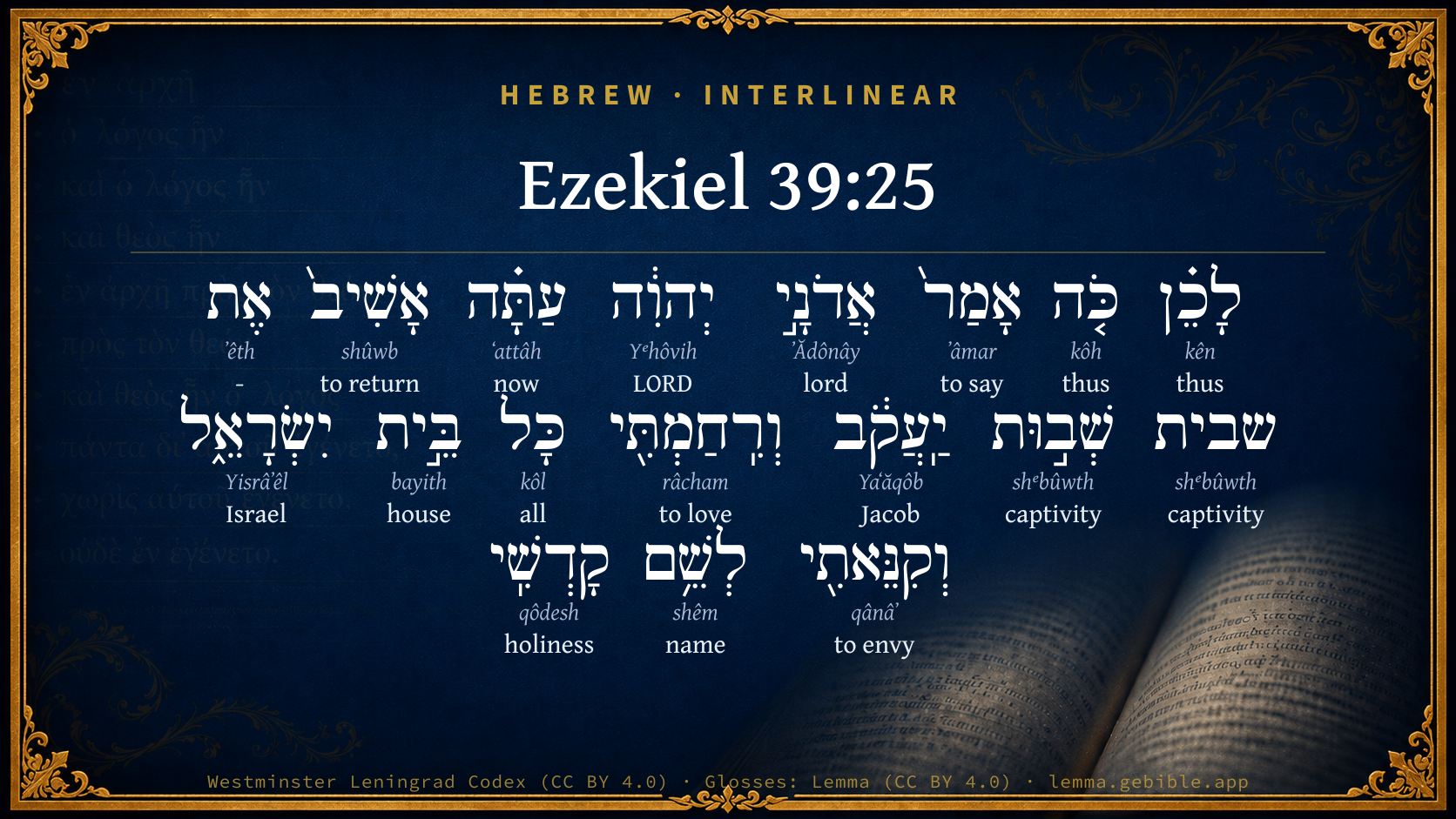
וְקִנֵּאתִ֖י
qânâʼ
H7065
“and · to envy”
Conjunction + Verb, Piel, Sequential Perfect, 1st Person, Common, Singular
Part of Speech
Conjunction + Verb
Stem
Piel
Form
Sequential Perfect
Person
1st Person
Gender
Common
Number
Singular
Full BDB Definition

Origin: a primitive root

TWOT: 2038

to envy, be jealous, be envious, be zealous - (Piel) - to be jealous of - to be envious of - to be zealous for - to excite to jealous anger - (Hiphil) to provoke to jealous anger, cause jealousy
  1. לָכֵ֗ן kên H3651 “to/for · thus” Preposition + Adverb
  2. כֹּ֤ה kôh H3541 “thus” Adverb
  3. אָמַר֙ ʼâmar H559 “to say” Verb, Qal, Perfect, 3rd Person, Masculine, Singular
  4. אֲדֹנָ֣י ʼĂdônây H136 “Lord · my” Noun, Common, Masculine, Plural, Construct + Suffix, Personal, 1st Person, Common, Singular
  5. יְהוִ֔ה Yᵉhôvih H3069 “LORD” Noun, Proper
  6. עַתָּ֗ה ʻattâh H6258 “now” Adverb
  7. אָשִׁיב֙ shûwb H7725 “to return” Verb, Hiphil, Imperfect, 1st Person, Common, Singular
  8. אֶת ʼêth H853 “-” Particle, Direct Object
  9. שבית shᵉbûwth H7622 “captivity of” Noun, Common, Feminine, Singular, Construct
  10. שְׁב֣וּת shᵉbûwth H7622 “captivity of” Noun, Common, Feminine, Singular, Construct
  11. יַֽעֲקֹ֔ב Yaʻăqôb H3290 “Jacob” Noun, Proper
  12. וְרִֽחַמְתִּ֖י râcham H7355 “and · to love” Conjunction + Verb, Piel, Sequential Perfect, 1st Person, Common, Singular
  13. כָּל kôl H3605 “all of” Noun, Common, Masculine, Singular, Construct
  14. בֵּ֣ית bayith H1004 “house of” Noun, Common, Masculine, Singular, Construct
  15. יִשְׂרָאֵ֑ל Yisrâʼêl H3478 “Israel” Noun, Proper
  16. לְשֵׁ֥ם shêm H8034 “to/for · name of” Preposition + Noun, Common, Masculine, Singular, Construct
  17. קָדְשִֽׁי qôdesh H6944 “holiness · my” Noun, Common, Masculine, Singular, Construct + Suffix, Personal, 1st Person, Common, Singular

About this verse

These counts appear in no published source. They are computed here, from the morphology-tagged text and Lemma’s own curated glosses. What Lemma adds →

18
words
17
distinct lemmas
Prophets
section

Shared distinctive vocabulary

וְקִנֵּאתִ֖י to envy H7065 occurs in 28 verses of the Hebrew Bible. Also found in:

Grammatical profile

  • 4 verbs
  • 10 nouns
  • 3 adverbs
  • 1 particle

Verb forms

  • אָמַר֙ Qal · Perfect
  • אָשִׁיב֙ Hiphil · Imperfect
  • וְרִֽחַמְתִּ֖י Piel · Sequential Perfect
  • וְקִנֵּאתִ֖י Piel · Sequential Perfect

Repetition

A word recurs within this verse — often emphatic in Hebrew:

  • שבית captivity H7622 ×2

Hebrew & Septuagint length

In English translation the verse runs 33 words from the Hebrew and 34 from the Septuagint (LXX English) — closely comparable.

A rough comparison of the two English renderings, which tokenize alike — not a word-level alignment.

Word counts can differ between the Hebrew and the Greek without any difference in meaning — e.g. the Hebrew direct-object marker אֵת has no separate Greek word, and Greek often adds the article ὁ.

In the original languages it is 18 Hebrew tokens and 24 Greek tokens — but the two are counted differently (Hebrew bundles its prefixes and suffixes into one token; the Greek is in lemma form), so that isn’t a like-for-like length.

Cross-references

22

Topical passages linked to Ezekiel 39:25 in the Treasury of Scripture Knowledge — connected by theme and wording, ordered by reader-vote popularity; previews shown in the World English Bible.

  • Ezekiel 34:13 I will bring them out from the peoples, and gather them from the countries, and will bring them into their own land; and I will feed them on the mountains of Israel, by the watercourses, and in all the inhabited places of the country.
  • Isaiah 27:12–13 It shall happen in that day, that Yahweh will beat off [his fruit] from the flood of the River to the brook of Egypt; and you shall be gathered one by one, you children of Israel.
  • Jeremiah 30:3 For, behold, the days come, says Yahweh, that I will turn again the captivity of my people Israel and Judah, says Yahweh; and I will cause them to return to the land that I gave to their fathers, and they shall possess it.
  • Ezekiel 20:40 For in my holy mountain, in the mountain of the height of Israel, says the Lord Yahweh, there shall all the house of Israel, all of them, serve me in the land: there will I accept them, and there will I require your offerings, and the first fruits of your offerings, with all your holy things.
  • Ezekiel 37:21–22 Say to them, Thus says the Lord Yahweh: Behold, I will take the children of Israel from among the nations, where they are gone, and will gather them on every side, and bring them into their own land:
  • Hosea 1:11 The children of Judah and the children of Israel will be gathered together, and they will appoint themselves one head, and will go up from the land; for great will be the day of Jezreel.
  • Isaiah 56:8 The Lord Yahweh, who gathers the outcasts of Israel, says, Yet will I gather [others] to him, besides his own who are gathered.
  • Jeremiah 30:10 Therefore don't you be afraid, O Jacob my servant, says Yahweh; neither be dismayed, Israel: for, behold, I will save you from afar, and your seed from the land of their captivity; and Jacob shall return, and shall be quiet and at ease, and none shall make him afraid.
  • Jeremiah 30:18 Thus says Yahweh: Behold, I will turn again the captivity of Jacob's tents, and have compassion on his dwelling-places; and the city shall be built on its own hill, and the palace shall be inhabited after its own manner.
  • Jeremiah 31:1 At that time, says Yahweh, will I be the God of all the families of Israel, and they shall be my people.
  • Jeremiah 33:7 I will cause the captivity of Judah and the captivity of Israel to return, and will build them, as at the first.
  • Ezekiel 36:4–6 therefore, you mountains of Israel, hear the word of the Lord Yahweh: Thus says the Lord Yahweh to the mountains and to the hills, to the watercourses and to the valleys, to the desolate wastes and to the cities that are forsaken, which are become a prey and derision to the residue of the nations that are round about;
  • Ezekiel 36:21–24 But I had regard for my holy name, which the house of Israel had profaned among the nations, where they went.
  • Jeremiah 3:18 In those days the house of Judah shall walk with the house of Israel, and they shall come together out of the land of the north to the land that I gave for an inheritance to your fathers.
  • Jeremiah 23:3 I will gather the remnant of my flock out of all the countries where I have driven them, and will bring them again to their folds; and they shall be fruitful and multiply.
  • Jeremiah 31:3 Yahweh appeared of old to me, [saying], Yes, I have loved you with an everlasting love: therefore with loving kindness have I drawn you.
  • Jeremiah 32:37 Behold, I will gather them out of all the countries, where I have driven them in my anger, and in my wrath, and in great indignation; and I will bring them again to this place, and I will cause them to dwell safely:
  • Joel 2:18 Then Yahweh was jealous for his land, And had pity on his people.
  • Amos 9:14 I will bring back the captivity of my people Israel, And they will rebuild the ruined cities, and inhabit them; and they will plant vineyards, and drink wine from them. They shall also make gardens, And eat the fruit of them.
  • Zechariah 1:14 So the angel who talked with me said to me, "Proclaim, saying, 'Thus says Yahweh of Hosts: "I am jealous for Jerusalem and for Zion with a great jealousy.
  • Zechariah 8:2 Thus says Yahweh of Hosts: "I am jealous for Zion with great jealousy, and I am jealous for her with great wrath."
  • Romans 11:26–31 and so all Israel will be saved. Even as it is written, "There will come out of Zion the Deliverer, And he will turn away ungodliness from Jacob.

Cross-references courtesy of OpenBible.info (CC BY 4.0).

Hebrew and Greek witnesses Masoretic Hebrew ↔ Greek Septuagint

The same verse in the two great witnesses to the Old Testament, shown verse-for-verse.

These are two independent witnesses, not word-aligned to each other, and the Septuagint is shown in lemma (dictionary) form.

Hebrew Ezekiel 39:25 Masoretic · Westminster Leningrad Codex

לָכֵ֗ן כֹּ֤ה אָמַר֙ אֲדֹנָ֣י יְהוִ֔ה עַתָּ֗ה אָשִׁיב֙ אֶת שבית שְׁב֣וּת יַֽעֲקֹ֔ב וְרִֽחַמְתִּ֖י כָּל בֵּ֣ית יִשְׂרָאֵ֑ל וְקִנֵּאתִ֖י לְשֵׁ֥ם קָדְשִֽׁי

Therefore thus says the Lord Yahweh: Now will I bring back the captivity of Jacob, and have mercy on the whole house of Israel; and I will be jealous for my holy name.

World English Bible · Public Domain

Greek LXX Ezekiel 39:25 Septuagint · lemma form

διά οὗτος ὅδε λέγω κύριος κύριος νῦν ἀποστρέφω ὁ αἰχμαλωσία ἰακώβ καί ἐλεέω ὁ οἶκος ἰσραήλ καί ζηλόω διά ὁ ὄνομα ὁ ἅγιος ἐγώ

Therefore thus says the Lord God, Now will I turn back captivity in Jacob, and will have mercy on the house of Israel, and will be jealous for the sake of my holy name.

LXX2012 (modern English Septuagint) · Public Domain

Hebrew: Westminster Leningrad Codex (CC BY 4.0). Greek: Septuagint (public domain); English from LXX2012 (modern English Septuagint) (Public Domain). How the Septuagint differs from the Hebrew →

Targum (Aramaic paraphrase)

1

The Targum is the ancient Jewish Aramaic paraphrase of the Hebrew Scriptures — an interpretive translation, not the Hebrew text itself. Onkelos (literal) and Pseudo-Jonathan (expansive) render the Torah, and Jonathan the Prophets. Coverage is partial: where no permissively-licensed English translation exists for a verse, only the Aramaic is shown. This is verse-level text, not a word-by-word alignment to the Hebrew.

  1. Targum Jonathan Prophets (Joshua–Malachi)
    בְּכֵן כִּדְנַן אֲמַר יְיָ אֱלֹהִים כְּעַן אֲתֵיב יַת גָלוּת יַעֲקֹב וְאֶרְחַם כָּל בֵּית יִשְׂרָאֵל וְאֶתְפְּרַע פּוּרְעֲנוּת גְבוּרְתִּי מִן עַמְמַיָא עַל דְאָחִילוּ יַת שְׁמָא דְקוּדְשִׁי:

    (no public-domain English translation for this verse)

    Targum Jonathan — Aramaic: “Mikraot Gedolot” (public domain). English: “Sefaria Community Translation” (CC0 1.0 (public-domain dedication)); “London "Chaldee Paraphrase," 1871” (public domain). Text via Sefaria.

Commentary

Notes on Ezekiel 39:25 from classic Christian and Jewish commentators (each source and its license shown beneath its notes). The classic Christian expositions comment on the surrounding passage and are grouped to its opening verse, so a note may address several verses; the Jewish commentaries on the Tanakh (Rashi and others) are per-verse, so they appear only where the commentator wrote on this verse.

Lemma curates 59 commentaries, every one of them public domain or Creative Commons licensed, each selected and text-cleaned for this edition rather than reprinted as found. About our sources →

Trapp's Complete Commentary

John Trapp

Eze 39:25 Therefore thus saith the Lord GOD; Now will I bring again the captivity of Jacob, and have mercy upon the whole house of Israel, and will be jealous for my holy name;

Ver. 25. Now will I bring again.] Three things he here promiseth his people, notwithstanding all the sorrow, (1.) Effectual vocation; (2.) Justification here; (3.) Glorification. {Eze 39:29} The Sun of righteousness loves not to set in a cloud.

And will be jealous.] Or, Zealous; "the zeal of the Lord of hosts," his free grace, "shall effect it,"

John Trapp, A Commentary or Exposition upon All the Books of the Old and New Testament (1647–1656) — public domain. Text from a community e-Sword module.

Joseph Benson's Commentary

Eze 39:25-26. Therefore now will I bring again the captivity of Jacob — See note on Eze 34:13; Eze 36:24. And have mercy upon the whole house of Israel — On the ten tribes with the two. This bringing back the captive Jews and Israelites, and gathering them from their dispersions, will be an act of mere mercy. By sin, indeed, they deserved to be made captives; but no righteousness of theirs did or could deserve deliverance from captivity. It was not extremity of justice that so punished them, but it will be the riches of mercy that thus pardons and redeems them. After they have borne their shame — The shame and reproach due to their sins; and all their trespasses — That is, the punishment of those trespasses, committed when they dwelt safely in their land, and none made them afraid — When they were in a state of peace, prosperity, and safety, which should have obliged them to love and obedience; but even then they sinned, as if dangers and calamities would never overtake them. Strange ingratitude! to cast off the fear of God, and all regard to his law, when he had set them free from the fear of all enemies.

Joseph Benson's Commentary on the Old and New Testaments (1811–1818) — public domain. Text from a community e-Sword module.

Tyndale Open Study Notes

Tyndale Open Resources

39:25-29 God would also demonstrate his glory through his people’s return home from exile in the lands of their enemies. Once God had exhausted his wrath upon them for their sins, he would bring them home again and leave none of them behind. He would pour out his Spirit upon the people of Israel, transforming them in order to prevent a recurrence of their former situation. He would never again turn his face from them. His future favor on his people was assured (cp. Rom 8:31-39).

Tyndale Open Study Notes — © Tyndale Open Resources, licensed CC BY-SA 4.0. Text via the HelloAO Bible API.

Jamieson, Fausset & Brown

Robert Jamieson, A. R. Fausset & David Brown

bring again the captivity--restore from calamity to prosperity.

the whole house of Israel--so "all Israel" (Rom 11:26). The restorations of Israel heretofore have been partial; there must be one yet future that is to be universal (Hos 1:11).

Jamieson, Fausset & Brown — Commentary Critical and Explanatory on the Whole Bible (1871) — public domain (CC PDM 1.0). Text via the HelloAO Bible API.

Adam Clarke's Commentary

Verse 25. Now will I bring again the captivity of Jacob] Both they and the heathen shall know that it was for their iniquity that I gave them into the hands of their enemies: and now I will redeem them from those hands in such a way as to prove that I am a merciful God, as well as a just God.

Adam Clarke's Commentary on the Bible (1810–1826) — public domain. Text from a community e-Sword/MySword module.

Ellicott's Commentary for English Readers

(25) Now will I bring again the captivity.—It was needed for the exiles in their distress that the prophet at the close of this far-reaching prophecy should bring out the first step in the long course of events leading to its fulfilment, because that step was one of especial interest and comfort to them; but even this promise is mingled with predictions which still look on to the then distant future.

A Bible Commentary for English Readers, edited by Charles John Ellicott (1878–1897) — public domain. Text from a community e-Sword module.

The Cambridge Bible for Schools and Colleges

gen. ed. J. J. S. Perowne

25. bring again the captivity] Cf. Eze_16:53, Eze_29:14.

jealous for my holy name] little different from “my divine name.” The prophet represents Jehovah as acting from the sense of that which he is. The representation is to be explained from the profound sense which the prophet, and other prophets, had of the Godhead of Jehovah, with all that Godhead meant. Cf. Eze_20:9; Eze_20:14; Eze_20:22; Eze_20:44.

The Cambridge Bible for Schools and Colleges (gen. ed. J. J. S. Perowne; Cambridge University Press, 1878–1918) — public domain. Text from a community e-Sword module.

John Gill's Exposition

Therefore thus saith the Lord,.... The Jews having been long punished for their sins; and being brought to repentance for them, and to faith in Christ, as they will be in the latter day: hence it follows,

now will I bring again the captivity of Jacob; or the captives of Jacob, the people of Israel, that have been carried captive into all lands; these shall be gathered from thence, and brought into their own land:

and have mercy upon the whole house of Israel; all the twelve tribes; which shows that this has not respect to the return of the Jews from the Babylonish captivity; for then the Lord had mercy on the house of Judah only; or the two tribes of Judah and Benjamin; but their return from their present captivity, and future conversion,

when all Israel shall be saved; as the fruit and effect of the rich sovereign grace and mercy of God unto them, Rom 11:25,

and will be jealous for my holy name; or, "zealous" (l) for the glory of it, that it be no more blasphemed among the Heathen; and that it be glorified among his own people.

(l) "assumam zelum", V. L. "zelabo", Pagninus, Montanus, Piscator, Cocceius, Starckius.

John Gill's Exposition of the Whole Bible (1746–1763) — public domain (CC PDM 1.0). Text via the HelloAO Bible API.

Haydock's Catholic Bible Commentary

Israel. All who please may now return. Hystaspes was very favourable to them. He married Esther, raised Mardochai to great power, and sent Esdras into Judea with ample privileges. Many returned under him, Artazerxes, and Alexander [the Great]. --- Jealous. I will restore the people to favour, and will protect them (Calmet) like a husband. (Haydock)

George Leo Haydock (1774–1849), Haydock's Catholic Family Bible and Commentary, 1859 edition — public domain. Excludes Psalms (Douay-Rheims chapter numbering differs from Protestant) and Deuterocanonical books (Catholic canon only).

Matthew Poole's English Annotations

Therefore; since my name, my power, and justice are vindicated, and the heathen see it was Israel’s iniquity brought them into captivity, and Israel knows this too.

Now; from this time of Gog’s overthrow. Jacob; the seed of Jacob, here called by their father’s name.

Have mercy: this reducing captive Jews is mere mercy: it is very true by sin they deserved to be made captives, and it is as true they never did or could deserve a deliverance from captivity; it was not extremity of justice that so punished, but it was the riches of mercy that so pardoned and redeemed.

Upon the whole house of Israel; on the ten tribes with the two. And all this in zeal

for my holy name, by which I am engaged to be their God.

Matthew Poole's English Annotations on the Holy Bible (1683–1685) — public domain. Text from a community e-Sword/MySword module.

The Pulpit Commentary

Vers. 25-29 This section Hengstenberg regards as the close of the whole system of prophecies of a predominantly comforting character from Eze_33:21 onwards;" Keil views it as the proper conclusion to the prophecy concerning Gog and the series of predictions from Eze_35:1 onwards. It is in substance a recapitulation of God"s gracious promiseto bring again the captivity of Israel, of which the prophet had just been reminded in ver. 23, and to which accordingly he now in thought goes back. It traces the whole course of the Divine dealings with the nation from the point of the exile onwards.

I will bring again the captivity of Jacob. (For the use of "Jacob" as a designation of the people, see Eze_28:25 Eze_37:25) The promise goes back to Deu_30:3; Jer_29:14 Jer_30:3 Jer_31:23 Jer_32:44; and other passages. That its fulfillment began with the return from Babylon is not inconsistent with the view that its fulfillment will terminate with the final ingathering of Israel out of the nations by her conversion to Christianity, and her consequent admission to the Church. That its first cause will be "mercy" to the whole house of Israel will not prevent that cause from being at the same time a jealous regard for the Divine holiness. (comp. Eze_36:21, Eze_36:22)

Vers. 25-29The glorious restoration.

I THE PEOPLE WHO ENJOY IT.

1. The people of God. This is promised for the Jews, the ancient people of God. God does not forget his people in their captivity any more than he forgot them in their Egyptian bondage. Now, we know that God regards the whole human race as one family. (Act_17:26) Though many reject him and many know him not, he cares for all. As all belong by right to their heavenly Father, so the perfect restoration in Christ is now offered to all men.

2. Sinners. This gracious promise is not only for the unfortunate like the Hebrews in Egypt; it is for the guilty who were driven into captivity on account of their own wickedness. This fact shows

(1) the grace of God, who is willing to be reconciled to his worst foes, to pardon his rebel subjects, to receive back his lost and disgraced children; and

(2) the hope of the world. The peculiarity of the mission of Christ was that he came to seek and to save that which was lost. The most degraded may hope to share in the glorious restoration of Israel if they will rightly seek to have their part in it.

II THE MEANS BY WHICH IT IS BROUGHT ABOUT.

1. God"s saving work. God brought back the captivity of Israel. If Nebuchadnezzar was his servant for punishment, Cyrus was even his "Messiah" for restoration. (Isa_45:1) The great restoration of soulsis God"s work. He does not wait for men to regenerate their own characters, and then consent to give them a welcome home. He himself effects the regeneration. It was God"s thought to send his Son to be the Savior of the world. This Divine action springs

(1) from God"s mercy;

(2) from his jealousy for his holy Name.

God is most glorified in saving his people. Righteousness is most honored not by the punishment of sin, but by the cure of it.

2. On condition of confession. "And they shall take upon them their shame, and all their trespass which they have committed against me." The restored Jews will own the guilt of the sin that drove them into captivity. Thus the chastisement will produce its bitter but wholesome fruit. God only forgives sin on condition of man"s confession. (1Jn_1:9) When the penitent takes the shame of his sin God removes the guilt of it.

III THE BLESSINGS WHICH IT BRINGS.

1. Return to the old home and its privileges. The Jews came back to Palestine from their captivity. Redeemed man is restored to the true human inheritance which he has lost by sin. Science, art, literature, social and domestic life, etc., will be enjoyed at their best when men are regenerated in heart. The earth will never yield her choicest increase until the people of God inherit it. But with these secular advantages, and far above them, is restoration to the spiritual home to the kingdom of heaven here, to the glory of heaven hereafter.

2. Peace and security. "When they dwell safely in their land, and none make them afraid." This suggests a striking contrast to the former position, when Israel was harassed by enemies on every side not the least being those of their own household in the long feud between the northern and the southern kingdoms. That feud was now ended forever. Still, the subsequent time was scarcely one of solid security. We must look to the spiritual restoration for the perfect accomplishment of the happy vision. The redeemed people of God enjoy peace and safety. Christ said, "My peace I give unto you". (Joh_14:27)

3. Closer communion with God. Then they shall know God better than before, with the knowledge of experience, and enjoy the never-failing light of his countenance. This is the Christian"s highest privilege.

Vers. 25-29Israel"s restoration a proof of Divine mercy.

The reader of this passage cannot but be impressed with the conviction that it has reference, not only to Israel, but to the redeemed race of man. His interest in it is not merely historical; it is personal and moral. There is a largeness, a fullness, in the promises given, which can scarcely be exhausted by the immediate reference to the return from the Oriental captivity.

I DELIVERANCE AND RESTORATION ARE WROUGHT BY THE SAME POWER THAT DECREED CAPTIVITY. "He that scattereth Israel shall gather." The Father who smites has pity; and he who wounds is he also who heals. The righteous Ruler and Judge who visits transgression with penalties proves himself to be the God to whom belong forgivenesses. He is not indifferent to sin; yet he delights in mercy. Men are wont to picture to themselves a Deity all wrath or all benignity. But revelation shows us, in that Supreme Being who hates sin and who corrects the sinner, "the Savior of all men, specially of them that believe.

II TEMPORAL BLESSINGS, SECURITY AND PROSPERITY, ARE ASSURED TO THE RESTORED. To Israel the promise was given that they should, upon their return, dwell safely in their land, and none should make them afraid. We know that this promise was only partially realized, and that it must accordingly, so far as it refers to Israel, be considered as comparative; the people enjoyed a measure of security and peace beyond what they had experienced or could expect to experience. It is right to regard prosperity and all external blessings as the gift of God s goodness. And whether enjoyed now in this Christian dispensation or in the period of millennial happiness to which the Church looks forward, it must ever be considered as the gift of Divine bounty and the expression of Divine love.

III SPIRITUAL BLESSINGS ARE PROMISED AS THE CHOICEST EXPRESSION OF GOD"S FAVOR TO THE RESTORED.

1. These blessings are conveyed by the outpouring of the Spirit of God. It is impossible to do other than refer this event to the Day of Pentecost, and to the dispensation of the Spirit which was then inaugurated. Other prophets concurred with Ezekiel in this prediction; and Peter authoritatively recognized the fulfillment of such prophetic words in the bestowal of the promise of the Father, and in that effusion which commenced at Pentecost, but which has never ceased.

2. These blessings are equivalent to the manifestation of the Divine favor. The Lord"s promise was no more to hide his face from his restored ones. We know that Israel passed through many afflictions subsequently to the restoration; and that, on account of the rejection of the Messiah, Israel was condemned to endure Divine displeasure. We are therefore constrained to refer this promise to the accepted people of God, to whom is no con-detonation, and who walk in the light of his countenance.

3. These blessings are the occasion of the acknowledgment and of the hallowing of the Lord"s Name. As is ever the ease, God is himself made the End of all. All things are of him and to him.

IV IMPRESSION FOR GOOD IS TO BE PRODUCED UPON THE NATIONS. In former times Israel was a lesson for the world, as is the Church of Christ in these latter days. In the favor shown to God"s people, his Divine hand is recognized. He is glorified both by the affliction and by the elevation of his own. All nations and all ages are summoned to behold the work of the Lord, to submit to his power and to adore his wisdom. His treatment of his own people does not end with them; it is designed for the instruction and for the highest benefit of mankind. There shall thus be made known by the Church the manifold wisdom of God. T.

The Pulpit Commentary (1880–1919), ed. H.D.M. Spence-Jones & Joseph S. Exell — public domain. Text from a community e-Sword module.

unfoldingWord translationNotes

Door43 World Missions Community

Connecting Statement:

Yahweh continues to give Ezekiel a message about what will happen to Israel.

will restore the fortunes of Jacob

Translate "will restore the fortunes" as in Ezekiel 16:53. However, some modern versions interpret the Hebrew expression here as "will bring Jacob back from captivity."

the house of Israel

The word "house" is a metonym for the family that lives in the house, in this case the Israelites, the descendants of Jacob over many years. See how you translated this in Ezekiel 3:1. AT: "the Israelites" or "the Israelite people group" (See: Metonymy)

act with zeal for my holy name

"make sure that they honor me"

they will bear their shame and all the treason

Experts do not agree on the meaning of this phrase. Possible meanings are 1) "they will regret their shame and all the treason" or 2) "they will forget their shame and all the treason."

the treason

"the unfaithfulness"

I will show myself to be holy in the sight of many nations

Here "sight" is a metonym for understanding. AT: "many nations will understand that I am holy because of what I did for the house of Israel" (See: Metonymy)

translationWords

Lord Yahweh

restore

Jacob

compassion

zeal

holy

name

shame

betray

rest

terror

people group

unfoldingWord translationNotes — © Distant Shores Media and the Door43 World Missions Community, licensed CC BY-SA 4.0. Source: git.door43.org/Door43/en_tn.

Rashi

Rabbi Shlomo Yitzchaki (Rashi)

and I shall be zealous for My Holy Name And I donned the zeal of salvation and vengeance for the sake of My Holy Name, that it no longer be profaned.

and I shall be zealous for My Holy Name [Heb. לְשֵּׁם,] for the sake of My Holy Name, as in (Num. 11:29): “Are you jealous for my sake (הַמְקַנֵא אַתָּה לִי).”

Rashi on the Tanakh — English translations: “The Judaica Press complete Tanach with Rashi, translated by A. J. Rosenberg” (CC BY 4.0); “Pentateuch with Rashi's commentary by M. Rosenbaum and A.M. Silbermann, 1929-1934” (public domain); “The Metsudah Tanach series, Lakewood, N.J” (CC BY 4.0); and “The Book of Joshua, Metsudah Publications, 1997” (CC BY 4.0). Text via Sefaria.

Lesson kit

Teaching starters — assembled from the data on this page, not authored interpretation. Every prompt links to the verse data it draws on. Edit before teaching.

Ezekiel, in the Prophets, opens this verse with 18 words (17 distinct Hebrew lemmas). Its most distinctive word is qânâʼ (“to envy”). A historical commentator’s framing appears above. Read the whole chapter for the surrounding context.

Discussion questions

  1. What does “to envy” (qânâʼ) contribute to the verse as a whole?
  2. Genesis 26:14 shares the word «to envy» with this verse. How do the two illuminate each other?
  3. “captivity” occurs 2× in this one verse. What is the effect of the repetition?
  4. The translations on this page render this verse differently — a whole-verse word diff, not a word-by-word alignment. What might account for the different wordings?
  5. The verb «אָמַר֙» is Qal Perfect. How does its form color the action?
  6. Reading how Trapp's Complete Commentary and Joseph Benson's Commentary read this verse, where do the two commentators agree and where do they part?

Things to notice

Reading settings

Reading text

Shown beneath each verse's original-language words.

Old Testament
Old Testament edition

Read the OT as the Masoretic Hebrew (MT) or the Greek Septuagint (LXX).

English shown for the Greek Septuagint (in the Hebrew ↔ Greek comparison).

Comparing translations? Open the Compare panel on any verse page to stack up to four side by side.