Zechariah 8:15

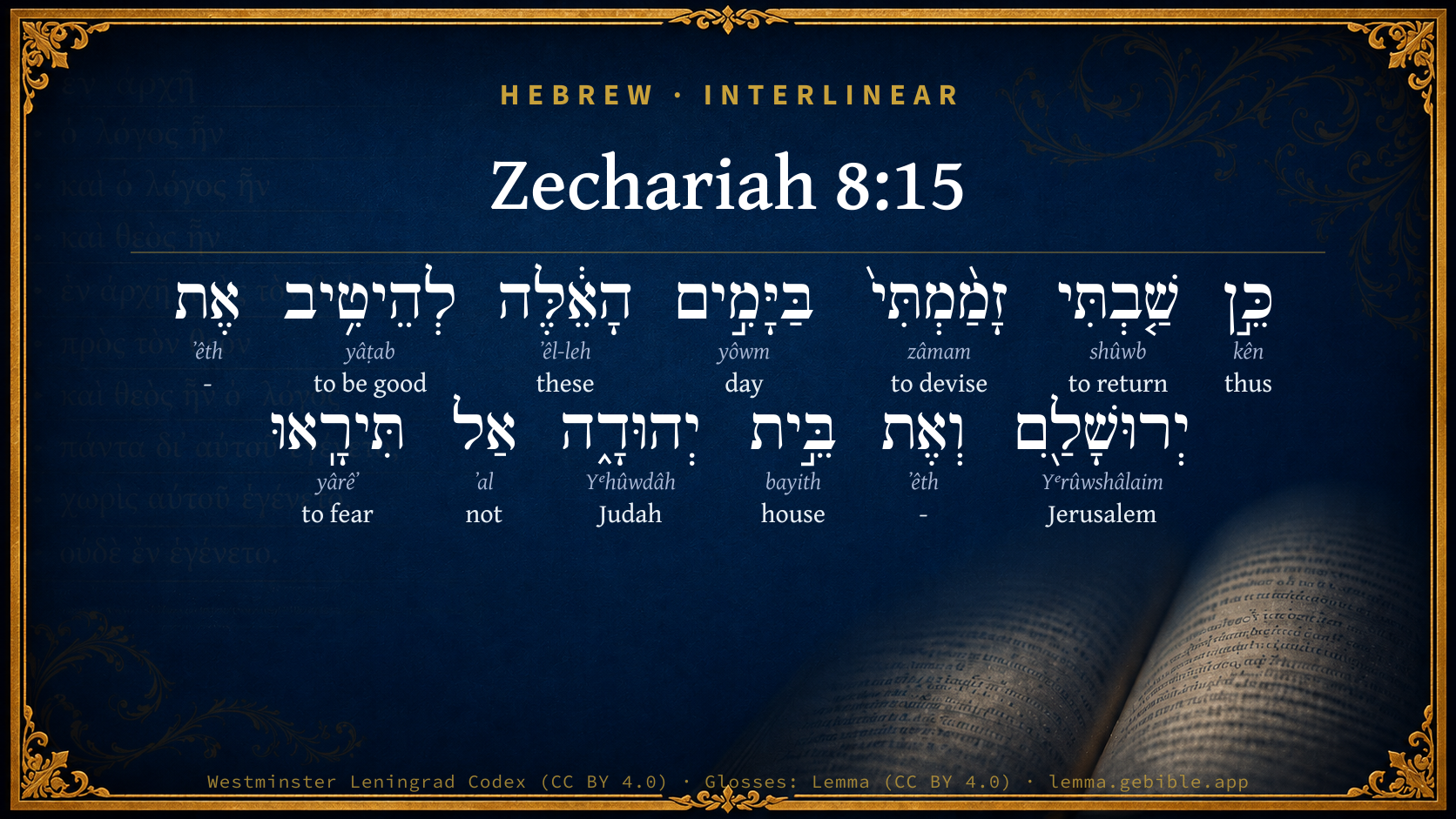
Hebrew (Westminster Leningrad Codex) Zechariah 8:15 appears in the Hebrew Old Testament. The text above is from the Westminster Leningrad Codex. Each word links to its Strong’s number, a concise gloss, and parsing drawn from the Open Scriptures Hebrew Bible morphology. Click any word for its full Brown-Driver-Briggs (BDB) entry.
Download image
Cite this verse

Zechariah 8:15 (World English Bible). Public Domain. Lemma interlinear Bible study tool, https://lemma.gebible.app/v/zechariah/8/15.

Show BibTeX & RIS
BibTeX
RIS
English Translation
so again have I thought in these days to do good to Jerusalem and to the house of Judah. Don't be afraid.
World English Bible · Public Domain
Download a study sheet

One document with this verse’s original text, its word-by-word gloss line, the meaning frame, cross-references with their text, attributed commentary, and full source and license credits — printable, and it pastes into notes with its structure intact.

This verse Autodidact and up

Study sheet (.html) Plain text (.txt)

A passage Seminary Student

Up to 50 verses in one chapter. A passage sheet keeps up to 6 commentary sources and 12 cross-references per verse, in the order this page ranks them, and says so on the sheet whenever that leaves anything out. Ask for a single verse and you get the Autodidact verse sheet above.

Everything on this page stays free to read, with no account — the sheet is a download of what is already on screen, not access to it.

Want to remove ads? Support Godless Engineer
Compare translations 3

The same verse in 3 English versions, stacked beneath the original-language interlinear above. Click any original word for its lexicon entry.

Each is an independent rendering of the whole verse — the interlinear is not word-aligned to these translations.

Highlighted words mark where these versions differ — a whole-verse word diff, not a word-by-word alignment.

  • World English Bible Public Domain
    so again have I thought in these days to do good to Jerusalem and to the house of Judah. Don't be afraid.
  • King James Version Public Domain
    So again have I thought in these days to do well unto Jerusalem and to the house of Judah: fear ye not.
  • unfoldingWord Literal Text CC BY-SA 4.0
    so also I will plan in these days to do good again to Jerusalem and the house of Judah! Do not fear!

unfoldingWord Literal Text — © unfoldingWord, licensed CC BY-SA 4.0. Word-aligned USFM3 via Door43 (git.door43.org/unfoldingWord/en_ult).

Versions to compare (up to 4)

3 of 4 selected

Show all 18 translations

Every available English version of this verse, each an independent rendering of the whole verse.

  • World English Bible Public Domain
    so again have I thought in these days to do good to Jerusalem and to the house of Judah. Don't be afraid.
  • Berean Standard Bible Public Domain
    “so now I have resolved to do good again to Jerusalem and Judah. Do not be afraid.
  • Majority Standard Bible Public Domain
    “so now I have resolved to do good again to Jerusalem and Judah. Do not be afraid.
  • King James Version Public Domain
    So again have I thought in these days to do well unto Jerusalem and to the house of Judah: fear ye not.
  • American Standard Version (1901) Public Domain
    so again have I thought in these days to do good unto Jerusalem and to the house of Judah: fear ye not.
  • Revised Version (1885) Public Domain
    so again have I thought in these days to do good unto Jerusalem and to the house of Judah: fear ye not.
  • Geneva Bible (1599) Public Domain
    So againe haue I determined in these daies to doe well vnto Ierusalem, and to the house of Iudah: feare ye not.
  • Douay-Rheims (1899) Public Domain
    And I had no mercy: so turning again I have thought in these days to do good to the house of Juda, and Jerusalem: fear not.
  • Young's Literal Translation Public Domain
    So I have turned back, I have purposed, in these days, To do good with Jerusalem, And with the house of Judah -- fear not!
  • Literal Standard Version CC BY-SA 4.0
    So I have turned back, I have purposed, in these days, || To do good with Jerusalem, || And with the house of Judah—do not fear!
  • Unlocked Literal Bible CC BY-SA 4.0
    so also I will plan in these days to do good again to Jerusalem and the house of Judah! Do not fear!
  • unfoldingWord Literal Text CC BY-SA 4.0
    so also I will plan in these days to do good again to Jerusalem and the house of Judah! Do not fear!
  • Darby Bible Public Domain
    so again have I thought in these days to do good unto Jerusalem and to the house of Judah: fear ye not.
  • World Messianic Bible Public Domain
    so again I have thought in these days to do good to Jerusalem and to the house of Judah. Don’t be afraid.
  • Webster's Bible Public Domain
    So again have I thought in these days to do good to Jerusalem and to the house of Judah: fear ye not.
  • Free Bible Version CC BY-SA 4.0
    But now I have made up my mind to do good to Jerusalem and the people of Judah. Don't be afraid!
  • Bible in Basic English Public Domain
    So in these days it is again my purpose to do good to Jerusalem and to the children of Judah: have no fear.
  • JPS Tanakh (1917) Public Domain
    so again do I purpose in these days to do good unto Jerusalem and to the house of Judah; fear ye not.

Literal Standard Version (2020), Covenant Press — licensed CC BY-SA 4.0. Text via the HelloAO Bible API (eBible.org). Unlocked Literal Bible (unfoldingWord) — licensed CC BY-SA 4.0. Text via the HelloAO Bible API (eBible.org). unfoldingWord Literal Text — © unfoldingWord, licensed CC BY-SA 4.0. Word-aligned USFM3 via Door43 (git.door43.org/unfoldingWord/en_ult). Free Bible Version, Dr. Jonathan Gallagher — licensed CC BY-SA 4.0. Text via the HelloAO Bible API (eBible.org).

Word by word

More ways to search: Search by grammar → Find every occurrence → Compare this word →

Practice this passage: Drill this verse → Learn its vocabulary →

זָמַ֨מְתִּי֙
zâmam
H2161
“to devise”
Verb, Qal, Perfect, 1st Person, Common, Singular
Part of Speech
Verb
Stem
Qal
Form
Perfect
Person
1st Person
Gender
Common
Number
Singular
Full BDB Definition

Origin: a primitive root

TWOT: 556

to have a thought, devise, plan, consider, purpose - (Qal) - to consider, fix thought upon - to purpose, devise - to plot (of evil intent)
  1. כֵּ֣ן kên H3651 “thus” Particle, Demonstrative
  2. שַׁ֤בְתִּי shûwb H7725 “to return” Verb, Qal, Perfect, 1st Person, Common, Singular
  3. בַּיָּמִ֣ים yôwm H3117 “in/at the · days” Preposition, Determined + Noun, Common, Masculine, Plural, Absolute
  4. הָאֵ֔לֶּה ʼêl-leh H428 “the · these” Particle, Definite Article + Pronoun, Demonstrative, Common, Plural
  5. לְהֵיטִ֥יב yâṭab H3190 “to be good” Preposition + Verb, Hiphil, Infinitive Construct
  6. אֶת ʼêth H853 “-” Particle, Direct Object
  7. יְרוּשָׁלִַ֖ם Yᵉrûwshâlaim H3389 “Jerusalem” Noun, Proper
  8. וְאֶת ʼêth H853 “and · -” Conjunction + Particle, Direct Object
  9. בֵּ֣ית bayith H1004 “house of” Noun, Common, Masculine, Singular, Construct
  10. יְהוּדָ֑ה Yᵉhûwdâh H3063 “Judah” Noun, Proper
  11. אַל ʼal H408 “not” Particle, Negative
  12. תִּירָֽאוּ yârêʼ H3372 “to fear” Verb, Qal, Jussive, 2nd Person, Masculine, Plural

About this verse

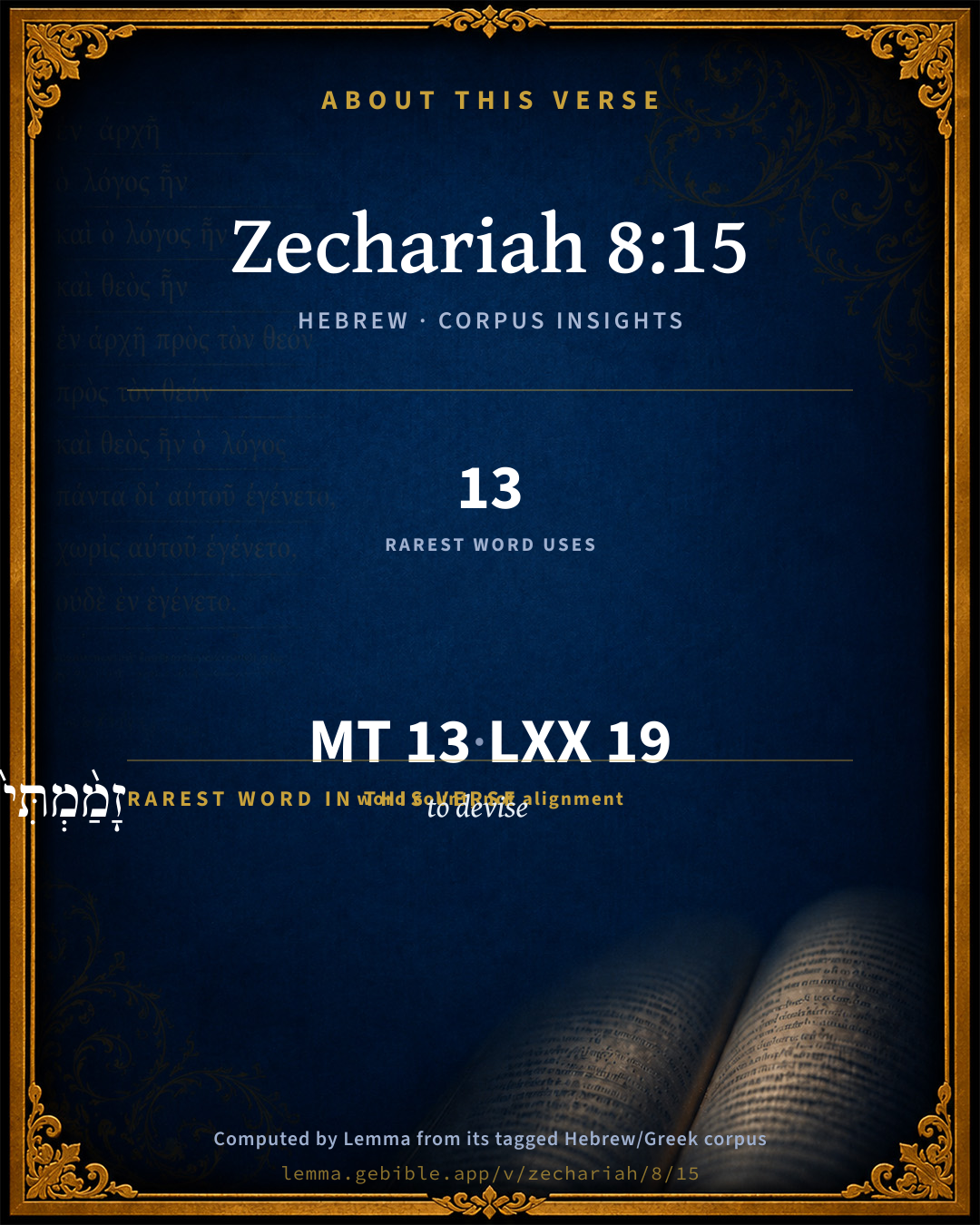
These counts appear in no published source. They are computed here, from the morphology-tagged text and Lemma’s own curated glosses. What Lemma adds →

13
words
12
distinct lemmas
Prophets
section

Notable vocabulary

The rarest word here is זָמַ֨מְתִּי֙ to devise H2161 — appearing just 13 times in the whole Hebrew Bible.

Shared distinctive vocabulary

זָמַ֨מְתִּי֙ to devise H2161 occurs in 13 verses of the Hebrew Bible. Also found in:

Grammatical profile

  • 4 verbs
  • 4 nouns
  • 1 pronoun
  • 4 particles

Verb forms

  • שַׁ֤בְתִּי Qal · Perfect
  • זָמַ֨מְתִּי֙ Qal · Perfect
  • לְהֵיטִ֥יב Hiphil · Infinitive Construct
  • תִּירָֽאוּ Qal · Jussive

Hebrew & Septuagint length

In English translation the verse runs 22 words from the Hebrew and 26 from the Septuagint (LXX English) — closely comparable.

A rough comparison of the two English renderings, which tokenize alike — not a word-level alignment.

Word counts can differ between the Hebrew and the Greek without any difference in meaning — e.g. the Hebrew direct-object marker אֵת has no separate Greek word, and Greek often adds the article ὁ.

In the original languages it is 13 Hebrew tokens and 19 Greek tokens — but the two are counted differently (Hebrew bundles its prefixes and suffixes into one token; the Greek is in lemma form), so that isn’t a like-for-like length.

Cross-references

8

Topical passages linked to Zechariah 8:15 in the Treasury of Scripture Knowledge — connected by theme and wording, ordered by reader-vote popularity; previews shown in the World English Bible.

  • Zechariah 8:13 It shall come to pass that, as you were a curse among the nations, house of Judah and house of Israel, so will I save you, and you shall be a blessing. Don't be afraid. Let your hands be strong."
  • Micah 7:18–20 Who is a God like you, who pardons iniquity, And passes over the disobedience of the remnant of his heritage? He doesn't retain his anger forever, Because he delights in loving kindness.
  • Luke 12:32 Don't be afraid, little flock, for it is your Father's good pleasure to give you the Kingdom.
  • Jeremiah 29:11–14 For I know the thoughts that I think toward you, says Yahweh, thoughts of peace, and not of evil, to give you hope in your latter end.
  • Jeremiah 32:42 For thus says Yahweh: Like as I have brought all this great evil on this people, so will I bring on them all the good that I have promised them.
  • Micah 4:10–13 Be in pain, and labor to bring forth, daughter of Zion, Like a woman in travail; For now you will go forth out of the city, And will dwell in the field, And will come even to Babylon. There you will be rescued. There Yahweh will redeem you from the hand of your enemies.
  • Isaiah 43:1–2 But now thus says Yahweh who created you, Jacob, and he who formed you, Israel: Don't be afraid, for I have redeemed you; I have called you by your name, you are mine.
  • Zephaniah 3:16–17 In that day, it will be said to Jerusalem, "Don't be afraid, Zion. Don't let your hands be slack."

Cross-references courtesy of OpenBible.info (CC BY 4.0).

Hebrew and Greek witnesses Masoretic Hebrew ↔ Greek Septuagint

The same verse in the two great witnesses to the Old Testament, shown verse-for-verse.

These are two independent witnesses, not word-aligned to each other, and the Septuagint is shown in lemma (dictionary) form.

Hebrew Zechariah 8:15 Masoretic · Westminster Leningrad Codex

כֵּ֣ן שַׁ֤בְתִּי זָמַ֨מְתִּי֙ בַּיָּמִ֣ים הָאֵ֔לֶּה לְהֵיטִ֥יב אֶת יְרוּשָׁלִַ֖ם וְאֶת בֵּ֣ית יְהוּדָ֑ה אַל תִּירָֽאוּ

so again have I thought in these days to do good to Jerusalem and to the house of Judah. Don't be afraid.

World English Bible · Public Domain

Greek LXX Zechariah 8:15 Septuagint · lemma form

οὕτως παρατάσσω καί δια ἀνανοέομαι ἐν ὁ ἡμέρα οὗτος ὁ καλῶς ποιέω ὁ ἰερουσαλήμ καί ὁ οἶκος ιουδα θαρρέω

so have I prepared and taken counsel in these days to do good to Jerusalem and to the house of Juda: be you⌃ of good courage.

LXX2012 (modern English Septuagint) · Public Domain

On this verse, The Pulpit Commentary discusses the Septuagint’s reading. Read the note in Commentary ↓

Hebrew: Westminster Leningrad Codex (CC BY 4.0). Greek: Septuagint (public domain); English from LXX2012 (modern English Septuagint) (Public Domain). How the Septuagint differs from the Hebrew →

Targum (Aramaic paraphrase)

1

The Targum is the ancient Jewish Aramaic paraphrase of the Hebrew Scriptures — an interpretive translation, not the Hebrew text itself. Onkelos (literal) and Pseudo-Jonathan (expansive) render the Torah, and Jonathan the Prophets. Coverage is partial: where no permissively-licensed English translation exists for a verse, only the Aramaic is shown. This is verse-level text, not a word-by-word alignment to the Hebrew.

  1. Targum Jonathan Prophets (Joshua–Malachi)
    כֵּן תָּבֵית הֲשִׁיבֵית בְיוֹמַיָא הָאִלֵין לְאַיטָבָא לְיַתְבֵי יְרוּשְׁלֵם וְלִדְבֵית יְהוּדָה לָא תִדְחֲלוּן:

    (no public-domain English translation for this verse)

    Targum Jonathan — Aramaic: “Mikraot Gedolot” (public domain). English: “Sefaria Community Translation” (CC0 1.0 (public-domain dedication)); “London "Chaldee Paraphrase," 1871” (public domain). Text via Sefaria.

Commentary

Notes on Zechariah 8:15 from classic Christian and Jewish commentators (each source and its license shown beneath its notes). The classic Christian expositions comment on the surrounding passage and are grouped to its opening verse, so a note may address several verses; the Jewish commentaries on the Tanakh (Rashi and others) are per-verse, so they appear only where the commentator wrote on this verse.

Lemma curates 59 commentaries, every one of them public domain or Creative Commons licensed, each selected and text-cleaned for this edition rather than reprinted as found. About our sources →

Trapp's Complete Commentary

John Trapp

Zec 8:15 So again have I thought in these days to do well unto Jerusalem and to the house of Judah: fear ye not.

Ver. 15. So again have I thought] Sic conversus sum. This change was not in God, but in the people, to whom he is now resolved to show mercy, and that from a gracious purpose and determination, such as altereth not.

Fear ye not] Faith quelleth and killeth distrustful fear; but awful dread breedeth it, feedeth, fostereth, and cherisheth.

John Trapp, A Commentary or Exposition upon All the Books of the Old and New Testament (1647–1656) — public domain. Text from a community e-Sword module.

Geneva Bible (1599)

Geneva Bible translators

Which declareth that man cannot turn to God till he changes man’s heart by his spirit, and so begin to do well, which is to pardon his sins and to give him his graces.

Geneva Bible (1599) marginal notes — public domain. Text via Bolls.life.

John Calvin's Commentaries

Now at the end of the verse the Prophet reminds us of the application of his doctrine, even to encourage the Jews, that they might go on with alacrity in the work of building the temple. But we have said that we ought to be armed with God’s promises, so that we may with courageous hearts follow wherever he may call us; for we shall all presently faint except we find that the hand of God is present with us. Since then we are by nature slothful and tender, and since inconstancy often creeps in, this is our only remedy, — that when we seek to go on in the course of our calling to the end, we know that God will be ever a help to us; and this is what the Prophet now teaches us. He then applies what he had before promised to its legitimate purpose, — to encourage the Jews to lay aside their fear, courageously to undertake their work, and to expect what was not yet evident, even a complete restoration. It follows —

John Calvin's Commentaries (1540-1563) — public domain. Text from the Calvin Translation Society English edition (1840s-50s) via the Christian Classics Ethereal Library (ccel.org). Calvin's coverage is partial (roughly two-thirds of the Bible); uncommented books and verses are honest gaps, never fabricated. The 19th-century editor's footnotes and remarks are omitted so the notes are faithfully Calvin's own voice.

John Gill's Exposition

These are the things that ye shall do,.... Which were duties incumbent on them, and which it became them to perform, under a sense of the favours bestowed on them, to show their gratitude to God, and that they might glorify him:

Speak ye every man the truth to his neighbour; not using deceit, prevarication, and lying, Eph 4:25 and it becomes every man under the Gospel dispensation, according to the gift he has received, to speak, publish, and declare the truth of the Gospel, to the edification of others:

execute the judgment of truth and peace in your gates; that is, execute true judgment, as in Zac 7:9 do justice between man and man, without respect of persons; the issue of which will be peace between the contending parties: and this was to be done in their "gates", because there their courts of judicature were kept.

John Gill's Exposition of the Whole Bible (1746–1763) — public domain (CC PDM 1.0). Text via the HelloAO Bible API.

Albert Barnes' Notes on the Bible

So have I turned and purposed in these days to do well unto Jerusalem - Dionysius: “God, to be better understood, speaketh with the feelings and after the manner of men, although, in the passionless and unchangeable God, there is no provocation to anger, nor turning, implying change in Himself.” So He says by Jeremiah, “I know the thoughts that I think toward you, saith the Lord, thoughts of peace and not of evil” Jer 29:11. And, with the same contrast as here, “As I have watched over them to pluck up and to break down and to throw down, and to destroy and to afflict, so will I watch over them, to build and to plant, saith the Lord” Jer 31:28. His having done what He purposed before was an earnest the more, that He would do what He purposed now. His chastisements were the earnests of His mercies; for they too were an austere form of His love. Osorius: “When the Lord stretches out His hand to strike those who are contumacious in guilt, none can hold His hand that He exact not the due punishment. Therefore He says, that He repented not; so, when He receives to grace those who repent of their sins, no one can any way delay the course of His benevolence. “For the gifts and calling of God are without repentance” Rom 11:29.

And to the house of Judah - Ribera: He speaks to the two tribes, not to, or of the ten, because Christ was to come to the two tribes, and Zechariah was prophesying to them, and they were to be admonished to prepare themselves in good works, lest the coming of Christ should not profit them, on account of their depraved ways. But the ten tribes were far off in the cities of the Medes, nor was Christ to come to them; but they were to hear the Gospel through the Apostles, and so he prophesies of the conversion of all to the glory of Christ, yet he could not admonish all, but those only to whom he was sent.

Albert Barnes' Notes on the Bible (1834–1885) — public domain. Text from a community e-Sword/MySword module.

Matthew Poole's English Annotations

So again; so with like steadiness of mind with an equal unchangeableness, I have purposed and promised to do well to you, O inhabitants of Jerusalem and house of Judah.

Fear ye not; for if in punishing, which I love not, I was constant, in blessing, which pleaseth me, I cannot but be constant.

Matthew Poole's English Annotations on the Holy Bible (1683–1685) — public domain. Text from a community e-Sword/MySword module.

The Pulpit Commentary

So again have I thought, etc. The past chastisement, which happened as it was threatened, is a guarantee of the fulfilment of the promised blessing. But there is a condition to be observed, which is set forth in the two next verses. The LXX has, "So have I ordered and purposed." In these special blessings Judah and Jerusalem alone were to share at the first; Israel"s happy time (ver. 13) was to come later.

The Pulpit Commentary (1880–1919), ed. H.D.M. Spence-Jones & Joseph S. Exell — public domain. Text from a community e-Sword module.

John Wesley's Explanatory Notes

So - So with like steadiness of mind I have purposed to do well to you.

John Wesley, Explanatory Notes Upon the Whole Bible (1754–1765) — public domain. Text via the GEBible commentary corpus.

Lesson kit

Teaching starters — assembled from the data on this page, not authored interpretation. Every prompt links to the verse data it draws on. Edit before teaching.

Zechariah, in the Prophets, opens this verse with 13 words (12 distinct Hebrew lemmas). Its most distinctive word is zâmam (“to devise”). A historical commentator’s framing appears above. Read the whole chapter for the surrounding context.

Discussion questions

  1. The word zâmam carries the sense “to devise.” How does it shape the verse?
  2. How does Genesis 11:6, which shares the word «to devise», read alongside this verse?
  3. These translations render this verse differently; the difference is in the English rendering, not the original. What questions does that raise?
  4. «שַׁ֤בְתִּי» is a Qal Perfect verb. How does that grammatical form shape the action described?
  5. Compare how Trapp's Complete Commentary and Geneva Bible (1599) read this verse. Where do they agree or differ?

Things to notice

Reading settings

Reading text

Shown beneath each verse's original-language words.

Old Testament
Old Testament edition

Read the OT as the Masoretic Hebrew (MT) or the Greek Septuagint (LXX).

English shown for the Greek Septuagint (in the Hebrew ↔ Greek comparison).

Comparing translations? Open the Compare panel on any verse page to stack up to four side by side.