
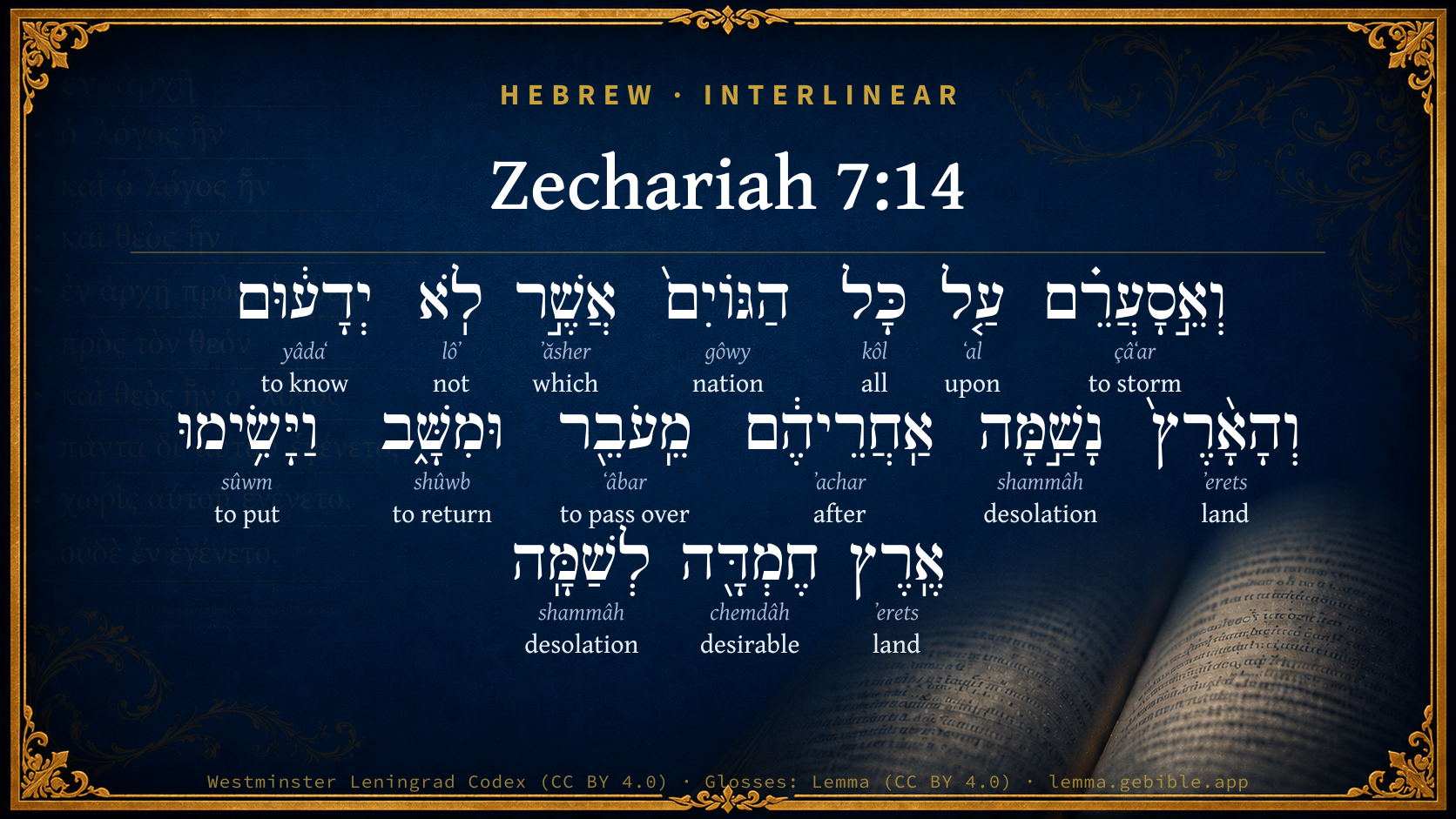
Zechariah 7:14

Hebrew (Westminster Leningrad Codex) Zechariah 7:14 appears in the Hebrew Old Testament. The text above is from the Westminster Leningrad Codex. Each word links to its Strong’s number, a concise gloss, and parsing drawn from the Open Scriptures Hebrew Bible morphology. Click any word for its full Brown-Driver-Briggs (BDB) entry.
Download image
Cite this verse

Zechariah 7:14 (World English Bible). Public Domain. Lemma interlinear Bible study tool, https://lemma.gebible.app/v/zechariah/7/14.

Show BibTeX & RIS
BibTeX
RIS
English Translation
"but I will scatter them with a whirlwind among all the nations which they have not known. Thus the land was desolate after them, so that no man passed through nor returned: for they made the pleasant land desolate."
World English Bible · Public Domain
Download a study sheet

One document with this verse’s original text, its word-by-word gloss line, the meaning frame, cross-references with their text, attributed commentary, and full source and license credits — printable, and it pastes into notes with its structure intact.

This verse Autodidact and up

Study sheet (.html) Plain text (.txt)

A passage Seminary Student

Up to 50 verses in one chapter. A passage sheet keeps up to 6 commentary sources and 12 cross-references per verse, in the order this page ranks them, and says so on the sheet whenever that leaves anything out. Ask for a single verse and you get the Autodidact verse sheet above.

Everything on this page stays free to read, with no account — the sheet is a download of what is already on screen, not access to it.

Want to remove ads? Support Godless Engineer
Compare translations 3

The same verse in 3 English versions, stacked beneath the original-language interlinear above. Click any original word for its lexicon entry.

Each is an independent rendering of the whole verse — the interlinear is not word-aligned to these translations.

Highlighted words mark where these versions differ — a whole-verse word diff, not a word-by-word alignment.

  • World English Bible Public Domain
    "but I will scatter them with a whirlwind among all the nations which they have not known. Thus the land was desolate after them, so that no man passed through nor returned: for they made the pleasant land desolate."
  • King James Version Public Domain
    But I scattered them with a whirlwind among all the nations whom they knew not. Thus the land was desolate after them, that no man passed through nor returned: for they laid the pleasant land desolate.
  • unfoldingWord Literal Text CC BY-SA 4.0
    “and I will scatter them over all the nations that not they had known. And the land was made desolate after them, with none passing through or returning. And they made the land of delight into a desolation.”

unfoldingWord Literal Text — © unfoldingWord, licensed CC BY-SA 4.0. Word-aligned USFM3 via Door43 (git.door43.org/unfoldingWord/en_ult).

Versions to compare (up to 4)

3 of 4 selected

Show all 18 translations

Every available English version of this verse, each an independent rendering of the whole verse.

  • World English Bible Public Domain
    "but I will scatter them with a whirlwind among all the nations which they have not known. Thus the land was desolate after them, so that no man passed through nor returned: for they made the pleasant land desolate."
  • Berean Standard Bible Public Domain
    But I scattered them with a whirlwind among all the nations that they had not known, and the land was left desolate behind them so that no one could come or go. Thus they turned the pleasant land into a desolation.”
  • Majority Standard Bible Public Domain
    But I scattered them with a whirlwind among all the nations that they had not known, and the land was left desolate behind them so that no one could come or go. Thus they turned the pleasant land into a desolation.”
  • King James Version Public Domain
    But I scattered them with a whirlwind among all the nations whom they knew not. Thus the land was desolate after them, that no man passed through nor returned: for they laid the pleasant land desolate.
  • American Standard Version (1901) Public Domain
    but I will scatter them with a whirlwind among all the nations which they have not known. Thus the land was desolate after them, so that no man passed through nor returned: for they laid the pleasant land desolate.
  • Revised Version (1885) Public Domain
    but I will scatter them with a whirlwind among all the nations whom they have not known. Thus the land was desolate after them, that no man passed through nor returned: for they laid the pleasant land desolate.
  • Geneva Bible (1599) Public Domain
    But I scattered them among all the nations, whom they knew not: thus the land was desolate after them, that no man passed through nor returned: for they layd the pleasant land waste.
  • Douay-Rheims (1899) Public Domain
    And I dispersed them throughout all kingdoms, which they know not: and the land was left desolate behind them, so that no man passed through or returned: and they changed the delightful land into a wilderness.
  • Young's Literal Translation Public Domain
    And I toss them on all the nations, That they have not known, The land hath been desolate behind them, Of any passing by and turning back, And they set a desirable land for a desolation!
  • Literal Standard Version CC BY-SA 4.0
    “And I toss them on all the nations, || That they have not known, || The land has been desolate behind them, || Of any passing by and turning back, || And they set a desirable land for a desolation!”
  • Unlocked Literal Bible CC BY-SA 4.0
    For I will scatter them with a whirlwind to all the nations that they have not seen, and the land will be desolate after them. For no one will pass through the land or return to it since the people have made their delightful land into a wasteland.”
  • unfoldingWord Literal Text CC BY-SA 4.0
    “and I will scatter them over all the nations that not they had known. And the land was made desolate after them, with none passing through or returning. And they made the land of delight into a desolation.”
  • Darby Bible Public Domain
    and I scattered them with a whirlwind among all the nations whom they knew not, and the land was desolate after them, so that no one passed through nor returned; and they laid the pleasant land desolate.
  • World Messianic Bible Public Domain
    “but I will scatter them with a whirlwind among all the nations which they have not known. Thus the land was desolate after them, so that no man passed through nor returned; for they made the pleasant land desolate.”
  • Webster's Bible Public Domain
    But I scattered them with a whirlwind among all the nations whom they knew not. Thus the land was desolate after them, that no man passed through nor returned: for they laid the pleasant land desolate.
  • Free Bible Version CC BY-SA 4.0
    With the winds of a storm I scattered them among the nations where they lived as foreigners. The land they left became so desolate that no one even traveled through it. They turned the Promised Land into a desert.
  • Bible in Basic English Public Domain
    But with a storm-wind I sent them in flight among all the nations of whom they had no knowledge. So the land was waste after them, so that no man went through or came back: for they had made waste the desired land.
  • JPS Tanakh (1917) Public Domain
    but I will scatter them with a whirlwind among all the nations whom they have not known. Thus the land was desolate after them, so that no man passed through nor returned; for they laid the pleasant land desolate.'

Literal Standard Version (2020), Covenant Press — licensed CC BY-SA 4.0. Text via the HelloAO Bible API (eBible.org). Unlocked Literal Bible (unfoldingWord) — licensed CC BY-SA 4.0. Text via the HelloAO Bible API (eBible.org). unfoldingWord Literal Text — © unfoldingWord, licensed CC BY-SA 4.0. Word-aligned USFM3 via Door43 (git.door43.org/unfoldingWord/en_ult). Free Bible Version, Dr. Jonathan Gallagher — licensed CC BY-SA 4.0. Text via the HelloAO Bible API (eBible.org).

Word by word

More ways to search: Search by grammar → Find every occurrence → Compare this word →

Practice this passage: Drill this verse → Learn its vocabulary →

וְאֵ֣סָעֲרֵ֗ם
çâʻar
H5590
“and · to storm · them”
Conjunction + Verb, Piel, Imperfect, 1st Person, Common, Singular + Suffix, Personal, 3rd Person, Masculine, Plural
Part of Speech
Conjunction + Verb
Stem
Piel
Form
Imperfect
Person
1st Person
Gender
Common
Number
Singular
Full BDB Definition

Origin: a primitive root

TWOT: 1528b

to storm, rage - (Qal) - to storm - stormy, growing storm (participle) - (Niphal) to be enraged - (Piel) to storm away - (Pual) to be driven by storm
  1. עַ֤ל ʻal H5921 “upon” Preposition
  2. כָּל kôl H3605 “all of” Noun, Common, Masculine, Singular, Construct
  3. הַגּוֹיִם֙ gôwy H1471 “the · nations” Particle, Definite Article + Noun, Common, Masculine, Plural, Absolute
  4. אֲשֶׁ֣ר ʼăsher H834 “which” Particle, Relative
  5. לֹֽא lôʼ H3808 “not” Particle, Negative
  6. יְדָע֔וּם yâdaʻ H3045 “to know · them” Verb, Qal, Perfect, 3rd Person, Common, Plural + Suffix, Personal, 3rd Person, Masculine, Plural
  7. וְהָאָ֨רֶץ֙ ʼerets H776 “and · the · land” Conjunction + Particle, Definite Article + Noun, Common, Both, Singular, Absolute
  8. נָשַׁ֣מָּה shammâh H8047 “desolation” Verb, Niphal, Perfect, 3rd Person, Feminine, Singular
  9. אַֽחֲרֵיהֶ֔ם ʼachar H310 “after · them” Preposition + Suffix, Personal, 3rd Person, Masculine, Plural
  10. מֵֽעֹבֵ֖ר ʻâbar H5674 “from · passing over” Preposition + Verb, Qal, Participle Active, Masculine, Singular, Absolute
  11. וּמִשָּׁ֑ב shûwb H7725 “and · from · returning” Conjunction + Preposition + Verb, Qal, Participle Active, Masculine, Singular, Absolute
  12. וַיָּשִׂ֥ימוּ sûwm H7760 “and · to put” Conjunction + Verb, Qal, Sequential Imperfect, 3rd Person, Masculine, Plural
  13. אֶֽרֶץ ʼerets H776 “land of” Noun, Common, Both, Singular, Construct
  14. חֶמְדָּ֖ה chemdâh H2532 “desirable” Noun, Common, Feminine, Singular, Absolute
  15. לְשַׁמָּֽה shammâh H8047 “to/for · desolation” Preposition + Noun, Common, Feminine, Singular, Absolute

About this verse

These counts appear in no published source. They are computed here, from the morphology-tagged text and Lemma’s own curated glosses. What Lemma adds →

16
words
14
distinct lemmas
Prophets
section

Notable vocabulary

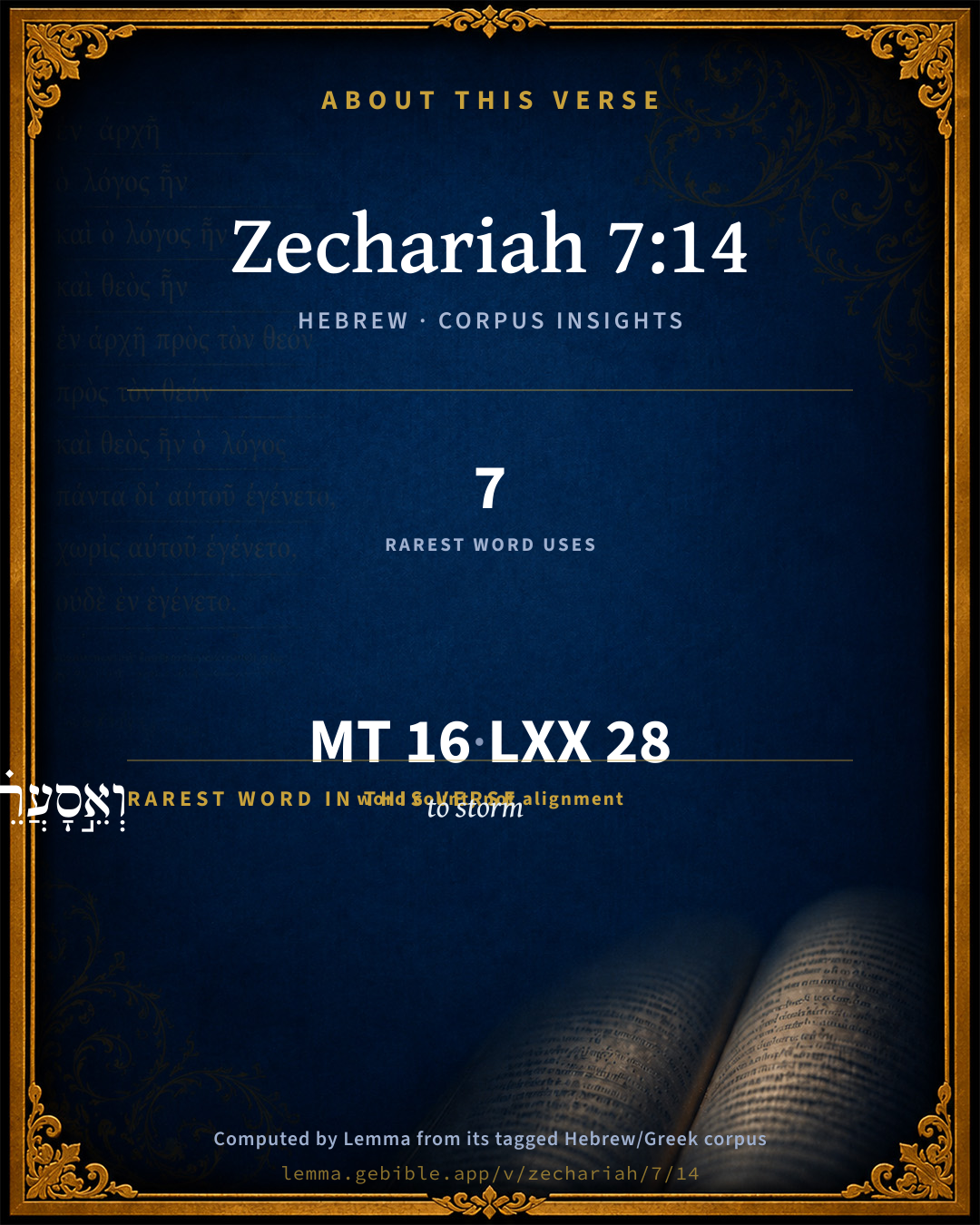
The rarest word here is וְאֵ֣סָעֲרֵ֗ם to storm H5590 — appearing just 7 times in the whole Hebrew Bible.

Shared distinctive vocabulary

וְאֵ֣סָעֲרֵ֗ם to storm H5590 occurs in 7 verses of the Hebrew Bible. Also found in:

Grammatical profile

  • 6 verbs
  • 6 nouns
  • 2 prepositions
  • 2 particles

Verb forms

  • וְאֵ֣סָעֲרֵ֗ם Piel · Imperfect
  • יְדָע֔וּם Qal · Perfect
  • נָשַׁ֣מָּה Niphal · Perfect
  • מֵֽעֹבֵ֖ר Qal · Participle Active
  • וּמִשָּׁ֑ב Qal · Participle Active
  • וַיָּשִׂ֥ימוּ Qal · Sequential Imperfect

Repetition

Words recur within this verse — often emphatic in Hebrew:

  • וְהָאָ֨רֶץ֙ land H776 ×2
  • נָשַׁ֣מָּה desolation H8047 ×2

Hebrew & Septuagint length

In English translation the verse runs 39 words from the Hebrew and 39 from the Septuagint (LXX English) — the same length.

A rough comparison of the two English renderings, which tokenize alike — not a word-level alignment.

Word counts can differ between the Hebrew and the Greek without any difference in meaning — e.g. the Hebrew direct-object marker אֵת has no separate Greek word, and Greek often adds the article ὁ.

In the original languages it is 16 Hebrew tokens and 28 Greek tokens — but the two are counted differently (Hebrew bundles its prefixes and suffixes into one token; the Greek is in lemma form), so that isn’t a like-for-like length.

Cross-references

27

Topical passages linked to Zechariah 7:14 in the Treasury of Scripture Knowledge — connected by theme and wording, ordered by reader-vote popularity; previews shown in the World English Bible.

  • Deuteronomy 28:33 The fruit of your ground, and all your labors, shall a nation which you don't know eat up; and you shall be only oppressed and crushed always;
  • Deuteronomy 28:64 Yahweh will scatter you among all peoples, from the one end of the earth even to the other end of the earth; and there you shall serve other gods, which you have not known, you nor your fathers, even wood and stone.
  • Jeremiah 23:19 Behold, the tempest of Yahweh, [even his] wrath, is gone forth, yes, a whirling tempest: it shall burst on the head of the wicked.
  • Deuteronomy 4:27 Yahweh will scatter you among the peoples, and you shall be left few in number among the nations, where Yahweh shall lead you away.
  • Jeremiah 5:15 Behold, I will bring a nation on you from far, house of Israel, says Yahweh: it is a mighty nation, it is an ancient nation, a nation whose language you don't know, neither understand what they say.
  • Deuteronomy 28:49 Yahweh will bring a nation against you from far, from the end of the earth, as the eagle flies; a nation whose language you shall not understand;
  • Zechariah 2:6 Come! Come! Flee from the land of the north,' says Yahweh; 'for I have spread you abroad as the four winds of the sky,' says Yahweh.
  • Leviticus 26:22 I will send the wild animals among you, which will rob you of your children, destroy your cattle, and make you few in number; and your roads will become desolate.
  • Leviticus 26:33 I will scatter you among the nations, and I will draw out the sword after you: and your land will be a desolation, and your cities shall be a waste.
  • 2 Chronicles 36:21 to fulfill the word of Yahweh by the mouth of Jeremiah, until the land had enjoyed its Sabbaths: [for] as long as it lay desolate it kept Sabbath, to fulfill seventy years.
  • Psalms 58:9 Before your pots can feel the heat of the thorns, He will sweep away the green and the burning alike.
  • Isaiah 17:13 The nations shall rush like the rushing of many waters: but he shall rebuke them, and they shall flee far off, and shall be chased as the chaff of the mountains before the wind, and like the whirling dust before the storm.
  • Isaiah 21:1 The burden of the wilderness of the sea. As whirlwinds in the South sweep through, it comes from the wilderness, from an awesome land.
  • Jeremiah 4:11–12 At that time shall it be said to this people and to Jerusalem, A hot wind from the bare heights in the wilderness toward the daughter of my people, not to winnow, nor to cleanse;
  • Jeremiah 25:32–33 Thus says Yahweh of hosts, Behold, evil shall go forth from nation to nation, and a great tempest shall be raised up from the uttermost parts of the earth.
  • Jeremiah 30:23 Behold, the tempest of Yahweh, [even his] wrath, is gone forth, a sweeping tempest: it shall burst on the head of the wicked.
  • Jeremiah 36:19 Then said the princes to Baruch, Go, hide you, you and Jeremiah; and let no man know where you are.
  • Jeremiah 44:6 Therefore my wrath and my anger was poured forth, and was kindled in the cities of Judah and in the streets of Jerusalem; and they are wasted and desolate, as it is this day.
  • Jeremiah 52:30 in the three and twentieth year of Nebuchadrezzar Nebuzaradan the captain of the guard carried away captive of the Jews seven hundred forty-five persons: all the persons were four thousand and six hundred.
  • Daniel 8:9 Out of one of them came forth a little horn, which grew exceeding great, toward the south, and toward the east, and toward the glorious [land].
  • Daniel 9:16–18 Lord, according to all your righteousness, let your anger and please let your wrath be turned away from your city Jerusalem, your holy mountain; because for our sins, and for the iniquities of our fathers, Jerusalem and your people are become a reproach to all who are round about us.
  • Amos 1:14 But I will kindle a fire in the wall of Rabbah, And it will devour its palaces, With shouting in the day of battle, With a tempest in the day of the whirlwind;
  • Nahum 1:3 Yahweh is slow to anger, and great in power, and will by no means leave the guilty unpunished. Yahweh has his way in the whirlwind and in the storm, and the clouds are the dust of his feet.
  • Habakkuk 3:14 You pierced the heads of his warriors with their own spears. They came as a whirlwind to scatter me, Gloating as if to devour the wretched in secret.
  • Zephaniah 3:6 I have cut off nations. Their battlements are desolate. I have made their streets waste, so that no one passes by. Their cities are destroyed, so that there is no man, so that there is no inhabitant.
  • Zechariah 9:14 Yahweh will be seen over them; And his arrow will go flash like lightning; And the Lord Yahweh will blow the trumpet, And will go with whirlwinds of the south.
  • Isaiah 66:15 For, behold, Yahweh will come with fire, and his chariots shall be like the whirlwind; to render his anger with fierceness, and his rebuke with flames of fire.

Cross-references courtesy of OpenBible.info (CC BY 4.0).

Hebrew and Greek witnesses Masoretic Hebrew ↔ Greek Septuagint

The same verse in the two great witnesses to the Old Testament, shown verse-for-verse.

These are two independent witnesses, not word-aligned to each other, and the Septuagint is shown in lemma (dictionary) form.

Hebrew Zechariah 7:14 Masoretic · Westminster Leningrad Codex

וְאֵ֣סָעֲרֵ֗ם עַ֤ל כָּל הַגּוֹיִם֙ אֲשֶׁ֣ר לֹֽא יְדָע֔וּם וְהָאָ֨רֶץ֙ נָשַׁ֣מָּה אַֽחֲרֵיהֶ֔ם מֵֽעֹבֵ֖ר וּמִשָּׁ֑ב וַיָּשִׂ֥ימוּ אֶֽרֶץ חֶמְדָּ֖ה לְשַׁמָּֽה

"but I will scatter them with a whirlwind among all the nations which they have not known. Thus the land was desolate after them, so that no man passed through nor returned: for they made the pleasant land desolate."

World English Bible · Public Domain

Greek LXX Zechariah 7:14 Septuagint · lemma form

καί ἐκβάλλω αὐτός εἰς πᾶς ὁ ἔθνος ὅς οὐ γιγνώσκω καί ὁ γῆ ἀπο ἀναἵζω κατόπισθεν αὐτός ἐκ διαὁδεύω καί ἐκ ἀναστρέφω καί τάσσω γῆ ἐκλεκτός εἰς ἀφανισμός

And I will cast them out among all the nations, whom they know not; and the land behind them shall be made utterly destitute of any going through or returning: yes they have made the choice land a desolation.

LXX2012 (modern English Septuagint) · Public Domain

On this verse, The Pulpit Commentary discusses the Septuagint’s reading. Read the note in Commentary ↓

Hebrew: Westminster Leningrad Codex (CC BY 4.0). Greek: Septuagint (public domain); English from LXX2012 (modern English Septuagint) (Public Domain). How the Septuagint differs from the Hebrew →

Targum (Aramaic paraphrase)

1

The Targum is the ancient Jewish Aramaic paraphrase of the Hebrew Scriptures — an interpretive translation, not the Hebrew text itself. Onkelos (literal) and Pseudo-Jonathan (expansive) render the Torah, and Jonathan the Prophets. Coverage is partial: where no permissively-licensed English translation exists for a verse, only the Aramaic is shown. This is verse-level text, not a word-by-word alignment to the Hebrew.

  1. Targum Jonathan Prophets (Joshua–Malachi)
    וַאֲבַדְרִינוּן בֵּינֵי עַמְמַיָא דִי לָא יַדְעוּנוּן וְאַרְעָא תִּצְדֵי בַתְרֵיהוֹן מִדְעָדַי וּמִדְתָאֵיב עַל דְשַׁוִיאוּ אַרְעָא דְחֶמְדָתָא לְצָדוּ:

    (no public-domain English translation for this verse)

    Targum Jonathan — Aramaic: “Mikraot Gedolot” (public domain). English: “Sefaria Community Translation” (CC0 1.0 (public-domain dedication)); “London "Chaldee Paraphrase," 1871” (public domain). Text via Sefaria.

Commentary

Notes on Zechariah 7:14 from classic Christian and Jewish commentators (each source and its license shown beneath its notes). The classic Christian expositions comment on the surrounding passage and are grouped to its opening verse, so a note may address several verses; the Jewish commentaries on the Tanakh (Rashi and others) are per-verse, so they appear only where the commentator wrote on this verse.

Lemma curates 59 commentaries, every one of them public domain or Creative Commons licensed, each selected and text-cleaned for this edition rather than reprinted as found. About our sources →

Trapp's Complete Commentary

John Trapp

Zec 7:14 But I scattered them with a whirlwind among all the nations whom they knew not. Thus the land was desolate after them, that no man passed through nor returned: for they laid the pleasant land desolate.

Ver. 14. But I scattered them with a whirlwind] This is the second part of their punishment. The first was no audience or help from heaven at their greatest need, Zec 7:13. This was the curse of Saul, 1Sa 28:15; of Moab, Isa 16:12; of David’s enemies, Psa 18:41. The next now is, they were dejected and dissipated, as the dust of the mountains before a whirlwind; cast out of their native soil, and carried, they knew not whither, with a great and fearful dispersion and discerption of the same body and nation.

Thus the land was desolate after them] This is the third degree of their grievous punishment, their land laid utterly waste and desolate; according to that, "God turneth a fruitful land into barrenness, for the wickedness of them that dwell therein," Psa 107:34. Here a learned expositor observeth a wonderful providence, that this pleasant country, left thus destitute of inhabitants, and compassed about with warlike nations, was not invaded and replanted by foreigners for seventy years’ time; but enjoyed her sabbaths, resting from tillage and all other employments.

For they laid the pleasant land desolate] They, by their sins, rather than the Babylonians by their armies, did all this spoil, as Daniel also confesseth, Dan 9:16, and Nehemiah, Neh 1:8. Sin is the great mischief-maker, hell-hag, {a} trouble maker, that hurled confusion over the world at first, and brings desolation still to pleasant countries. Palestine was very pleasant, not more by the nature of the soil than by God’s special blessing; a land that he had espied out for them, flowing with milk and honey, which was the glory of all lands, Eze 20:6. This land they had laid desolate, or for an astonishment, as some render it; or for an In qua quid? as Montanus reads it, What is here? Nothing of its old pleasantness.

{a} A diabolical or vile woman. ŒD

John Trapp, A Commentary or Exposition upon All the Books of the Old and New Testament (1647–1656) — public domain. Text from a community e-Sword module.

Tyndale Open Study Notes

Tyndale Open Resources

7:14 As with a whirlwind, I scattered them: The scattering of the Hebrews among the nations was one of the curses for violating the Mosaic covenant (Deut 28:36-37, 64). • The pleasant land was the land of God’s covenant promise (Ps 106:24; Jer 3:19). • Their land became . . . desolate through divine judgment on their covenant unfaithfulness and idolatry (Jer 12:10).

Tyndale Open Study Notes — © Tyndale Open Resources, licensed CC BY-SA 4.0. Text via the HelloAO Bible API.

Geneva Bible (1599)

Geneva Bible translators

By their sins whereby they provoked God’s anger.

That is, after they were called captive.

Geneva Bible (1599) marginal notes — public domain. Text via Bolls.life.

Jamieson, Fausset & Brown

Robert Jamieson, A. R. Fausset & David Brown

whirlwind--of wrath (Nah 1:3).

nations whom they knew not--foreign and barbarous.

desolate after them--after their expulsion and exile. It was ordered remarkably by God's providence, that no occupants took possession of it, but that during the Jews' absence it was reserved for them against their return after seventy years.

they laid . . . desolate--The Jews did so by their sins. The blame of their destruction lay with themselves, rather than with the Babylonians (Ch2 36:21).

pleasant land--Canaan. Literally, "the land of desire" (Jer 3:19).

Next: Zechariah Chapter 8

Jamieson, Fausset & Brown — Commentary Critical and Explanatory on the Whole Bible (1871) — public domain (CC PDM 1.0). Text via the HelloAO Bible API.

Adam Clarke's Commentary

Verse 14. I scattered them with a whirlwind] This refers to the swift victories and cruel conduct of the Chaldeans towards the Jews; they came upon them like a whirlwind; they were tossed to and fro, and up and down, everywhere scattered and confounded.

Adam Clarke's Commentary on the Bible (1810–1826) — public domain. Text from a community e-Sword/MySword module.

John Calvin's Commentaries

Here the Prophet concludes what he had been speaking of God’s vengeance, by which he had fully proved, that the sins of that nation had arrived to such a pitch, that there was no room for pardon. Hence he says, that they had been dispersed; for so I prefer to render the word, and the context seems to require this. Interpreters vary as to its meaning; and, indeed, the Hebrews themselves say, that this is a difficult passage, for, according to the rules of grammar, the word can hardly be made suitable to the context. But let us first see what the Prophet treats of; and secondly, what meaning, as the word signifies various things, is the most suitable.

The Prophet no doubt refers here to God’s vengeance, as evidenced by the dispersion of the Jews among many nations, not only when they were driven into exile, but also when scattered in various parts of the world. The verb, taken transitively, is by no means doubtful in its meaning, for סער, sor, means to move one from a place, or to expel, and that by force, inasmuch as it is derived from whirlwind. As it may therefore be here a transitive verb, I see no reason why we should seek other meanings at variance with the design and object of the Prophet. He then says, that the Jews had been dispersed — how? among all nations, that is, through all parts of the world; and then among unknown nations. Now we know, that the farther the exile, the more severe it is, for neighbors for the most part are the most humane; and when one is removed far to a barbarous nation, he would rather a hundred times to die on his journey than to live at a great distance from his country, and among a people of new and strange habits. The meaning is, that the Jews had been severely visited by God, not only because they had departed from his true worship and holy fear, but because they had been perverse, had rejected all sound doctrine, and had been deaf and indifferent to all admonitions. It was then for this reason that they had been dispersed among all nations

He afterwards adds, that the land after them became desolate that no one passed through it. This circumstance also, that God devoted the land to desolation, proved more fully his wrath: for when God imprints marks of his vengeance on the land, and on other harmless things, necessary for man’s support, it becomes evident that he is not lightly displeased with men. He then intimates, that God was not satisfied with the exile and dispersion of that people, but that he intended that there should be also visible marks of their wickedness in the sterility and desolation of the land itself: and that land, we know, was very fruitful, both by nature and by God’s blessing; for he had promised to give to the Israelites a land flowing with milk and honey. When this fruitfulness was turned to sterility, such a change ought to have roused the minds of all to consider the dreadful judgment of God. We now then see why the Prophet says, that the land after them, that is, after their departure, became desolate; for they had polluted the land so far as to constrain it, though innocent, to bear the judgment of God.

And he says further, that the desirable land became a waste, even through their fault. God was indeed the author of that waste, but Zechariah imputes this calamity to the people, because they had provoked God’s wrath, and procured this evil for themselves; yea, they had involved the land itself as it were in the same guilt, for it was cursed by God, though they had been driven hence to another country. Desirable land was a name often given to Judea, not only on account of its fruitfulness, and the abundance of its produce, but because God had chosen it for himself: for though that land excelled other lands in many respects, it is yet certain that its chief excellency consisted in this, — that God honored it with peculiar favor.

Zechariah then condemns the Jews, not only because they had by their own fault extinguished the favor as to the produce of the land, but because they had corrupted the land itself, which had been so singularly favored as to have become the habitation of God. And hence we more fully learn how great was the enormity of their sins, which caused God to devote to desolation a land chosen by himself; for, as we have said, it was no common honor for that land, in which God designed to be worshipped by his chosen and holy people, to have been destined by him to be made like Paradise. But when such an honor was turned to shame and perpetual reproach, it was clearly a remarkable sign of God’s wrath: and hence also becomes evident the impiety of that people who, as it had been said, turned aside God’s favor from the land, that not only it did not bring forth its usual produce, but that it also became, as it were, a disgraceful spectacle, and filled all with horror on seeing it so desolate, where was previously seen the temple and the worship of God.

John Calvin's Commentaries (1540-1563) — public domain. Text from the Calvin Translation Society English edition (1840s-50s) via the Christian Classics Ethereal Library (ccel.org). Calvin's coverage is partial (roughly two-thirds of the Bible); uncommented books and verses are honest gaps, never fabricated. The 19th-century editor's footnotes and remarks are omitted so the notes are faithfully Calvin's own voice.

The Cambridge Bible for Schools and Colleges

gen. ed. J. J. S. Perowne

14. with a whirlwind] Amo_1:14; Job_27:21.

whom they knew not] Deu_28:33; Jer_16:13.

after them] i.e. after they are removed from it.

passed through nor returned] as we say, went backward and forward. Eze_35:7. See note on Zec_9:8.

they laid] Either to be taken impersonally, it was laid; or they (the Jews) by their sins.

The Cambridge Bible for Schools and Colleges (gen. ed. J. J. S. Perowne; Cambridge University Press, 1878–1918) — public domain. Text from a community e-Sword module.

Albert Barnes' Notes on the Bible

But I scattered them - Rather, “And I will scatter them.” The saying continues what God had said that he had said, and which had come to pass. Among all nations whom they knew not. So God had repeatedly said by Jeremiah, “I will cast you out of this land into a land that ye know not, ye nor your fathers; where I will not show you favor” (Jer 16:13; add Jer 15:14; Jer 17:4). This was the aggravation of the original woe in the law: “The Lord shall bring a nation against thee from far, from the end of the earth, a nation whose tongue thou shalt not understand, a nation of fierce countenance” Deu 28:49-50. There was no mitigation of suffering, when the common bond between man and man, mutual speech, was wanting.

That no man passed through nor returned - Literally, “from passer through and from returner;” as in the prophecy of Alexander’s march and return, “because of him that passeth by and of him that returneth” Zec 9:8; and of Seir God saith, “I will cut off from him, passer-through and returner” . As we say, there shall be no traffic more through her.

And they made the pleasant land desolate - They were the doers of what they by their sins caused, by bringing down the judgments of God. Heretofore the land which God had given them, had been in our language “the envy” of all who knew it now they had made it into a desolation, one wide waste Joe 1:7; Isa 13:9; Jer 2:15; Jer 4:7; Jer 18:16; Jer 19:8; Jer 25:9; Jer 50:3; Jer 51:29.

Dionysius: “What is said in the beginning of the chapter against Jews who abstained indiscreetly, applies mystically to all, not inward, but rude Christians, who not being diligent enough but rather negligent about acts of piety and inward prayer and reformation of the powers of the soul, account highly of bodily exercises and outward observances, and use no slight scrupulosity as to things of less moment, and do not attend to the chief things, charity, humility, patience meekness. On these it must be inculcated, that if they wish their fasts and other outward exercises to please God, they must judge true judgment, and be compassionate, kind, liberal to their neighbors, keep their mind ever steadfast in God, cast away wholly all hardness of heart, and be soft and open to receive within them the word of God. Otherwise their land will be desolate, that is, deprived of the indwelling of the Holy Spirit, and they scattered amid various vices.” Jerome: “That which was formerly a pleasant land, and the hospice of the Trinity, is turned into a desert and dwelling-place of dragons.”

Albert Barnes' Notes on the Bible (1834–1885) — public domain. Text from a community e-Sword/MySword module.

Matthew Poole's English Annotations

But I scattered them; when they had so provoked me, I cast them out of their habitations, pursued them with the tempest of wrath that scattered them as I threatened.

With a whirlwind; irresistibly, suddenly, and tearing all into pieces, as whirlwinds do.

Among all the nations; all the heathen, that hated them and their ways.

Whom they know not; where they could have no pity, nor any relief, nor common commerce; but as barbarous usage as fierce and unintelligible enemies can give them.

Thus the land, once flowing with milk and honey, once full of cities, men, and cattle, now waste as a wilderness,

was desolate after them; either the Jews cast out, or the Chaldeans who cast them out.

No man passed through nor returned: it was not fit to make a road through a land so void of all necessaries, so full of wild and ravenous beasts, so unwholesome as to the air, &c.

For they, sinful Jews by their sins, fierce Chaldeans by their sword, and God by his just displeasure, laid the pleasant land most desolate and waste.

Matthew Poole's English Annotations on the Holy Bible (1683–1685) — public domain. Text from a community e-Sword/MySword module.

The Pulpit Commentary

I scattered them; I will scatter them. What had happened in the past is a sign of what shall befall them in the future in punishment of like obduracy. The form of the sentence denotes that God is recounting what he had said to the people in past time; hence it is best to translate the verbs in the future tense. Scattered them with a whirlwind; Septuagint, ekbalw autouv , "I will cast them out;" Vulgate, dispersi eos. (comp. Job_27:21 Amo_1:14) Nations whom they knew not. This is the usual phrase for people of strange tongue. (Deu_28:33 Jer_16:13) Thus the land was desolate. This was the result of God"s threatenings. Some make the words of Jehovah continue to "nor returned," but the punctuation is against them. After them; i.e. after they were carried away in captivity. No man passed through nor returned. No one went to and fro a picture of extreme desolation. (comp. Isa_33:8 Jer_9:12; and for the phrase, see Zec_9:8 Eze_35:7) For they laid the pleasant land desolate. The pronoun refers to the disobedient Jews, their sin being the cause of the desolation; or the verb may be taken impersonally, "So the pleasant land was made desolate." "The pleasant land" is literally, "the land of desire." Septuagint, ghn eklekthn . (Psa_106:24 Jer_3:19)

The Pulpit Commentary (1880–1919), ed. H.D.M. Spence-Jones & Joseph S. Exell — public domain. Text from a community e-Sword module.

John Wesley's Explanatory Notes

They laid the land desolate - By their sins.

John Wesley, Explanatory Notes Upon the Whole Bible (1754–1765) — public domain. Text via the GEBible commentary corpus.

Rashi

Rabbi Shlomo Yitzchaki (Rashi)

I will scatter them in exile. And so I did.

they made with their iniquity.

desolation And that brought about the fast (and the mourning), but now [I am jealous for Zion, etc.]

Rashi on the Tanakh — English translations: “The Judaica Press complete Tanach with Rashi, translated by A. J. Rosenberg” (CC BY 4.0); “Pentateuch with Rashi's commentary by M. Rosenbaum and A.M. Silbermann, 1929-1934” (public domain); “The Metsudah Tanach series, Lakewood, N.J” (CC BY 4.0); and “The Book of Joshua, Metsudah Publications, 1997” (CC BY 4.0). Text via Sefaria.

Lesson kit

Teaching starters — assembled from the data on this page, not authored interpretation. Every prompt links to the verse data it draws on. Edit before teaching.

Zechariah, in the Prophets, opens this verse with 16 words (14 distinct Hebrew lemmas). Its most distinctive word is çâʻar (“to storm”). A historical commentator’s framing appears above. Read the whole chapter for the surrounding context.

Discussion questions

  1. How does “to storm” (çâʻar) shape what this verse is saying?
  2. How does 2 Kings 6:11, which shares the word «to storm», read alongside this verse?
  3. What does the repetition of “land” (2× in this one verse) do in this verse?
  4. The translations on this page render this verse differently — a whole-verse word diff, not a word-by-word alignment. What might account for the different wordings?
  5. «וְאֵ֣סָעֲרֵ֗ם» is a Piel Imperfect verb. How does that grammatical form shape the action described?
  6. Compare how Trapp's Complete Commentary and Tyndale Open Study Notes read this verse. Where do they agree or differ?

Things to notice

Reading settings

Reading text

Shown beneath each verse's original-language words.

Old Testament
Old Testament edition

Read the OT as the Masoretic Hebrew (MT) or the Greek Septuagint (LXX).

English shown for the Greek Septuagint (in the Hebrew ↔ Greek comparison).

Comparing translations? Open the Compare panel on any verse page to stack up to four side by side.