Ezekiel 27:15

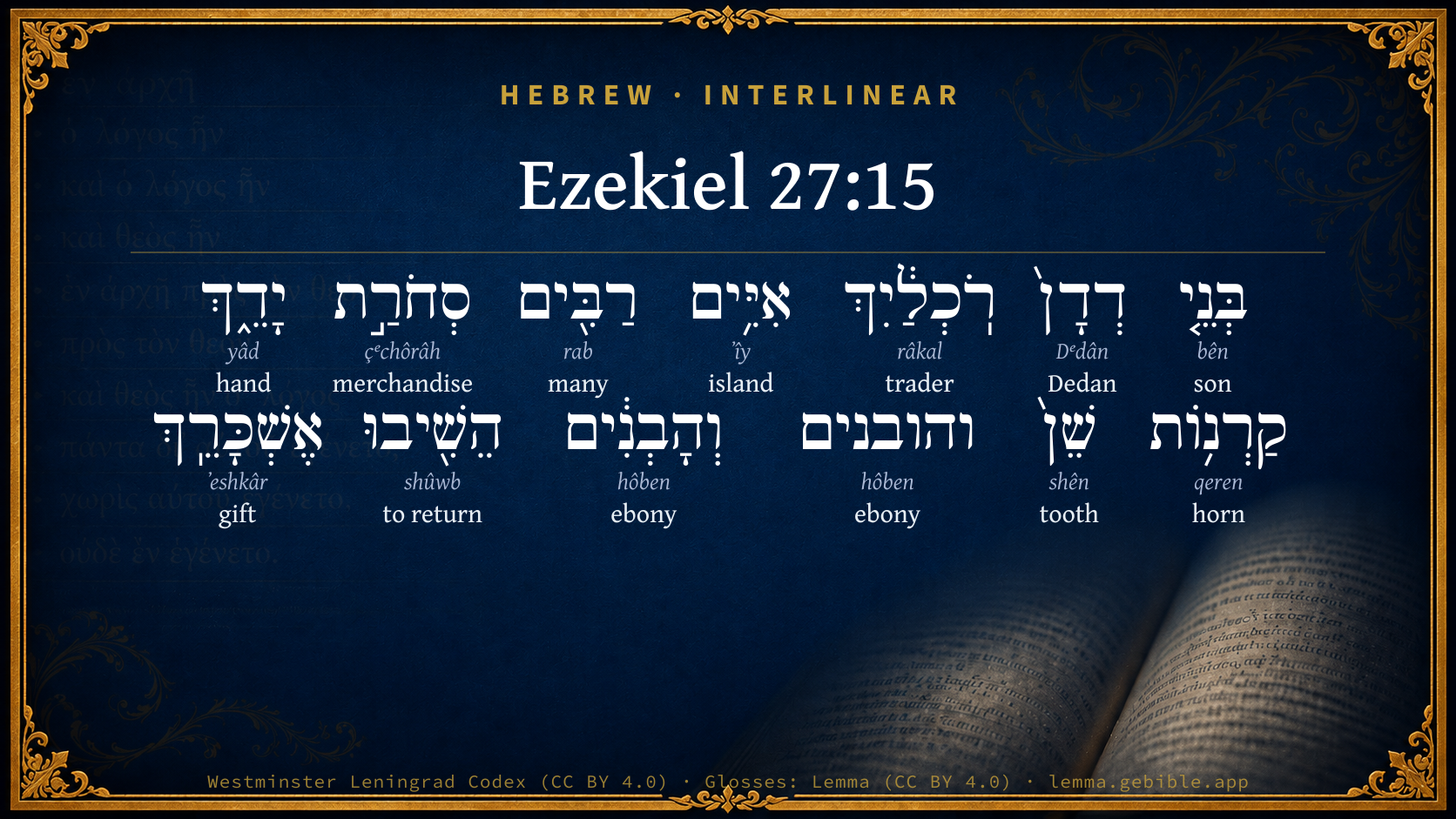
Hebrew (Westminster Leningrad Codex) Ezekiel 27:15 appears in the Hebrew Old Testament. The text above is from the Westminster Leningrad Codex. Each word links to its Strong’s number, a concise gloss, and parsing drawn from the Open Scriptures Hebrew Bible morphology. Click any word for its full Brown-Driver-Briggs (BDB) entry.
Download image
Cite this verse

Ezekiel 27:15 (World English Bible). Public Domain. Lemma interlinear Bible study tool, https://lemma.gebible.app/v/ezekiel/27/15.

Show BibTeX & RIS
BibTeX
RIS
English Translation
The men of Dedan were your traffickers; many isles were the market of your hand: they brought you in exchange horns of ivory and ebony.
World English Bible · Public Domain
Highlights
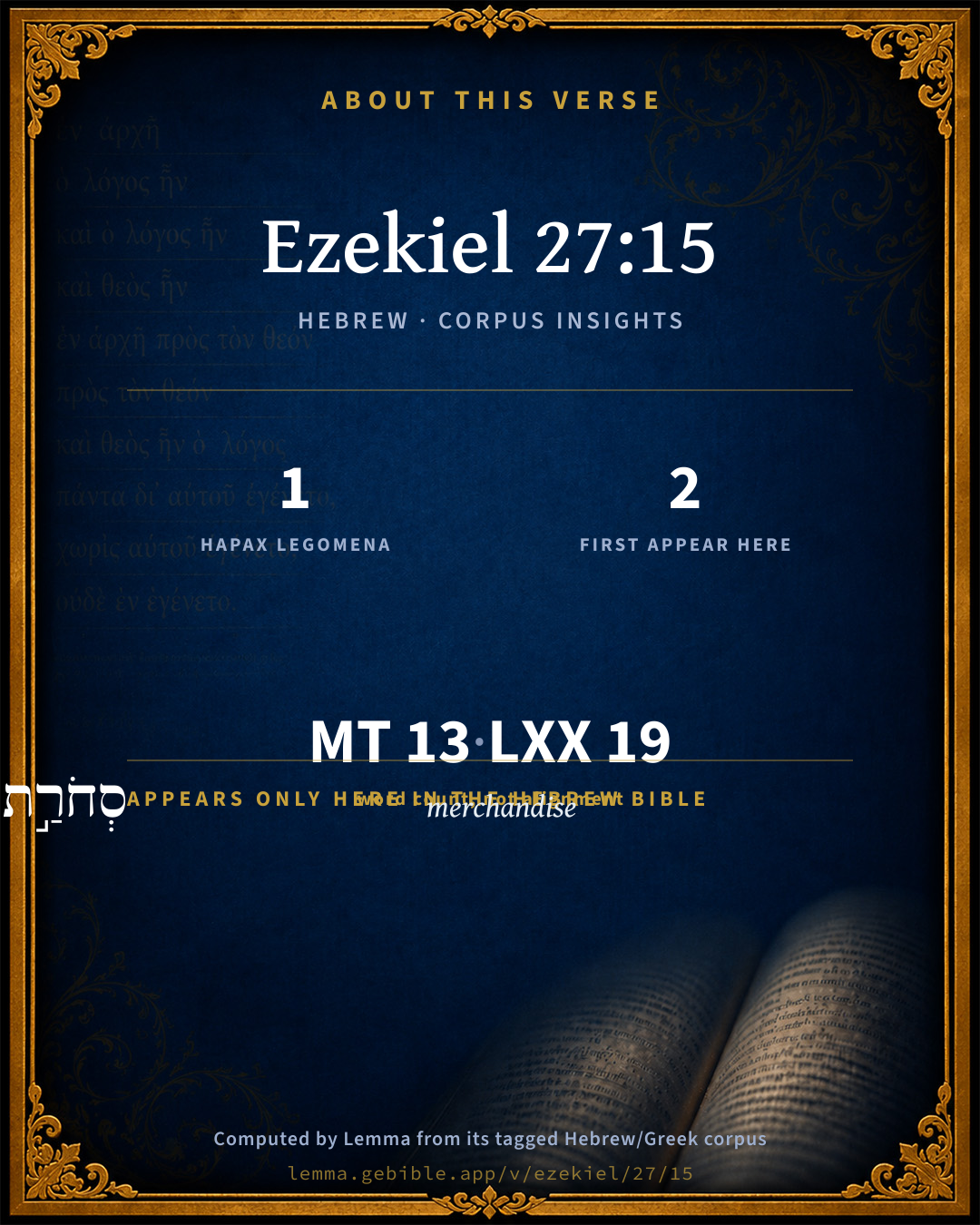
  • 1 hapax legomenon — only here in the Hebrew Bible
  • 2 first appearances in the Hebrew Bible
Full analysis ↓
Download a study sheet

One document with this verse’s original text, its word-by-word gloss line, the meaning frame, cross-references with their text, attributed commentary, and full source and license credits — printable, and it pastes into notes with its structure intact.

This verse Autodidact and up

Study sheet (.html) Plain text (.txt)

A passage Seminary Student

Up to 50 verses in one chapter. A passage sheet keeps up to 6 commentary sources and 12 cross-references per verse, in the order this page ranks them, and says so on the sheet whenever that leaves anything out. Ask for a single verse and you get the Autodidact verse sheet above.

Everything on this page stays free to read, with no account — the sheet is a download of what is already on screen, not access to it.

Want to remove ads? Support Godless Engineer
Compare translations 3

The same verse in 3 English versions, stacked beneath the original-language interlinear above. Click any original word for its lexicon entry.

Each is an independent rendering of the whole verse — the interlinear is not word-aligned to these translations.

Highlighted words mark where these versions differ — a whole-verse word diff, not a word-by-word alignment.

  • World English Bible Public Domain
    The men of Dedan were your traffickers; many isles were the market of your hand: they brought you in exchange horns of ivory and ebony.
  • King James Version Public Domain
    The men of Dedan were thy merchants; many isles were the merchandise of thine hand: they brought thee for a present horns of ivory and ebony.
  • unfoldingWord Literal Text CC BY-SA 4.0
    The men of Rhodes were your traders on many coasts. Merchandise was in your hand; they sent back horn, ivory, and ebony as tribute!

unfoldingWord Literal Text — © unfoldingWord, licensed CC BY-SA 4.0. Word-aligned USFM3 via Door43 (git.door43.org/unfoldingWord/en_ult).

Versions to compare (up to 4)

3 of 4 selected

Show all 18 translations

Every available English version of this verse, each an independent rendering of the whole verse.

  • World English Bible Public Domain
    The men of Dedan were your traffickers; many isles were the market of your hand: they brought you in exchange horns of ivory and ebony.
  • Berean Standard Bible Public Domain
    The men of Dedan were your clients; many coastlands were your market; they paid you with ivory tusks and ebony.
  • Majority Standard Bible Public Domain
    The men of Dedan were your clients; many coastlands were your market; they paid you with ivory tusks and ebony.
  • King James Version Public Domain
    The men of Dedan were thy merchants; many isles were the merchandise of thine hand: they brought thee for a present horns of ivory and ebony.
  • American Standard Version (1901) Public Domain
    The men of Dedan were thy traffickers; many isles were the mart of thy hand: they brought thee in exchange horns of ivory and ebony.
  • Revised Version (1885) Public Domain
    The men of Dedan were thy traffickers: many isles were the mart of thine hand: they brought thee in exchange horns of ivory and ebony.
  • Geneva Bible (1599) Public Domain
    The men of Dedan were thy marchantes: and the marchandise of many yles were in thine handes: they brought thee for a present hornes, teeth, and peacockes.
  • Douay-Rheims (1899) Public Domain
    The men of Dedan were thy merchants: many islands were the traffic of thy hand, they exchanged for thy price teeth of ivory and ebony.
  • Young's Literal Translation Public Domain
    Sons of Dedan `are' thy merchants, Many isles `are' the mart of thy hand, Horns of ivory and ebony they sent back thy reward.
  • Literal Standard Version CC BY-SA 4.0
    Sons of Dedan [are] your merchants, || Many islands [are] the market of your hand, || They sent back horns of ivory and ebony [for] your reward.
  • Unlocked Literal Bible CC BY-SA 4.0
    The men of Rhodes were your traders on many coasts. Merchandise was in your hand; they sent back horn, ivory, and ebony as tribute!
  • unfoldingWord Literal Text CC BY-SA 4.0
    The men of Rhodes were your traders on many coasts. Merchandise was in your hand; they sent back horn, ivory, and ebony as tribute!
  • Darby Bible Public Domain
    The children of Dedan were thy traffickers; many isles were the mart of thy hand: they rendered in payment horns of ivory, and ebony.
  • World Messianic Bible Public Domain
    “‘“The men of Dedan traded with you. Many islands were the market of your hand. They brought you horns of ivory and ebony in exchange.
  • Webster's Bible Public Domain
    The men of Dedan were thy merchants; many isles were the merchandise of thy hand: they brought thee for a present horns of ivory and ebony.
  • Free Bible Version CC BY-SA 4.0
    People from Dedan traded with you. You had marketplaces in many coastal areas where the people bartered with you using ivory tusks and ebony wood.
  • Bible in Basic English Public Domain
    The men of Rodan were your traders: a great number of sea-lands did business with you: they gave you horns of ivory and ebony as an offering.
  • JPS Tanakh (1917) Public Domain
    The men of Dedan were thy traffickers; many isles were the mart of thy hand; they brought thee as tribute horns of ivory and ebony.

Literal Standard Version (2020), Covenant Press — licensed CC BY-SA 4.0. Text via the HelloAO Bible API (eBible.org). Unlocked Literal Bible (unfoldingWord) — licensed CC BY-SA 4.0. Text via the HelloAO Bible API (eBible.org). unfoldingWord Literal Text — © unfoldingWord, licensed CC BY-SA 4.0. Word-aligned USFM3 via Door43 (git.door43.org/unfoldingWord/en_ult). Free Bible Version, Dr. Jonathan Gallagher — licensed CC BY-SA 4.0. Text via the HelloAO Bible API (eBible.org).

Word by word

More ways to search: Search by grammar → Find every occurrence → Compare this word →

Practice this passage: Drill this verse → Learn its vocabulary →

סְחֹרַ֣ת
çᵉchôrâh
H5506
“merchandise of”
Noun, Common, Feminine, Singular, Construct
Part of Speech
Noun
Type
Common
Gender
Feminine
Number
Singular
State
Construct
Full BDB Definition

Origin: from H5503

TWOT: 1486b

merchandise
  1. בְּנֵ֤י bên H1121 “sons of” Noun, Common, Masculine, Plural, Construct
  2. דְדָן֙ Dᵉdân H1719 “Dedan” Noun, Proper
  3. רֹֽכְלַ֔יִךְ râkal H7402 “trader · you” Verb, Qal, Participle Active, Masculine, Plural, Construct + Suffix, Personal, 2nd Person, Feminine, Singular
  4. אִיִּ֥ים ʼîy H339 “islands” Noun, Common, Masculine, Plural, Absolute
  5. רַבִּ֖ים rab H7227 “many” Adjective, Adjective, Masculine, Plural, Absolute
  6. יָדֵ֑ךְ yâd H3027 “hand · your” Noun, Common, Both, Singular, Construct + Suffix, Personal, 2nd Person, Feminine, Singular
  7. קַרְנ֥וֹת qeren H7161 “horns of” Noun, Common, Both, Plural, Construct
  8. שֵׁן֙ shên H8127 “tooth” Noun, Common, Both, Singular, Absolute
  9. והובנים hôben H1894 “and · ebony” Conjunction + Noun, Common, Masculine, Plural, Absolute
  10. וְהָבְנִ֔ים hôben H1894 “and · ebony” Conjunction + Noun, Common, Masculine, Plural, Absolute
  11. הֵשִׁ֖יבוּ shûwb H7725 “to return” Verb, Hiphil, Perfect, 3rd Person, Common, Plural
  12. אֶשְׁכָּרֵֽךְ ʼeshkâr H814 “gift · your” Noun, Common, Masculine, Singular, Construct + Suffix, Personal, 2nd Person, Feminine, Singular

About this verse

These counts appear in no published source. They are computed here, from the morphology-tagged text and Lemma’s own curated glosses. What Lemma adds →

13
words
12
distinct lemmas
Prophets
section

Notable vocabulary

1 hapax legomenon — a word that appears only here in the entire Hebrew Bible:

  • סְחֹרַ֣ת merchandise H5506

First appearance in Scripture

These words make their first canonical appearance in the Hebrew Bible here:

  • סְחֹרַ֣ת merchandise H5506
  • והובנים ebony H1894

Grammatical profile

  • 2 verbs
  • 10 nouns
  • 1 adjective

Verb forms

  • רֹֽכְלַ֔יִךְ Qal · Participle Active
  • הֵשִׁ֖יבוּ Hiphil · Perfect

Repetition

A word recurs within this verse — often emphatic in Hebrew:

  • והובנים ebony H1894 ×2

Hebrew & Septuagint length

In English translation the verse runs 25 words from the Hebrew and 29 from the Septuagint (LXX English) — closely comparable.

A rough comparison of the two English renderings, which tokenize alike — not a word-level alignment.

Word counts can differ between the Hebrew and the Greek without any difference in meaning — e.g. the Hebrew direct-object marker אֵת has no separate Greek word, and Greek often adds the article ὁ.

In the original languages it is 13 Hebrew tokens and 19 Greek tokens — but the two are counted differently (Hebrew bundles its prefixes and suffixes into one token; the Greek is in lemma form), so that isn’t a like-for-like length.

Cross-references

10

Topical passages linked to Ezekiel 27:15 in the Treasury of Scripture Knowledge — connected by theme and wording, ordered by reader-vote popularity; previews shown in the World English Bible.

  • Genesis 10:7 The sons of Cush: Seba, Havilah, Sabtah, Raamah, and Sabteca. The sons of Raamah: Sheba and Dedan.
  • 1 Kings 10:22 For the king had at sea a navy of Tarshish with the navy of Hiram: once every three years came the navy of Tarshish, bringing gold, and silver, ivory, and apes, and peacocks.
  • Revelation 18:12 merchandise of gold, silver, precious stones, pearls, fine linen, purple, silk, scarlet, all expensive wood, every vessel of ivory, every vessel made of most precious wood, and of brass, and iron, and marble;
  • Jeremiah 25:23 Dedan, and Tema, and Buz, and all who have the corners [of their hair] cut off;
  • Ezekiel 27:20 Dedan was your trafficker in precious cloths for riding.
  • Genesis 25:3 Jokshan became the father of Sheba, and Dedan. The sons of Dedan were Asshurim, Letushim, and Leummim.
  • 1 Chronicles 1:9 The sons of Cush: Seba, and Havilah, and Sabta, and Raama, and Sabteca. The sons of Raamah: Sheba, and Dedan.
  • 1 Chronicles 1:32 The sons of Keturah, Abraham's concubine: she bore Zimran, and Jokshan, and Medan, and Midian, and Ishbak, and Shuah. The sons of Jokshan: Sheba, and Dedan.
  • Jeremiah 49:8 Flee you, turn back, dwell in the depths, inhabitants of Dedan; for I will bring the calamity of Esau on him, the time that I shall visit him.
  • Ezekiel 25:13 therefore thus says the Lord Yahweh, I will stretch out my hand on Edom, and will cut off man and animal from it; and I will make it desolate from Teman; even to Dedan shall they fall by the sword.

Cross-references courtesy of OpenBible.info (CC BY 4.0).

Hebrew and Greek witnesses Masoretic Hebrew ↔ Greek Septuagint

The same verse in the two great witnesses to the Old Testament, shown verse-for-verse.

These are two independent witnesses, not word-aligned to each other, and the Septuagint is shown in lemma (dictionary) form.

Hebrew Ezekiel 27:15 Masoretic · Westminster Leningrad Codex

בְּנֵ֤י דְדָן֙ רֹֽכְלַ֔יִךְ אִיִּ֥ים רַבִּ֖ים סְחֹרַ֣ת יָדֵ֑ךְ קַרְנ֥וֹת שֵׁן֙ והובנים וְהָבְנִ֔ים הֵשִׁ֖יבוּ אֶשְׁכָּרֵֽךְ

The men of Dedan were your traffickers; many isles were the market of your hand: they brought you in exchange horns of ivory and ebony.

World English Bible · Public Domain

Greek LXX Ezekiel 27:15 Septuagint · lemma form

υἱός ῥόδιοι ἔμπορος σύ ἀπό νήσος πληθύνω ὁ ἐμπορία σύ ὀδούς ἐλεφάντινος καί ὁ εἰςἄγω ἀντιδίδωμι ὁ μισθός σύ

The sons of the Rhodians were your merchants; from the islands they multiplied your merchandise, even elephants' teeth: and to them that came in you did return your prices,

LXX2012 (modern English Septuagint) · Public Domain

On this verse, Trapp's Complete Commentary discusses the Septuagint’s reading. Read the note in Commentary ↓

Hebrew: Westminster Leningrad Codex (CC BY 4.0). Greek: Septuagint (public domain); English from LXX2012 (modern English Septuagint) (Public Domain). How the Septuagint differs from the Hebrew →

Targum (Aramaic paraphrase)

1

The Targum is the ancient Jewish Aramaic paraphrase of the Hebrew Scriptures — an interpretive translation, not the Hebrew text itself. Onkelos (literal) and Pseudo-Jonathan (expansive) render the Torah, and Jonathan the Prophets. Coverage is partial: where no permissively-licensed English translation exists for a verse, only the Aramaic is shown. This is verse-level text, not a word-by-word alignment to the Hebrew.

  1. Targum Jonathan Prophets (Joshua–Malachi)
    בְּנֵי דְדָן תַּגְרָךְ יַתְבֵי נַגְוָן סַגִיאָן מַיְתָן סְחוֹרָא לְגַוִיךְ בְּקַרְנִין דְיָעְלִין וְשֵׁן דְפִיל וְטַוְסִין אֲתִיבוּ קוּרְבָּנִיךְ:

    (no public-domain English translation for this verse)

    Targum Jonathan — Aramaic: “Mikraot Gedolot” (public domain). English: “Sefaria Community Translation” (CC0 1.0 (public-domain dedication)); “London "Chaldee Paraphrase," 1871” (public domain). Text via Sefaria.

Commentary

Notes on Ezekiel 27:15 from classic Christian and Jewish commentators (each source and its license shown beneath its notes). The classic Christian expositions comment on the surrounding passage and are grouped to its opening verse, so a note may address several verses; the Jewish commentaries on the Tanakh (Rashi and others) are per-verse, so they appear only where the commentator wrote on this verse.

Lemma curates 59 commentaries, every one of them public domain or Creative Commons licensed, each selected and text-cleaned for this edition rather than reprinted as found. About our sources →

Trapp's Complete Commentary

John Trapp

Eze 27:15 The men of Dedan [were] thy merchants; many isles [were] the merchandise of thine hand: they brought thee [for] a present horns of ivory and ebony.

Ver. 15. The men of Dedan.] Arabians. {Gen 10:7} The Septuagint render them Rhodians.

Horns of ivory.] The elephant’s two great tusks, crooked as horns.

And ebony.] Hebenum, which hath affinity with Eben, which signifieth a stone, for ebony is a wood hard and heavy as a stone. The Chaldee rendereth it peacocks.

John Trapp, A Commentary or Exposition upon All the Books of the Old and New Testament (1647–1656) — public domain. Text from a community e-Sword module.

Tyndale Open Study Notes

Tyndale Open Resources

27:15 Dedan was a central Arabian oasis (see also 27:20), but it might also refer to a coastal region north of Tyre.

Tyndale Open Study Notes — © Tyndale Open Resources, licensed CC BY-SA 4.0. Text via the HelloAO Bible API.

Geneva Bible (1599)

Geneva Bible translators

Meaning, Unicorn’s horns, and Elephant’s teeth.

Geneva Bible (1599) marginal notes — public domain. Text via Bolls.life.

Jamieson, Fausset & Brown

Robert Jamieson, A. R. Fausset & David Brown

Dedan--near the Persian Sea: thus an avenue to the commerce of India. Not the Dedan in Arabia (Eze 27:20), as the names in the context here prove, but the Dedan sprung from Cush [BOCHART], (Gen 10:7).

merchandise of thine hand--that is, were dependent on thee for trade [FAIRBAIRN]; came to buy the produce of thy hands [GROTIUS].

a present--literally, "a reward in return"; a price paid for merchandise.

horns of ivory--Ivory is so termed from its resemblance to horns. The Hebrew word for "ivory" means "tooth"; so that they cannot have mistaken ivory as if coming from the horns of certain animals, instead of from the tusks of the elephant.

Jamieson, Fausset & Brown — Commentary Critical and Explanatory on the Whole Bible (1871) — public domain (CC PDM 1.0). Text via the HelloAO Bible API.

Adam Clarke's Commentary

Verse 15. The men of Dedan] Dedan was one of the descendants of Abraham by Keturah, and dwelt in Arabia, Ge 25:3. Ivory and ebony might come from that quarter. By way of distinction ivory is called both in Hebrew ש shen, and in Arabic [Arabic] shen, the TOOTH, as that beautiful substance is the tooth of the elephant.

Adam Clarke's Commentary on the Bible (1810–1826) — public domain. Text from a community e-Sword/MySword module.

Ellicott's Commentary for English Readers

(15) Dedan.—This Dedan is a descendant of Ham through Cush (Gen_10:7). The tribe was located in Arabia, probably upon the shores of the Persian Gulf (Isa_21:13). The Dedan of Eze_27:20, on the other hand, is a Semitic tribe, spoken of also in Eze_25:13; Jer_49:8. The “many isles” of this Dedan were the islands in the Persian Gulf, on the Arabian coast, and they were “merchandise” in the sense of supplying material for the commerce of Tyre. “Brought thee for a present” might seem to imply tribute, but the original rather conveys the idea of return payment. “Horns of ivory” is, literally, horns of teeth; the name “horn” being simply a commercial term derived from the shape of the elephant’s tusk. “Ebony” is a word used only here. It was brought both from India and Ethiopia, the wood from the latter being preferred.

A Bible Commentary for English Readers, edited by Charles John Ellicott (1878–1897) — public domain. Text from a community e-Sword module.

The Cambridge Bible for Schools and Colleges

gen. ed. J. J. S. Perowne

15. men of Dedan] lit. sons of Dedan; LXX. sons of the Rhodians (r being read for d, as often). Dedan occurs again Eze_27:20, in connexion with Arabian tribes, and in Eze_25:13 it appears to be placed S. of Edom, being either part of that country or bordering on it (cf. Jer_49:8; Jer_25:23; Isa_21:13). Here, however, Dedan is connected with coast lands and must be another. Hence it has usually been placed on the Persian Gulf. Ivory and ebony, the articles in which it traded, might be Indian products. On the other hand the Phœnicians certainly had colonies in Rhodes; and if Rhodians were the true reading the “isles” would be the coasts of the Mediterranean.

merchandise of thine hand] If “merchandise” be the right reading the abstract term is used for “merchants.” The phrase “of thy hand” means under thee, doing thy service, cf. Eze_27:21.

horns of ivory] Tusks of elephants, so called from their resemblance to horns. Ebony, the other article referred to, was brought from India and Ethiopia. The African ebony was most esteemed. If Rhodians be read reference would be to the traffic between Phœnicia and the interior of Africa, the intermediaries of which were Rhodes and the sea-coasts of the Mediterranean. Rawlin. (Phœnicia, p. 287) mentions that many objects in ivory have been found in Cyprus.

brought thee for a present. Rather: horns of ivory … they rendered to thee as tribute, lit. rendered as thy tribute. Tyre is the mistress to whom the nations are subject, and the merchandise they bring is a tribute which they render to her.

The Cambridge Bible for Schools and Colleges (gen. ed. J. J. S. Perowne; Cambridge University Press, 1878–1918) — public domain. Text from a community e-Sword module.

John Gill's Exposition

Syria was thy merchant by reason of the multitude of the wares of thy making,.... Which they took off of their hands, and for them brought the following things:

they occupied in thy fairs with emeralds; precious stones of a green colour: Jarchi renders it "carbuncles", other precious stones of a different colour; and so the word is translated by Pagninus, Montanus, Grotius, the French, and Diodate; sometimes called "carchedonies", and which the Apostle John calls the "chalcedony", Rev 21:19, the same with rubies; and so the word here used is rendered by Luther; and, by Abarbinel, precious stones of great value; see Pro 3:15, from whence the Syrians had these to trade with at Tyre cannot be easily said; the modern rubies, which are thought to be the true and genuine carbuncles of the ancients, seldom exceed the weight of twenty carats; yet some say the Emperor Rudolphus the second had a ruby as big as a little hen's egg, bought at sixty thousand ducats, and supposed to be worth more; and that Regulus Decan had one of thirty four carats, bought at six minas of gold, that is, a hundred and ninety two pounds of gold; and that the great Mogul had one, which cost a million four hundred and twenty five thousand florins; and that there are some which exceed the weight of fifty carats (f); but there were few, if any of these, that came to the market of Tyre; however, no doubt, some valuable ones were here sold.

Purple, and broidered work, and fine linen; cloth of purple colour, raiment of needlework curiously embroidered, and linen of the best sort. So the Targum,

"purple clothes, and wrought with a needle, and linen of different colours;''

and of such they made their sails, tilts, and tents; see Eze 27:7.

And coral, and agate; the first is a sea plant.

"This opinion is now so well established, that all other sentiments seem almost precluded. P. Kircher supposes entire forests of it at the bottom of the sea; and M. Tournefort, that able botanist, maintains, that it evidently multiplies by seed, though neither its flower nor seed be known. However, the count de Marsigli has discovered some parts therein, which seem to serve the purpose of seeds and flower, it vegetates the contrary way to all other plants; its foot adhering to the top of the grotto, and its branches shooting downwards, there are properly but three kinds of coral, red, white, and black; the white is the rarest and most esteemed; but it is the red that is ordinarily used in medicine; the places for fishing it are the Persian gulf, Red sea, coasts of Africa towards the bastion of France, the isles of Majorca and Corsica, and the coasts of Provence and Catalonia (g).''

Perhaps the Syrians might have theirs from the Red sea, or the Mediterranean. The other, the "agate", is a precious stone, the same with the "achates", first found in Sicily, as Isidore says (h), by a river of the same name; is of a black colour, according to him, having in the middle black and white circles joined and variegated; but they are of different colours, and of different degrees of transparency. The word is variously rendered; by some the ruby; by others the carbuncle; by others the chalcedony; and by others crystal; it is hard to say what is meant. Now the Phoenicians or Tyrians were so deeply engaged in trade with the Syrians, that it became a common proverb, the Phonicians against the Syrians (i); when like are set against like, as the Egyptians against the Egyptians, Isa 19:2.

(f) Vid. Braunium de Vestitu Sacerdot. Hebr. 1. 2. c. 11. p. 669. (g) Chambers's Cyclopaedia in the word "Coral". (h) Origin, l. 16. c. 11. (i) Vid. Reinesium de Lingua Punic. c. 2. sect. 12.

John Gill's Exposition of the Whole Bible (1746–1763) — public domain (CC PDM 1.0). Text via the HelloAO Bible API.

Haydock's Catholic Bible Commentary

Dedan. Septuagint, "Rhodians;" or rather Arabs are meant, ver. 20. They might receive ivory from Ethiopia. --- Teeth. Hebrew, "horns or tusks," which the elephant casts every year. The ivory is less brittle, 3 Kings x. 18. (Calmet) --- Ebony; a hard black wood, like horn. (Bochart)

George Leo Haydock (1774–1849), Haydock's Catholic Family Bible and Commentary, 1859 edition — public domain. Excludes Psalms (Douay-Rheims chapter numbering differs from Protestant) and Deuterocanonical books (Catholic canon only).

Matthew Poole's English Annotations

Dedan: see Eze 25:13. This Dedan was in Arabia, built by Dedan the son of Regina, not far from the Persian Gulf, and now called Daden, whence through the Red Sea they might convey their own merchandise.

Many isles, in the Indian Seas and in the Red Sea, traded with thee.

For a present; knowing how acceptable they were to get thy favour, they either made presents, and gave these things, or brought them to sell. Horns; elks’ horns, or wild goats’; some think it is meant of the unicorn, but the first is likeliest.

Ivory; ivory, not

of, the Hebrew is not in

regimen, but in

apposition, and should be read, They brought thee presents, horns, ivory, and ebony, which is a very solid, heavy, shining, and black wood, fit for many choice works.

Matthew Poole's English Annotations on the Holy Bible (1683–1685) — public domain. Text from a community e-Sword/MySword module.

Whedon's Commentary on the Bible

Daniel D. Whedon

15. Dedan — This Dedan is perhaps different from the one mentioned in connection with Edom. (See note Eze_25:13). Here Dedan appears not with Edom, but with the “isles,” or “coasts,” and it is, perhaps, better to read, with the Greek version, “Rhoda.” A famous colony of the Phoenicians existed at Rhodes. The people named seem to have brought to Tyre for a present (literally, for payment, or tribute) elephant tusks and ebony, which they doubtless had obtained from Ethiopia or India.

Daniel D. Whedon (gen. ed.), Commentary on the Old and New Testaments (1874–1909) — public domain. Text from a community e-Sword module.

The Pulpit Commentary

The men of Dedan. The name occurs again in Ver. 20, and has already met us in Eze_25:13 (where see note) Here the words probably refer to the many isles of the Persian Gulf or the Red Sea. So the ships of Solomon and Hiram ships of Tarshish (name used generically for merchant-vessels) brought ivory among their other imports, starting from Ezion-Geber. (1Ki_9:26 1Ki_10:22) Ebony came from Ethiopia and India. Virgil, indeed, names the latter country as the only region which produced it ("Georg.," 2:115). Ceylon is at present one of the chief sources of supply. The LXX curiously enough gives Rhodians, the Hebrew letters for d and r being easily mistaken by copyists.

The Pulpit Commentary (1880–1919), ed. H.D.M. Spence-Jones & Joseph S. Exell — public domain. Text from a community e-Sword module.

John Wesley's Explanatory Notes

Isles - In the Indian seas, and in the Red-sea traded with thee. Horns - Elk's horns, or wild goats. Ebony - Is a very solid, heavy, shining, black wood, fit for many choice works.

John Wesley, Explanatory Notes Upon the Whole Bible (1754–1765) — public domain. Text via the GEBible commentary corpus.

Rashi

Rabbi Shlomo Yitzchaki (Rashi)

your place [Heb. יָדִךּ, lit. your hand,] your place.

horns, ivory, and peacocks horns of ibexes, bones of elephants, and peacocks, birds called paon in French.

brought you as a gift [Heb. הֵשִּׁיבוּ אֶשְּׁכָּרֵךּ,] brought your gift.

Rashi on the Tanakh — English translations: “The Judaica Press complete Tanach with Rashi, translated by A. J. Rosenberg” (CC BY 4.0); “Pentateuch with Rashi's commentary by M. Rosenbaum and A.M. Silbermann, 1929-1934” (public domain); “The Metsudah Tanach series, Lakewood, N.J” (CC BY 4.0); and “The Book of Joshua, Metsudah Publications, 1997” (CC BY 4.0). Text via Sefaria.

Lesson kit

Teaching starters — assembled from the data on this page, not authored interpretation. Every prompt links to the verse data it draws on. Edit before teaching.

Ezekiel, in the Prophets, opens this verse with 13 words (12 distinct Hebrew lemmas). Its most distinctive word is çᵉchôrâh (“merchandise”). A historical commentator’s framing appears above. Read the whole chapter for the surrounding context.

Discussion questions

  1. How does “merchandise” (çᵉchôrâh) shape what this verse is saying?
  2. This verse holds 1 word here found nowhere else in the Hebrew Bible. What might the rare word draw attention to?
  3. 2 words here appear for the first time in Scripture. What is being introduced at this debut?
  4. Genesis 10:7 shares this passage’s theme. How do the two illuminate each other?
  5. “ebony” occurs 2× in this one verse. What is the effect of the repetition?
  6. These translations render this verse differently; the difference is in the English rendering, not the original. What questions does that raise?
  7. The verb «רֹֽכְלַ֔יִךְ» is Qal Participle Active. How does its form color the action?
  8. Reading how Trapp's Complete Commentary and Tyndale Open Study Notes read this verse, where do the two commentators agree and where do they part?

Things to notice

  • 1 word in this verse appears nowhere else in the Hebrew Bible.
  • 2 words make their first canonical appearance in Scripture here.
  • This verse counts 13 Hebrew ↔ 19 Greek words.
  • These translations choose different wording for 18 words in this verse.
  • “ebony” occurs 2× in this single verse.

Reading settings

Reading text

Shown beneath each verse's original-language words.

Old Testament
Old Testament edition

Read the OT as the Masoretic Hebrew (MT) or the Greek Septuagint (LXX).

English shown for the Greek Septuagint (in the Hebrew ↔ Greek comparison).

Comparing translations? Open the Compare panel on any verse page to stack up to four side by side.