
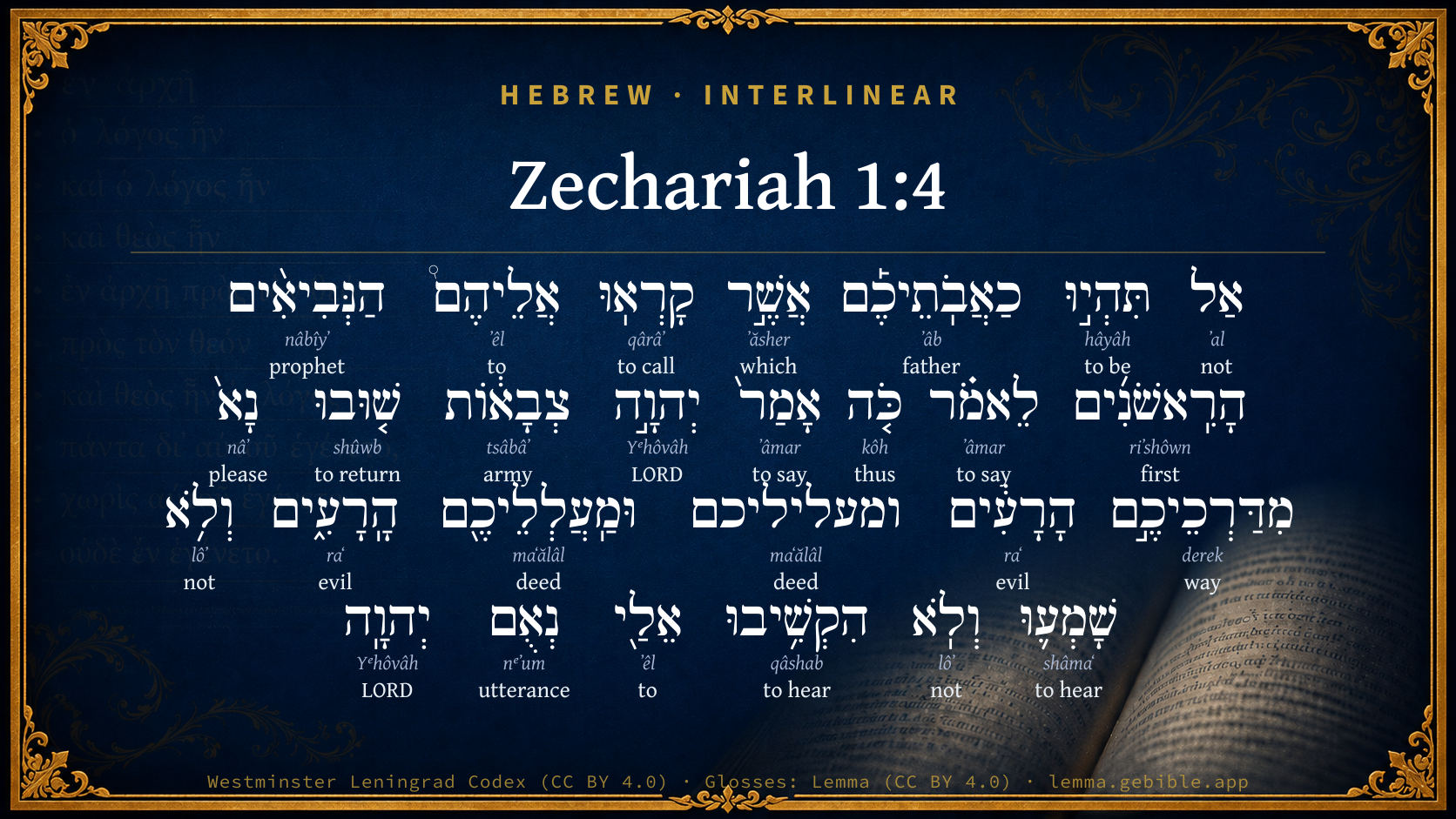
Zechariah 1:4

Hebrew (Westminster Leningrad Codex) Zechariah 1:4 appears in the Hebrew Old Testament. The text above is from the Westminster Leningrad Codex. Each word links to its Strong’s number, a concise gloss, and parsing drawn from the Open Scriptures Hebrew Bible morphology. Click any word for its full Brown-Driver-Briggs (BDB) entry.
Download image
Cite this verse

Zechariah 1:4 (World English Bible). Public Domain. Lemma interlinear Bible study tool, https://lemma.gebible.app/v/zechariah/1/4.

Show BibTeX & RIS
BibTeX
RIS
English Translation
Don't you be like your fathers, to whom the former prophets proclaimed, saying: Thus says Yahweh of hosts, 'Return now from your evil ways, and from your evil doings;' but they did not hear, nor listen to me, says Yahweh.
World English Bible · Public Domain
Download a study sheet

One document with this verse’s original text, its word-by-word gloss line, the meaning frame, cross-references with their text, attributed commentary, and full source and license credits — printable, and it pastes into notes with its structure intact.

This verse Autodidact and up

Study sheet (.html) Plain text (.txt)

A passage Seminary Student

Up to 50 verses in one chapter. A passage sheet keeps up to 6 commentary sources and 12 cross-references per verse, in the order this page ranks them, and says so on the sheet whenever that leaves anything out. Ask for a single verse and you get the Autodidact verse sheet above.

Everything on this page stays free to read, with no account — the sheet is a download of what is already on screen, not access to it.

Want to remove ads? Support Godless Engineer
Compare translations 3

The same verse in 3 English versions, stacked beneath the original-language interlinear above. Click any original word for its lexicon entry.

Each is an independent rendering of the whole verse — the interlinear is not word-aligned to these translations.

Highlighted words mark where these versions differ — a whole-verse word diff, not a word-by-word alignment.

  • World English Bible Public Domain
    Don't you be like your fathers, to whom the former prophets proclaimed, saying: Thus says Yahweh of hosts, 'Return now from your evil ways, and from your evil doings;' but they did not hear, nor listen to me, says Yahweh.
  • King James Version Public Domain
    Be ye not as your fathers, unto whom the former prophets have cried, saying, Thus saith the LORD of hosts; Turn ye now from your evil ways, and from your evil doings: but they did not hear, nor hearken unto me, saith the LORD.
  • unfoldingWord Literal Text CC BY-SA 4.0
    “Do not be like your fathers, to whom the former prophets called out, saying, ‘Thus says Yahweh of Armies: “Turn now from your evil ways and your evil deeds.”’ But they did not hear, and they did not pay attention to me”—the declaration of Yahweh.

unfoldingWord Literal Text — © unfoldingWord, licensed CC BY-SA 4.0. Word-aligned USFM3 via Door43 (git.door43.org/unfoldingWord/en_ult).

Versions to compare (up to 4)

3 of 4 selected

Show all 18 translations

Every available English version of this verse, each an independent rendering of the whole verse.

  • World English Bible Public Domain
    Don't you be like your fathers, to whom the former prophets proclaimed, saying: Thus says Yahweh of hosts, 'Return now from your evil ways, and from your evil doings;' but they did not hear, nor listen to me, says Yahweh.
  • Berean Standard Bible Public Domain
    Do not be like your fathers, to whom the former prophets proclaimed that this is what the LORD of Hosts says: ‘Turn now from your evil ways and deeds.’ But they did not listen or pay attention to Me, declares the LORD.
  • Majority Standard Bible Public Domain
    Do not be like your fathers, to whom the former prophets proclaimed that this is what the LORD of Hosts says: ‘Turn now from your evil ways and deeds.’ But they did not listen or pay attention to Me, declares the LORD.
  • King James Version Public Domain
    Be ye not as your fathers, unto whom the former prophets have cried, saying, Thus saith the LORD of hosts; Turn ye now from your evil ways, and from your evil doings: but they did not hear, nor hearken unto me, saith the LORD.
  • American Standard Version (1901) Public Domain
    Be ye not as your fathers, unto whom the former prophets cried, saying, Thus saith Jehovah of hosts, Return ye now from your evil ways, and from your evil doings: but they did not hear, nor hearken unto me, saith Jehovah.
  • Revised Version (1885) Public Domain
    Be ye not as your fathers, unto whom the former prophets cried, saying, Thus saith the LORD of hosts, Return ye now from your evil ways, and from your evil doings: but they did not hear, nor hearken unto me, saith the LORD.
  • Geneva Bible (1599) Public Domain
    Be ye not as your fathers, vnto whome the former prophets haue cried, saying, Thus sayth the Lord of hostes, Turne you nowe from your euill wayes, and from your wicked workes: but they would not heare, nor hearken vnto me, saith the Lord.
  • Douay-Rheims (1899) Public Domain
    Be not as your fathers, to whom the former prophets have cried, saying: Thus saith the Lord of hosts: Turn ye from your evil ways, and from your wicked thoughts: but they did not give ear, neither did they hearken to me, saith the Lord.
  • Young's Literal Translation Public Domain
    Ye shall not be as your fathers, To whom the former prophets called, saying: Thus said Jehovah of Hosts, Turn back I pray you, From your evil ways and from your evil doings, And they did not hearken, Nor attend to Me -- an affirmation of Jehovah.
  • Literal Standard Version CC BY-SA 4.0
    You will not be as your fathers, || To whom the former prophets called, || Saying, Thus said YHWH of Hosts: Please turn back from your evil ways and from your evil doings, || And they did not listen, || Nor attend to Me—a declaration of YHWH.
  • Unlocked Literal Bible CC BY-SA 4.0
    Do not be like your fathers to whom the prophets cried out previously, saying, “Yahweh of hosts says this: Turn from your evil ways and wicked practices!” But they would not hear and did not pay attention to me—this is Yahweh's declaration.'
  • unfoldingWord Literal Text CC BY-SA 4.0
    “Do not be like your fathers, to whom the former prophets called out, saying, ‘Thus says Yahweh of Armies: “Turn now from your evil ways and your evil deeds.”’ But they did not hear, and they did not pay attention to me”—the declaration of Yahweh.
  • Darby Bible Public Domain
    Be ye not as your fathers, unto whom the former prophets cried, saying, Thus saith Jehovah of hosts: Turn ye now from your evil ways, and from your evil doings; but they did not hearken nor attend unto me, saith Jehovah.
  • World Messianic Bible Public Domain
    Don’t you be like your fathers, to whom the former prophets proclaimed, saying: The LORD of Hosts says, ‘Return now from your evil ways and from your evil doings;’ but they didn’t hear nor listen to me, says the LORD.
  • Webster's Bible Public Domain
    Be ye not as your fathers, to whom the former prophets have cried, saying, Thus saith the LORD of hosts; Turn ye now from your evil ways, and from your evil doings: but they did not hear, nor hearken to me, saith the LORD.
  • Free Bible Version CC BY-SA 4.0
    You must not be like your forefathers. They were told by previous prophets: Give up your evil ways, and the evil things you do. But they would not listen or pay any attention to me, says the Lord.
  • Bible in Basic English Public Domain
    Be not like your fathers, to whom the voice of the earlier prophets came, saying, Be turned now from your evil ways and from your evil doings: but they did not give ear to me or take note, says the Lord.
  • JPS Tanakh (1917) Public Domain
    Be ye not as your fathers, unto whom the former prophets proclaimed, saying: Thus saith the LORD of hosts: Return ye now from your evil ways, and from your evil doings; but they did not hear, nor attend unto Me, saith the LORD.

Literal Standard Version (2020), Covenant Press — licensed CC BY-SA 4.0. Text via the HelloAO Bible API (eBible.org). Unlocked Literal Bible (unfoldingWord) — licensed CC BY-SA 4.0. Text via the HelloAO Bible API (eBible.org). unfoldingWord Literal Text — © unfoldingWord, licensed CC BY-SA 4.0. Word-aligned USFM3 via Door43 (git.door43.org/unfoldingWord/en_ult). Free Bible Version, Dr. Jonathan Gallagher — licensed CC BY-SA 4.0. Text via the HelloAO Bible API (eBible.org).

Word by word

More ways to search: Search by grammar → Find every occurrence → Compare this word →

Practice this passage: Drill this verse → Learn its vocabulary →

ומעליליכם
maʻălâl
H4611
“and · deeds · your”
Conjunction + Noun, Common, Masculine, Plural, Construct + Suffix, Personal, 2nd Person, Masculine, Plural
Part of Speech
Conjunction + Noun
Type
Common
Gender
Masculine
Number
Plural
State
Construct
Full BDB Definition

Origin: from H5953

TWOT: 1627e

deed, practice - practice (usually bad) - deeds - acts
  1. אַל ʼal H408 “not” Particle, Negative
  2. תִּהְי֣וּ hâyâh H1961 “to be” Verb, Qal, Jussive, 2nd Person, Masculine, Plural
  3. כַאֲבֹֽתֵיכֶ֡ם ʼâb H1 “like/as · fathers · your” Preposition + Noun, Common, Masculine, Plural, Construct + Suffix, Personal, 2nd Person, Masculine, Plural
  4. אֲשֶׁ֣ר ʼăsher H834 “which” Particle, Relative
  5. קָרְאֽוּ qârâʼ H7121 “to call” Verb, Qal, Perfect, 3rd Person, Common, Plural
  6. אֲלֵיהֶם֩ ʼêl H413 “to · them” Preposition + Suffix, Personal, 3rd Person, Masculine, Plural
  7. הַנְּבִיאִ֨ים nâbîyʼ H5030 “the · prophets” Particle, Definite Article + Noun, Common, Masculine, Plural, Absolute
  8. הָרִֽאשֹׁנִ֜ים riʼshôwn H7223 “the · first” Particle, Definite Article + Adjective, Adjective, Masculine, Plural, Absolute
  9. לֵאמֹ֗ר ʼâmar H559 “to say” Preposition + Verb, Qal, Infinitive Construct
  10. כֹּ֤ה kôh H3541 “thus” Adverb
  11. אָמַר֙ ʼâmar H559 “to say” Verb, Qal, Perfect, 3rd Person, Masculine, Singular
  12. יְהוָ֣ה Yᵉhôvâh H3068 “LORD” Noun, Proper
  13. צְבָא֔וֹת tsâbâʼ H6635 “armies” Noun, Common, Both, Plural, Absolute
  14. שׁ֤וּבוּ shûwb H7725 “return” Verb, Qal, Imperative, 2nd Person, Masculine, Plural
  15. נָא֙ nâʼ H4994 “please” Particle, Exhortation
  16. מִדַּרְכֵיכֶ֣ם derek H1870 “from · ways · your” Preposition + Noun, Common, Both, Plural, Construct + Suffix, Personal, 2nd Person, Masculine, Plural
  17. הָרָעִ֔ים raʻ H7451 “the · evil” Particle, Definite Article + Adjective, Adjective, Masculine, Plural, Absolute
  18. וּמַֽעֲלְלֵיכֶ֖ם maʻălâl H4611 “and · deeds · your” Conjunction + Noun, Common, Masculine, Plural, Construct + Suffix, Personal, 2nd Person, Masculine, Plural
  19. הָֽרָעִ֑ים raʻ H7451 “the · evil” Particle, Definite Article + Adjective, Adjective, Masculine, Plural, Absolute
  20. וְלֹ֥א lôʼ H3808 “and · not” Conjunction + Particle, Negative
  21. שָׁמְע֛וּ shâmaʻ H8085 “to hear” Verb, Qal, Perfect, 3rd Person, Common, Plural
  22. וְלֹֽא lôʼ H3808 “and · not” Conjunction + Particle, Negative
  23. הִקְשִׁ֥יבוּ qâshab H7181 “to hear” Verb, Hiphil, Perfect, 3rd Person, Common, Plural
  24. אֵלַ֖י ʼêl H413 “to · me” Preposition + Suffix, Personal, 1st Person, Common, Singular
  25. נְאֻם nᵉʼum H5002 “utterance of” Noun, Common, Masculine, Singular, Construct
  26. יְהוָֽה Yᵉhôvâh H3068 “LORD” Noun, Proper

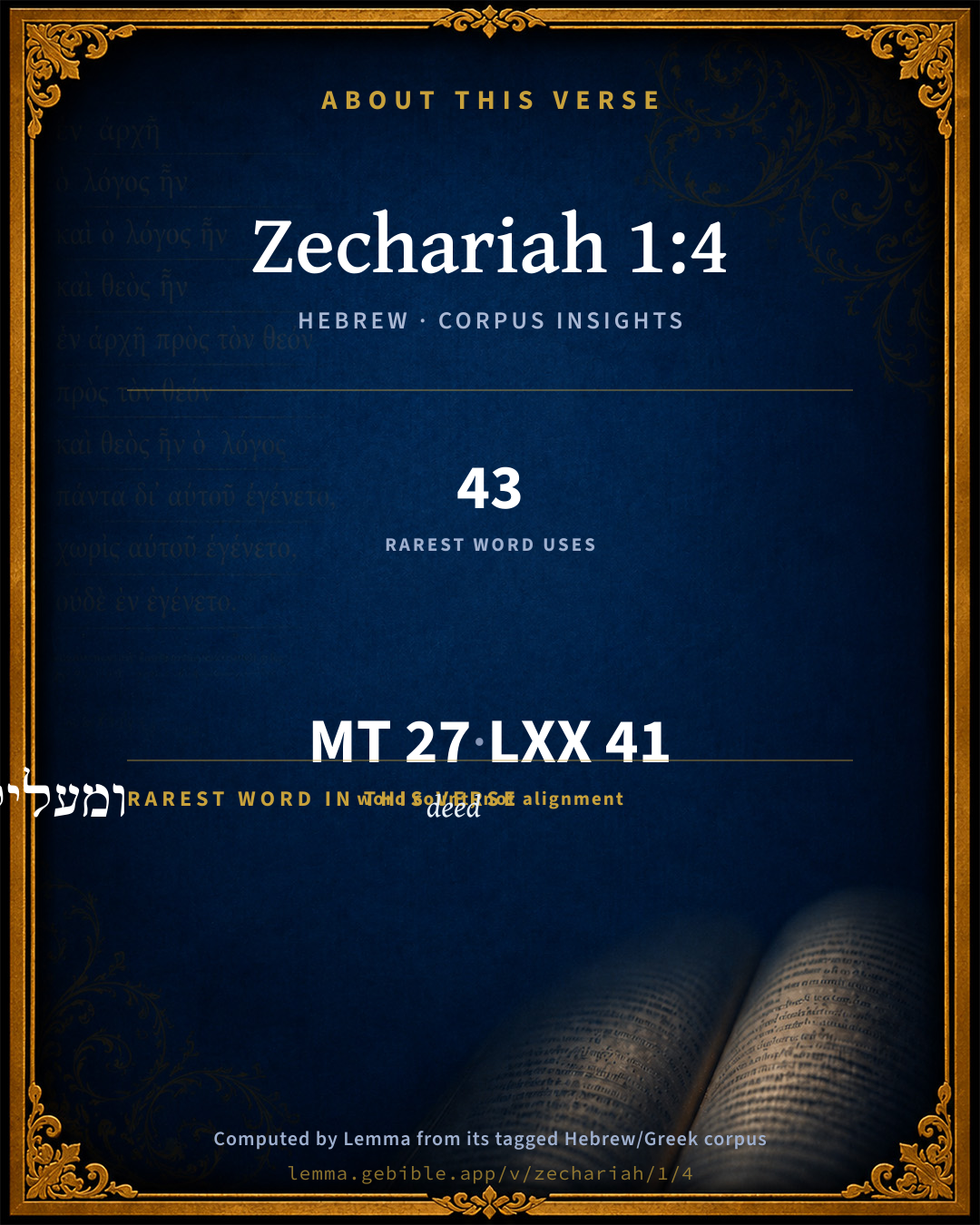
About this verse

These counts appear in no published source. They are computed here, from the morphology-tagged text and Lemma’s own curated glosses. What Lemma adds →

27
words
21
distinct lemmas
Prophets
section

Shared distinctive vocabulary

ומעליליכם deed H4611 occurs in 41 verses of the Hebrew Bible. Also found in:

Grammatical profile

  • 7 verbs
  • 9 nouns
  • 3 adjectives
  • 2 prepositions
  • 1 adverb
  • 5 particles

Verb forms

  • תִּהְי֣וּ Qal · Jussive
  • קָרְאֽוּ Qal · Perfect
  • לֵאמֹ֗ר Qal · Infinitive Construct
  • אָמַר֙ Qal · Perfect
  • שׁ֤וּבוּ Qal · Imperative
  • שָׁמְע֛וּ Qal · Perfect
  • הִקְשִׁ֥יבוּ Hiphil · Perfect

Repetition

Words recur within this verse — often emphatic in Hebrew:

  • לֵאמֹ֗ר to say H559 ×2
  • יְהוָ֣ה LORD H3068 ×2
  • הָרָעִ֔ים evil H7451 ×2
  • ומעליליכם deed H4611 ×2
  • אֲלֵיהֶם֩ to H413 ×2
  • וְלֹ֥א not H3808 ×2

Hebrew & Septuagint length

In English translation the verse runs 40 words from the Hebrew and 43 from the Septuagint (LXX English) — closely comparable.

A rough comparison of the two English renderings, which tokenize alike — not a word-level alignment.

Word counts can differ between the Hebrew and the Greek without any difference in meaning — e.g. the Hebrew direct-object marker אֵת has no separate Greek word, and Greek often adds the article ὁ.

In the original languages it is 27 Hebrew tokens and 41 Greek tokens — but the two are counted differently (Hebrew bundles its prefixes and suffixes into one token; the Greek is in lemma form), so that isn’t a like-for-like length.

Cross-references

45

Topical passages linked to Zechariah 1:4 in the Treasury of Scripture Knowledge — connected by theme and wording, ordered by reader-vote popularity; previews shown in the World English Bible.

  • Psalms 78:8 And might not be as their fathers, A stubborn and rebellious generation, A generation that didn't make their hearts loyal, Whose spirit was not steadfast with God.
  • Psalms 106:6–7 We have sinned with our fathers. We have committed iniquity. We have done wickedly.
  • Jeremiah 35:15 I have sent also to you all my servants the prophets, rising up early and sending them, saying, Return you now every man from his evil way, and amend your doings, and don't go after other gods to serve them, and you shall dwell in the land which I have given to you and to your fathers: but you have not inclined your ear, nor listened to me.
  • Ezekiel 33:11 Tell them, As I live, says the Lord Yahweh, I have no pleasure in the death of the wicked; but that the wicked turn from his way and live: turn you, turn you from your evil ways; for why will you die, house of Israel?
  • 2 Chronicles 36:15–16 Yahweh, the God of their fathers, sent to them by his messengers, rising up early and sending, because he had compassion on his people, and on his dwelling-place:
  • Isaiah 1:16–19 Wash yourselves, make yourself clean. Put away the evil of your doings from before my eyes; Cease to do evil.
  • Jeremiah 11:6–8 Yahweh said to me, Proclaim all these words in the cities of Judah, and in the streets of Jerusalem, saying, Hear you the words of this covenant, and do them.
  • Zechariah 1:3 Therefore tell them: Thus says Yahweh of Hosts: 'Return to me,' says Yahweh of Hosts, 'and I will return to you,' says Yahweh of Hosts.
  • Matthew 3:8–10 Therefore bring forth fruit worthy of repentance!
  • 2 Chronicles 24:19–22 Yet he sent prophets to them, to bring them again to Yahweh; and they testified against them: but they would not give ear.
  • 2 Chronicles 29:6–10 For our fathers have trespassed, and done that which was evil in the sight of Yahweh our God, and have forsaken him, and have turned away their faces from the habitation of Yahweh, and turned their backs.
  • 2 Chronicles 30:7 Don't be you like your fathers, and like your brothers, who trespassed against Yahweh, the God of their fathers, so that he gave them up to desolation, as you see.
  • 2 Chronicles 34:21 Go you, inquire of Yahweh for me, and for those who are left in Israel and in Judah, concerning the words of the book that is found; for great is the wrath of Yahweh that is poured out on us, because our fathers have not kept the word of Yahweh, to do according to all that is written in this book.
  • Ezra 9:7 Since the days of our fathers we have been exceeding guilty to this day; and for our iniquities have we, our kings, and our priests, been delivered into the hand of the kings of the lands, to the sword, to captivity, and to plunder, and to confusion of face, as it is this day.
  • Nehemiah 9:16 But they and our fathers dealt proudly and hardened their neck, and didn't listen to your commandments,
  • Nehemiah 9:26 Nevertheless they were disobedient, and rebelled against you, and cast your law behind their back, and killed your prophets that testified against them to turn them again to you, and they committed awful blasphemies.
  • Nehemiah 9:30 Yet many years did you bear with them, and testified against them by your Spirit through your prophets: yet would they not give ear: therefore gave you them into the hand of the peoples of the lands.
  • Isaiah 30:9–11 For it is a rebellious people, lying children, children who will not hear the law of Yahweh;
  • Isaiah 31:6 Turn you to him from whom you have deeply revolted, children of Israel.
  • Jeremiah 3:12 Go, and proclaim these words toward the north, and say, Return, you backsliding Israel, says Yahweh; I will not look in anger on you; for I am merciful, says Yahweh, I will not keep [anger] forever.
  • Jeremiah 6:16–17 Thus says Yahweh, Stand you in the ways and see, and ask for the old paths, where is the good way; and walk therein, and you shall find rest for your souls: but they said, We will not walk [therein].
  • Jeremiah 7:3–7 Thus says Yahweh of Hosts, the God of Israel, Amend your ways and your doings, and I will cause you to dwell in this place.
  • Jeremiah 13:9–10 Thus says Yahweh, After this manner will I mar the pride of Judah, and the great pride of Jerusalem.
  • Jeremiah 13:16–18 Give glory to Yahweh your God, before he cause darkness, and before your feet stumble on the dark mountains, and, while you look for light, he turn it into the shadow of death, and make it gross darkness.
  • Jeremiah 17:19–23 Thus said Yahweh to me: Go, and stand in the gate of the children of the people, through which the kings of Judah come in, and by which they go out, and in all the gates of Jerusalem;
  • Jeremiah 18:11 Now therefore, speak to the men of Judah, and to the inhabitants of Jerusalem, saying, Thus says Yahweh: Behold, I frame evil against you, and devise a device against you: return you now everyone from his evil way, and amend your ways and your doings.
  • Jeremiah 25:3–7 From the thirteenth year of Josiah the son of Amon, king of Judah, even to this day, these twenty-three years, the word of Yahweh has come to me, and I have spoken to you, rising up early and speaking; but you have not listened.
  • Jeremiah 26:5 to listen to the words of my servants the prophets, whom I send to you, even rising up early and sending them, but you have not listened;
  • Jeremiah 36:2–10 Take a scroll of a book, and write therein all the words that I have spoken to you against Israel, and against Judah, and against all the nations, from the day I spoke to you, from the days of Josiah, even to this day.
  • Jeremiah 36:23–24 It happened, when Jehudi had read three or four leaves, that [the king] cut it with the penknife, and cast it into the fire that was in the brazier, until all the scroll was consumed in the fire that was in the brazier.
  • Jeremiah 44:4–5 However I sent to you all my servants the prophets, rising up early and sending them, saying, Oh, don't do this abominable thing that I hate.
  • Jeremiah 44:16 As for the word that you have spoken to us in the name of Yahweh, we will not listen to you.
  • Ezekiel 3:7–9 But the house of Israel will not listen to you; for they will not listen to me: for all the house of Israel are of hard forehead and of a stiff heart.
  • Ezekiel 18:14–17 Now, behold, if he fathers a son, who sees all his father's sins, which he has done, and fears, and does not such like;
  • Ezekiel 18:30–32 Therefore I will judge you, house of Israel, everyone according to his ways, says the Lord Yahweh. Return you, and turn yourselves from all your transgressions; so iniquity shall not be your ruin.
  • Hosea 14:1 Israel, return to Yahweh your God; For you have fallen because of your sin.
  • Amos 5:13–15 Therefore he who is prudent shall keep silence in such a time; For it is an evil time.
  • Amos 5:24 But let justice roll on like rivers, And righteousness like a mighty stream.
  • Micah 2:6 "Don't you prophesy!" They prophesy. "Don't prophesy about these things. Disgrace won't overtake us."
  • Zechariah 7:11–13 But they refused to listen, and turned their backs, and stopped their ears, that they might not hear.
  • Acts 3:19 "Repent therefore, and turn again, that your sins may be blotted out, so that there may come times of refreshing from the presence of the Lord,
  • Acts 7:51–52 "You stiff-necked and uncircumcised in heart and ears, you always resist the Holy Spirit! As your fathers did, so you do.
  • Acts 26:20 but declared first to them of Damascus, at Jerusalem, and throughout all the country of Judea, and also to the Gentiles, that they should repent and turn to God, doing works worthy of repentance.
  • 1 Thessalonians 2:15–16 who killed both the Lord Jesus and their own prophets, and drove us out, and didn't please God, and are contrary to all men;
  • 1 Peter 1:18 knowing that you were redeemed, not with corruptible things, with silver or gold, from the useless way of life handed down from your fathers,

Cross-references courtesy of OpenBible.info (CC BY 4.0).

Hebrew and Greek witnesses Masoretic Hebrew ↔ Greek Septuagint

The same verse in the two great witnesses to the Old Testament, shown verse-for-verse.

These are two independent witnesses, not word-aligned to each other, and the Septuagint is shown in lemma (dictionary) form.

Hebrew Zechariah 1:4 Masoretic · Westminster Leningrad Codex

אַל תִּהְי֣וּ כַאֲבֹֽתֵיכֶ֡ם אֲשֶׁ֣ר קָרְאֽוּ אֲלֵיהֶם֩ הַנְּבִיאִ֨ים הָרִֽאשֹׁנִ֜ים לֵאמֹ֗ר כֹּ֤ה אָמַר֙ יְהוָ֣ה צְבָא֔וֹת שׁ֤וּבוּ נָא֙ מִדַּרְכֵיכֶ֣ם הָרָעִ֔ים ומעליליכם וּמַֽעֲלְלֵיכֶ֖ם הָֽרָעִ֑ים וְלֹ֥א שָׁמְע֛וּ וְלֹֽא הִקְשִׁ֥יבוּ אֵלַ֖י נְאֻם יְהוָֽה

Don't you be like your fathers, to whom the former prophets proclaimed, saying: Thus says Yahweh of hosts, 'Return now from your evil ways, and from your evil doings;' but they did not hear, nor listen to me, says Yahweh.

World English Bible · Public Domain

Greek LXX Zechariah 1:4 Septuagint · lemma form

καί μή γίγνομαι καθώς ὁ πατήρ σύ ὅς ἐνκαλέω αὐτός ὁ προφήτης ὁ ἔμπροσθεν λέγω ὁδε λέγω κύριος παντοκράτωρ ἀποστρέφω ἀπό ὁ ὁδός σύ ὁ πονηρός καί ἀπό ὁ ἐπιτήδευμα σύ ὁ πονηρός καί οὐ προςἔχω ὁ εἰςἀκούω ἐγώ λέγω κύριος

And be you⌃ not as your fathers, whom the prophets before charged, saying, Thus says the Lord Almighty: Turn you⌃ from your evil ways, and from your evil practices: but they listened not, and attended not to listen to me, says the Lord.

LXX2012 (modern English Septuagint) · Public Domain

On this verse, Ellicott's Commentary for English Readers discusses the Septuagint’s reading. Read the note in Commentary ↓

Hebrew: Westminster Leningrad Codex (CC BY 4.0). Greek: Septuagint (public domain); English from LXX2012 (modern English Septuagint) (Public Domain). How the Septuagint differs from the Hebrew →

Targum (Aramaic paraphrase)

1

The Targum is the ancient Jewish Aramaic paraphrase of the Hebrew Scriptures — an interpretive translation, not the Hebrew text itself. Onkelos (literal) and Pseudo-Jonathan (expansive) render the Torah, and Jonathan the Prophets. Coverage is partial: where no permissively-licensed English translation exists for a verse, only the Aramaic is shown. This is verse-level text, not a word-by-word alignment to the Hebrew.

  1. Targum Jonathan Prophets (Joshua–Malachi)
    לָא תְהוֹן כַּאֲבָהָתְכוֹן דְיִתְנַבּוּן לְהוֹן נְבִיַיָא קַדְמָאֵי לְמֵימַר כִּדְנַן אֲמַר יְיָ צְבָאוֹת תּוּבוּ כְעַן מֵאוֹרְחָתכוֹן בִּישְׁתָא וּמֵעוֹבָדֵיכוֹן מְקַלְקְלַיָא וְלָא קַבִּילוּ וְלָא אֲצִיתוּ לְמֵימְרִי אֲמַר יְיָ:

    (no public-domain English translation for this verse)

    Targum Jonathan — Aramaic: “Mikraot Gedolot” (public domain). English: “Sefaria Community Translation” (CC0 1.0 (public-domain dedication)); “London "Chaldee Paraphrase," 1871” (public domain). Text via Sefaria.

Commentary

Notes on Zechariah 1:4 from classic Christian and Jewish commentators (each source and its license shown beneath its notes). The classic Christian expositions comment on the surrounding passage and are grouped to its opening verse, so a note may address several verses; the Jewish commentaries on the Tanakh (Rashi and others) are per-verse, so they appear only where the commentator wrote on this verse.

Lemma curates 59 commentaries, every one of them public domain or Creative Commons licensed, each selected and text-cleaned for this edition rather than reprinted as found. About our sources →

Trapp's Complete Commentary

John Trapp

Zec 1:4 Be ye not as your fathers, unto whom the former prophets have cried, saying, Thus saith the LORD of hosts; Turn ye now from your evil ways, and [from] your evil doings: but they did not hear, nor hearken unto me, saith the LORD.

Ver. 4. Be ye not as your fathers] Man is a creature apt to imitate, to be led more by his eyes than by his ears; and children think they may lawfully be as their fathers. St Peter’s converts had received their vain conversation from their fathers, as it were, ex traduce, or by tradition, 1Pe 1:18. And St Stephen tells his perverse hearers that they were as good at resisting the Holy Ghost as their fathers had been before them, Act 7:51. They used to boast much of their ancestors, Joh 8:33, and to bind much upon their example and authority, Jer 44:17 Mat 5:21. They thought they were not much to be blamed, because they did but as their fathers had done before them. The prophet therefore dehorts or rather deters them from that folly; setting forth both the crime and doom of their forefathers, whom they so much admired, and so stiffly imitated, and this he often repeateth that they might once consider it, and be wrought upon by those domestic examples.

Have cried] Loudly and lustily; according to that, "Cry aloud, spare not, lift up thy voice like a trumpet," Isa 58:1 : sic clames ut stentora vineas, A minister should be a Simon Zelotes, a son of thunder; as Basil was said to thunder in his preaching, lightning in his life; as Jerome for his vehemence was called Fulmen Ecclesiasticum, the Church’s light bolt; as Harding, before his shameful apostasy, wished he could cry out against Popery as loud as the bells of Oseney; and as Farellus (that notable French preacher), whose voice when the envious monks sought to drown by ringing the bells as he was preaching at Metis, he lifted up his voice ad ravim usque; and would not suffer himself to be outroared. The saint’s bell (as they called it) Pierius useth for a hieroglyphic of a preacher, who must not speak the word only, but sound it out into all the earth, Rom 10:18, not preach it only, but cry it, as the apostle’s word signifieth, 2Ti 4:2, clangite, clamate, Jer 4:5. Boate, vociferate, Mat 3:3 (Bοωντος, boantis, vociferantis). Ministers have to do with deaf men, dead men, living carcases, walking sepulchres of themselves. Now therefore as our Saviour lifted up his voice when he said, "Lazarus, come forth"; so must they stand over men and cry aloud, "Awake, thou that sleepest, and stand up from the dead, that Christ may give thee light," Eph 5:14.

Turn you now from your evil ways, &c.] This was the constant cry of the prophets, as here, and apostles, as Act 26:18, to open men’s eyes (naturally closed up that they cannot see the evil of their ways, Jer 2:35 Rev 3:15), to turn them from darkness to light, and from the power of Satan to God.

And from your evil doings] Heb. Designs, gests, or exercises, enterprised advisedly, and prosecuted studiously, of natural disposition and inclination, as Pro 20:11 1Sa 25:3. This St John usually calleth committing of sin, 1Jn 3:4; 1Jn 3:8-9 Joh 8:34; this is to add rebellion to sin, Job 34:37, impudence to impotence, brows of brass to iron sinews, Isa 48:4. This is wickedness with a witness, which if men could but see in its native colours and cursed consequents, they would soon be persuaded to turn from it. As the eye cannot but be offended with a loathsome object, so neither can the understanding. Take rat poison, it looketh not evil; but when a man feels it boil, burn, torture him, &c., he hates it extremely. So he should do sin; he will do else at length, when it is too late. For prevention: take the counsel of a martyr, get thee God’s law, as a glass to look in. So shall you see your faces foul arrayed, and so shameful, mangy, pocky, and scabbed, that you cannot but be sorry at the contemplation thereof, and seek out for cure; especially if you look to the tag tied to God’s law, the malediction; which is such, as cannot but make us to cast our currish tails between our legs, if we believe it. But O faithless hard hearts! O Jezebel’s guests, rocked and laid asleep in her bed! O wicked wretches! &c.

But they did not hear] Though the prophets cried, and spake loud enough to be heard and heeded. A heavy ear is a singular judgment, Isa 6:10; a hearing ear, a precious mercy, Pro 20:12. God must be entreated to bore our ear, Psa 40:6, and to make the bore so big that the word may enter; to say as Isa 42:18, Hear, ye deaf, and look, ye blind, that ye may see.

John Trapp, A Commentary or Exposition upon All the Books of the Old and New Testament (1647–1656) — public domain. Text from a community e-Sword module.

Albert Barnes' Notes on the Bible

Be ye not like your fathers - Strangely infectious is the precedent of ill. Tradition of good, of truth, of faith, is decried; only tradition of ill and error are adhered to. The sin of Jeroboam was held sacred by every king of Israel: “The statutes of Omri were diligently kept, and all the works of the house of Ahab” Mic 6:16. “They turned back and were treacherous like their forefathers; they turned themselves like a deceitful bow” Psa 78:57, is God’s summary of the history of Israel. Cyril: “Absurd are they who follow the ignorances of their fathers, and ever plead inherited custom as an irrefragable defense, though blamed for extremest ills. So idolaters especially, being called to the knowledge of the truth, ever bear in mind the error of their fathers and, embracing their ignorance as an hereditary lot, remain blind.”

The former prophets - The prophets spake God’s words, as well in their pastoral office as in predicting things to come, in enforcing God’s law and in exhorting to repentance, as in announcing the judgments on disobedience. The predictive as well as the pastoral office were united in Nathan 2Sa 7:4-16; 2Sa 12:1-14, Gad 1Sa 22:5; 1Sa 24:11, Shemaiah 2Ch 11:2-4; 2Ch 12:5-8, Azariah 2 Chr. 15, Hanani 2Ch 16:7-9, Elijah 1Ki 17:1, 1Ki 17:14; 1Ki 18:1, 1Ki 18:41; 1Ki 21:19, 1Ki 21:21, 1Ki 21:23, 1Ki 21:29; 2Ki 1:4, 2Ki 1:16, Elisha 2Ki 3:17-18; 2Ki 4:16; 2Ki 5:27; 2Ki 7:1-2; 2Ki 8:10-13; 2Ki 13:14-19, Micaiah the son of Imla, whose habitual predictions against Ahab induced Ahab to say 1Ki 22:8, “I hate him, for he doth not prophesy good concerning me, but evil.” The specific calls to conversion here named and their fruitlessness, are summed up by Jeremiah as words of all the prophets. For ten years he says, “The word of the Lord hath come unto me, and I have spoken unto you, rising early and speaking, and ye have not hearkened. And the Lord hath sent unto you all His servants the prophets, rising early and sending; but ye have not hearkened nor inclined your ear to hear. They said, Turn ye again now every one from his evil ways and from the evil of your doings, and dwell in the land that the Lord hath given unto you and to your fathers forever and ever; and go not after other gods to serve and worship them, and provoke Me not to anger with the works of your hands, and I will do you no hurt. But ye have not hearkened unto Me, saith the Lord; that ye might provoke Me to anger with the works of your hands to your own hurt. Therefore, thus saith the Lord of hosts, Because ye have not heard My words ...” Jer 25:3-8. The prophetic author of the book of Kings sums up in like way, of “all the prophets and all the seers.” “The Lord testified against Israel and against Judah by the hand of all the prophets and all the seers, saying, Turn ye from your evil ways and keep My commandments, My statutes, according to all the law which I commanded your fathers, and which I sent to you by My servants the prophets, and they did not hear, and hardened their neck, like the neck of their fathers” 2Ki 17:13.

The characteristic word, “turn from your evil ways and the evil of your doings” occurring in Jeremiah, it is probable, that this summary was chiefly in the mind of Zechariah, and that he refers not to Isaiah, Joel, Amos etc., (as all the prophets were preachers of repentance), but to the whole body of teachers, whom God raised up, analogous to the Christian ministry, to recall people to Himself.

The title, “the former prophets,” contrasts the office of Haggai and Zechariah, not with definite prophets before the captivity, but with the whole company of those, whom God sent as He says, so unremittingly.

And they hearkened not unto Me - Jerome: “They heard not the Lord warning through the prophets, attended not - not to the prophets who spake to them but - not to Me, saith the Lord. For I was in them who spake and was despised. Whence also the Lord in the Gospel saith, “He that receiveth you, receiveth Me” Mat 10:40.

Albert Barnes' Notes on the Bible (1834–1885) — public domain. Text from a community e-Sword/MySword module.

Whedon's Commentary on the Bible

Daniel D. Whedon

4-6. Similar appeals were made to former generations, but they would not heed; therefore they were cut off.

The former prophets — All the predecessors of Zechariah. They all with one accord urged the people to hate the evil and love the good. It is not necessary to suppose that the prophet has in mind any particular prophet or any particular utterance (compare Hos_14:2; Eze_33:11; 2Ki_17:13; Amo_5:14). The fathers did not hearken, and judgment overtook them.

Where are they?… do they live forever? — The fathers are dead and even the prophets have passed away, but the words which the latter spoke and the former neglected proved true, for the threatened destruction came.

Words — Especially of threatening (Jer_39:16; Eze_12:28).

Statutes — Not a legal term as in Mal_4:4, but practically identical with the preceding “word”; the judicial decrees of Jehovah proclaimed by the prophets.

My servants the prophets — The “former prophets” (Zec_1:4). The prophets are frequently called the servants of God or of Jehovah, because it was their office to execute the purpose of their divine Master. Take hold of [“overtake”] — “The judgments decreed by Jehovah resemble messengers sent out by Jehovah to pursue and destroy the sinners” (Deu_28:15; Deu_28:45). The climax was the exile.

They returned — Though the judgments did not produce a complete change of heart, they did open the eyes of the people so that they recognized that they were sent by Jehovah in punishment for their own sins (Lam_2:17; Ezr_9:5 ff.). The experience of the fathers should teach a lesson to the children.

Daniel D. Whedon (gen. ed.), Commentary on the Old and New Testaments (1874–1909) — public domain. Text from a community e-Sword module.

Tyndale Open Study Notes

Tyndale Open Resources

1:4 Before the Exile, earlier prophets actively called Judah and Israel to repentance. Zechariah especially reflects the prophetic influence of Jeremiah and Ezekiel. • ancestors who would not listen: The people of Israel (2 Kgs 17:13-14) and Judah (2 Chr 36:15-16) were taken into exile because they stubbornly refused to heed the word of the Lord (cp. 2 Chr 30:7).

Tyndale Open Study Notes — © Tyndale Open Resources, licensed CC BY-SA 4.0. Text via the HelloAO Bible API.

Jamieson, Fausset & Brown

Robert Jamieson, A. R. Fausset & David Brown

Be ye not as your fathers--The Jews boasted of their fathers; but he shows that their fathers were refractory, and that ancient example and long usage will not justify disobedience (Ch2 36:15-16).

the former prophets--those who lived before the captivity. It aggravated their guilt that, not only had they the law, but they had been often called to repent by God's prophets.

Jamieson, Fausset & Brown — Commentary Critical and Explanatory on the Whole Bible (1871) — public domain (CC PDM 1.0). Text via the HelloAO Bible API.

John Calvin's Commentaries

In order to correct and to subdue the obstinacy of the people, he here upbraids them with having descended from wicked and perverse parents. The Jews, we know, too much flattered themselves; and we know that they were especially inflated with the vain boasting that they derived their origin from the holy fathers. But the Prophets had something else in view. We indeed know that when anything becomes customary, almost all become hardened and flatter themselves in their vice; for immorality is then counted almost as the law, and what is sanctioned by public consent seems lawful. Since then they had not ceased for many years to provoke the wrath of God, it was necessary to add this reproof, Be not like your fathers: for they no doubt imagined that God approved of them, as they were not worse than their fathers. But God shows that their fathers had been very wicked and perverse.

Let us learn from this passage, that the examples which are wont to be set up as a shield are so far from being of any weight before God, that they enhance our guilt: and yet we see that this folly infatuates many; for at this day the religion of the Papists seems to them holy and irreprehensible, because it has been handed down to them by their fathers. Hence, whenever they bring forward the fathers, they think it a sufficient defense against the charge of any errors. But nothing occurs more frequently in the Prophets than the truth, that examples tend more to kindle the wrath of God, when some men become the occasion of sin to others, and when posterity think that whatever has proceeded from their fathers is lawful.

But we must at the same time bear in mind the design of the Prophet, for he did not intend simply to show, that the Jews in vain alleged the examples of the ancient; but, as I have said, he intended to shake off their self-flatteries by which they lulled themselves asleep; and he intended especially to put down those evil practices, which by long use had prevailed among them. This then is the reason why he says, Be not like your fathers. The Spirit employs the same sentiment in many other places, especially in the ninety- fifth Psalm (Psalm 95:1), and also in other Psalms.

Then he says, that the Prophets, who had been sent by God, had cried to their fathers, but that they did not attend. As then contempt of the truth had for so many ages prevailed among the Jews, and as this impiety was not duly abhorred by them, since they thought themselves to be as it were in perpetual possession — these are the reasons why the Prophet expressly upbraids them with this, that God’s word had been formerly despised by their nation — cry then did the former Prophets. He also exaggerates again their crime and their sin, because God had often recalled them to himself but without success. Had the Prophets been silent, and had God applied no remedy for their defection, their ingratitude would not indeed have been excusable; but since Prophets had often been sent to them, in succession, one after the other, and each had endeavored to restore the wretched men to a state of safety, not to attend to their holy and serious admonitions, by which God manifested his care for their well-being, was a much more atrocious crime.

We hence learn, that when we find any people prone to this or that vice, it ought to be resisted with greater diligence; for Satan almost always employs this artifice — that when he finds us prone to this or that vice, he directs all his efforts to drive us headlong into it.

As then the Prophets had been for a long time despised by the Jews, Zechariah designedly brings before them that perverseness which had been too long known. cry then did the former Prophets, saying Thus saith Jehovah of hosts, return ye, I pray, from your evil ways, and from your evil works; but they heard not nor attended. After having spoken of God’s kind invitation, which was a singular pledge of his love, since he thus manifested his concern for their safety, he shows on the other hand how unworthily the Jews had conducted themselves, for they obstinately rejected this favor of God. They were indeed more than sufficiently proved guilty; for by saying, Return ye, I pray, from your evil ways and from your evil works, he assumes it as a fact that the reproofs given were just. And he farther says, that they refused to hear. Hence their perverseness was less endurable; for though they were self-condemned, they did not yet repent, nor deigned to hearken to God. And he subjoins the words, nor did they attend; for by this repetition is more fully expressed, not only their stupidity, but their strange madness, inasmuch as they had so rejected God, and closed up the door of his favor, as though they sought designedly to drive him far from them, lest he should come to them.

John Calvin's Commentaries (1540-1563) — public domain. Text from the Calvin Translation Society English edition (1840s-50s) via the Christian Classics Ethereal Library (ccel.org). Calvin's coverage is partial (roughly two-thirds of the Bible); uncommented books and verses are honest gaps, never fabricated. The 19th-century editor's footnotes and remarks are omitted so the notes are faithfully Calvin's own voice.

Ellicott's Commentary for English Readers

(4) The former prophets—viz., those who prophesied when Jerusalem was inhabited and in prosperity (Zec_7:7), before the captivity. LXX., οἱ πατέρες ἔμπροσθεν [to whom] the prophets before [enjoined], which is inaccurate. Οἱ προϕῆται οἱ ἔμπροσθεν, “the prophets of former times,” would have been correct.

A Bible Commentary for English Readers, edited by Charles John Ellicott (1878–1897) — public domain. Text from a community e-Sword module.

The Cambridge Bible for Schools and Colleges

gen. ed. J. J. S. Perowne

4. the former prophets have cried] Rather, cried, as R.V. The reference is not to any one particular prophet or prophets, in whose writings words similar to these may be found; but to the whole body of prophets, who had preceded Zechariah and Haggai, and of whose message in the discharge of the didactic, as distinguished from the predictive function of their office, the substance is here given. Comp. Jer_7:25-26.

now] i.e. I pray.

unto me] whose word, and not their own, the prophets spoke. Comp. Luk_10:16.

The Cambridge Bible for Schools and Colleges (gen. ed. J. J. S. Perowne; Cambridge University Press, 1878–1918) — public domain. Text from a community e-Sword module.

John Gill's Exposition

Be ye not as your fathers,.... Who lived before the captivity, and misused the prophets and messengers of the Lord, and despised his word, and fell into gross idolatry; the evil examples of parents and ancestors are not to be followed:

unto whom the former prophets have cried: such as Hosea, Isaiah, Jeremiah, and others:

saying, thus saith the Lord of hosts, Turn now from your evil ways, and from your evil doings; by their "evil ways" may be meant their idolatrous worship; and by their "evil doings" their immoralities; or, by both, their wicked lives and conversations, both before God and men; from whence they were exhorted by the former prophets to turn, and to reform; even "now", at that present time they prophesied to them, immediately, lest destruction come upon them:

but they did not hear, nor hearken unto me, saith the Lord; speaking by his prophets, who were sent by him, and came and spoke in his name; so that not hearing them was not hearing him who sent them, and whom they represented.

John Gill's Exposition of the Whole Bible (1746–1763) — public domain (CC PDM 1.0). Text via the HelloAO Bible API.

Matthew Poole's English Annotations

Be ye; you who have seen the sorrows of a long captivity, who are wonderfully brought back, who are under the teachings of rod and staff.

The former prophets; all the former prophets, 2Ch 36:15,16.

Cried; preached earnestly, frequently, and compassionately.

Turn ye now from your evil ways; now, to-day, yet before it is too late, O turn from vicious, sinful courses and ways; from your atheism, idolatry, murders, oppressions, and adulteries.

And from your evil doings: it is repeated that it might be more impressive upon them. The prophets importunately entreated them to cease from evil, Isa 1:16; 31:6 Jer 3:12; Eze 18:30; Hos 14:1.

They did not hear; they did not because they would not, they regarded not what I said by my prophets, neither could they be persuaded to it.

Nor hearken unto me: this obstinate disobedience is twice together charged on them, to make their sin appear in its greatness.

Matthew Poole's English Annotations on the Holy Bible (1683–1685) — public domain. Text from a community e-Sword/MySword module.

The Pulpit Commentary

The former prophets have cried. Omit "have." The prophets referred to are those before the Captivity, both those whoso writings are extant, as Hosea, Joel, Amos, etc., and those whose names are mentioned in the historical books, e.g. Nathan, Gad, Shemaiah, Azariah, Hanaui, Elijah, Elisha, Micaiah (Pusey). (See similar complaints in 2Ki_17:13 2Ch_36:15, etc.; Jer_25:3-8, which last passage seems to have been in Zechariah"s mind)

The Pulpit Commentary (1880–1919), ed. H.D.M. Spence-Jones & Joseph S. Exell — public domain. Text from a community e-Sword module.

unfoldingWord translationNotes

Door43 World Missions Community

Turn from your evil ways and wicked practices

No longer doing certain actions is spoken of as if it were turning away from those actions. The phrases "evil ways" and "wicked practices" mean basically the same thing. AT: "Stop doing all of your wicked actions" (See: Metaphor and Doublet)

But they would not hear and did not pay attention to me

Both of these phrases mean that the people of Israel would not obey the commands of Yahweh. AT: "But they would not listen to my commands" (See: Parallelism)

this is Yahweh's declaration

Yahweh speaks of himself by name to express the certainty of what he is declaring. See how you translated a similar phrase in Zechariah 1:3. AT: "this is what Yahweh has declared" or "this is what I, Yahweh, have declared" (See: First, Second, or Third Person)

Your fathers, where are they? Where are the prophets, are they here forever?

These two rhetorical questions emphasize that both their ancestors and the prophets who proclaimed Yahweh's message to their ancestors have died. The questions can be translated as a statement. AT: "Neither your fathers nor the prophets are here because they have all died." (See: Rhetorical Question)

But my words and my decrees that I commanded my servants the prophets, have they not overtaken your fathers?

This rhetorical question emphasizes the positive answer that it anticipates. Yahweh speaks of the people's ancestors experiencing the consequences of not obeying Yahweh's commands as if his words and decrees were a person who had chased after and overtaken them. The question can be translated as a statement. AT: "But my words and my decrees that I commanded my servants the prophets have overtaken your fathers." or "But your fathers have suffered the consequences for disobeying my words and my decrees that I commanded my servants the prophets to tell them." (See: Rhetorical Question)

my words and my decrees

These phrases are both ways to refer to Yahweh's message that the prophets had declared to their ancestors. (See: Doublet)

our ways and actions

The words "ways" and "actions" mean basically the same thing. AT: "our behavior" (See: Doublet)

translationWords

ancestor

evil

declare

word

decree

command

servant

repent

unfoldingWord translationNotes — © Distant Shores Media and the Door43 World Missions Community, licensed CC BY-SA 4.0. Source: git.door43.org/Door43/en_tn.

Lesson kit

Teaching starters — assembled from the data on this page, not authored interpretation. Every prompt links to the verse data it draws on. Edit before teaching.

Zechariah, in the Prophets, opens this verse with 27 words (21 distinct Hebrew lemmas). Its most distinctive word is maʻălâl (“deed”). A historical commentator’s framing appears above. Read the whole chapter for the surrounding context.

Discussion questions

  1. How does “deed” (maʻălâl) shape what this verse is saying?
  2. Deuteronomy 28:20 shares the word «deed» with this verse. How do the two illuminate each other?
  3. “to say” occurs 2× in this one verse. What is the effect of the repetition?
  4. These translations render this verse differently. What is at stake in choosing one wording over another?
  5. The verb «תִּהְי֣וּ» is Qal Jussive. How does its form color the action?
  6. Reading how Trapp's Complete Commentary and Albert Barnes' Notes on the Bible read this verse, where do the two commentators agree and where do they part?

Things to notice

Reading settings

Reading text

Shown beneath each verse's original-language words.

Old Testament
Old Testament edition

Read the OT as the Masoretic Hebrew (MT) or the Greek Septuagint (LXX).

English shown for the Greek Septuagint (in the Hebrew ↔ Greek comparison).

Comparing translations? Open the Compare panel on any verse page to stack up to four side by side.