
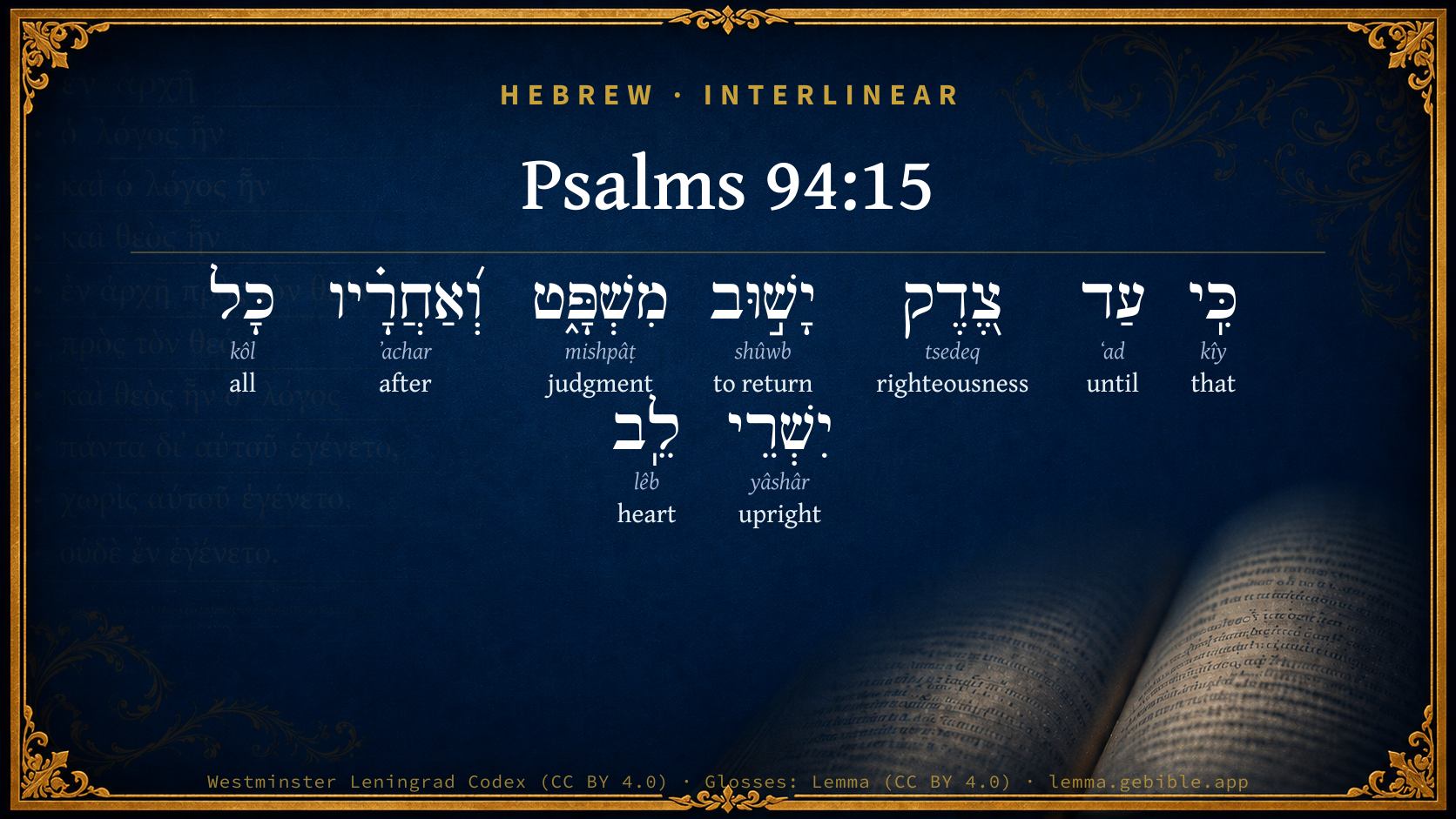
Psalms 94:15

Hebrew (Westminster Leningrad Codex) Psalms 94:15 appears in the Hebrew Old Testament. The text above is from the Westminster Leningrad Codex. Each word links to its Strong’s number, a concise gloss, and parsing drawn from the Open Scriptures Hebrew Bible morphology. Click any word for its full Brown-Driver-Briggs (BDB) entry.
Download image
Cite this verse

Psalms 94:15 (World English Bible). Public Domain. Lemma interlinear Bible study tool, https://lemma.gebible.app/v/psalms/94/15.

Show BibTeX & RIS
BibTeX
RIS
English Translation
For judgment will return to righteousness. All the upright in heart shall follow it.
World English Bible · Public Domain
Download a study sheet

One document with this verse’s original text, its word-by-word gloss line, the meaning frame, cross-references with their text, attributed commentary, and full source and license credits — printable, and it pastes into notes with its structure intact.

This verse Autodidact and up

Study sheet (.html) Plain text (.txt)

A passage Seminary Student

Up to 50 verses in one chapter. A passage sheet keeps up to 6 commentary sources and 12 cross-references per verse, in the order this page ranks them, and says so on the sheet whenever that leaves anything out. Ask for a single verse and you get the Autodidact verse sheet above.

Everything on this page stays free to read, with no account — the sheet is a download of what is already on screen, not access to it.

Want to remove ads? Support Godless Engineer
Compare translations 3

The same verse in 3 English versions, stacked beneath the original-language interlinear above. Click any original word for its lexicon entry.

Each is an independent rendering of the whole verse — the interlinear is not word-aligned to these translations.

Highlighted words mark where these versions differ — a whole-verse word diff, not a word-by-word alignment.

  • World English Bible Public Domain
    For judgment will return to righteousness. All the upright in heart shall follow it.
  • King James Version Public Domain
    But judgment shall return unto righteousness: and all the upright in heart shall follow it.
  • unfoldingWord Literal Text CC BY-SA 4.0
    For judgment will return to the right; and all the upright in heart after it.

unfoldingWord Literal Text — © unfoldingWord, licensed CC BY-SA 4.0. Word-aligned USFM3 via Door43 (git.door43.org/unfoldingWord/en_ult).

Versions to compare (up to 4)

3 of 4 selected

Show all 18 translations

Every available English version of this verse, each an independent rendering of the whole verse.

  • World English Bible Public Domain
    For judgment will return to righteousness. All the upright in heart shall follow it.
  • Berean Standard Bible Public Domain
    Surely judgment will again be righteous, and all the upright in heart will follow it.
  • Majority Standard Bible Public Domain
    Surely judgment will again be righteous, and all the upright in heart will follow it.
  • King James Version Public Domain
    But judgment shall return unto righteousness: and all the upright in heart shall follow it.
  • American Standard Version (1901) Public Domain
    For judgment shall return unto righteousness; And all the upright in heart shall follow it.
  • Revised Version (1885) Public Domain
    For judgment shall return unto righteousness: and all the upright in heart shall follow it.
  • Geneva Bible (1599) Public Domain
    For iudgement shall returne to iustice, and all the vpright in heart shall follow after it.
  • Douay-Rheims (1899) Public Domain
    Until justice be turned into judgment: and they that are near it are all the upright in heart.
  • Young's Literal Translation Public Domain
    For to righteousness judgment turneth back, And after it all the upright of heart,
  • Literal Standard Version CC BY-SA 4.0
    For judgment turns back to righteousness, || And after it all the upright of heart.
  • Unlocked Literal Bible CC BY-SA 4.0
    For judgment will again be righteous; and all the upright in heart will follow it.
  • unfoldingWord Literal Text CC BY-SA 4.0
    For judgment will return to the right; and all the upright in heart after it.
  • Darby Bible Public Domain
    For judgment shall return unto righteousness, and all the upright in heart shall follow it.
  • World Messianic Bible Public Domain
    For judgment will return to righteousness. All the upright in heart shall follow it.
  • Webster's Bible Public Domain
    But judgment shall return to righteousness: and all the upright in heart shall follow it.
  • Free Bible Version CC BY-SA 4.0
    Justice will once again be based on what is right; those who are sincere will support it.
  • Bible in Basic English Public Domain
    But decisions will again be made in righteousness; and they will be kept by all whose hearts are true.
  • JPS Tanakh (1917) Public Domain
    For right shall return unto justice, and all the upright in heart shall follow it.

Literal Standard Version (2020), Covenant Press — licensed CC BY-SA 4.0. Text via the HelloAO Bible API (eBible.org). Unlocked Literal Bible (unfoldingWord) — licensed CC BY-SA 4.0. Text via the HelloAO Bible API (eBible.org). unfoldingWord Literal Text — © unfoldingWord, licensed CC BY-SA 4.0. Word-aligned USFM3 via Door43 (git.door43.org/unfoldingWord/en_ult). Free Bible Version, Dr. Jonathan Gallagher — licensed CC BY-SA 4.0. Text via the HelloAO Bible API (eBible.org).

Word by word

More ways to search: Search by grammar → Find every occurrence → Compare this word →

Practice this passage: Drill this verse → Learn its vocabulary →

צֶ֭דֶק
tsedeq
H6664
“righteousness”
Noun, Common, Masculine, Singular, Absolute
Part of Speech
Noun
Type
Common
Gender
Masculine
Number
Singular
State
Absolute
Full BDB Definition

Origin: from H6663

TWOT: 1879a

justice, rightness, righteousness - what is right or just or normal, rightness, justness (of weights and measures) - righteousness (in government) - of judges, rulers, kings - of law - of Davidic king, Messiah - of Jerusalem as seat of just government - of God's attribute - righteousness, justice (in case or cause) - rightness (in speech) - righteousness (as ethically right) - righteousness (as vindicated), justification (in controversy), deliverance, victory, prosperity - of God as covenant-keeping in redemption - in name of Messianic king - of people enjoying salvation - of Cyrus
  1. כִּֽי kîy H3588 “that” Conjunction
  2. עַד ʻad H5704 “until” Preposition
  3. יָשׁ֣וּב shûwb H7725 “to return” Verb, Qal, Imperfect, 3rd Person, Masculine, Singular
  4. מִשְׁפָּ֑ט mishpâṭ H4941 “judgment” Noun, Common, Masculine, Singular, Absolute
  5. וְ֝אַחֲרָ֗יו ʼachar H310 “and · after · him” Conjunction + Preposition + Suffix, Personal, 3rd Person, Masculine, Singular
  6. כָּל kôl H3605 “all of” Noun, Common, Masculine, Singular, Construct
  7. יִשְׁרֵי yâshâr H3477 “upright of” Adjective, Adjective, Masculine, Plural, Construct
  8. לֵֽב lêb H3820 “heart” Noun, Common, Masculine, Singular, Absolute

About this verse

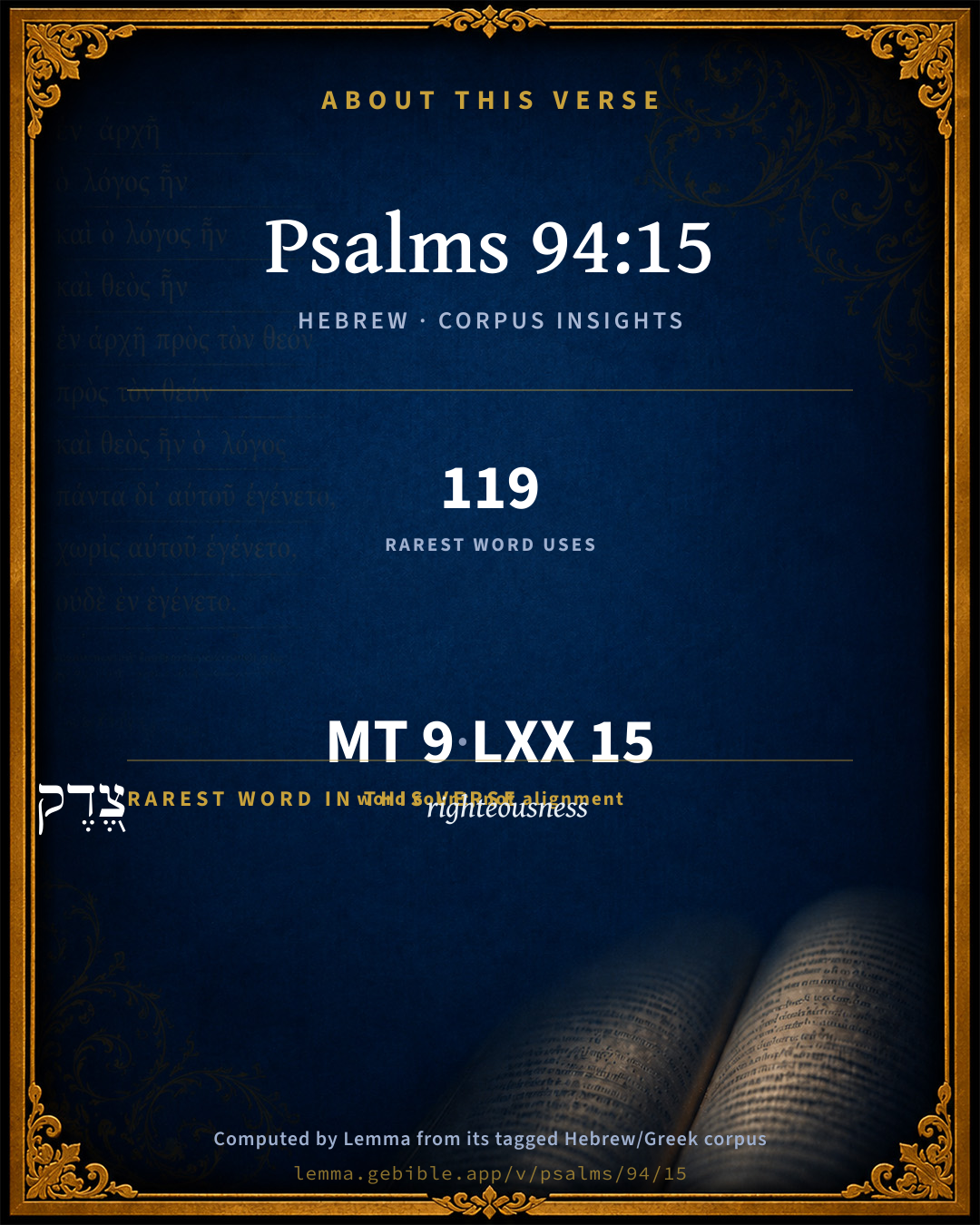
These counts appear in no published source. They are computed here, from the morphology-tagged text and Lemma’s own curated glosses. What Lemma adds →

9
words
9
distinct lemmas
Wisdom
section

Grammatical profile

  • 1 verb
  • 4 nouns
  • 1 adjective
  • 2 prepositions
  • 1 conjunction

Verb forms

  • יָשׁ֣וּב Qal · Imperfect

Hebrew & Septuagint length

In English translation the verse runs 14 words from the Hebrew and 15 from the Septuagint (LXX English) — closely comparable.

A rough comparison of the two English renderings, which tokenize alike — not a word-level alignment.

Word counts can differ between the Hebrew and the Greek without any difference in meaning — e.g. the Hebrew direct-object marker אֵת has no separate Greek word, and Greek often adds the article ὁ.

In the original languages it is 9 Hebrew tokens and 15 Greek tokens — but the two are counted differently (Hebrew bundles its prefixes and suffixes into one token; the Greek is in lemma form), so that isn’t a like-for-like length.

Cross-references

19

Topical passages linked to Psalms 94:15 in the Treasury of Scripture Knowledge — connected by theme and wording, ordered by reader-vote popularity; previews shown in the World English Bible.

  • Micah 7:9 I will bear the indignation of Yahweh, Because I have sinned against him, Until he pleads my case, and executes judgment for me. He will bring me forth to the light. I will see his righteousness.
  • Psalms 37:34 Wait for Yahweh, and keep his way, And he will exalt you to inherit the land. When the wicked are cut off, you shall see it.
  • Psalms 97:2 Clouds and darkness are around him. Righteousness and justice are the foundation of his throne.
  • Psalms 125:3–5 For the scepter of wickedness won't remain over the allotment of the righteous; So that the righteous won't use their hands to do evil.
  • Deuteronomy 32:35–36 Vengeance is mine, and recompense, At the time when their foot shall slide: For the day of their calamity is at hand, The things that are to come on them shall make haste.
  • Job 23:11–12 My foot has held fast to his steps. His way have I kept, and not turned aside.
  • Job 35:14 How much less when you say you don't see him. The cause is before him, and you wait for him!
  • Psalms 7:8–9 Yahweh administers judgment to the peoples. Judge me, Yahweh, according to my righteousness, And to my integrity that is in me.
  • Psalms 9:16 Yahweh has made himself known. He has executed judgment. The wicked is snared by the work of his own hands. Meditation. Selah.
  • Psalms 58:11 So that men shall say, "Most assuredly there is a reward for the righteous. Most assuredly there is a God who judges the earth."
  • Psalms 94:2–3 Rise up, you judge of the earth. Pay back the proud what they deserve.
  • Malachi 3:18 Then you shall return and discern between the righteous and the wicked, between him who serves God and him who doesn't serve him.
  • James 5:7–11 Be patient therefore, brothers, until the coming of the Lord. Behold, the farmer waits for the precious fruit of the earth, being patient over it, until it receives the early and late rain.
  • 2 Peter 3:8–10 But don't forget this one thing, beloved, that one day is with the Lord as a thousand years, and a thousand years as one day.
  • 1 John 2:19 They went out from us, but they didn't belong to us; for if they had belonged to us, they would have continued with us. But they left, that they might be revealed that none of them belong to us.
  • Revelation 15:3–4 They sang the song of Moses, the servant of God, and the song of the Lamb, saying, "Great and marvelous are your works, Lord God, the Almighty; Righteous and true are your ways, you King of the nations.
  • Isaiah 42:3 A bruised reed will he not break, and a dimly burning wick will he not quench: he will bring forth justice in truth.
  • Job 17:9 Yet shall the righteous hold on his way. He who has clean hands shall grow stronger and stronger.
  • Psalms 37:5–7 Commit your way to Yahweh. Trust also in him, and he will do this:

Cross-references courtesy of OpenBible.info (CC BY 4.0).

Hebrew and Greek witnesses Masoretic Hebrew ↔ Greek Septuagint

The same verse in the two great witnesses to the Old Testament, shown verse-for-verse.

You’re reading Greek Psalm 93 (Hebrew Psalm 94). The Septuagint counts the superscription, so verse numbers can differ from the Hebrew — chapter-level alignment, not verse-by-verse. Numbering follows Rahlfs.

These are two independent witnesses, not word-aligned to each other, and the Septuagint is shown in lemma (dictionary) form.

Hebrew Psalms 94:15 Masoretic · Westminster Leningrad Codex

כִּֽי עַד צֶ֭דֶק יָשׁ֣וּב מִשְׁפָּ֑ט וְ֝אַחֲרָ֗יו כָּל יִשְׁרֵי לֵֽב

For judgment will return to righteousness. All the upright in heart shall follow it.

World English Bible · Public Domain

Greek LXX Greek Psalm 93:15 Septuagint · lemma form

ἕως ὅς δικαιοσύνη ἐπιστρέφω εἰς κρίσις καί ἔχω αὐτός πᾶς ὁ εὐθύς ὁ καρδία διάψαλμα

until righteousness return to judgment, and all the upright in heart shall follow it. Pause.

LXX2012 (modern English Septuagint) · Public Domain

Hebrew: Westminster Leningrad Codex (CC BY 4.0). Greek: Septuagint (public domain); English from LXX2012 (modern English Septuagint) (Public Domain). How the Septuagint differs from the Hebrew →

Commentary

Notes on Psalms 94:15 from classic Christian and Jewish commentators (each source and its license shown beneath its notes). The classic Christian expositions comment on the surrounding passage and are grouped to its opening verse, so a note may address several verses; the Jewish commentaries on the Tanakh (Rashi and others) are per-verse, so they appear only where the commentator wrote on this verse.

Lemma curates 59 commentaries, every one of them public domain or Creative Commons licensed, each selected and text-cleaned for this edition rather than reprinted as found. About our sources →

Trapp's Complete Commentary

John Trapp

Psa 94:15 But judgment shall return unto righteousness: and all the upright in heart shall follow it.

Ver. 15. But judgment shall return unto righteousness] All shall be set to rights, and every one have his due, according to Rom 2:6-10, if not sooner, yet at the day of judgment without fail. Some give this sense, severity shall be changed into mercy, the rigour of the law to the clemency of the gospel. Others thus, judgment shall return to righteousness, that is, to its own place, licet defertur iudicium non aufertur.

And all the upright in heart shall follow it] viz. In their affections; they are carried out after it, earnestly desiring that dear day when God will unriddle his providences, and clear up his proceedings with the sons of men. Some read, shall follow him, that is, God; being brought home to him by their afflictions, they shall follow the Lamb whithersoever he goeth. Not so every loose ungirt Christian or profligate professor.

John Trapp, A Commentary or Exposition upon All the Books of the Old and New Testament (1647–1656) — public domain. Text from a community e-Sword module.

J. A. Alexander on Psalms

Joseph Addison Alexander

15. (Psa 94:15) For unto righteousness shall judgment turn, and after it (shall go) all the upright in heart. The apparent disturbance of the divine administration is to cease, and justice to return to its accustomed channels. In the last clause the righteous are described as following in its train or attending its triumphal march.

Joseph Addison Alexander, The Psalms Translated and Explained (1850) — public domain. Text from a community e-Sword module.

Geneva Bible (1599)

Geneva Bible translators

God will restore the state and government of things to their right use, and then the Godly shall follow him cheerfully.

Geneva Bible (1599) marginal notes — public domain. Text via Bolls.life.

Adam Clarke's Commentary

Verse 15. But judgment shall return unto righteousness] If we read יושב yosheb, shall sit, for ישוב yashub, shall return, which is only placing the ו vau before the ש shin instead of after it, we have the following sense: Until the just one shall sit in judgment, and after him all the upright in heart. Cyrus has the epithet צדק tsedek, the just one, in different places in the Prophet Isaiah. See Isa 41:2, Isa 41:10; Isa 45:8; Isa 51:5. It was Cyrus who gave liberty to the Jews, who appeared as their deliverer and conductor to their own land, and they are all represented as following in his train.

Adam Clarke's Commentary on the Bible (1810–1826) — public domain. Text from a community e-Sword/MySword module.

John Calvin's Commentaries

15. But judgment will return unto righteousness In the dark season of affliction, it is not easy to recognize the secret love which God even then bears to his own children, and the Psalmist adduces another ground of comfort, in the consideration that God will eventually put an end to the confusions which perplex them, and reduce matters to order. The form of expression used by the Psalmist is a little obscure, and this has led some to read the first part of the verse, as if it contained two distinct clauses — justice will return at the end, and then, judgment will return This is a violent wresting of the context. I have no doubt the Psalmist meant to say that judgment would be fitted or conformed to justice. And by judgment here is meant, as in many other places, the government or public state of matters. The confusion which prevails in the world, seems to argue some defect or unrighteousness of administration; and he holds out to us that it shall be well in the issue. More is said than merely that men who indulged in reckless oppression would be brought back to equitable dealing. A deeper meaning is intended, That God, when he interposed to restore the condition of his people, would bring forth openly to the light his justice which had lain concealed; by which we are not to understand that he ever deviates the least in his providence from the strictest rectitude, only there is not always that harmony and arrangement which might make his righteousness apparent to man’s view, and the correction of this inequality is here called justice of government. As the sun’s light is hid from view at night, or at a cloudy season, so when the wicked persecute the righteous, and are allowed to indulge in iniquity without restraint, the Divine justice is obscured by the clouds which are thus interposed between us and the providence of God, and judgment is in a manner separated from justice. But when things are brought back again to their proper state, justice and government are seen to harmonize perfectly together in the equality which prevails. Faith no doubt, should enable us to discern the justice of God even when things are most dark and disordered; but the passage speaks of what would be obvious to sense and actual observation, and asserts that the justice of God would shine as the sky when all is calm and serene.

And all that are upright in heart after him Some read, after it, that is, after righteousness; but as by righteousness here we are to understand the equal and harmonious government which prevails when God takes vengeance upon the wicked and delivers his own people, this rendering will scarcely suit. It would rather seem that God himself is to be understood, so that the relative is here without an antecedent. In the Hebrew, when mention is made of God, the relative is not unfrequently put instead of the name. The words then mean, that upon God’s restoring order in the world, his people would be encouraged to follow him with greater alacrity. Even when called to bear the cross, they sigh after him under their troubles and distresses, but it binds them more closely to his service when they see his hand stretched forth in this visible manner, and sensibly experience his deliverance.

John Calvin's Commentaries (1540-1563) — public domain. Text from the Calvin Translation Society English edition (1840s-50s) via the Christian Classics Ethereal Library (ccel.org). Calvin's coverage is partial (roughly two-thirds of the Bible); uncommented books and verses are honest gaps, never fabricated. The 19th-century editor's footnotes and remarks are omitted so the notes are faithfully Calvin's own voice.

Ellicott's Commentary for English Readers

(15) But.—Better, For; literally, for to righteousness judgment shall turn, and after it all upright in heart—i.e., there shall no longer be the seeming contradiction in things. God’s righteousness will triumph over the injustice under which Israel groans; His ways will be vindicated, so that all the upright in heart will acknowledge that “there is a reward for the righteous, a God who judges in the earth” (Psa_58:11). Luther’s fine paraphrase, “For Right must, whatever happens, remain Right,” expresses the feeling; but, better still, the question, “Shall not the Lord of all the earth do right?” The phrase, “shall after it,” is a common one for expressing attachment and adherence to a party or cause (Exo_23:2; 2Sa_2:10; Psa_49:13), and specially of adherence to Jehovah (1Sa_12:14; 1Ki_14:8).

A Bible Commentary for English Readers, edited by Charles John Ellicott (1878–1897) — public domain. Text from a community e-Sword module.

The Cambridge Bible for Schools and Colleges

gen. ed. J. J. S. Perowne

15. But] Or as R.V. For. Judgement will again be justice: i.e. its administration will once more be conducted upon principles of equity, when those who now pervert it are destroyed; and all true-hearted men will attach themselves to it as its supporters and adherents.

The Cambridge Bible for Schools and Colleges (gen. ed. J. J. S. Perowne; Cambridge University Press, 1878–1918) — public domain. Text from a community e-Sword module.

John Gill's Exposition

But judgment shall return unto righteousness,.... Which may be understood either of the judgment and righteousness of God, which seemed to be parted, and stand at a distance from each other; his conduct and government of the world from his justice; the righteous being persecuted and afflicted, and wicked men suffered to prosper; which sometimes makes it difficult to reconcile the judgment of God, or his government of the world, to his justice; see Jer 12:1, but as this has been made manifest in the destruction of the Jews, and in the downfall of Rome Pagan, the first persecutors of the Christians; so it will be seen in Rome Papal, when the judgments of God will be manifest, and appear to be just and true; and these two, judgment and justice, will openly come together, in the sight of all; as they also will at the last judgment; see Rev 15:4 or else of the righteousness of men, which, in times of general corruption, seems to be fled from them, and to stand at a distance, from their conduct and behaviour; as in the old world before the flood, and in the times Isaiah beautifully describes, Isa 59:14, and in the times of Christ and his apostles; and in the persecuting times of Rome Pagan and Papal; and as it will be at the time of the slaying of the witnesses; but upon the rising of them, which will not be long after, there will be a great pouring down of the Spirit, and a general reformation will follow throughout the world; all the Lord's people will be righteous, not only nominally, but really; every pot in Jerusalem shall be holy; and holiness shall be so common as that it is said it shall be upon the bells of the horses; and in the new heavens and new earth will dwell none but righteous persons; and then judgment and righteousness will come together indeed:

and all the upright in heart shall follow it; either judgment, as Jarchi; or righteousness, as Kimchi; not the righteousness of the law, but the righteousness of faith; or rather practical righteousness, works of righteousness, which both the grace wrought in them, and the doctrine of grace received by them, will teach, influence, and engage to pursue after with eagerness: or else the meaning is, that such who are "upright in heart"; who have new hearts and right spirits formed in them; who have the truth of grace, and the root of the matter, in them; whose hearts, words, and actions, agree; who are sincere souls, Israelites indeed, in whom is no guile; these will approve and applaud the righteous judgments of God upon antichrist; they shall follow the justice of God with their commendations and praises; see Rev 15:3. The words may be rendered, "and all the upright in heart shall be after him" (d), the Lord; they shall follow him whithersoever he goes, as sheep follow the shepherd, servants their masters, and soldiers their general; they shall follow him in his own ways, observe his commands, and obey his orders; see the description of such that will be with Christ, and follow him, before and at the time of antichrist's ruin, Rev 14:4. The Targum is,

"after him shall be redeemed all the upright in heart.''

(d) "post ipsum", Musculus, Gejerus.

John Gill's Exposition of the Whole Bible (1746–1763) — public domain (CC PDM 1.0). Text via the HelloAO Bible API.

Albert Barnes' Notes on the Bible

But judgment shall return unto righteousness - That is, The exercise of judgment shall be so manifest to the world - as if it “returned” to it - as to show that there is a righteous God. The truth here taught is, that the “results” of God’s interposition in human affairs will be such as to show that he is on the side of righteousness, or such as to vindicate and maintain the cause of righteousness in the earth.

And all the upright in heart shall follow it - Margin, shall be after it. The meaning is, that all who are upright in heart - all who are truly righteous - will follow on in the path of justice; that they will regard what God does as right, and will walk in that path. The fact that what occurs is done by God, will be to them a sufficient revelation of what ought to be done; and they will follow out the teachings properly suggested by the divine dealings as their rules of life. In other words, the manifested laws of the divine administration will be to them an indication of what is right; and they will embrace and follow the lessons thus made known to them by the dealings of Divine Providence as the rules of their own conduct.

Albert Barnes' Notes on the Bible (1834–1885) — public domain. Text from a community e-Sword/MySword module.

Matthew Poole's English Annotations

But although the world is now full of unrighteous judgments, and even God himself seems not to judge and administer things justly, because he suffers his people to be oppressed, and the wicked to triumph over them, yet the state or things shall be otherwise ordered, God will declare himself to be a righteous Judge, and will advance and establish justice in the earth, and especially among his people.

Follow it, to wit, just judgment restored; they will all approve of it, and imitate this justice of God in all their actions, whereas the wicked will still do wickedly, as is said. Dan 12:10, and in a land and state of uprightness will deal unjustly, and will not behold the majesty of the Lord, as it is Isa 26:10. Otherwise, shall follow him, to wit, the Lord, expressed Psa 94:14, whose act is to bring judgment to justice. Whilst the wicked forsake God, these will cleave to him, as being confident that, howsoever he may suffer them to be oppressed for a season, yet he will in due time plead their cause, and bring forth their righteousness.

Matthew Poole's English Annotations on the Holy Bible (1683–1685) — public domain. Text from a community e-Sword/MySword module.

The Treasury of David

Charles H. Spurgeon

Ver. 15. But judgment shall return unto righteousness. The great Judge will come, the reign of righteousness will commence, the course of affairs will yet be turned into the right channel, and then all the godly will rejoice. The chariot of right will be drawn in triumph through our streets,

and all the upright in heart shall follow it, as in happy procession. A delightful hope is here expressed in poetic imagery of much beauty. The government of the world has been for a while in the hands of those who have used it for the basest and most vicious ends; but the cry of prayer will bring back righteousness to the throne, and then every upright heart will have its portion of joy.

Ver. 15. My text contains two parts; the providence of God to his

people, and the prosperity of the providence among them. The providence of God to his people lies much in after games: God seems to go away from his, and then the wicked have the better: anon he returns, and then his people carry the day. Judgment shall return unto righteousness; or justice shall return unto judgment; a phrase of speech frequent in the Old Testament to note retaliation, quid for quo, like for like. The term is distinct as well as the phrase, and helps to give the sense of the Spirit of God here; qru from qru, se asseruit, justice shall assert herself; Christ shall assert his people, his promises, his threatenings. "Shall return, "retro-agi:what evil men do to good shall be redone to them, done back again upon them by God. Or this root, here rendered "return, "may be rendered to abide and rest. In Ps 23:6, it is so rendered: "I shall dwell in the house of the Lord for ever." Justice doth, as it were, go from home sometimes, when it visits the saints; but it returns to its home and dwelling, i.e., the wicked. Justice is, as it were, from home, till it returns to the wicked, there it abides and dwells. "Justice shall dwell and rest in judgment, "i.e., in the execution of punishments upon wicked men. jpvm, from jpv, judicium exercuit, notes the exercise and execution of justice: a thing rests in its end; justice dwells and rests in judgment, i.e., in its execution, in its end for which, and unto which and whom it is appointed. Nicholas Lockyer, 1612-1684-5.

Ver. 15. Shall follow it. The right reading is in the margin, shall be after it, or after that;that is, (1) shall observe it. "He poureth contempt upon princes; he setteth the poor on high from affliction; whose is wise shall observe these things, "etc., Ps 107:43: this Scripture, I think, in part explains the text. (2) "Shall be after it, "that is, shall confess and acknowledge it. It is not a small thing to bring men to confess the justice of God in his dealings. (3) "Shall be after it, "that is, shall triumph in it, and so to be compared with and opened by Ps 58:10-11. (4) "Shall be after it; "that is, the works of God shall be of effectual operation, to bring such as are upright in heart more to love and obey God, and so it is to be compared with Ps 31:23. Nicholas Lockyer.

Ver. 15.

1. Judgment suspended.

2. Judgment returned.

3. Judgment acknowledged. G. R.

Psalms 94:16*

Charles H. Spurgeon's The Treasury of David (1869–1885) — public domain. Psalms only. Text from a community e-Sword/MySword module.

Whedon's Commentary on the Bible

Daniel D. Whedon

15. Judgment shall return unto righteousness—However disordered the administration of the world may appear, a brighter day shall come, when judgment shall resume the course of justice, and the right be vindicated. A prophetic glimpse of the millennium. “I saw thrones, and they sat upon them, and judgment was given to them.” Rev_20:4

Daniel D. Whedon (gen. ed.), Commentary on the Old and New Testaments (1874–1909) — public domain. Text from a community e-Sword module.

The Pulpit Commentary

But judgment shall return unto righteousness. "Judgment," i.e. God"s actual award of good and evil upon the earth, which has seemed to be divorced from justice, while the ungodly have prospered and the pious been afflicted (vers. 3-6), shall in the end "return unto righteousness," i.e. once more, evidently, conform to it and coincide with it. And all the upright in heart shall follow it; i.e. "and then all honest hearted men shall recognize the fact, see it, and rejoice in it."

The Pulpit Commentary (1880–1919), ed. H.D.M. Spence-Jones & Joseph S. Exell — public domain. Text from a community e-Sword module.

John Wesley's Explanatory Notes

But - God will declare himself to be a righteous judge, and will again establish justice in the earth. Follow - They will all approve of it, and imitate this justice of God in all their actions.

John Wesley, Explanatory Notes Upon the Whole Bible (1754–1765) — public domain. Text via the GEBible commentary corpus.

Rashi

Rabbi Shlomo Yitzchaki (Rashi)

For until righteousness will judgment return [i.e., the judgment of] their chastisements [will persist] until they become righteous because of them. And after the judgment, all those upright in heart will gather, for they will receive their reward.

Rashi on the Tanakh — English translations: “The Judaica Press complete Tanach with Rashi, translated by A. J. Rosenberg” (CC BY 4.0); “Pentateuch with Rashi's commentary by M. Rosenbaum and A.M. Silbermann, 1929-1934” (public domain); “The Metsudah Tanach series, Lakewood, N.J” (CC BY 4.0); and “The Book of Joshua, Metsudah Publications, 1997” (CC BY 4.0). Text via Sefaria.

Lesson kit

Teaching starters — assembled from the data on this page, not authored interpretation. Every prompt links to the verse data it draws on. Edit before teaching.

Psalms, in the Wisdom, opens this verse with 9 words (9 distinct Hebrew lemmas). Its most distinctive word is tsedeq (“righteousness”). A historical commentator’s framing appears above. Read the whole chapter for the surrounding context.

Discussion questions

  1. How does “righteousness” (tsedeq) shape what this verse is saying?
  2. How does Micah 7:9, which shares this passage’s theme, read alongside this verse?
  3. The translations on this page render this verse differently — a whole-verse word diff, not a word-by-word alignment. What might account for the different wordings?
  4. «יָשׁ֣וּב» is a Qal Imperfect verb. How does that grammatical form shape the action described?
  5. Compare how Trapp's Complete Commentary and J. A. Alexander on Psalms read this verse. Where do they agree or differ?

Things to notice

Reading settings

Reading text

Shown beneath each verse's original-language words.

Old Testament
Old Testament edition

Read the OT as the Masoretic Hebrew (MT) or the Greek Septuagint (LXX).

English shown for the Greek Septuagint (in the Hebrew ↔ Greek comparison).

Comparing translations? Open the Compare panel on any verse page to stack up to four side by side.