
Joshua 19:27

Hebrew (Westminster Leningrad Codex) Joshua 19:27 appears in the Hebrew Old Testament. The text above is from the Westminster Leningrad Codex. Each word links to its Strong’s number, a concise gloss, and parsing drawn from the Open Scriptures Hebrew Bible morphology. Click any word for its full Brown-Driver-Briggs (BDB) entry.
Download image
Cite this verse

Joshua 19:27 (World English Bible). Public Domain. Lemma interlinear Bible study tool, https://lemma.gebible.app/v/joshua/19/27.

Show BibTeX & RIS
BibTeX
RIS
English Translation
and it turned toward the sunrise to Beth Dagon, and reached to Zebulun, and to the valley of Iphtah El northward to Beth Emek and Neiel; and it went out to Cabul on the left hand,
World English Bible · Public Domain
Highlights
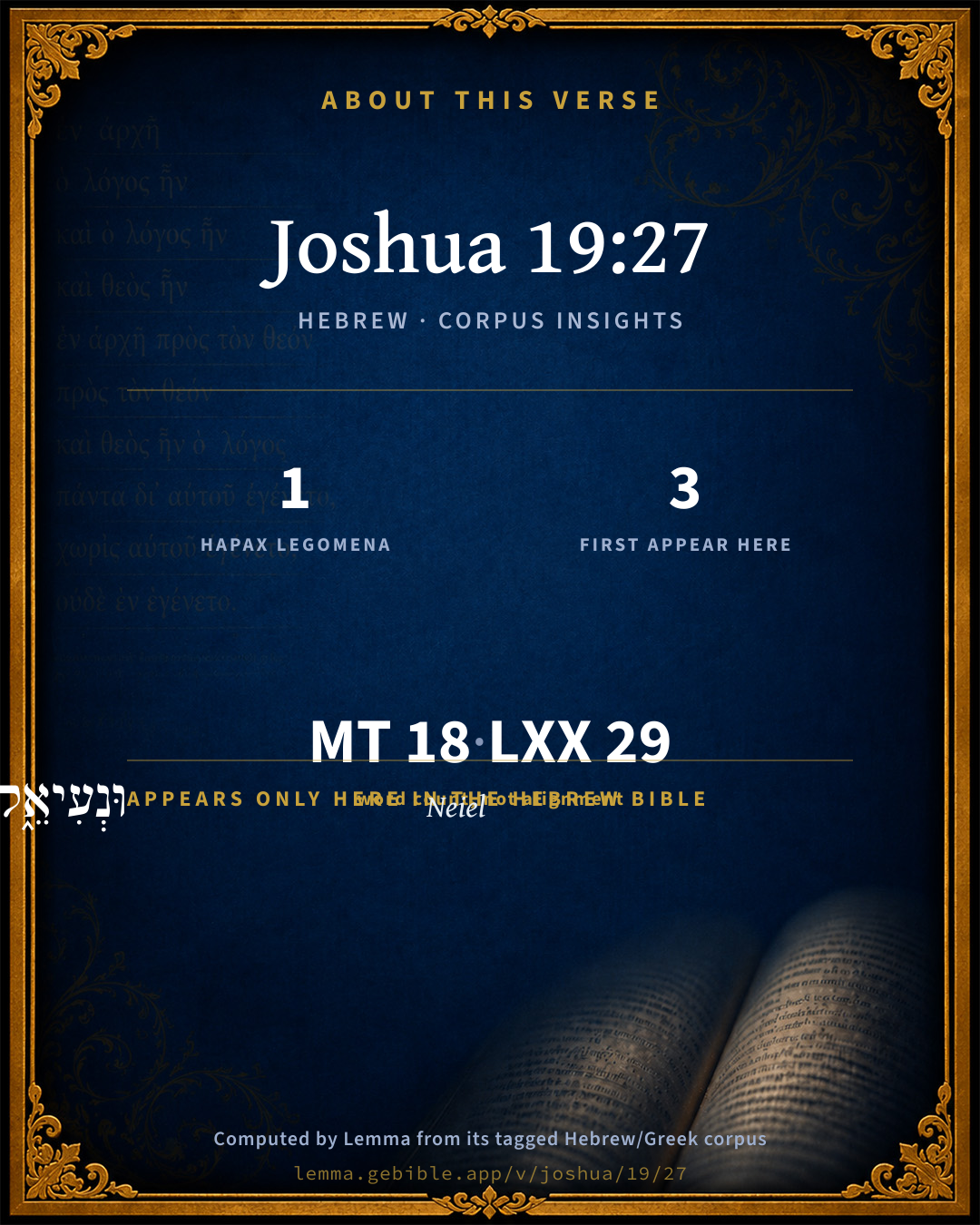
  • 1 hapax legomenon — only here in the Hebrew Bible
  • 3 first appearances in the Hebrew Bible
Full analysis ↓
Download a study sheet

One document with this verse’s original text, its word-by-word gloss line, the meaning frame, cross-references with their text, attributed commentary, and full source and license credits — printable, and it pastes into notes with its structure intact.

This verse Autodidact and up

Study sheet (.html) Plain text (.txt)

A passage Seminary Student

Up to 50 verses in one chapter. A passage sheet keeps up to 6 commentary sources and 12 cross-references per verse, in the order this page ranks them, and says so on the sheet whenever that leaves anything out. Ask for a single verse and you get the Autodidact verse sheet above.

Everything on this page stays free to read, with no account — the sheet is a download of what is already on screen, not access to it.

Want to remove ads? Support Godless Engineer
Compare translations 3

The same verse in 3 English versions, stacked beneath the original-language interlinear above. Click any original word for its lexicon entry.

Each is an independent rendering of the whole verse — the interlinear is not word-aligned to these translations.

Highlighted words mark where these versions differ — a whole-verse word diff, not a word-by-word alignment.

  • World English Bible Public Domain
    and it turned toward the sunrise to Beth Dagon, and reached to Zebulun, and to the valley of Iphtah El northward to Beth Emek and Neiel; and it went out to Cabul on the left hand,
  • King James Version Public Domain
    And turneth toward the sunrising to Bethdagon, and reacheth to Zebulun, and to the valley of Jiphthahel toward the north side of Bethemek, and Neiel, and goeth out to Cabul on the left hand,
  • unfoldingWord Literal Text CC BY-SA 4.0
    And it turned the rising of the sun Beth Dagon, and it met with Zebulun and with the Valley of Iphtah El northward, Beth Emek and Neiel. And it went out to Cabul from the left,

unfoldingWord Literal Text — © unfoldingWord, licensed CC BY-SA 4.0. Word-aligned USFM3 via Door43 (git.door43.org/unfoldingWord/en_ult).

Versions to compare (up to 4)

3 of 4 selected

Show all 18 translations

Every available English version of this verse, each an independent rendering of the whole verse.

  • World English Bible Public Domain
    and it turned toward the sunrise to Beth Dagon, and reached to Zebulun, and to the valley of Iphtah El northward to Beth Emek and Neiel; and it went out to Cabul on the left hand,
  • Berean Standard Bible Public Domain
    then turned eastward toward Beth-dagon, touched Zebulun and the Valley of Iphtah-el, and went north to Beth-emek and Neiel, passing Cabul on the left.
  • Majority Standard Bible Public Domain
    then turned eastward toward Beth-dagon, touched Zebulun and the Valley of Iphtah-el, and went north to Beth-emek and Neiel, passing Cabul on the left.
  • King James Version Public Domain
    And turneth toward the sunrising to Bethdagon, and reacheth to Zebulun, and to the valley of Jiphthahel toward the north side of Bethemek, and Neiel, and goeth out to Cabul on the left hand,
  • American Standard Version (1901) Public Domain
    and it turned toward the sunrising to Beth-dagon, and reached to Zebulun, and to the valley of Iphtah-el northward to Beth-emek and Neiel; and it went out to Cabul on the left hand,
  • Revised Version (1885) Public Domain
    and it turned toward the sunrising to Beth-dagon, and reached to Zebulun, and to the valley of Iphtah-el northward to Beth-emek and Neiel; and it went out to Cabul on the left hand,
  • Geneva Bible (1599) Public Domain
    And turneth towarde the sunne rising to Beth-dagon, and commeth to Zebulun, and to the valley of Iiphtah-el, toward the Northside of Beth-emek, and Neiel, and goeth out on the left side of Cabul,
  • Douay-Rheims (1899) Public Domain
    And it returneth towards the east to Bethdagon: and passeth along to Zabulon and to the valley of Jephthael towards the north to Bethemec and Nehiel. And it goeth out to the left side of Cabul,
  • Young's Literal Translation Public Domain
    and hath turned back, at the sun-rising, `to' Beth-Dagon, and come against Zebulun, and against the valley of Jiphthah-El toward the north of Beth-Emek, and Neiel, and hath gone out unto Cabul on the left,
  • Literal Standard Version CC BY-SA 4.0
    and has turned back, at the sun-rising, [to] Beth-Dagon, and come against Zebulun, and against the Valley of Jiphthah-El toward the north of Beth-Emek, and Neiel, and has gone out to Cabul on the left,
  • Unlocked Literal Bible CC BY-SA 4.0
    Then it turned eastward to Beth Dagon and went as far as Zebulun, and then to the Valley of Iphtah El, northward to Beth Emek and Neiel. Then it continued on to Kabul toward the north.
  • unfoldingWord Literal Text CC BY-SA 4.0
    And it turned the rising of the sun Beth Dagon, and it met with Zebulun and with the Valley of Iphtah El northward, Beth Emek and Neiel. And it went out to Cabul from the left,
  • Darby Bible Public Domain
    and turned towards the sun-rising to Beth-Dagon, and reached to Zebulun, and to the valley of Jiphthah-el northward [to] Beth-emek and Neiel, and went out to Cabul on the left,
  • World Messianic Bible Public Domain
    It turned toward the sunrise to Beth Dagon, and reached to Zebulun, and to the valley of Iphtah El northward to Beth Emek and Neiel. It went out to Cabul on the left hand,
  • Webster's Bible Public Domain
    And turneth towards the sun-rising to Beth-dagon, and reacheth to Zebulun, and to the valley of Jiphthah-el towards the north side of Beth-emek, and Neiel, and goeth out to Cabul on the left hand,
  • Free Bible Version CC BY-SA 4.0
    Then it turned east towards Beth-dagon, reaching the land of Zebulun and the valley of Iphtah-el. From there it headed north to Beth-emek and Neiel, and continued north to Cabul, and on through to
  • Bible in Basic English Public Domain
    Turning to the east to Beth-dagon and stretching to Zebulun and the valley of Iphtah-el as far as Beth-emek and Neiel to the north; on the left it goes as far as Cabul
  • JPS Tanakh (1917) Public Domain
    And it turned toward the sunrising to Beth-dagon, and reached to Zebulun and to the valley of Iphtahel northward at Beth-emek and Neiel; and it went out to Cabul on the left hand,

Literal Standard Version (2020), Covenant Press — licensed CC BY-SA 4.0. Text via the HelloAO Bible API (eBible.org). Unlocked Literal Bible (unfoldingWord) — licensed CC BY-SA 4.0. Text via the HelloAO Bible API (eBible.org). unfoldingWord Literal Text — © unfoldingWord, licensed CC BY-SA 4.0. Word-aligned USFM3 via Door43 (git.door43.org/unfoldingWord/en_ult). Free Bible Version, Dr. Jonathan Gallagher — licensed CC BY-SA 4.0. Text via the HelloAO Bible API (eBible.org).

Word by word

More ways to search: Search by grammar → Find every occurrence → Compare this word →

Practice this passage: Drill this verse → Learn its vocabulary →

וּנְעִיאֵ֑ל
Nᵉʻîyʼêl
H5272
“and · Neiel”
Conjunction + Noun, Proper
Part of Speech
Conjunction + Noun
Type
Proper
Full BDB Definition

Origin: from H5128 and H410

TWOT: None

Neiel = "moved by God" - a place on the border of the territory of Asher
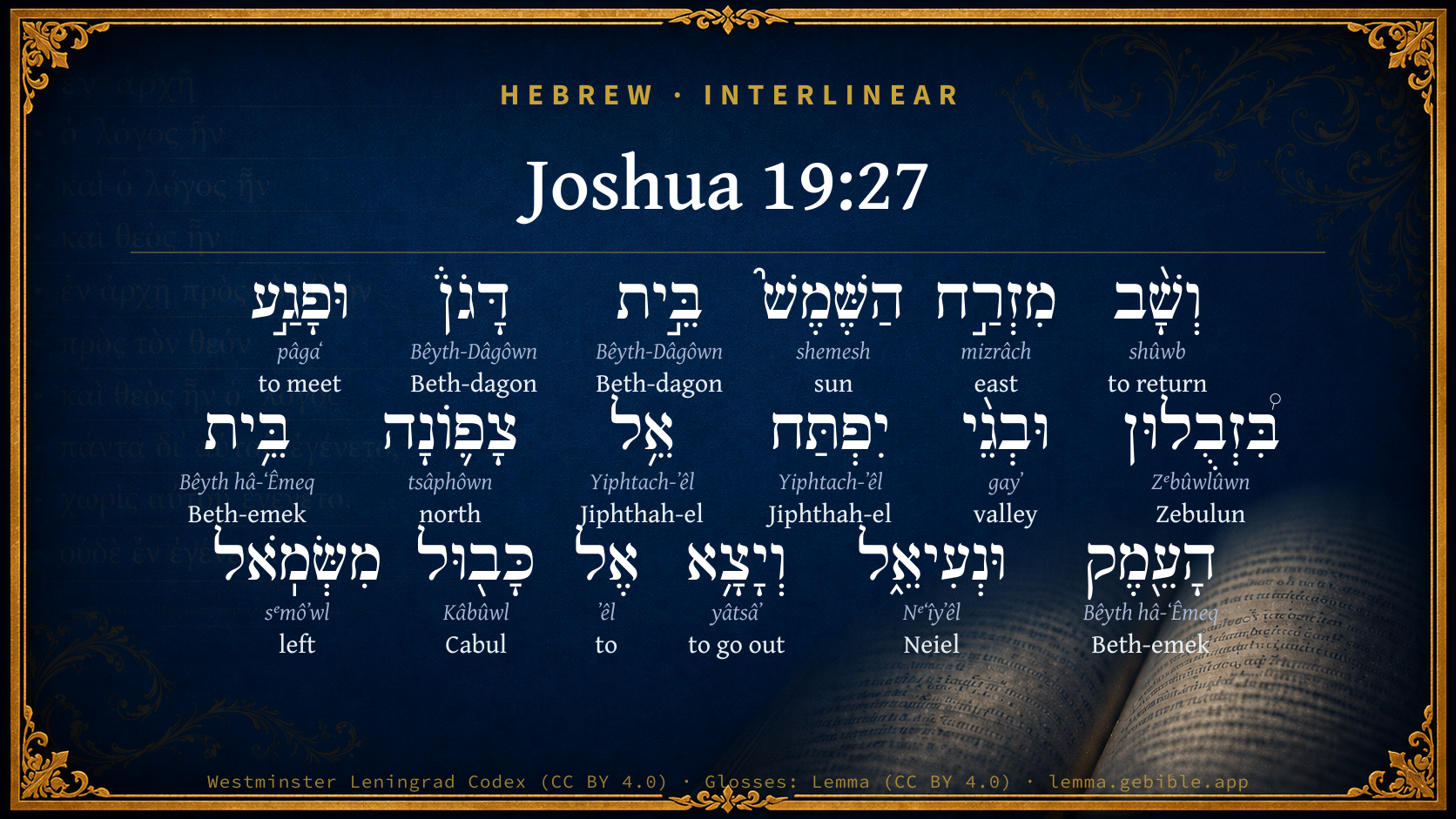
  1. וְשָׁ֨ב shûwb H7725 “and · to return” Conjunction + Verb, Qal, Perfect, 3rd Person, Masculine, Singular
  2. מִזְרַ֣ח mizrâch H4217 “east of” Noun, Common, Masculine, Singular, Construct
  3. הַשֶּׁמֶשׁ֮ shemesh H8121 “the · sun” Particle, Definite Article + Noun, Common, Both, Singular, Absolute
  4. בֵּ֣ית Bêyth-Dâgôwn H1016 “Beth-dagon” Noun, Proper
  5. דָּגֹן֒ Bêyth-Dâgôwn H1016 “Beth-dagon” Noun, Proper
  6. וּפָגַ֣ע pâgaʻ H6293 “and · to meet” Conjunction + Verb, Qal, Perfect, 3rd Person, Masculine, Singular
  7. בִּ֠זְבֻלוּן Zᵉbûwlûwn H2074 “in/at · Zebulun” Preposition + Noun, Proper
  8. וּבְגֵ֨י gayʼ H1516 “and · in/at · valley of” Conjunction + Preposition + Noun, Common, Both, Singular, Construct
  9. יִפְתַּח Yiphtach-ʼêl H3317 “Jiphthah-el” Noun, Proper
  10. אֵ֥ל Yiphtach-ʼêl H3317 “Jiphthah-el” Noun, Proper
  11. צָפ֛וֹנָה tsâphôwn H6828 “north · toward” Noun, Common, Feminine, Singular, Absolute + Suffix, Demonstrative
  12. בֵּ֥ית Bêyth hâ-ʻÊmeq H1025 “Beth-emek” Noun, Proper
  13. הָעֵ֖מֶק Bêyth hâ-ʻÊmeq H1025 “Beth-emek” Noun, Proper
  14. וְיָצָ֥א yâtsâʼ H3318 “and · to go out” Conjunction + Verb, Qal, Perfect, 3rd Person, Masculine, Singular
  15. אֶל ʼêl H413 “to” Preposition
  16. כָּב֖וּל Kâbûwl H3521 “Cabul” Noun, Proper
  17. מִשְּׂמֹֽאל sᵉmôʼwl H8040 “from · left” Preposition + Noun, Common, Masculine, Singular, Absolute

About this verse

These counts appear in no published source. They are computed here, from the morphology-tagged text and Lemma’s own curated glosses. What Lemma adds →

18
words
15
distinct lemmas
Historical
section

Notable vocabulary

1 hapax legomenon — a word that appears only here in the entire Hebrew Bible:

  • וּנְעִיאֵ֑ל Neiel H5272

First appearance in Scripture

These words make their first canonical appearance in the Hebrew Bible here:

  • בֵּ֥ית Beth-emek H1025
  • וּנְעִיאֵ֑ל Neiel H5272
  • כָּב֖וּל Cabul H3521

Grammatical profile

  • 3 verbs
  • 14 nouns
  • 1 preposition

Verb forms

  • וְשָׁ֨ב Qal · Perfect
  • וּפָגַ֣ע Qal · Perfect
  • וְיָצָ֥א Qal · Perfect

Repetition

Words recur within this verse — often emphatic in Hebrew:

  • בֵּ֣ית Beth-dagon H1016 ×2
  • יִפְתַּח Jiphthah-el H3317 ×2
  • בֵּ֥ית Beth-emek H1025 ×2

Hebrew & Septuagint length

In English translation the verse runs 36 words from the Hebrew and 31 from the Septuagint (LXX English) — closely comparable.

A rough comparison of the two English renderings, which tokenize alike — not a word-level alignment.

Word counts can differ between the Hebrew and the Greek without any difference in meaning — e.g. the Hebrew direct-object marker אֵת has no separate Greek word, and Greek often adds the article ὁ.

In the original languages it is 18 Hebrew tokens and 29 Greek tokens — but the two are counted differently (Hebrew bundles its prefixes and suffixes into one token; the Greek is in lemma form), so that isn’t a like-for-like length.

Cross-references

2

Topical passages linked to Joshua 19:27 in the Treasury of Scripture Knowledge — connected by theme and wording, ordered by reader-vote popularity; previews shown in the World English Bible.

  • 1 Kings 9:13 He said, What cities are these which you have given me, my brother? He called them the land of Cabul to this day.
  • 1 Samuel 5:2 The Philistines took the ark of God, and brought it into the house of Dagon, and set it by Dagon.

Cross-references courtesy of OpenBible.info (CC BY 4.0).

Hebrew and Greek witnesses Masoretic Hebrew ↔ Greek Septuagint

The same verse in the two great witnesses to the Old Testament, shown verse-for-verse.

These are two independent witnesses, not word-aligned to each other, and the Septuagint is shown in lemma (dictionary) form.

Hebrew Joshua 19:27 Masoretic · Westminster Leningrad Codex

וְשָׁ֨ב מִזְרַ֣ח הַשֶּׁמֶשׁ֮ בֵּ֣ית דָּגֹן֒ וּפָגַ֣ע בִּ֠זְבֻלוּן וּבְגֵ֨י יִפְתַּח אֵ֥ל צָפ֛וֹנָה בֵּ֥ית הָעֵ֖מֶק וּנְעִיאֵ֑ל וְיָצָ֥א אֶל כָּב֖וּל מִשְּׂמֹֽאל

and it turned toward the sunrise to Beth Dagon, and reached to Zebulun, and to the valley of Iphtah El northward to Beth Emek and Neiel; and it went out to Cabul on the left hand,

World English Bible · Public Domain

Greek LXX Joshua 19:27 Septuagint · lemma form

καί ἐπιστρέφω ἀπό ἀνατολή ἥλιος καί βαιθεγενεθ καί συνἅπτω ὁ ζαβουλων καί ἐκ γαι καί φθαιηλ κατά βορέας καί εἰςἔρχομαι ὅριον σαφθαιβαιθμε καί ιναηλ καί διαἔρχομαι εἰς χωβα μασομελ

And it will return westward from Baethegeneth, and will join Zabulon and Ekgai, and Phthaeel northwards, and the borders will come to Saphthaebaethme, and Inael, and will go on to Chobamasomel,

LXX2012 (modern English Septuagint) · Public Domain

Hebrew: Westminster Leningrad Codex (CC BY 4.0). Greek: Septuagint (public domain); English from LXX2012 (modern English Septuagint) (Public Domain). How the Septuagint differs from the Hebrew →

Targum (Aramaic paraphrase)

1

The Targum is the ancient Jewish Aramaic paraphrase of the Hebrew Scriptures — an interpretive translation, not the Hebrew text itself. Onkelos (literal) and Pseudo-Jonathan (expansive) render the Torah, and Jonathan the Prophets. Coverage is partial: where no permissively-licensed English translation exists for a verse, only the Aramaic is shown. This is verse-level text, not a word-by-word alignment to the Hebrew.

  1. Targum Jonathan Prophets (Joshua–Malachi)
    וְתַב מִמַדְנַח שִׁמְשָׁא בֵּית דָגוֹן וּמְעָרַע בִּזְבוּלֻן וּבְחֵילַת יִפְתַּח אֵל לְצִפּוּנָא בֵּית מֵישְׁרָא וּנְעִיאֵל וְנָפֵיק לְכָבוּל מִשְׂמָאלָא:

    (no public-domain English translation for this verse)

    Targum Jonathan — Aramaic: “Mikraot Gedolot” (public domain). English: “Sefaria Community Translation” (CC0 1.0 (public-domain dedication)); “London "Chaldee Paraphrase," 1871” (public domain). Text via Sefaria.

Commentary

Notes on Joshua 19:27 from classic Christian and Jewish commentators (each source and its license shown beneath its notes). The classic Christian expositions comment on the surrounding passage and are grouped to its opening verse, so a note may address several verses; the Jewish commentaries on the Tanakh (Rashi and others) are per-verse, so they appear only where the commentator wrote on this verse.

Lemma curates 59 commentaries, every one of them public domain or Creative Commons licensed, each selected and text-cleaned for this edition rather than reprinted as found. About our sources →

Joseph Benson's Commentary

Jos 19:27. Cabul — A city so called. Left hand — That is, on the north, which, when men look toward the east, as is usual, is on their left hand.

Joseph Benson's Commentary on the Old and New Testaments (1811–1818) — public domain. Text from a community e-Sword module.

Geneva Bible (1599)

Geneva Bible translators

Joineth to the tribe of Zebulun, which lay more Eastward.

Geneva Bible (1599) marginal notes — public domain. Text via Bolls.life.

Adam Clarke's Commentary

Verse 27. Cabul on the left hand] That is, to the north of Cabul, for so the left hand, when referring to place, is understood among the Hebrews.

We must not confound this town or Cabul with the twenty cities given by Solomon to Hiram, with which he was displeased, and which in contempt he called the land of Cabul, the dirty or paltry land, 1Kg 9:11-13: there was evidently a town of this name, widely different from the land so called, long before the time of Solomon, and therefore this cannot be adduced as an argument that the book of Joshua was written after the days of David. The town in question is supposed to be the same which Josephus in his Life calls χωβουλω Choboulo, and which he says was situated by the sea-side, and nigh to Ptolemais. De Bell. Jud., lib. iii., c. 4.

Adam Clarke's Commentary on the Bible (1810–1826) — public domain. Text from a community e-Sword/MySword module.

The Cambridge Bible for Schools and Colleges

gen. ed. J. J. S. Perowne

27. and turneth toward the sunrising] From the Shihor-libnath, the border, still keeping to the south of Carmel, turned in an easterly direction towards Beth-dagon, of which we know as little as of the Beth-dagon of Judah, above, Jos_15:41.

and reacheth to Zebulun] Thence it trended in a north-easterly direction, and “touched the border of Zebulun,” and the valley, or ravine, of Jiphthah-el, where, according to Jos_19:14, were “the outgoings” of the north-western boundary of the latter tribe; and passed on north of Beth-emek and Neiel (which has been identified with Mi’ar), “and went out to Cabul on the left hand,” i.e. on the north side of it.

Cabul] it is thought, may be considered as still existing in the modern Kabûl, found about eight or nine miles east of Akka, and thus on the very borders of Galilee. It is possible, therefore, that there may be some connection between this place and the district containing twenty cities, which was presented by Solomon to Hiram, king of Tyre (1Ki_9:11-13). See Smith’s Bibl. Dict. under Cabul.

The Cambridge Bible for Schools and Colleges (gen. ed. J. J. S. Perowne; Cambridge University Press, 1878–1918) — public domain. Text from a community e-Sword module.

John Gill's Exposition

And Hebron,.... Hebron seems to be the same with Abdon, Jos 21:30; and being changed, of which there are other instances; and hereby this is distinguished from another Hebron in the tribe of Judah, more commonly known, Jos 15:54,

and Rehob; in the time of Jerom (s), there was a village called Rooba, four miles from Scythopolis, and which he says was a city separated to the Levites, as this was, or one of the same name in this tribe; for there was another, Jos 19:30; see Jos 21:31; but whether either of them is the same with this is not certain:

and Hammon; of this city we read nowhere else:

and Kanah; this Kanah is generally thought to be the same where Christ wrought his first miracle, Joh 2:1. Jerom expressly says (u), there was a Cana in the tribe of Asher, where our Lord and Saviour turned water into wine, Joh 2:1, and from whence was Nathanael, Joh 21:2; and it is at this day, adds he, a town in Galilee of the Gentiles. Phocas (w) places Cana between Sippori and Nazareth, which is now shown six Roman miles from Sippori to the west, a little inclining to the north; and there is also in the same tract Cephar Cana, four miles from Nazareth to the north, inclining to the east; and it is disputed which of these two is Cana of Galilee the New Testament: with this account agrees pretty much what our countryman Mr. Maundrell (x) gives of his travels in those parts:"taking leave of Nazareth, (he says,) and going at first northward, we crossed the hills that encompassed the vale of Nazareth at that side; after which we turned to the westward, and passed in view of Cana of Galilee, the place signalized with the beginning of Christ's miracles, Joh 2:11; in an hour and a half more we came to Sepharia;''

or Sippori:

even unto great Zidon; of great Zidon, and why so called; see Gill on Jos 11:8.

(s) De loc. Heb. fol. 94. A. (u) Ibid. fol. 90. B. (w) Apud Reland. Palestin. Illustrat. tom. 2. p. 680. (x) Journey from Aleppo, &c. p. 117.

John Gill's Exposition of the Whole Bible (1746–1763) — public domain (CC PDM 1.0). Text via the HelloAO Bible API.

Haydock's Catholic Bible Commentary

Bethdagon. "The temple of Dagon, or of the fish," different from the town of Juda, chap. xv. 41. --- Zabulon, a city which took its name from the tribe, and separated Ptolemais from Judea. (Josephus, Jewish Wars ii. 37.) --- Left; that is, the north side of Cabul, which means either the canton where the 20 cities of Hiram were situated, or a village which Josephus (Vita) calls Chabolo, which lies near the sea, and Ptolemais.

George Leo Haydock (1774–1849), Haydock's Catholic Family Bible and Commentary, 1859 edition — public domain. Excludes Psalms (Douay-Rheims chapter numbering differs from Protestant) and Deuterocanonical books (Catholic canon only).

Matthew Poole's English Annotations

Either,

1. That country called Cabul, wherein were twenty cities, of which 1Ki 9:13. But this is not probable, because that was not within nor belonging to any particular tribe; for then Solomon could not have alienated it from them, and given it unto Hiram, whereas this did belong to Asher. Or

2. A certain city so called.

On the left hand, i.e. on the north, which, when men look towards the east, as is usual, is on their left hand.

Matthew Poole's English Annotations on the Holy Bible (1683–1685) — public domain. Text from a community e-Sword/MySword module.

Whedon's Commentary on the Bible

Daniel D. Whedon

27. Beth-dagon, house of Dagon, must be distinguished from that in Jos_15:41. It was probably a Philistine colony, and situated somewhere east or northeast of Tantura. Zebulun is not a city, but the tribe. On Jiphthah-el, see at Jos_19:14. Cabul is probably the modern village Kabul, which stands on the top of a rocky ridge eight miles east of Acre.

Daniel D. Whedon (gen. ed.), Commentary on the Old and New Testaments (1874–1909) — public domain. Text from a community e-Sword module.

The Pulpit Commentary

Beth-dagon. We learn that Dagon, the fish-god, was worshipped here as well as in the south of Palestine. (see Jos_15:41) The Valley of Jiphthah-el. This valley, or gai, is mentioned above, ver. 14, as the extreme northern border of Zebulun. Cabul. We read of a Cabul in 1Ki_9:11-13, but it can hardly be this place, though clearly not far off. For we read that the name given to that territory was given then by Hiram. There is a kwmh Cabwlw Ptolemaidov meyorion ousa mentioned by Josephus. There is a village four hours northeast of Acre, which still bears this name.

The Pulpit Commentary (1880–1919), ed. H.D.M. Spence-Jones & Joseph S. Exell — public domain. Text from a community e-Sword module.

John Wesley's Explanatory Notes

Cubal - A city so called. Left hand - That is, on the north, which, when men look towards the east, as is usual, is on their left hand.

John Wesley, Explanatory Notes Upon the Whole Bible (1754–1765) — public domain. Text via the GEBible commentary corpus.

unfoldingWord translationNotes

Door43 World Missions Community

Beth Dagon ... Valley of Iphtah El ... Beth Emek ... Neiel ... Kabul ... Abdon ... Rehob ... Hammon ... Kanah

These are the names of places. (See: How to Translate Names)

translationWords

Zebulun

Sidon

unfoldingWord translationNotes — © Distant Shores Media and the Door43 World Missions Community, licensed CC BY-SA 4.0. Source: git.door43.org/Door43/en_tn.

Lesson kit

Teaching starters — assembled from the data on this page, not authored interpretation. Every prompt links to the verse data it draws on. Edit before teaching.

Joshua, in the Historical, opens this verse with 18 words (15 distinct Hebrew lemmas). Its most distinctive word is Nᵉʻîyʼêl (“Neiel”). A historical commentator’s framing appears above. Read the whole chapter for the surrounding context.

Discussion questions

  1. The word Nᵉʻîyʼêl carries the sense “Neiel.” How does it shape the verse?
  2. 1 word here appears nowhere else in the Hebrew Bible. Why might the author reach for such rare wording?
  3. 3 words make their first appearance in Scripture here. What does this debut establish?
  4. How does 1 Kings 9:13, which shares this passage’s theme, read alongside this verse?
  5. What does the repetition of “Beth-dagon” (2× in this one verse) do in this verse?
  6. These translations render this verse differently; the difference is in the English rendering, not the original. What questions does that raise?
  7. «וְשָׁ֨ב» is a Qal Perfect verb. How does that grammatical form shape the action described?
  8. Compare how Joseph Benson's Commentary and Geneva Bible (1599) read this verse. Where do they agree or differ?

Things to notice

  • 1 word in this verse appears nowhere else in the Hebrew Bible.
  • 3 words make their first canonical appearance in Scripture here.
  • This verse counts 18 Hebrew ↔ 29 Greek words.
  • These translations choose different wording for 24 words in this verse.
  • “Beth-dagon” occurs 2× in this single verse.

Reading settings

Reading text

Shown beneath each verse's original-language words.

Old Testament
Old Testament edition

Read the OT as the Masoretic Hebrew (MT) or the Greek Septuagint (LXX).

English shown for the Greek Septuagint (in the Hebrew ↔ Greek comparison).

Comparing translations? Open the Compare panel on any verse page to stack up to four side by side.