
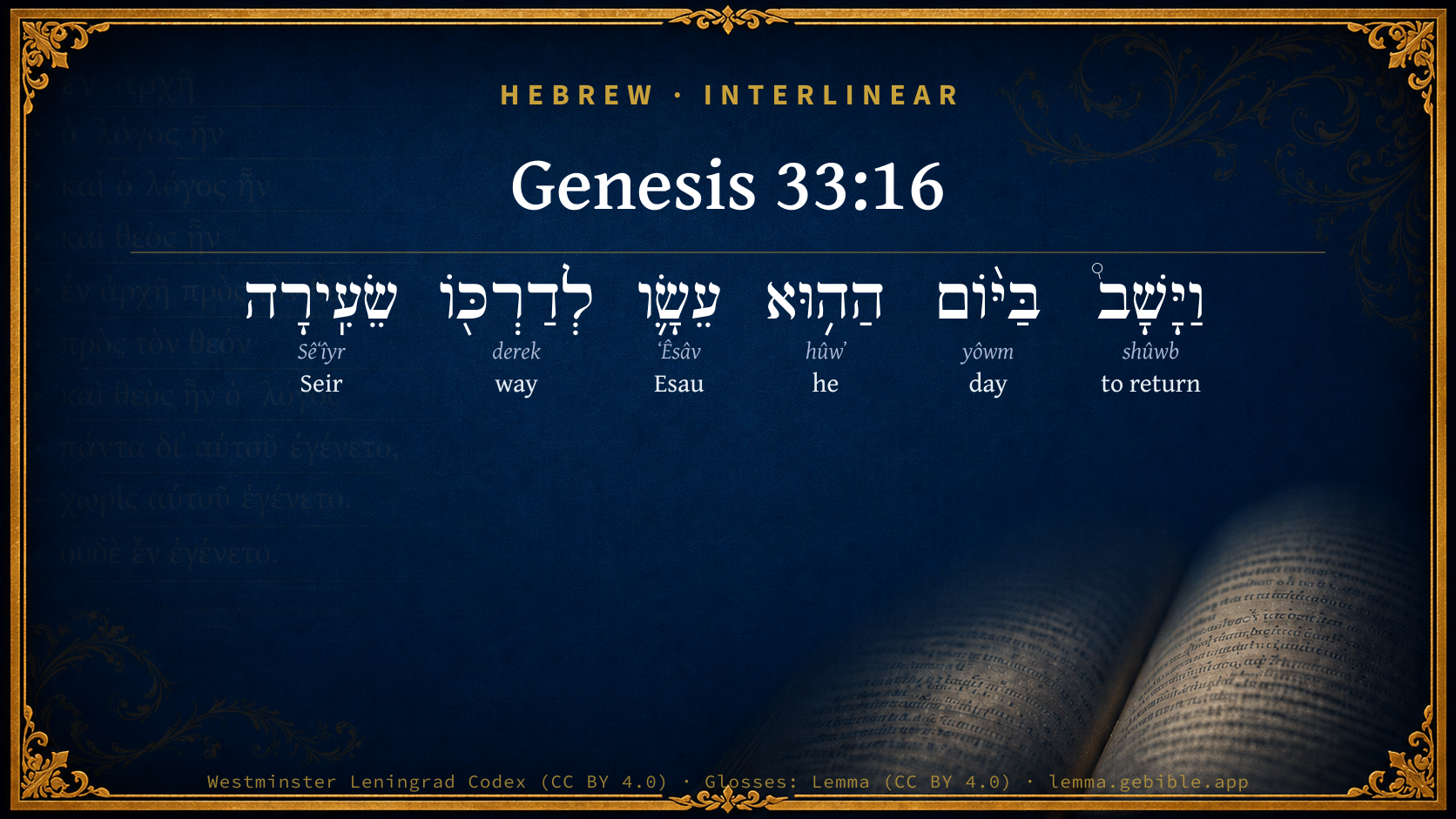
Genesis 33:16

Hebrew (Westminster Leningrad Codex) Genesis 33:16 appears in the Hebrew Old Testament. The text above is from the Westminster Leningrad Codex. Each word links to its Strong’s number, a concise gloss, and parsing drawn from the Open Scriptures Hebrew Bible morphology. Click any word for its full Brown-Driver-Briggs (BDB) entry.
Download image
Cite this verse

Genesis 33:16 (World English Bible). Public Domain. Lemma interlinear Bible study tool, https://lemma.gebible.app/v/genesis/33/16.

Show BibTeX & RIS
BibTeX
RIS
English Translation
So Esau returned that day on his way to Seir.
World English Bible · Public Domain
Download a study sheet

One document with this verse’s original text, its word-by-word gloss line, the meaning frame, cross-references with their text, attributed commentary, and full source and license credits — printable, and it pastes into notes with its structure intact.

This verse Autodidact and up

Study sheet (.html) Plain text (.txt)

A passage Seminary Student

Up to 50 verses in one chapter. A passage sheet keeps up to 6 commentary sources and 12 cross-references per verse, in the order this page ranks them, and says so on the sheet whenever that leaves anything out. Ask for a single verse and you get the Autodidact verse sheet above.

Everything on this page stays free to read, with no account — the sheet is a download of what is already on screen, not access to it.

Want to remove ads? Support Godless Engineer
Compare translations 3

The same verse in 3 English versions, stacked beneath the original-language interlinear above. Click any original word for its lexicon entry.

Each is an independent rendering of the whole verse — the interlinear is not word-aligned to these translations.

Highlighted words mark where these versions differ — a whole-verse word diff, not a word-by-word alignment.

  • World English Bible Public Domain
    So Esau returned that day on his way to Seir.
  • King James Version Public Domain
    So Esau returned that day on his way unto Seir.
  • unfoldingWord Literal Text CC BY-SA 4.0
    So on that day Esau went on his way back to Seir.

unfoldingWord Literal Text — © unfoldingWord, licensed CC BY-SA 4.0. Word-aligned USFM3 via Door43 (git.door43.org/unfoldingWord/en_ult).

Versions to compare (up to 4)

3 of 4 selected

Show all 18 translations

Every available English version of this verse, each an independent rendering of the whole verse.

  • World English Bible Public Domain
    So Esau returned that day on his way to Seir.
  • Berean Standard Bible Public Domain
    So that day Esau started on his way back to Seir,
  • Majority Standard Bible Public Domain
    So that day Esau started on his way back to Seir,
  • King James Version Public Domain
    So Esau returned that day on his way unto Seir.
  • American Standard Version (1901) Public Domain
    So Esau returned that day on his way unto Seir.
  • Revised Version (1885) Public Domain
    So Esau returned that day on his way unto Seir.
  • Geneva Bible (1599) Public Domain
    So Esau returned, and went his way that same day vnto Seir.
  • Douay-Rheims (1899) Public Domain
    So Esau returned, that day, the way that he came, to Seir.
  • Young's Literal Translation Public Domain
    And turn back on that day doth Esau on his way to Seir;
  • Literal Standard Version CC BY-SA 4.0
    And Esau turns back on that day on his way to Seir;
  • Unlocked Literal Bible CC BY-SA 4.0
    So Esau that day started on his way back to Seir.
  • unfoldingWord Literal Text CC BY-SA 4.0
    So on that day Esau went on his way back to Seir.
  • Darby Bible Public Domain
    And Esau returned that day on his way to Seir.
  • World Messianic Bible Public Domain
    So Esau returned that day on his way to Seir.
  • Webster's Bible Public Domain
    So Esau returned that day on his way to Seir.
  • Free Bible Version CC BY-SA 4.0
    So Esau started on his way back to Seir that day.
  • Bible in Basic English Public Domain
    So Esau, turning back that day, went on his way to Seir.
  • JPS Tanakh (1917) Public Domain
    So Esau returned that day on his way unto Seir.

Literal Standard Version (2020), Covenant Press — licensed CC BY-SA 4.0. Text via the HelloAO Bible API (eBible.org). Unlocked Literal Bible (unfoldingWord) — licensed CC BY-SA 4.0. Text via the HelloAO Bible API (eBible.org). unfoldingWord Literal Text — © unfoldingWord, licensed CC BY-SA 4.0. Word-aligned USFM3 via Door43 (git.door43.org/unfoldingWord/en_ult). Free Bible Version, Dr. Jonathan Gallagher — licensed CC BY-SA 4.0. Text via the HelloAO Bible API (eBible.org).

Word by word

More ways to search: Search by grammar → Find every occurrence → Compare this word →

Practice this passage: Drill this verse → Learn its vocabulary →

שֵׂעִֽירָה
Sêʻîyr
H8165
“Seir · toward”
Noun, Proper + Suffix, Demonstrative
Part of Speech
Noun
Type
Proper
Full BDB Definition

Origin: formed like H8163

TWOT: 2274h , 2274g

Seir = "hairy" or " shaggy" - patriarch of the Horites, the inhabitants of Edom before the descendants of Esau, the Edomites (noun proper masculine) - the land of Edom, south of the Dead Sea (noun proper territorial) - a mountain range in Edom extending from the Dead Sea to the Elanitic Gulf (noun proper mountain) - apparently also called 'Mount Seir' and extending most of the distance of the mountain range itself - a mountain in northern Judah lying westward from Kirjath-jearim (noun proper mountain)
  1. וַיָּשָׁב֩ shûwb H7725 “and · to return” Conjunction + Verb, Qal, Sequential Imperfect, 3rd Person, Masculine, Singular
  2. בַּיּ֨וֹם yôwm H3117 “in/at the · day” Preposition, Determined + Noun, Common, Masculine, Singular, Absolute
  3. הַה֥וּא hûwʼ H1931 “the · he” Particle, Definite Article + Pronoun, Personal, 3rd Person, Masculine, Singular
  4. עֵשָׂ֛ו ʻÊsâv H6215 “Esau” Noun, Proper
  5. לְדַרְכּ֖וֹ derek H1870 “to/for · way · his” Preposition + Noun, Common, Both, Singular, Construct + Suffix, Personal, 3rd Person, Masculine, Singular

About this verse

These counts appear in no published source. They are computed here, from the morphology-tagged text and Lemma’s own curated glosses. What Lemma adds →

6
words
6
distinct lemmas
Pentateuch
section

Shared distinctive vocabulary

שֵׂעִֽירָה Seir H8165 occurs in 38 verses of the Hebrew Bible. Also found in:

Grammatical profile

  • 1 verb
  • 4 nouns
  • 1 pronoun

Verb forms

  • וַיָּשָׁב֩ Qal · Sequential Imperfect

Hebrew & Septuagint length

In English translation the verse runs 10 words from the Hebrew and 11 from the Septuagint (LXX English) — closely comparable.

A rough comparison of the two English renderings, which tokenize alike — not a word-level alignment.

Word counts can differ between the Hebrew and the Greek without any difference in meaning — e.g. the Hebrew direct-object marker אֵת has no separate Greek word, and Greek often adds the article ὁ.

Hebrew and Greek witnesses Masoretic Hebrew ↔ Greek Septuagint

The same verse in the two great witnesses to the Old Testament, shown verse-for-verse.

These are two independent witnesses, not word-aligned to each other, and the Septuagint is shown in lemma (dictionary) form.

Hebrew Genesis 33:16 Masoretic · Westminster Leningrad Codex

וַיָּשָׁב֩ בַּיּ֨וֹם הַה֥וּא עֵשָׂ֛ו לְדַרְכּ֖וֹ שֵׂעִֽירָה

So Esau returned that day on his way to Seir.

World English Bible · Public Domain

Greek LXX Genesis 33:16 Septuagint · lemma form

ἀποστρέφω δέ ησαυ ἐν ὁ ἡμέρα ἐκεῖνος εἰς ὁ ὁδός αὐτός εἰς σηιρ

And Esau returned on that day on his journey to Seir.

LXX2012 (modern English Septuagint) · Public Domain

Hebrew: Westminster Leningrad Codex (CC BY 4.0). Greek: Septuagint (public domain); English from LXX2012 (modern English Septuagint) (Public Domain). How the Septuagint differs from the Hebrew →

Targum (Aramaic paraphrase)

2

The Targum is the ancient Jewish Aramaic paraphrase of the Hebrew Scriptures — an interpretive translation, not the Hebrew text itself. Onkelos (literal) and Pseudo-Jonathan (expansive) render the Torah, and Jonathan the Prophets. Coverage is partial: where no permissively-licensed English translation exists for a verse, only the Aramaic is shown. This is verse-level text, not a word-by-word alignment to the Hebrew.

  1. Targum Onkelos Torah (Genesis–Deuteronomy)
    וְתַב בְּיוֹמָא הַהוּא עֵשָׂו לְאָרְחֵהּ לְשֵׂעִיר

    (no public-domain English translation for this verse)

    Targum Onkelos — Aramaic: “Onkelos Genesis” (public domain); “Onkelos Exodus” (public domain); “Onkelos Leviticus” (public domain); “Onkelos Numbers” (public domain); “Onkelos Deuteronomy” (public domain). English: “Sefaria Community Translation” (CC0 1.0 (public-domain dedication)); “J.W. Etheridge. The Targums of Onkelos and Jonathan Ben Uzziel on the Pentateuch. London: Longmans, Green, 1862” (public domain). Text via Sefaria.

  2. Targum Pseudo-Jonathan Torah (Genesis–Deuteronomy)
    וְאִתְעֲבֵיד נִיסָא לְיַעֲקב וְתַב בְּיוֹמָא הַהוּא עֵשָו לְאָרְחֵיהּ לְגַבְלָא

    And a miracle was wrought for Jakob, and that day Esau returned on his way to Gabla.

    Targum Pseudo-Jonathan — Aramaic: “Targum Jonathan on Genesis” (public domain); “Targum Jonathan on Exodus” (public domain); “Targum Jonathan on Leviticus” (public domain); “Targum Jonathan on Numbers” (public domain); “Targum Jonathan on Deuteronomy” (public domain). English: “The Targum of Jonathan ben Uzziel, trans. J. W. Etheridge, London, 1862” (public domain). Text via Sefaria.

Commentary

Notes on Genesis 33:16 from classic Christian and Jewish commentators (each source and its license shown beneath its notes). The classic Christian expositions comment on the surrounding passage and are grouped to its opening verse, so a note may address several verses; the Jewish commentaries on the Tanakh (Rashi and others) are per-verse, so they appear only where the commentator wrote on this verse.

Lemma curates 59 commentaries, every one of them public domain or Creative Commons licensed, each selected and text-cleaned for this edition rather than reprinted as found. About our sources →

Matthew Henry's Commentary

Here, 1. Jacob comes to Succoth. Having in a friendly manner parted with Esau, who had gone to his own country (Gen 33:16), he comes to a place where, it should seem, he rested for some time, set up booths for his cattle, and other conveniences for himself and family. The place was afterwards known by the name of Succoth, a city in the tribe of Gad, on the other side Jordan (it signifies booths), that when his posterity afterwards dwelt in houses of stone, they might remember that the Syrian ready to perish was their father, who was glad of booths (Deu 26:5); such was the rock whence they were hewn. 2. He comes to Shechem; we read it, to Shalem, a city of Shechem; the critics generally incline to read it appellatively: he came safely, or in peace, to the city of Shechem. After a perilous journey, in which he had met with many difficulties, he came safely, at last, into Canaan. Note, Diseases and dangers should teach us how to value health and safety, and should help to enlarge our hearts in thankfulness, when our going out and coming in have been signally preserved. Here, (1.) He buys a field, Gen 33:19. Though the land of Canaan was his by promise, yet, the time for taking possession not having yet come, he is content to pay for his own, to prevent disputes with the present occupants. Note, Dominion is not founded in grace. Those that have heaven on free-cost must not expect to have earth so. (2.) He builds an altar, Gen 33:20. [1.] In thankfulness to God, for the good hand of his providence over him. He did not content himself with verbal acknowledgments of God's favour to him, but made real ones: [2.] That he might keep up religion, and the worship of God, in his family. Note, Where we have a tent God must have an altar, where we have a house he must have a church in it. He dedicated this altar, where we have a house he must have a church in it. He dedicated this altar to the honour of El-elohe-Israel - God, the God of Israel, to the honour of God, in general, the only living and true God, the best of beings and first of causes; and to the honour of the God of Israel, as a God in covenant with him. Note, In our worship of God we must be guided and governed by the joint-discoveries both of natural and revealed religion. God had lately called him by the name of Israel, and now he calls God the God of Israel; though he is styled a prince with God, God shall still be a prince with him, his Lord and his God. Note, Our honours then become honours indeed to us when they are consecrated to God's honour; Israel's God is Israel's glory.

Matthew Henry's Commentary on the Whole Bible (1708–1710) — public domain (CC PDM 1.0). Text via the HelloAO Bible API.

Trapp's Complete Commentary

John Trapp

Gen 33:16 So Esau returned that day on his way unto Seir.

Ver. 16. On his way unto Seir.] Whither God had sent him beforehand to plant, out of Jacob’s way. He was grown rich, desired liberty, and saw that his wives were offensive to the old couple; therefore he moved his dwelling to mount Seir, and left better room for Jacob; who, perhaps, had intelligence thereof from his mother, by Deborah, and so was the rather willing to return.

John Trapp, A Commentary or Exposition upon All the Books of the Old and New Testament (1647–1656) — public domain. Text from a community e-Sword module.

Tyndale Open Study Notes

Tyndale Open Resources

33:16-17 Instead of following Esau south to Seir as promised, Jacob again deceived his brother, then headed in the opposite direction to Succoth, east of the Jordan River and north of the Jabbok.

Tyndale Open Study Notes — © Tyndale Open Resources, licensed CC BY-SA 4.0. Text via the HelloAO Bible API.

John Gill's Exposition

So Esau returned that day on his way unto Seir. Took his leave of Jacob the same day he met him, and proceeded on in his journey towards Seir; whether he arrived there the same day is not certain, probably it was more than a day's journey.

So Esau returned that day on his way unto Seir. Took his leave of Jacob the same day he met him, and proceeded on in his journey towards Seir; whether he arrived there the same day is not certain, probably it was more than a day's journey.

Genesis 33:17

gen 33:17

gen 33:17

gen 33:17And Jacob journeyed to Succoth,.... Perhaps after he had been at Seir, and stayed there some little time. Succoth was on the other side of Jordan, so called by anticipation, for it had its name from what follows; as yet there was no city built here, or at least of this name; afterwards there was, it lay in a valley, and belonged to Sihon king of Heshbon, and was given to the tribe of Gad, Jos 13:27; it is mentioned along with Penuel, and was not far from it, Jdg 8:8. It is said to be but two miles distant from it (u), but one would think it should be more:

and built him an house, and made booths for his cattle; an house for himself and family, and booths or tents for his servants or shepherds, and for the cattle they had the care of, some for one, and some for the other. This he did with an intention to stay some time here, as it should seem; and the Targum of Jonathan says he continued here a whole year, and Jarchi eighteen months, a winter and two summers; but this is all uncertain:

therefore the name of the place is called Succoth; from the booths or tents built here, which this word signifies.

(u) Bunting's Travels, p. 72.

John Gill's Exposition of the Whole Bible (1746–1763) — public domain (CC PDM 1.0). Text via the HelloAO Bible API.

The Pulpit Commentary

Vers. 16, 17. So (literally, and, complying with his brother"s request) Esau returned that day on his way unto Seir from which he had come to meet Jacob. (vide Gen_32:3) And Jacob journeyed to Succoth. Succoth, so called here by anticipation, and afterwards belonging to the tribe of Gad, was situated in the valley of the Jordan, on the east side of the river, and to the south of the Jabbok (Jos_13:27; Jud_1:8:4, 5) and consequently is not to be identified with Sakut, on the western side of the Jordan, ten miles north of the Jabbok, and opposite the Wady Yabis (Robinson, vol. 3. p. 175; Thomson, "Land and Book," p. 456); but is to be sought for at the ford opposite the Wady-el-Fariah, "down which the little stream from Shechem drains into the Jordan" (Tristram, "Land of Israel," p. 144; Porter in Kitto"s "Cyclop.," art. Succoth; cf. Keil and Kalisch in loco). And built him a house. This was an indication that Jacob purposed some considerable stay at Succoth; and, indeed, if a period of repose was not now demanded by the state of Jacob s health after his long servitude with Laban, his exhausting conflict with the angel, and his exciting interview with Esau (Lange), an interval of some years appears to be imperatively required by the exigencies of the ensuing narrative concerning Dinah, who could not at this time have been much over six years of age (Murphy, Afford, Gosman, et alii). And made booths for his cattle. Porter states that he has frequently men such booths (Succoth, from saccac, to entwine) occupied by the Bedawin of the Jordan valley, and describes them as rude huts of reeds, sometimes covered with long grass, and sometimes with a piece of tent (vide Kitto"s "Cyclop.," ut supra). Therefore the name of the place is called (literally, he called the name of the place) Succothi.e. booths.

The Pulpit Commentary (1880–1919), ed. H.D.M. Spence-Jones & Joseph S. Exell — public domain. Text from a community e-Sword module.

John Wesley's Explanatory Notes

And Jacob journeyed to Succoth - Having in a friendly manner parted with Esau, who was gone to his own country, he comes to a place, where he rested, set up booths for his cattle, and other conveniences for himself and family. The place was afterwards known by the name of Succoth, a city in the tribe of Gad, on the other side Jordan; it signifies booths: that when his posterity afterwards dwelt in houses of stone, they might remember that the Syrian ready to perish was their father, who was glad of booths, Deut. xxvi, 5.

John Wesley, Explanatory Notes Upon the Whole Bible (1754–1765) — public domain. Text via the GEBible commentary corpus.

Keil & Delitzsch

C. F. Keil & F. Delitzsch

Esau set off the same day for Mount Seir, whilst Jacob proceeded to Succoth, where he built himself a house and made succoth for his flocks, i.e., probably not huts of branches and shrubs, but hurdles or folds made of twigs woven together. According to Jos 13:27, Succoth was in the valley of the Jordan, and was allotted to the tribe of Gad, as part of the district of the Jordan, "on the other side Jordan eastward;" and this is confirmed by Jdg 8:4-5, and by Jerome (quaest. ad h. l.): Sochoth usque hodie civitas trans Jordanem in parte Scythopoleos. Consequently it cannot be identified with the Scut on the western side of the Jordan, to the south of Beisan, above the Wady el Mlih. - How long Jacob remained in Succoth cannot be determined; but we may conclude that he stayed there some years from the circumstance, that by erecting a house and huts he prepared for a lengthened stay. The motives which induced him to remain there are also unknown to us. But when Knobel adduces the fact, that Jacob came to Canaan for the purpose of visiting Isaac (Gen 31:18), as a reason why it is improbable that he continued long at Succoth, he forgets that Jacob could visit his father from Succoth just as well as from Shechem, and that, with the number of people and cattle that he had about him, it was impossible that he should join and subordinate himself to Isaac's household, after having attained through his past life and the promises of God a position of patriarchal independence.

Keil & Delitzsch — Biblical Commentary on the Old Testament (1861–1891) — public domain (CC PDM 1.0). Text via the HelloAO Bible API. (Old Testament only.)

Kretzmann's Popular Commentary

Paul E. Kretzmann

Jacob Returns to Canaan

v. 16. So Esau returned that day on his way unto Seir, in the valley of Zin, south of the Dead Sea, the country which he had selected for his home.

v. 17. And Jacob journeyed to Succoth, and built him an house, and made booths for his cattle; therefore the name of the place is called Succoth (booths). Jacob, from the neighborhood of Peniel, turned toward the Jordan, where he built a more permanent encampment, by erecting a house for himself and sheds, or booths, for his cattle. This place probably remained one of his stations for his rapidly growing herds and flocks. Cf Jos 13:27; Jdg 8:4-5.

v. 18. And Jacob came to Shalem, a city of Shechem, which is in the land of Canaan, when he came from Padanaram; and pitched his tent before the city. After living at Succoth a number of years, until Dinah, his daughter, had become a young woman, during which time Jacob also made a visit to his aged father at Hebron and brought back the old nurse of his mother, Deborah, he finally entered Canaan proper with his family and at least some of his herds and flocks. He came into his home country in good health, as the Lord had promised him, and encamped before the city of Shechem, which the Hivite prince Hamor had built since the time of Abraham, calling it after the name of his son.

v. 19. And he bought a parcel of a field, where he had spread his tent, at the hand of the children of Hamor, for an hundred pieces of money. Jacob, trusting in the promises of the Lord and preparing for an even more permanent residence in Canaan than Abraham, bought a possession for himself during his lifetime. This piece of land, with the so-called Jacob’s well, is shown to this day at the southeast opening of the valley of Shechem. Jacob paid for this land one hundred pieces of money, the value of which can no longer be determined. Some scholars think that each piece of money was worth as much as a lamb, while others are of the opinion that there was money in those days which, in a crude manner, had the figure of a lamb stamped upon it.

v. 20. And he erected there an altar, and called it Elelohe Israel (God, the God of Israel). That was Jacob’s confession after the many years of travel and sojourn in strange countries: The strong God is the God of Israel. He had experienced the mighty power of God in numerous instances, and was thankful for the days of peace and rest which he now enjoyed. For this reason also his worship, which he formally instituted at Shechem, consisted chiefly in proclaiming the name of this true God. In this all believers, who ever and again enjoy the rich blessings of the Lord in wonderful measure, will cheerfully imitate the aged patriarch.

Paul E. Kretzmann, Popular Commentary of the Bible (1921–1924) — public domain. Text from a community e-Sword module.

Rashi

Rabbi Shlomo Yitzchaki (Rashi)

וישב ביום ההוא עשו לדרכו SO ESAU RETURNED THAT DAY ON HIS WAY — Esau alone returned, but the four hundred men who had accompanied him slipped away from him one by one. When did the Holy One, blessed be He, reward them for this? In the days of David, as it is said (1 Samuel 30:17) (in reference to an attack which he made upon the Amalekites, descendants of Esau) “[and there escaped not a man of them] save four hundred young men who rode upon camels” (Genesis Rabbah 78:15).

Rashi on the Tanakh — English translations: “The Judaica Press complete Tanach with Rashi, translated by A. J. Rosenberg” (CC BY 4.0); “Pentateuch with Rashi's commentary by M. Rosenbaum and A.M. Silbermann, 1929-1934” (public domain); “The Metsudah Tanach series, Lakewood, N.J” (CC BY 4.0); and “The Book of Joshua, Metsudah Publications, 1997” (CC BY 4.0). Text via Sefaria.

Lesson kit

Teaching starters — assembled from the data on this page, not authored interpretation. Every prompt links to the verse data it draws on. Edit before teaching.

Genesis, in the Pentateuch, opens this verse with 6 words (6 distinct Hebrew lemmas). Its most distinctive word is Sêʻîyr (“Seir”). A historical commentator’s framing appears above. Read the whole chapter for the surrounding context.

Discussion questions

  1. How does “Seir” (Sêʻîyr) shape what this verse is saying?
  2. How does Genesis 14:6, which shares the word «Seir», read alongside this verse?
  3. These translations render this verse differently; the difference is in the English rendering, not the original. What questions does that raise?
  4. «וַיָּשָׁב֩» is a Qal Sequential Imperfect verb. How does that grammatical form shape the action described?
  5. Compare how Matthew Henry's Commentary and Trapp's Complete Commentary read this verse. Where do they agree or differ?

Things to notice

Reading settings

Reading text

Shown beneath each verse's original-language words.

Old Testament
Old Testament edition

Read the OT as the Masoretic Hebrew (MT) or the Greek Septuagint (LXX).

English shown for the Greek Septuagint (in the Hebrew ↔ Greek comparison).

Comparing translations? Open the Compare panel on any verse page to stack up to four side by side.