Isaiah 29:17

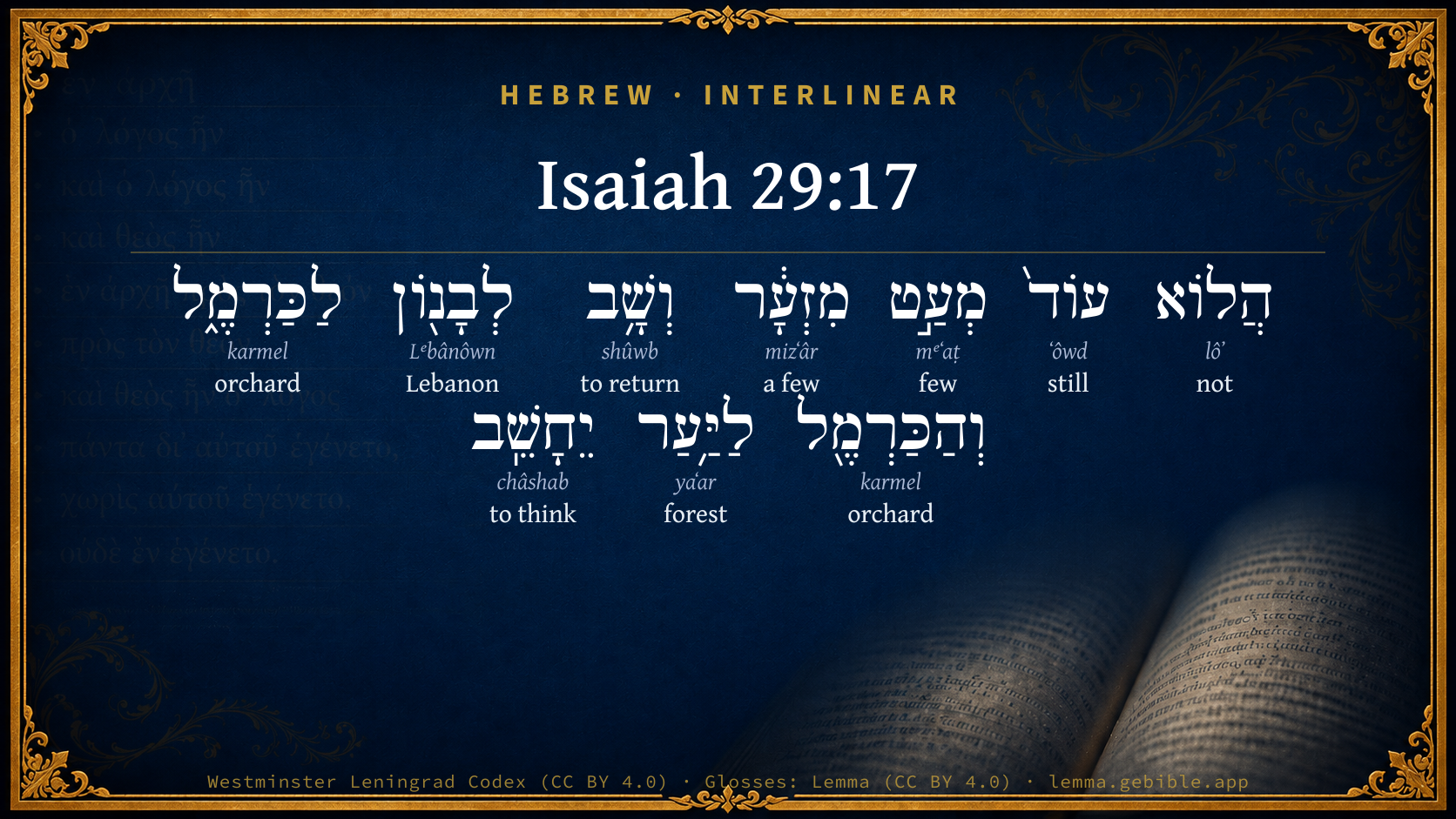
Hebrew (Westminster Leningrad Codex) Isaiah 29:17 appears in the Hebrew Old Testament. The text above is from the Westminster Leningrad Codex. Each word links to its Strong’s number, a concise gloss, and parsing drawn from the Open Scriptures Hebrew Bible morphology. Click any word for its full Brown-Driver-Briggs (BDB) entry.
Download image
Cite this verse

Isaiah 29:17 (World English Bible). Public Domain. Lemma interlinear Bible study tool, https://lemma.gebible.app/v/isaiah/29/17.

Show BibTeX & RIS
BibTeX
RIS
English Translation
Is it not yet a very little while, and Lebanon shall be turned into a fruitful field, and the fruitful field shall be esteemed as a forest?
World English Bible · Public Domain
Download a study sheet

One document with this verse’s original text, its word-by-word gloss line, the meaning frame, cross-references with their text, attributed commentary, and full source and license credits — printable, and it pastes into notes with its structure intact.

This verse Autodidact and up

Study sheet (.html) Plain text (.txt)

A passage Seminary Student

Up to 50 verses in one chapter. A passage sheet keeps up to 6 commentary sources and 12 cross-references per verse, in the order this page ranks them, and says so on the sheet whenever that leaves anything out. Ask for a single verse and you get the Autodidact verse sheet above.

Everything on this page stays free to read, with no account — the sheet is a download of what is already on screen, not access to it.

Want to remove ads? Support Godless Engineer
Compare translations 3

The same verse in 3 English versions, stacked beneath the original-language interlinear above. Click any original word for its lexicon entry.

Each is an independent rendering of the whole verse — the interlinear is not word-aligned to these translations.

Highlighted words mark where these versions differ — a whole-verse word diff, not a word-by-word alignment.

  • World English Bible Public Domain
    Is it not yet a very little while, and Lebanon shall be turned into a fruitful field, and the fruitful field shall be esteemed as a forest?
  • King James Version Public Domain
    Is it not yet a very little while, and Lebanon shall be turned into a fruitful field, and the fruitful field shall be esteemed as a forest?
  • unfoldingWord Literal Text CC BY-SA 4.0
    not yet a little, a trifle, and Lebanon will turn into agricultural land, and agricultural land will be regarded as a forest?

unfoldingWord Literal Text — © unfoldingWord, licensed CC BY-SA 4.0. Word-aligned USFM3 via Door43 (git.door43.org/unfoldingWord/en_ult).

Versions to compare (up to 4)

3 of 4 selected

Show all 18 translations

Every available English version of this verse, each an independent rendering of the whole verse.

  • World English Bible Public Domain
    Is it not yet a very little while, and Lebanon shall be turned into a fruitful field, and the fruitful field shall be esteemed as a forest?
  • Berean Standard Bible Public Domain
    In a very short time, will not Lebanon become an orchard, and the orchard seem like a forest?
  • Majority Standard Bible Public Domain
    In a very short time, will not Lebanon become an orchard, and the orchard seem like a forest?
  • King James Version Public Domain
    Is it not yet a very little while, and Lebanon shall be turned into a fruitful field, and the fruitful field shall be esteemed as a forest?
  • American Standard Version (1901) Public Domain
    Is it not yet a very little while, and Lebanon shall be turned into a fruitful field, and the fruitful field shall be esteemed as a forest?
  • Revised Version (1885) Public Domain
    Is it not yet a very little while, and Lebanon shall be turned into a fruitful field, and the fruitful field shall be counted for a forest?
  • Geneva Bible (1599) Public Domain
    Is it not yet but a litle while, and Lebanon shall be turned into Carmel? and Carmel shall be counted as a forest?
  • Douay-Rheims (1899) Public Domain
    Is it not yet a very little while, and Libanus shall be turned into charmel, and charmel shall be esteemed as a forest?
  • Young's Literal Translation Public Domain
    Is it not yet a very little, And turned hath Lebanon to a fruitful field, And the fruitful field for a forest is reckoned?
  • Literal Standard Version CC BY-SA 4.0
    Is it not yet a very little [while], || And Lebanon has turned into a fruitful field, || And the fruitful field is reckoned for a forest?
  • Unlocked Literal Bible CC BY-SA 4.0
    In just a little while, Lebanon will be turned into a field, and the field will become a forest.
  • unfoldingWord Literal Text CC BY-SA 4.0
    not yet a little, a trifle, and Lebanon will turn into agricultural land, and agricultural land will be regarded as a forest?
  • Darby Bible Public Domain
    Is it not yet a very little while, and Lebanon shall be turned into a fruitful field, and the fruitful field shall be esteemed as a forest?
  • World Messianic Bible Public Domain
    Isn’t it yet a very little while, and Lebanon will be turned into a fruitful field, and the fruitful field will be regarded as a forest?
  • Webster's Bible Public Domain
    Is it not yet a very little while, and Lebanon shall be turned into a fruitful field, and the fruitful field shall be esteemed as a forest?
  • Free Bible Version CC BY-SA 4.0
    It won't be long and the forests of Lebanon will be turned into a productive field, and a productive field will seem like a forest.
  • Bible in Basic English Public Domain
    In a very short time Lebanon will become a fertile field, and the fertile field will seem like a wood.
  • JPS Tanakh (1917) Public Domain
    Is it not yet a very little while, and Lebanon shall be turned into a fruitful field, and the fruitful field shall be esteemed as a forest?

Literal Standard Version (2020), Covenant Press — licensed CC BY-SA 4.0. Text via the HelloAO Bible API (eBible.org). Unlocked Literal Bible (unfoldingWord) — licensed CC BY-SA 4.0. Text via the HelloAO Bible API (eBible.org). unfoldingWord Literal Text — © unfoldingWord, licensed CC BY-SA 4.0. Word-aligned USFM3 via Door43 (git.door43.org/unfoldingWord/en_ult). Free Bible Version, Dr. Jonathan Gallagher — licensed CC BY-SA 4.0. Text via the HelloAO Bible API (eBible.org).

Word by word

More ways to search: Search by grammar → Find every occurrence → Compare this word →

Practice this passage: Drill this verse → Learn its vocabulary →

מִזְעָ֔ר
mizʻâr
H4213
“a few”
Noun, Common, Masculine, Singular, Absolute
Part of Speech
Noun
Type
Common
Gender
Masculine
Number
Singular
State
Absolute
Full BDB Definition

Origin: from the same as H2191

TWOT: 571b

a little, a trifle, a few - a trifle, a little (of time) - a remnant, a very few (of number)
  1. הֲלוֹא lôʼ H3808 “not” Particle, Interrogative + Particle, Negative
  2. עוֹד֙ ʻôwd H5750 “still” Adverb
  3. מְעַ֣ט mᵉʻaṭ H4592 “few of” Noun, Common, Masculine, Singular, Construct
  4. וְשָׁ֥ב shûwb H7725 “and · to return” Conjunction + Verb, Qal, Sequential Perfect, 3rd Person, Masculine, Singular
  5. לְבָנ֖וֹן Lᵉbânôwn H3844 “Lebanon” Noun, Proper
  6. לַכַּרְמֶ֑ל karmel H3759 “to/for the · orchard” Preposition, Determined + Noun, Common, Masculine, Singular, Absolute
  7. וְהַכַּרְמֶ֖ל karmel H3759 “and · the · orchard” Conjunction + Particle, Definite Article + Noun, Common, Masculine, Singular, Absolute
  8. לַיַּ֥עַר yaʻar H3293 “to/for the · forest” Preposition, Determined + Noun, Common, Masculine, Singular, Absolute
  9. יֵחָשֵֽׁב châshab H2803 “to think” Verb, Niphal, Imperfect, 3rd Person, Masculine, Singular

About this verse

These counts appear in no published source. They are computed here, from the morphology-tagged text and Lemma’s own curated glosses. What Lemma adds →

10
words
9
distinct lemmas
Prophets
section

Notable vocabulary

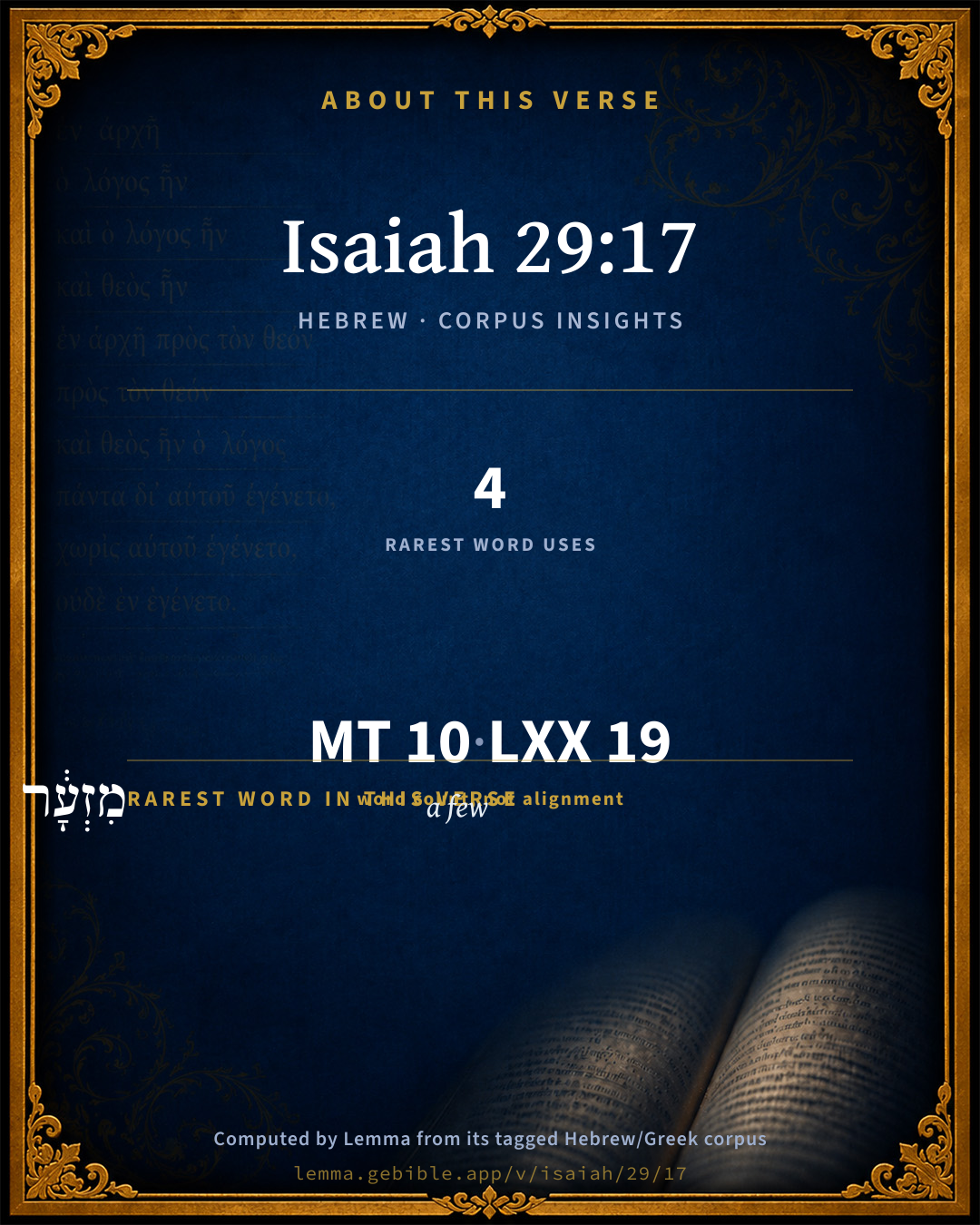
The rarest word here is מִזְעָ֔ר a few H4213 — appearing just 4 times in the whole Hebrew Bible.

Shared distinctive vocabulary

מִזְעָ֔ר a few H4213 occurs in 4 verses of the Hebrew Bible. Also found in:

Grammatical profile

  • 2 verbs
  • 6 nouns
  • 1 adverb
  • 1 particle

Verb forms

  • וְשָׁ֥ב Qal · Sequential Perfect
  • יֵחָשֵֽׁב Niphal · Imperfect

Repetition

A word recurs within this verse — often emphatic in Hebrew:

  • לַכַּרְמֶ֑ל orchard H3759 ×2

Hebrew & Septuagint length

In English translation the verse runs 27 words from the Hebrew and 25 from the Septuagint (LXX English) — closely comparable.

A rough comparison of the two English renderings, which tokenize alike — not a word-level alignment.

Word counts can differ between the Hebrew and the Greek without any difference in meaning — e.g. the Hebrew direct-object marker אֵת has no separate Greek word, and Greek often adds the article ὁ.

In the original languages it is 10 Hebrew tokens and 19 Greek tokens — but the two are counted differently (Hebrew bundles its prefixes and suffixes into one token; the Greek is in lemma form), so that isn’t a like-for-like length.

Cross-references

24

Topical passages linked to Isaiah 29:17 in the Treasury of Scripture Knowledge — connected by theme and wording, ordered by reader-vote popularity; previews shown in the World English Bible.

  • Isaiah 32:15 until the Spirit be poured on us from on high, and the wilderness become a fruitful field, and the fruitful field be esteemed as a forest.
  • Matthew 19:30 But many will be last who are first; and first who are last.
  • Hebrews 10:37 "In a very little while, He who comes will come, and will not wait.
  • Psalms 84:6 Passing through the valley of Weeping, they make it a place of springs. Yes, the autumn rain covers it with blessings.
  • Psalms 107:33 He turns rivers into a desert, Water springs into a thirsty ground,
  • Psalms 107:35 He turns a desert into a pool of water, And a dry land into water springs.
  • Isaiah 5:6 I will lay it a wasteland. It won't be pruned nor hoed, But it will grow briers and thorns. I will also command the clouds that they rain no rain on it."
  • Isaiah 35:1–2 The wilderness and the dry land shall be glad; and the desert shall rejoice, and blossom as the rose.
  • Isaiah 41:19 I will put in the wilderness the cedar, the acacia, and the myrtle, and the oil tree; I will set in the desert the fir tree, the pine, and the box tree together:
  • Isaiah 49:5–6 Now says Yahweh who formed me from the womb to be his servant, to bring Jacob again to him, and that Israel be gathered to him (for I am honorable in the eyes of Yahweh, and my God is become my strength);
  • Isaiah 55:13 Instead of the thorn shall come up the fir tree; and instead of the brier shall come up the myrtle tree: and it shall be to Yahweh for a name, for an everlasting sign that shall not be cut off.
  • Isaiah 63:18 Your holy people possessed [it] but a little while: our adversaries have trodden down your sanctuary.
  • Isaiah 65:12–16 I will destine you to the sword, and you shall all bow down to the slaughter; because when I called, you did not answer; when I spoke, you did not hear; but you did that which was evil in my eyes, and chose that in which I didn't delight.
  • Ezekiel 20:46–47 Son of man, set your face toward the south, and drop [your word] toward the south, and prophesy against the forest of the field in the South;
  • Hosea 1:9–10 He said, "Call his name Lo-Ammi; for you are not my people, and I will not be yours.
  • Hosea 3:4 For the children of Israel shall abide many days without king, and without prince, and without sacrifice, and without sacred stone, and without ephod or idols.
  • Micah 3:12 Therefore Zion for your sake will be plowed like a field, And Jerusalem will become heaps of rubble, And the mountain of the temple like the high places of a forest.
  • Habakkuk 2:3 For the vision is yet for the appointed time, and it hurries toward the end, and won't prove false. Though it takes time, wait for it; because it will surely come. It won't delay.
  • Haggai 2:6 For this is what Yahweh of Hosts says: 'Yet once, it is a little while, and I will shake the heavens, the earth, the sea, and the dry land;
  • Zechariah 11:1–2 Open your doors, Lebanon, That the fire may devour your cedars.
  • Matthew 21:18–19 Now in the morning, as he returned to the city, he was hungry.
  • Romans 11:11–17 I ask then, did they stumble that they might fall? May it never be! But by their fall salvation has come to the Gentiles, to provoke them to jealousy.
  • Romans 11:19–27 You will say then, "Branches were broken off, that I might be grafted in."
  • Matthew 21:43 "Therefore I tell you, the Kingdom of God will be taken away from you, and will be given to a nation bringing forth its fruits.

Cross-references courtesy of OpenBible.info (CC BY 4.0).

Hebrew and Greek witnesses Masoretic Hebrew ↔ Greek Septuagint

The same verse in the two great witnesses to the Old Testament, shown verse-for-verse.

These are two independent witnesses, not word-aligned to each other, and the Septuagint is shown in lemma (dictionary) form.

Hebrew Isaiah 29:17 Masoretic · Westminster Leningrad Codex

הֲלוֹא עוֹד֙ מְעַ֣ט מִזְעָ֔ר וְשָׁ֥ב לְבָנ֖וֹן לַכַּרְמֶ֑ל וְהַכַּרְמֶ֖ל לַיַּ֥עַר יֵחָשֵֽׁב

Is it not yet a very little while, and Lebanon shall be turned into a fruitful field, and the fruitful field shall be esteemed as a forest?

World English Bible · Public Domain

Greek LXX Isaiah 29:17 Septuagint · lemma form

οὐκέτι μικρός καί μετατίθημι ὁ λίβανος ὡς ὁ ὄρος ὁ χερμελ καί ὁ ὄρος ὁ χερμελ εἰς δρυμός λογίζομαι

Is it not yet a little while, and Libanus shall be changed as the mountains of Chermel, and Chermel shall be reckoned as a forest?

LXX2012 (modern English Septuagint) · Public Domain

Hebrew: Westminster Leningrad Codex (CC BY 4.0). Greek: Septuagint (public domain); English from LXX2012 (modern English Septuagint) (Public Domain). How the Septuagint differs from the Hebrew →

Targum (Aramaic paraphrase)

1

The Targum is the ancient Jewish Aramaic paraphrase of the Hebrew Scriptures — an interpretive translation, not the Hebrew text itself. Onkelos (literal) and Pseudo-Jonathan (expansive) render the Torah, and Jonathan the Prophets. Coverage is partial: where no permissively-licensed English translation exists for a verse, only the Aramaic is shown. This is verse-level text, not a word-by-word alignment to the Hebrew.

  1. Targum Jonathan Prophets (Joshua–Malachi)
    הֲלָא עוֹד צִיבְחַר כִּזְעֵיר וִיתוּב לִבְנָן לְמֶהֱוֵי כְּכַרְמְלָא וְכַרְמְלָא קִרְוִין סַגִיאִין יְתִיב:

    Is it not yet a very little while, and Lebanon shall turn into a fruitful field, and the fruitful field shall be inhabited by many cities.

    Targum Jonathan — Aramaic: “Mikraot Gedolot” (public domain). English: “Sefaria Community Translation” (CC0 1.0 (public-domain dedication)); “London "Chaldee Paraphrase," 1871” (public domain). Text via Sefaria.

Commentary

Notes on Isaiah 29:17 from classic Christian and Jewish commentators (each source and its license shown beneath its notes). The classic Christian expositions comment on the surrounding passage and are grouped to its opening verse, so a note may address several verses; the Jewish commentaries on the Tanakh (Rashi and others) are per-verse, so they appear only where the commentator wrote on this verse.

Lemma curates 59 commentaries, every one of them public domain or Creative Commons licensed, each selected and text-cleaned for this edition rather than reprinted as found. About our sources →

Matthew Henry's Commentary

Those that thought to hide their counsels from the Lord were said to turn things upside down (Isa 29:16), and they intended to do it unknown to God; but God here tells them that he will turn things upside down his way; and let us see whose word shall stand, his or theirs. They disbelieve Providence: "Wait awhile," says God, "and you shall be convinced by ocular demonstration that there is a God who governs the world, and that he governs it and orders all the changes that are in it for the good of his church." The wonderful revolution here foretold may refer primarily to the happy settlement of the affairs of Judah and Jerusalem after the defeat of Sennacherib's attempt, and the repose which good people then enjoyed, when they were delivered from the alarms of the sword both of war and persecution. But it may look further, to the rejection of the Jews at the first planting of the gospel (for their hypocrisy and infidelity were here foretold, Isa 29:13) and the admission of the Gentiles into the church.

I. In general, it is a great and surprising change that is here foretold, Isa 29:17. Lebanon, that was a forest, shall be turned into a fruitful field; and Carmel, that was a fruitful field, shall become a forest. It is a counterchange. Note, Great changes, both for the better and for the worse, are often made in a very little while. It was a sign given them of the defeat of Sennacherib that the ground should be more than ordinarily fruitful (Isa 37:30): You shall eat this year such as grows of itself; food for man shall be (as food for beasts is) the spontaneous product of the soil. Then Lebanon became a fruitful field, so fruitful that that which used to be reckoned a fruitful field in comparison with it was looked upon but as a forest. When a great harvest of souls was gathered in to Christ from among the Gentiles then the wilderness was turned into a fruitful field; and the Jewish church, that had long been a fruitful field, became a desolate and deserted forest, Isa 54:1.

II. In particular,

1. Those that were ignorant shall become intelligent, Isa 29:18. Those that understood not this prophecy (but it was to them as a sealed book, Isa 29:11) shall, when it is accomplished, understand it, and shall acknowledge, not only the hand of God in the event, but the voice of God in the prediction of it: The deaf shall then hear the words of the book. The fulfilling of prophecy is the best exposition of it. The poor Gentiles shall then have divine revelation brought among them; and those that sat in darkness shall see a great light, those that were blind shall see out of obscurity; for the gospel was sent to them to open their eyes, Act 26:18. Observe, In order to the making of men fruitful in good affections and actions, the course God's grace takes with them is to open their understandings and make them hear the words of God's book.

2. Those that were erroneous shall become orthodox (Isa 29:24): Those that erred in spirit, that were under mistakes and misapprehensions concerning the words of the book and the meaning of them, shall come to understanding, to a right understanding of things; the Spirit of truth shall rectify their mistakes and lead them into all truth. This should encourage us to pray for those that have erred and are deceived, that God can, and often does, bring such to understanding. Those that murmured at the truths of God as hard sayings, and loved to pick quarrels with them, shall learn the true meaning of these doctrines, and then they will be better reconciled to them. Those that erred concerning the providence of God as to public affairs, and murmured at the disposals of it, when they shall see the issue of things shall better understand them and be aware of what God was designing in all, Hos 14:9.

3. Those that were melancholy shall become cheerful and pleasant (Isa 29:19): The meek also shall increase their joy in the Lord. Those who are poor in the world and poor in spirit, who, being in affliction, accommodate themselves to their affliction, are purely passive and not passionate, when they see God appearing for them, they shall add, or repeat, joy in the Lord. This intimates that even in their distress they kept up their joy in the Lord, but now they increased it. Note, Those who, when they are in trouble, can truly rejoice in God, shall soon have cause given them greatly to rejoice in him. When joy in the world is decreasing and fading joy in God is increasing and getting round. This shining light shall shine more and more; for that which is aimed at is that this joy may be full. Even the poor among men may rejoice in the Holy One of Israel, and their poverty needs not deprive them of that joy, Hab 3:17, Hab 3:18. And the meek, the humble, the patient, and dispassionate, shall grow in this joy. Note, The grace of meekness will contribute very much to the increase of our holy joy.

4. The enemies, that were formidable, shall become despicable. Sennacherib, that terrible one, and his great army, that put the country into such a consternation, shall be brought to nought (Isa 29:20), shall be quite disabled to do any further mischief. The power of Satan, that terrible one indeed, shall be broken by the prevalency of Christ's gospel; and those that were subject to bondage through fear of him that had the power of death shall be delivered, Heb 2:14, Heb 2:15.

5. The persecutors, that were vexatious, shall be quieted, and so those they were troublesome to shall be quiet from the fear of them. To complete the repose of God's people, not only the terrible one from abroad shall be brought to nought, but the scorners at home too shall be consumed and cut off by Hezekiah's reformation. Those are a happy people, and likely to be so, who, when God gives them victory and success against their terrible enemies abroad, take care to suppress vice, and profaneness, and the spirit of persecution, those more dangerous enemies at home. Or, They shall be consumed and cut off by the judgments of God, shall be singled out to be made examples of. Or, They shall insensibly waste away, being put to confusion by the fulfilling of those predictions which they had made a jest of. Observe what had been the wickedness of these scorners, for which they should be cut off. They had been persecutors of God's people and prophets, probably of the prophet Isaiah particularly, and therefore he complains thus feelingly of them and of their subtle malice. Some as informers and persecutors, others as judges, did all they could to take away his life, or at least his liberty. And this is very applicable to the chief priests and Pharisees, who persecuted Christ and his apostles, and for that sin they and their nation of scorners were cut off and consumed. (1.) They ridiculed the prophets and the serious professors of religion; they despised them, and did their utmost to bring them into contempt; they were scorners, and sat in the seat of the scornful. (2.) They lay in wait for an occasion against them. By their spies they watch for iniquity, to see if they can lay hold of any thing that is said or done that may be called an iniquity. Or they themselves watch for an opportunity to do mischief, as Judas did to betray our Lord Jesus. (3.) They took advantage against them for the least slip of the tongue; and, if a thing were ever so little said amiss, it served them to ground an indictment upon. They made a man, though he were ever so wise and good a man, though he were a man of God, an offender for a word, a word mischosen or misplaced, when they could not but know that it was well meant, Isa 29:21. They cavilled at every word that the prophets spoke to them by way of admonition, though ever so innocently spoken, and without any design to affront them. They put the worst construction upon what was said, and made it criminal by strained innuendoes. Those who consider how apt we all are to speak unadvisedly, and to mistake what we hear, will think it very unjust and unfair to make a man an offender for a word. (4.) They did all they could to bring those into trouble that dealt faithfully with them and told them of their faults. Those that reprove in the gates, reprovers by office, that were bound by the duty of their place, as prophets, as judges, and magistrates, to show people their transgressions, they hated these, and laid snares for them, as the Pharisees' emissaries, who were sent to watch our Saviour that they might entangle him in his talk (Mat 22:15), that they might have something to lay to his charge which might render him odious to the people or obnoxious to the government. So persecuted they the prophets; and it is next to impossible for the most cautious to place their words so warily as to escape such snares. See how base wicked people are, who bear ill-will to those who, out of good-will to them, seek to save their souls from death; and see what need reprovers have both of courage to do their duty and of prudence to avoid the snare. (5.) They pervert judgment, and will never let an honest man carry an honest cause: They turn aside the just for a thing of nought; they condemn him, or give the cause against him, upon no evidence, no colour or pretence whatsoever. They run a man down, and misrepresent him, by all the little arts and tricks they can devise, as they did our Saviour. We must not think it strange if we see the best of men thus treated; the disciple is not greater than his Master. But wait awhile, and God will not only bring forth their righteousness, but cut off and consume these scorners.

6. Jacob, who was made to blush by the reproaches, and made to tremble by the threatenings, of his enemies, shall now be relieved both against his shame and against his fear, by the rolling away of those reproaches and the defeating of those threatenings (Isa 29:22): Thus the Lord saith who redeemed Abraham, that is, called him out of Ur of the Chaldees, and so rescued him from the idolatry of his fathers and plucked him as a brand out of the fire. He that redeemed Abraham out of his snares and troubles will redeem all that are by faith his genuine seed out of theirs. He that began his care of his church in the redemption of Abraham, when it and its Redeemer were in his loins, will not now cast off the care of it. Because the enemies of his people are so industrious both to blacken them and to frighten them, therefore he will appear for the house of Jacob, and they shall not be ashamed as they have been, but shall have wherewith to answer those that reproach them, nor shall their faces now wax pale; but they shall gather courage, and look their enemies in the face without change of countenance, as those have reason to do who have the God of Abraham on their side.

7. Jacob, who thought his family would be extinct and the entail of religion quite cut off, shall have the satisfaction of seeing a numerous progeny devoted to God for a generation, Isa 29:23. (1.) He shall see his children, multitudes of believers and praying people, the spiritual seed of faithful Abraham and wrestling Jacob. Having his quiver full of these arrows, he shall not be ashamed (Isa 29:22) but shall speak with his enemy in the gate, Psa 127:5. Christ shall not be ashamed (Isa 50:7), for he shall see his seed (Isa 53:10); he sees some, and foresees more, in the midst of him, flocking to the church, and residing there. (2.) His children are the work of God's hands; being formed by him, they are formed for him, his workmanship, created unto good works. It is some comfort to parents to think that their children are God's creatures, the work of the hands of his grace. (3.) He and his children shall sanctify the name of God as their God, as the Holy One of Jacob, and shall fear and worship the God of Israel. This is opposed to his being ashamed and waxing pale; when he is delivered from his contempts and dangers he shall not magnify himself, but sanctify the Holy One of Jacob. If God make our condition easy, we must endeavour to make his name glorious. Parents and children are ornaments and comforts indeed to each other when they join in sanctifying the name of God. When parents give up their children, and children give up themselves, to God, to be to him for a name and a praise, then the forest will soon become a fruitful field.

Matthew Henry's Commentary on the Whole Bible (1708–1710) — public domain (CC PDM 1.0). Text via the HelloAO Bible API.

Trapp's Complete Commentary

John Trapp

Isa 29:17 [Is] it not yet a very little while, and Lebanon shall be turned into a fruitful field, and the fruitful field shall be esteemed as a forest?

Ver. 17. Is it yet not a very little while?] Nonne adhuc paululum paululum; or, A hundred years hence the Gentiles shall be called by the preaching of the apostles (for here beginneth the consolatory part of this chapter; see on Isa 29:1); and that is but a very small time with God. He speeds away the generation, that he may finish the calling of his elect, and so put an end to all.

And Lebanon shall be turned into a fruitful field.] Heb., Lebanon shall be turned into Carmel, the wide world; the wide waste of the Gentiles, {confer Isa 42:15} the elect among them shall be made God’s husbandry or vineyard, {Eph 2:12 Rom 11:17} et e contra, Carmelus fiet Libanus. {a}

The fruitful field shall be esteemed as a forest.] The obstinate Jews, with their seeming fruitfulness, shall be rejected. Lo, here is a turning of things upside down that you dream not of; this is that marvellous work, Isa 29:14.

{a} Sylvestria corda electorum inter gentes. - Piscator

John Trapp, A Commentary or Exposition upon All the Books of the Old and New Testament (1647–1656) — public domain. Text from a community e-Sword module.

The Biblical Illustrator

Joseph S. Exell

Isa_29:17-19

Lebanon shall be turned into a fruitful field

The fruitful field and the forest

The comparison is evidently not between the high and the low, but between the cultivated and the wild, the field and the forest.

(J. A. Alexander.)

The first last and the last first

The only natural interpretation of the verse is that which regards it as prophetic of a mutual change of condition, the first becoming last and the last first. If the previous context has respect to the Jews under the old dispensation, nothing can be more appropriate or natural than to understand the verse before us as foretelling the excision of the unbelieving Jews and the admission of the Gentiles to the Church. (J. A. Alexander.)

Jew and Gentile

I. I shall show HOW THE LORD HAS BEEN PLEASED TO VERIFY THIS SCRIPTURE GENERALLY.

II. THE SIGNS THAT MUST ACCOMPANY THE WORK IN THESE LATTER DAYS.

1. The deaf shall hear the words of the book.

2. The blind shall see out of obscurity and darkness.

3. The meek also shall increase their joy in the Lord, etc.

III. IMPROVE THE SUBJECT. (F. G. Crossman.)

The Biblical Illustrator, edited by Joseph S. Exell (c. 1880s–1900s) — public domain. Text from a community e-Sword module.

Joseph Benson's Commentary

Isa 29:17. Is it not a very little while, &c. — The following paragraph, to the end of the chapter, relates to the times of the gospel; the prophet foretelling therein, in figurative language, the rejection of the Jews and the calling of the Gentiles. Lebanon, a barren mountain, a desolate wilderness, here stands for the Gentile world. This was to be turned into a fruitful field — Hebrew, לכרמל, into Carmel, or the vineyard of God, as the word signifies. On the other hand, the fruitful field, what had formerly been the vineyard of God, the Jewish Church, should be esteemed as a forest — See this interpretation confirmed, Isa 32:15; and Mat 15:7-8.

Joseph Benson's Commentary on the Old and New Testaments (1811–1818) — public domain. Text from a community e-Sword module.

Keil & Delitzsch

C. F. Keil & F. Delitzsch

But the prophet's God, whose omniscience, creative glory, and perfect wisdom they so basely mistook and ignored, would very shortly turn the present state of the world upside down, and make Himself a congregation out of the poor and wretched, whilst He would entirely destroy this proud ungodly nation. "Is it not yet a very little, and Lebanon is turned into a fruitful field, and the fruitful field esteemed as a forest? And in that day the deaf hear scripture words, and the eyes of the blind will see out of obscurity and out of darkness. And the joy of the humble increases in Jehovah, and the poor among men will rejoice in the Holy One of Israel. For tyrants are gone, and it is over with scoffers; and all who think evil are rooted out, who condemn a man for a word, and lay snares for him that is free-spoken in the gate, and overthrow the righteous through shameful lies." The circumstances themselves, as well as the sentence passed, will experience a change, in complete contrast with the present state of things. This is what is affirmed in Isa 29:17; probably a proverb transposed into a more literary style. What is now forest becomes ennobled into garden ground; and what is garden ground becomes in general estimation a forest (לכרמל, ליער, although we should rather expect ל, just as in Isa 32:15). These emblems are explained in Isa 29:18. The people that are now blind and deaf, so far as the word of Jehovah is concerned, are changed into a people with open ears and seeing eyes. Scripture words, like those which the prophet now holds before the people so unsuccessfully, are heard by those who have been deaf. The unfettered sight of those who have been blind pierces through the hitherto surrounding darkness. The heirs of the new future thus transformed are the anâvı̄m ("meek") and the 'ebhyōnı̄m ("poor"). אדם (the antithesis of אנשׁהים, e.g., Isa 29:13) heightens the representation of lowliness; the combination is a superlative one, as in הצאן צעירי, Jer 49:20, and הצאן עניי in Zac 11:7 (cf., חיות פריץ in Isa 35:9): needy men who present a glaring contrast to, and stand out from, the general body of men. Such men will obtain ever increasing joy in Jehovah (yâsaph as in Isa 37:31). Such a people of God would take the place of the oppressors (cf., Isa 28:12) and scoffers (cf., Isa 28:14, Isa 28:22), and those who thought evil (shâqad, invigilare, sedulo agere), i.e., the wretched planners, who made a חטא of every one who did not enter into their plans (i.e., who called him a chōtē'; cf., Deu 24:4; Ecc 5:5), and went to law with the man who openly opposed them in the gate (Amo 5:10; yeqōshūn, possibly the perf. kal, cf., Jer 50:24; according to the syntax, however, it is the fut. kal of qūsh = yâqōsh: see at Isa 26:16; Ges. 44, Anm. 4), and thrust away the righteous, i.e., forced him away from his just rights (Isa 10:2), by tōhū, i.e., accusations and pretences of the utmost worthlessness; for these would all have been swept away. This is the true explanation of the last clause, as given in the Targum, and not "into the desert and desolation," as Knobel and Luzzatto suppose; for with Isaiah tōhū is the synonym for all such words as signify nothingness, groundlessness, and fraud. The prophet no doubt had in his mind, at the time that he uttered these words, the conduct of the people towards himself and his fellow-prophets, and such as were like-minded with them. The charge brought against him of being a conspirator, or a traitor to his country, was a tōhū of this kind. All these conspirators and persecutors Jehovah would clear entirely away.

Keil & Delitzsch — Biblical Commentary on the Old Testament (1861–1891) — public domain (CC PDM 1.0). Text via the HelloAO Bible API. (Old Testament only.)

Tyndale Open Study Notes

Tyndale Open Resources

29:17 The forests of Lebanon are usually an image of luxuriant growth (see 2:13; 14:8), but here they represent desolation.

Tyndale Open Study Notes — © Tyndale Open Resources, licensed CC BY-SA 4.0. Text via the HelloAO Bible API.

Geneva Bible (1599)

Geneva Bible translators

Shall there not be a change of all things? And Carmel that is a plentiful place in respect of that it shall be then, may be taken as a forest, as Isa. 32:15, and thus he speaketh to comfort the faithful.

Geneva Bible (1599) marginal notes — public domain. Text via Bolls.life.

Jamieson, Fausset & Brown

Robert Jamieson, A. R. Fausset & David Brown

turned--as contrasted with your "turnings of things upside down" (Isa 29:16), there shall be other and better turnings or revolutions; the outpouring of the Spirit in the latter days (Isa 32:15); first on the Jews; which shall be followed by their national restoration (see on Isa 29:2; Zac 12:10) then on the Gentiles (Joe 2:28).

fruitful field--literally, "a Carmel" (see on Isa 10:18). The moral change in the Jewish nation shall be as great as if the wooded Lebanon were to become a fruitful field, and vice versa. Compare Mat 11:12, Greek: "the kingdom of heaven forces itself," as it were, on man's acceptance; instead of men having to seek Messiah, as they had John, in a desert, He presents Himself before them with loving invitations; thus men's hearts, once a moral desert, are reclaimed so as to bear fruits of righteousness: vice versa, the ungodly who seemed prosperous, both in the moral and literal sense, shall be exhibited in their real barrenness.

Jamieson, Fausset & Brown — Commentary Critical and Explanatory on the Whole Bible (1871) — public domain (CC PDM 1.0). Text via the HelloAO Bible API.

Adam Clarke's Commentary

Verse 17. And Lebanon shall be turned into a fruitful field - "Ere Lebanon become like Carmel"] A mashal, or proverbial saying, expressing any great revolution of things; and, when respecting two subjects, an entire reciprocal change: explained here by some interpreters, I think with great probability, as having its principal view beyond the revolutions then near at hand, to the rejection of the Jews, and the calling of the Gentiles. The first were the vineyard of God, כרם אל kerem El, (if the prophet, who loves an allusion to words of like sounds, may be supposed to have intended one here,) cultivated and watered by him in vain, to be given up, and to become a wilderness: compare Isa 5:1-7. The last had been hitherto barren; but were, by the grace of God, to be rendered fruitful. See Mt 21:43; Ro 11:30-31. Carmel stands here opposed to Lebanon, and therefore is to be taken as a proper name.

Adam Clarke's Commentary on the Bible (1810–1826) — public domain. Text from a community e-Sword/MySword module.

Ellicott's Commentary for English Readers

(17) Is it not yet a very little while . . .?—The image of the potter does not suggest to Isaiah the thought of an arbitrary sovereignty, but of a love which will in the long run fulfil itself. He paints as not far off the restoration at once of the face of nature and of the life of man. Lebanon, that had been stripped of its cedars by the Assyrian invader (Isa_10:34), so as to be as the wilderness of Isa_22:15, should regain its glory, and once more be as Carmel, or “the fruitful field,” while the fields that had rejoiced in the rich growth of herbage and shrubs should attain the greatness of the forests of Lebanon as they had been. (See Isa_32:15, where “the wilderness” answers to the “Lebanon” of this verse.) The thought and the language would seem to have been among Isaiah’s favourite utterances.

A Bible Commentary for English Readers, edited by Charles John Ellicott (1878–1897) — public domain. Text from a community e-Sword module.

The Cambridge Bible for Schools and Colleges

gen. ed. J. J. S. Perowne

17. The expressions here were perhaps proverbial; they are almost exactly repeated in ch. Isa_32:15.

yet a very little while] as in ch. Isa_10:25 (cf. Isa_16:14).

Lebanon is here a synonym for forest (see on ch. Isa_10:34); it answers to “wilderness” (uncultivated pasture-land) in Isa_32:15.

a fruitful field] cf. Isa_10:18.

The Cambridge Bible for Schools and Colleges (gen. ed. J. J. S. Perowne; Cambridge University Press, 1878–1918) — public domain. Text from a community e-Sword module.

John Gill's Exposition

Is it not yet a very little while,.... In a short space of time, in a few years, what follows would come to pass; when there would be a strange change and alteration made in the world, and by which it would appear, that the Lord not only knows, but foreknows, all things:

and Lebanon shall be turned into a fruitful field; the forest of Lebanon should be as Carmel. The meaning is, that the Gentile world, which was like a forest uncultivated, and full of unfruitful trees, to which wicked men may be compared, should through the preaching of the Gospel be manured, become God's husbandry, and be like a fruitful field, abounding with people and churches, fruitful in grace and good works:

and the fruitful field shall be esteemed as a forest? the people of the Jews, who once had the word and ordinances of God, and were a fruitful and flourishing people in religion; through their rejection of the Messiah, and contempt of his Gospel, should be deprived of all their privileges, and become like a forest or barren land: this was fulfilled, when the kingdom of God was taken from them, and given to a nation bringing forth the fruits of it, Mat 21:43. See Isa 32:15.

John Gill's Exposition of the Whole Bible (1746–1763) — public domain (CC PDM 1.0). Text via the HelloAO Bible API.

Albert Barnes' Notes on the Bible

Is it not yet a very little while - The idea here is, ‘you have greatly perverted things in Jerusalem. The time is at hand when there shall be “other” overturnings - when the wicked shall be cut off, and when there shall be poured out upon the nation such judgments that the deaf shall hear, and the blind see, and when those who have erred in spirit shall come to understanding’ Isa 29:18-24.

And Lebanon shall be tutored into a fruitful field - This is evidently a proverbial expression, denoting any great revolution of things. It is probable that in the times of Isaiah the whole chain of Lebanon was uncultivated, as the word is evidently used here in opposition to a fruitful field (see the note at Isa 2:13). The word which is rendered ‘fruitful field’ (כרמל karmel) properly denotes “a fruitful field,” or a finely cultivated country (see Isa 10:18). It is also applied to a celebrated mountain or promontory on the Mediterranean Sea, on the southern boundary of the tribe of Asher. It runs northwest of the plain of Esdraelon, and ends in a promontory or cape, and forms the bay of Acco. The mountain or promontory is about 1500 feet high; and abounds in caves or grottoes, and was celebrated as being the residence of the prophets Elijah and Elisha (see 1Ki 18:19, 1Ki 18:42; 2Ki 2:25; 2Ki 4:25; 2Ki 19:23; compare the note at Isa 35:2). More than a thousand caves are said to exist on the west side of the mountain, which it is said were formerly inhabited by monks. But the word here is to be taken, doubtless, as it is in our translation, as denoting a well-cultivated country. Lebanon, that is now barren and uncultivated, shall soon become a fertile and productive field. That is, there shall be changes among the Jews that shall be as great as if Lebanon should become an extensively cultivated region, abounding in fruits, and vines, and harvests. The idea is this: ‘The nation is now perverse, sinful, formal, and hypocritical. But the time of change shall come. The wicked shall be reformed; the number of the pious shall be increased; and the pure worship of God shall succeed this general formality and hypocrisy. The prophet does not say when this would be. He simply affirms that it would be before “a great while” - and it may, perhaps, be referred to the times succeeding the captivity (compare Isa 32:15; Isa 35:1-10; Isa 1:6).

And the fruitful field be esteemed as a forest - That is, there shall be great changes in the nation, as if a well-cultivated field should be allowed to lie waste, and grow up into a forest. Perhaps it means that that which was then apparently flourishing would be overthrown, and the land lie waste. Those who were apparently in prosperity, would be humbled and punished. The effect of this revolution is stated in the following verses.

Albert Barnes' Notes on the Bible (1834–1885) — public domain. Text from a community e-Sword/MySword module.

Haydock's Catholic Bible Commentary

Charmel. This word signifies a fruitful field. (Challoner) --- Shall Carmel be presently a forest or barren mountain? No. But I will work a greater miracle, ver. 18. Jerusalem shall rejoice, and Sennacherib shall be filled with dismay.

George Leo Haydock (1774–1849), Haydock's Catholic Family Bible and Commentary, 1859 edition — public domain. Excludes Psalms (Douay-Rheims chapter numbering differs from Protestant) and Deuterocanonical books (Catholic canon only).

Matthew Poole's English Annotations

The forest of Lebanon, which was a barren mountain and a desolate wilderness, shall by God’s wonderful providence become a fruitful and populous place; and these places, which are now fruitful and populous, shall then become as barren and desolate as that forest. The sense is confirmed by that parallel place, Isa 32:15. And from both places compared together, this seems to be a prophecy of the rejection of the wicked and unbelieving Jews, whose sins and marvellous judgments, and particularly infatuation, are declared in the foregoing verses; and of the calling of the Gentiles, of which he speaks in the following verse, as appears further by comparing that verse with Isa 35:5. And this opinion may receive some countenance from Mat 15:7, &c., where Christ expounds the foregoing words, Isa 29:13, upon which these have a dependence, of his own times.

Matthew Poole's English Annotations on the Holy Bible (1683–1685) — public domain. Text from a community e-Sword/MySword module.

Whedon's Commentary on the Bible

Daniel D. Whedon

17. Is it not a very little while — Equivalent to a declaration that the schemes and plans of Israel should soon come to naught.

Lebanon shall be turned into a fruitful field — Rocky and comparatively barren as was this noted mountain, even it should, metaphorically, soon become as a fruitful field, and in place of its thinly scattered cedars should be a crowded forest. To drop the metaphor, the time was not distant when Israel, now as barren of the products of righteousness as rocky Lebanon was of fruit, should become luxuriant in goodness.

Daniel D. Whedon (gen. ed.), Commentary on the Old and New Testaments (1874–1909) — public domain. Text from a community e-Sword module.

The Pulpit Commentary

Vers. 17-24. A RENEWAL OF PROMISE. God"s judgment (ver. 14), whatever it is, will pass. In a little while there will be a great change. The lowly will be exalted, the proud abased. From the "meek" and "poor" will be raised a body of true worshippers, who will possess spiritual discernment (ver. 18), while the oppressors and "scorners" will be brought to naught. When Isaiah expected this change is uncertain; but he holds out the hope of it here, as elsewhere so frequently, (Isa_1:24-31 Isa_2:2-5 Isa_4:2-6 Isa_5:13, etc.) to keep up the spirits of the people and prevent them from sinking into a state of depression and despair.

Ver. 17. Lebanon shall be turned into a fruitful field. Lebanon, the wild forest, shall become smiling garden-ground, while garden-ground shall revert into wild uncultivated forest. An inversion of the moral condition of Judaea is shadowed forth by the metaphor.

Vers. 17-24. A time of regeneration.

A time of refreshing and of renewal is, notwithstanding all the gloom of preceding pictures, at hand.

I THE CHANGE IN NATURE. "One of Isaiah"s most characteristic ideas is a future transformation of nature corresponding to that of man" (Cheyne). The forest will be turned into the garden-land. Lebanon stands for the wild or uncultivated land. (cf. Isa_10:18, Isa_10:34) The passage in Isa_32:15 is parallel. When God again begins to bless his people, the untilled land will become a cultivated country, and the fields will produce an abundance compared with which their present condition may be pronounced barren. The meaning may be both literal and symbolical. When human energy is renewed, so is the face of nature, which saddens with war, pestilence, and the depression of industry. And the turning of waste land

II SIGNS OF THE NEW LIFE, The deaf will hear the words of a writing, and the blind shall be brought out of gloom and darkness into new spiritual perception, the lowly hearted shall receive a fresh access of joy in Jehovah, and the poor shall exult in the Holy One of Israel. Notice everywhere the loving spirit of the gospel. Ever it is good news to those who need that news the most the ignorant, the humble, and the poor. And correspondingly, the proud and the self-sufficient are to be brought low. The terrible foe without, and the scornful foes within, will have vanished and be brought to naught. The prophetic message in every age is vehement, burning against oppression and treachery. There are men that watch for iniquity, that swear away others" lives by false testimony, or seek to ruin those who plead in the gate or judicial court, and wrest the just verdict from the righteous by frivolous pretences, (For the expression, "turning aside the right" of the weak, etc., cf. Exo_23:6 Mal_3:5) Traitors, conspirators, false witnesses, and false men of every kind will be rooted out of the new kingdom; and all that is incorrigible will be given up to destruction, that there may be room for the plants of Jehovah"s planting to flourish.

III THE HOLY AND HAPPY CONSUMMATION. No more shall Jacob be ashamed and his face turn pale. His oppressors will have been swept away. He will see "his sons, the work of Jehovah"s hands, within him." In presence of the judgments of Jehovah there will be a true conversion; they will become holy even as he is holy a Church sanctifying him, the Holy One of Israel. A sound intelligence will displace the former spirit of error, and former murmuring will give way to a willingness to receive instruction. This is the state of things for which we pray when we say, "Hallowed be thy Name" "They shall hallow thy Name," says the prophet; They shall fear the God of Israel." Pure reverence, united with bright clear intelligence, and applied in every department of thought and practice, will be the spirit of the future kingdom, must be the spirit in all who sincerely pray for the coming of that kingdom in their hearts now. J.

The Pulpit Commentary (1880–1919), ed. H.D.M. Spence-Jones & Joseph S. Exell — public domain. Text from a community e-Sword module.

John Wesley's Explanatory Notes

As a forest - The forest of Lebanon, which was a barren mountain, shall by God's providence, become a fruitful and populous place; and these places which are now fruitful and populous, shall then become as barren and desolate, as that forest. This is a prophecy of the rejection of the Jews, and of the calling of the Gentiles.

John Wesley, Explanatory Notes Upon the Whole Bible (1754–1765) — public domain. Text via the GEBible commentary corpus.

J. A. Alexander on Isaiah

Joseph Addison Alexander

“Is it not yet a very little while, and Lebanon shall turn (or be turned) to the fruitful field, and the fruitful field be reckoned to the forest (i.e., reckoned as belonging to it, or as being itself a forest)?” The negative interrogation is one of the strongest forms of affirmation. The metaphors of this verse evidently signify a great revolution, a mutual change of condition, the first becoming last and the last first. If, as we have seen sufficient reason to believe, the previous context has respect to the Jews under the old dispensation, nothing can be more appropriate or natural than to understand the verse before as foretelling the excision of the unbelieving Jews and the admission of the Gentiles to the church.

Joseph Addison Alexander, The Prophecies of Isaiah (1846–1847; New York: Scribner, 1870–1878) — public domain. Text from a community e-Sword module.

unfoldingWord translationNotes

Door43 World Missions Community

Lebanon will be turned into a field, and the field will become a forest

Possible meanings are 1) this is literal and Yahweh will cause the places where trees grew wild in Lebanon to become fruitful fields or 2) this is a metaphor and the large forests of Lebanon represent powerful oppressors, and the crops that grow in the field and become a forest are the common people who are suffering. This means Yahweh will humble those who are powerful, but he will honor those who are suffering. (See: Metaphor)

Lebanon will be turned into a field

Here "Lebanon" represents the large cedar forests in Lebanon. This can be stated in active form. AT: "God will turn the mighty forests of Lebanon into a field" (See: Metonymy and Active or Passive)

the deaf will hear the words of a book, and the eyes of the blind will see out of the deep darkness

Possible meanings are 1) this is literal and Yahweh will cause deaf people to hear and blind people to see or 2) this is a metaphor that means Yahweh will enable the people to hear and understand his message or 3) it may mean both options 1 and 2. (See: Metaphor)

the eyes of the blind

Here "eyes" represents the whole person. AT: "those who are blind" (See: Synecdoche)

The oppressed will again rejoice in Yahweh, and the poor among men will rejoice in the Holy One of Israel

These two phrases mean basically the same thing. AT: "The poor and oppressed people will again be happy because of what Yahweh, the Holy One of Israel, has done" (See: Parallelism)

translationWords

Lebanon

darkness

oppress

joy

Yahweh

Holy One

Israel

unfoldingWord translationNotes — © Distant Shores Media and the Door43 World Missions Community, licensed CC BY-SA 4.0. Source: git.door43.org/Door43/en_tn.

Rashi

Rabbi Shlomo Yitzchaki (Rashi)

Indeed, in a short time In a few days, it is easy in My eyes, if you return to Me

the Lebanon shall be turned The Lebanon, which is a forest of trees, shall be turned into a ‘karmel,’ a settlement of fields and vineyards.

and the fruitful field shall be regarded as a forest Jonathan renders: It shall be populated by large cities. And the Aggadah in Gen. Rabbah (24:1) explains it as forests of people, a settlement of cities and people, crowded and full, like this forest, which is full of trees.

Rashi on the Tanakh — English translations: “The Judaica Press complete Tanach with Rashi, translated by A. J. Rosenberg” (CC BY 4.0); “Pentateuch with Rashi's commentary by M. Rosenbaum and A.M. Silbermann, 1929-1934” (public domain); “The Metsudah Tanach series, Lakewood, N.J” (CC BY 4.0); and “The Book of Joshua, Metsudah Publications, 1997” (CC BY 4.0). Text via Sefaria.

Ibn Ezra

Rabbi Abraham ibn Ezra

מעט A little. A little while, a few days.

And Lebanon shall be turned, etc. And the Lebanon, that yields more fruit than Karmel, will become like Karmel, and the latter like a forest; that is to say, they will have scanty food.

Ibn Ezra on the Tanakh — English translations: “Sefaria Community Translation” (CC0 1.0 (public-domain dedication)); “Yalkut, Sifsei Chachomim Chumash, Metsudah Publications, 2009” (CC BY 4.0); and “Commentary of Ibn Ezra on Isaiah - trans. by M. Friedlander, 1873” (public domain). Text via Sefaria.

Lesson kit

Teaching starters — assembled from the data on this page, not authored interpretation. Every prompt links to the verse data it draws on. Edit before teaching.

Isaiah, in the Prophets, opens this verse with 10 words (9 distinct Hebrew lemmas). Its most distinctive word is mizʻâr (“a few”). A historical commentator’s framing appears above. Read the whole chapter for the surrounding context.

Discussion questions

  1. The word mizʻâr carries the sense “a few.” How does it shape the verse?
  2. Isaiah 10:25 shares the word «a few» with this verse. How do the two illuminate each other?
  3. “orchard” occurs 2× in this one verse. What is the effect of the repetition?
  4. These translations render this verse differently; the difference is in the English rendering, not the original. What questions does that raise?
  5. The verb «וְשָׁ֥ב» is Qal Sequential Perfect. How does its form color the action?
  6. Reading how Matthew Henry's Commentary and Trapp's Complete Commentary read this verse, where do the two commentators agree and where do they part?

Things to notice

Reading settings

Reading text

Shown beneath each verse's original-language words.

Old Testament
Old Testament edition

Read the OT as the Masoretic Hebrew (MT) or the Greek Septuagint (LXX).

English shown for the Greek Septuagint (in the Hebrew ↔ Greek comparison).

Comparing translations? Open the Compare panel on any verse page to stack up to four side by side.