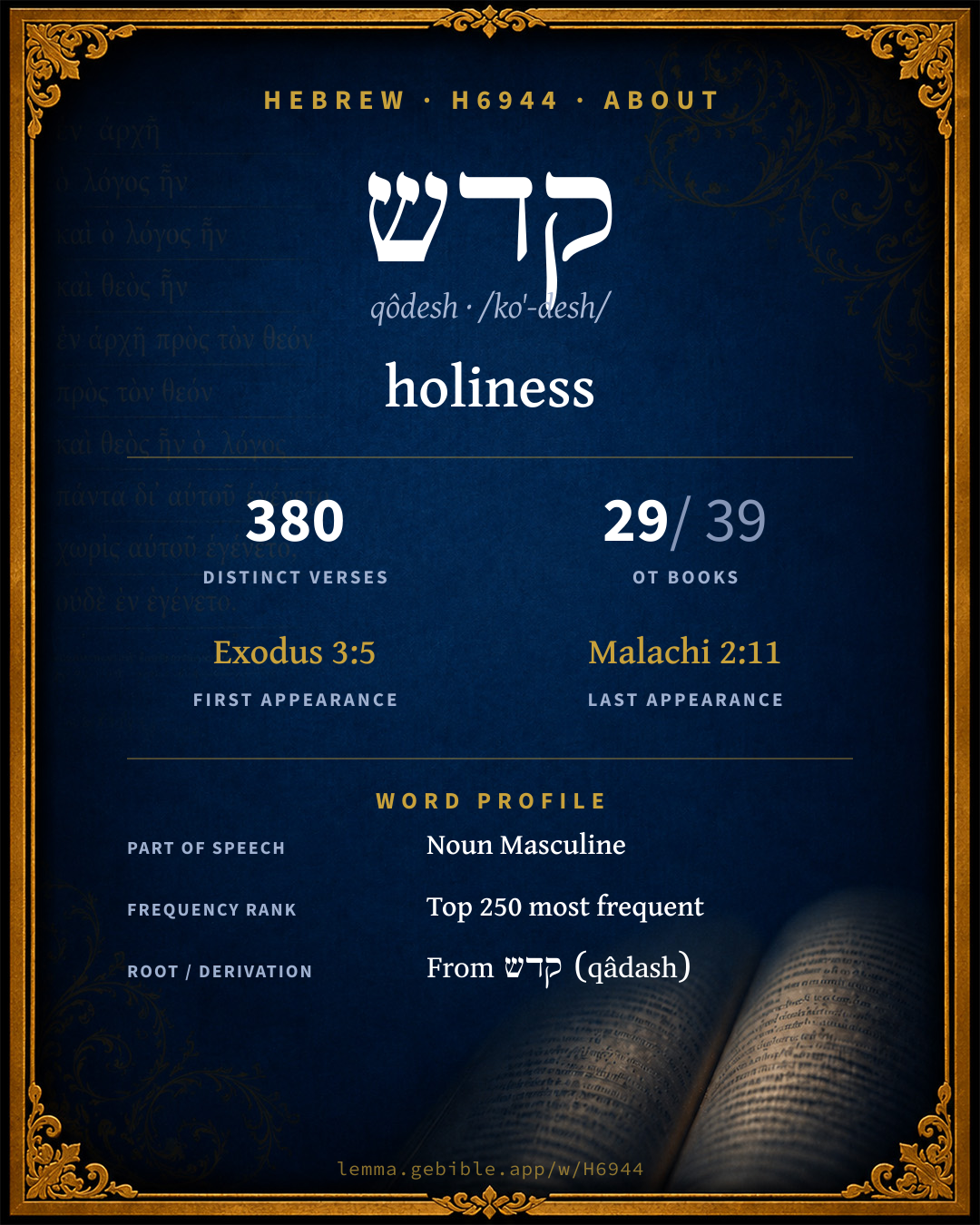
קֹ֫דֶשׁ
holiness
also: apartness, sacredness, separateness fuller range ↓
Full lexicon entry — Brown-Driver-Briggs (BDB)
From Brown-Driver-Briggs (BDB)
Where this word appears
See every Absolute-state word in the Hebrew Bible →
Grammar key — what these labels mean
Part of speech
- Noun
- A naming word — a person, place, thing, or idea.
Noun type
- Common
- A common noun — a general class of person, place, or thing (“king,” “city,” “water”), not a specific name.
State
- Absolute
- The independent form of a noun, not bound to a following word.
- Construct
- A noun bound to a following noun in a possessive / “of” relationship (the construct chain).
Gender
- Masculine
- Grammatically masculine.
Number
- Singular
- One.
- Plural
- More than one (in Hebrew, generally three or more).
Grammatical forms
- Noun, Common, Masculine, Singular, Absolute 249 times (53%)
- Noun, Common, Masculine, Singular, Construct 129 times (28%)
- Noun, Common, Masculine, Plural, Absolute 64 times (14%)
- Noun, Common, Masculine, Plural, Construct 25 times (5%)
Parsed forms decoded from the imported morphology (morphhb / Westminster Leningrad Codex — WLC text public domain, morphhb tagging CC BY 4.0), counted across 467 parsed occurrences — not distinct verses.
Page 1 of 2 — showing verses 1–200 of 380 distinct verses where H6944 appears, across 29 books. Click any verse to open its interlinear word-by-word view. Verse text shown in the World English Bible for context — . Each verse’s Hebrew form is shown with its reference; the English is not keyword-highlighted, since the data carries no word-level English alignment. Use “Compare translations” on any verse to read it across multiple English versions. This concordance covers the Hebrew Bible; Septuagint (Greek Old Testament) occurrences are not indexed here.
Exodus 53 verses
- Exodus 3:5 קֹ֖דֶשׁ n c ms He said, "Don't come close. Take off your sandals from off your feet, for the place you are standing on is holy ground."
- Exodus 12:16 קֹ֔דֶשׁ קֹ֖דֶשׁ n c ms n c ms In the first day there shall be to you a holy convocation, and in the seventh day a holy convocation; no manner of work shall be done in them, except that which every man must eat, that only may be done by you.
- Exodus 15:11 בַּ/קֹּ֑דֶשׁ prep det + n c ms Who is like you, Yahweh, among the gods? Who is like you, glorious in holiness, Fearful in praises, doing wonders?
- Exodus 15:13 קָדְשֶֽׁ/ךָ n c ms cs + sfx pers 2ms "You, in your loving kindness, have led the people that you have redeemed. You have guided them in your strength to your holy habitation.
- Exodus 16:23 קֹ֛דֶשׁ n c ms He said to them, "This is that which Yahweh has spoken, 'Tomorrow is a solemn rest, a holy Sabbath to Yahweh. Bake that which you want to bake, and boil that which you want to boil; and all that remains over lay up for yourselves to be kept until the morning."
- Exodus 22:31 קֹ֖דֶשׁ n c ms "You shall be holy men to me, therefore you shall not eat any flesh that is torn by animals in the field. You shall cast it to the dogs.
- Exodus 26:33 הַ/קֹּ֔דֶשׁ קֹ֥דֶשׁ הַ/קֳּדָשִֽׁים ptcl def.art + n c ms n c ms cs ptcl def.art + n c mp You shall hang up the veil under the clasps, and shall bring the ark of the testimony in there within the veil: and the veil shall separate the holy place from the most holy for you.
- Exodus 26:34 בְּ/קֹ֖דֶשׁ הַ/קֳּדָשִֽׁים prep + n c ms cs ptcl def.art + n c mp You shall put the mercy seat on the ark of the testimony in the most holy place.
- Exodus 28:2 קֹ֖דֶשׁ n c ms You shall make holy garments for Aaron your brother, for glory and for beauty.
- Exodus 28:4 קֹ֜דֶשׁ n c ms These are the garments which they shall make: a breastplate, and an ephod, and a robe, and a coat of checker work, a turban, and a sash: and they shall make holy garments for Aaron your brother, and his sons, that he may minister to me in the priest's office.
- Exodus 28:29 הַ/קֹּ֑דֶשׁ ptcl def.art + n c ms Aaron shall bear the names of the children of Israel in the breastplate of judgment on his heart, when he goes in to the holy place, for a memorial before Yahweh continually.
- Exodus 28:35 הַ/קֹּ֜דֶשׁ ptcl def.art + n c ms It shall be on Aaron to minister: and the sound of it shall be heard when he goes in to the holy place before Yahweh, and when he comes out, that he not die.
- Exodus 28:36 קֹ֖דֶשׁ n c ms "You shall make a plate of pure gold, and engrave on it, like the engravings of a signet, 'HOLY TO YAHWEH.'
- Exodus 28:38 הַ/קֳּדָשִׁ֗ים קָדְשֵׁי/הֶ֑ם ptcl def.art + n c mp n c mp cs + sfx pers 3mp It shall be on Aaron's forehead, and Aaron shall bear the iniquity of the holy things, which the children of Israel shall make holy in all their holy gifts; and it shall be always on his forehead, that they may be accepted before Yahweh.
- Exodus 28:43 בַּ/קֹּ֔דֶשׁ prep det + n c ms They shall be on Aaron, and on his sons, when they go in to the tent of meeting, or when they come near to the altar to minister in the holy place; that they don't bear iniquity, and die: it shall be a statute forever to him and to his descendants after him.
- Exodus 29:6 הַ/קֹּ֖דֶשׁ ptcl def.art + n c ms and you shall set the turban on his head, and put the holy crown on the turban.
- Exodus 29:29 הַ/קֹּ֨דֶשׁ֙ ptcl def.art + n c ms "The holy garments of Aaron shall be for his sons after him, to be anointed in them, and to be consecrated in them.
- Exodus 29:30 בַּ/קֹּֽדֶשׁ prep det + n c ms Seven days shall the son who is priest in his place put them on, when he comes into the tent of meeting to minister in the holy place.
- Exodus 29:33 קֹ֥דֶשׁ n c ms They shall eat those things with which atonement was made, to consecrate and sanctify them: but a stranger shall not eat of it, because they are holy.
- Exodus 29:34 קֹ֥דֶשׁ n c ms If anything of the flesh of the consecration, or of the bread, remains to the morning, then you shall burn the remainder with fire: it shall not be eaten, because it is holy.
- Exodus 29:37 קֹ֣דֶשׁ קָֽדָשִׁ֔ים n c ms cs n c mp Seven days you shall make atonement for the altar, and sanctify it: and the altar shall be most holy; whatever touches the altar shall be holy.
- Exodus 30:10 קֹֽדֶשׁ קָֽדָשִׁ֥ים n c ms cs n c mp Aaron shall make atonement on its horns once in the year; with the blood of the sin offering of atonement once in the year he shall make atonement for it throughout your generations. It is most holy to Yahweh."
- Exodus 30:13 הַ/קֹּ֑דֶשׁ ptcl def.art + n c ms They shall give this, everyone who passes over to those who are numbered, half a shekel after the shekel of the sanctuary; (the shekel is twenty gerahs;) half a shekel for an offering to Yahweh.
- Exodus 30:24 הַ/קֹּ֑דֶשׁ ptcl def.art + n c ms and of cassia five hundred, after the shekel of the sanctuary; and a hin of olive oil.
- Exodus 30:25 קֹ֔דֶשׁ קֹ֖דֶשׁ n c ms n c ms You shall make it a holy anointing oil, a perfume compounded after the art of the perfumer: it shall be a holy anointing oil.
- Exodus 30:29 קֹ֣דֶשׁ קָֽדָשִׁ֑ים n c ms cs n c mp You shall sanctify them, that they may be most holy. Whatever touches them shall be holy.
- Exodus 30:31 קֹ֨דֶשׁ n c ms You shall speak to the children of Israel, saying, 'This shall be a holy anointing oil to me throughout your generations.
- Exodus 30:32 קֹ֣דֶשׁ קֹ֖דֶשׁ n c ms n c ms It shall not be poured on man's flesh, neither shall you make any like it, according to its composition: it is holy. It shall be holy to you.
- Exodus 30:35 קֹֽדֶשׁ n c ms and you shall make incense of it, a perfume after the art of the perfumer, seasoned with salt, pure and holy:
- Exodus 30:36 קֹ֥דֶשׁ קָֽדָשִׁ֖ים n c ms cs n c mp and you shall beat some of it very small, and put some of it before the testimony in the tent of meeting, where I will meet with you. It shall be to you most holy.
- Exodus 30:37 קֹ֛דֶשׁ n c ms The incense which you shall make, according to its composition you shall not make for yourselves: it shall be to you holy for Yahweh.
- Exodus 31:10 הַ/קֹּ֨דֶשׁ֙ ptcl def.art + n c ms the finely worked garments--the holy garments for Aaron the priest--the garments of his sons to minister in the priest's office,
- Exodus 31:11 לַ/קֹּ֑דֶשׁ prep det + n c ms the anointing oil, and the incense of sweet spices for the holy place: according to all that I have commanded you they shall do."
- Exodus 31:14 קֹ֥דֶשׁ n c ms You shall keep the Sabbath therefore; for it is holy to you. Everyone who profanes it shall surely be put to death; for whoever does any work therein, that soul shall be cut off from among his people.
- Exodus 31:15 קֹ֖דֶשׁ n c ms Six days shall work be done, but on the seventh day is a Sabbath of solemn rest, holy to Yahweh. Whoever does any work on the Sabbath day shall surely be put to death.
- Exodus 35:2 קֹ֛דֶשׁ n c ms 'Six days shall work be done, but on the seventh day there shall be a holy day for you, a Sabbath of solemn rest to Yahweh: whoever does any work in it shall be put to death.
- Exodus 35:19 בַּ/קֹּ֑דֶשׁ הַ/קֹּ֨דֶשׁ֙ prep det + n c ms ptcl def.art + n c ms the finely worked garments, for ministering in the holy place, the holy garments for Aaron the priest, and the garments of his sons, to minister in the priest's office.'"
- Exodus 35:21 הַ/קֹּֽדֶשׁ ptcl def.art + n c ms They came, everyone whose heart stirred him up, and everyone whom his spirit made willing, and brought Yahweh's offering, for the work of the tent of meeting, and for all of its service, and for the holy garments.
- Exodus 36:1 הַ/קֹּ֑דֶשׁ ptcl def.art + n c ms "Bezalel and Oholiab shall work with every wise-hearted man, in whom Yahweh has put wisdom and understanding to know how to work all the work for the service of the sanctuary, according to all that Yahweh has commanded."
- Exodus 36:3 הַ/קֹּ֖דֶשׁ ptcl def.art + n c ms and they received from Moses all the offering which the children of Israel had brought for the work of the service of the sanctuary, with which to make it. They brought yet to him freewill-offerings every morning.
- Exodus 36:4 הַ/קֹּ֑דֶשׁ ptcl def.art + n c ms All the wise men, who performed all the work of the sanctuary, each came from his work which they did.
- Exodus 36:6 הַ/קֹּ֑דֶשׁ ptcl def.art + n c ms Moses gave commandment, and they caused it to be proclaimed throughout the camp, saying, "Let neither man nor woman make anything else for the offering for the sanctuary." So the people were restrained from bringing.
- Exodus 37:29 קֹ֔דֶשׁ n c ms He made the holy anointing oil and the pure incense of sweet spices, after the art of the perfumer.
- Exodus 38:24 הַ/קֹּ֑דֶשׁ הַ/קֹּֽדֶשׁ ptcl def.art + n c ms ptcl def.art + n c ms All the gold that was used for the work in all the work of the sanctuary, even the gold of the offering, was twenty-nine talents, and seven hundred thirty shekels, after the shekel of the sanctuary.
- Exodus 38:25 הַ/קֹּֽדֶשׁ ptcl def.art + n c ms The silver of those who were numbered of the congregation was one hundred talents, and one thousand seven hundred seventy-five shekels, after the shekel of the sanctuary:
- Exodus 38:26 הַ/קֹּ֑דֶשׁ ptcl def.art + n c ms a beka a head, that is, half a shekel, after the shekel of the sanctuary, for everyone who passed over to those who were numbered, from twenty years old and upward, for six hundred three thousand five hundred fifty men.
- Exodus 38:27 הַ/קֹּ֔דֶשׁ ptcl def.art + n c ms The one hundred talents of silver were for casting the sockets of the sanctuary, and the sockets of the veil; one hundred sockets for the one hundred talents, a talent for a socket.
- Exodus 39:1 בַּ/קֹּ֑דֶשׁ הַ/קֹּ֨דֶשׁ֙ prep det + n c ms ptcl def.art + n c ms Of the blue, purple, and scarlet, they made finely worked garments, for ministering in the holy place, and made the holy garments for Aaron; as Yahweh commanded Moses.
- Exodus 39:30 הַ/קֹּ֖דֶשׁ קֹ֖דֶשׁ ptcl def.art + n c ms n c ms They made the plate of the holy crown of pure gold, and wrote on it a writing, like the engravings of a signet: "HOLY TO YAHWEH."
- Exodus 39:41 בַּ/קֹּ֑דֶשׁ הַ/קֹּ֨דֶשׁ֙ prep det + n c ms ptcl def.art + n c ms the finely worked garments for ministering in the holy place, the holy garments for Aaron the priest, and the garments of his sons, to minister in the priest's office.
- Exodus 40:9 קֹֽדֶשׁ n c ms You shall take the anointing oil, and anoint the tent, and all that is in it, and shall make it holy, and all its furniture: and it will be holy.
- Exodus 40:10 קֹ֥דֶשׁ קָֽדָשִֽׁים n c ms cs n c mp You shall anoint the altar of burnt offering, with all its vessels, and sanctify the altar: and the altar will be most holy.
- Exodus 40:13 הַ/קֹּ֑דֶשׁ ptcl def.art + n c ms You shall put on Aaron the holy garments; and you shall anoint him, and sanctify him, that he may minister to me in the priest's office.
Leviticus 70 verses
- Leviticus 2:3 קֹ֥דֶשׁ קָֽדָשִׁ֖ים n c ms cs n c mp That which is left of the meal offering shall be Aaron's and his sons'. It is a most holy thing of the offerings of Yahweh made by fire.
- Leviticus 2:10 קֹ֥דֶשׁ קָֽדָשִׁ֖ים n c ms cs n c mp That which is left of the meal offering shall be Aaron's and his sons'. It is a thing most holy of the offerings of Yahweh made by fire.
- Leviticus 4:6 הַ/קֹּֽדֶשׁ ptcl def.art + n c ms The priest shall dip his finger in the blood, and sprinkle some of the blood seven times before Yahweh, before the veil of the sanctuary.
- Leviticus 5:15 מִ/קָּדְשֵׁ֖י הַ/קֹּ֖דֶשׁ prep + n c mp cs ptcl def.art + n c ms "If anyone commits a trespass, and sins unwittingly, in the holy things of Yahweh; then he shall bring his trespass offering to Yahweh, a ram without blemish from the flock, according to your estimation in silver by shekels, after the shekel of the sanctuary, for a trespass offering.
- Leviticus 5:16 הַ/קֹּ֜דֶשׁ ptcl def.art + n c ms He shall make restitution for that which he has done wrong in the holy thing, and shall add a fifth part to it, and give it to the priest; and the priest shall make atonement for him with the ram of the trespass offering, and he will be forgiven.
- Leviticus 6:17 קֹ֤דֶשׁ קָֽדָשִׁים֙ n c ms cs n c mp It shall not be baked with yeast. I have given it as their portion of my offerings made by fire. It is most holy, as the sin offering, and as the trespass offering.
- Leviticus 6:25 קֹ֥דֶשׁ קָֽדָשִׁ֖ים n c ms cs n c mp "Speak to Aaron and to his sons, saying, 'This is the law of the sin offering: in the place where the burnt offering is killed, the sin offering shall be killed before Yahweh. It is most holy.
- Leviticus 6:29 קֹ֥דֶשׁ קָֽדָשִׁ֖ים n c ms cs n c mp Every male among the priests shall eat of it: it is most holy.
- Leviticus 6:30 בַּ/קֹּ֖דֶשׁ prep det + n c ms No sin offering, of which any of the blood is brought into the Tent of Meeting to make atonement in the Holy Place, shall be eaten: it shall be burned with fire.
- Leviticus 7:1 קֹ֥דֶשׁ קָֽדָשִׁ֖ים n c ms cs n c mp "'This is the law of the trespass offering. It is most holy.
- Leviticus 7:6 קֹ֥דֶשׁ קָֽדָשִׁ֖ים n c ms cs n c mp Every male among the priests may eat of it. It shall be eaten in a holy place. It is most holy.
- Leviticus 8:9 הַ/קֹּ֔דֶשׁ ptcl def.art + n c ms He set the turban on his head; and on the turban, in front, he set the golden plate, the holy crown; as Yahweh commanded Moses.
- Leviticus 10:4 הַ/קֹּ֔דֶשׁ ptcl def.art + n c ms Moses called Mishael and Elzaphan, the sons of Uzziel the uncle of Aaron, and said to them, "Draw near, carry your brothers from before the sanctuary out of the camp."
- Leviticus 10:10 הַ/קֹּ֖דֶשׁ ptcl def.art + n c ms and that you are to make a distinction between the holy and the common, and between the unclean and the clean;
- Leviticus 10:12 קֹ֥דֶשׁ קָֽדָשִׁ֖ים n c ms cs n c mp Moses spoke to Aaron, and to Eleazar and to Ithamar, his sons who were left, "Take the meal offering that remains of the offerings of Yahweh made by fire, and eat it without yeast beside the altar; for it is most holy;
- Leviticus 10:17 הַ/קֹּ֔דֶשׁ קֹ֥דֶשׁ קָֽדָשִׁ֖ים ptcl def.art + n c ms n c ms cs n c mp "Why haven't you eaten the sin offering in the place of the sanctuary, seeing it is most holy, and he has given it you to bear the iniquity of the congregation, to make atonement for them before Yahweh?
- Leviticus 10:18 הַ/קֹּ֖דֶשׁ בַּ/קֹּ֖דֶשׁ ptcl def.art + n c ms prep det + n c ms Behold, its blood was not brought into the inner part of the sanctuary: you certainly should have eaten it in the sanctuary, as I commanded."
- Leviticus 12:4 קֹ֣דֶשׁ n c ms She shall continue in the blood of purification thirty-three days. She shall not touch any holy thing, nor come into the sanctuary, until the days of her purifying are completed.
- Leviticus 14:13 הַ/קֹּ֑דֶשׁ קֹ֥דֶשׁ קָֽדָשִׁ֖ים ptcl def.art + n c ms n c ms cs n c mp He shall kill the male lamb in the place where they kill the sin offering and the burnt offering, in the place of the sanctuary; for as the sin offering is the priest's, so is the trespass offering. It is most holy.
- Leviticus 16:2 הַ/קֹּ֔דֶשׁ ptcl def.art + n c ms and Yahweh said to Moses, "Tell Aaron your brother, not to come at all times into the Most Holy Place within the veil, before the mercy seat which is on the ark; lest he die: for I will appear in the cloud on the mercy seat.
- Leviticus 16:3 הַ/קֹּ֑דֶשׁ ptcl def.art + n c ms "Herewith shall Aaron come into the sanctuary: with a young bull for a sin offering, and a ram for a burnt offering.
- Leviticus 16:4 קֹ֜דֶשׁ קֹ֣דֶשׁ n c ms n c ms He shall put on the holy linen coat, and he shall have the linen breeches on his body, and shall put on the linen sash, and he shall be dressed with the linen turban. They are the holy garments. He shall bathe his body in water, and put them on.
- Leviticus 16:16 הַ/קֹּ֗דֶשׁ ptcl def.art + n c ms and he shall make atonement for the Holy Place, because of the uncleanness of the children of Israel, and because of their transgressions, even all their sins; and so he shall do for the Tent of Meeting, that dwells with them in the midst of their uncleanness.
- Leviticus 16:17 בַּ/קֹּ֖דֶשׁ prep det + n c ms There shall be no one in the Tent of Meeting when he enters to make atonement in the Holy Place, until he comes out, and has made atonement for himself and for his household, and for all the assembly of Israel.
- Leviticus 16:20 הַ/קֹּ֔דֶשׁ ptcl def.art + n c ms "When he has made an end of atoning for the Holy Place, the Tent of Meeting, and the altar, he shall present the live goat.
- Leviticus 16:23 הַ/קֹּ֑דֶשׁ ptcl def.art + n c ms "Aaron shall come into the Tent of Meeting, and shall take off the linen garments, which he put on when he went into the Holy Place, and shall leave them there.
- Leviticus 16:27 בַּ/קֹּ֔דֶשׁ prep det + n c ms The bull for the sin offering, and the goat for the sin offering, whose blood was brought in to make atonement in the Holy Place, shall be carried forth outside the camp; and they shall burn their skins, their flesh, and their dung with fire.
- Leviticus 16:32 הַ/קֹּֽדֶשׁ ptcl def.art + n c ms The priest, who is anointed and who is consecrated to be priest in his father's place, shall make the atonement, and shall put on the linen garments, even the holy garments.
- Leviticus 16:33 הַ/קֹּ֔דֶשׁ ptcl def.art + n c ms Then he shall make atonement for the Holy Sanctuary; and he shall make atonement for the Tent of Meeting and for the altar; and he shall make atonement for the priests and for all the people of the assembly.
- Leviticus 19:8 קֹ֥דֶשׁ n c ms cs but everyone who eats it shall bear his iniquity, because he has profaned the holy thing of Yahweh, and that soul shall be cut off from his people.
- Leviticus 19:24 קֹ֥דֶשׁ n c ms But in the fourth year all its fruit shall be holy, for giving praise to Yahweh.
- Leviticus 20:3 קָדְשִֽׁ/י n c ms cs + sfx pers 1cs I also will set my face against that person, and will cut him off from among his people because he has given of his seed to Molech, to defile my sanctuary, and to profane my holy name.
- Leviticus 21:6 קֹֽדֶשׁ n c ms They shall be holy to their God, and not profane the name of their God; for they offer the offerings of Yahweh made by fire, the bread of their God; therefore they shall be holy.
- Leviticus 21:22 מִ/קָּדְשֵׁ֖י הַ/קֳּדָשִׁ֑ים הַ/קֳּדָשִׁ֖ים prep + n c mp cs ptcl def.art + n c mp ptcl def.art + n c mp He shall eat the bread of his God, both of the most holy, and of the holy.
- Leviticus 22:2 מִ/קָּדְשֵׁ֣י קָדְשִׁ֑/י prep + n c mp cs n c ms cs + sfx pers 1cs "Tell Aaron and his sons to separate themselves from the holy things of the children of Israel, which they make holy to me, and that they not profane my holy name. I am Yahweh.
- Leviticus 22:3 הַ/קֳּדָשִׁים֙ ptcl def.art + n c mp Tell them, 'If anyone of all your seed throughout your generations approaches the holy things, which the children of Israel make holy to Yahweh, having his uncleanness on him, that soul shall be cut off from before me. I am Yahweh.
- Leviticus 22:4 בַּ/קֳּדָשִׁים֙ prep det + n c mp "'Whoever of the seed of Aaron is a leper or has an issue; he shall not eat of the holy things, until he is clean. Whoever touches anything that is unclean by the dead, or a man whose seed goes from him;
- Leviticus 22:6 הַ/קֳּדָשִׁ֔ים ptcl def.art + n c mp the person that touches any such shall be unclean until the evening, and shall not eat of the holy things, unless he bathe his body in water.
- Leviticus 22:7 הַ/קֳּדָשִׁ֔ים ptcl def.art + n c mp When the sun is down, he shall be clean; and afterward he shall eat of the holy things, because it is his bread.
- Leviticus 22:10 קֹ֑דֶשׁ קֹֽדֶשׁ n c ms n c ms "'No stranger shall eat of the holy thing: a foreigner living with the priests, or a hired servant, shall not eat of the holy thing.
- Leviticus 22:12 הַ/קֳּדָשִׁ֖ים ptcl def.art + n c mp If a priest's daughter is married to an outsider, she shall not eat of the heave offering of the holy things.
- Leviticus 22:14 קֹ֖דֶשׁ הַ/קֹּֽדֶשׁ n c ms ptcl def.art + n c ms "'If a man eats something holy unwittingly, then he shall add the fifth part of its value to it, and shall give the holy thing to the priest.
- Leviticus 22:15 קָדְשֵׁ֖י n c mp cs The priests shall not profane the holy things of the children of Israel, which they offer to Yahweh,
- Leviticus 22:16 קָדְשֵׁי/הֶ֑ם n c mp cs + sfx pers 3mp and so cause them to bear the iniquity that brings guilt, when they eat their holy things: for I am Yahweh who sanctifies them.'"
- Leviticus 22:32 קָדְשִׁ֔/י n c ms cs + sfx pers 1cs You shall not profane my holy name, but I will be made holy among the children of Israel. I am Yahweh who makes you holy,
- Leviticus 23:2 קֹ֑דֶשׁ n c ms "Speak to the children of Israel, and tell them, 'The set feasts of Yahweh, which you shall proclaim to be holy convocations, even these are my set feasts.
- Leviticus 23:3 קֹ֔דֶשׁ n c ms "'Six days shall work be done: but on the seventh day is a Sabbath of solemn rest, a holy convocation; you shall do no manner of work. It is a Sabbath to Yahweh in all your dwellings.
- Leviticus 23:4 קֹ֑דֶשׁ n c ms "'These are the set feasts of Yahweh, even holy convocations, which you shall proclaim in their appointed season.
- Leviticus 23:7 קֹ֖דֶשׁ n c ms In the first day you shall have a holy convocation. You shall do no regular work.
- Leviticus 23:8 קֹ֔דֶשׁ n c ms But you shall offer an offering made by fire to Yahweh seven days. In the seventh day is a holy convocation: you shall do no regular work.'"
- Leviticus 23:20 קֹ֛דֶשׁ n c ms The priest shall wave them with the bread of the first fruits for a wave offering before Yahweh, with the two lambs. They shall be holy to Yahweh for the priest.
- Leviticus 23:21 קֹ֨דֶשׁ֙ n c ms You shall make proclamation on the same day: there shall be a holy convocation to you; you shall do no regular work. This is a statute forever in all your dwellings throughout your generations.
- Leviticus 23:24 קֹֽדֶשׁ n c ms "Speak to the children of Israel, saying, 'In the seventh month, on the first day of the month, shall be a solemn rest to you, a memorial of blowing of trumpets, a holy convocation.
- Leviticus 23:27 קֹ֨דֶשׁ֙ n c ms "However on the tenth day of this seventh month is the day of atonement: it shall be a holy convocation to you, and you shall afflict yourselves; and you shall offer an offering made by fire to Yahweh.
- Leviticus 23:35 קֹ֑דֶשׁ n c ms On the first day shall be a holy convocation: you shall do no regular work.
- Leviticus 23:36 קֹדֶשׁ֩ n c ms Seven days you shall offer an offering made by fire to Yahweh. On the eighth day shall be a holy convocation to you; and you shall offer an offering made by fire to Yahweh. It is a solemn assembly; you shall do no regular work.
- Leviticus 23:37 קֹ֑דֶשׁ n c ms "'These are the appointed feasts of Yahweh, which you shall proclaim to be holy convocations, to offer an offering made by fire to Yahweh, a burnt offering, and a meal offering, a sacrifice, and drink offerings, each on its own day;
- Leviticus 24:9 קֹדֶשׁ֩ קָֽדָשִׁ֨ים n c ms cs n c mp It shall be for Aaron and his sons; and they shall eat it in a holy place: for it is most holy to him of the offerings of Yahweh made by fire by a perpetual statute."
- Leviticus 25:12 קֹ֖דֶשׁ n c ms For it is a jubilee; it shall be holy to you. You shall eat of its increase out of the field.
- Leviticus 27:3 הַ/קֹּֽדֶשׁ ptcl def.art + n c ms Your valuation shall be of a male from twenty years old even to sixty years old, even your valuation shall be fifty shekels of silver, after the shekel of the sanctuary.
- Leviticus 27:9 קֹּֽדֶשׁ n c ms "'If it is an animal, of which men offer an offering to Yahweh, all that any man gives of such to Yahweh becomes holy.
- Leviticus 27:10 קֹּֽדֶשׁ n c ms He shall not alter it, nor change it, a good for a bad, or a bad for a good: and if he shall at all change animal for animal, then both it and that for which it is changed shall be holy.
- Leviticus 27:14 קֹ֨דֶשׁ֙ n c ms "'When a man dedicates his house to be holy to Yahweh, then the priest shall evaluate it, whether it is good or bad: as the priest shall evaluate it, so shall it stand.
- Leviticus 27:21 קֹ֛דֶשׁ n c ms but the field, when it goes out in the Jubilee, shall be holy to Yahweh, as a field devoted; it shall be owned by the priests.
- Leviticus 27:23 קֹ֖דֶשׁ n c ms then the priest shall reckon to him the worth of your valuation up to the Year of Jubilee; and he shall give your valuation on that day, as a holy thing to Yahweh.
- Leviticus 27:25 הַ/קֹּ֑דֶשׁ ptcl def.art + n c ms All your valuations shall be according to the shekel of the sanctuary: twenty gerahs to the shekel.
- Leviticus 27:28 קֹֽדֶשׁ קָֽדָשִׁ֥ים n c ms cs n c mp "'Notwithstanding, no devoted thing, that a man shall devote to Yahweh of all that he has, whether of man or animal, or of the field of his possession, shall be sold or redeemed: every devoted thing is most holy to Yahweh.
- Leviticus 27:30 קֹ֖דֶשׁ n c ms "'All the tithe of the land, whether of the seed of the land or of the fruit of the trees, is Yahweh's. It is holy to Yahweh.
- Leviticus 27:32 קֹּ֖דֶשׁ n c ms All the tithe of the herds or the flocks, whatever passes under the rod, the tenth shall be holy to Yahweh.
- Leviticus 27:33 קֹ֖דֶשׁ n c ms He shall not search whether it is good or bad, neither shall he change it: and if he changes it at all, then both it and that for which it is changed shall be holy. It shall not be redeemed.'"
Numbers 46 verses
- Numbers 3:28 הַ/קֹּֽדֶשׁ ptcl def.art + n c ms According to the number of all the males, from a month old and upward, there were eight thousand six hundred, keeping the charge of the sanctuary.
- Numbers 3:31 הַ/קֹּ֔דֶשׁ ptcl def.art + n c ms Their charge shall be the ark, the table, the lamp stand, the altars, the vessels of the sanctuary with which they minister, and the screen, and all its service.
- Numbers 3:32 הַ/קֹּֽדֶשׁ ptcl def.art + n c ms Eleazar the son of Aaron the priest shall be prince of the princes of the Levites, with the oversight of those who keep the charge of the sanctuary.
- Numbers 3:47 הַ/קֹּ֨דֶשׁ֙ ptcl def.art + n c ms you shall take five shekels apiece for each one; after the shekel of the sanctuary you shall take them (the shekel is twenty gerahs):
- Numbers 3:50 הַ/קֹּֽדֶשׁ ptcl def.art + n c ms from the firstborn of the children of Israel he took the money, one thousand three hundred sixty-five shekels, after the shekel of the sanctuary:
- Numbers 4:4 קֹ֖דֶשׁ הַ/קֳּדָשִֽׁים n c ms cs ptcl def.art + n c mp This is the service of the sons of Kohath in the Tent of Meeting, the most holy things.
- Numbers 4:12 בַּ/קֹּ֗דֶשׁ prep det + n c ms They shall take all the vessels of ministry, with which they minister in the sanctuary, and put them in a blue cloth, and cover them with a covering of sealskin, and shall put them on the frame.
- Numbers 4:15 הַ/קֹּ֜דֶשׁ הַ/קֹּדֶשׁ֮ הַ/קֹּ֖דֶשׁ ptcl def.art + n c ms ptcl def.art + n c ms ptcl def.art + n c ms "When Aaron and his sons have finished covering the sanctuary, and all the furniture of the sanctuary, as the camp moves forward; after that, the sons of Kohath shall come to carry it: but they shall not touch the sanctuary, lest they die. These things are the burden of the sons of Kohath in the Tent of Meeting.
- Numbers 4:16 בְּ/קֹ֖דֶשׁ prep + n c ms "The charge of Eleazar the son of Aaron the priest shall be the oil for the light, the sweet incense, the continual meal offering, and the anointing oil, the charge of all the tabernacle, and of all that is in it, the sanctuary, and its furnishings."
- Numbers 4:19 קֹ֣דֶשׁ הַ/קֳּדָשִׁ֑ים n c ms cs ptcl def.art + n c mp but thus do to them, that they may live, and not die, when they approach to the most holy things: Aaron and his sons shall go in, and appoint them everyone to his service and to his burden;
- Numbers 4:20 הַ/קֹּ֖דֶשׁ ptcl def.art + n c ms but they shall not go in to see the sanctuary even for a moment, lest they die."
- Numbers 5:9 קָדְשֵׁ֧י n c mp cs Every heave offering of all the holy things of the children of Israel, which they present to the priest, shall be his.
- Numbers 5:10 קֳדָשָׁ֖י/ו n c mp cs + sfx pers 3ms Every man's holy things shall be his: whatever any man gives the priest, it shall be his."
- Numbers 6:20 קֹ֤דֶשׁ n c ms and the priest shall wave them for a wave offering before Yahweh. This is holy for the priest, together with the breast that is waved and the thigh that is offered. After that the Nazirite may drink wine.
- Numbers 7:9 הַ/קֹּ֨דֶשׁ֙ ptcl def.art + n c ms But to the sons of Kohath he gave none, because the service of the sanctuary belonged to them; they carried it on their shoulders.
- Numbers 7:13 הַ/קֹּ֑דֶשׁ ptcl def.art + n c ms and his offering was: one silver platter, the weight of which was one hundred thirty shekels, one silver bowl of seventy shekels, after the shekel of the sanctuary; both of them full of fine flour mixed with oil for a meal offering;
- Numbers 7:19 הַ/קֹּ֑דֶשׁ ptcl def.art + n c ms He offered for his offering: one silver platter, the weight of which was one hundred thirty shekels, one silver bowl of seventy shekels, after the shekel of the sanctuary; both of them full of fine flour mixed with oil for a meal offering;
- Numbers 7:25 הַ/קֹּ֑דֶשׁ ptcl def.art + n c ms gave his offering: one silver platter, the weight of which was a hundred and thirty shekels, one silver bowl of seventy shekels, after the shekel of the sanctuary; both of them full of fine flour mixed with oil for a meal offering;
- Numbers 7:31 הַ/קֹּ֑דֶשׁ ptcl def.art + n c ms gave his offering: one silver platter, the weight of which was one hundred thirty shekels, one silver bowl of seventy shekels, after the shekel of the sanctuary; both of them full of fine flour mixed with oil for a meal offering;
- Numbers 7:37 הַ/קֹּ֑דֶשׁ ptcl def.art + n c ms gave his offering: one silver platter, the weight of which was one hundred thirty shekels, one silver bowl of seventy shekels, after the shekel of the sanctuary; both of them full of fine flour mixed with oil for a meal offering;
- Numbers 7:43 הַ/קֹּ֑דֶשׁ ptcl def.art + n c ms gave his offering: one silver platter, the weight of which was one hundred thirty shekels, one silver bowl of seventy shekels, after the shekel of the sanctuary; both of them full of fine flour mixed with oil for a meal offering;
- Numbers 7:49 הַ/קֹּ֑דֶשׁ ptcl def.art + n c ms gave his offering: one silver platter, the weight of which was one hundred thirty shekels, one silver bowl of seventy shekels, after the shekel of the sanctuary; both of them full of fine flour mixed with oil for a meal offering;
- Numbers 7:55 הַ/קֹּ֑דֶשׁ ptcl def.art + n c ms gave his offering: one silver platter, the weight of which was one hundred thirty shekels, one silver bowl of seventy shekels, after the shekel of the sanctuary; both of them full of fine flour mixed with oil for a meal offering;
- Numbers 7:61 הַ/קֹּ֑דֶשׁ ptcl def.art + n c ms gave his offering: one silver platter, the weight of which was one hundred thirty shekels, one silver bowl of seventy shekels, after the shekel of the sanctuary; both of them full of fine flour mixed with oil for a meal offering;
- Numbers 7:67 הַ/קֹּ֑דֶשׁ ptcl def.art + n c ms gave his offering: one silver platter, the weight of which was one hundred thirty shekels, one silver bowl of seventy shekels, after the shekel of the sanctuary; both of them full of fine flour mixed with oil for a meal offering;
- Numbers 7:73 הַ/קֹּ֑דֶשׁ ptcl def.art + n c ms gave his offering: one silver platter, the weight of which was one hundred thirty shekels, one silver bowl of seventy shekels, after the shekel of the sanctuary; both of them full of fine flour mixed with oil for a meal offering;
- Numbers 7:79 הַ/קֹּ֑דֶשׁ ptcl def.art + n c ms gave his offering: one silver platter, the weight of which was one hundred thirty shekels, one silver bowl of seventy shekels, after the shekel of the sanctuary; both of them full of fine flour mixed with oil for a meal offering;
- Numbers 7:85 הַ/קֹּֽדֶשׁ ptcl def.art + n c ms each silver platter weighing one hundred thirty shekels, and each bowl seventy; all the silver of the vessels two thousand four hundred shekels, after the shekel of the sanctuary;
- Numbers 7:86 הַ/קֹּ֑דֶשׁ ptcl def.art + n c ms the twelve golden ladles, full of incense, weighing ten shekels apiece, after the shekel of the sanctuary; all the gold of the ladles weighed one hundred twenty shekels;
- Numbers 8:19 הַ/קֹּֽדֶשׁ ptcl def.art + n c ms I have given the Levites as a gift to Aaron and to his sons from among the children of Israel, to do the service of the children of Israel in the Tent of Meeting, and to make atonement for the children of Israel; that there be no plague among the children of Israel, when the children of Israel come near to the sanctuary."
- Numbers 18:3 הַ/קֹּ֤דֶשׁ ptcl def.art + n c ms They shall keep your charge, and the charge of all the Tent: only they shall not come near to the vessels of the sanctuary and to the altar, that they not die, neither they, nor you.
- Numbers 18:5 הַ/קֹּ֔דֶשׁ ptcl def.art + n c ms You shall keep the charge of the sanctuary, and the charge of the altar; that there be wrath no more on the children of Israel.
- Numbers 18:9 מִ/קֹּ֥דֶשׁ הַ/קֳּדָשִׁ֖ים קֹ֣דֶשׁ קָֽדָשִׁ֥ים prep + n c ms cs ptcl def.art + n c mp n c ms cs n c mp This shall be your of the most holy things, [reserved] from the fire: every offering of theirs, even every meal-offering of theirs, and every sin-offering of theirs, and every trespass-offering of theirs, which they shall render to me, shall be most holy for you and for your sons.
- Numbers 18:10 בְּ/קֹ֥דֶשׁ הַ/קֳּדָשִׁ֖ים קֹ֖דֶשׁ prep + n c ms cs ptcl def.art + n c mp n c ms As the most holy things shall you eat of it; every male shall eat of it: it shall be holy to you.
- Numbers 18:16 הַ/קֹּ֑דֶשׁ ptcl def.art + n c ms Those who are to be redeemed of them from a month old shall you redeem, according to your estimation, for the money of five shekels, after the shekel of the sanctuary (the same is twenty gerahs).
- Numbers 18:17 קֹ֣דֶשׁ n c ms But the firstborn of a cow, or the firstborn of a sheep, or the firstborn of a goat, you shall not redeem; they are holy: you shall sprinkle their blood on the altar, and shall burn their fat for an offering made by fire, for a sweet savor to Yahweh.
- Numbers 18:19 הַ/קֳּדָשִׁ֗ים ptcl def.art + n c mp All the heave-offerings of the holy things, which the children of Israel offer to Yahweh, have I given you, and your sons and your daughters with you, as a portion forever: it is a covenant of salt forever before Yahweh to you and to your seed with you.
- Numbers 28:7 בַּ/קֹּ֗דֶשׁ prep det + n c ms The drink-offering of it shall be the fourth part of a hin for the one lamb: in the holy place shall you pour out a drink-offering of strong drink to Yahweh.
- Numbers 28:18 קֹ֑דֶשׁ n c ms In the first day shall be a holy convocation: you shall do no servile work;
- Numbers 28:25 קֹ֖דֶשׁ n c ms On the seventh day you shall have a holy convocation: you shall do no servile work.
- Numbers 28:26 קֹ֨דֶשׁ֙ n c ms Also in the day of the first fruits, when you offer a new meal-offering to Yahweh in your [feast of] weeks, you shall have a holy convocation; you shall do no servile work;
- Numbers 29:1 קֹ֨דֶשׁ֙ n c ms In the seventh month, on the first day of the month, you shall have a holy convocation; you shall do no servile work: it is a day of blowing of trumpets to you.
- Numbers 29:7 קֹ֨דֶשׁ֙ n c ms On the tenth day of this seventh month you shall have a holy convocation; and you shall afflict your souls: you shall do no manner of work;
- Numbers 29:12 קֹ֨דֶשׁ֙ n c ms On the fifteenth day of the seventh month you shall have a holy convocation; you shall do no servile work, and you shall keep a feast to Yahweh seven days:
- Numbers 31:6 הַ/קֹּ֛דֶשׁ ptcl def.art + n c ms Moses sent them, one thousand of every tribe, to the war, them and Phinehas the son of Eleazar the priest, to the war, with the vessels of the sanctuary and the trumpets for the alarm in his hand.
- Numbers 35:25 הַ/קֹּֽדֶשׁ ptcl def.art + n c ms and the congregation shall deliver the manslayer out of the hand of the avenger of blood, and the congregation shall restore him to his city of refuge, where he was fled: and he shall dwell therein until the death of the high priest, who was anointed with the holy oil.
Deuteronomy 4 verses
- Deuteronomy 12:26 קָֽדָשֶׁ֛י/ךָ n c mp cs + sfx pers 2ms Only your holy things which you have, and your vows, you shall take, and go to the place which Yahweh shall choose:
- Deuteronomy 26:13 הַ/קֹּ֣דֶשׁ ptcl def.art + n c ms You shall say before Yahweh your God, I have put away the holy things out of my house, and also have given them to the Levite, and to the foreigner, to the fatherless, and to the widow, according to all your commandment which you have commanded me: I have not transgressed any of your commandments, neither have I forgotten them:
- Deuteronomy 26:15 קָדְשְׁ/ךָ֜ n c ms cs + sfx pers 2ms Look down from your holy habitation, from heaven, and bless your people Israel, and the ground which you have given us, as you swore to our fathers, a land flowing with milk and honey.
- Deuteronomy 33:2 קֹ֑דֶשׁ n c ms He said, Yahweh came from Sinai, Rose from Seir to them; He shined forth from Mount Paran, He came from the ten thousands of holy ones: At his right hand was a fiery law for them.
Joshua 2 verses
- Joshua 5:15 קֹ֣דֶשׁ n c ms The prince of Yahweh's host said to Joshua, Put off your shoe from off your foot; for the place whereon you stand is holy. Joshua did so.
- Joshua 6:19 קֹ֥דֶשׁ n c ms But all the silver, and gold, and vessels of brass and iron, are holy to Yahweh: they shall come into the treasury of Yahweh.
1 Samuel 3 verses
- 1 Samuel 21:4 קֹ֨דֶשׁ֙ n c ms The priest answered David, and said, There is no common bread under my hand, but there is holy bread; if only the young men have kept themselves from women.
- 1 Samuel 21:5 קֹ֑דֶשׁ n c ms David answered the priest, and said to him, Of a truth women have been kept from us about these three days; when I came out, the vessels of the young men were holy, though it was but a common journey; how much more then today shall their vessels be holy?
- 1 Samuel 21:6 קֹ֑דֶשׁ n c ms So the priest gave him holy [bread]; for there was no bread there but the show bread, that was taken from before Yahweh, to put hot bread in the day when it was taken away.
1 Kings 8 verses
- 1 Kings 6:16 לְ/קֹ֖דֶשׁ הַ/קֳּדָשִֽׁים prep + n c ms cs ptcl def.art + n c mp He built twenty cubits on the hinder part of the house with boards of cedar from the floor to the walls [of the ceiling]: he built [them] for it within, for an oracle, even for the most holy place.
- 1 Kings 7:50 לְ/קֹ֣דֶשׁ הַ/קֳּדָשִׁ֗ים prep + n c ms cs ptcl def.art + n c mp and the cups, and the snuffers, and the basins, and the spoons, and the fire pans, of pure gold; and the hinges, both for the doors of the inner house, the most holy place, and for the doors of the house, [to wit], of the temple, of gold.
- 1 Kings 7:51 קָדְשֵׁ֣י n c mp cs Thus all the work that king Solomon worked in the house of Yahweh was finished. Solomon brought in the things which David his father had dedicated, [even] the silver, and the gold, and the vessels, and put them in the treasuries of the house of Yahweh.
- 1 Kings 8:4 הַ/קֹּ֖דֶשׁ ptcl def.art + n c ms They brought up the ark of Yahweh, and the tent of meeting, and all the holy vessels that were in the Tent; even these did the priests and the Levites bring up.
- 1 Kings 8:6 קֹ֣דֶשׁ הַ/קֳּדָשִׁ֑ים n c ms cs ptcl def.art + n c mp The priests brought in the ark of the covenant of Yahweh to its place, into the oracle of the house, to the most holy place, even under the wings of the cherubim.
- 1 Kings 8:8 הַ/קֹּ֨דֶשׁ֙ ptcl def.art + n c ms The poles were so long that the ends of the poles were seen from the holy place before the oracle; but they were not seen outside: and there they are to this day.
- 1 Kings 8:10 הַ/קֹּ֑דֶשׁ ptcl def.art + n c ms It came to pass, when the priests were come out of the holy place, that the cloud filled the house of Yahweh,
- 1 Kings 15:15 קָדְשֵׁ֣י ו/קדש/ו וְ/קָדְשֵׁ֖י n c mp cs conj + n c ms cs + sfx pers 3ms conj + n c mp cs He brought into the house of Yahweh the things that his father had dedicated, and the things that himself had dedicated, silver, and gold, and vessels.
2 Kings 2 verses
- 2 Kings 12:4 הַ/קֳּדָשִׁ֜ים ptcl def.art + n c mp Jehoash said to the priests, All the money of the holy things that is brought into the house of Yahweh, in current money, the money of the persons for whom each man is rated, and all the money that it comes into any man's heart to bring into the house of Yahweh,
- 2 Kings 12:18 הַ/קֳּדָשִׁ֡ים קֳדָשָׁ֔י/ו ptcl def.art + n c mp n c mp cs + sfx pers 3ms Jehoash king of Judah took all the holy things that Jehoshaphat and Jehoram and Ahaziah, his fathers, kings of Judah, had dedicated, and his own holy things, and all the gold that was found in the treasures of the house of Yahweh, and of the king's house, and sent it to Hazael king of Syria: and he went away from Jerusalem.
1 Chronicles 15 verses
- 1 Chronicles 6:49 קֹ֣דֶשׁ הַ/קֳּדָשִׁ֑ים n c ms cs ptcl def.art + n c mp But Aaron and his sons offered on the altar of burnt offering, and on the altar of incense, for all the work of the most holy place, and to make atonement for Israel, according to all that Moses the servant of God had commanded.
- 1 Chronicles 9:29 הַ/קֹּ֑דֶשׁ ptcl def.art + n c ms Some of them also were appointed over the furniture, and over all the vessels of the sanctuary, and over the fine flour, and the wine, and the oil, and the frankincense, and the spices.
- 1 Chronicles 16:10 קָדְשׁ֔/וֹ n c ms cs + sfx pers 3ms Glory you in his holy name; Let the heart of them rejoice who seek Yahweh.
- 1 Chronicles 16:29 קֹֽדֶשׁ n c ms Ascribe to Yahweh the glory due to his name: Bring an offering, and come before him: Worship Yahweh in holy array.
- 1 Chronicles 16:35 קָדְשֶׁ֔/ךָ n c ms cs + sfx pers 2ms Say you, Save us, God of our salvation, Gather us together and deliver us from the nations, To give thanks to your holy name, To triumph in your praise.
- 1 Chronicles 22:19 קֹ֣דֶשׁ n c ms cs Now set your heart and your soul to seek after Yahweh your God; arise therefore, and build the sanctuary of Yahweh God, to bring the ark of the covenant of Yahweh, and the holy vessels of God, into the house that is to be built to the name of Yahweh.
- 1 Chronicles 23:13 קֹ֨דֶשׁ קָֽדָשִׁ֤ים n c ms cs n c mp The sons of Amram: Aaron and Moses; and Aaron was separated, that he should sanctify the most holy things, he and his sons, forever, to burn incense before Yahweh, to minister to him, and to bless in his name, forever.
- 1 Chronicles 23:28 קֹ֑דֶשׁ n c ms For their office was to wait on the sons of Aaron for the service of the house of Yahweh, in the courts, and in the chambers, and in the purifying of all holy things, even the work of the service of the house of God;
- 1 Chronicles 23:32 הַ/קֹּ֔דֶשׁ ptcl def.art + n c ms and that they should keep the charge of the tent of meeting, and the charge of the holy place, and the charge of the sons of Aaron their brothers, for the service of the house of Yahweh.
- 1 Chronicles 24:5 קֹ֨דֶשׁ֙ n c ms Thus were they divided impartially by drawing lots; for there were princes of the sanctuary, and princes of God, both of the sons of Eleazar, and of the sons of Ithamar.
- 1 Chronicles 26:20 הַ/קֳּדָשִֽׁים ptcl def.art + n c mp Of the Levites, Ahijah was over the treasures of the house of God, and over the treasures of the dedicated things.
- 1 Chronicles 26:26 הַ/קֳּדָשִׁים֙ ptcl def.art + n c mp This Shelomoth and his brothers were over all the treasures of the dedicated things, which David the king, and the heads of the fathers' [houses], the captains over thousands and hundreds, and the captains of the host, had dedicated.
About this entry
At a glance — auto-summarized from this page’s data, not written by a person. Every figure links to its source below. This summary describes the numbers; it doesn’t interpret them.
קדש — transliterated qôdesh — is a Hebrew noun carrying the sense “holiness.” Where the King James Version says “holy,” newer translations reach for “holiness” (unfoldingWord Literal Text); the renderings breakdown has the detail. The Hebrew Bible uses it across 380 verses — common. Debuting at Exodus 3:5, it then recurs through the corpus. Alongside “holiness” the lexicon also lists “apartness”, “sacredness”, and “separateness” — part of its full sense range. See the sense tree, 380-verse concordance, and the renderings breakdown below.
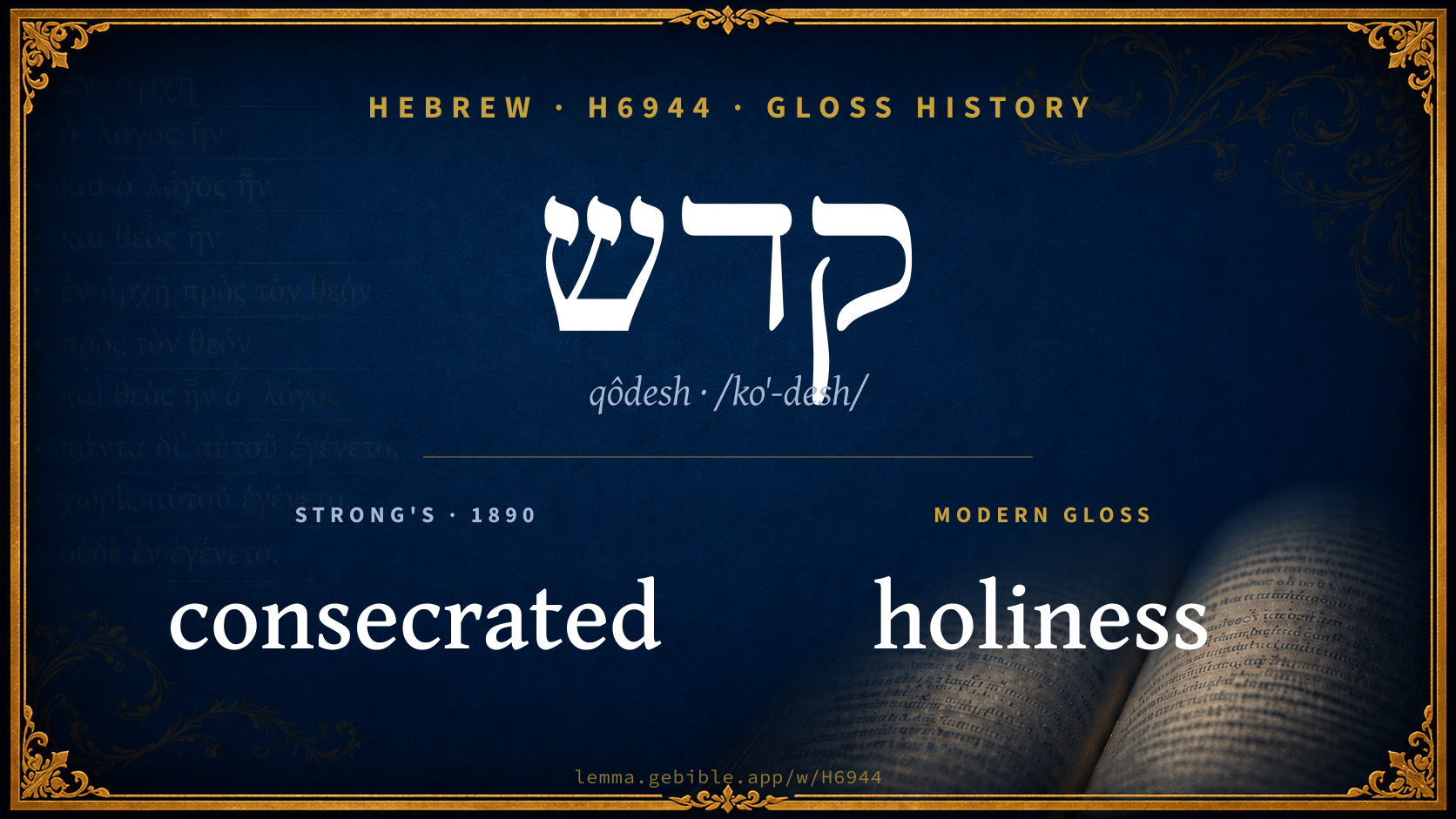
Gloss history
Strong's 1890 vs modern scholarship
About this word
Strong's H6944 catalogs a Hebrew word from the Hebrew Old Testament.
These counts are not copied from any lexicon or concordance. They are computed here, from the morphology-tagged Hebrew Old Testament. What Lemma adds →
- 380
- distinct verses
- The word appears in 380 distinct verses.
- 29 / 39
- OT books
- The word appears in 29 of 39 Old Testament books.
- #107
- by frequency
- Top 250 most frequent Hebrew words (rank 107 of 8,640 Hebrew words by occurrence).
View all 380 occurrences in the concordance →
By section of the Old Testament
By traditional corpus
Conventional, traditional groupings — biblical authorship is debated, so this is a traditional corpus grouping, not an authorship claim. Each share is this word’s portion of its verses in that division of the Hebrew canon. Each figure is a share of the word’s 380 distinct verses.
- Torah (Pentateuch) 173 verses · 46%
- Writings (Ketuvim) 106 verses · 28%
- Prophets (Nevi'im) 101 verses · 27%
How translations render this word
Counts come from each version’s own published word-to-Strong’s tagging or interlinear alignment — an approximate guide to how each version renders this word, not a word-level alignment the data otherwise carries. Because each total is that version’s own tagged count, the per-version totals vary from one another and need not match the appearance or distinct-verse counts above. These counts may also differ from a printed concordance because Lemma counts each distinctly tagged rendering and does not collapse phrase taggings into a single head-word total. This is a fixed set of word-tagged versions (KJV, ASV, BSB, ULT) and does not change with the reading translation you choose elsewhere. Each version’s license is shown beside its name below (and on Sources).
- King James Version: Holy 169×, Sanctuary 60×, Holiness 25×
- American Standard Version: Holy 158×, Sanctuary 65×, Holy things 21×
- Berean Standard Bible: Holy 167×, Sanctuary 43×, Sacred 28×
- unfoldingWord Literal Text: Holiness 120×, Holy 95×, Holy place 72×
King James Version Public Domain
Renders H6944 across 469 tagged occurrences — most commonly:
Plus other, less common renderings. Plus 79 renderings that appear only once — usually multi-word phrases or single function words the recovered tagging swept in, not distinct renderings. Not rendered by a distinct English word in 1 further occurrence.
American Standard Version Public Domain
Renders H6944 across 470 tagged occurrences — most commonly:
Plus other, less common renderings. Plus 91 renderings that appear only once — usually multi-word phrases or single function words the recovered tagging swept in, not distinct renderings.
Berean Standard Bible Public Domain
Renders H6944 across 437 tagged occurrences — most commonly:
Plus other, less common renderings. Plus 44 renderings that appear only once — usually multi-word phrases or single function words the recovered tagging swept in, not distinct renderings. Not rendered by a distinct English word in 31 further occurrences.
unfoldingWord Literal Text CC BY-SA 4.0
Renders H6944 across 489 tagged occurrences — most commonly:
Plus other, less common renderings. Plus 31 renderings that appear only once — usually multi-word phrases or single function words the recovered tagging swept in, not distinct renderings.
24 senses and sub-senses in the full BDB
What do BDB’s symbols mean?
BDB uses these scholarly abbreviations:
| Symbol | Meaning |
|---|---|
| 𝔊 | the Septuagint (the ancient Greek translation, LXX) |
| 𝔙 | the Vulgate (the Latin translation) |
| 𝔖 | the Syriac version (the Peshitta) |
| 𝔗 | the Targum (the Aramaic translation) |
| ψ | the Psalms |
| √ | root (the underlying root or stem) |
| ‖ | parallel passage (a synonymous or contrasted parallel) |
| † | the dagger: every passage where the word occurs is cited |
The 24 senses and sub-senses the full Brown-Driver-Briggs lexicon distinguishes for this word, in lexicon order (not ranked by frequency), with BDB’s own verbatim wording and sub-sense lettering. Shown in Hebrew script with BDB’s own scholarly abbreviations. The condensed entry is in the Lexicon Entry tab. See also the Forms in the corpus table below.
- 1. apartness, sacredness, holiness, of God:
- a. of divine activity, syn. majesty, בַּקֹּדֶשׁ (of victory), Ex 15:11 (song) ψ 68:18; 77:14; זְרוֹעַ ק׳ holy arm Is 52:10 ψ 98:1. e.g. Exodus 15:11
- b. to attest his word as inviolable נשׁבע בק׳ Am 4:2 ψ 89:36; cf. דִּבְרֵי ק׳ Je 23:9, דְּבַר ק׳ ψ 105:42. e.g. Amos 4:2
- c. of his name as sacred, inviolable, separate from all defilement, etc.: שֵׁם קָדְשִׁי Lv 20:3; 22:2, 32 (P), Am 2:7 1 Ch 16:10, 35; 29:16 + 9 times Ez, 5 times ψψ; זֵכֶר ק׳ ψ 30:5 = 97:12; and so e.g. Leviticus 20:3
- d. רוּחַ קָדְשׁוֹ his holy Spirit Is 63:10, 11, cf. ψ 51:13. e.g. Isaiah 63:10
- 2. of places set apart as sacred by God’s presence:
- a. heavenly abode; מעון ק׳ Dt 26:15 Je 25:30; Zc 2:17; 2 Ch 30:27 ψ 68:6; הֵיכַל ק׳ Mi 1:2; Hb 2:20; Jon 2:5, 8 ψ 11:4; מְרוֹם ק׳ ψ 102:20; זְבֻל ק׳ Is 63:15; שְׁמֵי ק׳ ψ 20:7 כסּא ק׳ 47:9; בְּקָדְשׁוֹ 150:1. e.g. Deuteronomy 26:15
- b. on earth: אַדְמַת ק׳ Ex 3:5 (E), cf. Jos 5:15 (JE) 2 Ch 8:11; הַר קם אלהים Ez 28:14 (cf. p. 249 b). e.g. Exodus 3:5
- c. (only P and Ch) the tabernacle and its courts Ex 40:9 Nu 3:28 +; tabernacle by itself Ex 38:24; Lv 10:4 +; court Lv 10:17, 18 + (so קדשׁ הקדשׁים †Nu 18:10); the outer room (specific designation; הַקּ׳) Ex 26:33; 28:29 +; inner room Lv 4:6; 16:2 +, but specif. design. קדשׁ הקדשׁים Ex 26:33, 34; 1 Ch 6:34; שֶׁקֶל הק׳ shekel of the sanctuary Ex 30:13 + 24 times P. e.g. Exodus 40:9
- d. the temple and its precincts 2 Ch 29:7; Dn 8:13 +; שָׂרֵי ק׳ Is 43:28; 1 Ch 24:5; דבּר בְּקָדְשׁוֹ ψ 60:8 = 108:8 (oracle; al. by his holiness, as נשׁבעתי בקדשׁי 89:36), temple by itself 2 Ch 29:5; †בית (ה)ק׳ Is 64:10; 1 Ch 29:3; †הֵיכַל קדשׁך ψ 5:8 = 138:2, 79:1; הַקּ׳ outer room 1 K 8:10 = 2 Ch 5:11; courts of priests Ez 42:14; 44:27(×2); †חצרות קדשׁי Is 62:9; inner room Ez 41:21, 23, specif. †דְּבִיר קדשׁך ψ 28:2; †קדשׁ הקדשׁים 1 K 6:16; 7:50; 8:6; 2 Ch 3:8, 10; 4:22; 5:7; Ez 41:4; †לִשְׁכוֹת הַקּ׳ Ez 42:13; 44:19; 46:19 (v. לִשְׁכָּה 1 c). e.g. 2 Chronicles 29:7
- e. Jerus. and its hills: מקום קדשׁו Ezr 9:8, עיר הק׳ Is 48:2; 52:1; Ne 11:1, 18, ע׳ קדשׁך Dn 9:24, הר (ה)ק׳ Is 11:9 + 6 times Is 2:3; Je 31:23; Ez 20:40 Jo 2:1; 4:17; Ob 16; Zp 3:11; Zc 8:3; Dn 9:16, 20; 11:45 + 6 times ψψ; גְּבוּל ק׳ ψ 78:54, הַרֲרֵי ק׳ 87:1 prob. also 110:3, ק׳ of city and suburbs in Mess. future Je 31:40 Jo 4:17. Cf. e.g. Ezra 9:8
- f. (ה)קדשׁ of Zion Ob 17 ψ 20:3; 24:3; 63:3; 68:25, ק׳ קדשׁים Ez 43:12; נְוֵה ק׳ Ex 15:13 of Zion (or Shiloh). e.g. Obadiah 1:17
- g. of holy land Zp 3:4, אדמת הק׳ Zc 2:16, עָרֵי קדשׁך Is 64:9; future portion of priests ק׳ Ez 45:1(×2) + 11 times Ez; קדשׁ קדשׁים Ez 45:3; 48:12; of Levites קדשׁ Ez 48:14. e.g. Zephaniah 3:4
- 3. things consecrated at sacred places:
- a. furniture of tabern. †קדשׁ (ה)קדשׁים Ex 30:10, 29; Nu 4:4, 19; altar of burnt-offering Ex 29:37; 40:10; Dn 9:24; ארון הק׳ 2 Ch 35:3. e.g. Exodus 30:10
- b. sacrifices of animals Nu 18:17; Ez 36:38; 2 Ch 29:33; sacrificial food Lv 21:22; Nu 5:9 +; †קדשׁ (ה)קדשׁים Lv 2:3, 10; 6:10, 18, 22; 7:1, 6; 10:12, 17; 14:13; Nu 18:9(×2) (all P), Ez 42:13(×2) 2 Ch 31:14 Ezr 2:63 = Ne 7:65; tithe was קדשׁ Lv 27:30 +, also first loaves of new harvest Lv 23:20; fruit of trees of 4th year Lv 19:24. e.g. Numbers 18:17
- c. any consecrated thing: ‖ vows Dt 12:26; Pr 20:25 +, house Lv 27:14, field Lv 27:21, 23; treasures consecrated to treasury of tabern. or temple Jos 6:19 (E) 1 K 7:51 +; consecrated things in gen. Ex 28:38 (P); Ez 20:40; 22:8 +; these may be †קדשׁ (ה)קדשׁים Ez 44:13, so חֵרֶם Lv 27:28. e.g. Deuteronomy 12:26
- d. anointing oil of priest Ex 30:25(×2) + 5 times (P), ψ 89:21; incense Ex 30:35, 37, ק׳ קדשׁים v 36; shew-bread 1 S 21:5, קדשׁ (ה)ק׳ Lv 24:9 (P); foretold of common articles, ק׳ לי׳ Zc 14:20, 21. On ק׳ הקדשׁים v. also Di Ex 26:33; Lv 21:22 WeComp. 160 f. Dr Dn 9:24. e.g. Exodus 30:25
- 4. persons sacred by connex. with sacred places:
- a. priests Lv 21:6; 2 Ch 23:6; 31:18 Ezr 8:28, garments of priesthood Ex 28:2, 4 + 7 times Ex, Lv 16:4, 32 Ez 42:14, specif. of h. priest כתנת ק׳ Lv 16:4, נֵזֶר הק׳ Ex 29:6; 39:30 Lv 8:9; inscription on head piece קדשׁ ליהוה Ex 28:36; 39:30. e.g. Leviticus 21:6
- b. of Israel, קדשׁ לי׳ Je 2:3, היתה לקדשׁו ψ 114:2, עם (ה)קדשׁ Is 62:12; Dn 12:7, עם קדשׁך Is 63:18; (ה)קדשׁ זֶרַע Is 6:13; Ezr 9:2; אַנְשֵׁי קדשׁ Ex 22:30 (R), and so spoil for their use Is 23:18; holy adornment הַדְרַת ק׳ 1 Ch 16:29; 2 Ch 20:21 ψ 29:2; 96:9; הַדְרֵי ק׳ ψ 110:3 (but read הַרְרֵי see 2 e; הָדָר 1); covt. between God and his people ברית ק׳ Dn 11:28, 30(×2). e.g. Jeremiah 2:3
- 5. times consecrated to worship: שׁבת Ex 16:23; 31:14, 15; 35:2 (P) Ne 9:14; of שׁבת also יום ק׳ Is 58:13; disting. from שׁבת Ne 10:32; יובל Lv 25:12 (P); assembly called at stated times for worship מקרא(י) ק׳ Ex 12:16(×2) + 17 times Lv 23 Nu 28 (all P). e.g. Exodus 16:23
- 6. of things and persons ceremonially cleansed, and so separated as sacred; things 1 S 21:6; flesh Je 11:15; Mal 2:11; priests cleanse thus, 1 Ch 23:13, 28; בין (ה)קדשׁ לחל Ez 22:26; 42:20; 44:23; בין הק׳ ובין החל Lv 10:10; דֶּרֶךְ הק׳ Is 35:8 way of the clean; שְׂאוּ יְדֵכֶם ק׳ ψ 134:2; לְבֵיתְךָ נֵאֲוָה־קּ׳ ψ 93:5.— e.g. 1 Samuel 21:6
- מֵרִבְבֹת קֹדֶשׁ Dt 33:2 is lit. from myriads of sacredness, sacred myriads; but ‖ suggests n.pr.loc., 𝔊 σὺν μυριάσιν Καδής, מִמְּרִבַת קָדֵשׁ from Meribah Kadesh Di Buhl Steuern.; or (מִן om.) to M. Kadesh WeProl. 364; 3rd ed. 359; Hist. 344; v. קָדֵשׁ and Dr Dt. e.g. Deuteronomy 33:2
Senses from the full Brown-Driver-Briggs lexicon (Brown, Driver, Briggs; Oxford 1906 — public domain), digitized via Sefaria, supplemented by the OpenScriptures HebrewLexicon (CC BY 4.0). Full attribution on Sources.
Word origin
n.m. apartness, sacredness (opp. חֹל Lv 10:10 + 4 times Ez);—abs. ק׳ Ex 3:5 +; קוֹדֶשׁ Dn 11:30; cstr. קֹדֶשׁ Ex 30:36 +; sf. קָדְשִׁי Lv 20:3 +, etc.; pl. קָֽדָשִׁים Ex 29:37 +, הַקֳּדָשִׁים 26:33 +; cstr. קָדְשֵׁי Lv 22:15 +; sf. קָֽדָשַׁי Ez 22:8 + 3 times, קֳדָשֶׁיךָ †Dt 12:26, קֳדָשָׁיו Nu 5:10; 2 K 12:19, קָֽדָשָׁיו †2 Ch 15:18, etc.;—
— Brown-Driver-Briggs (Oxford 1906, public domain), digitized via Sefaria, supplemented by the OpenScriptures HebrewLexicon (CC BY 4.0). See Sources.
Derived from קדש (qâdash) (H6942) — to consecrate.
Jastrow Dictionary
A second Hebrew/Aramaic lexicon for comparison, covering Aramaic and post-biblical (Talmudic, Targumic, Midrashic) usage that the biblical-Hebrew BDB does not. Matched by lemma rather than by Strong’s number, so a lemma may carry more than one Jastrow headword (shown separately below), and the entries cover usage well beyond the Bible.
קָדשׁ
- , v. קָדוֹשׁ
קָדַשׁ
- (b. h.) [to be cut off, separated, v. Ges. Hebr. Dict.12 s. v.; cmp. פָּרַשׁ,] to be, become pure, sacred, holy. Y. Sabb. III, 5ᵈ bot.; ib. IV, end, 7ᵃ ק׳ עליו היום the day became holy upon him, i.e. the Sabbath commenced while he was engaged in doing something. Meïl. II, 8 (10ᵃ) קָדְשׁוּ בכלים (Talm. ed. קדשן) after they have become sacred by being put in a sacred vessel (v. infra); Shebu. 11ᵃ (Ms. F. קידשן). Bekh. 4ᵇ קדשו בכורות וכ׳ the firstborn in the desert were consecrated; a. fr.
- 1. to sanctify, esp. ק׳ שם שמים, or ק׳ את השם to sanctify the name of the Lord, to manifest fidelity to religion by noble deeds, by martyrdom &c. Sot. 10ᵇ; 36ᵇ יוסף שק׳ שם וכ׳ Joseph who sanctified the name … in secret (when he resisted temptation); יהודה שק׳ וכ׳ Judah who sanctified … in public (when he admitted his guilt, Gen. XXXVIII, 26); a. fr. e.g. Genesis 38:26
- 2. to sanctify, consecrate; to purify, keep pure. Ber. 17ᵃ טהר וקַדֵּשׁ עצמך מכל וכ׳ keep thyself clean and pure (aloof) from every guilt &c. Yoma 39ᵃ (ref. to Lev. XI, 44) … אדם מְקַדֵּשׁ מְקַדְּשִׁין אותו הרבה if a man sanctifies himself a little (trains himself to self-restraint), they (the divine agencies) will help him much to sanctify him; מלמטה מקדשין אותו מלמעלה if he (sanctifies himself) below, they will sanctify him from above; בעולם הזה מקדשין וכ׳ he in this world, they will declare him holy in the hereafter. Yeb. 20ᵃ, a. e. קדש עצמך במותר לך sanctify thyself by self-restraint from what is permitted to thee. Ḥag. 3ᵇ, a. e. קִדְּשָׁהּ לשעתה, v. קְדוּשָּׁה. Sebu. 15ᵃ … כל הכלים מְקַדַּשְׁתָּן as regards all vessels that Moses made, the ointing of them gave them their sacred character; Snh. 16ᵇ מקדשן (corr. acc.). Men. 95ᵇ תנור מְקַדֵּשׁ the oven (the baking of the showbread) gives it its sacred character. Ib. 100ᵃ כלי שרת מְקַדְּשִׁין the vessels of the service consecrate (the things put into them); a. v. fr.—Part. pass. מְקוּדָּשׁ; f. מְקוּדֶּשֶׁת; pl. מְקוּדָּשִׁים &c. Sabb. 55ᵃ (ref. to Ez. IX, 6) א"ת מקדשי אלא מְקוּדָּשַׁי וכ׳ read not miḳdashi (my sanctuary) but m’ḳuddashai (my sanctified ones), that means those who fulfilled the whole Law &c.; Ab. Zar. 4ᵃ. Zeb. 115ᵇ (ref. to Ps. LXVIII, 36 מִמִּקְדָּשֶׁיךָ) read מִמְּקוּדָּשֶׁיךָ וכ׳ ‘from thy sanctified ones’, when the Lord passes judgment on his holy servants &c.; a. fr. e.g. Leviticus 11:44
- 3. (with, or sub., ידיו ורגליו) to wash hands and feet prior to a sacred act. Yoma III, 6. Ib. IV, 5. Ib. 22ᵃ; a. fr.
- 4. to prepare the water of lustration (Num. XIX). Par. VI, 1 המקדש ונפל הקִדּוּשׁ על ידו if he prepares the lustration, and some of the consecrated water falls upon his hand. Ib. 2 נוטל ומקדש he may take (of the ashes) and prepare the water with them. Ib. 3 המקדש בשוקת וכ׳ he who puts ashes into a large vessel of water; a. fr.
- 5. (of seasons) to proclaim the sanctity of esp., a) (ק׳ החדש) to proclaim in court that the new month had begun (v. infra). R. Hash. II, 7 אם לא … אין מקדשין אותו שכבד קִדְּשׁוּהוּ שמים unless the new moon is seen in its due time (on the evening of the twenty-ninth day), no announcement is made, for the heavens have already proclaimed it (and the new month begins with the thirty-first day). Ib. 24ᵃ בין כך שנים אתה מקדש וכ׳ … in neither case is the ceremony of announcement required, for we read (Lev. XXV, 10), ‘ye shall sanctify the fiftieth year’, years thou must sanctify &c. Ex. R. s. 15 אני ואתם נְקַדֵּשׁ את החדש I and you, let us (as a court) proclaim the month (of Nisan); a. fr.—Part. pass. as ab. R. Hash. II, 7 ראש ב"ד אומר מק׳ וכ׳ the president of the court says, ‘(the new month is) proclaimed’, and all the people say after him, ‘proclaimed, proclaimed.’ Ib. III, 1 נחקרו … ולא הספיקו לומר מק׳ וכ׳ when the witnesses were examined, and the court had no time to say m’ḳuddash before night set in; a. e.—b) ק׳ השבת, היום to pronounce the sanctity of the Sabbath, the Holy Day &c., to recite the Sabbath or the festive benediction (over wine), to say Ḳiddush. Pes. 105ᵃ מי שלא ק׳ בע"ש מקדש וכ׳ he who fails to bless the Sabbath on the Sabbath eve, may do so during the entire day. Ib. 106ᵇ טעם אינו מקדש if a man tasted something without Ḳiddush, he must not bless the Sabbath; Ib. 107ᵃ טעם מקדש even if he has tasted something, he must bless the Sabbath. Ib. כגון זה ראוי לקַדֵּשׁ עליו a beverage like this is fit for Ḳiddush; a. fr. e.g. Leviticus 25:10
- 6. ק׳ אשה [to consecrate a woman,] a) to betroth (expl. Kidd. 2ᵇ לישנא דרבנן דאסר לה … כהקדש the rabbinical term, in place of the Biblical קנה,—because he makes her forbidden to others like a consecrated object, v. הֶקְדֵּשׁ). Kidd. II, 1 האיש מקדש בו וכ׳ a man may betroth a woman either in person or through a deputy. Ib. 41ᵃ אסור לאדם שיְקַדֵּשׁ … עד וכ׳ a man is forbidden to betroth a woman to himself, before he has seen her. Ib. II, 4 האומר … צא וקַדֵּשׁ … והלך וקִדְּשָׁהּ וכ׳ if a man said to his deputy, go and betroth to me that certain woman in that certain place, and he went and betrothed her in a different place, she is not betrothed (the betrothal is invalid); a. v. fr.—Part. pass. מְקוּדֶּשֶׁת; pl. מְקוּדָּשׁוֹת. Ib. הרי זו מק׳ in such a case the betrothal is binding. Ib. 7; a. fr.—b) (of the father of a minor נַעֲרָה) to accept a betrothal in behalf of one’s daughter. Ib. 1 האיש מקדש את בתו וכ׳ a man may accept his daughter’s betrothal, if she is a naʿărah, either in person or through a deputy. Ib. 41ᵃ אסור לאדם שיקדש את בתו וכ׳ a man is forbidden to betroth his daughter as a child, (but must wait,) until she is grown up and says, I like this man; a. fr.
- 7. to cause a thing to be prohibited, esp. (by ref. to Deut. XXII, 9) by planting seeds in a vineyard, or vines among seeds; to cause condemnation. Kil. IV, 5 הזורע … ק׳ שורה אחת if a person sows within four cubits of a vineyard, he has caused the condemnation of one row of vines. Ib. V, 5 הרי זה מקדש ארבעים וכ׳ he has made forty-five vines forbidden. Ib. VII, 2 גפן … ואינה מְקַדֶּשֶׁת to plant seeds near a dried-up vine is forbidden, but it (the vine) does not cause the condemnation of the seeds. Ib. 3 אלו אוסרין ולא מְקַדְּשִׁין the following plants make the planting of seeds in their neighborhood forbidden, but do not cause condemnation of the seeds, if planted, or their own condemnation. Ib. 5 אין אדם מקדש דבר וכ׳ no man can cause condemnation of a thing not his own. Ib. הרי זה ק׳ וכ׳ he has caused the condemnation of his neighbor’s seeds and must pay damages; a. fr. e.g. Deuteronomy 22:9
- 1. to be sanctified, glorified as holy. Yeb. 79ᵃ מוטב … ויִתְקַדֵּשׁ שם וכ׳ let a letter of the Law be uprooted (disregarded), but let the name of God be sanctified in public. Tanḥ. Sh’mini 1 מִתְקַדֵּשׁ אני שם במכבדי there (at the dedication of the Tabernacle) I shall be sanctified by (the death of) those that honor me. Lev. R. s. 12; a. fr.
- 2. to be consecrated, dedicated; (of the New Moon) to be proclaimed. R. Hash. 21ᵇ יכול … עד שיִתְקַדְּשׁוּ וכ׳ you may have thought, as well as the Sabbath is to be disregarded (by the witnesses travelling to the seat of the court), until they (the months) are proclaimed, it may also be disregarded (by the messengers carrying the announcement), until they are established. Ex. R. s. 15 היה הכהן … והכלי מִתְקַדֶּשֶׁת the priest received in it some sacred object, by which the vessel was consecrated; וכלי חול מִתְקַדֵּשׁ and a profane vessel became sacred. Shebu. 15ᵃ אין העזרה מִתְקַדֶּשֶׁת וכ׳ the Temple hall was not consecrated, until the priests ate therein the remnants of the meal-offering. Ib. 16ᵃ תחתונה נִתְקַדְּשָׁה בכל אלו the lower reservoir became consecrated through all these (ceremonies mentioned); a. fr.
- 3. (of mixed seeds) to be condemnable, condemned. Kil. VII, 7 מאימתי … מתקדשת from what time are seeds of grain (planted among vines) to be condemned? Ib. אין מִתְקַדְּשׁוֹת are not to be condemned; a. fr.
- 4. to be betrothed. Kidd. II, 1 האשה מתקדשת בה וכ׳ a woman may be betrothed in person or through her deputy. Ib. האומר … הִתְקַדְּשִׁי לי וכ׳ if a man says to a woman, be betrothed to me with this fig. Ib. 45ᵇ נִתְקַדְּשָׁה לדעת אביה וניסת וכ׳ if she (the minor) was betrothed with her father’s consent, but was married without it; a. fr.
- 5. to sanctify one’s self. Sifra Vayikra, N’dab., ch. II, Par. 2 מי שהוא עתיד להִתְקַדֵּשׁ he that is ready to sanctify himself (by vowing a sacrifice).
- 1. to be sanctified; to become consecrated. Tem. 14ᵃ כאן לִיקָּדֵשׁ כאן ליקרב in the one case it refers to being consecrated (by being put in a sacred vessel), in the other to being offered. Bekh. 4ᵇ הוֹזהרו … ליקדש they were admonished concerning the firstborn, that they be consecrated; a. e.
- 2. to be betrothed. Kidd. 48ᵃ if she says, עשה לי … ואֶקָּדֵשׁ וכ׳ make for me chains &c., and I shall be betrothed unto thee.
- 1. to cause sanctification. Zeb. 115ᵇ לא מתו … להַקְדִּישׁ שמו וכ׳ thy (Aaron’s) sons died only in order to give thee an opportunity to sanctify the name of the Lord.
- 2. to sanctify, dedicate an object as Temple property (Lev. XXVII, 14-24). Arakh. VI, 2 המַקְדִּישׁ נכסיו וכ׳ if a person dedicates his property to the Temple, but owes his (divorced) wife her k’thubah (כְּתוּבָּה) &c. Ib. VII, 1 אין מַקְדִּישִׁין לפני היובל וכ׳ you cannot dedicate landed property within less than two or three years before the jubilee. Ib. 3 הִקְדִּישָׁהּ וגאלה if he dedicated and then redeemed it. Ib. 5 אין אדם מַקְדִּישׁ דבר וכ׳ nobody can dedicate a thing not belonging to him. B. Kam. VII, 2; a. v. fr. e.g. Leviticus 27:14
- to be dedicated, consecrated. Meïl. II, 8 המנחות … משהוּקְדָּשׁוּ the law concerning misappropriation of sacred things applies to meal-offerings as soon as they have been dedicated. Ib. 1 משהוּקְדָּשָׁה as soon as it has been designated for a sin-offering; a. fr.—Part. מוּקְדָּשׁ; f. מוּקְדֶּשֶׁת; pl. מוּקְדָּשִׁים &c. Ned. V, 6 (48ᵃ) אם … הרי הם מוק׳ לשמים if they are mine, be they dedicated to the Lord. Ib. כל מתנה … מקודשת אינה מתנה (read: מוקדשׁת) a gift which is not made so that if the recipient dedicates it to sacred use, it is dedicated, is no gift. Bekh. V, 1 כל פסולי המוק׳ all dedicated sacrifices which became unfit for the altar; a. fr.
קְדַשׁ
- , to be sanctified, sacred (v. קְדוֹשׁ). Shebu. 15ᵇ שתי הלחם … דקַדְשֵׁי (Rashi דמִיקַּדְּשֵׁי Ithpa.) it is through the slaughtering of the sheep that the two loaves received their sacred character. Bekh. 4ᵇ דקְדוּשׁ קדוש וכ׳ those firstborn that were consecrated, were consecrated &c.
- as preced. Pi., to sanctify; to proclaim; to betroth &c. Targ. Ex. XXVIII, 41. Ib. XXIX, 1 לקַדָּשָׁא (Y. לקַדְשָׁא). Ib. 44; a. fr.—Targ. Y. Deut. XX, 7 (not דקָדֵישׁ; h. text ארש). Ib. XXII, 16 (h. text נתתי); a. e.—Shebu. 16ᵃ ועזרא קַדּוּשֵׁי ק׳ וכ׳ and Ezra consecrated (the various places), although the Urim and Tummim were no longer extant. Pes. 106ᵃ עיקר קידושא … דכי ק׳ תחלת יומא בעי לקַדּוּשֵׁי the actual sanctification of the Sabbath must take place in the evening, for when one sanctifies the Sabbath, one must sanctify the beginning of the day. Ib. ליקַדֵּישׁ לן וכ׳ please, sir, recite for us the great Ḳiddush, v. קִידּוּשָׁא. Ib. 101ᵃ לקדושי בביתא to recite the Ḳiddush in the house. Ib. 106ᵇ זימנין … מקדש אריפתא at times, when he cared more for bread, he recited the Ḳiddush over bread.—R. Hash. 25ᵃ זיל … וקַדְּשֵׁיה וכ׳ go to ‘En-Ṭab and proclaim the New Moon Day. Ib. אמר … בעינן לקדושי בך וכ׳ he said (to the moon), to-night we desire to initiate the new month through thee, and thou standest here? Ib.ᵇ ולִיקַדְּשֵׁיה בליליא Ms. M. and we may proclaim it at night. Shebu. 15ᵇ דעד דקַדֵּישׁ יומא וכ׳ so that immediately after one has recited the blessing at the exit of the day (הַבְדָּלָה), one might finish the building and consecrate it.—Kidd. 50ᵇ באתרא דמְקַדְּשֵׁי והדר מסבלי where it is customary to send the gifts after betrothal, v. סְבַל. Ib. 59ᵃ לקדושי … לבריה to betroth a wife for his son (as his deputy); a. v. fr.—Part. pass. מְקַדַּשׁ; f. מְקַדְּשָׁא, &c. Shebu. l. c. תרוייהו … מְקַדְּשֵׁי both of them are consecrated at the same time. Ib. חדא מי מק׳ how can even one of them be consecrated?—Pes. 101ᵃ ולא מק׳ לכו בבית אכילה (Ms. M. 2 מתקדש) and no Ḳiddush will be recited for you in your dining place; a. fr.
- ; Ithpe. אִיקְּדִישׁ to sanctify one’s self; to be sanctified; (of mixed seeds) to be condemnable; (of woman) to be betrothed. Targ. Ex. XXIX, 37. Targ. Lev. XX, 7. Targ. O. ib. X, 3; a. fr.—Kidd. 54ᵃ ירושלים מי מִיקַּדְּשָׁא is Jerusalem itself consecrated ground? Ned. 31ᵃ כיון דאיק׳ אברהם וכ׳ when Abraham was consecrated (as the bearer of religion), they (the Israelites) were called after him (they are no longer included among ‘the sons of Noah’).—Keth. 62ᵇ אי מִיקַּדַּשְׁנָא (some ed. מְקַדַּשְׁנָא) if I consent to be betrothed unto thee, wilt thou go to college? Ib. אִיקַּדְּשָׁא ליה וכ׳ she was betrothed to him in secret, and she sent him (Akiba) away (to study). Kidd. 9ᵃ אי … מִיקַּדְּשַׁת לי if I give it thee, wilt thou be betrothed to me? Ib. 12ᵃ אשה … לא מִיקַּדְּשָׁא a woman cannot be betrothed with a P’ruṭah; a. fr.—Pes. 105ᵃ זיל חזי אי מִקְּדִישׁ יומא (Ms. M. קדיש) go and see whether the sacred day has begun.
- 1. to sanctify, dedicate. Targ. Lev. XXVII, 14 (Y. ed. Vien. יִקְדַּשׁ). Ib. 15. Targ. Jud. XVII, 3; a. fr.
- 2. to betroth. Kidd. 9ᵇ עד דמַקְדִּישׁ והדר בעיל (Rashi דמקדש) until he betroth her and consummates. Ib. 12ᵃ ההוא גברא דא׳ וכ׳ a man betrothed a woman with a piece of &c., v. כּוֹחֲלָא. Ib. 12ᵇ; a. fr. (interch. with Pa.).
קַדֵּשׁ
- m., v. קַדִּישׁ
קָדֵשׁ
- [cut off, rejected, cmp. חרם] sodomite. Sifré Deut. 260 ק׳ חמור the sodomite whose crime is the severer one (v. infra).—Pl. קְדֵשִׁים. Esth. R. to I, 9 (expl. מעולל, Is. III, 12) ק׳ בהון sodomites were among them (with ref. to ויתעללו, Jud. XIX, 25).—Fem. קְדֵשָׁה prostitute. Sifré l. c. ק׳ קלה the Ḳ’deshah whose crime is a minor one (compared with that of the Ḳadesh). e.g. Isaiah 3:12
קֶדֶשׁ
- (b. h.) pr. n. pl. Kedesh in Naftali, one of the cities of refuge. Macc. 9ᵇ. Y. Meg. I, 70ᵃ bot., v. אַגָּנָא.
קַדַשׁ
- , v. נוּנָא
קֹדֶשׁ
- , v. קוֹדֶשׁ, קוֹדַשׁ, קוּדְשָׁא.
A Dictionary of the Targumim, the Talmud Babli and Yerushalmi, and the Midrashic Literature (Marcus Jastrow; London, Luzac, 1903) — Public Domain. Digitized via Sefaria. Digitized via Sefaria. Full attribution on Sources.
Forms in the corpus
The 128 distinct written forms H6944 takes in the Hebrew Bible, most frequent first — each parse links to that state’s occurrences in the concordance. Hebrew forms include their vowel points and cantillation, so a single lemma takes many written forms.
The 60 most common forms are shown; 68 rarer forms follow in the full concordance.
Same root — word family
Other BDB entries built from the same root as H6944, grouped by Strong’s listed origin. These share a root / origin per the lexicon — not necessarily a shared meaning. Each links to that word’s own entry.
Derives from
Shares the same root
Proper names from this root
People and places named from this root — a name, not an additional meaning of the word.
Compare all same-root words → Showing 4 of 6 — not the complete family. 1 of the same-root words is a proper name (a person or place). They share a root, not necessarily a meaning.
Septuagint verse parallels
This word appears in 356 verses that also exist in the Greek Old Testament (Septuagint), out of the 380 Hebrew verses it occurs in. You can read those verses in Greek by switching the Old Testament edition to the Septuagint.
Read these verses in the Septuagint
- Exodus 3:5
- Leviticus 2:3
- Numbers 3:28
- Deuteronomy 12:26
- Joshua 5:15
- 1 Samuel 21:4
- 1 Kings 6:16
- 2 Kings 12:4
- 1 Chronicles 6:49
- 2 Chronicles 3:8
- Ezra 2:63
- Psalms 2:6
This is a verse-level parallel only — the same verses exist in both the Hebrew and Greek Old Testaments. No word-level Hebrew↔Greek correspondence is claimed: the data carries no such alignment, so no Greek word is shown as this Hebrew word’s translation. Coverage is not total — the Septuagint omits the deuterocanon and renumbers the Psalms, so some Hebrew verses have no direct Greek parallel.