Exodus 30:25

Hebrew (Westminster Leningrad Codex) Exodus 30:25 appears in the Hebrew Old Testament. The text above is from the Westminster Leningrad Codex. Each word links to its Strong’s number, a concise gloss, and parsing drawn from the Open Scriptures Hebrew Bible morphology. Click any word for its full Brown-Driver-Briggs (BDB) entry.
Download image
Cite this verse

Exodus 30:25 (World English Bible). Public Domain. Lemma interlinear Bible study tool, https://lemma.gebible.app/v/exodus/30/25.

Show BibTeX & RIS
BibTeX
RIS
English Translation
You shall make it a holy anointing oil, a perfume compounded after the art of the perfumer: it shall be a holy anointing oil.
World English Bible · Public Domain
Highlights
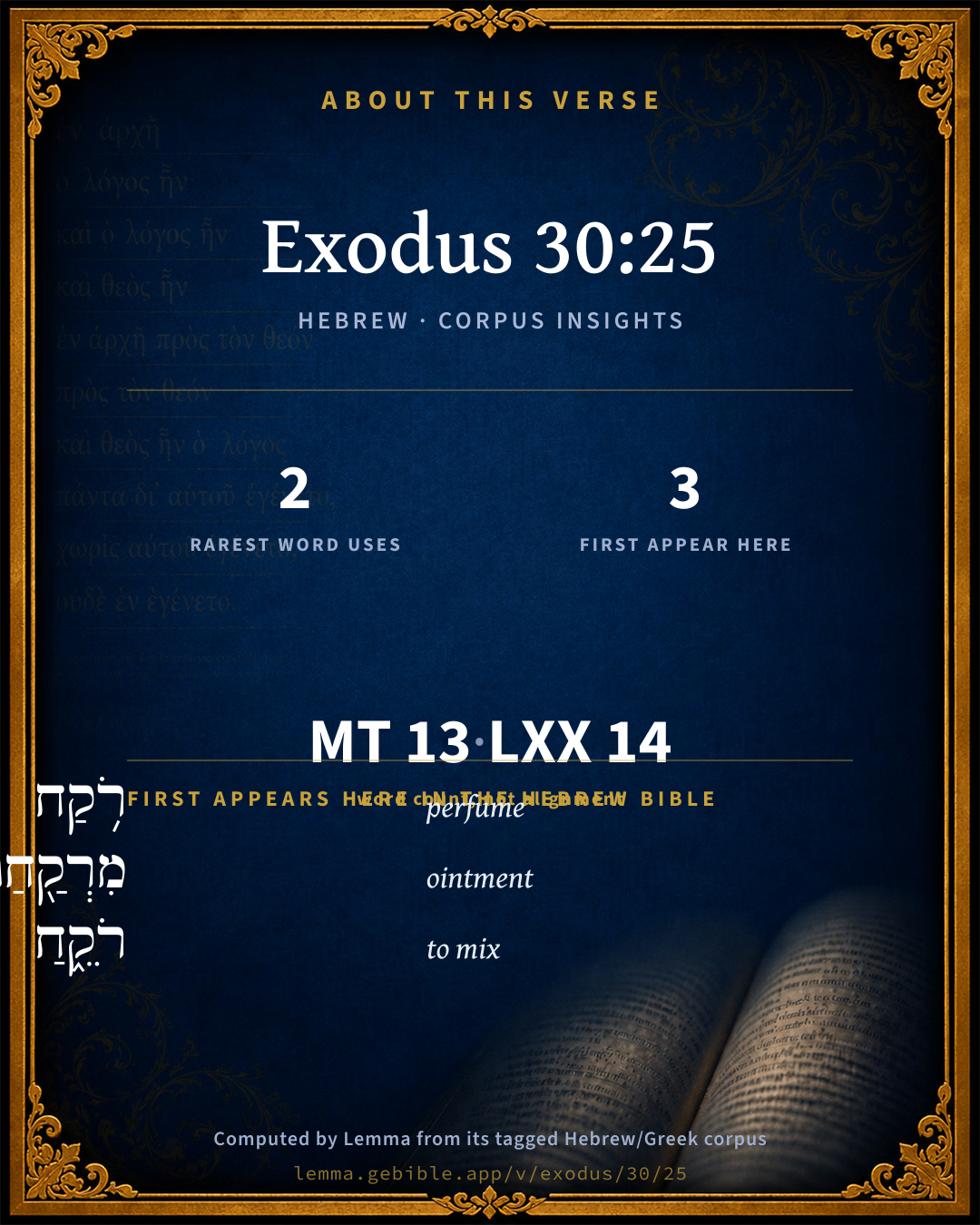
  • 3 first appearances in the Hebrew Bible
Full analysis ↓
Download a study sheet

One document with this verse’s original text, its word-by-word gloss line, the meaning frame, cross-references with their text, attributed commentary, and full source and license credits — printable, and it pastes into notes with its structure intact.

This verse Autodidact and up

Study sheet (.html) Plain text (.txt)

A passage Seminary Student

Up to 50 verses in one chapter. A passage sheet keeps up to 6 commentary sources and 12 cross-references per verse, in the order this page ranks them, and says so on the sheet whenever that leaves anything out. Ask for a single verse and you get the Autodidact verse sheet above.

Everything on this page stays free to read, with no account — the sheet is a download of what is already on screen, not access to it.

Want to remove ads? Support Godless Engineer
Compare translations 3

The same verse in 3 English versions, stacked beneath the original-language interlinear above. Click any original word for its lexicon entry.

Each is an independent rendering of the whole verse — the interlinear is not word-aligned to these translations.

Highlighted words mark where these versions differ — a whole-verse word diff, not a word-by-word alignment.

  • World English Bible Public Domain
    You shall make it a holy anointing oil, a perfume compounded after the art of the perfumer: it shall be a holy anointing oil.
  • King James Version Public Domain
    And thou shalt make it an oil of holy ointment, an ointment compound after the art of the apothecary: it shall be an holy anointing oil.
  • unfoldingWord Literal Text CC BY-SA 4.0
    And you shall make it an oil of anointment of holiness, an ointment from an ointment mixture, the work of an ointment mixer. It shall be an oil of anointment of holiness.

unfoldingWord Literal Text — © unfoldingWord, licensed CC BY-SA 4.0. Word-aligned USFM3 via Door43 (git.door43.org/unfoldingWord/en_ult).

Versions to compare (up to 4)

3 of 4 selected

Show all 18 translations

Every available English version of this verse, each an independent rendering of the whole verse.

  • World English Bible Public Domain
    You shall make it a holy anointing oil, a perfume compounded after the art of the perfumer: it shall be a holy anointing oil.
  • Berean Standard Bible Public Domain
    Prepare from these a sacred anointing oil, a fragrant blend, the work of a perfumer; it will be a sacred anointing oil.
  • Majority Standard Bible Public Domain
    Prepare from these a sacred anointing oil, a fragrant blend, the work of a perfumer; it will be a sacred anointing oil.
  • King James Version Public Domain
    And thou shalt make it an oil of holy ointment, an ointment compound after the art of the apothecary: it shall be an holy anointing oil.
  • American Standard Version (1901) Public Domain
    And thou shalt make it a holy anointing oil, a perfume compounded after the art of the perfumer: it shall be a holy anointing oil.
  • Revised Version (1885) Public Domain
    and thou shalt make it an holy anointing oil, a perfume compounded after the art of the perfumer: it shall be an holy anointing oil.
  • Geneva Bible (1599) Public Domain
    So thou shalt make of it the oyle of holie oyntment, euen a most precious oyntment after the arte of the Apothecarie: this shalbe the oyle of holy oyntment.
  • Douay-Rheims (1899) Public Domain
    And thou shalt make the holy oil of unction, an ointment compounded after the art of the perfumer,
  • Young's Literal Translation Public Domain
    and thou hast made it a holy anointing oil, a compound mixture, work of a compounder; it is a holy anointing oil.
  • Literal Standard Version CC BY-SA 4.0
    and you have made it a holy anointing oil, a compound mixture, work of a compounder; it is a holy anointing oil.
  • Unlocked Literal Bible CC BY-SA 4.0
    You must make holy anointing oil with these ingredients, the work of a perfumer. It will be a holy anointing oil, reserved for me.
  • unfoldingWord Literal Text CC BY-SA 4.0
    And you shall make it an oil of anointment of holiness, an ointment from an ointment mixture, the work of an ointment mixer. It shall be an oil of anointment of holiness.
  • Darby Bible Public Domain
    and make of it an oil of holy ointment, a perfume of perfumery after the work of the perfumer: it shall be the holy anointing oil.
  • World Messianic Bible Public Domain
    You shall make it into a holy anointing oil, a perfume compounded after the art of the perfumer: it shall be a holy anointing oil.
  • Webster's Bible Public Domain
    And thou shalt make it an oil of holy ointment, an ointment compound after the art of the apothecary: it shall be a holy anointing oil.
  • Free Bible Version CC BY-SA 4.0
    Mix these together into holy anointing oil, an aromatic blend like the product of an expert perfumer. Use it as holy anointing oil.
  • Bible in Basic English Public Domain
    And make these into a holy oil, a perfume made by the art of the perfume-maker; it is to be a holy oil.
  • JPS Tanakh (1917) Public Domain
    And thou shalt make it a holy anointing oil, a perfume compounded after the art of the perfumer; it shall be a holy anointing oil.

Literal Standard Version (2020), Covenant Press — licensed CC BY-SA 4.0. Text via the HelloAO Bible API (eBible.org). Unlocked Literal Bible (unfoldingWord) — licensed CC BY-SA 4.0. Text via the HelloAO Bible API (eBible.org). unfoldingWord Literal Text — © unfoldingWord, licensed CC BY-SA 4.0. Word-aligned USFM3 via Door43 (git.door43.org/unfoldingWord/en_ult). Free Bible Version, Dr. Jonathan Gallagher — licensed CC BY-SA 4.0. Text via the HelloAO Bible API (eBible.org).

Word by word

More ways to search: Search by grammar → Find every occurrence → Compare this word →

Practice this passage: Drill this verse → Learn its vocabulary →

רֹ֥קַח
rôqach
H7545
“perfume of”
Noun, Common, Masculine, Singular, Construct
Part of Speech
Noun
Type
Common
Gender
Masculine
Number
Singular
State
Construct
Full BDB Definition

Origin: from H7542

TWOT: 2215b

spice-mixture, perfume, ointment
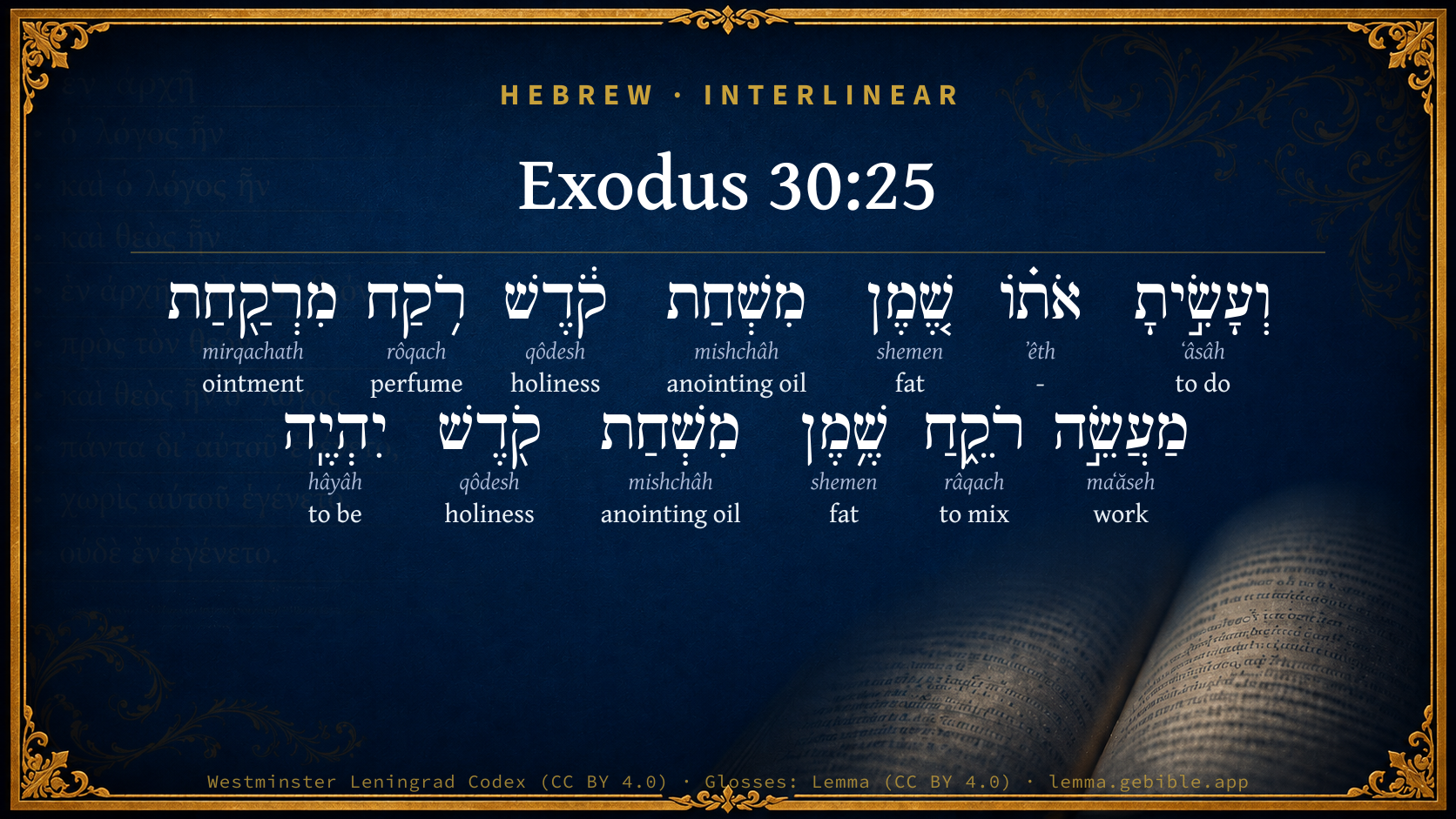
  1. וְעָשִׂ֣יתָ ʻâsâh H6213 “and · to do” Conjunction + Verb, Qal, Sequential Perfect, 2nd Person, Masculine, Singular
  2. אֹת֗וֹ ʼêth H853 “- · him” Particle, Direct Object + Suffix, Personal, 3rd Person, Masculine, Singular
  3. שֶׁ֚מֶן shemen H8081 “fat of” Noun, Common, Masculine, Singular, Construct
  4. מִשְׁחַת mishchâh H4888 “anointing oil of” Noun, Common, Feminine, Singular, Construct
  5. קֹ֔דֶשׁ qôdesh H6944 “holiness” Noun, Common, Masculine, Singular, Absolute
  6. מִרְקַ֖חַת mirqachath H4842 “ointment” Noun, Common, Feminine, Singular, Absolute
  7. מַעֲשֵׂ֣ה maʻăseh H4639 “work of” Noun, Common, Masculine, Singular, Construct
  8. רֹקֵ֑חַ râqach H7543 “mixing” Verb, Qal, Participle Active, Masculine, Singular, Absolute
  9. שֶׁ֥מֶן shemen H8081 “fat of” Noun, Common, Masculine, Singular, Construct
  10. מִשְׁחַת mishchâh H4888 “anointing oil of” Noun, Common, Feminine, Singular, Construct
  11. קֹ֖דֶשׁ qôdesh H6944 “holiness” Noun, Common, Masculine, Singular, Absolute
  12. יִהְיֶֽה hâyâh H1961 “to be” Verb, Qal, Imperfect, 3rd Person, Masculine, Singular

About this verse

These counts appear in no published source. They are computed here, from the morphology-tagged text and Lemma’s own curated glosses. What Lemma adds →

13
words
10
distinct lemmas
Pentateuch
section

Notable vocabulary

The rarest word here is רֹ֥קַח perfume H7545 — appearing just 2 times in the whole Hebrew Bible.

First appearance in Scripture

These words make their first canonical appearance in the Hebrew Bible here:

  • רֹ֥קַח perfume H7545
  • מִרְקַ֖חַת ointment H4842
  • רֹקֵ֑חַ to mix H7543

Shared distinctive vocabulary

רֹ֥קַח perfume H7545 occurs in 2 verses of the Hebrew Bible. Also found in:

Grammatical profile

  • 3 verbs
  • 9 nouns
  • 1 particle

Verb forms

  • וְעָשִׂ֣יתָ Qal · Sequential Perfect
  • רֹקֵ֑חַ Qal · Participle Active
  • יִהְיֶֽה Qal · Imperfect

Repetition

Words recur within this verse — often emphatic in Hebrew:

  • שֶׁ֚מֶן fat H8081 ×2
  • מִשְׁחַת anointing oil H4888 ×2
  • קֹ֔דֶשׁ holiness H6944 ×2

Hebrew & Septuagint length

In English translation the verse runs 24 words from the Hebrew and 26 from the Septuagint (LXX English) — closely comparable.

A rough comparison of the two English renderings, which tokenize alike — not a word-level alignment.

Word counts can differ between the Hebrew and the Greek without any difference in meaning — e.g. the Hebrew direct-object marker אֵת has no separate Greek word, and Greek often adds the article ὁ.

In the original languages it is 13 Hebrew tokens and 14 Greek tokens — but the two are counted differently (Hebrew bundles its prefixes and suffixes into one token; the Greek is in lemma form), so that isn’t a like-for-like length.

Cross-references

7

Topical passages linked to Exodus 30:25 in the Treasury of Scripture Knowledge — connected by theme and wording, ordered by reader-vote popularity; previews shown in the World English Bible.

  • Exodus 37:29 He made the holy anointing oil and the pure incense of sweet spices, after the art of the perfumer.
  • Exodus 40:9 You shall take the anointing oil, and anoint the tent, and all that is in it, and shall make it holy, and all its furniture: and it will be holy.
  • 1 Chronicles 9:30 Some of the sons of the priests prepared the confection of the spices.
  • Psalms 89:20 I have found David, my servant. I have anointed him with my holy oil,
  • Psalms 133:2 It is like the precious oil on the head, That ran down on the beard, Even Aaron's beard; That came down on the edge of his robes;
  • Numbers 35:25 and the congregation shall deliver the manslayer out of the hand of the avenger of blood, and the congregation shall restore him to his city of refuge, where he was fled: and he shall dwell therein until the death of the high priest, who was anointed with the holy oil.
  • Hebrews 1:9 You have loved righteousness, and hated iniquity; Therefore God, your God, has anointed you with the oil of gladness above your fellows."

Cross-references courtesy of OpenBible.info (CC BY 4.0).

Hebrew and Greek witnesses Masoretic Hebrew ↔ Greek Septuagint

The same verse in the two great witnesses to the Old Testament, shown verse-for-verse.

These are two independent witnesses, not word-aligned to each other, and the Septuagint is shown in lemma (dictionary) form.

Hebrew Exodus 30:25 Masoretic · Westminster Leningrad Codex

וְעָשִׂ֣יתָ אֹת֗וֹ שֶׁ֚מֶן מִשְׁחַת קֹ֔דֶשׁ רֹ֥קַח מִרְקַ֖חַת מַעֲשֵׂ֣ה רֹקֵ֑חַ שֶׁ֥מֶן מִשְׁחַת קֹ֖דֶשׁ יִהְיֶֽה

You shall make it a holy anointing oil, a perfume compounded after the art of the perfumer: it shall be a holy anointing oil.

World English Bible · Public Domain

Greek LXX Exodus 30:25 Septuagint · lemma form

καί ποιέω αὐτός ἔλαιον χρίσμα ἅγιος μύρον μυρεψικός τέχνη μυρεψός ἔλαιον χρίσμα ἅγιος εἰμί

And you shall make it a holy anointing oil, a perfumed ointment tempered by the art of the perfumer: it shall be a holy anointing oil.

LXX2012 (modern English Septuagint) · Public Domain

Hebrew: Westminster Leningrad Codex (CC BY 4.0). Greek: Septuagint (public domain); English from LXX2012 (modern English Septuagint) (Public Domain). How the Septuagint differs from the Hebrew →

Targum (Aramaic paraphrase)

2

The Targum is the ancient Jewish Aramaic paraphrase of the Hebrew Scriptures — an interpretive translation, not the Hebrew text itself. Onkelos (literal) and Pseudo-Jonathan (expansive) render the Torah, and Jonathan the Prophets. Coverage is partial: where no permissively-licensed English translation exists for a verse, only the Aramaic is shown. This is verse-level text, not a word-by-word alignment to the Hebrew.

  1. Targum Onkelos Torah (Genesis–Deuteronomy)
    וְתַעְבֵּד יָתֵהּ מְשַׁח רְבוּת קוּדְשָׁא בּוֹסֶם מְבַסָם עוֹבַד בּוּסְמָנוּ מְשַׁח רְבוּת קוּדְשָׁא יְהֵא:

    (no public-domain English translation for this verse)

    Targum Onkelos — Aramaic: “Onkelos Genesis” (public domain); “Onkelos Exodus” (public domain); “Onkelos Leviticus” (public domain); “Onkelos Numbers” (public domain); “Onkelos Deuteronomy” (public domain). English: “Sefaria Community Translation” (CC0 1.0 (public-domain dedication)); “J.W. Etheridge. The Targums of Onkelos and Jonathan Ben Uzziel on the Pentateuch. London: Longmans, Green, 1862” (public domain). Text via Sefaria.

  2. Targum Pseudo-Jonathan Torah (Genesis–Deuteronomy)
    וְתַעֲבֵיד יָתֵיהּ מְשַׁח רְבוּת קוּדְשָׁא בּוֹשֶם מִתְבַּשַם עוֹבַד מִתְבַּשֵם בִּישְמָא מַמְזִיג מְשַׁח רְבוּת קוּדְשָׁא יְהֵי

    And thou shalt make of it a holy anointing oil, perfumed with perfume, the work of the perfumer, of compounded perfumes: a holy anointing oil shall it be.

    Targum Pseudo-Jonathan — Aramaic: “Targum Jonathan on Genesis” (public domain); “Targum Jonathan on Exodus” (public domain); “Targum Jonathan on Leviticus” (public domain); “Targum Jonathan on Numbers” (public domain); “Targum Jonathan on Deuteronomy” (public domain). English: “The Targum of Jonathan ben Uzziel, trans. J. W. Etheridge, London, 1862” (public domain). Text via Sefaria.

Commentary

Notes on Exodus 30:25 from classic Christian and Jewish commentators (each source and its license shown beneath its notes). The classic Christian expositions comment on the surrounding passage and are grouped to its opening verse, so a note may address several verses; the Jewish commentaries on the Tanakh (Rashi and others) are per-verse, so they appear only where the commentator wrote on this verse.

Lemma curates 59 commentaries, every one of them public domain or Creative Commons licensed, each selected and text-cleaned for this edition rather than reprinted as found. About our sources →

Adam Clarke's Commentary

Verse 25. After the art of the apothecary] The original, רקח rokeach, signifies a compounder or confectioner; any person who compounds drugs, aromatics, &c.

Adam Clarke's Commentary on the Bible (1810–1826) — public domain. Text from a community e-Sword/MySword module.

Ellicott's Commentary for English Readers

(25) After the art of the apothecary.—Skill was to be called in. The spices were not to be pounded and mixed with the oil in a rude and unscientific way, but the best art of the time was to be employed in effecting the composition. Jewish tradition says that its essence was first extracted from each of the spices, and then the oil mingled with the essences.

A Bible Commentary for English Readers, edited by Charles John Ellicott (1878–1897) — public domain. Text from a community e-Sword module.

The Cambridge Bible for Schools and Colleges

gen. ed. J. J. S. Perowne

25. it] i.e. the olive oil of v. 24, by mixing it viz. with the other ingredients specified. ‘According to the Rabbis, the essences of the different spices were first extracted, and then mixed with the oil’ (Kn.).

a perfume, &c.] lit. a perfume of perfumery, the work of the perfumer (like the ‘work of the weaver,’ &c., see on Exo_26:1 : so v. 35, Exo_37:29). 1Ch_9:30 (render ‘compounding the perfume of the spices’) shews that in the age of the Chronicler (c. 300 b.c.) the anointing oil was made by the ‘sons of the priests.’ For other allusions to perfumers or perfumery, see 1Sa_8:13 (RVm.), Isa_57:9, Neh_3:8 (RVm.), Son_5:13 (RVm.).

26–28 (cf. Lev_8:10 b–11). The Tent of meeting, the ark and other articles belonging to it, with their various vessels, to be all anointed with the aromatic oil thus produced. The command is repeated in Exo_40:9-11 : cf. also Lev_8:10 b–11, Num_7:1, and (specially of the altar) Exo_29:36, Num_7:10; Num_7:84; Num_7:88.

The Cambridge Bible for Schools and Colleges (gen. ed. J. J. S. Perowne; Cambridge University Press, 1878–1918) — public domain. Text from a community e-Sword module.

John Gill's Exposition

And thou shalt make it an oil of holy ointment,.... All the above spices and oil being put together, an ointment was to be made out of them, not thick, as ointments usually are, but a liquid to be poured, and therefore called an "oil of ointment", and "holy", because devoted only to sacred uses:

an ointment compound after the art of the apothecary: or confectioner; the spices bruised, and pounded, and mixed together, and boiled or distilled, and so an oil or ointment extracted from them:

it shall be an holy anointing oil; for the uses next mentioned: it signified the Holy Spirit of God, and his graces, that oil of gladness with which Christ and his people are anointed; and is that anointing which teacheth all things, see Psa 45:7 Jo1 2:20 comparable to these several spices, and oil olive, for their sweet smell, cheering and reviving nature, and supplying quality, and for their valuableness and preciousness, and of which there was a certain weight and measure; for though Christ received this unction without measure, yet there is a certain measure of grace and gifts bestowed upon his people, and by which they are made holy and fit for their master's use.

John Gill's Exposition of the Whole Bible (1746–1763) — public domain (CC PDM 1.0). Text via the HelloAO Bible API.

Whedon's Commentary on the Bible

Daniel D. Whedon

25. Compound after the art of the apothecary — In the times after the exile some of the priest’s sons were intrusted with the preparation of the ointment of spices. 1Ch_9:30. As it was made the special care of the high priest to guard it, (Num_4:16,) we may naturally suppose that he was charged with the duty of either compounding it himself or employing some competent person to assist him. The original preparation of it would seem, from Exo_37:29, to have been intrusted to Bezaleel, the architect. Being of a special character, and known as an oil of holy ointment, or a holy anointing oil, it might not be used for ordinary purposes, such as anointing one’s flesh, (Exo_30:32,) or using it on a foreigner, (Exo_30:33,) and any attempt to make any other oil like it was strictly forbidden. The ceremony of anointing with oil denoted the setting apart and consecrating to a holy purpose, and accordingly this holy ointment was to be used solely for such consecration of the priests and the tabernacle and its sacred vessels. Exo_30:26-30.

Daniel D. Whedon (gen. ed.), Commentary on the Old and New Testaments (1874–1909) — public domain. Text from a community e-Sword module.

The Pulpit Commentary

An oil of holy ointment. Literally, "an oil of holy anointing," or "a holy anointing oil," as our translators render in ver. 31, and also in the last clause of the present verse. An ointment compound after the art of the apothecary. Not a simple mixture of the ingredients mentioned, but the product of trained skill and knowledge applied to the materials. Jewish tradition says that the essence of each spice was extracted from it, and only these essences mingled with the olive oil. We are told later (Exo_37:29) that the task of preparing the holy oil was committed to Bezaleel.

The Pulpit Commentary (1880–1919), ed. H.D.M. Spence-Jones & Joseph S. Exell — public domain. Text from a community e-Sword module.

Rashi

Rabbi Shlomo Yitzchaki (Rashi)

רקח מרקחת A COMPOUND COMPOUNDED — רקח is a noun and its accent proves it, for it is on the first syllable, on the ר, so that it is a noun just as are רֶקַח in (Song 8:2) “I would cause thee to drink of the mixed wine (מיין הרקח)” and רֶגַע in (Exodus 33:5) “one moment (רֶגַע אחד)”, and it is not a participle like (Isaiah 51:15) “[I am the Lord] who stireth up (רוֹגַע) the sea”, or (Isaiah 42:5) “Who spreadeth forth (רֹקַע) the earth”, where the accent is on the last syllable. Any thing (ingredient) which is mixed with another so thoroughly that one becomes impregnated with the other as regards the smell or the taste is called a מרקחת.

Thus רקח מרקחת (lit., a mixing of a mixture) means a compounding effected by skilled art and perfect mixing.

מעשה רקח THE WORK OF A COMPOUNDER — רֹקֵחַ is the name given to a workman skilled in this matter.

Rashi on the Tanakh — English translations: “The Judaica Press complete Tanach with Rashi, translated by A. J. Rosenberg” (CC BY 4.0); “Pentateuch with Rashi's commentary by M. Rosenbaum and A.M. Silbermann, 1929-1934” (public domain); “The Metsudah Tanach series, Lakewood, N.J” (CC BY 4.0); and “The Book of Joshua, Metsudah Publications, 1997” (CC BY 4.0). Text via Sefaria.

Ramban (Nachmanides)

Rabbi Moshe ben Nachman (Ramban / Nachmanides)

AND THOU SHALT MAKE IT A HOLY ANOINTING OIL, A PERFUME COMPOUNDED AFTER THE ART OF THE PERFUMER. In line with the simple meaning of Scripture, the preparation of the Oil of Anointment was in accordance with the view of Rabbi Yehudah, who said that they first soaked the spices in water in order that they would not absorb the oil which was poured upon them Now this soaking [of which Rabbi Yehuda speaks] was not mere soaking in water alone. Rather, they put ground spices in a vessel full of water and then they poured upon them a hin of olive oil. Then they placed this vessel upon another vessel full of water, and put it over a low flame with embers, and boiled it until the water [in the upper vessel] evaporated, and they retained the oil which was upon it. Such indeed is the way that perfumers make all aromatic oils. This is why Scripture shortened the explanation and commanded merely that they make this oil a perfume compounded after the art of the perfumer, without explaining the process by which it is to be made, for the way of the perfumers was known among them. And so I found in Tractate Shekalim of the Yerushalmi: “Rabbi Yehudah says: They boiled [the spices] in water and put the oil on top of it; as soon as [the oil] retained the odor [of the spices] they would take off the oil, just as druggists do, for it is said, And thou shalt make it a holy anointing oil, a perfume compounded after the art of the perfumer.”

Ramban (Nachmanides) on the Tanakh — English translation: “Commentary on the Torah by Ramban (Nachmanides). Translated and annotated by Charles B. Chavel. New York, Shilo Pub. House, 1971-1976” (CC BY 4.0). Text via Sefaria.

Lesson kit

Teaching starters — assembled from the data on this page, not authored interpretation. Every prompt links to the verse data it draws on. Edit before teaching.

Exodus, in the Pentateuch, opens this verse with 13 words (10 distinct Hebrew lemmas). Its most distinctive word is rôqach (“perfume”). A historical commentator’s framing appears above. Read the whole chapter for the surrounding context.

Discussion questions

  1. The word rôqach carries the sense “perfume.” How does it shape the verse?
  2. 3 words here appear for the first time in Scripture. What is being introduced at this debut?
  3. Exodus 30:35 shares the word «perfume» with this verse. How do the two illuminate each other?
  4. “fat” occurs 2× in this one verse. What is the effect of the repetition?
  5. These translations render this verse differently; the difference is in the English rendering, not the original. What questions does that raise?
  6. The verb «וְעָשִׂ֣יתָ» is Qal Sequential Perfect. How does its form color the action?
  7. Reading how Adam Clarke's Commentary and Ellicott's Commentary for English Readers read this verse, where do the two commentators agree and where do they part?

Things to notice

Reading settings

Reading text

Shown beneath each verse's original-language words.

Old Testament
Old Testament edition

Read the OT as the Masoretic Hebrew (MT) or the Greek Septuagint (LXX).

English shown for the Greek Septuagint (in the Hebrew ↔ Greek comparison).

Comparing translations? Open the Compare panel on any verse page to stack up to four side by side.