
Exodus 28:2

Hebrew (Westminster Leningrad Codex) Exodus 28:2 appears in the Hebrew Old Testament. The text above is from the Westminster Leningrad Codex. Each word links to its Strong’s number, a concise gloss, and parsing drawn from the Open Scriptures Hebrew Bible morphology. Click any word for its full Brown-Driver-Briggs (BDB) entry.
Download image
Cite this verse

Exodus 28:2 (World English Bible). Public Domain. Lemma interlinear Bible study tool, https://lemma.gebible.app/v/exodus/28/2.

Show BibTeX & RIS
BibTeX
RIS
English Translation
You shall make holy garments for Aaron your brother, for glory and for beauty.
World English Bible · Public Domain
Highlights
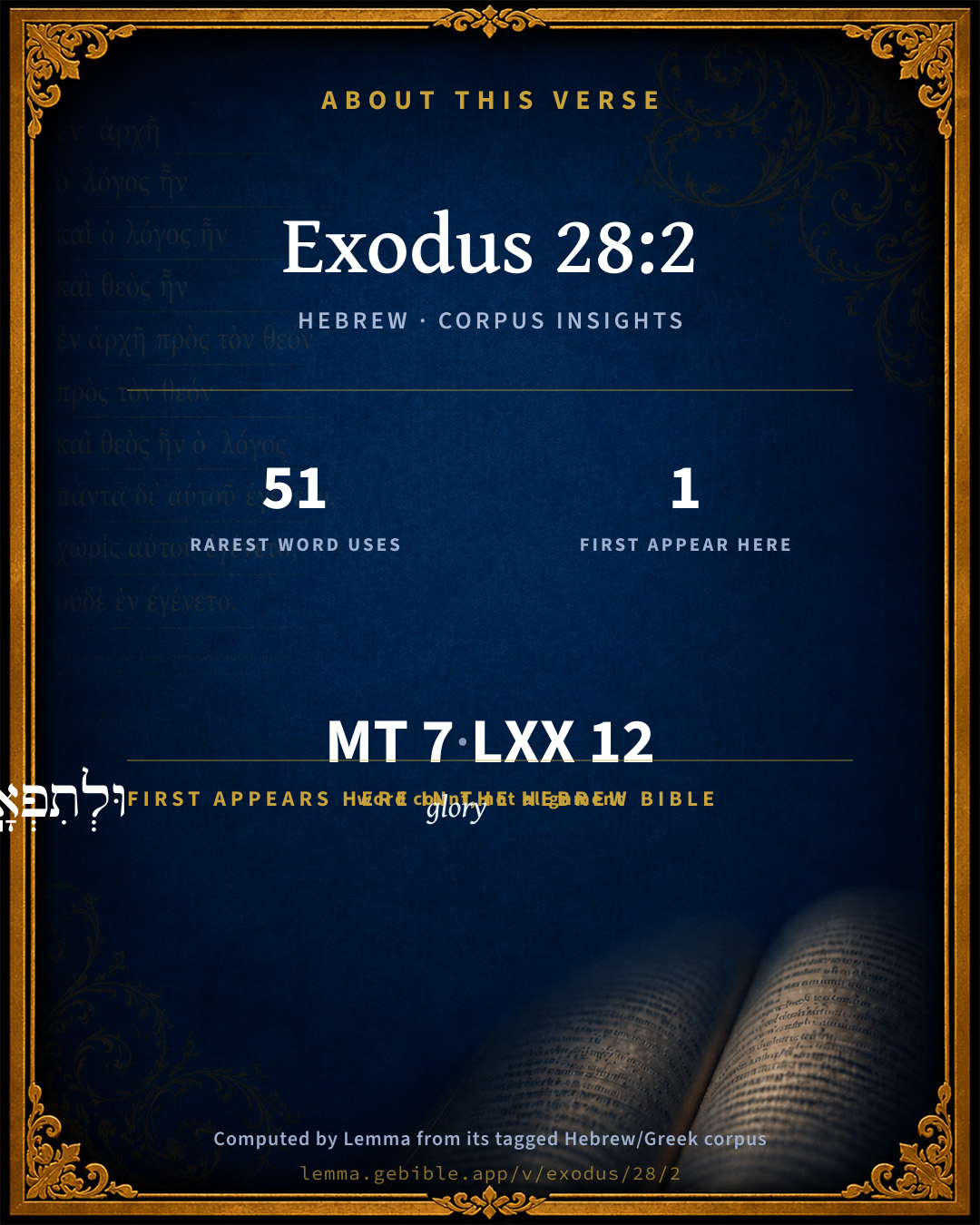
  • 1 first appearance in the Hebrew Bible
Full analysis ↓
Download a study sheet

One document with this verse’s original text, its word-by-word gloss line, the meaning frame, cross-references with their text, attributed commentary, and full source and license credits — printable, and it pastes into notes with its structure intact.

This verse Autodidact and up

Study sheet (.html) Plain text (.txt)

A passage Seminary Student

Up to 50 verses in one chapter. A passage sheet keeps up to 6 commentary sources and 12 cross-references per verse, in the order this page ranks them, and says so on the sheet whenever that leaves anything out. Ask for a single verse and you get the Autodidact verse sheet above.

Everything on this page stays free to read, with no account — the sheet is a download of what is already on screen, not access to it.

Want to remove ads? Support Godless Engineer
Compare translations 3

The same verse in 3 English versions, stacked beneath the original-language interlinear above. Click any original word for its lexicon entry.

Each is an independent rendering of the whole verse — the interlinear is not word-aligned to these translations.

Highlighted words mark where these versions differ — a whole-verse word diff, not a word-by-word alignment.

  • World English Bible Public Domain
    You shall make holy garments for Aaron your brother, for glory and for beauty.
  • King James Version Public Domain
    And thou shalt make holy garments for Aaron thy brother for glory and for beauty.
  • unfoldingWord Literal Text CC BY-SA 4.0
    And you shall make for Aaron your brother clothes of holiness for glory and for splendor.

unfoldingWord Literal Text — © unfoldingWord, licensed CC BY-SA 4.0. Word-aligned USFM3 via Door43 (git.door43.org/unfoldingWord/en_ult).

Versions to compare (up to 4)

3 of 4 selected

Show all 18 translations

Every available English version of this verse, each an independent rendering of the whole verse.

  • World English Bible Public Domain
    You shall make holy garments for Aaron your brother, for glory and for beauty.
  • Berean Standard Bible Public Domain
    Make holy garments for your brother Aaron, to give him glory and splendor.
  • Majority Standard Bible Public Domain
    Make holy garments for your brother Aaron, to give him glory and splendor.
  • King James Version Public Domain
    And thou shalt make holy garments for Aaron thy brother for glory and for beauty.
  • American Standard Version (1901) Public Domain
    And thou shalt make holy garments for Aaron thy brother, for glory and for beauty.
  • Revised Version (1885) Public Domain
    And thou shalt make holy garments for Aaron thy brother, for glory and for beauty.
  • Geneva Bible (1599) Public Domain
    Also thou shalt make holy garments for Aaron thy brother, glorious and beautifull.
  • Douay-Rheims (1899) Public Domain
    And thou shalt make a holy vesture for Aaron thy brother for glory and for beauty.
  • Young's Literal Translation Public Domain
    and thou hast made holy garments for Aaron thy brother, for honour and for beauty;
  • Literal Standard Version CC BY-SA 4.0
    and you have made holy garments for your brother Aaron, for glory and for beauty;
  • Unlocked Literal Bible CC BY-SA 4.0
    You must make for Aaron, your brother, garments that are set apart to me. These garments will be for his honor and splendor.
  • unfoldingWord Literal Text CC BY-SA 4.0
    And you shall make for Aaron your brother clothes of holiness for glory and for splendor.
  • Darby Bible Public Domain
    And thou shalt make holy garments for Aaron thy brother, for glory and for ornament.
  • World Messianic Bible Public Domain
    You shall make holy garments for Aaron your brother, for glory and for beauty.
  • Webster's Bible Public Domain
    And thou shalt make holy garments for Aaron thy brother, for glory and for beauty.
  • Free Bible Version CC BY-SA 4.0
    You are to have holy clothing made for your brother Aaron to make him look splendid and dignified.
  • Bible in Basic English Public Domain
    And make holy robes for Aaron your brother, so that he may be clothed with glory and honour.
  • JPS Tanakh (1917) Public Domain
    And thou shalt make holy garments for Aaron thy brother, for splendour and for beauty.

Literal Standard Version (2020), Covenant Press — licensed CC BY-SA 4.0. Text via the HelloAO Bible API (eBible.org). Unlocked Literal Bible (unfoldingWord) — licensed CC BY-SA 4.0. Text via the HelloAO Bible API (eBible.org). unfoldingWord Literal Text — © unfoldingWord, licensed CC BY-SA 4.0. Word-aligned USFM3 via Door43 (git.door43.org/unfoldingWord/en_ult). Free Bible Version, Dr. Jonathan Gallagher — licensed CC BY-SA 4.0. Text via the HelloAO Bible API (eBible.org).

Word by word

More ways to search: Search by grammar → Find every occurrence → Compare this word →

Practice this passage: Drill this verse → Learn its vocabulary →

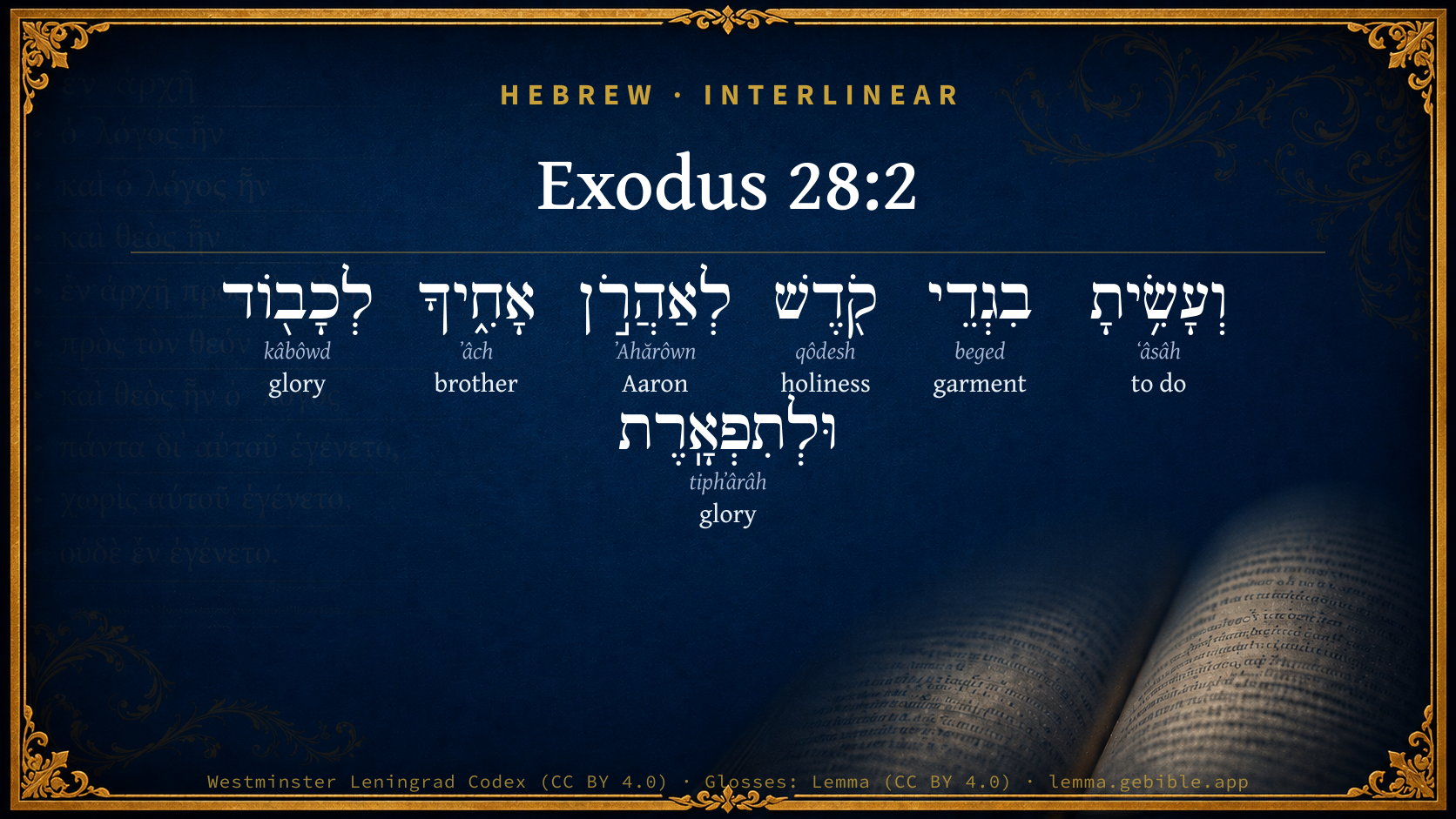
וּלְתִפְאָֽרֶת
tiphʼârâh
H8597
“and · to/for · glory”
Conjunction + Preposition + Noun, Common, Feminine, Singular, Absolute
Part of Speech
Conjunction + Preposition + Noun
Type
Common
Gender
Feminine
Number
Singular
State
Absolute
Full BDB Definition

Origin: from H6286

TWOT: 1726b

beauty, splendour, glory - beauty, finery (of garments, jewels) - glory - of rank, renown - as attribute of God - honour (or nation Israel) - glorying, boasting (of individual)
  1. וְעָשִׂ֥יתָ ʻâsâh H6213 “and · to do” Conjunction + Verb, Qal, Sequential Perfect, 2nd Person, Masculine, Singular
  2. בִגְדֵי beged H899 “garments of” Noun, Common, Masculine, Plural, Construct
  3. קֹ֖דֶשׁ qôdesh H6944 “holiness” Noun, Common, Masculine, Singular, Absolute
  4. לְאַהֲרֹ֣ן ʼAhărôwn H175 “to/for · Aaron” Preposition + Noun, Proper
  5. אָחִ֑יךָ ʼâch H251 “brother · your” Noun, Common, Masculine, Singular, Construct + Suffix, Personal, 2nd Person, Masculine, Singular
  6. לְכָב֖וֹד kâbôwd H3519 “to/for · glory” Preposition + Noun, Common, Both, Singular, Absolute

About this verse

These counts appear in no published source. They are computed here, from the morphology-tagged text and Lemma’s own curated glosses. What Lemma adds →

7
words
7
distinct lemmas
Pentateuch
section

First appearance in Scripture

This word makes its first canonical appearance in the Hebrew Bible here:

  • וּלְתִפְאָֽרֶת glory H8597

Shared distinctive vocabulary

וּלְתִפְאָֽרֶת glory H8597 occurs in 50 verses of the Hebrew Bible. Also found in:

Grammatical profile

  • 1 verb
  • 6 nouns

Verb forms

  • וְעָשִׂ֥יתָ Qal · Sequential Perfect

Hebrew & Septuagint length

In English translation the verse runs 14 words from the Hebrew and 14 from the Septuagint (LXX English) — the same length.

A rough comparison of the two English renderings, which tokenize alike — not a word-level alignment.

Word counts can differ between the Hebrew and the Greek without any difference in meaning — e.g. the Hebrew direct-object marker אֵת has no separate Greek word, and Greek often adds the article ὁ.

In the original languages it is 7 Hebrew tokens and 12 Greek tokens — but the two are counted differently (Hebrew bundles its prefixes and suffixes into one token; the Greek is in lemma form), so that isn’t a like-for-like length.

Cross-references

34

Topical passages linked to Exodus 28:2 in the Treasury of Scripture Knowledge — connected by theme and wording, ordered by reader-vote popularity; previews shown in the World English Bible.

  • Exodus 31:10 the finely worked garments--the holy garments for Aaron the priest--the garments of his sons to minister in the priest's office,
  • Leviticus 8:30 Moses took some of the anointing oil, and some of the blood which was on the altar, and sprinkled it on Aaron, on his garments, and on his sons, and on his sons' garments with him, and sanctified Aaron, his garments, and his sons, and his sons' garments with him.
  • Revelation 19:8 It was given to her that she would array herself in bright, pure, fine linen: for the fine linen is the righteous acts of the saints.
  • Job 40:10 "Now deck yourself with excellency and dignity. Array yourself with honor and majesty.
  • Hebrews 7:26 For such a high priest was fitting for us: holy, guiltless, undefiled, separated from sinners, and made higher than the heavens;
  • Exodus 39:1–2 Of the blue, purple, and scarlet, they made finely worked garments, for ministering in the holy place, and made the holy garments for Aaron; as Yahweh commanded Moses.
  • Leviticus 8:7–9 He put the coat on him, tied the sash on him, clothed him with the robe, put the ephod on him, and he tied the skillfully woven band of the ephod on him, and fastened it to him with it.
  • Revelation 5:10 And made them kings and priests to our God, And they reign on earth."
  • Exodus 28:40 "You shall make coats for Aaron's sons, and you shall make sashes for them and headbands shall you make for them, for glory and for beauty.
  • Psalms 90:16–17 Let your work appear to your servants; Your glory to their children.
  • Psalms 132:9 Let your priest be clothed with righteousness. Let your saints shout for joy!"
  • Psalms 132:16 Her priests I will also clothe with salvation. Her saints will shout aloud for joy.
  • Isaiah 61:3 to appoint to those who mourn in Zion, to give to them a garland for ashes, the oil of joy for mourning, the garment of praise for the spirit of heaviness; that they may be called trees of righteousness, the planting of Yahweh, that he may be glorified.
  • Isaiah 61:10 I will greatly rejoice in Yahweh, my soul shall be joyful in my God; for he has clothed me with the garments of salvation, he has covered me with the robe of righteousness, as a bridegroom decks himself with a garland, and as a bride adorns herself with her jewels.
  • Exodus 29:5–9 You shall take the garments, and put on Aaron the coat, the robe of the ephod, the ephod, and the breastplate, and dress him with the skillfully woven band of the ephod;
  • Exodus 19:5–6 Now therefore, if you will indeed obey my voice, and keep my covenant, then you shall be my own possession from among all peoples; for all the earth is mine;
  • Exodus 29:29–30 "The holy garments of Aaron shall be for his sons after him, to be anointed in them, and to be consecrated in them.
  • Exodus 40:13 You shall put on Aaron the holy garments; and you shall anoint him, and sanctify him, that he may minister to me in the priest's office.
  • Numbers 20:26–28 and strip Aaron of his garments, and put them on Eleazar his son: and Aaron shall be gathered [to his people], and shall die there.
  • Numbers 27:20–21 You shall put of your honor on him, that all the congregation of the children of Israel may obey.
  • Psalms 96:6 Honor and majesty are before him. Strength and beauty are in his sanctuary.
  • Psalms 149:4 For Yahweh takes pleasure in his people. He crowns the humble with salvation.
  • Isaiah 4:2 In that day, Yahweh's branch will be beautiful and glorious, and the fruit of the land will be the beauty and glory of the survivors of Israel.
  • Isaiah 64:6 For we are all become as one who is unclean, and all our righteousness are as a polluted garment: and we all do fade as a leaf; and our iniquities, like the wind, take us away.
  • Jeremiah 9:23–24 Thus says Yahweh, Don't let the wise man glory in his wisdom, neither let the mighty man glory in his might, don't let the rich man glory in his riches;
  • Zechariah 3:3–4 Now Joshua was clothed with filthy garments, and was standing before the angel.
  • John 1:14 The Word became flesh, and lived among us. We saw his glory, such glory as of the one and only Son of the Father, full of grace and truth.
  • Romans 3:22 even the righteousness of God through faith in Jesus Christ to all and on all those who believe. For there is no distinction,
  • Romans 13:14 But put on the Lord Jesus Christ, and make no provision for the flesh, for its lusts.
  • 1 Corinthians 1:30–31 But of him, you are in Christ Jesus, who was made to us wisdom from God, and righteousness and sanctification, and redemption:
  • Galatians 3:27 For as many of you as were baptized into Christ have put on Christ.
  • Hebrews 2:9 But we see him who has been made a little lower than the angels, Jesus, because of the suffering of death crowned with glory and honor, that by the grace of God he should taste of death for everyone.
  • 2 Peter 1:17 For he received from God the Father honor and glory, when the voice came to him from the Majestic Glory, "This is my beloved Son, in whom I am well pleased."
  • 1 John 3:2 Beloved, now we are children of God, and it is not yet revealed what we will be. But we know that, when he is revealed, we will be like him; for we will see him just as he is.

Cross-references courtesy of OpenBible.info (CC BY 4.0).

Hebrew and Greek witnesses Masoretic Hebrew ↔ Greek Septuagint

The same verse in the two great witnesses to the Old Testament, shown verse-for-verse.

These are two independent witnesses, not word-aligned to each other, and the Septuagint is shown in lemma (dictionary) form.

Hebrew Exodus 28:2 Masoretic · Westminster Leningrad Codex

וְעָשִׂ֥יתָ בִגְדֵי קֹ֖דֶשׁ לְאַהֲרֹ֣ן אָחִ֑יךָ לְכָב֖וֹד וּלְתִפְאָֽרֶת

You shall make holy garments for Aaron your brother, for glory and for beauty.

World English Bible · Public Domain

Greek LXX Exodus 28:2 Septuagint · lemma form

καί ποιέω στολή ἅγιος ααρων ὁ ἀδελφός σύ εἰς τιμή καί δόξα

And you shall make holy apparel for Aaron your brother, for honor and glory.

LXX2012 (modern English Septuagint) · Public Domain

Hebrew: Westminster Leningrad Codex (CC BY 4.0). Greek: Septuagint (public domain); English from LXX2012 (modern English Septuagint) (Public Domain). How the Septuagint differs from the Hebrew →

Targum (Aramaic paraphrase)

2

The Targum is the ancient Jewish Aramaic paraphrase of the Hebrew Scriptures — an interpretive translation, not the Hebrew text itself. Onkelos (literal) and Pseudo-Jonathan (expansive) render the Torah, and Jonathan the Prophets. Coverage is partial: where no permissively-licensed English translation exists for a verse, only the Aramaic is shown. This is verse-level text, not a word-by-word alignment to the Hebrew.

  1. Targum Onkelos Torah (Genesis–Deuteronomy)
    וְתַעְבֵּד לְבוּשֵׁי קוּדְשָׁא לְאַהֲרֹן אָחוּךְ לִיקָר וּלְתֻשְׁבְּחָן:

    (no public-domain English translation for this verse)

    Targum Onkelos — Aramaic: “Onkelos Genesis” (public domain); “Onkelos Exodus” (public domain); “Onkelos Leviticus” (public domain); “Onkelos Numbers” (public domain); “Onkelos Deuteronomy” (public domain). English: “Sefaria Community Translation” (CC0 1.0 (public-domain dedication)); “J.W. Etheridge. The Targums of Onkelos and Jonathan Ben Uzziel on the Pentateuch. London: Longmans, Green, 1862” (public domain). Text via Sefaria.

  2. Targum Pseudo-Jonathan Torah (Genesis–Deuteronomy)
    וְתַעֲבֵיד לְבוּשָׁא דְקוּדְשָׁא לְאַהֲרן אָחוּךְ לִיְקַר וּלְתוּשְׁבְּחָא

    And thou shalt make garments of holiness for Aharon thy brother, for glory and for praise.

    Targum Pseudo-Jonathan — Aramaic: “Targum Jonathan on Genesis” (public domain); “Targum Jonathan on Exodus” (public domain); “Targum Jonathan on Leviticus” (public domain); “Targum Jonathan on Numbers” (public domain); “Targum Jonathan on Deuteronomy” (public domain). English: “The Targum of Jonathan ben Uzziel, trans. J. W. Etheridge, London, 1862” (public domain). Text via Sefaria.

Commentary

Notes on Exodus 28:2 from classic Christian and Jewish commentators (each source and its license shown beneath its notes). The classic Christian expositions comment on the surrounding passage and are grouped to its opening verse, so a note may address several verses; the Jewish commentaries on the Tanakh (Rashi and others) are per-verse, so they appear only where the commentator wrote on this verse.

Lemma curates 59 commentaries, every one of them public domain or Creative Commons licensed, each selected and text-cleaned for this edition rather than reprinted as found. About our sources →

Trapp's Complete Commentary

John Trapp

Exo 28:2 And thou shalt make holy garments for Aaron thy brother for glory and for beauty.

Ver. 2. For glory and for beauty.] Prodit Aaron a capite ad calcem, os humerosque Deo similis. The high priest was gloriously apparelled, to strike a religious reverence into the eyes and hearts of the beholders, and to set forth the beauty and bravery of Christ and his Church.

John Trapp, A Commentary or Exposition upon All the Books of the Old and New Testament (1647–1656) — public domain. Text from a community e-Sword module.

The Biblical Illustrator

Joseph S. Exell

Exo_28:2

Holy garments for Aaron.

The vestments of our High Priest

The vestments appointed by God for the high priest when he went into the holy place were, besides those which he wore in common with the other priests, four: the ephod, with its curious girdle; the breastplate; the robe of the ephod; and the mitre.

1. And speaking of these garments generally, you will notice that it was Gods especial command that they should all be made of linen, which, being a material of a very simple and natural kind, has always been understood by the Church to be typical of that human nature which Christ wears still in His glorified state, and in which, as man, we are distinctly to understand that He now executes, as our Representative, all the services of His exalted Priesthood.

2. And, further, it is to be observed generally, that all the garments were carefully fastened together so as to be one. The girdle binding the ephod, and the ephod the robe, and the breastplate carefully joined to the ephod by chains of gold; signifying, again, the complete unity which there is in all Christs work for His people, so that it cannot be divided; for if we have Him in one of His offices so, necessarily, we hold Him in all. A blessed truth I there is no such thing as anything partial in the work of Jesus; no partial pardon; no partial peace! If you have one promise, you have every promise!

3. And yet, once more, generally, you will see that (unlike the description of our Saviours garments in the 59th chapter of Isaiah, and unlike that which is provided for the believer in the 6th chapter of Ephesians)all these are robes, not of war, but of peace. Indicating that the warfare is now accomplished, and that our Saviour, having triumphed over His enemies and ours, is now set down in the calm and quiet of His holy, peaceful functions. A thought which should be one of unselfish joy to the Christian.

4. The robe of ephod represents the perfect robe of the obedience of the Lord Jesus Christ, which He wore as man, and which He will always present to the Father for our sakes. Its seamless fabric denotes the perfectness and the unity of the righteousness which He has wrought.

5. The ephod itself was a closer vestment--long behind, and short in front--which was worn over the robe, and fastened by clasps, or ouches, over the shoulders; it was also for beauty and for glory--of gold, of blue, and of purple, of scarlet, and fine-twined linen, with cunning work, costly and magnificent. Upon each shoulder, in the ouches, was placed an onyx stone, and on either onyx stone were engraven the names of six of the tribes of the children of Israel, placed according to their seniority. Concerning this engraving, God was very express: With the work of an engraver in stone, like the engravings of a signet, that is, very accurately, very deeply, very beautifully, shalt thou engrave the two stones with the names of the children of Israel: thou shalt make them to be set in ouches of gold. And thou shalt put the two stones upon the shoulders of the ephod for stones of memorial unto the children of Israel: and Aaron shall bear their names before the Lord upon his two shoulders for a memorial. And, then, the ephod was girt about with a girdle of the same kind. Here, then, we have our great High Priest continually standing in heaven, and always of necessity bearing, as part of His own glory, the names of all His people in holy remembrance before God. He both remembers us, and causes us to be remembered. We are held in perpetual remembrance. The weakest and the strongest--the greatest saint with the unworthiest and guiltiest sinner--we are all remembered: everything which goes to make our name is there: the smallest work, the secret sorrow that the world knows nothing of: it is all in the memorial: our prayers, and tears, and sighs--they are all gone there! they are all rivetted there! There they are! They are knit into the dignity of Jesus, into the glory and the excellency of Jesus!

6. The breastplate teaches that Christ not only bears His people on His shoulders for strength, but lays them separately on His heart for love. He identifies His interest with ours. It becomes a dear and fond thing to Him to have us upon His breast, that He may save us and magnify us for ever! We live always in His love, and God sees us there; in that love, loves us--unloveable though we be--for the love He has to us. And, living on His heart, each one in his own proper place and order, we hold in Him safe and privileged intercourse.

7. The high priest wore a mitre of linen, with this inscription, Holiness to the Lord. Now observe the comfort of this thought. Here we all are assembled, in our holy devotions before the mercy seat of God, but every prayer we have put up this day is stained, and every service is unclean before Him who chargeth His angels with folly! Presently, your petitions will go up in your own bedroom; and the very supplication, in which you ask for pardon, only goes to increase the amount of the guilt that has to be pardoned. It is all unclean! The brand of sin, the degradation of sin, is everywhere! But He, in His very character and being, as our Representative, is standing before God; and high emblazoned upon His front is His own proper righteous title, Holiness to the Lord--not for Himself, He needs it not, but for us! He bears the iniquity of our holy things--what a thought! even as if we were the holy, we poor worms--as if we were the holy--we stand before God: Holiness to the Lord. A poor sinner, incapable of one pure thought, lifts himself up in Christ, and looks in the face of God, and stands there, in his High Priest--Holiness to the Lord;--and God recognizes His own eternal counsel, and acknowledges the unworthiest services of the poorest sinner to be--Holiness to the Lord. (J. Vaughan, M. A.)

The priestly garments

They signified--

1. The function to be glorious and excellent.

2. The fitness of their persons to that office.

3. The glory of the true High Priest, Jesus Christ, of whom Aaron was but a figure.

For all the glistering show of these priestly garments set forth the more angelical brightness of all the virtues which should shine in Jesus Christ. The priestly garments appointed by God were ten in number; of which four belonged to the inferior priests (Exo_28:40; Exo_28:42).

1. A linen garment. Which signified the white garment of Christs righteousness and innocency; which they were to appear in before the Lord, if they would be acceptable in their persons and duties. Noting to us by the way, that every godly minister wears a white linen garment, not woven and made by men, but by God; not without him, but within him; not a shadow or ceremony, but the substance and truth, to which all shadows give place. Nay, there is no private man that is godly, but he must wear this white linen garment, having put it on in the laver of regeneration: as Gal_3:27.

2. A girdle (verse 40). Which signifies constancy and stability in the truth, both in our High Priest, Jesus Christ, who was not a reed shaken, but a firm rock: as also in His members, who are commanded to stand fast, their loins girt with verity (Eph_6:14). Hence follows, that the ministers word must be yea and nay; his course must be constantly gracious and watchful. And for private Christians (Heb_13:9).

3. A bonnet (verse 40). A symbol and sign to them of Gods protection still covering them in their faithful service: signifying to us the Lords cover and faithful protection both over our head, and over His members for His sake.

4. The breeches (verse 42). Putting more comeliness upon the uncomely parts. Signifying to them and us--

(1) What reverence we ought to use in the service of God; far removing thence every uncomely thing.

(2) Shadowing out the true and perfect holiness, with which Christs humanity was clothed; and not only with that, but with the majesty of His Deity, which highly graced and honoured the despised and frail humanity, which had no form nor beauty (Isa_53:2).

(3) Not darkly representing that care and respect which our Lord and Saviour Christ hath of His inferior, base, and despised both ministers and members through the world (Isa_41:14). To the high priest belonged six peculiar garments:

I. First the ephod (verse 4), in which--

1. The matter. It was not wool or silk, but linen, which riseth out of the earth (Eze_44:17). Signifying that holy flesh of Christ which veiled His Deity as a garment; and that it was taken not from heaven, but from His mother on earth, as the matter of that garment grew immediately out of earth.

2. The form. It was a long white garment: signifying the long white garment of Christs absolute righteousness; white, innocent and unspotted; and long, to cover all our nakedness, without patching of merits.

3. The ornament of it. In it were set two onyx stones, and in them the names of the twelve tribes of Israel engraven, which Aaron carried upon his shoulders; signifying--

(1) That the names of the godly are not lightly written, but fast engraven in the love and memory of Christ as those names were engraven in very hard stones.

(2) That Christ doth still carry His Church on His shoulders; lifting them up out of dust and misery, and bearing them upon the shoulders of His power and providence, as on eagles wings (Isa_40:31).

II. The second garment peculiar to the high priest was called the breastplate of judgment (verse 15), the most precious part of all his garments.

1. In respect of the twelve costly and glittering stones, which were set in four rows, according to the number of the tribes (verse 17-22). In which--

(1) The shining of these stones signified the shining purity and innocency of Jesus Christ, both in Himself and in His members. If they be pure as the sun, fair as the moon, what is He?

(2) Their price of great value and worth signified what a price the Lord Jesus valued His Church at.

(3) Their place or situation. They are set in the pectoral, and Aaron must carry them on his heart: signifying that Christ hath as much care of His Church, as if it were enclosed in His heart; lets out His blood to make room in His heart for them.

(4) Their number; twelve, according to all the tribes: noting that there is room in the heart of Christ for every one of the elect. None can anticipate or prevent the other. With Him is plentiful redemption. The former without the latter shall not be perfected (Heb_11:40).

(5) Their order. They stand in four rows in a comely quadrangle: signifying the comely order that Christ hath established in the Church: some in higher places, some in lower, some in one rank and office, and some in another, as those stones, but all stand seemly and fitly. And this order we must maintain, keeping our ranks as they did.

(6) The figure. The foursquare (verse 16), signifying the stability and firmness of the Church, as a foursquare, turn it any way tis firm. Satan and all deceivers shall not pick one stone out of Christs pectoral. The gates of hell shall not prevail against him that is fixed in that rock and stone of Israel.

(7) Their use. That Aaron, who before bare the names of Israel on his shoulders before the Lord, might now bear them on his heart continually for a remembrance before the Lord, when he goeth into the holy place (verse 29). Signifying--

(a) The ardent love of Jesus Christ towards His Church, who bears it not only on His shoulders as a shepherd, or only in His arms as a nurse; but upon His heart, and in His heart, never to forget our good.

(b) Bearing of the names continually before the Lord on His heart signifieth the continual mindfulness and intercession of Jesus Christ for His Church in that heavenly sanctuary (Heb_7:25). By virtue of which all our prayers get audience and acceptance.

(8) The quantity. As all the names of Israel were gathered into a narrow compass: so Jesus Christ our Mediator shall gather together into one all the dispersed sons of God, and present them before God as the most beautiful and precious parts of the world (Joh_11:52). (T. Taylor, D. D.)

The garments of the priesthood, and their significance

In almost every modern nation there are some remnants of the ancient custom of representing office by garments of peculiar material, shape, and colour. History registers the decline of the custom, but not its birth and growth; for it was as powerful as ever in the earliest age which has transmitted to us its records. In the time of Moses, both kings and priests in every country were clothed in a garb not only distinctive but emblematic. In interpreting the significance conveyed by the garments of the Levitical priesthood, it will be convenient to treat first of the four pieces worn by priests of ordinary rank, and then of those peculiar to their chief. Is there, then, no significance in the fact that this official costume consisted of four pieces? As four limits the colours of the tapestry, the ingredients of the incense, the spices of the holy anointing oil, the composite parts of the cherubs, we conclude that the same signature of the kingdom of God was designedly impressed on the official costume of those who were elected to draw near to Jehovah.

This judgment is confirmed by the recurrence of four as the number of pieces additional to the dress of the ordinary priests which the head of the order was required to wear in the performance of official duty. The numerical signature of the Tabernacle was thus impressed on the official garments of its priesthood. The garments of the priests of ordinary rank were all of pure white except the girdle. The drawers, the coat, and the bonnet were of shesh, bleached, but not dyed. White raiment was emblematic of ethical purity. It was the righteousness of the saints. As worn by the priest, it signified that those who were admitted to intimacy with the Holy One of Israel must be pure in heart and life. The material also contributed something to the significance of the dress. The garments must all be of linen; and in the vision of Ezekiel the directions given for the official raiment of the priests add to the requirement of linen the express prohibition of anything woollen. The reason of the requirement lies, doubtless, in the greater cleanliness possible in a warm climate to one whose garments are exclusively of this material. Not only was the costume of a priest significant in its material, colour, and number of pieces, but each of the four garments of which it was composed contributed an element peculiar to itself.

The coat, or tunic, was first in importance, as it was in size. Reaching from the neck to the ankles, it was merely coincident, as a covering of the person, with the whole costume; so that the other three garments were supplements to this, rather than its equals. Its import, as might be expected, is also nearly the same as that of the whole dress. As the entire costume of four pieces, by means of its material and its dominant colour, was suggestive of holiness, so was the coat in particular, as it invested the person from the neck to the ankles with linen white and shining as light. Moreover, this garment was woven in one piece to represent, by this sort of integrity, moral wholeness or holiness. The tunic of the priest was also woven so as to exhibit checks like the pattern called damask; for such is the meaning of the descriptive adjective which the English translators incorrectly regarded as equivalent to broidered. The coat was therefore covered throughout with four-sided figures of small size. Bahr thinks that these were symbols of like import with the precious stones in the breastplate of the high priest; as if every member of the sacerdotal family bore on his person visible signs that as a priest he was the representative of the tribes of Israel, these symbols designedly having, in the case of the subordinate priests, only a reflection of the glory and beauty of those which distinguished the head of the order. A girdle of some kind was in ancient times, as it is even now, essential to the completeness of an oriental costume; and, by means of diversity in material, size, shape, and ornamentation, was easily made a badge of office.

The girdle of the Hebrew priest seems to have been, more than any other article of his attire, an official badge. According to the traditional law of the Hebrews, the priest must remove his girdle when he ceased to officiate, but might, if more convenient, continue to wear the other official garments through the day. How the girdle of the priest symbolized his office as an attaché of the Tabernacle, is evident when we consider its peculiar ornamentation. Like the other garments it was of white linen; but, unlike them, it was interwoven with threads of blue, purple, and crimson. The four colours of the Tabernacle signified that the wearer belonged to the institution. This badge of office certified that he had a right to enter the habitation where these significant colours were dominant. The Arab wears on his head a cap similar to the Turkish fez, which he calls a tarbush. The Bedouin spreads over it a handkerchief folded so that three of the four corners hang down on the back and shoulders, and binds it in place with a twisted rope of goats hair or camels hair, reaching around his head. The Syrian Arab, if he wishes any addition to his tarbush, ties a handkerchief over it, or winds around it a shawl of wool, silk, or cotton, so as to form a turban. The oriental turban has exhibited both in modern times and in the remotest antiquity, a great variety of form, material, and colour. By means of this diversity it has served to distinguish between men of different nations, and of different classes in the same nation.

As an ancient Assyrian king was distinguished by a head-dress of a peculiar shape and ornamentation, as a descendant of Mohammed is known by the colour of his turban, so the dignity of the Hebrew priest, as an attendant on Jehovah in His holy habitation, was symbolized by a turban peculiar to his order in its material, its colour, and perhaps its shape. The priests must wear drawers while officiating, to cover their nakedness; and neglect to do so was to be punished with death, even if no exposure of the person resulted. The covering was therefore symbolic. It was a removal from the significant tableau in which the priest was engaged, of those parts of his person which, as excretory, were especially representative of defilement. The significance of the costume of the Hebrew priest cannot be fully seen by one who overlooks the fact that it left his feet uncovered. An oriental does not wear a shoe or sandal for protection from cold, but from filth, and lays aside at least the outermost covering of his feet when he enters a house, because he will not need such protection in such a place, and because his shoe might bring filth into the house. The costume of the high priest consisted of the four pieces worn by his subordinates, and of four others peculiar to him as the head of the order.

Over the tunic he wore the robe of the ephod, the significance of which resulted from its blue colour and the ornamental fringe which hung from its border at the bottom. To understand the meaning of this fringe see Num_15:38-39. The ornaments were intended to remind the wearer of the commandments of Jehovah, and were connected with his garment, whatever its colour, by a cord or ribbon of blue, to signify the heavenly origin of that which he was to keep in remembrance. But this fringe, in the case of the high priest, consisted of tassels in the shape of pomegranates, alternated with little golden bells. If, as seems probable, the pomegranates symbolized the law in its totality as including every specific requirement, it is at least a plausible conjecture that the bells with which they alternated signified that the high priest, or rather the covenant people whom he represented, were not only to remember the commandments of Jehovah, but by obeying to proclaim them. So far as they remembered and obeyed it, the Word of the Lord sounded out from them. The specifications for the ephod make its shoulder-pieces so prominent that the Greek and Latin versions give it names in those languages which characterize it as a shoulder-garment. But the shoulder as the seat of strength was, in the early times, when the strongest ruled, the seat of authority, and the most appropriate position for an emblem of government. We infer, then, that the ephod was a symbol of rank; and from the materials of which it was made, that it invested the wearer as a badge of royalty. This garment was provided for the high priest as the representative of the holy nation, that the jewels on its shoulders, and the threads of beaten gold woven into it throughout, might signify that they were kings as well as priests.

The breastplate of judgment was closely connected in significance with the ephod, indicating that the wearer was a ruler endowed with wisdom for the decision of important questions relating to the public welfare. He wore it on his heart because the heart was regarded as the seat of wisdom. The head-dress of the high priest was distinguished from that of his subordinates not only by its shape, but by its plate of gold bearing the inscription, Holiness to Jehovah. This plate, peculiar to him as the head of the priesthood, and of the nation as a kingdom of priests, was another badge of rank, and equivalent in meaning to a crown. The inscription, peculiarly important from its position on the forehead, proclaimed that the high priest, through his election, his physical faultlessness, his separation from common life, his investment with the robes of office, and his consecration, was so holy that he might not only approach Jehovah, but could take away the sins of his people (verse 38). Their iniquity was taken away, and they were accounted holy because their representative was holy. (E. E. Atwater.)

The robes of glory and beauty

Aaron had not in himself the proper qualifications for shadowing forth the Lord Jesus, the great High Priest; so the requisite beauty and glory were put on him symbolically. Arrayed in those beautiful, costly, and Divinely-appointed garments, he was symbolically what Jesus Christ is in reality, and he could minister about the Tabernacle as a type of Him who is the true Minister and the ever-living Saviour. These garments were said to be for glory and for beauty (verse 2). They were very costly and very beautiful, and everything belonging to them was significant in some way of the manifold excellencies and glories of the blessed Jesus. They are so many glasses which God has given to us, by which we may see Jesus in various aspects, as manifested to us in all His moral comeliness, and beauty, and spiritual excellences. I love to see Jesus as set forth here, because He is so lovely. He is altogether lovely (Son_5:16). And yet even here we do but see through a glass darkly; we only know Him in part; we do not see Him face to face (1Co_13:12). He is here looking forth at the windows, and showing Himself through the lattice (Son_2:9), and it is very blessed to see Him thus; but it will be much better to see Him as He is, with no window or lattice between Him and ourselves (Php_1:23; 1Jn_3:2). (G. Rodgers.)

The Biblical Illustrator, edited by Joseph S. Exell (c. 1880s–1900s) — public domain. Text from a community e-Sword module.

Joseph Benson's Commentary

Exo 28:2. The priests’ garments were made for glory and beauty — Some of the richest materials were to be provided, and the best artists employed in making them, whose skill God, by a special gift, would improve to a very high degree. Eminence, even in common arts, is a gift of God; it comes from him, and ought to be used for him. The garments appointed were, 1st, Four, which both the high-priest and the inferior priest wore, namely, the linen breeches, the linen coat, the linen girdle, which fastened it to them, and the bonnet: that which the high-priest wore was called a mitre. 2d, Four more, which were peculiar to the high-priest, the ephod, with the curious girdle of it, the breast-plate of judgment, the long robe, and the golden plate on his forehead. These glorious garments were appointed, 1st, That the priests themselves might be reminded of the dignity of their office. 2d, That the people might thereby be possessed with a holy reverence for that God whose ministers appeared in such grandeur.

3d, That the priests might be types of Christ, and of all Christians who have the beauty of holiness put upon them.

Joseph Benson's Commentary on the Old and New Testaments (1811–1818) — public domain. Text from a community e-Sword module.

Scofield Reference Notes

C. I. Scofield

holy garments

Heb. qodesh= "set apart" for God. Trans. "holy," Exo 28:2; "consecrate," Exo 28:3. Often trans. "sanctify." See summary, (See Scofield "Zec 8:3"). This is always the fundamental idea of a holy, consecrated, separated, or sanctified person or thing--something set apart for God. Infinite confusion would have been spared the reader if qodesh had been uniformly trans. "set apart."

The Scofield Reference Bible (1917 edition), notes by C. I. Scofield — public domain. Text from a community e-Sword module.

Geneva Bible (1599)

Geneva Bible translators

Whereby his office may be known to be glorious and excellent.

Geneva Bible (1599) marginal notes — public domain. Text via Bolls.life.

Jamieson, Fausset & Brown

Robert Jamieson, A. R. Fausset & David Brown

holy garments--No inherent holiness belonged either to the material or the workmanship. But they are called "holy" simply because they were not worn on ordinary occasions, but assumed in the discharge of the sacred functions (Eze 44:19).

for glory and for beauty--It was a grand and sumptuous attire. In material, elaborate embroidery, and color, it had an imposing splendor. The tabernacle being adapted to the infantine aid of the church, it was right and necessary that the priests' garments should be of such superb and dazzling appearance, that the people might be inspired with a due respect for the ministers as well as the rites of religion. But they had also a further meaning; for being all made of linen, they were symbolical of the truth, purity, and other qualities in Christ that rendered Him such a high priest as became us.

Jamieson, Fausset & Brown — Commentary Critical and Explanatory on the Whole Bible (1871) — public domain (CC PDM 1.0). Text via the HelloAO Bible API.

Adam Clarke's Commentary

Verse 2. For glory and for beauty.] Four articles of dress were prescribed for the priests in ordinary, and four more for the high-priest. Those for the priests in general were a coat, drawers, a girdle, and a bonnet. Besides these the high-priest had a robe, an ephod, a breastplate, and a plate or diadem of gold on his forehead. The garments, says the sacred historian, were for honour and for beauty. They were emblematical of the office in which they ministered.

1. It was honourable. They were the ministers of the Most High, and employed by him in transacting the most important concerns between God and his people, concerns in which all the attributes of the Divine Being were interested, as well as those which referred to the present and eternal happiness of his creatures.

2. They were for beauty. They were emblematical of that holiness and purity which ever characterize the Divine nature and the worship which is worthy of him, and which are essentially necessary to all those who wish to serve him in the beauty of holiness here below, and without which none can ever see his face in the realms of glory. Should not the garments of all those who minister in holy things still be emblematical of the things in which they minister? Should they not be for glory and beauty, expressive of the dignity of the Gospel ministry, and that beauty of holiness without which none can see the Lord? As the high-priest's vestments, under the law, were emblematical of what was to come, should not the vestments of the ministers of the Gospel bear some resemblance of what is come? Is then the dismal black, now worn by almost all kinds of priests and ministers, for glory and for beauty? Is it emblematical of any thing that is good, glorious, or excellent? How unbecoming the glad tidings announced by Christian ministers is a colour emblematical of nothing but mourning and wo, sin, desolation, and death! How inconsistent the habit and office of these men! Should it be said, "These are only shadows, and are useless because the substance is come." I ask, Why then is black almost universally worn? why is a particular colour preferred, if there be no signification in any? Is there not a danger that in our zeal against shadows, we shall destroy or essentially change the substance itself? Would not the same sort of argumentation exclude water in baptism, and bread and wine in the sacrament of the Lord's Supper? The white surplice in the service of the Church is almost the only thing that remains of those ancient and becoming vestments, which God commanded to be made for glory and beauty. Clothing, emblematical of office, is of more consequence than is generally imagined. Were the great officers of the crown, and the great officers of justice, to clothe themselves like the common people when they appear in their public capacity, both their persons and their decisions would be soon held in little estimation.

Adam Clarke's Commentary on the Bible (1810–1826) — public domain. Text from a community e-Sword/MySword module.

Ellicott's Commentary for English Readers

(2) Holy garments.—Though holiness is, strictly speaking, a personal quality, yet all nations have felt it right to regard as “holy,” in a certain modified sense, all those material objects which are connected with religion and employed in the worship of God. Hence we hear, both in Scripture and elsewhere, of “holy places,” “holy vessels,” “holy books,” “holy garments.” These last are required especially for the ministrants in holy places, who need to be marked out by some evident signs from the body of the worshippers. In Egypt the ministering priests in temples always wore peculiar dresses; and probably there was no nation in the time of Moses which, if it possessed a class of priests, did not distinguish them by some special costume, at any rate when they were officiating. The natural instinct which thus exhibited itself, received Divine sanction by the communications which were made to Moses in Sinai, whereby special dresses were appointed both for the high priest and for the ordinary priests.

For glory and for beauty.—These words have great force. God would have His priests richly, as well as decently, apparelled, for two objects—(1) For glory—to glorify them—to give them an exalted position in the eyes of the nation, to cause them to be respected, and their office to be highly regarded; (2) for beauty—to make the worship of the sanctuary more beautiful than it would otherwise have been, to establish a harmony between the richly-adorned tabernacle and those who ministered in it; to give to the service of the sanctuary the highest artistic, as well as the highest spiritual, perfection. The relation of art to religion is a subject on which volumes have been written, and which cannot be discussed here; but God’s regard for “beauty” is here brought prominently before us, and no honest exegesis can ignore the pregnant fact that when God was pleased to give directions for His worship upon earth, they were made subservient, not only to utility and convenience, but to beauty. Beauty, it would seem, is not a thing despised by the Creator of the universe.

A Bible Commentary for English Readers, edited by Charles John Ellicott (1878–1897) — public domain. Text from a community e-Sword module.

The Cambridge Bible for Schools and Colleges

gen. ed. J. J. S. Perowne

2. for glory and for beauty] or, and for decoration (so v. 40),—for a distinctive decorated dress.

The Cambridge Bible for Schools and Colleges (gen. ed. J. J. S. Perowne; Cambridge University Press, 1878–1918) — public domain. Text from a community e-Sword module.

John Gill's Exposition

And thou shalt make holy garments for Aaron thy brother,.... Called so, because in these he was to minister in the holy place, and perform holy service; and because typical of the holy human nature of Christ our great High Priest, and of his spotless righteousness, and of the garments of sanctification, both outward and inward, that all believers in him, who are made priests unto God, are arrayed with: Aaron and his sons being appointed priests, their garments are first described before their work and even before their consecration to their office; and there were some peculiar to Aaron, or the high priest, and different from those of his sons, or the common priests; and which are first treated of, as the breastplate, the robe of ephod, and the plate of gold; besides these, there were four more, common to all the priests, as the coat, the breeches, the girdle, and bonnet. Now whereas some of the Heathen priests performed their office, and offered their sacrifices, naked, which was very shameful and abominable, as Braunius (o) from various authors has shown, though this was not done by them all: in opposition to such a filthy practice, and to show his detestation of it, the Lord orders his priests to be clothed, and that in a very splendid manner, with garments

for glory and beauty; that is, with glorious and beautiful ones, and which would make his priests look so: and this was done, partly to point out the dignity of their office to themselves, that they might take care to behave suitable to it, and keep up the honour and credit of it; and partly to make them respectable unto men, and be honoured by them, none being clothed as they were, as Aben Ezra observes; but chiefly because they were typical of the glory and beauty of Christ's human nature, which was as a garment put on, and put off, and on again, and in which he officiated as a priest, and still does; and which is now very glorious, and in which he is fairer than any of the children of men; and of the garments of salvation, and robe of righteousness, in which all his people, his priests, appear exceeding glorious and beautiful, even in a perfection of beauty.

(o) De Vestitu Sacerdot. Heb. l. 1. c. 1. sect. 5. p. 11.

John Gill's Exposition of the Whole Bible (1746–1763) — public domain (CC PDM 1.0). Text via the HelloAO Bible API.

Haydock's Catholic Bible Commentary

And beauty, that all may be filled with awe, and adore the majesty of God. (Calmet) --- Our priestly vestments, which are objects of derision to the ignorant, are made so rich and beautiful for the same purpose. They have the sanction of God, by a parity of reason; and the authority of his church. (Haydock)

George Leo Haydock (1774–1849), Haydock's Catholic Family Bible and Commentary, 1859 edition — public domain. Excludes Psalms (Douay-Rheims chapter numbering differs from Protestant) and Deuterocanonical books (Catholic canon only).

Matthew Poole's English Annotations

Garments to be used only in holy ministrations,

for glory and for beauty, i.e. such as are glorious and beautiful; partly to mind the people of the dignity and excellency of their office and employment; and principally to represent the glorious robes wherewith Christ is both clothed himself, and clotheth all his people, who are made priests unto God.

Matthew Poole's English Annotations on the Holy Bible (1683–1685) — public domain. Text from a community e-Sword/MySword module.

Whedon's Commentary on the Bible

Daniel D. Whedon

2. Holy garments… for glory and for beauty — As the entire sanctuary service constituted a system of object teaching to impress lessons of God’s truth and holiness and his relations to his people, it was eminently proper that the vestments of the ministers of the sanctuary should have noticeable harmony with the holy and beautiful places and services. Hence, the figures of clean robes and beautiful attire to signify the righteousness of the saints.

Daniel D. Whedon (gen. ed.), Commentary on the Old and New Testaments (1874–1909) — public domain. Text from a community e-Sword module.

The Pulpit Commentary

Holy garments have provoked an extreme aversion and an extreme affection at different periods of the world"s history. In Moses" time probably no one thought of raising any objection to them. Priestly dresses of many different kinds were worn in Egypt, and some costume other than that of ordinary life, was probably affected by the priest class of every nation. Without entering into any elaborate "philosophy of clothes," we may say that the rationale of the matter would seem to be that expressed with great moderation by Richard Hooker solemn actions of royalty and justice their suitable ornaments are a beauty. Are they in religion only a stain?" (See Eccl. Pol. 5:29, The garments ordered to be made for Aaron and his sons (ver. 41), are said to have been for glory and for beauty.

1. "For glory." To exalt the priestly office in the eyes of the people tomake them look with greater reverence on the priests themselves and the priestly functions to place the priests in a class by themselves, in a certain sense, above the rest of the nation.

2. "For beauty." As fit and comely in themselves suitable to thefunctions which the priests exercised in harmony with the richness and beauty of the sanctuary wherein they were to minister. God, himself, it would seem, is not indifferent to beauty. He has spread beauty over the earth, fie will have beauty in his earthly dwelling-place. He requires men to worship him "in the beauty of holiness". (Psa_29:2 Psa_96:9; 1Ch_16:29) He ordains for his priests rich and splendid dresses "for glory and for beauty."

The Pulpit Commentary (1880–1919), ed. H.D.M. Spence-Jones & Joseph S. Exell — public domain. Text from a community e-Sword module.

John Wesley's Explanatory Notes

The priests garments were made for glory and beauty - Some of the richest materials were to be provided, and the belt artists employed in making them, whose skill God, by a special gift, would improve to a very high degree. Eminency, even in common arts, is a gift of God; it comes from him, and, ought to be used for him. The garments appointed were, (1.) Four, which both the high-priest and the inferior priests wore, viz. The linen breeches, the linen coat, the linen girdle which fastened it to them, and the bonnet; that which the high-priest wore is called a mitre. (2.) Four more which were peculiar to the high-priest, the ephod, with the curious girdle of it, the breast-plate of judgment, the long robe, and the golden plate on his forehead. These glorious garments, were appointed,

1. That the priests themselves might be minded of the dignity of their office.

2. That the people might thereby be possessed with a holy reverence of that God whose ministers appeared in such grandeur.

3. That the priests might be types of Christ, and of all Christians who have the beauty of holiness put upon them.

John Wesley, Explanatory Notes Upon the Whole Bible (1754–1765) — public domain. Text via the GEBible commentary corpus.

Ramban (Nachmanides)

Rabbi Moshe ben Nachman (Ramban / Nachmanides)

AND THOU SHALT MAKE HOLY GARMENTS FOR AARON THY BROTHER FOR SPLENDOR AND BEAUTY — this means that he be distinguished and glorified with garments of distinction and beauty, just as Scripture says, as a bridegroom putteth on a priestly diadem. For these garments [of the High Priest] correspond in their forms to garments of royalty, which monarchs wore at the time when the Torah was given. Thus we find with reference to the tunic, and he made him a tunic of ‘pasim’ — meaning, a cloth woven of variegated colors, this being the tunic of chequer work [mentioned here], just as [Ibn Ezra] explained, which clothed him as a son of ancient kings. The same applies to the robe and the tunic, as it is written, Now she [Tamar] had a garment of many colors upon her; for with such robes were the king’s daughters that were virgins apparelled, which means that a garment of many colors was seen clearly upon her, for such was the custom that the virgin daughters of the king wore robes with which they wrapped themselves; thus the coat of many colors was upon her as an upper garment. It is for this reason that it says there, and she rent her garment of many colors that was on her., Verse 19. The mitre [mentioned here] is to this day known among kings and distinguished lords. Therefore Scripture says with reference to the fall of the kingdom [of Judah], The mitre shall be removed, and the crown taken off. Similarly it is written, and a royal diadem. Scripture also calls them the ornamented high caps, and it is further written, They shall have linen ornamented [caps] upon their heads, which are for the beauty and glory of those that are adorned with them. The ephod and the breastplate are also royal garments, just as it is written, and thou shalt have a chain of gold about thy neck. The plate [around the forehead, which the High Priest wore], is like a king’s crown. Thus it is written, ‘yatzitz nizro’ (his crown will shine). (plate) with the expression yatzitz nizro (his crown will shine), thus suggesting that the tzitz of the High Priest is a sort of royal crown. Furthermore, [the High Priest’s garments] are made of gold, blue-purple, and red-purple [which are all symbolic of royalty]. Thus it is written, All glorious is the king’s daughter within the palace; her raiment is of chequer work inwrought with gold, and it is further written, thou shalt be clothed with purple, and have a chain of gold about thy neck. As for the blue-purple, even to this day no man will lift up his hand to wear it except a king of nations, and it is written, And Mordecai went forth from the presence of the king in royal apparel of blue and white, and with a great crown of gold, and with a ‘tachrich’ (robe) of fine linen and purple — the tachrich being a robe in which the wearer wraps himself.By way of the Truth, [the mystic teachings of the Cabala,] majesty is to kavod (glory) and to tiphereth (splendor), the verse thus stating that they should make holy garments for Aaron to minister in them to the Glory of G-d Who dwells in their midst, and to the Splendor of their strength, as it is written, For Thou art the Glory of their strength, and it is further stated, Our holy and our beautiful house, where our fathers praised Thee, meaning [“the house of] our Holy One” which is the Glory, and “of our Splendor” which is the Splendor of Israel. And it is further stated, Strength and beauty are in His Sanctuary, and similarly, To beautify the place of My Sanctuary, and I will make the place of My feet glorious — meaning, that the place of the Sanctuary will be glorified by the Splendor, and the place of His feet, which is the place of the Sanctuary, will be honored by the presence of the Glory of G-d. And in Israel will He glorify Himself, 44:23. also means that in Israel He will show and designate His Splendor. Likewise He says further with respect to the garments of all of Aaron’s sons, that they are for splendor and for beauty. Of the sacrifices He also says, they will come up with ‘ratzon’ (‘will’ — acceptance) on Mine altar, and I will glorify My glorious house. Thus the altar is His Will and the house of His Glory is the Splendor.The [priestly] garments had to be made with the intention to be used for that purpose. It is possible that in making them, intent of heart [for what they symbolize] was also needed on the part of their makers. It is for this reason that He said, And thou shalt speak unto all that are wise-hearted, whom I have filled with the spirit of wisdom — who will understand what they will do. And the Rabbis have already said [of Alexander the Great, that when asked by his generals why he descended from his chariot to bow before the High Priest Simon the Just, he answered]: “His image glistened before me whenever I had a victory.”

Ramban (Nachmanides) on the Tanakh — English translation: “Commentary on the Torah by Ramban (Nachmanides). Translated and annotated by Charles B. Chavel. New York, Shilo Pub. House, 1971-1976” (CC BY 4.0). Text via Sefaria.

Lesson kit

Teaching starters — assembled from the data on this page, not authored interpretation. Every prompt links to the verse data it draws on. Edit before teaching.

Exodus, in the Pentateuch, opens this verse with 7 words (7 distinct Hebrew lemmas). Its most distinctive word is tiphʼârâh (“glory”). A historical commentator’s framing appears above. Read the whole chapter for the surrounding context.

Discussion questions

  1. How does “glory” (tiphʼârâh) shape what this verse is saying?
  2. The word “glory” first appears here in Scripture. What is being introduced at this debut?
  3. Exodus 28:40 shares the word «glory» with this verse. How do the two illuminate each other?
  4. These translations render this verse differently; the difference is in the English rendering, not the original. What questions does that raise?
  5. The verb «וְעָשִׂ֥יתָ» is Qal Sequential Perfect. How does its form color the action?
  6. Reading how Trapp's Complete Commentary and The Biblical Illustrator read this verse, where do the two commentators agree and where do they part?

Things to notice

Reading settings

Reading text

Shown beneath each verse's original-language words.

Old Testament
Old Testament edition

Read the OT as the Masoretic Hebrew (MT) or the Greek Septuagint (LXX).

English shown for the Greek Septuagint (in the Hebrew ↔ Greek comparison).

Comparing translations? Open the Compare panel on any verse page to stack up to four side by side.