
Leviticus 23:21

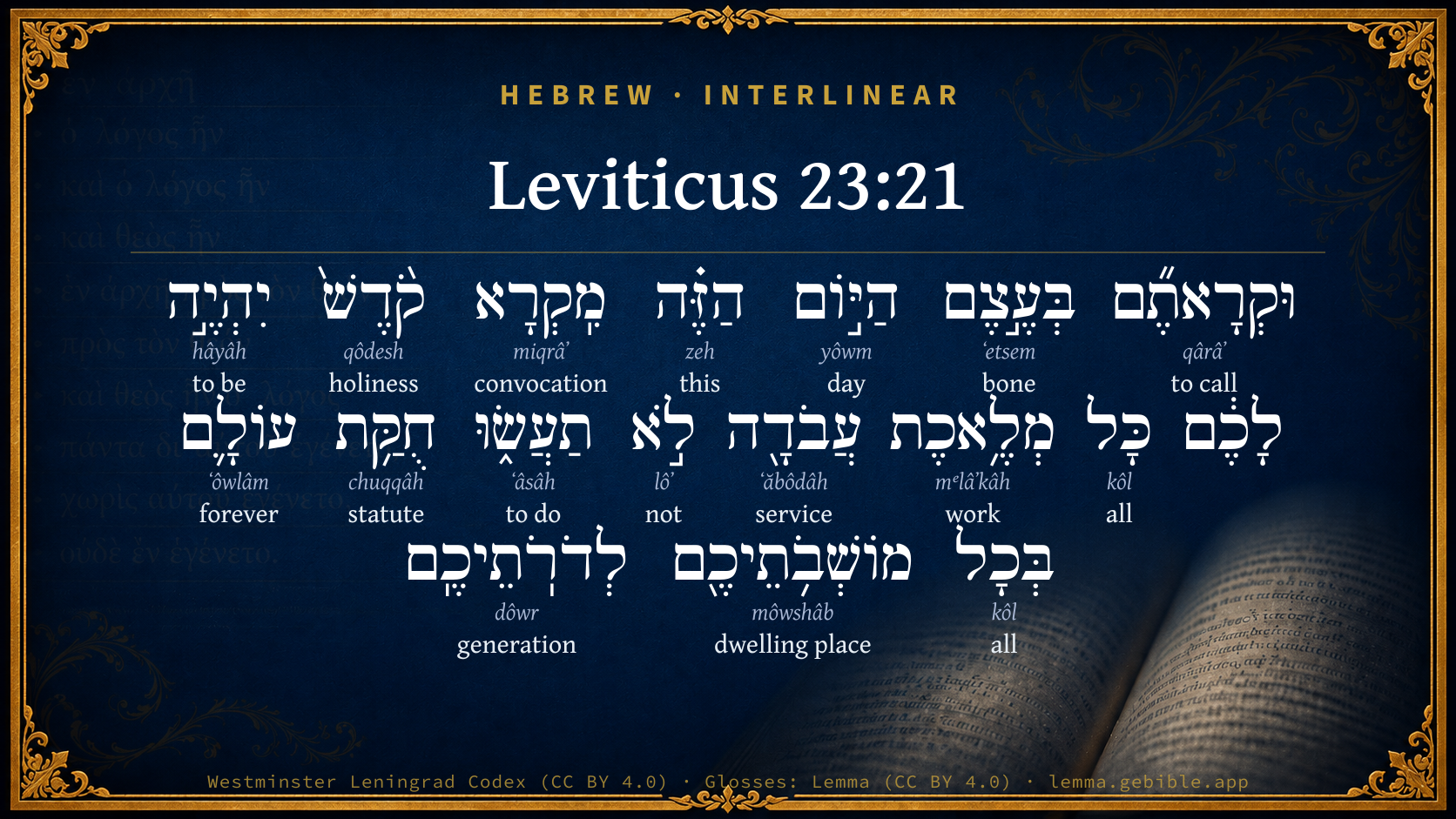
Hebrew (Westminster Leningrad Codex) Leviticus 23:21 appears in the Hebrew Old Testament. The text above is from the Westminster Leningrad Codex. Each word links to its Strong’s number, a concise gloss, and parsing drawn from the Open Scriptures Hebrew Bible morphology. Click any word for its full Brown-Driver-Briggs (BDB) entry.
Download image
Cite this verse

Leviticus 23:21 (World English Bible). Public Domain. Lemma interlinear Bible study tool, https://lemma.gebible.app/v/leviticus/23/21.

Show BibTeX & RIS
BibTeX
RIS
English Translation
You shall make proclamation on the same day: there shall be a holy convocation to you; you shall do no regular work. This is a statute forever in all your dwellings throughout your generations.
World English Bible · Public Domain
Download a study sheet

One document with this verse’s original text, its word-by-word gloss line, the meaning frame, cross-references with their text, attributed commentary, and full source and license credits — printable, and it pastes into notes with its structure intact.

This verse Autodidact and up

Study sheet (.html) Plain text (.txt)

A passage Seminary Student

Up to 50 verses in one chapter. A passage sheet keeps up to 6 commentary sources and 12 cross-references per verse, in the order this page ranks them, and says so on the sheet whenever that leaves anything out. Ask for a single verse and you get the Autodidact verse sheet above.

Everything on this page stays free to read, with no account — the sheet is a download of what is already on screen, not access to it.

Want to remove ads? Support Godless Engineer
Compare translations 3

The same verse in 3 English versions, stacked beneath the original-language interlinear above. Click any original word for its lexicon entry.

Each is an independent rendering of the whole verse — the interlinear is not word-aligned to these translations.

Highlighted words mark where these versions differ — a whole-verse word diff, not a word-by-word alignment.

  • World English Bible Public Domain
    You shall make proclamation on the same day: there shall be a holy convocation to you; you shall do no regular work. This is a statute forever in all your dwellings throughout your generations.
  • King James Version Public Domain
    And ye shall proclaim on the selfsame day, that it may be an holy convocation unto you: ye shall do no servile work therein: it shall be a statute for ever in all your dwellings throughout your generations.
  • unfoldingWord Literal Text CC BY-SA 4.0
    And you shall proclaim on this same day: it shall be an assembly of holiness for you. You shall not do any work of labor. a statute of eternity in all your dwellings for your generations.

unfoldingWord Literal Text — © unfoldingWord, licensed CC BY-SA 4.0. Word-aligned USFM3 via Door43 (git.door43.org/unfoldingWord/en_ult).

Versions to compare (up to 4)

3 of 4 selected

Show all 18 translations

Every available English version of this verse, each an independent rendering of the whole verse.

  • World English Bible Public Domain
    You shall make proclamation on the same day: there shall be a holy convocation to you; you shall do no regular work. This is a statute forever in all your dwellings throughout your generations.
  • Berean Standard Bible Public Domain
    On that same day you are to proclaim a sacred assembly, and you must not do any regular work. This is to be a permanent statute wherever you live for the generations to come.
  • Majority Standard Bible Public Domain
    On that same day you are to proclaim a sacred assembly, and you must not do any regular work. This is to be a permanent statute wherever you live for the generations to come.
  • King James Version Public Domain
    And ye shall proclaim on the selfsame day, that it may be an holy convocation unto you: ye shall do no servile work therein: it shall be a statute for ever in all your dwellings throughout your generations.
  • American Standard Version (1901) Public Domain
    And ye shall make proclamation on the selfsame day; there shall be a holy convocation unto you; ye shall do no servile work: it is a statute for ever in all your dwellings throughout your generations.
  • Revised Version (1885) Public Domain
    And ye shall make proclamation on the selfsame day; there shall be an holy convocation unto you: ye shall do no servile work: it is a statute for ever in all your dwellings throughout your generations.
  • Geneva Bible (1599) Public Domain
    So ye shall proclayme the same day, that it may be an holie conuocation vnto you: ye shall doe no seruile worke therein: it shalbe an ordinance for euer in al your dwellinges, throughout your generations.
  • Douay-Rheims (1899) Public Domain
    And you shall call this day most solemn, and most holy. You shall do no servile work therein. It shall be an everlasting ordinance in all your dwellings and generations.
  • Young's Literal Translation Public Domain
    and ye have proclaimed on this self-same day: a holy convocation is to you, ye do no servile work -- a statute age-during in all your dwellings, to your generations.
  • Literal Standard Version CC BY-SA 4.0
    and you have proclaimed in this very day [that] it is a holy convocation for yourselves, you do no servile work—a continuous statute in all your dwellings, throughout your generations.
  • Unlocked Literal Bible CC BY-SA 4.0
    You must make a proclamation on that same day. There will be a holy assembly, and you must do no ordinary work. This will be a permanent statute throughout your people's generations in all the places where you live.
  • unfoldingWord Literal Text CC BY-SA 4.0
    And you shall proclaim on this same day: it shall be an assembly of holiness for you. You shall not do any work of labor. a statute of eternity in all your dwellings for your generations.
  • Darby Bible Public Domain
    And ye shall make proclamation on that same day -- a holy convocation shall it be unto you: no manner of servile work shall ye do: [it is] an everlasting statute in all your dwellings throughout your generations.
  • World Messianic Bible Public Domain
    You shall make proclamation on the same day that there shall be a holy convocation to you. You shall do no regular work. This is a statute forever in all your dwellings throughout your generations.
  • Webster's Bible Public Domain
    And ye shall proclaim on the same day, that it may be a holy convocation to you: ye shall do no servile work in it. it shall be a statute for ever in all your dwellings throughout your generations.
  • Free Bible Version CC BY-SA 4.0
    That same day you are to announce a holy meeting, and you must not do any of your usual work. This regulation is for all time and for future generations everywhere you live.
  • Bible in Basic English Public Domain
    And on the same day, let it be given out that there will be a holy meeting for you: you may do no field-work on that day: it is a rule for ever through all your generations wherever you are living.
  • JPS Tanakh (1917) Public Domain
    And ye shall make proclamation on the selfsame day; there shall be a holy convocation unto you; ye shall do no manner of servile work; it is a statute for ever in all your dwellings throughout your generations.

Literal Standard Version (2020), Covenant Press — licensed CC BY-SA 4.0. Text via the HelloAO Bible API (eBible.org). Unlocked Literal Bible (unfoldingWord) — licensed CC BY-SA 4.0. Text via the HelloAO Bible API (eBible.org). unfoldingWord Literal Text — © unfoldingWord, licensed CC BY-SA 4.0. Word-aligned USFM3 via Door43 (git.door43.org/unfoldingWord/en_ult). Free Bible Version, Dr. Jonathan Gallagher — licensed CC BY-SA 4.0. Text via the HelloAO Bible API (eBible.org).

Word by word

More ways to search: Search by grammar → Find every occurrence → Compare this word →

Practice this passage: Drill this verse → Learn its vocabulary →

מִֽקְרָא
miqrâʼ
H4744
“convocation of”
Noun, Common, Masculine, Singular, Construct
Part of Speech
Noun
Type
Common
Gender
Masculine
Number
Singular
State
Construct
Full BDB Definition

Origin: from H7121

TWOT: 2063d

convocation, convoking, reading, a calling together - convocation, sacred assembly - convoking - reading
  1. וּקְרָאתֶ֞ם qârâʼ H7121 “and · to call” Conjunction + Verb, Qal, Sequential Perfect, 2nd Person, Masculine, Plural
  2. בְּעֶ֣צֶם ʻetsem H6106 “in/at · bone of” Preposition + Noun, Common, Feminine, Singular, Construct
  3. הַיּ֣וֹם yôwm H3117 “the · day” Particle, Definite Article + Noun, Common, Masculine, Singular, Absolute
  4. הַזֶּ֗ה zeh H2088 “the · this” Particle, Definite Article + Pronoun, Demonstrative, Masculine, Singular
  5. קֹ֨דֶשׁ֙ qôdesh H6944 “holiness” Noun, Common, Masculine, Singular, Absolute
  6. יִהְיֶ֣ה hâyâh H1961 “to be” Verb, Qal, Imperfect, 3rd Person, Masculine, Singular
  7. כָּל kôl H3605 “all of” Noun, Common, Masculine, Singular, Construct
  8. מְלֶ֥אכֶת mᵉlâʼkâh H4399 “work of” Noun, Common, Feminine, Singular, Construct
  9. עֲבֹדָ֖ה ʻăbôdâh H5656 “service” Noun, Common, Feminine, Singular, Absolute
  10. לֹ֣א lôʼ H3808 “not” Particle, Negative
  11. תַעֲשׂ֑וּ ʻâsâh H6213 “to do” Verb, Qal, Imperfect, 2nd Person, Masculine, Plural
  12. חֻקַּ֥ת chuqqâh H2708 “statute of” Noun, Common, Both, Singular, Construct
  13. עוֹלָ֛ם ʻôwlâm H5769 “forever” Noun, Common, Masculine, Singular, Absolute
  14. בְּכָל kôl H3605 “in/at · all of” Preposition + Noun, Common, Masculine, Singular, Construct
  15. מוֹשְׁבֹ֥תֵיכֶ֖ם môwshâb H4186 “dwelling places · your” Noun, Common, Masculine, Plural, Construct + Suffix, Personal, 2nd Person, Masculine, Plural
  16. לְדֹרֹֽתֵיכֶֽם dôwr H1755 “to/for · generations · your” Preposition + Noun, Common, Masculine, Plural, Construct + Suffix, Personal, 2nd Person, Masculine, Plural

About this verse

These counts appear in no published source. They are computed here, from the morphology-tagged text and Lemma’s own curated glosses. What Lemma adds →

18
words
16
distinct lemmas
Pentateuch
section

Notable vocabulary

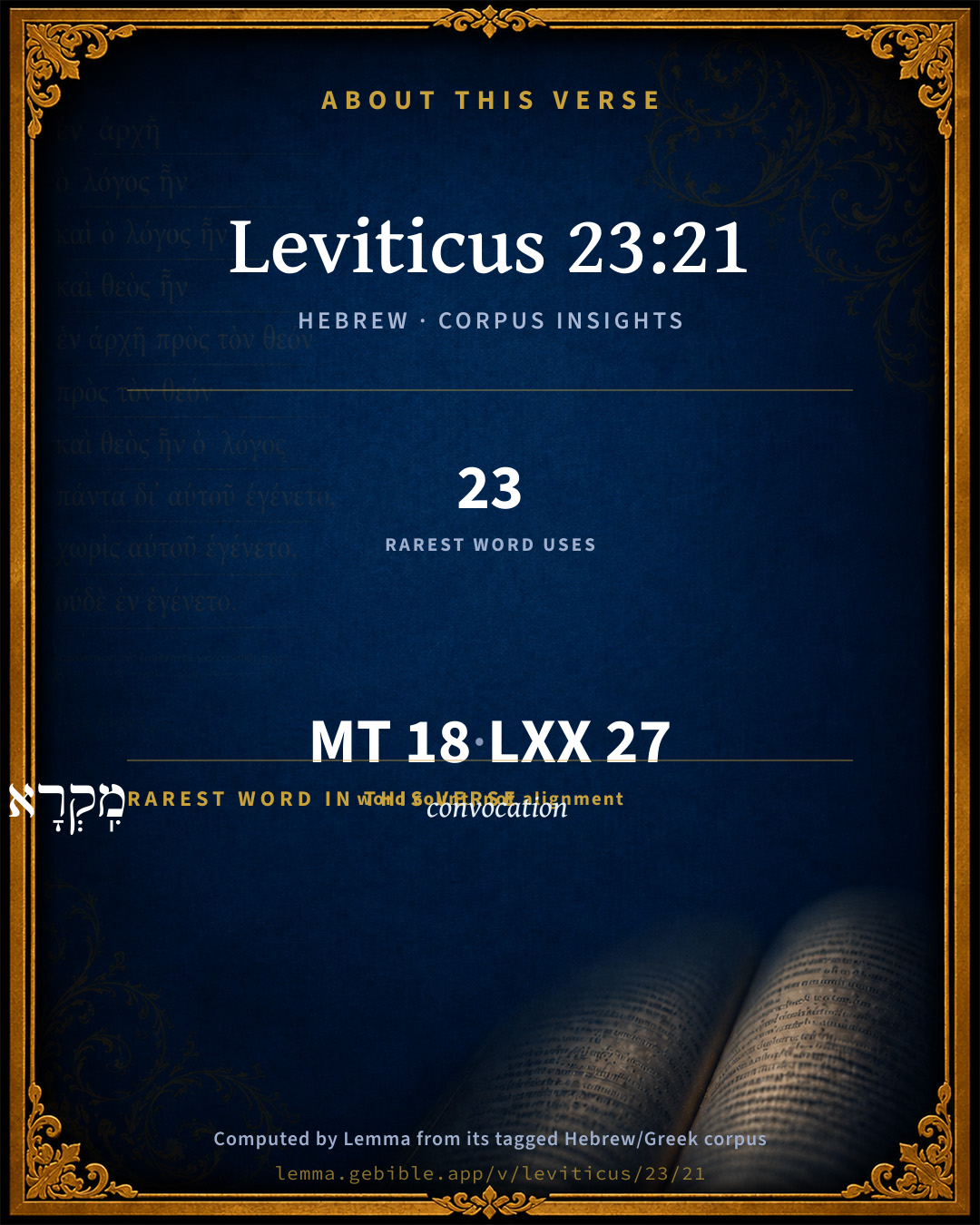
The rarest word here is מִֽקְרָא convocation H4744 — appearing just 23 times in the whole Hebrew Bible.

Shared distinctive vocabulary

מִֽקְרָא convocation H4744 occurs in 22 verses of the Hebrew Bible. Also found in:

Grammatical profile

  • 3 verbs
  • 12 nouns
  • 1 pronoun
  • 1 preposition
  • 1 particle

Verb forms

  • וּקְרָאתֶ֞ם Qal · Sequential Perfect
  • יִהְיֶ֣ה Qal · Imperfect
  • תַעֲשׂ֑וּ Qal · Imperfect

Repetition

A word recurs within this verse — often emphatic in Hebrew:

Hebrew & Septuagint length

In English translation the verse runs 34 words from the Hebrew and 34 from the Septuagint (LXX English) — the same length.

A rough comparison of the two English renderings, which tokenize alike — not a word-level alignment.

Word counts can differ between the Hebrew and the Greek without any difference in meaning — e.g. the Hebrew direct-object marker אֵת has no separate Greek word, and Greek often adds the article ὁ.

In the original languages it is 18 Hebrew tokens and 27 Greek tokens — but the two are counted differently (Hebrew bundles its prefixes and suffixes into one token; the Greek is in lemma form), so that isn’t a like-for-like length.

Cross-references

9

Topical passages linked to Leviticus 23:21 in the Treasury of Scripture Knowledge — connected by theme and wording, ordered by reader-vote popularity; previews shown in the World English Bible.

  • Leviticus 23:2 "Speak to the children of Israel, and tell them, 'The set feasts of Yahweh, which you shall proclaim to be holy convocations, even these are my set feasts.
  • Genesis 17:7 I will establish my covenant between me and you and your seed after you throughout their generations for an everlasting covenant, to be a God to you and to your seed after you.
  • Leviticus 23:4 "'These are the set feasts of Yahweh, even holy convocations, which you shall proclaim in their appointed season.
  • Leviticus 23:14 You shall eat neither bread, nor roasted grain, nor fresh grain, until this same day, until you have brought the offering of your God. This is a statute forever throughout your generations in all your dwellings.
  • Numbers 18:23 But the Levites shall do the service of the tent of meeting, and they shall bear their iniquity: it shall be a statute forever throughout your generations; and among the children of Israel they shall have no inheritance.
  • Deuteronomy 16:11 and you shall rejoice before Yahweh your God, you, and your son, and your daughter, and your man-servant, and your maid-servant, and the Levite who is within your gates, and the foreigner, and the fatherless, and the widow, who are in the midst of you, in the place which Yahweh your God shall choose, to cause his name to dwell there.
  • Isaiah 11:10 It shall happen in that day, that the root of Jesse, who stands for an ensign of the peoples, to him shall the nations seek; and his resting-place shall be glorious.
  • Exodus 12:16–17 In the first day there shall be to you a holy convocation, and in the seventh day a holy convocation; no manner of work shall be done in them, except that which every man must eat, that only may be done by you.
  • Leviticus 23:7 In the first day you shall have a holy convocation. You shall do no regular work.

Cross-references courtesy of OpenBible.info (CC BY 4.0).

Hebrew and Greek witnesses Masoretic Hebrew ↔ Greek Septuagint

The same verse in the two great witnesses to the Old Testament, shown verse-for-verse.

These are two independent witnesses, not word-aligned to each other, and the Septuagint is shown in lemma (dictionary) form.

Hebrew Leviticus 23:21 Masoretic · Westminster Leningrad Codex

וּקְרָאתֶ֞ם בְּעֶ֣צֶם הַיּ֣וֹם הַזֶּ֗ה מִֽקְרָא קֹ֨דֶשׁ֙ יִהְיֶ֣ה לָכֶ֔ם כָּל מְלֶ֥אכֶת עֲבֹדָ֖ה לֹ֣א תַעֲשׂ֑וּ חֻקַּ֥ת עוֹלָ֛ם בְּכָל מוֹשְׁבֹ֥תֵיכֶ֖ם לְדֹרֹֽתֵיכֶֽם

You shall make proclamation on the same day: there shall be a holy convocation to you; you shall do no regular work. This is a statute forever in all your dwellings throughout your generations.

World English Bible · Public Domain

Greek LXX Leviticus 23:21 Septuagint · lemma form

καί καλέω οὗτος ὁ ἡμέρα κλητός ἅγιος εἰμί σύ πᾶς ἔργον λατρευτός οὐ ποιέω ἐν αὐτός νόμιμος αἰώνιος εἰς ὁ γενεά σύ ἐν πᾶς ὁ κατοικία σύ

And you⌃ shall call this day a convocation: it shall be holy to you; you⌃ shall do no servile work on it: it is a perpetual ordinance throughout your generations in all your habitations.

LXX2012 (modern English Septuagint) · Public Domain

Hebrew: Westminster Leningrad Codex (CC BY 4.0). Greek: Septuagint (public domain); English from LXX2012 (modern English Septuagint) (Public Domain). How the Septuagint differs from the Hebrew →

Targum (Aramaic paraphrase)

2

The Targum is the ancient Jewish Aramaic paraphrase of the Hebrew Scriptures — an interpretive translation, not the Hebrew text itself. Onkelos (literal) and Pseudo-Jonathan (expansive) render the Torah, and Jonathan the Prophets. Coverage is partial: where no permissively-licensed English translation exists for a verse, only the Aramaic is shown. This is verse-level text, not a word-by-word alignment to the Hebrew.

  1. Targum Onkelos Torah (Genesis–Deuteronomy)
    וּתְעָרְעוּן בִּכְרַן יוֹמָא הָדֵין מְעָרַע קַדִישׁ יְהֵי לְכוֹן כָּל עִבִידַת פָּלְחָן לָא תַעֲבְּדוּן קְיַם עָלָם בְּכָל מוֹתְבָנֵיכוֹן לְדָרֵיכוֹן

    (no public-domain English translation for this verse)

    Targum Onkelos — Aramaic: “Onkelos Genesis” (public domain); “Onkelos Exodus” (public domain); “Onkelos Leviticus” (public domain); “Onkelos Numbers” (public domain); “Onkelos Deuteronomy” (public domain). English: “Sefaria Community Translation” (CC0 1.0 (public-domain dedication)); “J.W. Etheridge. The Targums of Onkelos and Jonathan Ben Uzziel on the Pentateuch. London: Longmans, Green, 1862” (public domain). Text via Sefaria.

  2. Targum Pseudo-Jonathan Torah (Genesis–Deuteronomy)
    וּתְעַרְעוּן חַיִין וְקַיָימִין חַי בִּזְמַן בִּכְרַן יוֹמָא הָדֵין מְעָרַע קַדִישׁ יְהֵי לְכוֹן כָּל עִיבִידַת פּוּלְחָנָא לָא תַעַבְּדוּן קְיַם עֲלָם בְּכָל מוֹתְבָנֵיכוֹן לְדָרֵיכוֹן

    And you shall proclaim with life and strength that self-same day, that at the time of that day there shall be to you a holy convocation: you shall do no work of labour: it is an everlasting statute in all your dwelling for your generations.

    Targum Pseudo-Jonathan — Aramaic: “Targum Jonathan on Genesis” (public domain); “Targum Jonathan on Exodus” (public domain); “Targum Jonathan on Leviticus” (public domain); “Targum Jonathan on Numbers” (public domain); “Targum Jonathan on Deuteronomy” (public domain). English: “The Targum of Jonathan ben Uzziel, trans. J. W. Etheridge, London, 1862” (public domain). Text via Sefaria.

Commentary

Notes on Leviticus 23:21 from classic Christian and Jewish commentators (each source and its license shown beneath its notes). The classic Christian expositions comment on the surrounding passage and are grouped to its opening verse, so a note may address several verses; the Jewish commentaries on the Tanakh (Rashi and others) are per-verse, so they appear only where the commentator wrote on this verse.

Lemma curates 59 commentaries, every one of them public domain or Creative Commons licensed, each selected and text-cleaned for this edition rather than reprinted as found. About our sources →

Trapp's Complete Commentary

John Trapp

Lev 23:21 And ye shall proclaim on the selfsame day, [that] it may be an holy convocation unto you: ye shall do no servile work [therein: it shall be] a statute for ever in all your dwellings throughout your generations.

Ver. 21. A holy convocation.] The feast day of Pentecost, kept in testimony of their thankfulness for the land’s fruitfulness, their deliverance from Egypt, {Deu 16:10; Deu 16:12} and the receiving of the law at that time of the year. {Exo 19:11}

John Trapp, A Commentary or Exposition upon All the Books of the Old and New Testament (1647–1656) — public domain. Text from a community e-Sword module.

Joseph Benson's Commentary

Lev 23:21. A holy convocation — A sabbath, or day of rest, called pentecost; which was instituted, partly in remembrance of the consummation of their deliverance out of Egypt, by bringing them thence to the mount of God, or Sinai, as God had promised; and of that admirable blessing of giving the law to them on the fiftieth day, and forming them into a commonwealth under his own immediate government; and partly in gratitude for the further progress of their harvest, as in the passover they offered a thank-offering to God for the beginning of their harvest. The perfection of this feast was the pouring out of the Holy Spirit upon the apostles on this very day in which the law of faith was given, fifty days after Christ our Passover was sacrificed for us. And on that day the apostles, having themselves received the first-fruits of the Spirit, begat three thousand souls through the word of truth, as the first-fruits of the Christian Church.

Joseph Benson's Commentary on the Old and New Testaments (1811–1818) — public domain. Text from a community e-Sword module.

Jamieson, Fausset & Brown

Robert Jamieson, A. R. Fausset & David Brown

ye shall proclaim on the selfsame day, that it may be an holy convocation unto you: ye shall do no servile work therein--Though it extended over a week, the first day only was held as a Sabbath, both for the national offering of first-fruits and a memorial of the giving of the law.

Jamieson, Fausset & Brown — Commentary Critical and Explanatory on the Whole Bible (1871) — public domain (CC PDM 1.0). Text via the HelloAO Bible API.

Ellicott's Commentary for English Readers

(21).And ye shall proclaim on the selfsame day.—This proclamation was made to the people by the priest with trumpet blasts.

Ye shall do no servile work.—For what constituted servile work, see Lev_23:7.

A statute for ever . . . . —See Lev_23:14, Lev_3:17; Lev_7:23-25. In accordance with this declaration, and with the fact that the Jews during the second Temple regarded it as the day on which the Decalogue was given, the Israelites to this day sacredly keep this festival on the 6th and 7th of Sivan, i.e. between the second half of May and the first half of June. From their circumstances, however, the harvest character of the festival is now subordinate, and more prominence is given to its commemorating the giving of the Law on Sinai. Still the synagogues and the private houses are adorned with flowers and odoriferous herbs. The male members of the community purify themselves for its celebration by immersion and confession of sin, and many of them spend all night in their respective places of worship.

A Bible Commentary for English Readers, edited by Charles John Ellicott (1878–1897) — public domain. Text from a community e-Sword module.

The Cambridge Bible for Schools and Colleges

gen. ed. J. J. S. Perowne

21. This v., unlike the rest of the section, has the characteristics of the Priestly Code. See above.

The Cambridge Bible for Schools and Colleges (gen. ed. J. J. S. Perowne; Cambridge University Press, 1878–1918) — public domain. Text from a community e-Sword module.

John Gill's Exposition

And ye shall proclaim on the selfsame day, that it may be an holy convocation unto you,.... This proclamation was made by the priests with the sound of a trumpet, that the people might observe that this fiftieth day, or day of Pentecost, was devoted to sacred service, and that they were called to holy exercises in it:

ye shall do no servile work therein; what was not necessary for food, as Ben Gersom observes, but what was necessary on that account, as kindling a fire, &c. might be done, see Lev 23:7; for this was to be kept in like manner as the first and seventh days of the feast of unleavened bread; the general design of which was to express thankfulness for the appointed weeks of the harvest, and to honour the Lord with the firstfruits of the increase of the earth: and the Jews say, as Ben Gersom observes, that this fiftieth day, being reckoned from the sixteenth of Nisan, fell upon the sixth of Sivan, on which day, they say, the law was given, which is another reason for the observance of it: and it is remarkable, that on this same day the Word of the Lord went out of Zion, and the law or doctrine of the Lord, even the everlasting Gospel, went out of Jerusalem, published by the apostles of Christ to the people of all nations, Act 2:14; when they were favoured with the firstfruits of the Spirit, after our Lord's ascension to heaven, and receiving gifts for men, which he now in an extraordinary manner bestowed on his disciples, Act 2:1; and which were the firstfruits of all others, after to be given forth in the course of time, and of the effusion of the Spirit in the latter day; and when there was a number of souls converted, as the firstfruits of after conversions among Jews and Gentiles, Act 2:41; and particularly of the conversion of the Jews in the latter day, and of the harvest of souls in the end of the world, Mat 13:30,

it shall be a statute for ever all your dwellings throughout your generations; so long as they dwelt in the land of Canaan, and had their harvest in it, even until the Messiah came, in whom all those types and figures had their accomplishment.

John Gill's Exposition of the Whole Bible (1746–1763) — public domain (CC PDM 1.0). Text via the HelloAO Bible API.

Haydock's Catholic Bible Commentary

Most holy. Hebrew, "a holy convocation." (Haydock) --- It is generally supposed that it had an octave, though the Scripture says nothing of it.

George Leo Haydock (1774–1849), Haydock's Catholic Family Bible and Commentary, 1859 edition — public domain. Excludes Psalms (Douay-Rheims chapter numbering differs from Protestant) and Deuterocanonical books (Catholic canon only).

Matthew Poole's English Annotations

An holy convocation, a sabbath or day of rest, called pentecost, which was instituted, partly in remembrance of the consummation of their deliverance out of Egypt, by bringing them thence to the mount of God, or Sinai, as God had promised, and of that admirable blessing of giving the law to them at that time, and forming them into a commonwealth under his own immediate government; and partly in gratitude for the further progress of their harvest, as in the passover they offered a thank-offering to God for the beginning of their harvest.

Matthew Poole's English Annotations on the Holy Bible (1683–1685) — public domain. Text from a community e-Sword/MySword module.

John Wesley's Explanatory Notes

An holy convocation - A sabbath or day of rest, called pentecost; which was instituted, partly in remembrance of the consummation of their deliverance out of Egypt by bringing them thence to the mount of God, or Sinai, as God had promised, and of that admirable blessing of giving the law to them on the 50th day, and forming them into a commonwealth under his own immediate government; and partly in gratitude for the farther progress of their harvest, as in the passover they offered a thank-offering to God for the beginning of their harvest. The perfection of this feast, was the pouring out of the Holy Spirit upon the apostles on this very day, in which the law of faith was given, fifty days after Christ our passover was sacrificed for us. And on that day the apostles, having themselves received the first-fruits of the spirit, begat three thousand souls thro' the word of truth, as the first-fruits of the Christian church.

John Wesley, Explanatory Notes Upon the Whole Bible (1754–1765) — public domain. Text via the GEBible commentary corpus.

Keil & Delitzsch

C. F. Keil & F. Delitzsch

On this day a holy meeting was to be held, and laborious work to be suspended, just as on the first and seventh days of Mazzoth. This was to be maintained as a statute for ever (see Lev 23:14). It was not sufficient, however, to thank the Lord for the blessing of harvest by a feast of thanksgiving to the Lord, but they were not to forget the poor and distressed when gathering in their harvest. To indicate this, the law laid down in Lev 19:9-10 is repeated in Lev 23:22.

Keil & Delitzsch — Biblical Commentary on the Old Testament (1861–1891) — public domain (CC PDM 1.0). Text via the HelloAO Bible API. (Old Testament only.)

Lesson kit

Teaching starters — assembled from the data on this page, not authored interpretation. Every prompt links to the verse data it draws on. Edit before teaching.

Leviticus, in the Pentateuch, opens this verse with 18 words (16 distinct Hebrew lemmas). Its most distinctive word is miqrâʼ (“convocation”). A historical commentator’s framing appears above. Read the whole chapter for the surrounding context.

Discussion questions

  1. The word miqrâʼ carries the sense “convocation.” How does it shape the verse?
  2. Exodus 12:16 shares the word «convocation» with this verse. How do the two illuminate each other?
  3. “all” occurs 2× in this one verse. What is the effect of the repetition?
  4. These translations render this verse differently; the difference is in the English rendering, not the original. What questions does that raise?
  5. The verb «וּקְרָאתֶ֞ם» is Qal Sequential Perfect. How does its form color the action?
  6. Reading how Trapp's Complete Commentary and Joseph Benson's Commentary read this verse, where do the two commentators agree and where do they part?

Things to notice

Reading settings

Reading text

Shown beneath each verse's original-language words.

Old Testament
Old Testament edition

Read the OT as the Masoretic Hebrew (MT) or the Greek Septuagint (LXX).

English shown for the Greek Septuagint (in the Hebrew ↔ Greek comparison).

Comparing translations? Open the Compare panel on any verse page to stack up to four side by side.