
Leviticus 23:3

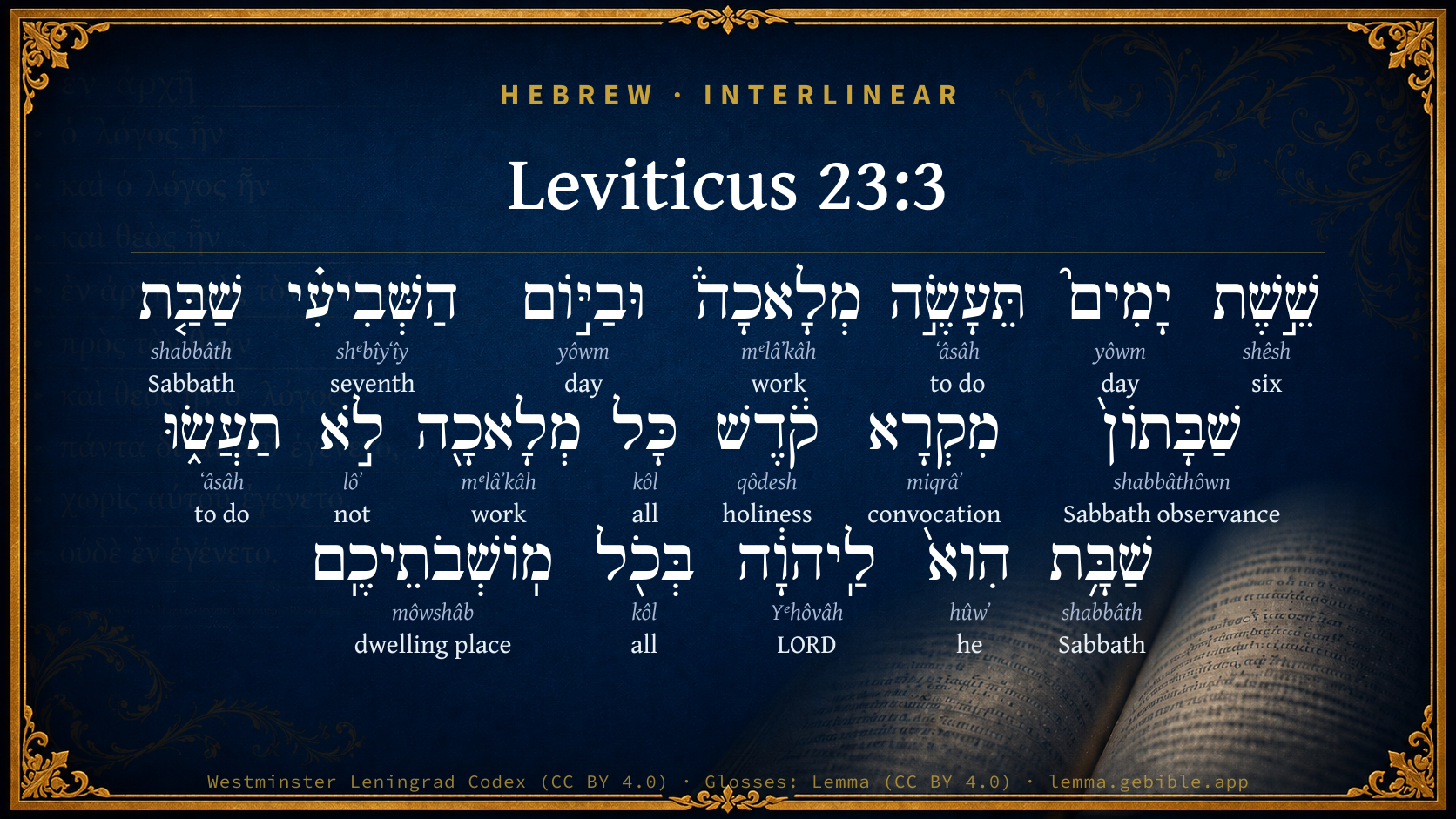
Hebrew (Westminster Leningrad Codex) Leviticus 23:3 appears in the Hebrew Old Testament. The text above is from the Westminster Leningrad Codex. Each word links to its Strong’s number, a concise gloss, and parsing drawn from the Open Scriptures Hebrew Bible morphology. Click any word for its full Brown-Driver-Briggs (BDB) entry.
Download image
Cite this verse

Leviticus 23:3 (World English Bible). Public Domain. Lemma interlinear Bible study tool, https://lemma.gebible.app/v/leviticus/23/3.

Show BibTeX & RIS
BibTeX
RIS
English Translation
"'Six days shall work be done: but on the seventh day is a Sabbath of solemn rest, a holy convocation; you shall do no manner of work. It is a Sabbath to Yahweh in all your dwellings.
World English Bible · Public Domain
Download a study sheet

One document with this verse’s original text, its word-by-word gloss line, the meaning frame, cross-references with their text, attributed commentary, and full source and license credits — printable, and it pastes into notes with its structure intact.

This verse Autodidact and up

Study sheet (.html) Plain text (.txt)

A passage Seminary Student

Up to 50 verses in one chapter. A passage sheet keeps up to 6 commentary sources and 12 cross-references per verse, in the order this page ranks them, and says so on the sheet whenever that leaves anything out. Ask for a single verse and you get the Autodidact verse sheet above.

Everything on this page stays free to read, with no account — the sheet is a download of what is already on screen, not access to it.

Want to remove ads? Support Godless Engineer
Compare translations 3

The same verse in 3 English versions, stacked beneath the original-language interlinear above. Click any original word for its lexicon entry.

Each is an independent rendering of the whole verse — the interlinear is not word-aligned to these translations.

Highlighted words mark where these versions differ — a whole-verse word diff, not a word-by-word alignment.

  • World English Bible Public Domain
    "'Six days shall work be done: but on the seventh day is a Sabbath of solemn rest, a holy convocation; you shall do no manner of work. It is a Sabbath to Yahweh in all your dwellings.
  • King James Version Public Domain
    Six days shall work be done: but the seventh day is the sabbath of rest, an holy convocation; ye shall do no work therein: it is the sabbath of the LORD in all your dwellings.
  • unfoldingWord Literal Text CC BY-SA 4.0
    Six days work shall be done, and on the seventh day a sabbath of sabbaths, an assembly of holiness. You shall not do any work. It a sabbath to Yahweh in all your dwellings.

unfoldingWord Literal Text — © unfoldingWord, licensed CC BY-SA 4.0. Word-aligned USFM3 via Door43 (git.door43.org/unfoldingWord/en_ult).

Versions to compare (up to 4)

3 of 4 selected

Show all 18 translations

Every available English version of this verse, each an independent rendering of the whole verse.

  • World English Bible Public Domain
    "'Six days shall work be done: but on the seventh day is a Sabbath of solemn rest, a holy convocation; you shall do no manner of work. It is a Sabbath to Yahweh in all your dwellings.
  • Berean Standard Bible Public Domain
    For six days work may be done, but the seventh day is a Sabbath of complete rest, a day of sacred assembly. You must not do any work; wherever you live, it is a Sabbath to the LORD.
  • Majority Standard Bible Public Domain
    For six days work may be done, but the seventh day is a Sabbath of complete rest, a day of sacred assembly. You must not do any work; wherever you live, it is a Sabbath to the LORD.
  • King James Version Public Domain
    Six days shall work be done: but the seventh day is the sabbath of rest, an holy convocation; ye shall do no work therein: it is the sabbath of the LORD in all your dwellings.
  • American Standard Version (1901) Public Domain
    Six days shall work be done: but on the seventh day is a sabbath of solemn rest, a holy convocation; ye shall do no manner of work: it is a sabbath unto Jehovah in all your dwellings.
  • Revised Version (1885) Public Domain
    Six days shall work be done: but on the seventh day is a sabbath of solemn rest, an holy convocation; ye shall do no manner of work: it is a sabbath unto the LORD in all your dwellings.
  • Geneva Bible (1599) Public Domain
    Six daies shall worke be done, but in the seuenth day shalbe the Sabbath of rest, an holie conuocation: ye shall do no worke therein, it is the Sabbath of the Lord, in all your dwellings.
  • Douay-Rheims (1899) Public Domain
    Six days shall ye do work: the seventh day, because it is the rest of the sabbath, shall be called holy. You shall do no work on that day: it is the sabbath of the Lord in all your habitations.
  • Young's Literal Translation Public Domain
    six days is work done, and in the seventh day `is' a sabbath of rest, a holy convocation; ye do no work; it `is' a sabbath to Jehovah in all your dwellings.
  • Literal Standard Version CC BY-SA 4.0
    [For] six days work is done, and in the seventh day [is] a Sabbath of rest, a holy convocation; you do no work; it [is] a Sabbath to YHWH in all your dwellings.
  • Unlocked Literal Bible CC BY-SA 4.0
    You may work for six days, but the seventh day is a Sabbath of complete rest, a holy assembly. You must do no work because it is a Sabbath for Yahweh in all the places where you live.
  • unfoldingWord Literal Text CC BY-SA 4.0
    Six days work shall be done, and on the seventh day a sabbath of sabbaths, an assembly of holiness. You shall not do any work. It a sabbath to Yahweh in all your dwellings.
  • Darby Bible Public Domain
    Six days shall work be done; but on the seventh day is the sabbath of rest, a holy convocation; no manner of work shall ye do: it is the sabbath to Jehovah in all your dwellings.
  • World Messianic Bible Public Domain
    “‘Six days shall work be done, but on the seventh day is a Sabbath of solemn rest, a holy convocation; you shall do no kind of work. It is a Sabbath to the LORD in all your dwellings.
  • Webster's Bible Public Domain
    Six days shall work be done: but the seventh day is the sabbath of rest, a holy convocation: ye shall do no work in it: it is the sabbath of the LORD in all your dwellings.
  • Free Bible Version CC BY-SA 4.0
    You have six days to work, but the seventh day is a Sabbath of complete rest, a holy day of meeting together. Don't do any work. It is the Lord's Sabbath everywhere you live.
  • Bible in Basic English Public Domain
    On six days work may be done; but the seventh day is a special day of rest, a time for worship; you may do no sort of work: it is a Sabbath to the Lord wherever you may be living.
  • JPS Tanakh (1917) Public Domain
    Six days shall work be done; but on the seventh day is a sabbath of solemn rest, a holy convocation; ye shall do no manner of work; it is a sabbath unto the LORD in all your dwellings.

Literal Standard Version (2020), Covenant Press — licensed CC BY-SA 4.0. Text via the HelloAO Bible API (eBible.org). Unlocked Literal Bible (unfoldingWord) — licensed CC BY-SA 4.0. Text via the HelloAO Bible API (eBible.org). unfoldingWord Literal Text — © unfoldingWord, licensed CC BY-SA 4.0. Word-aligned USFM3 via Door43 (git.door43.org/unfoldingWord/en_ult). Free Bible Version, Dr. Jonathan Gallagher — licensed CC BY-SA 4.0. Text via the HelloAO Bible API (eBible.org).

Word by word

More ways to search: Search by grammar → Find every occurrence → Compare this word →

Practice this passage: Drill this verse → Learn its vocabulary →

שַׁבָּתוֹן֙
shabbâthôwn
H7677
“Sabbath observance”
Noun, Common, Masculine, Singular, Absolute
Part of Speech
Noun
Type
Common
Gender
Masculine
Number
Singular
State
Absolute
Full BDB Definition

Origin: from H7676

TWOT: 2323d

Sabbath observance, sabbatism - of weekly sabbath - day of atonement - sabbatical year - of Feast of Trumpets - of the 1st and last days of the Feast of Tabernacles
  1. שֵׁ֣שֶׁת shêsh H8337 “six” Adjective, Cardinal number, Masculine, Singular, Construct
  2. יָמִים֮ yôwm H3117 “days” Noun, Common, Masculine, Plural, Absolute
  3. תֵּעָשֶׂ֣ה ʻâsâh H6213 “to do” Verb, Niphal, Imperfect, 3rd Person, Feminine, Singular
  4. מְלָאכָה֒ mᵉlâʼkâh H4399 “work” Noun, Common, Feminine, Singular, Absolute
  5. וּבַיּ֣וֹם yôwm H3117 “and · in/at the · day” Conjunction + Preposition, Determined + Noun, Common, Masculine, Singular, Absolute
  6. הַשְּׁבִיעִ֗י shᵉbîyʻîy H7637 “the · seventh” Particle, Definite Article + Adjective, Ordinal number, Masculine, Singular, Absolute
  7. שַׁבַּ֤ת shabbâth H7676 “Sabbath of” Noun, Common, Both, Singular, Construct
  8. מִקְרָא miqrâʼ H4744 “convocation of” Noun, Common, Masculine, Singular, Construct
  9. קֹ֔דֶשׁ qôdesh H6944 “holiness” Noun, Common, Masculine, Singular, Absolute
  10. כָּל kôl H3605 “all of” Noun, Common, Masculine, Singular, Construct
  11. מְלָאכָ֖ה mᵉlâʼkâh H4399 “work” Noun, Common, Feminine, Singular, Absolute
  12. לֹ֣א lôʼ H3808 “not” Particle, Negative
  13. תַעֲשׂ֑וּ ʻâsâh H6213 “to do” Verb, Qal, Imperfect, 2nd Person, Masculine, Plural
  14. שַׁבָּ֥ת shabbâth H7676 “Sabbath” Noun, Common, Both, Singular, Absolute
  15. הִוא֙ hûwʼ H1931 “he” Pronoun, Personal, 3rd Person, Feminine, Singular
  16. לַֽיהוָ֔ה Yᵉhôvâh H3068 “to/for · LORD” Preposition + Noun, Proper
  17. בְּכֹ֖ל kôl H3605 “in/at · all of” Preposition + Noun, Common, Masculine, Singular, Construct
  18. מֽוֹשְׁבֹתֵיכֶֽם môwshâb H4186 “dwelling places · your” Noun, Common, Masculine, Plural, Construct + Suffix, Personal, 2nd Person, Masculine, Plural

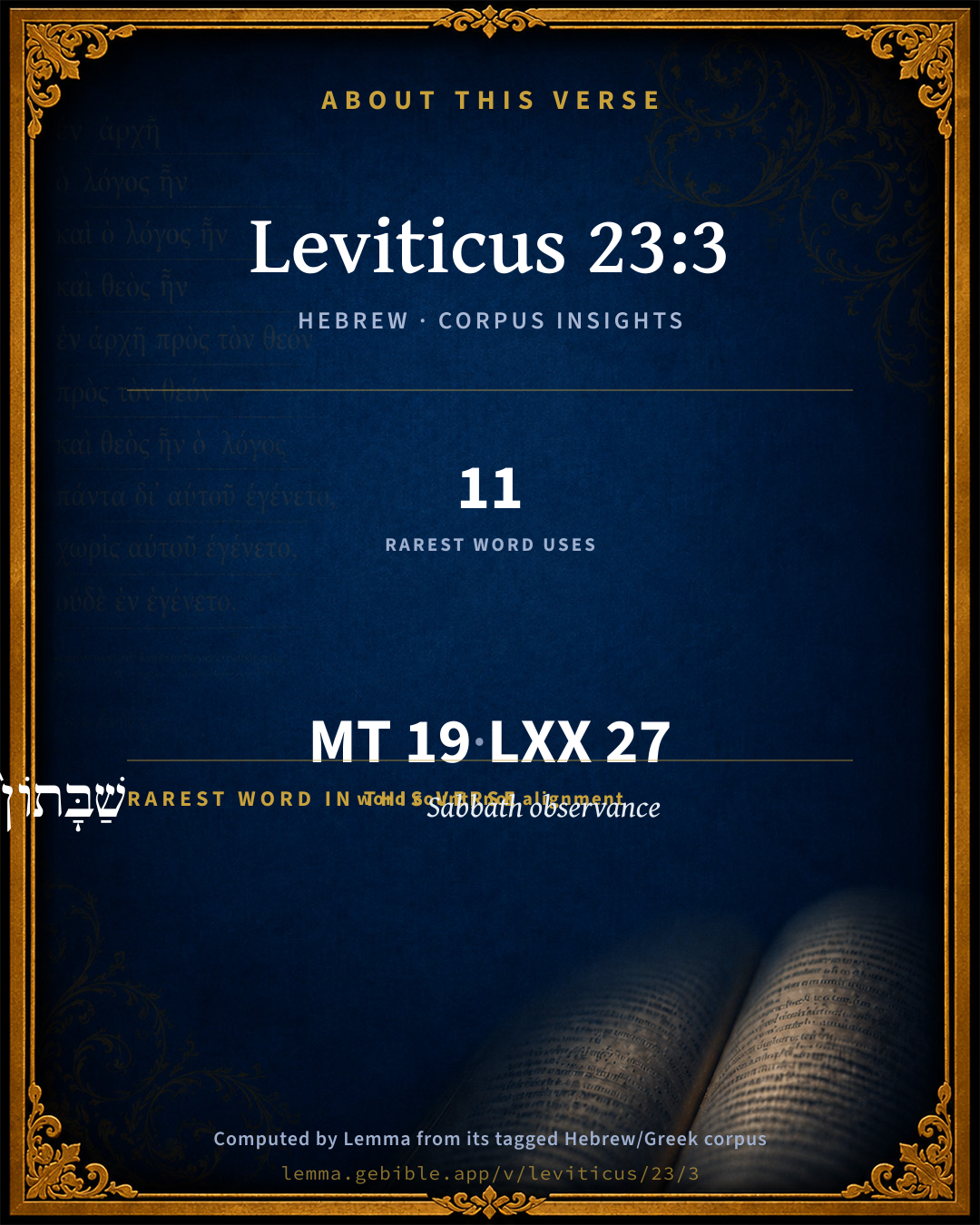
About this verse

These counts appear in no published source. They are computed here, from the morphology-tagged text and Lemma’s own curated glosses. What Lemma adds →

19
words
14
distinct lemmas
Pentateuch
section

Notable vocabulary

The rarest word here is שַׁבָּתוֹן֙ Sabbath observance H7677 — appearing just 11 times in the whole Hebrew Bible.

Shared distinctive vocabulary

שַׁבָּתוֹן֙ Sabbath observance H7677 occurs in 10 verses of the Hebrew Bible. Also found in:

Grammatical profile

  • 2 verbs
  • 13 nouns
  • 2 adjectives
  • 1 pronoun
  • 1 particle

Verb forms

  • תֵּעָשֶׂ֣ה Niphal · Imperfect
  • תַעֲשׂ֑וּ Qal · Imperfect

Repetition

Words recur within this verse — often emphatic in Hebrew:

  • יָמִים֮ day H3117 ×2
  • תֵּעָשֶׂ֣ה to do H6213 ×2
  • מְלָאכָה֒ work H4399 ×2
  • שַׁבַּ֤ת Sabbath H7676 ×2
  • כָּל all H3605 ×2

Hebrew & Septuagint length

In English translation the verse runs 37 words from the Hebrew and 39 from the Septuagint (LXX English) — closely comparable.

A rough comparison of the two English renderings, which tokenize alike — not a word-level alignment.

Word counts can differ between the Hebrew and the Greek without any difference in meaning — e.g. the Hebrew direct-object marker אֵת has no separate Greek word, and Greek often adds the article ὁ.

In the original languages it is 19 Hebrew tokens and 27 Greek tokens — but the two are counted differently (Hebrew bundles its prefixes and suffixes into one token; the Greek is in lemma form), so that isn’t a like-for-like length.

Cross-references

16

Topical passages linked to Leviticus 23:3 in the Treasury of Scripture Knowledge — connected by theme and wording, ordered by reader-vote popularity; previews shown in the World English Bible.

  • Leviticus 19:3 "'Each one of you shall respect his mother and his father. You shall keep my Sabbaths. I am Yahweh your God.
  • Exodus 23:12 "Six days you shall do your work, and on the seventh day you shall rest, that your ox and your donkey may have rest, and the son of your handmaid, and the alien may be refreshed.
  • Exodus 35:2–3 'Six days shall work be done, but on the seventh day there shall be a holy day for you, a Sabbath of solemn rest to Yahweh: whoever does any work in it shall be put to death.
  • Exodus 20:8–11 "Remember the Sabbath day, to keep it holy.
  • Exodus 31:13–17 "Speak also to the children of Israel, saying, 'Most assuredly you shall keep my Sabbaths: for it is a sign between me and you throughout your generations; that you may know that I am Yahweh who sanctifies you.
  • Exodus 34:21 Six days you shall work, but on the seventh day you shall rest: in plowing time and in harvest you shall rest.
  • Luke 13:14 The ruler of the synagogue, being indignant because Jesus had healed on the Sabbath, said to the multitude, "There are six days in which men ought to work. Therefore come on those days and be healed, and not on the Sabbath day!"
  • Exodus 16:29 Behold, because Yahweh has given you the Sabbath, therefore he gives you on the sixth day the bread of two days. Everyone stay in his place. Let no one go out of his place on the seventh day."
  • Deuteronomy 5:13–14 Six days shall you labor, and do all your work;
  • Isaiah 56:2 Blessed is the man who does this, and the son of man who holds it fast; who keeps the Sabbath from profaning it, and keeps his hand from doing any evil.
  • Isaiah 56:6 Also the foreigners who join themselves to Yahweh, to minister to him, and to love the name of Yahweh, to be his servants, everyone who keeps the Sabbath from profaning it, and holds fast my covenant;
  • Isaiah 58:13 If you turn away your foot from the Sabbath, from doing your pleasure on my holy day; and call the Sabbath a delight, [and] the holy of Yahweh honorable; and shall honor it, not doing your own ways, nor finding your own pleasure, nor speaking [your own] words:
  • Luke 23:56 They returned, and prepared spices and ointments. On the Sabbath they rested according to the commandment.
  • Acts 15:21 For Moses from generations of old has in every city those who preach him, being read in the synagogues every Sabbath."
  • Revelation 1:10 I was in the Spirit on the Lord's day, and I heard behind me a loud voice, like a trumpet
  • Exodus 16:23 He said to them, "This is that which Yahweh has spoken, 'Tomorrow is a solemn rest, a holy Sabbath to Yahweh. Bake that which you want to bake, and boil that which you want to boil; and all that remains over lay up for yourselves to be kept until the morning."

Cross-references courtesy of OpenBible.info (CC BY 4.0).

Hebrew and Greek witnesses Masoretic Hebrew ↔ Greek Septuagint

The same verse in the two great witnesses to the Old Testament, shown verse-for-verse.

These are two independent witnesses, not word-aligned to each other, and the Septuagint is shown in lemma (dictionary) form.

Hebrew Leviticus 23:3 Masoretic · Westminster Leningrad Codex

שֵׁ֣שֶׁת יָמִים֮ תֵּעָשֶׂ֣ה מְלָאכָה֒ וּבַיּ֣וֹם הַשְּׁבִיעִ֗י שַׁבַּ֤ת שַׁבָּתוֹן֙ מִקְרָא קֹ֔דֶשׁ כָּל מְלָאכָ֖ה לֹ֣א תַעֲשׂ֑וּ שַׁבָּ֥ת הִוא֙ לַֽיהוָ֔ה בְּכֹ֖ל מֽוֹשְׁבֹתֵיכֶֽם

"'Six days shall work be done: but on the seventh day is a Sabbath of solemn rest, a holy convocation; you shall do no manner of work. It is a Sabbath to Yahweh in all your dwellings.

World English Bible · Public Domain

Greek LXX Leviticus 23:3 Septuagint · lemma form

ἕξ ἡμέρα ποιέω ἔργον καί ὁ ἡμέρα ὁ ἕβδομος σάββατον ἀνάπαυσις κλητός ἅγιος ὁ κύριος πᾶς ἔργον οὐ ποιέω σάββατον εἰμί ὁ κύριος ἐν πᾶς κατοικία σύ

Six days shall you do works, but on the seventh day is the sabbath; a rest, a holy convocation to the Lord: you shall not do any work, it is a sabbath to the Lord in all your dwellings.

LXX2012 (modern English Septuagint) · Public Domain

Hebrew: Westminster Leningrad Codex (CC BY 4.0). Greek: Septuagint (public domain); English from LXX2012 (modern English Septuagint) (Public Domain). How the Septuagint differs from the Hebrew →

Targum (Aramaic paraphrase)

2

The Targum is the ancient Jewish Aramaic paraphrase of the Hebrew Scriptures — an interpretive translation, not the Hebrew text itself. Onkelos (literal) and Pseudo-Jonathan (expansive) render the Torah, and Jonathan the Prophets. Coverage is partial: where no permissively-licensed English translation exists for a verse, only the Aramaic is shown. This is verse-level text, not a word-by-word alignment to the Hebrew.

  1. Targum Onkelos Torah (Genesis–Deuteronomy)
    שִׁתָּא יוֹמִין תִּתְעֲבֵד עִבִידָא וּבְיוֹמָא שְׁבִיעָאָה שְׁבַת שְׁבָתָא מְעָרַע קַדִישׁ כָּל עִבִידָא לָא תַעֲבְּדוּן שַׁבְּתָא הִיא קֳדָם יְיָ בְּכֹל מוֹתְבָנֵיכוֹן

    (no public-domain English translation for this verse)

    Targum Onkelos — Aramaic: “Onkelos Genesis” (public domain); “Onkelos Exodus” (public domain); “Onkelos Leviticus” (public domain); “Onkelos Numbers” (public domain); “Onkelos Deuteronomy” (public domain). English: “Sefaria Community Translation” (CC0 1.0 (public-domain dedication)); “J.W. Etheridge. The Targums of Onkelos and Jonathan Ben Uzziel on the Pentateuch. London: Longmans, Green, 1862” (public domain). Text via Sefaria.

  2. Targum Pseudo-Jonathan Torah (Genesis–Deuteronomy)
    שִׁיתָּא יוֹמִין תִּתְעֲבֵיד עִיבִידָא וּבְיוֹמָא שְׁבִיעָאָה שַׁבָּא וְנַיְיחָא מְאַרַע קַדִישׁ כָּל עִיבִידָא לָא תַעַבְּדוּן שַׁבְּתָא הוּא לַיְיָ בְּכָל אֲתַר מוֹתְבָנֵיכוֹן

    Six days shalt thou do work, and the seventh day (shall be) a Sabbath and a rest, a holy convocation. No manner of work may you do; it is a Sabbath to the Lord in every place of your habitations.

    Targum Pseudo-Jonathan — Aramaic: “Targum Jonathan on Genesis” (public domain); “Targum Jonathan on Exodus” (public domain); “Targum Jonathan on Leviticus” (public domain); “Targum Jonathan on Numbers” (public domain); “Targum Jonathan on Deuteronomy” (public domain). English: “The Targum of Jonathan ben Uzziel, trans. J. W. Etheridge, London, 1862” (public domain). Text via Sefaria.

Commentary

Notes on Leviticus 23:3 from classic Christian and Jewish commentators (each source and its license shown beneath its notes). The classic Christian expositions comment on the surrounding passage and are grouped to its opening verse, so a note may address several verses; the Jewish commentaries on the Tanakh (Rashi and others) are per-verse, so they appear only where the commentator wrote on this verse.

Lemma curates 59 commentaries, every one of them public domain or Creative Commons licensed, each selected and text-cleaned for this edition rather than reprinted as found. About our sources →

Trapp's Complete Commentary

John Trapp

Lev 23:3 Six days shall work be done: but the seventh day [is] the sabbath of rest, an holy convocation; ye shall do no work [therein]: it [is] the sabbath of the LORD in all your dwellings.

Ver. 3. Ye shall do no work therein.] Save only works of piety, charity, and necessity. These are allowed by our Saviour. {Mar 2:23-28; Mar 3:4} The Jews superstitiously hold, {a} that it is not lawful for a blind man to lean upon a staff on a Sabbath day, as the lame may: that if a flea bite a man on that day, he may take it, but not kill it. That if a thorn prick him in the foot on that day, he may not pull it out. That a tailor may not carry a needle, much less a sword; that a man may not spet, {b} or be taken out of a jakes, as that Jew of Tewkesbury, who said,

“ Sabbata santa colo, de stercore {c} surgere nolo. ”

Whereunto the Earl of Gloucester replied,

“"Sabbata nostra quidem (Solomon) celebrabis ibidem." ”

“(Sir, reverence {d} of the Sabbath keeps me here:

And you, sir, reverence {e} shall our Sabbath there.)”

In all your dwellings.] Where you are to sanctify this rest, and to repair to your synagogues. {Act 15:21}

{a} Ranulph., lib. vii. cap. 37.

{b} [?Spit.]

{c} [A play upon the double meaning of the word stercus. See Ainsworth’s Dictionary.]

{d} Ibid.

{e} Idid.

John Trapp, A Commentary or Exposition upon All the Books of the Old and New Testament (1647–1656) — public domain. Text from a community e-Sword module.

Joseph Benson's Commentary

Lev 23:3. The seventh day is first named as a holy convocation — A day to be kept holy by every Israelite, in all places wheresoever they dwelt, as well as while they lived in the wilderness; and as a day of rest, in which they were to do no work — A similar prohibition is declared Lev 23:28, concerning the day of expiation, excluding all works about earthly employments, whether of profit or of pleasure; but upon other feast-days he forbids only servile works, as Lev 23:7; Lev 23:21; Lev 23:36; for surely this manifest difference in the expressions used by the wise God, must needs imply a difference in the things. In all your dwellings — Other feasts were to be kept before the Lord in Jerusalem only, whither all the males were to come for that end; but the sabbath was to be kept in all places, both in synagogues, and in their private houses.

Joseph Benson's Commentary on the Old and New Testaments (1811–1818) — public domain. Text from a community e-Sword module.

Keil & Delitzsch

C. F. Keil & F. Delitzsch

At the head of these moadim stood the Sabbath, as the day which God had already sanctified as a day of rest for His people, by His own rest on the seventh creation-day (Gen 2:3, cf. Exo 20:8-11). On שׁבּתון שׁבּת, see at Exo 31:15 and Exo 16:33. As a weekly returning day of rest, the observance of which had its foundation in the creative work of God, the Sabbath was distinguished from the yearly feasts, in which Israel commemorated the facts connected with its elevation into a people of God, and which were generally called "feasts of Jehovah" in the stricter sense, and as such were distinguished from the Sabbath (Lev 23:37, Lev 23:38; Isa 1:13-14; Ch1 23:31; Ch2 31:3; Neh 10:34). This distinction is pointed out in the heading, "these are the feasts of Jehovah" (Lev 23:4).

(Note: Partly on account of his repetition, and partly because of the supposed discrepancy observable in the fact, that holy meetings are not prescribed for the Sabbath in the list of festal sacrifices in Num 28 and 29, Hupfield and Knobel maintain that the words of Lev 23:2 and Lev 23:3, from יהוה to מושׁבתיכם, notwithstanding their Elohistic expression, were not written by the Elohist, but are an interpolation of the later editor. The repetition of the heading, however, cannot prove anything at all with the constant repetitions that occur in the so-called Elohistic groundwork, especially as it can be fully explained by the reason mentioned in the text. And the pretended discrepancy rests upon the perfectly arbitrary assumption, that Num 28 and 29 contain a complete codex of all the laws relating to all the feasts. How totally this assumption is at variance with the calendar of feasts, is clear enough from the fact, that no rule is laid down there for the observance of the Sabbath, with the exception of the sacrifices to be offered upon it, and that even rest from labour is not commanded. Moreover Knobel is wrong in identifying the "holy convocation" with a journey to the sanctuary, whereas appearance at the tabernacle to hold the holy convocations (for worship) was not regarded as necessary either in the law itself or according to the later orthodox custom, but, on the contrary, holy meetings for edification were held on the Sabbath in every place in the land, and it was out of this that the synagogues arose.)

In Num 28:11 the feast of new moon follows the Sabbath; but this is passed over here, because the new moon was not to be observed either with sabbatical rest or a holy meeting.

Keil & Delitzsch — Biblical Commentary on the Old Testament (1861–1891) — public domain (CC PDM 1.0). Text via the HelloAO Bible API. (Old Testament only.)

Geneva Bible (1599)

Geneva Bible translators

Or, ye may work.

Or, assembly.

Geneva Bible (1599) marginal notes — public domain. Text via Bolls.life.

Jamieson, Fausset & Brown

Robert Jamieson, A. R. Fausset & David Brown

Six days shall work be done: but the seventh day is the sabbath of rest--(See on Exo 20:8). The Sabbath has the precedence given to it, and it was to be "a holy convocation," observed by families "in their dwellings"; where practicable, by the people repairing to the door of the tabernacle; at later periods, by meeting in the schools of the prophets, and in synagogues.

Jamieson, Fausset & Brown — Commentary Critical and Explanatory on the Whole Bible (1871) — public domain (CC PDM 1.0). Text via the HelloAO Bible API.

Adam Clarke's Commentary

Verse 3. The seventh day is the Sabbath] This, because the first and greatest solemnity, is first mentioned. He who kept not this, in the most religious manner, was not capable of keeping any of the others. The religious observance of the Sabbath stands at the very threshold of all religion. See Clarke on Ge 2:3.

Adam Clarke's Commentary on the Bible (1810–1826) — public domain. Text from a community e-Sword/MySword module.

Ellicott's Commentary for English Readers

(3) Six days shall work be done.—Recurring every week, and being the most important as well as the oldest of all festivals, the sabbath introduces the holy seasons. Hence, during the second Temple it was declared that “the sabbath is in importance equal to the whole law; he who profanes the sabbath openly is like him who transgresses the whole law.” The hour at which it began and ended was announced by three blasts of the trumpets.

Ye shall do no work therein.—Better, ye shall do no manner of work, as the Authorised version renders this phrase in Lev_23:31 of this very chapter. (See Lev_16:29.) Whilst on all other festivals servile work only was forbidden (see Lev_23:7-8; Lev_23:21; Lev_23:25; Lev_23:35-36), and work connected with the preparation of the necessary food was permitted (see Exo_12:16), the sabbath and the day of atonement were the only days on which the Israelites were prohibited to engage in any work whatsoever. (See Lev_23:28; Lev_23:30; Lev_16:29.) Though manual labour on the sabbath was punished with death by lapidation (see Exo_31:14-15; Exo_35:2; Num_15:35-36), and though the authorities during the second Temple multiplied and registered most minutely the things which constitute labour, yet these administrators of the Law have enacted that in cases of illness and of any danger work is permitted. They laid down the principle that “the sabbath is delivered into your hand, but not you into the hand of the sabbath.” Similar is the declaration of Christ (Mat_12:8, Mar_2:27-28).

A Bible Commentary for English Readers, edited by Charles John Ellicott (1878–1897) — public domain. Text from a community e-Sword module.

John Gill's Exposition

Six days shall work be done,.... Or may be done by men, any sort of lawful work and honest labour, for the sustenance of themselves and families:

but the seventh day is the sabbath of rest; from all bodily labour and work of any kind; typical of rest by Christ and in him:

an holy convocation; when the people were called to holy exercises, to pray and praise, and hear the word, and offer sacrifice:

ye shall do no work therein; not any at all, see Exo 31:15,

it is the sabbath of the Lord in all your dwellings: other feasts were kept in the sanctuary, in the tabernacle or temple, or where they were; but this was not only observed there and in their synagogues, but in their private houses, or wherever they were, whether, travelling by sea or land; and so the Targum of Jonathan and Aben Ezra interpret it.

John Gill's Exposition of the Whole Bible (1746–1763) — public domain (CC PDM 1.0). Text via the HelloAO Bible API.

Albert Barnes' Notes on the Bible

The seventh day had been consecrated as the Sabbath of Yahweh, figuring His own rest; it was the acknowledged sign of the covenant between God and His people. See the Exo 20:1-11 notes. As such it properly held its place at the head of the days of holy convocation.

Albert Barnes' Notes on the Bible (1834–1885) — public domain. Text from a community e-Sword/MySword module.

Haydock's Catholic Bible Commentary

Sabbath. Hebrew, "the rest of rest;" a day in which no unnecessary servile work must be done, no more than on the great holidays, ver. 6, 8. (Haydock) --- Called holy, because it shall be really so: in which sense the word is often used, Isaias ix. 6, &c. --- Day; you must not even dress meat, which was also forbidden on the day of expiation. --- Lord, on which he ceased from work, and which you must keep in his honour. --- Habitations. In the temple, the priests were intent upon sacrificing, which was indeed a material, but not a formal, violation of the sabbath, Matthew xii. 5.

George Leo Haydock (1774–1849), Haydock's Catholic Family Bible and Commentary, 1859 edition — public domain. Excludes Psalms (Douay-Rheims chapter numbering differs from Protestant) and Deuterocanonical books (Catholic canon only).

Matthew Poole's English Annotations

No work; so it runs in the general for the sabbath day, and for the day of expiation, Lev 23:28, excluding all works about earthly occasions or employments, whether of profit or pleasure; but on other feast days he forbids only servile works, as Lev 23:7,21,36, for surely this manifest difference in the expressions used by the wise God must needs imply a difference in the things. In all your dwellings: this is added to distinguish the sabbath from other feasts, which were to be kept before the Lord in Jerusalem only, whither all the males were to come for that end; but the sabbath was to be kept in all places, where they were, both in synagogues, which were erected for that end, and in their private houses.

Matthew Poole's English Annotations on the Holy Bible (1683–1685) — public domain. Text from a community e-Sword/MySword module.

Whedon's Commentary on the Bible

Daniel D. Whedon

THE SABBATH.

3. The seventh day is the sabbath — See notes on Exo_16:23; Exo_20:8-11.

Ye shall do no work — Except in obedience to the higher law of brotherly kindness, (Exo_23:4; Deu_22:1-4,) and of compassion to the brute creature, (Mat_12:11,) commonly called works of necessity and of mercy.

Daniel D. Whedon (gen. ed.), Commentary on the Old and New Testaments (1874–1909) — public domain. Text from a community e-Sword module.

John Wesley's Explanatory Notes

Ye shall do no work therein - So it runs in the general for the sabbath day, and for the day of expiation, ver. 28, excluding all works about earthly employments whether of profit or of pleasure; but upon other feast days he forbids only servile works, as ver. 7, 21, 36, for surely this manifest difference in the expressions used by the wife God must needs imply a difference in the things. In all your dwellings - Other feasts, were to be kept before the Lord in Jerusalem only, whither all the males were to come for that end; but the sabbath was to be kept in all places, both in synagogues, and in their private houses.

John Wesley, Explanatory Notes Upon the Whole Bible (1754–1765) — public domain. Text via the GEBible commentary corpus.

unfoldingWord translationNotes

Door43 World Missions Community

General Information:

Yahweh continues telling Moses what the people must do on special days and times.

the seventh day is a Sabbath of complete rest

This is something the people must do habitually. After every six days in which they can work, they must rest on the seventh day.

a holy assembly

The requirement that people assemble to worship God on that day is spoken of as if that day were the assembly. AT: "a holy day, when you must assemble together to worship me" (See: Metonymy)

translationWords

works

Sabbath

rest

holy

assembly

life

unfoldingWord translationNotes — © Distant Shores Media and the Door43 World Missions Community, licensed CC BY-SA 4.0. Source: git.door43.org/Door43/en_tn.

Rashi

Rabbi Shlomo Yitzchaki (Rashi)

ששת ימים SIX DAYS [MAY WORK BE DONE BUT THE SEVENTH DAY IS THE SABBATH OF STRICT REST] — What relation is there between the Sabbath (the day that is invariably fixed by God as the holy day) and the festive seasons (the times of which are variable, being dependent upon the proclamation of the Sanhedrin)? But by putting both into juxtaposition Scripture intends to teach you that he who desecrates the festivals is regarded as though he had desecrated the Sabbath, and that he who keeps the festivals is regarded as though he had kept the Sabbath (Sifra, Emor, Section 9 7).

Rashi on the Tanakh — English translations: “The Judaica Press complete Tanach with Rashi, translated by A. J. Rosenberg” (CC BY 4.0); “Pentateuch with Rashi's commentary by M. Rosenbaum and A.M. Silbermann, 1929-1934” (public domain); “The Metsudah Tanach series, Lakewood, N.J” (CC BY 4.0); and “The Book of Joshua, Metsudah Publications, 1997” (CC BY 4.0). Text via Sefaria.

Lesson kit

Teaching starters — assembled from the data on this page, not authored interpretation. Every prompt links to the verse data it draws on. Edit before teaching.

Leviticus, in the Pentateuch, opens this verse with 19 words (14 distinct Hebrew lemmas). Its most distinctive word is shabbâthôwn (“Sabbath observance”). A historical commentator’s framing appears above. Read the whole chapter for the surrounding context.

Discussion questions

  1. What does “Sabbath observance” (shabbâthôwn) contribute to the verse as a whole?
  2. Exodus 16:23 shares the word «Sabbath observance» with this verse. How do the two illuminate each other?
  3. “day” occurs 2× in this one verse. What is the effect of the repetition?
  4. These translations render this verse differently; the difference is in the English rendering, not the original. What questions does that raise?
  5. The verb «תֵּעָשֶׂ֣ה» is Niphal Imperfect. How does its form color the action?
  6. Reading how Trapp's Complete Commentary and Joseph Benson's Commentary read this verse, where do the two commentators agree and where do they part?

Things to notice

Reading settings

Reading text

Shown beneath each verse's original-language words.

Old Testament
Old Testament edition

Read the OT as the Masoretic Hebrew (MT) or the Greek Septuagint (LXX).

English shown for the Greek Septuagint (in the Hebrew ↔ Greek comparison).

Comparing translations? Open the Compare panel on any verse page to stack up to four side by side.