
Exodus 30:13

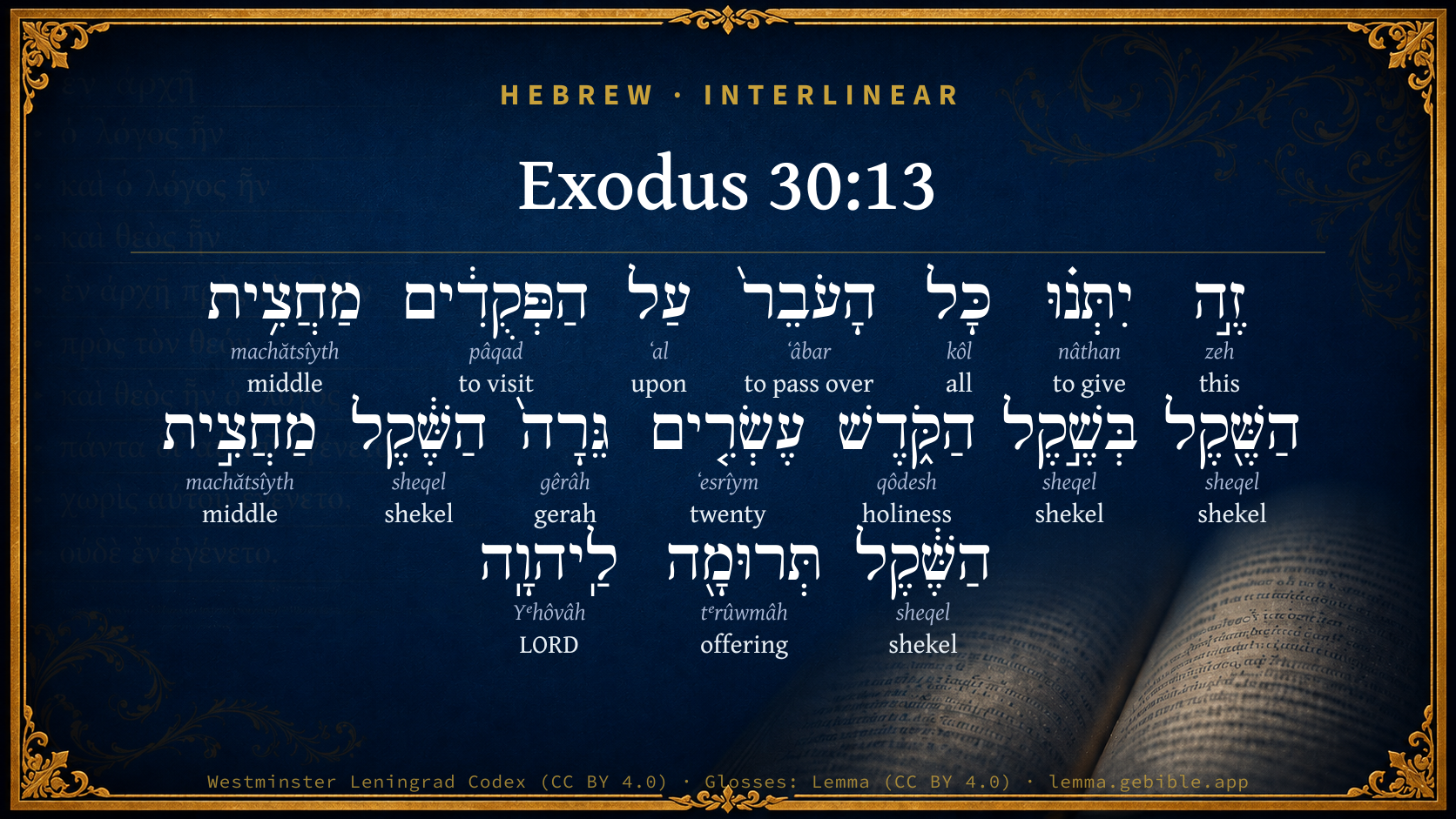
Hebrew (Westminster Leningrad Codex) Exodus 30:13 appears in the Hebrew Old Testament. The text above is from the Westminster Leningrad Codex. Each word links to its Strong’s number, a concise gloss, and parsing drawn from the Open Scriptures Hebrew Bible morphology. Click any word for its full Brown-Driver-Briggs (BDB) entry.
Download image
Cite this verse

Exodus 30:13 (World English Bible). Public Domain. Lemma interlinear Bible study tool, https://lemma.gebible.app/v/exodus/30/13.

Show BibTeX & RIS
BibTeX
RIS
English Translation
They shall give this, everyone who passes over to those who are numbered, half a shekel after the shekel of the sanctuary; (the shekel is twenty gerahs;) half a shekel for an offering to Yahweh.
World English Bible · Public Domain
Highlights
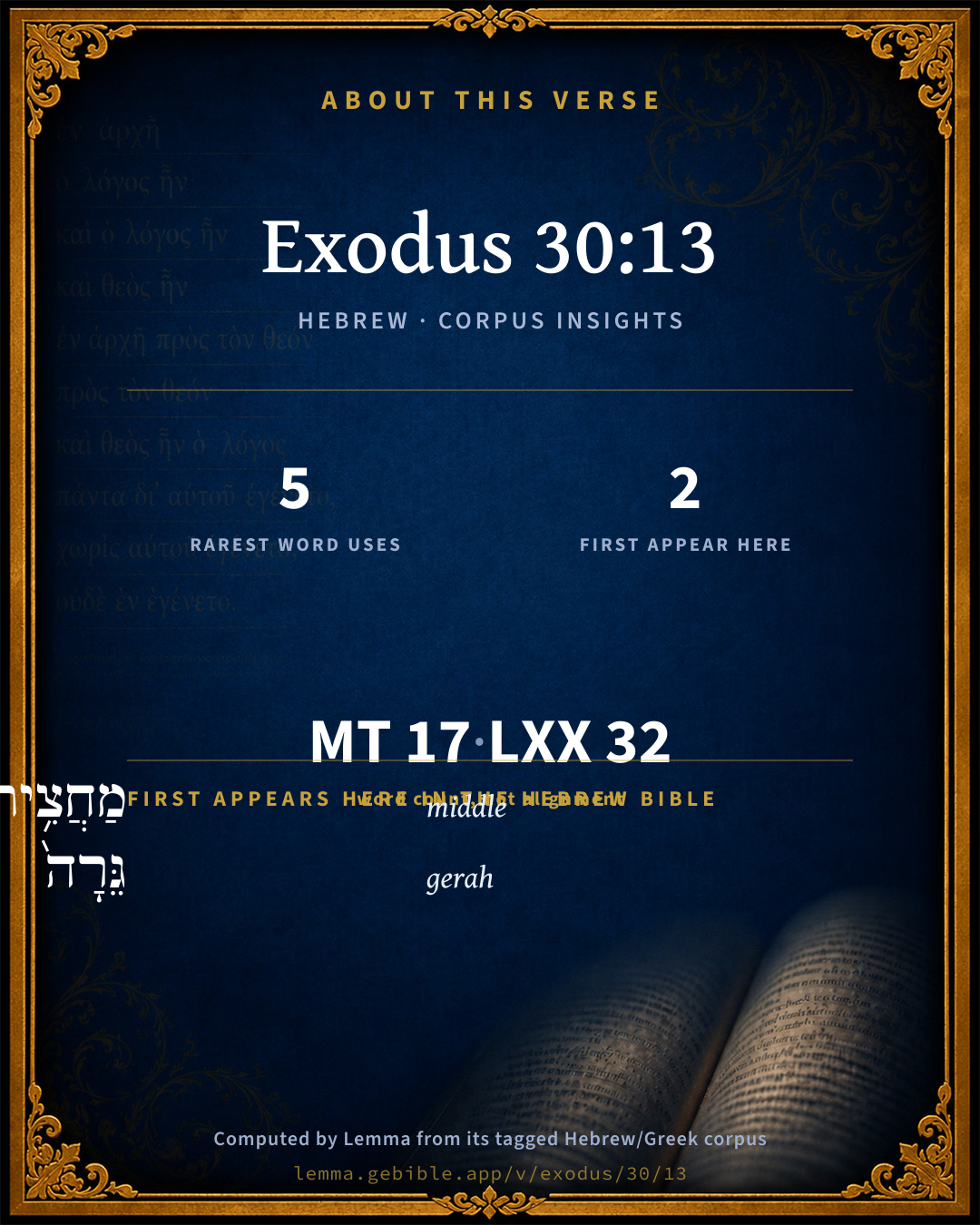
  • 2 first appearances in the Hebrew Bible
Full analysis ↓
Download a study sheet

One document with this verse’s original text, its word-by-word gloss line, the meaning frame, cross-references with their text, attributed commentary, and full source and license credits — printable, and it pastes into notes with its structure intact.

This verse Autodidact and up

Study sheet (.html) Plain text (.txt)

A passage Seminary Student

Up to 50 verses in one chapter. A passage sheet keeps up to 6 commentary sources and 12 cross-references per verse, in the order this page ranks them, and says so on the sheet whenever that leaves anything out. Ask for a single verse and you get the Autodidact verse sheet above.

Everything on this page stays free to read, with no account — the sheet is a download of what is already on screen, not access to it.

Want to remove ads? Support Godless Engineer
Compare translations 3

The same verse in 3 English versions, stacked beneath the original-language interlinear above. Click any original word for its lexicon entry.

Each is an independent rendering of the whole verse — the interlinear is not word-aligned to these translations.

Highlighted words mark where these versions differ — a whole-verse word diff, not a word-by-word alignment.

  • World English Bible Public Domain
    They shall give this, everyone who passes over to those who are numbered, half a shekel after the shekel of the sanctuary; (the shekel is twenty gerahs;) half a shekel for an offering to Yahweh.
  • King James Version Public Domain
    This they shall give, every one that passeth among them that are numbered, half a shekel after the shekel of the sanctuary: (a shekel is twenty gerahs:) an half shekel shall be the offering of the LORD.
  • unfoldingWord Literal Text CC BY-SA 4.0
    Every passer over to the counted ones shall give this: half of a shekel, according to the shekel of the sanctuary (the shekel is 20 gerahs). The half shekel is an offering to Yahweh.

unfoldingWord Literal Text — © unfoldingWord, licensed CC BY-SA 4.0. Word-aligned USFM3 via Door43 (git.door43.org/unfoldingWord/en_ult).

Versions to compare (up to 4)

3 of 4 selected

Show all 18 translations

Every available English version of this verse, each an independent rendering of the whole verse.

  • World English Bible Public Domain
    They shall give this, everyone who passes over to those who are numbered, half a shekel after the shekel of the sanctuary; (the shekel is twenty gerahs;) half a shekel for an offering to Yahweh.
  • Berean Standard Bible Public Domain
    Everyone who crosses over to those counted must pay a half shekel, according to the sanctuary shekel, which weighs twenty gerahs. This half shekel is an offering to the LORD.
  • Majority Standard Bible Public Domain
    Everyone who crosses over to those counted must pay a half shekel, according to the sanctuary shekel, which weighs twenty gerahs. This half shekel is an offering to the LORD.
  • King James Version Public Domain
    This they shall give, every one that passeth among them that are numbered, half a shekel after the shekel of the sanctuary: (a shekel is twenty gerahs:) an half shekel shall be the offering of the LORD.
  • American Standard Version (1901) Public Domain
    This they shall give, every one that passeth over unto them that are numbered, half a shekel after the shekel of the sanctuary; (the shekel is twenty gerahs;) half a shekel for an offering to Jehovah.
  • Revised Version (1885) Public Domain
    This they shall give, every one that passeth over unto them that are numbered, half a shekel after the shekel of the sanctuary: (the shekel is twenty gerahs:) half a shekel for an offering to the LORD.
  • Geneva Bible (1599) Public Domain
    This shall euery man giue, that goeth into the nomber, halfe a shekel, after the shekel of the Sanctuarie: (a shekel is twentie gerahs) the halfe shekel shalbe an offring to the Lord.
  • Douay-Rheims (1899) Public Domain
    And this shall every one give that passeth at the naming, half a sicle according to the standard of the temple. A sicle hath twenty obols. Half a sicle shall be offered to the Lord.
  • Young's Literal Translation Public Domain
    `This they do give, every one passing over unto those numbered, half a shekel, by the shekel of the sanctuary (the shekel `is' twenty gerahs); half a shekel `is' the heave-offering to Jehovah;
  • Literal Standard Version CC BY-SA 4.0
    This they give, everyone passing over to those numbered, half a shekel, by the shekel of the holy place (the shekel [is] twenty gerahs); half a shekel [is] the raised-offering to YHWH;
  • Unlocked Literal Bible CC BY-SA 4.0
    Everyone who is counted in the census is to pay half a shekel of silver, according to the weight of the shekel of the sanctuary (a shekel is the same as twenty gerahs). This half shekel will be an offering to Yahweh.
  • unfoldingWord Literal Text CC BY-SA 4.0
    Every passer over to the counted ones shall give this: half of a shekel, according to the shekel of the sanctuary (the shekel is 20 gerahs). The half shekel is an offering to Yahweh.
  • Darby Bible Public Domain
    This shall they give -- every one that passeth among them that are numbered -- half a shekel after the shekel of the sanctuary, -- twenty gerahs the shekel; a half shekel shall be the heave-offering for Jehovah.
  • World Messianic Bible Public Domain
    They shall give this, everyone who passes over to those who are counted, half a shekel according to the shekel of the sanctuary (the shekel is twenty gerahs ); half a shekel for an offering to the LORD.
  • Webster's Bible Public Domain
    This they shall give, every one that passeth among them that are numbered, half a shekel, after the shekel of the sanctuary: (a shekel is twenty gerahs:) a half shekel shall be the offering of the LORD.
  • Free Bible Version CC BY-SA 4.0
    Each one who crosses over to those counted must give a half shekel (using the sanctuary shekel standard, which weighs twenty gerahs). This half shekel is an offering to the Lord.
  • Bible in Basic English Public Domain
    And this is what they are to give; let every man who is numbered give half a shekel, by the scale of the holy place: (the shekel being valued at twenty gerahs:) this money is an offering to the Lord.
  • JPS Tanakh (1917) Public Domain
    This they shall give, every one that passeth among them that are numbered, half a shekel after the shekel of the sanctuary — the shekel is twenty gerahs — half a shekel for an offering to the LORD.

Literal Standard Version (2020), Covenant Press — licensed CC BY-SA 4.0. Text via the HelloAO Bible API (eBible.org). Unlocked Literal Bible (unfoldingWord) — licensed CC BY-SA 4.0. Text via the HelloAO Bible API (eBible.org). unfoldingWord Literal Text — © unfoldingWord, licensed CC BY-SA 4.0. Word-aligned USFM3 via Door43 (git.door43.org/unfoldingWord/en_ult). Free Bible Version, Dr. Jonathan Gallagher — licensed CC BY-SA 4.0. Text via the HelloAO Bible API (eBible.org).

Word by word

More ways to search: Search by grammar → Find every occurrence → Compare this word →

Practice this passage: Drill this verse → Learn its vocabulary →

גֵּרָה֙
gêrâh
H1626
“gerah”
Noun, Common, Feminine, Singular, Absolute
Part of Speech
Noun
Type
Common
Gender
Feminine
Number
Singular
State
Absolute
Full BDB Definition

Origin: from H1641 (as in H1625 )

TWOT: 386b

gerah, a weight, a 20th part of a shekel, equal to the weight of 16 barley grains or 4 to 5 carob beans
  1. זֶ֣ה zeh H2088 “this” Pronoun, Demonstrative, Masculine, Singular
  2. יִתְּנ֗וּ nâthan H5414 “to give” Verb, Qal, Imperfect, 3rd Person, Masculine, Plural
  3. כָּל kôl H3605 “all of” Noun, Common, Masculine, Singular, Construct
  4. הָעֹבֵר֙ ʻâbar H5674 “the · passing over” Particle, Definite Article + Verb, Qal, Participle Active, Masculine, Singular, Absolute
  5. עַל ʻal H5921 “upon” Preposition
  6. הַפְּקֻדִ֔ים pâqad H6485 “the · visited” Particle, Definite Article + Verb, Qal, Participle Passive, Masculine, Plural, Absolute
  7. מַחֲצִ֥ית machătsîyth H4276 “middle of” Noun, Common, Feminine, Singular, Construct
  8. הַשֶּׁ֖קֶל sheqel H8255 “the · shekel” Particle, Definite Article + Noun, Common, Masculine, Singular, Absolute
  9. בְּשֶׁ֣קֶל sheqel H8255 “in/at · shekel of” Preposition + Noun, Common, Masculine, Singular, Construct
  10. הַקֹּ֑דֶשׁ qôdesh H6944 “the · holiness” Particle, Definite Article + Noun, Common, Masculine, Singular, Absolute
  11. עֶשְׂרִ֤ים ʻesrîym H6242 “twenty” Adjective, Cardinal number, Both, Plural, Absolute
  12. הַשֶּׁ֔קֶל sheqel H8255 “the · shekel” Particle, Definite Article + Noun, Common, Masculine, Singular, Absolute
  13. מַחֲצִ֣ית machătsîyth H4276 “middle of” Noun, Common, Feminine, Singular, Construct
  14. הַשֶּׁ֔קֶל sheqel H8255 “the · shekel” Particle, Definite Article + Noun, Common, Masculine, Singular, Absolute
  15. תְּרוּמָ֖ה tᵉrûwmâh H8641 “offering” Noun, Common, Feminine, Singular, Absolute
  16. לַֽיהוָֽה Yᵉhôvâh H3068 “to/for · LORD” Preposition + Noun, Proper

About this verse

These counts appear in no published source. They are computed here, from the morphology-tagged text and Lemma’s own curated glosses. What Lemma adds →

17
words
13
distinct lemmas
Pentateuch
section

Notable vocabulary

The rarest word here is גֵּרָה֙ gerah H1626 — appearing just 5 times in the whole Hebrew Bible.

First appearance in Scripture

These words make their first canonical appearance in the Hebrew Bible here:

  • מַחֲצִ֥ית middle H4276
  • גֵּרָה֙ gerah H1626

Shared distinctive vocabulary

גֵּרָה֙ gerah H1626 occurs in 5 verses of the Hebrew Bible. Also found in:

Grammatical profile

  • 3 verbs
  • 11 nouns
  • 1 adjective
  • 1 pronoun
  • 1 preposition

Verb forms

  • יִתְּנ֗וּ Qal · Imperfect
  • הָעֹבֵר֙ Qal · Participle Active
  • הַפְּקֻדִ֔ים Qal · Participle Passive

Repetition

Words recur within this verse — often emphatic in Hebrew:

  • הַשֶּׁ֖קֶל shekel H8255 ×4
  • מַחֲצִ֥ית middle H4276 ×2

Hebrew & Septuagint length

In English translation the verse runs 35 words from the Hebrew and 43 from the Septuagint (LXX English) — closely comparable.

A rough comparison of the two English renderings, which tokenize alike — not a word-level alignment.

Word counts can differ between the Hebrew and the Greek without any difference in meaning — e.g. the Hebrew direct-object marker אֵת has no separate Greek word, and Greek often adds the article ὁ.

In the original languages it is 17 Hebrew tokens and 32 Greek tokens — but the two are counted differently (Hebrew bundles its prefixes and suffixes into one token; the Greek is in lemma form), so that isn’t a like-for-like length.

Cross-references

6

Topical passages linked to Exodus 30:13 in the Treasury of Scripture Knowledge — connected by theme and wording, ordered by reader-vote popularity; previews shown in the World English Bible.

  • Leviticus 27:25 All your valuations shall be according to the shekel of the sanctuary: twenty gerahs to the shekel.
  • Numbers 3:47 you shall take five shekels apiece for each one; after the shekel of the sanctuary you shall take them (the shekel is twenty gerahs):
  • Ezekiel 45:12 The shekel shall be twenty gerahs. Twenty shekels plus twenty-five shekels plus fifteen shekels shall be your mina.
  • Exodus 38:26 a beka a head, that is, half a shekel, after the shekel of the sanctuary, for everyone who passed over to those who were numbered, from twenty years old and upward, for six hundred three thousand five hundred fifty men.
  • Matthew 17:24 When they had come to Capernaum, those who collected the didrachma coins came to Peter, and said, "Doesn't your teacher pay the didrachma?"
  • Matthew 27:24 So when Pilate saw that nothing was being gained, but rather that a disturbance was starting, he took water, and washed his hands before the multitude, saying, "I am innocent of the blood of this righteous person. You see to it."

Cross-references courtesy of OpenBible.info (CC BY 4.0).

Hebrew and Greek witnesses Masoretic Hebrew ↔ Greek Septuagint

The same verse in the two great witnesses to the Old Testament, shown verse-for-verse.

These are two independent witnesses, not word-aligned to each other, and the Septuagint is shown in lemma (dictionary) form.

Hebrew Exodus 30:13 Masoretic · Westminster Leningrad Codex

זֶ֣ה יִתְּנ֗וּ כָּל הָעֹבֵר֙ עַל הַפְּקֻדִ֔ים מַחֲצִ֥ית הַשֶּׁ֖קֶל בְּשֶׁ֣קֶל הַקֹּ֑דֶשׁ עֶשְׂרִ֤ים גֵּרָה֙ הַשֶּׁ֔קֶל מַחֲצִ֣ית הַשֶּׁ֔קֶל תְּרוּמָ֖ה לַֽיהוָֽה

They shall give this, everyone who passes over to those who are numbered, half a shekel after the shekel of the sanctuary; (the shekel is twenty gerahs;) half a shekel for an offering to Yahweh.

World English Bible · Public Domain

Greek LXX Exodus 30:13 Septuagint · lemma form

καί οὗτος εἰμί ὅς δίδωμι ὅσος ἄν παραπορεύομαι ὁ ἐπίσκεψις ὁ ἥμισυς ὁ δίδραγμον ὅς εἰμί κατά ὁ δίδραγμον ὁ ἅγιος εἴκοσι ὀβολός ὁ δίδραγμον ὁ δέ ἥμισυς ὁ δίδραγμον εἰσφορά κύριος

And this is what they shall give, as many as pass the survey, half a didrachm which is according to the didrachm of the sanctuary: twenty oboli go to the didrachm, but the half of the didrachm is the offering to the Lord.

LXX2012 (modern English Septuagint) · Public Domain

On this verse, The Cambridge Bible for Schools and Colleges discusses the Septuagint’s reading. Read the note in Commentary ↓

Hebrew: Westminster Leningrad Codex (CC BY 4.0). Greek: Septuagint (public domain); English from LXX2012 (modern English Septuagint) (Public Domain). How the Septuagint differs from the Hebrew →

Targum (Aramaic paraphrase)

2

The Targum is the ancient Jewish Aramaic paraphrase of the Hebrew Scriptures — an interpretive translation, not the Hebrew text itself. Onkelos (literal) and Pseudo-Jonathan (expansive) render the Torah, and Jonathan the Prophets. Coverage is partial: where no permissively-licensed English translation exists for a verse, only the Aramaic is shown. This is verse-level text, not a word-by-word alignment to the Hebrew.

  1. Targum Onkelos Torah (Genesis–Deuteronomy)
    דֵין יִתְּנוּן כָּל דְעָבַר עַל מִנְיָנַיָּא פַּלְגוּת סִלְעָא בְּסִלְעֵי קוּדְשָׁא עֶסְרִין מָעִין סִלְעָא פַּלְגוּת סִלְעָא אַפְרָשׁוּתָא קֳדָם יְיָ:

    (no public-domain English translation for this verse)

    Targum Onkelos — Aramaic: “Onkelos Genesis” (public domain); “Onkelos Exodus” (public domain); “Onkelos Leviticus” (public domain); “Onkelos Numbers” (public domain); “Onkelos Deuteronomy” (public domain). English: “Sefaria Community Translation” (CC0 1.0 (public-domain dedication)); “J.W. Etheridge. The Targums of Onkelos and Jonathan Ben Uzziel on the Pentateuch. London: Longmans, Green, 1862” (public domain). Text via Sefaria.

  2. Targum Pseudo-Jonathan Torah (Genesis–Deuteronomy)
    דֵּין שִׁיעוּרָא אִיתְחַמֵי לְמשֶׁה בְּטַוְורָא הֵי כְדִינְרָא דְאֵשָׁא וְהֵיכְדֵין אָמַר לֵיהּ כְּדֵין יִנָּתְנוּן כָּל מַאן דְּעָבַר עַל מִנְיָנַיָא פַּלְגוּת סִילְעָא בְּסִילְעָא דְטַבְעָא דְקוּדְשָׁא עַשְרִין מָעִין סִילְעָא פַּלְגוּת סִילְעָא אַפְרָשׁוּתָא קֳדָם יְיָ

    This valuation was shown to Mosheh in the mountain as with a denarius of fire, and thus spake He to him: So shall every one who passeth to the numberment give a half shekel of the coin of the sanctuary: (a half shekel is twenty manin:) the half shekel is to be the separation before the Lord.

    Targum Pseudo-Jonathan — Aramaic: “Targum Jonathan on Genesis” (public domain); “Targum Jonathan on Exodus” (public domain); “Targum Jonathan on Leviticus” (public domain); “Targum Jonathan on Numbers” (public domain); “Targum Jonathan on Deuteronomy” (public domain). English: “The Targum of Jonathan ben Uzziel, trans. J. W. Etheridge, London, 1862” (public domain). Text via Sefaria.

Commentary

Notes on Exodus 30:13 from classic Christian and Jewish commentators (each source and its license shown beneath its notes). The classic Christian expositions comment on the surrounding passage and are grouped to its opening verse, so a note may address several verses; the Jewish commentaries on the Tanakh (Rashi and others) are per-verse, so they appear only where the commentator wrote on this verse.

Lemma curates 59 commentaries, every one of them public domain or Creative Commons licensed, each selected and text-cleaned for this edition rather than reprinted as found. About our sources →

Trapp's Complete Commentary

John Trapp

Exo 30:13 This they shall give, every one that passeth among them that are numbered, half a shekel after the shekel of the sanctuary: (a shekel [is] twenty gerahs:) an half shekel [shall be] the offering of the LORD.

Ver. 13. Half a shekel.] Towards the making of the tabernacle; and as an amercing himself for his sin, that subjected him to utter destruction. {Exo 30:15}

John Trapp, A Commentary or Exposition upon All the Books of the Old and New Testament (1647–1656) — public domain. Text from a community e-Sword module.

Geneva Bible (1599)

Geneva Bible translators

This shekel valued two common shekels: and the gerah valued about 12 pence after five shillings sterling the ounce of silver.

Geneva Bible (1599) marginal notes — public domain. Text via Bolls.life.

Adam Clarke's Commentary

Verse 13. Half a shekel] Each of the Israelites was ordered to give as a ransom for his soul (i.e., for his life) half a shekel, according to the shekel of the sanctuary. From this we may learn,

1. That the life of every man was considered as being forfeited to Divine justice.

2. That the redemption money given, which was doubtless used in the service of the sanctuary, was ultimately devoted to the use and profit of those who gave it.

3. That the standard by which the value of coin was ascertained, was kept in the sanctuary; for this appears to be the meaning of the words, after the shekel of the sanctuary.

4. The shekel is here said to be twenty gerahs. A gerah, according to Maimonides, weighed sixteen barleycorns, a shekel three hundred and twenty of pure silver. The shekel is generally considered to be equal in value to three shillings English; the redemption money, therefore, must be about one shilling and sixpence.

5. The rich were not to give more, the poor not to give less; to signify that all souls were equally precious in the sight of God, and that no difference of outward circumstances could affect the state of the soul; all had sinned, and all must be redeemed by the same price.

6. This atonement must be made that there might be no plague among them, intimating that a plague or curse from God must light on those souls for whom the atonement was not made.

7. This was to be a memorial unto the children of Israel, Ex 30:16, to bring to their remembrance their past deliverance, and to keep in view their future redemption.

8. St. Peter seems to allude to this, and to intimate that this mode of atonement was ineffectual in itself, and only pointed out the great sacrifice which, in the fulness of time, should be made for the sin of the world. "Ye know," says he, "that ye were not redeemed with corruptible things, as silver and gold, from your vain conversation received by tradition from your fathers; but with the precious blood of Christ, as of a lamb without blemish and without spot: who verily was foreordained before the foundation of the world," c.; 1Pe 1:18-20.

9. Therefore all these things seem to refer to Christ alone, and to the atonement made by his blood; and upon him who is not interested in this atonement, God's plagues must be expected to fall. Reader, acquaint now thyself with God and be at peace, and thereby good shall come unto thee.

Adam Clarke's Commentary on the Bible (1810–1826) — public domain. Text from a community e-Sword/MySword module.

Ellicott's Commentary for English Readers

(13) Half a shekel.—When shekels came to be coined, they were round pieces of silver, about the circumference of a shilling, but considerably thicker, and worth about 2s. 7 d. Of our money. Their average weight was about 220 grains troy. In Moses’s time coins were unknown, and a half-shekel was a small lump of silver, unstamped, weighing probably about 110 grains. The ransom of a soul was doubtless made thus light in order that the payment might not be felt practically as a burthen by any.

After the shekel of the sanctuary.—Without a standard laid up somewhere, weights and measures will always fluctuate largely. Even with a standard, they will practically vary considerably. The “shekel of the sanctuary” probably designates a standard weight kept carefully by the priests with the vessels of the sanctuary. All offerings were to be estimated by this shekel (Lev_27:25).

A shekel is twenty gerahs.—Rather, the shekel, i.e.; the shekel of the sanctuary is of this weight. A “gerah” was, literally, a bean, probably the bean of the carob or locust tree (Ceratonia siliqua), but became the name of a weight, just as our own “grain” did. It must have equalled about eleven grains troy.

A Bible Commentary for English Readers, edited by Charles John Ellicott (1878–1897) — public domain. Text from a community e-Sword module.

The Cambridge Bible for Schools and Colleges

gen. ed. J. J. S. Perowne

13. passeth over, &c.] viz. before the officer who took the census, to those that are numbered, and who stand on the other side. Cf. to ‘pass over’ (of sheep being numbered) Lev_27:32, Jer_33:13; and in 2Sa_2:15 Heb.

half] not the usual Heb. word for ‘half’; in the Hex, found only in P (11 times), and only 4 times elsewhere. So Exo_30:15; Exo_30:23, Exo_38:26.

the shekel of the sanctuary] Exo_38:24-26, Lev_5:15; Lev_27:3; Lev_27:25, Num_3:47; Num_3:50; Num_3:7 (14 times), Exo_18:16† (all P). Some standard (silver) ‘shekel’ is plainly alluded to: it is not known certainly what. A standard (silver) shekel, of full weight (as opposed to worn shekels in common use), preserved in the sanctuary, has been thought of. Or, as the expression may be rendered with equal, not to say, greater propriety, the sacred shekel (LXX. σίκλος ὁ ἅγιος), and as moreover the Mishnah (Bekhôrôth viii. 7) expressly enjoins that ‘all payments according to the sacred shekel are to be made in Tyrian (i.e. Phoenician) money,’ in which the silver shekel weighed 224 grs., it may (Kennedy, DB. iv. 422; G. F. Hill, EB. Shekel, § 5) denote the ancient Hebrew silver shekel (which had the same weight as the Phoenician silver shekel), called ‘sacred’ because it was the traditional standard by which sacred dues were paid (see further ll.cc.). A silver shekel of 224 grains would weigh just 6 grains more than an English half-crown: at the present value of silver (2 Samuel 3 d. an oz.) it would be worth about 1 Samuel 1 d.

the shekel is twenty gerahs] The same definition recurs Lev_27:25, Num_3:47; Num_18:16; and in Eze_45:12 (of his shekel, though not called ‘sacred’). The gçrâh (only in these passages) is rendered ὀβολὸς by LXX., and by Onk. mâ‘âh, also = an obol, the weight of which in 4–3 cent. b.c. was c. 11.21 grs.: this would make the ‘sacred’ shekel (=20 gçrâhs) c. 224.2 grs.

The later institution of an annual Temple-tax of a half-shekel (Mat_17:24 RV.: Gk. τὰ δίδραχμα, ‘the double drachm’) is based ultimately on this passage. The drachm was worth 6 obols: and the double drachm (= 12 obols) was taken as the equivalent of a half-shekel (= 10 obols): cf. DB. iii. 422b, 428b; EB. iv. 4446, 4786.

an offering] a contribution, Heb. terûmâh (see on Exo_25:2); here of a contribution levied on,—or, to preserve the figure of the original, taken off,—the whole of a man’s property for sacred purposes. So vv. 14, 15.

The Cambridge Bible for Schools and Colleges (gen. ed. J. J. S. Perowne; Cambridge University Press, 1878–1918) — public domain. Text from a community e-Sword module.

John Gill's Exposition

This they shall give, everyone that passeth among them that are numbered,.... And their number, according to Jarchi, was known by what was paid; for he says the sum was taken not by heads, but everyone gave the half shekel, and by counting them the number was known, as follows:

half a shekel after the shekel of the sanctuary; that is, after the standard of a shekel kept in the sanctuary as a rule for all; and so Jarchi paraphrases it,"according to the weight of a shekel, which I have fixed for thee to weigh, the shekel of the sanctuary.''It was about fourteen pence: a shekel is twenty gerahs; a gerah being the twentieth part of a shekel, it was not quite three halfpence of our money:

an half shekel shall be the offering of the Lord; which was to be offered to him for the ransom of souls, whose lives were forfeited by sin; and of the redemption of which this was an acknowledgment; and was typical of the ransom price of souls by Christ, which is not silver or gold, but his precious blood, his life, himself, which is given as an offering and sacrifice to God, in the room and stead of his people; and which is given to God, against whom sin is committed, the lawgiver, whose law is broken, the Judge, whose justice must be satisfied, and the creditor, to whom the price must be paid.

John Gill's Exposition of the Whole Bible (1746–1763) — public domain (CC PDM 1.0). Text via the HelloAO Bible API.

Haydock's Catholic Bible Commentary

Half a sicle. A sicle or shekel of silver, (which was also called a stater) according to the standard or weight of the sanctuary, which was the most just and exact, was half an ounce of silver; that is, about half a crown of English money. The obol, or gerah, was about three halfpence. (Challoner) --- A priest kept the weights and measures, 1 Paralipomenon xxiii. 29. The Egyptians and Romans took the like precaution to prevent any fraud; and Justinian required that such things should be kept in churches. Some have supposed, that the royal or common sicle was less than that of the sanctuary. But Moses admits of no distinction. (Leviticus xxvii. 25.; Ezechiel xiv. 12.) Perhaps the weights of the Egyptians, &c., might differ from this, which Moses therefore particularizes so well. (Calmet) --- Arbuthnot makes the weight of the sicle equal to 9 dwt. 2,57 gr. English Troy weight; and he values that of silver at 2s. 3,375d. sterling. (Haydock)

George Leo Haydock (1774–1849), Haydock's Catholic Family Bible and Commentary, 1859 edition — public domain. Excludes Psalms (Douay-Rheims chapter numbering differs from Protestant) and Deuterocanonical books (Catholic canon only).

Matthew Poole's English Annotations

The shekel of the sanctuary hath been commonly conceived to be double to the common shekel, yet divers late learned men seem more truly to judge that it was no more than the common shekel, consisting of half a crown of English money; which is called the shekel of the sanctuary, because the standard by which all shekels were to be examined was kept in the sanctuary, as afterwards the just weights and measures were kept in Christian temples, or other public places. See Lev 27:25; Num 3:47; Eze 45:10-12. Add to this, that it was a part of the priest’s office to look to the weights and measures, as plainly appears from 1Ch 23:29.

An half shekel shall be the offering; not less, lest it should be contemptible; nor more, lest it should be too burdensome for the poor.

Matthew Poole's English Annotations on the Holy Bible (1683–1685) — public domain. Text from a community e-Sword/MySword module.

Whedon's Commentary on the Bible

Daniel D. Whedon

13. Half a shekel — No large amount; perhaps about fifty cents of our currency. The exact weight of the silver shekel is no longer known. The shekel of the sanctuary is commonly supposed to have been larger and heavier than the common shekel. Gerah is the Hebrew name of a bean or berry, and like our word grain came to be used for a small weight.

Offering — תרומה, heave offering. See Exo_29:27.

Daniel D. Whedon (gen. ed.), Commentary on the Old and New Testaments (1874–1909) — public domain. Text from a community e-Sword module.

The Pulpit Commentary

Half a shekel. The shekel of later times was a silver coin, about the size round of our shilling, but considerably thicker, and worth about one shilling and eightpence. But at the date of the exodus coins were unknown, and the "shekel" meant a certain weight. The burthen imposed by the tax was evidently a light one. The shekel of the sanctuary. A standard weight in the possession of the priests, equal probably to about 220 grains troy. Twenty gerahs. The word "gerah "means" a bean;" and the gerah must bare been a weight equal to about eleven grains troy, It remained in use to the time of the captivity. (Eze_45:12)

The Pulpit Commentary (1880–1919), ed. H.D.M. Spence-Jones & Joseph S. Exell — public domain. Text from a community e-Sword module.

Scofield Reference Notes

C. I. Scofield

This they shall give

Cf. Exo 38:25-27. Silver thus becomes a type of redemption. (See Scofield "Exo 26:19").

The Scofield Reference Bible (1917 edition), notes by C. I. Scofield — public domain. Text from a community e-Sword module.

Rashi

Rabbi Shlomo Yitzchaki (Rashi)

זה יתנו THIS SHALL THEY GIVE — He (God) showed him (Moses) a kind of fiery coin the weight of which was half a shekel and said to him, “Like this shall they give” (Midrash Tanchuma, Ki Tisa 9).

העבר על הפקדים [EVERY ONE] THAT PASSETH AMONG THEM THAT ARE MUSTERED — Scripture uses the expression כל העבר על הפקדים instead of merely saying כל הפקדים because it is the practice of those who count animate beings to make these pass before them one after the other, counting them as they pass. Similar are: (Leviticus 27:32) “whatever passeth (יעבר) under the rod”; (Jeremiah 33:13) “the flock shall pass again (תעברנה) under the hands of him that counteth them”.

מחצית השקל בשקל הקדש THE HALF OF A SHEKEL AFTER THE SHEKEL OF HOLINESS – i. e. after the weight of the shekel which I have appointed for you as the standard by which to weigh the shekels used for sacred purposes, as, for instance, those shekels mentioned in the section dealing with estimating things dedicated to the Sanctuary and with “fields of possession” so dedicated (Leviticus ch. 27).

עשרים גרה השקל A SHEKEL IS TWENTY GERAHS — Having stated that it must be a holy shekel it now tells you exactly how much it is.

גרה in Hebrew denotes what is called a מעה, a coin of small value, in Aramaic. And in this sense we find it in the book of Samuel (I Samuel 2:36) “[every one that is left] shall come and crouch to him for a piece of (אגורת) silver and a morsel of bread” which the Targum renders by למעה דכסף.‎

עשרים גרה השקל A SHEKEL IS TWENTY GERAHS — For a full shekel is four zuz and a zuz was originally five meahs (consequently a shekel was twenty meahs or gerahs); only that they increased it (the zuz) by one sixth and so raised its value to six meahs of silver. Now THE HALF OF THIS (the original) SHEKEL of which I have spoken to you SHALL THEY GIVE AS A HEAVE OFFERING TO THE LORD.

Rashi on the Tanakh — English translations: “The Judaica Press complete Tanach with Rashi, translated by A. J. Rosenberg” (CC BY 4.0); “Pentateuch with Rashi's commentary by M. Rosenbaum and A.M. Silbermann, 1929-1934” (public domain); “The Metsudah Tanach series, Lakewood, N.J” (CC BY 4.0); and “The Book of Joshua, Metsudah Publications, 1997” (CC BY 4.0). Text via Sefaria.

Ramban (Nachmanides)

Rabbi Moshe ben Nachman (Ramban / Nachmanides)

HALF OF A SHEKEL AFTER THE SHEKEL OF HOLINESS. Moses our Teacher instituted a silver coin in Israel, for he was a great king. He called it “shekel” [literally: “weight”] because that whole coin was a perfect weight, it had nothing defective in it and the silver contained no dross. And since the standard shekel of Valuations and the redemption of the firstborn, which are holy matters, were given in that coin, as also all shekels mentioned in connection with the Tabernacle, and all moneys the amount of which is exactly specified in the Torah, therefore Scripture calls it the shekel of holiness.I hold that this is the same reason why our Rabbis call the language of the Torah “the Sacred Language,” because the words of the Torah, and the prophecies, and all words of holiness were all expressed in that language. It is thus the language in which the Holy One, blessed be He, spoke with His prophets, and with His congregation [when He said], — I am the Eternal thy G-d, etc. and Thou shalt have no other gods before Me, Verse 3, and Makkoth 23b. and the other communications of the Torah and prophecy — and in that tongue He is called by His sacred names: E-il, Elokim, Tze-baoth, Sha-dai, Ya-h, and the Great Proper Name [i.e., the Tetragrammaton]. In that tongue He created His world, and called the names shamayim (heavens), eretz (earth), Verse 10. and all that is in them, His angels and all His hosts — He called them all by name. The names of Michael and Gabriel are in this Sacred Language. ] signifies “who is like unto Thee, O G-d.” Gabriel [gabri E-il] means “my strength is from G-d.” In that language He called the names of the holy ones that are in the earth: Abraham,. Isaac, Verse 19: and thou shalt call his name Isaac [of the Hebrew root meaning “to laugh”]. Jacob, 25:26: and He called his name Jacob [“one that takes by the heel”], the word vayikra (and He called) referring to G-d (Rashi quoting the Midrash). Solomon,. and others..Now the Rabbi [Moshe ben Maimon] has written in the Moreh Nebuchim: “Do not think that our language is called the Sacred Language just as a matter of our pride, or it be an error on our part, but it is perfectly justified; for this holy language has no special names for the organs of generation in male or female, nor for semen, nor for urination or excretion, excepting in indirect language. Be not misled by the word sheigal [to take it to mean the act of intercourse; this is not the case,] but it rather denotes a female ready for intercourse. It says yishgalenah in accordance with what has been written on it, and it means that ‘he will take the woman as a concubine.’” ): “The most appropriate of the interpretations on it is that it is used in reference to a concubine.” Now there is no need for this reason [why Hebrew is called the Sacred Language], for it is clear that the Hebrew language is most holy, as I have explained. And the reason [Rabbi Moshe ben Maimon] mentioned is in my opinion not correct. The mere fact that [the masters of the Masorah] have circumscribed the word yishgalenah [to be read as] yishk’venah (he will lie with her), shows that the word mishgal is the term for sexual intercourse itself. Similarly the fact that they circumscribed the expression, to eat ‘et choreihem’ [to be read eth tzo’atam — “their dung”] shows that choreihem is an indecent term. And if the reason were indeed as the Rabbi [Moshe ben Maimon] has said, they should have called [the Hebrew language not “the Holy Language” but] “the modest langauge,” similarly to that which we have been taught [in a Mishnah]: “until he grows a beard — the lower one and not the upper one [is meant], except that the Sages spoke in modest language.” The Rabbis have further said: “Save the bread which he did eat, — this is a refined expression [for it refers to his wife],” and so also in many places.Now Scripture explained that the shekel is twenty gerahs, of silver. Onkelos translated gerahs as mo’ah, for the gerah was, in his opinion, a name for a coin which in Aramaic is called mo’ah. And so did Yonathan ben Uziel translate la’agorath keseph (a piece of silver): l’mo’ah d’chsaph (for a mo’ah of silver). So also did Onkelos translate after the shekel of holiness as sil’o, for such is the name of the [shekel] coin in Aramaic, and its measure is also known in the Talmud.Rashi wrote: 21:32. “A shekel weighs four gold coins, making half an ounce according to the correct weight of Cologne.” Now when the Rabbi [Rashi] found it clearly written in the Gemara that a [silver] sela [which is equivalent to the shekel] is four [silver] denars, he deduced [that a gold shekel is also equivalent to four gold denars], for the weight of the silver denars is as the weight of the gold denars. Thus he wrote in his commentary to the Gemara of Baba Kamma: “A [silver] denar weighs as much as a gold [denar], and in Constantinople they even call the gold coin denar.” All this is correct. But as to the Rabbi’s estimation, that in terms of the gold coins found in his generation and in our generation the shekel is equivalent to half an ounce, as he mentioned — that is not so, for the kings of the peoples have lessened [the weight of] the gold coins. We find it already mentioned in the words of the author of Hilchoth Gedoloth Note 70. and the first Gaonim, that the denar mentioned throughout the Talmud is the denar shashdang, and it is so written in Tractate Kiddushin in the Halachoth (Laws) of our Rabbi [Rabbi Yitzchak Alfasi] who said that “[the zuz is the same as a denar (ibid., zuz). shashdang] is the gold denar of the Arabs.” Now according to these estimations found in the words [of the Hilchoth Gedoloth and the Halachoth of Alfasi], the denars of the Talmud were larger than the gold coins current in our times by almost a third, and the shekel weighed three fourths of an ounce according to the weight of that country [and not as Rashi wrote that the shekel weighed four gold coins, making half an ounce etc.], and that is “the ounce” that the Rabbi [Rashi], of blessed memory, mentioned. Know that the shekels [mentioned in] the Torah are these s’laim [mentioned in the Talmud], each sela being four denars. But the shekel mentioned in the words of the Sages — such as that which we have been taught in a Mishnah: [“if a man lent his fellow money on a pledge, and the pledge was lost, and the borrower said,] ‘You have lent me a shekel on it and it was worth a sela [and therefore you owe me two denars],’ or [the lender said,] ‘I lent you a sela on it and it was worth a shekel [and therefore you still owe me two denars]’” — [this shekel] is two denars, half of a sela. The reason for this [change in the meaning of the term shekel — the shekel of the Torah being four denars whilst the shekel of the Sages is two denars], is that the people called the half-s’laim [which were each two denars] “shekels,” since they used them every year to pay the [half-] shekel to the Sanctuary. And so it was adopted by the Sages in the style of the Mishnah. Therefore a man would say to his friend, “You have lent me a shekel,” that is, the “shekel” which Israelites give to the Sanctuary., but since the Torah enjoined the giving of a half-shekel, that half-shekel came to be called “shekel,” as that was the coin the people gave yearly to the Sanctuary, and hence the Sages adopted the usage of that term — so that when people say “shekel” they really mean a coin worth two denars. It is possible that in the time of the Second Sanctuary they actually made a silver coin of two denars, so that it should be available to be given to the Temple treasurer, and they would not have to give an allowance [for exchanging the full shekel of the Torah into two half-shekels]. That coin they called “shekel,” and the shekel of Moses which is the shekel of the Torah they called sela, as Onkelos translated it. Some scholars say that the reason [they called the shekel of Moses sela] is because of what the Rabbis have said: “The maneh of the Sanctuary was double [as much as the common maneh],” and so also were all the coins. But this is not correct, for the [thirty] shekels that the owner of an ox who killed a slave must pay and the [fifty] shekels that the violator and seducer must pay, were not connected with the Sanctuary.

Ramban (Nachmanides) on the Tanakh — English translation: “Commentary on the Torah by Ramban (Nachmanides). Translated and annotated by Charles B. Chavel. New York, Shilo Pub. House, 1971-1976” (CC BY 4.0). Text via Sefaria.

Lesson kit

Teaching starters — assembled from the data on this page, not authored interpretation. Every prompt links to the verse data it draws on. Edit before teaching.

Exodus, in the Pentateuch, opens this verse with 17 words (13 distinct Hebrew lemmas). Its most distinctive word is gêrâh (“gerah”). A historical commentator’s framing appears above. Read the whole chapter for the surrounding context.

Discussion questions

  1. How does “gerah” (gêrâh) shape what this verse is saying?
  2. 2 words make their first appearance in Scripture here. What does this debut establish?
  3. How does Leviticus 27:25, which shares the word «gerah», read alongside this verse?
  4. What does the repetition of “shekel” (4× in this one verse) do in this verse?
  5. These translations render this verse differently; the difference is in the English rendering, not the original. What questions does that raise?
  6. «יִתְּנ֗וּ» is a Qal Imperfect verb. How does that grammatical form shape the action described?
  7. Compare how Trapp's Complete Commentary and Geneva Bible (1599) read this verse. Where do they agree or differ?

Things to notice

Reading settings

Reading text

Shown beneath each verse's original-language words.

Old Testament
Old Testament edition

Read the OT as the Masoretic Hebrew (MT) or the Greek Septuagint (LXX).

English shown for the Greek Septuagint (in the Hebrew ↔ Greek comparison).

Comparing translations? Open the Compare panel on any verse page to stack up to four side by side.