Leviticus 22:14

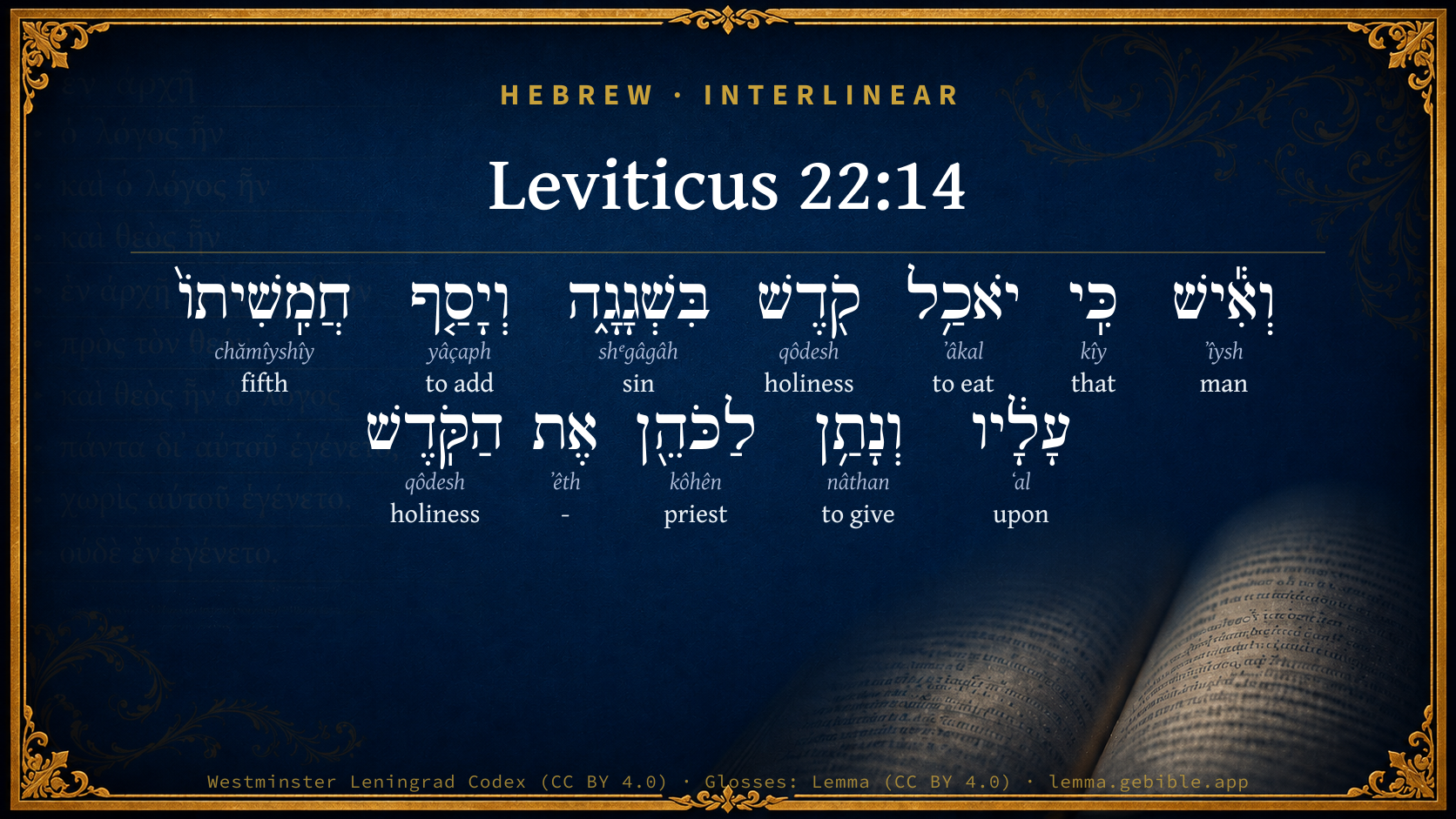
Hebrew (Westminster Leningrad Codex) Leviticus 22:14 appears in the Hebrew Old Testament. The text above is from the Westminster Leningrad Codex. Each word links to its Strong’s number, a concise gloss, and parsing drawn from the Open Scriptures Hebrew Bible morphology. Click any word for its full Brown-Driver-Briggs (BDB) entry.
Download image
Cite this verse

Leviticus 22:14 (World English Bible). Public Domain. Lemma interlinear Bible study tool, https://lemma.gebible.app/v/leviticus/22/14.

Show BibTeX & RIS
BibTeX
RIS
English Translation
"'If a man eats something holy unwittingly, then he shall add the fifth part of its value to it, and shall give the holy thing to the priest.
World English Bible · Public Domain
Download a study sheet

One document with this verse’s original text, its word-by-word gloss line, the meaning frame, cross-references with their text, attributed commentary, and full source and license credits — printable, and it pastes into notes with its structure intact.

This verse Autodidact and up

Study sheet (.html) Plain text (.txt)

A passage Seminary Student

Up to 50 verses in one chapter. A passage sheet keeps up to 6 commentary sources and 12 cross-references per verse, in the order this page ranks them, and says so on the sheet whenever that leaves anything out. Ask for a single verse and you get the Autodidact verse sheet above.

Everything on this page stays free to read, with no account — the sheet is a download of what is already on screen, not access to it.

Want to remove ads? Support Godless Engineer
Compare translations 3

The same verse in 3 English versions, stacked beneath the original-language interlinear above. Click any original word for its lexicon entry.

Each is an independent rendering of the whole verse — the interlinear is not word-aligned to these translations.

Highlighted words mark where these versions differ — a whole-verse word diff, not a word-by-word alignment.

  • World English Bible Public Domain
    "'If a man eats something holy unwittingly, then he shall add the fifth part of its value to it, and shall give the holy thing to the priest.
  • King James Version Public Domain
    And if a man eat of the holy thing unwittingly, then he shall put the fifth part thereof unto it, and shall give it unto the priest with the holy thing.
  • unfoldingWord Literal Text CC BY-SA 4.0
    And a man, when he eats a holy thing by mistake, then he shall add its fifth on it, and he shall give the holy thing to the priest.

unfoldingWord Literal Text — © unfoldingWord, licensed CC BY-SA 4.0. Word-aligned USFM3 via Door43 (git.door43.org/unfoldingWord/en_ult).

Versions to compare (up to 4)

3 of 4 selected

Show all 18 translations

Every available English version of this verse, each an independent rendering of the whole verse.

  • World English Bible Public Domain
    "'If a man eats something holy unwittingly, then he shall add the fifth part of its value to it, and shall give the holy thing to the priest.
  • Berean Standard Bible Public Domain
    If anyone eats a sacred offering in error, he must add a fifth to its value and give the sacred offering to the priest.
  • Majority Standard Bible Public Domain
    If anyone eats a sacred offering in error, he must add a fifth to its value and give the sacred offering to the priest.
  • King James Version Public Domain
    And if a man eat of the holy thing unwittingly, then he shall put the fifth part thereof unto it, and shall give it unto the priest with the holy thing.
  • American Standard Version (1901) Public Domain
    And if a man eat of the holy thing unwittingly, then he shall put the fifth part thereof unto it, and shall give unto the priest the holy thing.
  • Revised Version (1885) Public Domain
    And if a man eat of the holy thing unwittingly, then he shall put the fifth part thereof unto it, and shall give unto the priest the holy thing.
  • Geneva Bible (1599) Public Domain
    If a man eate of the holie thing vnwittingly, he shall put the fift part thereunto, and giue it vnto the Priest with the halowed thing.
  • Douay-Rheims (1899) Public Domain
    He that eateth of the sanctified things through ignorance, shall add the fifth part with that which he ate, and shall give it to the priest into the sanctuary.
  • Young's Literal Translation Public Domain
    `And when a man doth eat of a holy thing through ignorance, then he hath added its fifth part to it, and hath given `it' to the priest, with the holy thing;
  • Literal Standard Version CC BY-SA 4.0
    And when a man eats of a holy thing through ignorance, then he has added its fifth part to it, and has given [it] to the priest, with the holy thing;
  • Unlocked Literal Bible CC BY-SA 4.0
    If a man eats a holy food without knowing it, then he must repay the priest for it; he must add one-fifth to it and give it back to the priest.
  • unfoldingWord Literal Text CC BY-SA 4.0
    And a man, when he eats a holy thing by mistake, then he shall add its fifth on it, and he shall give the holy thing to the priest.
  • Darby Bible Public Domain
    And if a man eat of a holy thing through inadvertence, then he shall put the fifth part thereof unto it, and shall give it unto the priest with the holy thing.
  • World Messianic Bible Public Domain
    “‘If a man eats something holy unwittingly, then he shall add the fifth part of its value to it, and shall give the holy thing to the priest.
  • Webster's Bible Public Domain
    And if a man shall eat of the holy thing unknowingly, then he shall put to it the fifth part, and shall give it to the priest, with the holy thing.
  • Free Bible Version CC BY-SA 4.0
    Anyone who eats a holy offering by mistake must pay compensation by adding a fifth to its value, and give it all to the priest.
  • Bible in Basic English Public Domain
    And if a man takes the holy food in error, he will have to give the holy thing back to the priest, with the addition of a fifth part.
  • JPS Tanakh (1917) Public Domain
    And if a man eat of the holy thing through error, then he shall put the fifth part thereof unto it, and shall give unto the priest the holy thing.

Literal Standard Version (2020), Covenant Press — licensed CC BY-SA 4.0. Text via the HelloAO Bible API (eBible.org). Unlocked Literal Bible (unfoldingWord) — licensed CC BY-SA 4.0. Text via the HelloAO Bible API (eBible.org). unfoldingWord Literal Text — © unfoldingWord, licensed CC BY-SA 4.0. Word-aligned USFM3 via Door43 (git.door43.org/unfoldingWord/en_ult). Free Bible Version, Dr. Jonathan Gallagher — licensed CC BY-SA 4.0. Text via the HelloAO Bible API (eBible.org).

Word by word

More ways to search: Search by grammar → Find every occurrence → Compare this word →

Practice this passage: Drill this verse → Learn its vocabulary →

בִּשְׁגָגָ֑ה
shᵉgâgâh
H7684
“in/at · sin”
Preposition + Noun, Common, Feminine, Singular, Absolute
Part of Speech
Preposition + Noun
Type
Common
Gender
Feminine
Number
Singular
State
Absolute
Full BDB Definition

Origin: from H7683

TWOT: 2324a

sin, sin of error or inadvertence, inadvertent sin - error
  1. וְאִ֕ישׁ ʼîysh H376 “and · man” Conjunction + Noun, Common, Masculine, Singular, Absolute
  2. כִּֽי kîy H3588 “that” Conjunction
  3. יֹאכַ֥ל ʼâkal H398 “to eat” Verb, Qal, Imperfect, 3rd Person, Masculine, Singular
  4. קֹ֖דֶשׁ qôdesh H6944 “holiness” Noun, Common, Masculine, Singular, Absolute
  5. וְיָסַ֤ף yâçaph H3254 “and · to add” Conjunction + Verb, Qal, Sequential Perfect, 3rd Person, Masculine, Singular
  6. חֲמִֽשִׁיתוֹ֙ chămîyshîy H2549 “fifth · his” Noun, Common, Feminine, Singular, Construct + Suffix, Personal, 3rd Person, Masculine, Singular
  7. עָלָ֔יו ʻal H5921 “upon · him” Preposition + Suffix, Personal, 3rd Person, Masculine, Singular
  8. וְנָתַ֥ן nâthan H5414 “and · to give” Conjunction + Verb, Qal, Sequential Perfect, 3rd Person, Masculine, Singular
  9. לַכֹּהֵ֖ן kôhên H3548 “to/for the · priest” Preposition, Determined + Noun, Common, Masculine, Singular, Absolute
  10. אֶת ʼêth H853 “-” Particle, Direct Object
  11. הַקֹּֽדֶשׁ qôdesh H6944 “the · holiness” Particle, Definite Article + Noun, Common, Masculine, Singular, Absolute

About this verse

These counts appear in no published source. They are computed here, from the morphology-tagged text and Lemma’s own curated glosses. What Lemma adds →

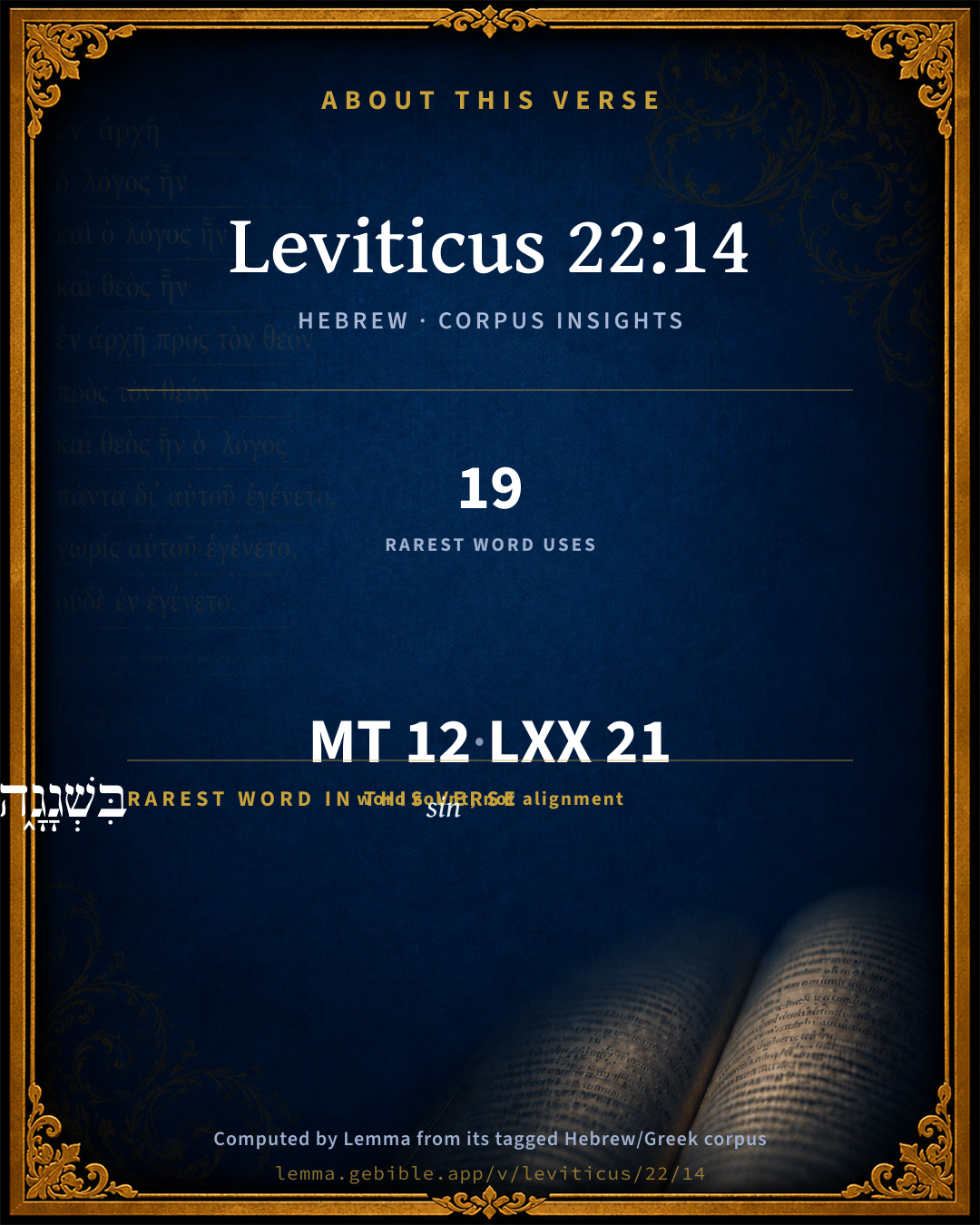
12
words
11
distinct lemmas
Pentateuch
section

Notable vocabulary

The rarest word here is בִּשְׁגָגָ֑ה sin H7684 — appearing just 19 times in the whole Hebrew Bible.

Shared distinctive vocabulary

בִּשְׁגָגָ֑ה sin H7684 occurs in 18 verses of the Hebrew Bible. Also found in:

Grammatical profile

  • 3 verbs
  • 6 nouns
  • 1 preposition
  • 1 conjunction
  • 1 particle

Verb forms

  • יֹאכַ֥ל Qal · Imperfect
  • וְיָסַ֤ף Qal · Sequential Perfect
  • וְנָתַ֥ן Qal · Sequential Perfect

Repetition

A word recurs within this verse — often emphatic in Hebrew:

  • קֹ֖דֶשׁ holiness H6944 ×2

Hebrew & Septuagint length

In English translation the verse runs 28 words from the Hebrew and 24 from the Septuagint (LXX English) — closely comparable.

A rough comparison of the two English renderings, which tokenize alike — not a word-level alignment.

Word counts can differ between the Hebrew and the Greek without any difference in meaning — e.g. the Hebrew direct-object marker אֵת has no separate Greek word, and Greek often adds the article ὁ.

In the original languages it is 12 Hebrew tokens and 21 Greek tokens — but the two are counted differently (Hebrew bundles its prefixes and suffixes into one token; the Greek is in lemma form), so that isn’t a like-for-like length.

Cross-references

3

Topical passages linked to Leviticus 22:14 in the Treasury of Scripture Knowledge — connected by theme and wording, ordered by reader-vote popularity; previews shown in the World English Bible.

  • Leviticus 27:13 But if he will indeed redeem it, then he shall add the fifth part of it to its valuation.
  • Leviticus 27:15 If he who dedicates it will redeem his house, then he shall add the fifth part of the money of your valuation to it, and it shall be his.
  • Leviticus 5:15–19 "If anyone commits a trespass, and sins unwittingly, in the holy things of Yahweh; then he shall bring his trespass offering to Yahweh, a ram without blemish from the flock, according to your estimation in silver by shekels, after the shekel of the sanctuary, for a trespass offering.

Cross-references courtesy of OpenBible.info (CC BY 4.0).

Hebrew and Greek witnesses Masoretic Hebrew ↔ Greek Septuagint

The same verse in the two great witnesses to the Old Testament, shown verse-for-verse.

These are two independent witnesses, not word-aligned to each other, and the Septuagint is shown in lemma (dictionary) form.

Hebrew Leviticus 22:14 Masoretic · Westminster Leningrad Codex

וְאִ֕ישׁ כִּֽי יֹאכַ֥ל קֹ֖דֶשׁ בִּשְׁגָגָ֑ה וְיָסַ֤ף חֲמִֽשִׁיתוֹ֙ עָלָ֔יו וְנָתַ֥ן לַכֹּהֵ֖ן אֶת הַקֹּֽדֶשׁ

"'If a man eats something holy unwittingly, then he shall add the fifth part of its value to it, and shall give the holy thing to the priest.

World English Bible · Public Domain

Greek LXX Leviticus 22:14 Septuagint · lemma form

καί ἄνθρωπος ὅς ἄν ἐσθίω ἅγιος κατά ἄγνοια καί προςτίθημι ὁ ἐπίπεμπτος αὐτός ἐπί αὐτός καί δίδωμι ὁ ἱερεύς ὁ ἅγιος

And the man who shall ignorantly eat holy things, shall add the fifth part to it, and give the holy thing to the priest.

LXX2012 (modern English Septuagint) · Public Domain

On this verse, Haydock's Catholic Bible Commentary discusses the Septuagint’s reading. Read the note in Commentary ↓

Hebrew: Westminster Leningrad Codex (CC BY 4.0). Greek: Septuagint (public domain); English from LXX2012 (modern English Septuagint) (Public Domain). How the Septuagint differs from the Hebrew →

Targum (Aramaic paraphrase)

2

The Targum is the ancient Jewish Aramaic paraphrase of the Hebrew Scriptures — an interpretive translation, not the Hebrew text itself. Onkelos (literal) and Pseudo-Jonathan (expansive) render the Torah, and Jonathan the Prophets. Coverage is partial: where no permissively-licensed English translation exists for a verse, only the Aramaic is shown. This is verse-level text, not a word-by-word alignment to the Hebrew.

  1. Targum Onkelos Torah (Genesis–Deuteronomy)
    וּגְבַר אֲרֵי יֵיכוּל קוּדְשָׁא בְּשָׁלוּ וְיוֹסֵף חוּמְשֵׁהּ עֲלוֹהִי וְיִתֵּן לְכַהֲנָא יָת קוּדְשָׁא

    (no public-domain English translation for this verse)

    Targum Onkelos — Aramaic: “Onkelos Genesis” (public domain); “Onkelos Exodus” (public domain); “Onkelos Leviticus” (public domain); “Onkelos Numbers” (public domain); “Onkelos Deuteronomy” (public domain). English: “Sefaria Community Translation” (CC0 1.0 (public-domain dedication)); “J.W. Etheridge. The Targums of Onkelos and Jonathan Ben Uzziel on the Pentateuch. London: Longmans, Green, 1862” (public domain). Text via Sefaria.

  2. Targum Pseudo-Jonathan Torah (Genesis–Deuteronomy)
    וּגְבַר יִשְרָאֵל אֲרוּם יֵיכוּל קוּדְשָׁא בְּשָׁלוּ וְיוֹסֵף חוֹמֶשׁ דְמוֹי עֲלוֹי וְיִתֵּן לְכַהֲנָא יַת קוּדְשָׁא

    And if a man of Israel eat that which is consecrated unknowingly, let him add a fifth part of its value to it, and give the (price of the) holy thing unto the priest.

    Targum Pseudo-Jonathan — Aramaic: “Targum Jonathan on Genesis” (public domain); “Targum Jonathan on Exodus” (public domain); “Targum Jonathan on Leviticus” (public domain); “Targum Jonathan on Numbers” (public domain); “Targum Jonathan on Deuteronomy” (public domain). English: “The Targum of Jonathan ben Uzziel, trans. J. W. Etheridge, London, 1862” (public domain). Text via Sefaria.

Commentary

Notes on Leviticus 22:14 from classic Christian and Jewish commentators (each source and its license shown beneath its notes). The classic Christian expositions comment on the surrounding passage and are grouped to its opening verse, so a note may address several verses; the Jewish commentaries on the Tanakh (Rashi and others) are per-verse, so they appear only where the commentator wrote on this verse.

Lemma curates 59 commentaries, every one of them public domain or Creative Commons licensed, each selected and text-cleaned for this edition rather than reprinted as found. About our sources →

Trapp's Complete Commentary

John Trapp

Lev 22:14 And if a man eat [of] the holy thing unwittingly, then he shall put the fifth [part] thereof unto it, and shall give [it] unto the priest with the holy thing.

Ver. 14. {See Trapp on "Lev 22:10"}

John Trapp, A Commentary or Exposition upon All the Books of the Old and New Testament (1647–1656) — public domain. Text from a community e-Sword module.

Joseph Benson's Commentary

Lev 22:14. The fifth part unto it — Over and above the principal, and besides the ram to be offered to God, Lev 5:15. And shall give unto the priest the holy thing — That is, the worth of it, which the priest was either to take to himself or to offer to God, as the nature of the thing was.

Joseph Benson's Commentary on the Old and New Testaments (1811–1818) — public domain. Text from a community e-Sword module.

Tyndale Open Study Notes

Tyndale Open Resources

22:14-16 Similar to provisions for the guilt offering, a common person who accidentally ate the priestly portion had to repay 120 percent (see 5:14-16). However, the offering of a ram was not required in this case.

Tyndale Open Study Notes — © Tyndale Open Resources, licensed CC BY-SA 4.0. Text via the HelloAO Bible API.

Geneva Bible (1599)

Geneva Bible translators

He shall give that and a fifth part over.

Geneva Bible (1599) marginal notes — public domain. Text via Bolls.life.

Jamieson, Fausset & Brown

Robert Jamieson, A. R. Fausset & David Brown

if a man eat of the holy thing unwittingly--A common Israelite might unconsciously partake of what had been offered as tithes, first-fruits, &c., and on discovering his unintentional error, he was not only to restore as much as he had used, but be fined in a fifth part more for the priests to carry into the sanctuary.

Jamieson, Fausset & Brown — Commentary Critical and Explanatory on the Whole Bible (1871) — public domain (CC PDM 1.0). Text via the HelloAO Bible API.

Adam Clarke's Commentary

Verse 14. Then he shall put the fifth part thereof unto it] The holy thing of which he has unknowingly eaten shall be fairly valued, and to this value he shall add one fifth more, and give the whole to the priest.

Adam Clarke's Commentary on the Bible (1810–1826) — public domain. Text from a community e-Sword/MySword module.

Ellicott's Commentary for English Readers

(14) Eat of the holy thing unwittingly.—Or, through ignorance, as it is rendered in the Authorised version in all the other five passages where this expression occurs in this book. (See Lev_4:2; Lev_4:22; Lev_4:27; Lev_5:15; Lev_5:18.) That is, when he ate of the things he was ignorant that they were holy.

He shall put the fifth part thereof unto it.—To make the people more careful, the offender though ignorant of the offence at the time when he committed it, had to pay the fifth part of the value of the holy property which he had eaten, in addition to the principal. For the way in which this was estimated see Lev_5:16.

And shall give it unto the priest with the holy thing.—Better, And shall give back the holy thing to the priest. “Holy thing” denotes here the equivalent of the holy thing which he has eaten. This he has to return to the priest with the fifth part. As eating holy things through ignorance was not so great an offence as withholding them altogether, or not delivering them up, restitution with a small fine was deemed a sufficient caution, whilst the case of ignorantly keeping them back was more serious, and hence the offender had also to bring a trespass offering. (See Lev_5:14-17.)

A Bible Commentary for English Readers, edited by Charles John Ellicott (1878–1897) — public domain. Text from a community e-Sword module.

The Cambridge Bible for Schools and Colleges

gen. ed. J. J. S. Perowne

14. unwittingly] Cp. Lev_4:2. We are reminded by the directions here (‘the fifth part’ to be added) of ch. Lev_5:14-16; but the case there is quite different. It had to do with unintentionally keeping back from the Lord His dues. Here the man has unwittingly eaten of consecrated food, although not belonging to those who, in accordance with the preceding regulations, were privileged in that respect. The penalty in the former case was naturally a heavier one, viz. a Guilt-Offering.

The Cambridge Bible for Schools and Colleges (gen. ed. J. J. S. Perowne; Cambridge University Press, 1878–1918) — public domain. Text from a community e-Sword module.

John Gill's Exposition

And if a man eat of the holy thing unwittingly,.... Either not knowing that it is an holy thing, or the heave offering, or any thing of that kind; or else is ignorant of the punishment of such an action, as Gersom observes; and this is to be understood of any man that was not a priest, or was not of the priest's family, even any common Israelite; so the Targum of Jonathan, a man of Israel, or an Israelite, one of the common people:

then he shall put a fifth part thereof unto it; a fifth part of the value of what he has eaten, to an equivalent for the whole, that is, he shall pay the full value for what he has eaten, and a fifth part besides:

and shall give it to the priest with the holy thing; the meaning is, that he shall give the fifth part to the priest, with the equivalent for what he has eaten; for he could not give the holy thing itself, but a compensation for it; according to Gersom, he was to give the principal to the priest, whose the holy thing was he ate of, and the fifth part he might give to what priest he would. The Jewish canon, concerning this matter, runs thus; he that ignorantly eats the heave offering pays the principal, and the fifth part; and the same, either he that eats, or drinks, or anoints; and whether the heave offering be clean or unclean, he pays the fifth, and the fifth of the fifth; and he does not pay the heave offering but of common things, rightly ordered, and they become an heave offering, and the compensation of it; and if the priest would forgive, he may not (p).

(p) Misn. Trumot, c. 6. sect. 1.

John Gill's Exposition of the Whole Bible (1746–1763) — public domain (CC PDM 1.0). Text via the HelloAO Bible API.

Albert Barnes' Notes on the Bible

Unwittingly - Inadvertently, or “through ignorance.” Compare Lev 4:2 note.

Albert Barnes' Notes on the Bible (1834–1885) — public domain. Text from a community e-Sword/MySword module.

Haydock's Catholic Bible Commentary

He. A layman, who, through mistake, eat of any of the tithes, &c., was obliged to give the capital, and a fifth part besides, with a sacrifice, mentioned [in] chap. v. 15. --- Sanctuary. Hebrew and Septuagint, "He shall give to the priest the holy thing." But if he ate it on purpose, he was to be slain, Numbers xv. 30.

George Leo Haydock (1774–1849), Haydock's Catholic Family Bible and Commentary, 1859 edition — public domain. Excludes Psalms (Douay-Rheims chapter numbering differs from Protestant) and Deuterocanonical books (Catholic canon only).

Matthew Poole's English Annotations

The fifth part, over and above the principal, and besides the ram to be offered to God, Lev 5:15.

Shall give it unto the priest with the holy thing; or, and shall give unto the priest the holy thing; i.e. the worth of it, which the priest was either to take to himself or offer to God, as the nature of the thing was.

Matthew Poole's English Annotations on the Holy Bible (1683–1685) — public domain. Text from a community e-Sword/MySword module.

Whedon's Commentary on the Bible

Daniel D. Whedon

14-16. Unwittingly — See Lev_4:2, note.

The fifth part — To inspire caution in dealing with holy things, the innocent offender was liable to a fine, the amount of which was to be estimated by the priest, who was to value the thing eaten and then add a fifth.

Not profane — The priests are required not to allow improper persons to eat the holy things, and thus cause the people to bear the iniquity of trespass. It may be that the priests are intended instead of the people, for the Hebrew is ambiguous. See Lev_10:17; Num_9:13, notes.

Daniel D. Whedon (gen. ed.), Commentary on the Old and New Testaments (1874–1909) — public domain. Text from a community e-Sword module.

The Pulpit Commentary

As the sacrificial meals made a part of the stipends of the priestly body, any one who inadvertently took a share in them by eating of the holy thing unwittingly, when he had no right to do so, had to refund the value of the meat, with one fifth, that is, twenty percent, added to it. He thus acknowledged that he had "committed a trespass in the holy things of the Lord," the case falling under the rule given in Lev_5:15, Lev_5:16, "And he shall make amends for the harm that he hath done in the holy thing, and shall add the fifth part thereto, and give it unto the priest." In the fifth chapter a trespass offering of a ram is also ordered, which, though not specified, is probably understood here also.

The Pulpit Commentary (1880–1919), ed. H.D.M. Spence-Jones & Joseph S. Exell — public domain. Text from a community e-Sword module.

John Wesley's Explanatory Notes

Unto it - Over and above the principle, and besides the ram to be offered to God, chap. v, 15. And shall give unto the priest the holy thing - That is, the worth of it, which the priest was either to take to himself or to offer to God, as the nature of the thing was.

John Wesley, Explanatory Notes Upon the Whole Bible (1754–1765) — public domain. Text via the GEBible commentary corpus.

unfoldingWord translationNotes

Door43 World Missions Community

he must repay the priest for it; he must add one-fifth to it

Possible meanings are 1) that the person had to replace the food that he had eaten with the same kind of food or 2) that the person had to pay money to the priest for the food that he had eaten.

one-fifth

This is one part out of five equal parts. (See: Fractions)

that they have raised high and presented

The phrase "raised high" refers to a symbolic gesture of respect that represents offering something to Yahweh. It means basically the same thing as "presented." AT: "that they have offered" (See: Symbolic Action and Doublet)

cause themselves to carry the sin that would make them guilty

Sin is spoken of as if it were an object that people can carry. Possible meanings are 1) they would be responsible for the sin and so become guilty. AT: "they would be guilty for the sin that they committed" or 2) the word "sin" is a metonym for punishment for the sin that they committed. AT: "they would receive the punishment because they are guilty" (See: Metaphor and Metonymy)

translationWords

people group

Israel

dishonor

raise

Yahweh

sin

guilt

holy

unfoldingWord translationNotes — © Distant Shores Media and the Door43 World Missions Community, licensed CC BY-SA 4.0. Source: git.door43.org/Door43/en_tn.

Rashi

Rabbi Shlomo Yitzchaki (Rashi)

כי יאכל קדש AND IF [A MAN] EAT OF HOLY THINGS — the heave-offering.

ונתן לכהן את הקדש THEN SHALL HE GIVE UNTO THE PRIEST THE קדש — i. e. a thing capable of becoming קדש, thus implying that he does not pay him money but fruits of a non-sacred character (חולין), which then become תרומה (cf. Sifra, Emor, Chapter 6 5; Pesachim 32b).

Rashi on the Tanakh — English translations: “The Judaica Press complete Tanach with Rashi, translated by A. J. Rosenberg” (CC BY 4.0); “Pentateuch with Rashi's commentary by M. Rosenbaum and A.M. Silbermann, 1929-1934” (public domain); “The Metsudah Tanach series, Lakewood, N.J” (CC BY 4.0); and “The Book of Joshua, Metsudah Publications, 1997” (CC BY 4.0). Text via Sefaria.

Ramban (Nachmanides)

Rabbi Moshe ben Nachman (Ramban / Nachmanides)

AND IF A MAN EAT OF THE HOLY THING (the heave-offering) which is given to the priest from the produce of the Land. THROUGH ERROR, THEN HE SHALL ADD ITS FIFTH PART UNTO IT, AND SHALL GIVE UNTO THE PRIEST THE HOLY THING. “He must give him a thing which is capable of becoming holy [like the original holy food of the priest that he ate, thus teaching] that he is not to pay him money, but fruits of a non-holy status, which then become terumah (a heave-offering).” This is Rashi’s language. Thus the explanation of the verse is as follows: “A man that eats the holy thing [i.e., the heave-offering which belongs to the priest], must add the fifth of that holy thing to it, and give to the priest this holy thing which is its original value and the added fifth.” And since Scripture called it [the restitution] kodesh (holy thing), we deduce that it becomes as the original heave-offering [which he ate in error, and that it must therefore be] something which is capable of so becoming [namely fruits, but not money]. This is the correct explanation according to both the plain meaning of Scripture and the [Rabbinical] interpretation thereof. So also did Rabbi Abraham ibn Ezra comment: “And he shall give unto the priest ‘eth’ the holy thing, means ‘with’ the holy thing [i.e., he is to give the priest its original value with the added fifth, all in fruits]. Or it may that the word v’nathan (and he shall give) draws along with it a similar word, and the sense of the verse is thus: ‘then he shall add its fifth part to it and shall give unto the priest, and he shall give unto the priest the holy thing.’ But in my opinion [so continues Ibn Ezra], there is no need [for both interpretations] because of the word alav (to it).”,’ it implies already that it is in addition to the original value of the heave-offering he ate which he must return to the priest. There is therefore no need any longer to interpret and he shall give unto the priest ‘eth’ the holy thing as meaning “with” the holy thing, since this has already been mentioned above, and instead we interpret the word eth in its normal way, namely, the mark of the accusative case. By the same token of reasoning, the second interpretation mentioned in the text [that the word v’nathan draws along with it a similar word] also becomes unnecessary, since the word alav (to it) clearly indicates that he is to give both the original value and the added fifth to the priest.

Ramban (Nachmanides) on the Tanakh — English translation: “Commentary on the Torah by Ramban (Nachmanides). Translated and annotated by Charles B. Chavel. New York, Shilo Pub. House, 1971-1976” (CC BY 4.0). Text via Sefaria.

Lesson kit

Teaching starters — assembled from the data on this page, not authored interpretation. Every prompt links to the verse data it draws on. Edit before teaching.

Leviticus, in the Pentateuch, opens this verse with 12 words (11 distinct Hebrew lemmas). Its most distinctive word is shᵉgâgâh (“sin”). A historical commentator’s framing appears above. Read the whole chapter for the surrounding context.

Discussion questions

  1. How does “sin” (shᵉgâgâh) shape what this verse is saying?
  2. How does Leviticus 4:2, which shares the word «sin», read alongside this verse?
  3. What does the repetition of “holiness” (2× in this one verse) do in this verse?
  4. The translations on this page render this verse differently — a whole-verse word diff, not a word-by-word alignment. What might account for the different wordings?
  5. «יֹאכַ֥ל» is a Qal Imperfect verb. How does that grammatical form shape the action described?
  6. Compare how Trapp's Complete Commentary and Joseph Benson's Commentary read this verse. Where do they agree or differ?

Things to notice

Reading settings

Reading text

Shown beneath each verse's original-language words.

Old Testament
Old Testament edition

Read the OT as the Masoretic Hebrew (MT) or the Greek Septuagint (LXX).

English shown for the Greek Septuagint (in the Hebrew ↔ Greek comparison).

Comparing translations? Open the Compare panel on any verse page to stack up to four side by side.