Exodus 31:10

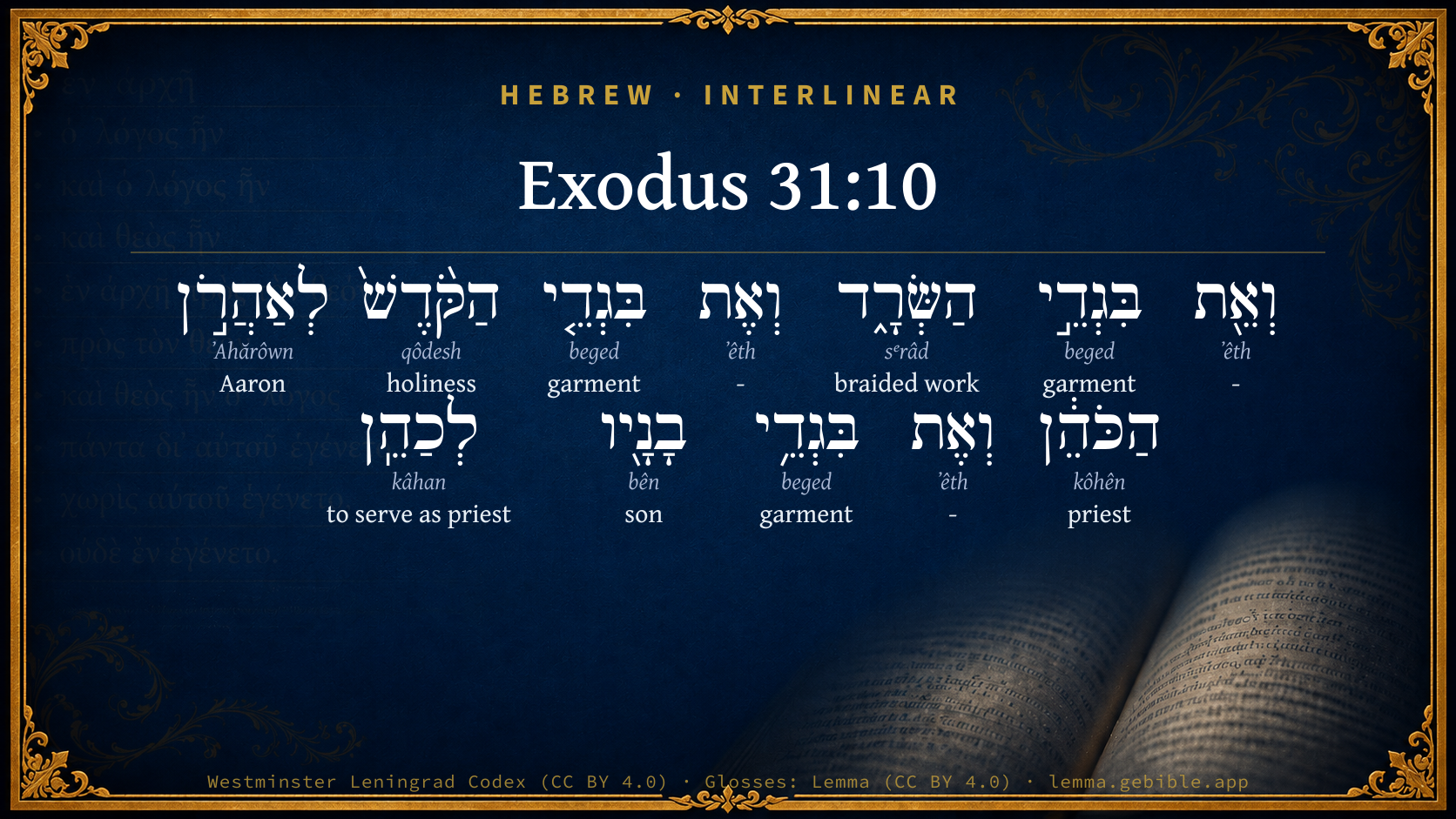
Hebrew (Westminster Leningrad Codex) Exodus 31:10 appears in the Hebrew Old Testament. The text above is from the Westminster Leningrad Codex. Each word links to its Strong’s number, a concise gloss, and parsing drawn from the Open Scriptures Hebrew Bible morphology. Click any word for its full Brown-Driver-Briggs (BDB) entry.
Download image
Cite this verse

Exodus 31:10 (World English Bible). Public Domain. Lemma interlinear Bible study tool, https://lemma.gebible.app/v/exodus/31/10.

Show BibTeX & RIS
BibTeX
RIS
English Translation
the finely worked garments--the holy garments for Aaron the priest--the garments of his sons to minister in the priest's office,
World English Bible · Public Domain
Highlights
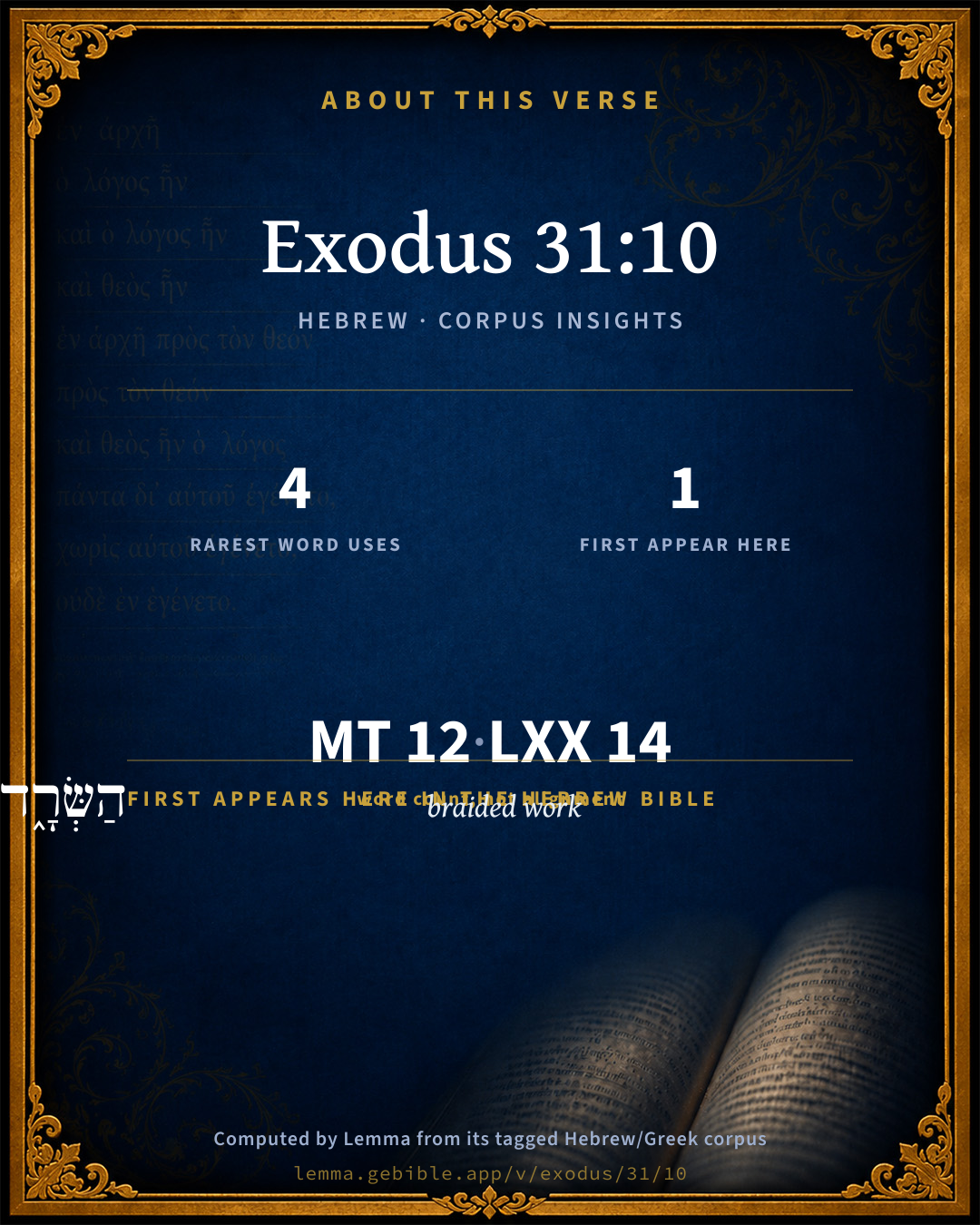
  • 1 first appearance in the Hebrew Bible
Full analysis ↓
Download a study sheet

One document with this verse’s original text, its word-by-word gloss line, the meaning frame, cross-references with their text, attributed commentary, and full source and license credits — printable, and it pastes into notes with its structure intact.

This verse Autodidact and up

Study sheet (.html) Plain text (.txt)

A passage Seminary Student

Up to 50 verses in one chapter. A passage sheet keeps up to 6 commentary sources and 12 cross-references per verse, in the order this page ranks them, and says so on the sheet whenever that leaves anything out. Ask for a single verse and you get the Autodidact verse sheet above.

Everything on this page stays free to read, with no account — the sheet is a download of what is already on screen, not access to it.

Want to remove ads? Support Godless Engineer
Compare translations 3

The same verse in 3 English versions, stacked beneath the original-language interlinear above. Click any original word for its lexicon entry.

Each is an independent rendering of the whole verse — the interlinear is not word-aligned to these translations.

Highlighted words mark where these versions differ — a whole-verse word diff, not a word-by-word alignment.

  • World English Bible Public Domain
    the finely worked garments--the holy garments for Aaron the priest--the garments of his sons to minister in the priest's office,
  • King James Version Public Domain
    And the cloths of service, and the holy garments for Aaron the priest, and the garments of his sons, to minister in the priest's office,
  • unfoldingWord Literal Text CC BY-SA 4.0
    and the finely woven clothing and the clothing of holiness for Aaron the priest and the clothing of his sons to priests

unfoldingWord Literal Text — © unfoldingWord, licensed CC BY-SA 4.0. Word-aligned USFM3 via Door43 (git.door43.org/unfoldingWord/en_ult).

Versions to compare (up to 4)

3 of 4 selected

Show all 18 translations

Every available English version of this verse, each an independent rendering of the whole verse.

  • World English Bible Public Domain
    the finely worked garments--the holy garments for Aaron the priest--the garments of his sons to minister in the priest's office,
  • Berean Standard Bible Public Domain
    as well as the woven garments, both the holy garments for Aaron the priest and the garments for his sons to serve as priests,
  • Majority Standard Bible Public Domain
    as well as the woven garments, both the holy garments for Aaron the priest and the garments for his sons to serve as priests,
  • King James Version Public Domain
    And the cloths of service, and the holy garments for Aaron the priest, and the garments of his sons, to minister in the priest's office,
  • American Standard Version (1901) Public Domain
    and the finely wrought garments, and the holy garments for Aaron the priest, and the garments of his sons, to minister in the priest's office,
  • Revised Version (1885) Public Domain
    and the finely wrought garments, and the holy garments for Aaron the priest, and the garments of his sons, to minister in the priest’s office;
  • Geneva Bible (1599) Public Domain
    Also the garments of the ministration, and ye holy garments for Aaron ye Priest, and the garmets of his sonnes, to minister in the Priestes office,
  • Douay-Rheims (1899) Public Domain
    The holy vestments in the ministry for Aaron the priest, and for his sons, that they may execute their office about the sacred things:
  • Young's Literal Translation Public Domain
    and the coloured garments, and the holy garments for Aaron the priest, and the garments of his sons, for acting as priests in;
  • Literal Standard Version CC BY-SA 4.0
    and the colored garments, and the holy garments for Aaron the priest, and the garments of his sons, for acting as priests in;
  • Unlocked Literal Bible CC BY-SA 4.0
    This also includes the finely-woven garments—the holy garments for Aaron the priest and those of his sons, reserved for me so that they may serve as priests.
  • unfoldingWord Literal Text CC BY-SA 4.0
    and the finely woven clothing and the clothing of holiness for Aaron the priest and the clothing of his sons to priests
  • Darby Bible Public Domain
    and the garments of service, both the holy garments of Aaron the priest, and the garments of his sons, to serve as priests;
  • World Messianic Bible Public Domain
    the finely worked garments—the holy garments for Aaron the priest, the garments of his sons to minister in the priest’s office—
  • Webster's Bible Public Domain
    And the clothes of service, and the holy garments for Aaron the priest, and the garments of his sons, to minister in the priest's office,
  • Free Bible Version CC BY-SA 4.0
    as well as the woven clothes for both Aaron the priest and for his sons to serve as priests,
  • Bible in Basic English Public Domain
    And the robes of needlework, the holy robes for Aaron and for his sons, for their use when acting as priests,
  • JPS Tanakh (1917) Public Domain
    and the plaited garments, and the holy garments for Aaron the priest, and the garments of his sons, to minister in the priest's office;

Literal Standard Version (2020), Covenant Press — licensed CC BY-SA 4.0. Text via the HelloAO Bible API (eBible.org). Unlocked Literal Bible (unfoldingWord) — licensed CC BY-SA 4.0. Text via the HelloAO Bible API (eBible.org). unfoldingWord Literal Text — © unfoldingWord, licensed CC BY-SA 4.0. Word-aligned USFM3 via Door43 (git.door43.org/unfoldingWord/en_ult). Free Bible Version, Dr. Jonathan Gallagher — licensed CC BY-SA 4.0. Text via the HelloAO Bible API (eBible.org).

Word by word

More ways to search: Search by grammar → Find every occurrence → Compare this word →

Practice this passage: Drill this verse → Learn its vocabulary →

הַשְּׂרָ֑ד
sᵉrâd
H8278
“the · braided work”
Particle, Definite Article + Noun, Common, Masculine, Singular, Absolute
Part of Speech
Particle + Noun
Type
Common
Gender
Masculine
Number
Singular
State
Absolute
Full BDB Definition

Origin: from H8277

TWOT: 2286a

plaited or braided work
  1. וְאֵ֖ת ʼêth H853 “and · -” Conjunction + Particle, Direct Object
  2. בִּגְדֵ֣י beged H899 “garments of” Noun, Common, Masculine, Plural, Construct
  3. וְאֶת ʼêth H853 “and · -” Conjunction + Particle, Direct Object
  4. בִּגְדֵ֤י beged H899 “garments of” Noun, Common, Masculine, Plural, Construct
  5. הַקֹּ֨דֶשׁ֙ qôdesh H6944 “the · holiness” Particle, Definite Article + Noun, Common, Masculine, Singular, Absolute
  6. לְאַהֲרֹ֣ן ʼAhărôwn H175 “to/for · Aaron” Preposition + Noun, Proper
  7. הַכֹּהֵ֔ן kôhên H3548 “the · priest” Particle, Definite Article + Noun, Common, Masculine, Singular, Absolute
  8. וְאֶת ʼêth H853 “and · -” Conjunction + Particle, Direct Object
  9. בִּגְדֵ֥י beged H899 “garments of” Noun, Common, Masculine, Plural, Construct
  10. בָנָ֖יו bên H1121 “sons · his” Noun, Common, Masculine, Plural, Construct + Suffix, Personal, 3rd Person, Masculine, Singular
  11. לְכַהֵֽן kâhan H3547 “to serve as priest” Preposition + Verb, Piel, Infinitive Construct

About this verse

These counts appear in no published source. They are computed here, from the morphology-tagged text and Lemma’s own curated glosses. What Lemma adds →

12
words
8
distinct lemmas
Pentateuch
section

Notable vocabulary

The rarest word here is הַשְּׂרָ֑ד braided work H8278 — appearing just 4 times in the whole Hebrew Bible.

First appearance in Scripture

This word makes its first canonical appearance in the Hebrew Bible here:

  • הַשְּׂרָ֑ד braided work H8278

Shared distinctive vocabulary

הַשְּׂרָ֑ד braided work H8278 occurs in 4 verses of the Hebrew Bible. Also found in:

Grammatical profile

  • 1 verb
  • 8 nouns
  • 3 particles

Verb forms

  • לְכַהֵֽן Piel · Infinitive Construct

Repetition

A word recurs within this verse — often emphatic in Hebrew:

  • בִּגְדֵ֣י garment H899 ×3

Hebrew & Septuagint length

In English translation the verse runs 20 words from the Hebrew and 17 from the Septuagint (LXX English) — closely comparable.

A rough comparison of the two English renderings, which tokenize alike — not a word-level alignment.

Word counts can differ between the Hebrew and the Greek without any difference in meaning — e.g. the Hebrew direct-object marker אֵת has no separate Greek word, and Greek often adds the article ὁ.

In the original languages it is 12 Hebrew tokens and 14 Greek tokens — but the two are counted differently (Hebrew bundles its prefixes and suffixes into one token; the Greek is in lemma form), so that isn’t a like-for-like length.

Cross-references

5

Topical passages linked to Exodus 31:10 in the Treasury of Scripture Knowledge — connected by theme and wording, ordered by reader-vote popularity; previews shown in the World English Bible.

  • Exodus 28:1–43 "Bring Aaron your brother, and his sons with him, near to you from among the children of Israel, that he may minister to me in the priest's office, even Aaron, Nadab and Abihu, Eleazar and Ithamar, Aaron's sons.
  • Exodus 39:1–43 Of the blue, purple, and scarlet, they made finely worked garments, for ministering in the holy place, and made the holy garments for Aaron; as Yahweh commanded Moses.
  • Leviticus 8:7–8 He put the coat on him, tied the sash on him, clothed him with the robe, put the ephod on him, and he tied the skillfully woven band of the ephod on him, and fastened it to him with it.
  • Leviticus 8:13 Moses brought Aaron's sons, and clothed them with coats, and tied sashes on them, and put headbands on them; as Yahweh commanded Moses.
  • Numbers 4:5–14 When the camp moves forward, Aaron shall go in, and his sons, and they shall take down the veil of the screen, and cover the ark of the Testimony with it,

Cross-references courtesy of OpenBible.info (CC BY 4.0).

Hebrew and Greek witnesses Masoretic Hebrew ↔ Greek Septuagint

The same verse in the two great witnesses to the Old Testament, shown verse-for-verse.

These are two independent witnesses, not word-aligned to each other, and the Septuagint is shown in lemma (dictionary) form.

Hebrew Exodus 31:10 Masoretic · Westminster Leningrad Codex

וְאֵ֖ת בִּגְדֵ֣י הַשְּׂרָ֑ד וְאֶת בִּגְדֵ֤י הַקֹּ֨דֶשׁ֙ לְאַהֲרֹ֣ן הַכֹּהֵ֔ן וְאֶת בִּגְדֵ֥י בָנָ֖יו לְכַהֵֽן

the finely worked garments--the holy garments for Aaron the priest--the garments of his sons to minister in the priest's office,

World English Bible · Public Domain

Greek LXX Exodus 31:10 Septuagint · lemma form

καί ὁ στολή ὁ λειτουργικός ααρων καί ὁ στολή ὁ υἱός αὐτός ἱερατεύω ἐγώ

and Aaron's robes of ministry, and the robes of his sons to minister to me as priests,

LXX2012 (modern English Septuagint) · Public Domain

On this verse, The Cambridge Bible for Schools and Colleges discusses the Septuagint’s reading. Read the note in Commentary ↓

Hebrew: Westminster Leningrad Codex (CC BY 4.0). Greek: Septuagint (public domain); English from LXX2012 (modern English Septuagint) (Public Domain). How the Septuagint differs from the Hebrew →

Targum (Aramaic paraphrase)

2

The Targum is the ancient Jewish Aramaic paraphrase of the Hebrew Scriptures — an interpretive translation, not the Hebrew text itself. Onkelos (literal) and Pseudo-Jonathan (expansive) render the Torah, and Jonathan the Prophets. Coverage is partial: where no permissively-licensed English translation exists for a verse, only the Aramaic is shown. This is verse-level text, not a word-by-word alignment to the Hebrew.

  1. Targum Onkelos Torah (Genesis–Deuteronomy)
    וְיָת לְבוּשֵׁי שִׁמוּשָׁא וְיָת לְבוּשֵׁי קוּדְשָׁא לְאַהֲרֹן כַּהֲנָא וְיָת לְבוּשֵׁי בְנוֹהִי לְשַׁמָשָׁא:

    (no public-domain English translation for this verse)

    Targum Onkelos — Aramaic: “Onkelos Genesis” (public domain); “Onkelos Exodus” (public domain); “Onkelos Leviticus” (public domain); “Onkelos Numbers” (public domain); “Onkelos Deuteronomy” (public domain). English: “Sefaria Community Translation” (CC0 1.0 (public-domain dedication)); “J.W. Etheridge. The Targums of Onkelos and Jonathan Ben Uzziel on the Pentateuch. London: Longmans, Green, 1862” (public domain). Text via Sefaria.

  2. Targum Pseudo-Jonathan Torah (Genesis–Deuteronomy)
    וְיַת לְבוּשֵׁי שִׁמּוּשָׁא וְיַת לְבוּשֵׁי קוּדְשָׁא לְאַהֲרן כַּהֲנָא וְיַת לְבוּשֵׁי בְנוֹי לְשַׁמָּשָׁא

    and the vestments for ministration, the holy vestments of Aharon the priest, and the vestments of his sons for ministry;

    Targum Pseudo-Jonathan — Aramaic: “Targum Jonathan on Genesis” (public domain); “Targum Jonathan on Exodus” (public domain); “Targum Jonathan on Leviticus” (public domain); “Targum Jonathan on Numbers” (public domain); “Targum Jonathan on Deuteronomy” (public domain). English: “The Targum of Jonathan ben Uzziel, trans. J. W. Etheridge, London, 1862” (public domain). Text via Sefaria.

Commentary

Notes on Exodus 31:10 from classic Christian and Jewish commentators (each source and its license shown beneath its notes). The classic Christian expositions comment on the surrounding passage and are grouped to its opening verse, so a note may address several verses; the Jewish commentaries on the Tanakh (Rashi and others) are per-verse, so they appear only where the commentator wrote on this verse.

Lemma curates 59 commentaries, every one of them public domain or Creative Commons licensed, each selected and text-cleaned for this edition rather than reprinted as found. About our sources →

Joseph Benson's Commentary

Exo 31:10. The clothes of service — Wherewith the ark, the table, the candlestick, and golden altar, were covered when the camp removed, Num 4:6.

Joseph Benson's Commentary on the Old and New Testaments (1811–1818) — public domain. Text from a community e-Sword module.

Adam Clarke's Commentary

Verse 10. Clothes of service] Vestments for the ordinary work of their ministry; the holy garments - those which were peculiar to the high priest.

Adam Clarke's Commentary on the Bible (1810–1826) — public domain. Text from a community e-Sword/MySword module.

Ellicott's Commentary for English Readers

(10) The cloths of service.—Modern critics generally suppose the state robes of the high priest to be meant (Keil, Knobel, De Wette, Kalisch, Cook); but the Rabbinical interpreters understand the cloths in which the ark and other vessels of the sanctuary were wrapped when the camp was moved from place to place (see Num_4:6-13). These, like the cloths here spoken of (Exo_39:1), were to be of blue, and purple, and scarlet; and it would be natural to distinguish them from the “holy garments,” as is done both here and also in Exo_35:19; Exo_39:1; Exo_39:41. They had, however, not been previously mentioned in the directions. Perhaps the true explanation is, that under the words “cloths of service” (bigdey sĕrâd, or bigdeh hassĕrâd) are included both the garments of Aaron and also those of his sons, the two later clauses of the verse being exegetical of the first clause. In that case, we should translate: The robes of service, both the holy garments for Aaron the priest, and also the garments of his sons. Exo_39:41 is decidedly favourable to this interpretation.

A Bible Commentary for English Readers, edited by Charles John Ellicott (1878–1897) — public domain. Text from a community e-Sword module.

The Cambridge Bible for Schools and Colleges

gen. ed. J. J. S. Perowne

10. the garments of plaited (?) work] in the Heb. a peculiar expression, of most uncertain meaning, not found before, but recurring (with the addition, ‘for ministering in the holy place’) in Exo_35:19, Exo_39:1; Exo_39:41†. No root שרד occurs in Heb.: in post-Bibl. Hebrew and Aramaic (see NHWB. iii. 587b) derivatives mean a plaited basket, a sieve, a grating before an oven; Onk. also uses sârâdâ for a grating in Exo_27:4, and for a hanging in Exo_27:9, &c.: hence, if the word is correctly handed down,—and it occurs four times,—it can, with our present knowledge, be only explained to mean something of the nature of plaited work. The reference is evidently to the artistically woven garments of the priests (ch. 28). The ‘and’ before ‘the holy garments’ is better omitted, as in Exo_35:19, and (in the Heb.) Exo_39:41 : the garments in question were the ‘holy’ ones. LXX. (στολαὶ λειτουργικαί), Pesh. Targ. render garments of ministry (cf. RVm.); either treating שרד, very improbably, as though it were the same as שרת, or finding שרת four times in their MSS. for שרד,—a not less improbable alternative. ‘Finely wrought’ (RV.) yields an excellent sense; but unfortunately has no philological justification.

The Cambridge Bible for Schools and Colleges (gen. ed. J. J. S. Perowne; Cambridge University Press, 1878–1918) — public domain. Text from a community e-Sword module.

John Gill's Exposition

And the clothes of service,.... Either those the priests ministered in in the time of service, and which they never wore but when in it, and so might with propriety be so called, and what they were the following words explain; or else these were clothes of blue, purple, and scarlet, and coverings of badgers' skins, in which the ark, the shewbread table, the candlestick, and the golden altar, and other instruments of the tabernacle were wrapped, as Aben Ezra observes, when the Israelites journeyed in the wilderness, see Num 4:5.

and the holy garments for Aaron the priest; the breastplate, ephod, and robe, the broidered coat, mitre, and girdle, Exo 28:4.

and the garments of his sons to minister in the priest's office; the bonnets, coats, girdles, and breeches, Exo 28:40.

John Gill's Exposition of the Whole Bible (1746–1763) — public domain (CC PDM 1.0). Text via the HelloAO Bible API.

Matthew Poole's English Annotations

The cloths of service, wherein the ark and other sacred utensils were wrapped up when they were to be removed. See Exo 35:19; Num 4.

Matthew Poole's English Annotations on the Holy Bible (1683–1685) — public domain. Text from a community e-Sword/MySword module.

Whedon's Commentary on the Bible

Daniel D. Whedon

10. Clothes of service — These are perhaps best understood of the ministerial official robes of the high priest, described in Exo_28:6-38, as distinguished from “the coat of fine linen,” (Exo_28:39,) and the other garments worn in common by Aaron and his sons, (Exo_28:40-43.) Others understand by these clothes of service the inner curtains of the tabernacle, or the cloth wraps in which the vessels of the tabernacle were bound up when they were carried from place to place in the march to Canaan. The passage might also be translated, “And the clothes of service, even the holy garments for Aaron the priest, and the garments of his sons;” thus making the clothes of service include the holy garments both of Aaron and his sons.

Daniel D. Whedon (gen. ed.), Commentary on the Old and New Testaments (1874–1909) — public domain. Text from a community e-Sword module.

The Pulpit Commentary

The cloths of service. Rather "the vestments of officei.e. , the distinguishing vestments of the High Priest, which he alone was allowed to wear. These were the blue robe, the ephod, the girdle of the ephod, and the breast-plate. (Exo_28:6-35) The holy garments. The rest of the High Priest"s dressi.e. , the linen drawers, the diapered tunic, the inner girdle and the mitre (ib, 39, 43; Lev_16:4) which constituted his whole apparel on the great day of atonement. The garments of his sonsi.e, the linen drawers, tunics, girdles, and caps, mentioned in Exo_28:40, Exo_28:42.

The Pulpit Commentary (1880–1919), ed. H.D.M. Spence-Jones & Joseph S. Exell — public domain. Text from a community e-Sword module.

unfoldingWord translationNotes

Door43 World Missions Community

General Information:

Yahweh continues speaking to Moses.

finely-woven garments

These were clothing made from narrow linen threads that someone twisted together to make a stronger thread. See how you translated a similar phrase in Exodus 28:8.

These craftsmen

"These people who are skilled in making beautiful things"

translationWords

holy

Aaron

priest

servant

anoint

oil

incense

holy place

command

unfoldingWord translationNotes — © Distant Shores Media and the Door43 World Missions Community, licensed CC BY-SA 4.0. Source: git.door43.org/Door43/en_tn.

Rashi

Rabbi Shlomo Yitzchaki (Rashi)

‎ואת בגדי השרד AND THE GARMENTS OF THE SERVICE — I think — according to the plain sense of the verse — that one cannot say that Scripture is here speaking of (referring to) the priestly garments, because to them refer the next words: “and the garments of holiness for Aaron the priest, and the garments of his sons to minister as priests”. But these בגדי שרד are identical with the garments of blue purple wool, and red purple wool, and crimson wool which are mentioned in the chapter (Numbers IV.) giving an account of Israel’s encampments: (Numbers 4:12) “and they shall put them in a garment of blue purple”; (Numbers 4:13) “and spread a garment of red purple thereon”; (Numbers 4:8) “and they shall spread upon them a garment of crimson”. And indeed my opinion appears correct, because it is said, (Exodus 39:1) “And of the blue purple, and of the red purple, and of the crimson, they made garments of the service (בגדי שרד) to minister in the holiness”, and linen is not mentioned among them (these materials). Now if Scripture were speaking of the priestly garments it could not have omitted “linen”“, for we do not find in respect of even one of them (of the priestly garments) mention of red purple or crimson without linen.

בגדי השרד GARMENTS OF SERVICE — Some explain שרד to mean work and service (cf. שרת to serve), as the Targum renders it: לבושי שמושא, “garments for the service”. There is, however, no other example of it (of שרד) in Scriptures. I, however, think that it is an Aramaic expression, like the Targum of קלעים, hangings, which Onkelos renders by שרדין, and of מכבר, “grate”, which he renders by שרדא, both words denoting net-work, and they are called “garments of שרד, net-work”, because they were woven not in the ordinary way but with the needle (a kind of crochet-work), made with many holes; “lacies” in old French; English, net or mesh-work.

Rashi on the Tanakh — English translations: “The Judaica Press complete Tanach with Rashi, translated by A. J. Rosenberg” (CC BY 4.0); “Pentateuch with Rashi's commentary by M. Rosenbaum and A.M. Silbermann, 1929-1934” (public domain); “The Metsudah Tanach series, Lakewood, N.J” (CC BY 4.0); and “The Book of Joshua, Metsudah Publications, 1997” (CC BY 4.0). Text via Sefaria.

Ramban (Nachmanides)

Rabbi Moshe ben Nachman (Ramban / Nachmanides)

AND THE GARMENTS OF ‘HA’SROD.’ I do not know why He did not command the making of these garments at the beginning, as He did concerning all the [rest of the] work of the Tabernacle and the garments of Aaron and his sons, for it would have been proper that He say to Moses, “and thou shalt make cloth of blue-purple to cover with it the ark, and a red-purple cloth to cover with it the altar, Verse 13. and a cloth of scarlet to cover with it the table,” and now when charging Moses about those who were to make these things, He should have included these garments with the rest of the work. Perhaps there was no insistence on how they were to be made, and they could have made these garments of srod of one kind alone, but they made them of blue-purple, red-purple and scarlet. They did not want to make them of linen, as that is not distinguished, as are those other colors. After they made them, G-d willed that the blue-purple cloth be for the ark, the red-purple for the altar, and the scarlet for the table. Therefore, it was sufficient to command them in brief [here] when He gave the command about those who were to do all the work, for these garments of ‘ha’srod’ were to be made according to their understanding.Now it is not befitting that a garment made to cover [the sacred vessels] should have many holes in it, as Rashi has said. Rather, the word ha’srod is of the term sarid (a lone survivor), because all these garments were of one kind, as Rabbi Abraham ibn Ezra said.All this I have written in accordance with the line of thought of Rashi. Yet all this availeth me nothing. For what meaning is there in the Holy One, blessed be He, saying to Moses that they should make “garments of kela,” (hangings) (above 27:9) Onkelos translates s’radin. Similarly he translates the Hebrew word michbar (grate) (ibid., Verse 4) as s’rada. On the basis of these translations of Onkelos, Rashi suggests here that the word ha’srod is an Aramaic term, which means “garments of net-work,” because they were made with many holes. — It is with reference to this basis for Rashi’s explanation that Ramban says, “garments of kela.” or “garments of s’ridah,” without explaining to him how many of them there should be, two or a hundred, how long and wide they should be, and why they should be made altogether, since the matter cannot be understood at all from this communication [stated here]? Moreover, why are they mentioned always before the garments of Aaron? etc. — Likewise further, 35:19, and 39:41. Besides, what is the meaning of the phrase, the garments of ‘ha’srod’, for ministering in the holy place, for this seems to refer to the sacrificial rites in the holy place, just as He says, or when they come near to the altar to minister in the holy place. Similarly, even he who cometh into the Tent of Meeting to minister in the holy place, 29:30. does not refer to outer work, or the carrying of the holy vessels. Furthermore, it is written, and they will make all that I commanded thee: the Tent of Meeting etc., and the garments of ‘ha’srod’ etc., and the incense of sweet spices; according to all that I have commanded thee shall they do. But He had not commanded him before about the garments of ‘ha’srod’ at all!What appears from the words of our Rabbis is that the garments of ‘ha’srod’ are the actual garments of the priesthood. This is mentioned in Tractate Yoma. (further 35:19)? If not for the garments of the priesthood [which are worn during the service which brings atonement to Israel], there would not have been left a survivor [a sarid] of Israel’s enemies.” The final expression is a euphemism. But the whole quotation shows that the garments of ‘ha’srod’ refer to the actual garments of the priests. If that is so, it is correct that we translate the garments of ‘ha’srod’ as “the garments of uniqueness,” that is to say, the garments which when worn designate the outstanding one of the people, the highest among his brethren. Similarly, ‘u’basridim’ whom the Eternal shall call means the remnants of those who have survived, [the word being] of the root, escape ‘v’sarid’ (and remain). [The garments of ‘ha’srod’] thus allude to the garments of Aaron, which are so called [‘unique’] because only one of the generation may wear them — Aaron in his lifetime, and after him the priest that is highest… upon whose head the anointing oil is poured, and that is consecrated to put on the garments. And Scripture always mentions Aaron’s garments in a way of honor, as it says: for splendor and for beauty; holy garments;, Verse 4. the golden plate, the holy crown. It is for this reason that they are called the garments of ‘ha’srod’ — garments of royalty. This is the meaning of the verse, And the garments of ‘ha’srod’ (the High Priest) to minister in the holy place, and the holy garments for Aaron the priest, Scripture thus reverting [in the second half of the verse] to explain [that the garments of ha’srod are for Aaron]. Similarly it is mentioned in the section beginning, And they brought the Tabernacle unto Moses.. And the reason why in this section of See, I have called by name it says, And the garments of ‘ha’srod,’ ‘and’ the holy garments for Aaron the priest [when the second half of the verse should have been without the connective vav which signifies “and,” since, as explained, it is in apposition to the first ], is to indicate that these garments are superior in two qualities: they are garments of ha’srod [the High Priesthood], and they are garments of holiness. This is in order to tell us that only the outstanding one among the people should wear them, [and only] when he comes in to minister in the holy place. And seeing that He did not mention here the phrase, to minister in the holy place, 29:30. He added in explanation that they are garments of s’rod and garments of holiness. Besides, there are many cases in Scripture where a redundant vav occurs. And the reason why Scripture states, And of the blue-purple, and red-purple, and scarlet, they made garments of ‘srod,’ is a term referring to the garments of the High Priest, why then does the verse not mention the linen, of which the garments of Aaron were also made? This is because etc. is because it comes to explain These are the accounts of the Tabernacle, 38:21. giving an accounting — because of their importance — of the gold, silver and brass, how much of them the Israelites brought and what they did with them; therefore it then said afterwards that of the blue-purple, and the red-purple, and scarlet which were brought to them they made the garments of ‘srod’ (the High Priest), neither more nor less. Thus it did not mention the linen because it is not as costly a matter [as the rest]. Perhaps they brought so much [of the linen] that it was left over [and therefore Scripture did not mention it]. Then Scripture there refers back and explains [what they did with the blue-purple, the red-purple, etc.] and says, and they made the holy garments for Aaron, as the Eternal commanded Moses, is a term referring to the garments of the High Priest, why then does the verse not mention the linen, of which the garments of Aaron were also made? This is because etc. And he made the ephod of gold, 39:2. and then finished the [whole] subject.

Ramban (Nachmanides) on the Tanakh — English translation: “Commentary on the Torah by Ramban (Nachmanides). Translated and annotated by Charles B. Chavel. New York, Shilo Pub. House, 1971-1976” (CC BY 4.0). Text via Sefaria.

Lesson kit

Teaching starters — assembled from the data on this page, not authored interpretation. Every prompt links to the verse data it draws on. Edit before teaching.

Exodus, in the Pentateuch, opens this verse with 12 words (8 distinct Hebrew lemmas). Its most distinctive word is sᵉrâd (“braided work”). A historical commentator’s framing appears above. Read the whole chapter for the surrounding context.

Discussion questions

  1. The word sᵉrâd carries the sense “braided work.” How does it shape the verse?
  2. This is the first place “braided work” appears in Scripture (first appears here). What does its debut here establish?
  3. How does Exodus 35:19, which shares the word «braided work», read alongside this verse?
  4. What does the repetition of “garment” (3× in this one verse) do in this verse?
  5. These translations render this verse differently; the difference is in the English rendering, not the original. What questions does that raise?
  6. «לְכַהֵֽן» is a Piel Infinitive Construct verb. How does that grammatical form shape the action described?
  7. Compare how Joseph Benson's Commentary and Adam Clarke's Commentary read this verse. Where do they agree or differ?

Things to notice

Reading settings

Reading text

Shown beneath each verse's original-language words.

Old Testament
Old Testament edition

Read the OT as the Masoretic Hebrew (MT) or the Greek Septuagint (LXX).

English shown for the Greek Septuagint (in the Hebrew ↔ Greek comparison).

Comparing translations? Open the Compare panel on any verse page to stack up to four side by side.