
Numbers 7:13

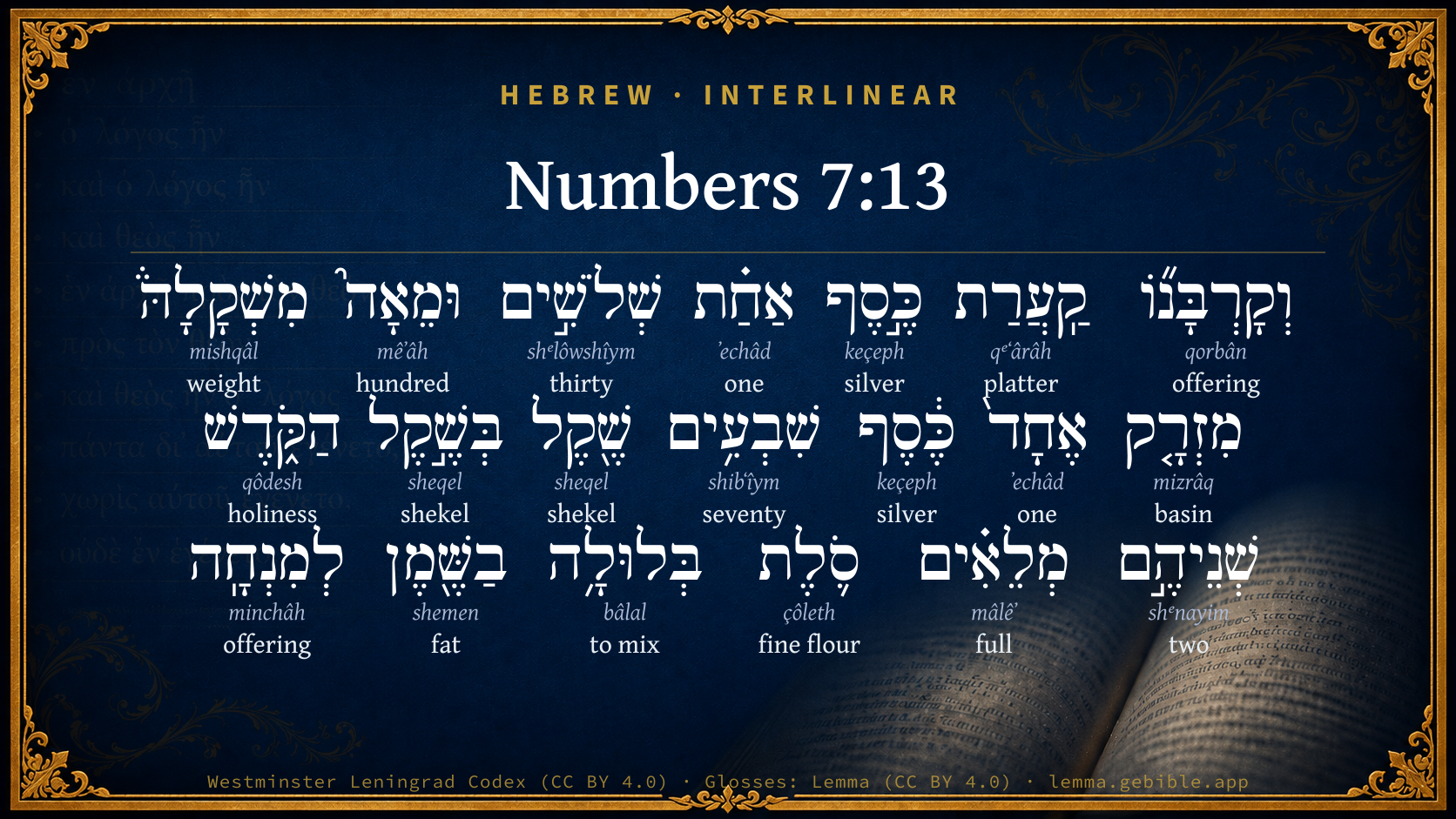
Hebrew (Westminster Leningrad Codex) Numbers 7:13 appears in the Hebrew Old Testament. The text above is from the Westminster Leningrad Codex. Each word links to its Strong’s number, a concise gloss, and parsing drawn from the Open Scriptures Hebrew Bible morphology. Click any word for its full Brown-Driver-Briggs (BDB) entry.
Download image
Cite this verse

Numbers 7:13 (World English Bible). Public Domain. Lemma interlinear Bible study tool, https://lemma.gebible.app/v/numbers/7/13.

Show BibTeX & RIS
BibTeX
RIS
English Translation
and his offering was: one silver platter, the weight of which was one hundred thirty shekels, one silver bowl of seventy shekels, after the shekel of the sanctuary; both of them full of fine flour mixed with oil for a meal offering;
World English Bible · Public Domain
Download a study sheet

One document with this verse’s original text, its word-by-word gloss line, the meaning frame, cross-references with their text, attributed commentary, and full source and license credits — printable, and it pastes into notes with its structure intact.

This verse Autodidact and up

Study sheet (.html) Plain text (.txt)

A passage Seminary Student

Up to 50 verses in one chapter. A passage sheet keeps up to 6 commentary sources and 12 cross-references per verse, in the order this page ranks them, and says so on the sheet whenever that leaves anything out. Ask for a single verse and you get the Autodidact verse sheet above.

Everything on this page stays free to read, with no account — the sheet is a download of what is already on screen, not access to it.

Want to remove ads? Support Godless Engineer
Compare translations 3

The same verse in 3 English versions, stacked beneath the original-language interlinear above. Click any original word for its lexicon entry.

Each is an independent rendering of the whole verse — the interlinear is not word-aligned to these translations.

Highlighted words mark where these versions differ — a whole-verse word diff, not a word-by-word alignment.

  • World English Bible Public Domain
    and his offering was: one silver platter, the weight of which was one hundred thirty shekels, one silver bowl of seventy shekels, after the shekel of the sanctuary; both of them full of fine flour mixed with oil for a meal offering;
  • King James Version Public Domain
    And his offering was one silver charger, the weight thereof was an hundred and thirty shekels, one silver bowl of seventy shekels, after the shekel of the sanctuary; both of them were full of fine flour mingled with oil for a meat offering:
  • unfoldingWord Literal Text CC BY-SA 4.0
    And his offering was one silver dish (its weight 130), one silver basin (70 shekels in the shekel of the holy place), the two of them full of flour mixed with the oil for a grain offering,

unfoldingWord Literal Text — © unfoldingWord, licensed CC BY-SA 4.0. Word-aligned USFM3 via Door43 (git.door43.org/unfoldingWord/en_ult).

Versions to compare (up to 4)

3 of 4 selected

Show all 18 translations

Every available English version of this verse, each an independent rendering of the whole verse.

  • World English Bible Public Domain
    and his offering was: one silver platter, the weight of which was one hundred thirty shekels, one silver bowl of seventy shekels, after the shekel of the sanctuary; both of them full of fine flour mixed with oil for a meal offering;
  • Berean Standard Bible Public Domain
    His offering was one silver platter weighing a hundred and thirty shekels, and one silver bowl weighing seventy shekels, both according to the sanctuary shekel and filled with fine flour mixed with oil for a grain offering;
  • Majority Standard Bible Public Domain
    His offering was one silver platter weighing a hundred and thirty shekels, and one silver bowl weighing seventy shekels, both according to the sanctuary shekel and filled with fine flour mixed with oil for a grain offering;
  • King James Version Public Domain
    And his offering was one silver charger, the weight thereof was an hundred and thirty shekels, one silver bowl of seventy shekels, after the shekel of the sanctuary; both of them were full of fine flour mingled with oil for a meat offering:
  • American Standard Version (1901) Public Domain
    and his oblation was one silver platter, the weight whereof was a hundred and thirty `shekels', one silver bowl of seventy shekels, after the shekel of the sanctuary; both of them full of fine flour mingled with oil for a meal-offering;
  • Revised Version (1885) Public Domain
    and his oblation was one silver charger, the weight thereof was an hundred and thirty shekels, one silver bowl of seventy shekels, after the shekel of the sanctuary; both of them full of fine flour mingled with oil for a meal offering;
  • Geneva Bible (1599) Public Domain
    And his offring was a siluer charger of an hundreth and thirtie shekels weight, a siluer boule of seuenty shekels, after the shekel of the Sanctuarie, both ful of fine floure, mingled with oyle, for a meate offring,
  • Douay-Rheims (1899) Public Domain
    And the princes offered for the dedication of the altar on the day when it was anointed, their oblation before the altar.
  • Young's Literal Translation Public Domain
    And his offering `is' one silver dish, its weight a hundred and thirty `shekels'; one silver bowl of seventy shekels, by the shekel of the sanctuary; both of them full of flour mixed with oil, for a present;
  • Literal Standard Version CC BY-SA 4.0
    And his offering [is] one silver dish, its weight one hundred and thirty [shekels], [and] one silver bowl of seventy shekels, by the shekel of the holy place, both of them full of flour mixed with oil for a present;
  • Unlocked Literal Bible CC BY-SA 4.0
    His sacrifice was one silver platter weighing 130 shekels and one silver bowl weighing seventy shekels, by the standard weight of the sanctuary shekel. Both of these objects were full of fine flour mixed with oil for a grain offering.
  • unfoldingWord Literal Text CC BY-SA 4.0
    And his offering was one silver dish (its weight 130), one silver basin (70 shekels in the shekel of the holy place), the two of them full of flour mixed with the oil for a grain offering,
  • Darby Bible Public Domain
    And his offering was one silver dish of the weight of a hundred and thirty [shekels], one silver bowl, of seventy shekels, according to the shekel of the sanctuary, both of them full of fine flour mingled with oil for an oblation;
  • World Messianic Bible Public Domain
    and his offering was: one silver platter, the weight of which was one hundred thirty shekels, one silver bowl of seventy shekels, according to the shekel of the sanctuary, both of them full of fine flour mixed with oil for a meal offering;
  • Webster's Bible Public Domain
    And his offering was one silver charger, the weight of which was a hundred and thirty shekels, one silver bowl of seventy shekels, after the shekel of the sanctuary; both of them were full of fine flour mingled with oil for a meat-offering:
  • Free Bible Version CC BY-SA 4.0
    His offering was a silver plate that weighed a hundred and thirty shekels, and a silver bowl that weighed seventy shekels (using the sanctuary shekel standard). They were both filled with the best flour mixed with olive oil as a grain offering.
  • Bible in Basic English Public Domain
    And his offering was one silver plate, a hundred and thirty shekels in weight, one silver basin of seventy shekels, by the scale of the holy place; the two of them full of the best meal mixed with oil for a meal offering;
  • JPS Tanakh (1917) Public Domain
    and his offering was one silver dish, the weight thereof was a hundred and thirty shekels, one silver basin of seventy shekels, after the shekel of the sanctuary; both of them full of fine flour mingled with oil for a meal-offering;

Literal Standard Version (2020), Covenant Press — licensed CC BY-SA 4.0. Text via the HelloAO Bible API (eBible.org). Unlocked Literal Bible (unfoldingWord) — licensed CC BY-SA 4.0. Text via the HelloAO Bible API (eBible.org). unfoldingWord Literal Text — © unfoldingWord, licensed CC BY-SA 4.0. Word-aligned USFM3 via Door43 (git.door43.org/unfoldingWord/en_ult). Free Bible Version, Dr. Jonathan Gallagher — licensed CC BY-SA 4.0. Text via the HelloAO Bible API (eBible.org).

Word by word

More ways to search: Search by grammar → Find every occurrence → Compare this word →

Practice this passage: Drill this verse → Learn its vocabulary →

קַֽעֲרַת
qᵉʻârâh
H7086
“platter of”
Noun, Common, Feminine, Singular, Construct
Part of Speech
Noun
Type
Common
Gender
Feminine
Number
Singular
State
Construct
Full BDB Definition

Origin: probably from H7167

TWOT: 2047a

dish, platter
  1. וְקָרְבָּנ֞וֹ qorbân H7133 “and · offering · his” Conjunction + Noun, Common, Masculine, Singular, Construct + Suffix, Personal, 3rd Person, Masculine, Singular
  2. כֶּ֣סֶף keçeph H3701 “silver” Noun, Common, Masculine, Singular, Absolute
  3. אַחַ֗ת ʼechâd H259 “one” Adjective, Cardinal number, Feminine, Singular, Absolute
  4. שְׁלֹשִׁ֣ים shᵉlôwshîym H7970 “thirty” Adjective, Cardinal number, Both, Plural, Absolute
  5. וּמֵאָה֮ mêʼâh H3967 “and · hundred” Conjunction + Adjective, Cardinal number, Both, Singular, Absolute
  6. מִשְׁקָלָהּ֒ mishqâl H4948 “weight · her” Noun, Common, Masculine, Singular, Construct + Suffix, Personal, 3rd Person, Feminine, Singular
  7. מִזְרָ֤ק mizrâq H4219 “basin” Noun, Common, Masculine, Singular, Absolute
  8. אֶחָד֙ ʼechâd H259 “one” Adjective, Cardinal number, Masculine, Singular, Absolute
  9. כֶּ֔סֶף keçeph H3701 “silver” Noun, Common, Masculine, Singular, Absolute
  10. שִׁבְעִ֥ים shibʻîym H7657 “seventy” Adjective, Cardinal number, Both, Plural, Absolute
  11. שֶׁ֖קֶל sheqel H8255 “shekel” Noun, Common, Masculine, Singular, Absolute
  12. בְּשֶׁ֣קֶל sheqel H8255 “in/at · shekel of” Preposition + Noun, Common, Masculine, Singular, Construct
  13. הַקֹּ֑דֶשׁ qôdesh H6944 “the · holiness” Particle, Definite Article + Noun, Common, Masculine, Singular, Absolute
  14. שְׁנֵיהֶ֣ם shᵉnayim H8147 “two · their” Adjective, Cardinal number, Masculine, Dual, Construct + Suffix, Personal, 3rd Person, Masculine, Plural
  15. מְלֵאִ֗ים mâlêʼ H4392 “full” Adjective, Adjective, Masculine, Plural, Absolute
  16. סֹ֛לֶת çôleth H5560 “fine flour” Noun, Common, Feminine, Singular, Absolute
  17. בְּלוּלָ֥ה bâlal H1101 “mixed” Verb, Qal, Participle Passive, Feminine, Singular, Absolute
  18. בַשֶּׁ֖מֶן shemen H8081 “in/at the · fat” Preposition, Determined + Noun, Common, Masculine, Singular, Absolute
  19. לְמִנְחָֽה minchâh H4503 “to/for · offering” Preposition + Noun, Common, Feminine, Singular, Absolute

About this verse

These counts appear in no published source. They are computed here, from the morphology-tagged text and Lemma’s own curated glosses. What Lemma adds →

20
words
17
distinct lemmas
Pentateuch
section

Notable vocabulary

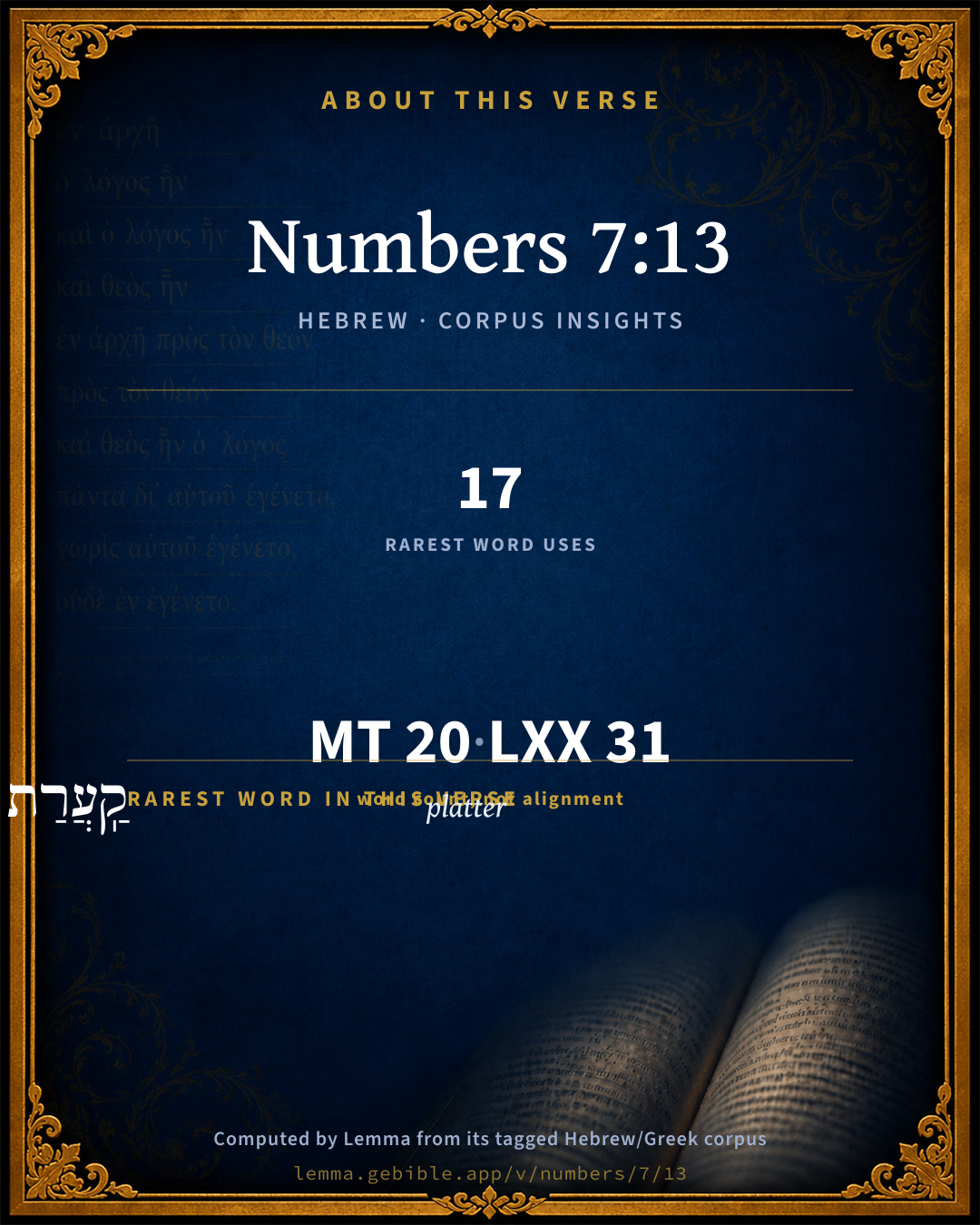
The rarest word here is קַֽעֲרַת platter H7086 — appearing just 17 times in the whole Hebrew Bible.

Shared distinctive vocabulary

קַֽעֲרַת platter H7086 occurs in 17 verses of the Hebrew Bible. Also found in:

Grammatical profile

  • 1 verb
  • 12 nouns
  • 7 adjectives

Verb forms

  • בְּלוּלָ֥ה Qal · Participle Passive

Repetition

Words recur within this verse — often emphatic in Hebrew:

  • כֶּ֣סֶף silver H3701 ×2
  • אַחַ֗ת one H259 ×2
  • שֶׁ֖קֶל shekel H8255 ×2

Hebrew & Septuagint length

In English translation the verse runs 42 words from the Hebrew and 39 from the Septuagint (LXX English) — closely comparable.

A rough comparison of the two English renderings, which tokenize alike — not a word-level alignment.

Word counts can differ between the Hebrew and the Greek without any difference in meaning — e.g. the Hebrew direct-object marker אֵת has no separate Greek word, and Greek often adds the article ὁ.

In the original languages it is 20 Hebrew tokens and 31 Greek tokens — but the two are counted differently (Hebrew bundles its prefixes and suffixes into one token; the Greek is in lemma form), so that isn’t a like-for-like length.

Cross-references

17

Topical passages linked to Numbers 7:13 in the Treasury of Scripture Knowledge — connected by theme and wording, ordered by reader-vote popularity; previews shown in the World English Bible.

  • Exodus 30:13 They shall give this, everyone who passes over to those who are numbered, half a shekel after the shekel of the sanctuary; (the shekel is twenty gerahs;) half a shekel for an offering to Yahweh.
  • Exodus 25:29 You shall make its dishes, its spoons, its ladles, and its bowls to pour out offerings with. Of pure gold shall you make them.
  • Exodus 37:16 He made the vessels which were on the table, its dishes, its spoons, its bowls, and its pitchers with which to pour out, of pure gold.
  • Leviticus 2:1 "'When anyone offers an offering of a meal offering to Yahweh, his offering shall be of fine flour; and he shall pour oil on it, and put frankincense on it.
  • Leviticus 27:3 Your valuation shall be of a male from twenty years old even to sixty years old, even your valuation shall be fifty shekels of silver, after the shekel of the sanctuary.
  • Leviticus 27:25 All your valuations shall be according to the shekel of the sanctuary: twenty gerahs to the shekel.
  • Numbers 3:47 you shall take five shekels apiece for each one; after the shekel of the sanctuary you shall take them (the shekel is twenty gerahs):
  • 1 Kings 7:43 and the ten bases, and the ten basins on the bases;
  • 1 Kings 7:45 and the pots, and the shovels, and the basins: even all these vessels, which Hiram made for king Solomon, in the house of Yahweh, were of burnished brass.
  • 2 Kings 25:14–15 The pots, and the shovels, and the snuffers, and the spoons, and all the vessels of brass with which they ministered, took they away.
  • Ezra 1:9–10 This is the number of them: thirty platters of gold, one thousand platters of silver, twenty-nine knives,
  • Ezra 8:25 and weighed to them the silver, and the gold, and the vessels, even the offering for the house of our God, which the king, and his counselors, and his princes, and all Israel there present, had offered:
  • Jeremiah 52:19 The cups, and the fire pans, and the basins, and the pots, and the lampstands, and the spoons, and the bowls-that which was of gold, in gold, and that which was of silver, in silver,-the captain of the guard took away.
  • Daniel 5:2 Belshazzar, while he tasted the wine, commanded to bring the golden and silver vessels which Nebuchadnezzar his father had taken out of the temple which was in Jerusalem; that the king and his lords, his wives and his concubines, might drink from it.
  • Zechariah 14:20 In that day there will be on the bells of the horses, "HOLY TO YAHWEH;" and the pots in Yahweh's house will be like the bowls before the altar.
  • Matthew 14:8 She, being prompted by her mother, said, "Give me here on a platter the head of John the Baptizer."
  • Matthew 14:11 His head was brought on a platter, and given to the young lady: and she brought it to her mother.

Cross-references courtesy of OpenBible.info (CC BY 4.0).

Hebrew and Greek witnesses Masoretic Hebrew ↔ Greek Septuagint

The same verse in the two great witnesses to the Old Testament, shown verse-for-verse.

These are two independent witnesses, not word-aligned to each other, and the Septuagint is shown in lemma (dictionary) form.

Hebrew Numbers 7:13 Masoretic · Westminster Leningrad Codex

וְקָרְבָּנ֞וֹ קַֽעֲרַת כֶּ֣סֶף אַחַ֗ת שְׁלֹשִׁ֣ים וּמֵאָה֮ מִשְׁקָלָהּ֒ מִזְרָ֤ק אֶחָד֙ כֶּ֔סֶף שִׁבְעִ֥ים שֶׁ֖קֶל בְּשֶׁ֣קֶל הַקֹּ֑דֶשׁ שְׁנֵיהֶ֣ם מְלֵאִ֗ים סֹ֛לֶת בְּלוּלָ֥ה בַשֶּׁ֖מֶן לְמִנְחָֽה

and his offering was: one silver platter, the weight of which was one hundred thirty shekels, one silver bowl of seventy shekels, after the shekel of the sanctuary; both of them full of fine flour mixed with oil for a meal offering;

World English Bible · Public Domain

Greek LXX Numbers 7:13 Septuagint · lemma form

καί προςφέρω ὁ δῶρον αὐτός τρυβλίον ἀργυροῦς εἷς τριάκοντα καί ἑκατόν ὁλκή αὐτός φιάλη εἷς ἀργυροῦς ἑβδομήκοντα σίκλος κατά ὁ σίκλος ὁ ἅγιος ἀμφότεροι πλήρης σεμίδαλις ἀναποιέω ἐν ἔλαιον εἰς θυσία

And he brought his gift, one silver charger of one hundred and thirty shekels was its weight, one silver bowl, of seventy shekels according to the holy shekel; both full of fine flour kneaded with oil for a meat-offering.

LXX2012 (modern English Septuagint) · Public Domain

On this verse, The Pulpit Commentary discusses the Septuagint’s reading. Read the note in Commentary ↓

Hebrew: Westminster Leningrad Codex (CC BY 4.0). Greek: Septuagint (public domain); English from LXX2012 (modern English Septuagint) (Public Domain). How the Septuagint differs from the Hebrew →

Targum (Aramaic paraphrase)

2

The Targum is the ancient Jewish Aramaic paraphrase of the Hebrew Scriptures — an interpretive translation, not the Hebrew text itself. Onkelos (literal) and Pseudo-Jonathan (expansive) render the Torah, and Jonathan the Prophets. Coverage is partial: where no permissively-licensed English translation exists for a verse, only the Aramaic is shown. This is verse-level text, not a word-by-word alignment to the Hebrew.

  1. Targum Onkelos Torah (Genesis–Deuteronomy)
    וְקֻרְבָּנֵהּ מְגִסְתָּא דִכְסַף חֲדָא מְאָה וּתְלָתִין סִלְעִין הֲוָה מַתְקְלַהּ מִזְרְקָא חַד דִכְסַף מַתְקְלֵהּ שַׁבְעִין סִלְעִין בְּסִלְעֵי קוּדְשָׁא תַּרְוֵיהוֹן מְלַן סֻלְתָּא דְּפִילָא בִמְשַׁח לְמִנְחָתָא

    (no public-domain English translation for this verse)

    Targum Onkelos — Aramaic: “Onkelos Genesis” (public domain); “Onkelos Exodus” (public domain); “Onkelos Leviticus” (public domain); “Onkelos Numbers” (public domain); “Onkelos Deuteronomy” (public domain). English: “Sefaria Community Translation” (CC0 1.0 (public-domain dedication)); “J.W. Etheridge. The Targums of Onkelos and Jonathan Ben Uzziel on the Pentateuch. London: Longmans, Green, 1862” (public domain). Text via Sefaria.

  2. Targum Pseudo-Jonathan Torah (Genesis–Deuteronomy)
    וְקוּרְבָּנֵיהּ דְמִקְרַב פְּיוֹלֵי דִכְסַף חֲדָא גִילְדָא סְמִיךְ מְאָה וּתְלָתִין סִלְעִין בְּסִלְעֵי בֵּית קוּדְשָׁא הֲוַת מַתְקְלָא מַזִירְקָא חָד דִכְסַף דְגִילְדָא קַלִישָׁא שׁוּבְעִין סִלְעִין בְּסִלְעֵי בֵּית קוּדְשָׁא תְּרֵין מָאנַיָא הָאִילֵין קְרֵיב יַתְהוֹן מַלְיָן סְמִידָא מִן אַפְרָשׁוּתָא פְּתִיכָא בִּמְשַׁח זֵיתָא לְמִנְחָתָא

    and his oblation which he offered was one silver bowl, thickly embossed, (or, crusted,) in weight one hundred and thirty shekels, in shekels of the sanctuary; one silver vase, slightly embossed, of seventy shekels, in shekels of the sanctuary; both of these vessels he brought filled with flour of the separation, sprinkled with olive oil for a mincha;

    Targum Pseudo-Jonathan — Aramaic: “Targum Jonathan on Genesis” (public domain); “Targum Jonathan on Exodus” (public domain); “Targum Jonathan on Leviticus” (public domain); “Targum Jonathan on Numbers” (public domain); “Targum Jonathan on Deuteronomy” (public domain). English: “The Targum of Jonathan ben Uzziel, trans. J. W. Etheridge, London, 1862” (public domain). Text via Sefaria.

Commentary

Notes on Numbers 7:13 from classic Christian and Jewish commentators (each source and its license shown beneath its notes). The classic Christian expositions comment on the surrounding passage and are grouped to its opening verse, so a note may address several verses; the Jewish commentaries on the Tanakh (Rashi and others) are per-verse, so they appear only where the commentator wrote on this verse.

Lemma curates 59 commentaries, every one of them public domain or Creative Commons licensed, each selected and text-cleaned for this edition rather than reprinted as found. About our sources →

Joseph Benson's Commentary

Num 7:13-14. One silver charger — This charger, or broad dish, appears to have been for the use of the altar of burnt-offering in the court of the tabernacle; for all the vessels of the sanctuary were of gold. The use of it seems to have been for receiving the flesh which was offered at the altar, or the fine flour for the meat-offering. Its weight was a hundred and thirty shekels, or about sixty-five ounces. The bowl, again, was for receiving the blood, and it weighed seventy shekels, or about thirty-five ounces. One spoon often shekels of gold — Both the metal and what was in it show this spoon to have been for the use of the golden altar.

Joseph Benson's Commentary on the Old and New Testaments (1811–1818) — public domain. Text from a community e-Sword module.

Adam Clarke's Commentary

Verse 13. One silver charger] קערת kaarath, a dish, or deep bowl, in which they kneaded the paste. See Ex 25:29.

One silver bowl] מזרק mizrak, a bason, to receive the blood of the sacrifice in. See Clarke on Ex 27:3.

Adam Clarke's Commentary on the Bible (1810–1826) — public domain. Text from a community e-Sword/MySword module.

The Cambridge Bible for Schools and Colleges

gen. ed. J. J. S. Perowne

13. charger] a dish. Cf. Exo_25:29; Exo_37:16.

The Cambridge Bible for Schools and Colleges (gen. ed. J. J. S. Perowne; Cambridge University Press, 1878–1918) — public domain. Text from a community e-Sword module.

John Gill's Exposition

And his offering was one silver charger,.... Or dish, like one of those used in the shewbread table to hold the bread in, only they were of gold, this of silver, and belonged to the altar of burnt offering; the use of which might be to hold the meat offering in, as it may seem from the latter part of the verse, or the wave breast or heave shoulder, which belonged to the priest:

the weight thereof was an hundred and thirty shekels; which were sixty one ounces, four drachms, one scruple, and seventeen grains (h), worth about sixteen pounds and five shillings of our money:

one silver bowl of seventy shekels, after the shekel of the sanctuary; the standard that was kept in the sanctuary; this was a lesser vessel, and was either for holding the drink offering, or receiving the blood of the sacrifices; its weight was thirty three ounces, five drachms, and three grains, and was worth about eight pounds and fifteen shillings of our money:

both of them were full of fine flour mingled with oil for a meat offering; which always attended other sacrifices after mentioned, part of which was burnt on the altar of burnt offering, and the rest were the perquisites of the priests.

(h) Vid. Scheuchzer. Physic. Sacr. vol. 2. p. 366.

John Gill's Exposition of the Whole Bible (1746–1763) — public domain (CC PDM 1.0). Text via the HelloAO Bible API.

Haydock's Catholic Bible Commentary

Dish, (acetabulum.) Hebrew kaharath. See Exodus xxv. 29. This present of the prince of Juda weighed five Roman pounds. It was of silver, and consequently could not be used in the sanctuary, but in the court, (Calmet) at the altar of holocausts. (Tirinus)

George Leo Haydock (1774–1849), Haydock's Catholic Family Bible and Commentary, 1859 edition — public domain. Excludes Psalms (Douay-Rheims chapter numbering differs from Protestant) and Deuterocanonical books (Catholic canon only).

Matthew Poole's English Annotations

One silver charger, a large dish or platter; of which see Exo 25:29, to be employed about the altar of burnt-offering, or in the court, not in the sanctuary, for all its vessels were of gold.

Matthew Poole's English Annotations on the Holy Bible (1683–1685) — public domain. Text from a community e-Sword/MySword module.

Whedon's Commentary on the Bible

Daniel D. Whedon

13. Charger — Rather, a dish or bowl for receiving water or blood. Throughout this chapter, and nowhere else, it is incorrectly translated charger; but in Num_4:7; Exo_25:29; Exo_37:16, it is rendered dish. The Arabic indicates that it was a deep dish. It is not probable that a mixture of flour and oil would have been brought in a platter.

Bowl — Or basin, as in Num_4:14; Exo_27:3; Exo_38:3. Between the various vessels bearing the name of basin, bowl, charger, cup, and dish, it is impossible now to ascertain the precise distinction, as very few, if any, remains of early Jewish metal-ware are known to exist. The tabernacle must have been well supplied with basins or bowls of large capacity for receiving the blood of the sacrifices. Lev_1:5.

Shekel of the sanctuary — See Num_3:47, note.

Meat offering — See Leviticus ii, notes.

Daniel D. Whedon (gen. ed.), Commentary on the Old and New Testaments (1874–1909) — public domain. Text from a community e-Sword module.

The Pulpit Commentary

His offering was. And exactly the same was the offering of each of the rest. This was right and good, because it showed an equal zeal and thankfulness and forwardness to give unto the Lord, and it took away all occasion for jealousy or boasting. One silver charger, or dish. Hebrew, kearah, a deep vessel. (Exo_25:9) Septuagint, trublion . (cf. Mat_26:23) A hundred and thirty shekels weighing about as much as 325 shillings. One silver bowl. Hebrew, mizrak, from zarak, to scatter; a bowl for pouring; translated bason Exo_27:3. Septuagint, fialh . (cf. Rev_5:8 Rev_15:7) After the shekel of the sanctuary. According to the standard weight kept in the tabernacle. (see Exo_30:13) It seems to have weighed about as much as half-a-crown. Full of fine flour mingled with oil. This was for a present meat offering to accompany the animal sacrifices, and also to intimate the future use of the vessels the larger as a measure for the fine flour, the smaller as a measure for the oil.

The shekel of the sanctuary.

Mentioned several times in Exodus, Leviticus, and Numbers. Was there a different standard for the sanctuary from that used in ordinary trade? or was the sanctuary shekel the standard to which all were supposed to conform? The very uncertainty teaches a lesson. One cannot err in being on the right side and taking the sanctuary shekel as a standard. The mention of this weight may be taken to illustrate the following line of thought. The fixed standard of God as contrasted with the fluctuating standards of men.

We should have a fixed standard

I IN DEALING WITH GOD. His claims are first. He took the first born and the first fruit. The great exactness that was required in all offerings as to quality and quantity. These sacrifices, perfect after their fashion, were only valuable as symbolizing the entire consecration and genuine penitence of those who brought them. Worship must be according to the shekel of the sanctuary. We must have a full sense of the reality of his existence, and adequate conceptions of all that belongs to his glory and sovereignty over creation. Also correct notions of ourselves as worshippers. Not with the humility of sinless angels who veil their faces, but as the polluted children of men, with their hands on their mouths, and their mouths in the dust. Our praise must be especially for his love, wisdom, and power in our redemption. Our expectations from God must be according to the shekel of the sanctuary. We must not lust for the comforts of Egypt. We must have expectations that correspond with the greatness of our redemption. Our Father in heaven treats us to an exhibition of the good and perfect gifts be ours the desire for them. To look for temporal comforts is to look for trifles, things not promised, things that come without prayer and seeking, if we would only look for such things as God would have us seek. Ask for God"s Spirit you are then supplicating according to the shekel of the sanctuary. Seek for the kingdom of God and his righteousness you are then seeking according to the shekel of the sanctuary. The sanctuary measure of expectation is in the Lord"s prayer. The daily conduct of life must be according tot he shekel of the sanctuary. Everything in which our voluntary powers are concerned should be done as for God. The world is hard to please, but even when it is pleased, it is with a low standard. We are careful when the eyes of men are upon us, for that means reputation; let us be careful also when no human eye can see, for that means character. Each daily presentation of the living sacrifice should make that sacrifice holier, more acceptable to God.

II IN DEALING WITH MEN. The Israelites were to do no unrighteousness in meteyard, in weight, or in measure. They were not to have divers weights and measures, great and small. Solomon tells us all the weights of the bag are the Lord"s work. Amos spoke of the wickedness of the people who waited for the Sabbath to be gone that they might sell their corn, making the ephah small and the shekel great. The Almighty is just as particular about our work as our worship. Trade customs are no excuse in his sight. The eye that never misses anything or mistakes anything is on the weights and measures of all dishonest traffickers. God is just as angry when a man defrauds his neighbour as when he breaks the Sabbath. How many have been hindered in their religion, lost their peace of mind, and finally backslidden from the ways of God, because all was not right in their daily business. Remember also all the other relations. Commercial relations only a small part of human intercourse. Husband and wife, parents and children, brothers and sisters, friends and neighbours, rulers and subjects, debtor and creditor, rich and poor, well and sick, young and old, believer and unbeliever: the shekel of the sanctuary has its place in all such intercourse. We need then to live in continual watchfulness and prayer, to have everything agreeable to this standard. One set of principles we should have, and one only, got from the teaching and example of our Divine Master. We must deal with one another as God has dealt with us, he who so loved the world that he gave his only begotten Son to redeem it. The actions of the Almighty himself are weighed according to the shekel of the sanctuary. Y.

The Pulpit Commentary (1880–1919), ed. H.D.M. Spence-Jones & Joseph S. Exell — public domain. Text from a community e-Sword module.

John Wesley's Explanatory Notes

Charger - A large dish or platter; to be employed about the altar of burnt-offering, or in the court; not in the sanctuary, for all its vessels were of gold.

John Wesley, Explanatory Notes Upon the Whole Bible (1754–1765) — public domain. Text via the GEBible commentary corpus.

Rashi

Rabbi Shlomo Yitzchaki (Rashi)

שניהם מלאים סלת BOTH OF THEM WERE FULL OF FINE FLOUR — for a free-will meal-offering.

Rashi on the Tanakh — English translations: “The Judaica Press complete Tanach with Rashi, translated by A. J. Rosenberg” (CC BY 4.0); “Pentateuch with Rashi's commentary by M. Rosenbaum and A.M. Silbermann, 1929-1934” (public domain); “The Metsudah Tanach series, Lakewood, N.J” (CC BY 4.0); and “The Book of Joshua, Metsudah Publications, 1997” (CC BY 4.0). Text via Sefaria.

Ramban (Nachmanides)

Rabbi Moshe ben Nachman (Ramban / Nachmanides)

FINE FLOUR (MINGLED) WITH OIL FOR A MEAL-OFFERING. The princes dedicated the altar with all the kinds of offerings that can be brought upon it. Therefore they brought a meal-offering, incense, a burnt-offering, a sin-offering, and a peace-offering. Now the incense and the sin-offering were [permitted to be brought by] a special temporary decree, since they cannot usually be brought as freewill offerings. But [this exception was made] in order to complete the dedication with all kinds of offerings, for no other offerings can be brought in Israel except for these offerings [mentioned here], the sin-offering and the guilt-offering being the same thing and having the same name, and there is one law for them.. Hence although no guilt-offering was brought as part of the dedication-offerings, it may yet be said that all kinds of offerings were brought on these days of dedication, since the sin-offering was brought.Now the Glorious G-d agreed to the intention of the princes and commanded, they shall present their offering, each prince on his day. Therefore it is possible that this is a commandment for all generations, that the Sanctuary and the altar should always be dedicated [with special offerings upon their completion]. It is for this reason that Solomon made a dedication of the House [of G-d], as it is written, So the king and all the people dedicated the House of G-d. Similarly the men of the Great Assembly dedicated [the Second Temple], as it is written, And the children of Israel, the priests and the Levites, and the rest of the children of captivity, kept the dedication of this House of G-d with joy. And so [will it be also] in the days of the Messiah, as it is said in the Book of Ezekiel, Seven days shall they make atonement for the altar and cleanse it; so shall they consecrate it. And when they have accomplished the days, it shall be that upon the eighth day, and forward, the priests shall make your burnt-offerings upon the altar, and your peace-offerings, this being the dedication of the altar with offerings to consecrate it. Thus the subject of this commandment is similar to that of the section about the impure people on Passover, and the section concerning the sons of Joseph, Chapter 36. See also in Seder Korach, Note 67. whose opinion coincided with the opinion on High, and which we were commanded to observe in all subsequent generations.Beha’alothcha

Ramban (Nachmanides) on the Tanakh — English translation: “Commentary on the Torah by Ramban (Nachmanides). Translated and annotated by Charles B. Chavel. New York, Shilo Pub. House, 1971-1976” (CC BY 4.0). Text via Sefaria.

Sforno

Rabbi Ovadia Sforno

His offering was one silver tray. Each one of them brought all types of offerings — burnt-offering, meal-offering, sin-offering, peace-offering, and incense — to inaugurate the Altar and its servants with all types of offering. The guilt-offering was excluded, though, because the sin-offering and the guilt-offering have the same law. The Torah relates the offering of each one of the leaders by itself because each leader had special intentions to atone for the particular sins prevalent in his tribe. This intention was in each of the details of his offering, to be acceptable before Hashem. The leader rested his hands on the offerings and stood by them on behalf of his tribe, just as the people of Israel would do for public offerings.

Sforno on the Tanakh — English translation: “Yalkut, Sifsei Chachomim Chumash, Metsudah Publications, 2009” (CC BY 4.0). Text via Sefaria.

Lesson kit

Teaching starters — assembled from the data on this page, not authored interpretation. Every prompt links to the verse data it draws on. Edit before teaching.

Numbers, in the Pentateuch, opens this verse with 20 words (17 distinct Hebrew lemmas). Its most distinctive word is qᵉʻârâh (“platter”). A historical commentator’s framing appears above. Read the whole chapter for the surrounding context.

Discussion questions

  1. How does “platter” (qᵉʻârâh) shape what this verse is saying?
  2. How does Exodus 25:29, which shares the word «platter», read alongside this verse?
  3. What does the repetition of “silver” (2× in this one verse) do in this verse?
  4. These translations render this verse differently. What is at stake in choosing one wording over another?
  5. «בְּלוּלָ֥ה» is a Qal Participle Passive verb. How does that grammatical form shape the action described?
  6. Compare how Joseph Benson's Commentary and Adam Clarke's Commentary read this verse. Where do they agree or differ?

Things to notice

Reading settings

Reading text

Shown beneath each verse's original-language words.

Old Testament
Old Testament edition

Read the OT as the Masoretic Hebrew (MT) or the Greek Septuagint (LXX).

English shown for the Greek Septuagint (in the Hebrew ↔ Greek comparison).

Comparing translations? Open the Compare panel on any verse page to stack up to four side by side.