
Leviticus 27:10

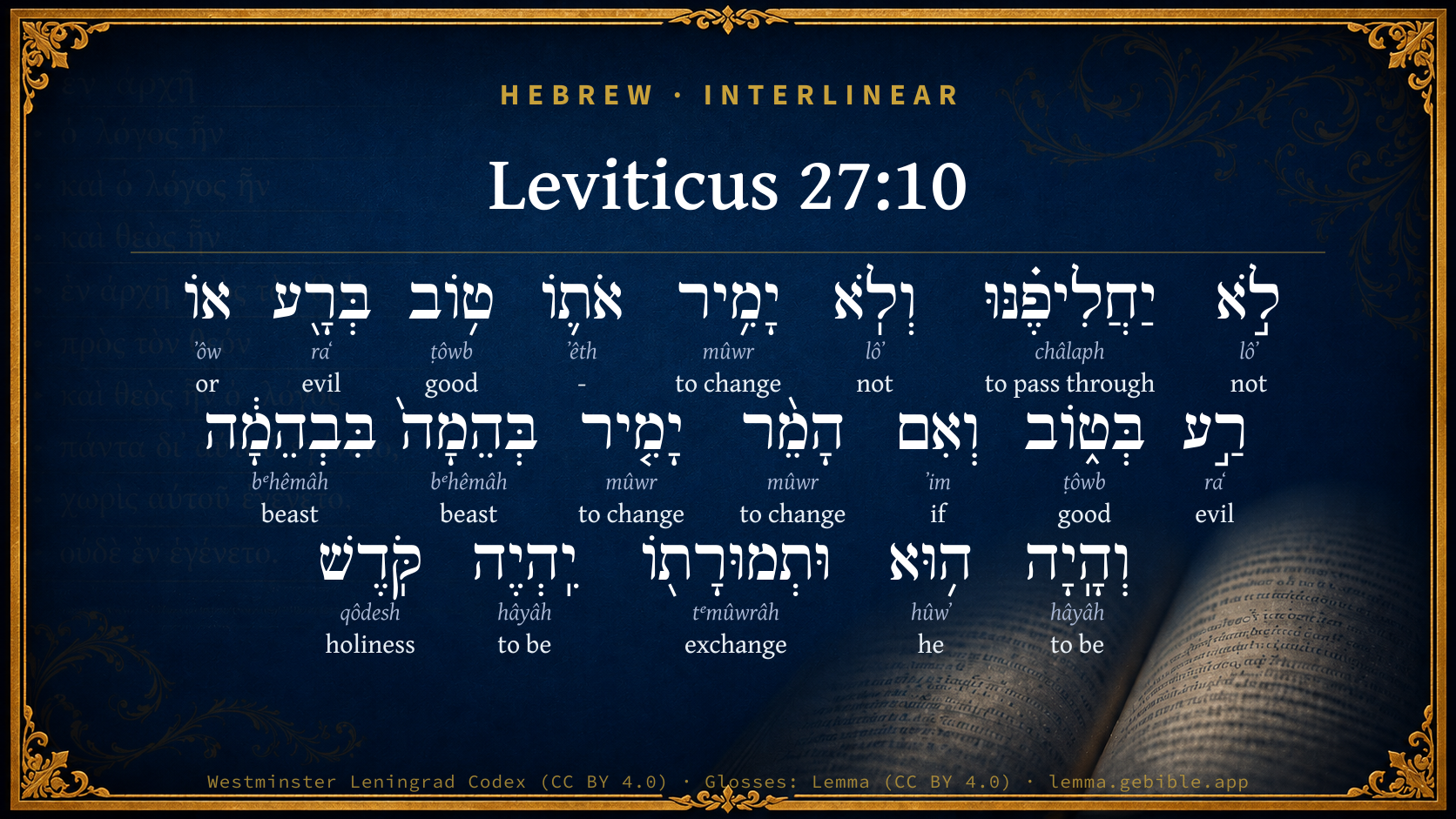
Hebrew (Westminster Leningrad Codex) Leviticus 27:10 appears in the Hebrew Old Testament. The text above is from the Westminster Leningrad Codex. Each word links to its Strong’s number, a concise gloss, and parsing drawn from the Open Scriptures Hebrew Bible morphology. Click any word for its full Brown-Driver-Briggs (BDB) entry.
Download image
Cite this verse

Leviticus 27:10 (World English Bible). Public Domain. Lemma interlinear Bible study tool, https://lemma.gebible.app/v/leviticus/27/10.

Show BibTeX & RIS
BibTeX
RIS
English Translation
He shall not alter it, nor change it, a good for a bad, or a bad for a good: and if he shall at all change animal for animal, then both it and that for which it is changed shall be holy.
World English Bible · Public Domain
Highlights
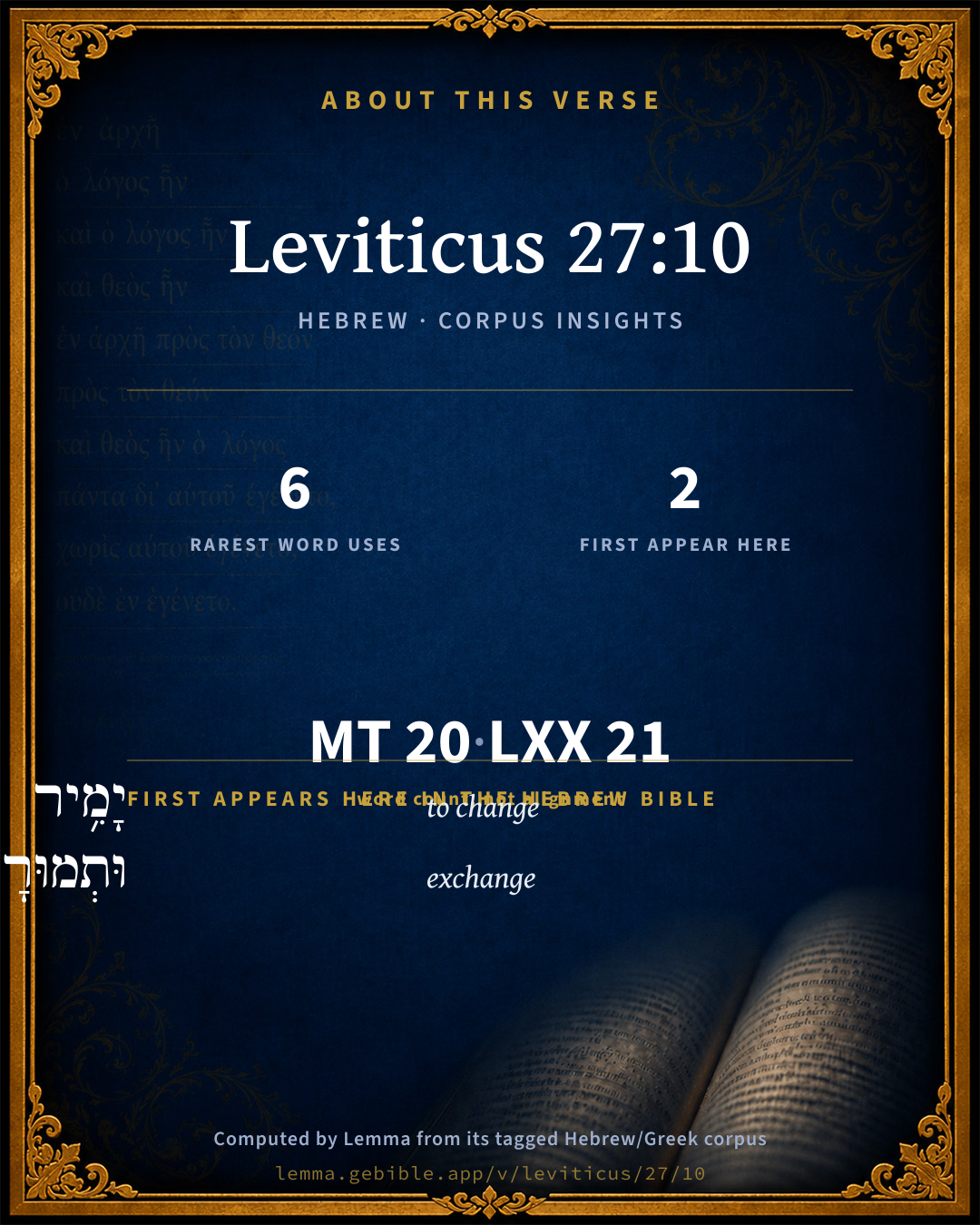
  • 2 first appearances in the Hebrew Bible
Full analysis ↓
Download a study sheet

One document with this verse’s original text, its word-by-word gloss line, the meaning frame, cross-references with their text, attributed commentary, and full source and license credits — printable, and it pastes into notes with its structure intact.

This verse Autodidact and up

Study sheet (.html) Plain text (.txt)

A passage Seminary Student

Up to 50 verses in one chapter. A passage sheet keeps up to 6 commentary sources and 12 cross-references per verse, in the order this page ranks them, and says so on the sheet whenever that leaves anything out. Ask for a single verse and you get the Autodidact verse sheet above.

Everything on this page stays free to read, with no account — the sheet is a download of what is already on screen, not access to it.

Want to remove ads? Support Godless Engineer
Compare translations 3

The same verse in 3 English versions, stacked beneath the original-language interlinear above. Click any original word for its lexicon entry.

Each is an independent rendering of the whole verse — the interlinear is not word-aligned to these translations.

Highlighted words mark where these versions differ — a whole-verse word diff, not a word-by-word alignment.

  • World English Bible Public Domain
    He shall not alter it, nor change it, a good for a bad, or a bad for a good: and if he shall at all change animal for animal, then both it and that for which it is changed shall be holy.
  • King James Version Public Domain
    He shall not alter it, nor change it, a good for a bad, or a bad for a good: and if he shall at all change beast for beast, then it and the exchange thereof shall be holy.
  • unfoldingWord Literal Text CC BY-SA 4.0
    He shall not exchange it and he shall not substitute it, good with bad or bad with good. And if substituting, he substitutes animal with animal, then it shall be it and its substitute shall be holy.

unfoldingWord Literal Text — © unfoldingWord, licensed CC BY-SA 4.0. Word-aligned USFM3 via Door43 (git.door43.org/unfoldingWord/en_ult).

Versions to compare (up to 4)

3 of 4 selected

Show all 18 translations

Every available English version of this verse, each an independent rendering of the whole verse.

  • World English Bible Public Domain
    He shall not alter it, nor change it, a good for a bad, or a bad for a good: and if he shall at all change animal for animal, then both it and that for which it is changed shall be holy.
  • Berean Standard Bible Public Domain
    He must not replace it or exchange it, either good for bad or bad for good. But if he does substitute one animal for another, both that animal and its substitute will be holy.
  • Majority Standard Bible Public Domain
    He must not replace it or exchange it, either good for bad or bad for good. But if he does substitute one animal for another, both that animal and its substitute will be holy.
  • King James Version Public Domain
    He shall not alter it, nor change it, a good for a bad, or a bad for a good: and if he shall at all change beast for beast, then it and the exchange thereof shall be holy.
  • American Standard Version (1901) Public Domain
    He shall not alter it, nor change it, a good for a bad, or a bad for a good: and if he shall at all change beast for beast, then both it and that for which it is changed shall be holy.
  • Revised Version (1885) Public Domain
    He shall not alter it, nor change it, a good for a bad, or a bad for a good: and if he shall at all change beast for beast, then both it and that for which it is changed shall be holy.
  • Geneva Bible (1599) Public Domain
    He shall not alter it nor change it, a good for a badde, nor a badde for a good: and if hee change beast for beast, then both this and that, which was changed for it, shall be holy.
  • Douay-Rheims (1899) Public Domain
    And cannot be changed, that is to say, neither a better for a worse, nor a worse for a better. And if he shall change it: both that which was changed, and that for which it was changed, shall be consecrated to the Lord.
  • Young's Literal Translation Public Domain
    he doth not change it nor exchange it, a good for a bad, or a bad for a good; and if he really change beast for beast, -- then it hath been -- it and its exchange is holy.
  • Literal Standard Version CC BY-SA 4.0
    he does not change it nor exchange it, a good for a bad, or a bad for a good; and if he really exchanges beast for beast, then it has been [holy] and its exchange is holy.
  • Unlocked Literal Bible CC BY-SA 4.0
    The person must not alter or change such an animal, a good one for a bad one or a bad for a good. If he does at all change one animal for another, then both it and the one for which it is exchanged become holy.
  • unfoldingWord Literal Text CC BY-SA 4.0
    He shall not exchange it and he shall not substitute it, good with bad or bad with good. And if substituting, he substitutes animal with animal, then it shall be it and its substitute shall be holy.
  • Darby Bible Public Domain
    They shall not alter it nor change it, a good for a bad, or a bad for a good; and if he at all change beast for beast, then it and the exchange thereof shall be holy.
  • World Messianic Bible Public Domain
    He shall not alter it, nor exchange it, a good for a bad, or a bad for a good. If he shall at all exchange animal for animal, then both it and that for which it is exchanged shall be holy.
  • Webster's Bible Public Domain
    He shall not alter it, nor change it, a good for a bad, or a bad for a good: and if he shall at all change beast for beast, then it and the exchange of it shall be holy.
  • Free Bible Version CC BY-SA 4.0
    You are not allowed to replace it or swap it, either for one that is better or one that is worse. However, if you do replace it then both animals become holy.
  • Bible in Basic English Public Domain
    It may not be changed in any way, a good given for a bad, or a bad for a good; if one beast is changed for another, the two will be holy.
  • JPS Tanakh (1917) Public Domain
    He shall not alter it, nor change it, a good for a bad, or a bad for a good; and if he shall at all change beast for beast, then both it and that for which it is changed shall be holy.

Literal Standard Version (2020), Covenant Press — licensed CC BY-SA 4.0. Text via the HelloAO Bible API (eBible.org). Unlocked Literal Bible (unfoldingWord) — licensed CC BY-SA 4.0. Text via the HelloAO Bible API (eBible.org). unfoldingWord Literal Text — © unfoldingWord, licensed CC BY-SA 4.0. Word-aligned USFM3 via Door43 (git.door43.org/unfoldingWord/en_ult). Free Bible Version, Dr. Jonathan Gallagher — licensed CC BY-SA 4.0. Text via the HelloAO Bible API (eBible.org).

Word by word

More ways to search: Search by grammar → Find every occurrence → Compare this word →

Practice this passage: Drill this verse → Learn its vocabulary →

וּתְמוּרָת֖וֹ
tᵉmûwrâh
H8545
“and · exchange · his”
Conjunction + Noun, Common, Feminine, Singular, Construct + Suffix, Personal, 3rd Person, Masculine, Singular
Part of Speech
Conjunction + Noun
Type
Common
Gender
Feminine
Number
Singular
State
Construct
Full BDB Definition

Origin: from H4171

TWOT: 1164a

that which is exchanged, exchange, substitute, recompense
  1. לֹ֣א lôʼ H3808 “not” Particle, Negative
  2. יַחֲלִיפֶ֗נּוּ châlaph H2498 “to pass through · him” Verb, Hiphil, Imperfect, 3rd Person, Masculine, Singular + Suffix, Personal, 3rd Person, Masculine, Singular
  3. וְלֹֽא lôʼ H3808 “and · not” Conjunction + Particle, Negative
  4. יָמִ֥יר mûwr H4171 “to change” Verb, Hiphil, Imperfect, 3rd Person, Masculine, Singular
  5. אֹת֛וֹ ʼêth H853 “- · him” Particle, Direct Object + Suffix, Personal, 3rd Person, Masculine, Singular
  6. ט֥וֹב ṭôwb H2896 “good” Adjective, Adjective, Masculine, Singular, Absolute
  7. בְּרָ֖ע raʻ H7451 “in/at · evil” Preposition + Adjective, Adjective, Masculine, Singular, Absolute
  8. אוֹ ʼôw H176 “or” Conjunction
  9. רַ֣ע raʻ H7451 “evil” Adjective, Adjective, Masculine, Singular, Absolute
  10. בְּט֑וֹב ṭôwb H2896 “in/at · good” Preposition + Adjective, Adjective, Masculine, Singular, Absolute
  11. וְאִם ʼim H518 “and · if” Conjunction + Conjunction
  12. הָמֵ֨ר mûwr H4171 “to change” Verb, Hiphil, Infinitive Absolute
  13. יָמִ֤יר mûwr H4171 “to change” Verb, Hiphil, Imperfect, 3rd Person, Masculine, Singular
  14. בְּהֵמָה֙ bᵉhêmâh H929 “beast” Noun, Common, Feminine, Singular, Absolute
  15. בִּבְהֵמָ֔ה bᵉhêmâh H929 “in/at · beast” Preposition + Noun, Common, Feminine, Singular, Absolute
  16. וְהָֽיָה hâyâh H1961 “and · to be” Conjunction + Verb, Qal, Sequential Perfect, 3rd Person, Masculine, Singular
  17. ה֥וּא hûwʼ H1931 “he” Pronoun, Personal, 3rd Person, Masculine, Singular
  18. יִֽהְיֶה hâyâh H1961 “to be” Verb, Qal, Imperfect, 3rd Person, Masculine, Singular
  19. קֹּֽדֶשׁ qôdesh H6944 “holiness” Noun, Common, Masculine, Singular, Absolute

About this verse

These counts appear in no published source. They are computed here, from the morphology-tagged text and Lemma’s own curated glosses. What Lemma adds →

20
words
13
distinct lemmas
Pentateuch
section

Notable vocabulary

The rarest word here is וּתְמוּרָת֖וֹ exchange H8545 — appearing just 6 times in the whole Hebrew Bible.

First appearance in Scripture

These words make their first canonical appearance in the Hebrew Bible here:

  • יָמִ֥יר to change H4171
  • וּתְמוּרָת֖וֹ exchange H8545

Shared distinctive vocabulary

וּתְמוּרָת֖וֹ exchange H8545 occurs in 6 verses of the Hebrew Bible. Also found in:

Grammatical profile

  • 6 verbs
  • 4 nouns
  • 4 adjectives
  • 1 pronoun
  • 2 conjunctions
  • 3 particles

Verb forms

  • יַחֲלִיפֶ֗נּוּ Hiphil · Imperfect
  • יָמִ֥יר Hiphil · Imperfect
  • הָמֵ֨ר Hiphil · Infinitive Absolute
  • יָמִ֤יר Hiphil · Imperfect
  • וְהָֽיָה Qal · Sequential Perfect
  • יִֽהְיֶה Qal · Imperfect

Repetition

Words recur within this verse — often emphatic in Hebrew:

  • יָמִ֥יר to change H4171 ×3
  • ט֥וֹב good H2896 ×2
  • בְּרָ֖ע evil H7451 ×2
  • בְּהֵמָה֙ beast H929 ×2
  • וְהָֽיָה to be H1961 ×2
  • לֹ֣א not H3808 ×2

Hebrew & Septuagint length

In English translation the verse runs 42 words from the Hebrew and 36 from the Septuagint (LXX English) — closely comparable.

A rough comparison of the two English renderings, which tokenize alike — not a word-level alignment.

Word counts can differ between the Hebrew and the Greek without any difference in meaning — e.g. the Hebrew direct-object marker אֵת has no separate Greek word, and Greek often adds the article ὁ.

In the original languages it is 20 Hebrew tokens and 21 Greek tokens — but the two are counted differently (Hebrew bundles its prefixes and suffixes into one token; the Greek is in lemma form), so that isn’t a like-for-like length.

Cross-references

2

Topical passages linked to Leviticus 27:10 in the Treasury of Scripture Knowledge — connected by theme and wording, ordered by reader-vote popularity; previews shown in the World English Bible.

  • Leviticus 27:15–33 If he who dedicates it will redeem his house, then he shall add the fifth part of the money of your valuation to it, and it shall be his.
  • James 1:8 He is a double-minded man, unstable in all his ways.

Cross-references courtesy of OpenBible.info (CC BY 4.0).

Hebrew and Greek witnesses Masoretic Hebrew ↔ Greek Septuagint

The same verse in the two great witnesses to the Old Testament, shown verse-for-verse.

These are two independent witnesses, not word-aligned to each other, and the Septuagint is shown in lemma (dictionary) form.

Hebrew Leviticus 27:10 Masoretic · Westminster Leningrad Codex

לֹ֣א יַחֲלִיפֶ֗נּוּ וְלֹֽא יָמִ֥יר אֹת֛וֹ ט֥וֹב בְּרָ֖ע אוֹ רַ֣ע בְּט֑וֹב וְאִם הָמֵ֨ר יָמִ֤יר בְּהֵמָה֙ בִּבְהֵמָ֔ה וְהָֽיָה ה֥וּא וּתְמוּרָת֖וֹ יִֽהְיֶה קֹּֽדֶשׁ

He shall not alter it, nor change it, a good for a bad, or a bad for a good: and if he shall at all change animal for animal, then both it and that for which it is changed shall be holy.

World English Bible · Public Domain

Greek LXX Leviticus 27:10 Septuagint · lemma form

οὐ ἀλλάσσω αὐτός καλός πονηρός οὐδέ πονηρός καλός ἐάν δέ ἀλλάσσω ἀλλάσσω αὐτός κτῆνος κτῆνος εἰμί αὐτός καί ὁ ἄλλαγμα ἅγιος

He shall not change it, a good for a bad, or a bad for a good; and if he do at all change it, a beast for a beast, it and the substitute shall be holy.

LXX2012 (modern English Septuagint) · Public Domain

Hebrew: Westminster Leningrad Codex (CC BY 4.0). Greek: Septuagint (public domain); English from LXX2012 (modern English Septuagint) (Public Domain). How the Septuagint differs from the Hebrew →

Targum (Aramaic paraphrase)

2

The Targum is the ancient Jewish Aramaic paraphrase of the Hebrew Scriptures — an interpretive translation, not the Hebrew text itself. Onkelos (literal) and Pseudo-Jonathan (expansive) render the Torah, and Jonathan the Prophets. Coverage is partial: where no permissively-licensed English translation exists for a verse, only the Aramaic is shown. This is verse-level text, not a word-by-word alignment to the Hebrew.

  1. Targum Onkelos Torah (Genesis–Deuteronomy)
    לָא יְחַלְפִנֵהּ וְלָא יְעִבַּר יָתֵהּ טַּב בְּבִישׁ אוֹ בִישׁ בְּטָב וְאִם חַלָפָא יְחַלֵף בְּעִירָא בִּבְעִירָא וִיהֵי הוּא וְחִלוּפֵי יְהֵי קַדִישׁ

    (no public-domain English translation for this verse)

    Targum Onkelos — Aramaic: “Onkelos Genesis” (public domain); “Onkelos Exodus” (public domain); “Onkelos Leviticus” (public domain); “Onkelos Numbers” (public domain); “Onkelos Deuteronomy” (public domain). English: “Sefaria Community Translation” (CC0 1.0 (public-domain dedication)); “J.W. Etheridge. The Targums of Onkelos and Jonathan Ben Uzziel on the Pentateuch. London: Longmans, Green, 1862” (public domain). Text via Sefaria.

  2. Targum Pseudo-Jonathan Torah (Genesis–Deuteronomy)
    לָא יְשַׁלְחְפִינֵיהּ וְלָא יִפְרַג יָתֵיהּ שְׁלִים בִּדְבֵיהּ מוּמָא וּדְבֵיהּ מוּמָא בִּשְׁלִים וְאִין מִיפְרוֹג יִפְרַג בְּעִירָא בִּבְעִירָא וִיהֵי הוּא וּפְרוֹגֵיהּ יְהֵי קוּדְשָׁא

    He shall not alter it nor change it, that which is perfect for that which hath blemish, or that in which there is blemish for the perfect: but if by changing he will exchange animal for animal, both that and the one that is changed shall be consecrate.

    Targum Pseudo-Jonathan — Aramaic: “Targum Jonathan on Genesis” (public domain); “Targum Jonathan on Exodus” (public domain); “Targum Jonathan on Leviticus” (public domain); “Targum Jonathan on Numbers” (public domain); “Targum Jonathan on Deuteronomy” (public domain). English: “The Targum of Jonathan ben Uzziel, trans. J. W. Etheridge, London, 1862” (public domain). Text via Sefaria.

Commentary

Notes on Leviticus 27:10 from classic Christian and Jewish commentators (each source and its license shown beneath its notes). The classic Christian expositions comment on the surrounding passage and are grouped to its opening verse, so a note may address several verses; the Jewish commentaries on the Tanakh (Rashi and others) are per-verse, so they appear only where the commentator wrote on this verse.

Lemma curates 59 commentaries, every one of them public domain or Creative Commons licensed, each selected and text-cleaned for this edition rather than reprinted as found. About our sources →

Trapp's Complete Commentary

John Trapp

Lev 27:10 He shall not alter it, nor change it, a good for a bad, or a bad for a good: and if he shall at all change beast for beast, then it and the exchange thereof shall be holy.

Ver. 10. Then it and the exchange thereof.] For a punishment of his instability and lightness.

John Trapp, A Commentary or Exposition upon All the Books of the Old and New Testament (1647–1656) — public domain. Text from a community e-Sword module.

Joseph Benson's Commentary

Lev 27:10. He shall not alter it, nor change it — Two words expressing the same thing more emphatically; that is, he shall in no wise change it, neither for one of the same nor of another kind: partly because God would preserve the sanctity and reverence of consecrated things, and therefore would not have them alienated; and partly to prevent abuses of them by those who on this pretence might exchange what had been vowed for the worse. It and the exchange — That is, both the thing first vowed, and the thing offered and given in exchange. This was inflicted upon him as a just penalty for his levity in such weighty matters.

Joseph Benson's Commentary on the Old and New Testaments (1811–1818) — public domain. Text from a community e-Sword module.

Geneva Bible (1599)

Geneva Bible translators

That is, consecrated to the Lord.

Geneva Bible (1599) marginal notes — public domain. Text via Bolls.life.

Adam Clarke's Commentary

Verse 10. He shall not alter it, nor change it, a good for a bad, c.] Whatever was consecrated to God by a vow, or purpose of heart, was considered from that moment as the Lord's property to change which was impiety; to withhold it, sacrilege. Reader, hast thou ever dedicated thyself, or any part of thy property, to the service of thy Maker? If so, hast thou paid thy vows? Or hast thou altered thy purpose, or changed thy offering? Has he received from thy hands a bad for a good? Wast thou not vowed and consecrated to God in thy baptism? Are his vows still upon thee? Hast thou "renounced the devil and all his works, the pomps and vanities of this wicked world, and all the sinful lusts of the flesh?" Dost thou feel thyself bound "to keep God's holy will and commandments, and walk in the same all the days of thy life?" Was not this thy baptismal covenant? And hast thou renounced IT? Take heed! God is not mocked: that which thou sowest, thou shalt also reap. If thou rob God of thy heart, he will deprive thee of his heaven.

Adam Clarke's Commentary on the Bible (1810–1826) — public domain. Text from a community e-Sword/MySword module.

Ellicott's Commentary for English Readers

(10) He shall not alter it, nor change it.—The identical animal vowed is to be delivered; no change whatever, even if it is in the substitution of a better for an inferior animal, is permitted. The stress laid upon this part of the enactment is indicated by the employment here of two verbs of the same import. If he who vows does change the one he dedicated to the Lord, both the animals, the one he originally vowed and the one he substituted for it, are alike holy, and must be delivered to the sanctuary.

A Bible Commentary for English Readers, edited by Charles John Ellicott (1878–1897) — public domain. Text from a community e-Sword module.

John Gill's Exposition

And if it be any unclean beast, of which they do not offer a sacrifice unto the Lord,.... Any creature, excepting a dog, the price of which was not to be brought into the house of the Lord; besides oxen, sheep, goats, rams, and lambs; though some understand it even of such that have blemishes on them, and so not fit to be offered unto the Lord; so Jarchi and others (x):

then he shall present the beast before the priest; to be viewed, examined, and judged of as to its worth, and a value put upon it, that it might be sold or redeemed, as no other but a beast might; so it is observed birds, wood, frankincense, and ministering vessels, have no redemption, for it is only said a beast (y).

(x) Maimon. & Bartenora in Misn. Menachot, c. 12. sect. 1. (y) Misn. ib.

John Gill's Exposition of the Whole Bible (1746–1763) — public domain (CC PDM 1.0). Text via the HelloAO Bible API.

Matthew Poole's English Annotations

He shall not alter it, nor change it; two words expressing the same thing more emphatically: q.d. He shall in no wise change it, neither for one of the same, nor of another kind.

A good for a bad, or a bad for a good; partly because God would preserve the sanctity and reverence of consecrated things, and therefore would not have them alienated; and partly to prevent abuses of them who on this pretence might exchange it for the worse, as reserving the judgment to himself.

The exchange thereof, i.e. both the thing first vowed, and thing offered or given in exchange. This was inflicted upon him as a just penalty for his rashness and levity in such weighty matters.

Matthew Poole's English Annotations on the Holy Bible (1683–1685) — public domain. Text from a community e-Sword/MySword module.

Whedon's Commentary on the Bible

Daniel D. Whedon

10. He shall not alter — He shall not modify the terms of his vow by substituting any thing else than the animal vowed.

Nor change — Another animal of the same species will not be accepted. “Whatever was consecrated to God by a vow or purpose of heart was considered from that moment as the Lord’s property; to change which was impiety; to withdraw, sacrilege.” — Bush. God will permit no dictation respecting the disposal of his own.

It and the exchange — As a penalty for his attempted usurpation of a divine prerogative, both animals shall be holy, and tradition adds that the intermeddler was scourged besides. The tendency of this law was to discourage rash vows, and to impress both Jews and Christians with the inviolable sacredness of the object consecrated, no part of which can ever be safely recalled.

Daniel D. Whedon (gen. ed.), Commentary on the Old and New Testaments (1874–1909) — public domain. Text from a community e-Sword module.

John Wesley's Explanatory Notes

He shall not alter it, nor change it - Two words expressing the same thing more emphatically, that is, he shall in no wise change it, neither for one of the same, nor of another kind: partly because God would preserve the reverence of consecrated things, and therefore would not have them alienated, and partly to prevent abuses of them who on this pretense might exchange it for the worse. It and the exchange - That is, both the thing first vowed, and the thing offered or given in exchange. This was inflicted upon him as a just penalty for his levity in such weighty matters.

John Wesley, Explanatory Notes Upon the Whole Bible (1754–1765) — public domain. Text via the GEBible commentary corpus.

Rashi

Rabbi Shlomo Yitzchaki (Rashi)

טוב ברע [HE SHALL NEITHER CHANGE IT NOR EXCHANGE IT] A GOOD FOR A BAD — i. e. he shall not give in exchange a perfect animal of a non-sacred character for one devoted to the Sanctuary but having some blemish (cf. Rashi on Temurah 9a on ‎‎‎מתני' טוב ברע),

‎‎‎או רע בטוב‎ OR A BAD FOR A GOOD — It follows à fortiori that he must not give in exchange a perfect animal for another perfect one, or one with a blemish for another with a blemish (Temurah 9a).

Rashi on the Tanakh — English translations: “The Judaica Press complete Tanach with Rashi, translated by A. J. Rosenberg” (CC BY 4.0); “Pentateuch with Rashi's commentary by M. Rosenbaum and A.M. Silbermann, 1929-1934” (public domain); “The Metsudah Tanach series, Lakewood, N.J” (CC BY 4.0); and “The Book of Joshua, Metsudah Publications, 1997” (CC BY 4.0). Text via Sefaria.

Lesson kit

Teaching starters — assembled from the data on this page, not authored interpretation. Every prompt links to the verse data it draws on. Edit before teaching.

Leviticus, in the Pentateuch, opens this verse with 20 words (13 distinct Hebrew lemmas). Its most distinctive word is tᵉmûwrâh (“exchange”). A historical commentator’s framing appears above. Read the whole chapter for the surrounding context.

Discussion questions

  1. The word tᵉmûwrâh carries the sense “exchange.” How does it shape the verse?
  2. 2 words here appear for the first time in Scripture. What is being introduced at this debut?
  3. Leviticus 27:33 shares the word «exchange» with this verse. How do the two illuminate each other?
  4. “to change” occurs 3× in this one verse. What is the effect of the repetition?
  5. These translations render this verse differently; the difference is in the English rendering, not the original. What questions does that raise?
  6. The verb «יַחֲלִיפֶ֗נּוּ» is Hiphil Imperfect. How does its form color the action?
  7. Reading how Trapp's Complete Commentary and Joseph Benson's Commentary read this verse, where do the two commentators agree and where do they part?

Things to notice

Reading settings

Reading text

Shown beneath each verse's original-language words.

Old Testament
Old Testament edition

Read the OT as the Masoretic Hebrew (MT) or the Greek Septuagint (LXX).

English shown for the Greek Septuagint (in the Hebrew ↔ Greek comparison).

Comparing translations? Open the Compare panel on any verse page to stack up to four side by side.