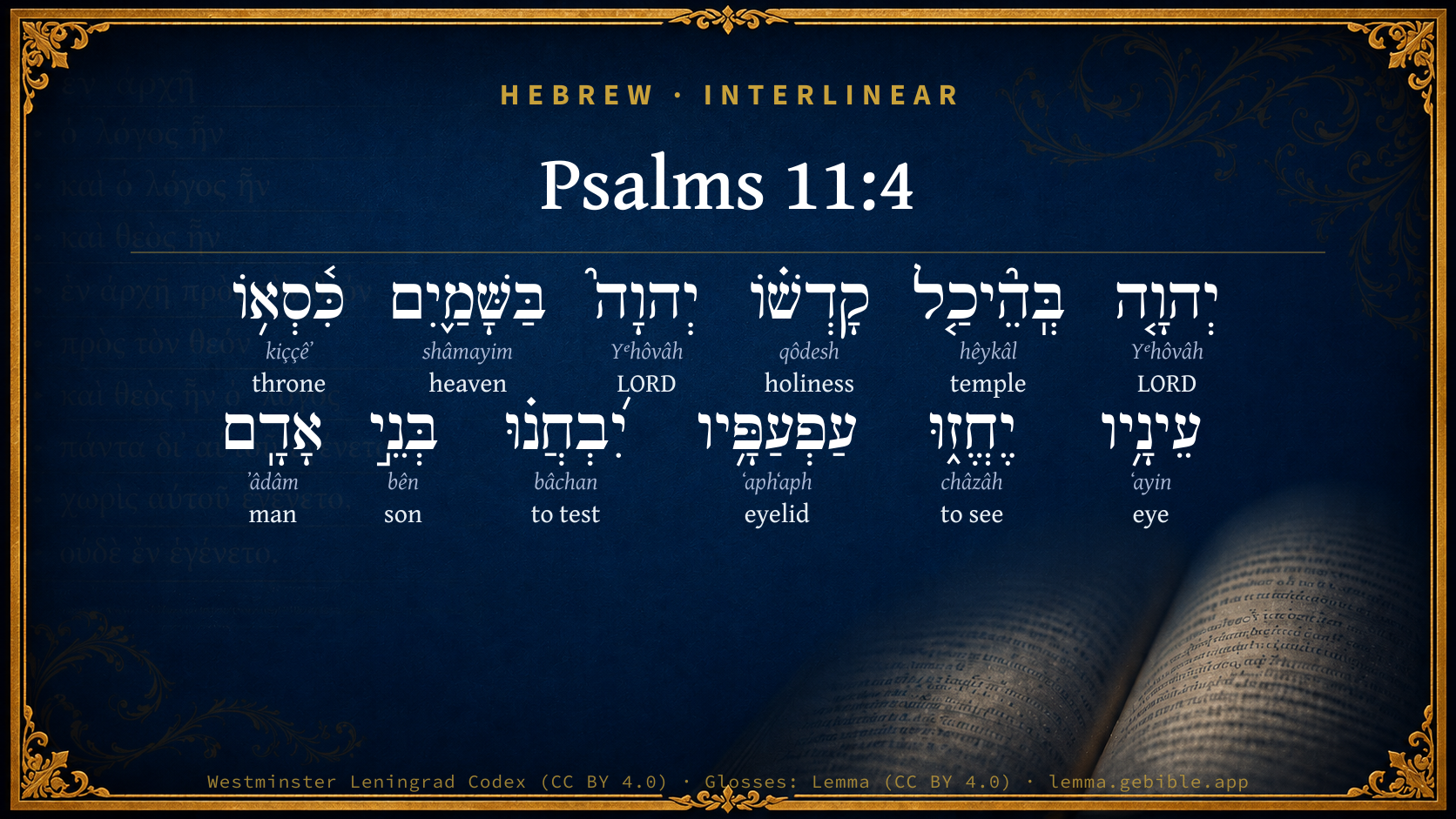
Psalms 11:4

Hebrew (Westminster Leningrad Codex) Psalms 11:4 appears in the Hebrew Old Testament. The text above is from the Westminster Leningrad Codex. Each word links to its Strong’s number, a concise gloss, and parsing drawn from the Open Scriptures Hebrew Bible morphology. Click any word for its full Brown-Driver-Briggs (BDB) entry.
Download image
Cite this verse

Psalms 11:4 (World English Bible). Public Domain. Lemma interlinear Bible study tool, https://lemma.gebible.app/v/psalms/11/4.

Show BibTeX & RIS
BibTeX
RIS
English Translation
Yahweh is in his holy temple. Yahweh is on his throne in heaven. His eyes observe. His eyes examine the children of men.
World English Bible · Public Domain
Download a study sheet

One document with this verse’s original text, its word-by-word gloss line, the meaning frame, cross-references with their text, attributed commentary, and full source and license credits — printable, and it pastes into notes with its structure intact.

This verse Autodidact and up

Study sheet (.html) Plain text (.txt)

A passage Seminary Student

Up to 50 verses in one chapter. A passage sheet keeps up to 6 commentary sources and 12 cross-references per verse, in the order this page ranks them, and says so on the sheet whenever that leaves anything out. Ask for a single verse and you get the Autodidact verse sheet above.

Everything on this page stays free to read, with no account — the sheet is a download of what is already on screen, not access to it.

Want to remove ads? Support Godless Engineer
Compare translations 3

The same verse in 3 English versions, stacked beneath the original-language interlinear above. Click any original word for its lexicon entry.

Each is an independent rendering of the whole verse — the interlinear is not word-aligned to these translations.

Highlighted words mark where these versions differ — a whole-verse word diff, not a word-by-word alignment.

  • World English Bible Public Domain
    Yahweh is in his holy temple. Yahweh is on his throne in heaven. His eyes observe. His eyes examine the children of men.
  • King James Version Public Domain
    The LORD is in his holy temple, the LORD's throne is in heaven: his eyes behold, his eyelids try, the children of men.
  • unfoldingWord Literal Text CC BY-SA 4.0
    Yahweh in his holy temple; Yahweh in the heavens, his throne. His eyes see, his eyelids test the sons of man.

unfoldingWord Literal Text — © unfoldingWord, licensed CC BY-SA 4.0. Word-aligned USFM3 via Door43 (git.door43.org/unfoldingWord/en_ult).

Versions to compare (up to 4)

3 of 4 selected

Show all 17 translations

Every available English version of this verse, each an independent rendering of the whole verse.

  • World English Bible Public Domain
    Yahweh is in his holy temple. Yahweh is on his throne in heaven. His eyes observe. His eyes examine the children of men.
  • Berean Standard Bible Public Domain
    The LORD is in His holy temple; the LORD is on His heavenly throne. His eyes are watching closely; they examine the sons of men.
  • Majority Standard Bible Public Domain
    The LORD is in His holy temple; the LORD is on His heavenly throne. His eyes are watching closely; they examine the sons of men.
  • King James Version Public Domain
    The LORD is in his holy temple, the LORD's throne is in heaven: his eyes behold, his eyelids try, the children of men.
  • American Standard Version (1901) Public Domain
    Jehovah is in his holy temple; Jehovah, his throne is in heaven; His eyes behold, his eyelids try, the children of men.
  • Revised Version (1885) Public Domain
    The LORD is in his holy temple, the LORD, his throne is in heaven; his eyes behold, his eyelids try, the children of men.
  • Geneva Bible (1599) Public Domain
    The Lord is in his holy palace: the Lordes throne is in the heauen: his eyes wil consider: his eye lids will try the children of men.
  • Young's Literal Translation Public Domain
    `Jehovah `is' in his holy temple: Jehovah -- in the heavens `is' His throne. His eyes see -- His eyelids try the sons of men.
  • Literal Standard Version CC BY-SA 4.0
    YHWH [is] in His holy temple: YHWH—His throne [is] in the heavens. His eyes see—His eyelids try the sons of men.
  • Unlocked Literal Bible CC BY-SA 4.0
    Yahweh is in his holy temple; his eyes watch, his eyes examine the children of mankind.
  • unfoldingWord Literal Text CC BY-SA 4.0
    Yahweh in his holy temple; Yahweh in the heavens, his throne. His eyes see, his eyelids test the sons of man.
  • Darby Bible Public Domain
    Jehovah [is] in the temple of his holiness; Jehovah, -- his throne is in the heavens: his eyes behold, his eyelids try the children of men.
  • World Messianic Bible Public Domain
    The LORD is in his holy temple. The LORD is on his throne in heaven. His eyes observe. His eyes examine the children of men.
  • Webster's Bible Public Domain
    The LORD is in his holy temple, the LORD'S throne is in heaven: his eyes behold, his eyelids try the children of men.
  • Free Bible Version CC BY-SA 4.0
    The Lord is in his Temple; the Lord's throne is in heaven. He keeps a close eye on everyone, watching them carefully.
  • Bible in Basic English Public Domain
    The Lord is in his holy Temple, the Lord's seat is in heaven; his eyes are watching and testing the children of men.
  • JPS Tanakh (1917) Public Domain
    The LORD is in His holy temple, the LORD, His throne is in heaven; His eyes behold, His eyelids try, the children of men.

Literal Standard Version (2020), Covenant Press — licensed CC BY-SA 4.0. Text via the HelloAO Bible API (eBible.org). Unlocked Literal Bible (unfoldingWord) — licensed CC BY-SA 4.0. Text via the HelloAO Bible API (eBible.org). unfoldingWord Literal Text — © unfoldingWord, licensed CC BY-SA 4.0. Word-aligned USFM3 via Door43 (git.door43.org/unfoldingWord/en_ult). Free Bible Version, Dr. Jonathan Gallagher — licensed CC BY-SA 4.0. Text via the HelloAO Bible API (eBible.org).

Word by word

More ways to search: Search by grammar → Find every occurrence → Compare this word →

Practice this passage: Drill this verse → Learn its vocabulary →

עַפְעַפָּ֥יו
ʻaphʻaph
H6079
“eyelids · his”
Noun, Common, Masculine, Dual, Construct + Suffix, Personal, 3rd Person, Masculine, Singular
Part of Speech
Noun
Type
Common
Gender
Masculine
Number
Dual
State
Construct
Full BDB Definition

Origin: from H5774

TWOT: 1582b

eyelid - eyelid - of dawn, rays of sun (figuratively)
  1. יְהוָ֤ה Yᵉhôvâh H3068 “LORD” Noun, Proper
  2. בְּֽהֵ֘יכַ֤ל hêykâl H1964 “in/at · temple of” Preposition + Noun, Common, Masculine, Singular, Construct
  3. קָדְשׁ֗וֹ qôdesh H6944 “holiness · his” Noun, Common, Masculine, Singular, Construct + Suffix, Personal, 3rd Person, Masculine, Singular
  4. יְהוָה֮ Yᵉhôvâh H3068 “LORD” Noun, Proper
  5. בַּשָּׁמַ֪יִם shâmayim H8064 “in/at the · heaven(s)” Preposition, Determined + Noun, Common, Masculine, Plural, Absolute
  6. כִּ֫סְא֥וֹ kiççêʼ H3678 “throne · his” Noun, Common, Masculine, Singular, Construct + Suffix, Personal, 3rd Person, Masculine, Singular
  7. עֵינָ֥יו ʻayin H5869 “eyes · his” Noun, Common, Both, Dual, Construct + Suffix, Personal, 3rd Person, Masculine, Singular
  8. יֶחֱז֑וּ châzâh H2372 “to see” Verb, Qal, Imperfect, 3rd Person, Masculine, Plural
  9. יִ֝בְחֲנ֗וּ bâchan H974 “to test” Verb, Qal, Imperfect, 3rd Person, Masculine, Plural
  10. בְּנֵ֣י bên H1121 “sons of” Noun, Common, Masculine, Plural, Construct
  11. אָדָֽם ʼâdâm H120 “man” Noun, Common, Masculine, Singular, Absolute

About this verse

These counts appear in no published source. They are computed here, from the morphology-tagged text and Lemma’s own curated glosses. What Lemma adds →

12
words
11
distinct lemmas
Wisdom
section

Notable vocabulary

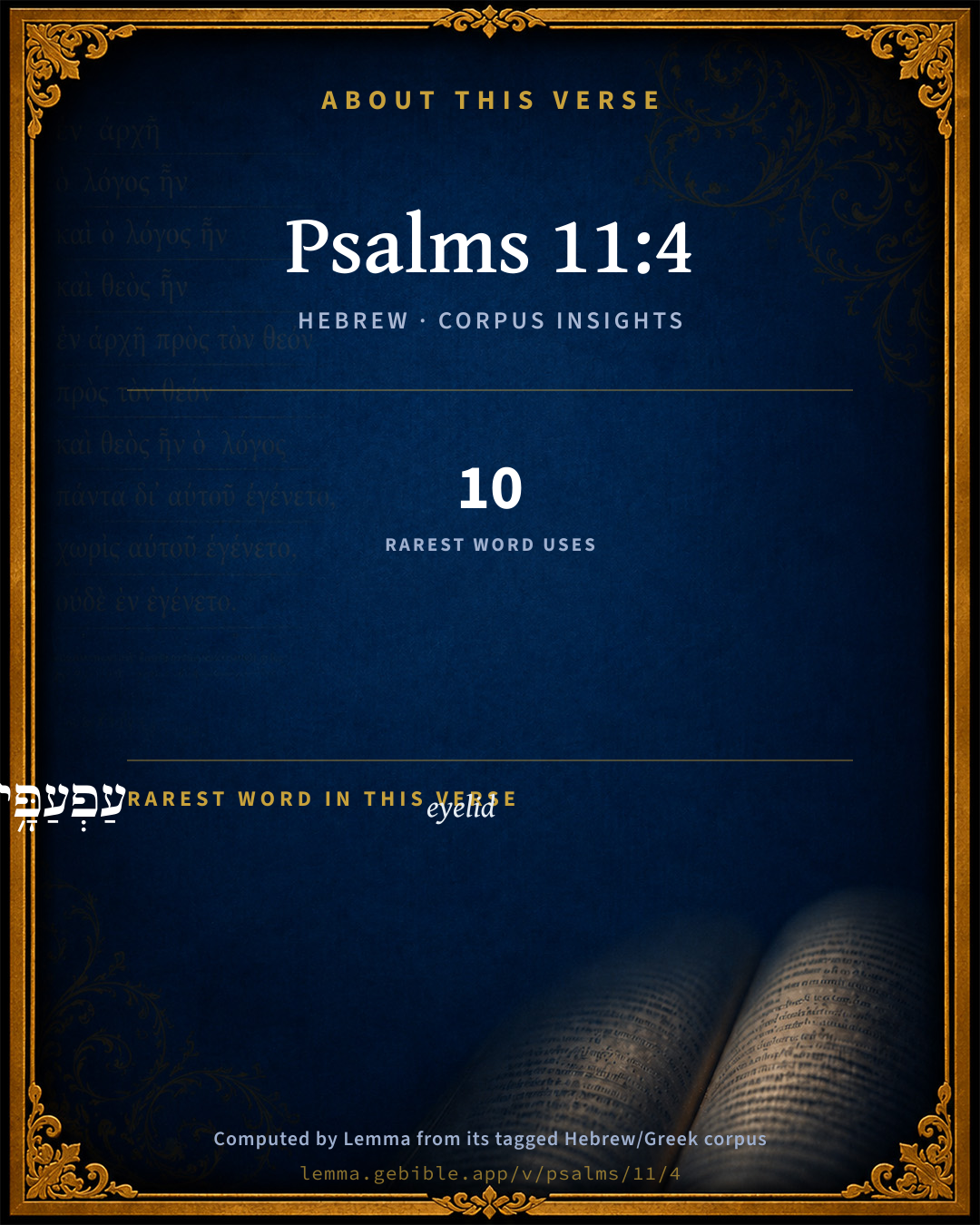
The rarest word here is עַפְעַפָּ֥יו eyelid H6079 — appearing just 10 times in the whole Hebrew Bible.

Shared distinctive vocabulary

עַפְעַפָּ֥יו eyelid H6079 occurs in 10 verses of the Hebrew Bible. Also found in:

Grammatical profile

  • 2 verbs
  • 10 nouns

Verb forms

  • יֶחֱז֑וּ Qal · Imperfect
  • יִ֝בְחֲנ֗וּ Qal · Imperfect

Repetition

A word recurs within this verse — often emphatic in Hebrew:

  • יְהוָ֤ה LORD H3068 ×2

Hebrew & Septuagint length

In English translation the verse runs 23 words from the Hebrew and 15 from the Septuagint (LXX English) — closely comparable.

A rough comparison of the two English renderings, which tokenize alike — not a word-level alignment.

Word counts can differ between the Hebrew and the Greek without any difference in meaning — e.g. the Hebrew direct-object marker אֵת has no separate Greek word, and Greek often adds the article ὁ.

Cross-references

24

Topical passages linked to Psalms 11:4 in the Treasury of Scripture Knowledge — connected by theme and wording, ordered by reader-vote popularity; previews shown in the World English Bible.

  • Psalms 103:19 Yahweh has established his throne in the heavens. His kingdom rules over all.
  • Psalms 2:4 He who sits in the heavens will laugh. The Lord will have them in derision.
  • Psalms 18:6 In my distress I called on Yahweh, And cried to my God. He heard my voice out of his temple, My cry before him came into his ears.
  • Habakkuk 2:20 But Yahweh is in his holy temple. Let all the earth be silent before him!"
  • Psalms 33:13 Yahweh looks from heaven. He sees all the sons of men.
  • Psalms 34:15–16 Yahweh's eyes are toward the righteous. His ears listen to their cry.
  • Isaiah 66:1 Thus says Yahweh, heaven is my throne, and the earth is my footstool: what manner of house will you build to me? and what place shall be my rest?
  • Jeremiah 23:24 Can any hide himself in secret places so that I shall not see him? says Yahweh. Don't I fill heaven and earth? says Yahweh.
  • 2 Chronicles 16:9 For the eyes of Yahweh run back and forth throughout the whole earth, to show himself strong in the behalf of them whose heart is perfect toward him. Herein you have done foolishly; for from henceforth you shall have wars.
  • Hebrews 4:13 There is no creature that is hidden from his sight, but all things are naked and laid open before the eyes of him with whom we have to do.
  • Revelation 4:2 Immediately I was in the Spirit. Behold, there was a throne set in heaven, and one sitting on the throne
  • 1 Chronicles 17:5 for I have not lived in a house since the day that I brought up Israel, to this day, but have gone from tent to tent, and from [one] tent [to another].
  • Psalms 66:7 He rules by his might forever. His eyes watch the nations. Don't let the rebellious rise up against him. Selah.
  • Proverbs 15:3 Yahweh's eyes are everywhere, Keeping watch on the evil and the good.
  • Matthew 5:34 but I tell you, don't swear at all: neither by heaven, for it is the throne of God;
  • Matthew 23:21 He who swears by the temple, swears by it, and by him who was living in it.
  • 2 Thessalonians 2:4 he who opposes and exalts himself against all that is called God or that is worshiped; so that he sits as God in the temple of God, setting himself up as God.
  • Jeremiah 17:10 I, Yahweh, search the mind, I try the heart, even to give every man according to his ways, according to the fruit of his doings.
  • Acts 7:49 'heaven is my throne, And the earth a footstool for my feet. What kind of house will you build me?' says the Lord; 'Or what is the place of my rest?
  • Exodus 40:34–35 Then the cloud covered the tent of meeting, and the glory of Yahweh filled the tent.
  • Psalms 9:11 Sing praises to Yahweh, who dwells in Zion, And declare among the people what he has done.
  • Zechariah 2:13 Be silent, all flesh, before Yahweh; for he has roused himself from his holy habitation!"
  • Psalms 44:21 Won't God search this out? For he knows the secrets of the heart.
  • Micah 1:2 Hear, you peoples, all of you. Listen, O earth, and all that is therein: And let the Lord Yahweh be witness against you, The Lord from his holy temple.

Cross-references courtesy of OpenBible.info (CC BY 4.0).

Hebrew and Greek witnesses Masoretic Hebrew ↔ Greek Septuagint

The same verse in the two great witnesses to the Old Testament, shown verse-for-verse.

You’re reading Greek Psalm 10 (Hebrew Psalm 11). The Septuagint counts the superscription, so verse numbers can differ from the Hebrew — chapter-level alignment, not verse-by-verse. Numbering follows Rahlfs.

These are two independent witnesses, not word-aligned to each other, and the Septuagint is shown in lemma (dictionary) form.

Hebrew Psalms 11:4 Masoretic · Westminster Leningrad Codex

יְהוָ֤ה בְּֽהֵ֘יכַ֤ל קָדְשׁ֗וֹ יְהוָה֮ בַּשָּׁמַ֪יִם כִּ֫סְא֥וֹ עֵינָ֥יו יֶחֱז֑וּ עַפְעַפָּ֥יו יִ֝בְחֲנ֗וּ בְּנֵ֣י אָדָֽם

Yahweh is in his holy temple. Yahweh is on his throne in heaven. His eyes observe. His eyes examine the children of men.

World English Bible · Public Domain

Greek LXX Greek Psalm 10:4 Septuagint · lemma form

κύριος ἐν ναός ἅγιος αὐτός κύριος ἐν οὐρανός ὁ θρόνος αὐτός ὁ ὀφθαλμός αὐτός εἰς ὁ πένης ἀποβλέπω ὁ βλέφαρον αὐτός ἐκἐτάζω ὁ υἱός ὁ ἄνθρωπος

For they have pulled down what you did frame, but what has the righteous done?

LXX2012 (modern English Septuagint) · Public Domain

On this verse, The Cambridge Bible for Schools and Colleges discusses the Septuagint’s reading. Read the note in Commentary ↓

Hebrew: Westminster Leningrad Codex (CC BY 4.0). Greek: Septuagint (public domain); English from LXX2012 (modern English Septuagint) (Public Domain). How the Septuagint differs from the Hebrew →

Commentary

Notes on Psalms 11:4 from classic Christian and Jewish commentators (each source and its license shown beneath its notes). The classic Christian expositions comment on the surrounding passage and are grouped to its opening verse, so a note may address several verses; the Jewish commentaries on the Tanakh (Rashi and others) are per-verse, so they appear only where the commentator wrote on this verse.

Lemma curates 59 commentaries, every one of them public domain or Creative Commons licensed, each selected and text-cleaned for this edition rather than reprinted as found. About our sources →

Trapp's Complete Commentary

John Trapp

Psa 11:4 The LORD [is] in his holy temple, the LORD’S throne [is] in heaven: his eyes behold, his eyelids try, the children of men.

Ver. 4. The Lord is in his holy temple] i.e. In heaven, and there hence he both can and will do much for the relief of his poor oppressed, though the righteous can do little for themselves, Ubi deficit auxilium humanum incipit divinum (Philo). He also knows, and will clear their innocence; for he sits between the cherubims, whence he is wont to send help, Psa 20:3, and hath his throne in heaven, whence he is wont to strike terror into the enemies, Psa 18:8, &c.

The Lord’s throne is in heaven] This is the same with the former, serving to set forth God’s sufficiency, as the following words do his efficiency, those props of David’s faith, answerable to Jachin and Boaz, those two brazen pillars in Solomon’s temple, Dei solium est nostrum asylum.

His eyes behold, his eyelids try, the children of men] The eye of God is taken in Scripture (saith one) either for his knowledge or for his judgment; his eye in this text pointeth out his knowledge, his eyelids his critical descant. It is a manner of speech, saith another, taken from those men’s actions who, being desirous to look upon a thing more intently, do wink with their eyes, or close up one of them, that they may see the better with the other.

John Trapp, A Commentary or Exposition upon All the Books of the Old and New Testament (1647–1656) — public domain. Text from a community e-Sword module.

The Biblical Illustrator

Joseph S. Exell

Psa_11:4

The Lord is in His holy temple.

The earthly temple

How are we to be assured of the truth that the Lord is in His holy temple? We have no visible sign; but He reveals Himself in our hearts, and requires that we should know and feel His presence there. How, then, are we to meet Him in the temple?

1. We come as created beings to offer a tribute of gratitude. Are any so worn with trouble as to think the gift of existence not worth the expression of gratitude? Let such remember that here we are but preparing for a blessed immortality, and that our trials, well endured, will add to the measure of our bliss hereafter.

2. We are dependent creatures. Then we should offer our thanks for the past, and supplications for the future.

3. We are sinful creatures. Then we should make confession to our God, whom we have so often and deeply offended.

4. We are accountable creatures. Then we should come here to learn His holy will, and of our obedience to it exact account will be required.

5. We are social creatures. Then we should ask blessings, not for ourselves only, but also for others. The sinner, the penitent, the believer, the sorrowful, the sufferer--all are remembered in our prayers. Learn so to worship that you may ever feel that you have indeed been with the Lord in His holy temple. (Edward Rice, M. A.)

The Biblical Illustrator, edited by Joseph S. Exell (c. 1880s–1900s) — public domain. Text from a community e-Sword module.

Joseph Benson's Commentary

Psa 11:4. The Lord is in his holy temple — The psalmist, having, in the first verse, declared that his trust was in Jehovah, and having mentioned the advice of his friends, is supposed to be now proceeding to show the fitness and propriety of his trust, notwithstanding the seeming desperate situation of affairs. His words, considered as being spoken in reply to his friends, may be interpreted as follows: My answer to you is, that the world is not governed by chance, nor can men carry things just as they please; but the Lord, into whose holy palace no unjust counsels can possibly enter, who observes every thing from his temple in the heavens, and whose throne is infinitely above that of the greatest king on earth: He, I say, is the supreme and most righteous ruler of all affairs; and no mischief can be so secretly contrived, no wicked design so artfully dissembled, but it lies open before his eyes, and he sees through it. Nor need he take any pains to discover it, for at the first glance, as we speak, he perfectly discerns how all men are inclined, and looks to the very bottom of their hearts.

Joseph Benson's Commentary on the Old and New Testaments (1811–1818) — public domain. Text from a community e-Sword module.

J. A. Alexander on Psalms

Joseph Addison Alexander

4. (Psa 11:4) Jehovah (is) in his palace (or temple) of holiness; Jehovah (or as to Jehovah), in the heavens (is) his throne. His eyes behold, his eyelids prove the sons of men. He is so exalted that he can see, and so holy that he must see and judge the conduct of his creatures. By an equally grammatical but less natural construction, the whole verse may be thrown into a single proposition. "Jehovah in his holy temple, Jehovah whose throne is in heaven, his eyes," etc.—For the meaning of the word translated temple, see above on Psa 5:8 (7).—Eyelids are mentioned as a poetical parallel to eyes, being the nearest equivalent afforded by the language.—Try or prove, as if by seeing through them. With the whole verse compare Psa 102:20 (19).

Joseph Addison Alexander, The Psalms Translated and Explained (1850) — public domain. Text from a community e-Sword module.

Tyndale Open Study Notes

Tyndale Open Resources

11:4 The righteous King rules from heaven, where his throne is untouched by human corruption (see 2:4). He examines everyone and sees everything that happens on earth (see 14:2-3).

Tyndale Open Study Notes — © Tyndale Open Resources, licensed CC BY-SA 4.0. Text via the HelloAO Bible API.

Geneva Bible (1599)

Geneva Bible translators

Though all things in earth be out of order, yet God will execute judgment from heaven.

Geneva Bible (1599) marginal notes — public domain. Text via Bolls.life.

Matthew Henry's Commentary

The shaking of a tree (they say) makes it take the deeper and faster root. The attempt of David's enemies to discourage his confidence in God engages him to cleave so much the more closely to his first principles, and to review them, which he here does, abundantly to his own satisfaction and the silencing of all temptations to infidelity. That which was shocking to his faith, and has been so to the faith of many, was the prosperity of wicked people in their wicked ways, and the straits and distresses which the best men are sometimes reduced to: hence such an evil thought as this was apt to arise, Surely it is vain to serve God, and we may call the proud happy. But, in order to stifle and shame all such thoughts, we are here called to consider,

I. That there is a God in heaven: The Lord is in his holy temple above, where, though he is out of our sight, we are not out of his. Let not the enemies of the saints insult over them, as if they were at a loss and at their wits' end: no, they have a God, and they know where to find him and how to direct their prayer unto him, as their Father in heaven. Or, He is in his holy temple, that is, in his church; he is a God in covenant and communion with his people, through a Mediator, of whom the temple was a type. We need not say, "Who shall go up to heaven, to fetch us thence a God to trust to?" No, the word is nigh us, and God in the word; his Spirit is in his saints, those living temples, and the Lord is that Spirit.

II. That this God governs the world. The Lord has not only his residence, but his throne, in heaven, and he has set the dominion thereof in the earth (Job 38:33); for, having prepared his throne in the heavens, his kingdom ruleth over all, Psa 103:19. Hence the heavens are said to rule, Dan 4:26. Let us by faith see God on this throne, on his throne of glory, infinitely transcending the splendour and majesty of earthly princes - on his throne of government, giving law, giving motion, and giving aim, to all the creatures - on his throne of judgment, rendering to every man according to his works - and on his throne of grace, to which his people may come boldly for mercy and grace; we shall then see no reason to be discouraged by the pride and power of oppressors, or any of the afflictions that attend the righteous.

III. That this God perfectly knows every man's true character: His eyes behold, his eye-lids try, the children of men; he not only sees them, but he sees through them, not only knows all they say and do, but knows what they think, what they design, and how they really stand affected, whatever they pretend. We may know what men seem to be, but he knows what they are, as the refiner knows what the value of the gold is when he has tried it. God is said to try with his eyes, and his eye-lids, because he knows men, not as earthly princes know men, by report and representation, but by his own strict inspection, which cannot err nor be imposed upon. This may comfort us when we are deceived in men, even in men that we think we have tried, that God's judgment of men, we are sure, is according to truth.

IV. That, if he afflict good people, it is for their trial and therefore for their good, Psa 11:5. The Lord tries all the children of men that he may do them good in their latter end, Deu 8:16. Let not that therefore shake our foundations nor discourage our hope and trust in God.

V. That, however persecutors and oppressors may prosper and prevail awhile, they now lie under, and will for ever perish under, the wrath of God. 1. He is a holy God, and therefore hates them, and cannot endure to look upon them: The wicked, and him that loveth violence, his soul hateth; for nothing is more contrary to the rectitude and goodness of his nature. Their prosperity is so far from being an evidence of God's love that their abuse of it does certainly make them the objects of his hatred. He that hates nothing that he has made, yet hates those who have thus ill-made themselves. Dr. Hammond offers another reading of this verse: The Lord trieth the righteous and the wicked (distinguishes infallibly between them, which is more than we can do), and he that loveth violence hateth his own soul, that is, persecutors bring certain ruin upon themselves (Pro 8:36), as follows here. 2. He is a righteous Judge, and therefore he will punish them, Psa 11:6. Their punishment will be, (1.) Inevitable: Upon the wicked he shall rain snares. Here is a double metaphor, to denote the unavoidableness of the punishment of wicked men. It shall be rained upon them from heaven (Job 20:23), against which there is no fence and from which there is no escape; see Jos 10:11; Sa1 2:10. It shall surprise them as a sudden shower sometimes surprises the traveller in a summer's day. It shall be as snares upon them, to hold them fast, and keep them prisoners, till the day of reckoning comes. (2.) Very terrible. It is fire, and brimstone, and a horrible tempest, which plainly alludes to the destruction of Sodom and Gomorrah, and very fitly, for that destruction was intended for a figure of the vengeance of eternal fire, Jde 1:7. The fire of God's wrath, fastening upon the brimstone of their own guilt, will burn certainly and furiously, will burn to the lowest hell and the utmost line of eternity. What a horrible tempest are the wicked hurried away in at death! What a lake of fire and brimstone must they make their bed in for ever, in the congregation of the dead and damned! It is this that is here meant; it is this that shall be the portion of their cup, the heritage appointed them by the Almighty and allotted to them, Job 20:29. This is the cup of trembling which shall be put into their hands, which they must drink the dregs of, Psa 75:8. Every man has the portion of his cup assigned him. Those who choose the Lord for the portion of their cup shall have what they choose, and be for ever happy in their choice (Psa 16:5); but those who reject his grace shall be made to drink the cup of his fury, Jer 25:15; Isa 51:17; Hab 2:16.

VI. That, though honest good people may be run down and trampled upon, yet God does and will own them, and favour them, and smile upon them, and that is the reason why God will severely reckon with persecutors and oppressors, because those whom they oppress and persecute are dear to him; so that whosoever toucheth them toucheth the apple of his eye, Psa 11:7. 1. He loves them and the work of his own grace in them. He is himself a righteous God, and therefore loves righteousness wherever he finds it and pleads the cause of the righteous that are injured and oppressed; he delights to execute judgment for them, Psa 103:6. We must herein be followers of God, must love righteousness as he does, that we may keep ourselves always in his love. He looks graciously upon them: His countenance doth behold the upright; he is not only at peace with them, and puts gladness into their hearts, by letting them know that he is so. He, like a tender father, looks upon them with pleasure, and they, like dutiful children, are pleased and abundantly satisfied with his smiles. They walk in the light of the Lord.

In singing this psalm we must encourage and engage ourselves to trust in God at all times, must depend upon him to protect our innocence and make us happy, must dread his frowns as worse than death and desire his favour as better than life.

Matthew Henry's Commentary on the Whole Bible (1708–1710) — public domain (CC PDM 1.0). Text via the HelloAO Bible API.

Jamieson, Fausset & Brown

Robert Jamieson, A. R. Fausset & David Brown

temple . . . heaven--The connection seems to denote God's heavenly residence; the term used is taken from the place of His visible earthly abode (Psa 2:6; Psa 3:4; Psa 5:7). Thence He inspects men with close scrutiny.

Jamieson, Fausset & Brown — Commentary Critical and Explanatory on the Whole Bible (1871) — public domain (CC PDM 1.0). Text via the HelloAO Bible API.

Adam Clarke's Commentary

Verse 4. The Lord is in his holy temple] He is still to be sought and found in the place where he has registered his name. Though the priests be destroyed, the God in whose worship they were employed still lives, and is to be found in his temple by his upright worshippers. And he tries the heart and the reins of both sinners and saints. Nothing can pass without his notice. I may expect his presence in the temple; he has not promised to meet me in the mountain.

Adam Clarke's Commentary on the Bible (1810–1826) — public domain. Text from a community e-Sword/MySword module.

John Calvin's Commentaries

4. Jehovah is in the palace of his holiness. In what follows, the Psalmist glories in the assurance of the favor of God, of which I have spoken. Being destitute of human aid, he betakes himself to the providence of God. It is a signal proof of faith, as I have observed elsewhere, to take and to borrow, so to speak, “De prendre et par maniere de dire, emprunter lumiere du ciel.” — Fr.

His eyes behold. Here he infers, from the preceding sentence, that nothing is hidden from God, and that, therefore, men will be obliged to render up to him an account of all that they have done. If God reigns in heaven, and if his throne is erected there, it follows that he must necessarily attend to the affairs of men, in order one day to sit in judgment upon them. Epicurus, and such like him as would persuade themselves that God is idle, and indulges in repose in heaven, may be said rather to spread for him a couch on which to sleep than to erect for him a throne of judgment. But it is the glory of our faith that God, the Creator of the world, does not disregard or abandon the order which he himself at first established. And when he suspends his judgments for a time, it becomes us to lean upon this one truth that he beholds from heaven; just as we now see David contenting himself with this consolatory consideration alone, that God rules over mankind, and observes whatever is transacted in the world, although his knowledge, and the exercise of his jurisdiction, are not at first sight apparent. This truth is still more clearly explained in what is immediately added in the fifth verse, that God distinguishes between the righteous and the unrighteous, and in such a way as shows that he is not an idle spectator; for he is said to approve the righteous, and to hate the wicked The Hebrew word בחן, bachan, which we have rendered to approve, often signifies to examine or try. But in this passage I explain it as simply meaning, that God so inquires into the cause of every man as to distinguish the righteous from the wicked. It is farther declared, that God hates those who are set upon the infliction of injuries, and upon doing mischief. As he has ordained mutual intercourse between men, so he would have us to maintain it inviolable. In order, therefore, to preserve this his own sacred and appointed order, he must be the enemy of the wicked, who wrong and are troublesome to others. There is also here contrasted God’s hatred of the wicked, and wicked men’s love of iniquity, to teach us that those who please and flatter themselves in their mischievous practices gain nothing by such flatteries, and only deceive themselves.

John Calvin's Commentaries (1540-1563) — public domain. Text from the Calvin Translation Society English edition (1840s-50s) via the Christian Classics Ethereal Library (ccel.org). Calvin's coverage is partial (roughly two-thirds of the Bible); uncommented books and verses are honest gaps, never fabricated. The 19th-century editor's footnotes and remarks are omitted so the notes are faithfully Calvin's own voice.

Ellicott's Commentary for English Readers

(4) Temple.—Here, plainly from the parallelism, not any earthly building, but the heavenly palace of the Divine King. One thought of God’s supreme righteousness, high above earth’s anarchy and sin, is enough to reassure the psalmist and make him strong. “God’s in His heaven; all’s right with the world.”—Browning, Pippa Passes.

A Bible Commentary for English Readers, edited by Charles John Ellicott (1878–1897) — public domain. Text from a community e-Sword module.

The Cambridge Bible for Schools and Colleges

gen. ed. J. J. S. Perowne

4. More exactly:

Jehovah in his holy temple, Jehovah, whose throne is in heaven,

His eyes behold &c.

The last clause is the predicate on which the emphasis falls. The temple is here heaven, as in Psa_18:6; Psa_29:9; Mic_1:2; Hab_2:20. There Jehovah sits enthroned in Majesty as King and Judge (Psa_9:4; Psa_9:7), surveying the course of human affairs. Cp. Psa_10:14; Psa_14:2; Psa_102:19 ff. The epithet ‘holy’ emphasises the contrast with earth. The confusions and mistakes and prejudices of earth cannot enter there.

behold] The Heb. word suggests the idea of a discerning, penetrating gaze. The P.B.V., His eyes consider the poor, is derived through the Vulg. from the LXX[8].

[8] ‘The consonants of the word for poor (עני) resemble those of the word for his eyes (עיניו), and this word appears to have been doubly read and translated by the LXX.

his eyelids try] The eyelids are contracted when we wish to examine an object closely. ‘Try’ is a metaphor from refining. He distinguishes at a glance between dross and gold. Cp. Psa_7:9.

4–6. David’s answer, justifying his rejection of his friends’ advice. They look to earth alone; he looks up to heaven. They judge by the appearance of the moment; his faith beholds the righteous Governor of the world exercising His sovereignty. On earth justice may be suspended or subverted; but the Eternal Judge has not quitted His throne in heaven.

The Cambridge Bible for Schools and Colleges (gen. ed. J. J. S. Perowne; Cambridge University Press, 1878–1918) — public domain. Text from a community e-Sword module.

John Gill's Exposition

The Lord is in his holy temple,.... Not in the temple at Jerusalem, which as yet was not built; nor in the temple of Christ's human nature; but rather in the church, where he dwells, which is an holy temple to the Lord; and which is an argument for trust in him, and a reason against the fears of men in the worst of times; see Psa 46:1. Though it may be best to understand it of heaven, the habitation of God's holiness, and which is the true sanctuary; and which the holy places made with hands were only a figure of; since it follows,

the Lord's throne is in heaven; yea, the heaven is his throne; here he sits on a throne of grace, and here he has prepared his throne for judgment; and both this and the preceding clause are expressive of his glory and majesty; and are said to command awe and reverence of the Divine Being, and to inject terror into the wicked; and to show that God is above the enemies of his people, and to encourage the saints' trust and confidence in him; and are mentioned as a reason why David put his trust in him; and are, with what follows in Psa 11:5, opposed to the advice and reasonings of some of his friends in the preceding ones;

his eyes behold; all men, and all their actions; he sees what the wicked are doing in the dark, what preparations for mischief they are making, and beholds them when they shoot privily at the upright in heart; he can turn the arrow another way, and cause it to miss the mark: his eyes run to and fro throughout the earth, in favour of those whose hearts are perfect and sincere. God's omniscience, which is denied by wicked men, who are therefore hardened in sin, and promise themselves impunity, is used by the saints as an argument to encourage their faith and trust in God, with respect to their preservation and deliverance. The Septuagint and Vulgate Latin, Arabic, and Ethiopic versions, read, "his eyes look unto the poor"; but this is an addition to the text not suitable to the context;

his eyelids try the children of men; he tries their reins, he searches into their very hearts, and into the inmost recesses of them, and takes cognizance of their thoughts, intentions, and designs; and confounds and disappoints them, so that they cannot perform their enterprises.

John Gill's Exposition of the Whole Bible (1746–1763) — public domain (CC PDM 1.0). Text via the HelloAO Bible API.

Albert Barnes' Notes on the Bible

The Lord is in his holy temple - Hebrew, “Jehovah is in the temple of his holiness.” That is, he is in heaven, regarded as his temple or dwelling-place. This is the answer of the psalmist to the suggestions of his advisers that he should flee from danger. The answer is, in substance, that he had nothing to fear; that he had a protector in heaven; and that he might appeal to Him for defense. The idea is, that God, the protector of the righteous, is always in the heavens; that his throne is always accessible; and that to it the persecuted may come, and may always be safe.

The Lord’s throne is in heaven - God is a king, ruling the universe. As such, the seat of his power or dominion is represented as in heaven, where he administers his government. That throne is fixed, and the affairs of his universe will be administered with justice. The righteous, therefore, may hope in his protection, and need not flee when the wicked assail them. The idea here is that of unwavering confidence in God as sitting upon the throne of the universe, and administering its affairs with justice and truth. Compare Isa 66:1, “heaven is my throne.” See the notes on that verse.

His eyes behold - He sees everything in all parts of his vast empire, and therefore he knows all the purposes of the wicked, and all the wants of the righteous. The thought here, as one imparting a sense of safety, is, that God sees us. He is not ignorant of what our enemies are doing, and he is not ignorant of what we need. If he were, the case would be different. We might their despair of safety, and feel that our enemies could overcome and destroy us. It is much, in the trials of life, to have this assurance - this constant feeling - that God sees us. He knows our condition, our wants, our dangers; he knows all that our enemies are doing - all their machinations against us. Knowing all this, we may be assured that he will interpose when it is best that he should interpose, and that he will suffer nothing to come upon us which it is not best that he should permit. When evil befalls us, therefore, it does not come because God does not know it, or because he could not prevent it, but because, seeing it all, he judges that it is best that it should thus occur. Compare Gen 16:13.

His eyelids try - That is, they prove, penetrate into, as if by seeing through them. The “eyelids” here are synonymous with the eyes. The form of the language is varied in accordance with a custom common in Hebrew, and there is attributed here to the eyelids what properly belongs to the eyes - the power of seeing.

The children of men - All men, good and bad. He knows them all - all their purposes, their designs, their wishes, their dangers. He knows, therefore, what our enemies are doing; he knows what are our perils; and we may safely leave our cause with him. We should not, therefore, listen to the counsel which advises us to flee Psa 11:1, but should rather put our trust in him who dwells in the heavens.

Albert Barnes' Notes on the Bible (1834–1885) — public domain. Text from a community e-Sword/MySword module.

Matthew Poole's English Annotations

The Lord, to whom I appeal from men’s unjust tribunals,

is in his holy temple; either,

1. In his tabernacle, which is sometimes called his temple, as 1Sa 1:9; 3:3; Psa 18:6; 48:9; 68:29, where he resides to hear the prayers and appeals of all his people. Or,

2. In heaven, as it is explained in the next clause; which is also called God’s temple, Mic 1:2; Rev 7:15, and which seems to be most emphatical here; for God’s being in heaven is oft mentioned as an evidence of his glorious majesty, of his sovereign power and dominion over all men and things, and of his accurate inspection into all men and their actions here below, which from that high tower he can easily behold, as it here follows.

The Lord’s throne; where he sits to examine all causes, and to judge all men, and to give forth righteous sentences according to every man’s works; which is my great comfort and joy.

His eyes behold, his eye-lids try, the children of men, i.e. he doth exactly and thoroughly discern all men, and all that is in men, their most inward and secret actions, Psa 7:9. And therefore he sees and will reward my innocency, notwithstanding all the reproaches and calumnies of mine enemies; and withal he sees all their secret, and subtle, and malicious designs against me through all their cunning pretences, and withal discover and defeat them.

Matthew Poole's English Annotations on the Holy Bible (1683–1685) — public domain. Text from a community e-Sword/MySword module.

The Treasury of David

Charles H. Spurgeon

Ver. 4. David here declares the great source of his unflinching courage. He borrows his light from heaven from the great central orb of deity. The God of the believer is never far from him; he is not merely the God of the mountain fastnesses, but of the dangerous valleys and battle plains.

Jehovah is in his holy temple. The heavens are above our heads in all regions of the earth, and so is the Lord ever near to us in every state and condition. This is a very strong reason why we should not adopt the vile suggestions of distrust. There is one who pleads his precious blood in our behalf in the temple above, and there is one upon the throne who is never deaf to the intercession of his Son. Why, then, should we fear? What plots can men devise which Jesus will not discover? Satan has doubtless desired to have us, that he may sift us as wheat, but Jesus is in the temple praying for us, and how can our faith fail? What attempts can the wicked make which Jehovah shall not behold? And since he is in his holy temple, delighting in the sacrifice of his Son, will he not defeat every device, and send us a sure deliverance?

Jehovah's throne is in the heavens; he reigns supreme. Nothing can be done in heaven, or earth, or hell, which he doth not ordain and overrule. He is the world's great Emperor. Wherefore, then, should we flee? If we trust this King of kings, is not this enough? Cannot he deliver us without our cowardly retreat? Yes, blessed be the Lord our God, we can salute him as Jehovahnissi; in his name we set up our banners, and instead of flight, we once more raise the shout of war.

His eyes behold. The eternal Watcher never slumbers; his eyes never know a sleep.

His eyelids try the children of men: he narrowly inspects their actions, words, and thoughts. As men, when intently and narrowly inspecting some very minute object, almost close their eyelids to exclude every other object, so will the Lord look all men through and through. God sees each man as much and as perfectly as if there were no other creature in the universe. He sees us always; he never removes his eye from us; he sees us entirely, reading the recesses of the soul as readily as the glancings of the eye. Is not this a sufficient ground of confidence, and an abundant answer to the solicitations of despondency? My danger is not hid from him; he knows my extremity, and I may rest assured that he will not suffer me to perish while I rely alone on him. Wherefore, then, should I take wings of a timid bird, and flee from the dangers which beset me?

Ver. 4. The infinite understanding of God doth exactly know the sins of men; he knows so as to consider. He doth not only know them, but intently behold them: His eyelids try the children of men, a metaphor taken from men, that contract the eyelids when they would wistly and accurately behold a thing: it is not a transient and careless look. Stephen Charnock.

Ver. 4. His eyes behold, etc. God searcheth not as man searcheth, by enquiring into that which before was hid from him; his searching is no more but his beholding; he seeth the heart, he beholdeth the reins; God's very sight is searching. Heb 4:13. "All things are naked, and opened unto his eyes, "tetrachlidmena, dissected or anatomised. He hath at once as exact a view of the most hidden things, the very entrails of the soul, as if they had been with never so great curiosity anatomised before him. Richard Alleine, 1611-1681.

Ver. 4. His eyes behold, etc. Consider that God not only sees into all you do, but he sees it to that very end that he may examine and search into it. He doth not only behold you with a common and indifferent look, but with a searching, watchful, and inquisitive eye: he pries into the reasons, the motives, the ends of all your actions. The Lord's throne is in heaven: his eyes behold, his eyelids try, the children of men. Re 1:14, where Christ is described, it is said, his eyes are as a flame of fire: you know the property of fire is to search and make trial of those things which are exposed unto it, and to separate the dross from the pure metal: so, God's eye is like fire, to try and examine the actions of men: he knows and discerns how much your very purest duties have in them of mixture, and base ends of formality, hypocrisy, distractedness, and deadness: he sees through all your specious pretences, that which you cast as a mist before the eyes of men when yet thou art but a juggler in religion: all your tricks and sleights of outward profession, all those things that you use to cozen and delude men withal, cannot possibly impose upon him: he is a God that can look through all those fig leaves of outward profession, and discern the nakedness of your duties through them. Ezekiel Hopkins, D.D.

Ver. 4. His eyes behold, etc. Take God into thy counsel. Heaven overlooks hell. God at any time can tell thee what plots are hatching there against thee. William Gurnall.

Ver. 4. His eyes behold, his eyelids try, the children of men. When an offender, or one accused for any offence, is brought before a judge, and stands at the bar to be arraigned, the judge looks upon him, eyes him, sets his eye upon him, and he bids the offender look up in his face: "Look upon me, "saith the judge, "and speak up:" guiltiness usually clouds the forehead and clothes the brow; the weight of guilt holds down the head! the evil doer hath an ill look, or dares not look up; how glad is he if the judge looks off him. We have such an expression here, speaking of the Lord, the great Judge of heaven and earth: "His eyelids try the children of men, "as a judge tries a guilty person with his eye, and reads the characters of his wickedness printed in his face. Hence we have a common speech in our language, such a one looks suspiciously, or, he hath a guilty look. At that great gaol delivery described in Re 6:16, All the prisoners cry out to be hid from the face of him that sat upon the throne. They could not look upon Christ, and they could not endure Christ should look upon them; the eyelids of Christ try the children of men... Wickedness cannot endure to be under the observation of any eye much less of the eye of justice. Hence the actors of it say, "Who seeth us?" It is very hard not to show the guilt of the heart in the face, and it is as hard to have it seen there. Joseph Caryl.

Ver. 4. The elevation, mystery, supremacy, purity, everlastingness, invisibility, etc., of the throne of God.

Ver. 4-5. In these verses mark the fact that the children of men, as well as the righteous, are tried; work out the contrast between the two trials in their designs and results, etc.

Ver. 4-5. In these verses mark the fact that the children of men, as well as the righteous, are tried; work out the contrast between the two trials in their designs and results, etc.

Charles H. Spurgeon's The Treasury of David (1869–1885) — public domain. Psalms only. Text from a community e-Sword/MySword module.

Whedon's Commentary on the Bible

Daniel D. Whedon

4. The Lord is in his holy temple—His earthly temple, or tabernacle called temple, 1Sa_1:9; 1Sa_3:3; and, by implication, is there for purposes of grace and protection to his covenant people.

Throne in heaven—As the universal ruler and judge. So that on this twofold ground David rests his cause in confidence.

Daniel D. Whedon (gen. ed.), Commentary on the Old and New Testaments (1874–1909) — public domain. Text from a community e-Sword module.

The Pulpit Commentary

The Lord is in his holy temple. David"s reply to his timid advisers is an expression of absolute faith and trust in God. Saul may reign upon earth; but Jehovah is in his holy temple (or rather, "palace," lkyhe) on high his throne is in heaven, where he sits and reigns. What need, then, to fear an earthly king? Especially when God is not inattentive to human affairs, but his eyes behold, his eyelids try, the children of men. (comp. Psa_7:9 Psa_17:3 Psa_139:1) His "eyelids" are said to try men, because, when we closely scrutinize a thing, we drop our eyelids and half close our eyes.

The Pulpit Commentary (1880–1919), ed. H.D.M. Spence-Jones & Joseph S. Exell — public domain. Text from a community e-Sword module.

John Wesley's Explanatory Notes

Temple - In heaven; which is mentioned as an evidence of his glorious majesty, of his sovereign power and dominion over all men and things, and of his accurate inspection into all men and their actions. Throne - Where he sits to examine all causes, and to give righteous sentence according to every man's works. Try - He throughly discerns all men, their most inward and secret actions: and therefore he sees and will reward my innocency, notwithstanding all the calumnies of mine enemies; and withal he sees all their secret designs, and will discover and defeat them.

John Wesley, Explanatory Notes Upon the Whole Bible (1754–1765) — public domain. Text via the GEBible commentary corpus.

Keil & Delitzsch

C. F. Keil & F. Delitzsch

The words of David's counsellors who fear for him are now ended. And David justifies his confidence in God with which he began his song. Jahve sits enthroned above all that takes place on earth that disheartens those of little faith. At an infinite distance above the earth, and also above Jerusalem, now in rebellion, is a קדשׁ היכל קד, Psa 18:7; Psa 29:9, and in this holy temple is Jahve, the Holy One. Above the earth are the heavens, and in heaven is the throne of Jahve, the King of kings. And this temple, this palace in the heavens, is the place whence issues the final decision of all earthly matters, Hab 2:20; Mic 1:2. For His throne above is also the super-terrestrial judgment-seat, Psa 9:8; Psa 103:19. Jahve who sits thereon is the all-seeing and omniscient One. חזה prop. to split, cf. cernere, is used here according to its radical meaning, of a sharp piercing glance. בּחן prop. to try metals by fire, of a fixed and penetrating look that sees into a thing to the foundation of its inmost nature. The mention of the eyelids is intentional. When we observe a thing closely or ponder over it, we draw the eyelids together, in order that our vision may be more concentrated and direct, and become, as it were, one ray piercing through the object. Thus are men open to the all-seeing eyes, the all-searching looks of Jahve: the just and the unjust alike. He tries the righteous, i.e., He knows that in the depth of his soul there is an upright nature that will abide all testing (Psa 17:3; Job 23:10), so that He lovingly protects him, just as the righteous lovingly depends upon Him. And His soul hates (i.e., He hates him with all the energy of His perfectly and essentially holy nature) the evil-doer and him that delights in the violence of the strong towards the weak. And the more intense this hatred, the more fearful will be the judgments in which it bursts forth.

Keil & Delitzsch — Biblical Commentary on the Old Testament (1861–1891) — public domain (CC PDM 1.0). Text via the HelloAO Bible API. (Old Testament only.)

Rashi

Rabbi Shlomo Yitzchaki (Rashi)

The Lord is in His Holy Temple Who sees and tests their deeds, and although His throne is in Heaven and is lofty, His eyes see you on the earth.

Rashi on the Tanakh — English translations: “The Judaica Press complete Tanach with Rashi, translated by A. J. Rosenberg” (CC BY 4.0); “Pentateuch with Rashi's commentary by M. Rosenbaum and A.M. Silbermann, 1929-1934” (public domain); “The Metsudah Tanach series, Lakewood, N.J” (CC BY 4.0); and “The Book of Joshua, Metsudah Publications, 1997” (CC BY 4.0). Text via Sefaria.

Lesson kit

Teaching starters — assembled from the data on this page, not authored interpretation. Every prompt links to the verse data it draws on. Edit before teaching.

Psalms, in the Wisdom, opens this verse with 12 words (11 distinct Hebrew lemmas). Its most distinctive word is ʻaphʻaph (“eyelid”). A historical commentator’s framing appears above. Read the whole chapter for the surrounding context.

Discussion questions

  1. How does “eyelid” (ʻaphʻaph) shape what this verse is saying?
  2. Job 3:9 shares the word «eyelid» with this verse. How do the two illuminate each other?
  3. “LORD” occurs 2× in this one verse. What is the effect of the repetition?
  4. The translations on this page render this verse differently — a whole-verse word diff, not a word-by-word alignment. What might account for the different wordings?
  5. The verb «יֶחֱז֑וּ» is Qal Imperfect. How does its form color the action?
  6. Reading how Trapp's Complete Commentary and The Biblical Illustrator read this verse, where do the two commentators agree and where do they part?

Things to notice

Reading settings

Reading text

Shown beneath each verse's original-language words.

Old Testament
Old Testament edition

Read the OT as the Masoretic Hebrew (MT) or the Greek Septuagint (LXX).

English shown for the Greek Septuagint (in the Hebrew ↔ Greek comparison).

Comparing translations? Open the Compare panel on any verse page to stack up to four side by side.