
1 Chronicles 22:19

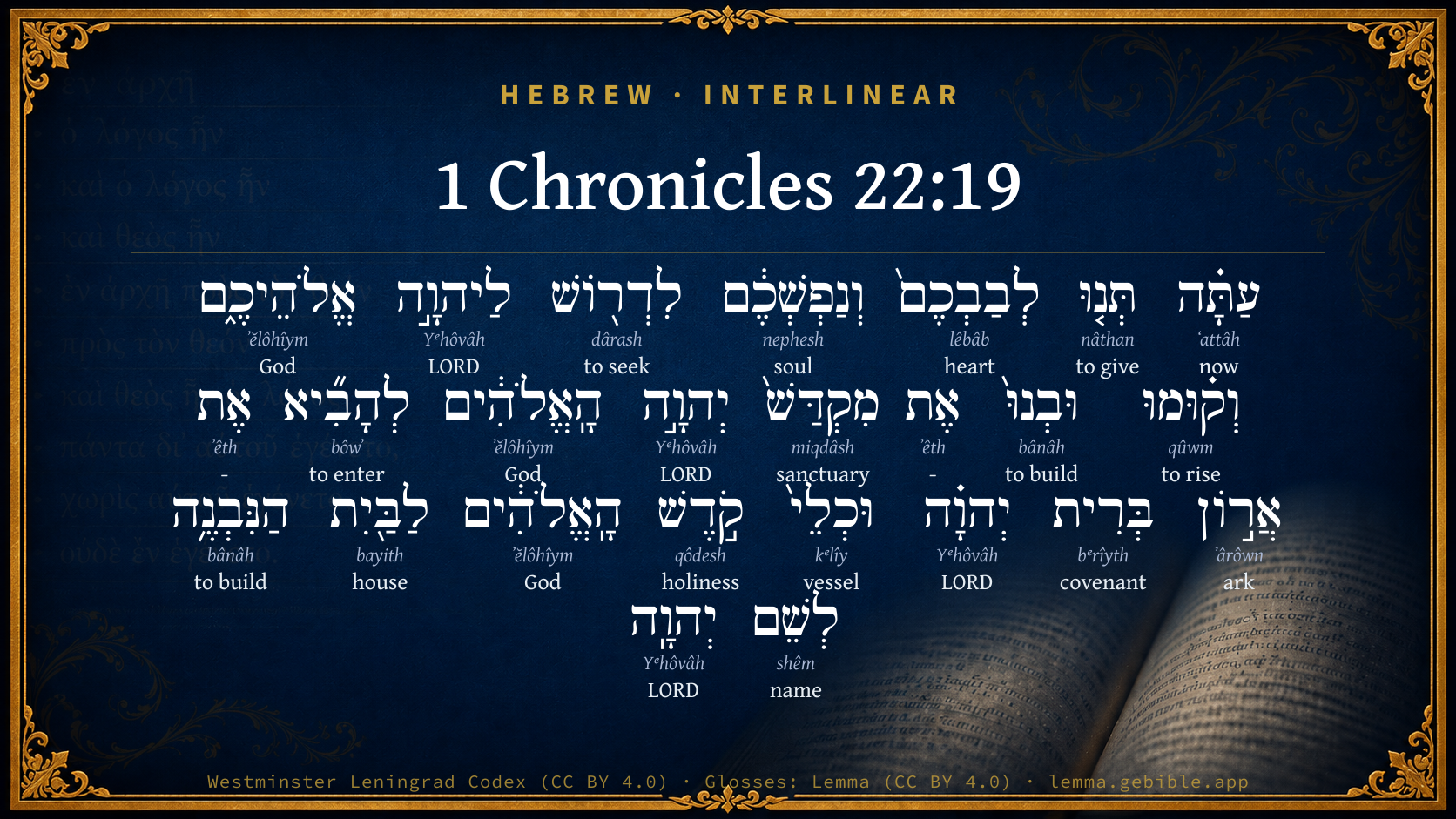
Hebrew (Westminster Leningrad Codex) 1 Chronicles 22:19 appears in the Hebrew Old Testament. The text above is from the Westminster Leningrad Codex. Each word links to its Strong’s number, a concise gloss, and parsing drawn from the Open Scriptures Hebrew Bible morphology. Click any word for its full Brown-Driver-Briggs (BDB) entry.
Download image
Cite this verse

1 Chronicles 22:19 (World English Bible). Public Domain. Lemma interlinear Bible study tool, https://lemma.gebible.app/v/1-chronicles/22/19.

Show BibTeX & RIS
BibTeX
RIS
English Translation
Now set your heart and your soul to seek after Yahweh your God; arise therefore, and build the sanctuary of Yahweh God, to bring the ark of the covenant of Yahweh, and the holy vessels of God, into the house that is to be built to the name of Yahweh.
World English Bible · Public Domain
Download a study sheet

One document with this verse’s original text, its word-by-word gloss line, the meaning frame, cross-references with their text, attributed commentary, and full source and license credits — printable, and it pastes into notes with its structure intact.

This verse Autodidact and up

Study sheet (.html) Plain text (.txt)

A passage Seminary Student

Up to 50 verses in one chapter. A passage sheet keeps up to 6 commentary sources and 12 cross-references per verse, in the order this page ranks them, and says so on the sheet whenever that leaves anything out. Ask for a single verse and you get the Autodidact verse sheet above.

Everything on this page stays free to read, with no account — the sheet is a download of what is already on screen, not access to it.

Want to remove ads? Support Godless Engineer
Compare translations 3

The same verse in 3 English versions, stacked beneath the original-language interlinear above. Click any original word for its lexicon entry.

Each is an independent rendering of the whole verse — the interlinear is not word-aligned to these translations.

Highlighted words mark where these versions differ — a whole-verse word diff, not a word-by-word alignment.

  • World English Bible Public Domain
    Now set your heart and your soul to seek after Yahweh your God; arise therefore, and build the sanctuary of Yahweh God, to bring the ark of the covenant of Yahweh, and the holy vessels of God, into the house that is to be built to the name of Yahweh.
  • King James Version Public Domain
    Now set your heart and your soul to seek the LORD your God; arise therefore, and build ye the sanctuary of the LORD God, to bring the ark of the covenant of the LORD, and the holy vessels of God, into the house that is to be built to the name of the LORD.
  • unfoldingWord Literal Text CC BY-SA 4.0
    Now give your heart and your soul to seek Yahweh your God, and arise and build the sanctuary of Yahweh God, to bring the Box of the Covenant of Yahweh and the vessels of holiness of God to the house being built for the name of Yahweh.”

unfoldingWord Literal Text — © unfoldingWord, licensed CC BY-SA 4.0. Word-aligned USFM3 via Door43 (git.door43.org/unfoldingWord/en_ult).

Versions to compare (up to 4)

3 of 4 selected

Show all 18 translations

Every available English version of this verse, each an independent rendering of the whole verse.

  • World English Bible Public Domain
    Now set your heart and your soul to seek after Yahweh your God; arise therefore, and build the sanctuary of Yahweh God, to bring the ark of the covenant of Yahweh, and the holy vessels of God, into the house that is to be built to the name of Yahweh.
  • Berean Standard Bible Public Domain
    Now set your heart and soul to seek the LORD your God. Get started building the sanctuary of the LORD God, so that you may bring the ark of the covenant of the LORD and the holy articles of God into the temple that will be built for the Name of the LORD.”
  • Majority Standard Bible Public Domain
    Now set your heart and soul to seek the LORD your God. Begin building the sanctuary of the LORD God, so that you may bring the ark of the covenant of the LORD and the holy articles of God into the temple that will be built for the Name of the LORD.”
  • King James Version Public Domain
    Now set your heart and your soul to seek the LORD your God; arise therefore, and build ye the sanctuary of the LORD God, to bring the ark of the covenant of the LORD, and the holy vessels of God, into the house that is to be built to the name of the LORD.
  • American Standard Version (1901) Public Domain
    Now set your heart and your soul to seek after Jehovah your God; arise therefore, and build ye the sanctuary of Jehovah God, to bring the ark of the covenant of Jehovah, and the holy vessels of God, into the house that is to be built to the name of Jehovah.
  • Revised Version (1885) Public Domain
    Now set your heart and your soul to seek after the LORD your God; arise therefore, and build ye the sanctuary of the LORD God, to bring the ark of the covenant of the LORD, and the holy vessels of God, into the house that is to be built to the name of the LORD.
  • Geneva Bible (1599) Public Domain
    Nowe set your hearts and your soules to seeke the Lord your God, and arise, and builde the Sanctuarie of the Lord God to bring the Arke of the couenant of the Lord, and the holy vessels of God into the house built for the Name of the Lord.
  • Douay-Rheims (1899) Public Domain
    Give therefore your hearts and your souls, to seek the Lord your God: and arise, and build a sanctuary to the Lord God, that the ark of the covenant of the Lord, and the vessels consecrated to the Lord, may be brought into the house, which is built to the name of the Lord.
  • Young's Literal Translation Public Domain
    `Now, give your heart and your soul to seek to Jehovah your God, and rise and build the sanctuary of Jehovah God, to bring in the ark of the covenant of Jehovah, and the holy vessels of God, to the house that is built to the name of Jehovah.'
  • Literal Standard Version CC BY-SA 4.0
    Now give your heart and your soul to seek for your God YHWH, and rise and build the sanctuary of YHWH God, to bring in the Ark of the Covenant of YHWH, and the holy vessels of God, to the house that is built for the Name of YHWH.”
  • Unlocked Literal Bible CC BY-SA 4.0
    Now seek Yahweh your God with all your heart and your soul. Get up and build the holy place of Yahweh God. Then you can bring the ark of the covenant of Yahweh and the things that belong to God into the house built for Yahweh's name.”
  • unfoldingWord Literal Text CC BY-SA 4.0
    Now give your heart and your soul to seek Yahweh your God, and arise and build the sanctuary of Yahweh God, to bring the Box of the Covenant of Yahweh and the vessels of holiness of God to the house being built for the name of Yahweh.”
  • Darby Bible Public Domain
    Now set your heart and your soul to seek Jehovah your God; and arise and build the sanctuary of Jehovah Elohim, to bring the ark of the covenant of Jehovah, and the vessels of the sanctuary of God into the house that is to be built unto the name of Jehovah.
  • World Messianic Bible Public Domain
    Now set your heart and your soul to follow the LORD your God. Arise therefore, and build the sanctuary of the LORD God, to bring the ark of the LORD’s covenant and the holy vessels of God into the house that is to be built for the LORD’s name.”
  • Webster's Bible Public Domain
    Now set your heart and your soul to seek the LORD your God; arise, therefore, and build ye the sanctuary of the LORD God, to bring the ark of the covenant of the LORD, and the holy vessels of God, into the house that is to be built to the name of the LORD.
  • Free Bible Version CC BY-SA 4.0
    Now, with your whole mind and heart, make a definite decision to always worship the Lord your God. Get started on building the sanctuary of the Lord God, Then you can bring the Ark of the Lord's Agreement and the holy things of God into the house that is to be built to honor the Lord.”
  • Bible in Basic English Public Domain
    Now give your heart and soul to the worship of the Lord your God; and get to work on the building of the holy place of the Lord God, so that you may put the ark of the Lord's agreement and the holy vessels of God in the house which is to be made for the name of the Lord.
  • JPS Tanakh (1917) Public Domain
    Now set your heart and your soul to seek after the LORD your God; arise therefore, and build ye the sanctuary of the LORD God, to bring the ark of the covenant of the LORD, and the holy vessels of God, into the house that is to be built to the name of the LORD.'

Literal Standard Version (2020), Covenant Press — licensed CC BY-SA 4.0. Text via the HelloAO Bible API (eBible.org). Unlocked Literal Bible (unfoldingWord) — licensed CC BY-SA 4.0. Text via the HelloAO Bible API (eBible.org). unfoldingWord Literal Text — © unfoldingWord, licensed CC BY-SA 4.0. Word-aligned USFM3 via Door43 (git.door43.org/unfoldingWord/en_ult). Free Bible Version, Dr. Jonathan Gallagher — licensed CC BY-SA 4.0. Text via the HelloAO Bible API (eBible.org).

Word by word

More ways to search: Search by grammar → Find every occurrence → Compare this word →

Practice this passage: Drill this verse → Learn its vocabulary →

מִקְדַּשׁ֙
miqdâsh
H4720
“sanctuary of”
Noun, Common, Masculine, Singular, Construct
Part of Speech
Noun
Type
Common
Gender
Masculine
Number
Singular
State
Construct
Full BDB Definition

Origin: from H6942

TWOT: 1990f

sacred place, sanctuary, holy place - sanctuary - of the temple - of the tabernacle - of Ezekiel's temple - of Jehovah
  1. עַתָּ֗ה ʻattâh H6258 “now” Adverb
  2. תְּנ֤וּ nâthan H5414 “give” Verb, Qal, Imperative, 2nd Person, Masculine, Plural
  3. לְבַבְכֶם֙ lêbâb H3824 “heart · your” Noun, Common, Masculine, Singular, Construct + Suffix, Personal, 2nd Person, Masculine, Plural
  4. וְנַפְשְׁכֶ֔ם nephesh H5315 “and · soul · your” Conjunction + Noun, Common, Both, Singular, Construct + Suffix, Personal, 2nd Person, Masculine, Plural
  5. לִדְר֖וֹשׁ dârash H1875 “to seek” Preposition + Verb, Qal, Infinitive Construct
  6. לַיהוָ֣ה Yᵉhôvâh H3068 “to/for · LORD” Preposition + Noun, Proper
  7. אֱלֹהֵיכֶ֑ם ʼĕlôhîym H430 “God(s) · your” Noun, Common, Masculine, Plural, Construct + Suffix, Personal, 2nd Person, Masculine, Plural
  8. וְק֗וּמוּ qûwm H6965 “and · rise” Conjunction + Verb, Qal, Imperative, 2nd Person, Masculine, Plural
  9. וּבְנוּ֙ bânâh H1129 “and · build” Conjunction + Verb, Qal, Imperative, 2nd Person, Masculine, Plural
  10. אֶת ʼêth H853 “-” Particle, Direct Object
  11. יְהוָ֣ה Yᵉhôvâh H3068 “LORD” Noun, Proper
  12. הָֽאֱלֹהִ֔ים ʼĕlôhîym H430 “the · God(s)” Particle, Definite Article + Noun, Common, Masculine, Plural, Absolute
  13. לְהָבִ֞יא bôwʼ H935 “to enter” Preposition + Verb, Hiphil, Infinitive Construct
  14. אֶת ʼêth H853 “-” Particle, Direct Object
  15. אֲר֣וֹן ʼârôwn H727 “ark of” Noun, Common, Both, Singular, Construct
  16. בְּרִית bᵉrîyth H1285 “covenant of” Noun, Common, Feminine, Singular, Construct
  17. יְהוָ֗ה Yᵉhôvâh H3068 “LORD” Noun, Proper
  18. וּכְלֵי֙ kᵉlîy H3627 “and · vessels of” Conjunction + Noun, Common, Masculine, Plural, Construct
  19. קֹ֣דֶשׁ qôdesh H6944 “holiness of” Noun, Common, Masculine, Singular, Construct
  20. הָֽאֱלֹהִ֔ים ʼĕlôhîym H430 “the · God(s)” Particle, Definite Article + Noun, Common, Masculine, Plural, Absolute
  21. לַבַּ֖יִת bayith H1004 “to/for the · house” Preposition, Determined + Noun, Common, Masculine, Singular, Absolute
  22. הַנִּבְנֶ֥ה bânâh H1129 “the · built” Particle, Definite Article + Verb, Niphal, Participle Passive, Masculine, Singular, Absolute
  23. לְשֵׁם shêm H8034 “to/for · name of” Preposition + Noun, Common, Masculine, Singular, Construct
  24. יְהוָֽה Yᵉhôvâh H3068 “LORD” Noun, Proper

About this verse

These counts appear in no published source. They are computed here, from the morphology-tagged text and Lemma’s own curated glosses. What Lemma adds →

25
words
18
distinct lemmas
Historical
section

Grammatical profile

  • 6 verbs
  • 16 nouns
  • 1 adverb
  • 2 particles

Verb forms

  • תְּנ֤וּ Qal · Imperative
  • לִדְר֖וֹשׁ Qal · Infinitive Construct
  • וְק֗וּמוּ Qal · Imperative
  • וּבְנוּ֙ Qal · Imperative
  • לְהָבִ֞יא Hiphil · Infinitive Construct
  • הַנִּבְנֶ֥ה Niphal · Participle Passive

Repetition

Words recur within this verse — often emphatic in Hebrew:

  • לַיהוָ֣ה LORD H3068 ×4
  • אֱלֹהֵיכֶ֑ם God H430 ×3
  • וּבְנוּ֙ to build H1129 ×2

Hebrew & Septuagint length

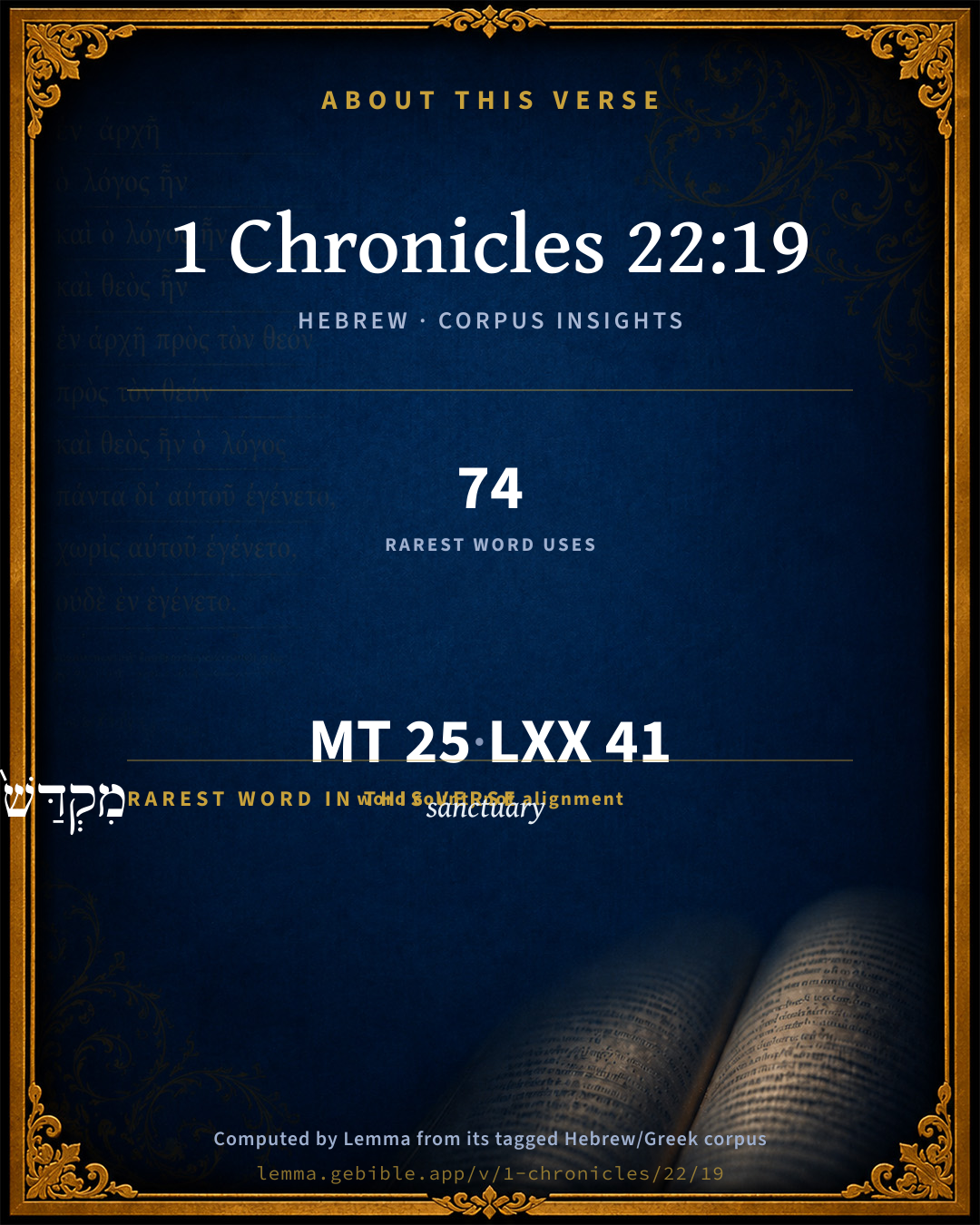
In English translation the verse runs 50 words from the Hebrew and 53 from the Septuagint (LXX English) — closely comparable.

A rough comparison of the two English renderings, which tokenize alike — not a word-level alignment.

Word counts can differ between the Hebrew and the Greek without any difference in meaning — e.g. the Hebrew direct-object marker אֵת has no separate Greek word, and Greek often adds the article ὁ.

In the original languages it is 25 Hebrew tokens and 41 Greek tokens — but the two are counted differently (Hebrew bundles its prefixes and suffixes into one token; the Greek is in lemma form), so that isn’t a like-for-like length.

Cross-references

18

Topical passages linked to 1 Chronicles 22:19 in the Treasury of Scripture Knowledge — connected by theme and wording, ordered by reader-vote popularity; previews shown in the World English Bible.

  • 1 Chronicles 28:9 You, Solomon my son, know the God of your father, and serve him with a perfect heart and with a willing mind; for Yahweh searches all hearts, and understands all the imaginations of the thoughts: if you seek him, he will be found of you; but if you forsake him, he will cast you off forever.
  • Deuteronomy 4:29 But from there you shall seek Yahweh your God, and you shall find him, when you search after him with all your heart and with all your soul.
  • 1 Chronicles 16:11 Seek you Yahweh and his strength; Seek his face forever more.
  • Psalms 27:4 One thing I have asked of Yahweh, that I will seek after, That I may dwell in the house of Yahweh all the days of my life, To see Yahweh's beauty, And to inquire in his temple.
  • 1 Chronicles 22:7 David said to Solomon his son, As for me, it was in my heart to build a house to the name of Yahweh my God.
  • 1 Kings 8:6 The priests brought in the ark of the covenant of Yahweh to its place, into the oracle of the house, to the most holy place, even under the wings of the cherubim.
  • 2 Chronicles 5:7 The priests brought in the ark of the covenant of Yahweh to its place, into the oracle of the house, to the most holy place, even under the wings of the cherubim.
  • 1 Kings 8:21 There have I set a place for the ark, in which is the covenant of Yahweh, which he made with our fathers, when he brought them out of the land of Egypt.
  • 2 Chronicles 6:11 There have I set the ark, in which is the covenant of Yahweh, which he made with the children of Israel.
  • Acts 22:16 Now why do you wait? Arise, be baptized, and wash away your sins, calling on the name of the Lord.'
  • Deuteronomy 32:46–47 He said to them, Set your heart to all the words which I testify to you this day, which you shall command your children to observe to do, [even] all the words of this law.
  • 1 Kings 5:3 You know how that David my father could not build a house for the name of Yahweh his God for the wars which were about him on every side, until Yahweh put them under the soles of his feet.
  • 2 Chronicles 20:3 Jehoshaphat feared, and set himself to seek to Yahweh; and he proclaimed a fast throughout all Judah.
  • 1 Chronicles 22:16 of the gold, the silver, and the brass, and the iron, there is no number. Arise and be doing, and Yahweh be with you.
  • Isaiah 60:1 Arise, shine; for your light is come, and the glory of Yahweh is risen on you.
  • Daniel 9:3 I set my face to the Lord God, to seek by prayer and petitions, with fasting and sackcloth and ashes.
  • Haggai 1:5 Now therefore this is what Yahweh of Hosts says: Consider your ways.
  • Acts 11:23 who, when he had come, and had seen the grace of God, was glad. He exhorted them all, that with purpose of heart they should remain near to the Lord.

Cross-references courtesy of OpenBible.info (CC BY 4.0).

Hebrew and Greek witnesses Masoretic Hebrew ↔ Greek Septuagint

The same verse in the two great witnesses to the Old Testament, shown verse-for-verse.

These are two independent witnesses, not word-aligned to each other, and the Septuagint is shown in lemma (dictionary) form.

Hebrew 1 Chronicles 22:19 Masoretic · Westminster Leningrad Codex

עַתָּ֗ה תְּנ֤וּ לְבַבְכֶם֙ וְנַפְשְׁכֶ֔ם לִדְר֖וֹשׁ לַיהוָ֣ה אֱלֹהֵיכֶ֑ם וְק֗וּמוּ וּבְנוּ֙ אֶת מִקְדַּשׁ֙ יְהוָ֣ה הָֽאֱלֹהִ֔ים לְהָבִ֞יא אֶת אֲר֣וֹן בְּרִית יְהוָ֗ה וּכְלֵי֙ קֹ֣דֶשׁ הָֽאֱלֹהִ֔ים לַבַּ֖יִת הַנִּבְנֶ֥ה לְשֵׁם יְהוָֽה

Now set your heart and your soul to seek after Yahweh your God; arise therefore, and build the sanctuary of Yahweh God, to bring the ark of the covenant of Yahweh, and the holy vessels of God, into the house that is to be built to the name of Yahweh.

World English Bible · Public Domain

Greek LXX 1 Chronicles 22:19 Septuagint · lemma form

νῦν δίδωμι καρδία σύ καί ψυχή σύ ὁ ζητέω ὁ κύριος θεός σύ καί ἐγείρω καί οἰκοδομέω ἁγίασμα κύριος ὁ θεός σύ ὁ εἰςφέρω ὁ κιβωτός διαθήκη κύριος καί σκεῦος ὁ ἅγιος ὁ θεός εἰς οἶκος ὁ οἰκοδομέω ὁ ὄνομα κύριος

Now set your hearts and souls to seek after the Lord your God: and rise, and build a sanctuary to your God to carry in the ark of the covenant of the Lord, and the holy vessels of God, into the house that is to be built to the name of the Lord.

LXX2012 (modern English Septuagint) · Public Domain

Hebrew: Westminster Leningrad Codex (CC BY 4.0). Greek: Septuagint (public domain); English from LXX2012 (modern English Septuagint) (Public Domain). How the Septuagint differs from the Hebrew →

Commentary

Notes on 1 Chronicles 22:19 from classic Christian and Jewish commentators (each source and its license shown beneath its notes). The classic Christian expositions comment on the surrounding passage and are grouped to its opening verse, so a note may address several verses; the Jewish commentaries on the Tanakh (Rashi and others) are per-verse, so they appear only where the commentator wrote on this verse.

Lemma curates 59 commentaries, every one of them public domain or Creative Commons licensed, each selected and text-cleaned for this edition rather than reprinted as found. About our sources →

The Biblical Illustrator

Joseph S. Exell

1Ch_22:19

Now set your heart and your soul to seek the Lord your God.

Seeking after God

I. The occasion on which this injunction was given.

II. The injunction itself.

1. The great object of our life.

2. In what way we are to prosecute it.

(1) Avail yourselves of the opportunities afforded for public usefulness.

(2) Begin with the surrender of your whole souls to God. (C. Simeon, M. A.)

The important search

I. The object searched.

II. The method of search.

1. Earnestly.

2. Resolutely. (J. Wolfendale.)

Building the temple

The great aim of missionary work, at home and abroad, is the same. This great work may be illustrated by the text. We have--

I. The heart set upon God.

1. All work for God must begin with ourselves (Act_22:28; 1Ti_4:16).

2. It must be heart-work, not merely duty, custom, or sympathy.

3. There must be a deliberate setting of the heart and soul upon God as our God, reconciled in Christ, fixedly His (Psa_57:7; Deu_10:12).

4. There must be continued seeking God, in prayer, meditation, holy living.

II. The building-work going on. The living Church is Gods sanctuary. He dwells in the hearts of His people (Joh_14:23; 2Co_6:16; 1Co_3:16). The work of Christs followers is to build the sanctuary.

1. By gathering souls out of the world around to Christ.

2. By gathering souls into the Church, uniting in one body in Christ.

III. The sanctuary used for God. Union in the Church must be--

1. For consecration. The temple is not for ornament, nor for the admiration of the world, but for God.

2. For worship: Bring the ark, etc. The ark shadows forth the great propitiation (Rom_3:25). This must hold the first position in the Church, heart, ministry (1Co_2:2).

3. For service: Bring the holy vessels, etc. Each vessel has its use. (J. E. Sampson.)

Set your heart

Let us take this exhortation--

I. In its reference to Gods own people.

1. What are they to seek? The Lord your God.

(1) By endeavouring to obey Him in everything.

(2) In building up His temple. It should be the main object of our life to seek the Lord by building up His Church.

(3) By doing everything to Gods glory.

2. How are they to seek? Set your heart and your soul to seek the Lord your God.

(1) With fixity of purpose: Set.

(2) Have an intense affection towards Gods service and glory.

(3) With an energetic use of the intellect. We ought as much to speculate and scheme to glorify God as we meditate how to advance our business.

(4) By the union and concentration of all our faculties.

3. When are we to seek the Lord? Now. Now is the only time worth having, because it is indeed the only time we have. When did David mean by his now?

(1) Now that they had an efficient leader--Solomon.

(2) When God is with you.

(3) When God gives rest. Hath He not given you rest on every side?

II. In its reference to those who are converted.

1. Set your heart on true religion, and be not content with the outward form of it.

2. Seek the Lord Himself.

3. Seek Him at once with all your heart. (C. H. Spurgeon.)

Seeking God

In the struggle of life many men and women are hampered and depressed by the memory of past weaknesses, errors, and sins. The hours of their real spiritual prosperity are overshadowed and embittered by the recollection of their spiritual adversities. It is one of the wise and helpful laws of our nature that in freeing ourselves from weakness and sin we do not free ourselves from the memory of them. The value of the experience lies in the lesson we learn from it, and the truest repentance is often witnessed by the poignancy of the sorrow, and both the lesson and the sorrow have their roots in memory. But, while we are not to forget that we have sometimes fallen, we are not always to carry the mud with us; the slough is behind, but the clean, clearly-defined road stretches ahead of us, skies are clear, and God is beyond. We were made for purity, truth, and fidelity, and the very abhorrence of the opposites of these qualities, which grows and deepens within us, bears testimony that our aspirations are becoming our attainments. The really noble thing about any man or woman is not freedom from all stains of the lower life, but the deathless aspiration which for ever drives us forward and will not let us rest in any past, whether good or bad. That which makes us respect ourselves is not what men call a blameless career, but the hunger and thirst after God which makes all our doing unsatisfying and inadequate to us. Better a thousand times the eager and passionate fleeing to God from a past of faults and weaknesses, with an irresistible longing for rest in the everlasting verities, than the most respectable career which misses this profound impulse. The past, remains with us to remind us of our perils and our constant need of help, but it ought not to haunt and oppress us. The real life of an aspiring soul is always ahead, We are not fleeing from the devil, but seeking God. (Lyman Abbott.)

The Biblical Illustrator, edited by Joseph S. Exell (c. 1880s–1900s) — public domain. Text from a community e-Sword module.

Geneva Bible (1599)

Geneva Bible translators

For else he knew that God would plague them, and not prosper their labor, except they sought with all their hearts to set forth his glory.

Geneva Bible (1599) marginal notes — public domain. Text via Bolls.life.

Ellicott's Commentary for English Readers

(19) To seek the Lord.—Hebrew, “to seek unto the Lord,” as in 2Ch_17:4; Ezr_4:2. The older construction, with a simple accusative, occurred in 1Ch_16:12; 1Ch_21:30.

Arise therefore, and build.—Rather, And arise ye, and build. The second clause explains how the first was to be carried out. Building the Lord a fair and noble sanctuary was equivalent to seeking His favour. Professions cost nothing, and they were not to serve the Lord “without cost” (1Ch_21:24).

To bring the ark.—From its temporary abode on Mount Zion (1Ch_15:1).

The holy vessels of God—e.g., the altar of burnt offering.

That is to be built.—The same participal form as in 1Ch_22:9 : “shall be born.”

A Bible Commentary for English Readers, edited by Charles John Ellicott (1878–1897) — public domain. Text from a community e-Sword module.

The Cambridge Bible for Schools and Colleges

gen. ed. J. J. S. Perowne

19. and the holy vessels of God] Cp. 1Ki_8:4.

CHAPTER 23

Ch. 1Ch_23:1. Solomon made King

The summary statement of the Chronicler ignores the struggle between the party of Solomon and the party of Adonijah for the throne. Cp. 1Ch_29:22-24; 1Ki_1:5-53.

The Cambridge Bible for Schools and Colleges (gen. ed. J. J. S. Perowne; Cambridge University Press, 1878–1918) — public domain. Text from a community e-Sword module.

Haydock's Catholic Bible Commentary

Is on the point of being built. David was convinced that the work would not be much longer retarded, so that he speaks of it as present. (Haydock)

George Leo Haydock (1774–1849), Haydock's Catholic Family Bible and Commentary, 1859 edition — public domain. Excludes Psalms (Douay-Rheims chapter numbering differs from Protestant) and Deuterocanonical books (Catholic canon only).

The Pulpit Commentary

To bring the ark of the covenant of the Lord, and the holy vessels of God. To settle these in a fixed home had now been of a long time the consuming desire of David"s heart (so 1Ch_15:1; 2Ch_5:2-4) Into the house that is to be built. The preposition l instead of la, before "the house," is to be noticed here (1 Chronicles. Neh_10:35) Also the Niphal participle, H"n,b]gih," here translated "that is to be built," is to be noticed. The meaning of David would be better met probably thus: "Arise, build the sanctuary to bring the ark into the house (then) builded to the Name of the Lord.

The aged king"s parting injunctions to the princes of his kingdom.

There both seems to have been, and on many accounts it is likely that there was, much savouring of the despotic in the position of the kings of Israel, and this even in their best times. It was in part the purposed and just result of their Divine call to the office they were to hold. And the despotic disposition was often as inconspicuous as could be desired, The characteristic evils of the despotic temper did not push themselves into any prominence, did not even make themselves visible, so long as that king divinely designated remembered faithfully to hold himself at the sovereign disposal of the King of kings. But when this was not the case, they developed rapidly and disastrously. It is nevertheless abundantly plain that, when the authority and voice of the good king sounded most absolute, the facts of human life and character were not disregarded. Full account was made of them, and the nature of human society was religiously respected. Hence, at the present time, David calls on the princes of the kingdom, as well as on his own son and successor. He calls on them to close up their ranks round him, and addresses them as though they were truly the responsible props of the throne. He intreats them to co-operate with Solomon as sympathizing fellow-labourers in a grand religious enterprise. Such association of subjects with ruler is necessary to bind together strongly and safely the framework of any community fit to be called sound. Disintegration inevitably sets in with the deceitful interstices often found between class and class, or between ruler and ruled. We may notice here how David

I SKETCHES THE ELEMENTS OF A NATION"S OPPORTUNITY. These elements in the present instance are found in:

1. The fact that there is trustworthy ground for being sure that the Lord is on the side of his people. He is with them, and if so, they may feel that they have One with them far greater than all they who are against them. Confidence in a good cause is a great moral help and support. The confidence that comes of knowing that in the last resort one has a strong friend, is often a great strength. But to have God on one"s side is to have both these in one. It is to have all in one. He will not be found with a bad cause. And he brings unerring wisdom, perfect knowledge, and an

2. omnipotent arm into the field. Nor is the consciousness of the presence and favourable regard of the Lord of less significance when not the works of war but those of peace are m question. Thought and works of skill and cunning invention, of beauty and of wisdom, memory and reason, and the highest attempts and successes of imagination, all lie open to his inspiration. "The inspiration of the Almighty giveth them understanding". (Job_32:8) And an even special stress is repeatedly laid upon the effects of this condescending presence upon the intelligence and the humble works of man, as, for instance, in the matter of the preparation of the materials used in the construction of the tabernacle of the wilderness. (Exo_31:1-6) And this may be called the central element in David"s suggestions as to the opportunity now before his nation.

3. The absence of external causes of anxiety and apprehension. Worldly care is no doubt a part of the necessity, the discipline, the improving education of the present life. But the distraction of it often has hindered the noblest developments of the powers that lie in human nature. These noblest efforts need the "united heart," the undivided zeal; and if you are to soar aloft, yours must be an unbroken wing. A nation"s life has times without number illustrated all this on a large scale. By severe effort the individual may occasionally triumph over distraction, but the mass are interested in and follow but one thing at a time.

4. The sense of restfulness now the portion of the people. Their own dwelling-place, home, the earthly Canaan, at all events, these are now their portion. And the spontaneous suggestion of them is some grateful earnest tribute forthcoming to their Giver. Home is for rest; rest is for work. Security is not to produce the fruit of sluggishness, but to yield that kind of "quietness and confidence" that shall make into strong, calm, determined purpose.

II MAKES A STRONG APPEAL TO THE LEADERS or THE NATION TO USE TO THE FULL THE OPPORTUNITY. This appeal is twofold.

1. It asks the enthusiasm, the devotion, the full affection of heart and soul, in the first place. These must be "set to seek the Lord God." They must not be left to take their hopeful chance, or chance more or less hopeful; they must be charged to rise to their higher selves. "My soul, wait thou only upon God." Some men of God of old recognized very distinctly how it devolved upon them to take their own heart, to talk, reason with it, urge it,

2. "stir up its good gift," and lay upon it its solemn responsibility, its high privilege.

3. It asks the honesty of action. Great affections will pine without the bracing effects of exercise and trial and strenuous enterprise. Innumerable great purposes have come to ruin; and the wreckage has been visible enough and mournful enough. But the inner invisible wreck that has come of purposes great and holy, which never saw the light, never dared the breath of criticism, nor the winds of opposition, has been a thousandfold mournful and fatal. So David specifics, if not details, yet the leading divisions of practical duty now. "Arise build the sanctuary., bring the ark of the covenant, and the holy vessels into the house," when" built to the Name of the Lord.

Arise, and build.

Before the old king died, he wished to see his successor"s work in train and order. Accordingly, both to Solomon and to the princes, David addressed stirring words of admonition. And as what he had most at heart was the erection of the temple, it was natural that he should lay the greatest stress upon this vast and glorious undertaking.

I Note first, as here described, THE NATURE AND CHARACTER OF THE BUILDING. It was "the sanctuary of the Lord God;" it was to be built "to the Name of the Lord." A Divine dwelling, a habitation for the Most High, a holy place. In all this an emblem of the temple of our Saviour"s body, and of that spiritual house which is the temple of the Holy Ghost.

II Remark next, THE PURPOSE OF THE BUILDING. It was to contain "the ark of the covenant of the Lord, and the holy vessels of God." That is to say, it was not only the locality of God"s manifested presence, but it was the scene of sacrifice and worship and the centre of the nation"s religion. This gave a practical and political significance to the erection of the sanctuary.

III Instructive is the account given of THE DISPOSITION AND SPIRIT OF THE BUILDERS. The work was not to be done mechanically, or from a feeling of constraint. They were to "set their heart and their soul to seek the Lord their God." That is, they were to undertake the work as one distinctively religious, and from a religious motive and with a religious aim.

PRACTICAL LESSONS.

1. Let everything that is Gods engage your sympathy and interest and zeal. Let each Christian hear the voice from heaven saying to him, "Arise, and build.

2. Let Gods work be done in a devout and religious spirit. In serving the Lord seek him, and he will be found of you. T.

Work for god must be done with heart and soul.

set your heart and your soul to seek the Lord your God." Scripture uses several terms for the composite being, man, but it may be questioned whether, without undue forcing, we oar form, on a Scripture basis, either a dualistic or tripartite theory of man"s being. We find the term body, as indicating the physical being, set in relations with an external world by its five senses; the term heart, as inclusive of the mind and the affections, set in relations with the world of thought, and the world of fellow human beings; and the term soul, as the equivalent of that spiritual being which is set in relation with God, and has its life only in him. But, though these may be the stricter meanings and uses of these terms, they are often used in Scripture as figures of speech; and a man is said to work with his heart when he likes to do what he is undertaking, and a man is said to do a thing with his soul when he does it with a will, with energy and perseverance. It will afford some effective contrasts to consider conceivable ways of working for God, and the illustrations of each will be at once suggested, so that they will need no more than statement.

I WORK FOR GOD MAY BE BY ACCIDENT; either of place, or circumstance, or association.

II WORK FOR GOD MAY BE BY COMPULSION; as may be illustrated in the case of Cyrus, of whom God says, "I girded thee, though thou hast not known me." God makes even the "wrath of man praise him;" and bad men have, unwillingly, done his sow-reign will.

III WORK FOR GOD MAY BE DONE THROUGH WORKING FOR SELF; one who seeks only" his own ends may find that, without credit or blessing to himself, he has really served God.

IV WORK FOR GOD MAY BE DONE HALF-HEARTEDLY. We may "fear the Lord, and serve other gods.

V WORK FOR GOD MAY BE DONE, AND SHOULD BE DONE, WITH CULTURED BODILY POWERS; WITH HEART-JOY IN GOD; and WITH THE INSPIRATION OF THE SOUL"S DEVOTION. Of such work for God the Lord Jesus Christ presents the highest type; but the example is as a human example, within human reach. R.T.

The Pulpit Commentary (1880–1919), ed. H.D.M. Spence-Jones & Joseph S. Exell — public domain. Text from a community e-Sword module.

Lesson kit

Teaching starters — assembled from the data on this page, not authored interpretation. Every prompt links to the verse data it draws on. Edit before teaching.

1 Chronicles, in the Historical, opens this verse with 25 words (18 distinct Hebrew lemmas). Its most distinctive word is miqdâsh (“sanctuary”). A historical commentator’s framing appears above. Read the whole chapter for the surrounding context.

Discussion questions

  1. What does “sanctuary” (miqdâsh) contribute to the verse as a whole?
  2. How does 1 Chronicles 28:9, which shares this passage’s theme, read alongside this verse?
  3. What does the repetition of “LORD” (4× in this one verse) do in this verse?
  4. These translations render this verse differently; the difference is in the English rendering, not the original. What questions does that raise?
  5. «תְּנ֤וּ» is a Qal Imperative verb. How does that grammatical form shape the action described?
  6. Compare how The Biblical Illustrator and Geneva Bible (1599) read this verse. Where do they agree or differ?

Things to notice

Reading settings

Reading text

Shown beneath each verse's original-language words.

Old Testament
Old Testament edition

Read the OT as the Masoretic Hebrew (MT) or the Greek Septuagint (LXX).

English shown for the Greek Septuagint (in the Hebrew ↔ Greek comparison).

Comparing translations? Open the Compare panel on any verse page to stack up to four side by side.