
Exodus 30:29

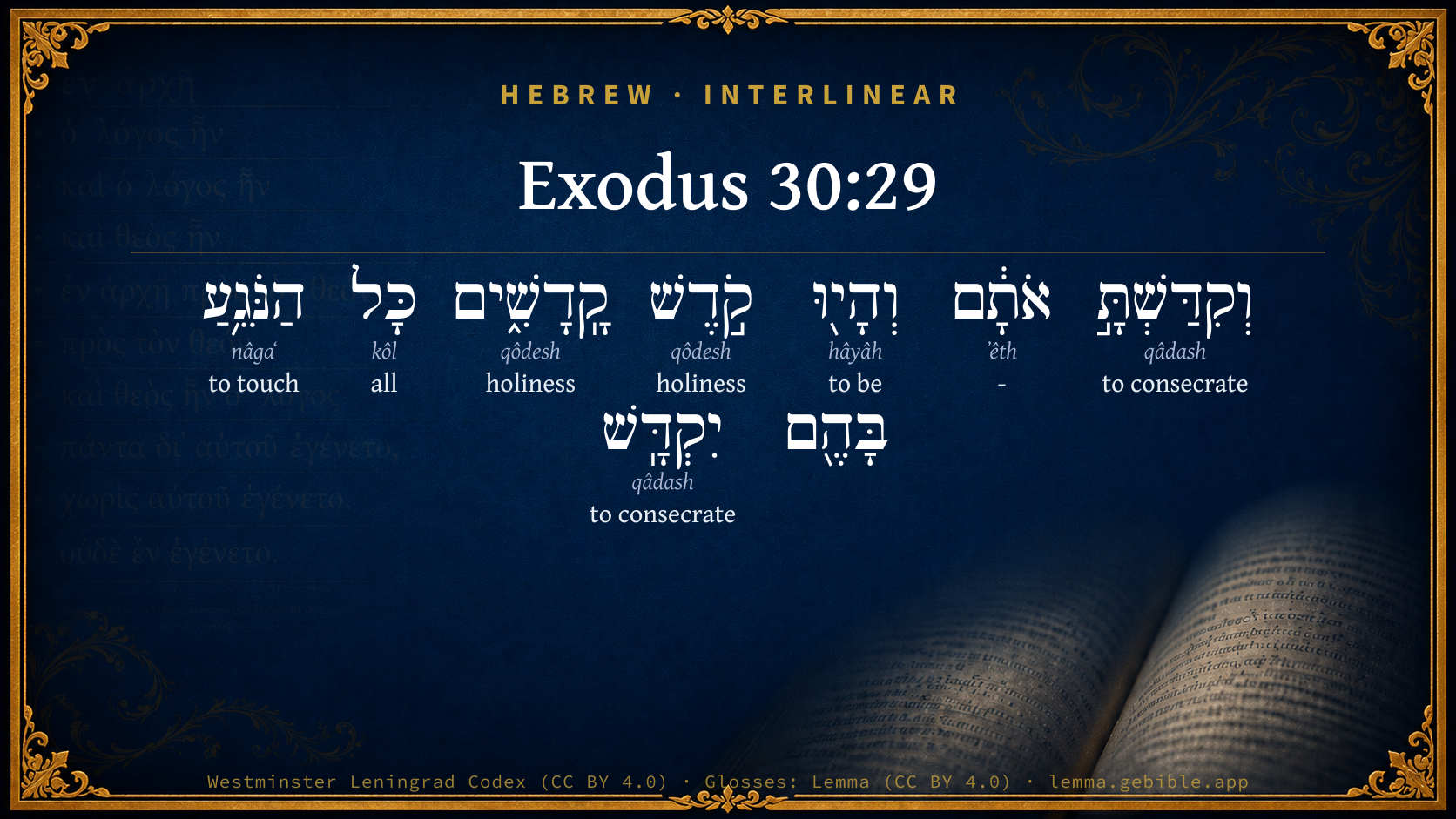
Hebrew (Westminster Leningrad Codex) Exodus 30:29 appears in the Hebrew Old Testament. The text above is from the Westminster Leningrad Codex. Each word links to its Strong’s number, a concise gloss, and parsing drawn from the Open Scriptures Hebrew Bible morphology. Click any word for its full Brown-Driver-Briggs (BDB) entry.
Download image
Cite this verse

Exodus 30:29 (World English Bible). Public Domain. Lemma interlinear Bible study tool, https://lemma.gebible.app/v/exodus/30/29.

Show BibTeX & RIS
BibTeX
RIS
English Translation
You shall sanctify them, that they may be most holy. Whatever touches them shall be holy.
World English Bible · Public Domain
Download a study sheet

One document with this verse’s original text, its word-by-word gloss line, the meaning frame, cross-references with their text, attributed commentary, and full source and license credits — printable, and it pastes into notes with its structure intact.

This verse Autodidact and up

Study sheet (.html) Plain text (.txt)

A passage Seminary Student

Up to 50 verses in one chapter. A passage sheet keeps up to 6 commentary sources and 12 cross-references per verse, in the order this page ranks them, and says so on the sheet whenever that leaves anything out. Ask for a single verse and you get the Autodidact verse sheet above.

Everything on this page stays free to read, with no account — the sheet is a download of what is already on screen, not access to it.

Want to remove ads? Support Godless Engineer
Compare translations 3

The same verse in 3 English versions, stacked beneath the original-language interlinear above. Click any original word for its lexicon entry.

Each is an independent rendering of the whole verse — the interlinear is not word-aligned to these translations.

Highlighted words mark where these versions differ — a whole-verse word diff, not a word-by-word alignment.

  • World English Bible Public Domain
    You shall sanctify them, that they may be most holy. Whatever touches them shall be holy.
  • King James Version Public Domain
    And thou shalt sanctify them, that they may be most holy: whatsoever toucheth them shall be holy.
  • unfoldingWord Literal Text CC BY-SA 4.0
    And you shall set them apart, and they will be holiest holy things. Anything that touches them will be set apart.

unfoldingWord Literal Text — © unfoldingWord, licensed CC BY-SA 4.0. Word-aligned USFM3 via Door43 (git.door43.org/unfoldingWord/en_ult).

Versions to compare (up to 4)

3 of 4 selected

Show all 18 translations

Every available English version of this verse, each an independent rendering of the whole verse.

  • World English Bible Public Domain
    You shall sanctify them, that they may be most holy. Whatever touches them shall be holy.
  • Berean Standard Bible Public Domain
    You are to consecrate them so that they will be most holy. Whatever touches them shall be holy.
  • Majority Standard Bible Public Domain
    You are to consecrate them so that they will be most holy. Whatever touches them shall be holy.
  • King James Version Public Domain
    And thou shalt sanctify them, that they may be most holy: whatsoever toucheth them shall be holy.
  • American Standard Version (1901) Public Domain
    And thou shalt sanctify them, that they may be most holy: whatsoever toucheth them shall be holy.
  • Revised Version (1885) Public Domain
    And thou shalt sanctify them, that they may be most holy: whatsoever toucheth them shall be holy.
  • Geneva Bible (1599) Public Domain
    So thou shalt sanctifie them, and they shalbe most holy: all that shall touch them, shalbe holy.
  • Douay-Rheims (1899) Public Domain
    And thou shalt sanctify all, and they shall be most holy: he that shall touch them shall be sanctified.
  • Young's Literal Translation Public Domain
    and thou hast sanctified them, and they have been most holy; all that is coming against them is holy;
  • Literal Standard Version CC BY-SA 4.0
    and you have sanctified them, and they have been most holy; all that is coming against them is holy;
  • Unlocked Literal Bible CC BY-SA 4.0
    You must set them apart to me so that they may be holy to me. Anything that touches them will also be holy.
  • unfoldingWord Literal Text CC BY-SA 4.0
    And you shall set them apart, and they will be holiest holy things. Anything that touches them will be set apart.
  • Darby Bible Public Domain
    And thou shalt hallow them, that they may be most holy: whatever toucheth them shall be holy.
  • World Messianic Bible Public Domain
    You shall sanctify them, that they may be most holy. Whatever touches them shall be holy.
  • Webster's Bible Public Domain
    And thou shalt sanctify them, that they may be most holy: whatever toucheth them shall be holy.
  • Free Bible Version CC BY-SA 4.0
    Dedicate them so that they will be especially holy. Whatever touches them will become holy.
  • Bible in Basic English Public Domain
    And you are to make them most holy; anything touching them will become holy.
  • JPS Tanakh (1917) Public Domain
    And thou shalt sanctify them, that they may be most holy; whatsoever toucheth them shall be holy.

Literal Standard Version (2020), Covenant Press — licensed CC BY-SA 4.0. Text via the HelloAO Bible API (eBible.org). Unlocked Literal Bible (unfoldingWord) — licensed CC BY-SA 4.0. Text via the HelloAO Bible API (eBible.org). unfoldingWord Literal Text — © unfoldingWord, licensed CC BY-SA 4.0. Word-aligned USFM3 via Door43 (git.door43.org/unfoldingWord/en_ult). Free Bible Version, Dr. Jonathan Gallagher — licensed CC BY-SA 4.0. Text via the HelloAO Bible API (eBible.org).

Word by word

More ways to search: Search by grammar → Find every occurrence → Compare this word →

Practice this passage: Drill this verse → Learn its vocabulary →

הַנֹּגֵ֥עַ
nâgaʻ
H5060
“the · touching”
Particle, Definite Article + Verb, Qal, Participle Active, Masculine, Singular, Absolute
Part of Speech
Particle + Verb
Stem
Qal
Form
Participle Active
Gender
Masculine
Number
Singular
State
Absolute
Full BDB Definition

Origin: a primitive root

TWOT: 1293

to touch, reach, strike - (Qal) - to touch - to strike - to reach, extend to - to be stricken - stricken (participle) - (Niphal) to be stricken, be defeated - (Piel) to strike - (Pual) to be stricken (by disease) - (Hiphil) to cause to touch, reach, approach, arrive - to cause to touch, apply - to reach, extend, attain, arrive, come - to approach (of time) - to befall (of fate)
  1. וְקִדַּשְׁתָּ֣ qâdash H6942 “and · to consecrate” Conjunction + Verb, Piel, Sequential Perfect, 2nd Person, Masculine, Singular
  2. אֹתָ֔ם ʼêth H853 “- · them” Particle, Direct Object + Suffix, Personal, 3rd Person, Masculine, Plural
  3. וְהָי֖וּ hâyâh H1961 “and · to be” Conjunction + Verb, Qal, Sequential Perfect, 3rd Person, Common, Plural
  4. קֹ֣דֶשׁ qôdesh H6944 “holiness of” Noun, Common, Masculine, Singular, Construct
  5. קָֽדָשִׁ֑ים qôdesh H6944 “holy things” Noun, Common, Masculine, Plural, Absolute
  6. כָּל kôl H3605 “all of” Noun, Common, Masculine, Singular, Construct
  7. יִקְדָּֽשׁ qâdash H6942 “to consecrate” Verb, Qal, Imperfect, 3rd Person, Masculine, Singular

About this verse

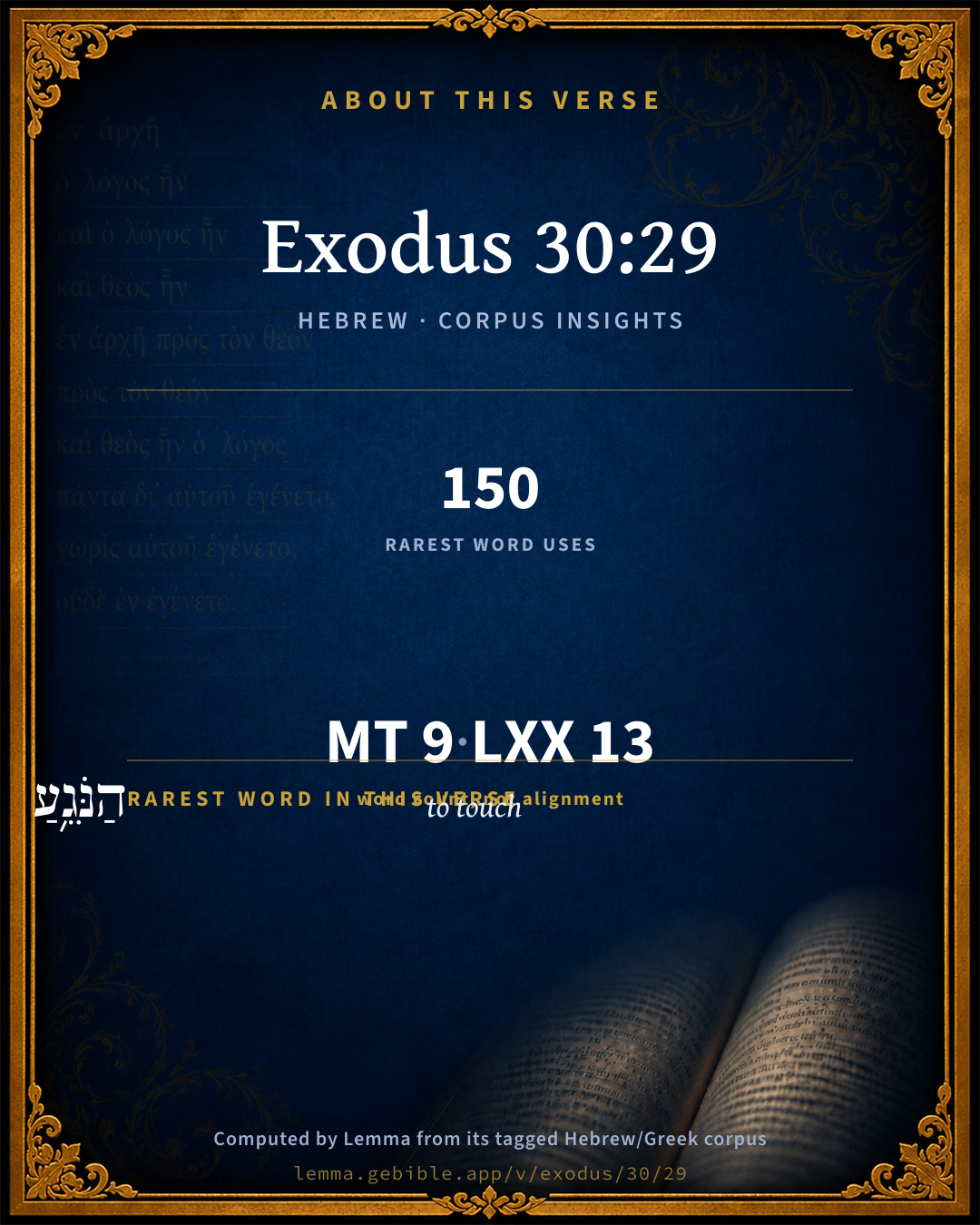
These counts appear in no published source. They are computed here, from the morphology-tagged text and Lemma’s own curated glosses. What Lemma adds →

9
words
6
distinct lemmas
Pentateuch
section

Grammatical profile

  • 4 verbs
  • 3 nouns
  • 1 preposition
  • 1 particle

Verb forms

  • וְקִדַּשְׁתָּ֣ Piel · Sequential Perfect
  • וְהָי֖וּ Qal · Sequential Perfect
  • הַנֹּגֵ֥עַ Qal · Participle Active
  • יִקְדָּֽשׁ Qal · Imperfect

Repetition

Words recur within this verse — often emphatic in Hebrew:

  • וְקִדַּשְׁתָּ֣ to consecrate H6942 ×2
  • קֹ֣דֶשׁ holiness H6944 ×2

Hebrew & Septuagint length

In English translation the verse runs 16 words from the Hebrew and 19 from the Septuagint (LXX English) — closely comparable.

A rough comparison of the two English renderings, which tokenize alike — not a word-level alignment.

Word counts can differ between the Hebrew and the Greek without any difference in meaning — e.g. the Hebrew direct-object marker אֵת has no separate Greek word, and Greek often adds the article ὁ.

In the original languages it is 9 Hebrew tokens and 13 Greek tokens — but the two are counted differently (Hebrew bundles its prefixes and suffixes into one token; the Greek is in lemma form), so that isn’t a like-for-like length.

Cross-references

4

Topical passages linked to Exodus 30:29 in the Treasury of Scripture Knowledge — connected by theme and wording, ordered by reader-vote popularity; previews shown in the World English Bible.

  • Exodus 29:37 Seven days you shall make atonement for the altar, and sanctify it: and the altar shall be most holy; whatever touches the altar shall be holy.
  • Leviticus 6:18 Every male among the children of Aaron shall eat of it, as their portion forever throughout your generations, from the offerings of Yahweh made by fire. Whoever touches them shall be holy.'"
  • Matthew 23:19 You blind fools! For which is greater, the gift, or the altar that sanctifies the gift?
  • Matthew 23:17 You blind fools! For which is greater, the gold, or the temple that sanctifies the gold?

Cross-references courtesy of OpenBible.info (CC BY 4.0).

Hebrew and Greek witnesses Masoretic Hebrew ↔ Greek Septuagint

The same verse in the two great witnesses to the Old Testament, shown verse-for-verse.

These are two independent witnesses, not word-aligned to each other, and the Septuagint is shown in lemma (dictionary) form.

Hebrew Exodus 30:29 Masoretic · Westminster Leningrad Codex

וְקִדַּשְׁתָּ֣ אֹתָ֔ם וְהָי֖וּ קֹ֣דֶשׁ קָֽדָשִׁ֑ים כָּל הַנֹּגֵ֥עַ בָּהֶ֖ם יִקְדָּֽשׁ

You shall sanctify them, that they may be most holy. Whatever touches them shall be holy.

World English Bible · Public Domain

Greek LXX Exodus 30:29 Septuagint · lemma form

καί ἁγιάζω αὐτός καί εἰμί ἅγιος ὁ ἅγιος πᾶς ὁ ἅπτομαι αὐτός ἁγιάζω

And you shall sanctify them, and they shall be most holy: every one that touches them shall be hallowed.

LXX2012 (modern English Septuagint) · Public Domain

Hebrew: Westminster Leningrad Codex (CC BY 4.0). Greek: Septuagint (public domain); English from LXX2012 (modern English Septuagint) (Public Domain). How the Septuagint differs from the Hebrew →

Targum (Aramaic paraphrase)

2

The Targum is the ancient Jewish Aramaic paraphrase of the Hebrew Scriptures — an interpretive translation, not the Hebrew text itself. Onkelos (literal) and Pseudo-Jonathan (expansive) render the Torah, and Jonathan the Prophets. Coverage is partial: where no permissively-licensed English translation exists for a verse, only the Aramaic is shown. This is verse-level text, not a word-by-word alignment to the Hebrew.

  1. Targum Onkelos Torah (Genesis–Deuteronomy)
    וּתְקַדֵשׁ יָתְהוֹן וִיהוֹן קֹדֶשׁ קוּדְשַׁיָא כָּל דְיִקְרַב בְּהוֹן יִתְקַדָשׁ:

    (no public-domain English translation for this verse)

    Targum Onkelos — Aramaic: “Onkelos Genesis” (public domain); “Onkelos Exodus” (public domain); “Onkelos Leviticus” (public domain); “Onkelos Numbers” (public domain); “Onkelos Deuteronomy” (public domain). English: “Sefaria Community Translation” (CC0 1.0 (public-domain dedication)); “J.W. Etheridge. The Targums of Onkelos and Jonathan Ben Uzziel on the Pentateuch. London: Longmans, Green, 1862” (public domain). Text via Sefaria.

  2. Targum Pseudo-Jonathan Torah (Genesis–Deuteronomy)
    וּתְקַדַּשׁ יַתְהוֹן וִיהוֹן קוֹדֶשׁ קוּדְשִׁין כָּל דְּיִקְרַב בְּהוֹן מִן כַּהֲנַיָא יִתְקַדָּשׁ וּמִשְׁאַר שִׁבְטַיָא יְתוּקַד בְּאֵשָׁא מְצַלְהֲבָא קֳדָם יְיָ

    and consecrate them, and they shall be most holy. Every one of the priests who approacheth to them shall be sanctified; but of the rest of the tribes, (whoever toucheth them) shall be consumed by the fiery flame from before the Lord.

    Targum Pseudo-Jonathan — Aramaic: “Targum Jonathan on Genesis” (public domain); “Targum Jonathan on Exodus” (public domain); “Targum Jonathan on Leviticus” (public domain); “Targum Jonathan on Numbers” (public domain); “Targum Jonathan on Deuteronomy” (public domain). English: “The Targum of Jonathan ben Uzziel, trans. J. W. Etheridge, London, 1862” (public domain). Text via Sefaria.

Commentary

Notes on Exodus 30:29 from classic Christian and Jewish commentators (each source and its license shown beneath its notes). The classic Christian expositions comment on the surrounding passage and are grouped to its opening verse, so a note may address several verses; the Jewish commentaries on the Tanakh (Rashi and others) are per-verse, so they appear only where the commentator wrote on this verse.

Lemma curates 59 commentaries, every one of them public domain or Creative Commons licensed, each selected and text-cleaned for this edition rather than reprinted as found. About our sources →

Trapp's Complete Commentary

John Trapp

Exo 30:29 And thou shalt sanctify them, that they may be most holy: whatsoever toucheth them shall be holy.

Ver. 29. Whatsoever toucheth them.] So are all those anointed holy, that by a lively faith touch the Lord Christ.

John Trapp, A Commentary or Exposition upon All the Books of the Old and New Testament (1647–1656) — public domain. Text from a community e-Sword module.

The Cambridge Bible for Schools and Colleges

gen. ed. J. J. S. Perowne

29. The effect of the anointing is to sanctify the objects to which the process is applied (cf. Exo_29:36).

most holy] See on Exo_29:37.

shall become holy] i.e. be forfeited to the sanctuary, or, if a person (marg.), be given over to the Deity, that He may deal with him as He pleases. See further on Exo_29:37.

Anointing1[213], in a religious sense, is in the OT. a symbolical act, denoting (1) the divine appointment, or consecration, of a person for a particular purpose, esp. a king (1Sa_10:1 and often), the high priest (Exo_29:7), later also the ordinary priests (see on v. 30), and, at least once, a prophet, 1Ki_Exo_19:16 b (cf., in a fig. sense, Isa_61:1); it is followed by, and is sometimes a figure of, the outpouring of the Spirit upon the person anointed (1Sa_10:6, cf. v. 1, Exo_16:13; Isa_61:1 (Luk_4:18), Act_4:27; Act_10:38, 2Co_1:21, 1Jn_2:20; 1Jn_2:27): (2) the consecration of a thing, viz. a sacred stone, Gen_31:13 (see Exo_28:18), Exo_35:14 (so among the Greeks; see the writer’s Genesis, p. 267), the Tabernacle and its appurtenances (see on vv. 26–28), a future Altar of burnt-offering, Dan_9:24 (see the note in the Camb. Bible). The practice of anointing is widely diffused in the world: the unguent—originally fat, regarded in primitive thought as an important seat of life—was regarded, it seems, at least primitively, as a vehicle transferring to the person or object anointed a Divine life or potency. See art. Anointing (Crawley and Jastrow) in Hastings’ Encycl. of Rel. and Ethics, i. (1908), 549–557, esp. 550, 554, 556 (cf. EB. s.v. i. 175); and for the anointing of priests, p. 552b, and of temples and other sacred objects, p. 553 f.

[213] Heb. mâshaḥ (whence ‘Messiaḥ’), to be carefully distinguished from anointing the head or person for the toilet (Heb. sûk) Deu_28:40, 2Sa_14:2 al. In NT. χρίω (fig., never lit.) corresponds to the former, and ἀλείφω (e.g. Mat_6:17) to the latter.

The Cambridge Bible for Schools and Colleges (gen. ed. J. J. S. Perowne; Cambridge University Press, 1878–1918) — public domain. Text from a community e-Sword module.

John Gill's Exposition

And thou shalt sanctify them, that they may be most holy,.... By anointing them, and so be set apart for sacred uses only; as by the grace of the Holy Spirit, the people of God, the vessels of mercy, are really sanctified, and made meet for the master's use; and therefore it is called the sanctification of the Spirit, which is true holiness, in opposition to typical or ceremonial holiness, here intended; and if this holy anointing oil made those things most holy that were anointed with it, how much more must the grace of the Spirit those who partake of it; and though it is at present imperfect, it will be perfected, and become complete holiness, without which no man can see the Lord:

whatsoever toucheth them shall be holy; as is said of the most holy altar; see Gill on Exo 29:37. The Targum of Jonathan interprets it of persons that approach these holy places, and things so anointed and sanctified, paraphrasing the words thus;"whosoever cometh unto them of the priests shall be holy, but of the rest of the tribes shall be burnt with flaming fire before the Lord.''

John Gill's Exposition of the Whole Bible (1746–1763) — public domain (CC PDM 1.0). Text via the HelloAO Bible API.

Haydock's Catholic Bible Commentary

Sanctified. But if he ought not to touch it, he shall be defiled the more: (Deuteronomy xxii. 9) a double effect, which we perceive in the Christian sacraments. (Calmet)

George Leo Haydock (1774–1849), Haydock's Catholic Family Bible and Commentary, 1859 edition — public domain. Excludes Psalms (Douay-Rheims chapter numbering differs from Protestant) and Deuterocanonical books (Catholic canon only).

unfoldingWord translationNotes

Door43 World Missions Community

General Information:

Yahweh continues speaking to Moses.

set them apart

This refers to the items listed in Exodus 30:26-28.

throughout your people's generations

"all the generations of your descendants." See how you translated this in Exodus 12:14.

translationWords

set apart

anoint

Aaron

servant

priest

Israel

oil

Yahweh

people group

generation

unfoldingWord translationNotes — © Distant Shores Media and the Door43 World Missions Community, licensed CC BY-SA 4.0. Source: git.door43.org/Door43/en_tn.

Rashi

Rabbi Shlomo Yitzchaki (Rashi)

וקדשת אתם AND THOU SHALT SANCTIFY THEM — This anointing (mentioned v. 26) sanctifies them so that they become most holy. And in what consists their holiness? כל הנגע בהם וגו׳ that WHOSOEVER TOUCHETH THEM [SHALL BECOME HOLY]. — Whatever is proper for use in a particular sacred vessel becomes itself holy (more lit., becomes holy with bodily holiness) as soon as it comes into it, so that it becomes invalid as an offering under the following conditions: when after it had been placed in the vessel it had been taken (lit., had gone forth) outside the fore-court, or when it had been left the whole of the night without being placed on the altar, or when it has come into contact with a טבול יום (a person who had been unclean and has taken the ritual immersion but is awaiting sunset to be regarded as clean, as is prescribed in Leviticus 22:7). Moreover it cannot be redeemed by payment of its value to the Temple treasury, thereby to reassume its ordinary character. But whatever is not proper to them (to these vessels) they do not make holy (Zevachim 87a). A similar statement is made in an uncontroverted (Hebrew: perfect) Boraitha (Zevachim 83b) about the hallowing power of the altar: Since it is said, (Exodus 29:37) “Whatsoever toucheth the altar shall become holy”, I might infer that this applies to a thing whether it was fitting to be an offering at the time when it was brought into the Sanctuary or whether it was not fitting; Scripture therefore states immediately afterwards, (Exodus 29:38) “[Now this is that which thou shalt offer upon the altar]; two lambs”. Now how is it in the case of the lambs? They are fitting for the altar! So, also, does the preceding statement, “Whatsoever [touches the altar shall become holy]”, refer only to anything that is fitting (i. e. that was already fitting to be brought upon the altar and became disqualified only after it had been brought into the forecourt of the Sanctuary). — In all cases where the term משח, “to anoint”, is used with reference to the Tabernacle or priests or kings it is rendered by the Targum by the appropriate form of the verb רבה, “to raise to high rank”, “to distinguish”, because the anointing of them had no other purpose than to show the distinction that was being bestowed upon them. For thus did the Heavenly King ordain (Rashi uses here the words of the text, (Esther 1:9) that this should constitute their installation in their high office. In any other case, however, where משח is used, — for instance, (Exodus 29:2) “wafers [unleavened] משוחים with oil”; (Amos 6:6) “and with the chief ointments ימשחו” — the Aramaic expression for them in the Targum is the same term as the Hebrew text, viz., a form of משח; (because in these passages anointing is an end in itself, whilst in the former case it is an indication only of elevation to a distinguished position).

Rashi on the Tanakh — English translations: “The Judaica Press complete Tanach with Rashi, translated by A. J. Rosenberg” (CC BY 4.0); “Pentateuch with Rashi's commentary by M. Rosenbaum and A.M. Silbermann, 1929-1934” (public domain); “The Metsudah Tanach series, Lakewood, N.J” (CC BY 4.0); and “The Book of Joshua, Metsudah Publications, 1997” (CC BY 4.0). Text via Sefaria.

Lesson kit

Teaching starters — assembled from the data on this page, not authored interpretation. Every prompt links to the verse data it draws on. Edit before teaching.

Exodus, in the Pentateuch, opens this verse with 9 words (6 distinct Hebrew lemmas). Its most distinctive word is nâgaʻ (“to touch”). A historical commentator’s framing appears above. Read the whole chapter for the surrounding context.

Discussion questions

  1. What does “to touch” (nâgaʻ) contribute to the verse as a whole?
  2. Exodus 29:37 shares this passage’s theme. How do the two illuminate each other?
  3. “to consecrate” occurs 2× in this one verse. What is the effect of the repetition?
  4. These translations render this verse differently; the difference is in the English rendering, not the original. What questions does that raise?
  5. The verb «וְקִדַּשְׁתָּ֣» is Piel Sequential Perfect. How does its form color the action?
  6. Reading how Trapp's Complete Commentary and The Cambridge Bible for Schools and Colleges read this verse, where do the two commentators agree and where do they part?

Things to notice

Reading settings

Reading text

Shown beneath each verse's original-language words.

Old Testament
Old Testament edition

Read the OT as the Masoretic Hebrew (MT) or the Greek Septuagint (LXX).

English shown for the Greek Septuagint (in the Hebrew ↔ Greek comparison).

Comparing translations? Open the Compare panel on any verse page to stack up to four side by side.