
Exodus 28:29

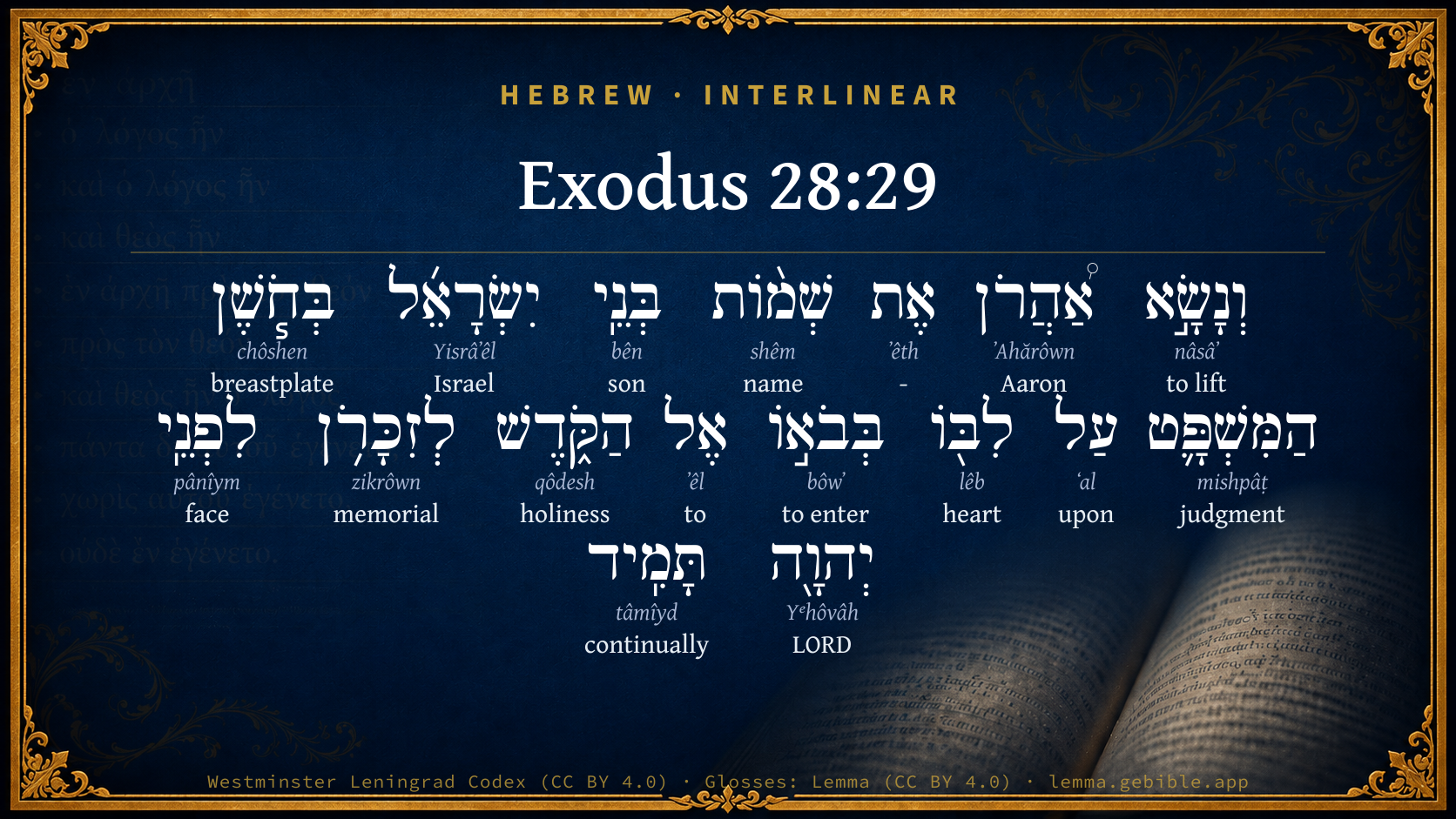
Hebrew (Westminster Leningrad Codex) Exodus 28:29 appears in the Hebrew Old Testament. The text above is from the Westminster Leningrad Codex. Each word links to its Strong’s number, a concise gloss, and parsing drawn from the Open Scriptures Hebrew Bible morphology. Click any word for its full Brown-Driver-Briggs (BDB) entry.
Download image
Cite this verse

Exodus 28:29 (World English Bible). Public Domain. Lemma interlinear Bible study tool, https://lemma.gebible.app/v/exodus/28/29.

Show BibTeX & RIS
BibTeX
RIS
English Translation
Aaron shall bear the names of the children of Israel in the breastplate of judgment on his heart, when he goes in to the holy place, for a memorial before Yahweh continually.
World English Bible · Public Domain
Download a study sheet

One document with this verse’s original text, its word-by-word gloss line, the meaning frame, cross-references with their text, attributed commentary, and full source and license credits — printable, and it pastes into notes with its structure intact.

This verse Autodidact and up

Study sheet (.html) Plain text (.txt)

A passage Seminary Student

Up to 50 verses in one chapter. A passage sheet keeps up to 6 commentary sources and 12 cross-references per verse, in the order this page ranks them, and says so on the sheet whenever that leaves anything out. Ask for a single verse and you get the Autodidact verse sheet above.

Everything on this page stays free to read, with no account — the sheet is a download of what is already on screen, not access to it.

Want to remove ads? Support Godless Engineer
Compare translations 3

The same verse in 3 English versions, stacked beneath the original-language interlinear above. Click any original word for its lexicon entry.

Each is an independent rendering of the whole verse — the interlinear is not word-aligned to these translations.

Highlighted words mark where these versions differ — a whole-verse word diff, not a word-by-word alignment.

  • World English Bible Public Domain
    Aaron shall bear the names of the children of Israel in the breastplate of judgment on his heart, when he goes in to the holy place, for a memorial before Yahweh continually.
  • King James Version Public Domain
    And Aaron shall bear the names of the children of Israel in the breastplate of judgment upon his heart, when he goeth in unto the holy place, for a memorial before the LORD continually.
  • unfoldingWord Literal Text CC BY-SA 4.0
    And Aaron shall bear the names of the sons of Israel in the breastpiece of judgment over his heart when he goes into the Holy Place as a reminder before the face of Yahweh continually.

unfoldingWord Literal Text — © unfoldingWord, licensed CC BY-SA 4.0. Word-aligned USFM3 via Door43 (git.door43.org/unfoldingWord/en_ult).

Versions to compare (up to 4)

3 of 4 selected

Show all 18 translations

Every available English version of this verse, each an independent rendering of the whole verse.

  • World English Bible Public Domain
    Aaron shall bear the names of the children of Israel in the breastplate of judgment on his heart, when he goes in to the holy place, for a memorial before Yahweh continually.
  • Berean Standard Bible Public Domain
    Whenever Aaron enters the Holy Place, he shall bear the names of the sons of Israel over his heart on the breastpiece of judgment, as a continual reminder before the LORD.
  • Majority Standard Bible Public Domain
    Whenever Aaron enters the Holy Place, he shall bear the names of the sons of Israel over his heart on the breastpiece of judgment, as a continual reminder before the LORD.
  • King James Version Public Domain
    And Aaron shall bear the names of the children of Israel in the breastplate of judgment upon his heart, when he goeth in unto the holy place, for a memorial before the LORD continually.
  • American Standard Version (1901) Public Domain
    And Aaron shall bear the names of the children of Israel in the breastplate of judgment upon his heart, when he goeth in unto the holy place, for a memorial before Jehovah continually.
  • Revised Version (1885) Public Domain
    And Aaron shall bear the names of the children of Israel in the breastplate of judgment upon his heart, when he goeth in unto the holy place, for a memorial before the LORD continually.
  • Geneva Bible (1599) Public Domain
    So Aaron shall beare the names of the children of Israel in the brest plate of iudgement vpon his heart, when he goeth into the holy place, for a remembrance continually before the Lord.
  • Douay-Rheims (1899) Public Domain
    And Aaron shall bear the names of the children of Israel in the rational of judgement upon his breast, when he shall enter into the sanctuary, a memorial before the Lord for ever.
  • Young's Literal Translation Public Domain
    `And Aaron hath borne the names of the sons of Israel in the breastplate of judgment, on his heart, in his going in unto the sanctuary, for a memorial before Jehovah continually.
  • Literal Standard Version CC BY-SA 4.0
    And Aaron has borne the names of the sons of Israel in the breastplate of judgment, on his heart, in his going into the holy place, for a memorial before YHWH continually.
  • Unlocked Literal Bible CC BY-SA 4.0
    When Aaron goes into the holy place, he must carry the names of the people of Israel over his heart in the breastpiece for decision making, as a continuing memorial before Yahweh.
  • unfoldingWord Literal Text CC BY-SA 4.0
    And Aaron shall bear the names of the sons of Israel in the breastpiece of judgment over his heart when he goes into the Holy Place as a reminder before the face of Yahweh continually.
  • Darby Bible Public Domain
    And Aaron shall bear the names of the children of Israel in the breastplate of judgment on his heart, when he goes in to the sanctuary, for a memorial before Jehovah continually.
  • World Messianic Bible Public Domain
    Aaron shall bear the names of the children of Israel in the breastplate of judgment on his heart, when he goes in to the holy place, for a memorial before the LORD continually.
  • Webster's Bible Public Domain
    And Aaron shall bear the names of the children of Israel in the breast-plate of judgment upon his heart, when he entereth into the holy place, for a memorial before the LORD continually.
  • Free Bible Version CC BY-SA 4.0
    Like this, whenever Aaron enters the Holy Place, he will wear the names of the Israelite tribes over his heart on the breastpiece, as a constant reminder before the Lord.
  • Bible in Basic English Public Domain
    And so Aaron will have the names of the children of Israel on the priest's bag over his heart whenever he goes into the holy place, to keep the memory of them before the Lord.
  • JPS Tanakh (1917) Public Domain
    And Aaron shall bear the names of the children of Israel in the breastplate of judgment upon his heart, when he goeth in unto the holy place, for a memorial before the LORD continually.

Literal Standard Version (2020), Covenant Press — licensed CC BY-SA 4.0. Text via the HelloAO Bible API (eBible.org). Unlocked Literal Bible (unfoldingWord) — licensed CC BY-SA 4.0. Text via the HelloAO Bible API (eBible.org). unfoldingWord Literal Text — © unfoldingWord, licensed CC BY-SA 4.0. Word-aligned USFM3 via Door43 (git.door43.org/unfoldingWord/en_ult). Free Bible Version, Dr. Jonathan Gallagher — licensed CC BY-SA 4.0. Text via the HelloAO Bible API (eBible.org).

Word by word

More ways to search: Search by grammar → Find every occurrence → Compare this word →

Practice this passage: Drill this verse → Learn its vocabulary →

לְזִכָּרֹ֥ן
zikrôwn
H2146
“to/for · memorial”
Preposition + Noun, Common, Masculine, Singular, Absolute
Part of Speech
Preposition + Noun
Type
Common
Gender
Masculine
Number
Singular
State
Absolute
Full BDB Definition

Origin: from H2142

TWOT: 551b

memorial, reminder, remembrance
  1. וְנָשָׂ֣א nâsâʼ H5375 “and · to lift” Conjunction + Verb, Qal, Sequential Perfect, 3rd Person, Masculine, Singular
  2. אַ֠הֲרֹן ʼAhărôwn H175 “Aaron” Noun, Proper
  3. אֶת ʼêth H853 “-” Particle, Direct Object
  4. שְׁמ֨וֹת shêm H8034 “names of” Noun, Common, Masculine, Plural, Construct
  5. בְּנֵֽי bên H1121 “sons of” Noun, Common, Masculine, Plural, Construct
  6. יִשְׂרָאֵ֜ל Yisrâʼêl H3478 “Israel” Noun, Proper
  7. בְּחֹ֧שֶׁן chôshen H2833 “in/at · breastplate of” Preposition + Noun, Common, Masculine, Singular, Construct
  8. הַמִּשְׁפָּ֛ט mishpâṭ H4941 “the · judgment” Particle, Definite Article + Noun, Common, Masculine, Singular, Absolute
  9. עַל ʻal H5921 “upon” Preposition
  10. לִבּ֖וֹ lêb H3820 “heart · his” Noun, Common, Masculine, Singular, Construct + Suffix, Personal, 3rd Person, Masculine, Singular
  11. בְּבֹא֣וֹ bôwʼ H935 “in/at · to enter · him” Preposition + Verb, Qal, Infinitive Construct + Suffix, Personal, 3rd Person, Masculine, Singular
  12. אֶל ʼêl H413 “to” Preposition
  13. הַקֹּ֑דֶשׁ qôdesh H6944 “the · holiness” Particle, Definite Article + Noun, Common, Masculine, Singular, Absolute
  14. לִפְנֵֽי pânîym H6440 “to/for · face(s) of” Preposition + Noun, Common, Both, Plural, Construct
  15. יְהוָ֖ה Yᵉhôvâh H3068 “LORD” Noun, Proper
  16. תָּמִֽיד tâmîyd H8548 “continually” Noun, Common, Masculine, Singular, Absolute

About this verse

These counts appear in no published source. They are computed here, from the morphology-tagged text and Lemma’s own curated glosses. What Lemma adds →

17
words
17
distinct lemmas
Pentateuch
section

Notable vocabulary

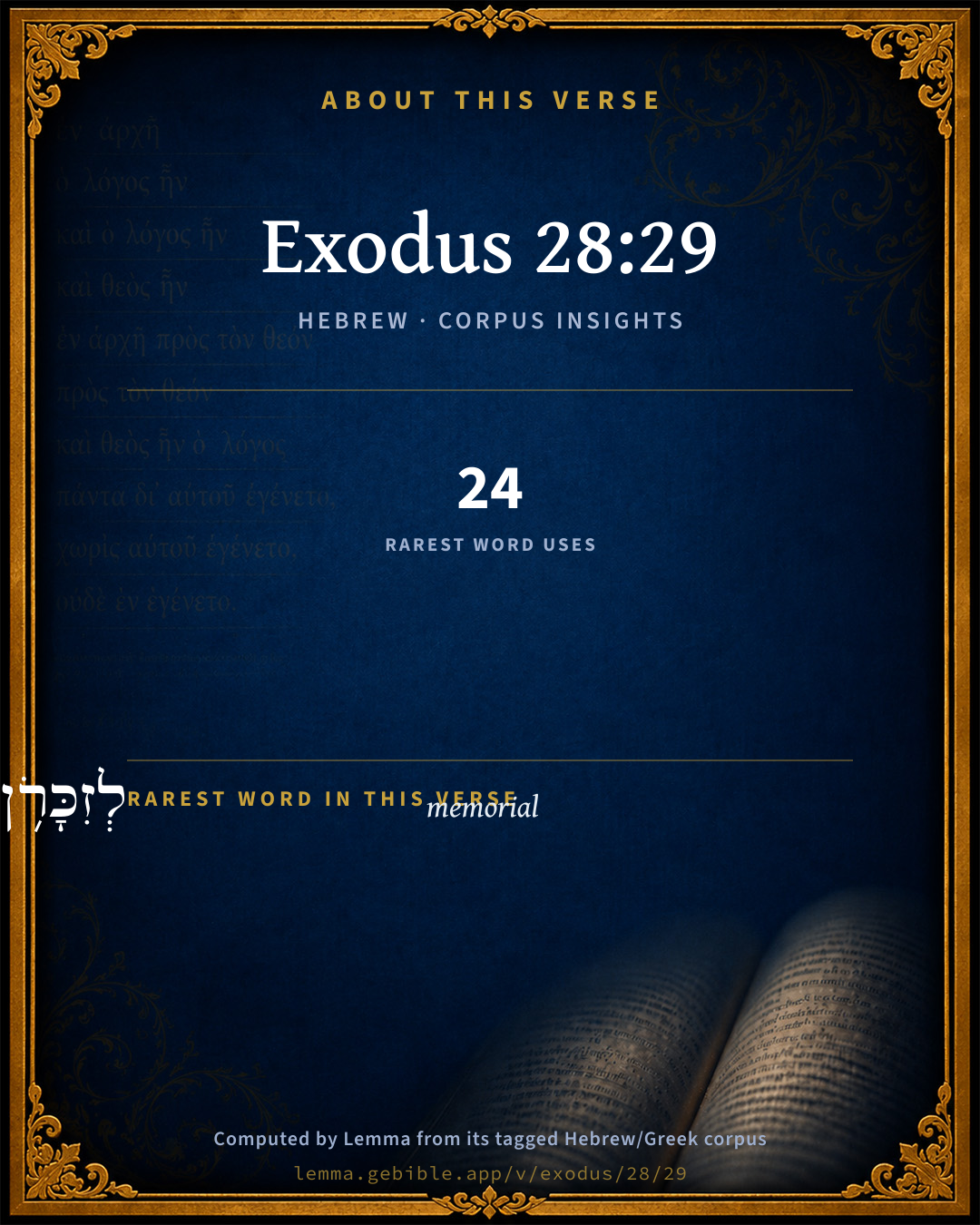
The rarest word here is לְזִכָּרֹ֥ן memorial H2146 — appearing just 24 times in the whole Hebrew Bible.

Shared distinctive vocabulary

לְזִכָּרֹ֥ן memorial H2146 occurs in 22 verses of the Hebrew Bible. Also found in:

Grammatical profile

  • 2 verbs
  • 12 nouns
  • 2 prepositions
  • 1 particle

Verb forms

  • וְנָשָׂ֣א Qal · Sequential Perfect
  • בְּבֹא֣וֹ Qal · Infinitive Construct

Hebrew & Septuagint length

In English translation the verse runs 32 words from the Hebrew and 51 from the Septuagint (LXX English) — the Septuagint runs noticeably longer here. See the side-by-side →

A rough comparison of the two English renderings, which tokenize alike — not a word-level alignment.

Word counts can differ between the Hebrew and the Greek without any difference in meaning — e.g. the Hebrew direct-object marker אֵת has no separate Greek word, and Greek often adds the article ὁ.

Cross-references

7

Topical passages linked to Exodus 28:29 in the Treasury of Scripture Knowledge — connected by theme and wording, ordered by reader-vote popularity; previews shown in the World English Bible.

  • Exodus 28:12 You shall put the two stones on the shoulder-pieces of the ephod, to be stones of memorial for the children of Israel: and Aaron shall bear their names before Yahweh on his two shoulders for a memorial.
  • Exodus 28:30 You shall put in the breastplate of judgment the Urim and the Thummim; and they shall be on Aaron's heart, when he goes in before Yahweh: and Aaron shall bear the judgment of the children of Israel on his heart before Yahweh continually.
  • Isaiah 49:15–16 Can a woman forget her sucking child, that she should not have compassion on the son of her womb? yes, these may forget, yet I will not forget you.
  • Jeremiah 30:21 Their prince shall be of themselves, and their ruler shall proceed from the midst of them; and I will cause him to draw near, and he shall approach to me: for who is he who has had boldness to approach to me? says Yahweh.
  • Romans 10:1 Brothers, my heart's desire and my prayer to God is for Israel, that they may be saved.
  • Exodus 28:15 "You shall make a breastplate of judgment, the work of the skillful workman; like the work of the ephod you shall make it; of gold, of blue, and purple, and scarlet, and fine twined linen, shall you make it.
  • Song of Solomon 8:6 Set me as a seal on your heart, As a seal on your arm; For love is strong as death. Jealousy is as cruel as Sheol; Its flashes are flashes of fire, A very flame of Yahweh.

Cross-references courtesy of OpenBible.info (CC BY 4.0).

Hebrew and Greek witnesses Masoretic Hebrew ↔ Greek Septuagint

The same verse in the two great witnesses to the Old Testament, shown verse-for-verse.

Here the Septuagint runs noticeably longer than the Hebrew — LXX2012 (modern English Septuagint) 51 words vs World English Bible 32. A rough length comparison of the two English translations, not a word-level alignment — read both below.

These are two independent witnesses, not word-aligned to each other, and the Septuagint is shown in lemma (dictionary) form.

Hebrew Exodus 28:29 Masoretic · Westminster Leningrad Codex

וְנָשָׂ֣א אַ֠הֲרֹן אֶת שְׁמ֨וֹת בְּנֵֽי יִשְׂרָאֵ֜ל בְּחֹ֧שֶׁן הַמִּשְׁפָּ֛ט עַל לִבּ֖וֹ בְּבֹא֣וֹ אֶל הַקֹּ֑דֶשׁ לְזִכָּרֹ֥ן לִפְנֵֽי יְהוָ֖ה תָּמִֽיד

Aaron shall bear the names of the children of Israel in the breastplate of judgment on his heart, when he goes in to the holy place, for a memorial before Yahweh continually.

World English Bible · Public Domain

Greek LXX Exodus 28:29 Septuagint · lemma form

καί λαμβάνω ααρων ὁ ὄνομα ὁ υἱός ἰσραήλ ἐπί ὁ λογεῖον ὁ κρίσις ἐπί ὁ στῆθος εἰςεἶμι εἰς ὁ ἅγιος μνημόσυνον ἔναντι ὁ θεός καί τίθημι ἐπί ὁ λογεῖον ὁ κρίσις ὁ κροσός ὁ ἁλυσιδωτός ἐπί ἀμφότεροι ὁ κλίτος ὁ λογεῖον ἐπιτίθημι καί ὁ δύο ἀσπιδίσκη ἐπιτίθημι ἐπί ἀμφότεροι ὁ ὦμος ὁ ἐπωμίς κατά πρόσωπον

And under the fringe of the robe below you shall make as it were pomegranates of a flowering pomegranate tree, of blue, and purple, and spun scarlet, and fine linen spun, under the fringe of the robe round about: golden pomegranates of the same shape, and bells round about between these.

LXX2012 (modern English Septuagint) · Public Domain

On this verse, John Gill's Exposition discusses the Septuagint’s reading. Read the note in Commentary ↓

Hebrew: Westminster Leningrad Codex (CC BY 4.0). Greek: Septuagint (public domain); English from LXX2012 (modern English Septuagint) (Public Domain). How the Septuagint differs from the Hebrew →

Targum (Aramaic paraphrase)

2

The Targum is the ancient Jewish Aramaic paraphrase of the Hebrew Scriptures — an interpretive translation, not the Hebrew text itself. Onkelos (literal) and Pseudo-Jonathan (expansive) render the Torah, and Jonathan the Prophets. Coverage is partial: where no permissively-licensed English translation exists for a verse, only the Aramaic is shown. This is verse-level text, not a word-by-word alignment to the Hebrew.

  1. Targum Onkelos Torah (Genesis–Deuteronomy)
    וְיִטוֹל אַהֲרֹן יָת שְׁמָהַת בְּנֵי יִשְׂרָאֵל בְּחשֶׁן דִינָא עַל לִבֵּהּ בְּמֵעֲלֵהּ לְקוּדְשָׁא לְדוּכְרָנָא קֳדָם יְיָ תְּדִירָא:

    (no public-domain English translation for this verse)

    Targum Onkelos — Aramaic: “Onkelos Genesis” (public domain); “Onkelos Exodus” (public domain); “Onkelos Leviticus” (public domain); “Onkelos Numbers” (public domain); “Onkelos Deuteronomy” (public domain). English: “Sefaria Community Translation” (CC0 1.0 (public-domain dedication)); “J.W. Etheridge. The Targums of Onkelos and Jonathan Ben Uzziel on the Pentateuch. London: Longmans, Green, 1862” (public domain). Text via Sefaria.

  2. Targum Pseudo-Jonathan Torah (Genesis–Deuteronomy)
    וְיִטוֹל אַהֲרן יַת שְׁמָהַת בְּנֵי יִשְרָאֵל בְּחֹשֶׁן דִּינָא עַל לִבֵּיהּ בִּזְמַן מַעֲלֵיהּ לְקוּדְשָׁא לְדוּכְרָן טַב קֳדָם יְיָ תְּדִירָא

    And Aharon shall bear the names of the sons of Israel upon his heart what time he entereth into the sanctuary for a good memorial before the Lord continually.

    Targum Pseudo-Jonathan — Aramaic: “Targum Jonathan on Genesis” (public domain); “Targum Jonathan on Exodus” (public domain); “Targum Jonathan on Leviticus” (public domain); “Targum Jonathan on Numbers” (public domain); “Targum Jonathan on Deuteronomy” (public domain). English: “The Targum of Jonathan ben Uzziel, trans. J. W. Etheridge, London, 1862” (public domain). Text via Sefaria.

Commentary

Notes on Exodus 28:29 from classic Christian and Jewish commentators (each source and its license shown beneath its notes). The classic Christian expositions comment on the surrounding passage and are grouped to its opening verse, so a note may address several verses; the Jewish commentaries on the Tanakh (Rashi and others) are per-verse, so they appear only where the commentator wrote on this verse.

Lemma curates 59 commentaries, every one of them public domain or Creative Commons licensed, each selected and text-cleaned for this edition rather than reprinted as found. About our sources →

John Gill's Exposition

And thou shall put in the breastplate of judgment the Urim and the Thummim,.... What these interpreters are at a loss about, both Jewish and Christian; some have confessed their ignorance of them, have conjectured they were only these two words and put in the duplicature of the breastplate; that the name of Jehovah, with other divine were put there and so called; and some have that they were little images, the same with the teraphim, the high priest carried in the folds of breastplate, by which consultation was made; others have thought them to be a work purely divine, of Jehovah's putting there; for my own part I am to follow Josephus (x), who takes them to be the same with the twelve stones; and it is observable that where the stones are mentioned nothing is said of the Urim and Thummim, and where the Urim and Thummim are observed, no notice is taken of the stones, see Exo 39:10 the use of these was to have the names of the children of Israel engraven upon them, and so be borne on the heart of Aaron when he went into the holy place, as is here said of the Urim and Thummim; and that consultation might be made by them in matters of moment and difficulty, as appears from various other passages of the Scripture, Num 27:21 and but in what manner this was done, and in what way the answer was given and understood, are not easily accounted for: some say, by the brightness or protuberance of the letters on the stones; others, by the shining and splendour of the stones, which is more probable; others, by an inward impression on the mind of the priest; and others, by an articulate voice, which seems best of all: the Septuagint render these two words "manifestation and truth"; and Aelianus (y) reports, that the chief and oldest among the Egyptian priests and judges wore an image of a sapphire stone about his neck, which they called "truth": and, according to Diodorus Siculus (z), this image was of more precious stones than one; for he says, the president in the Egyptian courts of judicature had on his neck, hanging on a golden chain, an image of precious stones, which they called truth: but there is no reason to believe that this custom was as ancient as the times of the Israelites in Egypt, or that they borrowed this from them; but rather, that the Egyptians did this in imitation of what the high priest among the Jews wore, which they might learn from the Jews in Solomon's time, or in later ages; the words Urim and Thummim signify "lights and perfections", agreeably to which is the paraphrase of Jonathan;"Urim, which enlighten their words, and manifest the hidden things of the house of Israel, and Thummim, which perfect their works, by the high priest, who seeks instruction from the Lord by them:''they were typical of Christ, in whom all lights and perfections are; all light is in him; the light of nature and reason is from him, as the Creator, and is given to every man that comes into the world; the light of grace is with him, and communicated to all his people at conversion, and in all the after degrees and supplies of it; all light and knowledge in divine things is from him, the knowledge of God, of himself, and of the Gospel, and the truths of it; and the light of glory will be from him: all the perfections of deity, the whole fulness of the Godhead, all human perfections, which make him as man in all things like unto us, but far exceeding us; as Mediator, all the blessings and promises of the covenant are in him; all the gifts of the Spirit, and a fulness of all grace; there are in him perfect righteousness, perfect holiness, all light, life, strength, wisdom, joy, and comfort (a): and these stones, or Urim and Thummim, may be an emblem also of the saints, being made light and perfect righteousness in Christ, from whom they have both:

and they shall be upon Aaron's heart, when he goeth in before the Lord; either into the holy or into the most holy place, just as the names of the children of Israel on the stones are said to be; see Gill on Exo 28:29,

and Aaron shall bear the judgment of the children of Israel upon his heart before the Lord continually; not only bear their names and remember their cases, make intercession for them, and represent their persons, in all which he was a type of Christ, but bear their judgment, have that at heart, and administer it unto them; and in all doubtful and difficult cases inquire of God what was fit and right to do for them, or for them to do: so Christ has the government of his people both at heart and in his hands; all judgment is committed to him, and he is the righteousness of his people now, and will be their Judge hereafter.

(x) Antiqu. l. 3. c. 7. sect. 5. (y) Var. Hist. l. 14. c. 34. (z) Bibliothec. l. 1. p. 68. (a) See a Discourse of mine, called Levi's Urim and Thummim, found with Christ, &c. published in 1725.

John Gill's Exposition of the Whole Bible (1746–1763) — public domain (CC PDM 1.0). Text via the HelloAO Bible API.

The Biblical Illustrator

Joseph S. Exell

Exo_28:29

Aaron shall bear the names.

I. The person typified by aaron.

1. Christ (Heb_5:4-5).

2. His Divine call to the priesthood (Heb_5:10).

3. The destruction of His enemies (1Jn_3:8).

4. The leader of His people (Joh_10:3).

5. The averter of Gods vengeance (1Ti_2:5).

II. The persons represented by the term Israel. Ancient Israel, as an elect nation, was a typical people, representing the collective body of Christs Church. For which compare Deu_7:6-8 with Rom_8:28-30.

1. All true believers are called Israel (Gal_6:16).

2. They are circumcised, as was Israel (Rom_2:28-29).

3. They are a peculiar people, as was Israel (Tit_2:14).

III. What is meant by Aarons bearing them on his heart.

1. Christs affection for us (1Jn_3:16).

2. His great pity towards us (Isa_63:9).

3. His interest in us (Joh_17:9-10; Joh_17:24).

IV. What we are to understand by Aarons going into the holy place. Eternal exclusion from Gods glory would have been our unchanging portion, had not the blessed Saviour opened a way for our admission. See it literally explained in Lev_16:1-34.

1. It shows Christs entrance into heaven for us (Heb_9:24).

2. To present His perfect offering for us (Heb_9:12).

3. His continual intercession (Heb_7:25).

V. Here i shall explain this continual memorial, ever before the lord: It may signify--

1. The constant efficacy of His blood.

2. The perfection of His everlasting righteousness.

3. The daily outpouring of His Spirit.

4. The gracious preservation of His people in holiness.

5. It represents the place which Christs Church occupies in His heart, in glory.

6. And ensures our everlasting enjoyment after this time-state is passed away. (T. B. Baker.)

The connection between priest and people

That the connection between the priest and the people might be made more plain, God not only placed on his breast the memorials of the twelve tribes, but also engraved their names on his shoulders. Thus the people would understand that this one man was not separated from the others for the sake of private advantage, but that in his one person they were all a kingdom of priests (see 1Pe_2:5; Isa_66:21; Rev_1:6). Hence arises our confidence of ascending to heaven because Christ raises us up with Him; we sit together in heavenly places in Christ Jesus; however weak we may be in ourselves, herein is all our strength that we are His burden. (J. Calvin.)

Shoulder and heart ministry

History shall not be forgotten, deliverances shall be held in perpetual remembrance; marvels of the Lord wrought yesterday shall be as the marvels wrought in the present hour. Then there shall be a tenderer representation--the names shall be upon the heart. There shall be a ministry of love, a pleading of sympathy, an identification of the spirit of the man with all the difficulties and distresses of the people. Shoulder work: representing publicity, courage, strength, leadership--shoulders to which men may look as to strong towers; and then the delicate heart-work; the sweet sympathy, the paternal or fraternal interest in all that concerns the development, and culture, and completion of poor, shattered, struggling human life. It is nothing to bear upon the shoulder--that is a kind of burden-carrying, and there is a kind of applause immediately following the completion of any athletic task--but who can tell the heart-work of the true mediator or minister of the new covenant? A man who enters into this work with his whole soul must live a life of singular tension and agony, otherwise he is but a shatterer of words; only his shoulder engaged in the function; his heart is at liberty to run after any vanity and court the applause of any foolish idolatry. We must look at ideals; we must fasten our attention upon the thing as God meant it to be, and taking the Divine meaning of the priesthood in the olden time and of the ministry of to-day, we have amongst us men who care for us, men with strong shoulders, tower-like men; sturdy, visible, valiant, dauntless men; men who can speak in the darkness and make their voices heard in the storm; men who know not the cloud of fear and who heed not the tempest of opposition. But we need in the same men other qualities, tenderer elements, more gracious and insinuating forces that find their way into our inmost experience, into our hearts aching and sore necessity--men who are taught of Heaven to speak a word in season to him that is weary; men who have the gift of consolation, who can lower the voice into a tender and helpful whisper, and who can bring all Gods gospel to bear in gracious and healing application upon the wound which makes the heart sore. This is the ideal. That we do not rise to it may be a rebuke to ourselves, but it is no just criticism upon the Divine purpose. It is an ideal we should do much to sustain. We cannot tell what we owe to the men who teach us great doctrines, who pray off many a burden that strains our strength; who speak to us, even between the lines of their eloquence, things that help us to bear lifes misery with a more cheerful courage. We do not know what is being done by ministry of a truly Christian type, whether in the pulpit, or in the school, or in the family, or in the market-place. No man can measure the full issue and outgoing of influence connected with the profound agonistic service on behalf of truth and humanity. (J. Parker, D. D.)

The Biblical Illustrator, edited by Joseph S. Exell (c. 1880s–1900s) — public domain. Text from a community e-Sword module.

MacLaren's Expositions of Holy Scripture

Alexander MacLaren

Exodus

THE NAMES ON AARON’S BREASTPLATE

Exo 28:12, Exo 28:29.

Every part of the elaborately prescribed dress of the high priest was significant. But the significance of the whole was concentrated in the inscription upon his mitre, ‘Holiness to the Lord,’ and in those others upon his breastplate and his shoulder.

The breastplate was composed of folded cloth, in which were lodged twelve precious stones, in four rows of three, each stone containing the name of one of the tribes. It was held in position by the ephod, which consisted of another piece of cloth, with a back and front part, which were united into one on the shoulders. On each shoulder it was clasped by an onyx stone bearing the names of six of the tribes. Thus twice, on the shoulders, the seat of power, and on the heart, the organ of thought and of love, Aaron, entering into the presence of the Most High, bore ‘the names of the tribes for a memorial continually.’

Now, I think we shall not be indulging in the very dangerous amusement of unduly spiritualising the externalities of that old law if we see here, in these two things, some very important lessons.

I. The first one that I would suggest to you is-here we have the expression of the great truth of representation of the people by the priest.

The names of the tribes laid upon Aaron’s heart and on his shoulders indicated the significance of his office-that he represented Israel before God, as truly as he represented God to Israel. For the moment the personality of the official was altogether melted away and absorbed in the sanctity of his function, and he stood before God as the individualised nation. Aaron was Israel, and Israel was Aaron, for the purposes of worship. And that was indicated by the fact that here, on the shoulders from which, according to an obvious symbol, all acts of power emanate, and on the heart from which, according to most natural metaphor, all the outgoings of the personal life proceed, were written the names of the tribes. That meant, ‘This man standing here is the Israel of God, the concentrated nation.’

The same thought works the other way. The nation is the diffused priest, and all its individual components are consecrated to God. All this was external ceremonial, with no real spiritual fact at the back of it. But it pointed onwards to something that is not ceremonial. It pointed to this, that the true priest must, in like manner, gather up into himself, and in a very profound sense be, the people for whom he is the priest; and that they, in their turn, by the action of their own minds and hearts and wills, must consent to and recognise that representative relation, which comes to the solemn height of identification in Christ’s relation to His people. ‘I am the Vine, ye are the branches,’ says He, and also, ‘That they all may be one in us as Thou, Father, art in Me, and I in Thee.’ So Paul says, ‘I live, yet not I, but Christ liveth in me.’ ‘The life which I live in the flesh, I live by the faith of the Son of God,’

So Christ gathers us all, if we will let Him, into Himself; and our lives may be hid with Him-in a fashion that is more than mere external and formal representation, or as people have a member of Parliament to represent them in the councils of the nation-even in a true union with Him in whom is the life of all of us, if we live in any real sense. Aaron bore the names of the tribes on shoulder and heart, and Israel was Aaron, and Aaron was Israel.

II. Further, we see here, in these eloquent symbols, the true significance of intercession.

Now, that is a word and a thought which has been wofully limited and made shallow and superficial by the unfortunate confining of the expression, in our ordinary language, to a mere action by speech. Intercession is supposed to be verbal asking for some good to be bestowed on, or some evil to be averted from, some one in whom we are interested. But the Old Testament notion of the priest’s intercession, and the New Testament use of the word which we so render, go far beyond any verbal utterances, and reach to the very heart of things. Intercession, in the true sense of the word, means the doing of any act whatsoever before God for His people by Jesus Christ. Whensoever, as in the presence of God, He brings to God anything which is His, that is intercession. He undertakes for them, not by words only, though His mighty word is, ‘I will that they whom Thou hast given Me be with Me where I am,’ but by acts which are more than even the words of the Incarnate Word.

If we take these two inscriptions upon which I am now commenting, we shall get, I think, what covers the whole ground of the intercession on which Christians are to repose their souls. For, with regard to the one of them, we read that the high priest’s breastplate was named ‘the breastplate of judgment’; and what that means is explained by the last words of the verse following that from which my text is taken: ‘Aaron shall bear the judgment of the children of Israel upon his heart before the Lord.’ Judgment means a judicial sentence; in this case a judicial sentence of acquittal. And that Aaron stood before God in the Holy Place, ministering with this breastplate upon his heart, is explained by the writer of these regulations to mean that he carried there the visible manifestation of Israel’s acquittal, based upon his own sacrificial function. Now, put that into plain English, and it is just this-Jesus Christ’s sacrifice ensures, for all those whose names are written on these gems on His heart, their acquittal in the judgment of Heaven. Or, in other words, the first step in the intercession of our great High Priest is the presenting before God for ever and ever that great fact that He, the Sinless, has died for the love of sinful men, and thereby has secured that the judgment of Heaven on them shall now be ‘no condemnation.’ Brethren, there is the root of all our hope in Christ, and of all that Christ is to individuals and to society-the assurance that the breastplate of judgment is on His heart, as a sign that all who trust Him are acquitted by the tribunal of Heaven.

The other side of this great continual act of intercession is set forth by the other symbol-the names written on the shoulders, the seat of power. There is a beautiful parallel, which yet at first sight does not seem to be one, to the thought that lies here, in the Book of the Prophet Isaiah, where, addressing the restored and perfected Israel, he says, speaking in the person of Jehovah: ‘I have graven thee upon the palms of My hands.’ That has precisely the same meaning that I take to be conveyed by this symbol in the text. The names of the tribes are written on His shoulders; and not until that arm is wearied or palsied, not till that strong hand forgets its cunning, will our defence fail. If our names are thus written on the seat of power, that means that all the divine authority and omnipotence which Jesus Christ, the Eternal Son of the Father, wields in His state of royal glory, are exercised on behalf of, or at all events on the side of, those whose names He thus bears upon His shoulders. That is the guarantee for each of us that our hands shall be made strong, according to the ancient prophetic blessing, ‘by the hands of the mighty God of Jacob.’ Just as a father or a mother will take their child’s little tremulous hand in theirs and hold it, that it may be strengthened for some small task beyond its unbacked, uninvigorated power; so Jesus Christ will give us strength within, and also will order the march of His Providence and send the gift of His Spirit, for the succour and the strengthening of all whose names are written on His ephod. He has gone within the veil. He has left us heavy tasks, but our names are on His shoulders, and we ‘can do all things in Christ who strengthened us.’

III. Still further, this symbol suggests to us the depth and reality of Christ’s sympathy.

The heart is, in our language, the seat of love. It is not so in the Old Testament. Affection is generally allocated to another part of the frame; but here the heart stands for the organ of care, of thought, of interest. For, according to the Old Testament view of the relation between man’s body and man’s soul, the very seat and centre of the individual life is in the heart. I suppose that was because it was known that, somehow or other, the blood came thence. Be that as it may, the thought is clear throughout all the Old Testament that the heart is the man, and the man is the heart. And so, if Jesus bears our names upon His heart, that does not express merely representation nor merely intercession, but it expresses also personal regard, individualising knowledge. For Aaron wore not one great jewel with ‘Israel’ written on it, but twelve little ones, with ‘Dan,’ ‘Benjamin,’ and ‘Ephraim,’ and all the rest of them, each on his own gem.

So we can say, ‘Such a High Priest became us, who could have compassion upon the ignorant, and upon them that are out of the way’; and we can fall back on that old-fashioned but inexhaustible source of consolation and strength: ‘In all their affliction He was afflicted’; and though the noise of the tempests which toss us can scarcely be supposed to penetrate into the veiled place where He dwells on high, yet we may be sure-and take all the peace and consolation and encouragement out of it that it is meant to give us-that ‘we have not a High Priest that cannot be touched with a feeling of our infirmities,’ but that Himself, having known miseries, ‘is able to succour them that are tempted.’ Our names are on Christ’s heart.

IV. Then, lastly, we have here a suggestion of how precious to Aaron Israel is.

Jewels were chosen to symbolise the tribes. Bits of tin, potsherds, or anything else that one could have scratched letters upon, would have done quite as well. But ‘the precious things of the everlasting mountains’ were chosen to bear the dear names. ‘The Lord’s portion is His people’; and precious in the eyes of Christ are the souls for whom He has given so much. They are not only precious, but lustrous, flashing back the light in various colours indeed, according to their various laws of crystallisation, but all receptive of it and all reflective of it. I said that the names on the breastplate of judgment expressed the acquittal and acceptance of Israel. But does Christ’s work for us stop with simple acquittal? Oh no! ‘Whom He justified them He also glorified,’ And if our souls are ‘bound in the bundle of life,’ and our names are written on the heart of the Christ, be sure that mere forgiveness and acquittal is the least of the blessings which He intends to give, and that He will not be satisfied until in all our nature we receive and flash back the light of His own glory.

It is very significant in this aspect that the names of the twelve tribes are described as being written on the precious stones which make the walls of the New Jerusalem. Thus borne on Christ’s heart whilst He is within the veil and we are in the outer courts, we may hope to be carried by His sustaining and perfecting hand into the glories, and be made participant of the glories. Let us see to it that we write His name on our hearts, on their cares, their thought, their love, and on our hands, on their toiling and their possessing; and then, God helping us, and Christ dwelling in us, we shall come to the blessed state of those who serve Him, and bear His name flaming conspicuous for ever on their foreheads.

Alexander MacLaren, Expositions of Holy Scripture (1904–1910) — public domain. Text from a community e-Sword module.

Tyndale Open Study Notes

Tyndale Open Resources

28:29 The high priest would go into the Holy Place (the outer room of the sanctuary) to trim the lamp, replace the bread on the table, and replenish the incense on the altar that stood outside the Most Holy Place.

Tyndale Open Study Notes — © Tyndale Open Resources, licensed CC BY-SA 4.0. Text via the HelloAO Bible API.

Geneva Bible (1599)

Geneva Bible translators

Aaron shall not enter into the holy place in his own name, but in the name of all the children of Israel.

Geneva Bible (1599) marginal notes — public domain. Text via Bolls.life.

Ellicott's Commentary for English Readers

(29) Aaron shall bear the names . . . upon his heart.—Comp. Exo_28:12. The high priest was to be wholly identified with the people; to be one with them in affection no less than in action; to bear their names on his shoulders, as supporting them and wrestling for them, while he also bore their names on his heart, as loving them and feeling for them. Thus he was continually to present before God a two-fold “memorial” of His people, and to make a sort of double appeal, on the one hand, to God’s power, and, on the other hand, to His mercy and loving-kindness.

A Bible Commentary for English Readers, edited by Charles John Ellicott (1878–1897) — public domain. Text from a community e-Sword module.

The Cambridge Bible for Schools and Colleges

gen. ed. J. J. S. Perowne

29. Aaron (i.e. the high priest), bearing the names of the tribes of Israel both (v. 12) on his shoulders (which support the weight and symbol of office, Isa_9:6; Isa_22:22), and on his heart (implying that they have a constant place in his thoughts, Deu_6:6), will thus enter the Holy place as Israel’s official representative, ever mindful of the nation’s interests, and ever bringing the remembrance of it before God;

the pouch of judgement] see on v. 15. So v. 30.

for a memorial] to call them to remembrance before God: so v. 12; cf. Exo_30:16, Num_10:10; Num_31:54.

The Cambridge Bible for Schools and Colleges (gen. ed. J. J. S. Perowne; Cambridge University Press, 1878–1918) — public domain. Text from a community e-Sword module.

Matthew Poole's English Annotations

Partly to admonish the high priest of that dear affection he should have to his people, and with what ardency he should pray for them, and principally to represent the tender compassions of Christ, the great High Priest, towards his people, and how mindful he is of them, and of all their concerns, even when he is in the holy of holies, that is, in heaven, where he remembers them still, and incessantly intercedes for them.

Unto the holy place, i.e. into the most holy place; the positive degree being put for the superlative.

Matthew Poole's English Annotations on the Holy Bible (1683–1685) — public domain. Text from a community e-Sword/MySword module.

Whedon's Commentary on the Bible

Daniel D. Whedon

29. For a memorial — Comp. Exo_28:12, note.

Daniel D. Whedon (gen. ed.), Commentary on the Old and New Testaments (1874–1909) — public domain. Text from a community e-Sword module.

The Pulpit Commentary

And Aaron shall bear, etc. "Aaron," i.e. , "shall not only bear the names of the twelve tribes upon his shoulders (ver. 12), but also upon his heart." He shall thus make a double presentation of them to God continually. The explanation is somewhat fanciful, that the names on the shoulder-stones indicated that the people were a burthen to him, while those on the stones of the breast-plate, being upon his breast, indicated that he bore them affection. The breast and the shoulder were probably chosen as being conspicuous and honourable positions.

The Pulpit Commentary (1880–1919), ed. H.D.M. Spence-Jones & Joseph S. Exell — public domain. Text from a community e-Sword module.

Keil & Delitzsch

C. F. Keil & F. Delitzsch

In this way Aaron was to bear upon his breast the names of the sons of Israel engraved upon this breastplate, as a memorial before Jehovah, whenever he went into the sanctuary.

Keil & Delitzsch — Biblical Commentary on the Old Testament (1861–1891) — public domain (CC PDM 1.0). Text via the HelloAO Bible API. (Old Testament only.)

Scofield Reference Notes

C. I. Scofield

heart

The place of affection. Cf. Exo 28:12.

The Scofield Reference Bible (1917 edition), notes by C. I. Scofield — public domain. Text from a community e-Sword module.

unfoldingWord translationNotes

Door43 World Missions Community

General Information:

Yahweh continues to tell Moses what the people must do.

he must carry the names of the people of Israel over his heart in the breastpiece

This refers to the names of the tribes engraved on the twelve stones the breastplate as described in Exodus 28:17-21.

over his heart

"over Aaron's heart" or "on his chest"

the Urim and the Thummim ... the means for making decisions

The second phrase appears to refer to the Urim and Thummim and explain their purpose.

the Urim and the Thummim

It not clear what these are. They were objects, possibly stones, that the priest used to determine somehow the will of God. (See: Translate Unknowns)

translationWords

Aaron

holy place

Israel

breastplate

sign

Yahweh

unfoldingWord translationNotes — © Distant Shores Media and the Door43 World Missions Community, licensed CC BY-SA 4.0. Source: git.door43.org/Door43/en_tn.

Sforno

Rabbi Ovadia Sforno

As a constant remembrance before Ad-noy. By means of the breastplate God would recall the merits of the progenitors of the tribes and grant their descendants peace on their account.

Sforno on the Tanakh — English translation: “Yalkut, Sifsei Chachomim Chumash, Metsudah Publications, 2009” (CC BY 4.0). Text via Sefaria.

Lesson kit

Teaching starters — assembled from the data on this page, not authored interpretation. Every prompt links to the verse data it draws on. Edit before teaching.

Exodus, in the Pentateuch, opens this verse with 17 words (17 distinct Hebrew lemmas). Its most distinctive word is zikrôwn (“memorial”). The Greek Septuagint runs longer here. A historical commentator’s framing appears above. Read the whole chapter for the surrounding context.

Discussion questions

  1. How does “memorial” (zikrôwn) shape what this verse is saying?
  2. How does Exodus 12:14, which shares the word «memorial», read alongside this verse?
  3. The Septuagint runs longer here than the Hebrew. What might account for the difference?
  4. The translations on this page render this verse differently — a whole-verse word diff, not a word-by-word alignment. What might account for the different wordings?
  5. «וְנָשָׂ֣א» is a Qal Sequential Perfect verb. How does that grammatical form shape the action described?
  6. Compare how John Gill's Exposition and The Biblical Illustrator read this verse. Where do they agree or differ?

Things to notice

Reading settings

Reading text

Shown beneath each verse's original-language words.

Old Testament
Old Testament edition

Read the OT as the Masoretic Hebrew (MT) or the Greek Septuagint (LXX).

English shown for the Greek Septuagint (in the Hebrew ↔ Greek comparison).

Comparing translations? Open the Compare panel on any verse page to stack up to four side by side.