
Ezekiel 43:8

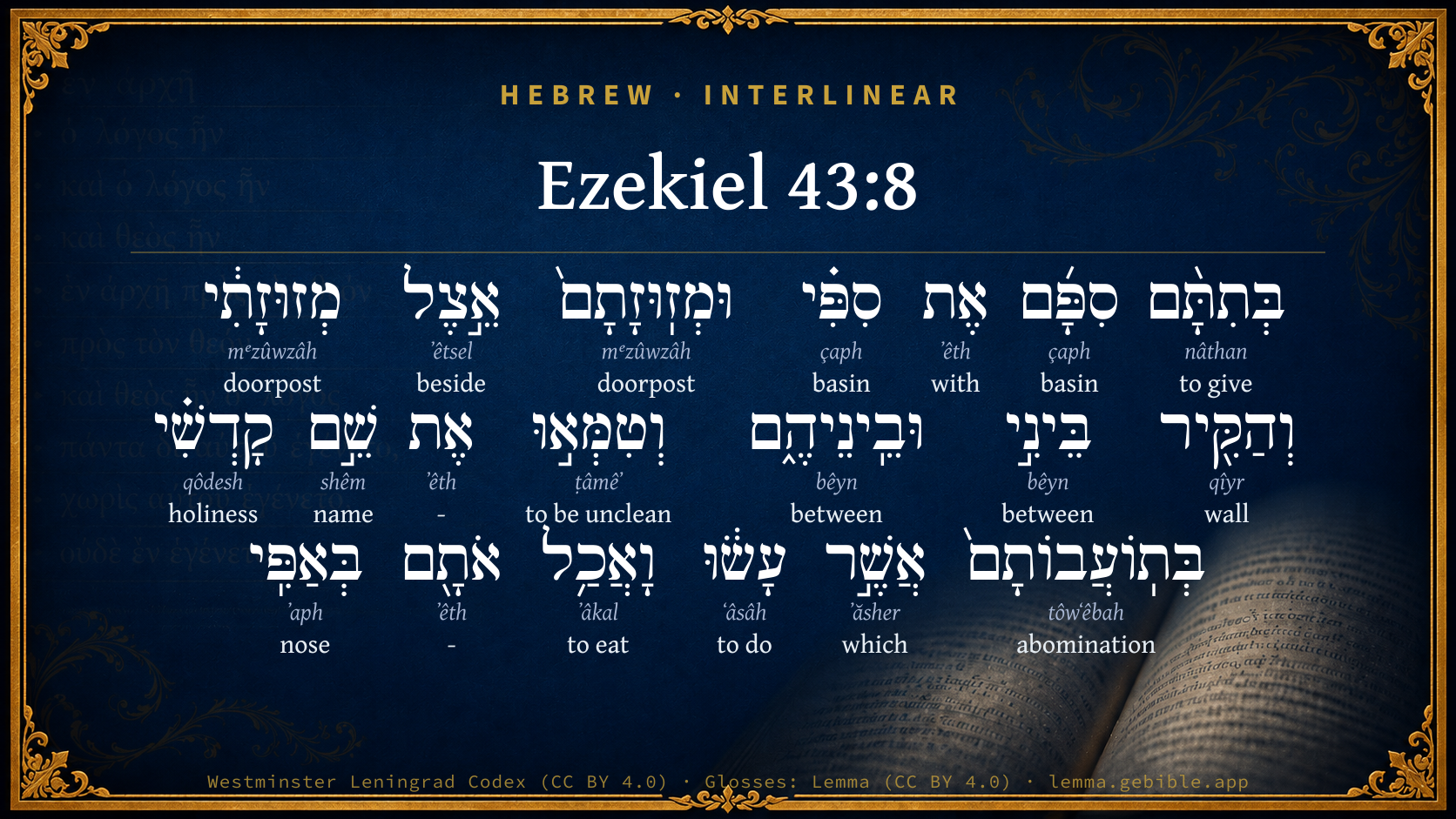
Hebrew (Westminster Leningrad Codex) Ezekiel 43:8 appears in the Hebrew Old Testament. The text above is from the Westminster Leningrad Codex. Each word links to its Strong’s number, a concise gloss, and parsing drawn from the Open Scriptures Hebrew Bible morphology. Click any word for its full Brown-Driver-Briggs (BDB) entry.
Download image
Cite this verse

Ezekiel 43:8 (World English Bible). Public Domain. Lemma interlinear Bible study tool, https://lemma.gebible.app/v/ezekiel/43/8.

Show BibTeX & RIS
BibTeX
RIS
English Translation
in their setting of their threshold by my threshold, and their door-post beside my door-post, and there was [but] the wall between me and them; and they have defiled my holy name by their abominations which they have committed: therefore I have consumed them in my anger.
World English Bible · Public Domain
Download a study sheet

One document with this verse’s original text, its word-by-word gloss line, the meaning frame, cross-references with their text, attributed commentary, and full source and license credits — printable, and it pastes into notes with its structure intact.

This verse Autodidact and up

Study sheet (.html) Plain text (.txt)

A passage Seminary Student

Up to 50 verses in one chapter. A passage sheet keeps up to 6 commentary sources and 12 cross-references per verse, in the order this page ranks them, and says so on the sheet whenever that leaves anything out. Ask for a single verse and you get the Autodidact verse sheet above.

Everything on this page stays free to read, with no account — the sheet is a download of what is already on screen, not access to it.

Want to remove ads? Support Godless Engineer
Compare translations 3

The same verse in 3 English versions, stacked beneath the original-language interlinear above. Click any original word for its lexicon entry.

Each is an independent rendering of the whole verse — the interlinear is not word-aligned to these translations.

Highlighted words mark where these versions differ — a whole-verse word diff, not a word-by-word alignment.

  • World English Bible Public Domain
    in their setting of their threshold by my threshold, and their door-post beside my door-post, and there was [but] the wall between me and them; and they have defiled my holy name by their abominations which they have committed: therefore I have consumed them in my anger.
  • King James Version Public Domain
    In their setting of their threshold by my thresholds, and their post by my posts, and the wall between me and them, they have even defiled my holy name by their abominations that they have committed: wherefore I have consumed them in mine anger.
  • unfoldingWord Literal Text CC BY-SA 4.0
    They will no longer profane my holy name by putting their threshold next to my threshold, and their gateposts next to my gateposts, with nothing but a wall between me and them. They profaned my holy name with their disgusting actions, so I consumed them with my anger.

unfoldingWord Literal Text — © unfoldingWord, licensed CC BY-SA 4.0. Word-aligned USFM3 via Door43 (git.door43.org/unfoldingWord/en_ult).

Versions to compare (up to 4)

3 of 4 selected

Show all 18 translations

Every available English version of this verse, each an independent rendering of the whole verse.

  • World English Bible Public Domain
    in their setting of their threshold by my threshold, and their door-post beside my door-post, and there was [but] the wall between me and them; and they have defiled my holy name by their abominations which they have committed: therefore I have consumed them in my anger.
  • Berean Standard Bible Public Domain
    When they placed their threshold next to My threshold and their doorposts beside My doorposts, with only a wall between Me and them, they defiled My holy name by the abominations they committed. Therefore I have consumed them in My anger.
  • Majority Standard Bible Public Domain
    When they placed their threshold next to My threshold and their doorposts beside My doorposts, with only a wall between Me and them, they defiled My holy name by the abominations they committed. Therefore I have consumed them in My anger.
  • King James Version Public Domain
    In their setting of their threshold by my thresholds, and their post by my posts, and the wall between me and them, they have even defiled my holy name by their abominations that they have committed: wherefore I have consumed them in mine anger.
  • American Standard Version (1901) Public Domain
    in their setting of their threshold by my threshold, and their door-post beside my door-post, and there was `but' the wall between me and them; and they have defiled my holy name by their abominations which they have committed: wherefore I have consumed them in mine anger.
  • Revised Version (1885) Public Domain
    in their setting of their threshold by my threshold, and their door post beside my door post, and there was but the wall between me and them; and they have defiled my holy name by their abominations which they have committed: wherefore I have consumed them in mine anger.
  • Geneva Bible (1599) Public Domain
    Albeit they set their thresholdes by my thresholdes, and their postes by my postes (for there was but a wall betweene me and them) yet haue they defiled mine holy Name with their abominations, that they haue committed: wherfore I haue consumed them in my wrath.
  • Douay-Rheims (1899) Public Domain
    They who have set their threshold by my threshold, and their posts by my posts: and there was but a wall between me and them: and they profaned my holy name by the abominations which they committed: for which reason I consumed them in my wrath.
  • Young's Literal Translation Public Domain
    In their putting their threshold with My threshold, And their door-post near My door-post, And the wall between Me and them, And they have defiled My holy name, By their abominations that they have done, And I consume them in Mine anger.
  • Literal Standard Version CC BY-SA 4.0
    In their putting their threshold with My threshold, || And their doorpost near My doorpost, || And the wall between Me and them, || And they have defiled My holy Name, || By their abominations that they have done, || And I consume them in My anger.
  • Unlocked Literal Bible CC BY-SA 4.0
    They will no longer profane my holy name by putting their threshold next to my threshold, and their gateposts next to my gateposts, with nothing but a wall between me and them. They profaned my holy name with their disgusting actions, so I consumed them with my anger.
  • unfoldingWord Literal Text CC BY-SA 4.0
    They will no longer profane my holy name by putting their threshold next to my threshold, and their gateposts next to my gateposts, with nothing but a wall between me and them. They profaned my holy name with their disgusting actions, so I consumed them with my anger.
  • Darby Bible Public Domain
    in that they set their threshold by my threshold, and their post by my post, and [there was only] a wall between me and them, and they defiled my holy name with their abominations which they committed; and I consumed them in mine anger.
  • World Messianic Bible Public Domain
    in their setting of their threshold by my threshold and their door post beside my door post. There was a wall between me and them; and they have defiled my holy name by their abominations which they have committed. Therefore I have consumed them in my anger.
  • Webster's Bible Public Domain
    In their setting of their threshhold by my threshholds, and their post by my posts, and the wall between me and them, they have even defiled my holy name by their abominations that they have committed: wherefore I have consumed them in my anger.
  • Free Bible Version CC BY-SA 4.0
    When they built their homes right next to mine—their threshold beside my threshold and their doorposts beside my doorposts, with only a wall separating us—they disgraced me and my holiness by the disgusting sins they committed. That's why I destroyed them in my anger.
  • Bible in Basic English Public Domain
    By putting their doorstep by my doorstep, and the pillar of their door by the pillar of my door, with only a wall between me and them; and they have made my holy name unclean by the disgusting things which they have done: so in my wrath I sent destruction on them.
  • JPS Tanakh (1917) Public Domain
    in their setting of their threshold by My threshold, and their door-post beside My door-post, and there was but the wall between Me and them; and they have defiled My holy name by their abominations which they have committed; wherefore I have consumed them in Mine anger.

Literal Standard Version (2020), Covenant Press — licensed CC BY-SA 4.0. Text via the HelloAO Bible API (eBible.org). Unlocked Literal Bible (unfoldingWord) — licensed CC BY-SA 4.0. Text via the HelloAO Bible API (eBible.org). unfoldingWord Literal Text — © unfoldingWord, licensed CC BY-SA 4.0. Word-aligned USFM3 via Door43 (git.door43.org/unfoldingWord/en_ult). Free Bible Version, Dr. Jonathan Gallagher — licensed CC BY-SA 4.0. Text via the HelloAO Bible API (eBible.org).

Word by word

More ways to search: Search by grammar → Find every occurrence → Compare this word →

Practice this passage: Drill this verse → Learn its vocabulary →

וּמְזֽוּזָתָם֙
mᵉzûwzâh
H4201
“and · doorpost · their”
Conjunction + Noun, Common, Feminine, Singular, Construct + Suffix, Personal, 3rd Person, Masculine, Plural
Part of Speech
Conjunction + Noun
Type
Common
Gender
Feminine
Number
Singular
State
Construct
Full BDB Definition

Origin: from the same as H2123

TWOT: 535b

doorpost, gatepost
  1. בְּתִתָּ֨ם nâthan H5414 “in/at · to give · them” Preposition + Verb, Qal, Infinitive Construct + Suffix, Personal, 3rd Person, Masculine, Plural
  2. סִפָּ֜ם çaph H5592 “basin · their” Noun, Common, Masculine, Singular, Construct + Suffix, Personal, 3rd Person, Masculine, Plural
  3. אֶת ʼêth H854 “with” Preposition
  4. סִפִּ֗י çaph H5592 “basin · my” Noun, Common, Masculine, Singular, Construct + Suffix, Personal, 1st Person, Common, Singular
  5. אֵ֣צֶל ʼêtsel H681 “beside” Preposition
  6. מְזוּזָתִ֔י mᵉzûwzâh H4201 “doorpost · my” Noun, Common, Feminine, Singular, Construct + Suffix, Personal, 1st Person, Common, Singular
  7. וְהַקִּ֖יר qîyr H7023 “and · the · wall” Conjunction + Particle, Definite Article + Noun, Common, Masculine, Singular, Absolute
  8. בֵּינִ֣י bêyn H996 “between · me” Preposition + Suffix, Personal, 1st Person, Common, Singular
  9. וּבֵֽינֵיהֶ֑ם bêyn H996 “and · between · them” Conjunction + Preposition + Suffix, Personal, 3rd Person, Masculine, Plural
  10. וְטִמְּא֣וּ ṭâmêʼ H2930 “and · to be unclean” Conjunction + Verb, Piel, Perfect, 3rd Person, Common, Plural
  11. אֶת ʼêth H853 “-” Particle, Direct Object
  12. שֵׁ֣ם shêm H8034 “name of” Noun, Common, Masculine, Singular, Construct
  13. קָדְשִׁ֗י qôdesh H6944 “holiness · my” Noun, Common, Masculine, Singular, Construct + Suffix, Personal, 1st Person, Common, Singular
  14. בְּתֽוֹעֲבוֹתָם֙ tôwʻêbah H8441 “in/at · abominations · their” Preposition + Noun, Common, Feminine, Plural, Construct + Suffix, Personal, 3rd Person, Masculine, Plural
  15. אֲשֶׁ֣ר ʼăsher H834 “which” Particle, Relative
  16. עָשׂ֔וּ ʻâsâh H6213 “to do” Verb, Qal, Perfect, 3rd Person, Common, Plural
  17. וָאֲכַ֥ל ʼâkal H398 “and · to eat” Conjunction + Verb, Piel, Sequential Imperfect, 1st Person, Common, Singular
  18. אֹתָ֖ם ʼêth H853 “- · them” Particle, Direct Object + Suffix, Personal, 3rd Person, Masculine, Plural
  19. בְּאַפִּֽי ʼaph H639 “in/at · nose · my” Preposition + Noun, Common, Masculine, Singular, Construct + Suffix, Personal, 1st Person, Common, Singular

About this verse

These counts appear in no published source. They are computed here, from the morphology-tagged text and Lemma’s own curated glosses. What Lemma adds →

20
words
16
distinct lemmas
Prophets
section

Notable vocabulary

The rarest word here is וּמְזֽוּזָתָם֙ doorpost H4201 — appearing just 19 times in the whole Hebrew Bible.

Shared distinctive vocabulary

וּמְזֽוּזָתָם֙ doorpost H4201 occurs in 17 verses of the Hebrew Bible. Also found in:

Grammatical profile

  • 4 verbs
  • 9 nouns
  • 4 prepositions
  • 3 particles

Verb forms

  • בְּתִתָּ֨ם Qal · Infinitive Construct
  • וְטִמְּא֣וּ Piel · Perfect
  • עָשׂ֔וּ Qal · Perfect
  • וָאֲכַ֥ל Piel · Sequential Imperfect

Repetition

Words recur within this verse — often emphatic in Hebrew:

  • סִפָּ֜ם basin H5592 ×2
  • וּמְזֽוּזָתָם֙ doorpost H4201 ×2
  • בֵּינִ֣י between H996 ×2

Hebrew & Septuagint length

In English translation the verse runs 47 words from the Hebrew and 49 from the Septuagint (LXX English) — closely comparable.

A rough comparison of the two English renderings, which tokenize alike — not a word-level alignment.

Word counts can differ between the Hebrew and the Greek without any difference in meaning — e.g. the Hebrew direct-object marker אֵת has no separate Greek word, and Greek often adds the article ὁ.

Cross-references

9

Topical passages linked to Ezekiel 43:8 in the Treasury of Scripture Knowledge — connected by theme and wording, ordered by reader-vote popularity; previews shown in the World English Bible.

  • Ezekiel 5:11 Therefore, as I live, says the Lord Yahweh, surely, because you have defiled my sanctuary with all your detestable things, and with all your abominations, therefore will I also diminish [you]; neither shall my eye spare, and I also will have no pity.
  • 2 Chronicles 33:4 He built altars in the house of Yahweh, of which Yahweh said, In Jerusalem shall my name be forever.
  • 2 Chronicles 33:7 He set the engraved image of the idol, which he had made, in the house of God, of which God said to David and to Solomon his son, In this house, and in Jerusalem, which I have chosen out of all the tribes of Israel, will I put my name forever:
  • Ezekiel 8:3–16 He put forth the form of a hand, and took me by a lock of my head; and the Spirit lifted me up between earth and the sky, and brought me in the visions of God to Jerusalem, to the door of the gate of the inner [court] that looks toward the north; where was the seat of the image of jealousy, which provokes to jealousy.
  • Ezekiel 23:39 For when they had slain their children to their idols, then they came the same day into my sanctuary to profane it; and, behold, thus have they done in the midst of my house.
  • Ezekiel 44:7 in that you have brought in foreigners, uncircumcised in heart and uncircumcised in flesh, to be in my sanctuary, to profane it, even my house, when you offer my bread, the fat and the blood, and they have broken my covenant, [to add] to all your abominations.
  • 2 Kings 21:4–7 He built altars in the house of Yahweh, of which Yahweh said, In Jerusalem will I put my name.
  • 2 Kings 16:14–15 The brazen altar, which was before Yahweh, he brought from the forefront of the house, from between his altar and the house of Yahweh, and put it on the north side of his altar.
  • 2 Kings 23:11–12 He took away the horses that the kings of Judah had given to the sun, at the entrance of the house of Yahweh, by the chamber of Nathan-melech the chamberlain, which was in the precincts; and he burned the chariots of the sun with fire.

Cross-references courtesy of OpenBible.info (CC BY 4.0).

Hebrew and Greek witnesses Masoretic Hebrew ↔ Greek Septuagint

The same verse in the two great witnesses to the Old Testament, shown verse-for-verse.

These are two independent witnesses, not word-aligned to each other, and the Septuagint is shown in lemma (dictionary) form.

Hebrew Ezekiel 43:8 Masoretic · Westminster Leningrad Codex

בְּתִתָּ֨ם סִפָּ֜ם אֶת סִפִּ֗י וּמְזֽוּזָתָם֙ אֵ֣צֶל מְזוּזָתִ֔י וְהַקִּ֖יר בֵּינִ֣י וּבֵֽינֵיהֶ֑ם וְטִמְּא֣וּ אֶת שֵׁ֣ם קָדְשִׁ֗י בְּתֽוֹעֲבוֹתָם֙ אֲשֶׁ֣ר עָשׂ֔וּ וָאֲכַ֥ל אֹתָ֖ם בְּאַפִּֽי

in their setting of their threshold by my threshold, and their door-post beside my door-post, and there was [but] the wall between me and them; and they have defiled my holy name by their abominations which they have committed: therefore I have consumed them in my anger.

World English Bible · Public Domain

Greek LXX Ezekiel 43:8 Septuagint · lemma form

ἐν ὁ τίθημι αὐτός ὁ πρόθυρον ἐγώ ἐν ὁ πρόθυρον αὐτός καί ὁ φλιά ἐγώ ἔχω ὁ φλιά αὐτός καί δίδωμι ὁ τοῖχος ἐγώ ὡς συνἔχω ἐγώ καί αὐτός καί βεβηλόω ὁ ὄνομα ὁ ἅγιος ἐγώ ἐν ὁ ἀνομία αὐτός ὅς ποιέω καί ἐκτρίβω αὐτός ἐν θυμός ἐγώ καί ἐν φόνος

when they set my door-way by their door-way, and my thresholds near to their thresholds: and they made my wall as it were joining myself and them, and they profaned my holy name with their iniquities which they wrought: and I destroyed them in my wrath and with slaughter.

LXX2012 (modern English Septuagint) · Public Domain

Hebrew: Westminster Leningrad Codex (CC BY 4.0). Greek: Septuagint (public domain); English from LXX2012 (modern English Septuagint) (Public Domain). How the Septuagint differs from the Hebrew →

Targum (Aramaic paraphrase)

1

The Targum is the ancient Jewish Aramaic paraphrase of the Hebrew Scriptures — an interpretive translation, not the Hebrew text itself. Onkelos (literal) and Pseudo-Jonathan (expansive) render the Torah, and Jonathan the Prophets. Coverage is partial: where no permissively-licensed English translation exists for a verse, only the Aramaic is shown. This is verse-level text, not a word-by-word alignment to the Hebrew.

  1. Targum Jonathan Prophets (Joshua–Malachi)
    בְּמִתַּנְהוֹן סִפֵּיהוֹן לָקֳבֵיל סִפֵי בֵית מַקְדְשִׁי וּבִנְיָנֵיהוֹן בִּסְטַר עֲזָרָתִי וְכוֹתֶל בֵּית מַקְדָשִׁי בֵּין מֵימְרִי וּבֵינֵיהוֹן וּסְאִיבוּ יַת שְׁמָא דְקוּדְשִׁי בְּתוֹעֲבַתְהוֹן דַעֲבָדוּ וְשֵׁיצֵתִי יַתְהוֹן בְּרוּגְזִי:

    (no public-domain English translation for this verse)

    Targum Jonathan — Aramaic: “Mikraot Gedolot” (public domain). English: “Sefaria Community Translation” (CC0 1.0 (public-domain dedication)); “London "Chaldee Paraphrase," 1871” (public domain). Text via Sefaria.

Commentary

Notes on Ezekiel 43:8 from classic Christian and Jewish commentators (each source and its license shown beneath its notes). The classic Christian expositions comment on the surrounding passage and are grouped to its opening verse, so a note may address several verses; the Jewish commentaries on the Tanakh (Rashi and others) are per-verse, so they appear only where the commentator wrote on this verse.

Lemma curates 59 commentaries, every one of them public domain or Creative Commons licensed, each selected and text-cleaned for this edition rather than reprinted as found. About our sources →

Trapp's Complete Commentary

John Trapp

Eze 43:8 In their setting of their threshold by my thresholds, and their post by my posts, and the wall between me and them, they have even defiled my holy name by their abominations that they have committed: wherefore I have consumed them in mine anger.

Ver. 8. In their setting of their threshold by my thresholds.] By broaching falsehoods for truth, and setting human devices in competition with the good Word of God. That detestable decree of the Council of Trent is well known, whereby the Apocrypha is set cheek by jowl, as they say, with the holy canon; the Vulgate translation with the original; traditions with Scriptures, and unwritten verities with those that are written. This is intolerable presumption. Jews and Turks do the like in their Talmud and Koran; that I speak not of our sect masters, who boldly obtrude their placits without just reproof, and require to be believed.

And the wall between me and them.] Which they have wretchedly set up by their sins, to their singular disadvantage; {Isa 59:2} or, They have come under my nose, as it were, to provoke me; or, The nearer they were to Church, the farther from God.

John Trapp, A Commentary or Exposition upon All the Books of the Old and New Testament (1647–1656) — public domain. Text from a community e-Sword module.

Adam Clarke's Commentary

Verse 8. In their setting of their threshold] They had even gone so far as to set up their idol altars by those of Jehovah; so that their abominable idols were found in the very house of God! therefore, "he consumed them in his anger."

Adam Clarke's Commentary on the Bible (1810–1826) — public domain. Text from a community e-Sword/MySword module.

Ellicott's Commentary for English Readers

(8) And the wall between.—The sense is given in the margin: there was only a wall between me and them.

A Bible Commentary for English Readers, edited by Charles John Ellicott (1878–1897) — public domain. Text from a community e-Sword module.

The Cambridge Bible for Schools and Colleges

gen. ed. J. J. S. Perowne

8. Ref. is to the fact that the royal palace and the first temple stood virtually within the same enclosure and were one ensemble of edifice. See the sketch in W. R. Smith’s Art. Temple, Encyc. Brit.

and the wall between] with but the wall between me and them; and they defiled.…

The Cambridge Bible for Schools and Colleges (gen. ed. J. J. S. Perowne; Cambridge University Press, 1878–1918) — public domain. Text from a community e-Sword module.

John Gill's Exposition

In their setting of their threshold by my threshold,.... The threshold is the way of entrance into the house; when men open any other way of entrance into the house of God than he has directed, it is setting up their threshold by his: the Gospel way of entrance into the church of Christ is Christ himself, and faith in him, and a profession of it, and submission to the ordinance of baptism, Joh 10:1, Act 2:41 but when men make carnal descent, religious education, mere morality and civility, the way of entrance into church communion; this is opposite to God's way, and is resented by him; this shall not be hereafter:

and their post by my post; which is done when the ordinances of men are substituted in the room of the ordinances of God, or set upon a level with them; when the ordinances of God are changed and altered, or that brought into his worship which he has not commanded; and the commandments of men are taught for the doctrines of God: so the Pharisees set up the traditions of the elders as equal to the written word, and, made it of no effect by them; as the Papists do, by setting up their traditions, under the name of the traditions of the apostles, and of the church, upon a level with the Scriptures; and the same is done when men set up their own doctrines, concerning the Persons in the Godhead, concerning the power and purity of human nature, and the way of redemption; and oppose their own works to the grace of God, in justification, pardon, and salvation; the allusion is to the setting up of altars and idols in the house of the Lord, by his altar, Kg2 21:4,

and the wall between me and them; that these sins and abominable practices were a wall of separation between God and them, and caused him to hide himself from them, withdraw his presence, and deny them communion with him, Isa 49:2, some render it, "for" or "so that there was but a wall between me and them" (s); so near were their thresholds, posts, and altars, to his:

they have even defiled my holy name by their abominations that they have committed: by their false doctrines, idolatrous worship, and immoral lives; such abominations as before mentioned:

wherefore I have consumed them in mine anger; as the Jews are now, and all the antichristian states will be.

(s) "ita ut paries tantum esset inter me et illos", Piscator.

John Gill's Exposition of the Whole Bible (1746–1763) — public domain (CC PDM 1.0). Text via the HelloAO Bible API.

Haydock's Catholic Bible Commentary

Wall. The kings of Juda had a door communicating with the temple, by which they entered on the west. It was guarded by Levites, 1 Paralipomenon xxvi. 16. Ezechiel places no door on that side. Yet in Herod’s temple we find one leading to the adjacent palace, and three others into the town. (Josephus, Antiquities xv. 14.)

George Leo Haydock (1774–1849), Haydock's Catholic Family Bible and Commentary, 1859 edition — public domain. Excludes Psalms (Douay-Rheims chapter numbering differs from Protestant) and Deuterocanonical books (Catholic canon only).

Matthew Poole's English Annotations

The idolatrous kings of Judah and Israel built, temples and altars for their idols, and these are called their thresholds. The Jews, or people of Judah, and their kings, erected these in the courts, or near the courts., of the temple, and so ill local nearness their threshold was by God’s thresholds, and their posts by his, that they were a nuisance to him. And there was but a wall between me and them, that under my eye, and within my hearing, they have with greatest presumption defiled my name.

Defiled my holy name; despised my ordinances, corrupted my worship, or forsaken it, used me as if I were neither great nor holy.

Abominations; abominable idolatries, and wickednesses not to be named.

Committed; acted boldly and openly, against precept, threat, and admonitions.

Wherefore I have consumed them; for which sins I brought destruction upon them. The Chaldeans ruined them, but they were the rod of God’s anger.

In mine anger; in great displeasure and wrath, i.e. in my provoked justice, as Eze 20:13; 22:31.

Matthew Poole's English Annotations on the Holy Bible (1683–1685) — public domain. Text from a community e-Sword/MySword module.

The Pulpit Commentary

In their setting of their threshold by my thresholds etc. The first "their" can only refer to "the house of Israel and their kings;" the second "their" may also allude to these, but is best taken as pointing to the "idols," whose thresholds or temples, according to the view adopted of the preceding verse, were set up in the court of Jehovah"s temple, and so close to the latter that nothing stood between them except the temple wall Smend, who favors the second view of the preceding verse, considers this verse as a complaint against the kings for having erected their royal residence on Mount Zion, in the immediate vicinity of the temple; but as David"s palace was older than the temple, it is not likely Ezekiel was guilty of perverting history in the manner this hypothesis would imply.

The Pulpit Commentary (1880–1919), ed. H.D.M. Spence-Jones & Joseph S. Exell — public domain. Text from a community e-Sword module.

John Wesley's Explanatory Notes

Their threshold - The kings of Judah and Israel, built temples and altars for their idols, and these are called their thresholds. They erected these in the courts, or near the courts of the temple. Abominations - Idolatries, and wickednesses not to be named.

John Wesley, Explanatory Notes Upon the Whole Bible (1754–1765) — public domain. Text via the GEBible commentary corpus.

Rashi

Rabbi Shlomo Yitzchaki (Rashi)

and I destroyed [Heb. וָאַכַל,] like וָאֲכַלֶה, [equivalent to] וְכִלִיתִי, and I destroyed.

Rashi on the Tanakh — English translations: “The Judaica Press complete Tanach with Rashi, translated by A. J. Rosenberg” (CC BY 4.0); “Pentateuch with Rashi's commentary by M. Rosenbaum and A.M. Silbermann, 1929-1934” (public domain); “The Metsudah Tanach series, Lakewood, N.J” (CC BY 4.0); and “The Book of Joshua, Metsudah Publications, 1997” (CC BY 4.0). Text via Sefaria.

Lesson kit

Teaching starters — assembled from the data on this page, not authored interpretation. Every prompt links to the verse data it draws on. Edit before teaching.

Ezekiel, in the Prophets, opens this verse with 20 words (16 distinct Hebrew lemmas). Its most distinctive word is mᵉzûwzâh (“doorpost”). A historical commentator’s framing appears above. Read the whole chapter for the surrounding context.

Discussion questions

  1. The word mᵉzûwzâh carries the sense “doorpost.” How does it shape the verse?
  2. Exodus 12:7 shares the word «doorpost» with this verse. How do the two illuminate each other?
  3. “basin” occurs 2× in this one verse. What is the effect of the repetition?
  4. These translations render this verse differently. What is at stake in choosing one wording over another?
  5. The verb «בְּתִתָּ֨ם» is Qal Infinitive Construct. How does its form color the action?
  6. Reading how Trapp's Complete Commentary and Adam Clarke's Commentary read this verse, where do the two commentators agree and where do they part?

Things to notice

Reading settings

Reading text

Shown beneath each verse's original-language words.

Old Testament
Old Testament edition

Read the OT as the Masoretic Hebrew (MT) or the Greek Septuagint (LXX).

English shown for the Greek Septuagint (in the Hebrew ↔ Greek comparison).

Comparing translations? Open the Compare panel on any verse page to stack up to four side by side.