Leviticus 16:23

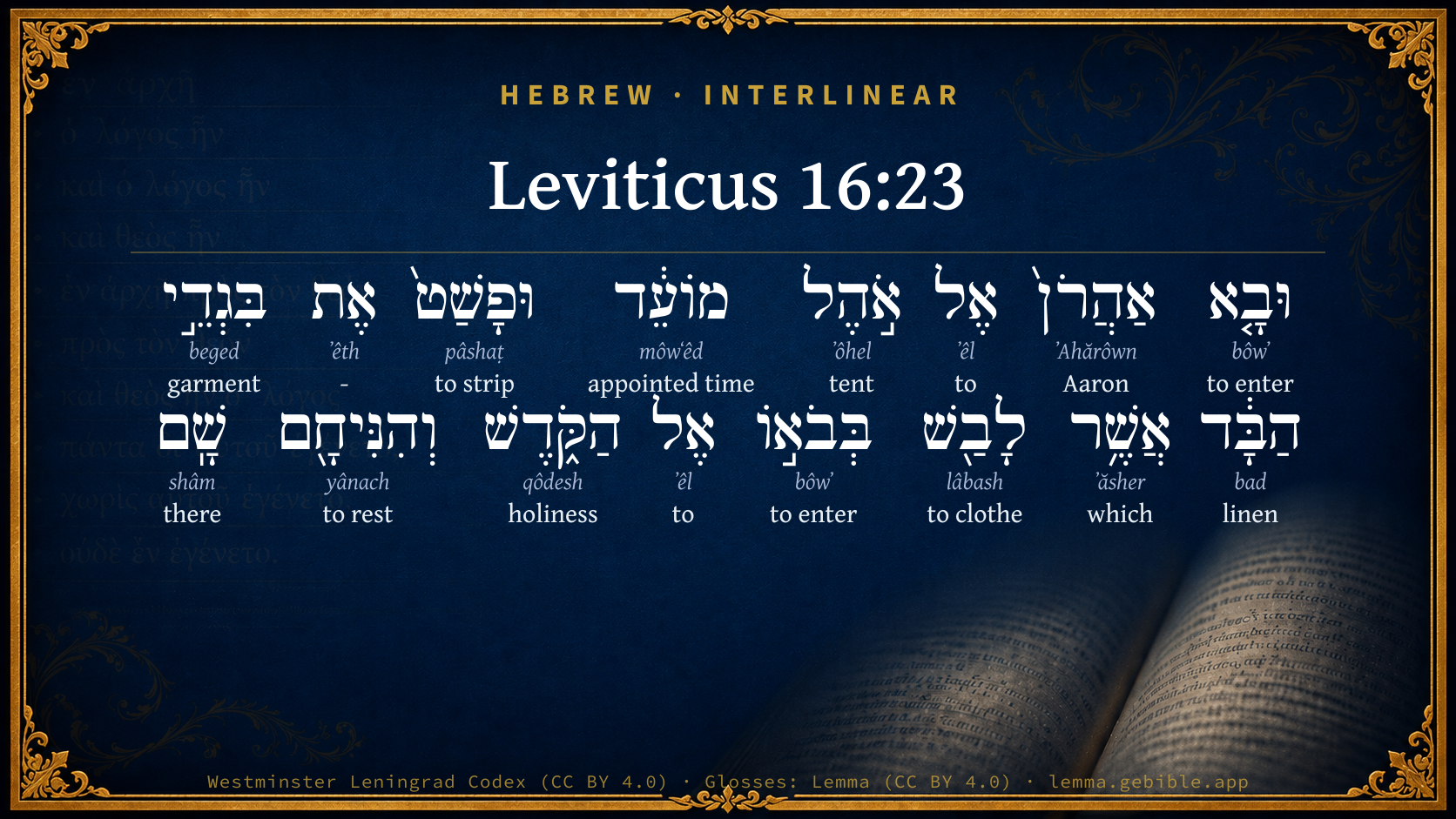
Hebrew (Westminster Leningrad Codex) Leviticus 16:23 appears in the Hebrew Old Testament. The text above is from the Westminster Leningrad Codex. Each word links to its Strong’s number, a concise gloss, and parsing drawn from the Open Scriptures Hebrew Bible morphology. Click any word for its full Brown-Driver-Briggs (BDB) entry.
Download image
Cite this verse

Leviticus 16:23 (World English Bible). Public Domain. Lemma interlinear Bible study tool, https://lemma.gebible.app/v/leviticus/16/23.

Show BibTeX & RIS
BibTeX
RIS
English Translation
"Aaron shall come into the Tent of Meeting, and shall take off the linen garments, which he put on when he went into the Holy Place, and shall leave them there.
World English Bible · Public Domain
Download a study sheet

One document with this verse’s original text, its word-by-word gloss line, the meaning frame, cross-references with their text, attributed commentary, and full source and license credits — printable, and it pastes into notes with its structure intact.

This verse Autodidact and up

Study sheet (.html) Plain text (.txt)

A passage Seminary Student

Up to 50 verses in one chapter. A passage sheet keeps up to 6 commentary sources and 12 cross-references per verse, in the order this page ranks them, and says so on the sheet whenever that leaves anything out. Ask for a single verse and you get the Autodidact verse sheet above.

Everything on this page stays free to read, with no account — the sheet is a download of what is already on screen, not access to it.

Want to remove ads? Support Godless Engineer
Compare translations 3

The same verse in 3 English versions, stacked beneath the original-language interlinear above. Click any original word for its lexicon entry.

Each is an independent rendering of the whole verse — the interlinear is not word-aligned to these translations.

Highlighted words mark where these versions differ — a whole-verse word diff, not a word-by-word alignment.

  • World English Bible Public Domain
    "Aaron shall come into the Tent of Meeting, and shall take off the linen garments, which he put on when he went into the Holy Place, and shall leave them there.
  • King James Version Public Domain
    And Aaron shall come into the tabernacle of the congregation, and shall put off the linen garments, which he put on when he went into the holy place, and shall leave them there:
  • unfoldingWord Literal Text CC BY-SA 4.0
    And Aaron shall enter into the tent of meeting, and he shall remove the linen clothing that he wore when he entered into the Holy Place. And he shall place them there.

unfoldingWord Literal Text — © unfoldingWord, licensed CC BY-SA 4.0. Word-aligned USFM3 via Door43 (git.door43.org/unfoldingWord/en_ult).

Versions to compare (up to 4)

3 of 4 selected

Show all 18 translations

Every available English version of this verse, each an independent rendering of the whole verse.

  • World English Bible Public Domain
    "Aaron shall come into the Tent of Meeting, and shall take off the linen garments, which he put on when he went into the Holy Place, and shall leave them there.
  • Berean Standard Bible Public Domain
    Then Aaron is to enter the Tent of Meeting, take off the linen garments he put on before entering the Most Holy Place, and leave them there.
  • Majority Standard Bible Public Domain
    Then Aaron is to enter the Tent of Meeting, take off the linen garments he put on before entering the Most Holy Place, and leave them there.
  • King James Version Public Domain
    And Aaron shall come into the tabernacle of the congregation, and shall put off the linen garments, which he put on when he went into the holy place, and shall leave them there:
  • American Standard Version (1901) Public Domain
    And Aaron shall come into the tent of meeting, and shall put off the linen garments, which he put on when he went into the holy place, and shall leave them there:
  • Revised Version (1885) Public Domain
    And Aaron shall come into the tent of meeting, and shall put off the linen garments, which he put on when he went into the holy place, and shall leave them there:
  • Geneva Bible (1599) Public Domain
    After, Aaron shall come into the Tabernacle of the Congregation, and put off the linnen clothes, which he put on when he went into the Holy place, and leaue them there.
  • Douay-Rheims (1899) Public Domain
    Aaron shall return into the tabernacle of the testimony, and putting off the vestments, which he had on him before when he entered into the sanctuary, and leaving them there,
  • Young's Literal Translation Public Domain
    and Aaron hath come in unto the tent of meeting, and hath stripped off the linen garments which he had put on in his going in unto the sanctuary, and hath placed them there;
  • Literal Standard Version CC BY-SA 4.0
    and Aaron has come into the Tent of Meeting, and has stripped off the linen garments which he had put on in his going into the holy place, and has placed them there;
  • Unlocked Literal Bible CC BY-SA 4.0
    Then Aaron must go back into the tent of meeting and take off the linen garments that he had put on before going into the most holy place, and he must leave those garments there.
  • unfoldingWord Literal Text CC BY-SA 4.0
    And Aaron shall enter into the tent of meeting, and he shall remove the linen clothing that he wore when he entered into the Holy Place. And he shall place them there.
  • Darby Bible Public Domain
    And Aaron shall go into the tent of meeting, and shall put off the linen garments, which he put on when he went into the sanctuary, and shall leave them there;
  • World Messianic Bible Public Domain
    “Aaron shall come into the Tent of Meeting, and shall take off the linen garments which he put on when he went into the Holy Place, and shall leave them there.
  • Webster's Bible Public Domain
    And Aaron shall come into the tabernacle of the congregation, and shall put off the linen garments which he put on when he went into the holy place, and shall leave them there:
  • Free Bible Version CC BY-SA 4.0
    Aaron is to return to the Tent of Meeting, take off the linen clothes he put on before he went into the Most Holy Place, and leave them there.
  • Bible in Basic English Public Domain
    Then let Aaron come into the Tent of meeting and take off the linen clothing which he put on when he went into the holy place, and put them down there;
  • JPS Tanakh (1917) Public Domain
    And Aaron shall come into the tent of meeting, and shall put off the linen garments, which he put on when he went into the holy place, and shall leave them there.

Literal Standard Version (2020), Covenant Press — licensed CC BY-SA 4.0. Text via the HelloAO Bible API (eBible.org). Unlocked Literal Bible (unfoldingWord) — licensed CC BY-SA 4.0. Text via the HelloAO Bible API (eBible.org). unfoldingWord Literal Text — © unfoldingWord, licensed CC BY-SA 4.0. Word-aligned USFM3 via Door43 (git.door43.org/unfoldingWord/en_ult). Free Bible Version, Dr. Jonathan Gallagher — licensed CC BY-SA 4.0. Text via the HelloAO Bible API (eBible.org).

Word by word

More ways to search: Search by grammar → Find every occurrence → Compare this word →

Practice this passage: Drill this verse → Learn its vocabulary →

הַבָּ֔ד
bad
H906
“the · linen”
Particle, Definite Article + Noun, Common, Masculine, Singular, Absolute
Part of Speech
Particle + Noun
Type
Common
Gender
Masculine
Number
Singular
State
Absolute
Full BDB Definition

Origin: perhaps from H909 (in the sense of divided fibres)

TWOT: 199

linen, white linen
  1. וּבָ֤א bôwʼ H935 “and · to enter” Conjunction + Verb, Qal, Sequential Perfect, 3rd Person, Masculine, Singular
  2. אַהֲרֹן֙ ʼAhărôwn H175 “Aaron” Noun, Proper
  3. אֶל ʼêl H413 “to” Preposition
  4. אֹ֣הֶל ʼôhel H168 “tent of” Noun, Common, Masculine, Singular, Construct
  5. מוֹעֵ֔ד môwʻêd H4150 “appointed time” Noun, Common, Masculine, Singular, Absolute
  6. וּפָשַׁט֙ pâshaṭ H6584 “and · to strip” Conjunction + Verb, Qal, Sequential Perfect, 3rd Person, Masculine, Singular
  7. אֶת ʼêth H853 “-” Particle, Direct Object
  8. בִּגְדֵ֣י beged H899 “garments of” Noun, Common, Masculine, Plural, Construct
  9. אֲשֶׁ֥ר ʼăsher H834 “which” Particle, Relative
  10. לָבַ֖שׁ lâbash H3847 “to clothe” Verb, Qal, Perfect, 3rd Person, Masculine, Singular
  11. בְּבֹא֣וֹ bôwʼ H935 “in/at · to enter · him” Preposition + Verb, Qal, Infinitive Construct + Suffix, Personal, 3rd Person, Masculine, Singular
  12. אֶל ʼêl H413 “to” Preposition
  13. הַקֹּ֑דֶשׁ qôdesh H6944 “the · holiness” Particle, Definite Article + Noun, Common, Masculine, Singular, Absolute
  14. וְהִנִּיחָ֖ם yânach H3240 “and · to rest · them” Conjunction + Verb, Hiphil, Sequential Perfect, 3rd Person, Masculine, Singular + Suffix, Personal, 3rd Person, Masculine, Plural
  15. שָֽׁם shâm H8033 “there” Adverb

About this verse

These counts appear in no published source. They are computed here, from the morphology-tagged text and Lemma’s own curated glosses. What Lemma adds →

16
words
14
distinct lemmas
Pentateuch
section

Notable vocabulary

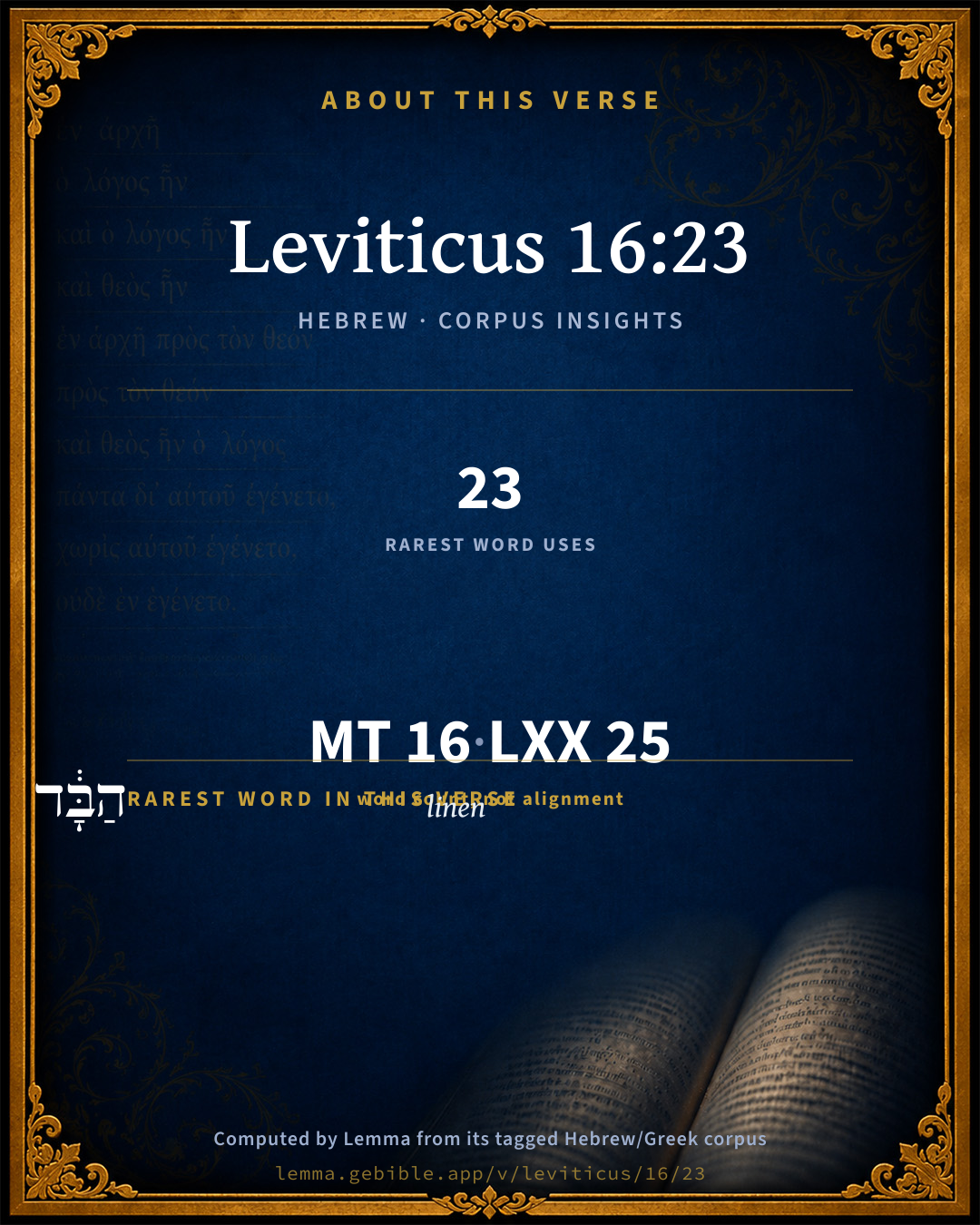
The rarest word here is הַבָּ֔ד linen H906 — appearing just 23 times in the whole Hebrew Bible.

Shared distinctive vocabulary

הַבָּ֔ד linen H906 occurs in 19 verses of the Hebrew Bible. Also found in:

Grammatical profile

  • 5 verbs
  • 6 nouns
  • 2 prepositions
  • 1 adverb
  • 2 particles

Verb forms

  • וּבָ֤א Qal · Sequential Perfect
  • וּפָשַׁט֙ Qal · Sequential Perfect
  • לָבַ֖שׁ Qal · Perfect
  • בְּבֹא֣וֹ Qal · Infinitive Construct
  • וְהִנִּיחָ֖ם Hiphil · Sequential Perfect

Repetition

Words recur within this verse — often emphatic in Hebrew:

  • וּבָ֤א to enter H935 ×2
  • אֶל to H413 ×2

Hebrew & Septuagint length

In English translation the verse runs 31 words from the Hebrew and 34 from the Septuagint (LXX English) — closely comparable.

A rough comparison of the two English renderings, which tokenize alike — not a word-level alignment.

Word counts can differ between the Hebrew and the Greek without any difference in meaning — e.g. the Hebrew direct-object marker אֵת has no separate Greek word, and Greek often adds the article ὁ.

In the original languages it is 16 Hebrew tokens and 25 Greek tokens — but the two are counted differently (Hebrew bundles its prefixes and suffixes into one token; the Greek is in lemma form), so that isn’t a like-for-like length.

Cross-references

6

Topical passages linked to Leviticus 16:23 in the Treasury of Scripture Knowledge — connected by theme and wording, ordered by reader-vote popularity; previews shown in the World English Bible.

  • Ezekiel 44:19 When they go forth into the outer court, even into the outer court to the people, they shall put off their garments in which they minister, and lay them in the holy chambers; and they shall put on other garments, that they not sanctify the people with their garments.
  • Ezekiel 42:14 When the priests enter in, then shall they not go out of the holy place into the outer court, but there they shall lay their garments in which they minister; for they are holy: and they shall put on other garments, and shall approach to that which pertains to the people.
  • Leviticus 16:4 He shall put on the holy linen coat, and he shall have the linen breeches on his body, and shall put on the linen sash, and he shall be dressed with the linen turban. They are the holy garments. He shall bathe his body in water, and put them on.
  • Romans 8:3 For what the law couldn't do, in that it was weak through the flesh, God did, sending his own Son in the likeness of sinful flesh and for sin, he condemned sin in the flesh;
  • Philippians 2:6–11 who, existing in the form of God, didn't consider it robbery to be equal with God,
  • Hebrews 9:28 so Christ also, having been once offered to bear the sins of many, will appear a second time, without sin, to those who are eagerly waiting for him for salvation.

Cross-references courtesy of OpenBible.info (CC BY 4.0).

Hebrew and Greek witnesses Masoretic Hebrew ↔ Greek Septuagint

The same verse in the two great witnesses to the Old Testament, shown verse-for-verse.

These are two independent witnesses, not word-aligned to each other, and the Septuagint is shown in lemma (dictionary) form.

Hebrew Leviticus 16:23 Masoretic · Westminster Leningrad Codex

וּבָ֤א אַהֲרֹן֙ אֶל אֹ֣הֶל מוֹעֵ֔ד וּפָשַׁט֙ אֶת בִּגְדֵ֣י הַבָּ֔ד אֲשֶׁ֥ר לָבַ֖שׁ בְּבֹא֣וֹ אֶל הַקֹּ֑דֶשׁ וְהִנִּיחָ֖ם שָֽׁם

"Aaron shall come into the Tent of Meeting, and shall take off the linen garments, which he put on when he went into the Holy Place, and shall leave them there.

World English Bible · Public Domain

Greek LXX Leviticus 16:23 Septuagint · lemma form

καί εἰςἔρχομαι ἀαρών εἰς ὁ σκηνή ὁ μαρτύριον καί ἐκδύω ὁ στολή ὁ λινοῦς ὅς ἐνδύω εἰςπορεύομαι αὐτός εἰς ὁ ἅγιος καί ἀποτίθημι αὐτός ἐκεῖ

And Aaron shall enter into the tabernacle of witness, and shall put off the linen garment, which he had put on, as he entered into the holy place, and shall lay it by there.

LXX2012 (modern English Septuagint) · Public Domain

Hebrew: Westminster Leningrad Codex (CC BY 4.0). Greek: Septuagint (public domain); English from LXX2012 (modern English Septuagint) (Public Domain). How the Septuagint differs from the Hebrew →

Targum (Aramaic paraphrase)

2

The Targum is the ancient Jewish Aramaic paraphrase of the Hebrew Scriptures — an interpretive translation, not the Hebrew text itself. Onkelos (literal) and Pseudo-Jonathan (expansive) render the Torah, and Jonathan the Prophets. Coverage is partial: where no permissively-licensed English translation exists for a verse, only the Aramaic is shown. This is verse-level text, not a word-by-word alignment to the Hebrew.

  1. Targum Onkelos Torah (Genesis–Deuteronomy)
    וְיֵיעוֹל אַהֲרֹן לְמַשְׁכַּן זִמְנָא וְיַשְׁלַח יָת לְבוּשֵׁי בוּצָא דִי לְבַשׁ בְּמֵעֲלֵהּ לְקוּדְשָׁא וְיַצְנִעוּן תַּמָן

    (no public-domain English translation for this verse)

    Targum Onkelos — Aramaic: “Onkelos Genesis” (public domain); “Onkelos Exodus” (public domain); “Onkelos Leviticus” (public domain); “Onkelos Numbers” (public domain); “Onkelos Deuteronomy” (public domain). English: “Sefaria Community Translation” (CC0 1.0 (public-domain dedication)); “J.W. Etheridge. The Targums of Onkelos and Jonathan Ben Uzziel on the Pentateuch. London: Longmans, Green, 1862” (public domain). Text via Sefaria.

  2. Targum Pseudo-Jonathan Torah (Genesis–Deuteronomy)
    וְיֵיעוֹל אַהֲרן וּבְנוֹי לְמַשְׁכַּן זִימְנָא וִישַׁלַח יַת לְבוּשֵׁי בוּצָא דְמִילַת דִלְבַשׁ בִּזְמַן מֵיעֲלֵיהּ לְקוּדְשָׁא וְיַצְנֵיעִינוּן תַּמָן

    And Aharon shall enter the tabernacle of ordinance, and take off the robes of fine linen with which he was attired at the time of his going into the holy place, and shall lay them aside there.

    Targum Pseudo-Jonathan — Aramaic: “Targum Jonathan on Genesis” (public domain); “Targum Jonathan on Exodus” (public domain); “Targum Jonathan on Leviticus” (public domain); “Targum Jonathan on Numbers” (public domain); “Targum Jonathan on Deuteronomy” (public domain). English: “The Targum of Jonathan ben Uzziel, trans. J. W. Etheridge, London, 1862” (public domain). Text via Sefaria.

Commentary

Notes on Leviticus 16:23 from classic Christian and Jewish commentators (each source and its license shown beneath its notes). The classic Christian expositions comment on the surrounding passage and are grouped to its opening verse, so a note may address several verses; the Jewish commentaries on the Tanakh (Rashi and others) are per-verse, so they appear only where the commentator wrote on this verse.

Lemma curates 59 commentaries, every one of them public domain or Creative Commons licensed, each selected and text-cleaned for this edition rather than reprinted as found. About our sources →

Trapp's Complete Commentary

John Trapp

Lev 16:23 And Aaron shall come into the tabernacle of the congregation, and shall put off the linen garments, which he put on when he went into the holy [place], and shall leave them there:

Ver. 23. Shall leave them there.] As afterwards the priests did, in some of the holy chambers about the sanctuary. {Eze 44:16}

John Trapp, A Commentary or Exposition upon All the Books of the Old and New Testament (1647–1656) — public domain. Text from a community e-Sword module.

Joseph Benson's Commentary

Lev 16:23. He shall put off the linen garments — Having finished the solemn expiatory and deprecatory offering, he was to put off those garments which were appropriated to this service, and to leave them there.

And Maimonides and others say they were never to be used more, either by him or any one else, and that new ones were prepared every year.

Joseph Benson's Commentary on the Old and New Testaments (1811–1818) — public domain. Text from a community e-Sword module.

Tyndale Open Study Notes

Tyndale Open Resources

16:23-24 For this ceremony, the high priest had to put on special clothing (16:4), which he used for no other purpose. When the ceremony concluded, he was to leave the garments in the Most Holy Place. Many scholars believe that the bathing and changes of clothing were necessary because handling the sin offering brought defilement.

Tyndale Open Study Notes — © Tyndale Open Resources, licensed CC BY-SA 4.0. Text via the HelloAO Bible API.

Jamieson, Fausset & Brown

Robert Jamieson, A. R. Fausset & David Brown

Aaron shall come into the tabernacle of the congregation, and shall put off the linen garments--On the dismissal of the scapegoat, the high priest prepared for the important parts of the service which still remained; and for the performance of these he laid aside his plain linen clothes, and, having bathed himself in water, he assumed his pontifical dress. Thus gorgeously attired, he went to present the burnt offerings which were prescribed for himself and the people, consisting of the two rams which had been brought with the sin offerings, but reserved till now. The fat was ordered to be burnt upon the altar; the rest of the carcasses to be cut down and given to some priestly attendants to burn without the camp, in conformity with the general law for the sin offerings (Lev 4:8-12; Lev 8:14-17). The persons employed in burning them, as well as the conductor of the scapegoat, were obliged to wash their clothes and bathe their flesh in water before they were allowed to return into the camp.

Jamieson, Fausset & Brown — Commentary Critical and Explanatory on the Whole Bible (1871) — public domain (CC PDM 1.0). Text via the HelloAO Bible API.

Ellicott's Commentary for English Readers

(23) Shall come into the tabernacle of the congregation.—Better, shall come into the tent of meeting. This was the fourth time that the high priest entered into the Holy of Holies on the Day of Atonement. The object of his going into the most Holy was to fetch the censer and the incense cup which he had left between the two staves (see Lev_16:12). To do this he had again to bathe, which always accompanied the change of garments, and to put on his white robes. As it was no part of the actual service, but was simply a necessary act subsequent to the service, it is not fully described in the text. This was the last act on the Day of Atonement which the high priest performed in his white robes.

And shall leave them there.—The robes were now deposited in a chamber in the sanctuary especially set apart for this purpose, and the high priest was never allowed to minister in them again.

A Bible Commentary for English Readers, edited by Charles John Ellicott (1878–1897) — public domain. Text from a community e-Sword module.

The Cambridge Bible for Schools and Colleges

gen. ed. J. J. S. Perowne

23. The high priest now removed the special garments in which he had performed the service of the day, and after again washing, put on the usual high priestly garments (Exodus 28) and offered the Burnt-Offerings. In Num_29:7-10 a young bullock and seven he-lambs of the first year are also prescribed. According to tradition these were offered after the ram for Aaron, and the ram for the people.

The Cambridge Bible for Schools and Colleges (gen. ed. J. J. S. Perowne; Cambridge University Press, 1878–1918) — public domain. Text from a community e-Sword module.

John Gill's Exposition

And Aaron shall come into the tabernacle of the congregation,.... Having been into the most holy place a fourth time, as the Jews say, to fetch out the censer and the incense cup; wherefore the Jewish writers observe, that this verse is not in its proper place; so Jarchi from the Rabbins says, the whole section is in its order, excepting this, which was after the sacrifice of his burnt offering, and the burnt offering of the people; and the burning the inwards of the bullock and the goat, which were done without in the golden garments; and then he dipped himself, and washed his hands and feet, and stripped and put on the white garments, and went in to fetch the incense cup and the censer, with which he offered in the inmost place (the holy of holies):

and shall put off the linen garments which he put on when he went into the holy place; the holy of holies, that is, as Jarchi interprets it, after he had brought it (the censer) out, then he clothed himself with the golden garments for the daily evening sacrifice; and this was the order of the services (on the day of atonement); the daily morning sacrifice (was performed) in the golden garments; the service of the bullock and of the goat, and the incense of the censer, in the white garments; and his ram, and the ram of the people, and some of the additions, in the golden garments; and the bringing out of the incense cup and the censer in the white garments; and the rest of the additions, and the daily evening sacrifice, and the incense of the temple, on the inward altar, in golden garments; and the order of the Scripture, according to the services, so it was:

and shall leave them there; in one of the chambers of the tabernacle, as afterwards, in the temple, where they were laid up, never to be used more, as say the Jewish writers, Ben Gersom, and others; hence we learn, says Jarchi, that they were obliged to be laid up, and he, the high priest, might not minister in these four garments on another day of atonement.

John Gill's Exposition of the Whole Bible (1746–1763) — public domain (CC PDM 1.0). Text via the HelloAO Bible API.

Matthew Poole's English Annotations

Aaron shall come, forthwith, not expecting the return of the man who carried the goat away, but securely committing that to God’s providence he shall go on in his work.

Matthew Poole's English Annotations on the Holy Bible (1683–1685) — public domain. Text from a community e-Sword/MySword module.

Whedon's Commentary on the Bible

Daniel D. Whedon

23. Put off the linen garments — The distinctive work of atonement having now been accomplished, the garments of humiliation are laid aside and the gorgeous and costly robes of the high priest are put on. Thus Jesus, after saying “It is finished,” laid aside the robes of mortal flesh soon to put on the vesture of a glorified humanity.

Daniel D. Whedon (gen. ed.), Commentary on the Old and New Testaments (1874–1909) — public domain. Text from a community e-Sword module.

The Pulpit Commentary

Vers. 23, 24. In later times another scene was interposed at this point. The high priest, having sent away the man with the goat, recited the passages of Scripture which commanded the observance of the Day of Atonement, (Le 16 Lev_23:27-32 Num_29:7-11) and offered prayers in which the people might mentally join. Then he went back into the tabernacle of the congregation (not into the holy of holies), and, as all the special atoning and purifying services of the day were now over, he there took off his linen dress, and put it away; and after bathing in the holy place, that is, in that part of the sanctuary set apart for that purpose, he put on his ordinary high-priestly garments, and sacrificed first a goat for a sin offering, (Num_29:16) next his own burnt offering of a ram, and then the burnt offering of the people, which was also a ram and other victims (Ibid.).

The Pulpit Commentary (1880–1919), ed. H.D.M. Spence-Jones & Joseph S. Exell — public domain. Text from a community e-Sword module.

Keil & Delitzsch

C. F. Keil & F. Delitzsch

After the living goat had been sent away, Aaron was to go into the tabernacle, i.e., the holy place of the dwelling, and there take off his white clothes and lay them down, i.e., put them away, because they were only to be worn in the performance of the expiatory ritual of this day, and then bathe his body in the holy place, i.e., in the court, in the laver between the altar and the door of the dwelling, probably because the act of laying the sins upon the goat rendered him unclean. He was then to put on his clothes, i.e., the coloured state-dress of the high priest, and to offer in this the burnt-offerings, for an atonement for himself and the nation (see Lev 1:4), and to burn the fat portions of the sin-offerings upon the altar.

Keil & Delitzsch — Biblical Commentary on the Old Testament (1861–1891) — public domain (CC PDM 1.0). Text via the HelloAO Bible API. (Old Testament only.)

unfoldingWord translationNotes

Door43 World Missions Community

take off the linen garments

These were the special garments Aaron wore only when he entered the most holy place.

He must bathe his body in water in a holy place

Here "holy place" does not refer to the tent of meeting. This was a different place set aside for him to bathe himself.

put on his normal garments

These are the clothes that Aaron wore for his ordinary duties.

translationWords

people group

unfoldingWord translationNotes — © Distant Shores Media and the Door43 World Missions Community, licensed CC BY-SA 4.0. Source: git.door43.org/Door43/en_tn.

Rashi

Rabbi Shlomo Yitzchaki (Rashi)

ובא אהרן אל אהל מועד AND AARON SHALL COME INTO THE APPOINTED TENT — Our Rabbis said (Sifra, Acharei Mot, Chapter 6 2; Yoma 32a), that this is not the proper place for this verse (it should be read after v. 25) and they gave a reason for this assertion in Treatise Yoma 32a. They said: The whole section is written in the order in which the rites actually took place with the exception of this "coming" into the appointed tent which was really done after he (the High-Priest) had offered his burnt offering and the burnt offering of the people (v. 24) and also after the burning of the fat-parts of the bullock and the goat, which rites were performed outside the Sanctuary (i. e. in the fore-court) he being then attired in the golden garments. This having been done he immersed himself, sanctified himself (i. e. washed his hands and feet), took them (the golden garments) off, and put on the linen garments and only then, ובא אהרן אל אהל מועד DID HE COME INTO THE APPOINTED TENT in order to bring out the spoon and the censer in which he had burnt the incense in the "Innermost" (the Holy of Holies).

ופשט את בגדי הבד AND HE SHALL PUT OFF THE LINEN GARMENTS — after he had brought it (the censer) out. Then he attired himself in his golden garments to offer the continual burnt offering due in the afternoon. Thus the order of the services on the Day of Atonement was as follows: The offering of the morning continual offering — in the golden garments; the service connected with the bullock and the ram the blood of both of which was sprinkled in the Interior, (v. 6—22) and the offering of the incense in the censer (in the Holy of Holies) — in the linen garments. The offering of his (the High-Priest's) ram and that of the people and one part of the additional offerings (the seven lambs mentioned in Numbers 29:8; cf. Yoma 70a) — in the golden garments. The bringing out of the spoon and the censer — in the linen garments. Finally the offering of the remaining additional offerings (the bullock and the ram mentioned in Numbers 29:8, 11) and of the continual burnt offering due in the afternoon and of the daily incense in the היכל. which was burnt on the golden altar — in the golden garments. The sequence of the Scriptural verses according to the rites as actually performed is as follows: "and he shall send the goat forth into the desert" (v. 22), then "and he shall lave his flesh with water …. and come out and burn his burnt offering etc." (v. 24) and the whole section up to "and afterwards he shall come into the camp" (end of v. 28), and only after this (v. 23) "and Aaron shall come etc."

והניחם שם AND HE SHALL PUT THEM THERE — This teaches us that they (the linen garments) must be laid by and that he must not officiate in those four garments again on any subsequent Day of Atonement (Sifra, Acharei Mot, Chapter 6 7; Yoma 12b).

Rashi on the Tanakh — English translations: “The Judaica Press complete Tanach with Rashi, translated by A. J. Rosenberg” (CC BY 4.0); “Pentateuch with Rashi's commentary by M. Rosenbaum and A.M. Silbermann, 1929-1934” (public domain); “The Metsudah Tanach series, Lakewood, N.J” (CC BY 4.0); and “The Book of Joshua, Metsudah Publications, 1997” (CC BY 4.0). Text via Sefaria.

Ramban (Nachmanides)

Rabbi Moshe ben Nachman (Ramban / Nachmanides)

AND AARON SHALL COME INTO THE TENT OF MEETING. “Our Rabbis have said that this is not the proper place of this verse [which ought rather to follow Verse 25], and they explained the reason for their saying so in Tractate Yoma, 32 a. stating: The whole section is written according to the procedure [which was actually followed in the Service on the Day of Atonement], except for this ‘coming’ [of the High Priest into the Holy of Holies] which was actually done after he offered his burnt-offering and the burnt-offering of the people [stated in Verse 24], and after the burning of the fats of the bullock [of Aaron] and the goat [of the sin-offering of the people], which rites were performed outside the Sanctuary [proper, as stated in Verse 25, i.e., in the Sanctuary Court, and therefore done by the High Priest dressed] in golden garments. [It was only after he had done these things that] he immersed himself [in a ritual pool] and washed his hands and feet and took them [the golden garments] off, and put on the linen garments, and then he came into the Tent of Meeting [as mentioned in our verse] to take out [from the Holy of Holies] the spoon and the censer in which he had burnt the incense in the innermost part of the Sanctuary. And then he shall put off the linen garments after he had taken them [the spoon and the censer] out, and attires himself in his golden clothes for the Daily burnt-offering brought in the afternoon.” All this is Rashi’s language.Now this is truly a case where the verse calls aloud for elucidation. For it is not at all conceivable that [the verse] should command that Aaron come into the Tent of Meeting for no purpose whatsoever other than that of taking off his garments. Under no circumstances, as Ramban points out, can this be taken literally. It must then mean etc. and being naked in G-d’s temple, and that he should leave the garments there to decay! Rather, we must perforce interpret the verse thus: And Aaron shall come into the Tent of Meeting to do some act of the Service which Scripture found it unnecessary to mention, that is, the removal of the spoon and the censer [which he had left in the Holy of Holies when he had burnt the incense there]. The explanation of the [order of the] verses is thus as follows. Having mentioned at first, And he shall put the incense upon the fire before the Eternal, that the cloud of the incense may cover the ark-cover that is upon the testimony, that he die not, meaning to say that he is to place the incense upon the fire until the cloud of the incense goes up, and then he is to go out immediately, leaving there the spoon [in which he had carried the incense] and the censer [which contained the coals of fire, and upon which the incense was now burning], and which he would in any case have to remove later on from there, Scripture therefore says, and Aaron shall come into the Tent of Meeting in order to enter within the Veil [and to bring out] the things he had left there. Now the Scriptural section here did not mention all that the priest did at the beginning when [attired] in the golden garments, such as the [offering of the] Daily burnt-offering of the morning, but rather it began with the [special] Service performed on the Day of Atonement, which was done in the white [linen] garments, and it arranged the following procedure [of things to be done in these garments]: burning of incense within the Holy of Holies, the [rites of the] bullock [of Aaron] and of the goat [whose blood was sprinkled] within [the Holy of Holies], and the matter of the goat that was sent away to Azazel. All these rites were done in one order, and there was nothing left to be performed in these [white linen] garments except for the bringing out of the spoon and the censer [from the Holy of Holies]. Now it is always the custom of Scripture to finish a subject which it began, although there may be some matters which took place after that which it mentions later [as here, where the removal of the spoon and censer took place after the events of Verses 24-28, but is referred to before, in Verse 23, to finish the subject of the events done in the white garments]. Therefore Scripture states, and Aaron shall come into the Tent of Meeting in these [white linen] garments, to complete his Service, namely, the bringing out of the spoon and the censer which he has to remove from there, and after he came out from there he shall put off his garments which he put on in the morning at the time when he went into the holy place, and he shall leave them there where he took them off, thus teaching us that he is not to use them again on a subsequent Day of Atonement. Therefore Scripture completed in one sequence everything that was to be done during the whole day in the white garments. [Thus Scripture mentions the removal of the spoon and censer here in Verse 23, although it actually took place only later after the events mentioned in Verses 24-28, in order to complete in one sequence all the events done in the white garments]. Then it went back and said, and he shall bathe his flesh in water … and put on his other vestments, i.e., those garments which are known to him from his ministry during the whole year, thus teaching that [whenever he changes on that day] from one set of garments to another, he had to immerse himself [in a ritual pool]. Then Scripture states, and ‘he shall come forth,’ and offer his burnt-offering, for everything that had been done hitherto in the white garments is considered “the Service within [the Sanctuary],” while his ram and the ram of the people, Verse 5. [which are the burnt-offerings] that He mentions [here in Verse 24: and he shall come forth, and offer his burnt-offering of the people], were done on the outer altar. Thus the section mentioned the High Priest’s first attirement in the white garments, and required him to immerse himself [first in a ritual pool], Verse 4: and he shall bathe his flesh in water, and put them on. and then it mentioned the final removal of these garments [after taking out the spoon and censer from the Holy of Holies], and required him to immerse himself [before he puts on the golden garments for the performance of the Daily burnt-offering of the afternoon]. Thus we learn that he had to immerse himself [in a ritual pool] whenever there was a change of the garments.Now in the opinion of Rashi this immersion of the High Priest for the bringing out of the spoon and the censer, took place after he had offered his ram and the ram of the people; [that is to say], between the Additional Offerings and the Daily burnt-offering of the afternoon. This is also the opinion of all the Gaonim, Vol. II, p. 521, Note 74. and it would likewise so appear from the plain meaning of a Beraitha, Vol. II, p. 133, Note 209. taught in the Torath Kohanim. 6:5. See in my Hebrew commentary p. 92. But we have found in the Yerushalmi: Note 44. “Rabbi Yochanan said, ‘All Sages agree that the taking out of the spoon and the censer [from the Holy of Holies] was done after [the slaughtering of] the Daily burnt-offering of the afternoon.’” And so did Rabbi Moshe [ben Maimon] write. 2:2. So also is the procedure taught in our Mishnah [following the High Priest’s removal of the spoon and the censer]: “He washed his hands and feet, took off [his white garments], went down and immersed himself, and they brought him the golden garments … and he went into [the Sanctuary] to burn the [daily] incense of the afternoon.” Rather, the order was as follows: The [special] Service of the Day of Atonement was performed in the white garments; immersion. This is important to note in order to understand the text which follows. his [the High Priest’s] ram and the ram of the people, the Additional Offerings, the [burning of the] fats of the sin-offering, and [the slaughtering of] the Daily burnt-offering of the afternoon were all done in the golden garments following the [High Priest’s] third immersion; the taking out of the spoon and censer [from the Holy of Holies] was done in the white garments following the fourth immersion, while the [daily] burning of the incense of [the afternoon], the [daily] offering of the High Priest’s cakes, the libations and [the kindling of] the lamps [in the candelabrum], were done in the golden garments following the fifth immersion. times and washes his hands and feet ten times” as he changes from one set of garments to another in the performance of the various rites of the day (Yoma 32 a, Rashi). Rashi’s statement here on the verse before us that “this is not its proper place” is thus to be understood as follows: Since Scripture wanted to complete in one section everything that was to be done in the white garments during the whole day, as is its custom everywhere to finish a subject that it began, although there may be some minor matters which are mentioned afterwards but really took place before the conclusion of that subject, it therefore purposely stated it here, although the actual performance thereof took place at a later point in the Service of the Day of Atonement, as is explained in the text. The reason for this [delaying of the removal of the spoon and censer until after the slaughtering of the Daily burnt-offering of the afternoon] is because it [the removal of the spoon and censer] is not in itself a rite of Service, therefore they delayed it until all the acts of the day were done, as long as the five [required] immersions times and washes his hands and feet ten times” as he changes from one set of garments to another in the performance of the various rites of the day (Yoma 32 a, Rashi). Rashi’s statement here on the verse before us that “this is not its proper place” is thus to be understood as follows: Since Scripture wanted to complete in one section everything that was to be done in the white garments during the whole day, as is its custom everywhere to finish a subject that it began, although there may be some minor matters which are mentioned afterwards but really took place before the conclusion of that subject, it therefore purposely stated it here, although the actual performance thereof took place at a later point in the Service of the Day of Atonement, as is explained in the text. were fulfilled. Therefore they interrupted the regular order of rites in the Daily burnt-offering of the afternoon, and [the High Priest] took out the spoon and censer [from the Holy of Holies] between the slaughtering of the burnt-offering and the burning of the incense.

Ramban (Nachmanides) on the Tanakh — English translation: “Commentary on the Torah by Ramban (Nachmanides). Translated and annotated by Charles B. Chavel. New York, Shilo Pub. House, 1971-1976” (CC BY 4.0). Text via Sefaria.

Lesson kit

Teaching starters — assembled from the data on this page, not authored interpretation. Every prompt links to the verse data it draws on. Edit before teaching.

Leviticus, in the Pentateuch, opens this verse with 16 words (14 distinct Hebrew lemmas). Its most distinctive word is bad (“linen”). A historical commentator’s framing appears above. Read the whole chapter for the surrounding context.

Discussion questions

  1. What does “linen” (bad) contribute to the verse as a whole?
  2. Exodus 28:42 shares the word «linen» with this verse. How do the two illuminate each other?
  3. “to enter” occurs 2× in this one verse. What is the effect of the repetition?
  4. The translations on this page render this verse differently — a whole-verse word diff, not a word-by-word alignment. What might account for the different wordings?
  5. The verb «וּבָ֤א» is Qal Sequential Perfect. How does its form color the action?
  6. Reading how Trapp's Complete Commentary and Joseph Benson's Commentary read this verse, where do the two commentators agree and where do they part?

Things to notice

Reading settings

Reading text

Shown beneath each verse's original-language words.

Old Testament
Old Testament edition

Read the OT as the Masoretic Hebrew (MT) or the Greek Septuagint (LXX).

English shown for the Greek Septuagint (in the Hebrew ↔ Greek comparison).

Comparing translations? Open the Compare panel on any verse page to stack up to four side by side.